Volume 1 — CHAPTER XI THE BEGINNINGS OF OPERA AND ORATORIO
Reading edition
The forerunners of opera—The Florentine reform of 1600; the ‘expressive’ style; Peri and Caccini; the first opera; Cavalieri and the origin of oratorio—Claudio Monteverdi: his life and his works.
I
In tracing the genesis of the connection of music with dramatic action we shall rely upon the delightful and exhaustive study of M. Rolland entitled L’Opéra avant l’opéra,[125] in which he shows our most popular species of musical art to have descended from the pastoral play and the ‘antique’ drama with music, this in turn to have come out of the sacre rappresentazione (sacred representations) and the maggi, the May festivals, which still exist in Italy. The sacred representations again were a union of the fourteenth century divozione or liturgical plays (dramatizations of the religious offices), and the national festival of Florence, held in honor of its patron saint, John. These remarkable festivals date back to the thirteenth century and were staged so sumptuously and elaborately as to require months of preparation.
Research has shown that the words of the sacred plays were at first entirely sung, and by analogy with the traditional May festivals we are even informed as to the nature of the melodies used. There were traditional cantilena forms for every part of the action: prologues, epilogues, prayers, etc., and we meet already the familiar variety of solo, duet, trio and semi-choir, even though all the voices sing in unison. Popular songs and dance music were interpolated as well as Te Deums and Laudi, and the intermezzi, later so popular, were already in evidence. The costuming and personation of characters were consistently carried out and the properties and mechanical devices (ingegni teatrali) were the creations of the genius of such men as Brunelleschi in Florence and Leonardo da Vinci in Milan. Parallel phenomena are the Marienklagen existing in Germany from the fourteenth century on, the music of which was similar to the liturgical chant of the church.[126]
We have mentioned the interest which Lorenzo de Medici took in the carnival celebrations. The sacred representations engaged his attention no less: following the spirit of the age, he secularized them to some extent, substituting classic myth for Christian allegory. The fifteenth century saw the spread of Humanism in the wake of the Revival of Learning, and the sixteenth beheld its ultimate triumph. The theatre felt the effect of the movement no less than architecture and sculpture. The love of show, of rich display, which obsessed the princely despots of the period, coupled with their ardor for the beauties of antiquity, found its expression in the classic tragedies, the comedies and pastoral plays which now taxed the talents of poets, of painters and of musicians. Far from being exclusive, these spectacles became the popular amusements in such centres as Rome, Urbino, Mantua, Venice and Ferrara. On festival occasions they assumed phenomenal proportions, as for instance at the marriage of Lucrezia Borgia to the son of Hercules d’Este, when five comedies by Plautus were played in one week in a theatre holding five thousand spectators. Music always played an essential part in the performance, though mostly in the form of intermedii, which, as they assumed a more independent dramatic character and developed their dancing features, became in themselves the forerunners of the ballet-opera.[127]
Notable exceptions, in which the purpose of music was something more than mere relief, were the great poet Poliziano’s Orfeo given in 1474 with music by one Germi, and also a Dafne produced with music by Gian Pietro della Viola, in 1486, both at Mantua, ‘that same Mantua in which there were to be played one hundred and forty years later the Orfeo of Monteverdi and the Dafne of Gagliano.’ The coincidence is indeed striking as is also the fact that the Florentine ‘inventors’ of opera in 1600 chose as their first themes the same two classic tales. It would be interesting to compare the 1474 version of the perennial—and ideal—operatic subject, the story of Orpheus and Eurydice, with that of the mighty Gluck; but, alas, the music has not been preserved to us. Mr. W. J. Henderson, who has endeavored to prove this Orfeo to be the first opera of record, concludes that the frottola, in its solo arrangement, formed the basis of the music; that the dialogue was probably sung throughout; that there were choruses and ballets—all the accessories of modern opera in fact.[128] It was nevertheless nothing more than an ‘antique’ drama with music, with the only difference that in this case the subject was a musical one, that the leading character represented a singer, and was in fact impersonated in the original performance by one of the most famous Italian vocalists of the period, Baccio Ugolino, who sang to the accompaniment of his own lyre (lira da braccia). The scenery of this performance at the Palazzo Gonzaga was simple, only one setting being required. The stage was divided, one side representing the Thracian countryside, and the other the realm of Pluto. But Poliziano later revised the work, dividing it into five acts and elaborating it along the line of the sacre rappresentazione.
Not only at Florence and Mantua, but in Venice, in Ferrara at the court of Hercules I, in Rome under papal auspices, in fact wherever there was a fastidious aristocracy, these ‘antique’ comedie flourished. Among artists, Leonardo da Vinci at Milan, Raphael at Rome, Andrea del Sarto at Florence, Dosso Dossi at Ferrara, and numerous other immortal names of the Renaissance are associated with their production, and among musicians Alphonso della Viola, Antonio dal Cornetto, Claudio Merulo, Andrea Gabrieli, and many more. As Humanism succumbs to the Catholic reaction, with the pillaging of Rome by Charles V (1527) and the taking of Florence soon after, as liberty of thought is crushed by the Inquisition, as petty tyrants supersede broad-spirited despots, the harmless pastoral play succeeds the comedia. Sumptuous settings and meaningless music now outweigh dramatic significance. Poets such as Ariosto and Tasso are the authors of these spectacles, and another generation of great artists, John of Bologna, Salviati, Bernardo Bumlalente and perhaps Michael Angelo, lavish their skill upon them. Indeed both painters and poets in this age are musicians. Music had at this epoch obsessed the entire thought of Italy. Painters, writers, the élite, especially in the north of Italy, madly abandoned themselves to it. Nearly all great Venetian painters of the sixteenth century: Giorgione, Bassano, Tintoretto, Giovanni d’Udine, Sebastiano del Piombo, were musicians. Let us recall the numerous paintings of ‘concerts,’ either sacred (Bellini) or profane (Giorgione, Bonifazio, Veronese); remember how in the ‘Marriage at Canaan’ of the Louvre, Titian holds the bass viol and Bassano the flute. Sebastiano del Piombo was celebrated as lute player and singer, while Vasari recognized more willing Tintoretto’s talent as a musician than as a painter. At the court of Leo X music superseded all the other arts. The pope decreed for two virtuosi, charged with the superintendence of St. Peter’s, a stipend equal to Raphael’s. A Jewish lutenist, Giammaria, received the title of count and a palace. A singer, Gabriel Merino, became archbishop of Bari. Finally, it will be remembered that, when Leonardo da Vinci presented himself at the court of Ludovico il Moro at Milan, it was, according to Vasari, not in the capacity of painter, but as musician. Girolamo Parabasco said, ‘I am a musician, not a poet’ and the great Tasso, ‘Music is, so to speak, the soul of poetry.’
Beccari’s Sacrificio, produced in 1554 with music by Alfonso della Viola (which is preserved), before Hercules II of Ferrara, the Aretusa of Alberto Lollio (1563), the Sfortunato of Agostino Argenti, and the famous Aminta of Torquato Tasso,[129] given with music at the court of the grand duke of Tuscany in 1590, are examples of pastoral plays. Tasso’s collaborators and advisers in this production were none other than Emilio de’ Cavalieri and Laura Guidicioni (perhaps also Ottavio Rinuccini, at any rate a spectator) who, we shall presently see, are to become instrumental in the creation of true opera. In the same year these two produced privately their pastoral plays with music, Il Satiro and Disperazione di fileno, the first known examples of opera, for they were set to music throughout, and probably even in ‘representative’ style, as it was called. Five years later (1595) followed Il Gioco della cieca, played before the Archduke Ferdinand, but the music of none of these works has been preserved.
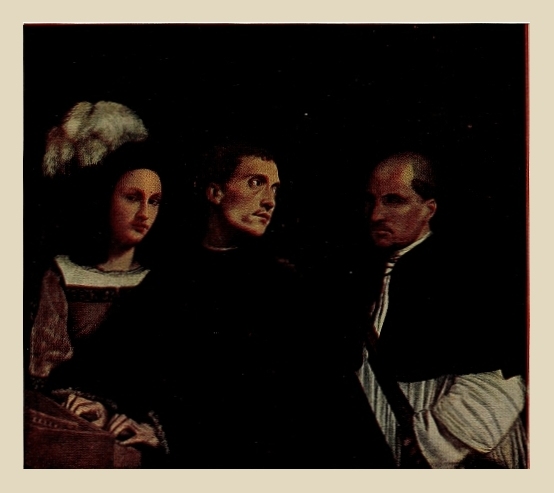
‘The Concert’.
After the painting by Giorgione (Pitti Palace).
II
The opera, then, had arrived. But, unaware of the fact, its so-called inventors, caught in the spell of antiquarian research, their imaginations transported by the glories of the classic past, turned their vision back to ancient Greece—to Athens, that prototype of their own city of Florence—where Æschylus unfolds before the eyes of his countrymen a spectacle worthy of the gods. They see no analogy in their madrigals and the dithyrambic chorus of the ancients, no parallel in their sacre rappresentazione to the Eleusynian mysteries and Bacchic festivals, but, rejecting all that has gone before, attempt to resurrect the magic power of music as an organic part of human speech, and the revival of the greatest product of classic genius—the Greek tragedy. Such was the purpose of the camerata, that genial circle of amateurs, literati and musicians which gathered at the house of Giovanni Bardi, count of Vernio, in Florence, one of those famous ‘academies’ which were the centres of the intellectual life of Italy in the sixteenth century.
Jacopo Peri, an erudite musician and a favorite singer; his younger colleague Giulio Caccini of Rome; the already familiar Emilio de’ Cavalieri, inspector-general of the artists in Florence; Luca Marenzio, the most eminent musician of the city, and Christoforo Malvezzi, all of whom had collaborated on the intermezzi to Bardi’s L’Amico fido in 1589, were, together with Jacopo Corsi, a wealthy and intelligent patron of music, and Vincenzo Galilei, father of the great astronomer, the chief members of the circle, besides the host. These men, liberal thinkers, modernists, literati rather than professional musicians, were out of sympathy with the pedants of the contrapuntal school, the ‘Goths’ against whom Galilei[130] had already published his diatribe in 1551. The Latin translations of Aristoxenus’, Ptolemy’s and Aristotle’s treatises on music, published in 1562, aroused their keenest interest and discussion, and their admiration of the plastic arts which had signalized the Renaissance in the preceding centuries now found an echo in their attempt to reconstruct a lost ideal. In 1585 the great Andrea Gabrieli had written choruses for the solemn performance of Œdipus Rex at Vincenza, and in 1589 Luca Marenzio wrote a ‘Combat of Apollo and the Dragon,’ drawing his inspiration from the descriptions of the Nomos Pythikos of the Greeks (see Chap. IV, p. 127). Convinced, despite the lack of examples, of the greater expressive power of Greek music with the employment of simpler means, Galilei, after long research with the aid of Bardi, now composed for a solo voice and instrumental accompaniment Dante’s ‘Lament of Ugolino,’ in the so-called stile rappresentativo, the representative style. His experiment proved suggestive if not altogether successful, and the task was next taken up by Caccini,[131] who, with probably more natural talent than Galilei, set himself to the composition of several canzone in the new style, a simple cantilena over a figured bass (see Chap. XI, p. 355) which provided a harmonious support to be executed by instruments (lute or theorbo). Endowed with a beautiful and well-cultivated voice, he achieved a genuine success among his sympathetic circle. To make sure of himself, however, he proceeded to Rome, where his new songs were applauded by an assemblage of connoisseurs. Thus encouraged, he appealed to his literary friends for verses in all metres, which he promptly set to music. Some years later (1601) these were published under the title La nuove musiche (‘The New Music’) with a remarkable preface, in which their author claims the merit for having originated the stile rappresentativo, and which contains so much technical information for singers that it may well be considered the first vocal method. Caccini’s arie were disseminated largely through his vocal pupils, for they adapted themselves admirably to the beautiful Italian style of singing of which he was one of the first masters. We may mention incidentally that his daughter, Septimia, became one of the famous singers of the period and aroused the admiration of Monteverdi. Her sister, Francesca, achieved distinction both as singer and composer.
Caccini, though he was probably the first to use and secure public acceptance of the arioso style, was—despite his own claims—not the originator of the true recitative. That distinction belongs to Jacopo Peri, a more learned musician though a less genial personality, who meantime had begun the application of the representative style to the drama.[132] Corsi, the successor of Bardi (now become papal chamberlain in Rome), as host and patron, was a close friend of the poet Ottavio Rinuccini (d. 1623). Both were familiar with the experiments of Cavalieri in the realm of dramatic music. After joint deliberation, the two appealed to Peri ‘to give a simple proof of the power of modern music’ by setting Rinuccini’s dramatic poem Dafne, a scene of which had already been experimented with by Bardi. ‘Remembering that it was a question of dramatic poetry and that the melody must at all times be modelled after the words,’ Peri concluded ‘that the ancients employed musical forms which, more elevated than ordinary speech yet less regularly designed than common song melodies, were half-way between the two.’ In an effort to forget every known style, he at first attempted to rediscover the diastematica of the Greeks, the quarter-tone interval, in the inflections of ordinary speech. According to his own testimony, he closely observed persons speaking, so that he might reproduce as naturally as possible their expressions, whether moderate or passionate. Thus he decided to have quiet expressions sung in half-spoken tones over a resting instrumental bass. In emotional moments, however, the voices proceeded in a more animated tempo and by larger intervals instead of strictly conjunct motion, while the accompaniment indulged in more frequently changing, and sometimes dissonant, harmonies. In other words, he used what we know to-day as recitative.
The importance of the principle thus introduced—the preference of expressive quality to purely musical effect—cannot be plain-song germ of romanticism itself lies in this departure, the elements of Gluck’s reform, of Wagner’s creed, repose in the assertion of Caccini that ‘one is always beautiful when one is expressive.’
Peri’s Dafne, after charming the circle of intimates, was performed at the house of Corsi one evening during the carnival of 1597, the composer singing the rôle of Apollo, in the presence of the Grand Duke Ferdinando de Medici, the cardinals dal Monte and Montalto, the poets Piero Strozzi and Francesco Cini and ‘a great number of gentlemen.’ ‘The pleasure and the stupor which seized the audience is inexpressible,’ said Gagliano later in the preface to his own Dafne. Every person there felt that he was in the presence of a new art. Spurred on by this victory, Rinuccini composed his Euridice for the festivities occasioned by the marriage of Maria de Medici to Henri IV, king of France, in 1600. Peri again wrote the music, though at the performance, which took place on October 6 at the Pitti palace, some of the numbers of Caccini’s version (composed after Peri’s) were substituted because of Caccini’s influence with the singers. The title rôle was sung by the famous Vittoria Archilei, ‘the Euterpe of Italy,’ while Peri himself impersonated Orpheus. The event not only aroused the greatest enthusiasm among the distinguished assemblage, but its echoes resounded through all the courts of Europe and tremendously stimulated interest in the new art.
The score of Euridice has been reprinted in Florence in 1863 and may be examined by the student. It consists of 48 small octavo pages of simple recitative dialogue written over a figured bass, interspersed with five-part choruses in predominatingly diatonic harmony. The preface indicates that the figured bass was executed by a clavier, a chitarrone, a lira grande and a large flute (in one place a triflauto—triple flute—is added), but it is not clear how the musicians managed to produce effective harmony without written-out parts. The impoverished quality of the music indicates a distinct retrogression from the contrapuntal compositions of the day, and vastly so when we consider the a capella style of Palestrina. Its striking novelty alone accounts for the extraordinary effect it had upon the hearers. Its value was not in its intrinsic quality but in the direction which it indicated, the path which was to lead to untold riches of sound.
Following closely upon the heels of Peri’s work came the setting of the same poem by Caccini, who had already produced Il rapimento di Caffalo (1597, performed 1600); Marco da Gagaliano (1575-1642) was already at work along similar lines and in 1608 produced his Dafne at Mantua—one year after Monteverdi’s ‘Orfeo’ which, however, marked so great an advance that it might have been written a generation later. Before discussing that master, it will be necessary to consider the utilization of the representative style in another field—that of the sacred drama or oratorio—by Emilio de’ Cavalieri,[133] whose dramatic essays in connection with Laura Guidicioni have already been mentioned.
The origin of the oratorio is twofold: the prose oratorio latino and the Italian oratorio volgare. The former is derived from the mediæval liturgical plays already spoken of, and the ‘mysteries’ and ‘moralities’ of the fifteenth century are clearly forerunners of it. The oratorio volgare, a didactic poem independent of scripture text, had its point of departure in the esercizii spirituali (scriptural lessons), instituted by the priest Filippo Neri (afterward canonized) at Rome. He became the founder of the congregation of Oratorians, which regularly met for Bible study under his leadership. On certain evenings of the week his sermons were preceded and followed either by a selection of popular hymns or by the dramatic rendering of a biblical scene. From the place in which these were first enacted, the oratory of the church of S. Maria in Vallicella, they received their name—Oratorio.
Just as the dramatic madrigal was built upon the style of the secular madrigal, so these sacred dramas probably modelled themselves after the ‘spiritual’ madrigal. While Peri and Caccini were still engaged in their experiments, Cavalieri, in 1600, staged in Neri’s oratory his most important creation La Rappresentazione di anima e di corpo, slightly antedating Peri’s Euridice. Like that work, it was written in ‘expressive’ style, of which Cavalieri may indeed have been the real originator. Cavalieri’s work belongs to the province of sacred opera, being the first of this important branch of the music drama, which is further represented by such works as Landis’ S. Alessio (1637) and Marazolli’s allegorical opera La Vita humana (1658). It is distinguished from the true non-scenic oratorio, which is associated with the artistic personality Carissimi. To show the distinction between his work and that of Florentines, however, we quote the criticism of his Il Satiro, by Giovanni Battista Doni, the historian of the Florentine monodists: ‘It must, however, be well understood,’ he says, ‘that these melodies are very different from those of to-day (seventeenth century) which are written in the stile recitativo; the others (of Cavalieri, etc.) are nothing but ariettas with all sorts of artifices and repetitions, echoes and other similar things, having nothing to do with the good and true dramatic music....’
On the other hand, Cavalieri’s own instructions show his wonderful practical knowledge in the performance of opera, and give us an exact idea of the first operatic theatre: ‘The hall should not hold more than a thousand spectators comfortably seated, in the greatest silence. Larger halls have bad acoustics: they make the singer force his voice and they kill expression. Moreover, when the words are not understood the music becomes tiresome. The number of instruments must be proportioned to the place of performance. The orchestra is invisible, hidden behind the drop. The instrumentation should change according to the emotion expressed. An overture, an instrumental and vocal introduction, are of good effect before the curtain rises. The ritornelle and sinfonie should be played by many instruments. A ballet, or better a singing ballet, should close the performance. The actor must seek to acquire absolute perfection in his voice, physique, gestures, bearing, and even his walk. He should sing with emotion—as it is written—not one passage like the other; and he must be careful to pronounce his words distinctly, so that he may be heard che siano intese. The chorus should not think they are excused from acting when they do not have to sing. They must feign to listen to what is going on; they must occasionally change their places, rise, sit down, make gestures. The performance should not exceed two hours.... Three acts suffice and one must be careful to infuse variety, not only into the music but also the poem, and even the costumes....’
‘Gluck and Wagner,’ says Romain Rolland, ‘have added little to these rules!’
III
The favolo in musica (it was not called opera as yet) had taken root; its first tender shoots, delectable morsels for a fastidious intellectual aristocracy, nurtured in the soil of princely patronage, had given evidence of hardihood. But it was an exotic, a hot-house plant, limited by its very nature to the homes of aristocracy: in order to flourish and grow to noble proportions it had to bathe in the sunlight of popular favor; it required the care of a master, a genius who substituted imagination for synthetic reason, intuition for experiment. That master was Monteverdi. If the works of Peri and Caccini smelt of the midnight oil, there coursed in his creations the red blood of humanity. If their music was ‘representative’ of the exact meaning of the word, attuned to the niceties of accent and inflection, his portrayed the gamut of human passions, the soul itself, even at times violating literary fidelity to reach that greater purpose. While they had ‘thrust upon them’ the honor of creating a new method of expression, he, the musical genius of a century, could deliberately choose between the old and the new—and he chose the new. ‘With him the new evolution began and the new edifice, hardly risen above the ground, became a magnificent monument. Well did he see what was lacking in the conception of the Florentines: he understood that to fight successfully against the resources of counterpoint new riches had to be brought, different but equally valuable. His prodigious inventive genius discovered them: he found them in harmony, in the expressive accent of the monodic chant and in the variety of instrumentation.’
Claudio Monteverdi (in old prints spelled Monteverde, though by himself as here) first saw the light of the world at Cremona, in May, 1567. His father was probably a physician, at any rate a man of culture, who provided for his children an education far above the average. Claudio gave early evidence of musical talent and was placed under the tutelage of Marc’ Antonio Ingegneri, the choirmaster of the cathedral and musical arbiter in Cremona, with whom he studied viola playing, singing and composition. Ingegneri was a composer of genius; his Responsoria, published anonymously, were for a long time ascribed to Palestrina, and, while worthy to be ranked with that composer’s, they contain harmonies and modulations foreign to his style.
Here, in the master’s originality we seem to find the explanation of his leniency toward his pupils’ vagaries, for Monteverdi from the first showed a most persistent tendency to break the rules of counterpoint. He first appears as composer at the age of sixteen, publishing in 1583 his Madrigali spirituali for four voices and in the following year his Canzonette a tre voci, which were full of irregularities and forbidden progressions. His first book of five-part madrigals was brought out in 1587 and it was evident that he was already reaching out for realms unknown, though perhaps not yet equal to the leap. An extraordinary addiction to dissonances, frequent use of the seventh in suspensions, and a number of unpleasant progressions characterize these otherwise beautiful madrigals, as well as the additional collections, printed in 1590, 1592 and 1603; but they nevertheless became popular, the last two going eventually through eight editions.
Meantime Monteverdi had become an able violist and aroused attention to his playing in high quarters. His virtuosity opened him the doors to the service of Duke Vincenzo di Gonzaga at Mantua, whither he went in 1590 as violist and singer. His modernist tendencies aroused the opposition of local musicians, which, already evident when he became maestro di capella in 1602, broke out openly as the madrigals of his fifth book, including the beautiful Cruda Amarilli, made their appearance. These drew the fire of Giovanni Maria Artusi, theoretician, and canonicus regulatis of S. Salvatore, who attacked him in a polemic, ‘On the Imperfections of Modern Music’ (1600), not mentioning his name, but quoting his newest compositions (still in MS.) as examples. The attack is so amusing, and its adherence to the perennial arguments of contemporary criticism so striking that we cannot refrain from quoting it in part.
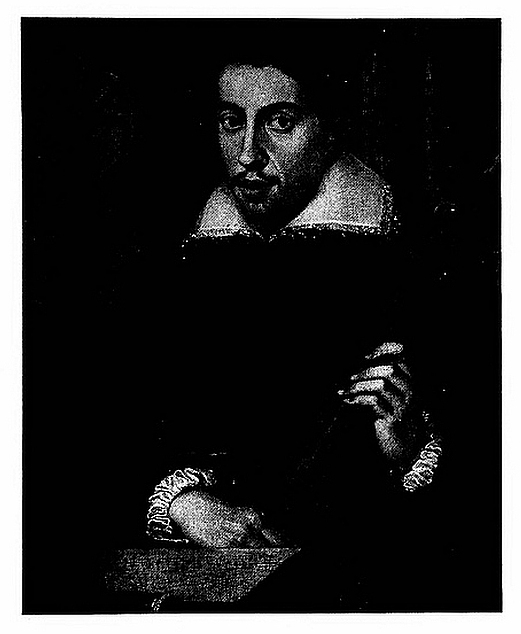
Claudio Monteverdi.
After a contemporaneous portrait (artist unknown).
‘Though I am glad to hear of a new manner of composition it would be more edifying to find in these madrigals reasonable passagi, but this kind of air-castles and chimeras deserves the severest reproof.’ Like all critics he cites the example of the masters: Palestrina, Porta, Merulo, Gabrieli, Gastode, Lasso, etc., whose works these ‘moderns’ should emulate, but instead ‘are content to concoct as great a noise as possible—a confused mixture of unrhyming things, and mountains of imperfections.’ ‘Behold, for instance,’ he cries, ‘the rough and uncouth passage in the third example (by Monteverdi). After a rest the bass attacks on a diminished fifth against the upper voice.’ Not after a consonance, mind you, as the masters have done, but after a rest—and, as for sevenths unprepared—preposterous!
Monteverdi had had the temerity not only to use the dominant seventh without ‘preparation’ according to the established rules, but to use other dissonances, diminished and secondary sevenths, ninths and elevenths in connection; he had introduced a freedom in the movement of voices and a sequence of chords the audacity of which still startles us to-day. ‘Modern! Certainly he is modern by these tokens,’ says Tiersot, after hearing the Paris revival of Orfeo. ‘But truly and spontaneously has he made his discoveries, they were so little searched for, that neither his contemporaries, nor his successors, perhaps not even himself, have understood their value; and it has taken us centuries to arrive at a true appreciation of their merit.’
Monteverdi replied to his critics (for the cry had been taken up by others and the argument developed into an open war) with the publication of his fifth book of madrigals, containing all the criticized compositions with not a note changed. He even travelled to Venice to supervise the printing so as to insure accuracy. In his preface he said that, having endeavored to express emotions hitherto unexpressed in music, it was necessary to invent new tone combinations. New harmonies, moreover, required new modulations. He insisted that more than one point of view is worthy of consideration and advised the cognoscenti to study further and learn ‘that the modern composer builds upon a foundation of truth.’ These madrigals reached eventually nine editions, were reprinted in Antwerp and Copenhagen and spread their composer’s fame throughout Europe.
Moreover, Monteverdi stood in high favor with his patron, a man of understanding who shared his ancestors’ leaning to lavish patronage of the arts. He accompanied Duke Vincenzo on his war expedition to Hungary, when in 1595 he supported Rudolph II against the Turks, and in 1599 went with him to Flanders, whence he brought a new style of composition, the canto alla francese, which he afterwards adopted in his Scherzi musicale a tre voci.
His domestic circumstances, however, were none too favorable. He had married in 1595 Claudia Cattaneo, the daughter of a violist and herself a singer at the ducal court, where her salary even exceeded Monteverdi’s meagre pay. She had borne him two sons and existence became more and more difficult. In 1607 she was taken seriously ill, and continued hardship and solicitude for his family spurred Monteverdi to complaint, but without result. His duties were most onerous, for besides directing the music at court he was obliged to participate in the church service and the many special performances which the duke’s love of festivities occasioned.
One of these occasions was the carnival of 1607, when Vincenzo, familiar with the successes of Peri and Caccini at Florence, determined to surpass them at Mantua, and intrusted the preparation of the work to Monteverdi. The result was the Favola di Orfeo, the text for which had been written by Alessandro Striggio, son of the famous madrigalist. It was performed, first in the Academia degl’Invaghite, and again, on February 24th, and March 1st, in the ducal theatre. Its success was enormous; the music aroused the most profound admiration, as did also the book, which, by order of the duke, was printed, so that the audience might follow it during the performance. As Orfeo is the only opera of Monteverdi preserved to us in its entirety, we may examine the score in Robert Eitner’s edition with modern notation and the figured bass harmonized, and so realize the tremendous advance it shows, over Caccini’s ‘Euridice,’ for instance (reprinted in the same publication).[134] The style of the recitative is similar, though it shows much greater fluency, the harmonies are beyond all comparison richer and more varied; dissonances, especially the diminished seventh, being used with great dramatic effect; suspensions and anticipations are particularly frequent and there are many daring chromatic modulations, such as from G# minor to G and from E♭ major to E, reminding of Wagner’s use of these same progressions. Instead of a simple figured bass we have in the instrumental numbers at least a completely worked-out harmonic structure, and for the first time instruments are used in definite combinations with respect to their various timbres. There is an agreeably varied sequence of toccata (overture), recitative, arioso, ritornelle, chorus and sinfonie (at ends of acts); in fact, we find in Orfeo all the elements of the later opera, from the instrumental introduction to the final movement, even though in small proportions and of modest pretentions. The ternary form, later so important, opens its way here and there, i. e. in the first movement of the second act. The great bravura aria is also represented and offers opportunity to the skillful singer to exhibit his technique. (Sometimes the vocal part appears in two ways; first in the simple unadorned form, and directly under it in elaborate coloratura arrangement, evidently leaving the choice to the singer.) The orchestra instruments play together only in the instrumental numbers; in the choruses they simply double the voice parts; but in accompanying the solo voices the composer has made use of a curious device of associating the tone quality of a certain instrument or group of instruments with each character. This is indicated in the table of characters, which at the same time shows the composition of Monteverdi’s orchestra:
CHARACTERS INSTRUMENTS
Music, prologue Two gravicembani (similar to spinets)
Orfeo Two bass viols
Euridice Ten violas
Chorus of nymphs and shepherds One double harp
Speranza Two small French violins
Caronte (Charon) Two chitaroni (zithers)
Chorus of infernal spirits Two organi di legno (small pipe organs)
Proserpina Three bassi da gamba (large viols)
Pluto Four trombones
Apollo One regale (reed organ)
Chorus of shepherds who dance the Moresca at the end Two cornets, a flute alla vigesima seconda; a clarino (small trumpet) and three muted trumpets
This recognition of a psychological correspondence between characters or situations and the timbre of instruments is interesting because it points the way to the dramatic utilization of orchestra color.
Directly after Orfeo, Monteverdi produced his Ballo delle Ingrate, a ballet scene in the manner of the usual intermezzi. The arduous labor and nervous strain incident to these performances forced upon him the necessity of a rest, which he spent in a visit to his father’s house at Cremona. There his wife, again stricken, died, and, plunged into grief, he himself succumbed to illness. His income reduced to his own earnings, he sent through his father an earnest appeal to the duke for greater emolument, and, that denied, a request to be released from further duty. But instead he was speedily summoned to return, in order to prepare a musical spectacle for the coming nuptials of the heir apparent, Don Francesco, and Margherita, infanta of Savoy. His financial condition was now slightly improved and, spurred by the prospect of greater fame, he plunged into the task of setting the music of a new opera, Arianna, for which Rinuccini had been commissioned to write the book. The work was to be staged on a scale far beyond anything attempted till then, the best singers available were engaged, and the rehearsals occupied five months. It is interesting to note that another opera, Tiede, by Cini and Peri, competed for the honor of the performance at these festivities, but was rejected in favor of Arianna. Peri was, however, commissioned to write the recitatives for Arianna.
The performance took place May 28th, 1608. The theatre, we are told by the official historian, Follino, was not large enough to accommodate all the nobles visiting in the train of foreign princes and the natives had to be denied admittance. While the play itself made a deep impression, in the music Monteverdi had surpassed himself. ‘The orchestra behind the scenes,’ continues Follino, ‘accompanied the beautiful voices throughout, following the character of the singing most faithfully. The lament of Arianna, abandoned by Theseus, was performed with great feeling and pictured so touchingly that all the auditors were profoundly stirred and not a lady’s eye remained tearless.’ This ‘Lament’ afterwards became one of the most popular pieces in Italy. After Cosimo II (de Medici) in 1613 obtained the score of Arianna from the duke and performed it in Florence it was said that the favorite selection was heard in every house that contained a clavicembalo or a lute.
The sumptuous ballet Idropica, for which Monteverdi composed the prologue, was produced during the same festivities. The succeeding period saw no diminution in the output of this indefatigable composer. In 1610 we see him in Rome suing for the favor of Clement VIII, to whom he presents his ecclesiastical compositions, which were, however, inferior to his secular works. In 1612 Duke Vincenzo died, and Monteverdi resigned his post to accept the most coveted musical office in Italy—that of choirmaster at St. Mark’s, Venice. His position there became the source of the greatest satisfaction to him, for, aside from the fact that he received three hundred ducats yearly, and after 1616 four hundred, while finally his total income increased to six hundred and fifty, he was honored and esteemed better even than his illustrious predecessors, Willaert, de Rore, Zarlino, etc. He enjoyed the title of maestro di capella to the republic, brought the music of St. Mark’s, where he had a choir of thirty singers and twenty instruments, to a high degree of perfection, superintended the chamber music of the city as well and earned the most general popular appreciation.
In 1621 he composed the music for a requiem in memory of Duke Cosimo II of Tuscany, and from Strozzi’s enthusiastic description it was a most gorgeous tone creation, better fitted for a theatre than a church. Similarly in 1631 he was called upon to provide the music for a great thanksgiving in St. Mark’s after the terrible plague raging through Italy, and responded with a mass, in the Gloria and Credo of which he introduced a trombone accompaniment. His creative power in the dramatic field remained unabated. Il Combattimento di Tancredi e Clorinda (half dramatic, half epic, with narrative testo, connecting the speeches), composed in 1624, was followed in 1627 by La finta pazza Licori (by Strozzi and Striggio) and five intermezzi for the marriage of Odoardo Farnese at Parma, and in 1630 by Proserpina rapita. The first public opera house in Venice, the Teatro di San Paolo, and soon after the Teatro S. Giovanni e Paolo, for which Monteverdi furnished L’Adone (1639), Le nozze di Enea con Lavinia (1641) and Il ritorno d’Ulisse in patria, which last is preserved. Thus, even in his last two years he was occupied on a series of operas, of which L’Incoronazione di Poppea (1642) was his last great effort. It might be added that his seventh book of madrigals had appeared in 1619 and his eighth, the famous Madrigali guerrieri et amorosi, in 1638.
In his Combattimento Monteverdi introduced a new effect, now familiar as the orchestral tremolo, which so startled the musicians that at first they refused to play it. His own explanation for its use is curious: ‘I have recognized,’ he says, ‘that our passions or emotions are expressed in three grades: anger (violence), temperate moderation, and humility or petition.... These three grades are clearly reflected in music, namely, in that of excited, tender, or moderate character (concitato, molle e temperato).’ Finding only the two last represented in the older music, he studied the question of spondeic and phyrric verse metre which the Greeks had transferred to music. Taking the semi-breve (whole note) for the unit of the former, he proposed to break it up into sixteen semicromes (sixteenths), which are to be played in succession upon one note to obtain the faster measure, which he calls concitato (tremolo).
This is but one instance of how Monteverdi constantly sought instructions from the ancients. In his letters of 1633 and 1634 he tells of his labors to rediscover human melody and the music of the passions. He had no one to guide him, and no books but Plato. The information which Galilei conveyed interested him, but he was careful not to be misled by the phantom of a lost art. He believed that in following his own principles he would be more true to classic thought than by trying to apply its formulas. He claimed that modern art has profited more from a study of Greek thought than from old-fashioned harmonic exercise. Thus the ancients had rendered to music the same service which the century before they had rendered to sculpture. They had taken it out of the studied formulas and had led artists back to the sole observation of nature. ‘Indeed, a real Renaissance opens at the beginning of the seventeenth century with Monteverdi—the Renaissance of the heart in the language of music.’
Monteverdi’s artistic creed and theories are to some extent perpetuated in his Selva morale e spirituale, dedicated to the Empress Eleonora Gonzaga, and published in 1640. Monteverdi died in Venice November 29, 1643, and was buried with great honors at the Chiesa dei Frari. With his death we see opera finally established in that place in the heart of the Italian people which it has held to this day. Others had already taken up the work, notably his pupil, Pietro Francesco Cavalli, whose genius burst upon the world in 1639 with his Nozze di Teti.
With the next generation the Florentine school divides into the new Venetian school founded by Giovanni Legrenzi (1635-1672), of which Antonio Lotti was to become the leader, and the Neapolitan, which found its guiding genius in Alessandro Scarlatti, one of the most conspicuous musical figures of the seventeenth century. From him and his teacher Francesco Provenzale (ca. 1669) there issued a long chain of masters and pupils—Francesco Durante (1684-1755); Leonardo Leo (1694-1744); Francesco Feo (1685-1740); Gaetano Greco (b. 1680), etc.—who developed the Italian opera in its narrowest sense—an opera that was purely vocal, whose chief aim was the production of beautiful melody and which paid a minimum of attention to orchestration and dramatic pathos. It was a purely musical school, and even more than that of Venice removed from the ideal of the Florentines. Against this school were ultimately to be directed the reforms of Gluck, whose theories are solidly founded upon the creed of Florence. Florence, then, is the true cradle of opera, also in its more modern sense, for the precepts there laid down have remained valid even to Wagner and the music drama of to-day.
C. S.
FOOTNOTES: