DESIGNS, LACE ARTICLES, EDGINGS, INSERTIONS, ETC., IN MODERN LACE.
Reading edition
Of necessity, most of the designs and specimens given on this and the following pages are smaller than the articles they represent, but they afford a correct idea of the method of making and the beauty of Modern Lace, and also its adaptability to dainty accessories of the toilet and the household. As before mentioned any design desired can be obtained from any lace-making establishment in any size, width or shape, according to the requirements of the article or lace to be made, and individual taste. Ingenious students will no doubt be able to adapt for themselves the designs offered, but it is not advisable for those who have no talent in the matter of drawing or designing to undertake an elaborate adaptation, though they may easily accomplish a simple one. Besides, a professional designer will furnish the design for a moderate sum, perfectly outlined upon tracing cloth, with ink, and with the proper filling-in stitches perfectly delineated; and if the student wishes it, will select the thread and braid appropriate for the design; or the student may select the braid she fancies, and the designer will then select the thread suitable for the braid.
No. 1. DESIGN FOR A LACE HANDKERCHIEF.
This design is suitable for point lace braid, but is of course very much reduced in size, in order to show the effect and arrangement of a design ready for working, as sent out from the lace-maker's. By a reference to the various stitches illustrated on preceding pages, the stitches shown in one corner of the design may be readily identified. The following engraving shows how braid is applied to a design before the stitches are begun.
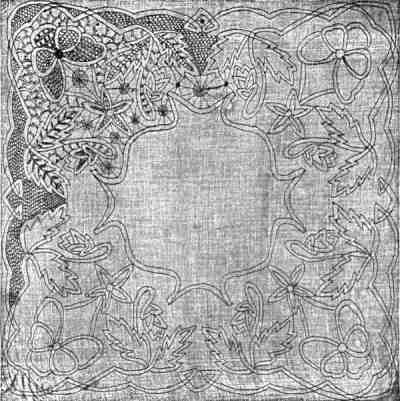
No. 1.—Design for a Lace Handkerchief.
No. 2. METHOD OF PLACING BRAID UPON DESIGNS.
This illustration shows the method of arranging braid upon designs for modern lace, and how, after the braid is basted along the pattern, the tracing cloth is basted to toile cirée or to smooth, light brown wrapping paper to provide sufficient firmness for working.
The following instructions apply particularly to engraving No. 2, but their principle should be observed and applied to any design decided upon, as good results in lace-making largely depend upon the arrangement of the braid.
Run on a straight line of braid for the lower edge, with fine stitches, working as shown, from left to right. Take another piece of braid, or the other end of the same piece, and begin to lay the braid by "running" stitches in its center, keeping it as smooth and even as possible. The outer edge presents no difficulty, but the inner edge will not lie evenly without being drawn in by a needle and thread, as follows: Fasten whipping thread securely, and insert the needle in and out of the edge of the braid, as if for fine gathering; this thread when drawn up will keep the braid in its place. Two or three fastening-off stitches should be worked when each circle, half circle, or rounded curve of a pattern is finished, as the drawing or gathering thread remains in the work, and forms an important, though unseen, part of its structure.
Before cutting off the braid run a few stitches across it to prevent it from widening. Joins should be avoided, but when a join is indispensable, stitch the braid together, open and turn back the ends, and stitch each portion down separately. When passing the thread from one part to another, run it along the center of the braid, allowing the stitches to show as little as possible. In commencing, make a few stitches, leaving the end of the thread on the wrong side and cutting it off afterwards. In fastening off, make a tight button-hole stitch, run in three stitches, bring the needle out at the back, and cut off.
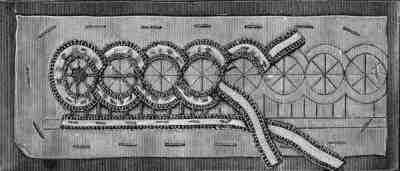
No. 2.—Method of Placing Braid upon Designs.
No. 3. ROYAL BATTENBURG LACE BUREAU-SCARF.
The engraving on the opposite page represents the article above mentioned, and shows the effectiveness of this magnificent and durable lace. In actual size the scarf is about a yard and one-half long and one-half yard wide, and is made of a heavy Battenburg braid, having a fancy edge (See Nos. 5 or 7, on page 20) and cord, rings and buttons. The main part of the design is outlined with the braid, cord is used as a veining for the leaves, and the rings and buttons are introduced here and there over the surface, as seen in the picture. Raleigh bars with picots connect the border and center designs, while the palms along the border as well as other small spaces are filled in with point Turque and point de Grecque stitches. Sorrento bars are also used in some of the long leaf-like spaces, while in a few of the circular spaces point d'Angleterre rosettes are introduced. These rosettes are also frequently called "spiders," and are made, according to the space, large or small; and according to the requirements of the braid selected, heavy or light.
For convenience in giving the name of this lace, the full title is rarely used—"Battenburg Lace" being considered sufficient to identify the fabric from the other and lighter laces.
Battenburg lace is made both heavy and light, according to personal taste or the object for which the lace is intended, but it was originally designed for heavy work only.
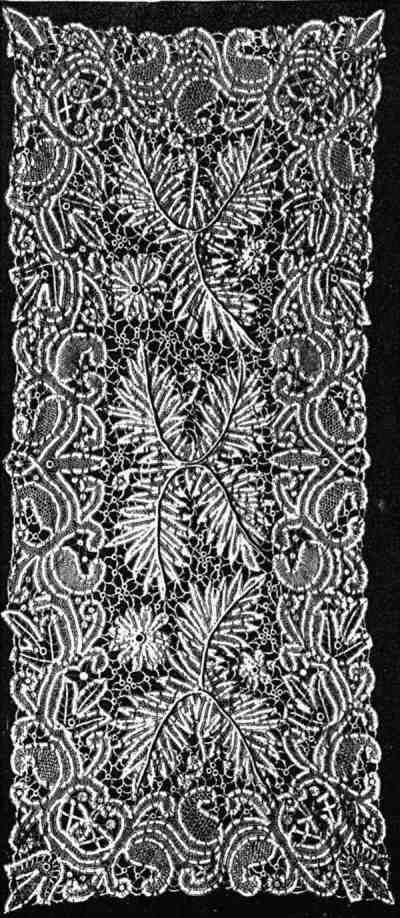
No. 3.—Royal Battenburg Lace Bureau-scarf.
No. 4. POINT LACE DOILY FOR A TOILET CUSHION.
This dainty doily may be made of the point lace braids illustrated at Nos. 30 and 31, together with the picot edging No. 36, seen on page 20. In filling in the spaces, thread suitable for the braid is used, and the stitches are point de Valenciennes, point d'Espagne, Sorrento bars, point de Bruxelles, open rings and "spiders." As all of these stitches, with many others are illustrated in that section of this book devoted to stitches, it will be unnecessary to repeat the details for making, as they are fully given in the department mentioned. It will also be understood that most of the articles illustrated are not of full size, but in some instances are nearly so. The doily just described is illustrated about three-quarters of its actual size; but by using a fine braid a doily of fairy-like texture, and just the size of the engraving may be produced. Any one accustomed to drawing may enlarge this or any of the designs given, but only clever fingers should try this experiment.
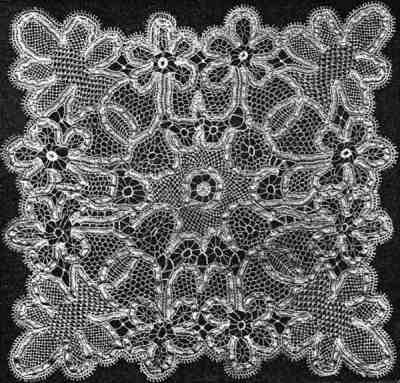
No. 4.—Point Lace Doily for a Toilet Cushion.
No. 5. BATTENBURG EDGING, WITH CORD.
This is a very elegant looking lace, though simply made after the regular Battenburg method. A plain braid (No. 10, page 20) is chosen to form the outlines, and after the stitches are filled in, cord of a suitable size is carried around the petals and foliage of the design, and rows of it are also used to indicate the vine, though the latter may be outlined with the tape and then with the cord. The petals of the blossoms are filled in in point de Bruxelles and point de Venise stitches, while point d'Espagne and point Brabançon are used for the foliage and vine. Point Grecque and d'Alençon bars are also used at the very heart of the blossom, and Raleigh net-work bars connect the design to the edge and are dotted here and there with "spiders."
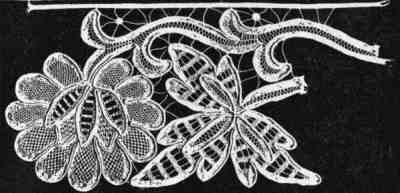
No. 5.—Battenburg Lace, with Cord.
No. 6. BATTENBURG INSERTION, WITH CORD.
This insertion matches the edging or lace above described, and is, therefore, made in exactly the same way, except that the design is double. Both the edging and insertion may be made of any width desired; and the design will be found very pretty for fancy-edge or plain braids without the cord. Buttons or rings may be used in place of the "spiders" seen in the engravings if preferred.
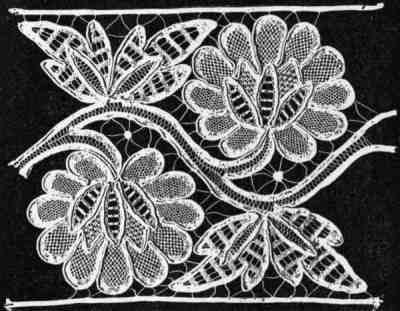
No. 6.—Battenburg Insertion, with Cord.
No. 7. DESIGN FOR A HONITON LACE CAP.
The design illustrated is, of necessity, much smaller than the cap it is intended for; but the clever student may easily enlarge it to, or design one for herself of the size required. Lace-makers will duplicate designs in any size desired for a moderate sum, thus saving the amateur much work and at the same time putting her to little expense.
The design here illustrated might also be used for handkerchief corners, scarf-ends, etc., etc.; and any of the stitches illustrated on preceding pages may be selected for filling-in purposes.
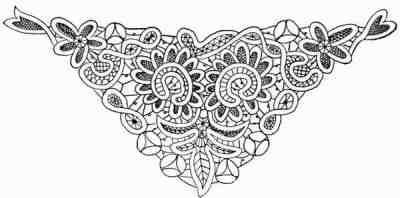
No. 7.—Design for a Honiton Lace Cap.
No. 8. DESIGN FOR A CORNER IN BATTENBURG, POINT, OR HONITON LACE.
According to the article to be decorated, this design will be found appropriate for either of the braids used for the laces above mentioned.
For table scarfs, tidies, heavy borders, etc., etc., the Battenburg braids should be selected; but for handkerchiefs or doilies, the point or Honiton braids are the proper ones to choose for this design.
Raleigh bars, Brussels point and any other stitches preferred, may be used in filling in the spaces. When a design is procured from a lace-maker a portion of it is always marked with the stitches to be used; but this is not an arbitrary matter, since the one who is to make the lace, may desire to and may insert other stitches in preference to those indicated.
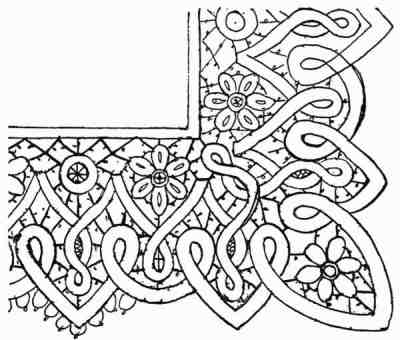
No. 8.—Design for a Corner in Battenburg, Point, or Honiton Lace.
No. 9. DOILY IN "IDEAL HONITON" LACE-WORK AND LINEN LAWN.
One of the prettiest and the very newest of the modern laces is here illustrated. It is made of two of the many varieties of Honiton braids, wash-silk floss and linen lawn. The braid is basted smoothly upon a square of lawn in the design illustrated (though individual taste will no doubt suggest many other equally pretty designs), after which the inner edges of the braid are permanently secured by a "short and long stitch." This is merely a short and long button-hole stitch reversed so that the cross loops are on the edge of the braid, while the stitches them selves extend beyond the braid, into the lawn, as seen in the engraving. Two short stitches alternate with single long ones throughout this part of the work. The outer edges are then fastened to the square by tiny button-hole scollops. Then the lawn is cut from under the squares formed by the braid, and the openings are button-holed through the lawn and braid so that the edges of the lawn will not fray. When this is done the spaces are filled in with fancy stitches, and when they are completed the lawn is cut away from the edge-scollops with a pair of fine sharp, scissors. In the doily illustrated "spiders" and point de Venise stitches are used for filling in the spaces. The floss used may be white or tinted, the latter washing as well as the white; but as a rule, white or yellow flosses are selected in preference to other colors. "Ideal Honiton" scarfs, tidies, doilies, pillow shams, tray cloths, etc., etc., may be purchased with the braid already basted on in a pretty design and with the necessary threads or floss, or they may be designed at home, and by either method will result in a beautiful variety of modern lace.
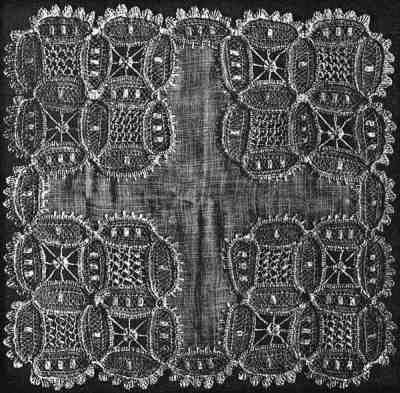
No. 9.—Doily of "Ideal Honiton" Lace and Linen Lawn.
No. 10. DESIGN FOR A CORNER IN BATTENBURG LACE.
Although this design is intended for Battenburg lace, and may be made up of any of the braids used for that kind of lace, it will also be found suitable for the finer point or Honiton braids for handkerchiefs, doilies, mats, etc., etc. As illustrated it would be suitable for a handkerchief. Enlarged and followed in Battenburg braid it would make a very handsome border for a table-scarf, curtains or draperies, or a substantial decoration for a gown of wash fabric or other goods. Raleigh bars, "spiders" and point de Bruxelles stitches are used for filling in, and a dainty picot edge is sewed to the outer line of the braid. Plain or fancy braid may be used for this design. If fancy loop-edge braid is selected, the picot edge will not be needed, the loops taking its place.
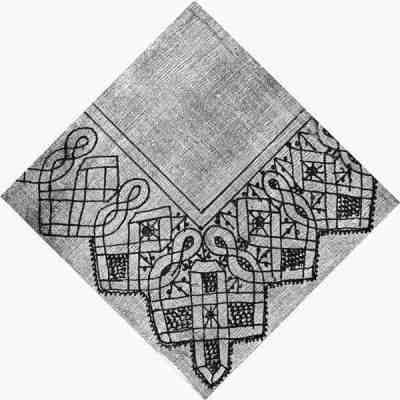
No. 10.—Design for a Corner in Battenburg Lace.
No. 11. BATTENBURG EDGING.
The edging here illustrated is represented about one-third less than its actual width, but the design is so distinctly brought out that its beauty in any width may be readily conceived. It is formed of fancy Battenburg braid, but may be made from a plain variety if preferred. The design is known as the fern leaf and is easy to follow. Sorrento bars are used to connect the work, and "spiders" are made here and there to add variety to the work. Point de Bruxelles stitches are used to fill in the spaces at the sides of the leaves, and, with the fancy braid, produce a very dainty, delicate effect.
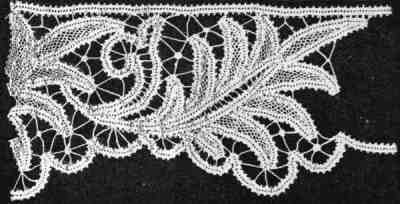
No. 11.—Battenburg Edging.
No. 12. BATTENBURG INSERTION.
This insertion is made to match the edging seen above it, but is much wider than the edging, though formed of the same braid. Either design could be varied so as to result in an edging and insertion of equal width, or the edging could be arranged for an insertion, and the insertion illustrated changed into an edging.
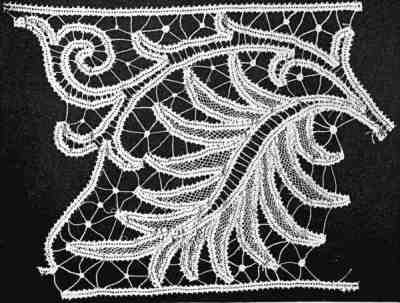
No. 12.—Battenburg Insertion.
No. 13. FINGER-BOWL DOILY OF PRINCESS LACE AND LINEN LAWN.
Princess lace, (also known as Duchesse lace) as elsewhere mentioned, results from combining Honiton and point lace braids in one design; and a charming specimen of this lovely lace is here illustrated.
The doily is pictured only a trifle smaller than its actual size, and even in its full size is a very dainty affair. After the braids are basted along the design, they are then connected by twisted bars that are an adaptation from the point d'Alençon bars with the twisted stitch; and the spaces are filled in in small d'Angleterre rosettes or "spiders." As few bars as possible are employed for the spiders, in order to produce a very delicate effect. The lawn center is added last.
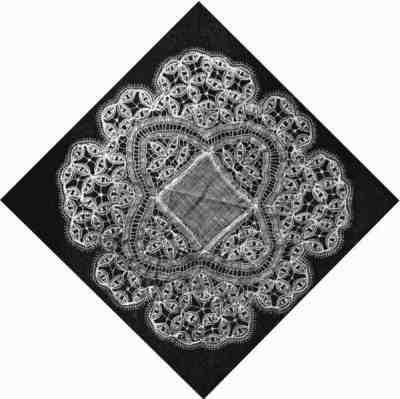
No. 13.—Finger-Bowl Doily of Princess Lace and Linen Lawn.
No. 14. DESIGN FOR INSERTION, OR A CENTER-PIECE, IN BATTENBURG LACE.
As suggested by the title, the design here presented may be used for insertion, or for a center to a table cloth or scarf, or a handsome spread. As represented it is intended for a center-piece, and the lace from which the engraving was made is about half-a-yard long and one-fourth of a yard wide. The ground-work is formed of Raleigh bars made with picots, and the loops of braid are filled in with twisted point d'Alençon bars.
This center-piece is very pretty made of ribbon with silk thread for the bars, and in this event it may be made of any color desired, and added to a spread or scarf of Surah silk or fine cloth, for which a border to match may be made.
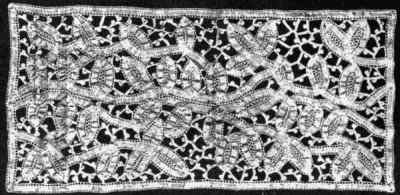
No. 14.—Design for Insertion, or a Center-piece, in Battenburg Lace.
No. 15. QUEEN ANNE TRAY-CLOTH OF BATTENBURG LACE AND LINEN.
This pretty cloth is intended for a Queen Anne tray, and its lace edges curve upward and just over the rim of the tray when it is laid upon it. The center is of fine table-linen, while the edge is formed of Battenburg braid, buttons and fancy stitches. As will be seen, the corner spaces are filled in with point d'Angleterre rosettes or "spiders," the large border spaces and corresponding corner ones are filled in with picot bars, while the very fine work seen in the triangles and square spaces are point de Venise stitches, and half-spiders are made in the other triangles. The narrow, straight inner border is composed of bars and tiny buttons arranged as represented. The cloth is hem-stitched before the braid is laid on, and the corners are cut out from underneath after the work is otherwise completed.
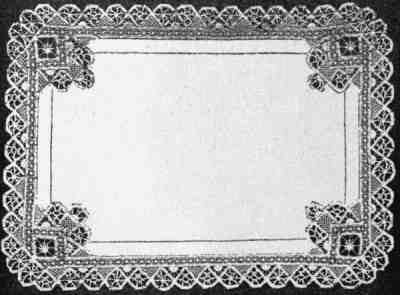
No. 15.—Queen Anne Tray-Cloth of Battenburg Lace and Linen.
No. 16. DESIGN FOR A BUTTERFLY IN POINT LACE. (FULL SIZE).
Butterflies for the corners of handkerchiefs, scarf-ends and the points of caps or coiffures are favorite designs in point and Honiton laces. The one illustrated is very dainty and exceedingly simple to execute. The upper portion of each wing has a point de reprise ground-work, but the solid sections are tiny spiders instead of point de reprise triangles. The outer tips of the wings are filled in with Raleigh bars, while similar bars, point de Bruxelles stitches and a point d'Angleterre rosette complete the lower wings. Any of the fine point or Honiton braids may be chosen for the outlining of the butterfly, and a fine over-and-over stitch or fine cord may be used to mark the lines extending from the head.
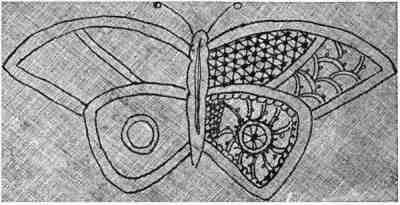
No. 16.—Design for a Butterfly in Point Lace. (Full Size).
No. 17. DESIGN FOR A DOILY OR HANDKERCHIEF OF POINT OR HONITON LACE.
This design, as illustrated, is of course too small for either a doily or handkerchief, but an expert lace-maker can enlarge it to any size desired; and the clever amateur will find no difficulty in doing the same thing, as the outlines are not at all intricate, and may be easily followed. In sending for the braid for this, or similar designs, it is advisable to permit the lace-maker addressed to select them, and of course, the thread, since her long experience enables her at once to correctly judge what materials are appropriate for the articles you wish to make, especially if she knows the size the article is desired to be. The stitches, as here indicated, are point d'Angleterre rosettes, and point de fillet, with small "spiders" on the latter. A dainty picot-braid edges the design.
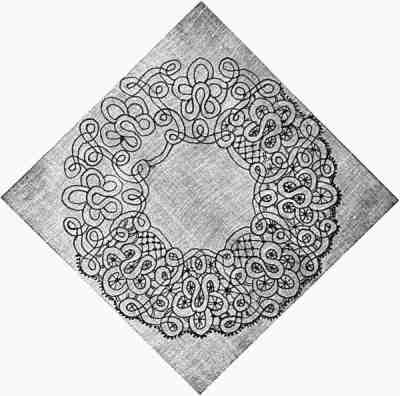
No. 17.—Design for a Doily or Handkerchief of Point or Honiton Lace. (Half Size.)
No. 18. "CARDINAL'S POINT" LACE.
This engraving represents a modern adaptation of an ancient lace which may be made of fancy Battenburg braid and plain Raleigh bars. The design is not especially definite in its outlines, and may be imitated with any variations which may seem pleasing to the copyist. The picots are made after the method directed at the illustration of point de Venise bars in the department devoted to stitches. "Cardinal's point" of genuine make is of Italian origin, and in the earlier eras, was largely used for the decoration of church vestments and draperies.
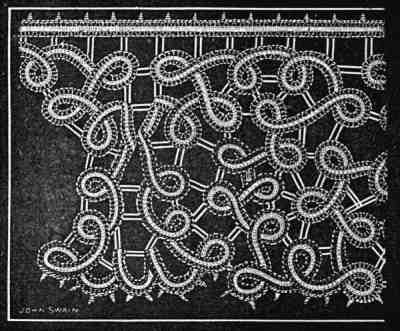
No. 18.—"Cardinal's Point" Lace.
Nos. 19 and 20. BATTENBURG EDGING AND INSERTION, WITH CORD.
These two engravings show a very pretty design for Battenburg lace made with a cord finish. The application of the cord has been fully described elsewhere, where a different design of the same kind of work is given. In the present instance the spaces are filled in with twisted bars, "spiders" and rosettes in point d'Angleterre. The specimens from which the engravings were made are a trifle wider than seen in the pictures; but the width is a matter of individual taste, and also a result of the braid selected. A professional lace-maker will enlarge or adapt the design to accord with personal requirements.
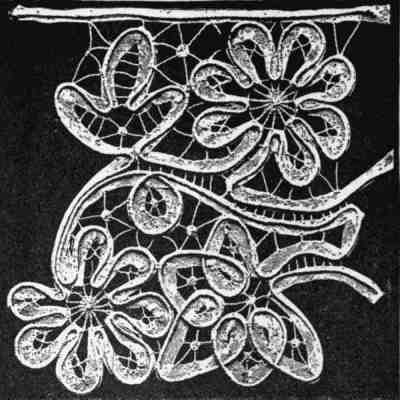
No. 19.—Battenburg Edging, with Cord.
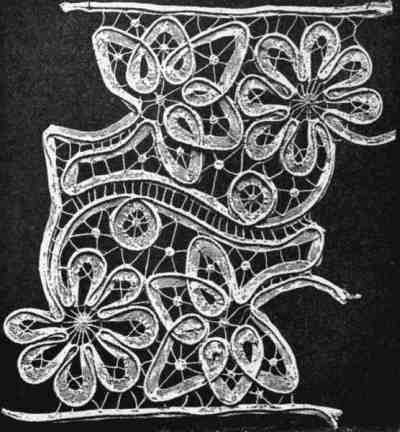
No. 20.—Battenburg Insertion, with Cord.
No. 21. TAPE-GUIPURE DESIGN, FOUND IN AN OLD CHURCH.
The design here illustrated was found in the old church of Santa Margherita, in Italy. It was drawn on parchment, and was undoubtedly intended as a design for altar lace. It was mentioned in a book of accounts for the year 1592, found in the archives of the church designated and is therefore of antique origin; but it may be easily adapted to modern methods of lace-making, and could be appropriately filled in with either Italian or Genoa lace stitches or with a combination of both, and twisted bars. Done with fancy Battenburg braid, it would be quite similar in effect to the "Cardinal's Point" illustrated on another page.
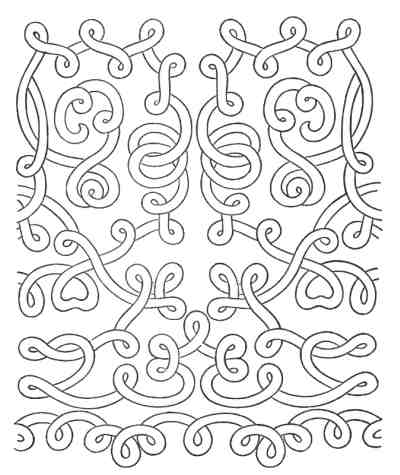
No. 21.—Tape-Guipure Design, found in an Old Church.
No. 22. BATTENBURG CHURCH LACE.
The engraving opposite illustrates a magnificent specimen of Modern Church Lace made of Battenburg braid with a limited introduction of Honiton braid. The specimen itself is considerably wider than represented, but as the width is a matter of individual taste, the engraving will serve as a design for a narrow church lace.
Sorrento bars are used to connect the braids and to form foundations for the spiders or rosettes here and there inserted, and the lace is delicately bordered with a dainty picot-braid. The fancy stitches in the main portions of the cross are point de Valenciennes, while those in the minor sections are point de Bruxelles.
Point de fillet is used for the central portion of the large T-shaped symbol, while the stitch forming the other symbol is one never used except for church lace, and consists of two or three sets of fine stitches so interlaced as to seem to form one solid stitch.
In making church lace any insignia desired can be introduced by a professional designer—an accomplishment that is usually beyond the inventive powers of the novice in lace-making.
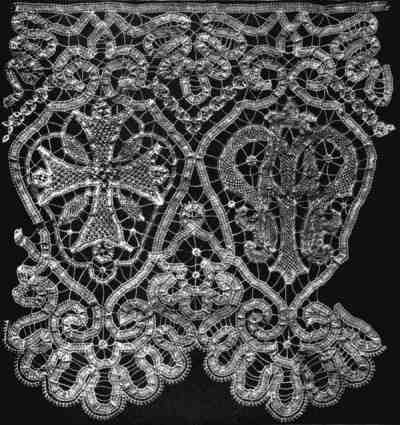
No. 22.—Battenburg Church Lace.
No. 23. ENGLISH NEEDLE-POINT.
This is a very handsome design combining the lily and the rose. The foundation work is made with unbleached linen braid having an ornamental edge, and the filling-in is done with fine and coarse linen thread in various stitches. Raleigh bars with picots define the upper edge of the edging, and Sorrento bars on which buttons are worked form the ground work.
Point de Grecque, point d'Angleterre, d'Alençon bars plain and twisted, point de Bruxelles and "spiders" are also used in making this lace, as will be seen from a close inspection of the engraving.
This specimen of lace is very handsome when developed in black silk braids and silk thread, for black costumes.
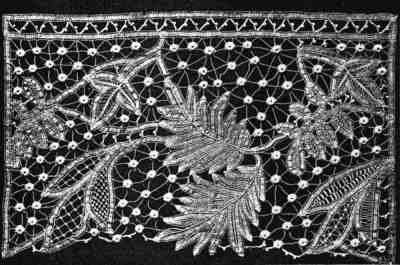
No. 23.—English Needle Point.
No. 24. PUNCH-GLASS DOILY OF POINT LACE AND LAWN.
As represented this doily is about three-fourths of its actual size. It is made of fine linen lawn, and a set generally comprises a dozen. Fine point lace braid is used to outline the design, and then rosettes in point d'Angleterre, and "spiders" or small rosettes are made in the openings as represented. The alternate outer scallops are filled in with point de Bruxelles stitches, and a dainty picot-braid is added to the edge by the usual over-and-over stitch.
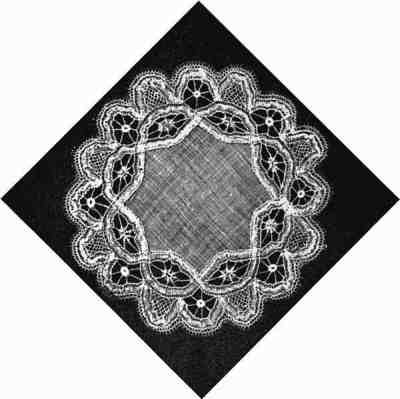
No. 24.—Punch-Glass Doily of Point Lace and Lawn.
No. 25. POINT LACE COLLAR AND CUFF.
A very handsome point lace set is here illustrated, and may be easily followed by an expert lace-maker; but it will be wiser for the novice to obtain a pattern or design of the shape and size desired, from a professional lace-maker. Point de Grecque, point de Bruxelles, point de Venise, Sorrento bars, and rosettes and rings are all employed in carrying out this design. As elsewhere mentioned, any fine stitch preferred may be used for filling-in purposes when those suggested or marked out upon a design are not admired.
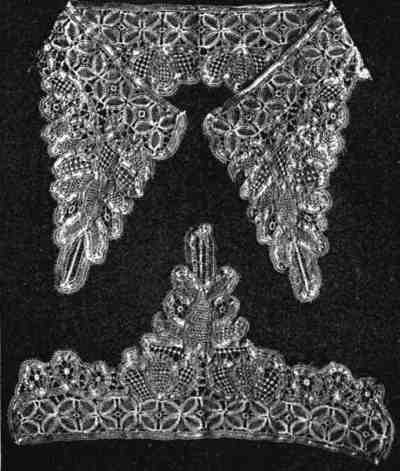
No. 25.—Point Lace Collar and Cuff.
No. 26. DESIGN FOR TABLE SCARF IN BATTENBURG LACE.
The scarf-end from which this design was copied is about ten inches deep, and it is about fourteen or fifteen inches wide. It will be seen from these dimensions, that it is impossible to produce a full-size design of it on these pages, but one of any size desired may be obtained at any lace-makers; or, a clever student of lace-making may enlarge the design to suit her own requirements. According to the size of the scarf-end, wide or narrow braid must be selected, with thread to correspond. The stitches used in filling in are point de fillet, point de Bruxelles and point d'Angleterre, and Raleigh, Sorrento and d'Alençon bars, and rosettes and "spiders."
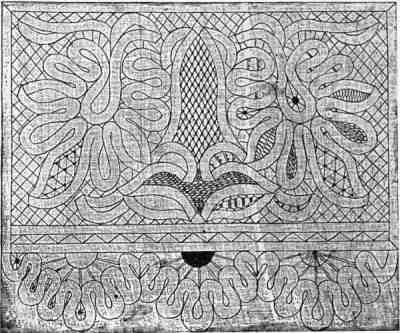
No. 26.—Design for a Table Scarf in Battenburg Lace.
No. 27. APPLE DESIGN FOR A CORNER IN BATTENBURG LACE.
This design is for the corner of a scarf, spread, tidy or pillow-sham and is very popular, as it is effective though simply made. The fine stitches are point de Bruxelles, while the others are Raleigh, Sorrento and point Grecque bars. Plain or fancy braid, or a combination of both may be used in this design with a charming effect.
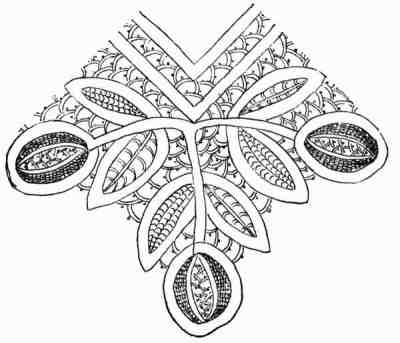
No. 27.—Apple Design for a Corner in Battenburg Lace.
No. 28. ROMAN PUNCH-GLASS DOILY IN POINT LACE.
Doilies of this description are generally made about four inches square. The engraving opposite pictures the doily mentioned as somewhat smaller, but the design is sufficiently large to enable the student to make her doilies as large as she desires them to be, as it is easy to follow. The corner spaces are filled in with twisted bars and rings worked at the same time; but rosettes or spiders may be worked in place of the rings if preferred. The corner spaces are filled in in point Brabançon, and for those at each side point de Bruxelles is used. The doily is edged with a fine picot-braid that finishes it daintily, and very sheer linen lawn is used for the center.
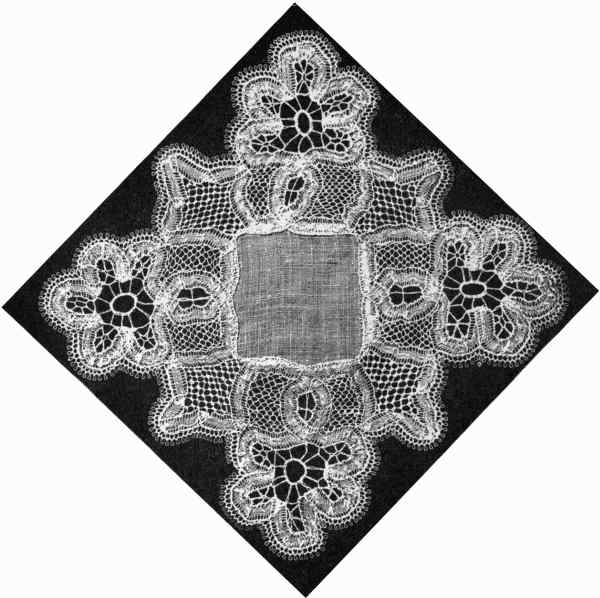
No. 28.—Roman Punch-Glass Doily in Point Lace.
No. 29. MODERN RUSSIAN LACE.
The design illustrated may be followed in Battenburg braid or plain lace tape, and any of the fancy stitches mentioned and described among the rosettes, bars and picots may be employed for filling-in purposes. Cream white or unbleached braids or tapes are prettier for Russian lace than pure white. Russian lace is a very durable as well as effective trimming for household draperies, and also for gowns of wash fabrics or those of cotton fabrics which will not need renovating.
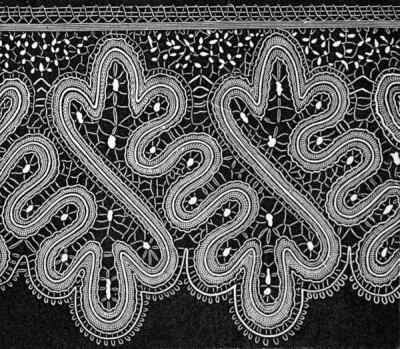
No. 29.—Modern Russian Lace.
No. 30. RUSSIAN LACE.
This engraving represents a specimen of genuine Russian lace made of fine braid, and wrought with bars similar to Raleigh bars, except that they have no picots. The Russians have always been noted for their exquisite needle-work, but as a nation they have never had any established lace manufactory. The workers of the small amount of lace produced are scattered about at their own houses, and many of them are poor ladies of gentle birth. Most of the laces, however, are made by the peasantry, who bring them to St. Petersburg where sale for them is found.
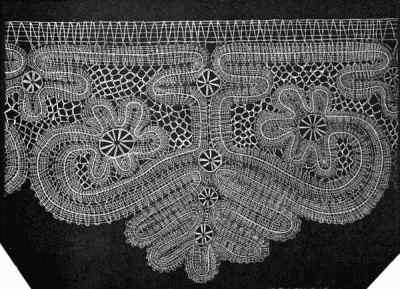
No. 30.—Russian Lace.
No. 31. BOW-KNOT DESIGN FOR MODERN LACE.
This fashionable design may be developed in various widths and braids as an insertion, or as an appliqué on lawn. The ground-work may be formed of Raleigh bars, or of twisted bars made like the net-work for Raleigh bars. The loops of the bows may be filled in with point de Bruxelles or any fine stitch preferred. The design is pretty for bordering table scarfs, tidies, valances and curtains when heavy braids are selected. The finer braids render the design appropriate for handkerchiefs and dainty trimming laces.
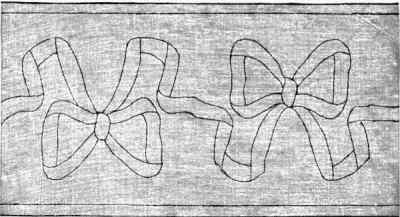
No. 31.—Bow-Knot Design for Modern Lace.
No. 32. PRINCESS LACE DOILY DESIGN.
The design here illustrated may be enlarged or simplified to please individual taste, and it may be made of Honiton braid as well as point. The connecting stitches may be point de Bruxelles, Raleigh and Sorrento bars, "spiders" or any of the fine stitches described and illustrated in the department devoted to stitches. A dainty picot braid follows the outer edge of the doily. This design, enlarged sufficiently, would form an elegant pattern for a lace handkerchief.
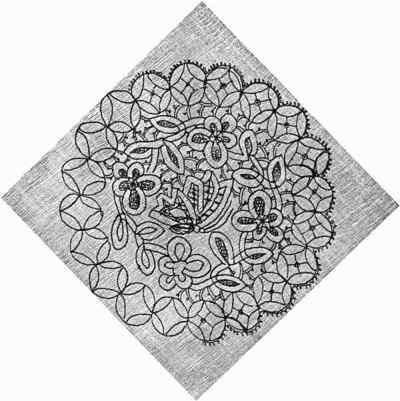
No. 32.—Princess Lace Doily Design.
No. 33. ALTAR LACE (BATTENBURG).
This very elegant specimen of altar lace is, in reality, about nine or ten inches deep; but, for want of space the engraving represents it as only about half as wide. The design, however, is perfect in detail, and the illustration fully displays its effectiveness, and discloses the variety of connecting and filling-in stitches used. A delicate Battenburg braid is chosen for the foundation, and in addition to regular lace stitches, those from drawn work are here and there interspersed. The cross is filled in in point de Venise, (or side stitch as it is sometimes called), and the same stitch is seen in the central design at each side of the cross. Drawn-work effects are seen also in these central figures and along the borders. Sorrento bars are here made and knotted at the center like drawn strands, or are connected by rosettes or "spiders" made in drawn-work style. At the center of the cross is a large drawn-work wheel, while small Maltese crosses and half-crosses are made elsewhere in the work by the drawn-work method, Sorrento bars taking the place of the usual strands. The central section of the border at the right of the cross is done in point de Bruxelles which is afterward button-holed as in bar-work, and a button-hole picot edge follows the lower outlines of the pattern. Raleigh bars with picots form the connecting ground-work throughout the work. This beautiful specimen shows two distinct methods of filling in the sections between the crosses. Either may be used alone, or the two may be used alternately with the crosses.
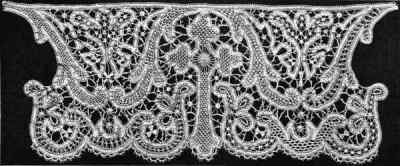
No. 33.—Altar Lace (Battenburg.)
No. 34. BATTENBURG OR POINT LACE COLLAR AND CUFF.
These engravings represent a very graceful design for a lace collar and cuffs. As suggested in the title, the set may be made of point or Battenburg braid. The leaf-points are all filled in with d'Alençon bars in the twisted stitch, while the centers are completed with rosettes or small open "spiders," and the latter are distributed elsewhere as will be seen by inspecting the engraving. Point de Grecque is also introduced into some of the spaces, and Raleigh bars are used for the ground-work. Any of the stitches previously described may be used in making such a collar if those mentioned are not admired; and the addition of buttons or rings will improve the work greatly.
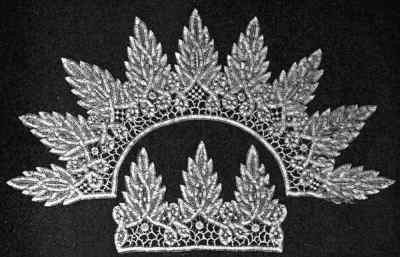
No. 34.—Battenburg or Point Lace Collar and Cuff.
No. 35. FLOUNCE IN BATTENBURG LACE.
A very elegant flounce of Battenburg lace may be made after the design represented on the opposite page. The picture shows the flounce just one-half its actual width; but even this width would be very handsome as a band for the bottom of a dress. By a close inspection of the stitches seen and a reference to these illustrated in the department devoted to stitches, the various kinds here used may be easily identified. They consist of point de Venise, point de Bruxelles, Sorrento and d'Alençon bars and "spiders." A fine picot braid edges each side of the flounce. The design can be obtained in any width desired from a reliable lace-maker.
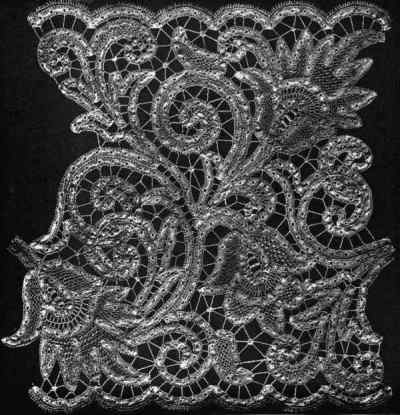
No. 35.—Flounce in Battenburg Lace (One-Half the Actual Width).
No. 36. BUTTERFLY DESIGN FOR POINT LACE.
This design is for point lace braid, and is very easily made. Fancy bars made after an adaptation from the d'Alençon bars, and point de Venise stitches are used for filling in. The butterfly may be used as a portion of an edging design, or as a corner or center for any small article to be decorated. The lines extending from the head are made with a fine over-and-over stitch, or a fine cord.
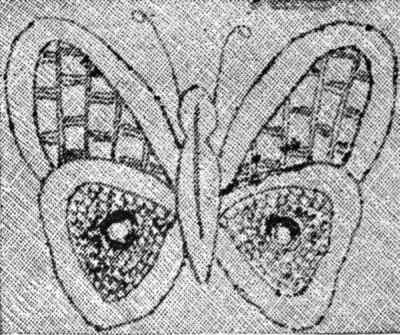
No. 36.—Butterfly Design for Point Lace.
No. 37. VENETIAN POINT LACE.
This is a design containing many of the features of antique lace patterns, and is made of narrow tape and fine cord combined with fancy stitches. The lace from which the engraving is made is about twice as wide as the picture represents it, but as the pattern differs in its sections for several inches at a time, the design could not be given full size. It will be seen that in the section illustrated no two figures are alike. The filling-in stitches consist of combinations and groupings of many of the stitches previously illustrated and described.
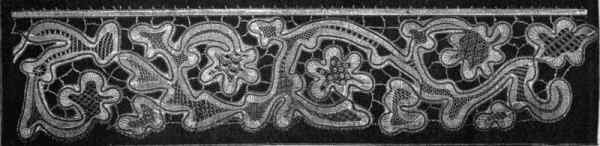
No. 37.—Venetian Point Lace.
No. 38. BUTTERFLY DESIGN FOR FINE BATTENBURG LACE.
This design, developed in Battenburg lace with d'Alençon and Sorrento bars and small "spiders" or dots, makes a pretty ornament for centers or corners, or is effective when introduced as a part of an edging design. Point or Honiton braids may also be made up by this design.
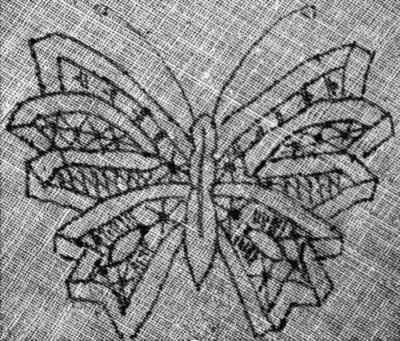
No. 38.—Butterfly Design for fine Battenburg Lace.
No. 39. DESIGN FOR INSERTION.
A very pretty design for insertion is here given. The braid may be basted as seen in the picture, and then the bars may be made of single threads, and of single threads over-wrought with button-hole stitches. Or, any of the bars or other stitches described, may be used to connect the braid and fill in the spaces. Tiny "spiders" are already used to fill in the circles.
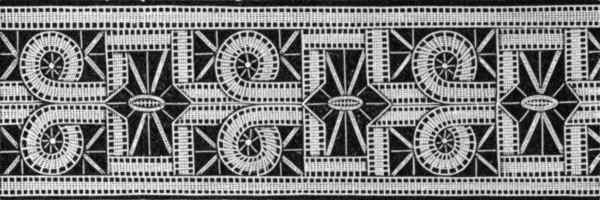
No. 39.—Design for Insertion.
No. 40. DESIGN FOR A LACE BORDER AND CORNER.
A great deal must be left to the ingenuity of the worker in filling in this design, which is not of the orthodox modern variety but may be readily transformed into that class by an adaptation of modern stitches. With the methods of the latter well mastered, the worker will have no trouble in bringing out the design just as it is illustrated; but she may also by the exercise of a little judgment and taste substitute many other pretty filling-in stitches for those here pictured.
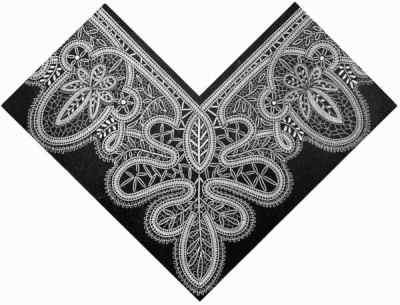
No. 40.—Design for a Lace Border and Corner.
No. 41. DESIGN FOR A BUTTERFLY IN POINT LACE.
Another butterfly design is here given for point lace, though it may also be developed in a larger size in Battenburg braid for decorative purposes. The filling-in stitches are d'Alençon and Raleigh bars, point de Venise and point de Bruxelles, and point d'Angleterre rosettes.
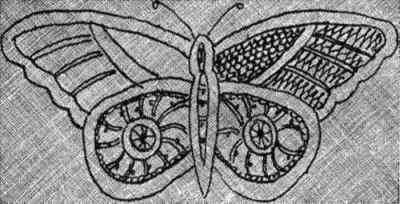
No. 41.—Design for a Butterfly in Point Lace.
No. 42. ITALIAN LACE.
This lace is of a conventional Italian pattern, and is filled in with the Italian lace and ground-stitches, and Sorrento bars. The lower edge is very daintily completed with a button-hole effect. The design is simple, elegant, and popular, and may be wrought in Battenburg or the finer braids, and in any width desired, the braid selected and the width decided upon determining the use to which the lace shall be put.
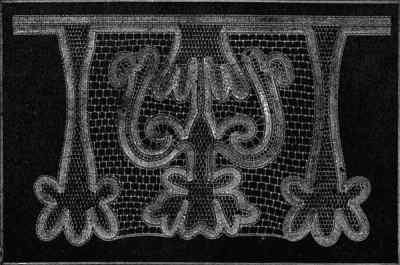
No. 42.—Italian Lace (Half Size).
No. 43. MODERN VENETIAN POINT.
The engraving shows a reduced representation of a very elegant specimen of modern lace—the reduction in size being necessary in order to present the whole design. In making the lace, narrow braid and cord are used for the foundation of the design, and then the filling-in stitches are made and at the same time rings and buttons and bars and picots are introduced. Some of the filling-in stitches are combinations—as in the figures with very open bars where point d'Espagne and point Brabançon are combined, and at the middle section of the central figure where point de Valenciennes and point Brabançon are combined. Other stitches used are d'Alençon bars, Raleigh bars, church stitch, point de Bruxelles, "spiders," Sorrento bars, and picots. The greater the variety in the filling-in stitches, the more beautiful the lace. A picot edge finishes the lace in a very dainty manner along its lower outline, while a cord forms the upper edge.
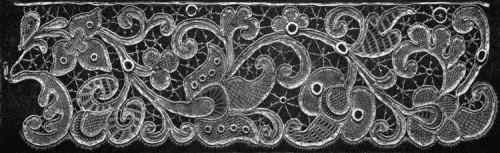
No. 43.—Modern Venetian Point.
No. 44. DESIGN FOR MODERN LACE.
This design may be made up in Battenburg braid, or of point or Honiton braid according to the texture of the lace desired. In making it for garments or articles that are to be renovated occasionally, the Battenburg braids are advisable; but for daintier uses, point or Honiton may be chosen. The Raleigh-bar stitch, point de Bruxelles, and "spiders" may be used in following the outlines given for stitches.
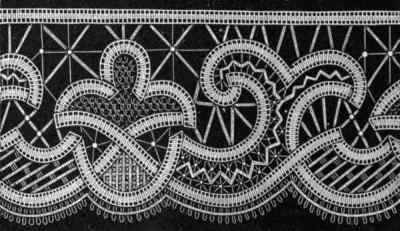
No. 44.—Design for Modern Lace.
45. CORNER IN MODERN LACE.
The suggestions given above will also apply to this design, which may be used for a table spread, or a handkerchief, according to the braid selected. As illustrated, the design is of pretty dimensions for a doily or a toilet-cushion cover, or for a handkerchief. All of the bar work seen may be done with single threads instead of the complete Raleigh method, and the rosettes or "spiders" may be larger or smaller as preferred.
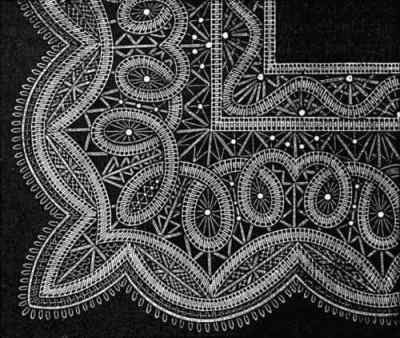
No. 45.—Corner in Modern Lace.
No. 46. PILLOW-SHAM OF BATTENBURG LACE AND LINEN.
A very elaborate pillow-sham is here illustrated. It is made of Battenburg braid and appropriate thread, together with an intermingling of rings, and forms one of the most elegant appointments of a handsomely furnished bed-room. The pattern is very distinct and is called the "rose and leaf" design. The ground-work is formed of rings and Raleigh bars, while the centers of the roses and their leaves are filled in in various fancy stitches which include the crosses and rosettes used in drawn-work, Sorrento bars, points de Venise and Bruxelles, d'Alençon bars, etc., etc. If desired the linen square may be made larger, and the lace but one row of blossoms in width. The square is made of the finest household linen and is completed with a broad hem-stitched hem before the lace is added. The lace design may be obtained in any width desired by sending to a professional lace-maker; or, a clever student may be able to enlarge the design herself.
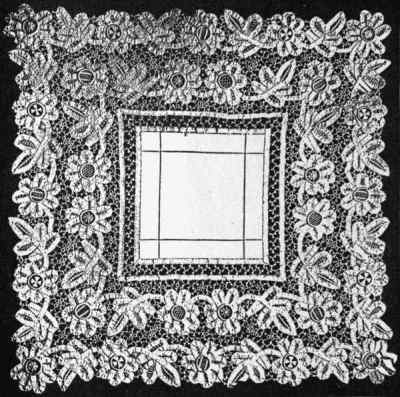
No. 46.—Pillow-Sham of Battenburg Lace and Linen.
No. 47. DESIGN FOR PRINCESS OR DUCHESSE LACE COLLAR AND CUFFS.
Although this design is represented very small, it is sufficiently clear to convey a good idea of its outlines, and enable a student of average ability to adapt it to collar and cuffs of any size desired. Raleigh bars are used in connecting the various portions of the braids, while any of the fine stitches preferred may be chosen to fill in around the loops of the blossoms and foliage. A fine picot braid finishes the edge.
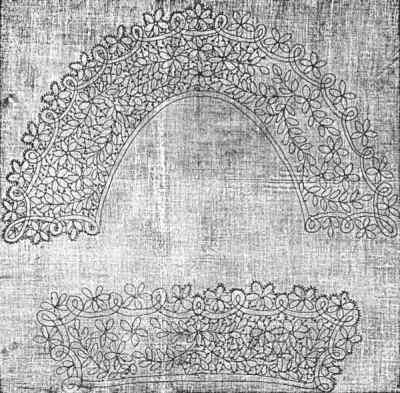
No. 47.—Design for Princess or Duchesse Lace Collar and Cuffs.
No. 48. ENGLISH NEEDLE-POINT LACE.
This engraving illustrates a very beautiful specimen of modern-point lace in a design combining the lily and the rose. Raleigh bars and buttons render the heavy part of the work effective, while the daintier point stitches and bars are used to fill in the floral sections—coarse and fine thread being used in the work.
This lace, like any of the varieties now fashionable may be made wide or narrow, or fine or coarse by designs furnished as required by lace-makers in general; and the patterns may also be developed in silk or ribbon needle-point, which is a style of ornamentation appearing extensively as a decoration for scarfs, piano and table covers, mantel valences, etc., etc.
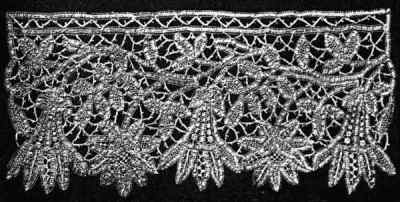
No. 48.—English Needle-Point Lace.
No. 49. ROYAL BATTENBURG LACE.
This design was among the first ones of this lace to appear, and is fully entitled to its royal name. Fancy Battenburg braid was selected for the foundation, and various stitches chosen for filling-in purposes. Among the stitches are point de Bruxelles, made similarly to the Italian lace stitch, point de fillet, plain Raleigh bars, point d'Alençon, rosettes, rings and point de Grecque. The central figure conveys a hint of the outlines of the royal crown, and the lace is really sumptuous in design and texture. In 1883, Mrs. Grace McCormick, the originator of the design and lace was awarded a diploma for her work which was forwarded from Washington, where she applied for a patent for her specimens of Royal Battenburg lace, of which this is one.
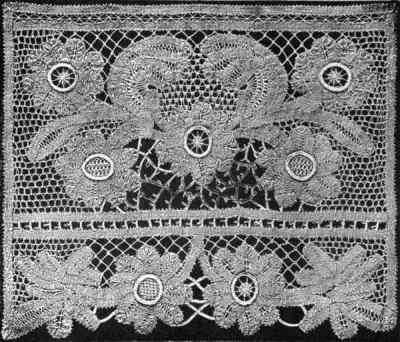
No. 49.—Royal Battenburg Lace.
No. 50. ROMAN LACE (CORAL PATTERN).
The design here given is for a lappet or scarf-end, and will afford a suggestion for the making of larger articles or edging in similar arrangements of braid. It will be observed that the braid forms irregular lines that recall the branchings of coral, and it will be a very easy matter for an amateur lace-maker to similarly arrange her braid for any purpose she desires. Fine Raleigh bars form the connecting work, and a button-hole picot-finish is made along the edge of the braid which forms the border. In making an edging, a definite outline could be kept for the lower edge, and above this an irregular or indefinite outline arranged.
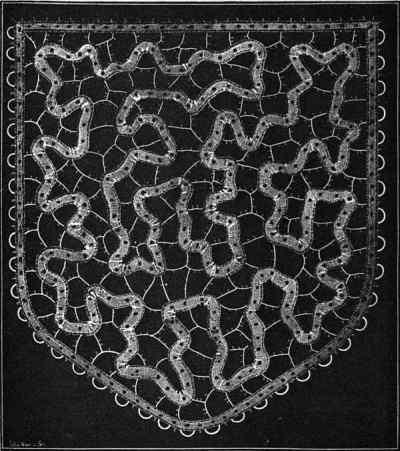
No. 50.—Roman Lace (Coral Pattern).
No. 51. TIDY OF BATTENBURG LACE.
The tidy here illustrated is made entirely of Battenburg lace, and is a beautiful specimen of this kind of work. The border design is the same as the one previously described for a pillow-sham, except that but one row of the blossoms and foliage is used. The center is composed of rows of braid crossed to form squares or open spaces that are filled in with rosettes in point d'Angleterre. This center is attached to the braid at the inner edge of the border by a series of bars arranged in d'Alençon style and then wrought with the thread after the method used in d'Anvers bars. This tidy, enlarged, forms an elegant design for a pillow-sham. When laid over a tinted silk spread or pillow, a sham of this design shows its full beauty. When the braid is basted on in the outlines desired, the remainder of the work will be a pleasing pastime, as none of it is so fine as to require very close attention.
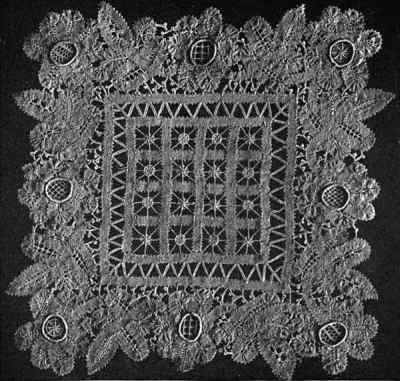
No. 51.—Tidy of Battenburg Lace.
No. 52. MODERN LACE.
A handsome specimen of lace is here illustrated. It will be observed that the braid from which it is made is woven like fine binding braid, and in this respect differs from any of the lace-braids herein illustrated. It will also be seen that no two figures of the design are alike, and that various stitches are used in completing them, many being combinations of or adaptations from the stitches illustrated at the beginning of this pamphlet. The engraving is sufficiently plain to enable the worker to decide which stitches are used alone or in combination, and to guide her correctly in their application. The picot-edge is done in point de Venise stitch.
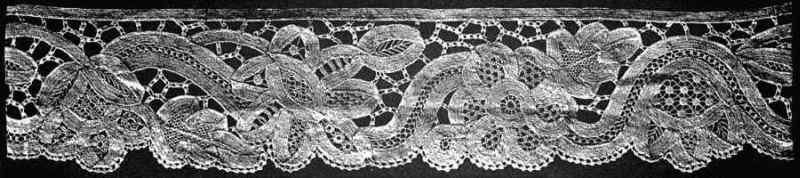
No. 52.—Modern Lace.
No. 53. MODERN-POINT LACE EDGING.
This is an easy design to follow and is simply made. Heavy Sorrento bars with picot loops form the ground-work, while the filling-in stitches are of the same class done in fine thread in regular squares and also a combination of point de fillet and point de Grecque. A dainty picot-finish is added at the lower edge. This edging is pretty for bordering draperies or decorating dresses, and may be made as fine or as coarse as desired.
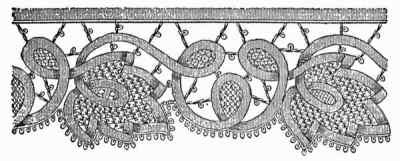
No. 53.—Modern-Point Lace Edging.
No. 54. SQUARE IN MODERN-POINT LACE.
In this design will be observed a favorite combination—the rose and the butterfly. Close inspection will also disclose that the filling-in stitches are of a diverse character, and that to this diversification much of the beauty of the work is due. As most of the stitches are easily recognized, and as the copyist can easily adapt methods for the combinations seen, it will not be necessary to definitely describe them.
The square may be used for a scarf-end in connection with the edging No. 53 seen on page 91, if the braid selected is sufficiently fine. When coarser braid is chosen, the square will be pretty for doilies, tidies or the center of a table spread. The design may be daintily made up of ribbon, with silk for the stitches. In this event it may be set into a scarf or drapery of China or Surah silk with charming results.
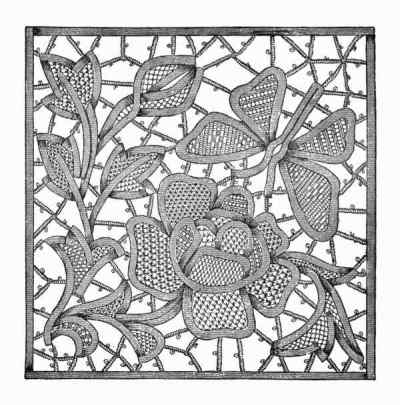
No. 54.—Square in Modern-Point Lace.
No. 55. LOUIS XIV. CURTAIN-LACE.
This is a very popular decoration for curtains and vestibule doors and is made of heavy écru or white net and braid. The design selected is generally a border with a corner piece, and sometimes a center piece. The specimen here given is simply a square of the net decorated as illustrated to convey an idea of this at present fashionable curtain lace. The design is first traced on tracing cloth that is then underlaid with brown paper to hold it stiffly in place. The net is then laid over this and smoothly basted down so that the tracing shows through plainly. Then écru or white Battenburg braid is used to follow the design, and is shaped into the leaves and flowers seen, rings being used for the centers of the blossoms and écru or white cord for the stems. The net is cut from under the rings at the centers of the large roses, and each opening is filled in with point de fillet and English wheels. The effect is very rich and the work is not difficult to do.
When a curtain is thus embroidered or decorated with braid, it is bordered the same as the square illustrated, or upon that principle, with rows and points of Battenburg braid. Ribbon is often used in this way for tidies, bureau scarfs and various other little household decorations, and in this event the flower and foliage tints may be carried out in the design.
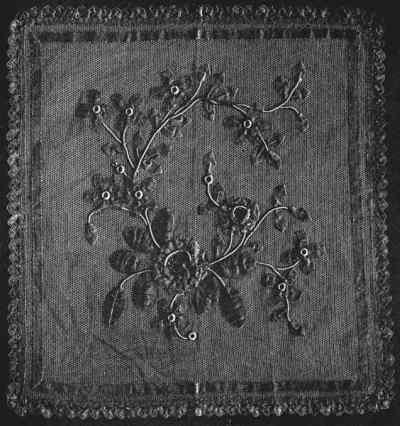
No. 55.—Louis XIV. Curtain-Lace.