DARNED-NET SCARFS, KERCHIEFS, TIDIES, EDGINGS, INSERTIONS, ETC., ETC., WITH DESIGNS FOR THE SAME AND OTHER ARTICLES.
Reading edition
Bobbin net, or "bobbinet," or "net" as it is now commonly called, was first made by machinery in 1809, and was so called because the threads from which it was made were wound upon bobbins, and twisted into meshes instead of being looped in knitting style as they were previous to the invention of the machine. The latter was invented by John Heathcoat, the son of an English farmer; but to France must be given the credit of introducing the "darned work" by which some of its costliest net laces were first made. From these laces originated the industry of darning net by machinery and by hand, and in all grades from fine silk-blonde and Brussels net to the coarsest wash net, such as is used for curtains and draperies.
In the earlier days the pattern was stamped on the net by means of wooden blocks, and the net was then placed in a frame, and the darner with her left hand under the lace followed the design with her needle and cotton, linen or silk floss held over the work in the right hand. This method may be employed at the present time; or, the design may be drawn on thick paper and the net basted over it; or, if the net is coarse the design may be followed by counting the meshes and inserting the needle and floss accordingly; or the design may be transferred to the net itself by black or colored pencils, or stamping. The darner must decide for herself which method for holding the work she will use. Some of the most expert darners simply hold the net loosely in their hands and copy the design by eye alone. Wash-silk floss, India floss which is of linen but looks like silk, and ordinary darning flosses are all used for this work. Darned net is liked for many purposes, as will be observed by the variety of designs and illustrations given on these pages.
No. 1. SCARF-END OF DARNED NET.
This illustration pictures a very pretty scarf-end, but presents it only half of its actual width. The scarf is about a yard in length and is darned with linen floss and edged with the finest feather-edge braid. The center portions of the flowers and foliage are cut out after the solid darning is made, and the spaces are then filled in with a fancy mesh done with fine cotton in point de Bruxelles stitch.
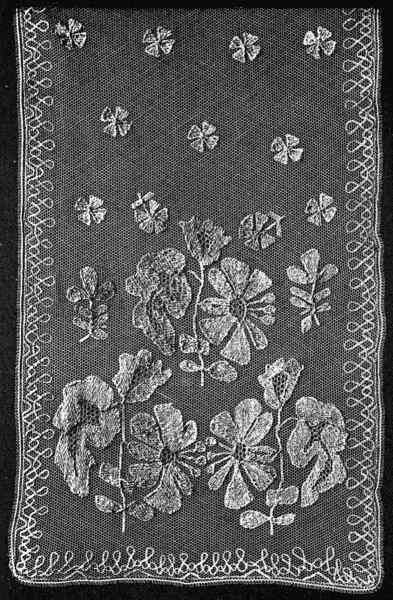
No. 1.—Scarf-End of Darned Net (Half Size).
No. 2. NARROW CUFF OF DARNED NET.
This engraving presents a cuff of darned net in its actual width. The design is also suitable for an edging and may be easily changed into an insertion. Feather-edge braid is used to complete the cuff. A collar may be made to match if desired.
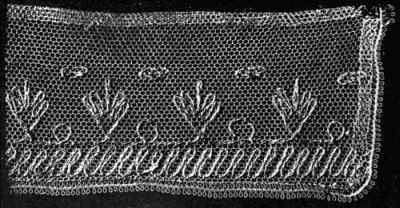
No. 2.—Narrow Cuff of Darned Net.
No. 3. CORNER OF KERCHIEF OF DARNED NET.
This kerchief is made similarly to the scarf-end illustrated on page 97, and as represented, the corner is only one-half its actual size. The kerchief itself is about twenty-two inches square and is very dainty in effect. The stars which fill in the central portion are very simple to make, and the eyelets in each are punched with a bodkin and then worked once around in point de Bruxelles or button-hole stitch. The kerchief is made of fine Brussels net and the darning is done with India floss.
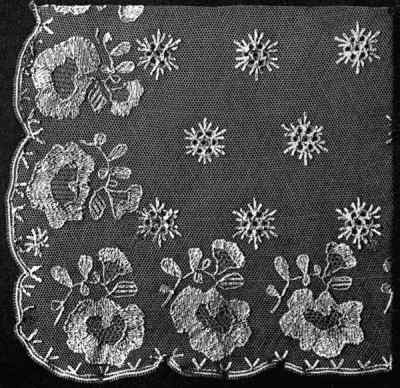
No. 3.—Corner of Kerchief of Darned Net (Half Size).
No. 4. TIDY OF DARNED NET.
This engraving represents a charming little tidy made of coarse wash-net darned with wash-silk floss in Oriental colorings. The tidy has an inch wide hem and is about eleven inches wide and twelve long. The hem is fastened down by three rows of darning stitches, the outer row being deep garnet, the middle row bright old-rose and the inner row deep orange. One small fan is made of the orange and pale-blue, another of the old-rose with sulphur-yellow, and the third peacock-blue and crimson. One large fan is made of pale-pink and silver-gray (darned together), and wood-brown; another is made of the garnet and the sulphur-yellow, while the third is made of orange and pale-blue. The scrolls meeting at the center are made, one of wood-brown, one of sulphur-yellow and one of garnet, and the rest of the design is made in different shades of dull green. Laid over white, this tidy is very effective. It may be darned in one color on white, black or écru net if preferred, and with linen floss.
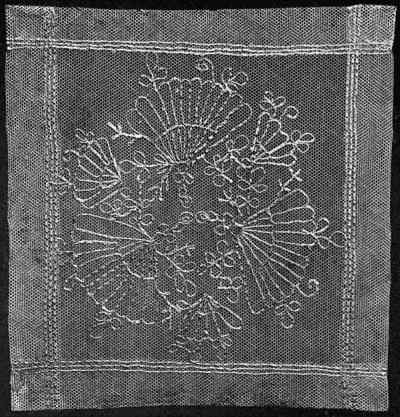
No. 4.—Tidy of Darned Net.
No. 5. TIE-END OF DARNED NET.
A tie-end in its actual width is here illustrated. The tie is about three-quarters of a yard long, and is darned in all-over style in the design seen in the engraving, with linen floss. A line of fine feather-edge braid finishes the tie in a dainty manner. This design may be used for any other article preferred, and its details will also suggest other designs of a similar character which may be invented by the worker. This scarf as well as the others just described, may be made up in black if preferred; and in this event it will be easier for the darner to follow the meshes if she bastes her net over a white background. The design may or not be traced on this background.
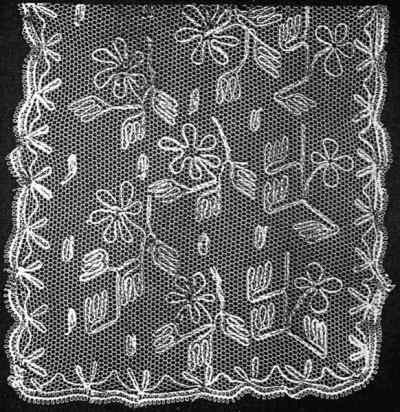
No. 5.—Tie-end of Darned Net (Full Width).
No. 6. DARNED-NET EDGING, WITH OVER-WROUGHT STITCH.
This handsome edging is darned upon a wide strip of net with coarse and fine embroidery cotton, and after the pattern is completed the lower edge of the net is cut away. The coarse cotton is used to outline the design and fill in some of the central portions, while the fine is darned in between the outer and center portions, and is used for the over-wrought portions. These portions are "run" back and forth loosely to form a raised foundation for the buds and rose-centers before the over-wrought work is done. The edging is given full-size and no difficulty will be experienced in following the design or making the lace; and the design may be adapted to any article of wear that can be made of darned net. A scarf or kerchief, dotted with rosebuds made like those of this design would be a very dainty article of personal adornment; and the buds might be made of pale-pink or yellow floss with a charming effect. The floral idea might be further carried out by using shaded green floss for the foliage.
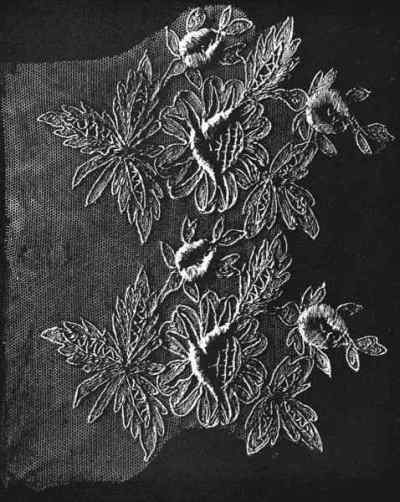
No. 6.—Darned-Net Edging, with Overwrought Stitch (Full Size).
Nos. 7 and 8. DARNED-NET EDGINGS.
It will not be necessary to give special instructions for either of the edgings here illustrated, as both are given full size and the designs are perfectly distinct. No. 7 is finished with a button-holed scallop from which the net is cut away when the work is completed. Either edging may be made of white, écru or black net as preferred, and the floss may be white or tinted, or of cotton, linen or silk.
In making No. 8 upon black net, silver or gilt thread or colored flosses will be found very effective. Black net thus darned is very pretty for ruching and jabots for dress-waists.
In making darned edgings, net may be purchased in various edging widths, and in this style is often called "footing." When bobbin net (or bobbinet as it is now called) was first invented, it was made only one inch wide but now it may be purchased three and one-half yards wide if desired.
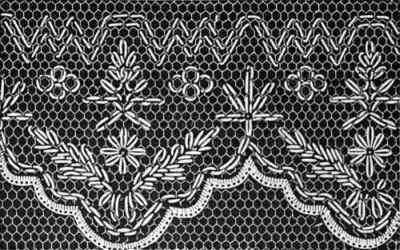
No. 7.—Darned-Net Edging.
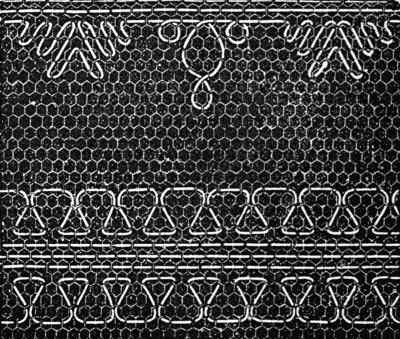
No. 8.—Darned-Net Edging.
No. 9. PILLOW-SHAM OF DARNED NET.
This engraving represents one of the many uses to which darned net is put. Moderately coarse net was selected, and the darning was done with linen floss in the various patterns seen, and which are repeated in a larger form on the following pages. The sham was hemmed after the darning was finished, and a frill of darned-net edging was then added. Tinted silk or sateen should be laid under such a sham in order to bring out the beauty of the work. The ambitious darner may make a bed-spread to correspond with her shams, if she has the time to devote to the task and the patience to complete it; and in making such a set, she need not confine herself to the designs here given, but may select any others she admires, or may originate a design herself. Individual ideas as to decoration so widely differ, that clever workers are sure to evolve designs of various characters and a generally uniform beauty. Blossoms, leaves, carvings, Oriental figures, brocades, etc., etc., all afford dainty ideas for designs for darned net.
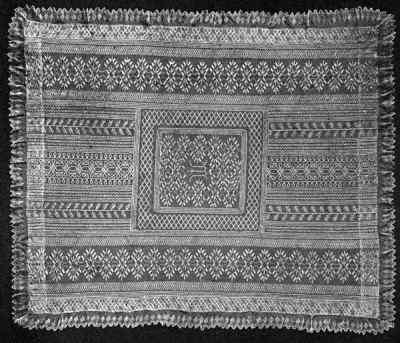
No. 9.—Pillow-Sham of Darned Net.
No. 10. CENTER OF PILLOW-SHAM.
This engraving presents an enlarged representation of the center of the pillow-sham seen on page 109, and also shows its suitability for the center of a tidy. The inner design is very easy to follow, as will be seen by referring to No. 12 on page 113, where a large illustration of it is seen supplemented by a vine-border at each side. The outer border of this center-piece is very simple, and may be darned in diamonds as large or as small as desired.
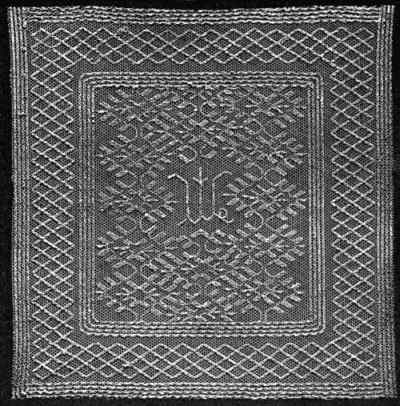
No. 10.—Center of Pillow-Sham.
No. 11. SECTION OF PILLOW-SHAM.
In looking at the sham illustrated on page 109, the design illustrated at No. 11 will be seen at either side of the middle-stripe design. As here represented it will be easy to copy either for a pillow-sham or for any article of decoration or personal use desired. The ingenious worker will find many methods of combining it with other designs or applying it as an insertion, a border or an edging; and she may also use her own taste as to darning with white or colored floss, or using white, écru, fancy-colored or black net.
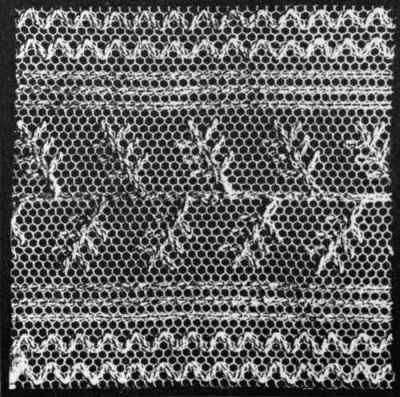
No. 11.—Section of Pillow-Sham.
No. 12. SECTION OF PILLOW-SHAM.
This design has been mentioned in connection with the pillow-sham seen upon page 109, and the engraving represents it perfectly. It may be employed for the purpose mentioned or adapted to any other use required, and may be copied exactly or varied to suit individual taste. Black net darned with gold thread in this design would be pretty for decorating a black silk gown or trimming a black hat.
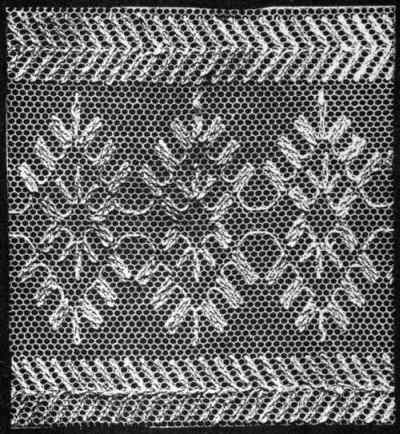
No. 12.—Section of Pillow-Sham.
No. 13. SECTION OF PILLOW-SHAM.
Another portion of the pillow-sham mentioned is here illustrated, but the design is quite as appropriate for any other decorative purpose. Yokes for night-dresses may be darned in this pattern, or in any of the ones previously given, with a very pretty effect; and when tinted ribbon, mull or lawn is laid under the darned stripes, the effect is very dainty indeed. Yokes to children's dresses may also be darned in this pattern or the others, and little caps or hoods may be made to match and lined with a tinted or white fabric.
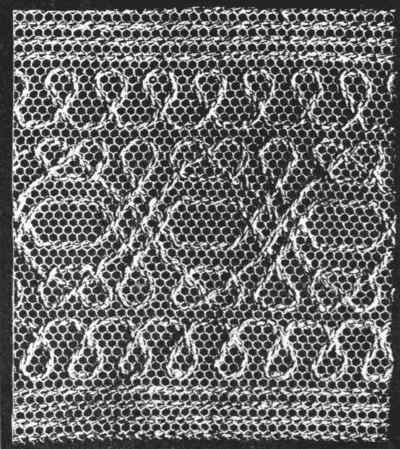
No. 13.—Section of Pillow-Sham.
No. 14. END OF DRAPERY-SCARF OF DARNED NET.
The end of the drapery-scarf from which this engraving was made is about fourteen inches square, and the sides are turned under for about a quarter of an inch, or a little more, and darned down closely to represent a selvedge. The design is Oriental in outline and is easy to follow. As represented the scarf is made of white net and darned with white linen floss; but the Oriental effect may be carried out more perfectly if the darning is done with colored flosses with an intermingling of silver or gilt thread. White, black, écru or colored net may be used. Two ends are made and then gathered to a smaller square of net. This small square is then drawn together through the center under a bow of wide satin ribbon, and the scarf is then fastened to the article of furniture it is to decorate. To its ends may be added tassels, rings or any edge-finish that is in accord with the materials of the scarf. Black net darned with gold, crimson, peacock-blue, and pale-yellow and pale-olive, results in a charmingly Eastern or Oriental effect.
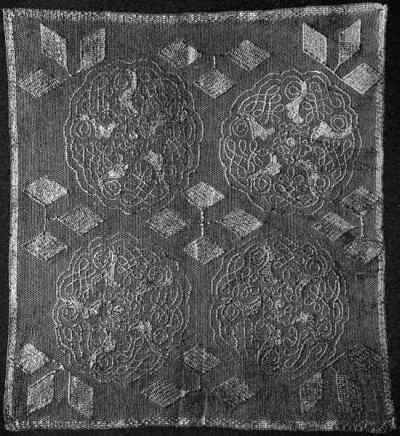
No. 14.—End of Drapery-Scarf of Darned Net.
No. 15. DESIGN FOR A CORNER OR SQUARE OF DARNED NET.
A very pretty design, as simple as it is effective, is here represented. According to the purpose for which the work is intended, and the color of the net selected, the darning may be done in cotton, linen or silk, and in white, black, écru or colors. The pattern may be modified in any way pleasing to the taste, or diversified by the introduction of portions of other designs or individual ideas.
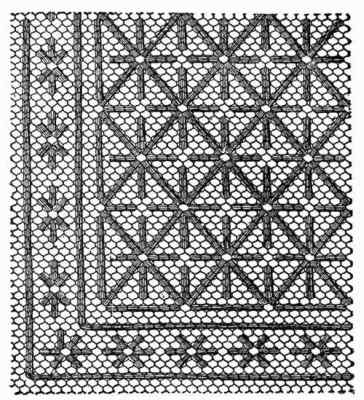
No. 15.—Design for a Corner Or Square of Darned Net.
No. 16. BORDER FOR DARNED NET.
A pretty border for tidies, draperies, flounces, yokes, collars or any article requiring a border is here illustrated. Any of the suggestions given above may be adopted in making this border, which may be used separately or in combination with other borders, according to individual taste. Gold thread upon black or white net would, in this design, result in a very effective dress decoration.
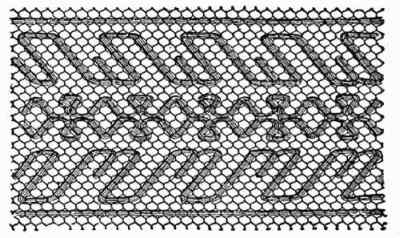
No. 16.—Border for Darned Net.
No. 17. DESIGN FOR DARNED NET.
This pretty pattern may be used as a border, insertion or stripe for personal or household articles, and is one of the most popular designs in use. It is very easy to follow and is illustrated full size. It might be used to border the lower edge of a wide flounce for a petticoat, or, with equal propriety, applied to a tidy or a window drapery, providing the worker regulates the size of the design appropriately for the work in hand. For window draperies it would need to be much broader and larger in other ways than as represented.
No. 18. EDGING OF DARNED NET.
The design here presented is of full size, and very easy to work. A dainty edge in button-hole stitch is worked for the border, and the net is afterward cut out to form the tiny scallops. This is a pretty pattern for neck and wrist frills, jabots or ruffles, or for the adornment of kerchiefs for the neck or pockets, or for any purpose for which lace edging is selected.
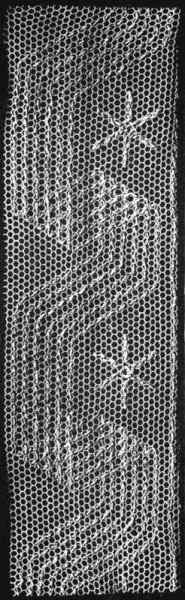
No. 17.—Design for Darned Net.
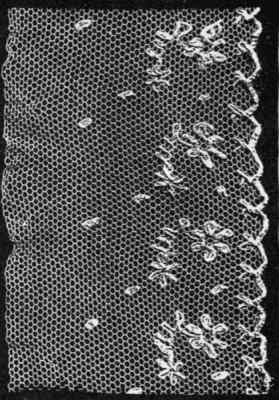
No. 18.—Edging of Darned Net.
No. 19. DESIGN FOR DARNED NET.
This engraving represents a flounce of darned-net in its actual size or width. It will be seen that the design is simple, but at the same time very effective. The flounce is for a child's dress made of net darned all over in the pattern seen in the picture, and worn over a tinted silk slip. The all-over work is very pretty indeed, and the design may be put to any of the many uses for which darned net is suitable. It is pretty for yokes, pillow-shams, counterpanes, infants' dresses and carriage-robes, parasol-covers, sofa-pillow covers, and in fact for any article that may be made of lace.
The points of the flounce are darned back and forth in selvedge effect; but they may be worked in button-hole stitch if preferred. A touch of color may be given the work by using a little tinted or colored floss with the white, though the latter is most generally selected for darning net. In using tints, more delicate shades will be found in silk darning-flosses.
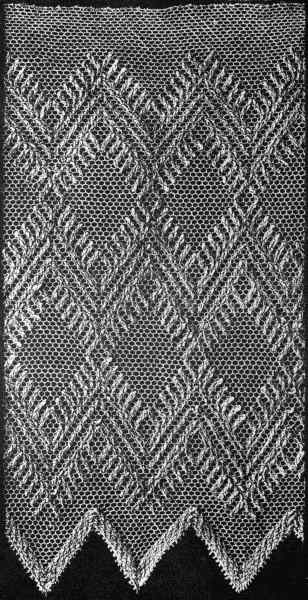
No. 19.—Design for Darned Net.
No. 20. DESIGN IN DARNED NET.
This design is extremely simple, and it may be used separately as a border or insertion, or in combination with parts of other designs in making up a large or elaborately-worked article. It is dainty enough for the decoration of an infant's garment if desired for such ornamentation, or heavy enough for elaborating an adult's attire.
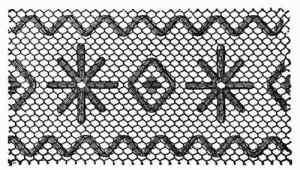
No. 20.—Design in Darned Net.
No. 21. DESIGN FOR A YOKE OR SECTION OF A GARMENT IN DARNED NET.
The yoke, sleeves, collar, cuffs and flounce of a child's dress were beautifully darned in the design illustrated by this engraving, and the effect was far more charming than can be conveyed by a picture. The little gown was airy enough for a sprite, and its greatest cost was in the outlay of the time devoted to its construction; and even this could not be counted a real outlay, as only odd moments of leisure were employed in making the pretty garment. White net, white floss and white India lawn were the composing materials.
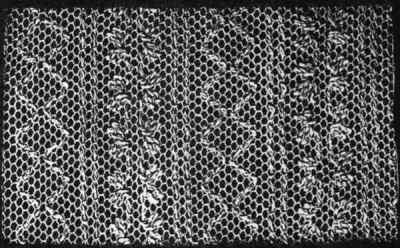
No. 21.—Design for a Yoke or Section of a Garment in Darned Net.
Nos. 22 and 23. DESIGNS FOR DARNED NET.
Both of these designs are very pretty for diverse purposes, and also very easy to follow. Either may be used as a heading, an insertion or a border, separately or in conjunction with other designs. Many of the suggestions given concerning other designs upon previous pages will apply to these two designs, which fact leaves little to suggest for them individually. Each darner will think out for herself many uses to which to put designs, many combinations in which they will prove effective, and many colorings suggested by the tints which govern her room or her wardrobe; all of which would be an impossible task for any one person, unacquainted with the surroundings of all our students to accomplish. One idea from one person will suggest another idea to a second person, and thus, in the lace-work at the beginning and after part of this book, as in all fancy work, upon an evolution of ideas must rest the great responsibility of an endless variety of designs.
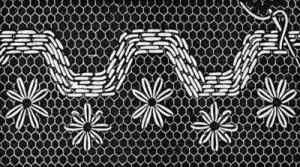
No. 22.—Design for Darned Net.
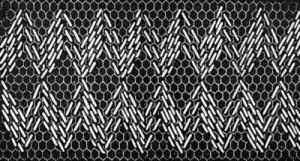
No. 23.—Design for Darned Net.
Mrs. Grace B. McCormick,
Lace-Maker for the Best Families of New York and Other Cities, Designer and Manufacturer of Modern Hand-Made Laces, ~~~~and~~~~
Importer of Materials for Laces, Needle-Work and General Household Decorative Work, and also of Fine Linens and Linen Lawn.
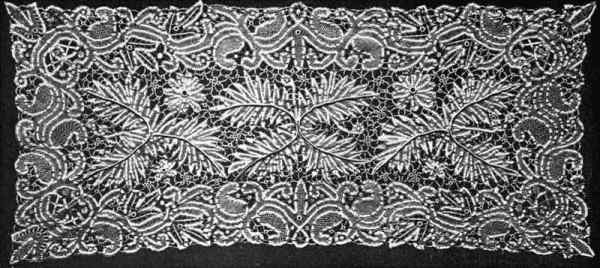
Designs for Borders, Pillow-Shams, Edgings, Insertions, Tray-Cloths, Center-Pieces, Buffet and Bureau Scarfs, Tidies, Pin-Cushion Covers, Doilies, Collars and Cuffs, Coiffures, Dress Sets, Panels, Handkerchiefs, Flounces, Vestibule and Window Curtains, And All Household Garnitures; also Exceptionally Rich Designs for Church and Altar Laces, etc., etc.
THESE DESIGNS WILL BE FURNISHED FOR
Royal Battenburg, Honiton, English Needle-Point, Princess, Russian and "Ideal Honiton" Laces, in ANY SIZE or SHAPE REQUIRED.
ALSO DESIGNS FOR DARNED NET.
Particular attention paid to Making Estimates, and Drafting Special Designs and Selecting the Proper Braids, Threads, Needles, Etc., Etc., for the same.
also, always on hand a fine assortment of Imported and American Samples of CROCHETED LACES; also CROCHETED MATS, DOILIES, TIDIES, SCARF-ENDS, Etc., Etc.
Curtains and Fine Laces Skilfully Cleaned and Repaired.
ALL INFORMATION DESIRED CONCERNING Modern or Antique Laces, Materials, Quantities and Prices, cheerfully Supplied upon Receipt of Inquiry, Full Address and Return Postage.
Address,
MRS. GRACE B. McCORMICK,
923 BROADWAY, NEW YORK.