THE SOUTH.
Reading edition
Rev. Joseph E. Roy, Field Superintendent.
Prof. Albert Salisbury, Superintendent of Education.
AVERY NORMAL INSTITUTE, CHARLESTON, S.C.
BY A. W. FARNHAM, PRINCIPAL.
With us the second of October dawned warm and bright. Before the last tardy risers were awakened, our school flag was hoisted over the building to beckon children and youth Averyward. And how they responded! Soon after the first stroke of the bell which announced that the gates were to be opened, more than three hundred children either walked, ran, or crowded, into the school yards. How they talked! Four months of vacation had dissipated all regard for established rules and usages. And who could scold the first day? It is true that many had been in summer schools during the greater part of vacation, but in many instances they were sent “just to keep them off the street, you know, sir.” Then the private houses in which these schools are “kept” have not school dignity nor school atmosphere, because they are not school buildings; hence they lack molding influence.
Another reason why the children talked was that a new principal (new and yet old) and five new teachers were to be met, measured, and, if possible, mastered. Every boy wants to know just how strong his teachers are; and as their strength is, so his respect will be.
Again the bell sounded, this time to announce the hour for devotions. As the pupils filed into the chapel their eyes fell upon a new crayon likeness of Prof. M. A. Warren, a former principal. This work of art, costing about $50, was presented to the school by the Alumni at their last annual meeting, July 4th. It is a generous expression of their love for a faithful teacher and a true man.
With the children came a large number of patrons “to start them,” of course, but little was done the first day but to exchange greetings, hold chapel exercises, take names and addresses of pupils, assign former pupils to the classes which the previous principal had named for them, and to examine and grade a part of the new ones. Other examinations and grading, with the selling of books, and the collection of tuitions for the month, hindered our programme of work from being fully taken up before the second week.
It is now four weeks since our opening. In the time we have registered three hundred and thirty-six pupils, collected $332.85 for tuition, sold $462.64 worth of books, organized in addition to the common-school branches, classes in physics, chemistry, mineralogy, botany, zoology, physiology, school economy, political economy, history (U.S. and ancient), algebra, geometry, rhetoric, Greek, Latin, French, German, music, gymnastics, sewing, stenography, and Bible study. We have also had our monthly written reviews. A good number of pupils are fitting for college, some of whom will be ready to enter next October. Other pupils are preparing for teaching, and will enter upon their work after leaving us. Others still are intending to follow trades, and are studying that they may become intelligent tradesmen.
In response to our circular of information which we have sent out to friends, we have already received a box of chemical apparatus, a scroll saw with lathe attachment and a book of patents, a quantity of basted patch-work, fifty magnifying glasses, and a box of minerals. In addition to these gifts from abroad, our pupils are daily contributing to start natural history cabinets. Among our pupils’ contributions are many fossils, some of which we would like to exchange with other schools. We need several more scroll saws, and more work for our sewing class.
In the senior class, one of the incentives to study is the Alumni Prize of $50, which is to be given to the student who makes the best record this year, and intends to pursue his studies at some higher institution of learning.
The morning of the 25th (October), we met to join in the concert of prayer for the A. M. A. As a part of the exercises twelve members of the senior class gave brief recitations, in which much information of the Association was given. The recitations, each of which was closed with an appropriate Bible text, were in answer to the following questions: What occasion do we observe this morning? What is the object of this observance? When was the American Missionary Association organized? What led to its organization? What is the character of its work? What is the extent of its work? Name some of the results of its work. What relation do we bear to the A. M. A.?
A more quiet, earnest spirit pervades our higher classes than I have ever seen so early in the term. With the sympathy and prayers of friends, and honest persistent effort on our part, we hope to be signally blessed in the work of the year.
NEW BUILDING AT ATHENS, ALA.
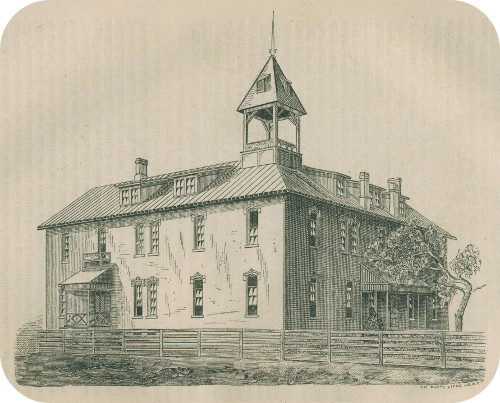
TRINITY SCHOOL BUILDING, ATHENS, ALA.
Trinity school building at Athens, Ala., a cut of which is given herewith, has accommodations for 200 day scholars, and the family of missionaries who have charge of A. M. A. work at Athens. Its history is somewhat unique and altogether encouraging. The old building, where Miss Wells, the principal, had managed the school since 1866, was insufficient and scarcely tenable. The debt of the Association and the claims of larger institutions were such that for a time it seemed almost inevitable that the school must be given up. Miss Wells, however, and the brave people whom she had been serving, determined to rally their forces and save the enterprise at all reasonable hazards.
Preparations were made for furnishing bricks; volunteers offered themselves for all sorts of needful work; some labored in clay pits, some in kiln, some went to the woods for the fuel required to burn the brick, while the women and girls contributed their dimes, nickels and half-dollars to raise a fund to have the wood hauled. In this way the colored people made two hundred thousand bricks, “mixing the clay by the tramp of their one small steer.” Meanwhile, Miss Wells spared no effort in interesting friends at the north to come to her relief. As a result the building was completed last spring at a cost of only $8,000 to the Association, in addition to what was furnished by the colored people. From the time the corner-stone was laid till the opening of the building, a good number of prominent towns’ people manifested their interest in and approval of the work.
THE GEORGIA ASSOCIATION.
We drop down from Savannah, thirty-one miles on the Florida railroad, to McIntosh, in Liberty County. Then it is four miles east over the old Yankee high-way to Midway and its “Lost Church Found,” and the brethren are on hand with their buggies to take us out. Pastor Snelson’s house and the teacher’s home are filled up, and the two rooms of the Academy furnish space for beds and cots for the lodging of eight persons.
Quite a village it is that has grown up there; the large church, the Dorchester Academy, and half a dozen houses and two or three small stores. Heretofore, the two teachers, Misses Kinney and Gibson, have been quartered in a cabin. Now, a new house is under process of construction for them.
All but one of the fifteen churches are represented. Pastor Kent, of Atlanta, preaches the opening sermon upon the Growth of Christian Character, a discourse which proved its fitness to the occasion by the fact that its truths were constantly bubbling up through the course of the meeting. The body changed its name from that of “Conference” to that of “Association,” elected Revs. A. J. Headen and J. E. Roy, with Revs. E. Kent and J. H. H. Sengstacke as alternates to the next National Council, made deliverance against putting churches on the color line, and had the full measure of essays, discussions, sermons, etc. During the Lansing temperance meeting, Rev. George V. Clark, of Athens, thrilled us all as he told of his being a saloon tumbler boy, of his going, full of liquor, to the Storrs School temperance meeting, and of his signing the temperance pledge at the solicitation of Miss Rose M. Kinney, who was at that time a teacher there, and who was then before him. Such a result was a reward of her fifteen years of service. The talks upon the converting power of the Sunday-school were stimulating indeed. The Association received the new Church at Athens, also Revs. George V. Clark and N. B. James.
On the Sabbath the fine large church, 50×60, which had been used several years as simply inclosed, and which had been brought to completion, was re-dedicated. The sermon by Superintendent Roy was upon the Glory of the Sanctuary as the place of Spiritual Nativity: “This and that man was born there.” The prayer of dedication was offered by Rev. E. T. Hooker, of Charleston, S.C. In the afternoon a grand missionary meeting was held in behalf of the American Board, the A. H. M. S., the Congregational Union, and the A. M. A., with addresses made by Revs. E. Kent, S. E. Lathrop, E. T. Hooker, and J. E. Roy, all of them using Mr. Kent’s two big maps, one of the world, and one of our country. Miss Kinney read a paper written by Miss Hardy upon that whole missionary scheme. The ladies appointed the wives of Revs. E. Kent, S. E. Lathrop and Dana Sherrill as a Provisional Committee to prepare the way for organizing a State Woman’s Missionary Society at the next meeting of the Association, to be held at Athens. Meantime the ladies propose to organize in each of several of the churches an auxiliary society, and these will unite in the State Society. Between the two services of Lord’s Day I went out and counted the vehicles and the animals that had brought the great assembly to church; I counted 68 vehicles, of which 38 were buggies, 95 horses and 30 ox teams, 40 oxen in all, as some of the carts were drawn by a single ox. There were two other important gatherings in that region on that day, or, as some of the brethren said, you could not have seen the ground, for the animals and the carryalls that would have been there. As it was, we had, by fair estimate, six hundred people present, and their’s was truly, as they call it, “A Big Meeting.”
J. E. R.
THE CENTRAL SOUTH ASSOCIATION.
That is now the name, changed from that of Central South Conference, at the meeting held in Rev. William H. Ash’s church at Florence, Ala., Nov. 2 to 5. This change is in order to uniformity of title in the state ecclesiastical bodies. Georgia, Alabama and North Carolina yet retain the name “Conference.” The Central South, which was the original Congregational body at the South, having sent off two daughters, the Alabama and the Georgia, still holds good her title to the name, as she yet represents the central States of Tennessee, Mississippi, Arkansas and a part of Alabama.
The older members said that this last was the best meeting ever held by the Association. Papers were read by B. F. Foster on pastoral work; by William A. Sinclair on the need of cultivating the missionary spirit; by B. A. Imes on Congregationalism; by Mr. Singleton on school work; and the reading was followed in each case by full and animated discussion. President Pope led in a discussion upon the subject of revivals, and also reported the industrial departments of Tougaloo University. Superintendent Roy reported the recent annual meeting of the A. M. A., at Cleveland. One evening was given to a rousing temperance meeting. The preachings were frequent. Revivals were reported at Fisk and Tougaloo Universities, at Memphis and Chattanooga. Two churches were received, one at Meridian, Miss., Rev. J. L. Grice, pastor, and the Welsh church at Soddy, East Tennessee, Rev. W. H. Thomas, where the Welsh are the colliers. Rev. H. S. Bennett, B. A. Imes and William A. Sinclair were elected to the next National Council. Pastor W. H. Ash, who had made ample provision for the entertainment of the Conference, was laid aside through all of the sessions by a severe illness; but the results of his work were manifest to all. A neat gothic church, a pleasant parsonage, and the whole within a tasteful white fence, were the other signs of the work, while the growing membership and Sunday-school, and the day-school of seventy, taught by Mr. Ash and his estimable wife, were the symbol of the intellectual and moral process going on. At the dedication, two years ago, more than fifty of the prominent white citizens were present, among them Ex-Gov. Patton, three or four pastors and as many lawyers. On the Sabbath the pulpits of the colored churches were supplied, and Messrs. Bennett and Roy preached at the Presbyterian church, where Gov. Patton is the S. S. Superintendent, an office which he has magnified for many years. The week before, the Memphis Synod had met in this church, when the appeal of Mr. Long from the Memphis Presbytery came up. By a technicality the appeal did not stand, and Mr. Long was permitted to withdraw from the denomination, to continue his service as pastor of the First Congregational Church of Memphis. The next meeting of the Association is to be with Rev. Joseph E. Smith, at Chattanooga.
J. E. R.
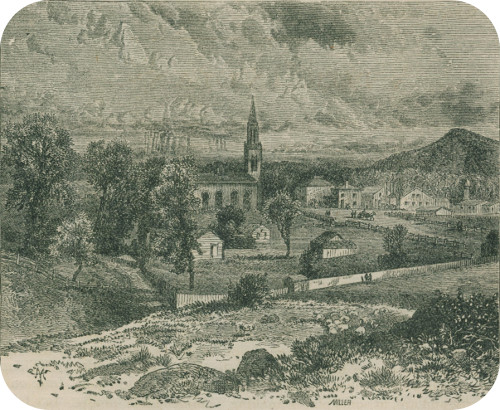
WYTHEVILLE, VA.
Wytheville, Va., is a representative mountain town, situated amidst a rich farming and mining region. Already Northern capital and enterprise have found their way to like portions of the South, where the climate is salubrious, the winters mild, and the rewards of labor immediate and sufficient for the wants of an industrious population. Very much, however, remains to be done for the vast areas of the mountain districts of the South. The school privileges of blacks and whites are as yet quite limited. The people, however, have been distinguished for their loyalty to the Government, and in some portions of the mountain country for their readiness to accept missionary endeavors, regardless of the color line. Prof. C. C. Painter, of Fisk University, and Rev. I. P. Dickerson, one of the original Jubilee Singers, now a missionary in the south of France, were born at Wytheville.
The Rev. W. H. Ash, pastor of our church, and teacher of our school at Florence, Alabama, died on the 13th of November. A protegé of Hon. A. C. Barstow, and a graduate of the Boston University, he began work for us at Mobile, Ala. He was then transferred to Florence, which was in need of such a man as he. Mr. Ash was married to Miss Sarah Hale, of Montgomery, an accomplished lady, who was his helpmeet, not only as a wife, but as a teacher in the school, which they had developed to the great delight of their people, and to the approbation of all the citizens. Mr. Ash, on behalf of the church and of the A. M. A., had built a tasteful church edifice which was also used for the school, and a parsonage. He had commanded the high appreciation of all the best people in the community. During his sickness, the Central South Association had its annual session in his church. His wife took his remains to Montgomery for burial. As writes the stricken companion: “It was only going home to receive the reward of the faithful servant.”