American Missionary Association.
Reading edition
ANOTHER YEAR.
With this issue The American Missionary greets its readers the thirty-seventh time on the threshold of a new year. For more than a generation it has participated in mighty struggles for the welfare of the church and the nation.
There is no more lofty tower of observation than that builded on the foundations of righteousness. From this eminence, the Missionary has cast its eye to the end of the earth and recorded the progress and change in events that have brought about this glad day.
The horrors of the slave trade, now happily passing away, have been unceasingly exposed and deplored. American slavery, so recently abolished, has been opposed with righteous and relentless warfare, and the elevation of the Freedman has been urged by every patriotic and Christian consideration. The rights of the Indians, now so generally recognized, have always been advocated; and the Heaven-given opportunity to evangelize the persecuted Chinaman on the Pacific coast, has been set forth without stint or abatement, while all along the line of the work which this periodical represents, the yoke of prejudice has been lifted from the necks of millions, and the curse threatened by national injustice, beaten back that it blast not the life of our free institutions.
The furrow of time is rapidly burying beneath the sod what is left of “unconquerable will, the study of revenge, immortal hate, and what is else not to be overcome.” The new generation, forgetful of the past, is concerned for its future. The flood of misjudgment and distrust that ingulfed the Southland is rapidly subsiding, and the peaks and hill tops are tipped with the effulgence of the Sun of Righteousness.
Surely those who wait on the Lord have reason to renew their strength and double their diligence for the toil, the sacrifices, and the rewards of another year.
We would respectfully call the special attention of our readers to the statement on the fourth page of cover, relating to our monthly magazine. Subscription price, 50 cents a year.
In common with other benevolent societies, we find many people quite ready to vote and to give sentiment for missions who are not willing to pay a cent for their support.
We are happy to make room in this number of the Missionary for copious extracts from two valuable papers read before the Woman’s Meeting in connection with our annual meeting at Cleveland. The gathering of ladies was so large as to fill the chapel where they assembled to overflowing, and the interest manifested such that the time allotted for the service was extended to occupy nearly all the forenoon. We commend the papers as worthy of the most careful consideration.
In an appeal sent to the churches from our office in Boston, Secretary Woodworth calls attention to the following facts, which are timely and suggestive:
“An average of one dollar each by the members of our churches would amount to more than $350,000. But when it is remembered that a large percentage of our churches are not annual contributors to our treasury, it will be seen that the ratio of giving, on the part of those which do contribute, must be considerably increased.
“That this matter be brought under the eye at a single glance, we tabulate below the number of giving and non-giving churches for the year closing September 30, 1882, for the New England Department:
GIVING CHURCHES. NON-GIVING CHURCHES.
Maine62Maine176
New Hampshire87New Hampshire101
Vermont113Vermont84
Massachusetts310Massachusetts218
Rhode Island12Rhode Island15
————
584594
“It will be seen, therefore, that less than one-half of these churches are on the giving list for the year. If this shall prove a surprise to the pastors, we are sure they will bear with us if we earnestly ask them to see that their people do not fail to contribute through lack of opportunity to do so. May we not reasonably ask two things? 1. A regular place and time for the American Missionary Association on the benevolent programme. 2. One annual contribution to its treasury. Grant us these two things, and we will have a reliable basis for our income, and an amount sufficient to meet the present and prospective needs of our work.”
Our annual report for 1882 will soon be ready for distribution. We shall be happy to forward it to any of our friends who will send us their name and address, signifying their wish to have it.
RETIREMENT OF REV. DR. LADD.
EXTRACT FROM THE MINUTES OF THE EXECUTIVE COMMITTEE.
The Executive Committee of the American Missionary Association, in accepting the resignation of the Rev. Henry M. Ladd, D.D., wish to express and place on record their high sense of his worth as a man, his intrepid courage and perseverance as an explorer, and his skill and accuracy in reporting the details of his observations. His success as an explorer gave the strongest assurance that he would have been eminently fitted as Superintendent of Missions, had Providence permitted the Association to enter upon the work in Eastern Africa, and to continue that on the Western coast. But, as it now seems the call of God to the Committee to retire from the foreign field, it commends Dr. Ladd most warmly to the churches for any work in their service to which the Master may call him.
MENDI MISSION.—JOHN BROWN STEAMER.
Pursuant to the instructions given at the Annual Meeting, this Association has made arrangements with the United Brethren to conduct the Mendi Mission, giving them the income of the Avery fund for a term of five years. Mr. Flickinger, the Secretary, and Mr. Billheimer, the Treasurer of the Society, were at one time missionaries of the American Missionary Association in the Mendi country, and thoroughly understand the necessities of the mission.
Mr. Flickinger sailed Dec. 9th for Glasgow, to provide for the construction of the John Brown Steamer. After the contract for the steamer is given out, it is the purpose of Mr. Flickinger to proceed to Shengay, on the West coast of Africa, where the United Brethren have a mission. When the steamer is ready, this point will be within easy distance of the principal stations of the Mendi Mission. During Mr. Flickinger’s visit to the Coast, he will complete arrangements for the continuance of our work under the auspices of his society.
We shall place at the disposal of the United Brethren the money contributed for the steamer. We hope the funds we have on hand, with what has been pledged, will be sufficient to pay for the boat. We request, therefore, that those who have made pledges or collected money through Sabbath-schools or otherwise for this purpose, will forward their gifts to us as early as possible, in order that there may be no uncertainty as to the amount that can be relied upon.
The Gospel in All Lands has completed its first year as an illustrated missionary weekly. As a power for good we believe it has been of great value. Its editorial department, which not only canvasses the missionary fields at home and abroad, but gives attention to principles underlying the work, and current events and questions of interest, has been much improved. Persons seeking information concerning the work of Protestant missions throughout the world can readily find what is wanted in its files. May it have the encouragement it so richly deserves.
“Home Life in the Bible,” by Henrietta Lee Palmer, is the title of a large and attractive book of 401 octavo pages, illustrated with two hundred wood cuts, and printed on good paper, with handsome type.
The book is full of the family.
What is known of the habitations of the ancient Hebrews is brought out by the author—their mode of life, their food, their cookery, their dress, their amusements, their customs in marriage and in mourning, their education and their religious worship. We believe the book is worthy of study in every American household, and especially among the colored people of the South.
HOW LONG IS THIS THING GOING ON?
In a New England village, not many years ago, the custom prevailed of making personal solicitation from the members of the church there located, for contributions to the several benevolent societies in regular order and at stated times. To this end certain persons were designated in each of several districts to visit all the resident members. A visitor in one of these districts relates that, after a strong presentation of the claims of the heathen world had been made from the pulpit, he was encouraged to visit a member of the church who had not been noted for his liberality, and to solicit funds in behalf of the work of evangelizing the dark parts of the earth. In response he received a donation of twenty-five cents. No other call was made on the individual referred to during the remainder of the year; but when the usual season for soliciting aid for foreign missions recurred, the visitor called again upon him asking for a contribution. He was met by the inquiry: “Didn’t I give you twenty-five cents for this last year!” Answer was made in the affirmative, when the rejoinder came, “Well, how long is this thing going on?” Of course, there was but one answer to make, and that to the effect that so long as men are born with depraved hearts, this process of the more favored children of the Highest contributing funds and efforts for the elevation and conversion of less privileged ones should not cease “going on.” Deut. xv., 11: “For the poor shal never cease out of the land. Therefore I command thee, saying, thou shalt open thine hand wide unto thy brother; to thy poor and to thy needy in the land.” * * *
BENEFACTIONS.
The late Hannah G. Russell, of Boston, willed $2,000 to the Boston University, to be used in clothing poor students of theology.
Mrs. Sarah B. Jacobs, of Boston, has given $5,000 to the University of Vermont, for the endowment of five scholarships.
Columbia College gets $500,000 from the estate of Stephen Whitney Phenix, making its aggregate endowment $5,300,000.
Roanoke College, Va., is to receive $1,000 from the estate of Rev. Andrew Bigelow, D.D., of Southboro, Mass.
The University of Vermont is to receive the valuable library of the late Hon. George P. Marsh, of Italy, a gift purchased by the Hon. Frederick Billings, of Woodstock, an alumnus of the University.
The late Edward Clark, of Cooperstown, N.Y., left $50,000 to Williams College, his alma mater.
Howard University has received $5,000 from the estate of the late F. P. Schoals, Esq., of New York.
Mr. Thomas Beaver, of Danville, Pa., has given $30,000 to the endowment fund of Dickinson College, as a memorial of his father.
The Vanderbilt University, Nashville, Tenn., will receive $125,000 from the estate of the late Mrs. Sarah E. Atkinson, of Memphis, Tenn., of which it is the residuary legatee.
McGill University is to receive $40,000 from the estate of Miss Barbara Scott.
Mrs. William E. Dodge has given $2,000 to found scholarships for the daughters of clergymen in the Mills Seminary of California.
The emancipation proclamation was issued January, 1863—twenty years ago. Since then 800,000 colored children have been enrolled during a single year in the schools of the South. The demand for a higher education for some of these, in order that they may be competent teachers and leaders in society, is not only urgent but imperative. The institutions founded by the A. M. A. to promote Higher Education, however, are almost entirely without endowment.
GENERAL NOTES.
AFRICA.
—An official journal of Tripoli reports, from a letter received from Fezzan, a large repository of minerals of different sorts. Lead, tin, zinc, iron, copper, silver and gold have been discovered between Tripoli and Fezzan, and even diamonds.
—The new steamer, Henry Wright, destined to the mission at Mombas, has been finished and will soon commence its trips between Mombas and Zanzibar.
—Late letters from Freretown say that fear reigns in that station on account of the near approach of a rebel named Mbaruk, who has established his camp near Rabai. He declares that he is not hostile to the mission, but his friendship would be much more dangerous for it than his hostility, in exciting the suspicion of the people of Mombas.
—The British Association has made a grant of 500 livres sterling to a naturalist, Mr. Atchinson, to take part in the expedition of Mr. J. Thomson, to the Victoria Nyanza by the country of the Masai. Mr. Atchinson will remain at Kilimandjaro to make botanical and zoological collections, while Mr. Thomson will proceed to Victoria Nyanza.
—Mr. Farler, missionary at Magila, has sent to the London Geographical Society an original map made by him from data furnished by the natives, and indicating the routes as far as known from the Pangani to the southeast side of Victoria Nyanza, across the country of the Masai.
—Dr. James Petrie, a graduate of the University of Aberdeen, has been sent to Magila, as medical missionary for Eastern Equatorial Africa.
—The missionaries sent out to reinforce the stations at Victoria Nyanza and Tanganyika have arrived safely at Zanzibar. Mr. Stecker had everything prepared for them to continue their journey without delay. The Sultan, Said Bargasch, has given safe conduct and letters of recommendation to Mtesa to those who go to Roubaga. They will go as far as Mamboya, the first station of the Church of England missions, with the missionaries of the London Society destined to Tanganyika under the conduct of Mr. Hore, accompanied by his wife and young child, who will probably remain in this healthy station while Mr. Hore will return with Mr. Swann to Zanzibar, to receive the steel steamer sent from England.
THE CHINESE.
—The steamship Coptic sailed for Hong Kong in November with nearly five hundred Chinese passengers, three hundred and seventy-five of whom had secured return certificates.
—The Japanese government has determined to establish 53,760 primary schools. The empire is divided into eight departments, with one college to each. Children are to be compelled to attend the primary school.
—Although Mongolian is the term usually applied to all people living in the Chinese Empire, yet the Mongolians proper live in a territory bounded on the north by Siberia and number only about 2,000,000. But few, if any of these, it is said, have emigrated to America.
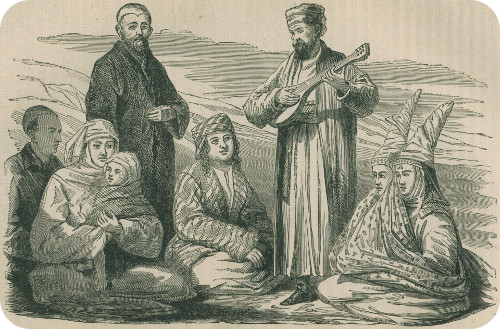
GROUP OF NATIVES IN MONGOLIA.
THE INDIANS.
—Thirty-one Indians, five of them girls, were returned to their homes in Dakota from the Hampton Institute last year. They are employed at different agencies at salaries of fifteen or twenty dollars per month. Of these, seven are farmers and herders, nine carpenters, three teachers, two office boys.
—The number of acres cultivated (not including the civilized tribes) by Indians in 1879 was 157,056; in 1881 it was 205,367. In 1879 they cut 48,333 tons of hay; in 1881, 76,763 tons. There has been from year to year a steady gain of products of all kinds among this class. Indians who are so inclined can earn money by freighting and as drovers.
—Private charity has already given $55,529.14 to buildings for, and expenses of, Indian education at Hampton. Meanwhile, the Government has furnished $33,128.04.
—The Indian Office cannot give a decided opinion as to whether Indians are increasing or decreasing, but think that they are about holding their own.
—The number of Indians at boarding schools, not including those in the Indian Territory, who attended one month or more in 1881, was 3,888. The number who attended day school one month or more, was 4,221.
—Rev. John P. Williamson, of Yankton, Dak., writes: “Give Indians protection of law. There is no earthly court having any authority to punish our Yankton Indians for murder, rape, arson or any other crime committed against the person or property of another Yankton Indian. And with a few exceptions this is the case with all these nations. This is a matter of immense importance, demanding immediate action, even more than education.”
TRAINING COLORED GIRLS.
MISS ANNA M. CAHILL, FISK UNIVERSITY.
If an astronomer wishes to show to any one through his glass the celestial visitor whose presence brightens our morning sky, he must arrange the instrument from his point of vision. Then, stepping aside, his friend will see the object nearly as he sees it. If now I am to bring nearer to you the work for the women of the South, whose interests are uppermost in our hearts to-day, I must adjust the glass from my own standpoint, at the risk of touching upon points that have been presented at other meetings, and without showing you some of the features which you are, perhaps, anxious to see.
Were I a physician among the people for whom I speak, I should urge upon you the physical wants, many and terrible, of that people, for which the ignorance of the women is so largely responsible, and from which they especially suffer.
Were it my mission to carry help and counsel to the lowly homes of our city, I might tell you such tales of the wretchedness and discomfort of many of these homes as would fill your hearts with pity—a wretchedness growing out of an utter lack of comprehension of the meaning of home, and showing the need of instruction in the simplest facts of household economy.
To carry so much of light and knowledge into these homes as would make them abodes of health and thrift is a work worthy the noblest effort of any Christian woman.
But I come from no such special work among the women of our people. Only a few hours ago I stepped from the platform of my school-room, where were gathered before me a room full of upturned faces, some of them familiar from years of acquaintance, some just stamping themselves upon my memory by the interest they are awakening as I meet them in these first days of their stay among us. To an unusual extent this year the numbers on the boys’ side and on the girls’ side are the same, the one side gaining, then the other, as new pupils are added to the school. September’s report showed exactly the same total for each. I like this; it looks as if our girls are to stand side by side with their brothers in life’s battle; as if both were stretching out their hands for the same weapons to help them in the strife.
My interest and work are thus divided; justice to the school demands that I consider the good of the whole; that I assign lessons not for one side nor for the other; that I chide or commend without special reference to sex—in short, that I consider all as members of a common society, and plan for them as having common rights and responsibilities.
When, therefore, I bring this subject to you, it is that you may look at it from the teacher’s standpoint, that you may consider the colored woman of the future—the colored girl of to-day—in her relations as a part of the social organization of the new South.
That the South is new no one who even passes through her great centres can doubt. New railroads are opening up her resources and carrying her trade; the flames of her furnace light up the darkness of many a mountain valley; even her fields are blooming with new abundance under the improved husbandry and greater diligence of her sons. As the morning sunlight strikes the brick walls of factories in view from my window, and nearly all of which have grown up within a few months, I can almost imagine myself in a New England town.
Woman’s place in Southern society (I use the term society in its wider sense) has always been quite different from that which she holds in the North. Accustomed to be protected, and taught to consider a limited social life as her only sphere of activity, she was often beautifully womanly, but lacking in self-reliance; having no confidence in her own mental powers, and not considered as being able to plan or execute any important measures. This feeling is, I think, gradually giving way before a more just appreciation of her own power, and as that power is developed, to a change in public sentiment as to her capacity and her duty.
It was my privilege to count among my friends a young Southern girl, who not content with the average boarding-school of the South, has already partly finished a thorough course of study in a Northern school with the expressed intention of becoming a teacher at her own home.
In an Eastern city during the past summer I found several young ladies who were spending the three hot months at the North, and while there were hard at work on music and other branches of study. They were taking care of themselves, and with eyes aglow with enthusiasm were apparently enjoying their new experience.
Such cases, multiplied as they will be, show that a new leaven is working out an ambition on the part of the Southern lady to win her way by an intelligent and self-reliant womanhood, not simply to charm by her helplessness and amiability.
But all this has reference to white society; you are ready to ask what is its bearing on the colored girls? The humbler life in the old days reflected the ideas of the superior, as the second rainbow reflects the coloring of the first. It will tend to do so now. When, by a sudden revolution the cords of the colored woman’s bondage were broken, and a new society of her own people sprang up around her, especially in the cities, the impress of old ideas was plainly seen. How quickly she copied the more artificial part of her white mistress’ life, exaggerating her elegance into display and her intellectual languor into utter indifference.
In the colored society of to-day, so largely an image of the old order of things, the colored woman does not realize what she has a right to expect or what she ought to require from the other sex among her own people. She has no knowledge of her womanly power or worth; why should she object to the outside gallantry which addresses her with flattering nonsense while it covers an underlying lack of genuine respect, and a sense of superiority that practically leaves her to do all the hard work and regards her as of lower intellectual grade?
Thus, from the impulse to imitate, the colored girl has a source of hope in the advanced position held by her white sister. But her new power of independent self-direction, unshielded by the safeguards that the white girl has, unguided by the intellectual culture that the other can obtain, may work incalculable harm.
What the colored woman’s place was under the old dispensation you know too well. Body and soul the slave of her owners; while her delicate mistress was shielded by all possible safeguards from evil, she was left exposed to all the storms of passion and sin, daring not to have any sense of her own value, her will for resistance growing weaker with each generation. What an element of moral weakness to both races this state of things was, neither race had any conception.
With the changing character and views of the South the colored woman’s position must change also, and she is an important agent in the change. She is no longer a captive, bound to the wheel, obliged to advance or retrograde with the chariot of her master. The place which she will take in the new civilization; the light in which she will be regarded by the white man, and her position among her own people, will be the result of her own choice—a choice which she, in the person of her best and most intelligent representatives, shall make within the next fifty years.
What choice she will make is a question of breathless interest. How to help her make the choice wisely and in time is the problem upon which we are at work. That she labors under great disadvantages in this decision of her destiny is plain. The vain and foolish life of a shallow society has all the ignorance of her nature to work on, to lead her to a life of the most empty frivolity. The door to greater evil is wide open at her feet. The tempter can no longer command, but he may allure—allure with deadly certainty, because inherited tendencies and customs of the past aid him to gain an easy victory. Over many a poor girl who comes to my thought now I could raise the prophet’s lament: “Oh, that my head were waters and mine eyes a fountain of tears, that I might weep day and night for the slain of the daughters of my people!”
Sometimes it seems that the colored woman is willingly—or under the irresistible pressure of circumstances—making her choice so rapidly and so fatally that the slow processes which are her only safety cannot reach the surface in time to save her. But the final decision in this matter does not rest with the present generation; the young girls who are now in our schools, and the children whose ideas they will mold, shall make the choice of her moral standing in the South in relation to both races, and of her intellectual and social standing among her own people.
Our question is how to help her most toward the end we wish.
Realizing that the foundation of a strong moral nature must be laid first of all, as the basis of true womanhood, shall we concentrate our work upon giving her religious instruction, and seek to bind her by bonds of Christian duty? Let me not seem for a moment to question the power of God’s grace to illuminate the heart and change the will; but until she better understands the force of Bible truth and has a nature more sensitive to receive it than is the case with many who come to us, religion, as she comprehends it, will do her no good. So divorced is it from morality, so satisfied as to the future, and so reckless as to the present are many who suppose they possess it, that I dare not present this last great motive of Christian principle until I see the moral sense working under direct and pointed Bible teaching, so that the Christian life may be grasped in its true meaning. Even then it will not do simply to see her converted and then to send her out to battle with evil, any more than Christian could have met Apollyon without the armor that was added to him after he had entered the wicket gate. The conscience, now in shattered ruins, must be built up that it may again perform its office in distinguishing right from wrong. A sense of her own worth—a genuine self-respect which recognizes degradation and flees from it; that will not even listen to evil, must arise as she comes gradually to know the duty and dignity to which God created her. But if we bring our girls to the point where they are inclined to choose honor and uprightness, we must make this choice possible by putting into their hands the means of supporting themselves; we must train them to habits of industry and to right ideas of labor.
The practical question is, “How shall we produce the results we seek?” Whatever of experience and knowledge I have of any one of our girls bids me answer, “Do with her just what you would do for some young girl in the North whom you wanted to save from the most corrupting influences. Take her early away from the home that oftentimes is no protection to her, and as there are no proper homes open to her, transplant her to as good a Christian home as our schools will afford; furnish her work to do when she has not money to meet the expense, and supplement this work by aid in money when necessary. Make her life in these homes as simple and true and elevating as genuine Christian culture will make it; throw around her the refinements of taste, that her own tastes may be improved; give her reading-rooms with wisely-chosen reading matter, music to refine and inspire; treat her with the courtesy and deference which she must learn to consider her due; give her training under suitable instructors in the industrial arts; and keep her through it all to a strict adherence to duty and a close and accurate course of study. Patiently and perseveringly hold her to this life until there begins to dawn upon her a vision of the noble and beautiful womanhood to which she may attain, and then help her to strive after it, through years of discouragement on the part of teacher and pupil, until a strong and true Christian character is built up to withstand the temptations and resist the tendencies that beset her.”
If you are tempted to say this is asking too much for our girls, that we ought to be content with less, at less expenditure of time and money, remember that the girls for whom I speak are the best among their people—the few who will ever have a chance to attain to higher things. Look just behind them and see the throngs, who, in ignorance and woe and sin, are turning their eyes toward you. Listen to them mutely pleading, “Do not set your standard too low, lest we who can only get a small part of our sister’s share of help, should be left to perish in our degradation.”
The objection is sometimes made that such training unfits our girls for their homes and surroundings. This is too often true. I used to think any education which placed them out of sympathy with their own lowly homes was false and wrong, but more extended knowledge of some of these homes leads me to the belief that in the struggle which must go on to save these people, the Scripture shall again be fulfilled—the mother shall be divided against the daughter, and the daughter against the mother; the mother-in-law against her daughter-in-law, and the daughter-in-law against her mother-in-law.
Much misunderstanding and suffering must result, perhaps to both sides, from this clash of the old and the new. In heathen countries, we find it unwise to change the customs which are foreign, unless some principle is involved; in our work, the differences that arise are wholly matters of knowledge or principle. The English civilization exists throughout our country, and what our girl finds as she goes to her home, that is contrary to her improved ideas of home, is the result of ignorance, or indolence, or sin. These, in a quiet, modest way, she must change. God grant her grace to be patient, true and firm through it all.
INDUSTRIAL WORK AT MEMPHIS.
BY MISS ELLA HAMILTON.
Two years ago, through the kindness of friends in the North, two rooms were fitted up in our building, at Memphis, for use in the industrial work among the girls. Will you visit these rooms with me this morning and see what is being done there? As we enter, we find ourselves in the midst of a dozen girls between the ages of 12 and 16, whose eyes and fingers are busy with their work, while their tongues are making sweet music as they sing some simple Sabbath-school hymn. Let us walk about among them, and see what it is that so engrosses their attention. Here, at our side, is a bright-eyed, pretty girl, who is patiently working on the long over-and-over seam, which, it may be, was quite as great a bug-bear to some of us in our childhood days as it is to this little one. Near her is another, busy with a child’s apron, destined, perhaps, for her own little sister. Another still is darning a stocking, while here, at the long table, stands a girl who is taking her first lessons in cutting. There is very little rest for the pleasant-faced teacher during this hour. She must straighten the gathered seams, show the awkward fingers how to take the tiny stitches, give the word of advice or encouragement where it is needed, and see that each one of these active girls is busy upon the task assigned her, and doing that task just as it ought to be done. This work has its place in the course and upon the programme of the school, just as any other school work. The class receives instruction forty minutes each day, for at least one school term. They are taught how to do plain cutting and sewing, and usually become quite expert with the needle. The materials for work have been obtained for the most part from the boxes sent our lady missionary. I had word, however, just before I left home, that these supplies were exhausted, and that they were very much in need of calicoes, needles and threads. Perhaps there are those who can help them in this need.
Adjoining the sewing-room is a kitchen, furnished with a range, a sink, a table and such other articles as are needed by the young ladies who are being initiated into the mysteries of cooking. This class meets four days of the week, two of which are used by the teachers in familiar talks on various subjects, such as the nature of the different foods, their adaptation to the wants of the body, the choice of meats, vegetables, etc. The other two days are used by the girls in actual experiments in the preparation of foods, of course under the supervision of the teachers. They learn how to prepare soups, to cook meats and vegetables, and to make bread, cakes and pies. Better still, they learn how to do this work neatly and economically. Whenever any cooking has to be done, the two girls who have had that in charge are expected to wash the dishes, sweep, dust and air the rooms, and have everything in order for the next day. Sometimes the class gives lunches at noon to their schoolmates or supper in the evening, inviting in their friends. In this way they have raised money enough to pay for all materials used. At one of these entertainments they gave us sandwiches, coffee, chicken salad, cake and strawberries. The bread made by one of the girls was as light and sweet as any I ever ate. To make such bread is an accomplishment of which any one might be proud. Besides the cooking and sewing, we teach our girls how to care for the sick. They have books, and prepare their lessons in this subject as in any other. They learn how to care for the room, and person of their patient, how to prepare such light foods as may be used without harm, the simple home remedies to be administered for ordinary diseases, and the preventatives for such diseases. About all this industrial work the girls themselves are very enthusiastic, seeming to enjoy it quite as well as any other school work. The mothers, too, are very glad that their daughters are having an opportunity to learn how to do these necessary things which they have not the time, or ability, to teach them. In the homes of their parents the girls try to put into practice that which they learn in the school, and as they come to have homes of their own we are sure that they will be better in many ways than they could have been, but for the work they are doing now.
No people can be made very much better except as we reach that center of power and influence, the home. The schools can do something in this direction, and we believe that out from the homes, touched by our A. M. A. schools, will go an influence which will elevate and purify to some extent this whole mass of society.