Chapter XXXII · A STATISTICAL TABLE. PREPARED BY MEN AND WOMEN IN THE FIELD
Reading edition
The past forty years we have had statistics on Indian advancement in the Secretary of the Interior and Indian Office reports. Until late years, these were not detailed, but presented in condensed form the opinions of Agents, Superintendents and employees.
In 1908 the United States Board of Indian Commissioners published a table containing answers to twenty-six questions. The information is valuable and was of service to the Government in handling Indian problems. I do not reproduce the table here for the reason that excellent though it was, it omits protection of property, and vital statistics. Under my chapter devoted to health I have discussed, in a general way, the health of the Indians, but have not presented tables for the reason that I do not wish this book to become too statistical in character.
Feeling that none of the statistical and other reports submitted by Superintendents, Special Agents, Inspectors—or even the Honorable Commissioner himself—emphasized the phase of the situation which in my eyes seemed the most important, I have prepared a table of my own.
Two general questions might be asked every man and woman in the Indian Service, every educated Indian, and every person living in, or near, Indian communities. These are:
First. “Is the Indian citizen treated as the white citizen, or is he discriminated against?”
Second. “Has his moral, physical, financial and general well being increased or diminished, the past twenty years?”
On these two very pertinent and important questions hang the entire future of the American Red Race.
After some thought, I decided to obtain opinions from those who knew at first hand how our wards were progressing. The information I desired must cover all of the United States, where Indians now live. Naturally, it was confined to the region west of the Mississippi, with the exception of tracts in Wisconsin and Michigan.
The excellent table prepared by Commissioner Sells in his report of 1913 is based upon statistics sent in by Superintendents, teachers and physicians. Of necessity, it could not include statements or opinions of missionaries and other observers. It presents the views of employees in the Department.
342After deliberation, a series of fourteen questions were prepared and addressed to upward of 300 men and women representing every reservation, Indian community, or school. Nearly half of these replied, and on pages 345 to 358 I have presented their comments grouped under these various questions. I have tried to make the questions sufficiently elastic to cover every phase of the subject. Specific requests applied to one section of the country, might be out of place in another. For instance, a series of questions concerning the Navaho, might not be answered intelligently if applied to the Ojibwa of Wisconsin.
In studying the table of statistics, one observes that the answers indicate a wide difference of opinion. This is quite natural. As an illustration; at Pine Ridge, Major Brennan—a competent Superintendent, who has been in charge of the fighting Sioux for many years—thinks that there is less sickness and more progress than formerly; whereas a prominent missionary takes the opposite view. Another missionary offers a compromise as between Major Brennan’s view, and the opinion of his worthy co-laborer. This difference does not reflect on the report of Major Brennan, but is an honest difference of opinion. Missionaries and their assistants go about among the Indians of a certain part of the reservation more than does the Agent, who is engrossed in many official duties.
Not a few of the answers are lengthy, and extremely interesting. Were it possible, all of them should be reproduced in this chapter.
A number of answers were received promptly, others have come to hand a few at a time, the past four months. Others are still arriving. It must be remembered that these people are all earnest workers, whether employed by the Government or benevolent organizations—hence the delays. Beyond question, many will reach me too late to be included in the table. There is also a class of excessively timid persons, who seem to think that to answer the questions, may involve them in controversy, or cast reflection on the Interior Department. It is quite surprising that so many correspondents should take this view.
The differences of opinion in nowise affect the table as a whole. On a large reservation, the Indians in one section may be rather backward. For instance, there will be more sickness at Pine Point, White Earth reservation, than about White Earth agency. Hence, the priest at Pine Point would report a worse condition among his Indians than the Agent at White Earth. In the great Indian area of eastern Oklahoma, near the schools conditions are satisfactory, whereas back in the hills, there is much suffering and distress. Also in Oklahoma, near the towns will live Indians who drink and gamble. Therefore, if such facts are taken into consideration, many of the apparent discrepancies in my table will be readily understood by readers. Upwards of a hundred of my correspondents have been very frank, and many of their recommendations and suggestions are purposely omitted for the reason that to incorporate them would seem like criticizing the present administration. This is not my purpose, as has been frequently pointed out in this book. All I desire to do is to present facts, and include sensible remedies suggested by correspondents on the ground.
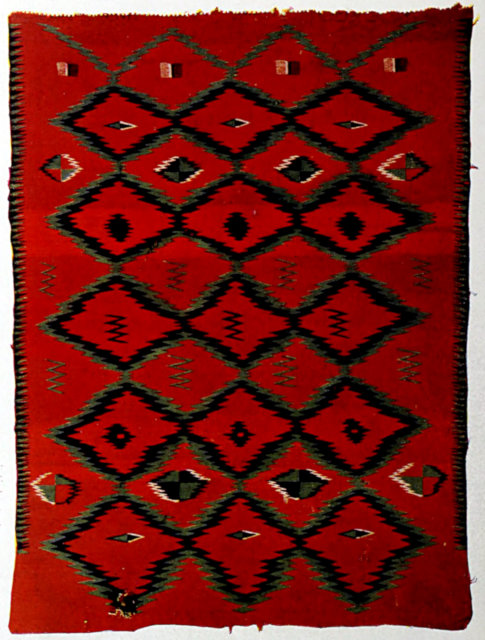
From “Indian Blankets and Their Makers” by George Wharton James. A. C. McClurg & Co., Publishers. OLD BAYETA SADDLE BLANKET
343If we average up the entire table and allow for the progress in the sections wherein are located schools; where Superintendents, through efficient farmers and teachers, have brought about advance of Indians, we will find that in many parts of the country there is a distinct advance. In other portions of the United States the natives are either at a standstill, or have retrograded. The best showing is in the Navaho country, where good work has been done by all the Superintendents and missionaries, by Rev. Johnson, and by the Agent at Shiprock, Mr. W. T. Shelton—where now the desert blossoms like the rose. The general policy as carried out by Major Peter Parquette, Superintendent of the Navaho, and his able assistants, has been to let them alone and permit them to work out their own salvation under a slight supervision. As the Navaho are today the largest body of Indians speaking the same language, and chiefly full-bloods, in this country, the Navaho statistics are sufficiently strong in the point of progress to appreciably raise the entire tone of Indians in the United States. This should be a lesson not lost on our Congress. While this is true and other communities, such as Tulalip Agency, Washington, show a marked gain, the general tone of Indian communities as to advance in the arts, health, etc., is not satisfactory. The table clearly indicates this. We must take into account two important factors in studying the reports of my correspondents. First, the Superintendents, very naturally, wish to present their wards in as creditable a manner as possible. They do not exaggerate, for they are all honest and competent observers. But they rather minimize the sad side of the story. The teachers, missionaries, priests, and the doctors rather lean toward a pessimistic view of conditions.
In our final analysis we find that a majority of the correspondents realize the difficulties under which the Indians labor, being discriminated against in their respective communities. That is, that although we claim citizenship for the Indians, all the facts point to the conclusion that the citizenship is not effective. While we claim to care for the health of the Indians, we have an insufficient number of doctors and hospitals. While we build many irrigation plants, prepare model farms, etc., we do not provide the Indians with sufficient seed, stock, implements, wagons, etc., 344whereby they may become self-supporting. Most important of all, where we have given the Indians deeds to their property, the majority of them lose the property. It is not pertinent in the table of statistics to enter into the question whether the Indian or the white man is at fault in this respect. The bald facts are to the effect that Indians lose their property.
The statistics indicate that education is advancing, and allotting of lands has far advanced. In education alone, the Indians certainly have advanced to a marked degree. Practically all Indians under fifty (save those referred to on page 27) have had some schooling.
For various reasons the names of the correspondents are omitted, although their original communications are preserved in my files. In various chapters throughout the book, I have incorporated partial or complete statements from these same correspondents. In the table, the answers to the questions have been presented in a few words. Many of the sentences are actual quotations, but others present in condensed form the opinions of the writers. Many correspondents have devoted an entire page to answering one question. Frequently, after answering the questions, the correspondent has written several pages in order to present his views concerning the Indian problem. Others have selected such questions as appeared to them to be of primary importance, and have answered these at considerable length. A majority of the correspondents realize that the protection of the Indian’s property, the safeguarding of his health, and the relation between the two races constitute the essentials of the Indian problem, and that all other considerations are secondary.
345
TABLE OF STATISTICS
Correspondent Is there more tuberculosis and trachoma among your Indians now than ten years ago? Are children discharged from the schools because of diseases, properly treated at home? Have many children the past ten years, been dismissed from the schools? In your opinion, has there been a high percentage of deaths among the children, suffering from tuberculosis, sent from the schools to their homes the past ten years? Are the Indians holding their allotments, or are the white people procuring the same? Is the general condition of the Indians as a body more satisfactory than ten years ago?
Alaska
No. 1. Nulato Tuberculosis not very much increased, but ten times as much trachoma. Not generally, but occasionally, seldom properly treated at home. Very few, if any. No. Indians ready to sell regardless of consequences. Rather less so.
No. 2 St. Michaels No. Not one. Not one. No white men here. Much better.
No. 3 Yes. No. Yes. Uncertain. None here. No.
Arizona
No. 1 Ft. Defiance Less tuberculosis and trachoma. No. (No diseases treated properly at home). Few, government regulation. Yes. Holding their allotments. Yes, much better.
No. 2 Parker Records do not show it. No. Eight, in last three years. Yes. Keeping their allotments. Decidedly so.
No. 3 Phoenix Increased, I think.
No. 4 Sacaton No reliable statistics. Not generally. Not able to state. Do not know. No allotments made. Need water to improve.
No. 5 St. Michaels No. No diseases treated at home. Few; tuberculosis cases. Yes. Holding allotments. Yes.
No. 6 Tucson Cannot answer. Yes and No. Very few. Cannot answer. Holding their allotments. Cannot answer.
No. 7 There is. Tuberculosis, discharged. Trachoma, treated in schools. Many. Yes. Allotments held by the Government. It is.
346California
No. 1 Banning No. Yes, sent home to die. Not many. There has not. No allotments. Decidedly better.
No. 2 Campo No. No proper treatment at home. One case on account of sickness. No children sent home. No allotments. Fifty per cent better.
No. 3 Covelo No. No. No treatment at home. Comparatively few. Only healthy children enrolled. No allotment held by white men. More farming, morals very little improved.
No. 4 El Cujon No. No. No. No. No allotments. Yes.
No. 5 Greenville I think not. No. Probably about twenty. Yes. Few allotments sold to best interest of Indian. Yes.
No. 6 Likely Yes, much more. No. No. No. Holding them. No, much worse.
No. 7 Pala There is much more than five years ago. Percentage very small. All sent home have died (seven). Holding them by law. Much better.
No. 8 Ukiah Not to my knowledge.
No. 9 Yuma Yuma No. No. No. No. Holding them. No.
No. 10 N. California I would say not so prevalent. By law, must be sent home. Necessary in few cases. Not many. No. Just received allotments. Yes, decidedly.
Colorado
No. 1 Navaho Springs No data. No treatment at home. No data. Yes. No allotments. Yes.
No. Dakota
No. 1 Elbowoods We have looked into the condition more, that is all, I think. No. No tuberculosis or trachoma cases admitted. Yes. Holding most of them. Yes.
No. 2 Elbowoods Yes, I believe there is. None of late. Yes, from non-reservation schools. Indian holds land. Yes.
No. 3 Ft. Yates Less frequent now. No. Few. About 2%. Holding them. No.
No. 4 Standing Rock Greatly increased. Not sent home soon enough. Holding them.
347So. Dakota
No. 1 Cheyenne I think so, at least more of it is known. I think not. Not a great many. No. Some are, others want to sell. No.
No. 2 Crow Creek I do not think so. No. Percentage high. Cannot dispose of lands. No.
No. 3 Flandreau More satisfactory.
No. 4 Greenwood About the same. No treatment at home. Not many. No. Two-thirds of land now in hands of white people. In some respects yes.
No. 5 McLaughlin Yes. Only when case is hopeless. Yes. Very high. Very few sales. Not much.
No. 6 Mission Both very bad. In some cases. High. Some sell. Yes and No.
No. 7 Oahe I think not. Not as a rule. Yes. Yes. Holding allotments. Yes.
No. 8 Pine Ridge No. Few given proper care. Twenty-three from non-res’n schools none from reservat’n. One hundred percent from enteric tuber’s, none from other tuber. In most cases. Much better.
No. 9 Pine Ridge So it seems to me. Few. Per cent. not so high. Holding allotments. Poorer.
No. 10 Rosebud Less. Not allowed to attend. Few. Very slow sale. Better.
No. 11 Rosebud Ag. Not so much. Yes. None except for infectious diseases. No. Holding own, but selling heirship lands. Yes.
No. 12 Sisseton No. No. Sick children, because of lack of room. Not a high percent. Indians want to sell. Some improvement.
No. 13 Sisseton No. Some are. Scarcely any. Two percent. Forty percent holding own. Yes, great improvement.
No. 14 Sisseton Probably less tuberculosis, more trachoma. No. Diseased ones not taken. Yes. Whites, as soon as they can. No.
No. 15 St. Francis Tuberculosis same, Trachoma better. Not so very many. No data. Not allowed to sell. Yes, in some respects.
Idaho
No. 1 Fort Hall Yes. No. Aver. 31 per year. Almost 100%. None sold yet. I think so.
No. 2 Ft. Lapwai I think there is more. No. Yes, but taken to hospital. Do not know. Whites are buying heirship lands. Yes.
No. 3 Lapwai Less, it has been stated. Examined before admitted. Few. Many deaths. Largest percent held by Indians. Better.
No. 4 Slickpoo Yes, more tuberculosis. Yes, for contagious diseases. Yes. Yes. Whites buying from half-breeds. I think not.
Iowa
No. 1 Toledo Not on the increase. They are not. No data. No. Unallotted. Yes.
348Kansas
No. 1 Baxter Springs Yes, among some families. No. No. No. Yes, until restriction is removed. Yes.
No. 2 Powhattan No. Not well cared for at home. Comparatively few. Yes. Majority are. Yes, except for morals.
Minnesota
No. 1 Winnebago No, not so much. No. None from our school. Not from our school. White people rent or buy fast. No.
No. 2 Beaulieu More tuberculosis, less trachoma. None. Only 15% will hold allotments in 6 years. No.
No. 3 Cass Lake I should judge so. No. Not many, they are examined before admitted. Percentage high. Whites get all they can. No.
No. 4 Cloquet Not more than ten years ago. Very few. Few. Thirty percent. Holding their allotments. No.
Montana
No. 1 Browning No. In many cases. No data. High percent. No allotments made. Yes.
No. 2 Crow Ag’cy No. Not a great many. No. High percent. Sell patents in fee and heirship lands. Yes, decidedly.
No. 3 Poplar Tuberculosis same, more trachoma. About ten a year. Percentage is above the average. Indians just received them. Far better.
No. 4 Jocko No. No. No boarding-school. No. Full-bloods are, the others sell. Yes.
No. 5 Lame Deer Yes, more. Not properly treated at home. Not many. High percent. No allotments. Yes.
No. 6 Lodge Grass No. No. Two in ten years. No, the reverse is true. Prefer to sell when they can. Yes, decidedly.
No. 7 St. Ignatius At least as much. Tuberculosis cases sent home, trachoma treated at home. Twenty-five in ten years. Very high percent. Holding them. No.
No. 8 Wolf Point I do not think so. No. No. No. Holding allotments. Yes, much.
349Nebraska
No. 1 Santee Less tuberculosis but possibly more trachoma. Very few. No. Very high percent. Holding them fairly well. Yes.
No. 2 Santee I think not. More notice is made of it. Cannot say. Cannot say. Many pass into white hands. Yes.
Nevada
No. 1 Nixon No. No. Four. No. No allotments made. Yes, very much.
No. 2 Schurz Yes. No. Twenty to thirty. Yes. Holding allotments. Yes.
New Mexico
No. 1 Albuquerque Apparently there is more. No. Yes. Yes. Holding allotments. Yes, slowly.
No. 2 Gallup I do not think so. No. No record. No. Holding allotments. Yes.
Oklahoma
No. 1 Anadarko Probably more is known. Not as a rule. Do not know of many. Yes. Some Indians sell. Yes.
No. 2 Anadarko About the same. No. No, not very many. Yes. Those who can, sell. Yes.
No. 3 Anadarko On the increase. Not as a rule. Ninety-six not admitted, 25 dismissed from 1300 this year. No. Dispose of them whenever they can. Yes.
No. 4 Atoka I think so. No. Do not know. Yes. Whites getting many. No.
No. 5 Bacone No data. No. Yes. Whites getting many.
No. 6 Carnegie Less tuberculosis, trachoma same. Not many. Yes. Whites getting many. No.
No. 7 Checotah Yes. No. A good number. Yes. All unrestricted are sold. No.
No. 8 Darlington Less tuberculosis, trachoma unknown ten years ago. Not here. Yes. Very high, but reducing. Both are true. Yes.
No. 9 Durant Considerably less. Are not admitted. Selling as fast as they can. Yes.
No. 10 Durant No increase. No. No. Nearly all die. Whites getting them. Indian says, no. I say, yes and no.
No. 11 Eufaula Not increasing. No. Six this year. Not high. Whites try to. Yes.
No. 12 Hobart No. Yes and no. No. Holding allotments. Yes.
No. 13 Holdenville There is. No. I do not know. They sell all they can. Yes.
No. 14 Hugo More. Discharged for outdoor exercise. Not many. Holding allotments. Indian not satisfied.
No. 15 Hugo Less tuberculosis, trachoma same. Very few. Do not know. High percentage. Few Indians hold all their allotments. Yes.
350No. 16 Lawton Less tuberculosis, more trachoma. Cared for in the schools. Very few. High percentage. Very few sell their lands. Yes.
No. 17 Mountain View Less tuberculosis, more trachoma. Not treated at home. A good many, I think. No. Holding them. Yes.
No. 18 Muskogee More satisfactory conditions. Yes.
No. 19 Pawhuska Less tuberculosis, more trachoma. None. No. Whites buying all they can. No. Decidedly.
No. 20 Pawhuska No, I think not. In most cases, no. I think not. Nearly all have died. Very few sales made. Yes.
No. 21 Sapulpa Tuberculosis more, trachoma common 10 years ago. Not treated at home. Not as many as should have been. Yes. Whites hold large per cent. Yes.
No. 22 Shawnee We think not. One or two cases. Very few. Three fatal cases. Holding allotments. Marked improvement.
No. 23 Watanga Less tuberculosis. Not given proper care. Allowed to go home if diseased. Little demand for land. Better.
No. 24 White Eagle I do not think so. Not as a rule. Very small percent. Very low. Nearly all holding lands. Better.
No. 25 Wyandotte I do not think so. Few. Three. One has died, there has not been. Whites hold a little less than one-half. Better.
Oregon
No. 1 Klamath About the same. Not given proper treatment. Yes. Yes. Sales just beginning. Yes.
No. 2 Pendleton More tuberculosis. Few. Full-bloods hold, mixed-bloods sell.
No. 3 Roseburg No data. Yes.
No. 4 Warm Spring More trachoma. No. No record. Yes. Holding them. Yes.
Utah
No. 1 Salt Lake City No data.
New York
No. 1 Gowanda No. No. No. No. Holding them. Yes.
351Washington
No. 1 Bellingham No. Yes. Five. All die. Indians hold lands. Yes.
No. 2 Bellingham No. Never treated properly at home. A good many. Whites getting lands. Yes.
No. 3 Marysville Naturally better on account of selling land.
No. 4 Neah Bay More tuberculosis, less trachoma. Yes. Do not know. No. Sold lands off reservation only. Yes.
No. 5 No. Yakima Perhaps not. Not treated properly at home. Cannot say. Whites swindle lands. Yes, but losing lands.
No. 6 Nespelem More prevalent, I think. Not as a rule. Cannot tell. No. Not over 10% have passed into white hands. Yes.
No. 7 St. Mary’s No. Never properly treated at home. Quite a few. Some have. Just now. Worse on account of whiskey which they get all the time.
No. 8 Takoma More tuberculosis, less trachoma. We discharge only when very sick, and take charge of them. Twenty from our school. Seven died. Only few hold lands after reservation is opened. Yes.
No. 9 Tulalip No. Occasionally. Five percent or less. Yes. Whites encroaching. Generally, yes.
No. 10 Wheeler I think there is more. No. Taken to government hospital. Do not know. White people buying heirship lands. Yes.
Wisconsin
No. 1 Adanah No. No. No. Cannot sell. Yes.
No. 2 Ashland No record of, ten years ago. Plenty now. No, children not cared for at home. Some. Yes. Indians holding them. Hardly.
No. 3 Bayfield I think not. They get better treatment at the schools. Whites not getting much. Yes.
No. 4 Carter There is some here. No school at Agency. No dismissals. Cannot answer. Indians hold no allotments. Conditions improved since Agency was established.
No. 5 Kesbena No. Yes. Thirty, but some have been transferred. No. Yes, whites buy when they can. No.
No. 6 Kesbena No. Yes, or not admitted. No record. No. Large number at Stockridge have. Menominees not allotted. Very much so.
No. 7 Tomah I think there is more. No. About fifteen. No. Indians holding them. More satisfactory.
352
Correspondent Is immorality, in your opinion, due to the presence of low whites, or because of the Indian himself? Which of the two classes are in the better condition, the mixed-blood or full-blood Indian? Are the white people crowding your Indians and taking advantage of them? Do the Indians who are trained near their homes do better than Indians who are educated at a distance and return? Is the population increasing or decreasing? Are white men marrying Indian women in order to secure property? Is the Government properly protecting the Indians?
Alaska
No. 1 Nolato Both, former about five times as much as latter. Not much difference. Yes, to some extent, but Indian retaliates. There is no difference. Slightly decreasing. No. Bureau of Education, yes; laws very bad.
No. 2 St. Michaels Low whites. Better, (Yes). Slightly increasing.
No. 3 Low whites. Both in poor shape. Not much. Decreasing. Not enough protecting.
Arizona
No. 1 Ft. Defiance Indian himself. Mixed-bloods. A little off the reservation. Yes. Slightly increasing. No. No.
No. 2 Parker Due to old customs. Few mixed-bloods same condition. They are not. Yes. Decreasing among the full-bloods. No. It is.
No. 3 Phoenix
No. 4 Sacaton Cases due to Indian. Few mixed-bloods, these not impr’v’d. Yes, in regard to water. Yes. Slight increase, I think. No. Yes, but hampered by law and politics.
No. 5 St. Michaels Due to Indian, because of customs. Mixed-bloods, only a few, however. Yes, off the reservation. Yes. Slightly increasing. No. No.
No. 6 Tucson To Indians. Very few mixed-bloods. Among the Papagos but not the Pimas. I think so. Increasing. No. Not as regards land and water.
No. 7 Low whites. No mixed bloods. Yes, if possible. Most assuredly. Increasing. Law forbids inter-marriages. No.
California
No. 1 Banning Little immorality. Mixed-bloods. No. About same. Just holding its own. No. Yes.
No. 2 Campo Indian himself. Few mixed-bloods, these are better. No. About same. Slowly decreasing. No. Yes.
No. 3 Covelo Both. Mixed-bloods. Not crowding, but taking advantage of necessities. Yes. About same. Only reprobates. Yes.
353
No. 4 El Cujon Very few cases. No. Few of them. Increasing. No. Yes.
No. 5 Greenville To both. The mixed-bloods. To no great extent. No. Holding its own. No. Yes.
No. 6 Likely Low whites. Full-bloods. No. Yes. Decreasing. No. No.
No. 7 Pala Little immorality. Very few full-bloods here. No. Yes, much better. Very slight increase. No. Yes, all it can.
No. 8 Ukiah Yes. No.
No. 9 Yuma, Yuma Indian himself. Very few mixed-bloods here. No. Same. Same. No. Yes.
No. 10 N. California Low whites. Full-bloods. No. Seems to be on the increase now. No. Government has done very little.
Colorado
No. 1 Navaho Springs No whites here. No mixed-bloods here. No. Yes. Increasing three percent per year. No. Yes.
No. Dakota
No. 1 Elbowoods Indian himself. No difference. No not much. No difference noted. Slightly increasing. No. More energy needed.
No. 2 Elbowoods Indian himself. Full bloods. No. Yes. Decreasing. Law forbids it. Yes.
No. 3 Ft. Yates Low whites and mixed-bloods. Mixed-bloods financially. No. Home training seems best. Increasing. Very seldom. Intentions good, officials bad.
No. 4 Standing Rock To Government, because Indian cannot marry until eighteen. Full-bloods. Yes. Yes. Increasing. No. No.
So. Dakota
No. 1 Cheyenne Both. Mixed-bloods. Yes. Yes. Holding its own. Yes.
No. 2 Crow Creek Indian nature (himself). Mixed-bloods. No. Little difference. Vacillating. No. Yes.
No. 3 Flandreau Mixed-bloods a little. No. No. What is necessary.
No. 4 Greenwood Both. Mixed-bloods. Yes. Yes. Increasing. No. Yes.
No. 5 McLaughlin Both. Mixed, materially, otherwise full-blood. Only a large cattle company. Yes. Slight increase. Very few. No, in many respects.
No. 6 Mission Low whites. Same. Often. Yes. Not often. Failure.
No. 7 Oahe Low whites. Not much difference. Not to any extent. Yes. Increasing. Not to any extent. Yes.
No. 8 Pine Ridge Indian (Mixed-blood). Mixed-blood. No. Yes. Increasing. Some. Yes .
354No. 9 Pine Ridge Low whites. Mixed-blood. No. Yes. Mixed-bloods increasing, full-bloods decreasing. Some.
No. 10 Rosebud Both. Both in some respects. No. Yes. Increasing 1%. Some. In some ways.
No. 11 Rosebud Ag. Indian himself. Mixed-blood. Not much. Yes. 4500 to 5490. Yes.
No. 12 Sisseton Indian himself. Hard to say, full-blood in health. Yes, when they can. Cannot tell. Increasing slowly. Few. Indians say no.
No. 13 Sisseton Low whites. Little difference. Some try to. Yes. Increasing. Some cases. Indians are citizens.
No. 13 Sisseton Indian mostly. Little difference. When they can. Little difference. full-bloods decreasing. Mixed-bloods increasing, cases. Not now, few. To some extent.
No. 15 St. Francis Mixed-blood. Some. Yes. Slight increase. Dealt honestly with them.
Idaho
No. 1 Ft. Hall Indian on sex, Low whites on liquor. Not much difference. No but would like to. Yes. Decreasing. Not many. Yes.
No. 2 Ft. Lapwai Low whites. Full-bloods. Yes. Yes. Don’t know. Rarely. Yes and No.
No. 3 Lapwai Indian customs. Mixed-bloods. Not generally. Yes. Increase slightly. No. Yes, here.
No. 4 Slickpoo Both. Mixed-bloods little better. Yes, as much as they can. Much better. Decreasing. A few. Not as regards morality and religion.
Iowa
No. 1 Toledo They keep aloof from whites. Indians themselves. No noticeable difference. Whites encourage them, but few prey on them. No. Increasing slowly. No.
Kansas
No. 1 Baxter Springs Indian himself. Mixed-bloods. When they get a chance. Yes. Decreasing. No. Yes.
No. 2 Powhattan Indian himself. Mixed-bloods, except morally. Yes. No. Increasing some. No. (Some Indians marry low white women.) Yes, could be improved.
355Minnesota
No. 1 Winnebago Low whites. Not much difference. Yes, to a great extent. Yes. Stationary. Not much now. Indians dissatisfied.
No. 2 Beaulieu Low whites. Yes. 75% increase.
No. 3 Cass Lake White man 90%. Full-blood. Yes. Yes. Full-blood decreasing, Mixed-blood increasing. Government ineffective.
No. 4 Cloquet Low whites. Mixed-blood financially; full-blood morally. No. Yes. Full-blood decreasing, mixed-bloods on the increase. Yes, but not many. Yes.
Montana
No. 1 Browning Low whites. Mixed-blood as a rule. No whites here. Cannot say. Increasing for two years. Few. Yes.
No. 2 Crow Ag. Indian nature. Full-blood, but little difference. No. No difference. Slowly decreasing. Two, but do not know the incentive. Yes, all possible.
No. 3 Poplar Early low whites. Mixed-blood. Few whites here. Yes. Increasing, Indian blood. Few cases. Yes.
No. 4 Jocko Indian himself. Mixed-blood. Some trying to. Yes. Increasing slightly. Not to any extent. Yes, all it can.
No. 5 Lame Deer What little there is, is due to Indian. Both the same. No. Same. Standstill. Three marriages to whites in eight years. Yes.
No. 6 Lodge Grass Low whites helped. No. No. Slight increase. Very few whites marry Indians. Yes, but system wrong.
No. 7 St. Ignatius Low whites. Mixed-bloods materially, full-bloods morally. Trying to. Yes. Full-bloods decreasing, but the population increasing. Yes. To some extent.
No. 8 Wolf Point Both. Full-bloods. No. Yes. Increasing. No. Trying to.
Nebraska
No. 1 Santee Indian himself. Mixed-bloods. No, not to any extent. Yes. Standstill. No. Yes.
No. 2 Santee Both. Full-bloods generally. Yes, when they can. Yes. Increasing. No. Not in some cases.
Nevada
No. 1 Nixon No whites here. Full-bloods. No. Yes. Increasing. No. Yes.
No. 2 Schurz Both. Full-bloods. Not on the reservation. Yes. Decreasing. No. Yes, on reservation.
356New Mexico
No. 1 Albuquerque Indian himself. Mixed-bloods. A certain class does. No. Increasing. No. Yes.
No. 2 Gallup Indian himself. No mixed-bloods. No. No. Standstill. No. Yes.
Oklahoma
No. 1 Anadarko Both. Same. Some whites are. Same. Increasing. In a few cases. Yes and No.
No. 2 Anadarko Largely to low whites. Same. Yes, when they can. Yes, as a rule. Increasing slightly. Not to any extent.
No. 3 Anadarko Indian himself. Full-bloods. No. Yes. Increasing. A few. Everything it can do.
No. 4 Atoka To low whites. Mixed-bloods. Yes. No. Full-bloods decreasing. Not much now. No.
No. 5 Bacone Both, mostly to whites. Very much. Yes. Yes. Partially so.
No. 6 Carnegie Low whites. Mixed-bloods. Yes. Yes. Increasing. Some, few. No.
No. 7 Checotah Low whites. Mixed-bloods. Yes. No difference. Full-bloods decreasing. Not now. Trying to.
No. 8 Darlington Low whites. Full-bloods, exceptions favor mixed. No. Cannot say. Increasing slightly. Not here. Not doing all it can, or should.
No. 9 Durant Both. Mixed-bloods. Many try to. No. Full-bloods decreasing, mixed increasing. Not as much now. Doing a great deal.
No. 10 Durant Low whites. Mixed-bloods. Yes. No difference. Decreasing. Yes, low whites are. Do not think so.
No. 11 Eufaula Early low whites, now Indian. Mixed-bloods. Yes. Full bloods decreasing. Yes. It is now.
No. 12 Hobart Both. When they can. Yes. Increasing. As far as Indian will let it.
No. 13 Holdenville Low whites. Mixed-bloods. Yes. I don’t know. Decreasing. Not now. No.
No. 14 Hugo Both. Mixed-bloods. When they can. Same. Decreasing. Yes. Government does not understand.
No. 15 Hugo Low whites. Mixed-bloods. Yes. Yes. Decreasing. Not as much now. Yes, but it makes mistakes.
357No. 16 Lawton Low whites. Little difference. A certain class do. Yes. Increasing 15% in ten years. A few have. Yes.
No. 17 Mountain View Both. No difference. Many do. No difference. Increase. No. As well as Indian lets it.
No. 18 Muskogee Indian himself. Mixed-bloods. Yes. No. Not as a rule. Making a conscientious effort.
No. 19 Pawhuska Low whites. Full-bloods. Yes. Yes. Full-bloods decreasing, population increasing. Nearly every time. All it can.
No. 20 Pawhuska Low whites and colored people. Mixed-bloods. Yes. Yes. Increasing. Yes. As far as possible.
No. 21 Sapulpa Both. Full-bloods. Yes. Not if those trained away are well advanced. Yes.
No. 22 Shawnee Both. Mixed-bloods. Some try to. Young children do. Increasing. Doing efficient work.
No. 23 Watanga Early whites. Same. Some try to. No difference. Mixed-bloods increased. Full-bloods, standstill. Two cases in 15 years. All it can.
No. 24 White Eagle Both. Same. They cannot. Yes. Increase. No. Yes, but needs changes.
No. 25 Wyandotte Low whites. Same. All they can. No difference. Slight increase. Not markedly true. All it can.
Oregon
No. 1 Klamath Indian himself. Mixed-blood. No. I think so. Standstill. Not yet. I think so.
No. 2 Pendleton Full-blood decreasing, mixed-blood increasing. No. Yes.
No. 3 Roseburg Both. Mixed-blood. Yes. Yes. Yes. Yes.
No. 4 Warm Sp. Indian (no whites here.) Same. Some do. No. Decreasing. No. Yes.
Utah
No. 1 Salt Lake City.
Washington
No. 1 Bellingham No low whites here. Same. They cannot. Yes. Increasing. None. Yes, could be improved.
No. 2 Bellingham Low whites. Same. No, except gamblers. I think so. Standstill. They try. Yes, but need police.
No. 3 Marysville Materially the mixed-bloods. Morally the full-bloods. Few. Slowly decreasing. Very few. Yes, at least theoretically.
358No. 4 Neah Bay Indian nature. All mixed-blood. No, they assist them. In my opinion, no. Some tribes increase, others decrease. No. Yes.
No. 5 No. Yakima Low whites and colored people. Mixed-blood. Yes, in every way possible. Do not know. Holding own. Yes. No.
No. 6 Nespelem Low whites. Mixed-blood. Yes, in places. Yes, as a rule. Mixed-bloods increasing. Full-bloods decreasing. Not very much. Doing very well.
No. 7 St. Mary’s Whiskey. About the same. No. I think so. About the same. They try. Yes. Lack of police is bad.
No. 8 Tacoma Mixed, temporally; full-blood otherwise. As soon as they can. Little difference. Increasing. Hardly ever. Only on the reservation.
No. 9 Tulalip Both. Mixed-blood. When they can. Yes. Increasing slightly. Not to any extent. Not sure it has.
No. 10 Wheeler Low whites. Full-blood. Yes. Yes. Rare. Yes and no.
Wisconsin
No. 1 Adanah Low whites. All mixed-bloods. No. Yes. Standing still. Now and then. Too much red tape.
No. 2 Ashland Both. Mixed-bloods. No. Yes. Decreasing. No. Yes.
No. 3 Bayfield Low whites mostly. Full-bloods, morally. Mixed financially and intellectually. Treated as whites. About same. Full-bloods decreasing. Population increasing. Occasionally. Yes.
No. 4 Carter Very little immorality. Only full-bloods. To a small degree. None have gone away. Increasing. No inter-marriages. Done a great deal.
No. 5 Kesbena Both. Mixed-bloods. No whites here. Yes. Small increase. No.
No. 6 Kesbena Both. Full-bloods. Traders, outside, do. Same. Increasing. Not yet. Here it is.
No. 7 Tomah Only to whites when they sell liquor. What few mixed-breeds we have are better. Not here. Yes, perhaps. Increased a little. Indians have no property. Yes. Mistakes are made.
New York
No. 1 Gowanda Indian himself. No full-bloods. Only hotels and saloons. No. No. Not in some cases.
359