Chapter I · TWO POINTS OF VIEW
Reading edition
The American Indian may be regarded from two wide and divergent points of view; that of the scientist, and that of the humanitarian. Under the former should be grouped all study of the Indian, past and present, falling under the general science of anthropology, and its various divisions and sub-divisions. This includes the study of the Indian as a primitive man belonging to the Red Race, and different from all other races on the face of the earth. This view comprises archaeology, physical anthropology, ethnology, folklore, religion, etc.
The second, under the general title of humanitarianism, includes all progress, education, missionary endeavor, and that which may be summed up under the title Civilization, or as the modernists have it, “Social Service.”
After much thought, it occurs to me that we must view the Indian from these two and quite opposed angles—the scientific, the philanthropic.
The average man or woman is not interested in the Indian from the point of view of the scientist. This is quite natural. But, persons of intelligence are interested in the Indian as a strange and peculiar individual. He appeals to their imagination. The public has had presented to it during past years, great numbers of books, pamphlets and articles all dealing with the Indian, and most of them regard him from what is known as “the popular point of view.” Having read, or glanced through scores of these, it is my firm conviction that, after all, we have not properly understood the Indian.
The scientists have made him the subject of technical study, beginning with the generalities of two centuries ago and continuing down to the minutest of detail of modern investigations. Through our records of wars, and our sensational articles, we have been given the impression that his days were spent in fighting, and his nights in war dances. To the scientist he has appeared, not as a man, but as a bit of life to be dissected and preserved; or a specimen duly catalogued, described, and placed in an exhibition case. To the average man or woman, influenced by sensational books, and degrading wild-west shows, and that modern invention, the motion picture, he presents a figure as unreal as it is unhuman.
The Indian of today, with few exceptions, having lost his aboriginal characteristics, the faith of his fathers and his whole life changed, is indeed, a fit subject for the educator, the philanthropist, and the social reformer.
18Would one desire to understand this very peculiar race of red men, one should begin his study by observing the Indian of today. And his observation should cover the character, activities and condition of this Indian of modern times. He should regard him not merely through the cold, unsympathetic eyes of the scientist, who looks for survival of savage or primitive customs, but in a larger and broader sense. To begin with, everyone should realize that the survivors of the American race[2] are more in need today of protection and help than of scientific study. From a purely scientific point of view, the Indian has been pretty thoroughly studied the past fifty years. This statement of mine does not necessarily imply that there should be no technical study of the American Indian in these present days. But as between the work of the scientist and that of the humanitarian the Indian is vastly more in need of the latter than of the former.
In the belief that our studies of the American Indian have so progressed that one may now consider the race in its entirety, I have set myself the rather ambitious task of preparing a number of volumes treating of the American Indian of the present and past. After much deliberation it has occurred to me that the Indian of today should be first considered—hence this volume. At the outset, we find that generally speaking the Indian throughout the United States although maintaining much of his original speech, and in places some of his aboriginal characteristics, yet, as a whole, he is in the transition period.
Our native Americans are, and have been, a remarkable people. Their very manner of life, their striking and picturesque costumes, their peculiar color and their diversified languages seem to have challenged the attention of explorers, travelers, priests and scientists. It is to be doubted if there is another aboriginal race, on the face of the earth, concerning which more books, articles and reports have been published. In Europe, as well as in America, the Indian is celebrated in song and story, yet since the discovery of America his domination has gradually diminished, and the period of his greatest activity (since the advent of the white race) is very short lived compared with that of other tribes of men. From 1500 to 1700, he may be said to have controlled a sufficient extent of the United States and Canada, to dominate it. His power after the year 1700 rapidly diminished, and in 1800 we find that he did not control any large areas save west of the Mississippi and west of Lake Superior. Up to the year 1865, he dominated a large portion of the West, South West and North West. From 1880 down to the present time, his sun has rapidly declined and he may be said today to have passed out of the tribal estate, to have ceased to be a factor in national life as a separate race. He is rapidly becoming merged into our larger body of citizens, and while some thousands of Indians (perhaps 45,000) live and think in the past, the great majority of Indians, like the great majority of foreign immigrants, belong to the body politic.
19
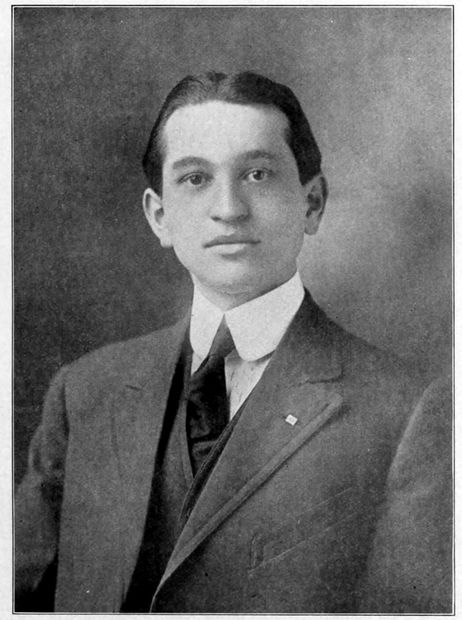
ARTHUR C. PARKER Iroquois. State Archaeologist of New York; Secretary Society American Indians.
20So, we consider the majority in this study of the Indian, rather than the minority; leaving that fraction to the scientist.
If we are consistent in the statement that we shall begin with the present and work backward into the past, we must consider in this volume the activities and the life of the modern Indian, and the modern Indian being in the transition period presents us very little in the way of folklore and traditions. A careful study of the recent reports of ethnological investigators emphasizes this truth. The writers have invariably sought out the older Indians, for the very good reason that they knew much concerning the past. The greater number of Indians—the middle-aged and young, and the thousands of educated Indians—are not able to furnish material such as scientific investigators seek. A confirmation of my statement will be found in that excellent memoir, “Chippewa Music,” by Miss Frances Densmore. This was published by the Bureau of Ethnology in 1913. In this worthy publication, denoting much research, Miss Densmore is dependent on the older people for her information. Even these older persons, as they appear in the photographs accompanying the book, are dressed in garments such as are worn by white persons. Many of these Indians (as in the case of other tribes) keep a few old war bonnets, buckskin coats, moccasins, leggings, embroidered belts, etc., with which they adorn themselves on state-occasions, but their natural dress today, is European in character. Not only in Miss Densmore’s book but in the reports of other investigators in the United States, where a group of Indians are assembled, one observes more evidence of European than native American costumes. It is frequently (if not usually) necessary to ask the Indians to put on their tribal costumes, and sometimes they are compelled to borrow a garment here and there among their friends in order to make up properly. There naturally arises the pertinent question—are not modern Indians so saturated with civilization that their opinions of tribal customs of past decades should be accepted with due reserve? This important question should be considered by some one of our numerous writers on Indian topics.
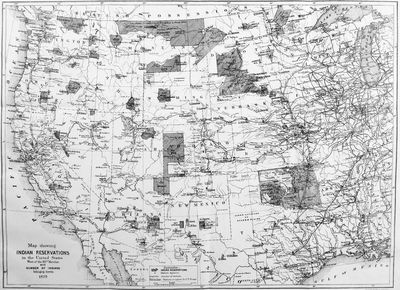
The two maps presented opposite pages 25 and 35, will bring home to readers the tremendous shrinkage of Indian lands during the short space of thirty-five years.
21The map, presented by Commissioner Sells in his report for 1913, as contrasted to the map of 1879, shows that the Indian reservations have been cut down to at least one-third. The population in the year 1881 will be found in small figures on each area given on the map. It will be seen by comparing the period of 1879 with 1913, that the Navaho have greatly increased, and also the tribes now living in Oklahoma (formerly Indian Territory). Others have either diminished, or show slight increases.
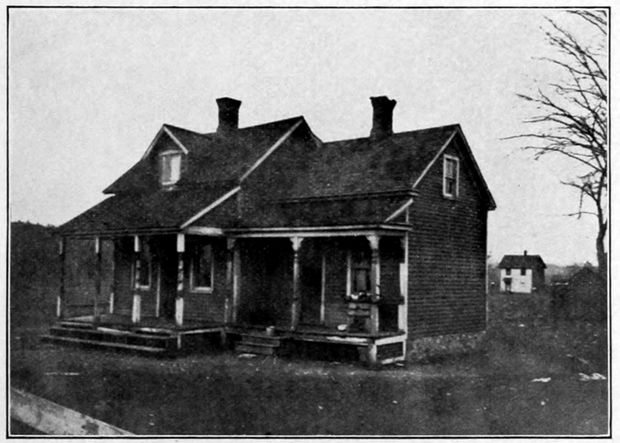
INDIAN HOME, ONONDAGA RESERVATION, NEW YORK
The increases are due to growth of the mixed-blood elements, to white men marrying Indian women.[3] The allotment plan, the accumulation of tribal funds, the increase in property values—all these factors induced many persons to “get on the Indian rolls” and thus swell the numbers; while the pure-blood Navahos are increasing, I doubt if other tribes show growth—save in the mixed-blood element referred to above.
Certainly these two maps present us with facts for serious study. They indicate the rapidity with which the Red Race’s property is being legislated away. Many reservations have been abolished, and the Indians allotted land in severalty. If the Indians held such lands as white men hold their farms, the whole Indian area today would be as large as formerly, even though reservation lines are abolished. Some do hold their 22lands. But most of them sell, lease, or mortgage; the maps, after all, tell the sad truth, and the erasure of governmental lines usually means the blotting out of Indian titles.
Table 1.—Indian population of the United States from 1850 to 1913
Year Authority
1850 Report of H. R. Schoolcraft 388,229
1853 Report of United States Census, 1850 400,764
1855 Report of Indian Office 314,622
1857 Report of H. R. Schoolcraft 379,264
1860 Report of Indian Office 254,300
1865 do 294,574
1870 Report of United States Census 313,712
1875 do 305,068
1876 do 291,882
1877 do 276,540
1878 do 276,595
1879 do 278,628
1880 do 322,534
1881 do 328,258
1882 Report of Indian Office 326,039
1883 do 331,972
1884 do 330,776
1885 do 344,064
1886 do 334,735
1887 do 243,299
1888 do 246,036
1889 do 250,483
1890 Report of United States Census 248,253
1891 Report of Indian Office 246,834
1892 do 248,340
1893 do 249,366
1894 do 251,907
1895 do 248,340
1896 do 248,354
1897 do 248,813
1898 do 262,965
1899 do 267,905
1900 do 270,544
1901 do 269,388
1902 do 270,238
1903 do 263,233
1904 do 274,206
1905 do 284,079
1906 do 291,581
1907 do 298,472
1908 do 300,412
1909 do 300,545
1910 do 304,950
1911 do 322,715
1912 do 327,425
1913 do 330,639
23
Table 2.—Indian population of the United States, exclusive of Alaska, June 30, 1913
(Figures compiled from reports of Indian School superintendents, supplemented by information from 1910 census for localities in which no Indian Office representative is located.)
Grand total 330,639
Five Civilized Tribes, including freedmen and intermarried whites 101,216
By blood 75,253
By Intermarriage 2,582
Freedman 23,381
Exclusive of Five Civilized Tribes 229,423
Grand total 330,639
Indian Population by States and Territories, 1913
Alabama 909
Arizona 41,505
Arkansas 460
California 16,513
Colorado 870
Connecticut 152
Delaware 5
District of Columbia 68
Florida 600
Georgia 95
Idaho 4,089
Illinois 188
Indiana 279
Iowa 365
Kansas 1,345
Kentucky 231
Louisiana 780
Maine 892
Maryland 55
Massachusetts 688
Michigan 7,512
Minnesota 11,338
Mississippi 1,253
Missouri 313
Montana 11,331
Nebraska 3,890
Nevada 7,756
New Hampshire 34
New Jersey 168
New York 6,029
New Mexico 21,725
North Carolina 7,945
North Dakota 8,538
Ohio 127
Oklahoma 117,274[4]
Oregon 6,414
Rhode Island 284
South Carolina 20,555
South Dakota 20,555
Tennessee 216
Texas 702
Utah 3,231
Vermont 26
Virginia 539
Washington 11,335
West Virginia 36
Wisconsin 9,930
Wyoming 1,715
It will be observed that between 1850 and 1887 there is wide difference of opinion as to the number of Indians. In 1886 there were 334,000 Indians, whereas in ’87 the number is given as 243,000. This must be due to faulty enumeration, or to estimating rather than counting. The gradual increase from 1898 to 1913 is for the reason assigned, page 21.
In the table presented by Commissioner Sells it will be observed that the Indians have made some progress along various industrial directions. 24As he has grouped under a total valuation of $22,238,242, all the horses, cattle, hogs and sheep raised by the Indians, it is difficult to compare this table with those of 1879–1881. I present tables of those years prepared long ago by the Board of Indian Commissioners and published by them February 1st, 1882. It will be seen that the number of acres under cultivation are about the same thirty-two years ago as at the present time. In 1881 there were over 2,000,000 head of stock owned by Indians. The value of sheep would reduce an average of $10 per head, horses and cattle would raise it. Some horses might be worth as high as $50, most of them would average $15. Cattle would range from $15 to $25 per head at that time. Mules would be higher, while hogs might be averaged at $8 per head, and sheep, $2. We might strike an average of $10 per head, which would amount to $20,000,000. In view of the present increased value of livestock, the $22,000,000 worth of property and livestock at the present time cannot amount to more than 2,000,000 head. (See [page 29])
I think the slight increase noted in the 1912 table is due to the progress of certain Indian tribes (notably the Navaho) and the increased money value per head of stock. It does not mean that the Indians own more “live” property today than they did in 1881.
All of this, it is understood, is no reflection on the Honorable Commissioner or his able assistants. It merely indicates that the Indians, as a body, have not progressed to the extent that we would desire.
Acreage agricultural lands cultivated by Indians Crops Raised by Indians Stock Owned by Indians
Hay Tons Corn Tons Wheat Bu. Oats and Barley Bu. Horses Cattle Swine Sheep
1912 558,503 158,478 1,525,334 1,343,213 1,001,504 [5]$22,238,242
1904 365,469 405,629 949,815 750,788 1,246,460 295,466 297,611 40,898 792,620
1898 352,217 215,163 1,339,444 664,930 599,665 328,866 214,474 37,359 1,041,315
25