IN AMERIKEY
Reading edition
San Francisco, night, 21st
“Good-bye, Mr. Belgic!”
I delight in personifying everything as a gentleman.
What does it mean under the sun! Kitsune ni tsukamareta wa! Evil fox, I suppose, got hold of me. “Gentlemen, is this real Amerikey?” I exclaimed.
Oya, ma, my Meriken dream was a complete failure.
Did I ever fancy any sky-invading dragon of smoke in my own America?
The smoke stifled me.
Why did I lock up my perfume bottle in my trunk?
I hardly endured the smell from the wagons at the wharf. Their rattling noise thrust itself into my head. A squad of Chinamen there puffed incessantly the menacing smell of cigars.
Were I the mayor of San Francisco—how romantic “the Mayor, Miss Morning Glory” sounds!—I would not pause a moment before erecting free bath-houses around the wharf.
I never dreamed that human beings could cast such an insulting smell.
The smell of honourable wagon drivers is the smell of a M-O-N-K-E-Y.
Their wild faces also prove their likeness to it.
They must have furnished all the evidence to Mr. Darwin. “The better part lies some distance from here,” said my uncle.
I exclaimed how inhospitable the Americans were to receive visitors from the back door of the city.
We are not empty-stomached tramps rapping the kitchen door for a crust of bread.
We refused hotel carriage.
We walked from the Oriental wharf for the sake of the street sight-seeing.
Tamageta wa! A house was whirling along the street. Look at the horseless car! How could it be possible to pull it with a rope under ground!
Everything reveals a huge scale of measurement.
The continental spectacle is different from that of our islands.
We 40,000,000 Japs must raise our heads from wee bits of land. There’s no room to stretch elbows. We have to stay like dwarf trees.
I shouldn’t be surprised if the Americans exclaim in Japan, “What a petty show!”
Such a riotous rush! What a deafening uproar!
The lazy halt of a moment on the street must have been regarded, I fancied, as a violation of the law.
I wondered whether one dozen were not slain each hour on Market Street by the cars.
Cars! Cars! And cars!
It was no use to look beautiful in such a cyclone city. Not even one gentleman moved his admiring eyes to my face.
How sad!
I thought it must be some festival.
“No, the usual Saturday throng!” my uncle said.
Then I asked myself whether Tokio streets were only like a midnight of this city.
My beloved minister kept his mouth open—what heavy lips he had!—amazed at the high edifices.
“O ho, that’s astonishing!” he cried, throwing his sottish eyes on the clock of the Chronicle building.
“Boys are commenting on you,” I whispered.
I beseeched him not to act so droll.
He tossed out in his careless fashion his everlasting heroic laughter, “Ha, ha, ha——”
A hawkish lad—I have not seen one sleepy fellow yet—drew near the minister shortly after we left the wharf, and begged to carry his bag.
He was only too glad to be assisted. The brown diplomatist thought it a loving deed toward a foreigner.
He bowed after some blocks, thanking the boy with a hearty “arigato.”
“Sir, you have to pay me two bits!”
His hand went to his pocket, when my uncle tapped his stooping back, speaking: “This is the country of eternal ‘pay, pay, pay,’ old man!”
“What does a genuine American beggar look like?” was my old question.
The Meriken beggar my friend saw at Yokohama park was dressed up in a swallow-tail coat. Emerson’s essays were in his hand. He was such a genteel Mr. Beggar, she said.
I often heard that everybody is a millionaire in America. I thought it likely that I should see a swell Mr. Beggar among the Americans.
How many a time had I planned to make a special trip to Yokohama for acquaintance with the honourable Emerson scholar!
Alas, it was merely a fancy!
I have seen Mr. Beggar on the street.
He didn’t appear in the formal dignity of a dress coat.
Where was his Emerson?
He was not unlike his Oriental brothers, after all.
He stood, because he wasn’t used to kneeling like the Japs.
The only difference was that he carried pencils instead of a musical instrument.
He is a merchant,—this is a business country,—while the Japanese Mr. Beggar is an artist, I suppose.
My little gold watch pointed eleven.
I have been writing for some hours about my first impression of the city from the wharf, and my journey from there to this Palace Hotel.
The number of my room is 489.
I fear I may not return if I once go out. It’s so hard to remember the number.
The large mirror reflected me as being so very small in the big room.
Such a great room with high ceiling!
I don’t feel at home at all.
Not a petal of flower. No inviting picture on the wall!
I was tired of hearing the artificial greeting, “Irasshai mashi,” or “Honourable welcome,” of the eternally bowing Japanese hotel attendants.
But the too simple treatment of ’Merican hotel is hardly to my taste.
Not even one girl to wait on me here!
No “honourable tea and cake.”
22nd—I need repose. The last few weeks have stirred me dreadfully. I will slumber just comfortably day after day, I decided.
But the same feeling as on the ocean returned.
My American bed acted like water, waving at even my slightest motion.
I fancied I was exercising even in sleep.
It is too soft.
Nothing can put me at complete ease like my hereditary lying on the floor.
I was restless all the night long.
I got up, since the bed was no joy.
Oh, the blue sky!
I thought I should never again see a sapphire sky while I am here. I was wrong.
This is church day.
The bells of the street-cars sounded musical.
The sky appeared in best Sunday dress.
I felt happy thinking that I should see the stars from my hotel window to-night.
I made many useless trips up and down the elevator for fun.
What a tickling dizziness I tasted!
I close my eyes when it goes.
It’s an awfully new thing, I reckon.
Something on the same plan, I imagine, as a “seriage” of the Japanese stage for a footless ghost rising to vanish.
It is astonishing to notice what a condescending manner the white gentlemen display toward ladies.
They take off their hats in the elevator—some showing such a great bald head, like a funny O Binzuru, that is as common as spectacled children—if any woman is present. They stand humbly as Japs to the august “Son of Heaven.” They crawl out like lambs after the woman steps away.
It puzzles me to solve how women can be deserving of such honour.
What a goody-goody act!
But I wonder how they behave themselves before God!
23rd—It is delightful to sit opposite the whitest of linen and—to portray on it the face of an imaginary Mr. Sweetheart while eating.
Whiteness is appetising.
And the boldly-marked creases of the linen are so dear. Without them the linen is not half so inviting.
I was taught the beauty of single line in drawing class some years ago.
But now for the first time I fully comprehended it from the Meriken tablecloth.
I wished I could ever stay gazing at it.
If I start my housekeeping in this country—do I ever dream of it?—I shall not hesitate to invest all my money in linen.
I laughed when I fancied that I sat with my husband—where’s he in the world?—spreading a skilfully ironed linen cloth on the Spring grasses (what a gratifying white and green!), and I upset a teapot over the linen, while he ran after water;—then I picked all the buttercups and covered the dark red stain.
The minister makes a ridiculous show of himself in the dining-room.
His laughter draws the attention of every lady.
This morning he exclaimed: “Americans have no courtesy for strangers, except meaning money.”
And he finished his speech with his boisterous “Ha, ha, ha!”
A pale impatient lady, like a trembling winter leaf, sitting at the table next to us, shrugged her shoulders and muttered, “Oh, my!”
I hoped I could invent any scheme to make him hasten to his post—Kara or Tenjiku, whatever place it be.
He is good-natured like a rubber stamp.
But I am sorry to say that he does not fit Amerikey.
I was relieved when he announced that his departure would occur to-morrow.
My dignity was saved.
I cut a square piece of paper. I pencilled on it as follows:
To the Japanese Legation.
The City of Mexico.
Handle Carefully, Easily Broken.
I put it on the large palm of the minister. I warned him that he should never forget to pin it on his breast.
“Mean little thing you are!” he said.
And his great happy “Ha, ha, ha!” followed as usual.
Bye-bye!
The negroes are horrid. I scanned them on the first chance of my life.
What is the standard of beauty of their tribe, I am eager to be informed!
I searched for “coon” in my dictionary. The explanation was unsatisfactory.
The ever-so-kind Americans don’t consider them, I am certain, as “animals allied to the bear.”
Tell me what it means.
24th—Spittoon!
The American spittoon is famous, Uncle says.
From every corner in this nine-story hotel—think of its eight hundred and fifty-one rooms!—you are met by the greeting of the spittoon.
How many thousand are there?
It must be a tremendous task to keep them clean as they are.
I wonder why the proprietor doesn’t give the city the benefit of some of them.
San Francisco ought to place spittoons along the sidewalk.
The ladies wear such a long gaudy skirt.
And it is quite a fashion of modern gents, it appears, to spit on the pavements.
This Palace Hotel is a palace.
You drop into the toilet room, for instance.
You cannot help exclaiming: “Iya, haya, Japan is three centuries behind!”
Everything presents to you a silent lecture of scientific modernism.
Whenever I am bothered too much by my uncle I lock myself up in the toilet room. There I feel the whole world is mine.
I can take off my shoes. I can play acrobat if I prefer.
Nobody can spy me.
It is the place where you can pray or cry all you desire without one interruption.
My room is great, equipped with every new invention. Numbers of electric globes dazzle with kingly light above my head.
If I enter my room at dusk, I push a button of electricity.
What a satisfaction I earn seeing every light appear to my honourable service!
I look upon my finger wondering how such an Oriental little thing can make itself potent like the mighty thumb of Mr. Edison.
25th—What a novel sensation I felt in writing “San Francisco, U.S.A.,” at the head of my tablet!
(What agitation I shall feel when I write my first “Mrs.” before my name! Woman must grow tired of being addressed “Miss,” sooner or later.)
I have often said that I hardly saw any necessity for corresponding when one lives on such a small island as Japan.
I could see my friends in a day or two, at whatever place I was.
I have now the ocean between me and my home.
Letter writing is worth while.
I did not know it was such a sweet piece of work.
I should declare it to be as legitimate and inexpensive a game as ever woman could indulge in.
I was stepping along the courtyard of this hotel.
I have seen a gentleman kissing a woman.
I felt my face catching fire.
Is it not a shame in a public place?
I returned to my apartment. The mirror showed my cheeks still blushing.
The Japanese consul and his Meriken wife—she is some inches higher than her darling—paid us a call.
I said to myself that they did not match well. It was like a hired haori with a different coat of arms.
The Consul looked proud, as if he carried a crocodile.
Mrs. Consul invited us for luncheon next Sunday.
“Quite a family party—O ho, ho!”
Her voice was unceremonious.
I noticed that one of her hairpins was about to drop. I thought that Meriken woman was as careless as I.
How many hairpins do you suppose I lost yesterday?
Four! Isn’t that awful?
My uncle innocently stated to her I was a great belle of Tokio.
I secretly pinched his arm through his coat-sleeve. My little signal did not influence him at all. He kept on his hyperbolical advertisement of me.
She promised a beautiful girl to meet me on Sunday.
I fancied how she looked.
I thought my performance of the first interview with Meriken woman was excellent. But my rehearsal at home was useless.
26th—I lost my little charm.
It worried me awfully.
It was given me by my old-fashioned mother. She got it after a holy journey of one month to the shrine of Tenno Sama.
I should be safe, Mother said, from water, fire and highwayman (what else, God only knows) as long as I should carry it.
I sought after it everywhere. I begged my uncle to let me examine his trunk.
“Cast off an ancient superstition!” Uncle scorned.
I sat languidly on the large armchair which almost swallowed my small body.
I imagined many a punishment already inflicted on me.
The tick-tack of my watch from my waist encouraged my nervousness.
There is nothing more irritating than a tick-tack.
I locked up my watch in the drawer of the dresser.
I still felt its tick-tack pursuing my ears.
Then I put it under the pillow.
27th—How I wished I could exchange a ten-dollar gold-piece for a tassel of curly hair!
American woman is nothing without it.
Its infirm gesticulation is a temptation.
In Japan I regarded it as bad luck to own waving hair.
But my tastes cannot remain unaltered in Amerikey.
I don’t mind being covered with even red hair.
Red hair is vivacity, fit for Summer’s shiny air.
I remember that I trembled at sight of the red hair of an American woman at Tokio. Japanese regard it as the hair of the red demon in Jigoku.
I sat before the looking-glass, with a pair of curling-tongs.
I tried to manage them with surprising patience. I assure you God doesn’t vouchsafe me much patience.
Such disobedient tools!
They didn’t work at all. I threw them on the floor in indignation.
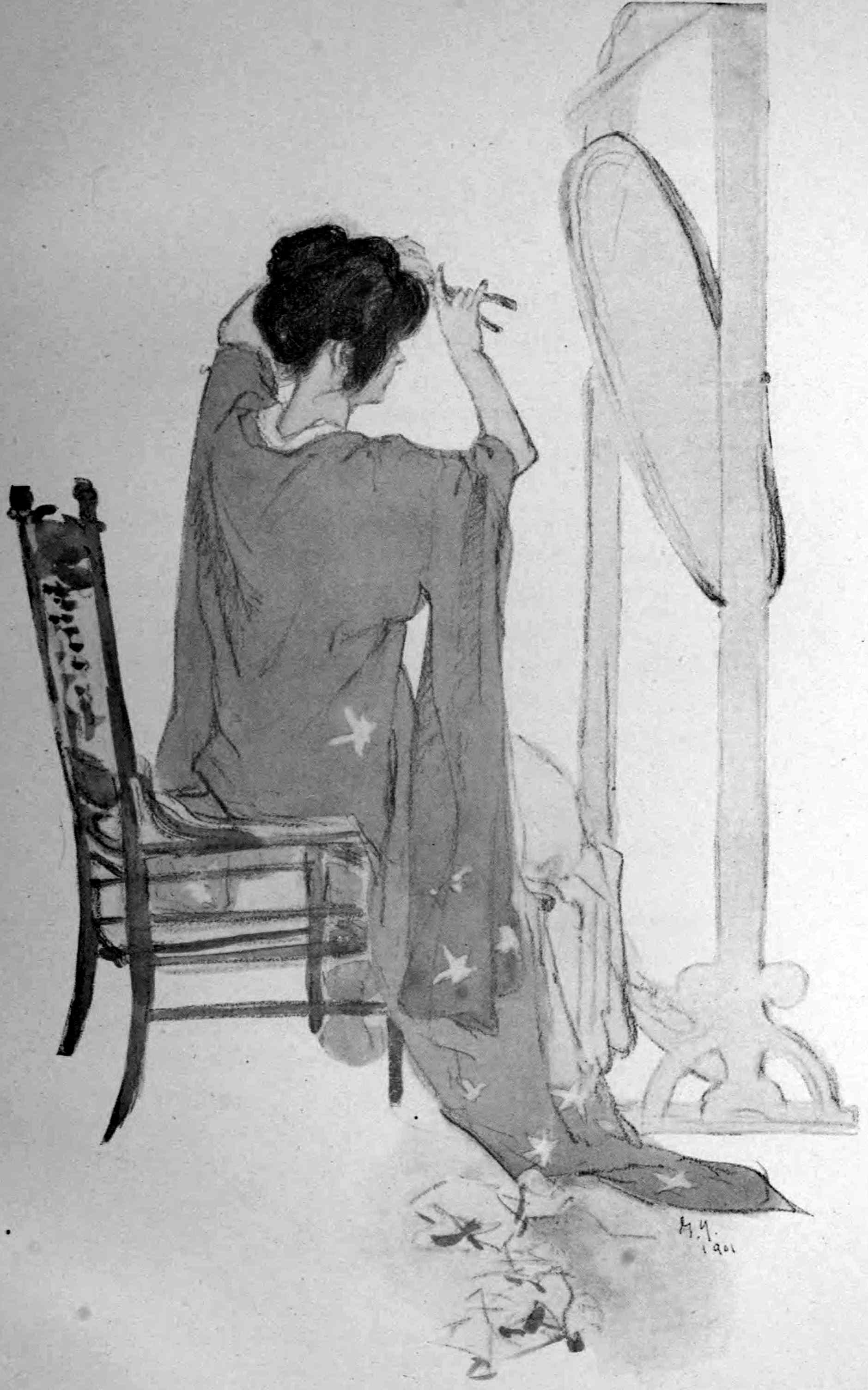
Drawn by Genjiro Yeto “Such Disobedient Tools!”
My wrists pained.
I sat on the floor, stretching out my legs. My shoe-strings were loosed, but my hand did not hasten to them.
I was exhausted with making my hair curl.
I sent my uncle to fetch a hair-dresser.
28th—How old is she?
I could never suggest the age of a Meriken woman.
That Miss Ada was a beauty.
It’s becoming clearer to me now why California puts so much pride in her own girls.
Ada was a San Franciscan whom Mrs. Consul presented to me.
What was her family name?
Never mind! It is an extra to remember it for girls. We don’t use it.
How envious I was of her long eyelashes lacing around the large eyes of brown hue!
Brown was my preference for the velvet hanao of my wooden clogs.
Long eyelashes are a grace, like the long skirt.
I know that she is a clever young thing.
She was learned in the art of raising and dropping her curtain of eyelashes. That is the art of being enchanting. I had said that nothing could beat the beauty of my black eyes. But I see there are other pretty eyes in this world.
Everything doesn’t grow in Japan. Noses particularly.
My sweet Ada’s nose was an inspiration, like the snow-capped peak of O Fuji San. It rose calmly—how symmetrically!—from between her eyebrows.
I had thought that ’Merican nose was rugged, big of bone.
I see an exception in Ada.
She must be the pattern of Meriken beauty.
I felt that I was so very homely.
I stole a sly glance into the looking-glass, and convinced myself that I was a beauty also, but Oriental.
We had different attractions.
She may be Spring white sunshine, while I am yellow Autumn moonbeams. One is animation, and the other sweetness.
I smiled.
She smiled back promptly.
We promised love in our little smile.
She placed her hand on my shoulder. How her diamond ring flashed! She praised the satin skin of my face.
She was very white, with a few sprinkles of freckles. Their scattering added briskness to the face in her case. (But doesn’t San Francisco produce too many freckles in woman?) The texture of Ada’s skin wasn’t fine. Her face was like a ripe peach with powdery hair.
Is it true that dark skin is gaining popularity in American society?
The Japanese type of beauty is coming to the front then, I am happy.
I repaid her compliment, praising her elegant set of teeth.
Ada is the free-born girl of modern Amerikey.
She need never fear to open her mouth wide.
She must have been using special tooth-powder three times a day.
“We are great friends already, aren’t we?” I said.
And I extended my finger-tips behind her, and pulled some wisps of her chestnut hair.
“Please, don’t!” she said, and raised her sweetly accusing eyes. Then our friendship was confirmed.
Girls don’t take much time to exchange their faith.
I was uneasy at first, thinking that Ada might settle herself in a tête-à-tête with me, in the chit-chat of poetry. I tried to recollect how the first line of the “Psalm of Life” went, for Longfellow would of course be the first one to encounter.
Alas, I had forgotten it all.
I was glad that her query did not roam from the remote corner of poesy.
“Do you play golf?” she asked.
She thinks the same things are going on in Japan.
Ada! Poor Ada!
The honourable consul and my uncle looked stupid at the lunch table.
I thought they were afraid of being given some difficult question by the Meriken ladies.
Mrs. Consul and Ada ate like hungry pigs. (I beg their pardon!)
“You eat like a pussy!” is no adequate compliment to pay to a Meriken woman.
I found out that their English was neither Macaulay’s nor Irving’s.
29th—I ate a tongue and some ox-tail soup.
Think of a suspicious spumy tongue and that dirty bamboo tail!
Isn’t it shocking to even incline to taste them?
My mother would not permit me to step into the holy ground of any shrine in Japan. She would declare me perfectly defiled by such food.
I shall turn into a beast in the jungle by and by, I should say.
My uncle committed a greater indecency. He ate a tripe.
It was cooked in the “western sea egg-plant,” to taste of which brings on the small-pox, as I have been told.
He said that he took a delight in pig’s feet.
Shame on the Nippon gentleman!
Harai tamae! Kiyome tamae!
30th—“Chui, chui, chui!”
A little sparrow was twittering at my hotel window.
I could not believe that the sparrow of large America could be as small as the Nippon-born.
Horses are large here. Woman’s mouth is large, something like that of an alligator. Policeman is too large.
I fancied that little birdie might be one strayed from the bamboo bush of my family’s monastery.
“Sweet vagabond, did you cross the ocean for Meriken Kenbutsu?” I said.
“Chui, chui! Chui, chui, chui!” he chirped.
Is “chui, chui” English, I wonder?
I pushed the window up to receive him.
Oya, ma, he has gone!
I felt so sorry.
I was yearning after my beloved home.
This is the great Chrysanthemum season at home. I missed the show at Dangozaka.
How gracefully the time used to pass in Dai Nippon, while I sat looking at the flowers on a tokonoma.
Every place is a strange gray waste to me without the intimate faces of flowers.
Flowers have no price in Japan, just as a poet is nothing, for everybody there is poet. But they have a big value in this city—although I am not positive that an American poet creates wealth.
I purchased a select bouquet of violets.
I passed by several young gentlemen. Were their eyes set on my flowers or my hands?
I don’t wear gloves. I don’t wish my hands to be touched harshly by them. Truly I am vain of showing my small hands.
I love the violet, because it was the favorite of dear John—Keats, of course.
It may not be a flower. It is decidedly a perfume, anyhow.
31st—I have heard a sad piece of news from Mrs. Consul about Mr. Longfellow.
She says that he has ceased to be an idol of American ladies.
He has retired to a comfortable fireside to take care of school children.
Poor old poet!
Nov. 1st—American chair is too high.
Are my legs too short?
It was uncomfortable to sit erect on a chair all the time as if one were being presented before the judge.
And those corsets and shoes!
They seized me mercilessly.
I said that I would spend a few hours in Japan style, reclining on the floor like an eloped angel.
I brought out a crape kimono and my girdle with the phœnix embroidery, after having locked the entrance of my room.
“Kotsu, kotsu, kotsu!”
Somebody was fisting on my door.
Oya, she was Ada, my “Rose of Frisco” or “Butterfly of Van Ness.”
(She was quartered in Van Ness Avenue, the most elegant street of a whole bunch.)
She was sprightly as a runaway princess. She blew her sunlight and fragrance into my face.
I was grateful that I chanced to be acquainted with such a delightful Meriken lady.
“O ho, Japanese kimono! If I might only try it on!” she said.
I told her she could.
“How lovely!” she ejaculated.
We promised to spend a gala day together.
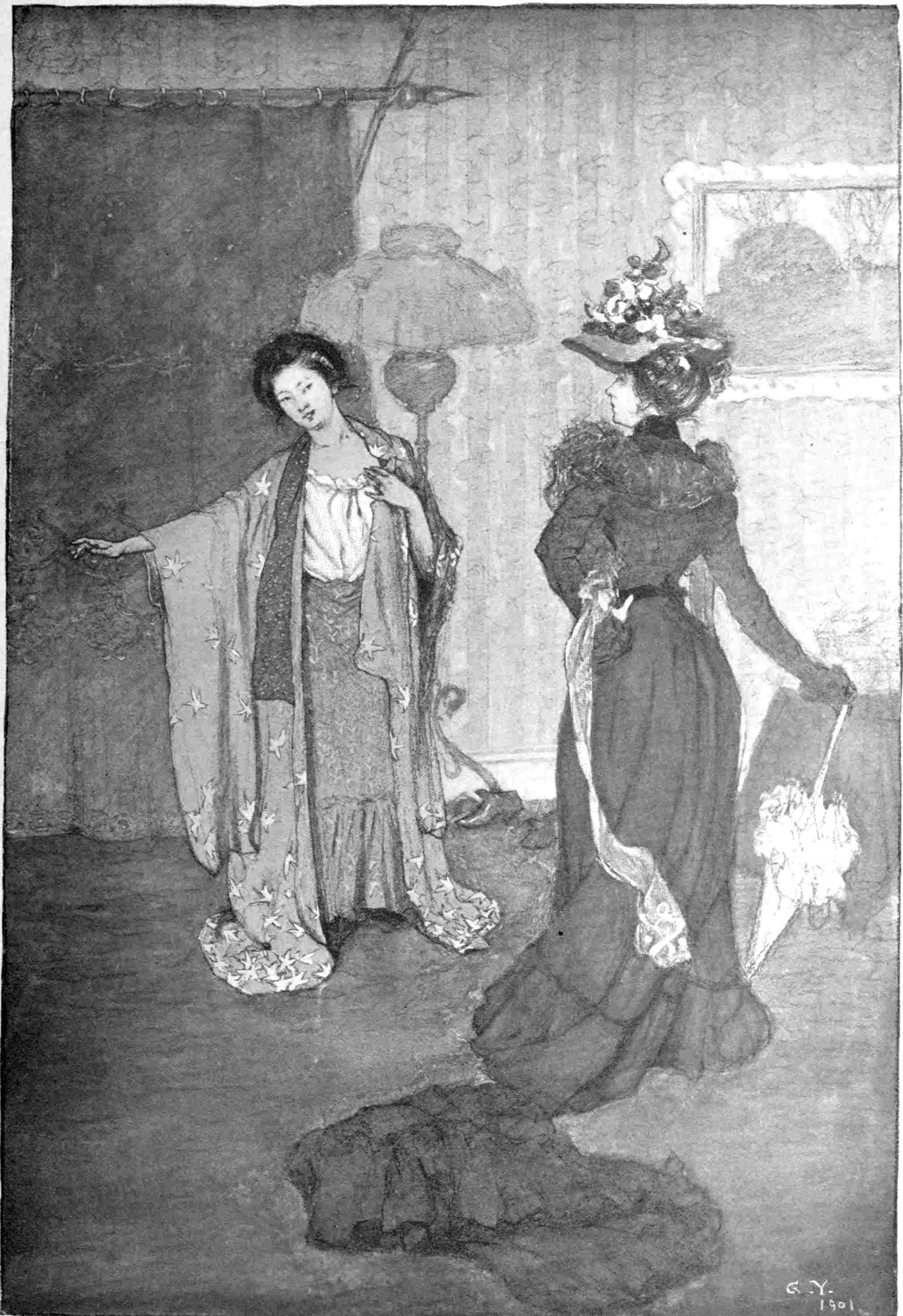
Drawn by Genjiro Yeto “O ho, Japanese kimono!”
“We will rehearse,” I said, “a one-act Japanese play entitled ‘Two Cherry Blossom Musumes.’”
I assisted her to dress up. She was utterly ignorant of Oriental attire.
What a superb development she had in body! Her chest was abundant, her shoulders gracefully commanding. Her rather large rump, however, did not show to advantage in waving dress. Japs prefer a small one.
My physical state is in poverty.
I was wrong to believe that the beauty of woman is in her face.
It is so, of course, in Japan. The brown woman eternally sits. The face is her complete exhibition.
The beauty of Meriken woman is in her shape.
I pray that my body may grow.
The Japanese theatre never begins without three rappings of time-honoured wooden blocks.
I knocked on the pitcher.
Miss Ada appeared from the dressing room, fluttering an open fan.
How ridiculously she stepped!
It was the way Miss What’s-her-name acted in “The Geisha,” she said.
She was much taller than little me. The kimono scarcely reached to her shoes. I have never seen such an absurd show in my life.
I was tittering.
The charming Ada fanned and giggled incessantly in supposed-to-be Japanese chic.
“What have I to say, Morning Glory?” she said, looking up.
“I don’t know, dear girl!” I jerked.
Then we both laughed.
Ada caught my neck by her arm. She squandered her kisses on me.
(It was my first taste of the kiss.)
We two young ladies in wanton garments rolled down happily on the floor.
2nd—If I could be a gentleman for just one day!
I would rest myself on the hospitable chair of a barber shop—barber shop, drug store and candy store are three beauties on the street—like a prince of leisure, and dream something great, while the man is busy with a razor.
I am envious of the gentleman who may bathe in such a purple hour.
I never rest.
American ladies neither!
Each one of them looks worried as if she expected the door-bell any moment.
I suppose it is the penalty of being a woman.
3rd—My little heart was flooded with patriotism.
It is our Mikado’s birthday.
I sang “The Age of Our Sovereign.” I shouted “Ten thousand years! Banzai! Ban banzai!”
My uncle and I hurried to the Japanese Consulate to celebrate this grand day.
4th—The gentlemen of San Francisco are gallant.
They never permit the ladies—even a black servant is in the honourable list of “ladies”—to stand in the car.
If Oriental gentlemen could demean themselves like that for just one day!
I should not mind a bit if one proposed to me even.
I love a handsome face.
They part their hair in the middle. They have inherited no bad habit of biting their finger-nails. I suppose they offer a grace before each meal. Their smile isn’t sardonic, and their laughter is open.
I have no dispute with their mustaches and their blue eyes. But I am far from being an admirer of their red faces.
Japs are pygmies. I fear that the Americans are too tall. My future husband is not allowed to be over five feet five inches. His nose should be of the cast of Robert Stevenson’s.
Each one of them carries a high look. He may be the President at the next election, he seems to say. How mean that only one head is in demand!
A directory and a dictionary are kind. The ’Merican husband is like them, I imagine.
I have no gentleman friend yet.
To pace alone on the street is a melancholy discarded sight.
What do you do if your shoe-string comes untied?
I have seen a gentleman fingering the shoestrings of a lady. How glad he was to serve again, when she said, “That’s too tight!”
Shall my uncle fill such a part?
Poor uncle!
Old company, however, isn’t style.
He is forty-five.
Why can I not choose one to hire from among the “bully” young men loitering around a cigar-stand?
5th—My uncle was going out in a black frock-coat and tea-coloured trousers. I insisted that his coat and trousers didn’t match.
How can a man be so ridiculous?
I declared that it was as poor taste as for a darkey to wear a red ribbon in her smoky hair.
Uncle surrendered.
He said, “Hei, hei, hei!”
Goo’ boy!
He dismissed the great tea-colour.
6th—We had a shower.
The city dipped in a bath.
The pedestrians threw their vaguely delicate shadows on the pavements. The ladies voluntarily permitted the gentlemen to review their legs. If I were in command, I would not permit the ladies to raise an umbrella under the “para para” of a shower. Their hastening figures are so fascinating.
The shower stopped. The pavements were glossed like a looking-glass. The windows facing the sun scattered their sparkling laughter.
How beautiful!
I am perfectly delighted by this city.
One thing that disappoints me, however, is that Frisco is eternally snowless,
Without snow the year is incomplete, like a departure without sayonara.
Dear snow! O Yuki San!
Many Winters ago I modelled a doll of snow, which was supposed to be a gentleman.
How proud I used to be when I stamped the first mark with my high ashida on the white ground before anyone else!
I wonder how Santa Claus will array himself to call on this town.
His fur coat is not appropriate at all.
7th—Why didn’t I come to Amerikey earlier—in the Summer season?
I was staring sadly at my purple parasol against the wall by my dresser.
I have no chance to show it.
I have often been told that I look so beautiful under it.
8th—My darling O Ada came in a carriage. Her two-horsed carriage was like that of our Japanese premier.
She is the daughter of a banker.
The sun shone in yellow.
Ada’s complexion added a brilliancy. I was shocked, fearing that I looked awfully brown.
Ada said that I was “perfectly lovely.” Can I trust a woman’s eulogy?
I myself often use flattery.
A jewel and face-powder were not the only things, I said, essential to woman.
We drove to the Golden Gate Park and then to the Cliff House.
What a triumphant sound the hoofs of the bay horses struck! I fancied the horses were a poet, they were rhyming.
I don’t like the automobile.
Ada was sweet as could be.
“Tell me your honourable love story!” she chattered.
I did only blush.
I hadn’t the courage to burst my secrecy.
I loved once truly.
It was an innocent love as from a fairy book.
If true love could be realised!
In the park I noticed a lady who scissored the “don’t touch” flowers and stepped away with a saintly air. The comical fancy came to me that she was the mother of a policeman guarding against intruders.
We found ourselves in the Japanese tea garden.
A tiny musume in wooden clogs brought us an honourable tea and o’senbe.
The grounds were an imitation of Japanese landscape gardening.
Homesickness ran through my fibre.
The decorative bridge, a stork by the brook, and the dwarf plants hinted to me of my home garden.
A sudden vibration of shamisen was flung from the Japanese cottage close by.
“Tenu, tenu! Tenu, tsunn shann!”
Who was the player?
When I sat myself by the ocean on the beach I found some packages of peanuts right before me.
The beautiful Ada began to snap them.
She hummed a jaunty ditty. Her head inclined pathetically against my shoulder. My hair, stirred by the sea zephyrs, patted her cheek.
She said the song was “My Gal’s a High-Born Lady.”
Who was its author? Emerson did not write it surely.
When I returned to the hotel, I undertook to place on the wall the weather-torn fragment of cotton which I had picked up at the park.
These words were printed on it:
“KEEP OFF
THE GRASS.”
I decided to mail it to my Japan, requesting my daddy to post it upon my garden grasses—somewhere by the old cherry tree.
9th—To-day is the third anniversary of my grandmother’s death.
I will keep myself in devotion.
I burned the incense I had bought from a Chinaman. I watched the beautiful gesticulation of its smoke.
Good Grandma!
She wished she could live long enough to be present at my wedding ceremony. She prayed that she might select the marriage equipage for me.
I am alone yet.
I wonder if she knows—does her ghost peep from the grasses?—that I am drifting among the ijins she ever loathed.
I don’t see how to manage myself sometimes—like an unskilful fictionist with his heroine.
When shall I get married?
10th—I yawned.
Nothing is more unbecoming to a woman than yawning.
I think it no offence to swear once in a while in one’s closet.
I was alone.
I tore to pieces my “Things Seen in the Street,” and fed the waste-paper basket with them.
The basket looked so hungry without any rubbish. An unkept basket is more pleasing, like a soiled autograph-book.
“I didn’t come to Amerikey to be critical, that is, to act mean, did I?” I said.
I must remain an Oriental girl, like a cherry blossom smiling softly in the Spring moonlight.
But afterwards I felt sorry for my destruction.
I thrust my hand into the basket. I plucked them up. They were illegibly as follows:
“ women coursing like a
’rikisha of ’Hama their children
crying at home left somewhere
their womanliness
gentleman with stove-pipe hat blowing
nose with his fingers young
lady kept busy chewing gum
while walking. If you once show such a grace
at Tokio, you shall wait fruitlessly for the
marriage offer.
“ old grandma in gay red skirt
aged man arm-in-arm with wife
so young What a martyrdom
to marry for G-O-L-D! policeman
has no
“San Francisco is a beautiful city, but
’vertisements of ‘The Girl From Paris’
W——d’s Beer
with the watches hanging on their breasts
God bless you, red necktie
gentleman woman at the corner
chattering like a street politician.”
And I missed some other hundred lines.
11th—A letter from the minister arrived.
(I’d be a postman, by the way, if I were a man. A noble work that is to deliver around the love and “gokigen ukagai.”)
I clipped off the Mexican stamp.
I will make a stamp book for my boy who may be born when I become a wife.
Before opening the letter I pressed it to my ear. My imaginative ear heard his illustrious “Ha, ha, ha——” rolling out.
How I missed his happy laughter!
Can he now pronounce a “How do?” in Mexican?
12th—It surprises me to learn that many an American is born and dies in a hotel.
Such a life—however large rooms you may possess—is not distinguishable, in my opinion, from that of a bird in a cage.
Is hotel-living a recent fashion?
Don’t say so!
The business locality—like the place where this Palace Hotel takes its seat—does not afford a stomachful of respectable air.
I preferred some hospitable boarding house in a quiet street, where I might even step up and down in nude feet. I wished to occupy a chamber where the morning sun could steal in and shake my sleepy little head with golden fingers as my beloved mama might do.
We will move to the “high-toned” boarding house of Mrs. Willis this afternoon.
Her house is placed on the high hill of California Street.
I am grateful there is no car quaking along there.
My uncle says I shall have a whole lot of millionaires for neighbours.
California must be one dignified street.
The Chinese colony is close at hand from Mrs. Willis’,—the exotic exposition brilliant with green and yellow colour. The incense surges. So cute is the sparrow-eyed Asiatic girl—such a “karako”—with a small cue on only one side of the head. Dear Oriental town!
Good luck, I pray, my Palace Hotel!
Sayonara, my graceful butlers!
I shall hear no more of their sweet “Yes, Madam!” They talk gently as a lottery-seller.
The more they bow and smile the more you will press the button of tips.
They are so funny.
So long, everybody!
13th—The savour of the air is rich without being heavy.
The Tokio atmosphere emits a lassitude.
It’s natural that the Japs are prone to languor.
A good while ago I pushed down my window facing the Bay of San Francisco. I leaned on the sill, my face propped up by both my hands.
The grand scenery absorbed my whole soul.
“Ideal place, isn’t it?” I emphasised.
The bay was dyed in profound blue.
The Oakland boat joggled on happily as from a fairy isle. My visionary eyes caught the heavenly flock of seagulls around it.
If I could fly in their company!
The low mountains over the bay looked inexpressively comfortable, like one sleeping under a warm blanket.
The moon-night view from here must be wonderful.
I felt a new stream of blood beginning to swell within my body.
I buzzed a silly song.
I crept into my uncle’s room.
I stole one stalk of his cigarettes.
I bit it, aping Mr. Uncle, when my door banged.
14th—I bustled back to my room.
My breast throbbed.
A naked woman in an oil painting stood before me in the hall.
Is Mrs. Willis a lady worthy of respect?
It is nothing but an insulting stroke to an Oriental lady—yes sir, I’m a lady—to expose such an obscenity.
I brought down one of my crape haoris, raven-black in hue, with blushing maple leaves dispersed on the sleeves, and cloaked the honourable picture.
My haori wasn’t long enough.
The feet of the nude woman were all seen.
I have not the least objection to the undraped feet. They were faultless in shape.
I myself am free to bestow a glimpse of my beautiful feet.
I turned the key of my door.
I stripped off my shoes and my stockings also.
Dear red silken stockings!
I scrutinised my feet for a while. Then I asked myself:
“Which is lovelier, my feet or those in the painting?”
15th—I couldn’t rest last night.
The long wail of a horn somewhere in the distance—at the gate of the ocean perhaps—haunted me. The night was foggy.
I had a wild dream.
The fogs were not withdrawn this morning.
I was discouraged, I had to go out in my best gown.
Wasn’t it a shame that two buttons jumped out when I hurried to dress up?
“Are the buttons secure?” is my first worry and the last.
Why don’t Meriken inventors take up the subject of buttonless clothes?
Woman cannot be easy while her dress is fastened by only buttons.
16th—I wish I could pay my bill with a bank check.
Have I money in the bank with my name?
I fancied it a great idea to sleep with a big bank book under the pillow.
I decided to save my money hereafter.
How often have I expressed my hatred of an economical woman!
I detested the clinking “charin charan” of small coins in my purse. Very hard I tried to get from them.
Extravagance is a folly. Folly is only a mild expression for crime.
I deducted ten dollars from the fifty that I had settled for my new street gown. I dropped a card notifying my ladies’ tailor that I had altered my mind for the second price.
“Ten already for the bank!” I said.
I took it to the “Yokohama Shokin Ginko” of this city.
I was given a little book for the first time in my life.
I thought myself quite a wealthy woman preserving my money in the bank.
I pressed the book to my face. I held it close to my bosom as a tiny girl with a new doll.
And I smiled into a looking-glass.
17th—I went to the gallery of the photographer Taber, and posed in Nippon “pera pera.”
The photographer spread before me many pictures of the actress in the part of “Geisha.”
She was absurd.
I cannot comprehend where ’Mericans get the conception that Jap girls are eternally smiling puppets.
Are we crazy to smile without motive?
What an untidy presence!
She didn’t even fasten the front of her kimono.
Charm doesn’t walk together with disorder under the same Japanese parasol.
And I had the honour to be presented to an extraordinary mode in her hair.
It might be entitled “ghost style.” It suggested an apparition in the “Botan Toro” played by kikugoro.
The photographer handed me a fan.
Alas! It was a Chinese fan in a crude mixture of colour.
He urged me to carry it.
I declined, saying:
“Nobody fans in cool November!”
18th—We had a laugh.
Ada, my sweet singer of “My Gal’s a High-Born Lady,” accompanied me to a matinée of one vaudeville.
This is the age of quick turn, sudden flashes.
The long show has ceased to be the fashion. Modern people are tired of the slowness of old times which was once supposed to be seriousness.
Could anything be prouder than the face of the acrobat retiring after a perilous performance?
Woman tumbler!
I wondered how Meriken ladies could enjoy looking at such a degeneration of woman.
I was glad, however, that I did not see any snake-charmer.
What a delightful voice that negro had! Who could imagine that such a silvery sound could come from such a midnight face? It was like clear water out of the ground.
I was struck by a fancy.
I sprang up.
I attempted to imitate the high-kick dance.
I fell down abruptly.
“Jap’s short leg is no use in Amerikey—can’t achieve one thing. I am frankly tired of mine,” I grumbled.
19th—The Sunday chime was the voice of an angel. The city turned religious.
Mrs. Willis—I had no curiosity about her first name; it is meaningless for the “Mrs.” of middle age—indulged in chat with me.
If I say she was “sociable”?—it sounds so graceful.
She announced herself a bigot of poetry. She was bending to make a full poetical demonstration.
Of course it was more pleasing than a mourning-gowned narrative of her lamented husband. (I suppose he is dead, as divorce is too commonplace.)
But it were treachery, if I were put under her long recital of the insignificant works of local poets.
Tasukatta wa!
A little girl came as a relief.
Dorothy! She is a boarder of Mrs. Willis’, the golden-haired daughter of Mrs. Browning.
(Mrs. Browning was a disappointment, however. I fancied she might be a relative of the poet Browning. I asked about it. Her response was an unsympathetic “No!”)
“O’ hayo!” Dorothy said, spattering over me her familiarity.
It takes only an hour to be friends with the Meriken girl, while it is the work of a year with a Japanese musume.
“Great girl! Your Nippon language is perfect! Would you like to learn more?” I said.
“I’d like it,” was her retort.
Then we slipped to my room.
I wonder how Mrs. Willis fared without an audience!
I was sorry, thinking that she might regard me as an uncivil Jap.
“Chon kina! Chon kina!”
Thus Dorothy repeated. It was a Japanese song, she said, which the geisha girls sung in “The Geisha.”
Tat, tat, tat, stop, Dorothy!
Truly it was the opening sound—not the words—of a nonsensical song.
I presume that “The Geisha” is practising a plenteous injustice to Dai Nippon.
I recalled one Meriken consul who jolted out that same song once at a party.
He became no more a gentleman to me after that.
20th—I pasted my little card on my door.
I wrote on it “Japanese Lessons Given.”
I gazed at it.
I was exceedingly happy.
21st—A gardener came to fix our lawn.
There is nothing lovelier than verdant grasses trimmed neatly. They are like the short skirt of the Meriken little girl.
We women could be angels, I thought, if our speech lapped justly. Women talk superfluously. I do often.
What language did that gardener use?
It must be the English of Carlyle, I said, for its meaning was intangible.
I discovered, by and by, that German English was his honourable choice.
My eyes could express more than my English uttered in Nippon voice. My gestures helped to make my meaning plain.
He became my friend.
He carried a red square of cotton to wipe his mouth, like the furoshiki in which a Japanese country “O’ ba san” wraps her New Year’s present.
And again as he was leaving I saw a red thing around his neck.
Was it not the same furoshiki which served for his nose?
It wouldn’t be a bad idea to play amateur gardener.
The season wasn’t fitting for such a performance, however.
A large summer hat! That was the customary attire.
But my light-hearted straw one with its laughing bouquet was not adapted to November, however gorgeously the sun might shine.
And it’s sheer stupidity to track after a tradition.
I wound a large flapping piece of black crape about my head. (How awfully becoming the garb of a Catholic nun would be! I do not know what is dear, if it is not the rosary. A writhing rope around the waist is celestial carelessness.)
I appeared on the lawn, but without a sprinkler and rake. It would have been too theatrical to carry them.
I gathered the small stones from amid the grasses into a wheelbarrow near by.
Just as my new enterprise was beginning to seem so delightful, the luncheon gong gonged.
My uncle goggled from the hall, and said:
“Where have you been? I was afraid you had eloped.”
“I’ve no chance yet to meet a boy,” I spoke in an undertone.
Afterward I was ashamed that I had been so awkwardly sincere.
22nd—There was one thing that I wanted to test.
My uncle went out. I understood that he would not be back for some hours.
I found myself in his room, pulling out his drawer.
“Isn’t it elegant?” I exclaimed, picking up his dress-suit.
At last I had an opportunity to examine how I would look in a tapering coat.
Gentleman’s suit is fascinating.
“Where is his silk hat?” I said.
I reached up my arms to the top shelf of a closet, standing on the chair.
The door swung open.
Tamageta! My liver was crushed by the alarm.
A chambermaid threw her suspicious smile at me.
Alas!
My adventure failed.
23rd—I mean no one else but O Ada San, when I say “my sweet girl.”
She was tremendously nice, giving a tea-party in my honour.
The star actress doesn’t appear on the stage from the first of the first act. I thought I would present myself a bit later at the party, when they were tattling about my delay.
I delight in employing such little dramatic arts.
I dressed all in silk. It’s proper, of course, for a Japanese girl.
I chose cherry blossoms in preference to roses for my hat. Roses are acceptable, however, I said in my second thought, for they are given a thorn against affronters.
I went to Miss Ada’s looking my best.
They—six young ladies in a bunch—stretched out their hands. I was coaxed by their hailing smile.
Ada kissed me.
I had no charming manner in receiving a kiss before the people no more than in giving one. I blushed miserably. I knew I was bungling.
O Morning Glory, you are one century late!
They besieged me.
None of them was so pretty as Ada. Beauty is rare, I perceive, like good tweezers or ideal men.
I distributed my Japanese cards.
All of my new friends held them upside down.
Is it a modern vogue to be ignorant?
Ada played skilfully her role of hostess, which was a middle-aged part. She didn’t even spill the tea in serving. Her “Sugar? Two lumps?” sounded fit. She divided her entertaining eye-flashes among us.
Tea is the thing for afternoon, when woman is excused if she be silly.
We all undressed our too-tight coat of rhetoric in the sipping of tea.
We laughed, and laughed harder, not seeing what we were laughing at.
I couldn’t catch all of their names.
Such a delicious name as “Lily” was absurdly given to a girl with red blotches on her face.
(A few blemishes are a fascination, however, like slang thrown in the right place.)
Her flippancy was like the “buku buku” of a stream.
Lightness didn’t match with her heavy physique.
“How lovely an earthquake must be!” she chirruped. “Shall I go to Japan just on that account? A jolly moment I had last February. A baby earthquake visited here, as you know. I was drinking tea. The worst of it was that I let the cup tumble on to my pink dress. I prayed a whole week, nevertheless, to be called again.”
Woman has nothing to do with a hideous make-up. Miss Lily should not select a pink hue.
“You are awful!” I said.
I told about the horror of a certain famous Japanese earthquake. They all breathed out “Good heavens!”
There was one second of silence.
Ada struck a gushing melody on the piano.
The lively Meriken ladies prompted themselves to frisk about.
I was ready to cry in my destitution.
One girl hauled me up violently by the hand.
“Come and dance!”
Her arm crawled around my waist, while she directed:
“Right foot—now, left!”
I returned to Mrs. Willis’, my thoughts absorbed in a dancing academy.
“I must learn how to skip,” I said.
24th—I hate the alarm clock, simply because it is always so punctual.
“I was too late” is a delightful expression.
“Mrs. Willis’ breakfast is at quarter-past eight!”
Isn’t that “quarter-past” interesting?
And I can never be ready before nine.
25th—I dragged my uncle off to the Chute to enrich my store of zoology.
“One gape more, Uncle, to count up one dozen!” I said, and pulled his mustache in the car.
It was lucky that no one saw my act.
Poor Oji San! Playing chaperon is not a very promising occupation, is it?
I stood by the “happy family” of monkeys. I tried to descry their point of view in orations.
I gave it up.
The vain Miss Polly worked hard to bring everybody to an understanding with one eternal “Hello, dear!”
I found such grace in the elephant when he waved his honourable trunk.
The stupid Mr. Elephant wasn’t stupid a bit in accepting my present.
How philosophically he gazed at me! Very likely I was the first Jap girl to his audience.
What respectable eyes!
“You’ll bankrupt yourself in peanuts,” my uncle warned.
26th—A white apron on my black dress makes me so cute.
I am just suited to be a chambermaid. Shall I volunteer as a servant?
I bought an apron.
To-day is house-cleaning day.
I kept busy a good while arranging my theatrical costume as a maid.
Wasn’t it fun?
I was ready to scrub the floor, when I heard “kotsu kotsu,” on my door.
It was Annie with a broom.
“I’m your help. Just a moment! I have forgotten the finishing glance in my mirror.”
27th—I have been studying the catechism.
I am afraid to go to church, for the minister may put many a question to me.
Is Miss Ada a dutiful church-goer?
I don’t think so.
She would rather mumble a nigger song than a chapter from the Bible.
I will ask her a few things from the catechism at my first opportunity.
28th—“Hand me your cup after you are done with your tea!” Mrs. Browning requested. “I will ponder on your fortune.”
“How delightful!” I said.
My fortune?
I remembered how I used to scatter my pocket money among the fortune-tellers, pleased to be informed of a lot of nice things.
What meaning she could find in a cup!
I felt like a mother with her children already in bed, when I dropped my spoon into my tea.
I felt mistress of the situation.
Was there ever anything more welcome than to learn your fortune?
“A young American (rich, very rich—indeed) will win your affection. The marriage will be a happy one,” she prophesied.
Is that so?
Life is becoming very interesting.
I wonder where my would-be husband is seeking me.
Shall I advertise in a paper?
How?
If my first-rate picture by Mr. Taber were printed, it would be a whole thing in such a business.
I thought the picture beautiful enough to sell at any stationer’s of U.S.A.
How many thousand could I sell in a week?
Could I make money out of it? Some decent fortune, I mean, of course.
29th—Ho, ho, such a day!
I was aroused by the roar of a milk-wagon early in the morning.
I sought a pin in vain.
I tore my skirt on a sneering nail at the door.
I upset my flower-vase.
I sat by my window. A vegetable pedlar howled to me, “Potatoes? Potatoes?”
I couldn’t recall a sweet dream I had last night.
The clamour of a Chinese funeral passed under my room. The carriages were packed with hired “crying women.” Isn’t it a farce?
I went out. My street-car ran off the track.
A fire-engine deafened me.
I passed by an undertaker’s. It was cold like a grave.
The sight stunned me.
30th—Is my nose high enough?
I bought a pair of “nose spectacles.”
Those with wires to circle the ears, which are Oriental (that is to say old-fashioned), would suit even a noseless Formosa Chinee.
But how many Japs could show themselves ready for nose spectacles?
The Optician asked if they were for myself.
He was a trifle uncertain about my nose, I suppose.
“No! For my friend,” I said.
It was a white lie.
I blushed as if I had committed a heavy crime.
I hoped I had not.
I put my new spectacles on my nose, as soon as I returned to my room. Very well they stayed. Mother Nature was specially kind to me.
But what a depression—also what torture—I felt from their clutch!
I was pleased, however, seeing myself somewhat scholarly.
Aren’t spectacles an emblem of wisdom?
The first requirement to be a critic should be spectacles. The second is a pessimistic smile, of course.
My mirror told me that I looked quite modern.
“Book!” I exclaimed.
I must see what effect I could produce with a book on my lap.
I leaped from the chair to fetch one.
My spectacles dropped from my honourable nose on to the hearthstone. My nose was exceedingly stupid.
Alas, and alas!
The spectacles were crushed to pieces.
I was broken also.
I buried my face in the pillow for some time.
Then I said: “I’m not short in my sight. I have no use for them except for fun.”
I wiped my disturbed eyes with a handkerchief. My finger felt the rude marks printed on both sides of my nose.
Dec. 1st—I bought a Louisiana lottery ticket through Annie.
Like any other domestic girl, she has no key to her mouth. She is like a sentence that has forgotten to add the period.
I begged all sorts of gods to drop the capital prize on me.
Thirty thousand dollars! Think!
How shall I manage with them when I have won?
2nd—If I were a painter!
My eyes were fixed upon the dying sun. Its solemnity was like the passing of a mighty king.
Some time glided by.
My thought was pursuing the sun.
The twilight!
Oh, twilight pacifying me as with the odour from a magical palace!
Hush!
The melody of a piano effused from my neighbour.
The best thing in the world is to play music. The very best is to listen to the profuse melody evoked by a master.
Was it a superb execution?
My soul was dissolved, anyhow, in the rapture.
I left my uncle’s room where I saw the grand sun pass away.
I put me in my bed, because my visionary mood was not to be stirred for the world, and because I wished to dream a romance without the delay of a moment.
But I could not slumber.
And I missed my dinner.
I petitioned my uncle to step out into the street for my beloved chestnuts.
Dear Italian chestnut vendor!
I never pass by without buying.
3rd—We start to-morrow for Los Angeles of Southern California.
Mr. and Mrs. Schuyler have invited us to spend some weeks with them.
The gentleman was the former consul at Yokohama. My uncle is his intimate friend.
My new trunk was brought in from the store.
It bears my name in Roman of commanding type.
I stared at the characters as upon an ancient writing whose meaning could only be imagined.
“Doesn’t ‘Miss Morning Glory’ suggest that the owner is a charming young lady?”
My little smile smiled, as I thought that it would, of course.
A new trunk, I am sorry to say, lacks a historical look. An old one is more gratifying, like old brocade or an old ring.
Au revoir, my Ada!
South-bound train, 4th—I was lavish of my art of “bothering.”
My poor uncle—my eternally “poor uncle” was the victim. I wanted some diversion at any price.
His face scowled as I bored him with my successive questions.
I thought his irritated face fascinating.
When I presented another question, he was droning a genteel snore.
I twisted an edge of a newspaper into a roll. I thrust it into his nose.
There was no doubt about his starting.
“Bikkurishita!” he exclaimed.
Then he begged to be allowed some chance to rest.
This is a “bad year for cucumbers” for him. He made a mistake in accompanying me on Meriken Kenbutsu.
Honestly I have to behave nicely.
My opening question to Uncle was: “What’s the derivation of ‘damn’?”
“Imperialism” was my last.
I have a high regard for the people dignified by using the capital “I” for the personal pronoun.
But if I were the President I should not wish to be addressed with that hackneyed, unromantic “Mr.”
The cartoonists making sport of the President shock me.
How big-hearted the President is!
Those “devils” would be beheaded in the Orient.
Los Angeles, 5th—No one bangs the door at Schuyler’s.
The servants drop their eyes meekly before they speak.
A well-bred atmosphere circulates.
A woman over forty-five is nothing if she isn’t motherly enough to let one feel at home. Mrs. Schuyler’s silence is a smile. I loved her from my first glance. I thought I could ask her to wash my hair some sunny day. I could fancy how pleasant it would be to immerse myself in her chat—such sort of talk as an old-bonneted “how to keep house”—while I was drying my hair in the indolence of a sea-nymph. Modern topic is like black coffee, it is too stimulating. There is nothing dearer than a domestic subject.
I have no hesitation in accepting her as my Meriken mother.
I am positive I would feel more comfortable if I had one in this country.
How good-naturedly she was fattened!
A somewhat stout woman looks so proper for a mother.
I wished I could lean on her plump shoulder from the back in Japanese girl’s way, and play with her hair, and ask a few innocent questions like “What have I to eat for dinner?”
She talked about the Japanese woman, principally praising her shapely mouth.
I felt conceitedly, because I was given one classical little mouth, if I had nothing else to be noticed.
Mr. Schuyler grasped my hand ever so hard. My hand was buried in his palm. His manner was courteously boyish.
His body is erect like a redwood.
Such an old gentleman gives me the impression of another race from the divine realm of everlasting youth. A Jap after fifty is capped with “retired.”
But the work of the American gentleman is only finished when he dies.
Great Meriken Jin!
Mr. Schuyler shows more civility to his servants than to his wife.
Here I can study the typical household of America’s best caste.
6th—“Anata donata?”
I rubbed my dreamy eyes, scanning my room.
Who was the Japanese speaker?
I crept to the door, and opened it slightly.
Not a soul was there.
I heard the trivial clatter of the kitchen stepping up.
I dipped into my bed again. I smiled sceptically, thinking that I must have been dreaming.
“Gokigen ikaga?”
I was addressed again by the same voice.
I said that there was positively some mischief in my room.
I leaped down from the bed.
I inspected my slippers. I made sure there was nothing strange under the pictures on the wall. I tugged at the drawers. I tumbled every blanket. I pried in the pitcher.
I sat on the bed wrapped in fog.
The blind rustled.
The sunbeams crawled in marvellously.
Then I was frightened by another speech, “Nihonjin desu.”
I declared that it flew in from the outside.
I rolled up the blind.
Oya, oya! There was a parrot perching in a cage by my window!
He adjusted his showy coat first, and then sent me his inquisitive eyes.
“Anata donata?” he repeated.
“Morning Glory is my insignificant name, sir,” I replied.
A trifling toss of his head showed his satisfaction in my name. I thought he was trying to set me at ease with his smile.
“Gokigen ikaga?”
“I feel splendidly, thank you, Mr. Parrot!” I said.
Then pressing his head backward he looked haughtily at me with fixed eyes, and announced:
“Nihonjin desu.”
“I’m also a Jap,” I muttered.
He was the most profound Japanese scholar, Mrs. Schuyler said, in all Los Angeles. Mr. Schuyler Jr. brought him from Kobe last spring.
I told her the incident of this morning.
She laughed, she said she expected it.
Bad Mother Schuyler!
17th—Dear Baby! Kawaii koto!
I hugged the baby of Mrs. Schuyler Jr. and kissed it.
Her husband is away in Japan for the tea business.
It was the darling baby, I thank the gods, who received my first kiss.
It’s heavenly to stamp love with a kiss. Lips are the portal of the human heart.
Kiss is sweet.
I say that it marks an epoch in the spiritual evolution of the Japanese when they learn what a kiss is—but not how to kiss.
The baby crawled like a sportive crab. It orationed. It! I felt sorry that “It” would soon be changed to “He” or “She.” It caught sight of a piece of burnt match in the course of its expedition. It turned its way and clinched it with its fingers. It hastened to the mother to exhibit it, and waited patiently with its great game for Mamma’s praise.
I nearly cried in my excitement at such a pathetic revelation.
Lovely thing!
The baby had blue eyes.
My preference wasn’t for blue eyes. I often snapped at them, saying that they were like a dead fish’s eyes.
But how long can I keep up my ill-will, when I look with delight upon the blueness in water, sky and mountain?
Isn’t it precious to see the blue pictures on china?
A blue pencil is just the thing to mark on the margin of a pleasing book.
Blue is a poetical hue.
Robert Burns was blue-eyed.
I recalled the first American I met in Tokio, who seriously questioned whether it was a fact that Japs butcher a blue-eyed baby.
Bakabakashii wa!
Japan has no blue eye.
And Japanese are worshippers of any sort of baby.
If American babies were like Chinese girls!
I would pile up all my coins to buy one.
Meriken baby understood how to smile before how to cry. It is a lady or gentleman already.
I will serve as baby’s nurse if I must support myself.
It’s a high task to be useful to the baby, and watch its growth as a silent astronomer watches the stars.
I wish I could roll the baby’s carriage day after day.
How sweetly the world would be turning then!
Shall I hire Schuyler’s baby for one day?
8th—Is there any more gratifying word than dinner?
I had a “hipp goo’” dinner. (Permit a Chinese-English expression for once.)
Its inviting heaviness was like an honourable poem by Milton.
Schuyler’s house has a Miltonic presence.
Electric light is too imposing.
Candelabra are like a moon whose beams are a lenitive song.
The nude shoulders of Mrs. Schuyler, Jr., crimsoned in the rays from the candelabra.
The exposure of some part of the skin is the highest order of art. How to show it is just as serious a study as how to clothe it.
If I had such supreme shoulders as hers, I would not pause before displaying them.
What falling shoulders are mine!
The slope of the shoulders is prized in Japan. Amerikey is another country, you know.
I appeared at the dinner in my native gown.
The things on the table had a high-toned excellence.
I will not forget to have my initials engraved if I happen to buy any silver.
Coffee was served. I felt that an old age had returned, when eating was only a dissipation.
I’m growing to love Meriken food.
I am glad that I don’t see any musty pudding at Schuylers’, a sight that makes me ten years older.
And another thing I hate is the smell of cabbage.
How pleased I was to see a “chabu chabu” of shallow water in my finger bowl! Just a glimpse of water is tasty.
Our taciturn butler retired from the dining-room with graceful dignity.
The butler has ceased to be a common servant. He has advanced, I suppose, to the rank of an ornament of the Meriken household.
The sister of Mother Schuyler and her husband dined with us.
The funniest thing about her was that she kept a few long hairs on her cheek. They grew from a mole.
It may be good luck to preserve them.
Her husband was surprised when he heard that we do not use knife and fork at home.
Bamboo chop-sticks! How dear!
9th—I have no belief in the earring.
It is a savage mode, like the deformed feet of the Chinese woman.
But why did the Meriken lady discard her veil?
Her face behind the veil would appear like a rose through the Spring mist. It is a charming thing as ever was fashioned for woman.
I have seen no lady with a veil in this town.
I suppose the Los Angeles women confide in their faces.
They strew more liberty in their grace than the San Franciscans.
Their beauty is informal.
The city is enchanting.
I am pleased that I am not shown here so many a “To Let” as in Frisco.
Even the barefooted Arabs, those street sparrows, are quite a picture.
10th—I promised Mrs. Schuyler, Jr., good care of her baby for half an hour.
I carried it firm on my arms.
I jogged out to the garden.
The baby faced toward me and said:
“Bu, bu! Bu, bu, bu!”
I felt grateful, thinking that it counted me among its friends.
I laid its head on my breast.
I sang a little Japanese lullaby:
“Nenneko, nenneko,
Nennekoyo!
Oraga akanbowa
Itsudekita?
Sangatsu sakurano
Sakutokini!
Doride okawoga.
Sakurairo.”
(Sleep, sleep, sleep! When was our baby made? Third month, when the cherry blossoms. So the honourable face of our child is cherry-blossom coloured.)
The breezes billed and cooed upon the grasses. An imperial palm cast its rich shadow.
The affectionate sunlight made me think of a “little Spring” of the Japanese September. Everything inclined to a siesta in the yellow air.
A tropical touch is the touch of passion.
Can you fancy this is the month of December?
I cannot.
After I put the baby to its nurse, I paced around a bronze statue upon the lawn, losing myself in Greek beauty.
Then I snatched a rose.
I pressed it to my nose-tip.
12th—Where’s my painstaking description of Echo Mountain?
I made a pleasant trip there yesterday with Schuyler’s party.
I lost my writing penned last night.
Such a heedless tomboy!
I idled, watching a spider from my window. It was framing a net amid the garden trees. An awfully dignified tom cat glared from under a bush. I was sorry no game came upon the scene to his honour. My profound Japanese scholar was not discouraged by the lack of an audience. He was busy presenting his polite “Gokigen ikaga?”
Then I found what I did with my yesterday’s diary.
Areda mono!
I wiped my oily hands with it and buried it in a trash basket.
I fixed my hair this morning.
Morning Glory San, you have to keep your Nikki in a safe!
Great Carlyle wrote his “French Revolution” twice.
I wish I had been given a slice of his persistency.
13th—A Bishop visited and lunched with us.
Bishop! How I desired to meet one!
It had been my fancy, ever since I read of the venerable Bishop who threw out candle-sticks to Jean Valjean in Hugo’s book.
His name was Myriel.
What is my friend’s name? After a man reaches the bishop’s see, his own name should retire from actual service. People call him “Bishop! Bishop!” as if it were a nickname.
My bishop had a holy face.
“Who is this good man who is staring at me?” I said to myself at first sight, as Napoleon said when he saw Myriel.
A young churchman is unnatural.
The customarily pessimistic face of the Japanese priest causes aversion.
I got what I wanted in my new friend.
If I were his daughter, I would comb his silken hair before he goes to church on Sunday.
I was glad he was not thin.
Ho, ho, ho! He ate meat like anybody else.
He would seem holier if he merely bit a crust of bread, and sipped three spoonfuls of tea.
After luncheon we strolled through the garden arm in arm.
Not a bit I blushed. I was as completely at ease with him as with my papa.
He told me of the beauty of Christ. His soft, deep voice was as from a far-away forest.
I plucked a few stems of violets. I fitted them to his buttonhole.
Such a little thing pleased him immensely.
Dear, simple Bishop!
I digested what he spoke. I declared that Christianity was the sun, while Buddhism was the moon.
The sun is day and life, and the moon night and rest.
How can we live without the sun? The moon is poetry.
14th—The sky became low, its colour frowning gray.
The winds snarled.
December was suddenly calling us.
We sat by a snug fire at evening.
Its yellow flame suggested a preacher uplifting his hands in prayer. The fire flickered in jollity.
“Pachi, pachi, pachi!”
The parlour was not lighted.
The pictures on the wall were impressive in the firelight.
Any woman looks charming at night and by the fireside. I felt happy imagining that I must appear lovely.
The fireplace is so dear, like mamma’s lap.
Mr. Schuyler brought a chess-board and challenged.
I offered me for a fight.
I used to play American chess with a Meriken missionary who lived in my neighbourhood. I thought it fun to beat an old man.
“Namu Tenshoko Daijingu!” I repeated.
The gentleman asked what I muttered.
“Never mind! Only a little spell!” I replied in the lightest fashion.
The chess-board was placed between us.
“Mr. Schuyler, can you sacrifice anything for the game?”
“Whatever you please, my little woman!”
“Well!”
“Well, then!”
“Suppose you make Mrs. Schuyler your stake! My uncle will be mine.”
“Ha, ha! Very well!”
He was a tactician. I fought hard.
Alas, my game was lost!
My second stake was myself.
“It means that I may marry you, doesn’t it?”
“As you please, sir!”
Iyani natta!
He was far superior.
Oya, oya, I was a loser again!
I looked sadly on my uncle, and said:
“Uncle, you cannot return home! We are the property of Mr. Schuyler. Isn’t it really too bad?”
15th—Shall I make a little kimono for Schuyler’s baby?
It would be a souvenir of my visit.
The crape kept in the Jap stores of this town isn’t appropriate for a baby’s “bebe.” My flower-dyed under-kimono should be utilized.
I opened my trunk.
Mother Schuyler brought in a young lady. She was her niece, that is to say the daughter of Mrs. Ellis. Mrs. Ellis is the one with the long hair on her cheek.
I told them of my new drift.
They were surprised at my determination.
Miss Olive applied to be my pupil in Japanese sewing.
What a southern name! Olive perfectly fits for a girl born in the passionate breeze.
Her “Is that so?” or “Don’t you?” fluttered affectionately like golden sunshine.
Mrs. Schuyler bade her servant to move in the machine.
I objected.
Machine-clicking is not Oriental. The “bebe” has to be done in pure Japanese.
16th—I found a hammock on the veranda.
It is the thing for summer, of course.
I never laid me in it before in my life.
I thought that I would see how I would feel.
I hanged it.
I romped in it.
It was delightful. I fancied that we—I and who?—hammocked among the summer breezes. Then a star appeared. He said, “How beautiful the star is!”
What did I fancy next?
Oh, never mind!
I tossed my feet. The skirt fluttered. My new satin slippers—number one and a half—were all seen. I drew up my skirt a little, and made a whole show of my honourable legs.
I prayed that somebody would pass by to fling an adoring glance at them.
No one roamed along. I scorned my frivolity.
The Bible by me wasn’t open at all.
I decided to read it to-day, although religion isn’t so becoming.
My Bishop sent it this morning. Dear old Bishop! He thought me quite a docile “nenne.”
I stretched my body in the hammock.
Alas, ma!
My hana kanzashi with the butterflies was caught by the meshes. The wings of one butterfly were tortured. Yes, I had put a Japanese pin on my hair this morning.
I hoped I could pay a bit more attention to my head all the time.
I was sad for a while.
17th—Good Annie wrote me from Mrs. Willis’.
What a scrawl!
But woman’s bad grammar and infirm penmanship are pathetic, don’t you think so?
It might look better on a thin blue tablet.
But poor Annie chose such thick smooth paper.
Oya! What?
A five-dollar check?
My goodness, I had forgotten all about my lottery! Even the ticket I have lost. It drew out five dollars.
Why not thirty thousand dollars?
It was better than a blank, anyway, I said philosophically.
Now let me send a little present to my home!
A little thing is a deal sweeter.
I ordered fourteen packets of N. Y. Central Park lawn seed from a nursery.
New York Central Park!
Doesn’t it sound grand?
And other flower seeds also.
The dwarf sweet pea is named “Cupid.”
It will be no wonder if my father mistakes it for a kibisho.
Cupid is a handsome boy, not a bullfrog-looking teapot, funny papa!
He is garden crazy. I can imagine how conceited he will be showing around his western sea flowers when they are in bloom.
I asked my uncle to translate the directions.
Isn’t it handy to keep a secretary?
I’ll not miss signing my name on the translation.
My daddy may think it was done by myself.
Woman is a snob.
Now what for mamma?
18th—Mother Schuyler took me to her church.
Such a heathen me!
I felt that I was “sitting on needles,” when I slipped into the Meriken church without glancing at even one page of the Bible. It was as risky a venture as to face an examination before fitting.
The service hadn’t begun.
Many ladies were introduced to me by Mrs. Schuyler.
They talked about—what?—anything but religion.
I was fanned continually by an offensive odor. Some one had left her perfume at home.
Honourable arm-pit smell!
Amerikey cultivates many a disagreeable sort of thing, doubtless.
The ladies seemed to regard the church as another drawing parlor.
My mind was calmed within ten minutes.
Ureshiya!
The Meriken church is not a difficult place at all.
A Japanese church is ever so sad-faced. No woman under thirty is seen there. I laughed at the thought of an “incense-smelling” young girl.
Isn’t it strange that Meriken girls love the church?
Is it because they cannot marry without it?
Sunday amusement doesn’t begin before noon. What would girls do if there were no church where they could burst into song?
How classically the bald head of the minister shone!
There is nothing more pleasing than a sweeping sermon on a bright day.
But my mind strayed, wondering why all those ladies were so homely.
I snatched my hat off, wishing to be different from the rest.
I fancied the reason why their hats were eternally glued to their heads was because their hair was never in first-rate order for exhibition.
Many years ago I used to steal into a Buddha temple, being a little “otenba,” and tap an idol’s shoulder, saying: “How are you getting along, Hotoke Sama?”
Not one idol here!
No incense!
How uninteresting!
How silly I was inventing some clever thing for the occasion when I should be forced to confess! The church was not Catholic.
When we returned home, Mrs. Schuyler asked me what was the text.
“Let me see——”
I made as if I had been a listener to the sermon.
“Dear Mrs. Schuyler, what was it?” I exclaimed as if I had accidentally forgotten.
19th—Miss Olive offered to show me how to play golf.
I went to her home at Pasadena.
Pasadena is a luxurious Winter resort of cheerful aspect.
Its water is blessed.
Even the street cars run like a well-bred gentleman. The dog never growls around. It only wags its tail. No beggars.
America’s outdoor diversion demands a great deal of strength.
What an imbecile “anego!”
After fifteen minutes I found two bean-like blisters on each palm.
I gave up the game.
I bought a golf outfit, nevertheless, in a store on my way home. The sight of a lady carrying it once stamped itself on my mind as so charming.
What attire would be becoming to me?
I said that my waist should be of deep red wool. Skirt? It must also be of wool, of course, with a large checkerboard pattern. Silk isn’t gamesome, is it? And the hat should be a mouse-coloured felt, which must be thrust carelessly by my big gold pin with a coral head.
I well-nigh decided to dye my hair red.
What will my uncle say?
20th—Schuyler’s cook wasn’t acquainted with the art of rice-cooking.
Mother Schuyler said explanatorily that she had never tasted properly cooked rice since the day at Yokohama.
The rice was pasty.
I thought I would boil the rice according to Japanese prescription for to-day’s dinner.
I stepped down to the kitchen.
I put three cupfuls of rice in a saucepan, and dipped my hand in it, and supplied water as much as to my wrist.
I placed it on the splendid fire till the agitated water pushed up the lid. Then I moved it on to a gentle fire. The cooking was done after twenty minutes.
I was honoured by everybody at the dinner. The rice was singularly fine. The grains kept their own perfect shapes.
After the dinner I approached Mrs. Schuyler with ink and paper.
“Will you write your recommendation of my rice-cooking?” I said.
She gazed at me questioningly.
“What a funny girl! What shall I say?”
Then I dictated solemnly thus:
“To whom it may concern:
“I highly recommend Miss Morning Glory with her honourable art of rice-cooking. Her method is Japanese, that is to say, the best in the world.
Mrs. Schuyler”
21st:—Without a nephew Mother Schuyler wouldn’t be a complete old dear.
She has one fortunately.
Olive San told me a whole lot about her great brother.
He is a promising artist.
Artist?
Doesn’t an artist affect boorish hair? I was anxious to know how his hair was, because I hated anything long except a frock-coat.
Miss Olive declared him one handsome boy. (I thought how ridiculous is the American girl to praise her brother. It is Japanese etiquette to undervalue one’s relatives in describing them.)
I finished my imaginary sketch of his face before we intruded in his studio.
Olive presented me to him.
He was a comely young man.
What gratified me most about him was his shapely shoes, well-polished.
He knew how to talk with girls.
I was instantly put on unceremonious terms.
How beautifully he once slipped “Miss” in addressing me! His gracefully-sounding “Pardon me, I mean Miss Morning Glory!” pleased me enormously.
I told him that it was a regular humbug to be particular.
“I will call you Oscar, shall I?” I said, winking.
I felt some fervid water oozing down my cheeks. I was blushing.
I was glad that he was not Mr. Ellis, Jr. The word “Jr.” appears to me like a ragged papa’s old coat which is dreadfully out of fashion.
“Will you let me paint you?” he requested.
“Am I beautiful enough, do you think?” I said, dropping my eyelids.
“Only too charming!” he said bravely.
I always think every gentleman whom I meet falls in love with me.
I regarded Mr. Oscar Ellis already as an adorer.
O sentimental Morning Glory!
When I returned to Schuyler’s my mind was completely occupied with an absurd fancy.
I was thinking what I shall do when he proposes to me. Shall I say yes?
For a girl to fall in love with one while she is staying at his aunt’s isn’t romantic a bit, is it?
I don’t care, anyhow, for an artist lover.
It is a worn-out hero in old fiction.
Doesn’t the word “artist” ring like a synonym for poverty?
22nd—Mrs. Ellis invited me to dinner.
I went to Pasadena with Mrs. Schuyler, Jr.
The evening was fragrant.
After the dinner we stepped out to the garden. It was dusky.
By and by, twenty Japanese lanterns were candled among the trees in my honor.
I was in a sprightly bent.
I was whispering a little Jap song, when Oscar led out two donkeys.
Olive sprang upon the back of one in gracious audacity.
“Jump, Morning Glory!” she exclaimed.
I was wavering about my action, when I felt Oscar’s firm arms around my waist. My small body was lifted on to the donkey’s by his careless gallantry.
What a sensation ran through me! It was the first occasion to put me into so close contact with a Meriken young man.
My skirt was caught by the saddle. I made a whole exhibition of my leg.
But I was glad the stocking was beautiful.
Oscar held my bridle, pacing by my side.
Alas!
My donkey acted awfully.
Did he take it as a degradation to be whipped by a Jap?
Suddenly it dropped its honourable rump. I should have been pitifully thrown out, if my arm had not seized Oscar’s neck. I looked apologetically at him. He turned his delighted face.
I could not stay a minute longer.
When I got me off from the donkey, I observed the new moon over my right shoulder.
“Good luck!” Olive San said.
Why?
Mr. Oscar began to whistle somewhat as follows:
“Ho pop pop pop, ho pop pop pa!”
23rd—To-day is Mrs. Schuyler’s reception day.
She set two Japanese screens in the drawing room, moving them from her chamber. She sprinkled a great lot of exotic bric-a-bric about.
She opened a regular Chinese bazar which expressed every poor taste. Such confusion!
I fancied she wanted the callers to recollect that she was Mrs. Ex-Consul of the Orient.
Japan teaches nothing but simplicity. Simplicity is the philosophy of art.
I wondered how she lived there without learning it.
Every inch of Schuyler’s parlour means a heap of money.
But is there anything more displeasing than tasteless luxury? Sufficiency is grateful, but superfluity is nothing but offence.
I thought that Americans buy things because they love to buy, not because they have to buy.
Meriken jin has to study the high art of concealing.
The brown people look upon the scattering of things (however costly they be) as lower than barbarity. Japs believe in the sublimity of space.
Isn’t it delightful to sit on the new matting of a Japanese guest-room? Its fresh whiteness used to cure my headache.
Isn’t it taste to place just one seasonable picture on the tokonoma?
So many a Mrs. Brown and Mrs. Smith called.
They surrounded me.
I asked myself whether they paid a visit to Mother Schuyler or to me.
They incessantly threw the following questions at me:
“How do you like America?”
“How long do you expect to stay?”
Such an inquisitive Meriken woman!
I wished I had been bright enough to print a slip with my reply.
Each lady wore four rings at least.
Are they real things?
Diamond is hardly my choice. Haughtily cold, isn’t it?
I declared that their shapeless fingers were not fit to show without embellishment.
If I had money for a ring I would use it for 365 pairs of silk stockings. Isn’t it a joy to change every day?
Schuyler’s baby made a hit with its kimono.
All the ladies kissed and kissed.
The baby wondered at their act, rolling its eyes.
Mother Schuyler was quite fussy with a little speech about the history of its Japanese gown.
Funny old dear!
24th—Mr. Oscar Ellis came to paint me.
Dear Oscar!
I have never before left my face alone for such a close scrutiny.
I was restless at first, fancying that he was gathering all my flaws.
Then it happened in my thought that his absorption had something of religious devotion in it.
I grew easy.
I began to feel like a star with all the admirers in the earth.
A garden tree sent its shadow through the window. The time passed as gracefully as a fairy on tiptoe. The air was purple.
Oscar San chatted freely.
I never took the part of a listener before in my life. I found listening honourable.
“So you like the Oriental woman?” I said.
He said American beauty was rather external, like a street shop window. He would like to know, he said, if there was any word more pathetic than “sayonara.”
“Isn’t the Japanese woman like it?” he asked.
I thought he was correct.
He continued:
“I read in a modern poet the following lines:
‘ .... full of whispers and of shadows,
Thou art what all the winds have uttered not,
What the still night suggesteth to the heart.’
Such is the vague Japanese beauty in my idea.”
“I am not so nobly sweet, am I?” I exclaimed.
He cast a strong look, as if he were trying to put his final judgment upon me.
He moved his brush slowly on the canvas.
I bowed a profound bow.
“Gomen kudasai!” I said.
And I laid me on the floor, stretching out my legs.
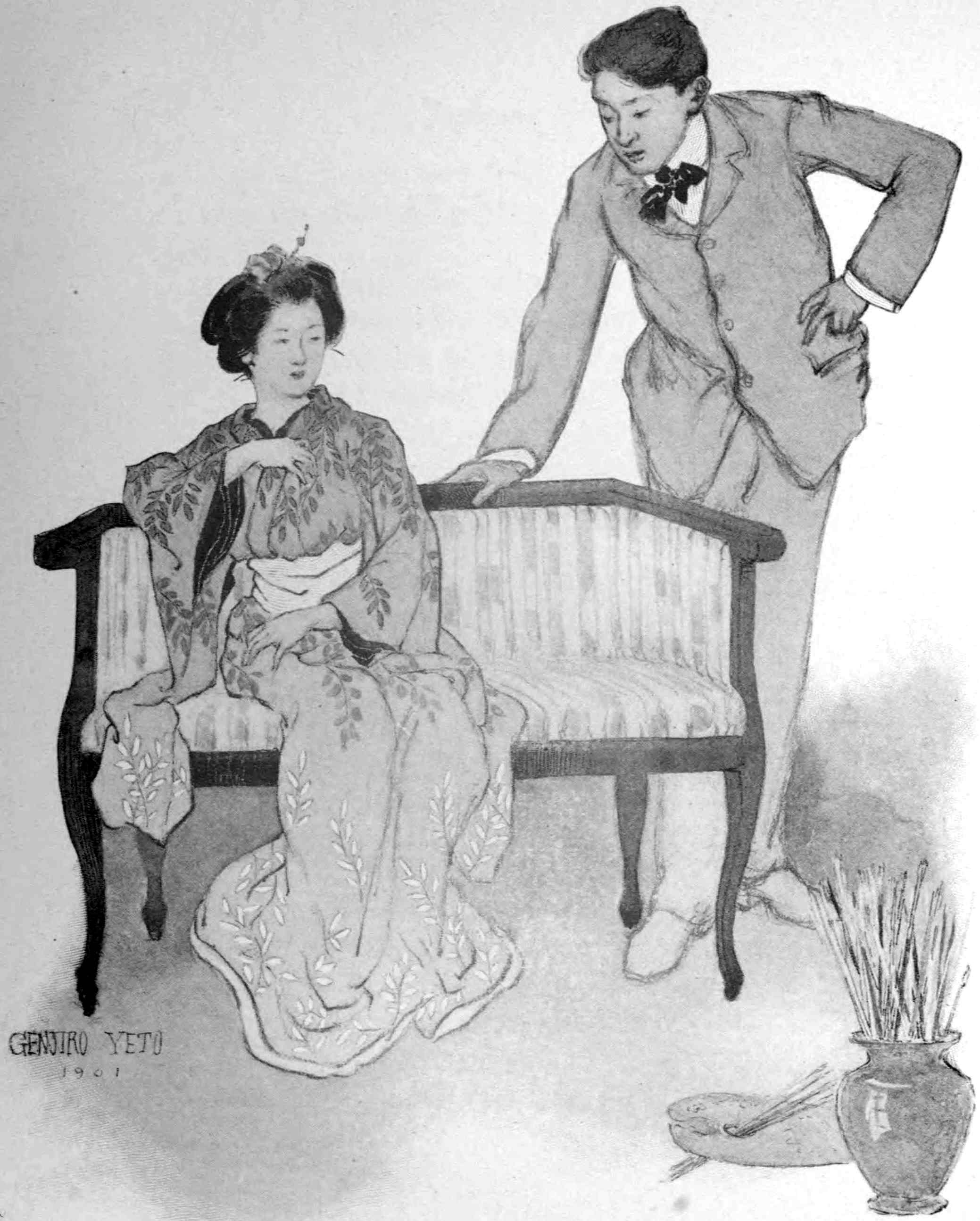
Drawn by Genjiro Yeto “So you like the Oriental woman?”
25th—I bought two dolls.
One for Schuyler’s baby, as my Christmas gift.
I slept with the other last night. I squeezed my ear to the dolly, fancying I might hear a few scratches of human voice. I kissed it. I laughed, saying that the doll was the thing for my starting to learn how to kiss.
“Sleep till mamma comes back, darling!” I said in the morning when I stepped down for my breakfast.
I left the table before I had half-finished, on account of my anxiety lest the upstairs girl might tattle of my childishness, if she found the doll in my bed.
Thank Heavens!
The girl hadn’t come around yet.
I locked it up in my trunk.
What name shall I give it?
Charley?
I was disgusted at the thought, because every Chinee—ten thousand Mongols in all—is named one Charley.
Merry Christmas, all of you!
26th—It rained.
I implored Mother Schuyler to select a book from her library.
All the literature was packed in there, beginning with Socrates, sane as a silver dollar.
Every book was without finger-marks. Book without finger-mark is like bread without brown crust. Dear finger-mark!
The fashion is to buy books and to glance at their covers, I suppose, but not to read them. Modern publications aren’t meant to be read, are they? The authors have degenerated to the place of upholsterers. Isn’t it a shame?
Mrs. Schuyler picked out for me “Rubaiyat of Omar Khayyam.”
My uncle said: “American woman can’t keep away from Omar and chicken-salad.”
I began to peruse it.
The raindrops by my window tuned:
“Tap, tap, tip, tap, tap!”
I thumped the book on the floor, and exclaimed:
“Mr. Khayyam!”
Rubaiyat is a menace against civilisation.
Americanism is nothing but the delight in life and the world.
I wonder why the wise government of Washington does not oppose its pagan circulation.
It is leprosy.
But I thought how truly true was his “I came like Water, and like Wind I go.”
I took up the book and opened it again.
Then I shut it.
I listened to the “Tap, tap, tip!”
Doesn’t it sound like a wan voice of Omar?
Yes!
27th—A lady whom I met at Mrs. Schuyler’s reception sent me a mass of distinguished roses.
Loving American!
I said I would arrange them in Japanese cult.
My style is the enshin.
Amerikey is destitute of flowers.
Nippon is known as a paradise of botanists. The “scientists” of flower decoration (if I may call them so) are given a great advantage in their craft of delineating beauty.
The rose is not much of a flower to the Jap mind.
They never employ it in their work. It has no grace of line. Its perfume cannot indemnify for its being thorny. Things not qualified to convey charm are declined from the tokonama.
I love roses awfully well myself.
I will make the best of them in my art.
Is there any proper vase in Schuyler’s house?
Mother Schuyler fetched me two pieces.
One was a silver vase and the other a china one.
I couldn’t use them, I was sorry. Silver was commercial-looking. The painting on the china a hodge-podge of a joss house.
Then I was seized with a thought.
I ran down to the kitchen.
I borrowed an old scrubbing bucket.
“Such a soft antique hue!” I exclaimed with delight.
I elected one imperial rose and one little one for a “retainer.”
I fixed them in the bucket.
I thought it was verily the simplicity of the illustrious Mr. Rikiu.
I presented the rest of the roses to Mrs. Schuyler, Jr.
She stared at the bucket without a word. I knew that her silence was the most forcible irony. She didn’t approve of setting such a bucket on the table.
“Meriken jins don’t know any art!” I said, when she left.
My uncle begged me not to act so fantastically.
28th—“Here’s a shamisen, Morning Glory!” Mother Schuyler cried from the hall.
I darted out of my room.
“Well!” I exclaimed.
Shamisen?
It is a three-stringed guitar of Japan.
Mr. Schuyler, Jr., had sent it from Yokohama, as she explained.
She wished me to tinkle a little gamboling music in the parlour before dinner.
It is a hard implement to handle. It has no notation. Attainment is through unending blind practice.
I was compelled to learn by mother, many a year ago, but I soon gave it up for an English spelling-book.
But I daresay I can play.
I regulated the key to begin with.
“Ting, ting! Chang, Chang, ting!”
“What to hum, Uncle?” I asked, facing aside.
“Love ditty is desirable,” Oji San considered.
“Don’t fancy me a geisha!” I said in defending laughter.
Then I murmured an old hauta, “Haori kakushite,” which was Englished by some one.
“She hid his coat,
She plucked his sleeve,
‘To-day you cannot go!
To-day, at least, you will not leave,
The heart that loves you so!’
The mado she undid
And back the shoji slid:
And clinging cried, ‘Dear Lord, perceive
The whole world is snow!’”
29th—We went to a theatre last evening.
Dear, classical “flower path”!
How I missed it in the Meriken stage!
Flower path?
It is a projection into the auditorium used to represent when one starts out of the house or returns.
So the American stage has no front gate scene! Every one enters very likely from the kitchen door.
The stage never turns round like the Japanese stage.
Oh, dear, iyadawa!
American play has too much kissing. Each time I was electrified.
The pit was filled with a well-behaved throng. All the ladies took off their hats. Do they pay more respect than in church? The gentlemen never whiffed smoke.
Japan theatre is a hurly-burly.
The “boys” roar up “Honourable tea—O’cha wa yoroshi? Honourable cake?” The attendants of tea houses bow around to the beneficent habitues, like inclining puppets.
Women sob. They laugh, stuffing their sleeves into their mouths. They are ready to put themselves in the play. They are sentimental.
Meriken women place themselves above the play.
I doubted whether they were criticising or enjoying.
Some lady even used a spy-glass to examine the face of a player.
I thought it decidedly an impertinence.
What a pry!
I will not act to such an assembly, if I ever happen to be an actress.
What was the title of the play?
I could hardly understand half of it.
I tried hard to swallow my gape.
30th—Mr. Oscar Ellis came to put the finishing touch to my picture.
The execution was subtle sureness.
He said that he would offer it to his beloved aunty—Mother Schuyler, of course—begging to let it ornament the wall of my room.
My room?
It is “my room” for a few days yet.
I thought it exceedingly sweet.
The wall is duskily red. The effect would be superb.
When I announced to him that our leave would take place on the approaching fourth, he started as if he had received a stroke.
“So soon?” he said.
“Yes,” I said, turning my uneasy face.
“We are only beginning to understand each other.”
“I am a bird of passage, as you know. I have to fly on my road.”
The air grew tragic.
Then Oscar said:
“What will you do when you tire of flying?”
“Sah!”
“Well?”
“I’ll return to Los Angeles and induce you to marry me with my honourable Oriental oratory. Will that do?”
We interchanged our nimble look. We laughed afterward.
After he left Schuyler’s, I said to myself that I would not mind positively if he would kiss me. The kiss must be on my brow, however. Lips are too personal.
I wrote a note, beseeching him not to forget to kiss me at my farewell.
Then I chewed the note.
I reviled my folly.
31st—Street walking is a delight.
I’ll mirror my face in the glass of the shop windows ambling by.
I dropped a handkerchief to-day.
A gentle gentleman—man behind me should be young and good looking always—picked it up. His respectful “Pardon me—” made me feel as if I were living in the silver-armoured age of chivalry.
Shall I drop something again?
I observed a variety of form in raising the skirt.
One lifted a bit of the left by her finger-tips. Another pulled up the right edge of her front. Another clinched out the centre of her back, showing a significant fist. A corpulent one stepped, holding up both sides of her front. The miserable underskirt revealed itself in red.
Which mode is becoming to me?
Jan. 1st, 1900—Is to-day the opening of another century?
Happy New Year!
I will send a lot of “Shinnen omedeto” to Tokio.
Isn’t this a queer New Year?
No shimenawa along the façades with flitting gohei!
No “gate pine tree”!
No sambow for an oblation unto the gods in any room!
No rice-bread! No golden toso for the cup!
I mingled with a neighbour’s girls for a “rope-jumping.”
We played hide-and-seek. I offered ten cents reward to the one who detected me. I abandoned the unprofitable job after emptying out all my change.
Miss Olive called on a bicycle.
I persuaded her to let me try on her bloomers. She exchanged them for my walking skirt which was four inches shorter.
We hurried to the garden.
She helped me on the wheel.
Such a bad Meriken girl!
She slipped her hand from it. I fell on a bush. The touchy rose thorned in my hand.
2nd—I made a discovery.
Mother Schuyler’s teeth are all false.
I have no chance to explore whether her hair is a wig.
She chains a big bunch of keys to her waist. Its rattle sounds housewifely.
She forgot it, laying it on the sitting-room table.
I knotted it to my waist-strap.
I jiggled it.
“Jaran, jaring, jaran, jaran!”
3rd—The sayonara dinner was given. Mrs. Ellis’ folks joined us.
Mother Schuyler repeated every ten minutes her query, “when would I visit them again?”
Mr. Oscar set his depressive look on me. I wasn’t brave enough to encounter it.