IN AMERIKEY (continued 2)
Reading edition
I slid away from confronting him.
I found him an elegant young man. He impressed me as an image of Apollo.
Only God knows when I will reprint my footsteps on the soil of Los Angeles!
I felt awfully sorry in leaving such an agreeable company.
“Fold your tent like the Arabs,
And silently steal away.”
How sad!
4th—Good-bye, Mr. Parrot!
San Francisco, 5th.
I am again at Mrs. Willis’.
San Francisco!
Such miraculous San Francisco water!
I will taste bliss again in drinking the midnight water, stretching out my arm from the bed.
6th—I tied Dorothy’s hair in Nippon style.
She pleased me much by remembering the Japanese words I taught her.
She is a cute dear.
The mode had been the “O’tabaco bon.”
I straightened her hair with my wet hand.
I added a tiny bit of crimson crape.
She looked a lovely fairy.
7th—Rainy day!
The heavily reserved weather confines me in the pose of genius.
My hair lounged down my shoulders. Disorder is the first step in being a genius, I fancy. My eyes should be rolled up to the sky in divine tragicalness.
I have had a greediness for the name of novelist.
To-day I found myself in the crisis where I must scribble or die.
I regret to say that mine is a love story also, as every beginner’s book has been. I hope everybody will be contented with “The Destiny,” a respectable title for my fiction. Who says it is the style of name employed one hundred years ago?
The book will be concluded with three hundred pages.
Now I wonder whether a long story is in demand.
Chapter I, is as follows:
WHEN THE MOON ROSE.
This story begins when the moon rose.
Its silvery rays—it was six P.M. of April—fell on the Shiba park in laughter.
My heroine jogged along into the park, singing a light song.
“Miss Honourable Moon, how old are you?
Thirteen and seven, you say?
You are young enough to marry——”
Let me explain about her a bit!
Her name is O Hana San.
Thirteen years old. Thirteen? It is the age when the flower of girlhood starts to bloom.
Bewitching Hana!
Do you remember a well by the glorious cherry tree in the park? The ’rikisha men moisten their parched lips at the “Heaven-Sent.” That is its name, sir.
Miss Hana looked down into the well.
She began to adjust her hair. The first worry of a girl after thirteen would naturally be about her hair.
She gazed up to the cherry blossoms and exclaimed:
“Utsukushii nah! Lovely!”
Then she found her face again in the well-mirror, thinking what a charming O Hana San it would make with the flowers on her hair.
My worthy readers, I suppose it is the time some one must enter.
He came.
He was a little boy.
I will not mention his name just yet.
He came close to her and pinched her little back. Both blushed, facing each other. They were quite strangers.
The evening zephyrs stirred the cherry blossoms. They planted themselves silently among the falling petals, as ethereal as snow.
“I delight to stand in the storm of petals, don’t you?” Hana inclined her head a trifle in speaking.
The woman always speaks first.
“Let me see your school book!” again she said.
“Why?”
He put it in her tiny hand.
“Thanks! Arigato!”
She bowed low. When she put the book on her shoulder, she was running away, singing:
“Miss Honourable Moon, how old are you?”
The boy stood aghast.
* * * * * * *
The author of this story found O Hana San again by the same well on the next evening.
The boy’s book in her hand, of course.
She paced around the well, muttering:
“He must come, because the moon rose.”
But he was not seen.
My next chapter will be “The Second Meeting.”
8th—My precious Ada again!
How could I live without her?
We hastened to a circus.
If I were a boy, I could earn a heap of money selling “Pea—nuts! Lemon—ade!”
How those clowns did tumble!
If I could share in such fun!
The ringmaster was the handsomest man in the world, in shiny boots and heavenly hat. How splendidly his whip cracked!
The clack dashed like a burst of bamboo.
“Wouldn’t you be glad to be the lady on horseback? I would truly. Glance at her daring grace!” I whispered to Miss Ada.
Even the seal performed.
We laughed till tears dropped.
The circus had twenty elephants. Think!
Our Imperial Menagerie of Tokio has only one. How poor!
9th—Last night I went over to Mrs. Consul’s to be given a lesson in card-playing.
“Cribbage would be the thing. Why? Because the Lambs took much pleasure in it,” she said.
“How is poker?” I suggested.
“Gambling game!” she protested.
“I delight in gambling, Mrs. Consul,” I proclaimed.
I had a wicked dream.
What do you imagine?
I ran away with a circus rider.
10th—I made the acquaintance of a Japanese woman.
She must have been passing her thirty springs. I could be accurate in my scale, being one of her sisterhood.
A cigar-stand keeper in Dupont Street.
Her name is O Fuji San.
Mrs. Wistaria brought a box of cigarettes that my uncle had ordered.
The morning is unoccupied in such a retail shop. Nobody puffs much before lunch. She set herself in a tête-à-tête.
The chastity of a wife may be measured by her solo on her husband. Woman’s greatest joy often lies in lamenting the faults of her teishu.
Mrs. Wistaria spoke of her husband’s being ill. I was to accept any chance for squandering my feelings. I sympathised, repeating, “Komaru nei! How sad!”
She said that she was going to leave the city for a week for the spring of San Jose, to take care of her infirm dear.
“I fear I may lose my customers,” she flagged.
Her husband was afflicted with rheumatism.
I promised to call at her store.
Japs never visit an invalid without a present.
Champagne? It’s too ostentatious a drink. It’s like a highly rouged woman.
The loving-eyed claret should be chosen.
I sent half a dozen bottles to Mrs. Wistaria’s.
A charity woman should be dressed in black and white. I went to Dupont street, however, in my grey dress.
Her husband struggled to entertain me. His clumsy smile appeared all the time at the wrong cue.
Poor Mr. What’s-his-name!
Their business was an absurdly small affair.
The whole stock hardly valued above one hundred dollars.
I thought I could conduct it rightly.
I was carried away by a sudden fancy.
“Can’t you leave your store in my hands, while you are away? Say yes! No?” I pressed myself upon them eagerly.
They were amazed.
“High-born lady like you? Oh, no! Doshite, doshite! Think! Do you know this is the toughest part of the town?” Mrs. Wistaria tried to make me retreat.
I couldn’t listen to her, my whole soul being absorbed in my new caprice.
I thought it remarkably romantic.
I left the store to bring uncle to talk the matter over.
Mrs. Wistaria’s store was neighboured by every saloon. The fuddling sounds overflowed in song:
“Hello ma baby, hello ma honey——”
11th—Now he is my beloved uncle.
He assured me of his help in carrying out my freak.
“You are fitting me for a slightly better rôle, I fancy,” he said, venturing to add even one or two of his good-natured giggles. “The secretaryship of a cigar-stand is a rather more hopeful occupation than carrying your wraps through the street.”
Everything was arranged.
Mrs. Wistaria and her husband set off for San Jose.
I am a merchant-lady.
The first thing I did was to put up a dignified sign with the following black letters:
MORNING GLORY CIGAR STORE.
I borrowed a picture from Mrs. Willis’ parlour, and placed it by the slot machine.
It is the picture of a dear Injun sitting against a woodland fire with a respectable pipe, whose smoke sails up to the yellow moon. What resignation! What dream! What joy! It did suit beautifully for the cigar-stand.
I love to see a man smoking. The elfish smoke acts like a merry-hearted May gossamer. When I observe a man’s eye pursuing his smoke, I say to myself that his soul must be stepping nearer to his ideal. The road of smoke is the road of poesy.
A noble trade is tobacco.
Man’s hermitage is situated only in smoking, I should say.
I divested my uncle of his coat. I begged him to hold a bucket and a piece of cloth for a moment.
“Are you ready to wash the windows, Uncle?” I said.
“Traitor, Morning Glory!” He flashed his accusing glare.
Docile old man!
He cleaned four windows of the kitchen, which was also the dining-room and the parlour.
I paid him five cents for each.
I said: “It’s good fun to hire the chief secretary of the Nippon Mining Company to rub windows, isn’t it?”
And I laughed.
Then I forced him to buy a cigar.
“You made some twenty cents out of me. Your turn is coming, my uncle!” I said.
I sold him a box of Lillian Russell cigars for three dollars. The real price was two.
Ha, ha, ha!
12th—I invited my precious Ada to my store to dine à la Japonaise.
One Jap restaurant catered to it.
“Irrashaimashi! Condescend to enter!” I showered my wooden-clogged greeting over Ada.
From “The Klondyke,” my neighbouring saloon, a nigger song was flapping in.
“If you ain’t got no money, you needn’t come round.”
Happy Ada San!
She was about to join in it, when I brought her into my great dining-room.
(Beg pardon, it was a paltry kitchen!)
Everything was seen on the table.
Japanese dinner has no strict order of courses. You are a frolicsome butterfly among the dishes set like flowers before you. You may flit straight to any one which catches your whim.
“Take your honourable chop-sticks!” I said.
Poor Miss Ada!
“How shall I manage with one stick?” she raised her eyelids in questioning meekness.
I bade her to split the stick in two. It was a brand new wooden one. I showed her how to finger it.
She nibbled a bit from each dish. Every time she tasted she looked upon me with a suspicious smile.
And how she slipped her sticks at the critical moment!
The sight amused me hugely.
“How dare I swallow raw fishes!” she said shrinking.
“What delight I taste in them!” I slammed back at her timidity.
Then I dipped a few cuts of the fishes into a porcelain soy pan for my mouth.
I even trampled into her fish-dish by and by.
She was literally terrified.
The feast was over. I said, “Go yukkuri! Honourable not-to-be-in-a-hurry!” I slid away.
I tied my white apron like a shop girl. I was glad that I did not forget to push a lead-pencil through my hair. I presented myself to Ada carrying a cigarette box.
“Will you buy tobacco for your lord?”
I spread the box before her.
“How much for one packet,” she asked with the charming arrogance of a customer.
She was acting also.
“To-day is the memorial day of Lord Nono Sama. My sweet Oku San, allow me to make a reduction!”
Then we laughed.
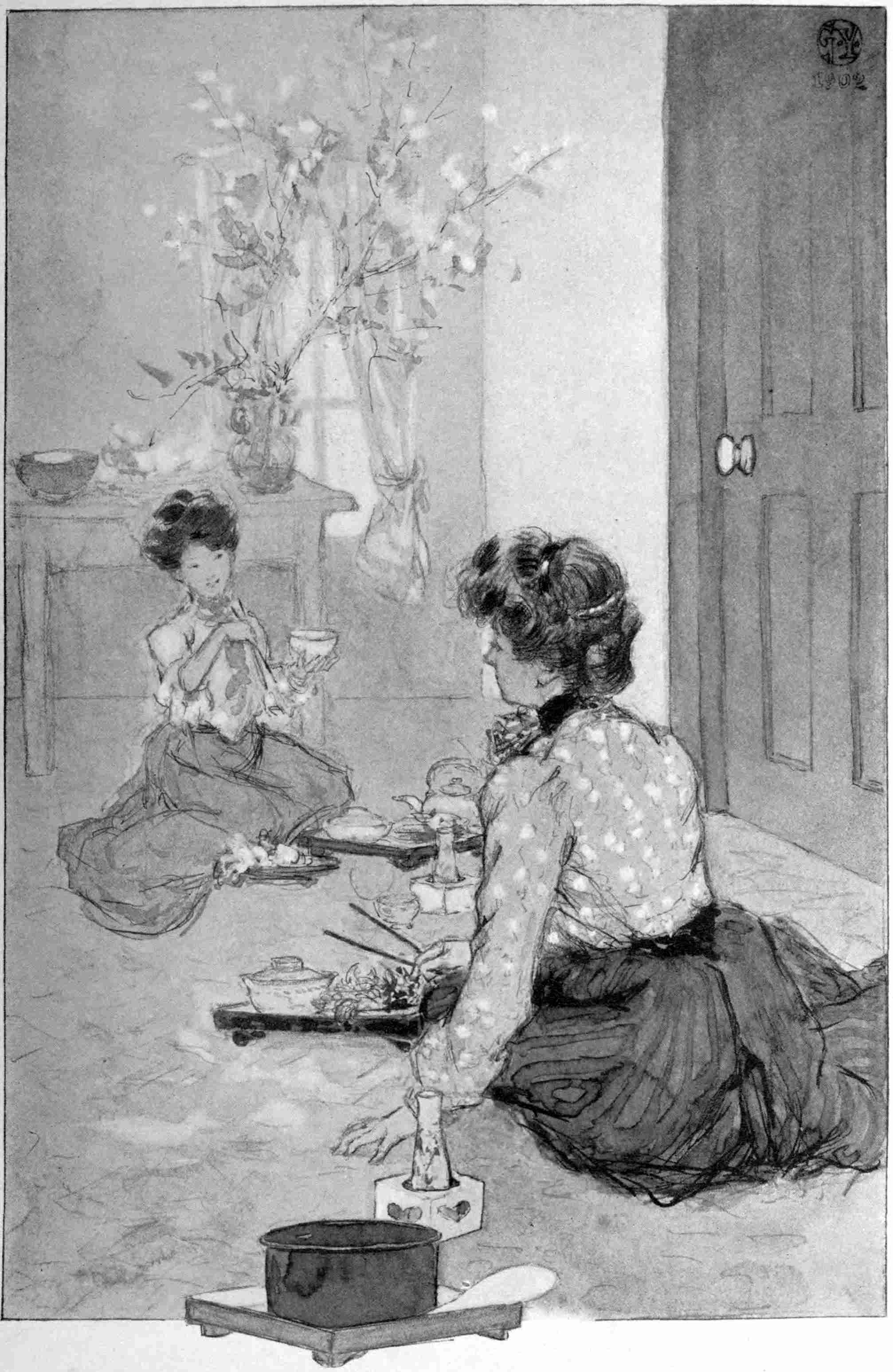
Drawn by Genjiro Yeto “How dare I swallow raw fishes!”
13th—I created much noise in the Jap colony!
Why not?
Many brown men pause by my store and buy, simply because they can address a word or two to me.
They are silly, aren’t they?
I announce that I am tired of their faces. I have never met one progressive-seeming Oriental since I landed. They are like a dry tree. Are their souls dying?
“Well, that’s why, they have no girl,” my uncle conclusioned.
He is so bright once in a while.
Why not make love with Meriken musume?
I said I would petition the Tokio government to transplant her women.
It may ruin the Japanese girl’s name, was my afterthought, if they ship only the homely gang.
Lovely girl has no longing to sail over the ocean. She has plenty of chance to grow a flower bride at home.
I pity my native boys of this city.
“Jap! Jap!”
They are dashed with such exclamations from every corner.
As for me the sound of “Jap” is my taste, so I spray it in my writing.
I took up again my knitting work which I had commenced on the seas. Nothing could be more decent to fill up my leisure in the store.
My little neck fell, as I was intent on my stocking.
Some one spoke above my head: “How is business?”
“So, so!” I replied in businesslike reserve.
I lifted my face.
Oya, he was Mr. Consul.
“Will you sell me a cigar?”
“Things are becoming awfully high. Mine is a distinctly dear store. Do you know it, Mr. Consul?”
“I’m prepared to pay more at the beautiful girl’s,” he began to titter.
“General Arthur cigar has leaped one dollar higher since Monday, and——”
“You don’t mean it!” He mimicked a sudden alarm.
14th—O funny drunkard!
To-day one fellow established himself before my store. He fixed his amazing eyes on my face, and extended his hairy hand.
“Hel-lo, Japanese!” he stuttered.
He wanted to shake hands with me.
I lengthened my arm, and slapped his face. I withdrew directly within, and watched him from a hole.
“Ha, ha! She got mad—ha, ha, ha!”
He was in a tip-top state of mind.
“Let me help myself!”
He pilfered one cigar from the shelf. He struck a match. He bit the cigar.
“Good!” he muttered.
He tossed himself away with ludicrous dignity, singing:
“Pon pili, yon, pon, pon!”
“This is undeniably a tough place!” I exclaimed.
15th—Night has just arrived.
Only ten minutes ago a white-capped “Jim” (I overheard people calling him so) lighted a paper lantern labelled “Tomales.” He is an eating-stand keeper across the street. The loafers passed. There was some time to watch the lazy parade. It was a blank hour of Saturday when he could puff a whiff of smoke.
The prankish songs ceased.
Even in Dupont Street I am given a page of dream.
The barkeeper of “Remember the Maine” called at my store.
“Remember the Maine?”
It is a name cheap as the grimness of a toothless woman.
Mr. Barkeeper had something to say, I imagined.
I offered a stem of cigarette.
“Do you ever hear a bloody cry at night?” he began his chapter, gathering a medley of gravity on his brow.
“Scream? No!”
“Never mind!”
He turned aside. I thought he was playing a threadbare artifice of a story-teller to tantalise my fancy.
“Tell me why!”
I knew I became his victim.
“I fear I do scare you.”
“No! I never——” I leaned forward.
“To begin with——”
He stopped, looking around.
“Your kitchen—don’t be scared—is close by a haunted room of a house on Pine Street. It’s no story. A chorus girl lived—well, some five years ago—in that house with her step-mother. Just think! The old hen of sixty-five fell in love with her daughter’s lover. Do you understand? She saw one morning the young fellow kissing her daughter. She went crazy. She shot him. Isn’t it awful? The murderess leaned against the wall by your kitchen, and cried, ‘I killed him!’ I swear to you that it is all true. So, people say, a wail is heard at night from your side.”
“Mah! Mah!” I breathed.
“That is all.”
He retired heavily.
Do I believe it?
“No! No!” I denied.
But I was thickly swarmed by sickening air. How could I trust me in the kitchen!
I closed the store.
I pasted up a piece of paper whereon was written: “NO BUSINESS TO-NIGHT.”
16th—I had a stomach-ache this morning. I couldn’t rise.
The maid fetched me some toast and a cup of coffee.
I think it is very nice to eat in bed.
17th—Mrs. Wistaria and her husband returned from San Jose.
She lavished on me her thousand arigatos.
She said I sold sixty per cent more than on any previous week.
She wished me to condescend to accept a “meagre” fifteen dollars as a share of the profits.
I refused it.
18th—My letter to Miss Pine Leaf (who wept with me reading Keats’ love-letters one mournful night) is as follows:
“Matsuba San:
‘Hitofude mairase soro.
‘I have the honour to present a brief writing.’
“Let me omit the shopworn form of Japanese letter-writing! Its redundant ‘honourables’ are more cheap than honourable.
“Satetoya!
“Shall I begin my letter with a deep bow?
“Bow?
“I use it occasionally before Meriken San for sport’s sake. But it is degenerating, in my opinion, to comic opera, like the tortoise-shell-framed spectacles of a Chinese doctor.
“Now I address you with a thousand kisses.
“The kiss is the thing to begin with for up-to-date girls.
“It is useful, as a poem is useful in filling up space in magazine-making. Woman—even a loftily learned American woman—cannot be ready always with her rhetoric of expression. The kiss comes to her relief in the crisis whenever she fails in speech.
“The kiss is everything.
“The Jap girl is intimate with the art of crying.
“A kiss is as eloquent as a tear.
“I suppose the cleverness of American woman is graded by the way she handles it. It strikes me that every white girl is perfectly at home with it.
“She is awfully bright.
“You wonder why she is so?
“There is one reason that I can tell you. It is because she has a serious job to pick out her husband herself. I don’t think it is fair to blame her growing insipid after marriage. Every one feels tired when a weighty work is done. What would be her doom if she were stupid? An old maid is such a sad sight, like a broken clock, or a cradle after baby’s death. Isn’t it dreadful to have nothing to rejoice in but a customary tea or books? Literary critic is one occupation left for her. Worse than death!
“I am pained to state that our brown sisters are extremely behind time.
(“There are lots of exceptions, of course, like honourable you and Miss M. G.)
“I am talking of common Jap musumes.
“Naturally so.
“They are like those waiting at the station for the next train. They have only to doze and wait for the footsteps of a matchmaker with a young man.
“I am grateful to the Nippon government for stimulating education in women.
“But I advise her to imprison all the matchmakers. Then the girls will wake up at once, like one who has everything on her back after papa’s passing.
“That is one process to brighten them, I think.
“Am I not logical?
“Your last tegami questioned me whether the American lady was charming.
“Are you attentive to western sea painting?
“How does it impress you when you are close by it? Only a jumble of paint, isn’t it? So with Meriken woman!
“You should be off half a dozen steps to estimate her beautiful captivation. You would be horrified, otherwise, by her hairy skin.
“I love her.
“She has no headache like the Japs. (By the way, I will call Japan, hereafter, the country of headache.) She lives in a comedy.
“Nothing turns bad in Amerikey.
“‘Tragedy To Be a Woman,’ could only be seen on a fiction thrown in a moth-trodden second-hand store.
“Police never bother.
“Such a deliverance!
“I am delighted with my Meriken Kenbutsu.
“Sayonara!
Yours,
“Morning Glory”
19th—I forced Uncle to swear to me that he would overlook everything I did, in consideration of my great service in darning his socks.
I peeled off my shoes to begin with.
I sat like a Turk.
“Why do you frown like an Oni in hell?” I acidified my smile. I held my needle and thread suspended in the air, while I said: “What is a Trust?”
“Be quiet!” he exclaimed.
He didn’t even glance at me, being engaged in writing in the other nook.
“Uncle, your hair ought to be curled. I will step in to-morrow morning, and turn it up before you awake. What do you think, Uncle? Oji San!”
“Morning Glory San!”
He emitted a growl of satanic despotism, and soon resumed his work gracefully.
I thought what a scandal if he were penning a love letter to Mrs. Schuyler, junior.
I rose. I approached him with secret step. I fell on him from his massy back and cried:
“What are you scribbling?”
Erai, my honourable uncle!
He was translating Gibbon’s “History of Rome.”
I was stunned from the shame of taking him to be in such a wretched line even in fancy.
I vowed to myself—with three low bows—to take perfect care of my noble worker.
Then I gave him my sweet smile.
“Uncle, let me fix something more! Haven’t you anything? Tear your shirt or pull off the buttons, then!”
20th—Already I could suck from the agile air the flavour of spring upon the lawn.
I was roving by the rose-bushes along the street with scissors.
A gentleman passed by me. How sluggish his shoes sounded! He stopped, waving his old-scented smile, and addressed me:
“Good morning, young lady!”
“Ohayo!”
“I perceive that you are Japanese.”
“Yes, sir!”
He stepped nearer to me. I took a peep at the Bible under his arm.
“Are you a Christian?” he lowered his tone.
“Don’t you read the Gospel?” his voice rose higher.
“Don’t you attend church?” his sound grew higher still.
“I love to be shocked. I couldn’t sustain myself against a bore. Church? It’s too sleepy, don’t you know? I have remarked that God is with me without any sort of prayer, if I trace the path of righteousness. A minister is only a meddling grandmamma to my mind. If I ever build my ideal city, two things shall not be tolerated. One is a lawyer’s office and the other is a church. Church, sir! May I present you with one rose?”
I raised me to place it in his coat.
“Here’s a letter for you, Morning Glory!”
I was rescued by my uncle. How angelic his voice rang!
“I’m sorry, I’m much occupied this very morning,” I said, bowing slightly.
I pushed myself within the door.
Poor preacher!
21st—My answer to Oscar is as follows:
“Dear Honourable Mr. Ellis:
“Let me begin in respectable fashion!
“A Jap girl is awfully formal.
“Do you know, Mr. Ellis, whom you are addressing?
“I am an Oriental.
“Nippon daughters believe ‘ev’rithin’ a gentleman mentions.
“They have been fooled enough, I should declare, in American fiction. Oscar—no, Mr. Ellis—don’t let me earn the anecdote that I drifted to Ameriky to be toyed with! My ancestor did a harakiri. I am pretty sure I have, then, to kill myself.
“Don’t recite again your honourable confession of love!
“It made me cry.
“My dark face with drenched eyes will degrade me to a hired Chinese ‘crying woman.’
“Your narration was dramatic.
“Your cleverness is the most lamentable thing about you. Woman used to love a bright fellow many years ago. Do you know that the modern girl woos a stupid man?
“Please, don’t repeat again such an adjective as ‘heavenly’ for my face! No one utters the word ‘heaven’ except in swearing. Even ministers juggle with it for a jest in church, I suppose. My face isn’t heavenly at all. You know it, don’t you?
“You amused me, however, when you told how you had pillaged my picture from Mother Schuyler’s room to put in your own, feigning that it needed to be retouched.
“Poor Mother Schuyler!
“If she knew your secret!
“Frankly, I fear that such a gentleman as you does commit forgery always. Have you no consanguinity with a convict?
“O such a wretched boy!
“The saddest thing about a woman is that she is glad to fall in love with the worthless.
“Do I love you?
“Give me time to reply to the question!
“Everything is tardy with a Japanese. I was educated by slowness; I bow one dozen times before I speak.
“O Oscar, you got to think of my side a little bit!
“Every girl claims that she has half a population as adorers in her pocket handkerchief.
“You are the only one young American I ever met.
“If I accept your love, I am afraid one may satirise my destitution.
“You’ll write me soon, won’t you?
“Yours, M. G.
“P.S.—I wish I could show you how charmingly I smoke. I learned the art recently. I tap the cigarette with my middle finger to knock the ashes off. It is delightful to heap a hill of ashes on the table edge. When I puff, finding no word after ‘And—’ the smoke seems to be speaking for me.
“But I assure you that I smoked only before my uncle.
“I was a pretty naughty girl at home, but I flatter myself that I can easily be classed among the best in this country.
“White women behave terribly, you know.”
22nd—I passed the afternoon at Mrs. Consul’s. She gave me her “favourite” discourse on Walt Whitman.
I delivered to my uncle what I had learned.
“No newness in it. It is what dear John Burroughs or Mr. Stedman said.”
He overturned my castle with one blow, and lit his cigar with a victorious air.
I was enraged.
“Yes, yes, eraiwa! Oriental gentleman knows everything we poor women know,” I said.
I sulkily drew away to my room with Mr. Whitman’s fat book, that I borrowed from Mrs. Consul.
23rd—A letter from my father arrived.
“O Papa, please don’t! I am tired of such a dirty conference.” I scoffed.
I tore the paper into shreds.
“What a sullen lady! What did Otto San write? Marriage proposal, I reckon!” my uncle intruded.
“Papa threatened me with a list of suitors. He cried, ‘Chance, chance!’ like the gate-man of an ennichi show. Pray grant me for once in my life, Uncle, to say: ‘The marriage lottery go to the dogs!’ How many Jap girls kill themselves from the burden of such a glued union, do you suppose?”
“Then, ‘free marriage’?”
“Of course!”
“It’s very beautiful, Miss Morning Glory.”
“Why not?”
“You are Japanese, aren’t you?”
“Did you ever think I was a Meriken jin?”
“Well, then, how did you come to know young men in a country where familiarity with one is regarded as a crime for a girl?”
“Things all wrong in Nippon, Uncle!”
“I am sorry you were born a Jap.”
“I’ll never go back to Japan, I think. The dictionary for Jap girls comprises no such word as ‘No.’ But you must remember, Uncle, I have the capital ‘No’ in my head. I am a revolutionist,” I proclaimed.
Then I thought much of my dear Oscar.
24th—My worthy labourer upon Gibbon’s work sat before the table for some hours.
I stood behind him and dropped the fluid from a bottle on his head.
“Cold! What are you doing, my little romp?” He looked up in a fright.
“No harm, Uncle! It is only a remedy. Your hair is growing so thin. Do you know it? I think it a shame to appear in Greater New York with a bald gentleman.”
I bought the bottle this morning.
25th—A bamboo table in my room reminded me of a take bush in the neighbouring churchyard of my Tokio home.
(I cannot sound Meriken jin’s curiosity in prizing such a cheap thing. The bamboo was painted. The cross nails glared from everywhere. I never saw such a Jap work in Nippon.)
Dear take, O bamboo bush!
How I used to laugh, breaking the dreams of sparrows by wriggling the bush!
I was so ungoverned.
If I could be a grammar school girl again!
I secured a reader at a bookstall. My mind was made up to present myself in the Lincoln night school and mingle with the girls in “SEE THE BOY AND THE DOG!”
What fun!
I went to see the stooping principal. His tarnished frock-coat—I fancied he was an old bachelor, as one button was off—was just the thing for such a rôle.
I seemed to him a regular nenne of thirteen.
He was heartily pleased with my greediness for learning English.
Poor soul!
He ushered me into the class for which I had brought the book.
It was the hour for composition. “Ocean,” the subject.
When I was seated, the girl next me winked charmingly. She threw me a note within a minute, to which I promptly replied, “Morning Glory.” My note was answered “Miss Madge, 340 Mission Street.” I wrote her, “May I call on you to-morrow?” for which she wrote, “As you please.”
I was placed on the dangerous verge of clapping Byron’s poem into my “Ocean.” I manufactured one dozen of spelling errors.
“You should belong to some higher class. Take this slip to the principal!” the teacher said. “You have an imagination.” She wiped her spectacles slowly.
I left the room remarking, “Because I am a Japanese.”
I slipped away from the school altogether.
“One experience is plenty,” I declared.
26th—I went to Mission Street to call on Madge.
From both sides of the street peeped the famous Jewish noses. The second-hand clothing shops parade. How droll to see those noses shrivelling like a lobster!
Madge’s father owns a despicable restaurant with only four eating tables. Mamma cooks, while she sits on the counter.
When I appeared, she shot out, greeting me: “Hello, Morning Glory!”
“Awfully glad to see you! I have come to help you, haven’t I?”
I was ready to strip off my jacket and wind myself in her apron.
Her papa was dumbfounded by my sudden action.
The outside board with the bill of fare was scraped out by this morning’s rain. It looked as miserable as an Italian vegetable wagon under the rain.
My first work was to rewrite it.
I saw a Jew at a neighbouring door striving with one about the value of pants. A shoemaker’s “pan, pan” hammered on my head from the opposite house.
Mission Street is the street of horse-dung.
When my job was over, an honourable Mr. Wagon Driver leaped in, bidding me serve some soup.
I ran into the kitchen to fetch it.
I spilled it on the table.
“That’s all right, honey!” he said in patronising aloofness, and pierced my face with his gummy red eyes.
O Kowaya! Shocking!
I put one five-dollar piece of gold on Madge’s palm when I left her.
Because her shoes were heelless.
Pity the musume!
27th—I bought one book, being captivated by its title. Isn’t “When Knighthood was in Flower” beautifully chivalrous?
I have remarked that every Imperial cruiser anchors at an isle close by Loo Choo, just on account of the enticement in the name “Come and See.”
I found in my trunk an introduction to Miss Rose by my professor friend of Tokio ’versity.
Miss Rose?
My imagination started to move like a watch. I fancied she should be nineteen, since she was a Miss. No Rose girl can be homely.
I went to see her.
Alas!
She was a lady like a beer-barrel. Her finger-nails were black.
I left her like a miner stepping out of a gold mountain with empty hands.
I wonder why the mayor didn’t object to letting an ugly woman be crowned with a pretty name.
Fifty-years-old Miss Rose!
Now I fear to read Mr. Major’s book.
28th—The following is my letter to Mr. Oscar:
“Oscar San! Ellis San!
“I never liked your profession, simply because it is too beautiful.
“I don’t see why you cannot transfer to some other business.
“I have been ever so much fascinated with odd sorts of manual work. If I were a gentleman, I would very likely pursue the calling of grave-digger or sea-diver.
“Yesterday I passed by some labourers breaking massive stones. They lifted their hammers (O Oscar, look at their muscles!) and knocked them down to the sound of ‘Sara bagun!’ They jerked the ‘sara bagun,’ Oscar. Does it mean ‘ready?’ Mrs. Willis’ Century dictionary must be imperfect, since it does not contain such a word. Am I mis-spelling?
“Suppose I marry one of those!
“He will return home awfully tired. He will naturally doze after dinner. When his smoking pipe has slipped from his lips and burned my best tablecloth, isn’t it possible that I will be mad?... I startled him, pulling his hair ever so hard. Now you must think that he grew mad also. He seized my arm, and beat me. O Oscar, he beat me surely!... Then he will repent his conduct, and kneel by my side, begging my forgiveness. He will say, ‘My dear sweet wife—’
“Do you know how interesting it is to be beaten by a husband?
“I well-nigh fixed my mind never to affiance with a man too genteel to hit me.
“Woman is a revolting little bit of thing.
“If you say ‘Yes,’ I am quite ready to slam my ‘No!’
“Oscar San!
“I am afraid that you are too amiable.
“What you have to do for your next missive is to collect every kind of dreadful adjectives from your dictionary, and throw them in.
“You know what to do when I get angry, don’t you?
“Ellis San!
“You are too handsome.
“I am fond of a comely face as anybody else.
“But I fancy often how it would be if I fell in love with a deformity.
“People would laugh at me doubtless. But how dramatic it would be when I proclaimed, ‘Because I love him!’
“What a romantic phrase that is!
“Can’t you deform yourself?
“Sayonara,
“With a thousand bows,
“M. G.
“P.S.—My letter never finishes without a P.S.
“Isn’t that awful?
“My uncle asked me whom I was corresponding with. I mentioned ‘Olive.’
“Old man is jealous always.
“So you got to counterfeit your sister’s penmanship for your envelope.”
29th—I drank the last drop of my coffee.
“Oji San, when shall we go to New York?” I said, pillowing my face on my hands on the breakfast table.
“As soon as spring begins to flicker in the East, my little woman! It’s snow and snow there at present.”
“I love snow, Uncle.”
“Old gentleman can’t bear tyrannical cold, Morning Glory.”
“Don’t you notice how tired I am of Frisco? Aren’t you tired?”
“Yes—frankly!”
“Why don’t you then contrive some novel diversion to pass a month?”
“I’ve a fancy, but——”
“What is it?”
“It may not strike you as romantic.”
“Tell me!”
“I am known to one poet who dreams and erects a stone wall on the hillside. He is unlike another. His garden and cottage are open to everybody. I ever incline to loaf in an irregular puff of odour from his acacia trees. If you lean towards a poetical life, I have no hesitation in seeing him to make an arrangement.”
“Great Uncle, it’s romantic! Is he married?”
“Why?”
“Because a poet is not one woman’s property, but universal. My ideal poet is melancholy. Fat poet is ridiculous. Happy poet isn’t of the highest order. Tennyson? I wish his life had been more hard up. I suppose your friend-poet won’t mind if I sleep all day. Is he particular about the dinner time? Does he look up to the stars every night? Does he wash his shirt once in a while?”
“Stop!”
Then I asked respectably:
“Is the sight from there beautiful?”
“Wonderful! The only place where you can breathe the air of divinity!”
“Very well, Uncle. We will settle there, and hasten to become poets.”
“It wouldn’t be a bad idea, I say, to start again with your honourable ‘Lotos Eaters!’”
“‘Paradise Lost’ shall be my next subject.”
“If nobody publishes it?”
“I will present it solemnly to our Empress. She is a poetess, you know.”
My uncle went to see Mr. Poet.
30th—Uncle said that the poet said: “You are welcome, sir. The cottage for your young lady lies by one willow tree. The waters, the air, the grand view, are God’s. It costs a wee bit of money to provide the best coffee. I tell you that my claret is superb. You shall be my guest as long as you please. Present my love to Miss Morning Glory! Everything will be ready when you come.”
“Isn’t he adorable?” I ejaculated.
I stirred my trunk, and sifted out the things needful for my adventure.
31st—To-morrow!
The Heights, Feb. 1st
Let me recline heart-to-heart on the breast of Mother Nature! Let me retreat to a hillside not far from the city, yet verily near to God! Let me go to my poet abode!
We abandoned the Fruitvale car at the hill-foot.
My uncle picked out our destination from the speckles in the distance.
The breeze (how heavenly is a country breeze!) enticed my soul—a Jap girl also is provided with some soul—into “Far-Beyond.”
“I feel myself another girl, Uncle.”
“How?”
“I’m a poet already. The poet without poem is greater, don’t you know?”
We climbed the hill slowly. Every step enlarged the spectacle.
When we attained to one wildly well-kept garden, the whole bay of the Golden Gate stretched before us. A thousand villages knelt humbly like vassals.
I saw a tiny gate with the sign:
“Fruit Grower.”
An old gentleman appeared from a cottage, singing.
“Ah, take the Cash, and let the Credit go,
Nor heed the rumble of a distant Drum!”
“Poet!” Uncle whispered.
Let me now examine him!
What lengthy hair he wore!
It didn’t annoy me, however, because he stamped himself on my mind as if he were an ancient statue. I imagined him a type of mediæval squire. I thought of him truly as one metamorphosed from the frontispiece of a wholly forgotten volume in a cobwebbed recess of a library.
His courteous voice was simply dignified.
“Nature never hurries. God commands you every happiness and all repose. Here’s your little home, my gentle lady! I am at your service any time. I hope you will find it comfortable.”
He set me at the “Willow Cottage.”
He slipped gracefully away.
There was some time before I heard his “kotsu kotsu” on my door.
I opened it.
“Greeting from the host!” Mr. Heine offered me a tuft of brisk roses.
Heine was the poet’s name.
How loving!
I buried myself in the thought of straying to a fairy isle, and being accepted romantically by the dwellers.
I suspected that I was dreaming.
“Arcadia!” I exclaimed, when the poet announced that supper would be prepared within half an hour.
I spied him through the window, gathering the loppings of trees and leaves. He made a camp-fire. Its soft smoke surged into the sky. Oh, smell it!
How fascinating is the Poet’s life!
I ran out, crying:
“Pray, make me useful!”
2nd—Dream and reality are not marked here by different badges. They waltz round. Dear poet home!
Was it in my dream that I heard the tinkle of bells?
I thought something was going on.
I parted from the bed. I pushed out my face from the window.
Look at the procession of cows!
I have read much of them, but I admit that it was my first occasion to admire them. I am a trivial Jap, only acquainted with cherry blossoms and lanterns. How I wished to knot the bells round my waist, and whisk down the path by the violets!
“Lover’s lane!”
It should be the title for that path, I thought, if I were Mr. Poet.
I finished my toilet. I leaped out upon the grasses smiling up to the sunlight.
I congratulated myself on my new life.
Then I found my uncle sitting by the camp-fire.
“Ohayo!” I said, filling the seat on another side.
I remember one Japanese essay, “The Poetry of a Tea Kettle.” Indeed! The kettle was a singer. Its melody was far-reaching. It was like a harp of pine leaves fingered by the zephyr.
I faced up, and saw my poet moving down from the lily pond. Two frogs in his hand.
“Frogs?” I cried.
“They will complete our table. How did you sleep, my lady?”
“Splendid!”
“Do you love the country?”
“I begin to taste a greater joy in Nature.”
“I’m happy to hear it, my dear. My life is like the life of a bird. I awake when the sun rises. I lay me in the bed at the bird’s dipping into its nest. God made the night for keeping quiet. That is better than prayer itself. I light neither lamp nor candle. I presume that every young lady has certain secret work at night. Let me offer you a few candles!”
We ate breakfast from the table by the fire.
Frogs supplied a special dish.
I couldn’t touch it, thinking of the songs of frogs that I had heard all the night long.
Such a song! It was the muddy-booted song of the countryside. No valuable quality in it, of course. But I should say that they tried the best they could.
Poor Messrs. Frog!
I fancied the leg in my dish was that of one who volunteered to sing my lullaby.
I almost cried in grief.
The poet was ready to wash the dishes. I was quick to snatch his job. My uncle wiped them.
Stupid uncle!
He broke two dishes.
I collected the bones of the frogs, and buried them. On the stone above them I wrote with a pencil:
“Tomb of Unknown Singers.”
What time was it when we were done with our breakfast?
I couldn’t tell.
The first thing I did yesterday was to stop the tick-tack of my watch, and hide it in the lowest drawer.
The watch is a nuisance since I am thrown in The Garden of Eternity.
3rd—I searched for a pen and ink in my Willow Cottage.
Nothing like those.
Foxy Poet!
He hid them from view, I fancied, in the opinion that playing with them for a girl is more jeopardous than swallowing needles.
I say that letter-writing—particularly a decent love letter, if there is one—isn’t half so grave a crime as rhyming.
I was spraying some water on a rose by the gate, when I caught sight of a white quill by my shoes.
“This will serve me perfectly,” I said.
I had not one thing with any tooth except my comb. (Comb? Luckily I have not lost it Ara, ma, my hairpins! Five of them vanished from my head while I was springing amid the rocks. By and by the stems of acacia leaves shall be used in their places. Don’t you know this is quite a remote spot from civilisation?) A kitchen knife shaped my quill as a pen.
Now only ink!
I begged Uncle to run down three miles to fetch one bottle.
4th—We went to “breathe the song of the forest.”
The forest laces the poet’s canyon.
(By the way, poet’s ground spreads over one hundred and fifty acres. Does he pay taxes?)
We climbed the “Road to the Milky Way.” I beseech your forgiveness, it was merely the name I wished for the path to the poet’s hilltop. I felt as if I were hurrying to the “Sermon on the Mount.” You would hardly believe Morning Glory if she said that sublimity vibrated in her soul, because she was just a little Oriental. How grand! We faced toward the Gate of the Pacific Ocean. We were still. Why? Because we were thinking the same thing.
We traversed the poet’s graveyard.
How romantic to put up a tombstone while living!
How romantic to lie in the ecstasy of a marvellous view! We could be nearer the stars here.
We stepped down to the canyon.
The poet said solemnly:
“Lady and gentleman, this is a holy place where you can pray heartily.”
My uncle started to drone Bryant’s hymn:
“The groves were God’s first temples.”
“Did you ever read Thanatopsis, my dear?” Mr. Heine asked.
“Yes, sir!”
“It’s a noble piece. So many thousand Asiatics converted every year to the English alphabet. Wonderful!” he soliloquised.
We seated ourselves by a brook.
“Such a lesson in Nature! We endeavour to transcribe, but fail,” he sighed, looking on the trees.
Then he turned to me questioning:
“Do you hear the silent song of the forest?”
I nodded.
“Silence! Silence!” he muttered.
We walked among the trees. We came back to the same hilltop, when the large red ball of the sun sank heavily from the Gate.
“Bye-bye!” I shook my handkerchief.
The playful breeze carried it away. It glimmered like a silvery inspiration. Who knows how far it sailed?
I thought a huge statue of the Muse bidding sayonara to the dying sun would be the fitting ornamentation for these Heights. Countless numbers of people would look upon it from the valley. It would be a salvation, if they could bind themselves with Poesy by its noble figure. There was no question it would be more effective than a thousand pages of poem.
“I have no coin to build it,” the poet said, in dear openness.
“Let me present it by and by!”
“When?
“When? It must be after I get married to a rich philanthropist.”
We laughed.
We rolled down the hill in the purple fragrance of evening. The evening was sweet like a legend.
5th—I wrote a letter to the artist:
“My sweet Oscar:
“You will love no more your Morning Glory, I am certain, when you are informed how she looks nowadays.
“She inclines against a willow trunk by her cottage. Were you ever acquainted with the great repose of a poetess? Her eyes flash in divine sarcasm. She will shoot them down to the mortal domain (she lives on the mountain), while she murmurs in tragical accents: ‘I pity you, ant-mortals!’
“Isn’t she shocking?
“Oscar, I have withdrawn to the Heights, and am prying into the Incomprehensible of Nature with Mr. Heine.
“He is unique.
“I take it upon me to say that he is a great poet. Because, in the first place, he never asked me yet, ‘Do poems pay in Japan?’
“It’s such a trying work for an old man like him to pose as a poet all the time.
“Poet is a sensitive creation. He fancies, I think, the whole world is staring at him. Poor Poet! He keeps up, and tries to be picturesque as he can.
“I am grieved to state, however, that his picturesqueness frequently drops into silliness.
“The absurd thing is that even my uncle takes a part in his farce.
“We had no meat to bite yesterday.
“The poet had no shot left for his gun.
“What did he plan, do you imagine?
“He went up the hill, shouldering his pick. My uncle retainered him with a spade.
“‘We will soon bring back a squirrel which we will dig out, Miss Morning Glory,’ the poet said.
“Could you ever suppose, Oscar, that any animal except an invalid (an animal who has four feet at that, instead of two like my venerable gentlemen) could permit itself to be so slow like them?
“I laughed till my side ached.
“Funny old men!
“Every sort of sweat fell from their brows when they dragged their fatigued feet home not accompanied by even one inch of any animal tail.
“‘I have never heard yet, Mr. Poet, of a squirrel turned to turnip,’ I gibed.
“I dread old age, because it makes woman inquisitive, and man silly. Inquisitiveness is tasteless like wax, while silliness is helpless, like a fish on the sand.
“I fear you are silly already, when you say that you sat up late looking at my picture.
“Sat up late?
“What will you do if your mamma thinks you can’t sleep from hard drink when you yawn continually at the table?
“Please, don’t do it again!
“Step to your bed at half-past six as I do!
“Are you sure that my picture approved your act?
“I guess it shrugged its shoulders from contempt, the delicious moment of blushing being passed.
“If my picture is so precious, I advise you to alter it to ashes. You will take two spoonfuls of the ashes every morning. I am sure, then, your soul will be saved.
“O my darling, I love you!
“I am your
“Little Jap Girl
“P.S.—This letter was written by my duck-quill. My new invention, you know.
“My handwriting is clumsy enough, I suppose, to sell as high as any ancient author’s autograph.
“Sayonara!”
6th—O poppy, beloved harbinger of California spring!
I “hung on the honourable eyes” of a poppy by my door. Its quaking cup burnt in love (for a meadow-lark perhaps).
“Let me feed you, my new friend!” I said, and brought out a cupful of water.
I moistened it.
A golden flake of the sun-ray came down to it. It smiled, daintily thanking me for my humble treat.
I stared at it, slowly fabricating a fable of its love affair, when the breeze sent me a dreamy song.
The song was old-fashioned, like the afternoon snore of a water-wheel.
I plunged into the song, not knowing who was the singer.
“Ara, ara, Grandmamma’s song!” I exclaimed.
She is the aged mother of our poet. She is within the rim of ninety. I suspected her of having discovered the “Elixir for Preserving Eternal Girlhood.” You cannot help esteeming her a philosopher when you are told that she has visited San Francisco only twice in ten years. I have no bit of doubt that she would die if you were to rob her of the sight of her flower garden and one stout scrap-book about her son’s poems. They work a miracle. What a mystery is human life!
I say that I’m touched by superstition.
I have read of a villainous fox who masquerades in the shape of an old woman.
My wretched fantasy about Mrs. Heine passed, when I heard that no fox resided in the hill.
She is such a dear grandma.
She has no hostile grimace against age. She welcomes it. Her wrinkles are all her beauty. Natural ripening in age is but another form of girlhood.
She is happy as a sparrow.
(Sparrow never forgets, it is said in Nippon, to dance in its hundredth year.)
She hoes round her garden. Her vanity is to make her table rich with her own potatoes and roses.
She lives alone by herself in a cottage some hundred steps from mine.
Did you ever taste her cooking?
“Good morning, Mrs. Heine!” I said.
“Come in!”
She showed herself, extending her large hands. They were damp. I thought she was employing herself in washing.
Is there any sweeter occupation than service to an old lady?
“Let me help you!”
I carried out a bucket to a spring in the backyard.
I brimmed it with the waters. It was so weighty. A naughty stone bounced under my heel. I was thrown down like a toy.
Alas!
My bucket was upset over my skirt.
I had made myself a specimen of misery. “O grandma, it’s raining awfully outside!” I cried.
7th—To-day I was the chef, while my uncle was second cook.
I placed a heroic iron pot over the camp-fire I dropped a lump of beef in, and afterward the mass of potatoes, carrots, and onions. Mr. Poet’s directions were that they should boil for two hours.
Mr. Heine intruded, saying that he would like to season them himself.
“Longfellow, Lowell—they all loved high seasoning as I,” he said, snatching a pepper-box from my hand.
He kept tapping the bottom of the box, when the cover fell into the pot.
Oya!
The red pepper garmented the whole thing.
“Go, Mr. Poet! Why don’t you mind your own business? You are butler to-day.” I spoke in rough sweetness, and drove him away.
He began to place a linen cloth on the table, while I dipped up all the pepper. He picked up one dozen pebbles to weight the tablecloth. The first thing he put on the table was his claret bottle. How could he lose it from sight! When he said that everything was in place, he had forgotten the knives and forks. Dear old poet!
We sat at the table under the wild rose bushes.
Mr. Heine read aloud the following menu:
“Perfume of Omar’s Rose
Water of Jordan River
Mother Love Broth
Meat of Wisdom
Potatoes of Simplicity
Passion Carrot
Onion of Wit
Dream Coffee.
Dessert
Typical Tokio Smile of Miss Morning Glory.”
My grandmamma was our guest.
“Mother, you talk too much always. Remember, this is a sacred service. Silence helps your digestion. Eat slowly, think something higher, and be content!” Poet said.
We smelled the “Perfume of Omar’s Rose,” and wet our lips with the “Water of Jordan River.”
The broth was served.
Everybody choked with its pungent fire.
Poor Mrs. Heine!
She was showering her tear-beans.
“This is perfectly seasoned. Send up your bowl again, ladies and gentlemen!”
Mr. Poet’s performance was beautifully buffoonish.
We finished our meat and vegetables.
I smiled lightly, and said: “Are you ready for the Tokio smile?”
“Just ten minutes yet, my dear!” The poet smoothed such a lengthy gray beard.
I winked to Grandma. We looked upon him slyly.
8th—The poet was hoeing in his vegetable garden.
His attire was theatrical.
His red crape sash laxly surrounding his trousers lacked, I am sorry to say, a large Japanese tobacco bag. The cap with gay ribbons was like one of Li Hung Chang’s. His back carried a bearskin, inside of which some slovenly yellow silk flapped down.
How tall he was!
“Please, don’t dig over there, Mr. Heine, because I buried my poem there,” I said.
“What poem, my lady?” he asked.
“The poem to be read at the unveiling of my statue of the Muse on your mountain top, which may occur possibly within five years. The opening lines sound thus:
‘Victor of Life and Song,
O Muse of golden grace!’”
“That’s great! Why did you bury it?”
“Don’t you bury your poems? The best poems are those not published. The very best are those not written. Dante Gabriel Rosetti buried his ‘House of Life,’ because they were not for a gaping millionaire’s wife, but only for his own little wife. But his greatness was ruined when he dug them up and sold them. Poor poet! What all the poets ought to do, I think, is to bury their poems in a potato garden. What a shame even the poets have to eat once in a while! They should wait till the potatoes grow, and then sell them in a vegetable stand, calling ‘Poetical Potatoes!’ Do you sell your poems, Mr. Heine?”
“Yes.”
“Aren’t you making your living with your fruits?”
“I never sell them, my dear.”
“What do you do?”
“I give them to needy persons. But I was obliged, last year, to hang up a sign, ‘No Fruit Lover is Wanted.’ I told an Oakland minister to come up and eat some plums. He brought his wife and children, even his grand-mother. They shouldered away every bit of fruit from half a dozen trees. Next day so many people trampled in with an introduction from the minister.”
“Such a minister! I see no use to have the sign, ‘Fruit Grower,’ if you don’t sell.”
“Well, my dear lady, God will be merciful to let me use it in place of ‘Poem Manufacturer!’”
My uncle announced that tea was boiled.
We left the garden.
9th—The fogs held possession of our world, like the darkness of night.
Where did they invade from?
Pacific Ocean?
Our hillside cottages looked like a tottering ship having no hope for any haven.
Tremendous sight!
I planted me on the hilltop. My mind merged in Japanese mythology. I felt as if I were the first goddess, Izanagi, standing on the “Floating Bridge of Heaven,” before the creation.
The divine ghastliness bit my little soul.
I couldn’t stand against it. I crept down like a mouse.
The poet said he was preparing a lecture. Its title was “Not in Books.”
He in his bed—there he passes every forenoon—was reciting his song.
The words leapt like a leaping sword:
“Sail on! Sail! Sail on! And on!”
I threw a bunch of roses over to his bed as an admirer does to a star.
Then I clapped my hands.
“Pan, pan! Pan, pan!”
10th—I went up the hill to gather mushrooms and watercresses.
I filled a huge basket with them.
I carried it down on my shoulder in Chinese laundry style. I paused every twenty steps.
I slipped within the gate of Mrs. Heine’s back garden.
“Mush—rooms! Water—cresses!” I called boisterously.
“My dear girl!” Grandma smiled out from her door.
“Keep your hands off, please! They are things for sale. To-day they are uncommonly cheap. Will you buy them?”
“How much do you charge?”
“Two thousand words of the story about your illustrious son’s life.”
“What a funny vendor!”
“Tell me something about him! I’m ready to leave you the whole business.”
“Shall I narrate to you how he started to write?”
“How interesting!” I ejaculated.
“Let me see your things first!” she said, tugging the basket nearer.
“My dear child, they aren’t watercresses, but baby weeds. I don’t consider they are legitimate mushrooms, either.”
She turned upon me with compassionate objection.
“Oya, oya, you don’t say so!” I exclaimed. “Then, no story, Grandma?” I looked up meekly.
11th—We had sipped our supper tea some time ago.
A band from the bay sent up irregularly the melody of the love and prowess of dear mariners.
The white moon rose.
I sat alone on my front step, and watched tenderly by the poppy.
My darling Miss Poppy shook herself prettily, as if she uttered a sweet word out of her heart. I imagined every sort of speech that may come from such a tiny bit of flower.
“Sodah, she said that she loved me!” I murmured.
I made a little letter.
“Miss Poppy:
“I love you too.
“Yours,
“Morning Glory.”
I rolled it to a ball. I dropt it in her cup.
The moon turned gold. The evening odour filled the air.
Look!
She was folding her cup, pressing my missive to her breast. There was no question that she understood.
Dearest friend!
Was it silly that I cried?
12th—The poet left the Heights to exchange his MS. for a gallon of whiskey.
He carried a demijohn, which was as apt to him as a baby to a woman.
I volunteered to clean his holy grotto.
The little cottage brought me a thought of one Jap sage who lived by choice in a ten-foot square mountain hut. The venerable Mr. Chomei Kamo wrote his immortal “Ten-Foot Square Record.” A bureau, a bed, and one easy chair—everything in the poet’s abode inspires repose—occupy every bit of space in Mr. Heine’s cottage. The wooden roof is sound enough against a storm. A fountain is close by his door. Whenever you desire, you may turn its screw and hear the soft melody of rain.
That’s plenty. What else do you covet?
The closetlessness of his cottage is a symbol of his secretlessness. How enviable is an open-hearted gentleman! Woman can never tarry a day in a house without a closet.
He never closes his door through the year.
A piece of wire is added to his entrance at night. He would say that that will keep out the tread of a dog and a newspaper reporter.
Not even one book.
He would read the history written on the brow of a star, he will say if I ask him why.
Every side was patched by pictures and a medley of paper clippings. Is there anything sweeter to muse upon than personal knick-nacks?
O such a dust!
I swept it.
But I thought philosophically afterward, why should people be so fussy with the dust, when things are but another form of dust. What a far-away smell the dust had! What an ancient colour!
I observed on the wall an odd coat and boots that dear old Santa Claus might have lost.
“Klondyke costume!” I exclaimed.
I undressed myself, and tried them on.
When I was ready to put on a fur cap, Mrs. Heine wandered down, calling me.
“Morning Glory! Morning Glory!”
I trembled in deadly fear.
I hid me promptly by the bureau, under the bed. I shut my eyes, praying:
“Namu Daijingu, don’t let her find me!”
13th—Last midnight (O voicelessness of the hillside yonaka!) I woke up. The moon peeped into my sitting-room. She laid a square looking-glass on the floor.
I abandoned my bed, and sat by the glass.
I spread on it the letter from my sweetheart.
I read it over and over, till I couldn’t read any more, the moon being kidnapped by the cloud-highwayman.
“O Oscar!”
I cried in the darkness.
I could not slumber all the night, on account of my thought of him.
A letter was written to him to-day.
Nature and love! I am now living with them.
14th—I elaborated a nosegay.
The poet and uncle dignified themselves in frock-coats.
The coming of the coffin was slow.
Mr. Poet had proffered his own graveyard to let an unknown poet lodge there. “Is it because you want some one to greet you when you die?” I said in laughter.
I seated myself by a creek.
I entered involuntarily into the riddle of Life and Death.
The water under my feet rolled down, positively not knowing why nor whence. The wind passed, “willy-nilly blowing.” I wondered whither it went. Mr. Omar is unquestionably a true poet. The petals of a rose before me fell.
I murmured:
“Each Morn a thousand Roses brings, you say;
Yes, but where leaves the Rose of Yesterday?”
I was crying in sadness when the coffin arrived.
Mr. Heine and my uncle lifted it by either edge. The neighbouring farmers and two sardonically cool gentlemen from the undertaker’s aided them. The jaw-fallen papa of the dead carried all the posies.
And Miss Morning Glory (who is the belle of Tokio) shouldered a bench for the purpose of sustaining the coffin when they were tired.
The hill is precipitous.
The gentlemen stopped numberless times, before they stationed themselves on the top.
The grave was hollowed behind Mr. Poet’s monument. They sank the coffin.
What a tremor of silence sharpened the air! I was shaking.
The poor papa read a chapter from the Bible. He described his loving son’s life, in doleful honourableness.
“There are a thousand flowers in Spring,”—the poet spoke—“whose repute is not extensively spoken, like that of the rose or violet. Some of them are not given even a name. They spend their smile and odour into the breeze, and die without any repining. They are content, because they are true to God. So a poet’s life should be. What is celebrity? Keats was told of his beautiful graveyard, and he said: ‘I have already seemed to feel the flowers growing over me.’ If this poet, whom we now bury, had been told of this hill, he might have said: ‘I see already the butterflies beaming over my head.’ Spring is coming. The poppies and buttercups shall dress the hill.”
A church-bell chimed from the valley.
We left the buried to his solitude.
My uncle and I sat under an acacia tree, silent for some time.
“Look, Morning Glory!” he said, exhibiting a silver piece.
“Is there any story about that dollar?”
“The father of the dead paid me for carrying the coffin.”
“Uncle, did you accept it?”
“Yes.”
“Such a funny uncle!”
“Why not?”
“You have spoiled all your nobility for only one dollar.”
I upturned my face, afterward, appealing in gleeful tone:
“O Uncle, you ought to give me half of it. Fifty cents! I carried the bench, you know.”
15th—I arose at the first whistling of a meadow-lark.
Hearken to its hailing morning voice!
O simple bird!
Its so various moods are expressed only in its eternally changeless syllables. What a magical song!
How bungling seemed our human vocabularies!
I trod the garden in bare feet.
Naked feet, sir!
The delicious chilliness of the ground animated me rapturously. Do you believe me if I confess that I knelt and kissed it? I said that I would not mind burying my nude body for a few hours. Mother earth is so sweet.
I ran up the hill, humming an Oriental ditty.
The air was relishable, like an ice-cream on a summer midnight.
The beautiful sun was rising.
I clapped my palms thrice, reverently bowing.
Am I a sun-worshipper?
Yes!
I cleansed my feet in the water of the creek when I returned from the hill. I sat me on a rock, extending my bare feet in the sunlight. I thought that towel-wiping was too much of a modernism.
“Uncle! O Uncle!” I called.
“What is it, Miss Morning Glory?”
The poet jutted out from a bamboo bush by the wooden bridge over the creek.
“Such charming feet!” he said.
I instantly lowered my skirt, blushing.
He was carrying a spade and hoe. He said that he had been planting flowers about the grave of our friend, ever since four o’clock. “To make it beautiful is high poetry,” he philosophised.
“What do you wish with Uncle, my child?” he continued.
“I want my shoes.”
“Let me have the honour of fetching them for you!” he said in amiably dignified docility.
16th—The poet gave me five feet square, behind the Willow Cottage, for my potato garden.
I sticked a stick at each corner. I encircled it with my crape sash.
The note hanging on it read, “Graveyard of Morning Glory’s Poem.”
I hired uncle for ten cents, to clear off every weed.
I raked.
I set the seeds.
I got a suspicious coat and pants from a nook in the unrespectable barn. It was fortunate that the horse—who may also be a poet, he is so philosophically thin,—didn’t shout, “Hoa, clothes-thief!”
I put them on the limbs of an acacia tree.
I planted it on my graveyard to scare away wild intruders.
It is holy ground.
I wondered when the potatoes would grow.
17th—Squirrel!
What admirable eyes!
He projected his head from a hole by my window. He withdrew it a bit, and bent it to one side, as if he were solving a question or two.
Then his eyes stabbed my face.
“I’m no questionable character, Mr. Squirrel,” I said.
He hid himself altogether.
I amassed some crusts of bread by his hole, and watched humbly for his honourable presence.
He did not peep out at all.
The bread was not a worthy invitation. I varied it with a fragment of ham.
Mr. Squirrel wasn’t void-stomached.
I thought he needed something to read. I tore a poem from the wall. I left it by his respectable cavern.
Lo!
His head sprouted out to pull it in.
“Aha, even the squirrel is a poetry devotee, in this hill!” I said in humourous mood.
18th—
“Most Beloved:
“Mamma was flogged with a bamboo rod some hundred times when she was a girl, her exchanging of a word with a boy over the fence being deemed an obscenity. My papa spent his lonely days in a room with Confucious till one night a middleman left him with my mamma as with a dolly. I do believe they never wrote any love letter.
“What would they say, I wonder, if they knew that their daughter had taken to Love-Letter Writing as a profession in Amerikey?
“You shouldn’t censure my penury in writing, knowing that I am a musume from such a source.
“Oscar, are your windows clean?
“Every window of my Willow Cottage was washed yesterday. Is there anything more happy to see (your beautiful eyes excepted) than a shiny window? I pressed my cheek to the window mirthfully, when Mr. Poet tried to pinch it from the outside. My dearest, if he had been my very Mr. Ellis!
“I made a discovery while I was trimming about the kitchen.
“Can you guess what it was?
“‘Love-Letter Writer!’
“‘Gift from Heaven!’ I said, trusting it would help me in my composition.
“I lit a candle last night. I hid it behind the cover of such a huge bible which I had borrowed for the purpose. I was heedful of two old men who might disturb me, mistaking the light for a sign that something had happened. Poor Mrs. Heine almost cried, she was so pleased to think that I loved the Bible. Do I love it? Oho, ho, ho——
“Bakabakashi, how sad!
“The whole bunch of letters wasn’t fit for my taste at all, at all.
“I’m sorry that I used up two candles that were all we had in this hill.
“So, my darling, my letter has to be woven from my truest heart.
“Good morning, my sweet lord! How are you? Have you breakfasted? Did you eat a beefsteak? I dislike a hearty morning eater. My ideal man shouldn’t be given more than a cup of coffee and one trembling leaf of bacon.
“Mr. Poet kills a frog every morning. He says that his fancy springs like a pond singer when he tastes it. I should say that his idea bounds too far in his case.
“Do you eat frog?
“I beseech you not to incline toward it.
“What should I do if your thought ran off from me?
“Failure of my life! Love is the whole business of woman, you know.
“Have you any shirt to mend?
“I have been fixing the poet’s.
“Pray, express it to me!
“Should you ask such a pleasure of any other girl, it would be a fatal mistake for you. Remember, Oscar, that the Japanese girl is a mightily jealous thing!
“My sweetheart, I dreamed a dream.
“You were a dragonfly, while I was a butterfly. It is needless to say that we loved. One spring day we floated down along the canyon from a mountain a thousand miles afar. Our path was suddenly barred by a dense bush. We couldn’t attain to the Garden of Life without adventuring in it. So, then, you stole in from one place, I from another. Alas! We got parted forever.
“Isn’t that a terrible indication?
“Do you know any spell to turn it good? I am awfully agitated by it.
“Oh, kiss!
“Kiss me, my dear!
“I have to ascertain your love in it.
“Your
“Morning Glory”
19th—A little “chui chui” was building a nest under the roof, by my door.
Dear jovial toiler!
I must help him in some way.
I unravelled one of my stockings, hoping it might be serviceable in bettering his home.
I stood me on a chair, raising up my arms with my gift.
The poor sparrow was scared. He cast a gray “honourableness” on my hand.
O naughty “chui chui!”
He winged away, twittering, “chui, chui, chui!”
20th—The squirrel by my window shows a great fancy for me. He honoured me three times already this morning. He bore a somewhat scholarly air. A retired professor, I reckon.
Is he regular with his diary?
Possibly he is idle with a pen, like any other professor.
Let me scribble for him to-day!
My one bottle of ink has some time to dry up yet.
I will name it “The Cave Journal.” I will leave it to the Professor for a souvenir upon my sayonara to this hill.
A
Where are my spectacles?
B
Upon my soul, I believe that some mischief is raging. I can never trust even the poet abode. Who stole my two-cent stamp?
God bless you, my precious daughter at Sierra Nevada!
By and by I will erect my private telegraph between us.
C
The idea of an idiotic spider tying his net across my front gate!
How ever could he be so ambitious as even to incline to arrest me!
He may very likely be a detective. A railroad brigand is hiding in these Heights, I suppose.
The world is running worse every day.
How shocking!
It was a fundamental error of God, to create that adventuress Eve. The offspring of a crow can’t be other than a crow.
Our squirrel history is not blotted by any criminal. I feel a bit conceited in speaking about it. How can I help it?
The trouble with God is that he was awfully vain to express his own ability by so many useless things.
Rifle, for instance.
My poor wife!
D
To-day is the anniversary of my beloved. She was shot by one two-legged barbarian.
I appealed to the police. American police are rotten, through and through. The murderer bribed them, I fancy.
I found my wife, but she was only a skin.
How often did I tell her that she was risking too much in sporting around! But she didn’t mind me, insisting that sight-seeing was a better education.
I carried her skin into my home.
I cleansed it, and altered its form a trifle, because it was a lady’s. I am still keeping it for church-wear.
I feel dreadful, thinking of her.
E
A butterfly passed by my cavern, a hundred times.
Each time she threw me a vulgar laugh.
Her face was thickly powdered in yellow. Does she think herself charming? I should say that I would prefer a girl in tights from a saloon-stage to her indecency.
Such a flirt!
I suppose that she wanted me to marry her.
No!
Am I not old enough to avoid running into such foolishness?
F
Rainy day!
I sat in a memorial corner of my cave, with an unfinished novel of my wife’s.
I do judge she had flashes of genius. She was so deep, like the sky. I never suspected that she could gracefully have beaten George Eliot, if she had only survived.
Poor girl!
One tenderly loved by God passes away young.
I have fallen into the habit of crying unmanfully nowadays.
I cannot help it, can I?
G
One thing I must furnish is a bathroom.
Cleanliness is the first rule of heaven, I am told.
I went to the lily pond to take a gracious bath.
O such water gamins! Dirty-handed frogs!
How could I dip me in the turbid water?
The frogs ought to go to a reformatory school. They have no culture, whatever.
H
Camera hunters are thick as fogs.
To-day I came near being a victim.
No, sir!
I can’t permit my picture to be seen with those of cheap matinee idols. I must keep some dignity.
Americans are too commercial altogether. The pictures of our race are in demand, I imagine.
I
Beautiful moon, last night!
I filled my stomach with the divine water from a creek.
My face waved in the water. I flattered myself that I was a pretty handsome gentleman.
I sang an ancient Chinese song:
“Come ’long, to-morrow moon,
Carrying a harp!”
J
Stop your empty noise, meadow-larks!
Silence is the first study of this hill and the last, don’t you know?
I am absorbed in my grave work, “The Secret of the World.”
K
My neighbouring Jap girl is rather attractive, isn’t she?
I heard a few scratches of her native bubbling.
The pagan speech is not so bad as I thought.
L
If there is one thing I cannot endure, it is ignorance.
What is the state of your roses, old boy?
The poet Heine is utterly alien to rose culture. Shall I order “How to Raise Roses” from a London publisher?
M
I went up the hill to pray to God. The higher the nearer.
When I came back, my honourable vestibule was blocked, I found, by the dirt. The poet was ditching close by my residence.
I couldn’t blame his conduct, however, because no one could see my home. I don’t hang out a sign like a quack doctor.
It occurred to me that I would strike into his cottage, and snatch the best poems from his drawer, and sell them with my name.
“I must secure the international copyright,” I said.
But I couldn’t dare it, my impulse being thwarted.
I am no wicked reporter, don’t you see?
I hid me in his historical iron pot all day.
N
Heine was posting around the following card:
No Shooting.
I venture to say that he is the only one civilised Two-Legged in the whole world.
O
Where is my napkin?
Chinese laundry isn’t punctual in delivery.
P
I think I must learn how to swear for a pastime.
Q
My fellow brother Mr. —— was shot this morning.
The paper says that there is a possibility of war between Russia and Japan. A preacher prophesies the disappearance of the universe.
Everything is precarious in the extreme.
I will not poke around outside during the day. I will loaf in the poet’s orchard under the breezy moonlight.
Poetical existence is just enough. I will withdraw me to the sanctuary of the Muses.
R
Heaven be with my soul! Amen!
S
Good-bye, my dear old world!
21st—A Chinaman passed with a weighty load of washing on his shoulder.
“Friend, stop a minute! Take a glass with me before you go!”
The poet rolled out with a claret bottle.
Did you ever see a Chinee in love? Did you ever see one smile?
Mr. Charley smiled a serene smile of the Flower Kingdom pattern.
“God bless the Empress Dowager!” Mr. Poet said. Both raised their wine.
“The load is too heavy for you. You are killing yourself. I can’t bear to see it. My friend, obey me! Let me help you! Don’t leave till I come back!”
The poet, hurried for his questionable buggy and horse. He cracked his whip—he never whips the horse, but he carries it for fashion’s sake, as he remarks—when Mr. Charley protested, “Me oll-righ, you savvy!”
The Chinaman was dumbfounded, for the poet was unknown to him.
Mr. Heine pushed him in.
When he leaped up, he noticed his horse in tender tone:
“Go on, baby!”
“What a goody-goody! His act never parts from poetry, however,” I said.
I was simply dying for an opportunity to explode my good heart, when I invited one tramp to my Willow Cottage.
I fed him with one dozen eggs.
I emptied out all my change for him.
“Don’t you feel cold, lying outdoors?” I said.
“Yes, Miss!”
“Don’t you need an overcoat?”
“Yes, Miss!”
When Mr. Tramp left me with an overcoat in his hand, looking like a proud Mayor of Tokio, my uncle was coming from Mrs. Heine’s.
“Uncle, you do want to be good to a poor man, don’t you? You have made yourself a great philanthropist with your overcoat.”
“What have you done?”
“I presented it to a tramp.”
“Morning Glory!”
“Never mind, Uncle! I will buy a swell coat in New York. You have some more, haven’t you?”
“It cost me forty yens at ’Hama. You really are a foolish girl, Asagao!”
(Asagao is my humble name in Japanese.)
Then I kissed his hand most pathetically—in fun for my part, of course.
22nd—My superstitious Mamma!
She mailed me an o mikuji from the holy box of the Akiwa god.
The number written on the slip was fifty-one. The divine will read as follows:
“Faith in the Well-God will result fortunately.”
Mamma bade me make my prayer long (not mixing it with any laughter whatever).
I wondered whether there was any well around here.
I explored. I came across one (such a doubtful well) by an apple tree.
I hastened to my cottage to cut a paper flag.
The poet gave me one cup of claret for the Well-God.
I sat by the well.
What did I pray?
I pried into the well for the fin of a fish. Well without a funa fish isn’t holy to a Jap mind.
23rd—Uncle left the Heights for Frisco.
I have encountered somewhere one picture, “Stolen Kiss,” symbolising sweetness.
I dare say the sweetest thing in the world is to steal into a gentleman’s room and over-turn his things.
The gentleman smell is provocative.
My uncle?
I can only say that he is more desirable than an old woman. Old woman is sad as a dry persimmon.
I stole into his room.
God will overlook my petty crime—how lovely to be scratched by guilt!—in consideration of the fact that a Jap girl never profanes.
I turned his pillow. Pillow is a fascination for me ever since I have read of a poet who hid his diary under it.
Look at the book, “A Random Note!”
He was working to beat me with his journal, I derided.
I sat on his bed, opening it.
“How original!” I exclaimed.
Uncle, you are a cynic, aren’t you?
Let me pick a few pieces from his pen!
“Unfortunately! Japanese are accustomed from babyhood to depend on another’s back. The hereditary fashion of nursing the baby on the back has thoroughly taught them dependence. Independence is only a coat of arms to distinguish man from the beasts—that is all. I urge that Emerson’s essays be adopted in the Nippon schools. His ‘Self-reliance’ should be the first of all.
“Most unhappily! I have observed the Japanese fad in America for years, and it has not yet reached its culmination. Each month the books on Japan are placed before the public. It is verily sad even to cut their edges. (The practical Americans prove themselves unpractical in leaving the leaves of books uncut.) I say that our Japan is entitled to regard for worthier things than geisha girls or a fashion in bowing. We should decline your love, Americans, if it is rooted merely in your fancy for our paper lanterns. I have frequently come to conclude that Americans are eminently the freakish nation. I feel not only occasionally that they lack the reasoning power. I do not assume the phenomena of the yellow journals as my proof.
“A year or two ago, one Japanese theatrical troup roamed. They are not catalogued at home as actors. They chose to skip on the stage, simply because a bit more money is in it than in the calling of ‘lantern-carrying for politicians.’ Any wild animal can skip. I am now confronted with the question whether American generosity is not without sense. They piled up their money for them. Even the first-class critics struggled to find out something from such poor art. I am bound to be thankful, however, for the Americans saved these poor players from bankruptcy in Japan. It reminds me of a story. Our Nippon government many years ago appointed a certain loafing sailor as an English instructor, giving him a monthly pay of three hundred dollars. Sailor with an anchor-tatoo on his hand! Three hundred dollars are no small coin in Japan. Our sailor professor said, I am told, that he had not heard of any Milton. Ignorance can easily be a philanthropist, if it can be anything.
“Japanese love Nature? They do. But how sad to glance at Japanese garden! It is painful to notice the dwarf trees. Japs never permit one thing to grow naturally. Country of deformity! America, most natural, most manly nation!”
24th—My uncle didn’t come back yesterday. Mr. Poet condescended to the town.
I am alone.
I spent the entire forenoon with Grandma, peeling potatoes, strewing sweet pea seeds on the ground.
I ascended the hill with the root of a white rose—believing in the Nippon idea that blossoms for the dead should be white—and set it by the grave.
Then I stole into the canyon.
I amassed the dead leaves of redwood by the brook for a camp-fire.
The smoke rose like a soul unto heaven.
I watched its beautiful confusion.
When I left, a snake obstructed my path, flashing its needle of a tongue.
Snake, one of my greatest foes! (The others being cheese and mathematics.)
I turned pale.
But I bravely faced it, hoping that it would speak a word or two, as one did to Eve. I placed my eyes on it, though in fear. Perhaps it wasn’t as intelligent as the one in the garden of Eden. Maybe it thought it nothing but a waste of time to address a Jap poorly stored in English. It crept away.
I ran down the hill.
A storm of laughter struck me from within when I came to my Willow Cottage. I examined it from the window. Half a dozen young ladies were biting pie. (Pie! Rustic pastry I ever so hate!)
“Picnic!” I murmured.
My blood gushed up. I was on the verge of denouncing their irruption. The cottage belongs to any one, I said in my afterthought, as it does to me.
I slipped away.
I found myself in the plum orchard with a hoe.
I began to root the weeds. I waited silently for their departure.
25th—The spring hills were coquetting like a tea-house maiden, singing:
“The air is lovely like wine;
Come, Lord! Come, Lord!”
The curtain for the spring comedy has not yet risen.
Already the picnic band invades.
To-day I will make myself mistress of a hillside coffee-house.
The poet—the eternally sweet poet—hastened to borrow a tent from a neighbour.
He set it on the greenest spot of grass before my cottage. I must excuse his conceit, he entreated, in showing his skill by baking a cake for me.
“Accept my hundred arigatos!”
I bowed demonstratively.
I pasted a paper—such a bashful brown piece from a butcher’s table—with the sign of
“BISHOPS’ REST.”
The poet tacked “Ten Cents for Coffee and Cake” on the fence by the tent.
The cups (what a shame that their arms were all off) were rinsed, when he showed me an imperial poundcake, declaring it his own manufacture.
At three o’clock I was fully prepared for an honorable guest.
The coffee on the oil-stove was surging, when two parties went by, not spending even one look at my sign.
“Times are awfully hard, I think. People have not luxury enough to spare even a dime,” I murmured sadly.
I said that I would have no business, if I didn’t make the next party my victim.
I appeared before the tent, when a few girls—who were born for laughing, but not for thinking—came close by.
“Will you rest and taste the cake that the poet made, ladies?” I said.
“That’s nice,” they said, rolling into the tent.
I served them with coffee and cake.
“Is this surely the poet’s cake? It looks like baker’s cake,” one girl said.
“Mr. Poet assured me it was of his own making,” I replied in cool reserve.
After they left, I scrutinised the cake. Oya! A little bakery mark was seen.
“Mighty liar!” I grumbled.
Abrupt clouds clouded the sun. The winds scolded bitterly. I decided there was no business remaining.
I called Mr. Heine and uncle into the Bishops’ Rest.
“Your cake was fine, Mr. Poet.”
“I know it, Miss Morning Glory. I’m a pretty good cook, you see. I cooked once in a Sierra camp for fifty miners. I was paid twenty dollars a week. Alas! It was the biggest money I ever earned.”
“By the way, Mr. Heine, the bakery sent a bill for you.”
I placed before him a slip that I had prepared for the purpose.
“Ha! Ha, ha, ha!”
His open laughter was as from a simple Faun.
I noticed, afterward, a black mass heaped in a ditch. The whole situation grew plain to me. He couldn’t bake, but only burn, in the oven, and had despatched his neighbour for the cake.
Dear Poet!
26th—We pressed the poet to receive some money as just a sign of our gratitude.
Mr. Heine despised our thought.
Honourable gentleman!
I found a tin box. I put the money in—ask me not how much!
I dug a hole by the willow tree beside the lily pond, and buried the money box. I tumbled a stone over it to mark it.
“I’ll write him about it from New York. See, Uncle! Isn’t it unique?” I said.
Uncle wasn’t enthusiastic in approving my idea. He couldn’t check me, however, as the money was mine.
He said he would order an elegant vase from Tokio.
27th—I intended to keep a sweet fashion of old Japan in presenting a poem at my sayonara.
We will take leave to-morrow.
O gracious graceful poet abode!
My farewell poem in seventeen syllable form is as follows:
“Sayonara no
Ureiya nokore
Mizu no neni!”
“Remain, oh, remain,
My grief of sayonara,
There in water sound!”
28th—Mrs. Heine kissed me.
Dear old Grandma!
“Do you know what this is, Miss Morning Glory?” the poet said, plucking a leaf from a tree by his door.
“Fig-leaf! Isn’t it?”
My Sayonara Poem in Japanese Autograph.
“Yes, my child! It is a fig-leaf. Do you know the fig tree? It is the shyest tree in the world. Classical tree, indeed! It has no blossom, being so modest of display, but it has the fruits. Remember, my young lady, its teaching of ‘Modesty! Modesty!’”
“Sayonara, Mr. Poet!”
“One minute, Uncle!” I said.
I ran into the Willow Cottage to get a cupful of water. I watered my friend Miss Poppy with love.
Bye-bye, little girl!
San Francisco, March 1st
Civilisation again!
The first thing was to buy a cake of the best soap.
Because my hands had perfected their transformation into worthless leather while I dwelt on the hill.
What kind of soap did I use, do you suppose?
Laundry soap.
2nd—Delightful Ada!
We drove to the Cliff House, Ada to laugh at the stupid song of the seals, I to say my adieu.
Good-bye, Pacific Ocean!
We cried in hugging.
We shall not see each other for some time,—maybe never again!
Ada!
O Ada San!
3rd—This afternoon!
Eastward, ho, ho!
Overland Train, March 4th
“Madame Butterfly” lay by me, appealing to be read.
“No, iya, I’ll never open! I erred in buying you,” I said.
I dislike that “Madame.” It sounds indecent ever since the “gentleman” Loti spoiled it with his “Madame Chrysanthème.”
The honourable author of “Madame Butterfly” is Mr. Wrong. (Do you know that Japanese have no boundary between L and R?) Undoubtedly, he is qualified to be a Wrong.
Authorship is nothing at all, nowadays, since authors are thick as Chinese laundries.
Well, still, it can be honourable, if it is honourable.
Japanese fiction penned by the tojin!
It is a completely sad affair. I wonder why the author (God bless him) didn’t fit himself for brooming the streets instead of scrawling.
The characters in his book—I am grateful I see no lady writer of Japanese novels yet—remind me of the “devils of mixture” swarming in Yokohama or Kobe, whose Jap mother was a professional “hell.” It is lamentable to set the verdict on them that they have inherited the art of framing lies from their mamma.
Do I vex you, gentleman, when I say that your Japanese type could only be an unprincipled half-caste?
Your Nippon character eyed in blue, and hairy-skinned always. Isn’t it absurd when it puts a ’Merican shoe on one foot and a wooden clog on the other?
And if you insist on registering it as a Jap, I shall merely laugh loudly.
One heroine I have read of placed a light summer haori over her heavily padded mid-winter clothes.
Your Oriental novel, let me be courageous enough to say, is a farce at its best.
Oh, just wait, my sweet Americans! A genuine one will soon be offered to you by Morning Glory.
I stepped out to the platform, and threw out “Madame Butterfly.”
Poor “Madame!”
I trust in the mountain lions of high Nevada to cherish her lovingly.
5th—
“Matsuba Sama, the following letter creeps ‘under your honourable table.’
“How is yourself?
“I imagine that the breeze fills your bower with the odour of ume flowers. I am definite in saying that the Japanese ume is of different origin from the California plum tree, which has no expression in divine fragrance as I am told. I see your indolent face in the air, awaiting poetical inspiration on your bamboo piazza where the ume petals are beautifully blotched.
“There are several months yet till we shall quarrel face-to-face over the superiority of English or Oriental literature.
“Miss Pine Leaf, I—or rather we—have said farewell to Frisco.
“It was sad that I never saw any battleship (excepting one shamefaced gunboat) in the bay of the Golden Gate. A bay without battleship is like a door without a lock.
“Can you fancy any Japanese city without soldiers?
“American soldier?
“I am sorry to say that I have met no soldier in my four months at the Pacific.
“I presume that the practical Meriken jins can’t bear to see such a useless ornamentation. Yes! Soldiers are degenerating, in my opinion, to the rank of a fireplace on a hot summer day. How stimulating, however, was the sound of the fearless hoofs of a cavalier! When the sabres of a regiment flashed in the sunlight, I could never keep from fluttering my paper handkerchief.
“I shall not excite myself in such a joy in Amerikey.
“I made the acquaintance of one colonel at Mrs. Willis’. He is a jolly business man. Just think of a colonel plus merchant! Is it possible? He changes his white shirt every morning, and shines his shoes twice a day. I should say that he will carry a sheet and opera hat, and leave his gun behind, whenever he is summoned to a battle-field. Possibly he has hidden his colonelship in his trunk.
“I found afterward that every old gentleman is a colonel or judge.
“Everything in California is made for just a woman.
“California gentleman isn’t privileged to raise one question against a lady. He is provided with all sorts of exclamations to please the woman. If he should ever miss one dinner with his wife, he would be divorced in court on the morrow.
“Uncle says that the Eastern gents are not so devoted to the lady.
“If it be true!
“Am I now entering the city of Man?
“How sad!
“Have you any experience of writing by the car-window?
“I feel a strange delight in scanning my romantically tremulous handwriting. A certain famous Jap penman takes wine before he begins, for the sake of putting his mind in a fine frenzy, as you know. The shaking of the car produces in me the same effect. Isn’t this letter great enough to be honoured on your tokonama?
“Can you ever imagine how vast Amerikey is?
“Yesterday our car ran all day long, over the mountains and prairies, seeing only a few huts.
“O such a snowstorm in the evening!
“The train rushed like a maddened dragon. It was verily an astonishingly ghastly spectacle as any human thought could ever picture. I thrilled with a feeling of tragic ecstasy, which is the highest emotion.
“Can you recollect that you and I once stood under the darkest rains without an umbrella, and laughed hysterically?
“I love shocking emotion.
“Since I was touched by the continental air, I measure my lungs dilating two inches bigger. How sorry I shall be for you when I return! You are so tiny! I expect myself to be five inches higher within the next few months.
“Amerikey is the country where everything grows, don’t you know?
“Even the stars look a deal larger than in Japan.
“Looking back at the Rocky Mountains,
“Yours,
“Asagao”
6th—The rocking of the train makes us babies in the cradle.
The car is a modern opium resort, where we sleep and sleep.