Part 2 — CHAPTER V.
Reading edition
An Account of the Defeat of General Burrows at Maiwand—The Disaffection among the Wali’s Troops—Intrigues between Local Sirdars and Ayub Khan—The Desertion of the Wali’s Infantry—General Burrows at Girishk—His Orders—Ayub Khan’s Line of Advance from Farrah—The Helmund River Fordable at all Points—The Routes from Girishk to Candahar—Strategical Importance of Girishk—General Burrows’ Council of War on July 15th—Retirement of the Brigade upon Khusk-i-NakhudRetirement of the Brigade upon Khusk-i-Nakhud—Defective Cavalry Reconnaissances—Ayub Khan’s Advance upon Maiwand—His Arrival at Sangbur—General Burrows’ Movement from Khusk-i-Nakhud to intercept the Afghan Army—The Action at Maiwand—Comparative Strength of the British and Afghan Forces—General Burrows’ First Disposition of Attack—An Artillery Duel—The effect upon the Brigade of acting on the Defensive—Advance of the Afghan Irregulars—The Behaviour of Jacob’s Rifles on the Left—Confusion among the Native Troops—Defeat and Rout of the Brigade—Ineffectual Attempt to make the Cavalry Charge—The Retreat to Candahar.
Candahar, 13th September.
From such sources as I have been able to draw upon, I have gained a fairly exact idea of the circumstances attending General Burrows’ defeat on the 27th of July, and I am now writing what, perhaps, is the first unofficial account of the Maiwand disaster. Taking up the story from the mutiny of the Wali’s troops on the 14th of July, it would seem that though General Burrows succeeded on that occasion in recapturing the 6-pounder smooth-bore battery, there was not that severe punishment inflicted upon the mutineers which would have been their just reward. The disaffection in the Wali Shere Ali’s army was well known in the British camp, and decisive measures might have been taken for disarming the 2,000 infantry soldiers before they had fully made up their minds to desert. But that indecision which was the ruling power in the Girishk Brigade was all-powerful even in the early days of July; and there was, perhaps, also the feeling in the political mind that it was too early to acknowledge how mere a shadow the Wali’s authority was, and how worthless was his so-called army. The fact that Nur Mahomed Khan, “the Surteep,” had been wholly won over to Ayub’s side, must surely 546have been known to the Wali, who was no doubt also tempted to throw over the British. One of the Candahar regiments, even before it marched to the Helmund, was greatly disaffected; but as the Wali had officered his “army” from this particular regiment there was a disinclination to disband it, as the other regiments might have given trouble. Thus the Surteep was allowed full scope to work out his plans, and his subsequent desertion followed in the natural order of things. His character as a hospitable entertainer of British officers had won him some goodwill; but there were those who suspected his loyalty to us, and were doubtful of his relations with Ayub Khan. For months there must have been secret correspondence between this man and the Herat leaders, who were no doubt kept fully informed of all our movements, and furnished with exact details of our local strength. That such a truly Afghan intrigue should not have been detected, proves how small was the sympathy really felt for us in Candahar, and the question arises was the Wali unacquainted with the plot to seduce his army when the occasion served? If he were not, he must indeed be an exception to the general rule, for Afghan sirdars are so well versed in intrigue that they can usually detect danger when our political officers believe all is going smoothly and satisfactorily. But on July 14th the plot came to a head, and General Burrows found himself left, with a weak brigade, alone on the Helmund. Nominally, he had been supposed to act in support of the Wali’s army; but this farce had come to an end, and his position was defined only too clearly: he had to meet single-handed whatever force Ayub could muster. Our late “allies” were in the ranks of the enemy; the Wali’s army had ceased to exist; and the Surteep’s desertion would probably be followed by the rising of the armed peasantry of Zamindawar and the surrounding districts, for the Sirdar’s example could not fail to influence ignorant men. If a chief of such importance had declared for Ayub, surely, it would be argued, the British were in great straits. Now comes the moot point as to what were General Burrows’ orders, and what expectation he had of being reinforced from Candahar. Regarding the first, I believe I am perfectly right in stating that he was ordered to “stop Ayub Khan and disperse his troops if possible.” On the question of reinforcements I am more doubtful; but I 547state pretty confidently that General Primrose had decided that Candahar could not spare another regiment to strengthen the Girishk Brigade, even under the altered conditions reported to him after the mutiny. General Burrows was not relieved of his task of “stopping Ayub,” and there must have been an over-weening confidence in the mind of the General commanding at Candahar in respect to the fighting power of the regiment with his absent Brigadier. That there was not the same feeling among the officers of the brigade itself is now well known, and one paragraph from the letter of an artillery officer, dated July 19th, and published soon afterwards, is so true an estimate of the situation that I cannot refrain from quoting it. He wrote:—
“We are now waiting for Ayub Khan, who is about 30 miles off, with thirty-six guns and about 6,000 men. It will be a stiff fight if he comes to the scratch, as this is a perfectly open country, and we are only 1,500 infantry, 500 sabres, and six guns.”
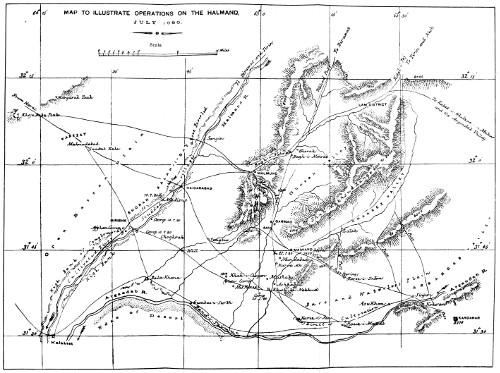
MAP TO ILLUSTRATE OPERATIONS ON THE HALMAND. JULY 1880
This forecast of a “stiff fight” proved only too true, but instead of the 6,000 men referred to, our soldiers had to meet a host of irregulars led by fanatical ghazis.
It devolved upon General Burrows to decide what course would be most calculated to bar Ayub’s progress, and on July 15th he wisely called together his commanding officers and held a small council of war. The day was not wasted in idle discussion, as while opinions were being exchanged our gunners were horsing and equipping the captured guns, the teams of which had been used by the mutineers to aid them in their flight. Many considerations had to be weighed in council. First, the position of the enemy the brigade were bound to “stop and disperse if possible.” Such information as Colonel St. John possessed favoured the belief that the enemy’s cavalry under the Naib Hafizulla were still distant 30 miles from the bank of the Helmund, and that the main body with the guns was several marches in rear of this advanced party. Ayub’s line of advance was along the main Herat Road, and he would probably enter the Helmund Valley near the Khoja Baba Peak, a high point of the range of hills which run parallel to the course of the river. This peak is 30 miles in a bee-line from Girishk, and between it and the river is an open plain, waterless, but otherwise quite easy for a force of all 548arms to cross. There was this plain still between the brigade and Ayub’s advanced cavalry, so that the two forces were scarcely “in touch,” more particularly as it was imperatively laid down in instructions from the Government of India that the Helmund River was not to be crossed under any circumstances. General Burrows was to wait for the enemy to appear before him, and his council of war had to decide at what point so to wait. The Helmund is usually fordable at only four points: Sangin on the south, Hyderabad, Girishk and Kalabist (at the junction with the Argandab). From these fords four roads converge on Candahar: the northern by way of the Malmund and Maiwand Passes, practicable for wheeled artillery; the two central passing through Khusk-i-Nakhud, and the southern route viâ Balakhana and the Bund-i-Taimur. Of these four routes, that most commonly used, on account of its directness, water and other supplies, is the road passing through Khusk-i-Nakhud from Girishk. Hence the value of Girishk as a strategical point at which to hold in check an army advancing from the west upon Candahar. But that strategical value had almost disappeared, as the Helmund, owing to an exceptionally dry season, was everywhere fordable for men on foot, thus allowing Ayub to cross it wherever he might choose and avoid Girishk. Furthermore, when the question of supplies was entered into, it appeared that the brigade had been quite dependent upon grain and forage collected by the Wali and stored near the fort on the eastern bank of the river. What supplies had existed on the 18th had either been carried off or destroyed by the mutinous regiments, leaving Girishk practically unable to provide longer for our troops. The necessity of at once finding supplies made a move from Girishk unavoidable, and General Burrows and his officers had determined what direction should be taken. The opinion of the majority favoured a retirement to Asu Khan, whence all the roads could be commanded and supports easily drawn from Candahar. This, of course, took it for granted that Ayub Khan meant to march direct upon Candahar and not turn off northwards for Ghazni and Cabul; and the retirement was advocated also on the ground that the brigade was not strong enough, unsupported, to meet the enemy in an open fight. There was a bolder proposal to move northwards to Hyderabad, retaining 549the Helmund as our advanced line, but this found little support. Finally the middle course of a partial retirement was agreed on, the brigade to fall back instantly upon Khusk-i-Nakhud. This would place General Burrows upon the central road to Candahar, and therefore commanding, to a certain extent, the northern and southern routes; the force would also be only some 50 miles from head-quarters, whence it was hoped new orders would be received, and possibly reinforcements. This was the result of the little council of war held at Girishk, and it seems to have been just and reasonable. To have stayed at Girishk was almost impossible, as supplies were exhausted: to have moved to Hyderabad would have involved serious risk if Ayub’s army were joined by the people of the district; while to have fallen so far back as Asu Khan before a shot had been fired would have seemed excessive timidity. Khusk-i-Nakhud was an admirable point from which to watch Ayub’s passage of the Helmund, and thence to ascertain his strength and probable intentions.
On July 15th a night march was made, and on the morning of the 16th the brigade encamped on their old ground at Khusk-i-Nakhud. On the following days the troops moved two miles nearer to Mis Karez, and took up a position which they occupied until the morning of the 27th. The stores were placed in a small walled enclosure, and the baggage laagered up ready for all emergencies. Spies, furnished by the Wali, were busy during the next few days in bringing news of Ayub’s movements. Their story was that the Afghan force was distributed in the dry river-bed between the Girishk and Hyderabad fords; it made no signs of moving eastwards, and the opinion began to prevail that Ghazni and not Candahar was Ayub’s objective. Reconnaissances were made every day by General Nuttall’s cavalry, but they were not of the kind to preserve touch with an enemy. Thus a troop or so visited Garmao, Sangbur, and the Bund-i-Taimar daily, as if for a constitutional ride, baited their horses, looked around, and returned. Their movements were so beautifully regular that every peasant knew at what time to expect them. Ayub’s movements were never really watched at all, though sufficient cavalry were with the brigade to have allowed of regular outpost work being done, instead of a few hours’ visit daily to the same villages. 550It was not until the 21st that Ayub’s cavalry pushed forward from the Helmund and exchanged shots with our reconnoitring party at Sangbur. The next day the village was found to be held by them, and news reached camp that 500 sowars were to seize Maiwand within twenty-four hours. There were stores of grain lying in the fields about Maiwand, and fearing they would fall into Ayub’s hands, General Burrows ordered a squadron of cavalry to destroy the grain. They had only gone a few miles from Khusk-i-Nakhud when they were fired upon by a large body of Afghan cavalry, who were reconnoitring our position with some boldness. Our cavalry scouts, deceived by the haze, reported that two regiments of infantry were supporting the hostile cavalry, and the Horse Artillery and some infantry were sent out from Khusk-i-Nakhud. It turned out to be a myth; there were no Afghan infantry, and by this time their cavalry were retiring in perfect safety. The guns certainly fired a round or two after them, but our sowars missed their chance of a charge, scared by the report that infantry were hidden under some low hills. Sangbur contained no enemy on the 24th, but in the same neighbourhood on the 25th two of the Scind Horse were killed, the Afghan sowars being again on the move. So late as the 26th it was believed all Ayub’s guns were at Hyderabad, and that no movement in the direction of the Malmund Pass had been made. The Afghan army was then believed to be about 12,000 strong, counting regulars alone, while the number of ghazis and irregulars from Zamindawar was said to be very large. Ayub’s advance could not be exactly foreshadowed, but from his position at Hyderabad it was most likely that he would try to reach Maiwand through Sangbur, as none of his troops were reported to be on the longer route viâ the Malmund Pass.
The camp at Khusk-i-Nakhud was once more aroused on the afternoon of the 26th by positive news of a demonstration in the Maiwand direction, that village having been occupied by 200 irregulars, while Garmao, five miles away, was said to be held in strength by cavalry. The conclusion arrived at upon this becoming known was that Ayub meant to occupy Maiwand by a sudden move without joining battle with our troops, and that not improbably he would thence try to slip away through the Maiwand Pass 551so as to place himself between the brigade and Candahar.[52] Spies also led General Burrows and Colonel St. John to believe that the main body must be still a march in rear of the cavalry at Garmao.[53] In view of this, it seemed important to seize Maiwand before it could be occupied in force, more particularly as the brigade had been for some days drawing its supplies from that village, and stores of grain still remained in its neighbourhood which would fall into Ayub’s hands. The distance from Khusk-i-Nakhud to Maiwand was twelve miles, and a rapid march to the latter place might anticipate Ayub’s movements and enable the brigade to clear GarmaoGarmao of the Naib and his advanced cavalry. All this was of course on the supposition that the main body of the Afghan army with the thirty odd guns was well in rear of the cavalry—an unfortunate supposition as it afterwards turned out, but one due to the wretched information resulting from the cavalry “reconnaissances.”
General Burrows, on the night of the 26th, issued orders for the whole brigade, baggage and stores included, to march at daybreak on the following morning. At such short notice the large quantity of reserve supplies in the walled enclosures could not be got out in time, and it was not until half-past six that the troops left Khusk-i-Nakhud. The route taken was along the right bank of the Khusk-i-Nakhud river-bed, then quite dry. There was a strip of cultivation near the bank, but beyond, on either hand, lay arid, stony plains. The brigade halted at eight o’clock at Mushak, to enable the baggage to close up. This occupied half an hour, and then the march was continued, the next place reached being Karezak. Here, for the first time, the unexpected news was brought by our spies that the whole of Ayub’s force was on the left front, marching on Maiwand. The cavalry were sent 552out to reconnoitre, and found large bodies of horsemen moving in the direction indicated; but the haze and mirage prevented our sowars making any estimate of what force was covered by the cavalry. This was about 10 o’clock, and yet even with the aid of telescopes little could be seen of Ayub’s army. Spies reported that the guns were there; but this news was looked upon by the General with great mistrust, natives being so given to exaggeration. General Burrows moved his troops at once rapidly towards Maiwand, meaning to occupy one of the large walled enclosures wherein to stow his 3,000 baggage animals and their loads, thus leaving the brigade freedom of movement in attacking the Afghan army. It was too late. Before the intervening village of Mundabad was gained, a large number of white-clothed figures, irregulars who follow their moollahs' dictation and their ghazis’ lead, were seen pouring out from Maiwand itself. The enemy’s cavalry ceased to retire, and along the slopes of the low hills above Garmao could be distinguished masses of men in some sort of organized formation. The haze still lay over the country, and it was impossible to make out in detail the strength of the army thus suddenly confronting the weak brigade. The ground on which the action which followed was fought is thus described to me by an officer present:—“A small stream, rising in the hills immediately north of Maiwand, formed almost the only drainage line intersecting the barren waste in our front. It ran successively past the villages of Mundabad, Karezak, and Mushak, eventually disappearing in a karez. Between this stream and the dry bed of the Khusk-i-Nakhud river the ground was level and cultivated, dotted occasionally with high walled enclosures, but generally open.” General Burrows had with him, approximately, 1,500 rifles, 550 sabres, and 12 guns, of which 6 formed the smooth-bore battery, manned by one officer and 42 men of the 66th Foot. He resolved to force the fighting; and four guns of the Horse Artillery Battery (E-B) with the cavalry crossed the dry nullah forming the bed of the Khusk-i-Nakhud stream, followed by the 66th Foot, 1st Bombay Grenadiers, and Jacob’s Rifles with the smooth-bore guns. The baggage crossed in rear under an escort of two companies of infantry, a squadron of cavalry, and two horse artillery guns. The nullah having been crossed, the troops advanced about a mile and 553formed up in line in the following order:—66th Foot on extreme right, guns in the centre, with a wing of Jacob’s Rifles and the Sappers as escort, Grenadiers on left, a wing of Jacob’s Rifles in reserve behind the guns. The cavalry were at first on the extreme left guarding the flank of the Grenadiers.
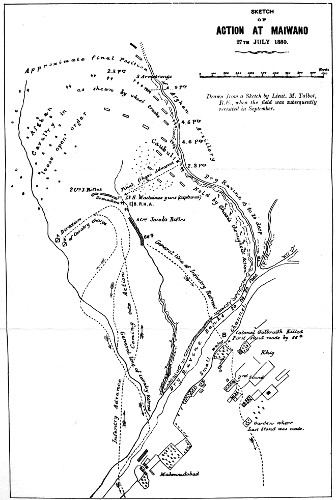
SKETCH OF ACTION AT MAIWAND 27th JULY 1880. Drawn from a Sketch by Lieut. M. Talbot, R.E. when the field was subsequently visited in September.
It was not until nearly noon that the action began. Lieutenant Maclaine with two horse artillery guns and a small cavalry escort galloped out on the extreme left, and got his guns into action at a range of 1,800 yards, firing shrapnel at the Afghan cavalry. General Burrows disapproved of his boldness, and ordered the guns to retire, an order which Lieutenant Maclaine was very loth to obey. However, the guns were withdrawn, and by the time they had resumed their place in the line the enemy’s strength had begun to be developed. Large numbers of irregulars, led by the usual ghazis, were seen swarming over the low hills, and they presently moved down upon the 66th, evidently meaning to turn the right flank. To check this, General Burrows ordered his right to be thrown back on the front extended, Ayub’s cavalry being on the move to the left as if to carry out a flanking movement in that direction.[54] Accordingly two companies of Jacob’s Rifles were sent to the extreme left, while the remaining companies of that regiment and detachment of the Bombay Sappers and Miners filled up the gap between the 66th on the right, and the guns in the centre. Two guns were placed in position to support the 66th on the right, the remaining ten between the Grenadiers and the main body of Jacob’s Rifles. Every rifle was thus in the line of attack, it not being possible to form any reserve worthy of the name for such a small force. The cavalry (3rd Scind Horse and 3rd Bombay Light Cavalry), under General Nuttall, formed up in rear of the left centre of the line, where they remained during the action. Our guns began shelling the enemy, whose artillery did not reply for quite half an hour, confirming the idea that Ayub’s guns were far in rear. By half-past twelve, however, this delusion was cleared away, for some five batteries opened upon the brigade, and their shells fell 554with fair accuracy. The effect of our own artillery fire could not be followed, as the haze continued. Under cover of their thirty or more guns the irregulars advanced to within 600 or 700 yards of the 66th; but the Martini fire from the latter swept them down wherever they appeared; and so cowed were they that, planting their standards, they sought cover in a dry ravine, firing upon our men without doing much damage. Our infantry were lying down under such cover as the ground afforded, and two of the smoothbore guns were sent to the left to shell the Afghan cavalry. Then came the fatal mistake in the action: instead of following the usual tactics which our generals have found so successful all through the war—taking the initiative and attacking with his infantry—General Burrows entered into an artillery duel, which lasted for two hours. The brigade had twelve guns (six of which were inferior smooth-bores, worked by volunteers from the horse artillery, and infantry men trained during the halt at Khusk-i-Nakhud) the Afghans had nearly three times that number, and their gunners were unusually expert. “They soon got our range,” says an officer present, “and shot and shell came crashing into us.” Shrapnel, round-shot, and afterwards grape, were freely used by the enemy; and while our infantry were fairly safe at first, the horses of the cavalry and the gun-teams suffered severely. The latter had to be renewed constantly; and it was evident that in a trial of strength with artillery the brigade was greatly over-matched. Little did our men know that the Herati regiments suffered so from their shell-fire that twice they retired, and were quite ready to have fled at the first direct attack. The enemy’s artillery fire was so well sustained that casualties soon began to be reported all along the line. Harris, of the staff, and Blackwood, commanding E-B Battery, were among the first hit; but Blackwood, after having his wound dressed (he was hit in the thigh), returned to his battery—a rare example of true bravery and endurance. The want of water told heavily upon all our men, and the slackness resulting therefrom was only too plain—men leaving the ranks to get water from the nullah in rear or from the water-carriers. Our three regiments were still out of range of any musketry fire, except stray shots from irregulars; but the artillery fire had a demoralizing effect upon the sepoys. Jacob’s Rifles are 555said to have had nearly 100 men who had never fired ball-cartridge, so that they could not be looked upon at all as trained soldiers whose fire could be relied upon.
At about two o’clock the smooth-bore guns were reported as running short of ammunition. Sixty rounds per gun had been made up since their capture, and with these they went into action. There were no reserves to fall back upon. Captain Slade had taken charge of these guns, but returned to his own battery when they ceased to fire. There was nothing for it but to order the four six-pounders and the two howitzers forming the battery to retire and this movement was at once carried out. No sooner did the enemy notice that half our guns were out of action than they advanced along their whole line. Their batteries were brought forward in the boldest manner, and some of their guns actually came into action, on the right, from behind a depression in the ground only 800 yards from our infantry. Two or three thousand cavalry manœuvred on the left flank of the brigade, trying to get well in rear; while on the right a large number of mounted men and irregulars on foot, who had made a wide detour, got into the villages, and were firing upon the baggage escort. The 66th had still the ghazi-led mob in front of them in check, steady volleys keeping the ground clear. At this time the casualties all round must have been considerably over 100, while many horses had been killed.
At about half-past two the two companies of Jacob’s Rifles on the extreme left began to waver. Their two officers had been killed, and their two native officers, who had kept them together for some time, had also fallen; there were none of the enemy’s infantry near them, but the artillery fire had demoralized them; and the last straw which broke the back of their courage was the retirement of the smooth-bores out of action. They thought such a move could only mean that all was over, and they broke their ranks and fell back in utter confusion, breaking into the ranks of the Grenadiers, who had up to that time been steady. Their bad example was quickly imitated, and the Grenadiers likewise gave way. The remaining companies of Jacob’s Rifles shared the panic, and with a quickness that carried consternation into the heart of every European officer, all the native infantry 556were surging upon the 66th. The Grenadiers fought bravely and tried to form square but could only get into a V shape with the apex towards the enemy: in the mêlée they were cut down literally “in hundreds.” The Sapper detachment under Lieutenant Henn, with the guns, stood bravely to their post, but so small a party could not hope to save the guns without immediate help. Lieutenant Henn was killed after behaving most gallantly. The enemy saw their advantage, and a rush of irregulars led by ghazis was made from the right front. The guns fired canister into the mass; but it was useless, and Slade limbered up and retired. Maclaine remained with two guns firing, until the ghazis were actually at the muzzles, and these two guns had to be left behind. The 66th were broken by the rush of sepoys upon them. The confusion was hopeless, many of the sepoys being so cowed that they allowed the Afghans to pull them backwards from among their comrades and cut them down. No attempt to use the bayonet was made by the recruits among Jacob’s Rifles, who scarcely seemed to know that they carried arms wherewith to defend themselves. A cavalry charge was ordered; but the men were out of hand, and though two squadrons rode out, they never really charged. One of their officers had his horse shot, and the sowars would not go on, but veered round and came back to add to the disorganization of the infantry.[55] The 66th and the Grenadiers rallied twice in walled enclosures and sold their lives dearly, but they were outnumbered, and could not help to check the Afghan advance. Colonel Galbraith was killed outside the first 557enclosure, and the 66th lost nine other officers killed. Major Blackwood, commanding E-B Battery, was also shot down, one of his subalterns (Lieutenant Osborne) having been killed in the rush. By three o’clock the brigade had been routed, and the enemy were in hot pursuit. Fortunately that pursuit lasted only two or three miles, the enemy returning to Maiwand to loot General Burrows’ camp.
The following extract from a letter from an officer who was engaged in the action may well close this sad record:—
“When I realized that we were defeated, and had to retreat some 50 miles to Candahar, my heart sank within me, and never shall I forget the agonies of that fearful night march without water, hundreds of poor wretches lying strewn about the road calling aloud for a drop of water. It was agonizing, but one was obliged to steel his heart, as nothing could be done, we all being in the same box. The order to march on Maiwand from Khusk-i-Nakhud was only given at 10 P.M., on the 26th July, and the march commenced at 6.30 A.M. (on the 27th). We had no idea that Ayub’s army was at Maiwand till we had marched half-way there, and then we only half believed it: however, after going a few miles further we sighted the enemy moving towards Maiwand. Our troops seemed to consider that they would have it all their own way, and advanced very boldly; but the demoralizing effect of thirty odd guns and the being outnumbered, obliged them to retreat, and the retreat became a rout. From prisoners lately taken we hear that we inflicted a fearful loss on the enemy, and that if we could only have brought a fresh regiment we could have won the day. Our heaviest losses were during the retreat, as all the villagers on the line of route turned against us. I was among the last to leave the field, and walked half the way, having given up my pony to a wounded soldier. I was not fired on by the villagers till within six miles of Candahar, when I, with two sepoys and the wounded soldier, had to ascend a hill, and take refuge behind a rock, where we remained a good while, till the country was cleared by the cavalry under General Brooke, who had come out from Candahar to meet us. I then continued my journey, and when arriving at the village near the cantonments 558some 10 European and 15 native soldiers had joined me. The native soldiers were utterly demoralized,[56] and I could not get them to obey me. Some 100 or 150 Afghans were congregated on a little hillock commanding the road to Candahar, and seeing the hesitation of my party they streamed down the hill, yelling, and I was obliged to fall back and take up a position on another hillock. Then the native soldiers came to me and expressed their opinion that we ought to run for it. However, I abused them, and made them lie down and point their guns towards the enemy, who at once retreated to their former position. I felt perfect confidence in the European portion of my party, and if I could have felt the same in the native I would not have minded an attack from 150 half-armed Afghans. When General Brooke returned with the rear-guard of the Girishk column, he shelled the hills where the Afghans were collected, and we marched peaceably into cantonments.”
CONCLUSION.
I have not gone into the details of the movements of the Cabul-Candahar force after the Battle of Candahar, as there was no further opposition, and the military programme carried out was only of local importance. The brigades were marched back to India as quickly as possible, with the exception of the 9th Lancers and 6-8 R.A., which were left at Candahar. The following letter, written in Candahar, will throw some light on the strategy of the action on September 1st:—
CANDAHAR, 20th September.
There is but one opinion here as to the unsoundness of the criticisms upon General Roberts’s action of the 1st; it is that the critics have jumped to conclusions on imperfect reports, having taken the first meagre telegrams as their guide. By an incessant study of small-scale maps they gained a superficial 559knowledge of the Argandab Valley, and were fully convinced that the proper mode of directing the attack would have been to throw an intercepting force 30 or 40 miles in rear of Mazra, and then to have attacked Ayub from Candahar—no doubt by way of the Pir Paimal village. They point their arguments by adding that our cavalry pursuit was really inoperative, as only 400 of the fugitives were killed, while the great mass escaped. Admitted that after we had rolled them back from Pir Paimal the great majority got off scot-free, this by no means proves that a weak brigade could have cut off their retreat; for it seems to be forgotten that not one, but many, roads were open to them, while the mountainous nature of the country on the higher reaches of the Argandab was all in favour of trained hill-men such as Afghans always are. Their cavalry and many thousands of footmen made straight for the Khakrez Valley, knowing well that once the range of hills, eight miles west and north-west of the Argandab, was reached, they were quite safe. There was no necessity at all for their retirement northwards up the Argandab—or rather north-eastwards—and it is quite an open question if any brigade we could have spared would have even seen many of the fugitives. General Roberts’s first and greatest duty was to induce Ayub Khan to give him battle, and not to cause a scare in his camp by premature strategical movements, 30 or 40 miles up the Argandab Valley. It may not be known, also, that when the infantry was encamped near Shar-i-Safa, one march from Robat, on August 27th the news from Candahar led us to believe that Ayub might possibly forsake Mazra and try to escape in the Ghazni direction by way of the Argandab stream. General Roberts at once recognized the necessity of barring any movement in force in this direction, and a column of about 2,000 men was told off to march by way of Bori, and Dala, and block the road up the Argandab. But when heliographic communication with Candahar was opened up later in the day, and Colonel St. John’s reports showed that Ayub was busy strengthening his position at Mazra, the order given for the column to move out was at once countermanded. It was known that the Afghan force was mainly composed of men from Zamindawar, Candahar, and Herat—the Cabuli element being very small, and the Kizilbashes 560and Kohistanis being already in treaty with Colonel St. John to desert at short notice. The main body of real fighting men, therefore, would seek safety in flight, after defeat, not northwards towards Khelat-i-Ghilzai, but to the west and north-west, where the hills offered them shelter until they could regain their homes. This line of flight was really taken; but as our cavalry brigade under General Hugh Gough could not reach the Kokaran Ford until Gundigan and the orchards about had been cleared by General Baker’s Infantry Brigade, Ayub Khan and his cavalry escort—leaving Mazra, it should be remembered, at 11.30 A.M.—had easily covered the seven or eight miles of ground between the river and the slopes of the hills bounding the Khakrez Valley on the south. Besides, the tactics of the fugitives were such as to neutralize any pursuit or the action of any intercepting force: hundreds took refuge in the villages, buried their arms, or hid them securely away, and came out to greet our troops in the guise of harmless peasants. If these had been slaughtered in cold blood the cavalry would have returned with the report that not 300 or 400, but 1,300 or 1,400 of the enemy had been killed. I do not make this statement on my own unsupported authority, but on the direct testimony of cavalry officers engaged in the pursuit. Thus the 9th Lancers gave chase to a large number of men evidently in full flight. On coming up with them, the Lancers found these fugitives without arms, and though there could be no reasonable doubt that they had hidden their weapons some little time before, Lieutenant Colonel Bushman ordered his men to spare their lives. The Lancers rode among them, and if any man had been detected with a knife or pistol he would probably have paid the forfeit of his life. In other instances small bands were hunted into villages, and when the cavalry rode up men appeared holding little children in their arms, and prayed for mercy. What was to be done to an enemy resorting to such manœuvres? Our cavalry could not take prisoners as they had to continue the pursuit: and these units of the Mazra army were shown that mercy which they refused to our men retreating from Maiwand!
Again, any intercepting force thrown into the Argandab Valley could not hope to co-operate with the force attacking from Candahar; 561they would have been a detached corps of observation, merely watching for Afghans fleeing into their arms. First of all they must have been sent completely away from our main body either at Shar-i-Safa or Robat in order to cross the hills by the only available kotal near Dala (between 30 and 40 miles above the Baba Wali Kotal); for the Murcha Kotal was held in force by Ayub. They could not approach to within 20 miles of Mazra, for a further advance would have been to court an attack by overwhelming numbers, while General Roberts was marching from Robat to Candahar. The safety of 2,000 men would have been endangered, while the only object they could have gained would have been the interception of a few hundred of Cabulis, who would probably have taken to the precipitous hills and escaped in the night. The Argandab Valley narrows greatly, 30 or 40 miles above Mazra, and cavalry would have been worse than useless with the intercepting (?) column. It cannot be urged with too much emphasis, that Ayub Khan’s line of retreat, if his army were defeated, was in the Khakrez direction, for his men, in their slack disciplinediscipline, would make for their own villages and not rush off at a tangent towards Khelat-i-Ghilzai. All Afghan “armies,” so-called, and Ayub’s was perhaps more worthy of respect than any we have yet met, have a power of dispersion which is unrivalled. Organized pursuit against them is almost impossible: unless every mountain path and torrent bed within 50 miles could be searched at once.
General Roberts has had more experience in Afghan warfare than any other of our commanders; and his tactics were based on sounder principles than those advocated by critics unversed altogether even in the details of past actions. To say Pir Paimal could have been carried with fewer troops than those engaged is to beg the whole question. The action of Ahmed Khel proved that when fanaticism is at red-heat, 5,000 or 6,000 men may charge right into our ranks. Would it have been wise to have dispensed with General Macgregor’s brigade (some 2,000 strong) as a reserve in case of such another charge down from the Baba Wali Kotal upon General Macpherson’s right flank? And yet General Macgregor had about the number of men which would have been absorbed if the much-talked of “intercepting column” 562had been waiting, 30 or 40 miles up the Argandab Valley, ignorant of what was happening at Candahar. It may be urged that there were 4,000 men of the Candahar garrison at General Roberts’s disposal; but it would have been unwise to ask much of a garrison still suffering from the shock of the terrible disaster at Maiwand, and only half-realizing that they were no longer besieged within the walls of Candahar. That I am not exaggerating the depression prevailing in the Bombay Division, will be clear from the fact that General Primrose, on the evening of the 31st August, personally stopped a string of mules which were leaving the citadel with bread and barley for the Bengal troops. Our reconnaissance was returning, and there was certainly heavy rifle-fire beyond Karez hill, while the enemy’s guns on Baba Wali Kotal were also adding to the din. Our troops were holding Picquet Hill, and our camp was within 2,500 yards of the Eedgah Gate, out of which an officer in the Commissariat Department was conducting the little convoy. Between that convoy and “danger” were some 10,000 picked men, nearly all British, Sikhs, and Ghoorkas; but the “risk” of allowing the bread and grain to be carried a mile and a half was pronounced “too great” by General Primrose himself. The Commissariat officer, knowing food was needed in camp, managed to gain permission to take on the mules laden with bread, and he saw nothing to disturb him on the road. The ground between the north-western bastion and the nearest wall of cantonments (1,200 yards away) is as bare as the Sahara, and it was not likely the enemy’s cavalry picquet below the Baba Wali Kotal would have charged out a couple of miles to capture the mules, even if they had seen them. The story is told not to detract from General Primrose’s judgment and ability, but to illustrate the unhealthy feeling and want of tone in the garrison, in spite of the efforts of brave and resolute men to wipe out the recollection of Maiwand and Deh-i-Khwaja from the minds of their fellows.
I have tried to write without undue dogmatism: but I may have been betrayed into laying too great a stress upon “probabilities,” viz., that the enemy’s line of retreat would be towards Khakrez and not up the narrow Argandab Valley, and that Ayub’s irregulars might have furnished a band of desperate men led by ghazis to 563make a counter-attack from Baba Wali Kotal. I have carefully avoided any reference to the entrenched camp of Ayub at Mazra, which our spies assured us existed, and which General Macgregor’s Brigade, fresh and untouched by fire, were intended to storm if Generals Macpherson and Baker had been checked in their progress. I think these probabilities were justified fully so far as the retreat is concerned, while the knowledge that we had all our forces concentrated behind Karez and Picquet Hills may have prevented the masses of men about the Baba Wali Kotal (in the earlier part of the day) from making a counter-attack. If there is one part which criticism may fairly seize upon, and which our own Brigadiers would be the first to acknowledge, it is the want of cavalry with General Ross when the 72nd and 2nd Sikhs on the one hand, and the 92nd and 2nd Ghoorkas on the other, rolled back the enemy at the turning-point of the Pir Paimal spur. The basin leading towards Mazra and the open ground due west towards the Argandab was covered with men in full flight, and 500 sabres could have swept into them with terrific effect. It is, I believe, an axiom that no division shall now go into action without one regiment of cavalry attached to it, but all through the war we have brigaded all our cavalry, and on several occasions the want of 500 troops to follow up rapidly an infantry attack has been severely felt. Witness in particular the first action of Charasia, when the Afghans fled towards Indikee; and the storming of the ridge leading up to the Takht-i-Shah Peak when the open ground beyond Beni Hissar was black with fugitives. General Hugh Gough and his splendid cavalry brigade of 1,600 sabres and lances did all that men could do to gain the Kokaran Ford, and cut up such bodies of men as they could overtake; but if one regiment had been spared from that brigade to have followed up our infantry advance there would have been rare work for the troops about Pir Paimal. The answer, of course, to this is that the network of orchards and walled enclosures, with intersecting channels, seemed to shut out cavalry from participating in that part of the action; there was no one as usual to tell us of the grand open ground when the ridge was turned.
565