The Secret of the Source
Reading edition
There had been a great drought. Plague was sure to follow such weather, and the Moros were already dying of starvation. “Rice, rice!” was the cry, but everywhere the crop had failed, and the natives were desperate.
Piang had been more successful in foraging than the other lads had, and his mother was safe for a time, but there seemed to be no hope, and he sorrowed as he pictured her dying for want of the food that it was his business to provide for her.
In the stifling heat of midday, the village was startled by the appearance of several white men on the biggest animals they had ever seen. Tiny ponies, straying about the village, fled to cover at sight of the strange creatures, and most of the women hid themselves in fright. The Moro men sullenly watched the strangers advance, making no attempt to stop them, but there was no mistaking their hostile attitude.
“Where is the dato?” asked the interpreter, who rode in ahead of the men. There was no answer.
“Come, where is the chief? The white men bring good news; they bring food.”
Instantly there was a change. Kali Pandapatan stepped in front of the others and said in his musical patois:
“I am Dato Kali Pandapatan. Speak. Do not deceive us.”
A lengthy conversation followed, and while the two men were arguing and gesticulating, the strangers gradually coaxed some of the children toward them. Finally the women sidled nearer, and soon the entire population had hedged the little company in, and were gazing with awe at the huge American horses with their odd trappings. One mare stamped her foot and neighed loudly, scattering the spectators in every direction, greatly to the amusement of the white men.
It was all very hard for the dato to understand. He explained to his people that some great power had sent the white men to save them from starvation. The interpreter had told him that the Moros all belonged now to some nation called the United States. A fierce murmur rippled through the crowd at this piece of news. The dato raised his hand for quiet.
“Let us hear them through. We are hungry; let them feed us. We will fight for our freedom later, if necessary.”
Haughtily Dato Kali Pandapatan faced the newcomers and bade them speak. The interpreter explained that the men were United States soldiers, and that their chief had commanded them to search the islands for starving Moros and to relieve their suffering. The crafty dato pondered long before he accepted their offer, all the while watching for an attack. It was impossible for him to believe their generosity could be genuine, so used was he to the treachery of Spanish strangers. When the pack-train loaded with supplies appeared at the head of the steep mountain pass, a cry went up from the hungry people, and a rush was made toward it. When the supplies had been portioned out to each family, and suspicion banished from the minds of the natives, the “Americanos” were hailed as their saviors. Lieutenant Lewis, in charge of the expedition, was offered every courtesy, and the soldiers were showered with gifts of brass and trinkets. Dato Kali Pandapatan vowed his allegiance to the soldiers and offered the services of his tribe.
“Ask the dato if he has heard of the mysterious rice that has been found on Lake Lanao, Ricardo,” said Lieutenant Lewis.
The interpreter addressed the dato and learned that it was a well known fact that rice had appeared on the surface of the lake from no apparent source. As it had never been grown in that district, the authorities were puzzled over the persistent rumors. If it could be cultivated there, it might be possible to supply the tribes with enough to avoid these frequent famines.
“He says he is not sure, sir, but travelers from that section all bring the same tales of gathering rice in an eddy at one corner of the lake. The tribes are very fierce around there, and as they will not tolerate interference from strangers, no one has dared to investigate.”
“I can easily believe it. General Bushing’s expedition through that country met with fearful opposition. It’s a wonder to me that so many of them came out alive.” The lieutenant was silent for a time, then said:
“Ask him if he has a swift runner, some one that he can trust.”
Ricardo questioned the chief.
“Yes, sir, he says there is a boy named Piang, who is fleeter than the wind, surer than the sun.”
“Ask him if he will send this boy for me to the lake to search out the truth about this rice. Offer him fifty bushels of corn for the lad’s family and tell him I will send him twenty-five bushels whether he is successful or not.”
“Piang! Piang!” the name was on every one’s lips. From out the crowd stepped a slender faun of a youth, slim and supple as a reed. The gaily-colored breech-cloth wound about his loins supported his bolo and small knives, and in his tightly knotted long hair, glistened a creese. With silent dignity he awaited his orders. No curiosity manifested itself in his face; no question was on his lips; he simply waited. Lieutenant Lewis marveled at the boy’s indifference, but when the mission was explained to Piang, the light that sparkled in his eyes and the expressions of excitement and joy that chased each other across his face removed all doubt from the lieutenant’s mind.
Piang was chosen! Piang was to ferret out the secret of the lake! Piang was to bring honor to his tribe! When it was explained to him that his mother would be provided for, he abruptly turned from the dato and dashed off to his hut to procure weapons and scanty provisions. A silence held the natives as they waited for Piang to reappear. They all seemed to sense the dangers that were confronting the boy so eager to undertake the task. Hardly ten minutes had elapsed before he was in their midst again. He salaamed before the dato and, without a glance at the others, bounded up the trail, away into the jungle.
“But,” protested the lieutenant, “no one has given him any orders, any directions.” The interpreter conveyed the American’s misgivings to the dato. A smile broke over his face.
“Piang needs no directions, no advice. No jungle is too thick for him to penetrate, no water deep enough to hide its secrets from him. Piang will bring you news of the rice. I have spoken.”
“And to think of the fuss it takes to get a few dough-boys ready for a hike!” exclaimed the amazed lieutenant.
The jungle was terrible. Everywhere Piang came across victims of the drought. Little monkeys, huddled together, cried like babies; big birds, perched on the sun-scorched trees, were motionless. He stumbled over something soft. Always on the alert, his bolo was ready in an instant, but there was no need for it. He looked down into the dying eyes of a little musk-deer. Pity and misgiving filled his heart, and he wondered if he would be able to reach the Big Pass before he starved. Surely, up there it would be different; they always had rain, and if he could only hold out.... A snuff-like dust constantly rose from the decayed vegetation; it pained his nostrils, and he muffled his face in his head-cloth as he penetrated deeper into the jungle. He must reach a clearing before night; it would mean almost certain death to sleep in the jungle’s poisonous atmosphere. There was a good spot further up, and he worked his way toward it, determined to reach it for his first night. The liana-vine that he cut for water was dry. He listened for the trickle of a brook. The jungle is usually full of little streams, but no sound rewarded his vigilance. Stumbling along, he began to think his journey would end there, when he was startled by loud chattering. A monkey settlement was evidently near, and he knew by their liveliness that they were not famishing for water. Spurred on by hope, he redoubled his efforts and was rewarded by the sight of a cocoanut grove in a clearing.
There was a general protest from the inhabitants as he made his appearance, but he paid no attention to the monkey insults hurled at him and gratefully picked up the cocoanuts with which they bombarded him. Shaking each one, he tossed it from him. They were all dry. The monkeys were too clever to waste any nuts that had milk in them. Piang tied his feet together loosely with his head-cloth, and, using it as a brace, hopped up one of the trees as easily as a monkey. Sitting in the branches, he drained one cocoanut after another, and when his thirst was slaked, he amused himself by returning the bombardment. He was surrounded by monkey snipers and he laughingly rubbed his head where one of their shots had struck home. With careful aim he showered the trees, and gradually the monkeys began to disperse. He had won; the fun was over. He watched them scold and fuss as they retreated into the jungle, regretting that he had not kept them with him a little longer for company.
The big sun was dipping into the trees now, and he descended to gather material for his bed. High up in the cocoanut-tree Piang built his couch. He selected two trees that were close together, and, cutting strips of ratan, bound stalks of bamboo together making a platform which he lashed to the trees, far out of reach of night prowlers. He dipped into his scanty provisions, and then, scrambling to his nest, covered himself with palm branches, which afford warmth as well as protection from the unhealthy dew. Quickly Piang sank into an untroubled slumber. All night long creatures fought below him for the few remaining drops of moisture in the discarded shells, but he knew that he was safe, and their snarls and bickerings did not alarm him.
Piang started guiltily. He must have overslept. The sun was high, but for some reason the heat had not awakened him. Sitting up, he rubbed his eyes, sniffed the air, and uttered a shout of joy. A gentle rain was trickling through the foliage; the spell was broken; the jungle would live again. After hastily gathering a few nuts he climbed down the tree and prepared for his journey, thankful that the drought was to be broken by the gentle “liquid sunshine,” as it is called, instead of by a violent typhoon. Eating what he wanted of the soft, green cocoanut meat, he tied two nuts to the ends of a ratan strip, and, slinging them across his shoulder, was off again, darting here and there to avoid the stinging vines and treacherous pitfalls.
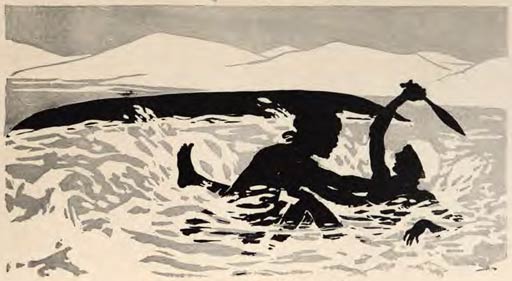
Over and over they rolled, splashing and fighting
How many days was he from Lake Lanao? He counted the suns that must rise and set before he should arrive. There were four, if he should be fortunate enough to find the Ganassi trail. Piang had not lost time by returning to the coast to pick up the trail, but had trusted to his instinct to lead him aright. Surely, if he followed the sun by day, and the big bright evening star by night, he would come upon the trail the second day. He must avoid the lake people at all costs; they were not to be trusted, and his life would pay the penalty if they caught him spying. Silently the jungle child sped along. Nothing escaped his watchful eye; no sound eluded his trained ear. Once he darted aside just in time to escape the toils of the dread python as it swooped from above to claim its victim. Another time his bolo saved him, and a wild civet-cat lay at his feet. Chuckling at his prowess, Piang drew his knife across the animal’s belly, and slipped off the skin, almost whole. It would be useful to him, and maybe he could find the herb that is used to cure pelts.
It was very difficult traveling. The sun was not visible during the afternoon, and Piang lost his direction. Blundering here and there, he often came back to the same place. It was no use; he could not find the trail without the assistance of sun or stars. Sometimes it was days before either could penetrate the dense mist that accompanies the tropical rains. Discouraged, he threw himself on the ground.
An unusual sound made him jerk his head up to listen. It came again, and the boy rose quietly to his feet, focusing his senses on the sound. Cautiously he advanced toward it. In the jungle it is always wiser to be the one to attack. The sound was repeated, and Piang breathed easier. It was made by an animal, not by his dread lake enemies. Gradually he crept nearer and when he parted the bushes and peeped through, he almost shouted in his excitement. He had reached the Big Pass. A broad river swept rapidly by, and along the banks wild carabao rolled and splashed, making queer diminutive sounds, not in keeping with their ungainly size. Piang was careful to keep out of sight, as they are apt to be dangerous when their very uncertain nerves are startled.
For more than two days Piang fought his way through the entanglement of cogon grass and vicious vines, cutting and hewing his way, afraid to cross the river and follow the Ganassi trail. Finally, one rosy dawn, he came upon the lake as it sparkled and shimmered in the early light. The boy held his breath, delighted with the beauty of the view. Far in the distance mountains rose in a blue and purple haze. The lake was nestled in the heart of them, fed by many clear brooks and springs. Its bed had once been the crater of an active volcano, but Piang did not know this.
From his retreat, built high among the dense trees, Piang watched the lake people ply their way to and fro across the water. Somewhere on that lake was the secret of the floating rice, and the boy was determined to discover the truth. He hid before dawn at the water’s edge near a spot that he had noticed was much frequented. As usual, a swarm of natives visited it about noon. Piang watched them dip up gourds and cocoanut-shell cups full of water. They strained it through cloths, repeating and repeating the action. He was sure it was the coveted rice that they were gathering and he impatiently waited for them to go; no sooner had they departed, however, than others arrived to take up the task. There was nothing to do, but wait again for dawn, and Piang wriggled himself back to his grove and mounted his platform home.
He was very restless all night and hardly slept at all, so anxious was he for the first streaks of light. As he lay with eyes upturned, he watched the stars grow dim: before they had entirely disappeared, Piang was standing by the water ready for the dive. His bolo was slung at his side, and in his mouth he carried a smaller knife. One never knows what one may meet at the bottom of an unknown lake, and Piang was prepared for any emergency.
At last it was light, at last he could see into the clear lake. Climbing out on the rocks as far as he could, he let himself down into the cool water. How he rejoiced at the feel of it and how easily he slipped along toward the spot where he had watched the natives the day before!
He looked for signs of rice. Seaweed tricked him; bubbles vanished and he reached to grasp them. Round and round he swam, and finally his hands closed over something small and slippery. Breathlessly he fingered it, and opening his hand as he trod water, he beheld the mushy rice grains.
Taking a long survey, he assured himself that there was no one in sight. Yesterday the Moros had not come before noon; and if he worked quickly, he might discover the secret to-day. Taking a long breath, Piang dived straight down and, swimming along the bottom, examined the rocks carefully; but he came back to the surface none the wiser for his plunge. A puzzled look puckered his face. Tilting his head to one side, he considered. That was surely rice; it did not grow here, so it must come from under the water. Again he dived, but this time he swam nearer the surface and he saw that there was more rice floating by than he had imagined. It was not coming from the bottom, it was drifting from the center of the lake!
Excitedly he headed in that direction, swimming under water whenever he lost the trail of the rice. It was not strange that it only came to the top in that one spot. There was a strong current that bore it upward, whirling it in an eddy before it sank to the bottom. Farther, farther he went, always swimming toward the center of the lake; and as he went, the rice grew thicker. Eagerly he plunged forward, keeping his eyes open, watching the rice.
He stopped. What was that dark object resting on the bottom? He did not know how exhausted he was until he paused for breath; then, knowing that his next dive would take him far down, he rolled over on his back and floated quietly. Burning with curiosity, he could hardly wait to see what was there. Slowly he swam downward. Something warned him to be more careful, and afterward he was grateful for his caution, for had he plunged recklessly to the bottom, in all probability in would have been his last dive.
He was aware of a large body moving near him and he dodged just in time to avoid a collision, striking out for the surface. Lying flat on the water, he peered into the depth and discovered several dark things swimming about. Frightened at first, he remembered that sharks and crocodiles do not live in mountain lakes. Bravely he descended, but this time he swam with his bolo in his hand. Down, down, and again he saw the queer, square things flopping about. They were huge tortoises, clustered around a darker object at the very bottom of the lake. Once more Piang came to the top. He was not afraid now; tortoises do not fight unless attacked, and the boy could easily outswim any of the clumsy creatures. But what were they doing out there in the middle of the lake? Tortoises live near shoals and feed on fungi and roots. As he plunged down once more, he was met by a strong up-current and had to fight his way through. Tiny particles stung him as they rushed by, and it seemed to him that millions of fish were darting here and there, snapping at something. It was rice. Gradually it dawned on Piang that he had reached his goal; the tortoise had reached it first, and the secret lay hidden in that dark thing at the bottom.
Frantically, but steadily, he worked his way down, avoiding weeds and driftwood. The water grew calmer as he neared the bottom, the rush of the current less. His breath was almost gone; he could hardly stand it a few seconds longer, but he must see what it was there. With one supreme effort, he struggled and reached the hard sand of the lake floor. A trifle dazed, he looked about, and there, towering above him, was a ship.
Piang was almost unconscious when he reached the air. Had he been dreaming? How could a ship be resting on the bottom of Lake Lanao? Restraining his curiosity, he forced himself to rest. Lying on his back again, he took long regular breaths until he was entirely rested. Slowly he descended and, avoiding contact with the loggy tortoise, circled around the dark thing. Yes, it was a boat. Piang had seen only one other boat like it in his life. It was only about thirty-five feet long, but to the boy it seemed to rise above him like a mountain. Fascinated, he sank lower until he was standing on the deck. The tortoises and fish paid no attention to him, and he examined it carefully. The big tube, sticking up in its middle Piang recognized as the thing that belches smoke, and along the sides, covered with slime and weeds, were small black objects. He had heard that these boats hurl “hot-spit” into the jungle when they are angry, and he supposed it must come from these ugly things. All this occupied only a few seconds, but to Piang it seemed like years. Making a hasty ascent, he again filled his lungs and prepared to explore farther. As he worked his way back, he crossed the current that was bearing the rice to the surface and remembered his mission. Following the milky trail, he arrived at the stern of the boat and shuddered to see the mass of animal life clustered there. Worming his way alongside, he frightened the swarming creatures, and they scattered, leaving him a clear view of the boat. Only one old tortoise refused to be disturbed, and Piang watched it pull and bite at something. He was very close to it, when suddenly something blinded him. He put out his hands to ward it off, but the rush increased, and when he found his way to the top his hands were full of soggy rice. The old tortoise had torn the end of a rice-sack, and the contents were being whirled upward.
As the boy lay on the water, reviewing his remarkable discovery, his strength almost exhausted, he was startled into the realization of a new danger. Quickly he dived, but not before a man in a vinta, headed that way, had seen him. Piang was caught. In his excitement he had failed to watch for the coming of his enemies, and now he must fight. Swiftly the vinta approached. Piang could see it through the water and he watched until it was over his head. With a lunge, he struck at it with all his might, upsetting it and throwing the occupant out. With a yell the man grabbed Piang, and the startled boy recognized his old enemy, Sicto, the outcast, who drifted from tribe to tribe, a parasite on all who would tolerate him. He was making his home with the lake people just now and had discovered Piang’s hiding-place. Guessing that the boy was after the secret of the rice, he had watched his chance and had pounced on him when he was least able to protect himself.
Over and over they rolled, splashing and fighting. Piang was struggling for breath, but luckily he still had his bolo in his hand. The big bully was sure to win the fight unless Piang could escape soon, as he was already winded and exhausted. A happy thought flashed through Piang’s mind. He watched for one of the tortoises to swim near the surface, and then shrieking “Crocodile,” he pointed toward it. When the frightened Sicto shrank from the tortoise, Piang struck with all his might, but he was so weak and his knife was so heavy that he only stunned his adversary.
Then he was away like a flash. Before the bully could recover, Piang had righted the vinta and was paddling off in the direction of the river. Sicto tried to follow him, but Piang only laughed and paddled faster. He was free again; he had a boat, and knew the secret of the rice. Allah was indeed good to little Piang.
Rapidly he plied his paddle. The current was against him as he headed for the mouth of the river, but he worked steadily and soon lost sight of the infuriated Sicto.
He paused. Coming out of the river was a flotilla of boats. They were the usual rice-fishers, and he must pass them to gain the outlet. What if they called to him? He could not speak their dialect, and they would surely recognize Sicto’s boat. He did not think they had seen him, so he changed his course to the east-ward and slowly paddled in that direction. They soon passed behind him, paying no attention to the solitary boatman, and he thankfully headed toward the river. As soon as the men reached Sicto, he would tell them of the fight, and they would give chase. Piang’s chances of escape were indeed slim, but he had a little start.
Stubbornly he fought the current; patiently he worked against the swift water. At last he was in the river, but he knew that by this time the Moros were in pursuit. That they did not appear in the river behind him was no reason to feel safe. He was sure they would try to head him off by land, as the river wound round and round through the valleys. The odds were certainly against Piang. He was in a strange country, unfamiliar with the trails and hunted by the swiftest tribe of Moros. The Ganassi trail was out of the question. It would be lined with the lake people watching for him. The jungle, which he had worked his way through, would be searched, and his recent camping site discovered. Every passable trail to his home would be watched.
Suddenly Piang remembered the “Americano” soldiers. They lived somewhere off in the other direction, beyond the terrible marshlands. Without a moment’s hesitation, he headed toward the shore, pulled up the vinta, and secured it. He then plunged into the stream and swam to the opposite shore. When the lake people found the vinta, they would search that side of the jungle. Piang was pleased at his ruse.
Bravely the boy faced his only avenue of escape. The journey through the marshlands and over the mountains was considered impossible, but Piang was not discouraged. Searching the surrounding jungle, he made sure that he had not been discovered, and, turning his back on his home as well as on his enemies, headed toward the distant peaks, the Dos Hermanas.
“Halt!” The sentry on Post No. 4 wheeled and took aim. There was another rustle in the bushes. “Halt!” came the second warning. Luckily the man was an old soldier, whose nerves were well seasoned. There would be only one more warning; the bullet would come then. Tensely the sentry listened. In the jungle one does not wait long out of curiosity. Just as he was about to utter his ultimatum and emphasize it with lead, a slender form tottered through the bushes and fell to the ground.
“Sure, an’ he ’s a-playin’ dead. None of that game for yer Uncle Dudley.” The Irishman, coming to port arms, sang out:
“Corporal of the guard. Number Four!” Never taking his eyes off the still form, he waited.
“What’s up?” called the corporal, as he came running up the trail with his squad.
“Suspicious greaser!” The sentry pointed at the prostrate form. Cautiously they approached it. Too many times their humane sympathy had been rewarded by treachery. The native did not stir. One of the guard poked him with his foot. There was no resistance.
“Guess he’s all in, all right,” announced the corporal. “Heave him up. Never mind the leeches; they won’t hurt you.” The boy was lifted to the top of a woodpile. He bore the marks of the jungle. His hands and feet were scratched and torn by thorns, some of which still showed in the flesh. His ribs showed plainly through the tightly pulled skin, and leeches clung to him, sucking the blood from his tired body. The long hair had been jerked from its customary chignon, and was hanging loose around his head. His thin arms hung listlessly at his side.
“Gosh, he needs a wash bad enough. Must have been starving, too.” With his bayonet the corporal removed the black hair from the face. Uttering an exclamation, he bent over the boy.
“Well, I’ll be dinged! This is the kid Lieutenant Lewis sent up to the lake! How in tarnation did he get to us from this direction?” The men silently exchanged glances, all remembering their fruitless attempts to make a trail over the Dos Hermanas. Forcing water between the parched lips, the corporal gently shook Piang. The boy opened his eyes and shuddered.
“You’re all right now, little ’un,” the corporal said, and although Piang did not understand the language, he responded to the kind tone with a weak smile. Slowly getting to his elbow, he motioned toward the garrison:
“Hombre!” (“Man!”) he muttered. It was the only Spanish word he knew, and the soldiers guessed that he wanted Lieutenant Lewis.
“Give him a lift, boys,” said the corporal and set the example by helping Piang to stand.
“Why, the boy’s story is incredible, Lewis. It is simply impossible that a gunboat could be at the bottom of Lake Lanao,” General Beech protested as he walked to and fro in front of his desk in the administration building.
“If you will search the records at headquarters, sir, I think you will find mention of three gunboats that were shipped to this island by the Spanish government and disappeared mysteriously on the eve of our occupancy.”
And so it turned out. Inquiries among the older natives of the barrio brought confirmation of the report, and weird tales of transporting the diminutive gunboats in sections over the mountain passes began to float about. Finally General Beech was convinced and gave the necessary orders to equip and send an investigating party to the lake. Piang was to be the guide.
The transport Seward carried the troops around to Iligan, and the struggle up the mountain trail to Lake Lanao began.
Sicto was the first to give warning of the approach. He came upon the party one morning as they were breaking camp near the Marie Christina falls and immediately dashed off to Marahui.
“The white devils are coming,” he shrieked. “Piang, the traitor, is leading them to us!”
Dato Grande assembled his council, and they awaited the coming of the soldiers with misgivings. They had good reason to fear the Americans. General Bushing had swept that district in his marvelous campaign, and there was many a cripple among the lake people to testify to the accuracy of his marksmen. But they were relieved by the appearance of Ricardo, the interpreter, who explained to the dato that the troops were not hostile, but had come to make friends with the Moros.
Proudly Piang swung along at the head of the column, guiding them to his recent platform home. Camp was pitched on the shore, and the engineers commenced work at once. The boy impatiently waited for the divers to fix their cumbersome suits, and when all was ready, he plunged into the water and disappeared from view. The grotesque figures floating down with him made Piang want to laugh. They looked like huge devil-fish, and he wondered how they could stand the clumsy dress. After he had led the men to the boat he came to the top and swam with eyes down. If there were more boats, he wanted to find them first. The men on the bank were watching his agile movements with interest. With a shout he disappeared again. Yes, yes, there was a second boat. And as he circled the sunken craft he spied another near it. Striking out for the shore, he swam to where the general and the lieutenant were waiting.
“What is he chattering about, Ricardo?” asked the general.
“He says he has seen the other two boats, sir.”
“This is certainly a fortunate discovery, Lewis. I shall make a report to Washington on the matter, and you shall be commended for your sagacity.”
The young officer flushed with pleasure, but replied:
“Thank you, sir, but I think the boy Piang deserves all the credit.”
It was many days before the task was completed. The rice had remained a mystery to the last, and the officers puzzled over the fact that it had not rotted entirely. The first report from the divers confirmed the rumor that the boats had been scuttled, presumably to prevent the Americans from capturing them. They had all been loaded with rice packed in sacks, and secured in tin-lined boxes. Until recently it had been protected from the water, but something heavy from above had fallen on them, crushing the outside coverings. The tortoise had done the rest.
Another surprise awaited the troops. A diver brought up a handful of Krag cartridges.
“This is a mystery,” said Lieutenant Lewis. “The Spanish never used Krags; we were the first to bring them to this part of the world, weren’t we?”
A shadow crossed General Beech’s face. Quietly he ordered the divers to search for more ammunition. Silently they waited, and Lewis wondered what had brought the sad expression to his chief’s face. When the divers brought up a wooden box half filled with cartridges, the two officers bent over it; on one side, branded in the wood, was plainly visible:
“Depot Quartermaster, San Francisco, Cal.”
“I thought so,” murmured the general.
“Well, what do you know about that!” exclaimed Lewis. “The public has been wondering for years what became of the thousands of rounds of ammunition General Bushing took with him on his spectacular march through Mindanao. Murder will out. It is here!” He rubbed his hands together in glee, laughing softly.
“How do you suppose this ammunition got here, Lewis?” General Beech asked gravely.
“Why, dumped here, of course. Don’t you remember the Sunday editions at home proclaiming Bushing a hero because he had used more ammunition and apparently done more fighting, than any one on record? Why didn’t he come out with the truth?”
General Beech colored at this injustice to his colleague.
“The usual hasty conclusion characteristic of Young America!” said the General, sharply. “Do you know, young man, that General Bushing is not only one of our ablest soldiers, but one of the most finished diplomats in the service?” Lewis had never seen General Beech so agitated.
“This discovery will be no news to the war department; they are in possession of the detailed account of the accident.” He paused, his eyes sweeping the lake. “Lewis, this lake is the site of a most unfortunate accident. Out there,” General Beech pointed toward the center of the lake, “dozens of our soldiers were lost, and the public will never know the tragic story of their fall. General Bushing was trying to transport six rafts of ammunition across the lake to the troops stranded at Camp Vicars. During a wild night storm, the handful of men set out on improvised rafts, but half-way across they were attacked from all sides and nearly annihilated. Only the wisdom and bravery of General Bushing saved the entire detachment from death; he ordered the ammunition thrown overboard and rescued his remaining men after a hard fight. That the survivors, one and all, have kept faith, and never divulged the story of the lost Krags, proves the remarkable influence General Bushing had over his command, for had the Moros got wind of this handy arsenal—!”
The day finally came when the tiny flotilla was at last raised, and, gay in its paint and polished metal, gallantly rode at anchor. All the lake tribes were assembled to witness the celebration, and they gazed with wonder at the strange craft. Many Americans had been attracted to the lake by news of the discovery, and the camp had grown to almost twice its original size. Some of the officers’ wives had endured the hardships of the journey to witness the novel sight.
The boats were pronounced seaworthy and were to be tested. The largest boat, the flagship, was decorated from one end to the other with its faded pennants, but in the stern, proudly proclaiming its present nationality, flew the Stars and Stripes. Under the flag at the bow stood a sturdy, nonchalant figure, arms folded, head erect. Condescendingly Piang swept the crowd of wondering natives with his haughty eye. He paid no more attention to Sicto than to the others. In his supreme self-confidence Piang scorned to report Sicto to the authorities. He was clothed in a new dignity that put him far above considering such an unworthy opponent as Sicto and he silently cherished the hope that other opportunities to outwit the mestizo would be granted him.
An order was given. A shrill whistle startled the jungle folk. The engines throbbed, and one after another the boats responded. A cheer went up from the banks.
Piang had been given the honor of renaming the boats. The smallest one bore the name of his mother, Minka. The next was dedicated to the memory of his tribe’s greatest hero, Dato Ali, and characteristically, on the bow of the flagship, beneath the boy’s feet, glittered the bright gold letters, “P-I-A-N-G.”