The Bichara1Bichara means meeting and corresponds to the East Indian word, durbar.
Reading edition
The Bichara1Bichara means meeting and corresponds to the East Indian word, durbar.
Piang was about to land for the first time at Zamboanga. His tribe had looked with distrust upon the overtures made by Governor Findy, and although they obeyed his command to appear at the bichara, they were prepared to fight if necessary. Pagans, Mohammedans, Catholics, and Protestants were ordered to assemble at Zamboanga to establish peaceful trading relations, a thing that had never been dreamed of in the belligerent Sulu Isles, and Americans as well as natives were fearful of the outcome. The governor was severely criticized for his experiment, but he had made a deep study of the Moros, and was willing to run the risks of the present in his desire to bring the light of freedom and peace to the misguided savages. After centuries of oppression and outrages against them, the Moros had of necessity become suspicious and cautious. Preyed upon by Jesuits, Filipinos, and Spaniards, they had long ago found a ready bolo the safest argument. Governor Findy had sent them word that they were to be protected from their enemies, and that Americans were their friends, but disturbing whispers of traps and bondage made the wild folk hesitate to obey the summons.
Thus, a strange scene was being enacted at the Zamboanga wharf. From all directions weird crafts made their way hesitatingly toward it. The sentries were distrustfully scrutinized, but not a soldier was armed.
“See, Kali Pandapatan, I told you the new governor was good. He trusts us and permits us to enter his barrio as friends.” Proudly the tribe’s charm boy sprang from the war-prau, and, to the astonishment of the soldiers, as well as the Moros, strutted up to the sergeant in charge and offered his hand, American fashion.
“I’ll be dinged, if it ain’t Piang!” exclaimed Sergeant Greer. “Is this your old man, Piang?” he asked genially, pointing to Kali Pandapatan. The old chief stiffened at the apparent familiarity.
“Him big chief! Him Kali Pandapatan,” hastily corrected Piang.
“Excuse me, sor; no hard feelings, I hope. Had a rough trip over, I hear; how did you leave the missus?”
When the remark had been interpreted, a murmur rippled through Kali’s ranks, and hands flew to hips. No Moro permits his women to be spoken of.
“What’s all the fuss, kid?” asked the sergeant, innocently.
With an impish grin, Piang replied:
“Him no like talk about missus; him got twenty.”
“The deuce he has!” laughed the sergeant. “Some old scout!”
The good-natured Irishman finally gained the confidence of the ruffled potentate, and when Piang explained that he and the soldier were old friends, Kali solemnly acknowledged the union with a stiff handshake.
“Ver’ good,” said the savage with a grin. Piang glowed with pride at Kali’s display of English.
“Now what do you know ’bout that?” commented Greer.
The savages were for all the world like packs of wild animals brought to bay. Gaudy Bogobos from Davao brushed shoulders for the first time with Sabanas and Kalibugans, and their snarls and bickerings boded ill for the success of the bichara; but finally the natives huddled together, linked by the common suspicion of their Christian enemy.
Before entering the town, every visitor was required to place his weapons in the lanceria. Now a weaponless Moro is the most embarrassed of men, with the possible exception of the dreamer who finds himself at a party in pajamas. A Moro’s idea of his costume, arranged in order of its importance is: first, weapons; second, hat; third, shirt, and, incidentally, trousers.
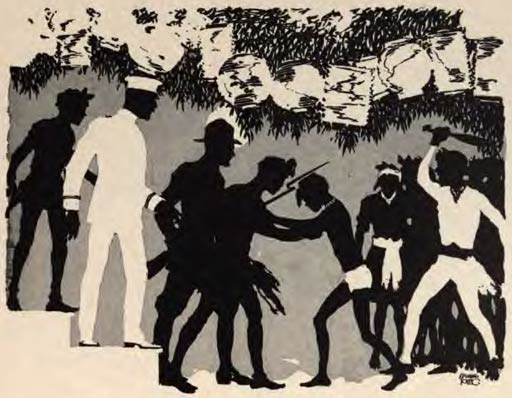
“Juramentado! Gobernado!” faintly whispered Piang
The timid creatures slunk along, looking suspiciously behind them, but as the soldiers paid no attention to them, they gradually forgot their enmity toward civilization and became engrossed in the new delights: pink lemonade, pop-corn, toy balloons. They were beside themselves with joy. When ice-cream was introduced, and they had been assured that it would not burn them, their admiration was unbounded. Piang surreptitiously slipped some of the heavenly sweet into his wallet for future consumption and was dismayed a little later to find a thin stream trickling down his leg and an empty wallet.
Governor Findy watched with interest the mingling of the many alien people. Wily Chinamen behind their bamboo street-stalls ministered to the wants of the throng, taking in trade bits of gold-dust and trinkets of brass; Filipinos offered their wares, cooling drinks and sweets. The Filipino’s costume is very different from that of the Moro. He wears stiff, white trousers, carefully creased and immaculate shirts which hang outside the trousers. He wears no shoes, and his short black hair is oiled and brushed very carefully.
“Now, it’s many times I’ve been wonderin’ what the advantage is in wearin’ your shirt outside your trousers,” said Sergeant Greer to a sentry. “That’s what I call practical,” and he pointed to an ice-cream vender, industriously wiping a spoon on the tail of his shirt, before offering it to a new customer.
There was great excitement over the coming baile (ball). That night savages and Christians were to enjoy the festivities side by side, and marvelous tales of preparation were being circulated. Piang and Kali Pandapatan wandered about the village, pausing here and there, filled with awe at the novel sights. The value of garters as necklaces had been discovered, and a brilliant crimson pair decorated the chief’s neck (he had gladly parted with five dollars’ worth of gold-dust for the treasure). Gilt collar buttons were forced into the holes in his ears. Safety-pins and their surprises had to be investigated, and an admiring throng crowded around, marveling at Kali’s daring.
“Kali!” Piang exclaimed suddenly. “Look!”
Seated at a table in front of a Chino café, were three men in earnest conversation: Alverez, a Filipino mestizo, who had acquired by deception the Moro title, Dato Tamangung; his cousin Vincente; and the Moro malcontent, Sicto. The two Filipinos were disloyal employees of the government, already suspected of being the instigators of unrest among the Moros. Sicto was a deserter from Kali’s ranks and was wanted by that august chief for many serious offenses. Dato Kali Pandapatan scorned to report Sicto to the authorities. A Moro dato is supreme and has the right to punish his subjects according to his own lights. A woman, mingling with the gala bichara throng had a mere stump for an arm; she was a thief and her hand had been severed to prevent it from offending again. A man with face half covered showed the savage justice dealt a liar; his mouth had been split from ear to ear to permit easier passage of the truth. Sicto would be handled according to Moro law, but not here.
Kali and Piang exchanged a knowing look, and Piang wandered off, apparently seeking new pleasures, but furtively watching the three men. He wormed his way through the crowd intent on a game of chess, played by two venerable old Chinamen. A sudden “Sssshhh” from Sicto interrupted Alverez’s excited whisper, but not before Piang had caught a few significant words:
“The baile—juramentado—Findy.”
The little charm boy’s heart beat violently, but his face never changed expression. Juramentado! So some poor misguided fanatic had been persuaded to assassinate the governor. He and Kali must prevent the outrage, for had they not sworn allegiance to this new chief? Piang feared that Sicto suspected the words had been overheard, so he carefully avoided Kali and strolled on among the people. A glance at his chief had warned Kali that trouble was in the air.
Sicto, Alverez, and Vincente moved off toward the dock.
“Sicto, did Piang hear what I said?” asked Alverez.
“Does the jungle hear the trumpeting of the elephant?” angrily retorted Sicto.
“He hasn’t spoken to any one yet,” said Vincente, significantly. “We had better get rid of him before—”
A whispered conversation followed, and Alverez finally exclaimed:
“I’ll do it! Wait here. Watch Piang.” Then he hurried off.
Without approaching Kali, or divulging the secret to any one, Piang followed the men to the dock, and Sicto laughed softly as he watched the unsuspecting boy walk into the trap. The little gunboat Sabah was bobbing at her moorings, and Piang joined the crowd that was gazing in wonder at the strange craft. A shrill whistle, signifying the Sabah’s intention of immediate departure, so terrified the Moros that some took to their heels while others sought the safety of tall lamp-posts. Piang was laughing merrily when he was startled by a noise, and turning, he saw Alverez and a soldier running toward him.
Instantly everything was confusion, and Piang realized that he was the center of the excitement.
“Are you Piang?” asked the soldier, cautiously approaching him.
“Sure, me Piang.”
“Hike! Beat it!” said the man, pointing to the Sabah.
What did he mean? Was Piang to be allowed to go aboard the boat?
The soldier made it very plain, finally, that such was the case, but Piang insisted that he could not depart on a pleasure ride without getting his chief’s permission.
“Sigi, beat it, I tell you, pronto!” said the soldier impatiently, emphasizing the command with a push. Almost before Piang realized it, he found himself on the gunboat, which was slowly moving out toward the channel. In his hand was a crumpled piece of paper which the soldier had gingerly thrust into it.
“Here’s your passport, kid,” he had said with a grin. Piang carefully unrolled the paper and stared at the queer American characters. A sailor offered to translate it for him, but when he glanced over the paper, he uttered a low whistle.
“Say, you go away back and sit down! Don’t you come near me or any one else, sabe?”
Piang recoiled before the look of disgust on the sailor’s face. What was the matter with every one? Why were they all afraid to come near him, and where were they taking him? He summoned up enough courage to ask who had written the letter, and when he was told that it was signed by Governor Findy, he felt reassured. Surely if the good governor was sending him somewhere, it would be all right. Disconsolately, Piang crouched in a corner, watching sharks and dolphins sporting in the foaming wake. He wondered how long the boat was going to be out, if it would return in time for him to save the governor. When he started toward a group of men to ask for information he was met with a shout.
“Get out of here, you!” they yelled, and poor Piang hurriedly retreated to the stern. Much talk of the coming baile seemed to indicate that the sailors expected to return before evening, so Piang patiently squatted on a coil of rope, wondering when the mysteries of his errand would be revealed to him.
The ocean is dotted with many lovely islands off Zamboanga. Somber, lowering Basilan guards its secrets to this day; Sacol, home of Dato Mandi, invites and then repels the intruder; tiny clumps of vivid green rise out of the channel in the most unexpected places, as if timidly wishing to investigate before adding their emerald mite to crown the Celebes. The island toward which the Sabah was making her way seemed blacker and denser than its more frivolous neighbors. Two staccato whistles warned the islanders of the Sabah’s approach, and the beach was soon the scene of lively commotion. The engines stopped, and the gunboat slid along easily. A boat was lowered. The sailors were speaking in low voices; one looked toward Piang and shook his head sadly.
“My task is not to be an easy one,” thought the charm boy, but his head went up proudly. These sailor men should see how a brave Moro executed the commands of his superiors.
“Come on, kid,” called a jacky, and just as Piang stepped over the side a kindly sailor slipped a quarter in his hand. It was evidently a gift, and the boy grinned appreciatively.
“Wastin’ your coin, man,” remarked another sailor with a harsh laugh. “He’s not likely to need dinero (a silver coin) soon.” Piang wondered again at the pitying looks that were cast at him, but he only held his head higher and climbed into the boat. The men seemed in a great hurry; they landed far up the beach, and bags and provisions were hastily dumped on the sand.
“Here you are, young ’un,” said a sailor, and Piang looked up eagerly.
“Me, here?”
“Yep, this is your place,” replied the man, looking away quickly from the soft brown eyes.
Obediently the jungle boy jumped out, awaiting instructions. The sailor in charge pointed to the paper in Piang’s hand and waved toward the barrio.
“For dato?” Piang asked, with a puzzled look.
“Sure, the dato,” replied the man evasively, and Piang turned and started off through the jungle, following a well defined path.
“Plucky kid, that,” said the sailor who pushed off. “Wonder if he knows what’s up? Half the time they don’t tell the poor devils. Row over toward the patrol-boat, and I’ll warn them to watch carefully to-night in case he tries to escape. When they first land here they kick up a terrible row and usually try to make a get-away or commit their particular brand of hari-kari [suicide].”
Piang was in a great hurry. There was no time to be lost and whatever the business in hand might be, it must be finished quickly. He wondered why some of the sailors had not come with him. Americans are always so curious and never lose an opportunity to visit a strange barrio. He ran on swiftly.
Two sounds broke simultaneously on his ears. What was there in them to strike a chill to his heart, to fill him with forebodings? That shrill whistle! It was surely the Sabah’s, and as Piang came to a small clearing, he caught a glimpse of the harbor. A cry broke from him. The Sabah was sailing away. Before he could fully realize the calamity, that other sound, ominous and terrible, came again from the barrio. A low rumbling, punctuated with shrieks and screams, came nearer, nearer. Suddenly from out the dense undergrowth protruded a face, shoulders, and finally a woman, old and bent, crept through. Spell-bound, Piang watched her. Wisps of unkempt gray hair straggled around her head; filthy rags hung from her lean, stooping shoulders; sunken eyes, sly and vicious, glared at Piang. Tremblingly the boy watched her creep toward him. There was something about the old hag that turned his blood cold. The distant rumble became individual howls, and Piang suddenly realized that he was being hunted. But why, and by whom? The innocent paper in his hand crackled. The old hag was very near, was about to touch him. With a shriek, Piang jumped back. Her hands were festered; her face and neck were covered with white splotches.
“A leper!” cried the boy and suddenly he realized that he had been trapped by that villain, Sicto. Not Sicto, but Alverez had filched the order for the confinement of a leper, had erased the name, and substituted Piang’s. He flung the damning paper from him.
As the boy darted off through the jungle, the old woman yelled. The cry brought the others, and when Piang caught sight of them, he almost lost hope. Would he be able to escape the contamination of this island? With mad shrieks, the lepers gave chase, eager to lay hands on one so lately relegated to their colony. Was he not a leper too? What right had he to scorn them, his brothers? Hotter, fiercer grew the chase. The island was so small that it afforded little refuge for the hunted boy. Sounds from all sides indicated that the chase was almost over; it was only a matter of minutes now, and never again could he leave the dread colony.
A rustle at his feet startled him, and some animal scurried off into the bush. A dark hole from which it had evidently crawled attracted Piang’s attention, and without an instant’s hesitation, he flung himself on the ground and wormed his body into the welcoming shelter. Pulling a fallen branch in front of the opening, he shrank farther back into the cave. Cave? No, he had taken refuge in a fallen tree trunk, hollowed out by the persistent ferreting of termites (ants).
“He was here, here,” screamed the old woman. The pursuers flocked to the spot, and Piang listened as they beat the bush, clamoring for their victim. They were so infuriated at the new arrival’s unsociability that they would probably kill him if they found him.
Piang crouched back in his cramped quarters. The tiny white ants announced their disapproval of the intrusion by vicious stings, but Piang did not move. A sudden jolt made his heart beat wildly. Some one had jumped on the other end of the log, and the rotting wood had caved in. He expected each moment to be his last. Over his head the pattering of bare feet, running along the trunk, sounded like thunder.
When the lepers moved off into the jungle, Piang was not deceived. They would lie in wait, and their revenge would be the more terrible for the delay. Sweat poured down Piang’s face; his body ached where the ants had stung him. He tried to plan some means of escape, but none came to his tired brain.
“There is no God but Allah,” whispered the charm boy, and a peace seemed to fall upon him.
Many weary hours went by before a squawk penetrated the death-like stillness. Fruit-bats! It must be night. Very slowly he made his way toward the opening. Unfortunately for Piang the full moon was rising, making the soft, tropical night a wonder of beauty and loveliness. Cautiously he thrust his head through the branches that shielded his retreat. He was very near the ocean; the other end of the fallen tree, in which he had found refuge, was lying in the water, and the rising tide was gradually creeping up over it. The gentle swish of the sea comforted Piang. It was his friend, the only friend that could help him escape from this island of decay. His practised eyes discerned the shadowy forms of watchers squatting along the beach; beyond, the patrol-boat moved about restlessly, and in the distance twinkled the lights of Zamboanga.
“If I could only get past the lepers and the boat, I could swim back,” thought Piang, and he looked with longing at the oily smoothness of the water. Nothing could slip past the boat on that sea of glass in the bright moonlight. He remembered the schools of sharks he had seen in the Sabah’s wake and shuddered; but even that was better than being doomed to die here. He pillowed his head on his arms and leaned against the trunk; his hand closed over a piece of dry bamboo. Lifting it to his eye, he idly squinted through it; it was smooth and clean.
Piang fell to soliloquizing. How many times, surrounded by his friends, he had swum in the moonlight. He remembered one night in particular. How they had sported with bamboo sticks, blowing the spray high in the air, laughing as it fell upon each other! Piang could swim miles with arms folded, pushing through the water like a fish, rolling over on his back or sides, when tired. He had fooled the tribe by staying under water for three minutes, breathing easily through his hollow, bamboo tube. Kali had given him a prize.
Piang’s eyes widened, brightened. With the bamboo stick—could he? He blew through it softly and laughed. But how to get into the water without being detected? The approaching tide, lapping the other end of the fallen log, seemed to be caressing it in pity. Piang examined it closely. Dared he crawl along the trunk? His eyes fell upon the hole just above the water where one of his pursuers had broken through.
“Allah, I thank Thee,” breathed the excited boy. He had found his chance, had discovered a possible means of escape.
Crawling back into the log, he tested the heart of the tree and to his joy, it crumbled under his touch. With a smothered cry, he began to cut his way through the pithy, dust-like wood, and as he gradually worked quantities of the soft fiber loose, he tossed it behind him. If he could work his way through the rotted trunk before the tide turned, it would be an easy matter to slip through the hole into the water.
It was suffocating in the damp inclosure, as the discarded pith began to fill the opening. Tiny apertures let in just enough air, but Piang was panting and dripping with sweat. As he struggled on toward the hole, he could feel the water under him, as it swayed the log gently. Only a little further!
The moonlight bathed Piang in its soft light; a cool breeze blew across his face. One of the watching lepers stood up suddenly.
“There are many crocodiles to-night,” he finally said, pointing toward the log where a slight ripple, widening into vanishing rings, closed over a dark form.
“That’s a queer kind of fish!”
The sailors on the patrol-boat crowded around the speaker, glad of any excitement to break the monotony of their vigil. A thin stream of water had spurted up, disturbing the perfect calm of the surface, and a small black object could plainly be seen, hurrying through the water.
“Now what the deuce?” said the captain. Two bells were loudly sounded, and the boat bounded forward.
“Look out, don’t run it down. Steer to one side.”
The search-light, turned full upon the strange object, revealed to the puzzled sailors a slim bamboo tube, sticking upright, propelled by a strong force from below.
“Now, why don’t that stick float, instead of sailing along like a periscope?” pondered the captain.
As suddenly as the phenomenon had appeared, it sank from sight and the chase ended abruptly.
“Look at our visitors,” said a sailor, pointing over the side. Long streaks of phosphorescence darted back and forth in the shadow of the boat.
“That’s a pretty bunch of shovel-nosed man-eaters, for you,” remarked the mate. “Gosh, wouldn’t you hate to give the hungry devils a chance at you, though?”
The baile was in full swing. The bichara was proving a great success. Governor Findy graciously accepted the savages’ allegiance to the new government and their promises to make the trading system a success. The small park in the center of the garrison was teeming with life. On one side the American band gave the first notes of civilized music that the Moros had ever heard; opposite, rows of brass tom-toms responded mournfully. Gaudy lanterns festooned the tall trees and swung between, describing graceful curves. Flickering moonlight and fireflies added their bit. At one end of the park a platform had been erected for the officers and their families. The savages crowded around as the Americans swayed to the waltz, and their surprise was no less than that of the Americans, when the tom-toms stirred the Moros to the dance and they whirled and crouched in native fashion.
Governor Findy was surrounded by his personal guard; burly Irishmen shared this honor with stalwart Moros, thus proving the governor’s trust in the wild people.
Dato Mandi, Dato Kali Pandapatan, and Governor Findy were conversing on the steps of the dancing platform.
“Kali says that Piang mysteriously disappeared about noon to-day,” explained Mandi in excellent English.
“Who is this Piang, Mandi?” asked the governor.
“Piang is the idol of the Buldoon tribe. He is Kali Pandapatan’s famous charm boy, friend of General Beech and Lieutenant Lewis,” replied Mandi.
“Strange that one so well known should disappear. Yes, I have heard much of this boy’s loyalty and sagacity.” The two Moros turned quickly, warned by a startled look on the governor’s face. Far down the smooth shell road a figure was staggering, wavering toward them.
“Trouble, trouble,” muttered Findy.
The music ceased with a discordant jar, there was a slight stir among the spectators as Sicto and his companions attempted to retire, but to their surprise, Kali’s faithful men closed about them significantly. On came the figure, lithe, slim, and brown.
“Piang!” cried Kali Pandapatan, and instantly his eyes sought out the cowering Sicto.
The heavy, labored breathing became audible as the exhausted boy stumbled through the crowd. A sentry started forward to seize him, but the governor waved him aside. Dripping and panting, Piang staggered toward his chief.
“Juramentado—gobernador!” faintly whispered Piang.
A wild shriek crashed through the intense stillness; a green sarong was torn off, and the white-clad figure of a juramentado rushed at the governor. But Kali Pandapatan was quicker, and just as the assassin raised his barong, a slender kriss glistened in the moonlight and descended. The juramentado lay bathed in his own blood.
Jumping up to the platform, Kali Pandapatan raised his hands.
“My brother chiefs,” he cried, “did any of you know of this foul plot?”
“No, no!” came the quick response from every Moro, and although the Americans could not understand his words, they began to realize that Kali was exhorting his people to disclaim knowledge of the outrage.
“Viviz Gobernador!” came from the full, savage throats, and the cry was taken up by the multitude.
The dazed governor looked down at the prostrate figure at his feet, looked long, and sorrowed.
“But for the brave Piang I should have been lying there,” he murmured.
Piang supported by Kali watched this new chief.
“Come here, Piang,” said the governor. Fumbling with the collar of his white uniform, he loosened something.
“My lad, I thank you for your bravery,” he said, his voice shaking slightly. “For your timely arrival, and your courage. Your name shall be sent to the great chief at Washington.”
The words were repeated to the jungle boy, and his manly little chest swelled with pride.
“Piang, I am about to decorate you with the emblem of our government; these infantry cross-guns I shall pin on your breast.” The dignified governor reached forward to make good his words, but he paused in embarrassment, the noble speech dying on his lips. He gazed in dismay at the naked little savage, standing straight and expectantly before him.
“I shall place this emblem.” The officer began again. There was a titter among the spectators.
Piang, eagerly eyeing the treasure, wondered why the governor delayed. Suddenly a gleam of understanding broke over him, and he grinned, broadly. With the tip of his finger he touched the shining cross-guns, then his necklace of crocodile teeth. The situation was saved.
Amid thunderous applause the smiling governor fastened the guns to the indicated article of dress, and loud and clear rose the shout:
“Piang! Piang!”