UPS AND DOWNS.
Reading edition
I should not probably have spoken of these last incidents in my life, as the relation of them savours rather too much of vanity, but for certain results of the highest importance to my future fortunes.
When I reached the old kennel I found, waiting my return, two terrier dogs in livery, with bulls' heads grinning from such a quantity of buttons upon their lace coats that it was quite startling. They brought a polite message from Sir John and Lady Bull, begging me to call upon them without delay. As the servants had orders to show me the road, we set off at once.
I was very silent on the journey, for my companions were so splendidly dressed that I could not help thinking they must be very superior dogs indeed; and I was rather surprised, when they spoke to each other, to find that they talked just like any other animals, and a good deal more commonly than many that I knew. But such is the effect of fine clothes upon those who know no better.
We soon reached the grounds of the mansion, having crossed the river in a boat that was waiting for us; and after passing through a garden more beautiful than my poor dog's brain had ever imagined, we at last stood before the house itself. I need not describe to you, who know the place so well, the vastness of the building or the splendour of its appearance. What struck me more even than the palace, was the number of the servants and the richness of their clothes. Each of them seemed fine enough to be the master of the place, and appeared really to think so, if I could judge by the way they strutted about and the look they gave at my poor apparel. I was much abashed at first to find myself in such a company and make so miserable a figure; but I was consoled with the thought that not one of them that morning had ventured, in spite of his eating his master's meat and living in his master's house, to plunge into the water to save his master's son. Silly dog that I was! it did not enter my head at the same time to inquire whether any of them had learnt to swim.
If the outside of the mansion had surprised me by its beauty, the interior appeared of course much more extraordinary to my ignorant mind. Every thing I was unused to looked funny or wonderful; and if I had not been restrained by the presence of such great dogs, I should have sometimes laughed outright, and at others broken forth into expressions of surprise.
The stout Sir John Bull was standing in the middle of the room when I entered it, while the stouter Lady Bull was lying on a kind of sofa, that seemed quite to sink beneath her weight. I found out afterwards that it was the softness of the sofa which made it appear so; for sitting on it myself, at my Lady's request, I jumped up in the greatest alarm, on finding the heaviest part of my body sink lower and lower down, and my tail come flapping into my face.
Sir John and Lady Bull now thanked me very warmly for what I had done, and said a great many things which it is not worth while to repeat. I remember they were very pleasing to me then, but I am sure cannot be interesting to you now. After their thanks, Sir John began to talk to me about myself—about my parents—my wishes—what I intended to do—and what were my means? To his great surprise he learnt that parents I had none; that my only wishes were the desire to do some good for myself and others, and earn my meat; that I had no notion what I intended doing, and had no means whatever to do anything with. It may be believed that I willingly accepted his offer to watch over a portion of his grounds, to save them from the depredations of thieves, on condition of my receiving good clothes, plenty of food, and a comfortable house to live in. It was now my turn to be thankful. But although my heart was full at this piece of good fortune, and I could think of a great many things to say to show my gratitude, not a single word could I find to express it in, but stood before them like a dumb dog, with only the wave of my tail to explain my thanks. They seemed, however, to understand it, and I was at once ordered a complete suit of clothes and everything fitted for my new position. I was also supplied with the most abundant supper I had ever had in my life, and went to rest upon the most delightful bed; so that before I went to sleep, and I do believe afterwards too, I kept saying to myself, "Job, Job, you have surely got some other dog's place; all this good luck can't be meant for you; what have you done, Job, that you should eat such meat, and sleep on so soft a bed, and be spoken to so kindly? Don't forget yourself, Job; there must be some mistake." But when I got up in the morning, and found a breakfast for me as nice as the supper, and looked at my clothes, which, if not so smart as some of the others, were better and finer than any I could ever have thought I should have worn, I was at last convinced, that although I was poor Job, and although I did not, perhaps, deserve all the happiness I felt, that it was not a dream, but real, plain truth. "As it is so," I said again, "I must do my duty as well as I am able, for that is the only way a poor dog like me can show his gratitude."
After breakfast, I accompanied Sir John to the place of my future home. A quarter of an hour's walk brought us to a gentle hill, which, similar to the one whereon the mansion itself was situated, sloped downwards to the water. One or two trees, like giant sentinels, stood near the top, and behind them waved the branches of scores more, while beyond for many a mile spread the dark mass of the thick forest of which I have more than once made mention. Nearly at the foot of the hill, beneath a spreading oak, was a cottage, a very picture of peace and neatness; and as we paused, Sir John pointed out the peculiarities of the position and explained my duties. It appeared that this part of his grounds was noted for a delicate kind of bird, much esteemed by himself and his family, and which was induced to flock there by regular feeding and the quiet of the situation. This fact was, however, perfectly well known to others besides Sir John; and as these others were just as fond of the birds as himself, they were accustomed to pay nightly visits to the forbidden ground, and carry off many of the plumpest fowl. The wood was known to shelter many a wandering fox, who, although dwelling so near the city, could not be prevailed on to abandon their roguish habits and live in a civilised manner. These birds were particularly to their taste, and it required the greatest agility to keep off the cunning invaders, for, though they had no great courage, and would not attempt to resist a bold dog, they frequently succeeded in eluding all vigilance and getting off with their booty. Often, too, a stray cur, sometimes two or three together, from the lowest classes of the population, would, when moved by hunger, make a descent on the preserves, and battles of a fierce character not seldom occurred, for, unlike the foxes, they were never unwilling to fight, but showed the utmost ferocity when attacked, and were often the aggressors. But those were not all. The grounds were exactly opposite that part of the city of Caneville known as the "Mews," and occupied by the cat population, who have a general affection for most birds, and held these preserved ones in particular esteem. Fortunately, the water that interposed was a formidable barrier for the feline visitors, as few pussies like to wet their feet; but, by some means or other, they frequently found their way across, and by their dexterity, swiftness, and the quiet of their movements, committed terrible ravages among the birds. When Sir John had told me all this, he led the way down the hill to the small house under the tree. It had two rooms, with a kennel at the back. The front room was the parlour, and I thought few places could have been so neat and pretty. The back was the sleeping-room, and the windows of both looked out upon the soft grass and trees, and showed a fine view of the river.
"This," said Sir John, "is your house, and I hope you will be happy in it yourself, and be of service to me. You will not be alone, for there"—pointing to the kennel at the back—"sleeps an old servant of the family, who will assist you in your duties."
He then called out "Nip," when a rumbling noise was heard from the kennel, and directly after a lame hound came hopping round to the door. The sight of this old fellow was not pleasant at first, for his hair was a grizzly brown and his head partly bald; his eyes were sunk, and, indeed, almost hidden beneath his bushy brows, and his cheeks hung down below his mouth and shook with every step he took. I soon found out that he was as singular in his manners as in his looks, and had such a dislike to talking that it was a rare thing for him to say more than two or three words at one time. Sir John told him who I was, and desired him to obey my orders; commanded us both to be good friends and not quarrel, as strange dogs were rather apt to do; and after some more advice left us to ourselves, I in a perfect dream of wonderment, and "Nip" sitting winking at me in a way that I thought more funny than agreeable.
After we had sat looking at one another for some time, I said, just to break the silence, which was becoming tiresome—
"A pretty place this!"
Nip winked.
"Have you been here long?" I asked.
"Think so," said Nip.
"All alone?" I inquired.
"Almost," Nip replied.
"Much work to do, eh?" I asked.
The only answer Nip gave to this was by winking first one eye and then the other, and making his cheeks rise and fall in a way so droll that I could not help laughing, at which Nip seemed to take offence, for without waiting for any farther questions he hopped out of the room, and I saw him, soon after, crawling softly up the hill, as if on the look out for some of the thieves Sir John had spoken of.
I, too, went off upon the watch. I took my way along the bank, I glided among the bushes, ran after a young fox whose sharp nose I spied pointed up a tree, but without catching him, and finally returned to my new home by the opposite direction. Nip came in shortly after, and we sat down to our dinner.
Although this portion of my life was, perhaps, the happiest I have ever known, it has few events worth relating. The stormy scenes which are so painful to the dog who suffers them, are those which are most interesting to the hearer; while the quiet days, that glide peacefully away, are so like each other, that an account of one of them is a description of many. A few hours can be so full of action, as to require volumes to describe them properly, and the history of whole years can be written on a single page.
I tried, as I became fixed in my new position, to do what I had resolved when I entered it; namely, my duty. I think I succeeded; I certainly obtained my master's praise, and sometimes my own; for I had a habit of talking to myself, as Nip so rarely opened his mouth, and would praise or blame myself just as I thought I deserved it. I am afraid I was not always just, but too often said, "Well done, Job; that's right, Job;" when I ought to have called out, "You're wrong, Job; you ought to feel, Job, that you're wrong;" but it is not so easy a thing to be just, even to ourselves.
One good lesson I learned in that little cottage, which has been of use to me all my life through; and that was, to be very careful about judging dogs by their looks. There was old Nip: when I first saw him, I thought I had never beheld such an ugly fellow in my life, and could not imagine how anything good was to be expected from so cross a looking, ragged old hound. And yet nothing could be more beautiful, more loveable than dear old Nip, when you came to know him well. All the misfortunes he had suffered, all the knocks he had received in passing through the world, seemed to have made his heart more tender; and he was so entirely good-natured, that in all the time we were together, I never heard him say an unkind thing of living or dead animal. I believe his very silence was caused by the goodness of his disposition; for as he could not help seeing many things he did not like, but could not alter, he preferred holding his tongue to saying what could not be agreeable. Dear, dear Nip! if ever it should be resolved to erect a statue of goodness in the public place of Caneville, they ought to take you for a model; you would not be so pleasant to look on as many finer dogs, but when once known, your image would be loved, dear Nip, as I learned to love the rugged original.
It can be of no interest to you to hear the many fights we had in protecting the property of our master during the first few moons after my arrival. Almost every night we were put in danger of lives, for the curs came in such large numbers that there was a chance of our being pulled to pieces in the struggle. Yet we kept steady watch; and after a time, finding, I suppose, that we were never sleeping at our post, and that our courage rose with every fresh attack, the thieves gradually gave up open war, and only sought to entrap the birds by artifice; and, like the foxes and cats, came sneaking into the grounds, and trusted to the swiftness of their legs rather than the sharpness of their teeth when Nip or I caught sight of them.
And thus a long, long time passed away. I had, meanwhile, grown to my full size, and was very strong and active: not so stout as I have got in these later years, when my toes sometimes ache with the weight which rests on them, but robust and agile, and as comely, I believe, as most dogs of my age and descent.
The uniformity of my life, which I have spoken of as making me so happy, was interrupted only by incidents that did not certainly cause me displeasure. I renewed my acquaintance with "Fida," no longer little Fida, for she had grown to be a beautiful lady-dog. Our second meeting was by chance, but we talked like old friends, so much had our first done to remove all strangeness. I don't think the next time we saw each other was quite by accident. If I remember rightly, it was not; and we often met afterwards. We agreed that we should do all we could to assist one another, though what I could do for so rich and clever a lady-dog I could not imagine, although I made the promise very willingly. On her part, she did for me what I can never sufficiently repay. She taught me to read, lending me books containing strange stories of far-off countries, and beautiful poetry, written by some deep dogs of the city; she taught me to write; and in order to exercise me, made me compose letters to herself, which Nip carried to her, bringing me back such answers as would astonish you; for when you thought you had got to the end, they began all over again in another direction. Besides these, she taught me to speak and act properly, in the way that well-behaved dogs ought to do; for I had been used to the company of such low and poor animals, that it was not surprising if I should make sad blunders in speech and manners. I need not say that she taught me to love herself, for that you will guess I had done from the first day I saw her, when I was wet from my jump in the river, and she spoke to me such flattering words. No; she could not teach me more love for herself than I already knew. That lesson had been learnt by heart, and at a single sitting.
Our peaceful days were drawing to a close. Sir John died. Lady Bull lived on for a short time longer. Many said, when she followed, that she ate herself to death; but I mention the rumour in order to deny it, for I am sure it was grief that killed her. It is a pity some dogs will repeat everything they hear, without considering the mischief such tittle-tattle may occasion—although it has been asserted by many that in this case the false intelligence came from the Cats, who had no great affection for poor Lady Bull. Whatever the cause, she died, and with her the employment of poor Nip and myself. The young Bulls who came into possession of the estate, sold the preserves to a stranger; and as the new proprietor intended killing off the birds, and did not require keepers, there being no longer anything for them to do, we were turned upon the world.
The news came upon us so suddenly, that we were quite unprepared for it; and we were, besides, so far from being rich, that it was a rather serious matter to find out how we should live until we could get some other occupation. I was not troubled for myself; for, though I had been used to good feeding lately, I did not forget the time when I was often forced to go the whole day with scarce a bit to eat; but the thought of how poor old Nip would manage gave me some pain.
Having bid adieu to the peaceful cottage, where we had spent such happy times, we left the green fields and pleasant trees and proceeded to the town, where, after some difficulty, we found a humble little house which suited our change of fortune. Here we began seriously to muse over what we should do. I proposed making a ferry-boat of my back, and, stationing myself at the waterside near the "Mews," swim across the river with such cats as required to go over and did not like to walk as far as where the boat was accustomed to be. By these means I calculated on making enough money to keep us both comfortably. Nip thought not. He said that the cats would not trust me—few cats ever did trust the dogs—and then, though he did not dislike cats, not at all, for he knew a great many very sensible cats, and very good ones too, he did not like the idea of seeing his friend walked over by cats or dogs, or any other animal, stranger or domestic. Besides, there were other objections. Strong as I was, I could not expect, if I made a boat of myself, that I could go on and on without wanting repair any more than a real boat; but where was the carpenter to put me to rights, or take out my rotten timbers and put in fresh ones. No; that would not do; we must think of something else.
It must not be imagined that Nip made all this long speech in one breath, or in a dozen breaths. It took him a whole morning to explain himself even as clearly as I have tried to do; and perhaps I may still have written what he did not quite intend, for his words came out with a jump, one or two at a time, and often so suddenly that it would have startled a dog who was not used to his manner.
Nip himself made the next proposal, and though I did not exactly like it, there seemed so little choice, that I at once agreed to do my part in the scheme. Nip was the son of a butcher, and though he had followed the trade but a short time himself, he was a very good judge of meat. He, therefore, explained that if I would undertake to become the seller, he would purchase and prepare the meat, and he thought he could make it look nice enough to induce the dogs to come and buy.
Our stock of money being very small, a house-shop was out of the question, so there was no chance of getting customers from the better class,—a thing which I regretted, as I had little taste for the society of the vulgar; but, again, as it could not be helped, the only thing to do was to make the best of it. A wheelbarrow was therefore bought by Nip, with what else was necessary to make me a complete "walking butcher," and having got in a stock of meat the day before, Nip cut, and contrived, and shaped, and skewered, in so quiet and business-like a way as proved he knew perfectly well what he was about. With early morning, after Nip had arranged my dress with the same care as he had bestowed upon the barrow and its contents, I wheeled my shop into the street, and amid a great many winks of satisfaction from my dear old friend, I went trudging along, bringing many a doggess to the windows of the little houses by my loud cry of "Me-eet! Fresh me-eet!"
As I was strange in my new business, and did not feel quite at my ease, I fancied every dog I met, and every eye that peeped from door and casement, stared at me in a particular manner, as if they knew I was playing my part for the first time, and were watching to see how I did it. The looks that were cast at my meat, were all, I thought, intended for me, and when a little puppy leered suspiciously at the barrow as he was crossing the road, no doubt to see that it did not run over him, I could only imagine that he was thinking of the strange figure I made, and my awkward attempt at getting a living. Feelings like these no doubt alarm every new beginner; but time and habit, if they do not reconcile us to our lot, will make it at least easier to perform, and thus, after some two hours' journeying through the narrow lanes of Caneville, I did what my business required of me with more assurance than when I first set out.
One thing, however, was very distasteful to me, and I could so little bear to see it, that I even spoke of it aloud, and ran the risk of offending some of my customers. I mean the way in which several of the dogs devoured the meat after they had bought it. You will think that when they had purchased their food and paid for it, they had a right to eat it as they pleased: I confess it; nothing can be more true; but still, my ideas had changed so of late, that it annoyed me very much to see many of these curs, living as they did in the most civilized city in this part of the world, gnawing their meat as they held it on the ground with their paws, and growling if any one came near as though there was no such thing as a police in Caneville. I forgot when I was scolding these poor dogs, that perhaps they had never been taught better, and deserved pity rather than blame. I forgot too that I had myself behaved as they did before I had been blessed with happier fortune, and that, even then, if I had looked into my own conduct, I should have found many things more worthy of censure than these poor curs' mode of devouring their food.
The lane I was passing along was cut across by a broad and open street, the favourite promenade of the fashionables of Caneville. There might be seen about mid-day, when the sun was shining, troops of well-dressed dogs and a few superior cats, some attended by servants, others walking alone, and many in groups of two or three, the male dogs smoking cigars, the ladies busily talking, while they looked at and admired one another's pretty dresses and bonnets.
By the time I had got thus far, I had become tolerably used to my new work, and could imagine that when the passers-by cast their eyes on my barrow, their glances had more to do with the meat than with myself. But I did not like the idea of crossing the road where such grand dogs were showing off their finery. After a little inward conversation with myself, which finished with my muttering between my teeth, "Job, brother Job, I am ashamed of you! where is your courage, brother Job? Go on; go on;" I went on without further delay.
I had got half-way across, and was already beginning to praise myself for the ease with which I turned my barrow in and out of the crowd without running over the toes of any of the puppies, who were far too much engaged to look after them themselves when a dirty little cur stopped me to buy a penn'orth of meat. I set down my load just in time to avoid upsetting a very fat and splendidly dressed doggess, who must, if I had run the wheel into her back, and it was very near it, have gone head foremost into the barrow. This little incident made me very hot, and I did not get cooler when my customer squatted down in the midst of the well-dressed crowd, and began tearing his meat in the way I have before described as being so unpleasant. At the same moment another dog by his side, with a very ragged coat, and queer little face, held up his paw to ask for "a little bit," as he was very hungry, "only a little bit." I should, probably, have given him a morsel, as I remembered the time when I wanted it as much as he seemed to do, but for an unexpected meeting. Turning my head at a rustling just behind me, I saw a well-dressed dog, with a hat of the last fashion placed so nicely on his head that it seemed to be resting on the bridge of his nose, the smoke from a cigar issuing gracefully from his mouth, and his head kept in an upright posture by a very stiff collar which ran round the back of his neck, and entirely prevented his turning round his head without a great deal of care and deliberation, while a tuft of hair curled nicely from beneath his chin, and gave a fine finish to the whole dog. But though I have spoken of this Caneville fashionable, it was not he who caused the rustling noise, or who most attracted my attention. Tripping beside him, with her soft paw beneath his, was a lady-dog, whose very dress told her name, at least in my eyes, before I saw her face. I felt sure that it was Fida, and I wished myself anywhere rather than in front of that barrow with an ill-bred cur at my feet gnawing the penn'orth of meat he had just bought of me. Before I had time to catch up my load and depart, a touch on my shoulder, so gentle that it would not have hurt a fly, and yet which made me tremble more than if it had been the grip of a giant animal, forced me again to turn. It was Fida; as beautiful and as fresh as ever, who gave me a sweet smile of recognition and encouragement as she passed with her companion, and left me standing there as stupid and uncomfortable as if I had been caught doing something wrong.
A CANINE BUTCHER
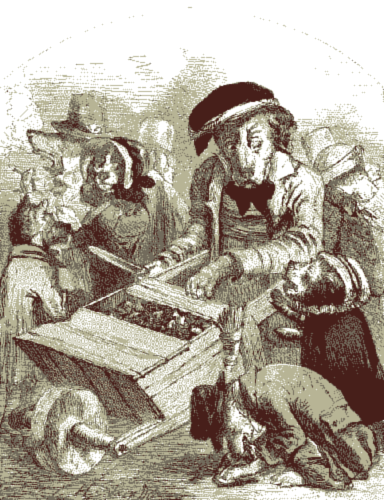
You will say that it was very ridiculous in me to feel so ashamed and disconcerted at being seen by her or any other dog or doggess in my common dress, and following an honest occupation. I do not deny it. And in telling you these things I have no wish to spare myself, I have no excuse to offer, but only to relate events and describe feelings precisely as they were.