PAINS AND PLEASURES.
Reading edition
When I again opened my eyes after the deep sleep which had fallen upon me, morning was just breaking, and a grey light was in the sky and on the clouds which dotted it all over.
As I looked round, you may well think, with hope and anxiety, still nothing met my view but the great world of water, broken up into a multitude of little hills. I now understood that I was on the sea, where I had been borne by the rushing river; that sea of which I had often read, but which I could form no idea about till this moment.
The sad thought struck me that I must stop there, tossed about by the wind and beaten by the waves, until I should die of hunger, or that, spent with fatigue, my limbs would refuse to sustain me longer, and I should be devoured by some of the monsters of the deep, who are always on the watch for prey.
Such reflections did not help to make my position more comfortable, and it was painful enough in itself without them. It was certain, however, that complaint or sorrow could be of no service, and might be just the contrary, as the indulging in either would, probably, prevent my doing what was necessary to try and save myself should an opportunity offer.
The grey light, in the meantime, had become warmer and warmer in its tone, until the face of every cloud towards the east was tinged with gold. While I was admiring the beautiful sight, for it was so beautiful that it made me forget for a time my sad position, my eyes were caught by the shining arch of the rising sun, as it sprang all of a sudden above the surface of the sea. Oh! never shall I forget the view! Between me and the brilliant orb lay a pathway of gold, which rose, and fell, and glittered, and got at last so broad and dazzling, that my eyes could look at it no longer. I knew it was but the sun's light upon the water, but it looked so firm, that I could almost fancy I should be able to spring upon it, and run on and on until I reached some friendly country. But alas! there seemed little chance of such a thing happening as my ever reaching land again.
As the sun got high up, and poured his rays on to the sea, I began to feel a craving for food, and, though surrounded with water, yet the want of some to drink. When the thirst came upon me, I at first lapped up a few drops of the sea-water with avidity, but I soon found that it was not fit to drink, and that the little I had taken only made my thirst the greater. In the midst of my suffering, a poor bird came fluttering heavily along, as if his wings were scarce able to support his weight. Every little object was interesting to me just then, and as I sat upon my piece of timber I looked up at the trembling creature, and began comparing his fate with my own. "Ah, Job," I said, half-aloud, "you thought, perhaps, that you were the only unhappy being in the world. Look at that poor fowl; there he is, far away from land, from his home, from his friends, perhaps his little ones (for many birds have large families), with tired wings, and not a piece of ground as broad as his own tail for him to rest upon. He must go on, fatigued though he may be, for if he fall, nothing can prevent his death; the water will pour among his feathers, clog his wings, and not only prevent him ever rising more into the air, but pull him down until his life is gone. So, Job, badly off as you are just now, there is another, as you see, whose fate is worse; and who shall say that in other places, where your eye cannot reach, there are not others yet so very, very miserable, that they would willingly, oh! how willingly! change places with you, or with that poor fluttering bird?"
This talk with myself quieted me for a time, and I felt a certain joy when I saw the bird slowly descend, and having spied my uncomfortable boat, perch heavily on the other end of it. He did not do so until he had looked at me with evident alarm; and, worn out as he was, and his heart beating as though it would burst through his yellow coat, he still kept his eyes fixed upon me, ready to take wing and resume his journey, wherever he might be going, at the least motion I should make.
Some time passed over in this way; myself in the middle, and Dicky at the end of the beam. We did not say a word to each other; for, as I spoke no other language but my own, and he seemed about as clever as myself, we merely talked with our eyes.
A thought now came into my head. My thirst returned, and I felt very hungry. What if I should suddenly dart on little Dicky, and make a meal of him? I did not consider at the instant that, by so doing, I should be acting a very base part, for Dicky had placed confidence in me; and killing him for trusting to my honour, and eating him because he was poor and unfortunate, would be neither a good return nor a kind action. Luckily for Dicky, and even for myself, although he was not able to speak foreign languages, he could read my meaning in my eyes; for when I turned them slowly towards him, just to see my distance, he took alarm, and rose into the air with a swiftness which I envied. I am sorry to say my only thought at first was the having lost my dinner: but as I watched him through the air, flying on and on, until he diminished to a misty speck, and then disappeared, my better feelings came back to me and said, "Oh, Job! I would not have believed this of you!" "But," replied my empty stomach, "I am so hungry; without food, I shall fall in, and Job will die." "Let Job die," said my better self again, in a cold, firm tone; "let Job rather die, than do what he would live to feel ashamed of."
As the day wore on, I began to think that death only could relieve me; and the thought was very, very painful. Nothing before and around but the salt waves—nothing above but the blue sky and hot sun—not even a cloud on which to rest my aching eyes. The want of water which I could drink was now becoming terrible. When I thought of it, my head began to turn; my brain seemed to be on fire; and the public basins of Caneville, where only the lowest curs used to quench their thirst, danced before me to add to my torture; for I thought, though I despised them once, how I could give treasures of gold for one good draught at the worst of them just then.
There is not a misfortune happens to us from which we may not derive good if our hearts are not quite hardened, and our minds not totally impenetrable. Great as my sufferings were during this incident of my life, I learnt from it much that has been useful to me in after years. But even if it had taught me no other truth than that we should despise nothing which is good and wholesome, merely because it is ordinary, I should not have passed through those sad hours in vain. We dogs are so apt, when in prosperity, to pamper our appetites, and, commonly speaking, to turn up our noses at simple food, that we require, from time to time, to be reminded on how little canine life can be preserved. All have not had the advantage of the lesson which I was blessed with; for it was a blessing; one that has so impressed itself on my memory, that sometimes when I fancy I cannot eat anything that is put before me, because it is too much done, or not done enough, or has some other real or supposed defect, I say to myself, "Job, Job, what would you have given for a tiny bit of the worst part of it when you were at sea?" And then I take it at once, and find it excellent.
As the sun got lower, clouds, the same in shape that had welcomed him in the morning, rose up from the sea as if to show their pleasure at his return. He sunk into the midst of them and disappeared; and then the clouds came up and covered all the sky. I suffered less in the cool evening air, and found with pleasure that it was growing into a breeze. My pleasure soon got greater still, for, with the wind, I felt some drops of rain! The first fell upon my burning nose; but the idea of fresh water was such a piece of good fortune, that I dared not give loose to my joy until the drops began to fall thickly on and around me, and there was a heavy shower. I could scarcely give my rough coat time to get thoroughly wet before I began sucking at it. It was not nice at first, being mixed with the salt spray by which I had been so often covered; but as the rain still came down, the taste was fresher every moment, and soon got most delicious. I seemed to recover strength as I licked my dripping breast and shoulders; and though evening changed to dark night, and the rain was followed by a strong wind, which got more and more fierce, and appeared to drive me and my friendly log over the waves as if we had been bits of straw, I felt no fear, but clung to the timber, and actually gave way to hope.
I must have slept again, for daylight was once more in the sky when I unclosed my eyes. Where was I now? My sight was dim, and though I could see there was no longer darkness, I could make out nothing else. Was I still on the rolling water? Surely not; for I felt no motion. I passed my paw quickly across my eyes to brush away the mist which covered them. I roused myself. The beam of wood was still beneath me, but my legs surely touched the ground! My sight came back to me, and showed me, true, the sea stretching on, on, on, in the distance, but showed me also that I—oh, joy!—I had reached the shore!
When my mind was able to believe the truth, I sprang on to the solid land with a cry which rings in my ears even now. What though my weakness was so great that I tumbled over on to the beach and filled my mouth with sand? I could have licked every blade of grass, every stone, in my ecstacy; and when forced to lie down from inability to stand upon my legs, I drove my paws into the earth, and held up portions to my face, to convince myself that I was indeed on shore. I did not trouble myself much with questions as to how I got there. I did not puzzle my brain to inquire whether the wind which had risen the evening before, and which I felt driving me on so freely, had at length chased me to the land. All I seemed to value was the fact that I was indeed there; and all I could persuade myself to say or think was the single, blessed word, saved!
I must have lain some time upon the sand before I tried again to move, for when I scrambled on to my legs the sun was high and hot—so hot, that it had completely dried my coat, and made me wish for shelter. Dragging myself with some trouble to a mound of earth, green and sparkling with grass and flowers, I managed to get on top of it; and when I had recovered from the effort, for I was very weak, looked about me with curiosity to observe the place where I had been thrown.
The ground was level close to where I stood, but at a little distance it rose into gentle grassy hills, with short bushes here and there; and just peeping over them, were the tops of trees still farther off, with mountains beyond, of curious forms and rich blue colour.
While considering this prospect, I suddenly observed an animal on one of the hills coming towards me, and I lay down at full length on the grass to examine who he might be. As he drew nearer, I was surprised at his form and look (I afterwards learnt that he was called an ape), and thought I had never beheld so queer a being. He had a stick in his right hand, and a bundle in his left, and kept his eyes fixed on the ground as he walked along.
When he was quite close, I rose again, to ask him where I could procure food and water, of which I felt great want. The motion startled him; and stepping back, he took his stick in both hands as if to protect himself. The next moment he put it down, and coming up to me, to my surprise addressed me in my own language, by inquiring how I came there. My astonishment was so great at first that I could not reply; and when I did speak, it was to ask him how it happened that he used my language. To this he answered, that he had been a great traveller in his day, and among other places had visited my city, where he had studied and been treated kindly for a long time; that he loved dogs, and should be only too happy now to return some of the favours he had received. This speech opened my heart; but before he would let me say more, he untied his bundle, and spread what it contained before me. As there were several savoury morsels, you may believe I devoured them with great appetite—indeed, I hope Master Ximio's opinion of me was not formed from the greediness with which I ate up his provisions.
After I had refreshed myself at a spring of water, we sat down, and I told him my story. He heard me patiently to the end, when, after a pause, he exclaimed—
"Come, Job, come with me. A few days' rest will restore your strength, and you can return to your own city. It is not a long journey over land; and with stout limbs like those, you will soon be able to get back and lick old Nip again."
I need not dwell upon this part of my story, although I could fill many pages with the narration of Master Ximio's dwelling, and above all of his kindness; he kept me two or three days at his house, and would have detained me much longer, but, besides that I was anxious to return to Nip, I felt certain pains in my limbs, which made me wish to get back to Caneville, as I did not like the idea of troubling my good friend with the care of a sick dog. He was so kind-hearted, however, and showed me such attention, that I was afraid to say anything about my aches, lest he should insist on keeping me. He seemed to think it was quite natural I should desire to get home; and when he saw my impatience to depart, he assisted to get me ready.
Having supplied me with everything I could want on my journey, and pressed upon me many gifts besides, he led me by a little path through the wood, until we came to the sea. "Along this shore," he said, "your road lies. Follow the winding of the coast until you reach the mouth of a broad river, the waters of which empty themselves into the sea. That river is the same which runs through your city. Keep along its banks and you will shortly arrive at Caneville, where I hope you may find everything you wish—for I am sure you wish nothing that is unreasonable. If pleasure awaits you there, do not, in the midst of it, forget Ximio. If, against my hopes, you should find yourself unhappy, remember there is a home always open to you here, and a friend who will do his best to make you forget sorrow. Farewell!"
I was greatly moved at his words and the memory of his kindness. We licked each other tenderly—murmured something, which meant a good deal more than it expressed—and then we parted. I turned my head often as I went, and each time beheld Ximio waving his hand in the air; at last a dip in the ground hid him from my sight, and I continued my journey alone.
It was fortunate I had been well furnished with provisions by my good friend, for as I proceeded, I found the pains in my limbs so great that I could scarce drag one leg after the other, and should probably have died of hunger, as I had no strength left to procure food, and did not meet with any more Ximios to assist me had I stood in need. With long rests, from which I rose each time with greater difficulty,—with increasing anxiety as I drew near my home, to learn all that had taken place during my absence,—and yet with legs which almost refused to carry me; after many days that seemed to have grown into months,—they were so full of care and suffering,—I toiled up a hill, which had, I thought, the power of getting steeper as I ascended. At length I reached the top, and to my joy discovered the well-known city of Caneville, lying in the plain beneath me. The sight gave me strength again. I at once resumed my journey, and trotted down the hill at a pace which surprised myself. As I got warm with my exertions, the stiffness seemed by degrees to leave my limbs; I ran, I bounded along, over grass and stone through broad patches of mud which showed too plainly to what height the river had lately risen, out of breath, yet with a spirit that would not let me flag, I still flew on, nor slackened my speed until I had got to the first few houses of the town. There I stopped indeed, and fell; for it then seemed as if my bones were all breaking asunder. My eyes grew dim; strange noises sounded in my ears; and though I fancied I could distinguish voices which I knew, I could neither see nor speak; I thought it was my dying hour.
From the mouths of Nip and others I learnt all which then occurred, and all that had passed after my supposed loss on the night of the inundation. How my noble conduct (for so they were kind enough to call it, though I only tried to do my duty, and failed) had been made known to the great dogs of Caneville, and how they had sought after me to thank me for it;—how they had offered rewards to those who assisted in my recovery;—how, when it was supposed that I was dead, they took Nip from our modest home, and placed him in this present house, fitted with everything that could make him comfortable for life;—how, when all hope was gone, my unexpected appearance brought a crowd about me, each one anxious to assist me in my distress, though some maliciously said, in order to lay claim to the reward;—and how I was finally brought again to my senses through the care of our clever canine doctors, and the kind nursing of dear old Nip.
It was long, however, before I recovered my legs sufficiently to be able to use them without support. My long exposure at sea, the want of food, and the trouble I had gone through, during my involuntary voyage, had all assisted to weaken me. But my anxiety to enjoy the fresh air again, took me out into the streets directly it was thought safe for me to do so, and with a pair of crutches beneath my arms, I managed to creep about.
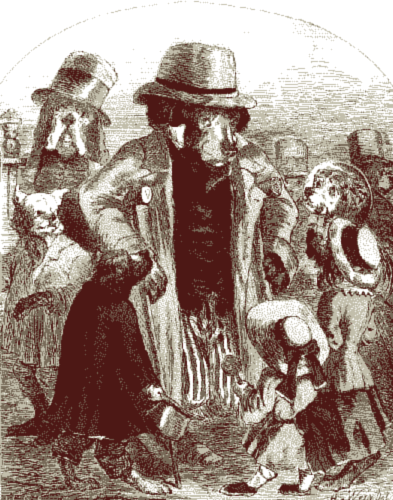
Never shall I forget the first time this pleasure was allowed me. The morning was so fresh and bright; the sun shone so gaily upon the houses; the river, now reduced to its usual size, ran so cheerily along, that I got into my old habit, and began to think they were all talking to me and bidding me welcome after my long illness. Kind words were soon said to me in right earnest, for before I had got half-way down the street, with old Nip just behind me,—his hat still adorned with the band which he had unwillingly put on when he thought me dead and gone, and which he had forgotten to take off again,—the puppies ran from different quarters to look up in my face and say, "How do you do, Job? I hope you are better, Job." Many a polite dog took off his hat to bid me good morrow; and praises more than I deserved, but which I heard with pleasure, came softly to my ear, as I hobbled slowly along. Nip told me afterwards, that there had been another in the crowd who kept a little back, and who, though she said nothing, seemed to be more glad to see me than all the rest. I had not seen her, nor did he mention her name, but that was not necessary. My heart seemed to tell me that it could only have been Fida.
A WORTHY SUBJECT