Front matter
Reading edition
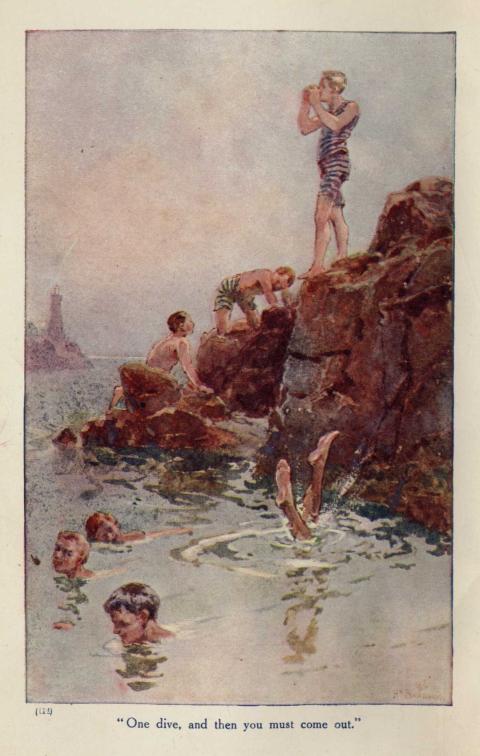
"One dive, and then you must come out."
THE ACADEMY BOYS IN CAMP
BY S. F. SPEAR
LONDON, EDINBURGH, DUBLIN, & NEW YORK THOMAS NELSON AND SONS 1909
CONTENTS.
The Roll-call
A Costly "Yes"
Off for Whaleback
In Camp
The Swimming-pool
The Fog-storm
The Wreck
Anemone Pool
A Day of Freedom
Boys in a Trap
The Escape
The Missing Boys
On Board the "Una"
Tribulations
The Little Cabin
A Wretched Night
A Surprise
The Greeting
Improving the Time
The Two Matches
A Full Day
Tents Down
LIST OF ILLUSTRATIONS.
"One dive, and then you must come out" . . . . . . Frontispiece
"It was a fellow about your size"
He pushed open the door and fell upon Joe
Away went the basket to the wreck
"There, Ben, how does that sound?" he asked
The two boys watched the sport
Ralph put his hand in the outstretched palm of the teacher
"Now! All together!" (missing from book)
THE ACADEMY BOYS IN CAMP.
CHAPTER I.
THE ROLL-CALL.
Groups of excited boys were gathered in the school-room of Massillon Academy one morning in June, near the end of the term.
So busy were they with their conversation that the bell had sounded twice before they began to disperse, and even then the last words were exchanged as they went to their seats.
"Order!" was the stern command from the teacher's desk.
Quiet at once followed, and the roll was called as usual, followed by morning devotions.
Then Mr. Bernard came forward to the edge of the platform, and said quietly, "The leaves containing the lesson for the day have been torn from my 'Anabasis,' and a rumour has reached me that all the class-books have been similarly mutilated. Let those who have thus lost portions of their books stand up."
Fifteen boys, the entire class, sprang to their feet as if they had been waiting for the signal--some with a laugh, as if they considered it a good joke; others indignant; and all with an air of excitement and expectation, knowing that the offender was sure to be called to account.
Mr. Bernard glanced from face to face with short, sharp scrutiny, and said, without further comment, "Be seated."
Taking the large school ledger from the desk, he said, "I will call the roll. Let each boy answer on his honour. If you say 'No,' I shall understand that you had nothing to do with planning or executing this mischief."
There were eighty-five boys in the Academy; and as their names were called, each and all, from Adams to Warden, answered with a ringing "No!" After the last name there was a silence.
Mr. Bernard put aside the ledger, and surveyed the school. A slow, sweeping glance of the keen gray eyes searched every boyish face.
The most guilty-looking lad in the room was Joe Chester--"Little Joe" as every one called him; and Joe Chester was above suspicion.
Mr. Bernard did not for a moment suspect that Joe's confusion was the result of guilt; but knowing the boy so well, he felt sure that he had some knowledge of the offender, and that the knowledge was a burden.
After another glance along the seats where the older boys sat, the teacher said, very soberly, and with a peculiar look in his searching eyes: "Is it possible that we have a liar amongst us? A LIAR!"
The boys shrank visibly from this plain speaking, but the teacher repeated it slowly, "A LIAR!"
A lie was a deadly sin with Mr. Bernard, and the boy who would tell a deliberate falsehood he considered mean enough and bad enough for any wickedness.
He was a "liar," and no other word would describe him, even if he wore the finest broadcloth, or stood at the head of the class. The word had been spoken almost in a whisper, but with such emphasis that it seemed to ring through the school-room, and to come echoing back from the four walls.
Every honest boy felt thankful that the word could not apply to him; and some who had never considered an untruth a very shocking thing felt they would never be guilty of another.
To the astonishment of all, after another silence, in which the echo of the terrible word seemed still sounding through the room, Mr. Bernard said quietly, "You are dismissed."
The matter was surely a serious one when they were dismissed so early in the day with lessons unheard. The boys passed out in silence, most of them forgetting to be glad of a holiday.
Not till they were out of the building did any boy venture even to whisper to his neighbour.
Some retired at once to their rooms; but most of the pupils gathered in knots on the playground, to talk over the subject uppermost in the minds of all.
Joe Chester was not ready to discuss the question, and was not intending to join the crowd of talkers; but as he passed there was a cry: "Chester! Ho there, Chester!"
He waved his hand towards them, and was passing on, when one of the older boys seized him roughly by the collar, and straightway pulled him into one of the groups.
Joe struggled bravely to release himself; but being one of the smallest boys in the class, he stood small chance of escaping his assailant; so laughing good-naturedly, he allowed himself to be drawn into the centre of the crowd of eager talkers.
"That's right! Don't let him off till he gives a guess as to the scamp!" shouted several boys.
"Perhaps he did it himself," said the tall youth who had appointed himself policeman to collar Joe and bring him to the conclave.
"See here, Ralph Drayton, if I had been mean enough to play such a miserable trick with the books, I wouldn't be mean enough to deny it," said Joe stoutly, throwing his head back proudly, and looking the other straight in the eye.
Drayton laughed derisively, and said with a sneer, "Oh, I forgot; he is 'Saint Bernard's' pet billy-goat. He never would do anything bad, would he? Oh no." Then in a change of tone, he added in a conciliatory way, "Never mind me, Chester; of course I am funning. No one suspects you."
"No, I suppose not," said Joe coolly.
This he said with his honest blue eyes fastened searchingly on Ralph Drayton's small black ones.
The black eyes fell beneath the glance, but Drayton quickly recovered himself, and loosing his grasp on Joe's collar, said with a laugh, "I'll bet anything that the janitor did it!"
"Oh, pooh! The janitor!" said a half-dozen boys derisively.
"What did he care about the lesson?"
"Well, who then could it be? If I could find out, I'd thrash him for spoiling my book. I'll get a lecture from father at home when he sees that torn book. You see my brother Nelson is coming next year, and he will take my books as I leave them. My copy was new too!" and Ralph's tone was one of righteous indignation.
Joe Chester was too impatient to listen longer, and turned to go; but Drayton shouted, "Hold on, Chester! where are you going?"
"In," answered Joe shortly, motioning with his head towards the commons.
"Wait for me; I am going in too. It's no use to stand here and guess who did the mischief."
Joe Chester walked straight on, but Ralph Drayton overtook him with three strides.
As soon as they were out of hearing of the group on the playground, Drayton turned suddenly and said, "See here, Joe Chester, what do you know about this fuss?"
Joe walked on and made no answer.
"You know something. I saw it in your eye just now back there, and I saw it in your red face when old Bernard called the roll. You can't cheat me!"
"Well, Drayton, I am sure I don't want to cheat you. Yes, I do know something about it."
"What! do you know who tore the books?"
"Yes."
This Joe said steadily, with his eyes upon Ralph's face.
Both boys paused in their walk; and Joe, leaning back against the fence, folded his arms.
"Who was it?"
"You want to know, really?"
"To be sure I want to know."
"Well, Drayton, it was a fellow about your size; and the sooner he goes to Mr. Bernard and owns it, the better for him and for all the rest of us."
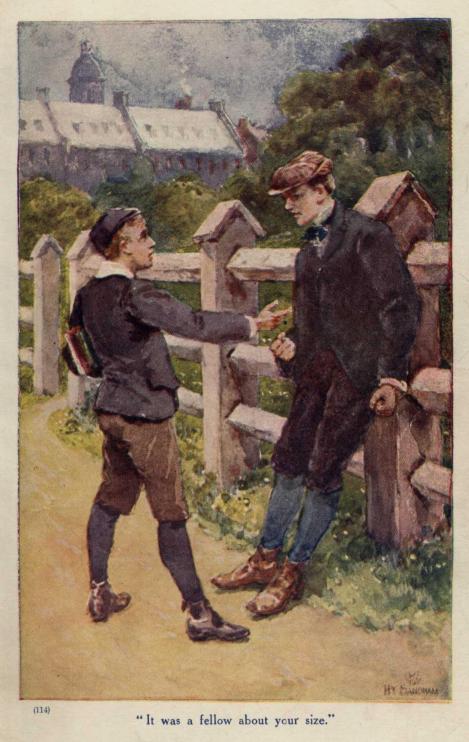
"It was a fellow about your size."
Drayton turned pale, and said, "Chester, do you mean that I did it?"
"I do mean just that."
Drayton's fists doubled up threateningly, and he was about to assume a fighting attitude, when he changed his plan, and tried to coax Joe.
"Oh come, Joe, you know better. You are only chaffing. I thought at first that you were in earnest."
"You thought right then," added Joe dryly.
Drayton made no reply, but tried to stare indignantly at Joe.
The effort failed; his own eyes dropped before the steady, honest eyes that looked him through.
"How do you know?--what made you think I did it?" added Drayton hurriedly, fearing that he had admitted his guilt.
"I saw you burning paper in the garden last evening, and although I had no idea then that you were up to mischief, I felt sure of it as soon as I found the fellows all complaining about their books."
"Pooh! those were letters I was burning--some I didn't want to carry home."
"They were not letters, they were book-leaves. I saw them plainly."
"Spy!" hissed Drayton furiously. "You hung around and watched."
"I did not. I was passing along that way because I left my geometry under the big tree, and I had to finish my lesson before bedtime."
"Oh yes," sneered Drayton. "You had time to take special notice of the size of the paper. You'd no business there; and I have a good mind to thrash you within an inch of your life."
Joe laughed at this furious threat. "I didn't know you owned the garden, or I would have kept out of it. As for thrashing, you know I don't thrash easy, even by a boy of your size. You tried it once. If you think it will help you out of your scrape, you can try it again."
Drayton looked amazed. Here was little Joe Chester not only defying him, but actually laughing at his threat as if it were a joke.
"Well, I'll tell you what it is, Chester: if you breathe a word about this I will have my revenge somehow."
Chester began to look fierce now himself. "Come, Drayton, you have blustered and fumed long enough. You had better change your course. I am not easily frightened."
Drayton had reached the same conclusion, and, changing his tone, said almost pleadingly,--
"Chester, if I am found out in this I'll be sent home, and my father would be awfully cut up if I had to leave this school. He is in a hurry to get me into college, and this would put me back if I get expelled. Don't you tell what you know, will you, Joe?" Then he added hurriedly, "I was an idiot to do it! I knew it as soon as I tore out the first leaf, which happened to be from Mr. Bernard's book. After that was gone, I was in for the business, and I just rushed it through."
"What put such a silly joke into your head?" asked Joe, curious to have that explained.
"Oh, Ben Carver and I planned it together. We thought it would be fun to get up a fuss over the books; but Ben backed out."
"Then Ben Carver knows it too?" asked Joe, with a sigh of relief, as if his burden were lightened by this assurance that some one else shared the secret.
"Yes, Carver knows, but I can trust him. He will just as soon lie as not, though he hadn't the pluck to carry out the plan. It all rests with you, Chester: if you will stand by me I shall come through all right."
"Well, Drayton, I'll do anything I can, except lie, for you. You needn't ask that."
"What if Bernard asks if you know?"
"If he asks me that question plump and fair, I shall have to say yes."
Drayton looked frightened and pale.
"Then it is all up with me, for he will ask as sure as fate."
"Now, Ralph, take my advice," said Joe, putting his arm over Drayton's shoulder. "Go and tell Mr. Bernard the truth. It isn't too late. Come; I will go with you."
The boy shook off Joe's arm, and said, "Nonsense, Joe; he might forgive the mischief, but he never would overlook the lie. I would be expelled at once. No, Joe, my only hope is in you. If you won't lie for me--"
"And you do not expect me to do that?" interrupted Joe proudly.
"No. I suppose you wouldn't lie to save yourself, and I can't expect you to for me, but I hate to go home in disgrace. The fact is, though I have been bragging around here, my father has pretty hard work to give us boys an education. Oh, such an idiot as I was!"
"Well, Drayton, I am sorry for you. I really am; and you may depend on me never to expose you. I'll let you do that yourself."
Drayton brightened up.
"Then you will keep mum?"
"Of course I will."
"Lie or no lie?"
"I didn't say that at all. If Mr. Bernard asks if I know, I shall be obliged to say yes, but he can't make me tell who did it."
"Not if he should threaten to expel you?"
Joe hesitated for a moment, and then said, "He would hardly do that, but if he should,--no, not even then."
"Joe Chester, you are a good fellow! Give us your hand! Now mum is the word!"
CHAPTER II.
A COSTLY "YES."
It was near the close of the summer term, the end of the school-year, and the boys were looking forward with brightest anticipations towards the camping season. Provided their school reports had averaged well throughout the year, the boys were given a fortnight of camp-life before scattering to their several homes.
Sometimes they had gone to the mountains with their tents and accoutrements for hunting and fishing; sometimes to Lake Myrtle; and last year they had explored Barrimore river from the mouth to the source.
This year Mr. Bernard had obtained permission to take his boys out to Whaleback, an island containing about a hundred acres, uninhabited save by the family of the lighthouse-keeper.
There they would be "monarchs of all they surveyed," and no one would be disturbed by their noise--consequently no one to complain of "those dreadful boys."
This excursion was the great treat of the year for the Academy boys, and through the spring months it was the favourite theme for conversation.
Some ten or fifteen of the boys had forfeited their right to join the excursion by bad conduct or incorrigible laziness with lessons; but those who had reason to expect to go were already collecting and putting in order fishing-tackle, guns, bows and arrows, and all the things that boys consider essential to camp-life.
The rifle barrels were polished till they shone like steel mirrors; and under the careful supervision of one of the teachers, the owners practised with them two or three times a week.
The archery club had their targets set in the playground, and were in daily practice, the members considering themselves rivals of the rifle club.
Joe Chester was one of the most eager of all for the fun of camp-life, and he, with some four or five other boys, had ordered a boat to be sent to the landing where they were to take the steamer for the island.
Two or three other boats had also been engaged for the use of the scholars--row-boats; for Mr. Bernard absolutely declined the responsibility of sail-boats, even for those who were accustomed to manage them.
During the forenoon following the summary dismissal of school, the boys were anxiously discussing the probable effect of this mischief upon their vacation trip; and, after all, their conjectures ended in a return to the same question, "Who can the mean fellow be who made all this trouble?"
In the midst of the discussion the great bell sounded, and the boys returned to the school-room.
There were no laggards now; every boy was in his seat before the desk-bell had been struck.
Mr. Bernard stood in the desk with his hand on the open ledger, while the other teachers were seated near by.
The room was so still that a pin dropped would have sounded loud, and the boys almost held their breath while they waited for Mr. Bernard to speak.
He was evidently in no haste; lessons could wait. After a silence that seemed very long to the boys, he began to speak.
It was a short, sharp lecture upon the meanness of falsehood and all deceit, without a word in regard to the original trouble--the mutilation of the books.
I think it doubtful if a lecturer ever before had so attentive and awe-struck an audience. At the close he said, "Boys, I will call the roll once more. Let each answer on his honour--if he have any honour--whether he mutilated the books of the class in 'Anabasis.'"
Again from the beginning to the end of the roll the names were called, and again every voice unhesitatingly answered, "No."
Joe Chester's face was crimson; he dared not look up.
Some of his school-mates noticed his confusion, and whispered to their neighbours, "Look at little Joe! Do you suppose he did it after all?"
"Is it possible?" exclaimed Mr. Bernard in a despairing tone. "Have I been harbouring a liar among my boys all the year?"
With a sigh he opened the book again, and said, "On your honour, boys, answer me this question: Do you know who did the mischief? Although I confess I almost forget that in my regret that one of my boys has told a direct lie."
Once more the boys answered to their names, "No."
Joe listened almost heart-sick, hoping that Carver would say yes; but his negative was a decided one.
Then followed "Cheney."
"No."
"Chester."
The whole burden was to rest on him after all.
Joe blushed to the very roots of his hair, and without glancing up, answered bravely, "Yes, sir."
There was a little pause, followed by a suppressed buzz of surprise; then Mr. Bernard proceeded with the roll.
Again Drayton's name was called; and, as before, he answered boldly, "No."
No one but Joe Chester in all the school knew aught of the mischief-maker.
The ledger was returned to its place in the desk, and leaving the room in charge of Mr. Andrews, one of the head-teachers, Mr. Bernard retired to his study, and summoned poor Joe for an interview.
The boy turned as pale as he had been rosy, as he passed up the room and across the platform to the door of the study, and disappeared.
"Little Chester, after all!" said some.
"Ain't I glad I am not Joe Chester?" and similar expressions, were exchanged by the boys, until Mr. Andrews began to distribute black marks, which had a tendency to restore order, as a certain number of these marks would prevent participation in the summer gipsying, and some of the boys were alarmingly near the limit.
The eighty-five tongues were stilled, but twice eighty-five eyes were continually straying towards the study door behind the desk. In the meantime, Drayton could only conceal his anxiety and alarm by pretending to be very much engaged looking up a Latin translation, while all the time he was saying over and over to himself, "Joe promised to be mum! Joe promised to be mum!" and the minutes seemed hours.
"What could teacher and scholar be doing?"
The boys were all asking themselves that question, as they studied, or tried to study, in obedience to Mr. Andrews's orders.
It was a full hour before Joe appeared and came across the platform.
He did not glance up as he came down the room, and hastily seated himself, bending over his book, with both hands thrust through his short curls.
Mr. Bernard did not appear at once, and the lessons went on as usual.
When the usual hour for closing came, Mr. Bernard addressed the school again:--
"I am aware that among boys there is a code of honour in regard to information that will implicate a companion, and I have respect for it; but in this case, if the boy who is guilty will not confess, I deem it my duty to the school to hunt him down, and it seems to me that ordinary scruples ought not to prevent justice. This lie rests like a cloud over the whole school. Chester refuses to tell me what he knows."
A murmur of applause followed, but a heavy rap on the desk silenced it, and Mr. Bernard continued:--
"I am sorry to add, that unless the guilty boy is manly enough to save him by confessing his guilt, Chester must lose his fortnight in camp."
An audible "Oh no!" followed this. But Joe's voice did not join in the murmur; he only bent a little lower over his book, and looked steadily at the page without seeing a word upon it.
"You are dismissed."
The bell gave the signal for each class, and the boys passed out in an orderly way; but once outside there was a shout, "Chester! Chester!"
As soon as he appeared he was seized by the crowd and borne on the shoulders of his comrades to the centre of the playground, where all began cheering and scolding him in the same breath.
"If any fellow is mean enough to keep still and let you bear the punishment, he ought to be told on! I wouldn't keep his secret for him!" exclaimed one of the older boys.
"I declare I didn't know we had such a mean fellow among us!" said another.
"He must feel about the size of a dried pea about this time."
"But he won't be mean enough to let you stay behind and go himself to camp out," said Fred Wurden, one of the quiet boys.
Some of the more impulsive boys cried, "If Joe can't go, we won't any of us go!"
Joe said little, and went away to his room as soon as possible with David Winter, his room-mate. Drayton had not joined the indignant crowd. He and Ben Carver had an errand at the village, and hurried away; and during the remainder of the term these two boys held themselves aloof from the other boys, who were, however, too busy with their plans for vacation to remark upon it.
Only once did Ralph and Joe meet alone, and then Ralph said, "I don't know how this affair is to end, old boy; but I would rather be in your shoes than mine."
"So would I!" exclaimed Joe heartily.
At length the examinations were over, and the last day of school was about closing, when Mr. Bernard said, "To-morrow morning at six we are to start for the Cape to take steamer for our island camp-ground. Several boys will be left behind, having forfeited their pleasure. Unless the boy who was guilty of the mischief, and the far greater crime of hiding himself behind a lie, will confess, Joseph Chester must stay behind."
There was a pause long enough to allow the guilty boy time to speak.
"There is time now for the guilty boy or boys to speak."
No voice answered, and the silence grew painful.
Then Mr. Bernard said, "Chester, my boy, unless you receive other orders you will remain behind. This, I think you know, gives me more pain than it does you, and I am sure you understand why I deem it necessary."
Chester bowed, and made a desperate effort to bear the sentence bravely, but soon resorted to the old attitude, and sat staring blindly at his book, with both elbows on the desk and both hands buried in his hair.
The boys passed out of the room when dismissed, and only Chester remained behind with the teachers, who waited to speak with him; but finding that he could not well bear their pity, and that his quivering lips could not frame a reply, each expressed his regret at the disappointment, and presently Joe occupied the room alone. Still he showed no sign of moving after a half-hour had passed.
Presently the door opened and some one peeped in; then Joe heard a step inside, and with the pretence of looking up a book on the different desks, he stood a moment at Joe's side, and dropped a note on his open Virgil, and then hastily retreated.
Joe unfolded the note and read:--
"JOE, I hate to go. I only go to keep my father from finding out. You can't hate me any more than I hate myself. D."
That evening Joe kept his room; he could not bear to hear his friends saying continually, "Poor Joe!" "Oh, if Joe could go!"
CHAPTER III.
OFF FOR WHALEBACK.
In the early morning Joe heard the shouts of the merry crowd as they went down through the Academy grounds to the river where the steamer was waiting to take the party out to the island. The boys were laden with blankets, fishing-rods, guns, or other warlike implements; while tents and cooking utensils were taken along in a waggon.
David Winter remained behind with Joe until the whistle sounded, feeling sure that the culprit would confess at the last moment, and that Joe would go after all.
Finding that the hope had been a vain one, he gave Joe a parting hug that would have done credit to the most affectionate bear in the world, and without a word darted out of the room.
As soon as Joe was alone he opened a little note that he had been holding tight in his hand--one that Mr. Bernard had put there himself when he came to the door to say good-bye.
It was a short note, but it gave Joe a great deal of pleasure,
"DEAR BOY,--I am sure you know that I am more than sorry to leave you behind.
"It seems to me the only way to reach the offender, and I hope he will yet confess. Be sure I shall send for you at once if he should do so. Meanwhile don't go home. The summons may come at any time. Yours with affection, J. W. BERNARD."
The boat was gay with flags that streamed from every available point, and the band was playing the liveliest airs as the boys stepped on board.
"Are we all here?" asked Mr. Bernard, as he stood on the top of the saloon and glanced over the crowd of lads.
"All but little Joe!" said one or two boys a little spitefully.
"Carver isn't here yet, sir!" said another.
"Sure enough; where is Carver?" asked the teacher.
"Blow the whistle again!" shouted Mr. Bernard.
"Drayton is missing too!" exclaimed Mr. Andrews.
"O father, here's a note one of the chambermaids gave me for you. I forgot all about it," cried Max Bernard, the teacher's little son, who was to make one of the party.
Mr. Bernard opened the note hastily and read:--
"MR. BERNARD,--I can't go with you. Let Joe Chester go, please. I did the mischief, and was afraid to tell. Ben Carver knew about it, but did not do it. We are going off together. Please send our fathers word that we are safe. RALPH DRAYTON.
"P.S.--I was never sorrier in my life, Mr. Bernard."
Mr. Bernard read the note again carefully, and then said to the waiting crowd,--
"Drayton and Carver have gone, they do not say where; but in this note which they leave behind, Drayton confesses that he is the guilty person."
A murmur of astonishment passed around the throng of boys, which was changed to a cheer when Mr. Bernard added,--
"Who will go back for Chester?"
A score of eager voices shouted, "I, sir!" and before he could speak again a dozen boys had leaped ashore, led by David Winter, and were scampering like a herd of wild deer across the fields towards the Academy boarding-house, each determined to be first in announcing the good news to Joe Chester.
It was at least a mile from the shore to the house, and the boys raced as they had never raced before, Dave, Joe's "chum" and room-mate, keeping the lead all the way, but with such an effort that he only reached the head of the stairs as one or two of the other boys reached the foot.
Without stopping to knock, he pushed open the door, and fell upon Joe, who, hearing the rush of feet, had come forward with eager expectation.
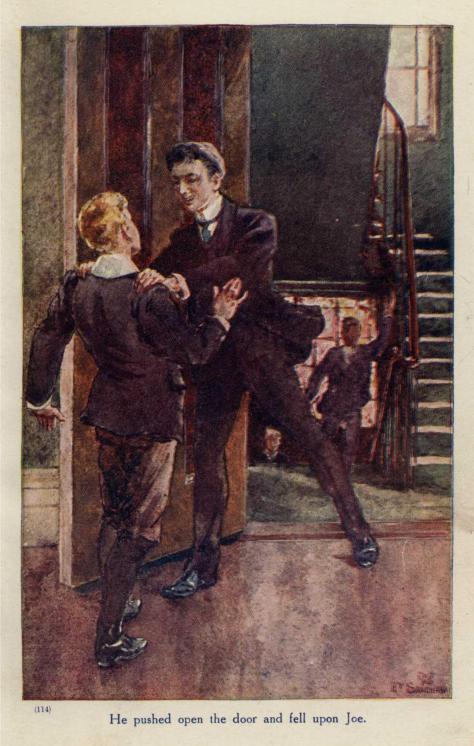
He pushed open the door and fell upon Joe.
"What's the matter, Dave?" Joe cried in real alarm, as the boy, too breathless to speak, incoherently gasped, "It's all right! You are to go. Come on, old boy!"
The other boys were in the room now, and as all were panting and holding their sides, it was rather difficult for Joe to make out the story they had come to tell.
But he was to go to the island after all; he knew that, and that was good news enough.
He gathered, also, that Drayton had confessed and was missing.
"Where did you say they are gone?"
"Nobody knows."
"Nobody cares!" added another.
"I care," said Joe boldly. "I wish I had time to hunt him up!"
"You, of all fellows! You hunt him up!" exclaimed Frank Furman.
"The idea of your troubling yourself about him!" cried Dave angrily. "You make me mad, Joe!"
"But I know something how he was feeling, and what a hard thing it was for him to confess."
"Never mind him!" said Dave impatiently. "The boat is waiting! Where's your baggage?"
"I'll take your rod," said Ned Gould, taking Joe's fishing-rod from the hooks.
"No, not that one. Ralph left his for me. The janitor brought it around; he said he found it in the hall. Poor Ralph!" said Joe, examining the paper tied to the rod with the address, "For Joe Chester."
"Humph! that's the least he could do!" grumbled Dave. "Come, get your things together quick!" and he pulled Joe's valise from under the bed.
Joe was too excited to help much, but among them all they soon had the valise filled; and with a whoop that would have delighted the heart of a red Indian, the boys dashed downstairs, nearly crushing the janitor, who was labouring slowly up to investigate the noise coming from Room 8.
The race back to the steamboat was not quite so brisk as that to the house had been, but they were not long on the way.
They were hailed by the throng of boys on the boat with cheer after cheer as they came in sight, and most of the boys leaped ashore and rushed to greet the hero of the occasion, who was quite overcome with congratulations and expressions of delight.
Mr. Bernard had gone to make inquiries about the two missing boys, and the boat was kept waiting till nearly noon, when he came with the tidings that Drayton and Carver had sailed that morning in a fishing-smack from that very wharf.
Mr. Bernard had also written to the boys' parents, giving a brief account of the trouble, with information in regard to their sailing, the name of the vessel, and the time when it might be expected to return to port. At the close he had expressed his regret that he must decline to receive the boys again as pupils.
"Gone in a fishing-smack!"--"Such high-toned fellows, too!"
These were some of the exclamations of the boys.
The delay was over at last.
The boat swung around from the pier and steamed away; the band played "Bonnie Dundee," and the boys' shouts quite drowned the music.
The day was beautiful and bright, and every one was in high spirits, as the little boat puffed its way out between the capes and towards Whaleback, which lay within sight, and among scores of white sails, from that of the tiniest wherry up to the broad canvas of the huge ships sailing proudly away to foreign ports.
They passed one fishing-smack on which somebody thought he espied two boys who looked about Drayton and Carver's size; but when they passed it no one but the captain and his one helper could be seen.
"I'll bet Drayton and Carver are down in that cabin. I just know I saw them dodge; besides, I saw the twinkle in that old fisherman's eye," said Dick Wooster.
The orders were for the steamboat to land its passengers on the southern side of Whaleback; and as they steamed past the lighthouse on its rocky perch, and the long line of jagged coast against which the waves were dashing furiously, the boys wondered how they were to get ashore. On rounding the southern end, a fine pebbly beach, sheltered a little by projecting points of land, offered a comfortable entrance for boats.
The steamboat anchored outside, and four boats were lowered and speedily filled with boys, who were almost ready to jump overboard and swim ashore in their eagerness to land.
The landing occupied some time, as the boats made many trips before all the boys, tents, bedding, stove, cooking utensils, and, last but not least, the provisions for the hungry crowd, could be put on shore.
Jonas Brown, the cook, and his man Freitag (conveniently translated by the boys, "Friday"), attended to that part of the labour, and long before the boxes and barrels were all ashore, the boys were demanding something to eat.
Some started off on an exploring tour; others helped to put up the tents; and some of the hungriest went grubbing in the clam-beds,[#] still wet with the receding tide.
[#] Clams are shell-fish, used for food.
"Here are clam-forks, boys," shouted Jonas. "Glad to have your help. You dig the clams, and I'll build up my fire and get ready for a bake. I reckon that will taste as good as anything."
"A clam-bake! a clam-bake! Who will dig clams?"
More boys volunteered than could find forks to dig with; but not to be outdone, some of them worked with sticks, prying in the mud wherever the little holes indicated the presence of the shell-fish.
Jonas showed those who had forks how to strike them deep into the beds, and the boys were apt scholars; so that by the time the rocks were well heated, and the sea-weed gathered, there were clams enough piled up on the shore to furnish a feast even for such a crowd of boys.
While the clams were slowly baking under their sea-weed cover, Jonas and his Friday pitched their cook-tent, set up their stove, and baked biscuits to be eaten with the clams.
Long before the roast was pronounced "done," the boys were on hand waiting for the sea-weed to be removed, and a hungrier pack of young savages never danced around a clam-pile.
A barrel of biscuits had been opened on their first arrival at the island, and the boys had "taken the sharp edge off their appetite," as they said, by eating them; otherwise Jonas would never have been able to bring those clams to the stage of perfection that he did.
"Come, Jonas! they are done to a turn!" cried the impatient boys.
"They will lose all their goodness in that good smell," said Joe, sniffing the air.
All noses went up, and fifty boys gave a prolonged "Ah! Isn't that gul--orious?"
It did seem that Jonas was provokingly slow in testing those clams; but at last he said, in his drawling way, "Well, now, I reckon them'll do!"
The boys cheered this remark, and hastened to offer their assistance in removing the sea-weed; but Jonas declined their offer in a most decided way.
"Now, you just move off, every boy of you! or you shan't have a clam. Off with you, till I get 'em out in piles, and give every one a fair chance!"
The boys knew by experience that it was policy to keep Jonas good-natured; so, with a good deal of pushing and whooping, they widened the circle, and contented themselves with watching the operations and exhorting Jonas to "hurry up."
"Now, that there pile belongs to the gentlemen!" said Jonas, pointing to the first heap that he threw down on the clean pebbles.
"O Jonas! aren't we all gentlemen?" asked Walter Martin, and a chorus of groans followed from the other boys.
Jonas vouchsafed no reply, but continued to shovel out clams and divide them into a half-dozen piles along the beach; while the boys danced around, awaiting the signal of the bell.
Freitag presently appeared with the great bell, and, although the summons was wholly unnecessary so far as the boys were concerned, as they had been at the scene of action for nearly an hour, it brought the teachers from their work of tent-raising.
After a blessing asked by Mr. Bernard, permission was given to the hungry crowd to attack the shellfish.
There were three courses provided--roast clams, then warm biscuit, and finally a dessert of gingersnaps, a barrel of which stood open from which all helped themselves.
Fortunately the boys were not difficult to suit, and they pronounced it a meal fit for a king.
CHAPTER IV.
IN CAMP.
After the dinner Mr. Bernard said, "There are two dozen hatchets, and I want two dozen boys to use them."
"Oh yes, the fir-boughs to be chopped!" said a dozen voices.
"I'll chop!"
"I'm the boy for a hatchet!"
In a minute the two dozen hatchets were seized, and as soon as the boys received their directions about the bushes they were allowed to cut, they started off for the pasture, followed by a crowd to drag the boughs back to camp, where others of the party, who had done the same work before, were to lay them down for beds. The pasture where the boys had gone for the fragrant fir-boughs extended across the end of the island and stretched back a half-mile to the woods,--a dense growth of hemlocks, junipers, firs, oaks, beeches, wild cherries, thorn trees, and hazel bushes. Along the course of a stream running from a spring grew rows of alders, over which ran the clematis; and along the edge of the water-course grew clumps of ferns and patches of velvety moss.
These woods extended for a mile, thinning at the other end of the island into a bush-covered pasture that, a little later in the season, would furnish all the blueberries and whortleberries the boys would want, and, later still, would be a garden of golden-rods and wild asters. All around the shore of the island, except at the southern end, was a border of rough boulders and cliffs, upon the highest of which was perched the lighthouse, with its revolving lantern.
While the boys were at work in the pasture, Jonas and Freitag were putting up their long tables of matched boards and covering the whole with oilcloth, "to look more civilized-like than bare boards," Jonas said.
Then the great baskets of tinware were unpacked, and the table set for the next meal; for Jonas had camped out before with Mr. Bernard's school, and he knew that they liked to see signs of the next meal as soon as one was disposed of. Moreover, he had discovered that they were less likely to be around sampling the crackers if they saw the table set. He may have been deceived in this, but Jonas was a pretty keen observer, especially in the line of his profession.
Seeing some of the boys idle, Jonas called, "Here, you fellows, catch me some fish for supper. There's plenty of chances along the shore yonder. I saw 'em when we came past.--You go along too, Freitag, and help 'em."
The boys were all eager for the sport.
"Here's bait, and a big pile of fishing-rods all rigged. Take that there big basket for your fish," continued Jonas, as if he were giving orders to a group of fishermen.
The boys, however, followed his directions good-naturedly, each seizing a rod, but leaving "Friday," as they called the man, to bring on the bait and fish-basket.
"Remember your promise, boys, not to go into dangerous places," called Mr. Bernard.
"Yes, sir, we will be careful," answered the boys. They were soon perched on the rocks, dropping their hooks into the water and pulling them out, exclaiming, "I've got a bite!"
"So have I."
"My! ain't they plenty!"
"There's one! Hold on, my beauty! Let go my hook!"
It was lively work, as they said, and presently they had enough to do to bait hooks and take off fish without much talking. Jonas gave a grunt of satisfaction as Freitag came dragging the heavy basket and exclaiming, "Py, but dat was a pig pizness!"
"Now, I can get a supper as is a supper!" exclaimed the cook.--"Freit, you just get them fish ready, and I'll cut up the pork. It ain't nigh supper-time, of course; dinner isn't much more than over, so you boys go off somewhere. Why don't you go see the lighthouse?"
Now Jonas was very cunning in making this suggestion, for he knew the lighthouse was at the other end of the island, a mile and a half away, and if the crowd would only start on that pilgrimage, he could have peace and quiet, and get supper at his leisure. His suggestion seemed good to the boys, and they cried, "Oh yes, the lighthouse!"
"Hurrah for the lighthouse!"
"Mr. Bernard, may we go to the lighthouse?"
Mr. Bernard was in his tent; but hearing his name called, he came outside.
"We want to go to the lighthouse. Can we go?"
"Yes, if Mr. Andrews is ready to go now; he has an errand there to see about a supply of milk. Now, boys, I have not found out the dangerous places on the island, and until we have explored a little ourselves, I want you to use extra precautions. Remember, no bathing except on the beach where we landed; that slopes very evenly, and I think there is no under-current."
"We will be careful, sir."
"We will remember," said the boys.
"Come on; who wants to go to the lighthouse?"
"Ho, for the lighthouse!"
The choppers and bough-layers were at leisure again, and many of them joined the party.
Others said, "Oh, I am too tired to go so far!"
"Wait till to-morrow!"
But the first speakers were already hurrying across the pasture with Mr. Andrews, stopping here and there to pick strawberries or raspberries, and to look for some blueberries that had ripened before their fellows.
The walk was longer than they expected, and the way through the tangled underbrush of the woods was no easy one; but they at length came out into the pasture-land at the northern end of the island, and from there the path was smoother.
The light-keeper gave them a gruff but hearty welcome, and his wife invited as many to come into her nest of a house as the little room would hold.
The two boys belonging to the family were shy but radiant at the prospect of something to break the monotony of their island life.
"I suppose you want to go up and see the lantern, boys," said Jacob Kramer, the light-keeper.--"Here you, John and Jerry, go up with 'em, and tell 'em all about how it works."
John made no reply save to run up the steps leading to the lighthouse, and Jerry, with the crowd of other boys, followed, or as many as could enter at once.
After the lantern had been examined, John led the way down the side of the cliff where they could see the surf-bell rung by the waves.
"That sounds like somebody's funeral!" exclaimed Joe Chester, shrugging his shoulders.
"Doesn't it keep you awake at night?" asked Ned Gould.
John shook his head.
"Nothin' keeps me awake, only the storms when the big waves strike 'way up against the house and spatter the top windows."
"Do you have such storms as that, really?" asked Dave.
John nodded, and added with frankness,--
"When them come Jerry and I get scared, and crawl down to father's room."
"Don't you get lonesome here?" asked Joe, glancing around at the rocks and water forming the landscape.
"Not very. We don't get lonesome at all in the summer."
"What do you do for fun?"
"Oh, we build towers on the cliff. We've got a big one now. Come over and see it;" and both boys scampered off over the rough rocks with their bare feet, leaving the others to pick their way more carefully.
The tower was as high as Jerry's head, and large enough for four boys to stand upon comfortably. In the centre was a fir-tree from which the boys had trimmed every branch, until it was like a flag-staff.
"Some time we are going to have a flag of our own to fly atop there," said Jerry with pride.
"I've got a good-sized flag over in camp that you may have; it will do till you can get a bigger," said Walter Martin.
"What else do you do besides build stone things?" asked Dave curiously.
"Oh, lots of things."
"You fish off the rocks, I suppose."
"Yes, plenty of fish round here. We go off in the boat with father, too, to tend the lobster-pots."
"Lobster-pots! what are they?" asked Joe.
"What you catch lobsters in. Didn't you ever see a lobster-pot? There's some there on the grass."
"What! these cages? How do you catch them with these?"
The boys gathered around the "cages" and examined them.
"See, this hole grows small at the back of it, and the lobster is so anxious to get the bait inside that he squeezes through; but after he is in he doesn't know how to double his claws back and get out, so he just don't; he stays."
"And you catch him?"
"He catches himself," laughed John.
"All we do is to set the pot,--that is, we bait it,--and then we anchor it off somewhere, and after a while we go back for it and get the lobsters."
"How do you get them out?"
"See these little doors up above? We open them, and reach in there."
"Don't they bite?" asked Dan.
"If you don't know where to catch 'em they nip, I tell you."
"Of course you swim like fish, both of you," said Joe, who was quite a famous swimmer himself.
"Can't swim."
"Can't swim? What fellows you are! Why don't you learn? What if you should tumble overboard? what would you do then?"
"Go to the bottom," answered John with a broad smile, as if that were a funny thing to do.
The boys exclaimed over this lack of knowledge, and Joe finally said, "See here, you two fellows; get your father to let you come over to our camp every day, and before our camp-life is over we will teach you so you can swim like fish."
This was a delightful proposal to the boys, not only because they wanted to swim, but because it would take them among other boys.
As soon as the party returned to the lighthouse, John and Jerry whispered the invitation to their father, and asked if they might accept.
He consented willingly.
"May we learn to swim?"
"Well, yes, I suppose so. I want ye to learn. I suppose it's time you did; and there ain't no chance at this end o' the island."
"There is a good beach where we are camping, and we shall fasten a rope across to show the boys how far they can go safely."
During the boys' absence Mr. Andrews had been negotiating with the light-keeper for all the milk he could spare, and also for a supply of lobsters; and it was now arranged that John and Jerry were to bring milk every morning to camp, and remain as long as they liked during the day.
"Come, boys; it will be nearly dark before we get back!" said Mr. Andrews, bidding the keeper's family good-bye.
"And we shall lose our supper.--Good-bye, John and Jerry. Come over early." As if there were any need to tell the eager boys that.
They kept near the shore on the way back; and though it was a rocky road to travel, they saved a half-mile thereby, and arrived with very keen appetites just as their comrades had finished supper.
"I'm so hungry I could eat a whale, Joe," exclaimed Dave.
"A whale! why, I could eat a brick house," was the quick response.
"Jonas, did you save us anything?" asked a chorus of voices.
Jonas waved a frying-pan for answer, and presently set before them fried fish, crisp and brown, bread hot from the oven, and warm gingerbread, all of which won the unbounded approbation of the famished boys.
After supper the various events of the day were recounted, and all united in declaring that it had been the jolliest twelve hours they had ever known--a remark that Mr. Bernard had heard every summer on the first day in camp.
"Now, boys," said Mr. Bernard, "you are tired and will want to retire early. Come into my tent, and we will have prayers together."
This tent was divided unequally into two parts; the larger devoted to general assemblages--for morning and evening devotions, and for a resort in wet weather; for sleeping-tents were crowded with beds and baggage.
Besides the large apartment in Mr. Bernard's tent, there was one smaller--a tiny affair, where he slept and wrote or read.
The boys gathered now in the large tent, and sat down on the ground while Mr. Bernard read the Bible to them and explained the portion selected in a brief and interesting way that held the attention of the listeners. After the reading he offered a prayer, asking a blessing upon them all, and praying that none but good influences might prevail with any of them.
Then the "good-nights" were exchanged, many of the boys crowding around the teacher to thank him for the pleasure they were having; and as they scattered to their tents, many boyish words of hearty admiration were spoken of the teacher who had planned this vacation treat for them.
"I tell you, Dave, there ain't many teachers like him!" exclaimed Joe Chester, as he and his friend crept under their blankets on their mattress of fir-boughs.
"No, sir, not many."
The boys were too tired to talk much, and they were soon lulled to sleep by the dash of the ocean against the beach, and the rattle of the pebbles as they followed the receding water only to be tossed up by the next incoming wave.
CHAPTER V.
THE SWIMMING-POOL.
No bell was needed to awaken the boys in the morning; and one tent after another was thrown open to the breeze as the boys in undress ran down the beach for a plunge.
"Colder than Greenland's icy mountains," shouted Joe, as he met some of the boys on their way to the water when he was returning to his tent.
"Yes, colder than the north-east side of the pole," added David, who followed close behind.
"But jump in all of a sudden and it isn't bad," continued Joe.
The boys returned one after another, racing and jumping and exclaiming over their icy bath; and presently all were rosy and glowing with the exercise, ready for anything in the line of work or fun.
They found it hard to calm down at once, as they gathered in Mr. Bernard's tent for morning prayers; but at the first quiet reminder of the teacher the boys ceased their joking and listened to the Scripture reading and the fervent prayer that they all might be helped to live noble, Christian lives. He asked that they might not be contented to go through life selfishly, seeking only their own comfort and happiness; but that they might watch for opportunities to be helpful to others, and that they might be kept from all meanness of word or act.
When they came from the tent the savoury odour of breakfast was wafted to them from the cook-tent.
Jonas and Freitag had been fishing off the point as soon as daylight, and now the victims of their hooks--only an hour ago swimming in the broad ocean--were served up on tin trenchers, set at intervals along the table.
John and Jerry arrived in time to furnish the milk for the coffee, and room was made for them at the table, although they had already eaten breakfast.
During the meal the boys were discussing plans for the day, and probably the fishermen in their vessels a mile away heard the noise, and wondered at the babel of voices sounding across the waters.
The archery club announced that they intended to set up their targets in the pasture and practise.
The rifle club were asking permission to use their rifles in the woods, knowing that they were only to do so under the supervision of one of the teachers.
Some wanted to fish, and were discussing the relative advantages of the different shores of the island.
"If you want rock-cod I'd advise ye to go out on the point that juts out alongside the beach," said Jonas, throwing in a suggestion as he brought a fresh supply of bread.
"I am going to hunt for crystal quartz; who wants to go with me? I found quite a lump yesterday. See here," and little Fred Wurden displayed his treasure.
"My! where did you find that?"
"Oh, I've seen plenty of that! I know where there's plenty of it--a big hole in the rocks, where them shiny things are all hanging down!" said John, the light-keeper's son, with shining eyes.
"Where?"--"Show us!" cried a number of voices; and even Mr. Andrews made inquiries, and said he would go to the place after breakfast.
"As soon as the tide is right, I move we have a swimming match," said Joe Chester.
"When will the tide be right, I'd like to know?" asked Dave.
"It is on the ebb now, and by the time our breakfast is done it will be quite low," said another grumblingly.
"Don't you worry; there's water enough in the ocean for you to swim in, if the tide is down!" said Jonas. "Yes, water enough, forty fathoms deep!"
Jonas shook his head knowingly.
"I've been out on the point more than once, and sometimes the water is still, and I can see bottom. I sounded with that long fishin'-rod o' mine, and, allowing for the tide, I reckoned there must be about as nice a pool left there at low tide as you'd want to see."
"Good!"--"Good for you, Jonas."
"Mr. Bernard, did you hear Jonas?" asked Joe.
"I think I heard, but there are so many talking at once I am not sure. If it is about a swimming-place, I assure you I will investigate the matter this morning, and find a safe place for you to go."
"Thank you, sir," answered Joe for himself and the others.
"I shall stretch ropes across, showing how far I am willing you should go out; and I expect you to obey me strictly. You know we have promised your parents to run no risk. We have camped out three summers, and have never met with an accident; and I sincerely trust our record may not be changed through any carelessness of ours."
The boys agreed to follow his wishes in every particular.
Then, having finished their breakfast, they scattered about the island, some going to the rocks to fish, some to pick berries, and others to practise with bows or rifles.
Mr. Bernard and two other teachers went to the beach with drills, iron staples, cement, and ropes, to make the bath-beach as safe as possible.
As it was ebb-tide, it was easy to see by the wet sea-weed on the sides of the little cove the height of the water when the tide was in; so there was no delay in locating the position of the first rope to be used at high-water.
Holes were drilled in the rocks, and strong iron staples cemented in, in which the rope was fastened.
After that was accomplished they sat on the rocks and watched the sea, or read until the tide was at its lowest, and the boys began to gather around, anxiously questioning whether there was "a chance yet."
"That looks like a first-rate swimming-pool, Mr. Bernard, just as Jonas said," remarked Joe, coming to stand by his favourite teacher.
"So it does, Joe; but wait till I make sure. The water is much deeper than it looks. I will get my bathing-suit and try."
"Hurrah! be all ready, boys; Mr. Bernard is going to try the water."
Led by Joe, the crowd scampered away for their trunks, and returned before Mr. Bernard appeared.
He came at length from the bath-tent, and went down into the water amid the cheers of the boys; and probably their applause prevented a hasty retreat when he learned from experience the temperature of the water.
"I am not taking this plunge for my own pleasure, boys!" he said, shivering and laughing. "I hope you will appreciate the act, for I am a martyr in your behalf."
The first six or eight feet from the edge sloped gradually from one to three feet in depth; beyond that the water deepened rapidly until he was floated from his feet and forced to swim; but everywhere the gravelly bottom could be seen, and he was sure there were no treacherous holes to trap the unskilful.
"Is it all right, Mr. Bernard?" asked Joe, standing on the rocks and swinging his arms, impatient for the leap.
"Yes, I think it is."
"May I come?" and Joe's body was thrown into a diving position.
"Any of you who are accustomed to dive may come here. The others must come in by the beach, where the water is shallower."
Before he had finished the sentence, some dozen boys dropped or dived into the pool, and presently he found himself surrounded by a circle of seal-like heads as the young swimmers came to the surface one after another.
"It is too cold for me," he said, as the boys challenged him to swim a match. "I must get dressed and warmed.--Mr. Andrews, look out for the boys. I will send Freitag and Jonas to drill the rocks for the other staples," and Mr. Bernard hastened away, inwardly determined that he had taken his last plunge in that pool. The more timid boys and those who could not swim at all stood at the edge, thrusting in a foot, and then dancing and shrieking at the cold.
John and Jerry stood looking on in open-mouthed amazement or admiration, Joe could not decide which.
"I promised to teach you to swim, didn't I?" cried Joe, coming through the water towards them, grasshopper fashion.
"But you needn't," said both boys retreating, as if fearing that he would seize them and force them in.
"But it's fun!"
John shrugged his shoulders.
Joe swam to and fro with his mouth open at the surface of the water, and blowing like a young sea-lion; then suddenly, to the horror of the two brothers, he disappeared beneath the waves.
"Oh, he's drowned!" shrieked both boys.
No one paid any attention to their cry, and John fairly danced into the water in his fright.
"He's gone under! can't somebody get him?"
"Who?" asked one of the swimmers, looking around.
"Why, that boy Joe. I saw him go under!"
"Oh ho, Joe Chester! You couldn't drown him if you should try. There he is away over there by the rocks. He's a regular water-rat."
And the speaker disappeared under the waves himself.
"I mean to learn to do that myself, Jerry," said John in a confidential tone.
Jerry nodded, as if to say, "So will I."
It seemed to the boys that they had hardly got into the spirit of the sport, before Mr. Andrews, with watch in hand, shouted, "Time's up, boys!"
"Oh no," groaned the swimmers. "Give us one more dive!"
"Well, one dive, and then you must come out."
The boys swam to the rocks, climbed up like dripping monkeys, and in a minute the pool was full of eddies where the divers had gone down.
As they came to the surface, Mr. Andrews shouted again, "Come; time's up!"
As soon as his words were spoken every head disappeared, and it was useless to call them again until they were obliged to come up for air.
"Come on, boys; we agreed to mind!" said Joe. "Let's go ashore;" and following his own advice, he swam in, and ran up the beach to the bath-tent, followed by his companions, all giving whoops and cries, to help to warm them, they said.
CHAPTER VI.
THE FOG-STORM.
There were two or three more days of pleasant weather, with boating and fishing and target-shooting; and then a fog crept in, hiding the ocean from view, and even shutting down like a thick curtain between the tents.
"Thick enough to bite," Joe said.
Everything was wet, and Jonas was cross; so there was not much comfort, although most of the party were cheerful and good-natured.
The table was taken apart and set up in the large tent; but Jonas and his Friday had further to travel with the meals, and they grumbled accordingly.
"No knowin' how long this fog will hang around," growled Jonas, as he set the tin plates down with a clatter.
"I've known it to last a week," said Frank Furman.
"A week! what are you thinkin' of? It about always lasts a week! I've known it to last a month!"
"O Jonas!" chorused the boys, glad to see any signs of good-nature, "have you really?"
"Humph! I camped out with a party once, and we never saw the sun after we landed till the day we left, and that was three weeks; for they were hardy fellows, and they said they were bound to stay till that fog cleared out, if it took all the vacation."
"Did they?" asked Joe, as Jonas paused in his story to count plates.
"No, they didn't. They got enough of it; and when the third week was ended, and the fog was packed down tighter than ever, one of 'em said, 'Come, boys, I'll give it up. I am completely mildewed now, inside and out. We have eaten and drunk and breathed fog for twenty-one days, and for once I've had enough of one thing.'"
"Well, Jonas, go on; what did the rest do?" asked David.
"Why, they all said 'Amen,' and packed up as quick as they could, and got into the yacht, and started for the nearest shore. We had to go by the compass, because we'd no idea where the sun was. Part of the way we rowed, and part of the way we drifted, and by-and-by we got ashore. Once in a while I see one of them fellows, and they laugh about it now, and call it a good joke; but they didn't laugh much then."
"You didn't neither, I'm sure," said Freitag, shrugging his shoulders.
"You are right there. I felt like I could bite a board-nail, for I had to work around, good weather or bad. No, there was only one fellow that called it funny, after the first two or three days; and that man nearly killed himself laughing about it! That fellow would have found a queer side to his own tombstone. He laughed about the fog, and he laughed at the way the other fellows took it; and he laughed so when he left the island, that the others threatened to throw him overboard. I've never seen him but once since, and he began again as soon as he spied me; and he dragged me into a shop and bought me a nice pipe, laughing all the time the shopman was doing it up. 'That was a jolly trip, Jonas!' says he; and I heard him chuckling after I left him.--But goodness, Freitag, ring that bell! the breakfast will be stone-cold."
"You don't suppose this will last," said Max Bernard disconsolately. "Our tent is dripping now. We'll all be sick!"
"Sick! nonsense! You won't get cold in a salt fog," cried Walter Martin.
"It will most likely end in a big storm," exclaimed Jonas croakingly, feeling quite safe in making such a prophecy.
The boys groaned at the suggestion, and one of them remarked that "there was nothing so consoling in dull weather as making toffy."
Joe, remembering that Jonas had lost his jackknife, slipped his own into his hand as a bribe, and got his unwilling consent to give them butter and sugar and a chance to boil it.
Joe Chester and David Winter were chief cooks on the occasion, with a large crowd of advisers and tasters; and when the toffy was boiled they poured it into a baking-pan to cool, and took it to the large tent.
Although Jonas had given them a generous supply of sugar and butter, there were so many boys the toffy was eaten before it was thoroughly cool.
They had a great deal of fun over it, and the pleasure helped to while away the dull day.
They could not have toffy-making every day, and the fog still remained. Some days the fog did not lift at all, and at other times it would disappear for an hour or two, giving them a glimpse of bright sunshine, then it would return to wrap them in as closely as ever.
One day they had the good fortune to see a fog-bow, which is like a rainbow in very subdued colours--"a Quaker rainbow," Joe called it.
After a week had passed, and the boys had exhausted their resources for indoor amusement, the storm predicted by Jonas commenced in the night.
Joe waked his friend Dave by pulling his hair, words having failed to arouse him.
"Let go there!" growled Dave.
"Wake up, boy! wake up! There's an awful storm!"
"What d'you say?" asked Dave sleepily.
"There's an awful storm, I tell you! Don't you hear the rain pelting on the tent? The wind blows like fury. I expect our tent will be down in a minute. The water is all running in under the canvas."
"Dripping through it, too," cried David, thoroughly awakened by the great drops that fell fast upon his upturned face, to avoid which he sprang from bed only to alight in a pool of water deep enough to splash under his feet.
Both boys laughed in spite of their discomfort, and just then Mr. Bernard came to the tent and rapped on the canvas.
"Boys, how are you getting on?"
"Oh, swimmingly."
"Yes, I presume so. It is a fearful storm! You are fortunate to have your tent standing. Several have blown down. You had better come over to the large tent. We have been strengthening the stakes around that. Wrap yourselves in your blankets and run."
The boys got on their rubber boots, and covering themselves with their red blankets, they opened the tent, stood a moment to watch the sheet of rain as it descended, and then ran across to Mr. Bernard's tent, which was about two rods away.
"Let us in!" cried Joe, bumping his blanketed head against the canvas curtain. Some one opened the tent, and the two boys stumbled in.
"Joe and Dave!"
"Oh, got drowned out, too!"
"Did your tent go down?"
"For once Joe Chester's got water enough!"
And the boys inside made room on the table where most of them were perched.
The teachers, with Jonas and Freitag, were driving stakes inside and fastening the tent to them to help to anchor it; and it seemed to need it, for sometimes the wind would sweep in beneath the canvas and swell it like a big balloon, as if it must either burst or go up in spite of ropes and stakes.
"God help the sailors!" exclaimed Mr. Bernard solemnly, as one of the sudden gusts died away.
"Oh, Ralph and Ben!" cried Joe. "Where are they? Do you suppose they are out in that little vessel, Mr. Bernard?"
"God forbid! I trust they are in some safe harbour. Fishermen are wise in such matters."
"But if they are out!" continued Joe anxiously. "Ralph will be frightened! You know he is a coward, and afraid of the water, anyway."
"I don't see how they happened to go in a vessel," said Frank Furman.
"They went to get away from us all, poor fellows; they didn't know what else to do," said Joe pityingly. "Besides, the weather was pleasant then, and the water didn't look as if it ever could be rough; don't you remember?"
"I think they have been sick enough of it before this," suggested another.
"Oh, very likely they are safe in their own homes, and pitying us poor wretches. They would be likely to get that fisherman to put them ashore at the first port they made," added Ned Gould.
Still Joe worried about them, and Mr. Bernard was very solemn; he had been anxious about the two absent lads ever since the storm commenced.
The wind continued till morning, but the rain ceased soon after midnight, and the boys, wrapped in their damp blankets, lay across the long table with legs dangling down the side, packed very closely together, and trying to sleep; but the roaring of the sea, and the rattle of the stones tossed by the waves, the creaking of the tent as it swayed to and fro as far as the ropes would allow, all combined to keep them awake.
Some gave up the effort to go to sleep, and tried to while away the time by telling doleful stories of shipwrecks and other disasters; and then, growing sleepy at daylight when the others went out to see the havoc of the storm, they were sound asleep when Mr. Bernard's bell summoned the boys for prayers, and they had no time for a morning toilet.
The thanksgiving for shelter and safety in the fearful storm found an echo in every heart; and when he prayed for their two companions that they might be returned to their friends in safety and with the determination to be true and noble boys hereafter, Chester felt like uttering a loud amen.
The sun was shining brightly again, and every trace of fog was gone, but the wind was still blowing, and the sea a perfect witch's caldron.
After breakfast the bedding was taken out to dry, and anchored with large stones to the ledge to keep it from flying away.
The tents were once more pitched, and they all felt that with the return of the sun there was also a return of pleasure in camp-life.
Even Jonas seemed in a fair way towards good-nature again, and that made them all more cheerful.
During the fog-storm he had been crabbed enough; and Joe said if he saw a boy come within five yards of the cook-tent he would growl like a bear.
He was improving now, and when one of the boys suggested doughnuts for a variety, Jonas announced that the next job he "tackled" should be to fry doughnuts.[#]
[#] Small, roundish cakes.
"Twisted fellows, Jonas," suggested Joe.
"Yes, twisted."
"And will you give us one while they are hot?"
"Ye-es; go 'long with you, every one of ye."
CHAPTER VII.
THE WRECK.
John and Jerry were late coming with the milk, and they were in a state of great excitement.
"Did you hear about the wreck?"
"Wreck!" cried the boys in chorus, as they gathered around the news-bearers.
"Yes, a wreck."
"Where?" was the eager query.
"Right on that reef near the surf-bell."
"Tell us about it!"--"Anybody lost?"
"Yes, one fellow. Father's been talking with 'em. He can't but just make out what they say. She's just keeled up on that ledge. I tell you she looks awful!"
"She? Is there a woman there?"
"I don't know."
"Oh, he means the vessel when he says 'she,'" exclaimed Frank Furman.
"Wasn't it an awful storm?"--"Wasn't it!"
"I tell you we was scared, Jerry and me! I thought sure the old lighthouse was going over, and our house, too. Everything was creakin' and groanin', and the surf was flyin' up against the windows."
"Father stayed by the lantern all night; he afraid the light might go out," added Jerry. "We didn't know nothin' about the wreck till daylight."
"John, tell me what kind of a vessel it is," said Joe, pale with some sudden apprehension.
"It's a schooner."
"Were they fishermen, do you think?"
"I think so. They are trying to get her off before she breaks up. They think if they get her over to the Cape she can be mended."
Joe had already darted away to Mr. Bernard's tent, and rapping on the canvas, he asked hurriedly, "Mr. Bernard, may I come in?"
"Come."
"O Mr. Bernard, John and Jerry are here, and they have been telling us about a wreck over there on the ledge."
Mr. Bernard threw down his book and listened.
"One fellow was lost. The boys think it was a fishing-vessel. What if it should be the Una, Mr. Bernard?"
The teacher arose hastily and put on his hat.
"Did they know the name of the vessel?"
"I didn't ask, Mr. Bernard; I didn't dare to," answered Joe, still very pale.
"I will go over there at once."
"Oh, may I go too?"
A reluctant consent was given, and Joe boldly asked,--
"May we all go--Max and all?"
"Yes, you may all go.--Max, come with me."
Joe hastened back to the boys, shouting, "Come on! Mr. Bernard says we may go over to see the wreck!"
"Good for him! Hurrah, boys! we are off for the wreck."
"What did you say about a wreck?" asked Jonas, as John and Jerry delivered the milk at the cookhouse.
The boys enlightened him, and Jonas, turning to his man Friday, said, "Come on, Freit--we'll let the dishes go;" and seizing his hat he hurried after the boys, who were scampering off towards the lighthouse with the teachers.
They attempted to go by the shorter route over the rocks on the shore, in spite of John's warning, but after some of the party had been drenched by the surf they retreated to the woods.
Joe kept close to Mr. Bernard's side, without speaking a word, and some of the boys behind whispered, "They are afraid it is that vessel that Ralph and Ben went in."
This sobered them all, and there was very little conversation as the crowd hurried on. They could hear the "boom-boom" of the sea against the cliff long before they reached it, and Joe's heart felt heavier than ever.
Ralph had never been a favourite among his schoolmates, and Joe, especially, had never been attracted toward him. Their acquaintance had developed during the last weeks of the school, while the search was being made for the offender; and in helping him then he came to pity him, and feel an interest in him, quite sure that the boy had received a lesson that would make him hesitate to speak an untruth again.
At length John ran through the bushes out on the top of one of the high boulders, where he pointed to the dismantled vessel with the men working at the pumps.
"What's the name on the stern?" asked Joe, straining his eyes as the waves now and then left the end of the vessel.
No one could tell, but it was plain to all that the word was a long one.
"It can't be the Una, then!" cried Joe with a sigh of relief.
"No--thank God for that; but these poor fellows are having a hard time," said Mr. Bernard.
"Bad enough!" exclaimed the light-keeper, who had joined the party on the rocks. "They think they can save the vessel; but unless she is off before noon she's gone! She will break up fast in this sea."
"Is there no way for us to help them?" asked Mr. Andrews.
"No; it would be nonsense to try to get to them with my boat. The landing here is bad at the best; and I never think of going out except in fair weather."
"What kind of boats have you?"
"Nothing but a common sail-boat and a couple of skiffs, and they wouldn't stand a sign of a chance in this sea."
"What will the men do if the vessel goes down?"
"They've got their boats all ready to launch, and their boats are much better than mine."
"They are calling you, father!" cried Jerry, pulling his father's coat.
"Who?"
"The men over yonder."
"Yes,--hear them!" said the boys excitedly.
"Keep still, all o' ye!" said the light-keeper. Then, making a speaking-trumpet of his hands, he shouted, "Ship ahoy! what's wanted?"
Converting his speaking-trumpet into an ear-trumpet, he listened intently.
"She's filling fast! Is there anything there to fasten our rope over?"
The light-keeper glanced quickly around, and shouted back, "Yes!"
Then the boys saw the sailors draw something forward near the taffrail.
"What are they going to do, Mr. Kramer?" asked Joe.
"Fire us a line."
There was a little delay, then a puff of smoke, and a line fell across the island. There was a great rush and scramble for it, and some of the boys in their eagerness fell over each other, doing more harm than good; but the line was secured, and pulled in with a will. At the end of this line was fastened a rope, and this, in turn, brought a double cable.
"A long pull, and a strong pull, and a pull all together!" said the light-keeper.
There were hands enough to pull, but after all it was hard work; and there was a cheer when they got hold of the double cable and ran with it to an old oak stump.
The light-keeper sent John for some heavy spikes, which he drove into the stump, in a circle above the cable, to prevent its slipping up when it began to move.
"Pull tight now!" shouted Kramer.
The boys could see the rope tighten.
"What are they doing now, Mr. Bernard?" asked Dave.
"That's what I should like to know," said Joe. "They are coming ashore, I think."
"Coming ashore! What! on that rope?"
"Astride of it, or hanging on by their hands? That's what I'd like to know!" and there was great confusion among the boys, all talking at once.
"Boys, keep quiet!" said Mr. Bernard. "The captain is calling."
"All ready there?"
"Ay, ay,--all ready!" shouted the light-keeper.
"They can't hear," said Mr. Bernard; "the wind is this way."
"All ready!" shouted Kramer again, beckoning with his hand.
"Oh, they are launching a big basket!" cried Ned Gould.
"They are coming in that? Whew!" cried Frank Furman, fairly dancing with excitement.
"Ready, there?" was shouted again from the vessel.
"All ready!"
"Steady, then--pull!"
"Now, boys, stand off!" said Kramer, motioning the crowd away. "I only want the men now; steady pulling is what we want."
Mr. Bernard, Mr. Andrews, Mr. Wiseman, Jonas, and Freitag began to pull with the light-keeper, who timed them with a monotonous, "There she comes! there she comes!" while the boys watched the basket in breathless excitement as it moved on, swaying frightfully at times as it hung over the seething mass of water.
At length a loud cheer from the boys, and a "Hold, there!" from the occupants of the basket, announced its safe arrival with its precious freight.
The vessel's cook and the captain's little son, a boy of eight years, were the passengers, and a cheer, loud and long, as they were helped ashore, announced their safety to the anxious father on the wreck.
The basket was speedily returned to the vessel, and once more it started on its shoreward trip.
"That's the mate," said the cook. "The captain vowed he'd be the last man to leave."
"Take that child to the house, and tell mother to get him warmed, John," said the light-keeper.
The boy refused to go until his father should get across; so Joe wrapped him in his overcoat, and they stood together watching the advancing basket.
"How did it seem coming over in that basket?" asked Joe.
"I don't know; I was too frightened to think; I kept my eyes shut, and just curled down in Jim's lap."
Another cheer presently announced the arrival of the basket the second time, as the mate landed safely and waved a signal to the captain.
"I tell you, friends, that cheer you sent up when the basket got across with the captain's boy was the most welcome sound I ever heard; and poor captain, he almost broke down with joy. Now if we can get him over safely we shall give thanks in earnest."
Away went the basket to the wreck as fast as the men could pull the rope, every foot of which the mate examined carefully as they pulled.
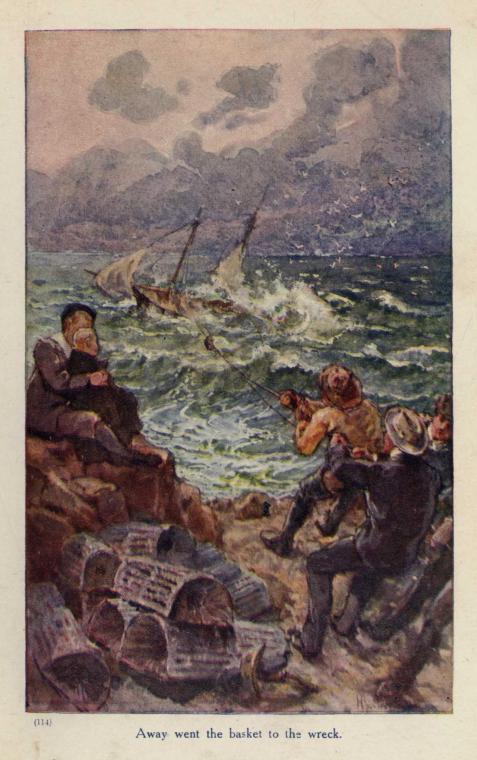
Away went the basket to the wreck.
The captain was below, when the basket reached the vessel, and it was some minutes before he reappeared.
"He has got Jingo, Bertie," cried the mate.
"Oh, has he? I thought Jingo would have to drown. Are you sure, Mr. Osmond?"
"Yes," said the mate, looking through his field-glass. "He is going to stow everything into that basket that he can. I am afraid he will get it too full."
"Ready!" shouted the captain.
"Steady!" cried the mate. "If we spill that load we lose the best man that ever trod the deck of a vessel!"
Again the light-keeper's monotonous chant, "There she comes! there she comes!" commenced, and slowly and steadily the basket advanced.
Suddenly, when it was about two-thirds of the distance over, the rope ceased to move, and the basket hung motionless over the rough sea.
"What's the matter?" shouted the light-keeper, looking at the mate.
"The cable must have caught on the rigging, with no one there to keep it clear. We thought we guarded against that," said the mate.
"Oh, father can't get ashore!" cried the child, pale with terror.
Joe tried to comfort him, assuring him that they would find some way to save him.
Another pull, long and strong, but the rope did not yield.
"What will be done?" asked Mr. Bernard, losing all his ordinary calmness. "Can he help himself at all?"
"He can if anybody can," answered the mate gruffly.
"Hark, he is calling!"
Every ear was strained to catch the words.
"Let go there! let's see if I can move."
They all left the rope and crowded near the edge of the rocks, watching the slow and dangerous transit as the shaky basket was pushed along step by step, with a jerky motion that tipped the basket from side to side in a frightful way.
"Hold on there; I'll sling a line, captain," as the basket came near enough to make it possible.
The man seemed too exhausted to pull a foot further, and he crouched down in the basket as low as possible, with hands outstretched to catch the line.
A dozen attempts were made in vain, as the wind would blow it out of its course; but at last the coil dropped into the basket, and was easily clutched and made fast.
The boys commenced to cheer, but Mr. Bernard hushed them, saying, "Not now, boys,--wait!"
Steadily on came the basket now, and in a few moments the mate seized it and steadied it as the captain stepped ashore.
"O father!" cried his son, throwing his arms around him.
"Thank God for his great goodness!" he said reverently, as he held the child close.
The basket contained dry clothing for the party, and among it little Herbert's rat-terrier, almost lifeless with fright.
The light-keeper hurried the rescued party to the house, where his wife had hot coffee and a bountiful meal ready for them. The men were too much exhausted to talk, and were glad to accept the offer of a chance to sleep off their fatigue.
"Now, boys, we must go back and leave it quiet here; these men need rest."
"Come on, then, John and Jerry; show us the spouting-horn," cried Joe.
"Will it take us far out of the way, boys? I am too tired to waste steps," said Mr. Bernard.
"No, sir; we can go to camp right up that shore," and John led the way, running like a young deer.
"There she spouts!" he shouted as they came within sight of it.
Loud were the exclamations of surprise and delight as the column of water shot up into the air with a boom like a cannon.
"What makes it?" asked Maurice Perry.
"I don't know, I'm sure," said John. "This one always does so after a storm; and one on the other side there spouts and bangs at low tide--the lower the tide the louder she bangs."
Mr. Bernard and the rest of the party had arrived now, and as if for their benefit the horn spouted full eighty feet, dropping the spray in a shower all around them.
"What makes it bang so, Mr. Bernard?" asked Maurice again, not satisfied with John's answer.
"The air driven by a rush of the water, Maurice. There is a hole in the side of that rock, extending up to the surface, and the air rushes through, followed presently by a mass of water, and the escape of the air from its pursuer causes the loud report."
"It is simply a big pop-gun," said Joe, "and it works itself, without any boy's help."
"Oh, I see a rainbow," said Lewis Germaine.
"Where, where?" asked the others.
"Right there in the spray."
"Oh, so there is! just as bright."
"Isn't that fine?"
After they had exhausted the list of adjectives expressing their admiration and delight, John said, "I'll show you somethin' else some time when it's low tide."
This he said with a very proud air, as if he owned all the wonders of the island.
"Show it now."
"Can't; it only shows at low tide."
"Oh, the other spouter!"
"No; somethin' else."
"What is it?--tell us." And the boys gathered around him.
"Why, right down there, where you see that big rock with a sharp pick--see it? Well, right down behind there is a place where the tide leaves a big puddle when it goes out, and that puddle is full of live things."
"What are they?" asked Joe laughing;--"not whales?"
"Oh, nothin' like that. Flowery kind of things, awful pretty, that shut up if you look at 'em very hard, or leastways if you poke 'em ever so easy."
"Those are sea-anemones," said Mr. Bernard.
"Then there are crowds of little things with pricks all over their backs, and if you turn them over they stick out those splinters sideways, and make 'em long-like, and pull themselves right side up again," said John, trying to imitate, with his own arms, the sea-urchin's movements with his spines.
"There's more than that there, too," piped Jerry. "There's five-fingers, plenty of 'em--big ones, and baby-fellers, too, no bigger than your finger-nail; nor so big."
"Sometimes fish get in there, too," said John. "I tell you it's an awful pretty puddle."
"I should think so, indeed," said Mr. Andrews. "It certainly is a 'puddle' worth seeing.--When will the tide be low, Jonas?"
"About five o'clock, I reckon, though the fog has been too thick to tell whether there has been any tide or not," answered the cook, who had come with the others to see the "spouting-horn."
"Very little doubt of that, I should judge from appearances," said Mr. Lane, one of the teachers.
"I am too tired to come over again to-day, boys," said Mr. Bernard, turning to take little Max's hand. "But you can come at low tide, if you like. I suppose John and his brother will be willing to meet you."
"Oh, they are going to camp with us!--Aren't you, John?"
"No; we want to see what becomes of the wreck--we don't have one every day."
"No, I hope not," said Joe. "Well, good-bye till to-night."
CHAPTER VIII.
ANEMONE POOL.
"By the time we get over there, Mr. Andrews, the tide will be down. Are you ready?" called Joe, rapping on the tent occupied by that gentleman and Mr. Lane.
"Yes; we will come directly. You need not wait."
"All right, sir.--Come on, boys. They'll come after. Who wants to race?"
"I do," cried Walter Martin. "Race open for all! No handicapping either. One, two, three! Luck to the fellow that happens to start ahead!"
Away went two score boys over the pasture, like a herd of wild deer, clearing the hillocks and patches of hemlock at a bound.
Dave got the lead, and, with Joe close at his heels, he reached the woods; and there discovering that they had the race to themselves, and the other boys calling "Time! time!" at the top of their voices, they both cried "Quits," and dropped together by a blueberry patch, where, as soon as they recovered breath, they began to pick and eat. They waited there until their companions came up; and then, tired of racing, the party sauntered lazily along, picking berries by the way.
"No John or Jerry here yet?" said Maurice Perry, as they came near the rendezvous.
"We can find the place easy enough though," said Ned Gould. "It was near that rock with a peaked top, John said."
The whole troop of boys leaped down from rock to rock along the boulder-strown shore, until they reached the rock spoken of as a landmark.
"I don't believe the tide is low enough," said Joe, peering into one pool after another. "Hullo! there are John and Jerry.--Hullo there! Come, find your 'puddle.' We can't."
"Good reason why. It's covered up with water. The tide isn't low enough. There it is, right there; but you've got to wait till the tide is down, and the water in the 'puddle' settles."
After a while, a standing-place on the outer edge of the pool was free from water, and as many of the boys as possible crowded upon it.
"You'd better get off that. A big wave will come and give you a duckin'," said John laughing.
The boys were hesitating whether to heed the advice, when a shout went up from the crowd higher up on the rocks.
"Jump! Quick! You'll be ducked!"
The shout gave the warning to some in time, and, leaping across the pool, they clambered up to a safe place; but others, stopping to look around and see what was the matter, were drenched by a huge incoming wave, that fairly took them from their feet and hurled them into John's "puddle," among the "live things" he had told them of.
There was a great shrieking, and sputtering, and splashing, as the boys emerged from their bath, wiser, if not sadder, for the experience.
When the teachers arrived, they found some half-dozen boys dressed in an exceedingly primitive style, while they wrung their clothes, and hung them to dry on the boulders.
"I told 'em not to go there," said John. "You can't hurry the tide out; it takes its own time, no matter how many folks is waitin'."
"'Time and tide wait for no man,'" suggested Maurice.
"Well, the rest of us will take warning, and keep where it is safe," said Mr. Andrews, striving to peer into the troubled waters of the pool.
After a few more waves had swept over, making the crowd run back in a lively way from the edge, John announced oracularly,--
"There, that's about the last. There won't be any more come over that strip of ledge on the other side; but you can't see nothin' till it gets settled."
He was right in his prophecy: no more rude waves chased them from their position, and gradually the water of the pool grew clearer and clearer, until some of its wonders could be plainly seen.
"I see an anemone!" cried Mr. Andrews.
"Yes, dozens of them. How beautiful--purple and yellow in every shade!" added Mr. Lane.
"What! those filmy-looking things against the sides?" asked Joe, lying flat on the rocks to see better.
"Yes; those are sea-anemones."
"See 'em shut up when I poke 'em," cried John, coming with a stick to show them off.
"No, no, John; not yet," cried Mr. Andrews, motioning him away. "We want to see them open. See them wave their tentacles in search of food! Ah, one fellow has a periwinkle eating!"
"You don't mean to say that soft-looking thing can eat that winkle!" exclaimed Dave.
"Yes, indeed, and very much larger things than that.--Let me take the stick, John."
Then touching one of the anemones with it in the gentlest way, he caused it to draw in its tentacles and shut up like a puckered bag, all beauty gone.
"Oh, leave the rest open!" cried the boys.
Mr. Lane stooped down, and, working carefully and perseveringly, detached one from the side of the rock, and offered it to Joe. But it was not an inviting-looking object out of its element; and Joe, shrinking back, said, "Thanks,--no jelly for me."
"Now look at the sea-urchins and star-fish," said Mr. Andrews, picking up a specimen of each. "See these spines, how stiff and unyielding they look."
"Only put him down bottom upward," interposed Jerry, setting one down that he held in his hand.
The boys crowded around and watched the curious creature as he slanted his spines until he brought them into position where he could move himself on them, and gradually bring himself right side up again.
The boys experimented with them and with the star-fish for a long time, and tried to spread the latter out to dry on the rocks; but by the time they had smoothed out the last ray the first would be curling up, conscious that it was in an unfriendly place.
"We will take some over to camp and pin them on a board," said Mr. Lane, collecting specimens of various sizes from that of a penny to that of a hat-crown.
"Pin them down? You wouldn't stick pins into them, Mr. Lane!" said Joe, horrified.
"In the cause of science. Besides, they have no brains, and consequently no feelings to hurt."
"They may not have brains; but if they have no feeling, why do they twist up when you bother them?"
"I've seen 'em growing a new finger when one's been pulled off," piped Jerry.
"Yes; they can readily supply any such loss."