Front matter (continued 2)
Reading edition
"Wasn't I right in saying it was a pretty puddle?" asked John proudly.
"Yes, indeed; but it deserves a better name. Let's call it Anemone Pool."
"That's it. That sounds first-rate," answered the boys. "Anemone Pool it is."
The wet clothes were still damp, but the owners dressed themselves, and were proceeding to hurry away, when John said, "Hold on! I forgot to tell you something." The boys stood still and looked back, waiting for the speaker to come to them.
"Those men from the wreck said they spoke a fishing-smack just off yonder the night before the storm, and they had aboard two of the scaredest fellows you ever see."
The boys were all attention now, and crowded around John.
"The captain of the smack said the boys had been sea-sick ever since they shipped, and as soon as the fog came on they had been so frightened he didn't know what to do with 'em."
"Well, what did he do?" demanded Joe impatiently.
"He wanted Captain Melrose to take them off his hands; he thought there was goin' to be a storm, and he really hadn't room for 'em. He said they just stayed around and moped."
"Poor fellows!" said Joe soberly.
"Captain Melrose couldn't take 'em; he was bound out. The other cap'n said somethin' about the two belongin' on an island with a campin'-party; and afterwards when he came ashore here and see all you fellows he concluded this was the island."
The boys exchanged glances with Mr. Lane and Mr. Andrews, but not a word was spoken for several minutes; then Mr. Andrews said, "Boys, go on to camp, and Mr. Lane and I will go back to the lighthouse and interview these men to see if we can get any further information."
The boys went slowly away, feeling very sober over John's news, and the two teachers hastened in the opposite direction.
"What do you suppose has become of them?" asked Dave, in a low tone, of his friend Joe.
"I wish I knew; and yet I don't either. That awful storm came after Captain Melrose spoke the smack. Oh, I wish they would come sailing by now!"
"What would you do?"
"I would fly over to Mr. Bernard and beg him to let them land. I think they've been punished enough, and I think he thinks so too, and would forgive them."
"Who wants to go out in the boat?" shouted Ned Gould, looking back towards Joe and Dave, who owned part of the little craft.
"I," said Joe; "but it's too rough yet from the storm. Look at the white-caps."
"Who cares for white-caps? It's all the more fun when the boat dances."
"Well, fun or no fun, you won't get Mr. Bernard's permission to go before to-morrow, and very likely not then."
"Oh, bother! Mr. Bernard is always tying us up so. We can't go here, we can't go there," said Ned angrily.
"That's so. I should think we were old enough to do as we choose. My father doesn't want me to be made a Miss Nancy; he wants me to rough it," growled Walter Martin.
"I've managed a boat ever since I was out of petticoats," continued Ned, "and father knows it; but I suppose Mr. Bernard would be horrified if I should ask leave to borrow the light-keeper's boat for a sail."
"I don't think Mr. Bernard is a bit too strict," said Joe boldly. "Just remember that he has the care of a big crowd, and feels responsible for our safety. I believe most of our folks would say he couldn't be too careful in such a place as this."
"Oh, of course you would stand up for him!" sneered Walter, "you and he are such friends."
Joe laughed good-naturedly.
"Well, if we can't use our boat we might as well set her adrift. What's the use of having a boat?" growled Walter.
"Bite off your nose to spite your face!" whispered Dave.
"I'll tell you what we'll do. I'll get Mr. Bernard to let us go off to the other end of the island down by the place John told us about, and we'll bring our lunch and have a high time!" exclaimed Joe.
"Can't go without a teacher along to look after us, just as if we were infants out with their nurse," grumbled Walter.
"I will ask Mr. Bernard to give us liberty for once, and trust us to take care of ourselves," laughed Joe, determined to restore Walter to good-nature.
"He won't do it."
"I'll ask, anyhow. I believe he will."
"There's the supper-bell!" shouted Dave, dashing away toward camp.
The rest of the crowd quickened their steps to a run, and were soon gathered around the table, having returned from their long walk with keen appetites.
Joe gave Mr. Bernard the story told by Captain Melrose and repeated to them by John Kramer; and added that the two teachers had gone on to the lighthouse, hoping to hear something that would give them a clue to the whereabouts of the fishing-smack.
CHAPTER IX.
A DAY OF FREEDOM.
The next morning, directly after breakfast, Joe was reminded of his promise, and approaching Mr. Bernard, he said, "I want to ask a favour, sir."
"Very well, Joe."
"We boys, the whole crowd of us, want to go off on a lark."
"That is frankly said, Joe," said Mr. Bernard smiling.
Joe laughed, and continued, "We want to go over to a fishing-place John tells about, where the fish are extra big and quick to bite."
"I am willing, Joe, perfectly willing."
"But that isn't all, Mr. Bernard," said Joe reddening, and finding it harder to ask the favour than he expected. "We want to go on our own hook, and not have any one to look after us."
"That would be sorry fishing, to get on your own hooks, Chester," was the laughing reply. "But I understand: you object to the company of the teachers. Is that it?"
That did not sound just right to Joe, but it was the truth; so he laughed and admitted the fact. "What have you against us, Joe? Are we too strict?" asked Mr. Bernard good-naturedly. "Have we offended your majesties in any way?"
"Oh no, sir. The teachers are very nice; but some of the boys think they are tied up too much, and get kind of uneasy."
Mr. Bernard glanced over the crowd of boys gathered round to hear the decision, and seemed to be studying the question.
"We would be just as careful as if the teachers were there," interposed Lewis Swift; and many other voices added a like assurance.
"Very well, boys. If you will all be careful, I will agree to your going without a leader. I think myself that it is much wiser to have one of the teachers with such a troop of boys. When men gather in companies, they always appoint a leader, and consider it no disgrace to them."
"That's so," said Joe Chester. "I never thought of that; did you, Walt?"
"No, but I'm for a day of freedom!" replied Walter in a low tone. Then aloud he said, "So we may go, Mr. Bernard, may we?"
"Yes, you may go. Success to you, and a safe return!"
"Three cheers for the teachers!" cried Ned Gould, waving his cap, and adding in a low tone to Walter, "Nice fellows--at a distance!"
Jonas grumbled a good deal at having so many lunches to put up.
"It's worse than getting dinner for you! It will take all my bread and gingerbread."
"Put in plenty; we'll be hungry as sharks," said David, bringing along a good-sized basket.
"Put in some potatoes, Jonas, and we'll make a fire and cook some for dinner ourselves. I can fry fish on a stick," said Joe.
"Now, you youngsters, save all the fish you catch, and Freitag and I'll come over and fetch 'em back."
"All right, Jonas; we'll have a big load for you."
Mr. Bernard gave them numerous cautions; and, promising to remember them, the boys hurried away, laden with baskets of lunch, fishing-rods, and bait.
They were in high spirits, and Mr. Bernard could hear them, long after they were out of sight, singing, "Cheer, boys, cheer."
"This is something like--don't you say so, boys? It seems good to be our own masters. I'm sick of hearing 'Don't do this,' and 'You'd better not do that.' It spoils all the fun of camping out."
"Well, Walt, we are free for once. Let's enjoy our liberty, and not grumble," said Joe.
They made a second breakfast of blueberries on the way, and arrived at the fishing-place in the best of spirits.
They found the sport, as John had told them, the liveliest kind imaginable; and all were soon engaged with hook and line.
The tide was quite low, but coming in steadily, and they found it necessary to retreat before it continually. Sometimes the advancing waves would overtake them in their eagerness for one more bite, and as a result it was necessary now and then to remove their rubber boots and empty out the water.
"I guess there'll be more fish than Jonas and his man Friday will want to carry," said Dave, as he began to gather the fish from the rocks to put them in the basket. "Let's have a lunch."
"So say I," said Donald Parker. "There's plenty of drift-wood close at hand."
The fires were soon built, the potatoes were put to roast, and the fish were hung by the gills on sticks over the coals.
There was a great deal of laughing and shouting over the preparation for "Lunch No. 1," as they called this, intending to save enough food to have several more during the day.
Some began to eat their fish before they were half cooked, and others found theirs burned or smoked; but all were merry over the gipsy meal, when Joe, standing up and looking around, said, "Where are Walt and Ned?"
"Sure enough, where are they?" asked Dave, dropping his fish into the fire. "I haven't heard their voices for ever so long."
"Nor I," said several boys.
"Not since we first got here."
"Walt Martin! Ned Gould!"
"Ned! Walt!" shouted the crowd, making war-whoops with their hands over their mouths.
"Shout again, all together!"
Again they all shouted, loud enough to frighten the mermaids in the sea.
"Ho, Walt!"
Only a prolonged echo came back, and seemed to mock them.
"Now it's mean for those fellows to go off and frighten us!" cried Joe indignantly.
"I say as much. They've hid somewhere to make us hunt them up. I move we let them wait, and eat our lunch."
So they began eating again, talking meanwhile of their missing companions.
No one remembered anything about them after they reached the rocks.
Each boy had been busy selecting his place, baiting hooks, and pulling in fish, with the frequent shout, "Look out there! Big wave coming!"
Then would be a rushing back, and dragging of lines, as the tide pursued them further and further back.
"Perhaps they've gone up to the lighthouse," suggested Dave. "I'll go up and see."
"Hold on, Dave; I'll go too," said Joe, disposing hastily of a large piece of gingerbread. "One of you fellows tend my fish."
"All right! Eat it, too, if you want us."
Joe and David met John and Jerry coming rapidly down over the rocks.
"We heard an awful yelling, and thought we'd come and see what the matter was."
"We were calling Walt and Ned. We thought perhaps they had come up here. Have you seen anything of them?"
"No; they haven't been near us. Perhaps they've tumbled into the sea."
"Cheerful suggestion!" said Joe, shrugging his shoulders.
"They'd hardly be likely to do so without one yell at least; and both of them together would make a considerable noise. No; I suppose they are hiding somewhere to frighten us."
"What are you doing--fishing?"
"Yes; you see we are over here by ourselves--no teachers with us," said Joe.
"Wish there was now!" added Dave.
"So do I. If one of the teachers had come, those boys wouldn't be playing their pranks this way."
"What's the matter?" shouted Mr. Kramer, coming out on the ledge before his door. "What are you youngsters howling about?"
"We can't find two of the boys."
"Can't find 'em! Where were they when you see 'em last?"
"They came over from camp with us, and we all began to fish; that's the last any of us saw of them."
"Humph! that's a nice business," said the light-keeper thoughtfully, knocking the ashes out of his pipe, and tucking it in the pocket of his monkey-jacket.
"We didn't miss them until we made our fires and were cooking our fish."
Jacob Kramer said nothing, but started across the ledge that paved his yard.
"How long have you been over there fishing?"
"Oh, we got there by nine o'clock."
"And now it is about eleven," said Kramer, looking at the sun.
"Yes, sir," replied Joe, referring to his little silver watch; "it is five minutes past."
"If they went around the cliff just beyond the fishing-place, and didn't watch, the tide would soon cut them off."
Joe and Dave looked frightened.
"Where would they be now? can they get over the cliff?"
"Over the cliff? Not much, unless they can walk up a wall like a fly. It isn't less than forty feet high in any place right there, and part o' the way it's sixty and seventy, straight up and down. I'll go and look over."
He led the way to the brow of the cliff, about twenty yards off; and, lying down flat, looked over the edge.
The boys held their breath until he spoke.
"Yes; there are the young scamps!"
Joe and Dave threw themselves upon the ground and crept to the edge also.
"Keep back there, you rascals! This is no place for you."
The boys crept back until it was safe to stand again, saying, "I saw them!"
"So did I! What a place!"
"Hullo, down there!" shouted Mr. Kramer.
Ned and Walter looked up in evident surprise and relief.
"O Mr. Kramer, can't you get us off?" they screamed.
"I don't think I can."
"The tide is coming higher and higher, and we have climbed as far as we can. Will we have to drown?"
The light-keeper looked down some time before answering--it seemed an hour to Joe--then he said in a tone the boys below could not hear, "The tides are so much higher now, and the sea so rough since the storm, there's no knowin' how high it will get."
The boys below, tired of waiting for an answer, screamed, "Mr. Kramer, do something to help us. Bring a boat around here and take us off."
"That's the worst place on the island to take a boat. The water drives in furiously, and then sucks back enough to drag the solid cliff after it, if it wasn't anchored very strong."
This the light-keeper said to the two boys near him; and Ned and Walter, in their perilous position under the cliff, waited breathlessly for an answer, nearly frantic at the delay.
"Mr. Kramer, O Mr. Kramer! How high does the tide come here?"
"I can't see. Can't you tell by the looks of the rocks?"
"No, we don't know how."
"You can tell how high it comes generally by the seaweed and barnacles. I think it won't come up to you," he said at last.
This was sorry comfort.
"But you are not sure! Oh, come round in the boat, please."
"I shan't risk my boat in there unless it's a case of life or death, for she'd be smashed in a moment, and no one could save himself in that whirlpool."
"But can't you go out in the boat and be near, so you could get to them if the water got too high where they are?" asked Joe eagerly.
Kramer hesitated.
"Oh, do, Mr. Kramer," urged Joe. "We boys will make up a purse and pay you."
"Nonsense, boy! If I do it at all it won't be for money. I tell you a boat would get smashed there very quick. It would go against the rocks in spite of me. I'll get some of those wrecked fellows waked up, and go out. I suppose the youngsters will feel better to see the boat."
"Oh yes," said Joe; "we shall all feel easier."
"It is almost half an hour yet before the tide is high," said the light-keeper meditatively as he looked below again.
"Here, you down there! I'll come around in the boat.--John, you run to the house and wake up a couple of those men. You needn't disturb the captain. I only want two. Fetch 'em along quick down to the boat-landing!"
John was off in a minute, and Joe and Dave ran down to the boat with Kramer, who, now he had made up his mind, seemed inclined to hurry.
The two men from the house soon followed, and the boat was quickly launched.
CHAPTER X.
BOYS IN A TRAP.
Meanwhile the other boys, having disposed of their lunch, and hearing nothing from Joe and David, became more anxious, and set off for the lighthouse.
There they learned from Mrs. Kramer that John had reported Walter and Ned surrounded by the tide, and that the boat was to be launched to go to the rescue.
In great excitement the crowd of boys rushed down over the rocks to the place where the men had just pushed off in their boat.
There were two pairs of oars and two strong boat-hooks in the skiff, and the three men were ready to do all they could for the castaways.
The boat was soon out of sight beyond the spur of the cliff that helped to form the trap in which Walter and Ned were caught, and the crowd rushed back to their lunch-place, to see if they could get a glimpse of the boat there; but another spur, around which the boys had gone to hide, shut off the view.
When they reached their fishing-ground, they found, to their disgust, that the tide had risen over much of their lunch, and had carried off many of their nice, jointed rods, that were still floating provokingly near, but just out of reach.
The baskets had been tipped over by the waves, spilling all the fine fish they had caught in the morning.
"Did you ever see such luck?" cried Clifford Davis--"everything at sixes and sevens."
"This is the result of too much freedom, eh?" asked Don.
"That's so, Don," said Joe. "I wish we were all safe out of this scrape."
Some of the boys had taken the precaution to throw their rods well up on the rocks, and with these they tried to rescue the floating baskets and rods, but with a limited success; only a few could be recovered.
It was a great temptation to Joe and Dave, knowing of the look-out on the edge of the cliff and yet keeping away from it; but they understood too well the risk that would be run by a crowd of careless, venturesome boys, who would never believe that they could come to harm by just looking over the edge of the cliff, however steep it might be.
The time seemed very long as they waited for Mr. Kramer's return, or some tidings from the missing boys.
"Pretty near high tide," exclaimed Joe soberly, as he held his watch for Dave to see.
"The boat is around there by this time, and the question is now whether they are to be taken off that way or left to wait for the tide to get as low as it was when they dodged around that place."
"Why, isn't Mr. Kramer going to take them off anyway?" asked Lewis Germaine.
"Not if he finds they are safe without it. He won't risk his boat in there if they can be saved any other way. The water rushes in there like a mill-race, and sweeps out again the same way."
"Then we may have to wait two or three hours yet before we can see the boys!" exclaimed Don.
"Yes," said Joe, "all that time."
He presently whispered to David, "I can't stand it, boy. You stay here, so the others won't suspect. I am going to look, if I can steal off without their knowing it. Don't you say that I'm gone."
"All right," said Dave. "Get back as quick as you can."
Joe began skipping stones lazily, and, moving slowly away from the rest of the party, disappeared behind some rocks, beyond which he dropped suddenly, and crept on hands and knees up the bank where the bushes were thickest.
Once out of sight of his companions, he arose and hurried out to the point on the cliff overlooking the prison-house of his two friends. There he crept carefully to the edge and looked over.
"Good! they are safe, and there's the boat."
"How are you there? All right?" he heard the mate of the wrecked vessel shout.
"All right! No, sir--not by a good deal. The water is still coming up," shouted Walter.
As the boat was pulled within speaking distance the frightened boys became more and more alarmed, it plunged about so wildly on the rough water; and they thought, perilous as their position was, it was preferable to a change to the boat.
"We'll drown getting into that skiff, Walt," said Ned, paler than ever at the dilemma.
"Yes, if there is any chance here, I would rather stay till the tide goes down; wouldn't you?"
"Yes, I would."
"Say, Mr. Kramer, just lie off there, and wait; perhaps the water won't come up here."
"That's just what I'm doing. You don't catch me risk my boat in there unless you are ready to go under."
"When is it high tide?" shouted Walter.
"Five minutes before twelve."
Walter looked at his watch eagerly. "I believe it won't reach us, Ned. It is ten minutes off high now, and unless the last few waves are extra high we will have a standing-place in this cleft in the rock."
Ten minutes dragged slowly away, and the angry waves had not reached them. They waited a little longer, to be sure, and then cried joyfully, "It is twelve o'clock and after, and we are all right."
"Good! Then all you've got to do is to wait, and learn wisdom against another time. The tide will be down low enough to let you out of that trap in about two hours and a half, or three, at most."
The boys groaned, and then Ned said dolefully, "We'll starve to death. I didn't know I was hungry until the danger was over."
"You'll be hungrier before you get off," shouted the hard-hearted Kramer, laughing provokingly.--"A good lesson for the young scamps. It seems they made a fuss about having a teacher go along with 'em to look after them, so the head man, Mr. Bernard, let 'em off alone to-day. That little chap, Joe, he owned they'd got enough of it."
"I'll lower them something with a line when we get ashore," said the mate, glancing up at the perpendicular face of the cliff. "It isn't long ago that I was wrecked myself and wanted help."
Joe had seen enough to gladden his heart as he lay looking over the edge of his high perch. The boys were safe at high tide, and the boat was coming back without them, so he went back toward his companions, and when within hailing distance, cried, "Come on, boys; let's go over to the boat-landing, and wait till Mr. Kramer gets back."
The boys were ready for anything that would help to pass away the time, and they rushed away in time to see the boat rounding the rocky point that had hidden it from view.
"Whew! there they come, but no Walt or Ned," exclaimed Cliff Davis.
"What did you find out, Joe?" whispered David, locking arms with his friend.
"The boys are all right: the water won't come any higher. But won't it seem a long time before they get back?"
When the boat reached the landing the mate called cheerily, "Boys, your messmates are all right, but very hungry; have you got any dinner with you?"
"Yes; we saved some for them, but the tide carried off a lot."
"Well, bring it along, and I'll get a line and lower it to them."
"Hurrah for you, sir!" shouted the boys. "Oh how glad they'll be!"
Joe and Dave ran for the lunch, while John scampered to the house for a long line.
Going out on the cliff, the mate tied the basket to the line, and prepared to drop it over.
"Stand back," he shouted, as the boys crowded forward. "I shan't do it unless you all stand back."
"Are they down there? Can you see them?" asked the boys eagerly.
"Yes, I see them."
"My! just think, we might have been here watching them just as well as not," exclaimed Lewis.
Joe and Dave exchanged wise glances at this, and Mr. Kramer said, "Lucky you didn't know it, for a crowd of you boys jiggling and pushing and fooling, as boys do, would have gone over. Stand back there!"
"Hullo, below!" shouted the mate. "Here's some food for you."
Walter and Ned, looking up, saw the basket slowly descending, and the boys listening heard a faint cheer above the roar of the sea.
"Got it?"
"Yes, all right!" shouted Walter, taking the basket from the line.
"There! that's all I can do for them," said the mate, reeling in the line. "Now, boys, I'll give you some advice for nothing: Go back to a safer place, and wait for your friends. They will be prisoners for over two hours yet, and if you stay here some of the rest of you will be pretty likely to tumble over to keep them company; only I reckon your company wouldn't be good for much after you got down there."
"All right, sir," said Joe, glad to have some one speak authoritatively.--"Come on, boys! Let's go back and lie around on the rocks and tell stories."
"Agreed, if you will be the teller," cried several, knowing that he had Robinson Crusoe and the Arabian Nights at his tongue's end.
Away went the crowd back to the fishing-place; and Mr. Kramer and the other two men returned to the lighthouse.
CHAPTER XI.
THE ESCAPE.
The time passed much more quickly to the crowd listening to Joe, as they lay on the rocks in every attitude imaginable, than to Walter and Ned under the cliff, with the sea still surging around them.
As soon as their fright was over, they began to blame each other for the trouble they were in.
"It was your idea, hiding from the boys," said Ned, as they paced to and fro as far as their prison would allow.
"Yes; but you were just as willing as I, old fellow. We were both idiots. We might have known the tide would cut us off."
"Won't the teachers laugh at us! 'Serve them right,' they'll say, plague on them!" grumbled Ned.
"Well, it does serve us right; but I wish the boys would keep quiet about it though, and not give the teachers a chance to laugh at us."
"But they won't; they'll say it's too good to keep."
The lunch lowered by the mate restored their good-nature, and they waited, watch in hand, as the waters abated around their perch. Ned even recovered enough to joke about their misfortune, and Walter sang,--
"On a lone, barren isle,
Where the wild, angry billows
Assail the stern rock," etc.
At length the tide was so low they ventured out to the high rock that shut them away from the rest of the party; and too impatient to wait longer, they doffed boots and stockings, rolled their trousers above their knees, and, waiting till the waves rolled back, they dashed into the water, and were quickly around the other side of the cliff, and in sight of their companions.
"There they are!" shouted Don Parker, interrupting Joe's story in its most exciting part.
"Where?"--"Who?"
"Walt and Ned."
"Sure enough, so they are!"
"Hurrah!"--"Welcome to the castaways!" cried the crowd, leaping to their feet.
"Glad to see you, old fellows!" said Joe; "but you gave us an awful fright."
"We gave ourselves a greater, I'll be bound," said Walter frankly. "That was a mighty uncomfortable place we stumbled into."
"Yes, and we thought we'd seen the last of you fellows," added Ned, throwing himself down upon the rock, and pillowing his head on his locked arms as he lay on his back. "That's just as near as I want to come to Robinson Crusoe's experience. We were worse off than he was--he had plenty of room; and one time when the tide was highest we had the spray flying over our heads. My coat is wet now."
"Is it this week, or next, or the year 1900?" said Walt. "It seems ages since we dodged around behind that rock to see if we could frighten you."
"You won't feel complimented, I am afraid," said Joe laughing, "when I tell you we didn't miss you till noon. We were so busy fishing, we thought only of that, until some one went to cook fish; then we all got hungry and decided to have a lunch. When we got ready to eat we missed you."
"That was when we heard them shouting, Ned."
"Yes, I suppose so."
"Why didn't you answer?"
"We did; we just yelled. But it was no use, and we knew it, for we could hardly hear you, the sea roared so, as it made up into that pocket in the cliff; and we knew by the sound that you were all shouting together, though it reached us just as faintly. Oh! it was awful there. I thought I was a pretty good kind of a fellow till then, and I thought of all the bad things I ever did."
"So did I," said Ned, looking up at the clouds meditatively. "I wonder if folks always do when they get into danger?"
"I think they do. I've heard my uncle tell how he felt when he came within an inch of drowning. He said everything came back to him like a flash," said Cliff Davis.
"Well, it's awful anyway!" added Walter. "I shall never forget how it seemed to have that water come at us like wild beasts, roaring and snapping at us as if it would swallow us whole in a minute."
"Don't talk about it, Walt," said Ned shuddering "I saw you down below there, when Mr. Kramer first hailed you," said Joe to change the subject, which was getting painful.
"You did?" asked Ned, opening his half-closed eyes.
"You did?" echoed the crowd.
"Where were you?"
"Yes, that's what we would like to know."
"Up on the cliff, lying flat on my stomach; but as soon as I got one glimpse, Mr. Kramer ordered me back."
"Why didn't you tell us, so we could look?" grumbled the crowd.
"I didn't want you to break your necks. It was bad enough to have two fellows down in that trap, without letting the rest of the party tumble down on them. Kramer drove me back, but I went and peeped once afterwards. Dave knew I was going. I couldn't stand it a minute longer; I knew the men had gone in the boat, and was afraid you two would drown before it could get around there, or afraid the boat would swamp if you tried to get in. I prayed hard for a minute."
"Did you?" asked Walter, looking quickly at Joe. "So did I--harder than I ever did before in all my life."
Ned said nothing, but lay with his eyes closed; and the other boys were unusually quiet.
"Wasn't I glad to hear you say, 'It's twelve o'clock, and we are safe!'"
"Is my hair gray, Joe?" asked Walter, half laughing, and half in earnest, as he took off his round cap, and revealed a crop of short black curls.
"Not much that I can see."
"I have heard of hair turning gray from fright, and I thought perhaps I might be needing hair-dye."
"When shall we go back to camp, boys?" asked Dave.
"It depends on whether you are going to tell about our scrape, whether I go back at all," replied Walter, laughing, and yet half in earnest. "You fellows promise not to say anything about it, won't you?"
"I am willing. It's all over now, and no harm done to any one; but the teachers will hear of it from Kramer," replied Joe.
"Yes, I suppose so; but don't let's tell to-day."
"Just as you say. We got a joke on ourselves too. While we were rushing around looking at the boat, the tide came up over our baskets of fish and the lunch, and carried off the very best of the fishing-rods. So the laugh will be against us all."
"Here is Jonas with his 'man Friday,' after the fish!" exclaimed Maurice Perry, doubling up with a fit of laughter, as he glanced at the empty baskets that had been rescued after much effort.
"Well, boys, had good luck?" called Jonas as soon as he came within speaking distance.
"First-rate, Jonas," answered Joe.
"Where are the fish, then?" demanded Jonas, staring at the empty baskets.
"Echo answers, 'Where?'"
"You didn't catch any, after all. You've been foolin' around here all day!" cried the cook wrathfully. "Now you'll get little supper for this, 'cause I've been dependin' on them fish. Here, give me a rod! I'll catch some for the gentlemen's supper. You boys can go without.--Come on, Freitag!"
The boys were rolling on the rocks and laughing, which added greatly to Jonas's wrath.
"Lazy scamps!" he said.
"Now, Jonas," remonstrated Joe, as soon as he could recover himself and sober his face enough to speak, "we are not laughing at you; we are laughing at ourselves. Don't get mad. We met with a big misfortune. We got fish enough to stock a market--beauties too; and while we went over to see Mr. Kramer the tide came up and swept them all out, and worse still, carried off our fishing-tackle."
"That's so, Jonas."
"Humph! great thing to laugh about!" grumbled Jonas, somewhat mollified.
"You ought to pity rather than scold us," cried Joe, pretending to feel hurt. "We lost most of our lunch, too. You'll do as well as you can for us with supper, won't you?--'cause this has been an awful hard day on us."
"Oh--oh, hear!" cried the crowd, writhing again in convulsions of laughter.
Jonas shrewdly suspected that they had not told all their bad luck; but he had heard enough, and summoning Friday to get a fishing-rod and hurry along, he went down where it seemed most probable to him that the fish would be plenty.
When the boys went back to camp they fully intended to keep the rest of the story to themselves; but at the supper-table, when Mr. Bernard asked for an account of their day's adventures, each looked at his neighbour to see who would be spokesman, and in looking they fell to laughing, and there was no one sober enough to answer.
"You evidently had a very jolly day, boys," said Mr. Bernard, with a twinkle in his gray eyes.
"Not very, sir," said Joe, feeling that it was impolite to leave the remark unanswered. The boys all laughed again, and Joe said, "The tide carried off our lunch, and our fish, and ever so many of the best rods."
"Ah, that was bad, but not half so had as if you were in danger yourselves."
The boys exchanged glances, and Walter and Ned reddened very uncomfortably.
Had the news travelled across the island so soon?
Surely Mr. Andrews and Mr. Lane both looked very wise as they glanced down the double row of boys.
"It's no use; I am going to tell," exclaimed Walter abruptly. "We had a horrid time, Mr. Bernard. Ned and I got hemmed in by the tide, and had to stay five hours. It wasn't much fun."
"I had heard as much, Walter," said Mr. Bernard kindly. "Mr. Kramer told Jonas. We may thank a kind Providence that you escaped with your lives. It was a very frightful experience, I am sure. I don't see how any of you can feel like laughing."
"O Mr. Bernard," said Joe apologetically, "we didn't all day, I assure you. We were wretched enough while Walt and Ned were missing; but after they got back safe, and we came to think it all over, and remember that we were only having our own way as we wanted to, and what a hard way it had turned out, it struck us as a pretty good joke on ourselves."
"Perhaps it was, boys, but the escape has given us new cause for thankfulness to the good Lord who holds us in his keeping, and I think our little prayer-meeting to-night will become a praise-meeting, in which every heart will join."
CHAPTER XII.
THE MISSING BOYS.
To take up the story where Ralph and Ben Carver dropped out, we must return to the evening after the final examination.
They had come to their room early, as all the scholars had, to pack for their camp trip. Ben pulled out the valises from the closet, and began to stir up the contents of his trunk to make a selection of the thickest and oldest garments to take with him.
"There's a jacket in the sear and yellow leaf, but it's warm; in she goes. Those trousers, I don't know about them. There's a pretty big hole in them; but yes, they'll do to fish in. Come, Ralph, get your clothes together," exclaimed Ben, seeing that his room-mate had thrown himself down astride of a chair, and with his head supported by both hands, looked like a third-rate tragedy actor.
There was no answer, and Ben went on packing and talking.
"I'm going to take more things this time. I know I hadn't anything fit to wear last year. Camp-life is very hard on clothes and shoes."
There was no response from Ralph, and Ben, pausing in his packing, exclaimed,--
"What's the matter, Drayton? You look as glum as a catfish with a hook in his gills!"
"I feel just as I look, then."
"Come on, boy, we've got to start right after breakfast, and there'll be no time to pack then."
"I don't care."
"Nonsense! Come, here's your valise gaping at you."
"I'm not going, Carver."
"Fiddlesticks! you are too. There's the foot-ball and your fishing-tackle. I'll get your things together for you."
"No. I tell you I shan't go. I've let this thing go on far enough. I absolutely haven't courage to go with the rest of the crowd to that island, where I can't get away, if I feel ever so much like running."
"The supply of courage has given out, has it?" asked Ben laughing. "There has been a pretty heavy drain on it, I will admit."
"Yes, it has given out," and Ralph laughed in spite of his melancholy.
"That's bad; but come, old fellow, you'll feel better after we get off."
"And leave Joe Chester behind?"
Ralph got off the chair that he had been torturing, and, putting his hands deep in his pockets, paced to and fro.
"No, Ben; I'm a pretty mean lot, but I declare it's getting beyond my depth. The next thing I shall go all under."
"And drag me too," added Ben, casting a sidelong glance at his friend.
"Yes, you too. I have been dragging you along in the same mire, until, to accommodate me, you've got in about as deep as I have."
"Don't mind me, Drayton. It doesn't trouble me one bit," said Ben carelessly. "My lies have all been in the cause of friendship. Come, cheer up, old fellow. We'll both reform after this, and never again tell lies."
"If I ever do tell another, I'll be a fool," said Ralph emphatically. "It doesn't pay; besides, it is mean work."
"Yes, but what could you do? Confess to that job with the books? That was enough to expel you; don't you know it was?"
"I don't care; that would be better than living a lie here day after day, and seeing those eyes of Joe Chester's on me day and night. No, sir! I'm not going to the island and leave him behind. You are mistaken in me. I've got to the end of my rope."
Ben whistled dolefully; went and drummed a funeral march on the window; then coming back, and dropping into a chair, rested his elbow on the table, and his cheek on his hand, looking up meanwhile at his companion.
"What's the next thing on the bill of fare, then?"
"I'm going to cut," answered Ralph deliberately.
"What good will that do?"
"I'll leave a note for Bernard, confessing about the books, and then Joe Chester can go. Even if the master did not get the note till after the boat started, he would come back for Joe."
"Now, Ralph, if you do this I am set adrift too, you see. I have told as many lies as you have, and if you tell on yourself it will come out somehow,--that I know."
"No, it won't, Ben."
"It will, as sure as anything. Anyhow my courage is gone too. I don't want to face Mr. Bernard and the other fellows. No, sir! I shall stick by you. Give us your hand, old fellow. 'Sink or swim, live or die, survive or perish,' we'll stick together. What's the use of a chum that won't stick? Now, where shall we go? That's the question."
"That's the question," repeated Ralph, beginning to throw things into his open trunk, to be left till called for, because he expected this was to end his school-days at Massillon Academy.
"If we start off now on foot we shall be tracked, for Mr. Bernard will not rest till he gets news of us."
"That's so. And if we wait and go by train in the morning, all the town will know it. That will never do."
Both meditated a while, and then Ben said, waving an imaginary hat around his head, "I tell you! Let's go over to the Cape and see if we can't find a vessel bound out. Father sent me ten pounds for the camp out, and we'll hire a passage."
"Agreed!--the very thing! What shall we want to take?"
"We will wear these school-suits, and pack up some rough clothes, our blankets, and just about what we would take to camp, for we may have to work our way to get the fellow to take us."
Ralph was about to throw his fishing-rod into the closet with his foot-ball and base-ball, when he exclaimed, "Hold on; I will make my will, and leave that rod in the hall for Joe Chester. Here, give me a card! 'For Joe Chester.' There, that will please the little chap, and let him know I remember him. Now I must write to Bernard. Where's my portfolio? Oh, here. Well, now, what to say to him? That's a puzzler. Shall I say anything about you, Ben?"
"I suppose you'll have to; but I am not anxious to be remembered to him," was the laughing reply, as Ralph dipped his pen in the ink and wrinkled his brow, trying to think of the proper thing to say. "Tell him I'm just as bad as you are, and we thought we had both better get out from such a high-toned crowd."
"Well, it is a good crowd, Ben--a splendid set of boys, take them all together. You know it is. No; I am going to do the right thing, and confess without any nonsense. He won't think me any meaner than I think myself. I'll just say that you knew about it, and so thought you had better go too."
After dipping his pen and scowling again, he wrote hastily:--
"MR. BERNARD,--I can't go with you. Let Joe Chester go, please. I did the mischief, and was afraid to tell. Ban Carver knew about it, but did not do it. We are going off together. Please send our fathers word that we are safe.--Respectfully yours,
"RALPH DRAYTON.
"P.S.--I was never sorrier in my life, Mr. Bernard."
"There, Ben, how does that sound?" he asked, throwing the letter across the table to his companion.
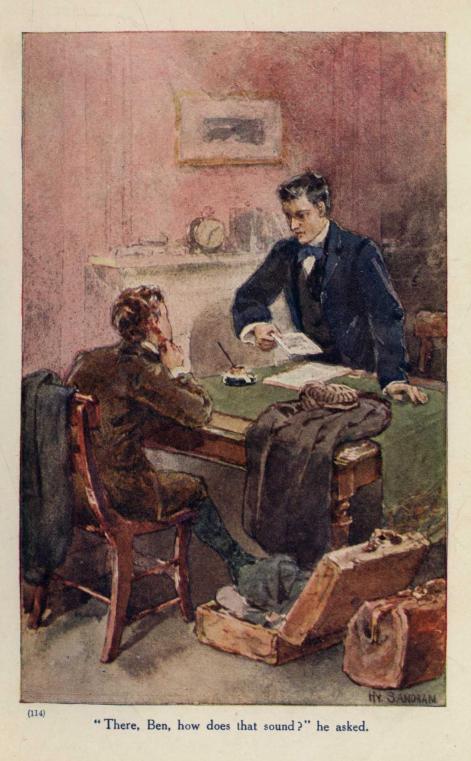
"There, Ben, how does that sound?" he asked.
Ben laughed as he read it, and said, "Nothing could be better. I couldn't have done it so well myself."
"Seal it then, please. I don't want to read it over."
"Now, shall we start, or go to bed for an hour or two?" asked Ben, as the arrangements were all completed.
"I am afraid we would oversleep, and not get away till daylight, if we lie down. Let's sit up and talk till after midnight. We want to start before the first streak of light."
"All right."
They chatted a while, and then grew sleepy. So after finding himself nodding a number of times, Ralph said, "Let's just take a short nap, Ben."
"So I say."
Folding their arms on the table for a pillow, the boys dropped their heads upon them, and were speedily sleeping soundly. They might have slept till the rising-bell rang, only Ralph was awakened by a fearful dream, in which he thought Mr. Bernard had seized him, and was trying to hold him under the water as a punishment for lying, to wash off the sin of it, Ralph thought. He started up so violently that he nearly fell over backward.
"What! what's the matter?" cried Ben in alarm.
"Nothing but a dream," said Ralph laughing. "But it is lucky I had it, for it is getting toward morning, and we may as well be stealing out. We had better take our boots in our hands and just crawl, those confounded stairs squeak so!"
Taking their valises, the boys, with a parting glance around the room to see if they had left anything, opened the door softly, and crept downstairs cautiously, waiting long after each step; for, as Ralph had said, they did creak unmercifully, as if in a league to betray them.
They knew the boys, their schoolmates, were too soundly sleeping to be disturbed, and if Mr. Andrews, whose room was at the farther end of the hall, did not hear them, they were safe.
They were down at last; and, unlocking the outer door, they stepped outside, and closed it carefully behind them.
"Good!" whispered Ben. "Now put on your boots, and away you go."
The moon was down long ago, and only the stars gave light to the runaways as they hastened through the Academy garden and over the fence into the field leading to the shore, feeling that every bush by the way might have some one behind to arrest them.
Everything on the Cape was quiet.
There were several vessels at the wharf, but if manned at all, it was by a sleeping crew. They crept under the outside stairs leading to the second story of a sail-loft, and waited impatiently and uncomfortably for daylight.
"It seems like a graveyard or a funeral. I hate things so still," whispered Ben, as if whispering were necessary in such stillness.
"It is an hour yet before daylight," said Ralph, looking at his watch.
"We may as well have a nap."
"If we can get one. Oh, how cold it is down here!"
The boys crept closer together for warmth, and with their heads on their knees tried to sleep; and after much turning and twisting, and grumbling at the hard seat, and shivering in the cold night air as it blew across the water, they at last fell asleep.
CHAPTER XIII.
ON BOARD THE "UNA."
It was broad daylight when the boys waked again, cold and cramped from their uncomfortable position, and they found the men beginning to stir about on the vessels at the wharf, washing the decks and overhauling rigging.
It was some time before Ralph and Ben could find courage to venture forth from their hiding-place.
"But it is no use to wait. We must go. Unless we can get away before the steamboat comes, we will have to skulk off and try another plan. Come on; I'll ask."
Dire necessity gave Ralph courage; and motioning Ben to follow, he went on the wharf and hailed the first man he saw: "Are you the captain of that ship?"
"It ain't a ship, sonny, and I ain't the cap'n by a long chalk. Why?"
"I wanted to know when you expect to sail."
"Sail! we are just in; cargo all in the hold," said the sailor good-naturedly, relighting his pipe, and looking curiously at the two boys. "What d'ye want to know for? Don't want to ship, do you?"
"Not exactly; we want to go as passengers on a sea-voyage."
"Where do you want to go?"
"Oh, nowhere in particular."
"I never sailed to that port," said the sailor, laughing as well as he could and still hold on to his pipe with his teeth.
"Is there any vessel going to sail from here to-day?" asked Ben.
"Well, now, there isn't a very big fleet here. If any of 'em was going to start soon, you'd be likely to see some stirring about. There's a little smack over the other side, just goin' out; but that ain't your style, I reckon."
The boys looked in the direction indicated by the sailor's tar-stained thumb, and saw the sails going up.
"Let's go over there, Ben," said Ralph, pulling his companion's arm.
They were soon at the vessel's side, and as the crew only numbered two, and only one of these was a full-grown man, it was not difficult to know who was the captain.
Ralph, cap in hand, asked politely, "Captain, can you take two passengers?"
"Two what?" roared the captain as he gave a final pull, and fastened the sheets around a belaying-pin.
"Passengers," answered Ralph meekly, feeling very much like retreating before the roar.
"Do you take this for a Cunarder?"
Ralph and Ben laughed, and said, "No; we see it is nothing but a fishing-smack."
"Nothing but--humph, you little land-lubbers, don't you know this craft will beat anything else afloat?"
"Will it?" asked Ralph, eying the craft narrowly. "It looks as if it might. Will you take us?"
"Humph! you want to go fishing, do you? Your clothes look like that business. Got any overalls anywhere about you?"
"No, but we have thick old things in our valises."
"If you'll take us, captain, we will pay you just what you ask. We'll give you ten pounds," said Ben recklessly, with his hand in his pocket grasping the little red pocket-book that contained just that sum, sent by his father to defray his part of the camp expenses.
The captain whistled, and said, "Money's plenty! I ain't quite such a highway robber as to take ten pounds. What do you want to go for?"
"Oh, for fun, and for our health! The doctors have ordered a sea-voyage for us, we've been studying so hard."
"There now, Ben! What did you say last night about lying?" interrupted Ralph.
"No, captain, we want to go on a voyage, and we've got the money to pay for the trip. Won't you take us?"
"Well, now, I don't know about that. You are running away from home, you two chaps; I know you be."
"No, honest!" said Ben. "We are hundreds of miles away from home now, and our fathers don't expect us back for over a month yet. It's vacation now, and we want to go somewhere: that's what father sent me the money for."
"I don't know whether you are tellin' the truth or lyin', boys."
"That's the truth," said Ben, "every word of it."
"You ain't used to quarters like mine. Look down in that cabin!"
The boys looked down, and felt that he was right; but Ralph answered bravely,--
"Oh, pooh, we don't mind! we can stand anything you can."
"You can now--eh? Ha, ha, ha!---Marcus, they can stand anything I can--ha, ha, ha!"
It was very aggravating to hear the two men laughing at their expense, but the boys joined in the laugh, and insisted that they could.
"How about fare? Like pretty good food, I reckon; don't you now?"
"Oh, we don't care what it is, if we only get enough. We expect to rough it."
"Oh, you do! Well, now, you ain't never sea-sick nor nothin'; are you?"
"Oh, sea-sick! No; I've been on the lake many a time when it was rough enough," said Ben loftily.
"Oh, the lake! yes, I see.--Then of course they won't be sea-sick in a chop sea here, Marcus; will they?"
Marcus only answered with a provoking chuckle.
"I declare I've a good mind to take you, just to take the conceit out of you."
"We don't care what you do it for, if you only say we can go," said Ben laughing.
"Have you got pork and potatoes aboard, enough to keep two more, Marcus?"
"Ye-es," drawled Marcus; "they won't draw very heavy on the food."
"No; that's so, poor wretches!--I tell you, boys, it won't be fun going in a fishing-smack. Rough seas like enough, and rough quarters, and rough fare."
"We know that--we expect that; we'll promise not to grumble," said Ralph.
"And we'll pay you well, captain," added Ben.
"Well, now, wait till we see how much trouble you make before you talk about the pay. I don't believe I ought to take you; but I'd like to have you get enough of it for once."
"Then we may come! Wait till we get our luggage."
"Luggage!" cried the captain in alarm; "how much have you got?"
"Oh, only two valises;" and away darted the boys toward the sail-loft, and a minute later leaped on to the dingy little vessel; and with some misgivings, but a feeling of relief, they sat down forward of the cabin, and watched the men push off.
"My native land, farewell,--farewell," hummed Ben as they moved away from the wharf.
"Oh, hush, Ben!" said Ralph dolefully.
The men were too busy, as they tacked about to get before the wind, to notice their passengers, and they talked together about the boys and the commotion there would be when their absence was discovered.
The Una was bound outside for mackerel, and her deck was covered with empty barrels for their reception.
She was, as the captain had boasted, a swift sailer, and once before the wind she fairly flew through the waves, throwing the spray over her deck in a shower; and, excited by the novelty of their situation, Ralph and Ben quite enjoyed the sail.
They had followed the captain's advice, and changed their clothes, putting on the heaviest and warmest garments they owned.
Marcus, they found, was man-of-all-work on board, and Captain Dare was a host in himself--more at home on the sea than on the land, and needing little help during the summer months in the management of the little craft, of which he was sole owner.
The breakfast consisted of fried pork, fried potatoes, and biscuits; and it tasted good to the boys with their keen appetites.
After a while Ralph and Ben both began to feel like keeping quiet; and the captain, who was watching them as he smoked and tended the sails, saw that Ralph was growing pale.
"There it comes!" he thought. "Now won't they wish themselves high and dry on the shore?--How do you like it, boys?"
"Splendid!" cried Ben, who was wiping the spray from his face.
Ralph said nothing, but smiled a ghastly smile.
"What's your names, boys? I haven't heard yet."
"I'm Ben Carver; my folks live in--Why, what's the matter, Ralph? you look like a ghost!"
"He feels like one too, I'll be bound!" exclaimed Marcus, who was scraping the breakfast refuse over the side of the vessel.
"Are you sick, Ralph?" asked Ben, putting his hand on him.
"A little, but it will soon be gone," said Ralph, trying to brace himself against the terrible feeling that had seized upon him.
"P'raps it will, and p'raps it won't," said Marcus with a laugh.
"Get rid o' them potatoes and things, and then you'll feel better," said the captain kindly.--"Marcus, mix him some hot ginger."
Ben was feeling very well still, or he forgot himself in waiting upon his friend, making him as comfortable as possible in the bow of the boat, where the breeze would blow over him, and where he was out of the way.
It was so cool that Ben brought their blankets and tucked them around Ralph, who was shivering.
"Cheer up, comrade! we are miles away from Saint Bernard and his cherubs; and after you get over this bad turn we'll have a jolly time, and no thanks to them!"
Ralph nodded, and rewarded him with a dismal smile.
Ben had hardly got his friend snugly tucked away in the blankets, when he glanced back shoreward and saw the steamboat making straight toward them apparently.
"Ralph Drayton, there's the steamboat covered with our boys! Let's get out of this as quick as we can. They'll see us!"
Ralph forgot his misery, and throwing off his blankets, he looked quickly in the direction indicated by Ben.
Sure enough! The boat was coming with its crowd of merry boys, and the band playing gaily.
Without a word the two boys crept along the side of the cabin away from the steamboat, and disappeared in the depths below.
The captain saw them, and being keen at noting signs, he guessed at once that his passengers were runaways from the party on the boat. "But it beats me what they wanted to run away from a good time for! I ain't got to the core of that apple yet," he soliloquized with a puzzled look.
Ralph and Ben remained in close confinement until long after the boat had passed the smack, not daring to look out themselves, nor to ask either of the men on deck, fearing that they in turn might ask questions that would be disagreeable to answer. At length Ralph gasped, "O Ben, just look out; I can't stay in this horrid place any longer!"
Ben went up the steps and peeped around the end of the cabin.
"Good! they are away off where they can't see us. Come on; I'll help you up."
"I'd like to know what you two fellows ran down below for just then?" said the captain.
The boys pretended not to hear the remark; and just then Marcus shouted, "There's a school!"
The boys turned in alarm, thinking only of their own affairs and the only school that interested them; but the captain, turning the vessel's bow, quickly answered, "Good! Bring the lines and bait."
The lines were soon ready, the bait thrown overboard, and the vessel brought-to before the wind.
As they drew near the "school," and could see the countless multitudes fairly leaping, Ben forgot his disgust over the ill-smelling bait, and eagerly watched the fishermen as they dexterously tended the lines and landed their flapping prey on the deck.
Ralph was too sick to give any more than a passing glance at the work; but Ben cried, "That's the fun!--Give me some hooks, Marcus, and let me help."
"Help yourself! there's plenty there. One will be all you can manage though," said Marcus, snapping a fish from one of the hooks with a jerk.
"Come on, Ralph! perhaps you'll feel better to stir about. Shan't I get you a line? I tell you it looks lively out here! The water is all alive with fish, just jumping and turning somersaults--regular acrobats!"
A groan from under the blankets was the only reply, and Ben proceeded to use his hook and line as he saw the others do.
It was rare sport, and in his excitement he forgot that he had felt at all sea-sick.
As soon, however, as the "school" had passed, and the last fish had been pulled in, Ben felt some of the disgust returning. There lay the slippery fish scattered over the deck, flapping still, and refusing to die. Beautiful fish they were, banded and mottled with green and blue and purple; but Ben turned away from them with a shudder, which was changed into a groan as the two men began to dress them for packing.
"Want to help, boys?" asked the captain, with a wink at Marcus.
"Not much, captain."
"Ralph, this is going to be horrid," he whispered, as he threw himself down by his friend, and put his head under the blanket with him.
"Going to be? Isn't it already? I hope it won't get any worse," groaned Ralph. "How long do you suppose the voyage will last?"
"Oh, I don't know; how long do you?"
"And where are we going?"
"Sure enough, we didn't ask."
"Well, wherever it is, we are in for it now, and have got to make the best of it."
A prolonged groan was the only answer.
CHAPTER XIV.
TRIBULATIONS.
The two men worked steadily and cheerily over the fish, sorting and dressing and packing them in salt, only leaving off long enough to eat some bread and cheese with dry salt codfish.
"Come, boys, dinner's ready. Step up and help yourselves," said the captain, with his mouth full of bread and cheese, which he had made into a sandwich for convenience and speed.
"We don't feel hungry," answered Ben, looking out from the blanket long enough to see that the captain was complacently munching his food as he sat astride of the board on which he had been dressing the fish.
"Don't feel hungry! That's queer. I do, now. This salt air ought to make you eat like a shark," exclaimed the captain, as he set his teeth through an enormous piece of dried cod. "I'm hungry enough to eat those mackerel raw, if there was nothing else handy."
"Oh, don't!" groaned Ralph, crawling further under the blanket, and feeling his stomach rise up and roll over uneasily.
All the afternoon the fishermen worked over their "catch," and the boys did not venture out from their retreat until a great splashing of water told them that Marcus was washing the deck. Then they began to look around and breathe in the sea air, that seemed to bring a revival of spirits to the boys.
Before supper-time another school of mackerel came by, and the lines were again thrown out, and lively work recommenced.
The two boys watched the sport as the men tended their lines so dexterously, going from one to another, and keeping a fish in the air continually, as Ben said.
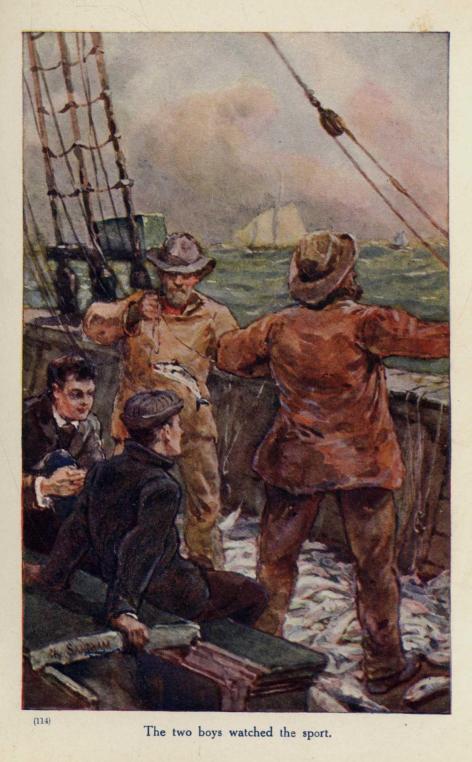
The two boys watched the sport.
This was exciting enough to make even Ralph forget his sea-sickness for the time; but when the "school" had passed, the work of dressing mackerel began again, and this was not at all soothing to disturbed stomachs.
"Let's go to bed, and get out of this, Ben," exclaimed Ralph in disgust.
"All right."
They tiptoed by the pile of fish that were still flapping feebly, and looked down into the cabin. It was not an inviting place, and Ralph hesitated.
"Going to turn in, boys?" asked the captain, thrusting his knife into a fish before he looked up.
"Yes, we thought of it."
"Without any supper? That will never do. Help yourselves in there. The biscuit-barrel's in the corner, and the codfish hangs right over it. Eat a good meal, and you'll feel better. There ain't nothin' equal to dry codfish for turning sea-sickness."
"Thanks; but we don't feel hungry," said Ben.
"That's queer. It beats me how anybody can be out to sea and not feel hungry! Well, a night's rest will make you better, like as not. You'll sleep like a couple of tops; that is, if you've got good clean consciences afore God."
The boys made no reply.
"I hope you have. It's bad work being out to sea, or anywhere else, for that matter, with anything lying heavy on your conscience. Now, I don't pretend to be any guide for any one. I'm bad enough myself; but I always says every night, 'Just look me over, Lord, and if there is any bad in me'--and of course I know there is plenty of it--'forgive it, and help me to start better to-morrow.' It's mighty comfortin' for me to know that He sees that I mean fairer than I do."
After these remarks the captain finished dressing the fish he held on the board, and the boys disappeared down the short flight of steps leading into the cabin.
It was a close place there, and filled with odours of fish; in fact the whole vessel seemed to be stuccoed with fish-scales.
"Are we first or second cabin passengers, Ralph?" asked Ben laughingly, "or are we steerage?"
"Steerage, sure enough!"
"Well, it isn't the worst place that ever was. I'd rather be here than outside there in the sea, with a shark after me," continued Ben, who was far more inclined than Ralph to be jolly under difficulties.
"Bad as it is, I'd rather be here than on the island camping out, with Joe Chester left behind," said Ralph.
"Yes, of course you would. If I had my fiddle here I'd cheer you up; that is, if I didn't feel kind of gone about my own stomach." And Ben sat down suddenly on the captain's green chest in the corner, looking very pale.
It was Ralph's turn now to wait upon him, and putting his head out of the door he shouted, "Captain, where shall we sleep?"
"Oh, anywhere you've a mind to. Take the bunks if you want to. Marcus and I'll look out for ourselves."
Ralph looked sharply at the rough bed, and said, "It isn't a royal couch, but tumble in, Ben." Ben was too sick to care where he went, and letting Ralph pull off his boots and coat, he literally tumbled in, as requested.
Whether it was a lack of good consciences that the old captain had spoken of, or the strangeness of their situation, or the awful sea-sickness, the boys could not sleep. They lay and tossed in their close berths, listening to the "thud" and "swish" of the waves against the sides of the little vessel, and the creak of the yards, as the canvas swung around in the wind.
It was a bright moonlight night, and the fishing was good, so the noise on deck continued nearly all night, making it still more impossible for the boys to sleep, until, their labours being over, Marcus came below for a nap. Rolling himself in a blanket, he dropped down in the corner of the cabin, and in less than five minutes he was snoring loud enough to drown the creak of the sails.
Ralph and Ben slept at last, and were only aroused in the morning by the captain's voice as he hailed another fishing-vessel. Marcus was preparing breakfast, and the odour of the coffee came into the cabin to tempt the boys.
"That smells good," cried Ben, throwing off his blanket. "Let's get out of this pen, Ralph, as quick as ever we can. I believe I'm hungry."
"Good!" said the captain, looking down into the little cabin, having overheard the exclamation. "How fare ye this morning?"
The boys answered as cheerily as they could, and hastening up on deck, they washed their faces and hands in sea water, and were ready for breakfast.
The deck was scrubbed clean, and the sea air was pure and sweet. Even Ralph felt hungry, and the fried mackerel, with biscuits and coffee, tasted very good. The fishing was dull that day; no schools of mackerel were to be seen, and the men busied themselves with trolling for cod and hake, or anything that would bite; and before night a long row of fish was spread out on the top of the cabin to dry, much to the boys' disgust. The second night was passed much like the first, in trying to become accustomed to their close quarters; and the third was much like the second. The only excitement was in running down schools of fish; but as this was always followed by the disagreeable work of dressing them, the dainty passengers were earnestly hoping they might not see any more.
"How long before you go ashore, captain?" asked Ben, as he walked the deck uneasily.
"Oh, when I get my load."
"But what do you call a load?"
"Now, that's a question I never could answer. I never saw the time I couldn't get on one more haul of fish. A smack is like an omnibus--it always has room for one more," said the captain laughing.
"You are pretty full now."
"Bless you, no! This isn't a trifle to what we ought to do. Mighty poor fishing this trip. Reckon I've got a Jonah aboard."
"A couple of them, perhaps," answered Ben, with a wink at Ralph.
"The fog is coming on," continued the captain, looking off seaward. "We shan't be able to see our hands afore our faces to-night, like as not."
"What do you do in a fog?" asked Ralph eagerly.
"Do? why, we make the best of it, boy. What do you suppose?"
"I thought, perhaps, you went ashore, or anchored somewhere," said Ralph hesitatingly.
"Oh, you did? The fog lasts two or three weeks sometimes. No; we go ahead, and catch every fish we can."
"Aren't you afraid some other vessel will run you down?"
"It would be about as bad for her as it would for us," answered the captain, puffing the smoke from his pipe contentedly. "I'd rather have it pleasant; but we don't have the ordering of the weather, and I've fallen into the way of making the best of things--weather and everything else. If it's good weather, I'm glad; if it isn't, I don't fret. If the fish bite, I'm glad; if they don't, I just stay out the longer; and sooner or later I get a good load. It don't do no good to be frettin' and fussin'."
The captain's words did not cheer the boys. They felt far from contented at the prospect of a fog at sea; and when it came rolling in and closing down around them, hiding not only the strip of shore in the distance, but also the island and the other vessels that were near them, they wished themselves on shore more earnestly than ever.
"We didn't bargain for this," said Ben, making a wry face at his companion.
"No, nor for anything else we have had. I'd rather be in the Rocky Mountains," grumbled Ralph.
"So had I, or on the top of the North Pole, provided it is planted in solid ground instead of water," was Ben's laughing reply.
"I'm in earnest. I hate the sea. I'm afraid of it just as soon as it begins to be rough. I don't see what possessed us to come to sea," continued Ralph, peering uneasily through the fog.
"We couldn't help it, if I recollect right," said Ben. "There wasn't any place to run to on land, so we took to the water like musk-rats. But we are all right. Captain Dare knows everything about vessels and fogs. I am not going to worry myself about it at any rate, unless a big storm comes; then I suppose I would be scared enough."
CHAPTER XV.
THE LITTLE CABIN.
The captain indulged in an afternoon nap, to be in readiness for a watchful night; and the fog grew thicker and heavier as the evening came on.
The great lantern was lighted early, and the wall of fog reflected the light back in a weird, ghostly way upon the boys, who sat in the bow, dreading to go down into the little cabin.
"I feel as if we were shut up in a tomb of fog," said Ralph dismally.
"Well, if 'misery likes company,' it may make you happier to know the other boys are in the fog too, over on the island," returned Ben.
"Yes, but they have solid ground under their feet, and are not likely to be run down as we are; besides, they'll have a jolly time in spite of the fog. I know I could if I were on shore and not sea-sick, and that fog-horn of Marcus's didn't sound so dismal. I wonder how many blasts he blows in a minute?"
"Let's go to bed; morning will come quicker," exclaimed Ben in desperation.
"If we could only sleep."
"Well, we did pretty well last night."
"Pretty well; but the cabin is so fishy and musty, and my stomach rolls over so many times in a minute, I can't sleep," complained Ralph.
"'Hark, from the tombs, a doleful sound,'" said Ben, and then laughed in spite of his discomfort. "We sit here and croak like a couple of ravens, and Marcus toots that everlasting horn; let's go below and try that," he continued.
Ralph arose and staggered to the cabin steps, said good-night to the captain and Marcus, and, followed by Ben, crept into his berth. Ben tried to sing one of the school glees to cheer himself and friend, and forget his sea-sickness.
"Oh, hush, Ben! That makes me as homesick as a cat. I tell you that little room of ours at school was an awful cosy place, after all. Just think of that bed. We used to call that hard."
"Yes, and that grate where we had a fire on cold nights."
"We used to rail at it and call it stuffy, but if we were only there now I'd feel like dancing."
Ben struck up another tune, and hummed it through, chorus and all, to try to keep from utter wretchedness.
Ralph was quiet till he finished; then he said,--
"Ben, Mr. Bernard is a good man. He had the right of it about that lying business. I hate myself for it."
"So you said before," answered Ben, beginning another air.
"I know it," interrupted Ralph, "I mean it more and more. I mean never to deceive any one again."
"Quoth the raven, 'Nevermore;' anyway never till you get into trouble again," said Ben.
"I don't care how great the trouble may be, I'll confess and be true. Do you know I tried saying last night what the captain told us he said. Somehow I never liked before to think the Lord was looking at me, but now I am glad he is, for he can see I really mean to do better."
"It's queer you feel that way. I don't see any use worrying over a little lie. I've told dozens of them, and I never felt bad about it. I feel uncomfortable enough now, but I reckon it's my stomach and not my mind. I say, let's go to sleep."
This was easier to say than do, and both boys tossed and rolled in misery with sea-sickness, home-sickness, and fear, until from sheer exhaustion they fell asleep.
The morning dawned foggy, and foggy the day ended. The next day was like this; and the boys were too sick and worried to taste a mouthful of food. The fog did not prevent the fishing, and the two men kept busy with their lines, or their work of dressing the fish, and had little time to devote to the boys, even if they had known what to do for them.
"I wish the two little land-lubbers were safe ashore," was the fervent remark uttered over and over again by the captain, as he and Marcus worked together.
"A storm is coming, and this fog will get blown higher than a kite," the boys heard the captain say.
"Yes, it feels like bad weather," was Marcus's answer, as he gave a wise glance around their foggy prison and blew a long blast on the big horn.
"Hear that, Ben?" asked Ralph.
"What? The horn? Yes, I hear it."
"No! Didn't you hear what Captain Dare said? We've got to have a storm after all. In this little vessel, too. It will go down, sure as the world," and Ralph grew paler than ever. Ben felt very much as his friend did, but said less.
"I hear another horn, captain."
"Yes!" said the captain, listening.
Marcus blew again long and loud; and again was answered from out in the fog. After a while the two vessels came within hailing distance, and Ralph, seized with a sudden longing, rushed up to the captain, and said eagerly,--
"O captain, it's a larger vessel than this! Don't you suppose they would take us aboard? If there is going to be a storm, I would rather be in a large vessel; this is such a little egg-shell."
"Egg-shell! not a bit of it. But I'd like nothing better than to get rid of you. I don't want passengers to look out for in a gale. My little smack has rode out many a storm, but I'd rather be alone with my one man."
"Oh, ask them! beg them!" urged Ralph, more and more excited.
"Tell them we've got money to pay with," added Ben a little more quietly.
The captain laughed, but gratified them by hailing the brig. "Here are two boys, sea-sick and scared; storm coming; no accommodation. Can you take them off my hands?"
"We are bound out," came the answer from the vessel, whose outlines were only dimly seen through the fog.
"Never mind where they are bound, tell him," said Ralph, pulling the captain's arm; "we don't care."
"We've no room for passengers," added the invisible speaker on the brig.
"Nor I neither," grumbled the captain of the smack. "I ought to have knowed better than to take 'em;" then aloud he added, "They'll die of fright on my hands if there comes a tough gale."
"Who are they?" asked the voice in the fog.
"Two young scamps that belong to a school that's gone on Whaleback to camp. Leastways that's what I guess.--Isn't it so, boys?"
"Yes."
The vessels were soon far apart, and the boys, disappointed in their hopes, sat down by the captain to watch him splice a rope.
"How did you know we belonged to that school? and how did you know where they were going to camp?" they asked.
"I guessed at one and heard the other. They told me on the wharf that Bernard's school was going to camp on Whaleback; and when that boat came by, and you two ran for the cabin so sudden like and kept so still, I put two and two together and made four easy enough without a slate or pencil."
"That's because you are an old tar," said Ben.
"But I haven't figgered out yet what you wanted to run away from that crowd for! It seems to me if I was a fellow of your age I'd rather go to camp than go aboard a fishing-smack and be sea-sick and scared to death."
Neither of the boys cared to answer.
"You had some reason, I suppose. I'd really like to know it. Tell me truly now--were you lying when you said your folks were willing you should come?"
"We didn't say just that. We said they didn't expect us home for a month, and they don't," said Ralph; then, regardless of Ben's frown of disapproval, he added, "I'll tell you how we happened to leave them. I did a mean thing--a shabby joke that didn't turn out the way I meant--and then when Mr. Bernard told the boy who did it to stand, I didn't dare to."
"Of course you didn't!" said Ben apologetically.
"No 'of course' about it!" said the captain abruptly. "An honest boy never gets out of a scrape in a mean way."
"Well, I know it now, but I didn't dare to stand up. And then he pulled the line tighter by telling any one who knew the boy who did the mischief to stand; and Joe Chester was the only fellow that confessed to knowing. He gave us several chances on that, and tried to shame us out of lying; and at last, as long as Joe Chester wouldn't tell, Mr. Bernard said unless the other fellow confessed, Joe would have to lose his camping-out time with the crowd."
"Did you own it?" asked the captain.
"Not then. I felt meaner than dirt; but I was afraid I'd be expelled. It went on that way till the night before the school left for the island; then I couldn't stand it to have Joe left behind, and I up and wrote a note and left it for Mr. Bernard, confessing all."
"And what did you have to do with it, Ben?" asked Captain Dare, wondering why Ralph had not mentioned him.
"I? Oh, I knew about it, but I wasn't going to tell on Ralph."
"Then you got behind me to keep out of their way," said Captain Dare. "Well, what is going to be the end of it all?"
Ralph shook his head.
"None of us know, and that's a fact, boys! But it ought to be a lesson to you to keep truth on your side. Lies never pay."
"So I believe," said Ralph in sober earnest.
"I begin to think so too," said Ben. "Anyhow, these didn't."
"Now's the time to take a fresh start, then; and I hope we'll all of us live so we can be glad to have the Lord see all we do and hear all we say,--yes, and know all we think, too. That's the tough part--the heart is such a queer thing. Sometimes it looks all fair and smooth, and we feel pretty well satisfied with ourselves; but just dig down a little way and we'll find a lot of rubbish there we are ashamed of. The only way is to keep it open for the Lord to look through all the time."
Then, after a silence, during which the boys looked gloomily out into the fog that seemed to be growing blacker and heavier like a pall, he added cheerfully, "Well, good-night, boys; keep up good courage. The Una is a tough little boat, and has rode out many a stiff gale."
"She's such a little thing to fight against big waves and strong wind," said Ben.
"Yes; when I'm down in that cabin I feel as if there was no more than a paper wall between us and the other world," added Ralph.
"Less than that, boy, less than that. There's only a breath 'twixt us and the other world any time, on sea or on land. What's the difference, as long as God's hand holds on to us? I feel just as safe as my little grand-baby does in his crib," said the captain.
"I don't," said Ben in a low tone; "I'd give all I own, and all my father owns too, if I was near enough the shore to jump on it. I'd be willing to make a long leap too."
"Good-night," again said the captain, as if to dismiss them.
"Good-night," replied the boys; but they were restless and anxious, and could not bear to go down into the close cabin, which seemed more like a prison than ever.
The storm had not commenced, and the only sign of it that the boys could see was the blackness of the fog and the peculiar feeling of the air, which seemed heated and heavy.
They sat down again behind the cabin, where the captain could not see them, and spoke in whispers.
"Let's stay on deck all night," said Ben. "If she capsizes we would stand a better chance here."
"I don't suppose we'd have the least chance in either place," was the doleful reply.
"That vessel might have taken us off," grumbled Ben.
Ralph was feeling too badly to talk, and he stared at the fog in a despairing way. They sat there until the wind began to blow, and the spray from the big waves to dash over them; then, as a last resort, they retreated to the cabin.
"Good-night, captain," said Ralph dolefully as he passed.
"What! you two fellows on deck yet! I thought I sent you below a couple of hours ago. Down with you! You'll be washed overboard if you stay up here."
CHAPTER XVI.
A WRETCHED NIGHT.
The boys went reluctantly into their berths, but not to sleep.
Sick and frightened, they could only listen anxiously to the beating of the waves against the vessel, and the hurried movements of the two men on deck, as, tossed by the winds and the sea, the Una rolled heavily to and fro.
The moments seemed hours, and the hours seemed ages.
Never in their lives had they been so terrified. Several times the water rushed down into the cabin, as the waves broke over the deck; and Captain Dare looked down upon them, long enough to ask if they were drowned out.
"Hear the thunder!" exclaimed Ralph, as the heavy roll and crash sounded overhead, and the cabin was lighted almost continually with flashes of lurid light.
Ben made no reply, but buried his head under the blanket.
"It's queer I don't feel so scared as I did," said Ralph soberly. "I feel something as Captain Dare does--that after all we are in God's hand. Hear that peal! It seemed to roll right over the deck."
Ben made no answer, but cowered still closer under the blanket.
The rain now descended in perfect sheets upon the deck; and although the cabin door was closed, the water poured down through the cracks, and came in around the small windows above the berths, adding to the discomfort of the boys, who could not escape the drenching there without stepping into the water with which the cabin floor was covered.
The rain fell as if another flood had commenced; and the wind had no mercy on the little vessel--breaking her yards and snapping her topmasts; and unreefing with goblin fingers the topsails, it whipped them to tatters.
At length the thunder ceased to mutter, and after midnight the rain fell no more; but the wind continued to blow, and the little vessel to run before it.
It was sunrise when the captain opened the cabin door and looked down.
"Well, boys, get up and give thanks! The little vessel has weathered the toughest kind of a gale. We are all safe now."
"Is the danger really over?" asked the boys eagerly, as they sprang from the berth upon the wet floor.
"The worst is over, thank God! It was a tough storm and a stiff blow, but the Una rode it out," he said proudly. "One mast got a bad wrench, and all the canvas that could get loose got ripped into rags; but that's nothin' to what it might have been, considerin' how the wind roared and howled over the sea. Folks blame the sea for these accidents; but bless you, the sea ain't to blame! How can it help rearing up, with a gale like that throwing it on its pitchfork? I don't like to see things abused, and I stick up for the sea; it behaves well enough as long as the wind lets it."
"Where are we?" asked the boys, as they reached the deck and looked curiously around. "There's no land at all in sight!"
"No; we got blown well out to sea. It's lucky we didn't try to make a port last night: we'd have been caught among some o' them islands if we had, and knocked to pieces on the rocks."
"That's so," added Marcus, with a wise shake of the head.
"You two fellows did first-rate last night!"
"You are chaffing, captain," said Ralph, looking red.
"No, honestly. I expected I'd have trouble with you when that storm came; but I'll say that for you--you did first-rate!"
"We were too scared to do any other way," confessed Ben with a laugh.
"Scared or not, some folks will make a rumpus just when they ought to keep stillest.--Now, Marcus, give us a good breakfast, and then we'll shake out our canvas and see where our damages are. We must be working back, for I don't propose to let this wind drive us off shore any further than I can help.--One time last night, along the first of the blow, we came very near Whaleback, boys; but a miss is as good as a mile when the danger is over."
"Whaleback! Oh, I wish we were there now! No, I don't either!" exclaimed Ralph.
"I wish you was there, anyhow," said the captain gruffly. "That's where you belong. I believe the master there would take you back and forgive you. You've got a good dose of punishment, if ever a couple of young liars had."
"You don't know how Mr. Bernard feels about lying. He will never want the other boys to be with us again,--never!" said Ralph.
"I don't know about that," and Captain Dare shook his head wisely. "I know there isn't nobody hates a lie worse nor me; but it ain't for me to hold back when a fellow is sorry for it, and quits the whole business of lying."
"And I mean to do that!" interposed Ralph with emphasis; "but Mr. Bernard doesn't know it."
"No, and that's just what I was wishing you on Whaleback for, so you could tell him."
"He wouldn't believe us!" exclaimed Ben. "We couldn't expect him to, after we lied to him as we did. No, I don't want to see him. A storm at sea is bad enough; but I believe I'd rather go through another than go ashore and face him."
"I'd like to have him know how I feel about it," said Ralph. "I mean to write him a letter after I get back to father's. Of course we never can be taken back into school."
"Breakfast!" shouted Marcus, flourishing the towel with which he had been polishing the tin plates.
"I believe the fright last night took away my seasickness," said Ralph, as he helped himself to the fish Marcus had broiled. "The fright did it, or else it died a natural death, for I had it long enough. I feel more like myself than I have since I came on board."
"So do I," said Ben, following Ralph's example.
"When is this voyage going to end, captain?"
"Oh, when I get my load, I told ye before. It will take some time for this sea to go down enough to give us another chance at the fish; but with fair luck I reckon a week more will fill us."
The boys groaned.
"What! don't you like it? You seem so fresh after the storm, I concluded you was makin' up your mind to follow my profession. Then you don't mean to take to the business as a steady thing?" Captain Dare asked, with a twinkle in the funny light-gray eyes overshadowed with bushy brows.
"No," answered the boys laughing. "Dry land for us."
After breakfast, the two men unreefed the sails, and began to repair damages. The small boat that had been stowed on deck during the storm was again launched and towed behind.
The broken topmasts were useless; but the most serious injury was to the foremast, which was sprung out of position.
This they braced as well as possible, and setting all available canvas, they began the process of tacking, to regain their former-position.
As the wind abated, they began to troll for fish; and in spite of the rough sea, the boys felt well enough to help with the lines.
"If you stay aboard long enough, I'll make good fishermen of you yet," said the captain with a chuckle, as he noticed the colour in their cheeks and the sparkle in their eyes when they surveyed the mass of fish they had helped to catch.
"Now, just turn to and help to dress 'em," said Marcus.
The boys respectfully declined to join in this work, and went to sit in the bow as far as possible away from the board on which the fish were being prepared for drying.
They had been so busy fishing, the time had passed very quickly, and, tired and sleepy, they soon went to bed, thankful that the storm was over and their seasickness gone.
The morning dawned bright and clear, and when they went on deck at sunrise, Captain Dare pointed to the islands toward which they were once more sailing.
"Home again! home again, from a foreign shore!" sang Ben; and Ralph was at ease enough now to join in the song.
"That sounds good," said the captain approvingly. "Give us another. Sing us a hymn tune."
After a little consulting together the two boys sang the chant, "The Lord is my Shepherd." When they ceased, the captain said,--
"Give me that again; twice more, and then I'll let you off. I never heard anything so good as that!"
The boys complied, and wondered, as they sang it, why there seemed so much more in the chant than they had ever noticed before in singing it at school.
"I never noticed that chant much," said Ralph: "it means a lot more than it used to. I wonder why?"
"Bless your heart, boy! you've got more feelin' in your soul now, and more thoughts in your head. I tell you that's a psalm that has to grow on you. It don't mean nothin' particular to folks that haven't had trouble, but to them that have, it keeps growin' and growin', until they see more and more in it every time they think of it. I say that psalm over and over to myself when I'm sittin' here o' nights with my hand on the helm, but I never knew it could be sung. I used to sing once; I wonder if I could learn that. I'd give 'most anything to do it."
"Why, of course you can," exclaimed Ralph. "See here, it is just as easy;" and he hummed the first line. "Strike right in and sing it with us."
The two boys sang the chant again and again, until the captain had mastered it; and during the day he hummed it as he worked, resolving in his joy over his success that he would go out of his way to do those lads a favour, but it should be a surprise, and he would not tell Marcus even of his intention.
It proved a fine day for fishing. School after school of mackerel came by, and the boys worked industriously, helping the fishermen to gather their harvest. At night, tired and sleepy after their unusual labours, they went below early, and the captain, with a wink and crook of his finger at Marcus, beckoned him to his side.