Part 4 — V. THE IVALDE RACE. (continued 5)
Rasmus Björn Anderson translation
That this taking up was equivalent to an adoption of these children by the moon-god is manifest from the position Bil afterwards got in the circle of gods. She becomes an asynje (Younger Edda, i. 118, 556) and distributes the Teutonic mythological soma, the creative sap of nature and inspiration, the same liquid as she carried when she was taken up by the moon-god. The skalds of earth pray to her (ef unna itr vildi Bil skáldi!) and Asgard's skald-god, Brage, refreshes himself with her in Gevarr-Nokver's silver-ship (see Sonatorrek; cp. Nos. 90, 91). Odin came to her every day and got a drink from the mead of the moon-ship, when the latter was sinking toward the horizon in the west. The ship is in Grimnersmal called Sökkvabekkr, "the setting or sinking ship," in which Odin and Saga "daily drink from golden goblets," while "cool billows in soughing sound flow over" the place where they sit. The cool billows that roar over Sokvabek are the waves of the atmospheric sea, in which Nokver's ship sails, and they are the waves of the ocean when the silver-ship sinks into the sea. The epithet Saga is used in the same manner as Bil, and it probably has the same reason for its origin as that which led the skalds to call the bucket which Bil and Hjuke carried Sægr. Bil, again, is merely a synonym of Idun. In Haustlaung, Idun is called Byrgis ár-Gefn, "Byrger's harvest-giving dis;" Thjasse is called Byrgis ár-Gefnar bjarga-Tyr, "Byrger's harvest-giving dis, mountain-Tyr." Idun is thus named partly after the fountain from which Bil and Hjuke fetched the mead, partly after the bucket in which it was carried.
That Hjuke, like Bil-Idun, was regarded by the moon-god as a foster-child, should not be doubted, the less so as we have already seen that he, in the Norse sources, bears his foster-father's name. As an adopted son of the moon-god, he is a foster-brother of Hoder and Nanna. Hjuke must therefore have occupied a position in the mythology similar to that in which we find Gelderus as a brother-in-arms of Nanna's husband, and as one who was held in friendship even by his opponent, Hoder. As a brother of the Ivalde daughter, Bil-Idun, he too must be an Ivalde son, and consequently one of the three brothers, either Slagfin, or Orvandel-Egil, or Volund. The mythic context does not permit his identification with Volund or Egil. Consequently he must be Slagfin. That Gelderus is Slagfin has already been shown.
This also explains how, in Christian times, when the myths were told as history, the Niflungs-Gjukungs were said to be descended from Næfr, Nefir, (Nefir er Niflunger eru frá komnir—Younger Edda, i. 520.) It is connected with the fact that Slagfin, like his brothers, is a Niflung (see No. 118) and an adopted son of the moon-god, whose name he bore.
Bil's and Hjuke's father is called Vidfinnr. We have already seen that Slagfin's and his brothers' father, Ivalde, is called Finnr, Finnakonungr (Introduction to Volundarkvida), and that he is identical with Sumbl Finnakonungr, and Finnálfr. In fact the name Finnr never occurs in the mythic records, either alone or in compounds or in paraphrases, except where it alludes to Ivalde or his son, Slagfin. Thus, for instance, the byrnie, Finnzleif, in Ynglingasaga, is borne by a historified mythic person, by whose name Saxo called a foster-son of Gevarr, the moon-god. The reason why Ivalde got the name Finnr shall be given below (see No. 123). And as Ivalde (Sumbl Finnakonungr—Olvalde) plays an important part in the mead-myth, and as the same is true of Vidfin, who is robbed of Byrger's liquid, then there is every reason for the conclusion that Vidfin's, Hjuke's, and Bil-Idun's father is identical with Finnakonungr, the father of Slagfin and of his sister.
Gjuke and Hjuke are therefore names borne by one and the same person—by Slagfin, the Niflung, who is the progenitor of the Gjukungs. They also look like analogous formations from different roots.
This also gives us the explanation of the name of the Asgard bridge, Bilröst, "Bil's way." The Milky Way is Bil-Idun's way, just as it is her brother Hjuke's; for we have already seen that the Milky Way is called Irung's way, and that Irung is a synonym of Slagfin-Gjuke. Bil travelled the shining way when she was taken up to Asgard as an asynje. Slagfin travelled it as Balder's and Hoder's foster-brother. If we now add that the same way was travelled by Svipdag when he sought and found Freyja in Asgard, and by Thjasse-Volund's daughter, Skade, when she demanded from the gods a ransom for the slaying of her father, then we find here no less than four descendants of Ivalde who have travelled over the Milky Way to Asgard; and as Volund's father among his numerous names also bore that of Vate, Vade (see Vilkinasaga), then this explains how the Milky Way came to be called Watling Street in the Old English literature.[15]
In the mythology there was a circle of a few individuals who were celebrated players on stringed instruments. They are Balder, Hoder, Slagfin, and Brage. In the heroic poems the group is increased with Slagfin-Gjuke's son, Gunnar, and with Hjarrandi, the Horund of the German poem "Gudrun," to whom I shall recur in my treatise on the heroic sagas. Balder's playing is remembered by Galfrid of Monmouth. Hoder's is mentioned in Saxo, and perhaps also in the Edda's Hadarlag, a special kind of metre or manner of singing. Slagfin's quality as a musician is apparent from his name, and is inherited by his son, Gunnar. Hjarrandi-Horund appears in the Gudrun epic by the side of Vate (Ivalde), and there is reason for identifying him with Gevarr himself. All these names and persons are connected with the myth concerning the soma preserved in the moon. While the first drink of the liquid of inspiration and of creative force is handed to Odin by Mimer, we afterwards find a supply of the liquid preserved by the moon-god; and those mythic persons who are connected with him are the very ones who appear as the great harp-players. Balder is the son-in-law of the moon-god, Hoder and Slagfin are his foster-sons, Gunnar is Slagfin's son, Brage becomes the husband of Bil-Idun, and Hjarrandi is no doubt the moon-god himself, who sings so that the birds in the woods, the beasts on the ground, and the fishes in the sea listen and are charmed ("Gudrun," 1415-1418, 1523-1525, 1555-1558).
Both in Saxo and in Galfrid Hoder meets Slagfin with the bow in his conflict with him (Cheldricus in Galfrid; Gelderus in Saxo). The bow plays a chief part in the relation between the gods and the sons of Ivalde. Hoder also met Egil in conflict with the bow (see No. 112), and was then defeated, but Egil's noble-mindedness forbade his harming Slagfin's foster-brother. Hoder, as an archer, gets satisfaction for the defeat in Saxo, when with his favourite weapon he conquers Egil's brother, Slagfin (Gelderus), who also is an archer. And finally, with an arrow treacherously laid on Hoder's bow, Volund, in demoniac thirst for revenge and at Loke's instigation, takes the life of Balder, Hoder's brother.
122.
REVIEW OF THE SYNONYMS OF THE SONS OF IVALDE.
The names by which Slagfin is found in our records are accordingly Idi, Gjúki, Dankrat (thakkrádr), Irung, Aldrian, Cheldricus, Gelderus, Hjúki. We have yet to mention one more, Hengest (Hengist), to which I shall return below. Of these names, Gelderus (Geldr), Cheldricus, and Aldrian form a group by themselves, and they are possibly simply variations of the same word. The meaning of the name Hengest, "a gelding," is connected with the same group, and particularly to the variation Geldr. The most important Slagfin epithets, from a mythological standpoint, are Ide, Gjuke, Hjuke, and Irung.
The names of Volund (Wieland, Veland) in the various records are, as we have seen, thjazi, Ajo (Aggo), Anund (Önundr), Rögnir, Brunni, Ásólfr, Vargr, Fjallgyldir, Hlébardr, Byrr, Gustr, Loptr, Haquinus (Aki, Ecke). Of these names and epithets Ásólfr, Vargr, Fjallgyldir, and Hlébardr form a group by themselves, and refer to his animal-symbol, the wolf. The other brothers also have animal-symbols. Egil is symbolised as a wild boar and a bear by the names Aurnir, Ebur, Isólfr. Slagfin is symbolised as a horse in Hengest, and also in the paraphrase öndr-Jálkr, "the gelding of the skees." Like his brothers, he is a runner on skees. The Volund epithet, Brunni, also alludes to skee-running. Rögnir and Regin are names of Volund and his brothers in their capacity of artists. The names Ajo, Anund, and Thjasse (the sparkling) may have their origin in ancient Aryan times.
The names of the third brother, Egil, are Gangr, Örvandill, Egill, Agelmund, Eigel, Euglin, Hödbroddr, Toko, and Avo, the archer; Ebur (Ibor, Wild-Ebur, Villefer, Ebbo), Aurnir Isólfr. Of these names Egill, Agelmund, Egil, and Euglin form a separate group; Örvandill, Hödbroddr, Toko, and Avo sagittarius form another group, referring to his fame as an archer; Ebur, Aurnir, and Isolfr a third, referring to his animal-symbols.
123.
IVALDE.
In the course taken by our investigation we have already met with and pointed out several names and epithets by which Ivalde occurs in the mythology and in the heroic poems. Such are Geirvandill, with the variation Geirvadill; Vadi (Vate), Allvaldi, Audvaldi, Olvaldi, Svigdir (Svegdir), Ölmódr, Sumbl Finnakonungr (Sumblus Phinnorum rex), Finnakonungr, Vidfinnr, Finnálfr, Fin Folcvalding, Hlaudverr.
Of these names Ívaldi, Allvaldi, Audvaldi, and Ölvaldi form a group by themselves, inasmuch as they all have the part, valdi, valdr, "mighty," an epithet preserved from the mythology in those heroic sagas which have treated distinct portions of the Ivalde-myth, where the hero reappears as Walther, Valthari, Valdere, Valtarius Manufortis.
Another group is formed by Ölvaldi, Ölmodr, Svidir, Sumbl Finnakonungr. Svigdir means, as already shown, "the great drinker," and Sumbl is a synonym of "ale," "mead." All the names in this group refer to the quality of their bearer as a person belonging to the myth about the mead.
The name Sumbl Finnakonungr is at the same time connected with a third group of names—Finnakonungr, Finnr, Vidfinnr, Finnálfr, Fin Folcvalding. With this group the epithets Vadi and Vadill (in Geirvadill) have a real mythological connection, which shall be pointed out below.
Finally, Geirvadill is connected with the epithet Geirvandill from the fact that both belong to Ivalde on account of his place in the weapon-myth.
As has been shown above, Geirvandill means "the one occupied with the spear," or, more accurately, "the one who exhibits great care and skill in regard to the spear" (from geir, spear, and vanda, to apply care to something in order that it may serve its purpose). In Saxo, Gervandillus-Geirvandel is the father of Horvendillus-Orvandel; the spear-hero is the father of the archer. It is evident that the epithets of the son and father are parallel formations, and that as the one designates the foremost archer in mythology, the other must refer to a prominent spear-champion. It is of no slight importance to our knowledge of the Teutonic weapon-myth that the foremost representatives of the spear, the bow, and the sword among the heroes are grandfather, father, and son. Svipdag, Ivalde's grandson, the son of Orvandel-Egil, is above all others the sword-champion, "the sword-elf" (sverdálfr—see Olaf Trygv., 43, where Svipdag-Erik's namesake and supposed descendant, Erik, Jarl Hakonson, is called by this epithet). It is he who from the lower world fetches the best and most terrible sword, which was also probably regarded as the first of its kind in that age, as his uncle, who had made it, was called "the father of swords" (see Nos. 113, 114, 115). Svipdag's father is the most excellent archer whose memory still survives in the story about William Tell. The grandfather, Ivalde, must have been the most excellent marksman with the spear. The memory of this survives not only in the epithets, Geirvandill and Geirvadill, but also in the heroic poem, "Valtarius Manufortis," written before the year 950 by Eckehard in St. Gallen, and in Vilkinasaga, which has preserved certain features of the Ivalde-myth.
Clad in an armour smithied by Volund (Vuelandia fabrica), Valtarius appears as the great spear-champion, who despises all other weapons of attack—
Vualtarius erat vir maximus undique telis Suspectamque habuit cuncto sibi tempori pugnam (v. 366-7).
With the spear he meets a sword-champion—
Hic gladio fidens hic acer et arduus hasta (v. 822);
and he has developed the use of the spear into an art, all of whose secrets were originally known by him alone, then also by Hagano, who learned them from the former (v. 336, 367). Vilkinasaga speaks of Valthari as an excellent spear-champion. Sure of success, he wagers his head in a competitive contest with this weapon.
It has already been shown above (see No. 89) that Svigdir-Ivalde in the mythic saga concerning the race-heroes was the first ruler of the Swedes, just as his sons, Volund and Egil, became those of the Longobardians and Slagfin that of the Burgundians, and, as shall be shown below, also that of the Saxons. Even in the Ynglingasaga, compiled in the twelfth century, he remains, by the name Svegdir among the first kings of the Yngling race, and in reality as the first hero; for his forerunners, Fjölnir, Freyr, and Odinn, are prehuman gods (in regard to Fjölnir, see Völuspa). That Svidir was made the race-hero of the Swedes is explained by the fact that Ivalde, before his sons, before he had yet become the foe of the gods and a "perjured hapt," was the guardian of the northern Teutonic world against the powers of frost, and that the Sviones were the northernmost race of the Teutonic domain. The elf-citadel on the southern coast of the Elivagar was Geirvadill-Ivalde's setr before it became that of his sons (see Nos. 109, 113-115, 117, 118). The continental Teutons, like their kinsmen on the Scandian peninsula, knew that north of the Swedes and in the uttermost north lived a non-Teutonic people who ran on skees and practised hunting—the Finns. And as the realm that was subject to the race-hero of the Swedes in the mythology extended to the Elivagar, where his setr was situated, even the Finns must have been subject to his sceptre. This explains his surname, Finnakonungr, Finnr, Vidfinnr, Fin Folcvalding, and also the fact that his descendants form a group of skee-runners. To the location of the setr near the Elivagar, at the point where Thor was wont to wade across this body of water (see Nos. 109, 114), we have a reference in the Ivalde epithets, Vadill Vadi. They indicate his occupation as the keeper of the ford. Vilkinasaga makes him a wader of the same kind as Thor, and makes him bear his son, Volund, across a sound while the latter was still a lad. Reasons which I may yet have an opportunity to present indicate that Ivalde's mother was the mightiest amazon of Teutonic mythology, whose memory survives in Saxo's account of Queen Rusila, Rusla (Hist., 178, 365, 394-396), and in the German heroic-saga's Rütze. This queen of the elves, dwelling south of the Elivagar, is also remembered by Tactitus' informer. In Germania (45) we read: Svionibus Sitonum gentes continuantur. Cetera similes uno different quod femina dominatur.... Hic Suebiæ fines—"The Sviones are bounded by the Sitones. While they are like each other in other things they differ in the one respect, that a woman rules over the Sitones. Here the confines of Suebia end." The name Sitones does not occur elsewhere, and it would be vain to seek it in the domain of reality. Beyond the domain of the Sviones extended at that time that of the mythic geography. The Sitones, who were governed by a queen, belonged to the Teutonic mythology, like the Hellusians and Oxionians, mentioned elsewhere in Germania. It is not impossible that the name Sitones, of which the stem is sit, is connected with the Norse mythological name of the chief citadel in their country—setr (Geirvadill's setr, Ide's setr; cp. setr-verjendr as a designation in Ynglingasaga [17] of the descendants of Svigdir-Ivalde). The word setr is derived from setja, a causative form of sitja, the Gothic sitan.
I now pass to the name Hlaudverr, in Volundarkvida. This poem does not state directly who Volund's, Egil's, and Slagfin's father was, but it does so indirectly by mentioning the name of the father of Volund's and Slagfin's swan-maids, and by stating that these swan-maids were sisters of the brothers. Volund's swan-maid is called theirra systir in str. 2. Among the many uncalled-for "emendations" made in the text of the Elder Edda is also the change of theirra to theirrar, made for the reason that the student, forgetting that Volundarkvida was a poem born of mythology, regarded it as impossible for a brother and sister to be husband and wife, and for the reason that it was observed in the prose introduction to Volundarkvida that the father of the three brothers was Finnakonungr. Hlaudverr is also found in a German source, "Biterolf," as King Liutwar. There he appears in the war between Hadding-Dieterich and Gudhorm-Ermenrich, and the poem makes him a champion on the side where all who in the mythology were foes of the Asas generally got their place, that is, on Ermenrich's. There he occupied the most conspicuous place as Ermenrich's standard-bearer, and, with Sabene, leads his forces. The same position as Ermenrich's standard-bearer occupies is held in "Dieterich's Flucht" by Vate, that is to say, Vadi-Ivalde, and in Vilkinasaga by Valthari, that is to say again, Ivalde. Liutwar, Vate, and Valthari are originally one and the same person in these German records, just as Hlaudver (corresponding to Liutwar), Vade (corresponding to Vate), and Ivalde (corresponding to Valthari) are identical in the Scandinavian Volundarkvida's statement, that Volund's and Slagfin's swan-maids are their sisters (half-sisters, as we shall see), and, like them, daughters of Ivalde, is thus found to be correct by the comparison of widely-separated sources.
While the father of these two swan-maids is called Hlaudverr in Volundarkvida, the father of the third swan-maid, Egil's beloved, is called King Kiarr in Valland. As Egil was first married to the dis of vegetation, Groa, whose father is Sigtryg in the heroic saga, and then to Sif, his swan-maid must be one of these two. In Volundarkvida, where none of the swan-maids have their common mythological names, she is called Olrun, and is said to be not a sister, but a kinswoman (kunn—str. 15) of both the others. Hlaudverr (Ivalde) and Kiarr are therefore kinsmen. Who Kiarr was in the mythology I cannot now consider. Both these kings of mythological descent reappear in the cycle of the Sigurd songs. It has already been shown above (No. 118) that the Gjukungs appear in the Sigurd saga as heirs and possessors of Hlaudverrs halls and treasures; it is added that "they possess the whitest shield from Kiarr's hall (Gudrunarkvida, ii. 25; Atlakvida, 7). Here we accordingly once more find the connection already pointed out between the persons appearing in Volundarkvida and those in the Gjukungsaga. The fathers of the swan-maids who love Volund and his brothers reappear in the Sigurd songs as heroes who had already left the scene of action, and who had owned immense treasures, which after their death have passed by inheritance into the possession of the Gjukungs. This also follows from the fact that the Gjukungs are descendants of Gjuke-Slagfin, and that Slagfin and his brothers are Niflungs, heirs of Hlaudver-Ivalde, who was gullaudigr mjök (Younger Edda).
Like his sons, Ivalde originally stood in a friendly relation to the higher reigning gods; he was their sworn man, and from his citadel near the Elivagar, Geirvadills setr, he protected the creation of the gods from the powers of frost. But, like his sons, and before them, he fell into enmity with the gods and became "a perjured hapt." The features of the Ivalde-myth, which have been preserved in the heroic poems and shed light on the relation between the moon-god and him, are told partly in the account of Gevarus, Nanna's father, in Saxo, and partly in the poems about Walther (Valtarius, Walthari) and Fin Folcvalding. From these accounts it appears that Ivalde abducted a daughter of the moon-god; that enmity arose between them; that, after the defeat of Ivalde, Sunna's and Nanna's father offered him peace, and that the peace was confirmed by oath; that Ivalde broke the oath, attacked Gevar-Nokver and burnt him; that, during the hostilities between them, Slagfin-Gjuke, though a son of Ivalde, did not take the side of his natural father, but that of his foster-father; and that Ivalde had to pay for his own deeds with ruin and death.
Concerning the point that Ivalde abducted a daughter of Gevar-Nokver and married her, the Latin poems Valtarius Manufortis, Nibelunge Noth, Biterolf, Vilkinasaga, and Boguphalus (Chronicon Poloniæ) relate that Walther fled with a princess named Hildigund. On the flight he was attacked by Gjukungs, according to Valtarius Manufortis. The chief one of these (in the poem Gunthari, Gjuke's son) received in the battle a wound "clean to the hip-bone." The statement anent the wound, which Walther gave to the chief one among the Gjukungs, has its roots in the mythology where the chief Gjukung, that is, Gjuke himself, appears with surnames (Hengest, Geldr, öndr-Jálkr) alluding to the wound inflicted. In the Anglo-Saxon heroic poem Fin Folcvalding is married to Hildeburh, a daughter of Hnæf-Hoce, and in Hyndluljod (cp. str. 17 with str. 15) Hildigunnr is the mother of Halfdan's wife Almveig, and consequently the wife of Sumbl Finnakonungr, that is, Ivalde. Hildigunnr's father is called Sækonungr in Hyndluljod, a synonym of Nökkver ("the ship-captain," the moon-god), and Hildigun's mother is called Sváfa, the same name as that by which Nanna is introduced in the poem concerning Helge Hjorvardson. Hildeburh, Hnæf-Hoce's daughter, is identical with Hildigun, daughter of Sækonungr. Compare furthermore str. 20 in Hyndluljod, which speaks of Nanna as Nokver's daughter, and thus refers back to str. 17, where Hildigun is mentioned as the daughter of Sækonungr. The phrase Nanna vat næst thor Nauckva dottir shows that Nökkver and another elder daughter of his were named in one of the immediately preceding strophes. But in these no man's name or epithet occurs except Sækonungr, "the sea-king," which can refer to Nökkver, "the ship-owner," or "ship-captain," and the "daughter" last mentioned in the poem is Hildigunnr.
Of the names of Ivalde's wife the various records contain the following statements:
Hlaudver-Ivalde is married to Svanfeather (Svanfjödr, Volundarkvida).
Finnalf-Ivalde is married to Svanhild Gold-feather, daughter of Sol (Fornal. saga).
Fin Folcvalding-Ivalde is married to Hildeburh, daughter of Hnæf-Hoce (Beowulf poem).
Walther-Ivalde is married to Hildigunt (German poems).
Sumbl-Finnakonungr is married to Hildigun, daughter of Sækonungr Nokver, the same as Hnæfr, Hnefr, Nanna's father (Hyndluljod, compared with Saxo and other sources).
She who is called Svanfeather, the sun-daughter Svanhild Gold-feather, Hildeburh, Hildigunt, and Hildigun is accordingly a sister of the moon-dis Nanna, and a daughter of the ruler of the atmosphere and of the moon. She is herself a sun-dis. In regard to the composition of the name, we must compare Hildigun, Hiltigunt, with Nanna's surname Sinhtgunt. The Teutonic, or at all events the Norse, mythology knew two divinities of the sun, mother and daughter. Grimnersmal (47) tells us that the older one, Alfraudull, has a daughter, who, not at the present time, but in the future, is to drive the car of the sun (eina dottur berr Alfraudull ...). The elder is the wife of the moon-god. The younger one is the Sunna mentioned in the Merseburg formula (see No. 92), Sinhtgunt-Nanna's sister. As a surname, Sunna also occurs in the Norse literature (Alvissmal, 17; Younger Edda, i. 472, and elsewhere).
In the Beowulf poem and in "Battle of Furnesburg," we find Fin Folcvalding, Hildeburh's husband, as the foe of his father-in-law Hnæf, and conquered by him and Hengest. After a war ending unluckily for him, he makes peace with his victors, breaks the peace, attacks the citadel in the night, and cremates the slain and wounded in an immense funeral pyre. Hnæf is among those fallen, and Hildeburh weeps at his funeral pyre; Hengest escapes and afterwards avenges Hnæf's death. Saxo confirms the fact, that the historified person who in the mythology is the moon-god is attacked and burnt by one of his "satraps," and afterwards avenged. This he tells of his Gevarus, Nanna's father (Hist., 131). The correspondence on this point shows that the episode has its root in the mythology, though it would be vain to try to find out the symbolic significance from a standpoint of physical nature of the fact that the moon-god was attacked and burnt by the husband of his daughter, the sun-dis.
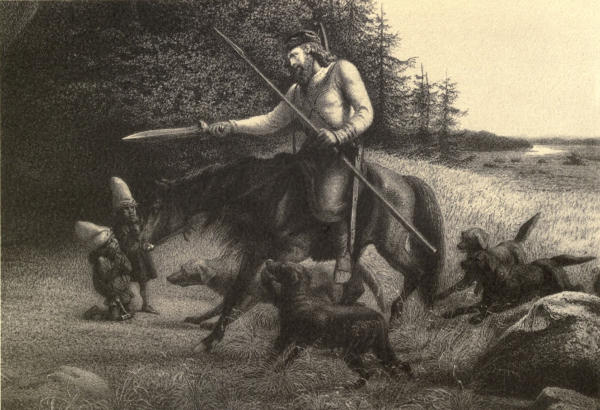
KING SVAFRLAME SECURES THE SWORD TYRFING. (From a painting by Lorenz Frölich.) In the Icelandic Hervar's Saga is an account of the mythical sword called Tyrfing, which Odin commanded the dwarfs Durin and Dvalin to forge for his grandson, King Svafrlame. When, against their will, they were compelled to deliver the sword to the king, the dwarfs pronounced a curse upon it, declaring that it should never be drawn from its sheath without causing the death of some one. Soon after Svafrlame was killed by Arngrim and the sword passed to Angantyr, who, in turn, was slain by Hjalmar and, to abate the curse, Tyrfing was buried with him. Angantyr's daughter, Hervor, however, by a spell, exorcised the spirit of her father and obtained the sword, after which it had many owners in succession, but the curse remained, for it brought death as before to every one who unsheathed it.
Meanwhile we obtain from these scattered mythic fragments preserved in the heroic poems, when compared with the statements found in the mythology itself, the following connected story as the myth about the mead:
Originally, the mead, the soma, belongs to Mimer alone. From an unknown depth it rises in the lower world directly under the world-tree, whose middle root is watered by the well of the precious liquid. Only by self-sacrifice, after prayers and tears, is Odin permitted to take a drink from this fountain. The drink increases his strength and wisdom, and enables him to give order to the world situated above the lower regions. From its middle root the world-tree draws liquids from the mead-fountain, which bless the einherjes of Asgard as a beverage, and bless the people of Midgard as a fructifying honey-dew. Still this mead is not pure; it is mixed with the liquids from Urd's and Hvergelmer's fountains. But somewhere in the Jotunheims, the genuine mead was discovered in the fountain Byrger. This discovery was kept secret. The keeper of the secret was Ivalde, the sworn watchman near the Elivagar. In the night he sent his son Slagfin (afterwards called after his adopted father Hjuke) and his daughter Bil (Idun) to dip liquid from the fountain Byrger and bring it to him. But the children never returned. The moon-god had taken them and Byrger's liquids unto himself, and thus the gods of Asgard were able to partake of this drink. Without the consent of the moon-god, Ivalde on his part secured his daughter the sun-dis, and doubtless she bears to him the daughters Idun, Almveig, and other dises of growth and rejuvenation, after he had begotten Slagfin, Egil, and Volund with the giantess Greip. The moon-god and Ivalde have accordingly taken children from each other. The circumstance that the mead, which gives the gods their creative power and wisdom, was robbed from Ivalde—this find which he kept secret and wished to keep for himself alone—makes him the irreconcilable foe of the moon-god, is the cause of the war between them, and leads him to violate the oath which he had taken to him. He attacks Gevar in the night, kills and burns him, and recaptures the mead preserved in the ship of the moon. He is henceforth for ever a foe of the gods, and allies himself with the worst enemies of their world, the powers of frost and fire. Deep down in Hades there has long dwelt another foe of the gods, Surt-Durin, the clan-chief of Suttung's sons, the father of Fjalar. In the oldest time he too was the friend of the gods, and co-operated with Mimer in the first creation (see No. 89). But this bond of friendship had now long been broken. Down into the deep and dark dales in which this clan hostile to the gods dwells, Ivalde brings his mead-treasure into safety. He apparently gives it as the price of Fjalar's daughter Gunlad, and as a pledge of his alliance with the world of giants. On the day of the wedding, Odin comes before him, and clad in his guise, into Surt's halls, marries Gunlad, robs the liquids of Byrger, and flies in eagle guise with them to Asgard. On the wedding day Ivalde comes outside of Surt's mountain-abode, but never enters. A dwarf, the keeper of the halls, entices him into his ruin. It has already been stated that he was probably buried beneath an avalanche.
The myth concerning the carrying of the mead to the moon, and concerning its fate there, has left various traces in the traditions of the Teutonic people. In the North, Hjuke and Bil with their mead-burden were the objects seen in the spots on the moon. In southern Sweden, according to Ling, it was still known in the beginning of this century, that the bucket carried by the figures in the moon was a "brewing kettle," consequently containing or having contained a brewed liquid. According to English traditions, not the two children of Vidfin, but a drunken criminal (Ritson's Ancient Songs; cp. J. Grimm, Deut. Myth., 681), dwelt in the full moon, and that of which he is charged in widely circulated traditions is that he was gathering fagots for the purpose of crime, or in an improper time (on the Sabbath). Both the statements that he is drunk and that his crime consists in the gathering of fagots—lead us to suppose that this "man in the moon" originally was Ivalde, the drink-champion and the mead-robber, who attacked and burnt the moon-god. His punishment is that he will never get to heaven, but will remain in the moon, and there he is for ever to carry a bundle of thorn-fagots (thus according to a German tradition, and also according to a tradition told by Chaucer). Most probably, he has to carry the thorn-rod of the moon-god burnt by him. The moon-god (see Nos. 75, 91) ruled over the Teutonic Erynnies armed with rods (limar), and in this capacity he bore the epithet Eylimi. A Dutch poem from the fourteenth century says that the culprit in duitshe heet Ludergheer. A variation which J. Grimm (Deut. Myth., 683) quotes is Lodeger. The name refers, as Grimm has pointed out, to the Old High German Liutker, the Lüdiger of the German middle-age poem. In "Nibelunge Noth," Lüdiger contends with the Gjukungs; in "Dieterichs Flucht," he abandons Dieterich's cause and allies himself with the evil Ermenrich. Like Liutwar, Lüdiger is a pendant to the Norse Hlaudver, in whom we have already rediscovered Ivalde. While, according to the Younger Edda, both the Ivalde children Hjuke and Bil appear in the moon, according to the English and German traditions it is their criminal father who appears on the scene of the fire he kindled, drunk with the mead he robbed, and punished with the rod kept by his victim.
The statement in Forspjallsljod, that Ivalde had two groups of children, corresponds with the result at which we have arrived. By the giantess Greip he is the father of Slagfin, Egil, and Volund; by the sun-dis Gevar, Nokver's daughter and Nanna's sister, he is the father of dises of growth, among whom are Idun, who first is Volund's beloved or wife, and thereupon is married to Brage. Another daughter of Ivalde is the beloved of Slagfin-Gjuke, Auda, the "frau Ute" of the German heroic saga. A third is Signe-Alveig, in Saxo the daughter of Sumblus Phinnorum (Ivalde). At his wedding with her, Egil is attacked and slain by Halfdan. Hadding is Halfdan's and her son.
Several things indicate that, when their father became a foe of the gods, Ivalde's sons were still their friends, and that Slagfin particularly was on the side of his foster-father in the conflict with Ivalde. With this corresponds also the conduct of the Gjukungs toward Valtarius, when he takes flight with Hildigun. In the Anglo-Saxon heroic poetry, the name Hengest is borne by the person who there takes Slagfin's place as Hnæf-Gevar's nearest man. The introduction to the Younger Edda has from its English authorities the statement that Heingestr (Hengest) was a son of Vitta and a near kinsman of Svipdag. If, as previous investigators have assumed, Vitta is Vade, then Hengest is a son of Ivalde, and this harmonises with the statement anent his kinship with Svipdag, who is a grandson of Ivalde. The meaning of the word Hengest refers of itself to Slagfin-Geldr. The name Geldr is a participle of gelda, and means castratus. The original meaning of Hengest is "a gelding," equus castratus (in the modern German the word got for the first time its present meaning). That the adjective idea castratus was transferred to the substantive equus castratus is explained by the fact that Gils, Gisl, a mythic name for a horse (Younger Edda, i. 70, 482), was also a Gjukung name. One of Hengest's ancestors in his genealogy in Beda and in the Anglo-Saxon Chronicle is called Vict-gils; one of Slagfin-Gjuke's sons is named Gilser. A neither mythic nor historic brother of Hengest added in later times is named Horsa. The Ravenna geography says that when the Saxons left their old abodes on the continent, they marched cum principe suo Anschis, and with their chief Ans-gisl, who therefore here appears in the place of Hengest. Synonymous with Hengest is the Norse Jálkr, equus castratus, and that some member of the mythological group of skee-runners, that is, some one of the male members of the Ivalde race, in the Norse version of the Teutonic mythology, bore this epithet is proved by the paraphrase öndr-Jálkr, "the equus castratus of the skee-runners." The cause of the designation is found in the event described above, which has been handed down by the poem "Valtarius Manufortis." The chief one of the Gjukungs, originally Gjuke himself, there fights with Valtarius, who in the mythology was his father, and receives in the conflict a wound "clean to the thigh-bone." This wound may have symbolic significance from the fact that the fight is between father and son. According to the English chronicler Nennius, Hengest had two brothers, Ochta and Ebissa. In spite of their corruption these names remind us of Slagfin's brothers, Aggo-Ajo (Volund) and Ibor-Ebbo (Egil).
According to the historified saga, Hengest was the leader of the first Saxon army which landed in Britain. All scholars have long since agreed that this Hengest is a mythical character. The migration saga of the Teutonic mythology was transferred by the heathen Saxons to England, and survived there until Christian times. After the names of the real leaders of the Saxon immigration were forgotten, Hengest was permitted to take their place, because in the mythology he had been a leader of the Saxon emigrants from their original country, the Scandian peninsula (see No. 16), and because this immigration was blended in Christian times with the memory of the emigration from Germany to Britain. Thus, while the Longobardians made Volund and Egil (Ajo and Ibor) the leaders of their emigration, the Saxons made Volund's and Egil's brother Slagfin (Hengest-Gjuke) their leader. The Burgundians also regarded Slagfin (Gjuke) as their emigration hero and royal progenitor. Of this there is evidence partly in Lex Burgundionum, the preface of which enumerates Burgundian kings who have Gjukung names; partly in a Middle High German poem, which makes the Gjukungs Burgundian kings. The Saxon migration saga and the Burgundian are therefore, like those of the other Teutonic races, connected with the Ivalde race and with the fimbul-winter.
THE END.