Part 4 — V. THE IVALDE RACE. (continued 3)
Rasmus Björn Anderson translation
In two passages in Saxo we read mythic accounts told as history, from which it appears that Njord selected a foster-father for his son, or let him be reared in a home under the care of two fosterers. In the one passage (Hist., 272) it is Fridlevus-Njord who selects Avo the archer as his son's foster-father; in the other passage (Hist., 181) it is the tender Frotho, son of Fridlevus and future brother-in-law of Ericus-Svipdag, who receives Isulfus and Aggo as guardians.
So far as the archer Avo is concerned, we have already met him above (see No. 108) in combat by the side of Anundus-Volund against one Halfdan. He is a parallel figure to the archer Toko, who likewise fights by the side of Anundus-Volund against Halfdan, and, as has already been shown, he is identical with the archer Orvandel-Egil.
The name Aggo is borne by one of the leaders of the emigration of the Longobardians, brother of Ebbo-Ibor, in whom we have already discovered Orvandel-Egil.
The name Isolfr, in the Old Norse poetic language, designates the bear (Younger Edda, i. 589; ii. 484). Vilkinasaga makes Ebbo (Wild-Ebur) appear in the guise of a bear when he is about to rescue Volund's son Vidga from the captivity into which he had fallen. In his shield Ebbo has images of a wild boar and of a bear. As the wild boar refers to one of his names (Ebur), the image of the bear should refer to another (Isolfr).
Under such circumstances there can be no doubt that Orvandel-Egil and one of his brothers, the one designated by the name Aggo (Ajo), be this Volund or Slagfin, were entrusted in the mythology with the duty of fostering the young Frey. Orvandel also assumes, as vassal under Njord, the place which foster-fathers held in relation to the natural fathers of their protégés.
Frey, accordingly, is reared in Alfheim, and in the Ydales he is fostered by elf-princes belonging to a circle of brothers, among whom one, namely, Volund, is the most famous artist of mythology. His masterpiece, the sword of victory, in time proves to be superior to Sindre's chief work, the hammer Mjolner. And as it is always Volund whom Saxo mentions by Orvandel-Egil's side among his brothers (see No. 108), it is most reasonable to suppose that it is Volund, not Slagfin, who appears here under the name Aggo along with the great archer, and, like the latter, is entrusted with the fostering of Frey. It follows that Svipdag and Ull were Frey's foster-brothers. Thus it is the duty of a foster-brother they perform when they go to rescue Frey from the power of giants, and when they, later, in the war between the Asas and Vans, take Frey's side. This also throws additional light on Svipdag-Skirner's words to Frey in Skirnersmal, 5:
ungir saman varom i árdaga, vel mættim tvæir truasc.
110.
SVIPDAG'S GRANDFATHER IS IVALDE. ORVANDEL, VOLUND, AND SLAGFIN THEREFORE IDENTICAL WITH IVALDE'S SONS.
In the mythology we read that elves smithied splendid treasures for Frey (Grimnersmal, 42; Younger Edda, i. 140, 340). Among these treasures were the remarkable ship Skidbladnir and the gold-glittering boar Slidrugtanni, also called Gullinbursti (Younger Edda, i. 176, 264, 340-344), both clearly symbols of vegetation. The elves that smithied these treasures are called Ivalde's sons, and constitute the same group of brothers whose gifts to the gods, at the instigation of Loke, are subjected to a public examination by the Asas and by them found wanting as compared with Sindre's products. It would be most surprising, nay, quite incredible, if, when other artists made useful presents to Frey, the elf-prince Volund and his brothers did not do likewise, inasmuch as he is the chief smith of them all, and inasmuch as he, with his brother Orvandel-Egil, has taken upon himself the duties of a foster-father toward the young harvest-god, among which duties one was certainly to care for his good and enable him to perform the important task devolving on him in the administration of the world.
From this standpoint already it is more than probable that the same artist who in the heroic saga of the Teutonic tribes, under the name Volund, Wieland, Weland, by the side of Mimer, plays the part of the foremost smith that antiquity knew is the same one as in the mythology was the most excellent smith; that is, the most skilful one among Ivalde's sons. This view is perfectly confirmed as to its correctness by the proofs which I shall now present.
Of Ivalde, Fornspjallsljod says that he had two groups of children, and that Idun, the goddess of vegetation, belonged to one of these groups:
Álfa ættar Ithunni heto Ivallds ellri ýngsta barna.
Idun is, therefore, a sister of the celebrated artists, the sons of Ivalde. In Volundarkvida, Volund and Slagfin are brothers or half-brothers of the dises of vegetation, who are together with them in the Wolfdales (see str. 2). According to Fornspjallsljod, Idun was for a time absent from Asgard, and stayed in a winter-cold land near Narfe-Mimer's daughter Nat, and in company with persons whose names and epithets indicate that they were smiths, primeval artists (Rögnir and Regin; see Nos. 113, 115, and the epithet viggiar, a synonym of smidar—Younger Edda, i. 587). Thus we read precisely the same of Idun as of the swan-maids and vegetation-dises who dwelt for a time in the Wolfdales with Volund and his brothers. Further on it shall be demonstrated that the name of Volund's father in the introduction of Volundarkvida and the name given to the father of Volund's and Slagfin's swan-maids are synonyms, and refer to one and the same person. But if we for the present leave this proof out, and confine ourselves to the evidences already presented, then the question concerning the identity of the Ivalde sons with the group of brothers Volund, Egil, and Slagfin assumes the following form:
1. (a) There is in the mythology a group of brothers, the Ivalde sons, from whose hands the most wonderful works proceeded, works which were presented to the gods, and by the latter were compared with those of the primeval artist Sindre.
(b) In the heroic saga there is a group of brothers, to whom Volund belongs, the most celebrated of the smiths handed down from the mythology.
2. (a) Ivalde is an elf and his sons elves.
(b) Volund, Egil, and Slagfin are elves (Volundarkvida, 32).
3. (a) Ivalde's sons are brothers or half-brothers of the goddess of vegetation, Idun.
(b) Volund, Egil, and Slagfin are brothers or half-brothers of swan-maids and dises of vegetation.
4. (a) Of Idun, the sister of Ivalde's sons, it is stated that she was for a time absent from the gods, and dwelt with the primeval artists in a winter-cold land, near Nat, the daughter of Narfi-Mimer.
(b) Volund and his brothers' swan-maids dwell for a time in a winter-cold land, which, as my researches have already shown, is situated fyr nágrindr nedan, consequently in the lower world, near the realm of Nat.
5. (a) Ivalde's sons were intimately associated with Frey and gave him precious treasures.
(b) Volund and Egil were intimately associated with Frey, and were his fosterers and wards.
6. (a) Ivalde's sons were most deeply insulted by the gods.
(b) Volund has been most deeply insulted by the Asas. He and Egil become their foes, and ally themselves with the powers of frost.
7. (a) The insult given to Ivalde's sons consisted in the fact that their works were judged inferior as compared with the hammer Mjolner made by Sindre.
(b) The best smith-work produced by Volund is a sword of such a quality that it is to prove itself superior to Mjolner in battle.
These circumstances alone force us to assume the identity of Ivalde's sons with Volund and his brothers. We must either admit the identity, or we are obliged to assume that the epic of the mythology contained two such groups of brothers, and made them identical in descent, functions, and fortunes. Besides, it must then have made the one group avenge not an insult offered to itself, but an insult to the other. I have abstained from the latter assumption, because it is in conflict with the best rules for a logical investigation—causæ non sunt præter necessitatem multiplicandæ. And the identity gains confirmation from all sides as the investigation progresses.
111.
THE RESULTS OF THE JUDGMENT PASSED ON THE WORKS OF ART PRODUCED BY THE IVALDE SONS. PARALLEL MYTHS IN RIGVEDA.
In the Younger Edda, which speaks of the judgment passed by the gods on the art works of the Ivalde sons (p. 340, &c.), there is nothing said about the consequences of the judgment; and the mythologists seem therefore to have assumed that no results followed, although it was prepared by the "father of misfortunes," the far-calculating and evil-scheming Loke. The judgment would in that case be an isolated event, without any influence on the future, and without any connection with the other mythic events. On the other hand, no possible explanation was found of Volund's words (Volundarkvida, 28), which he utters after he has taken his terrible vengeance on Nidad and is prepared to fly away in eagle guise from his prison: Nu hefi ec hefnt harma minna allra nema einna ivithgjarnra—"Now I have avenged all the wrongs done to me, excepting one, which demands a more terrible vengeance." The wrong here referred to by him is not done to him by Nidad, and did not happen to him while he lived as an exile in the wilderness of the Wolfdales, but belongs to an earlier time, when he and his brothers and their kinsmen dwelt in the realm rich in gold, where, according to Volundarkvida (14), they lived a happy life. This wrong was not avenged when he and his brothers left their home abounding in gold, in order that far from his enemies he might perfect his plan of revenge by making the sword of victory. Volund's words refer to the judgment passed on the art work of the Ivalde sons, and thus the mythic events unite themselves into a continuous chain.
This judgment was in its consequences too important not to be referred to in Völuspa, which makes all the danger-boding events of the mythology pass one by one before our eyes in the order in which they happened, in order to show how this world from an innocent and happy beginning sank deeper and deeper into the misery which attains its maturity in Ragnarok. That is the plan and purpose of the poem. As I shall show fully and in detail in another part of this work, its purpose is not to speak of Valfather's "art work," but of the treacherous deeds of Loke, "the father of evil" (Vafodrs vel—Cod. Hauk.); not to speak of "the traditions of the past," but of "the past events full of danger" (forn spjöll fira). The happy time during which the Asas tefldu i túni and teitir váru passes away for ever, and is followed by an epoch in which three dangerous thurs-maidens came from Jotunheim. These thurs-maidens are not the norns, as has usually been assumed. Of the relation of the norns to the gods I have given a full account already. The three thurs-maids are the one who in her unity is triple and is thrice born of different parents. Her name is Heid-Gulveig-Angerboda, and, in connection with Loke, she constitutes the evil principle of Teutonic mythology, like Angra Mainyu, and Jahi in the Iranian mythology (Bundehesh, 3). The misfortune-boding event which happens after the first hypostasis of "the three times born" came from Jotunheim is mentioned in connection with its consequences in Völuspa (str. 8.) The Asas had not hitherto suffered from want of works of gold, but now came a time when such as might be of use or pleasure to the gods were no longer to be had. Of the gold-metal itself the gods have never been in want. Their halls glitter with this metal, and it grows in the bright wood Glasir, outside of Valhal (Younger Edda, i. 340). The poem, as the very words show, means golden works of art, things made of gold, such as Gungnir, Draupnir, Sif's hair, Brisingamen, and Slidrugtanni, things the possession of which increased the power of the gods and the wealth of Midgard. Such ceased to flow into the hands of the gods. The epoch in which Sindre's and the Ivalde son's gifts increased Asgard's collection of world-protecting weapons and fertility-producing ornaments was at an end, when Loke, through Heid's arrival, found his other ego and when the evil principle, hitherto barren, could as man and woman give birth to evil deeds. The consequence of the first deceitful act was, as we see, that hands skilful in art—hands which hitherto had made and given such treasures—refused to serve the gods any longer. The arrangement whereby Loke gained this end Völuspa does not mention, but it can be no other than the judgment brought about by him, which insulted the sons of Ivalde, and, at the same time, cheated the victorious Sindre out of the prize agreed on, Loke's head. Both the groups of artists must have left the divine court angry at the gods. When we remember that the primeval artists are the creative forces of vegetation personified, then we can also understand the significance of the conflict between them and the gods, whom they hitherto had served. The first part of Völuspa is interpolated partly with strophes from an old song of creation of great mythological importance, partly with its lists of names for the use of young poets. If we remove these interpolations, there remains a chain of primeval mythological mishaps, the first link of which is the event which marks the end of the first epoch during which the primeval artists, amicably united with the gods, made splendid weapons, means of locomotion, and ornaments for the latter. On this conflict followed the blending of the air with harmful elements—in other words, it was the beginning of the great winter. Freyja was betrayed into the hands of the giants; the black art, sown by Heid, was disseminated among mankind; the murder was committed against the one thrice born contrary to promise and oath; there is war between the Asas and Vans; the first great war in the world breaks out, when Asgard is stormed and Midgard is covered with battlefields, on which brothers slay each other; Balder is killed by the mistletoe; the host of monsters are born who, in the Ironwood, await Ragnarok; on account of the sins of men, it became necessary to make places of torture in the lower world. All these terrible events, which happened in time's morning, are the cunning work of the father of misfortunes and of his feminine counterpart. The seeress in Völuspa relates all these events and deeds to show the necessity of the coming destruction and regeneration of the world.
Above (see No. 54), it has already been shown that the fragments of old Aryan mythology, which Avesta, Zend, and Bundehesh have preserved, speak of a terrible winter, which visited the world. To rescue that which is noblest and best among plants, animals, and men from the coming destruction, Jima arranged in the lower world a separate enclosed domain, within which selected organisms live an uncontaminated life undisturbed by the events of this world, so that they may people a more beautiful and a happier earth in the regenerated world. I have shown that the same myth in all important details reappears in the Teutonic doctrine anent Mimer's grove and the ásmegir living there. In the Iranian records, we read that the great winter was the work of the evil spirit, but they do not tell the details or the epic causes of the destruction by the cold. Of these causes we get information in Rigveda, the Indian sister of the Iranian mythology.
Clothed with divine rank, there lives among Rigveda's gods an extraordinary artist, Tvashtar (Tvashtri), often mentioned and addressed in Rigveda's hymns. The word means "the master-workman," "the handi-workman" (Bergaigne, Relig. Ved., iii. 45; Darmesteter, Ormazd, 63, 100). He is the one who forms the organisms in the maternal wombs, the one who prepares and first possesses as his secret the strength- and inspiration-giving soma-drink (Rigv., ii. 53, &c.); it is he that supports the races of men (Rigv., iii. 55, 19). Among the wonderful things made by his hands are mentioned a goblet, which the gods drink from, and which fills itself with blessings (Rigv., iii. 55, 20; x. 53, 9), and Indra's the Hindooic Thor's, thunderbolt, corresponding to Thor's Mjolner.
But among mortals brothers have been reared, themselves mortals, and not of divine rank, but who have educated themselves into artists, whose skill fills the world with astonishment. They are three in number, usually called the Ribhus, but also Anus and Ayus, names which possibly may have some original connection with the Volund names Anund and Ajo. Most clever and enterprising in successful artistic efforts is the youngest of the three (Rigv., iv. 34). They are also soma-brewers, skalds, and heroes (Rigv., iv. 36, 5, 7), and one of them, like Volund's brother Orvandel-Egil, is an unsurpassed archer (Rigv., iv. 36, 6). On account of their handiwork, these mortal artists come in contact with the gods (Rigv., iv. 35), and as Volund and Orvandel-Egil become Thor's friends, allies, war-comrades, and servants, so the Ribhus become Indra's (Rigv., i. 51, 2; vii. 37, 7); "with Indra, the helpful, allied themselves the helpers; with Indra, the nimble, the Ribhus." They make weapons, coats-of-mail, and means of locomotion, and make wonderful treasures for the gods. On earth they produce vegetation in the deserts, and hew out ways for the fertilising streams (Rigv., v. 42, 12; iv. 33, 7). With Ivalde's sons, they, therefore, share the qualities of being at the same time creators of vegetation, and smiths at the hearth, and bestowers of precious treasures to the gods.
But some evil tongue persuaded the gods that the Ribhus had said something derogatory of the goblet made by Tvashtar. This made Tvashtar angry, and he demanded their death. The gods then sent the fire-god Agni to the Ribhus. The Ribhus asked: "Why has the most excellent, the most youthful one come to us? On what errand does he come?" Agni told them that it was reported that they had found fault with Tvashtar's goblet; they declared that they had not said anything derogatory, but only talked about the material of which it was made. Agni meanwhile stated the resolution of the gods, to the effect that they were to make from Tvashtar's goblet four others of the same kind. If they were unable to do this, then the gods would doubtless satisfy Tvashtar's request and take their lives; but if they were able to make the goblets, then they should share with the gods the right to receive offerings. Moreover, they were to give the following proof of mastership. They were to smithy a living horse, a living chariot, a living cow, and they were to create a means of rejuvenation and demonstrate its efficacy on two aged and enfeebled beings. The Ribhus informed the gods that they would do what was demanded of them. So they made the wonderful chariot or the chariot-ship, which they gave to the Asvinians—the beautiful twin-gods—on which they ride through the air and on the sea (cp. Skidbladner, Frey's ship, and Hringhorne, Balder's, and probably also Hoder's means of locomotion through the air and on the sea). Of one horse they made two, and presented them to Indra. Out of an empty cow's hide they smithied a cow (cp. Sindre's work of art when he made the boar Slidringtanne out of an empty pig's skin). They made the remedy of rejuvenation, and tested it successfully on their aged parents. Finally, they do the great master-work of producing four goblets of equal excellence from Tvashtar's. Thereupon they appear before the gods who, "with insight," test their works. Tvashtar himself could not help being astounded when he saw the goblets. But the result of the test by the gods, and the judgment passed on the art-works of the Ribhus, were fraught with danger for the future. Both Tvashtar and the Ribhus became dissatisfied. Tvashtar abandoned the gods and betook himself to the mountains with the dises of vegetation, in whose company he is often mentioned. The Ribhus refused to accept from the gods the proffered share in morning and noon sacrifices, and went away cursing their adversaries. They proceeded on long journeys, and the gods knew not where to find them (Rigv., i. 161, 1-13; iv. 33, 1-11, &c.).
The result of this trouble between the primeval artists themselves, and between them and the gods, becomes clear from the significance which Tvashtar, he who nourishes the world, and the Ribhus, they who deck the deserts with vegetation, and irrigate the valleys, have as symbols of nature. The beneficent powers of nature, who hitherto had operated in the service of the gods, abandon their work, and over the world are spread that winter of which the Iranian mythology speaks, that darkness, and that reign of giant-monsters which, according to Rigveda, once prevailed, and during which time Indra, at the head of the gods, fought valiantly to restore order and to bring back the sun.
Here we find remarkable points of contact, or rather contact surfaces, between the Asiatic-Aryan groups of myths and the Teutonic. The question is not as to similarity in special details. That kind of similarities may be pointed out in nearly all mythic groups in the world, and, as a rule, altogether too bold hypotheses are built on the feeble foundations they offer. The question here is in regard to identity in great, central, connected collections of myths. Such are: The myths concerning an original harmony between a divine clan on the one hand, and artists subordinate to, and in the service of, the divine clan on the other hand. Artists who produce fertility, ornaments, and weapons for the gods, know how to brew the strength- and inspiration-giving mead, and are closely connected with dises of vegetation, who, as we shall show, appear as swan-maids, not only in the Teutonic mythology but also in the Hindooic; the myths telling how this harmony was frustrated by a judgment in a competition, the contending parties being on the one hand he who in the Hindooic mythology made Indra's thunderbolt, and in the Teutonic Thor's thundering Mjolner; and on the other hand three brothers, of whom one is an excellent archer; the myths concerning the consequences of the judgment, the destruction of nature by frost-powers and giant-monsters; the myths (in the Iranian and Teutonic records of antiquity) concerning the subterranean paradise, in which a selection of the best beings of creation are protected against annihilation, and continue to live uncorrupted through centuries; the myths (in the Iranian and Teutonic records of antiquity) of the destiny of these beings, connected with the myths likewise common to the Iranian and Teutonic mythologies concerning the destruction and regeneration of the world. Common to the Hindooic and Teutonic mythology is also the idea that a cunning, spying, being, in Rigveda Dadhyak (Dadhyank), in the Icelandic sources Loke, has lost his head to an artist who smithied the bolt for Indra and the hammer for Thor, but saves his wager through cunning.
An important observation should here be pointed out. A comparison between different passages in Rigveda shows, that of all the remarkable works of art which were exhibited to the gods for their examination, there was originally not one of metal. Tvashtar's goblet was not made of gold, but of fire and water and a third element. Indra's thunderbolt was made of the bones of the head of Dadhyak's horse, and it is in a later tradition that it becomes bronze. Common to the Aryan-Asiatic and the Teutonic mythology is the ability of the primeval artists to make animals from empty skins of beasts, and of making from one work of art several similar ones (the goblet of the Ribhus, Sindre's Draupner). In the Teutonic mythology, Thor's hammer was not originally of metal, but of stone, and the other works produced by Sindre and Ivalde's sons may in the course of centuries have undergone similar changes. It should also be noted that not a trace is to be found in the Asiatic groups of myths of a single one to be compared with that concerning Svipdag and the sword of victory. In the Teutonic heroic saga, Geirvandel, the spear-hero, is the father of Orvandel, the archer, and of him is born Svipdag, the sword-hero (cp. No. 123). The myth concerning the sword of victory seems to be purely Teutonic, and to have sprung into existence during one of the bronze or iron ages, while the myths concerning the judgment passed on the primeval artists, and concerning the fimbul-winter following, must hail from a time when metals were not yet used by the Aryans. In the other event it would be most incredible to suppose that the judgment should concern works of art, of which not a single one originally suggested a product of metal.
112.
THE CONSEQUENCES OF THE JUDGMENT PASSED ON THE IVALDE SONS (continued). NJORD'S EFFORTS TO BRING ABOUT A RECONCILIATION.
It has already been stated that Fridlevus-Njord rescues a princely youth from the power of the giants. According to Saxo, the event was an episode in the feud between Fridlevus-Njord and Anundus (Volund), and Avo, the archer (Orvandel-Egil). This corroborates the theory that the rescued youth was Frey, Volund's and Egil's foster-son. The first one of the gods to be seized by fears on account of the judgment passed on Ivalde's sons, ought, naturally, to be Njord, whose son Frey was at that time in the care and power of Volund and Egil (see No. 109). We also learn from Saxo that Fridlevus took measures to propitiate the two brothers. He first sends messengers, who on his behalf woo the daughter of Anund-Volund, but the messengers do not return. Anund had slain them. Thereupon Fridlevus goes himself, accompanied by others, and among the latter was a "mediator." The name of the mediator was Bjorno, and he was one of those champions who constituted the defence of that citadel, which Fridlevus afterwards captured, and which we have recognised as Asgard (see No. 36). Thus Bjorno is one of the Asas, and there are reasons, which I shall discuss later, for assuming him to be Balder's brother Hödr. The context shows that Fridlevus' journey to Ivalde's sons and meeting with them takes place while there was yet hope of reconciliation, and before the latter arrived in the inaccessible Wolfdales, which are situated below the Na-gates in the subterranean Jotunheim. On the way thither they must have been overtaken by Fridlevus, and doubtless the event occurred there which Saxo relates, and of which an account in historical form is preserved in the Longobardian migration saga.
The meeting did not lead to reconciliation, but to war. Avo, the archer (Orvandel-Egil; see Nos. 108, 109) appeared on the one side and challenged Fridlevus-Njord to a duel. Bjorno became angry that a person of so humble descent as this Avo dared to challenge the noble-born Fridlevus, and in his wrath he drew his bow to fell "the plebeian" with an arrow. Thus Bjorno also was an archer. But Avo anticipated him, and an arrow from him severed Bjorno's bow-string from the bow. While Bjorno was tying the string again, there came from Avo a second arrow, which passed between his fingers without hurting him, and then there came a third arrow, which shot away Bjorno's arrow just as he was placing it on the string. Then the Ivalde sons continued their departure. Bjorno let loose a molossus he had with him to pursue them, probably the same giant-dog or giant wolf-dog which Saxo describes in a preceding chapter (Hist., 260) as being in Bjorno's possession, and which before had guarded the giant Offote's herds. But this molossus was not able to prevent those fleeing from reaching their destination in safety. In all probability Frey had already been delivered by his wards to the giants when this happened. This must have occurred on the way between the abode abounding in gold, where Ivalde's sons had formerly lived in happiness, and the Wolfdales, and so within Jotunheim, where the gods were surrounded by foes.
The story of this adventure on the journey of the emigrating Ivalde sons reappears in a form easily recognised in Paulus Diaconus, where he tells of the emigration of the Longobardians under Ibor (Orvandel-Egil; see No. 108) and Ajo (Volund). In Saxo Avo-Egil, who belongs to the race of elves, becomes a low-born champion, while the Vana-god Njord becomes King Fridlevus. In Paulus the saga is not content with making the great archer of the emigrants a plebeian, but he is made a thrall who challenges a chosen free-born warrior among the foes of the Longobardians. In the mythology and in Saxo the duel was fought with bows and arrows, and the plebeian was found to be far superior to his opponent. Paulus does not name the kind of weapons used, but when it had ended with the victory of "the thrall," an oath was taken on an arrow that the thralls were to be freed from their chains by the Longobardians. Consequently the arrow must have been the thrall's weapon of victory. In the mythology, the journey of the Ivalde sons to the Wolfdales was down to the lower world Jotunheim and northward through Nifelhel, inhabited by thurses and monsters. Both in Saxo and Paulus this sort of beings take part in the adventures described. In Saxo, Fridlevus' war-comrade Bjorno sends a monster in the guise of a dog against the sons of Ivalde. In Paulus, according to the belief of their enemies, the emigrants had as their allies "men with dog-heads."
Bjorno is an Asa-god; and he is described as an archer who had confidence in his weapon, though he proved to be inferior to Avo in the use of it. Among the gods of Asgard only two archers are mentioned—Hödr and Ullr. At the time when this event occurred Ull had not yet been adopted in Asgard. As has been shown above (see No. 102), he is the son of Orvandel-Egil and Sif. His abode is still with his parents when Svipdag, his half-brother, receives instructions from Sif to seek Frey and Freyja in Jotunheim (see No. 102), and he faithfully accompanies Svipdag through his adventures on this journey. Thus Ull is out of the question—the more so as he would in that case be opposing his own father. Hoder (Hödr) is mentioned as an archer both in the Beowulf poem, where he, under the name Hædcyn, shoots Balder-Herebeald accidentally with his "horn-bow," and in Saxo (arcus peritia pollebat—Hist., 111), and in Christian tales based on myths, where he appears by the name Hedinn. That Bjorno, mentioned by Saxo as a beautiful youth, is Hoder is confirmed by another circumstance. He is said to be sequestris ordinis vir (Hist., 270), an expression so difficult to interpret that scholars have proposed to change it into sequioris or equestris ordinis vir. The word shows that Bjorno in Saxo's mythological authorities belonged to a group of persons whose functions were such that they together might be designated as a sequestris ordo. Sequester means a mediator in general, and in the law language of Rome it meant an impartial arbitrator to whom a dispute might be referred. The Norse word which Saxo, accordingly, translated with sequestris ordo, "the mediators," "the arbitrators," can have been none other than the plural ljónar, a mythological word, and also an old legal term, of which it is said in the Younger Edda: Ljónar heita their menn, er ganga um sættir manna, "ljónar are called those men whose business it is to settle disputes." That this word ljónar originally designated a certain group of Asa-gods whose special duty it was to act as arbitrators is manifest from the phrase ljóna kindir, "the children of the peacemakers," an expression inherited from heathendom and applied to mankind far down in Christian times; it is an expression to be compared with the phrase megir Heimdallar, "Heimdal's sons," which also was used to designate mankind. In Christian times the phrase "children of men" was translated with the heathen expression ljóna kindir; and when the recollection of the original meaning of ljónar was obliterated, the word, on account of this usage, came to mean men in general (viri, homines), a signification which it never had in the days of heathendom.
Three Asa-gods are mentioned in our mythological records as peacemakers—Balder, Hoder, and Balder's son, Forsete. Balder is mentioned as judge in the Younger Edda (90). As such he is liksamastr—that is, "the most influential peacemaker." Of Forsete, who inherits his father's qualities as judge, it is said in Grimnersmal (15) that he svefer allar sacir, "settles all disputes." Hoder, who both in name and character appears to be a most violent and thoughtless person, seems to be the one least qualified for this calling. Nevertheless he performed the duties of an arbitrator by the side of Balder and probably under his influence. Saxo (Hist., 122) speaks of him as a judge to whom men referred their disputes—consueverat consulenti populo plebiscita depromere—and describes him as gifted with great talents of persuasion. He had eloquentiæ suavitatem, and was able to subdue stubborn minds with benignissimo sermone (Hist., 116, 117). In Völuspa (60) the human race which peoples the renewed earth is called burir brodra tvegia, "the sons of the two brothers," and the two brothers mentioned in the preceding strophe are Balder and Hoder. Herewith is to be compared ljóna kindir in Völuspa (14). In Harbardsljod (42) the insolent mocker of the gods, Harbard, refers to the miserable issue of an effort made by jafnendr, "the arbitrator," to reconcile gods with certain ones of their foes. I think it both possible and probable that the passage refers to the mythic event above described, and that it contains an allusion to the fact that the effort to make peace concerned the recovery of Frey and Freyja, who were delivered as "brides" to naughty giants, and for which "brides" the peacemakers received arrows and blows as compensation. Compare the expression bæta mundi baugi and Thor's astonishment, expressed in the next strophe, at the insulting words, the worst of the kind he ever heard. Saxo describes the giant in whose power Frey is, when he is rescued by his father, as a cowardly and enervated monster whose enormous body is a moles destituta rubore (Hist., 268). In this manner ended the effort of the gods to make peace. The three sons of Ivalde continue their journey to the Wolfdales, inaccessible to the gods, in order that they thence might send ruin upon the world.
113.
PROOFS THAT IVALDE'S SONS ARE IDENTICAL WITH OLVALDE'S.
Observations made in the course of my investigations anent Ivalde and his sons have time and again led me to the unexpected result that Ivalde's sons, Slagfin, Egil, and Volund, are identical with Olvalde-Alvalde's sons, who, in the Grotte-song, are called Idi, Urnir or Aurnir (Ornir), and thjazi, and in the Younger Edda (p. 214) thjazi, Idi, and Gángr. This result was unexpected and, as it seemed to me in the beginning, improbable, for the reason that where Thjasse is mentioned in the Elder Edda, he is usually styled a giant, while Volund is called a prince or chief of elves in Volundarkvida. In Grimnersmal (11) Thjasse is designated as inn amátki iotunn; in Harbardsljod (19) as enn thrudmothgi iotunn; in Hyndluljod (30) as a kinsman of Gymer and Aurboda. The Grotte-song (9) says that Thjasse, Ide, and Aurnir were brothers of those mountain giants who were the fathers of Menja and Fenja. In the Younger Edda he is also called a jötunn. In the beginning of my researches, and before Volund's position in the mythology was clear to me, it appeared to me highly improbable that a prince among the elves and one of the chief artists in the mythology could be characterised as a giant. Indeed I was already then aware that the clan-names occurring in the mythology—áss, vanr, álfr, dvergr, and jötunn—did not exclusively designate the descent of the beings, but could also be applied to them on account of qualities developed or positions acquired, regardless of the clan to which they actually belonged by their birth. In Thrymskvida (15), so to speak in the same breath, Heimdal is called both áss and vanr—"thá quath that Heimdallr, hvitastr ása, vissi han vel fram sem vanir áthrir." And Loke is designated both as áss and jötunn, although the Asas and giants represent the two extremes. Neither Heimdal nor Loke are of the Asa-clan by birth; but they are adopted in Asgard, that is, they are adopted Asas, and this explains the appellation. Elves and dwarfs are doubtless by descent different classes of beings, but the word dwarf, which in the earliest Christian times became the synonym of a being of diminutive stature, also meant an artist, a smith, whence both Vans and elves, nay, even Fjalar, could be incorporated in the Völuspa dwarf-list. When, during the progress of my investigations, it appeared that Volund and his brothers in the epic of the mythology were the most dangerous foes of the gods and led the powers of frost in their efforts to destroy the world, it could no longer surprise me that Volund, though an elf prince, was characterised as inn ámátki iotunn, enn thrudmothgi iotunn. But there was another difficulty in the way: according to Hyndluljod and the Grotte-song, Thjasse and his brothers were kinsmen of giants, and must therefore undoubtedly have had giant-blood in their veins. But there are kinsmen of the giants among the Asas too; and when in the progress of the investigation it appears that Thjasse's mother is a giantess, but his father a hapt, a god of lower rank, then his maternal descent, and his position as an ally and chief of the giants, and as the most powerful foe of Asgard and Midgard, are sufficient to explain the apparent contradiction that he is at the same time a giant and a kinsman of the giants, and still identical with the elf-prince, Volund. It should also be observed that, as shall be shown below, the tradition has preserved the memory of the fact that Volund too was called a giant and had kinsmen among the giants.
The reasons which, taken collectively, prove conclusively at least to me, that Ivalde's sons and Olvalde's are identical are the following:
(1) In regard to the names themselves, we note in the first place that, as has already been pointed out, the name of the father of Ide, as Aurnir-Gang, and of Thjasse appears with the variations Allvaldi, Ölvaldi, and Audvaldi. To persons speaking a language in which the prefixes I-, Id-, and All- are equivalents and are substituted for one another, and accustomed to poetics, in which it was the most common thing to substitute equivalent nouns and names (for example, Grjótbjörn for Arinbjörn, Fjallgyldir for Ásólfr, &c.), it was impossible to see in Ivaldi and Allvaldi anything but names designating the same person.
(2) Anent the variation Olvalde we have already seen that its equivalents Olmodr and Sumbl (Finnakonungr, phinnorum rex) allude to Slagfin's, Orvandel-Egil's, and Volund's father, while Olvalde himself is said to be the father of Ide, Aurnir, and Thjasse.
(3) Ajo's and Ibor's mother is called Gambara in Origo Longobardorum and in Paulus Diaconus. Aggo's and Ebbo's mother is called Gambaruc in Saxo. In Ibor-Ebbo and Ajo-Aggo we have re-discovered Egil and Volund. The Teutonic stem of which the Latinised Gambara was formed is in all probability gambr, gammr, a synonym of gripr (Younger Edda, ii. 572), the German Greif. According to the Younger Edda (i. 314), Thjasse's mother is the giantess Greip, daughter of Geirrödr. The forms grip, neuter, and greip, feminine, are synonyms in the Old Norse language, and they surely grew out of the same root. While Gambara thus is Volund's mother, Thjasse's mother bears a name to which Gambara alludes.
(4) The variation Audvaldi means "the one presiding over riches," and the epithet finds its explanation in the Younger Edda's account of the gold treasure left by Thjasse's father, and of its division among his sons (p. 214.) It is there stated that Thjasse's father was mjök gullaudigr. Ivalde's sons, who gave the gods golden treasures, were likewise rich in gold, and in Volundarkvida Volund speaks of his and his kinsmen's golden wealth in their common home.
(5) Of the manner in which Thjasse and his brothers divided the golden treasure the Younger Edda contains, in the above passage, the following statement: "When Olvalde died and his sons were to divide the inheritance, they agreed in the division to measure the gold by taking their mouths full of gold an equal number of times. Hence gold is called in poetry the words or speech of these giants."
It is both possible and assumable that in the mythology the brothers divided the gold in silence and in harmony. But that it should have been done in the manner here related may be doubted. There is reason to suspect that the story of the division of the gold in the manner above described was invented in Christian times in order to furnish an explanation of the phrase thingskil thjaza in Bjarkamal, of Idja glysmál in the same source, and of idja ord, quoted in Malskrudsfrædi. More than one pseudo-mythic story, created in the same manner and stamped by the same taste, is to be found in the Younger Edda. It should not be forgotten that all these phrases have one thing in common, and that is, a public deliberation, a judicial act. Mál and ord do not necessarily imply such an allusion, for in addition to the legal meaning, they have the more common one of speech and verbal statements in general; but to get at their actual significance in the paraphrases quoted we must compare them with thingskil, since in these paraphrases all the expressions, thingskil, glysmál, and ord, must be founded on one and the same mythic event. With thingskil is meant that which can be produced before a court by the defendant in a dispute to clear up his case; and as gold ornaments are called Thjasse's thingskil in Bjarkamal, it should follow that some judicial act was mentioned in the mythology, in which gold treasures made or possessed by Thjasse were produced to clear up a dispute which, in some way or other, touched him. From the same point of view Ide's glysmál and Ide's ord are to be interpreted. Ide's glysmál are Ide's "glittering pleadings;" his ord are the evidence or explanation presented in court by the ornaments made by or belonging to him. Now, we know from the mythology a court act in which precious works of the smiths, "glittering pleadings," were produced in reference to the decision of a case. The case or dispute was the one caused by Loke, and the question was whether he had forfeited his head to Sindre or not. As we know, the decision of the dispute depended on a comparison between Brok's and Sindre's works on the one hand, and those of the Ivalde sons on the other. Brok had appeared before the high tribunal, and was able to plead his and his brother's cause. Ivalde's sons, on the other hand, were not present, but the works done by them had to speak in their behalf, or rather for themselves. From this we have, as it seems to me, a simple and striking explanation of the paraphrases thjaza thingskil, Idja glysmál, Idja ord. Their works of art were the glittering but mute pleadings which were presented, on their part, for the decision of the case. That gold carried in the mouth and never laid before the tribunal should be called thingskil I regard as highly improbable. From heathen poems we cannot produce a single positive proof that a paraphrase of so distorted and inadequate a character was ever used.
(6) Saxo relates that the same Fridlevus-Njord who fought with Anund-Volund and Avo-Egil wooed Anund's daughter and was refused, but was married to her after Anund's death. Thus it would seem that Njord married a daughter of Volund. In the mythology he marries Thjasse's daughter Skade. Thus Volund and Thjasse act the same part as father-in-law of Njord.
(7) Saxo further relates that Freyja-Syritha's father was married to the soror of Svipdag-Otharus. Soror means sister, but also foster-sister and playmate. If the word is to be taken in its strictest sense, Njord marries a daughter of Volund's brother; if in its modified sense, Volund's daughter.
(8) In a third passage (Hist., 50, 53), Skade's father appears under the name Haquinus. The same name belongs to a champion (Hist., 323) who assists Svipdag-Ericus in his combat with the Asa-god Thor and his favourite Halfdan, and is the cause that Thor's and Halfdan's weapons prove themselves worthless against the Volund sword wielded by Svipdag-Ericus. There is, therefore, every reason for regarding Haquinus as one of Saxo's epithets for Volund. The name Hákon, of which Haquinus has been supposed to be the Latinised form, never occurs in the Norse mythic records, but Haquinus is in this case to be explained as a Latinisation with the aspirate usual in Saxo of the Old German Aki, the Middle German Ecke, which occurs in the compositions Eckenbrecht, Eckehard, and Eckesachs. In "Rosengarten," Eckenbrecht is a celebrated weapon-smith. In Vilkinasaga, Eckehard is, like Volund, a smith who works for Mimer; and Eckesachs is a sword made by the three dwarfs, of which in part the same story is told as of Volund's sword of victory. Thus while Haquinus and what is narrated of Haquinus refers to the smith Volund, a person who in Saxo is called Haquinus assumes the place which belongs to Thjasse in his capacity of Skade's father.
(9) In Lokasenna (17), Loke reproaches Idun that she has embraced the slayer of her own brother:
thic queth ec allra quenna vergjarnasta vera, sitztu arma thina lagdir itrthvegna um thinn brothurbana.
Idun is a daughter of Ivalde (Forspjallsljod), and hence a sister or half-sister of the famous smiths, Ivalde's sons. From the passage it thus appears that one of Ivalde's sons was slain, and Loke insists that Idun had given herself to the man who was the cause of his death.
There is not the slightest reason to doubt that in this instance, as in so many other cases, Loke boasts of the evil deeds he has committed, and of the successes he has had among the asynjes, according to his own assurances. With the reproaches cast on Idun we should compare what he affirms in regard to Freyja, in regard to Tyr's wife, in regard to Skade and Sif, in reference to all of whom he claims that they have secretly been his mistresses. Against Idun he could more easily and more truthfully bring this charge, for the reason that she was at one time wholly in his power, namely, when he stole into Thjasse's halls and carried her away thence to Asgard (Younger Edda, i. 210-214). Under such circumstances, that slayer of Idun's brother, whom she is charged with embracing, can be none other than Loke himself. As a further allusion to this, the author of the poem makes Loke speak of a circumstance connected with the adventure—namely, that Idun, to sweeten the pleasure of the critical hour, washed her arms shining white—a circumstance of which none other than herself and her secret lover could know. Thus Loke is the cause of the slaying of one of the famous artists, Ivalde's sons. The murders of which Loke boasts in the poem are two only, that of Balder and that of Thjasse. He says that he advised the killing of Balder, and that he was the first and foremost in the killing of Thjasse (fyrstr oc ofstr). Balder was not Idun's brother. So far as we can make out from the mythic records extant, the Ivalde son slain must have been identical with Thjasse, the son of Alvalde. There is no other choice.
(10) It has already been shown above that Volund and the swan-maid who came to him in the Wolfdales were either brother and sister or half-brother and half-sister. From what has been stated above, it follows that Thjasse and Idun were related to each other in the same manner.
(11) Thjasse's house is called Brunn-akr (Younger Edda, i. 312). In Volundarkvida (9) Volund is called Brunni.
(12) Idun has the epithet Snót (Younger Edda, 306), "the wise one," "the intelligent one." Volund's swan-maid has the epithet Alvitr, "the much-knowing one," "the very intelligent one" (Volundarkvida, 1). Volund has the epithet Ásólfr (Hyndluljod; cp. No. 109). Thjasse has the epithet Fjallgylder (Younger Edda, 308), which is a paraphrase of Ásólfr (áss = fjöll, olfr = gyldir).
(13) One of Volund's brothers, namely Orvandel-Egil, had the epithet "Wild boar" (Ibor, Ebur). One of Thjasse's brothers is called Urnir, Aurnir. This name means "wild boar." Compare the Swedish and Norwegian peasant word orne, and the Icelandic word runi (a boar), in which the letters are transposed.
(14) At least one of Alvalde's sons was a star-hero, viz., Thjasse, whose eyes Odin and Thor fastened on the heavens (Harbardsljod, 18; Younger Edda, i. 318, 214). At least one of Ivalde's sons was a star-hero, viz., Orvandel-Egil (Younger Edda, i. 276, &c.). No star-hero is mentioned who is not called a son of Alvalde or is a son of Ivalde, and not a single name of a star or of a group of stars can with certainty be pointed out which does not refer to Alvalde's or Ivalde's sons. From the Norse sources we have the names Örvandilstá thjaza augu Lokabrenna and Reid Rögnis. Lokabrenna, the Icelandic name of Sirius, can only refer to the brenna (fire) caused by Loke when Thjasse fell into the vaferflames kindled around Asgard. In Reid Rögnis, Rogner's car, Rogner is, as shall be shown below, the epithet of a mythic person, in whom we rediscover both Volund and Thjasse. In Old English writings the Milky Way is called Vætlingastræt, Watlingestræt. The Watlings or Vætlings can only be explained as a patronymic meaning Vate's sons. Vate is one of the names of the father of Volund and his brothers (see No. 110). Another old English name of star-group is Eburthrung, Eburthring. Here Egil's surname Ebur, "wild boar," reappears. The name Ide, borne by a brother of Thjasse, also seems to have designated a star-hero in England.
At least two of these figures and names are very old and of ancient Aryan origin. I do not know the reasons why Vigfusson assumes that Orvandel is identical with Orion, but the assumption is corroborated by mythological facts. Orion is the most celebrated archer and hunter of Greek mythology, just as Orvandel is that of the Teutonic. Like Orvandel-Egil, he has two brothers of whom the one Lykos (wolf) has a Telchin name, and doubtless was originally identical with the Telchin Lykos, who, like Volund, is a great artist and is also endowed with powers to influence the weather. Orion could, so it is said, walk on the sea as well as on the land. Orvandel-Egil has skees, with which he travels on the sea as well as on the snow-fields, whence small ships are called Egil's andrar, Egil's skees (Kormak, 5). Orion wooes a daughter of Oinopion. The first part of the word is oinos (wine); and as Oinopion is the son of Bacchus, there is no room for doubt that he originally had a place in the Aryan myth in regard to the mead. Orvandel-Egil woos a daughter of Sumbl (Olvalde), the king of the Finns, who in the Teutonic mythology is Oinopion's counterpart. Orion is described as a giant, a tall and exceedingly handsome man, and is said to be a brother of the Titans. His first wife, the beautiful Sida, he soon lost by death; just as Orvandel lost Groa. Sida, Sida with its Dorian variation Rhoa, Roa, means fruit. The name Groa refers, like Sida, Rhoa, to vegetation, growth. After Sida's decease, Orion woos Oinopion's daughter just as Orvandel-Egil woos the daughter of the Finnish king Sumbl after Groa's death. He has a third erotic alliance with Eos. According to one record he is said to have been killed because, in his love of the chase, he had said that he would exterminate all game on earth. This statement may have its origin in the myth preserved by the Teutons about Volund's and Orvandel-Egil's effort to destroy all life on the earth by the aid of the powers of frost. Hesiod says that the Pleiades (which set when Orion rises above the horizon) save themselves from Orion in the stream of the ocean. The above-mentioned Old English name of a constellation Eburthrung may refer to the Pleiades, since the part thrung, drying, refers to a dense cluster of stars. The first part of the word, Ebur, as already stated, is a surname of Orvandel-Egil. It should be added that the points of similarity between the Orion and Orvandel myths are of such a nature that they exclude all idea of being borrowed one from the other. Like the most of the Greek myths in the form in which they have been handed down to us, the Orion myth is without any organic connection with any epic whole. The Orvandel myth, on the other hand, dovetails itself as a part into a mythological epic which, in grand and original outlines, represents the struggle between gods, patriarchs, ancient artists, and frost-giants for the control of the world.
The name Thjasse, thjazi, in an older and uncorrupted form thizi, I regard to be most ancient like the person that bears it. According to my opinion, Thjasse is identical with the star-hero mentioned in Rigveda, Tishya, the Tistrya of the Iranians, who in Rigveda (x. 64, 8) is worshipped together with an archer, who presumably was his brother. The German middle-age poetry has preserved the name Thjasse in the form Desen (which is related to thjazi as Delven is to thialfi). In "Dieterichs Flucht" Desen is a king, whose daughter marries Dieterich-Hadding's father. In the Norse sources a sister of Thjasse (Alveig-Signe, daughter of Sumbl, the king of the Finns) marries Hadding's father, Halfdan. Common to the German and Norse traditions is, therefore, that Hadding's father marries a near kinswoman of Thjasse.
(15) In the poem Haustlaung Thjasse's adventure is mentioned, when he captured Loke with the magic rail. Here we get remarkable, hitherto misunderstood, facts in regard to Thjasse's personality.
That they have been misunderstood is not owing to lack of attention or acumen on the part of the interpreters. On the contrary, acumen has been lavished thereon.[10] In some cases the scholars have resorted to text-changes in order to make the contents intelligible, and this was necessary on account of the form in which our mythology hitherto has been presented, and that for good reasons, since important studies of another kind, especially of accurate editions of the Teutonic mythological texts, have claimed the time of scholars and compelled them to neglect the study of the epic connection of the myths and of their exceedingly rich and abundant synonymics. As a matter of course, an examination of the synonymics and of the epic connection could not fail to shed another light than that which could be gained without this study upon a number of passages in the old mythological poems, and upon the paraphrases based on the myths and occurring in the historical songs.
In Haustlaung Thjasse is called fadir mörna, "the father of the swords." Without the least reason it has been doubted that a mythic person, that is so frequently called a giant, and whose connection with the giant world and whose giant nature are so distinctly held forth in our mythic sources, could be an artist and a maker of swords. Consequently the text has been changed to fadir mornar or fadir morna, the father of consumption or of the strength-consuming diseases, or of the feminine thurses representing these diseases. But so far as our mythic records give us any information, Thjasse had no other daughter than Skade, described as a proud, bold, powerful maid, devoted to achievements, who was elevated to the rank of an asynje, became the wife of the god of wealth, the tender stepmother of the lord of harvests (Skirnersmal), Frigg's elja, and in this capacity the progenitress of northern rulers, who boasted their descent from her. That Thjasse had more daughters is indeed possible, but they are not mentioned, and it must remain a conjecture on which nothing can be built; and even if such were the case, it must be admitted that as Skade was the foremost and most celebrated among them, she is the first one to be thought of when there is mention of a daughter or of daughters of Thjasse. But that Skade should be spoken of as a morn, a consumption-witch, and that Hakon Jarl should be regarded as descended from a demon of consumption, and be celebrated in song as the scion of such a person, I do not deem possible. The text, as we have it, tells us that Thjasse was the father of swords (mörnir = sword; see Younger Edda, i. 567; ii. 560, 620). We must confine ourselves to this reading and remember that this is not the only passage which we have hitherto met with where his name is put in connection with works of a smith. Such a passage we have already met with in thjaza thingskil.
(16) In the same poem, Haustlaung, Thjasse is called hapta snytrir, "the one who decorated the gods," furnished them with treasures. This epithet, too, appeared unintelligible, so long as none of the artists of antiquity was recognised in Thjasse; hence text-changes were also resorted to in this case in order to make sense out of the passage.
The situation described is as follows: Odin and Hænir, accompanied by Loke are out on a journey. They have traversed mountains and wildernesses (Bragarædur, 2), and are now in a region which, to judge from the context, is situated within Thjasse's domain, Thrymheim. The latter, who is margspakr and lómhugadr (Haustl., 3, 12), has planned an ambush for Loke in the very place which they have now reached: a valley (Bragarædur, 2) overgrown with oak-trees (Haustl., 6), and the more inviting as a place of refreshment and rest, inasmuch as the Asas are hungry after their long journey (Bragarædur, 21), and see a herd of "yoke-bears" pasturing in the grass near by. Thjasse has calculated on this and makes one of the bears act the part of a decoy (tálhreinn = a decoy reindeer—Haustlaung, 3; see Vigfusson's Dict., 626), which permits itself to be caught by the travellers. That the animal belongs to Thjasse's herds follows from the fact that it (str. 6) is said to belong to the "dis of the bow-string," Skade, his daughter. The animal is slaughtered and a fire is kindled, over which it is to be roasted. Near the place selected for the eating of the meal there lies, as it were accidentally, a rail or stake. It resembles a common rail, but is in fact one of Thjasse's smith-works, having magic qualities. When the animal is to be carved, it appears that the "decoy reindeer was quite hard between the bones for the gods to cut" (tálhreinn var medal beina tormidladr tífum—str. 3). At the same time the Asas had seen a great eagle flying toward them (str. 2), and alighting near the place where they prepared their feast (str. 3). From the context it follows that they took it for granted that the eagle guise concealed Thjasse, the ruler of the region. The animal being found to be so hard to carve, the Asas at once guess that Thjasse, skilled in magic arts, is the cause, and they immediately turn to him with a question, which at the same time tells him that they know who he is:
Hvat, quotho, hapta snytrir hjálmfaldinn, thvi valda?
"They (the gods) said (quotho): Why cause this (hvat thvi valda) thou ornament-giver of the gods (hjálmfaldinn hapta snytrir), concealed in a guise (eagle guise)?" He at once answers that he desires his share of the sacred meal of the gods, and to this Odin gives his consent. Nothing indicates that Odin sees a foe in Thjasse. There is then no difficulty in regard to the roast; and when it is ready and divided into four parts Thjasse flies down, but, to plague Loke, he takes so much that the latter, angry, and doubtless also depending on Odin's protection if needed, seizes the rail lying near at hand and strikes the eagle a blow across the back. But Loke could not let go his hold of the rail; his hand stuck fast to one end while the other end clung to the eagle, and Thjasse flew with him and did not let go of him before he had forced him to swear an oath that he would bring Idun into Thjasse's hands.
So long as it was impossible to assume that Thjasse had been the friend of the gods before this event happened, and in the capacity of ancient artist had given them valuable products of his skill, and thus become a hapta snytrir, it was also impossible to see in him, though he was concealed in the guise of an eagle, the hjálmfaldinn here in question, since hjálmfaldinn manifestly is in apposition to hapta snytrir, "the decorator of the gods." (The common meaning of hjálmr, as is well known, is a covering, a garb, or which hjálmr in the sense of a helmet is a specification.) It therefore became necessary to assume that Odin was meant by hjálmfaldinn and hapta snytrir. This led to the changing of quotho to quad, and to the insertion in the manuscripts of a mun not found there, and to the exclusion of a thvi found there. The result was, moreover, that no notice was taken of the use made of the expressions hjálmfaldinn and snytrir in a poem closely related to Haustlaung, and evidently referring to its description of Thjasse. This poem is Einar Skalaglam's "Vellekla," which celebrates Hakon Jarl, the Great. Hakon Jarl regarded himself as descended from Thjasse through the latter's daughter, Skade (Háleygjatal), and on this account Vellekla contains a number of allusions to the mythic progenitor. The task (from a poetic and rhetorical point of view) which Einar has undertaken is in fact that of taking, so far as possible, the kernel of those paraphrases with which he celebrates Hakon Jarl (see below) from the myth concerning Thjasse, and the task is performed with force and acumen. In the execution of his poem Einar has had before him that part of Thjodulf's Haustlaung which concerned Thjasse. In str. 6 he calls Thjasse's descendant thjódar snytrir, taking his cue from Haustlaung, which calls Thjasse hapta snytrir. In str. 8 he gives Hakon the epithet hjálmi faldinn, having reference to Haustlaung, which makes Thjasse appear hjálm faldinn. In str. 10 Hakon is a gard-Rögnir, just as Thjasse is a ving-Rögnir in Haustlaung. In str. 11 Hakon is a midjungr, just as Thjasse is a midjungr in Haustlaung. In str. 16 an allusion is made in the phrase vildi Yggsnidr fridar bildja to Haustlaung's málunautr hváts mátti fridar bidja. In str. 21 Hakon is called hlym-Narfi, just as Thjasse in Haustlaung is called grjót Nidadr (Narfi and Nidadr are epithets of Mimer; see Nos. 85, 87). In str. 22 Hakon is called fangsæll, and Thjasse has the same epithet in Haustlaung. Some of the paraphrases in Vellekla, to which the myth about Thjasse furnishes the kernel, I shall discuss below. There can, therefore, be no doubt whatever that Einar in Haustlaung's hjálmfaldinn and hapta snytrir saw epithets of Thjasse, and we arrive at the same result if we interpret the text in its original reading and make no emendations.
Thus we have already found three paraphrases which inform us that Thjasse was an ancient artist, one of the great smiths of mythology: (1) thiaza thingskil, golden treasures produced as evidence in court owned or made by Thjasse; (2) hapta snytrir, he who gave ornaments to the gods; (3) fadir mörna, the father of the swords.
Thjasse's claim to become a table-companion of the gods and to eat with them, af helgu skutli, points in all probability to an ancient mythological fact of which we find a counterpart in the Iranian records. This fact is that, as a compensation for the services he had rendered the gods, Thjasse was anxious to be elevated to their rank and to receive sacrifices from their worshippers. This demand from the Teutonic star-hero Thjasse is also made by the Iranian star-hero Tistrya, Rigveda's Tishya. Tistrya complains in Avesta that he has not sufficient strength to oppose the foe of growth, Apaosha, since men do not worship him, Tistrya, do not offer sacrifices to him. If they did so, it is said, then he would be strong enough to conquer. Tishya-Tistrya does not appear to have obtained complete rank as a god; but still he is worshipped in Rigveda, though very seldom, and in cases of severe dry weather the Iranians were commanded to offer sacrifices to him.
(17) In Haustlaung Thjasse is called ving-Rögnir vagna, "the Rogner of the winged cars," and fjardarblads leik-Regin, "the Regin of the motion of the feather-leaf (the wing)." In the mythology Thjasse, like Volund, wears an eagle guise. In an eagle guise Volund flies away from his prison at Mimer-Nidadr's. When Thjasse, through Loke's deceit, is robbed of Idun, he hastens in wild despair, with the aid of his eagle guise, after the robber, gets his wings burned in the vaferflames kindled around Asgard, falls pierced by the javelins of the gods, and is slain by Thor. The original meaning of Regin is maker, creator, arranger, worker. The meaning has been preserved through the ages, so that the word regin, though applied to all the creative powers (Völsupa), still retained even in Christian times the signification of artist, smith, and reappears in the heroic traditions in the name of the smith Reginn. When, therefore, Thjasse is called "the Regin of the motion of the feather-leaf," there is no reason to doubt that the phrase alludes not only to the fact that he possessed a feather guise, but also to the idea that he was its "smith;" the less so as we have already seen him characterised as an ancient artist in the phrases thiaza thingskil, hapta snytrir, and fadir mörna. Thus we here have a fourth proof of the same kind. The phrase "the Rognir of the winged cars" connects him not only with a single vehicle, but with several. "Wing-car" is a paraphrase for a guise furnished with wings, and enabling its owner to fly through the air. The expression "wing-car" may be applied to several of the strange means used by the powers for locomotion through the air and over the sea, as, for instance, the cars of Thor and Frey, Balder's ship Ringhorn, Frey's ship Skidbladner, and the feather garbs of the swan-maids. The mythology which knew from whose hands Skidbladner proceeded certainly also had something to say of the masters who produced Ringhorn and the above-mentioned cars and feather garbs. That they were made by ancient artists and not by the highest gods is an idea of ancient Aryan birth. In Rigveda it was the Ribhus, the counterparts of the Ivalde sons, who smithied the wonderful car-ship of the Asvinians and Indra's horses.
The appellations Rögnir and Regin also occur outside of Haustlaung in connection with each other, and this even as late as in the Skida-Rima, composed between 1400 and 1450, where Regin is represented as a smith (Rögnir kallar Regin til sín: rammliga skaltu smida—str. 102). In Forspjallsljod (10) we read: Galdr gólo, gaundom ritho Rögnir ok Regin at ranni heimis—"Rogner and Regin sang magic songs at the edge of the earth and constructed magic implements." They who do this are artists, smiths. In strophe 8 they are called viggiar, and viggi is a synonym of smidr (Younger Edda, i. 587). While they do this Idun is absent from Asgard (Forspjallsljod, str. 6), and a terrible cold threatens to destroy the earth. The words in Völuspa, with which the terrible fimbul-winter of antiquity is characterised, loptr lævi blandinn, are adopted by Forspjallsljod (str. 6—lopti med lævi), thus showing that the same mythic event is there described. The existence of the order of the world is threatened, the earth and the source of light are attacked by evil influences, the life of nature is dying, from the north (east), from the Elivagar rivers come piercing, rime-cold arrows of frost, which kill men and destroy the vegetation of the earth. The southern source of the lower world, whose function it is to furnish warming saps to the world-tree, was not able to prevent the devastations of the frost. "It was so ordained," it is said in Forspjallsljod, str. 2, "that Urd's Odrærir (Urd's fountain) did not have sufficient power to supply protection against the terrible cold."[11] The destruction is caused by Rogner and Regin. Their magic songs are heard even in Asgard. Odin listens in Lidskjalf and perceives that the song comes from the uttermost end of the world. The gods are seized by the thought that the end of the world is approaching, and send their messengers to the lower world in order to obtain there from the wise norn a solution of the problem of the world and to get the impending fate of the world proclaimed.
In the dictionaries and in the mythological text-books Rögnir is said to be one of Odin's epithets. In his excellent commentary on Vellekla, Freudenthal has expressed a doubt as to the correctness of this view. I have myself made a list of all the passages in the Old Norse literature where the name occurs, and I have thereby reached the conclusion that the statement in the dictionaries and in the text-books has no other foundation than the name-list in Eddubrott and the above-cited Skidarima, composed in the fifteenth century. The conceptions of the latter in regard to heathen mythology are of such a nature that it should never in earnest be regarded as an authority anent this question. In the Old Norse records there cannot be found a single passage where Rögnir is used as an epithet of Odin. It is everywhere used in reference to a mythic being who was a smith and a singer of magic songs, and regularly, and without exception, refers to Thjasse. While Thjodolf designates Thjasse as the Rogner of the wing-cars, his descendant Hakon Jarl gets the same epithet in Einar Skalaglam's paraphrases. He is hjörs brak-Rögnir, "the Rogner of the sword-din," and Geirrásargard-Rögnir, "the Rogner of the wall of the sword-flight (the shield)." The Thjasse descendant, Sigurd Hladejarl, is, in harmony herewith, called fens furs Rögnir. Thrym-Rögnir (Eg., 58) alludes to Thjasse as ruler in Thrymheim. A parallel phrase to thrym-Rögnir is thrym-Regin (Younger Edda, i. 436). Thus, while Thjasse is characterised as Rögnir, Saxo has preserved the fact that Volund's brother, Orvandel-Egil, bore the epithet Regin. Saxo Latinises Regin into Regnerus, and gives this name to Ericus-Svipdag's father (Hist., 192). The epithet Rögnir confines itself exclusively to a certain group—to Thjasse and his supposed descendants. Among them it is, as it were, an inheritance.
The paraphrases in Vellekla are of great mythological importance. While other mythic records relate that Thjasse carried away Idun, the goddess of vegetation, the goddess who controls the regenerating forces in nature, and that he thus assisted in bringing about the great winter of antiquity, we learn from Vellekla that it was he who directly, and by separate magic acts, produced this winter, and that he, accordingly, acted the same part in this respect as Rogner and Regin do in Forspjallsljod.
Thus, for example, the poem on Hakon Jarl, when the latter fought against the sons of Gunhild, says: Hjörs brak-Rögnir skók bogna hagl or Hlakkar seglum, "the Rogner of the sword-din shook the hail of the bows from the sails of the valkyrie." The mythic kernel of the paraphrase is: Rögnir skók hagl ur seglum, "Rogner shook hails from the sails." The idea is still to be found in the sagas that men endowed with magic powers could produce a hailstorm by shaking napkins or bags, filling the air with ashes, or by untying knots. And in Christian records it is particularly stated of Hakon Jarl that he held in honour two mythic beings—Thorgerd and Irpa—who, when requested, could produce storms, rain, and hail. No doubt this tradition is connected with Hakon's supposed descent from Thjasse, the cause of hailstorms and of the fimbul-winter. By making Rogner the "Rogner of the sword-din," and the hail sent by him "the hail of the bows," and the sails or napkins shook by him "the sails of the valkyrie"—that is to say, the shields—the skald makes the mythological kernel pointed out develop into figures applicable to the warrior to the battle.
In other paraphrases Vellekla says that the descendant of Thjasse, Hakon, made "the death-cold sword-storm grow against the life of udal men in Odin's storm," and that he was "an elf of the earth of the wood-land" coming from the north, who, with "murder-frost," received the warriors of the south (Emperor Otto's army) at Dannevirke. Upon the whole Vellekla chooses the figures used in describing the achievements of Hakon from the domain of cold and storm, and there can be no doubt that it does so in imitation of the Thjasse-myth.
In another poem to Hakon Jarl, of which poem there is only a fragment extant, the skald Einar speaks of Hakon's generosity, and says: Verk Rögnis mer hogna, "Rogner's works please me." We know that Hakon Jarl once gave Einar two gilt silver goblets, to which belonged two scales in the form of statuettes, the one of gold, the other of silver, which scales were thought to possess magic qualities, and that Hakon on another occasion gave him an exceedingly precious engraved shield, inlaid between the engraved parts with gold and studded with precious stones. It was customary for the skalds to make songs on such gifts. It follows, therefore, that the "works of Rogner," with which Einar says he was pleased, are the presents which Hakon, the supposed descendant of Rogner-Thjasse, gave him; and I find this interpretation the more necessary for the reason that we have already found several unanimous evidences of Thjasse's position in the mythology as an artist of the olden time.
Forspjallsljod's Rogner "sings magic songs" and "concocts witchcraft" in order to encourage and strengthen by these means of magic the attack of the powers of frost on the world protected by the gods. Haustlaung calls Thjasse ramman reimud Jötunheima, "the powerful reimud of Jotunheim." The word reimud occurs nowhere else. It is thought to be connected with reimt and reimleikar, words which in the writings of Christian times refer to ghosts, supernatural phenomena, and reimudr. Jötunheima has therefore been interpreted as "the one who made Jotunheim the scene of his magic arts and ghost-like appearances." From what has been stated above, it is manifest that this interpretation is correct.
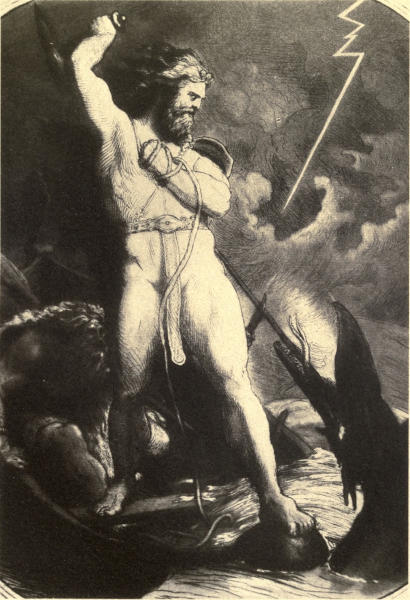
THOR, HYMIR, AND THE MIDGARD SERPENT. (From an etching by Lorenz Frölich.) Hymir, a giant and ruler of the winter sea, was the owner of a great kettle that brewed any quantity desired of the finest ale. The gods, eager to posses the kettle, sent Thor to obtain it. Proceeding to the borders of heaven, where Hymir lived, Thor assumed the form of a young man and appearing before the giant, asked permission to accompany him on a fishing excursion. The giant objected that so small a youth could not endure the hardships of such a journey, but finally consented. Thor secured necessary bait by tearing the head from a bull, and the two then set off to row far out to sea. Thor insisted upon going further until they came near the borders of the world, and the two began to fish. Hymir soon hooked and drew up two whales, which he boastfully showed as proof of his strength, but soon after Thor hooked the Midgard Serpent, which rose spouting floods of venom that greatly terrified Hymir. Thor pulled with so much strength on the line that he broke through the bottom of the boat, but his feet stood upon the bottom of the sea and he raised his hammer to strike the serpent; Hymir was so alarmed, however, that he cut the line and let the serpent escape. Thor then rowed back with Hymir to his castle, where he slew Hymir and several other giants and secured the kettle. See page 855.
A passage in Thorsdrapa (str. 3), to which I shall recur below, informs us that at the time when Thor made his famous journey to the fire-giant Geirrod, Rogner had not yet come to an agreement with Loke in regard to the plan of bringing ruin on the gods. Rogner was, therefore, during a certain period of his life, the foe of the gods, but during a preceding period he was not an enemy. The same is true of Thjasse. He was for a time hapta snytrir, "the one giving the gods treasures." At another time he carried away Idun, and appeared as one changed into dólgr ballastr vallar, "the most powerful foe of the earth" (Haustl., 6), an expression which characterises him as the cause of the fimbul-winter.
There still remain one or two important passages in regard to the correct interpretation of the epithet Rogner. In Atlakvida (33) it is said of Gudrun when she goes to meet her husband Atle, who has returned home, carrying in her hand a golden goblet, that she goes to reifa gjöld Rögnis, "to present that requital or that revenge which Rogner gave." To avenge her brothers, Gudrun slew in Atle's absence the two young sons she had with him and made goblets of their skulls. Into one of these she poured the drink of welcome for Atle. A similar revenge is told about Volund. The latter secretly kills Nidadr's two young sons and makes goblets out of their skulls for their father. In the passage it is stated that the revenge of Gudrun against Atle was of the same kind as Rogner's revenge against some one whom he owed a grudge. So far as our records contain any information, Volund is the only one to whom the epithet Rogner is applicable in this case. Of no one else is it reported that he took a revenge of such a kind that Gudrun's could be compared therewith. In all other passages the epithet Rogner refers to "the father of the swords," to the ancient artist Thjasse, the son of Alvalde. Here it refers to the father of the most excellent sword, to the ancient artist Volund, the son of Ivalde.
The strophe in Vellekla, which compares the Thjasse descendant Hakon Jarl with the hail-producing Rogner, also alludes to another point in the myth concerning him by a paraphrase the kernel of which is: Varat svanglýjadi at frýja ofbyrjar nè drifu, "it was impossible to defy the swan-pleaser in the matter of storm and bad weather." The paraphrase is made applicable to Hakon by making the "swan-pleaser" into the "pleaser of the swan of the sword's high-billowing fjord"—that is to say, the one who pleases the bird of the battlefield, that is, the raven. The storm is changed into "the storm of arrows," and the bad weather into the "bad weather of the goddess of the battle." The mythological kernel of this paraphrase, and that which sheds light on our theme, is the fact that Rogner in the mythology was "one who pleased the swans." In the heroic poem three swan-maids are devoted in their love to Volund and his brothers. Volundarkvida says that the third one lays her arms around Volund-Anund's white neck.
We will now combine the results of this investigation concerning Rogner, and in so doing we will first consider what is said of him when the name occurs independently, and not connected with paraphrases, and then what is said of him in paraphrases in which his name constitutes the kernel.
Forspjallsljod describes Rogner as dwelling on the northern-most edge of the earth at the time when Idun was absent from Asgard. There he sings magic songs and concocts witchcraft, by which means he sends a destructive winter out upon the world. He is a "smith," and in his company is found one or more than one mythic person called Regin. (Regin may be singular or plural.)
Einar Skalaglam, who received costly treasures from Hakon Jarl, speaks in his song of praise to the latter of the "works of Rogner," which please him, and which must be the treasures he received from the Jarl.
In Thorsdrapa, Eilif Gudrunson relates that Rogner had not yet "associated himself" with Loke when Thor made his expedition to Geirrod.
Atlakvida states that he revenged himself on some one, with which revenge the song compares Gudrun's when she hands to Atle the goblets made of the skulls of the two young sons of the latter.
All the facts presented in these passages are rediscovered in the myth concerning Ivalde's sons—Volund, Egil, and Slagfin. There was a time when they were the friends of the gods and smithied for them costly treasures, and there was another time when they had the same plans as Loke tried to carry out in a secret manner—that is, to dethrone the gods and destroy what they had created. They deliver their foster-son Frey, the young god of harvests, to the giants (see Nos. 109, 112)—an event which, like Idun's disappearance from Asgard, refers to the coming of the fimbul-winter—and they depart to the most northern edge of the lower world where they dwell with swan-maids, dises of growth, who, like Idun in Forspjallsljod (str. 8), must have changed character and joined the world-hostile plots of their lovers. (Of Idun it is said, in the strophe mentioned, that she clothed herself in a wolf-skin given her by the smiths, and lyndi breytti, lek at lævisi, litom skipti.) The revenge which Volund, during his imprisonment by Nidad, takes against the latter explains why Atlakvida characterises Gudrun's terrible deed as "Rogner's revenge." In regard to the witchcraft (gand) concocted by Rogner and Regin, it is to be said that the sword of victory made by Volund is a gandr in the original sense of this word—an implement endowed with magic powers, and it was made during his sojourn in the Wolfdales.
One passage in Volundarkvida (str. 5), which hitherto has defied every effort at interpretation, shows that his skill was occupied with other magic things while he dwelt there. The passage reads: Lucthi hann alla lindbauga vel. The "lind"-rings in question, smithied of "red gold" (see the preceding lines in strophe 5), are, according to the prefix, lind, linnr, serpent-formed rings, which again are gand- (witchcraft) rings on account of the mysterious qualities ascribed to the serpent. Lindbaugi is another form for linnbaugi, just as lindból is another form for linnból. The part played by the serpent in the magic arts made it, when under the influence or in the possession of the magician, a gand, whence linnr, a serpent, could be used as a paraphrase of gandr, and gandr could in turn, in the compound Jörmungandr, be used as an epithet for the Midgard-serpent. The rings which Volund "closed well together" are gand-rings. The very rope (bast, böstr—Volundarkvida, 7, 12) on which he hangs the seven hundred gand-rings he has finished seems to be a gand, an object of witchcraft, with which Volund can bind and from which he can release the wind. When Nidad's men surprised Volund in his sleep and bound him with this rope, he asks ambiguously who "had bound the wind" with it (str. 12). In two passages in Volundarkvida (str. 4, 8) he is called vedreygr, "the storm-observer," or "the storm-terrible." The word may have either meaning. That Volund for his purposes, like Rogner, made use of magic songs is manifest from Saxo (Hist., 323, 324). According to Saxo it was by means of Volund-Haquinus' magic song that the Volund-sword, wielded by Svipdag-Ericus, was able to conquer Thor's hammer and Halfdan's club.
Passing now to the passages where the name Rogner occurs in paraphrases, I would particularly emphasize what I have already demonstrated: that Haustlaung with this name refers to Thjasse; that poems of a more recent date than Haustlaung, and connected with the same celebrated song, apply it to the supposed descendants of Thjasse, Hakon Jarl and his kinsmen; that all of these paraphrases represent Rogner as a producer of storm, snow, and hail; and that Rogner made "wind-cars," was a "Regin of the motion of the feather-leaf" (the wing), and "one who pleased the swans." Therefore (a) Rogner is an epithet of Thjasse, and at the same time it designates Volund; (b) all that is said of Rogner, when the name in the paraphrases is a Thjasse-epithet, applies to Volund; (c) all that is said of Rogner, independently of paraphrases, applies to Volund.
(18) A usage in the Old Norse poetry is to designate a person by the name of his opponent, when, by means of an additional characterisation, it can be made evident that the former and not the latter is meant. Thus, a giant can be called berg-thórr or grjót-Módi, because he once had Thor or Thor's son Mode as an opponent, and these epithets particularly apply to giants who actually fought with Thor or Mode in the mythology. In contrast with their successors in Christian times, the heathen skalds took great pains to give their paraphrases special justification and support in some mythological event. For the same reason that a giant who had fought with Mode could be called grjót-Módi, Volund, as Nidad's foe, could be called grjót-Nidudr. This epithet also occurs a single time in the Old Norse poetry, namely, in Haustlaung, and there it is applied to Thjasse. The paraphrase shows that the skald had in his mind a corresponding (antithetic) circumstance between Thjasse and Nidadr (Nidudr). What we are able to gather from our sources is, that Volund and Nidadr had had an encounter, and that one of so decisive a character, that the epithet grjót-Nidudr naturally would make the hearers think of Volund.
(19) When Loke had struck Thjasse, who was in eagle guise, with the magic pole, Thjasse flew up; and as Loke's hand was glued fast to one end of the pole and the eagle held fast to the other end, Loke had to accompany the eagle on its flight. Haustlaung says that Thjasse, pleased with his prey, bore him a long distance (of veg lángan) through the air. He directed his course in such a manner that Loke's body fared badly, probably being dragged over trees and rocks (svá at slitna sundr úlfs födor mundi). Then follows in the poem the lines given below, which I quote from Codex Regius, with the exception of a single word (midjungs, instead of mildings), which I cite from Codex Wormianus. Here, as elsewhere, I base nothing on text emendations, because even such, for which the best of reasons may be given, do not furnish sufficient foundation for mythological investigation, when the changes are not supported by some manuscript, or are in and of themselves absolutely necessary.
thá vard thórs ofrunni, thúngr var Loptr, of sprúnginn; málunautr hvats mátti midjungs fridar bidja.
The contents of these lines, in the light of what has now been stated, are as follows:
Thjasse's pleasure in dragging Loke with him, and making his limbs come in disagreeable contact with objects on their way, was so great that he did not abstain therefrom, before he felt that he had over-exerted himself. Strong as he was, this could not but happen, for he had been flying with his burden very far from the place where he captured Loke in the ambush he had laid; and, besides, Loke was heavy. The badly-hurt Loke had during the whole time desired to beg for mercy, but during the flight he was unable to do so. When Thjasse finally sank to the ground, Loke obtained a breathing space, so that he could sue for mercy.
In the four lines there are four paraphrases. Thjasse is called thórs ofrunni or thórs ofrúni, "he who made Thor run," or "he who was Thor's friend," and "midjungr," a word the meaning of which it is of no importance to investigate in connection with the question under consideration. Loke is called Loptr, a surname which is applied to him many times, and málunautr hvats midjungs, "he who had journeyed with the female companion of the powerful Midjung (Thjasse)." The female companion (mála) of Thjasse is Idun, and the paraphrase refers to the myth telling how Loke carried Idun away from Thjasse's halls, and flew with her to Asgard.
With these preparatory remarks I am ready to present a literal translation of the passage:
(Thjasse flew a long way with Loke, so that the latter came near being torn into pieces), "... thereupon (thá = deinde) became he who caused Thor to run (vard Ihórs ofrunni)—or who became Thor's friend (Ihórs ofrúni)—tired out (ofsprúnginn), (for) Lopt was heavy (thúngr var Loptr). He (Loke) who had made a journey with the powerful Midjung's (Thjasse's) female companion (málunautr hvats midjungs) could (now finally) sue for peace (mátti fridar bidja)."
In the lines—
thá vard thórs ofrunni thúngr var Loptr, ofsprúnginn—
thúngr var Loptr clearly stands as an intermediate sentence, which, in connection with what has been stated above, namely, that Thjasse had been flying a long way with his burden, will justify and explain why Thjasse, though exceedingly strong, stronger than Hrungnir (the Grotte-song), still was at the point of succumbing from over-exertion. The skald has thus given the reason why Thjasse, "rejoicing in what he had caught," sank to the earth with his victim, before Loke became more used up than was the case. To understand the connection, the word mátti in the third line is of importance. Hitherto the words málunautr hvats mátti midjungs fridar bidja have been interpreted as if they meant that Loke "was compelled" to ask Thjasse for peace. Mátti has been understood to mean coactus est. Finnur Jonsson (Krit. Stud., p. 48) has pointed out that not a single passage can with certainty or probability be found where the verb mega, mátti, means "to be compelled." Everywhere it can be translated "to be able." Thus the words mátti fridar bidja mean that Loke could, was able to, ask Thjasse for peace. The reason why he was able is stated above, where it is said that Thjasse got tired of flying with his heavy burden. Before that, and during the flight and the disagreeable collisions between Loke's body and objects with which he came in contact, he was not able to treat with his capturer; but when the latter had settled on the ground, Loke got a breathing space, and could beg to be spared. The half strophe thus interpreted gives the most logical connection, and gives three causes and three results: (1) Loke was able to use his eloquent tongue in speaking to Thjasse, since the latter ceased to fly before Loke was torn into pieces; (2) Thor's ofrunni or ofrúni ended his air-journey, because he, though a very powerful person, felt that he had over-exerted himself; (3) he felt wearied because Loke, with whom he had been flying, was heavy. But from this it follows with absolute certainty that the skald, with Thor's ofrunni or ofrúni, meant Thjasse and not Loke, as has hitherto been supposed. The epithet Thor's ofrunni, "he who made Thor run," must accordingly be explained by some mythic event, which shows that Thor at one time had to take flight on account of Thjasse. A single circumstance has come to our knowledge, where Thor retreats before an opponent, and it is hardly credible that the mythology should allow its favourite to retreat conquered more than once. On that occasion it is Volund's sword, wielded by Svipdag, which cleaves Thor's hammer and compels him to retire. Thus Volund was at one time Thor's ofrunni. In Haustlaung it is Thjasse. Here, too, we therefore meet the fact which has so frequently come to the surface in these investigations, namely, that the same thing is told of Volund and of Thjasse.
But by the side of ofrunni we have another reading which must be considered. Codex Wormianus has ofrúni instead of ofrunni, and, as Wisén has pointed out, this runni must, for the sake of the metre, be read rúni. According to this reading Thjasse must at some time have been Thor's ofrúni, that is, Thor's confidential friend. This reading also finds its support in the mythology, as shall be demonstrated further on. I may here be allowed to repeat what I have remarked before, that of two readings only the one can be the original, while both may be justified by the mythology.
(20) In the mythology are found characters that form a group by themselves, and whose characteristic peculiarity is that they practise skee-running in connection with the use of the bow and arrow. This group consists of the brothers Volund, Egil, Slagfin, Egil's son Ull, and Thjasse's daughter Skade. In the introduction to Volundarkvida it is said of the three brothers that they ran on skees in the Wolfdales and hunted. We have already referred to Egil's wonderful skees, that could be used on the water as well as on the snow. Of Ull we read in Gylfaginning (Younger Edda, i. 102): "He is so excellent an archer and skee-runner that no one is his equal;" and Saxo tells about his Ollerus that he could enchant a bone (the ice-shoe formed of a bone, the pendant of the skee), so that it became changed into a ship. Ull's skees accordingly have the same qualities as those of his father Egil, namely, that they can also be used on the sea. Ull's skees seem furthermore to have had another very remarkable character, namely, that when their possessor did not need them for locomotion on land or on sea, they could be transformed into a shield and be used in war. In this way we explain that the skalds could employ skip Ullar, Ullar far, knörr Örva áss, as paraphrases for shields, and that, according to one statement in the Edda Lovasina, Ullr átti skip that, er Skjöldr hét. So far as his accomplishments are concerned, Ull is in fact the counterpart of his father Egil, and the same may be said of Skade. While Ull is called "the god of the skees," Skade is called "the goddess of the skees," "the dis of the skees," and "the dis of the sea-bone," sævar beins dis, a paraphrase which manifestly has the same origin as Saxo's account of the bone enchanted by Ull. Thus Thjasse's daughter has an attribute belonging to the circle of Volund's kinsmen.