THE MYTH IN REGARD TO THE LOWER WORLD. (Part IV. Continued from Volume I.) (continued 5)
Rasmus Björn Anderson translation
Heimdal's antithesis in all respects, and therefore also his constant opponent in the mythological epic, is Loke, he too a fire-being, but representing another side of this element. Natural agents such as fire, water, wind, cold, heat, and thunder have in the Teutonic mythology a double aspect. When they work in harmony, each within the limits which are fixed by the welfare of the world and the happiness of man, then they are sacred forces and are represented by the gods. But when these limits are transgressed, giants are at work, and the turbulent elements are represented by beings of giant-race. This is also true of thunder, although it is the common view among mythologists that it was regarded exclusively as a product of Thor's activity. The genuine mythical conception was, however, that the thunder which purifies the atmosphere and fertilises the thirsty earth with showers of rain, or strikes down the foes of Midgard, came from Thor; while that which splinters the sacred trees, sets fire to the woods and houses, and kills men that have not offended the gods, came from the foes of the world. The blaze-element (see No. 35) was not only in the possession of the gods, but also in that of the giants (Skirnersmal), and the lightning did not proceed alone from Mjolner, but was also found in Hrungner's hein and in Geirrod's glowing javelin. The conflicts between Thor and the giants were not only on terra firma, as when Thor made an expedition on foot to Jotunheim, but also in the air. There were giant-horses that were able to wade with force and speed through the atmosphere, as, for instance, Hrungner's Gullfaxi (Younger Edda, i. 270), and these giant-horses with their shining manes, doubtless, were expected to carry their riders to the lightning-conflict in space against the lightning-hurler, Thor. The thunder-storm was frequently a vig thrimu, a conflict between thundering beings, in which the lightnings hurled by the ward of Midgard, the son of Hlodyn, crossed the lightnings hurled by the foes of Midgard.
Loke and his brothers Helblindi and Byl-eistr are the children of a giant of this kind, of a giant representing the hurricane and thunder. The rain-torrents and waterspouts of the hurricane, which directly or indirectly became wedded to the sea through the swollen streams, gave birth to Helblinde, who, accordingly, received Rán as his "maid" (Yngl., 51). The whirlwind in the hurricane received as his ward Byleistr, whose name is composed of bylr, "whirlwind," and eistr, "the one dwelling in the east" (the north), a paraphrase for "giant." A thunderbolt from the hurricane gave birth to Loke. His father is called Fárbauti, "the one inflicting harm," and his mother is Laufey, "the leaf-isle," a paraphrase for the tree-crown (Younger Edda, 104, 268). Thus Loke is the son of the burning and destructive lightning, the son of him who particularly inflicts damaging blows on the sacred oaks (see No. 36) and sets fire to the groves. But the violence of the father does not appear externally in the son's character. He long prepares the conflagration of the world in secret, and not until he is put in chains does he exhibit, by the earthquakes he produces, the wild passion of his giant nature. As a fire-being, he was conceived as handsome and youthful. From an ethical point of view, the impurity of the flame which he represents is manifested by his unrestrained sensuousness. After he had been for ever exiled from the society of the gods and had been fettered in his cave of torture, his exterior, which was in the beginning beautiful, became transformed into an expression of his intrinsic wickedness, and his hair grew out in the form of horny spears (see above). In this too he reveals himself as a counterpart of Heimdal, whose helmet is ornamented with a glittering ram's horn.
83.
MUNDILFORE'S IDENTITY WITH LODUR.
The position which we have found Mundilfore to occupy indicates that, although not belonging to the powers dwelling in Asgard, he is one of the chief gods of the Teutonic mythology. All natural phenomena, which appear to depend on a fixed mechanical law and not on the initiative of any mighty will momentarily influencing the events of the world, seem to have been referred to his care. The mythology of the Teutons, like that of the Rigveda-Aryans, has had gods of both kinds—gods who particularly represent that order in the physical and moral world which became fixed in creation, and which, under normal conditions, remain entirely uniform, and gods who particularly represent the powerful temporary interference for the purpose of restoring this order when it has been disturbed, and for the purpose of giving protection and defence to their worshippers in times of trouble and danger. The latter are in their very nature war-gods always ready for battle, such as Vita and Indra in Rigveda, Odin and Thor-Indride in the Eddas; and they have their proper abode in a group of fortified celestial citadels like Asgard, whence they have their out-look upon the world they have to protect—the atmosphere and Midgard. The former, on the other hand, have their natural abode in Jormungrund's outer zone and in the lower world, whence the world-tree grew, and where the fountains are found whose liquids penetrate creation, and where that wisdom had its source of which Odin only, by self-sacrifice, secured a part. Down there dwell, accordingly, Urd and Mimer, Nat and Dag, Mundilfore with the dises of the sun and the moon, Delling, the genius of the glow of dawn, and Billing, the genius of the blushing sunset. There dwell the smiths of antiquity who made the chariots of the sun and moon and smithied the treasures of vegetation. There dwell the nidjar who represent the moon's waxing and waning; there the seven sons of Mimer who represent the changing seasons (see No. 87). Mundilfore is the lord of the regular revolutions of the starry firmament, and of the regular rising and sinking of the sea in its ebb and flood. He is the father of the dises of the sun and moon, who make their celestial journeys according to established laws; and, finally, he is the origin of the holy fire; he is father of Heimdal, who introduced among men a systematic life in homes fixed and governed by laws. As the father of Heimdal, the Vana-god, Mundilfore is himself a Vana-god, belonging to the oldest branch of this race, and in all probability one of those "wise rulers" who, according to Vafthrudnersmal, "created Njord in Vanaheim and sent him as a hostage to the gods (the Asas)."
Whence came the clans of the Vans and the Elves? It should not have escaped the notice of the mythologists that the Teutonic theogony, as far as it is known, mentions only two progenitors of the mythological races—Ymer and Bure. From Ymer develop the two very different races of giants, the offspring of his arms and that of his feet (see No. 86)—in other words, the noble race to which the norns Mimer and Beistla belong, and the ignoble, which begins with Thrudgelmer. Bure gives birth to Burr (Bor), and the latter has three sons—Odinn, Vei (Vé), and Vili (Vilir). Unless Bure had more sons, the Van- and Elf-clans have no other theogonic source than the same as the Asa-clan, namely, Burr. That the hierologists of the Teutonic mythology did not leave the origin of these clans unexplained we are assured by the very existence of a Teutonic theogony, together with the circumstance that the more thoroughly our mythology is studied the more clearly we see that this mythology has desired to answer every question which could reasonably be asked of it, and in the course of ages it developed into a systematic and epic whole with clear outlines sharply drawn in all details. To this must be added the important observation that Vei and Vili, though brothers of Odin, are never counted among the Asas proper, and had no abode in Asgard. It is manifest that Odin himself with his sons founds the Asa-race, that, in other words, he is a clan-founder in which this race has its chieftain, and that his brothers, for this very reason, could not be included in his clan. There is every reason to assume that they, like him, were clan-founders; and as we find besides the Asa-clan two other races of gods, this of itself makes it probable that Odin's two brothers were their progenitors and clan-chieftains.
Odin's brothers, like himself, had many names. When Völuspa says that Odin, in the creation of man, was assisted by Honer and Loder, and when the Younger Edda (i. 52) says that, on this occasion, he was attended by his brothers, who just before (i. 46) are called Ve and Vile, then these are only different names of the same powers. Honer and Loder are Ve and Vile. It is a mistake to believe that Odin's brothers were mythical ghosts without characteristic qualities, and without prominent parts in the mythological events after the creation of the world and of man, in which we know they took an active part (Völuspa, 4, 16, 17). The assumption that this was the case depends simply upon the fact that they have not been found mentioned among the Asas, and that our records, when not investigated with proper thoroughness, and when the mythological synonymics have not been carefully examined, seem to have so little to say concerning them.
Danish genealogies, Saxo's included, which desire to go further back in the genealogy of the Skjoldungs than to Skjold, the eponym of the race, mention before him a King Lotherus. There is no doubt that Lotherus, like his descendants, Skjold, Halfdan, and Hadding, is taken from the mythology. But in our mythic records there is only one name of which Lotherus can be a Latinised form, and this name is, as Müller (Notæ ulterior ad Saxonis Hist.) has already pointed out, Lodurr.
It has above been demonstrated (see Nos. 20, 21, 22) that the anthropomorphous Vana-god Heimdal was by Vana-gods sent as a child to the primeval Teutonic country, to give to the descendants of Ask and Embla the holy fire, tools, and implements, the runes, the laws of society, and the rules for religious worship. It has been demonstrated that, as an anthropomorphous god and first patriarch, he is identical with Scef-Rig, the Scyld of the Beowulf poem, that he becomes the father of the other original patriarch Skjold, and the grandfather of Halfdan. It has likewise been demonstrated (No. 82) that Heimdal, the personified sacred fire, is the son of the fire-producer (by friction) Mundilfore, in the same manner as Agni is the son of Matariçvan. From all this it follows that when the authors of mythic genealogies related as history wish to get further back in the Skjoldung genealogy than to the Beowulf Skjold, that is to say, further back than to the original patriarch Heimdal, then they must go to that mythic person who is Heimdal's father, that is to say, to Mundilfore, the fire-producer. Mundilfore is the one who appears in the Latinised name Lotherus. In other words, Mundilfore, the fire-producer, is Lodurr. For the name Lodurr there is no other rational explanation than that which Jacob Grimm, without knowing his position in the epic of mythology, has given, comparing the name with the verb lodern, "to blaze." Lodurr is active in its signification, "he who causes or produces the blaze," and thus refers to the origin of fire, particularly of the friction-fire and of the bore-fire.
Further on (Nos. 90, 91, 92, 121, 123) I shall give an account of the ward of the atmosphere, Gevarr (Nökkvi, Næfr), and demonstrate that he is identical with Mundilfore, the revolver of the starry firmament. All that Saxo tells about Lotherus is explained by the character of the latter as the chieftain of a Vana-clan, and by his identity with Mundilföri-Gevarr. As a chieftain of the Vans he was their leader when the war broke out between the Asas on the one side, and the Vans and Elves on the other. The banishment of Odin and the Asas by the Vans causes Saxo to say that Lotherus banished from the realm persons who were his equals in noble birth (nobilitate pares), and whom he regarded as competitors in regard to the government. It is also stated that he took the power from an elder brother, but spared his life, although he robbed him of the sceptre. The brother here referred to is not, however, Odin, but Hænir (Vei). The character of the one deposed is gentle and without any greed for rule like that by which Honer is known. Saxo says of him that he so patiently bore the injustice done him that he seemed to be pleased therewith as with a kindness received (ceterum injuriæ tam patiens fuit, ut honoris damno tanquam beneficio gratulari crederetur). The reason why Honer, at the outbreak of the war with the Asas, is deposed from his dignity as the ruler of Vanaheim and is succeeded by Loder, is explained by the fact that he, like Mimer, remained devoted to the cause of Odin. In spite of the confused manner in which the troubles between the Asas and Vans are presented in Heimskringla, it still appears that, before the war between the Asas and Vans, Honer was the chief of the latter on account of an old agreement between the two god-clans; that he then always submitted to the counsels of the wise Mimer, Odin's friend; that Mimer lost his life in the service of Odin, and that the Vans sent his head to Odin; and, finally, that, at the outbreak of the feud with the Asas and after the death of Mimer, they looked upon Honer as unqualified to be their judge and leader. Thus Loder becomes after Honer the ruler of Vanaheim and the chieftain of the Vans, while the Vans Njord, Frey, and the Elf Ull, who had already been adopted in Asgard, administer the affairs of the rest of the world. To the mythical circumstance, that Honer lost his throne and his power points also Völuspa, the poem restoring to the gentle and patient Vana-god, after the regeneration, the rights of which he had been robbed, thá kná Hænir hlautvid kjosa (str. 60). "Then Honer becomes able to choose the lot-wood," that is to say, he is permitted to determine and indicate the fortunes of those consulting the oracle; in other words, then he is again able to exercise the rights of a god. In the Eddas, Honer appears as Odin's companion on excursions from Asgard. Skaldskaparmal, which does not seem to be aware that Honer was Odin's brother, still is conscious that he was intimately connected with him and calls him his sessi, sinni, and máli (Younger Edda, i. 266). During the war between Asas and Vans, Frigg espoused the cause of the Vans (see No. 36); hence Loke's insulting words to her (Lokasenna, 26), and the tradition in Heimskringla (Yngl., 3), that Vilir and Vei took Frigg to themselves once when Odin was far away from Asgard.
Saxo makes Lotherus fall at the hands of conspirators. The explanation of this statement is to be sought in Mundilföri-Gevarr's fate, of which, see Nos. 91, 123.
Mundilfore's character seems at least in one respect to be the opposite of Honer's. Gylfaginning speaks of his ofdrambi, his pride, founded, according to this record, on the beauty of his children. Saxo mentions the insolentia of Lotherus, and one of his surnames was Dulsi, the proud. See No. 89, where a strophe is quoted, in which the founder of the Swedish Skilfing race (the Ynglings) is called Dulsa knor, Dulse's descendant. As was shown above in the account of the myth about Scef, the Skjoldungs, too, are Skilfings. Both these branches of the race have a common origin; and as the genealogy of the Skjoldungs can be traced back to Heimdal, and beyond him to Mundilfore, it must be this personality who is mentioned for his ofdrambi, that bears the surname Dulsi.
With Odin, Vei-Höner and Vili-Lodurr-Mundilföri have participated in the shaping of the world as well as in the creation of man. Of the part they took in the latter act, and of the importance they thereby acquired in the mythical anthropology, and especially in the conceptions concerning the continued creation of man by generation and birth, see No. 95.
84.
NAT, THE MOTHER OF THE GODS.
It has already been shown above that Nat, the mother of the gods, has her hall in the northern part of Mimer's realm, below the southern slopes of the Nida mountains.
There has been, and still is, an interpretation of the myths as symbols. Light is regarded as the symbol of moral goodness, and darkness as that of moral evil. That there is something psychologically correct in this cannot be denied; but in regard to the Aryan religions the assumption would lead to a great error, if, as we might be tempted to do, we should make night identical with darkness, and should refer her to the world of evil. In the mythologies of the Rigveda-Aryans and of the Teutons, Nat is an awe-inspiring, adorable, noble, and beneficent being. Night is said in Rigveda "to have a fair face, to increase riches, and to be one of the mothers of order." None of the phenomena of nature seemed to the Teutons evil per se; only when they transgressed what was thought to be their lawful limits, and thus produced injury and harm, were giant-powers believed to be active therein. Although the Teutonic gods are in a constant, more or less violent conflict with the powers of frost, still winter, when it observes its limits of time, is not an evil but a good divinity, and the cold liquids of Hvergelmer mixed with those of Urd's and Mimer's fountains are necessary to the world-tree. Still less could night be referred to the domain of demons. Mother Nat never transgresses the borders of her power; she never defies the sacred laws, which are established for the order of the universe. According to the seasons of the year, she divides in an unvarying manner the twenty-four hours between herself and day. Work and rest must alternate with each other. Rich in blessing, night comes with solace to the weary, and seeks if possible to sooth the sufferer with a potion of slumber. Though sombre in appearance (Gylfy., 10), still she is the friend of light. She decorates herself with lunar effulgence and with starry splendour, with winning twilight in midsummer, and with the light of snow and of northern aurora in the winter. The following lines in Sigrdrifumal (str., 3, 4) sound like a reverberation from the lost liturgic hymns of our heathendom.
Heill Dagr, heilir Dags synir, heil Nott ok Nipt! Oreithom augom litith ocr thinig oc gefit sitiondom règr! Heilir æsir, heilar asynjor, heil sia in fiolnyta fold! Hail Dag, Hail Dag's sons, Hail Nat and Nipt! Look down upon us With benevolent eyes And give victory to the sitting! Hail Asas, Hail Asynjes, Hail bounteous earth!
Of the Germans in the first century after Christ, Tacitus writes (Germ., 3): "They do not, as we, compute time by days but by nights, night seems to lead the day" (nec dierum numerum, ut nos, sed noctium computant: nox ducere diem videtur). This was applicable to the Scandinavians as far down as a thousand years later. Time was computed by nights not by days, and in the phrases from heathen times, nótt ok dagr, nótt med degi bædi um nætr ok um daga, night is named before day. Linguistic usage and mythology are here intimately associated with each other. According to Vafthrudnersmal (25) and Gylfaginning (10), Nat bore with Delling the son Dag, with whom she divided the administration of the twenty-four hours. Delling is the elf of the morning red (see No. 35). The symbolism of nature is here distinct as in all theogonies.
Through other divinities, Naglfari and Ónarr (Anarr, Aunarr), Nat is the mother with the former of Unnr (Udr), also called Audr, with the latter of the goddess Jord, Odin's wife. Unnr means water, Audr means rich. It has above been shown that Unnr-Audr is identical with Njord, the lord of wealth and commerce, who in the latter capacity became the protector of navigators, and to whom sacrifices were offered for a prosperous voyage. Gods of all clans—Asas, Vans, and Elves—are thus akin to Nat, and are descended from her.
85.
NARFI, NAT'S FATHER, IDENTICAL WITH MIMER. A PSEUDO-NARFI IN THE YOUNGER EDDA.
Nat herself is the daughter of a being whose name has many forms.
Naurr, Nörr (dative Naurvi, Nörvi, Nott var Naurvi borin—Vafthrudnersmal, 25; Nott, Naurvi kenda—Alvism., 29).
Narfi, Narvi (niderfi Narfa—Egil Skallagr., 56, 2; Gylfag., 10).
Norvi, Nörvi (Gylfag., 10; kund Nörva—Forspjallsl., 7).
Njörfi, Njörvi (Gylfag., 10; Njörva nipt—Sonatorr.).
Nori (Gylfag., 10).
Nari (Höfudl., 10).
Neri (Helge Hund., 1).
All these variations are derived from the same original appellation, related to the Old Norse verb njörva, the Old English nearwian meaning "the one that binds," "the one who puts on tight-fitting bonds."
Simply the circumstance that Narve is Nat's father proves that he must have occupied one of the most conspicuous positions in the Teutonic cosmogony. In all cosmogonies and theogonies night is one of the oldest beings, older than light, without which it cannot be conceived. Light is kindled in the darkness, thus foreboding an important epoch in the development of the world out of chaos. The being which is night's father must therefore be counted among the oldest in the cosmogony. The personified representatives of water and earth, like the day, are the children of his daughter.
What Gylfaginning tells of Narve is that he was of giant birth, and the first one who inhabited Jotunheim (Norvi eda Narfi hét jötun, er bygdi fyrst Jotunheima—Gylfag., 10). In regard to this we must remember that, in Gylfaginning and in the traditions of the Icelandic sagas, the lower world is embraced in the term Jotunheim, and this for mythical reasons, since Nifelheim is inhabited by rimthurses and giants (see No. 60), and since the regions of bliss are governed by Mimer and by the norns, who also are of giant descent. As the father of the lower-world dis, Nat, Narve himself belongs to that group of powers, with which the mythology peopled the lower world. The upper Jotunheim did not exist before in a later epoch of the cosmogonic development. It was created simultaneously with Midgard by Odin and his brothers (Gylfaginning).
In a strophe by Egil Skallagrimson (ch. 56), poetry, or the source of poetry, is called niderfi Narfa, "the inheritance left by Narve to his descendants." As is well known, Mimer's fountain is the source of poetry. The expression indicates that the first inhabitant of the lower world, Narve, also presided over the precious fountain of wisdom and inspiration, and that he died and left it to his descendants as an inheritance.
Finally, we learn that Narve was a near kinsman to Urd and her sisters. This appears from the following passages:
(a) Helge Hundingsbane (1, 3, ff.). When Helge was born norns came in the night to the abode of his parents, twisted the threads of his fate, stretched them from east to west, and fastened them beneath the hall of the moon. One of the threads nipt Nera cast to the north and bade it hold for ever. It is manifest that by Nere's (Narve's) kinswoman is meant one of the norns present.
(b) Sonatorr. (str. 24). The skald Egil Skallagrimson, weary of life, closes his poem by saying that he sees the dis of death standing on the ness (Digraness) near the grave-mound which conceals the dust of his father and of his sons, and is soon to receive him:
Tveggja bága Njörva nipt a nesi stendr. Skal ek thó gladr med gódan vilja ok úhryggr Heljar bida. The kinswoman of Njorve (the binder) of Odin's (Tvegge's) foes stands on the ness. Then shall I be glad, with a good will, and without remorse, wait for Hel.
It goes without saying that the skald means a dis of death, Urd or one of her messengers, with the words, "The kinswoman of Njorve (the binder) of Odin's foes," whom he with the eye of presentiment sees standing on the family grave-mound on Digraness. She is not to stop there, but she is to continue her way to his hall, to bring him to the grave-mound. He awaits her coming with gladness, and as the last line shows, she whose arrival he awaits is Hel, the goddess of death or fate. It has already been demonstrated that Hel in the heathen records is always identical with Urd.
Njorve is here used both as a proper and a common noun. "The kinswoman of the Njorve of Odin's foes" means "the kinswoman of the binder of Odin's foes." Odin's foe Fenrer was bound with an excellent chain smithied in the lower world (dwarfs in Svartalfheimr—Gylfag., 37), and as shall be shown later, there are more than one of Odin's foes who are bound with Narve's chains (see No. 87).
(c) Hofudlausn (str. 10). Egil Skallagrimson celebrates in song a victory won by Erik Blood-axe, and says of the battle-field that there trad nipt Nara náttverd ara ("Nare's kinswoman trampled upon the supper of the eagles," that is to say, upon the dead bodies of the fallen). The psychopomps of disease, of age, and of misfortunes have nothing to do on a battle-field. Thither come valkyries to fetch the elect. Nipt Nara must therefore be a valkyrie, whose horse tramples upon the heaps of dead bodies; and as Egil names only one shield-maid of that kind, he doubtless has had the most representative, the most important one in mind. That one is Skuld, Urd's sister, and thus a nipt Nara like Urd herself.
(d) Ynglingatal (Ynglingasaga, ch. 20). Of King Dygve, who died from disease, it is said that jódis Narva (jódis Nara) chose him. The right to choose those who die from disease belongs to the norns alone (see No. 69). Jódis, a word doubtless produced by a vowel change from the Old Germanic idis, has already in olden times been interpreted partly as horse-dis (from jór, horse), partly as the dis of one's kin (from jod, child, offspring). In this case the skald has taken advantage of both significations. He calls the death-dis ulfs ok Narva jódis, the wolf's horse-dis, Narve's kin-dis. In regard to the former signification, it should be remembered that the wolf is horse for all giantesses, the honoured norns not excepted. Cp. grey norna as a paraphrase for wolf.
Thus what our mythic records tell us about Narve is:
(a) He is one of the oldest beings of theogony, older than the upper part of the world constructed by Bur's sons.
(b) He is of giant descent.
(c) He is father of Nat, father-in-law of Nagelfar, Onar, and of Delling, the elf of the rosy dawn; and he is the father of Dag's mother, of Unnr, and of the goddess Jord, who becomes Odin's wife and Thor's mother. Bonds of kinship thus connect him with the Asas and with gods of other ranks.
(d) He is near akin to the dis of fate and death, Urd and her sisters. The word nipt, with which Urd's relation to him is indicated, may mean sister, daughter, and sister's daughter, and consequently does not state which particular one of these it is. It seems upon the whole to have been applied well-nigh exclusively in regard to mythic persons, and particularly in regard to Urd and her sisters (cp. above: Njörva nipt, nipt Nara, nipt Nera), so that it almost acquired the meaning of dis or norn. This is evident from Skaldskaparmal, ch. 75: Nornir heita thær er naud skapa; Nipt ok Dis nú eru taldar, and from the expression Heil Nótt ok Nipt in the above-cited strophe from Sigrdrifumal. There is every reason for assuming that the Nipt, which is here used as a proper noun, in this sense means the dis of fate and as an appellation of kinship, a kinswoman of Nat. The common interpretation of heil Nótt ok Nipt is "hail Nat and her daughter," and by her daughter is then meant the goddess Jord; but this interpretation is, as Bugge has shown, less probable, for the goddess Jord immediately below gets her special greeting in the words: heil sia in fiolnyta Fold! ("hail the bounteous earth!")
(e) As the father of Nat, living in Mimer's realm, and kinsman of Urd, who with Mimer divides the dominion over the lower world, Narve is himself a being of the lower world, and the oldest subterranean being; the first one who inhabited Jotunheim.
(f) He presided over the subterranean fountain of wisdom and inspiration, that is to say, Mimer's fountain.
(g) He was Odin's friend and the binder of Odin's foes.
(h) He died and left his fountain as a heritage to his descendants.
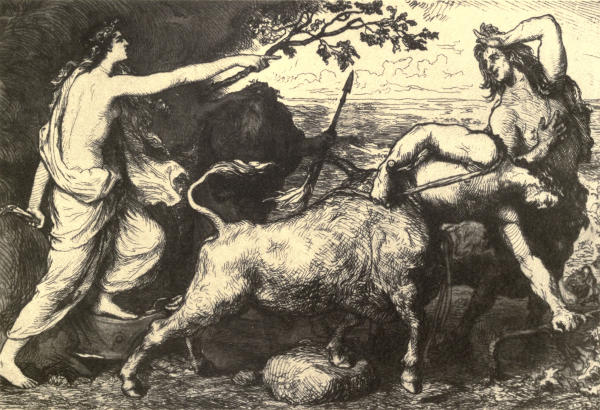
GEFION AND KING GYLPHI. (From an etching by Lorenz Frölich.) It is told that once when Gylphi, King of Sweden and Denmark, was sorely distressed, Gefion, "the giver," appeared before him in the form of a charming maiden and so delighted the king with a song, accompanied with dulcet notes of her harp, that Gylphi offered to bestow upon her any guerdon she might ask. To this proffer the divine Gefion replied, that if she had found so much favor in the eyes of her sovereign as to merit so great a reward, she asked that as much land might be given her as could be ploughed around by her four bulls in a day and night. Surprised at the modesty of her request Gylphi immediately granted it. Thereupon Gefion brought four wonderful bulls which she harnessed to a plow that had a hundred shares and ploughed the sea day and night, raising earth out of the water until the island of Zealand was formed, upon which she built a castle and established a kingdom. By her magic spells she transformed the four bulls into as many youths, who were indeed her sons by a giant. Soon afterwards she married Skjöld and became mother of a long line of kings.
As our investigation progresses it will be found that all these facts concerning Narve apply to Mimer, that "he who thinks" (Mimer) and "he who binds" (Narve) are the same person. Already the circumstances that Narve was an ancient being of giant descent, that he dwelt in the lower world and was the possessor of the fountain of wisdom there, that he was Odin's friend, and that he died and left his fountain as an inheritance (cp. Mims synir), point definitely to Narve's and Mimer's identity. Thus the Teutonic theogony has made Thought the older kinsman of Fate, who through Nat bears Dag to the world. The people of antiquity made their first steps toward a philosophical view of the world in their theogony.
The Old English language has preserved and transferred to the Christian Paradise a name which originally belonged to the subterranean region of bliss of heathendom—Neorxenavang. Vang means a meadow, plain, field. The mysterious Neorxena looks like a genitive plural. Grein, in his Anglo-Saxon Dictionary, and before him Weinhold, refers neorxena to Narve, Nare, and this without a suspicion that Narve was an epithet of Mimer and referred to the king of the heathen regions of bliss. I consider this an evidence that Grein's assumption is as correct as it is necessary, if upon the whole we are to look for an etymological explanation of the word. The plural genitive, then, means those who inhabit Narve's regions of bliss, and receive their appellation from this circumstance. The opposite Old Norse appellation is njarir, a word which I shall discuss below.
To judge from certain passages in Christian writings of the thirteenth century, Mimer was not alone about the name Narve, Nare. One or two of Loke's sons are supposed to have had the same name. The statements in this regard demand investigation, and, as I think, this will furnish another instructive contribution to the chapter on the confusion of the mythic traditions, and on the part that the Younger Edda plays in this respect. The passages are:
(a) The prosaic afterword to Lokasenna: "He (Loke) was bound with the entrails of his son Nari, but his son Narfi was turned into a wolf."
(b) Gylfaginning, ch. 33. (1) Most of the codices: "His (Loke's) wife is hight Sygin; their son is Nari or Narvi."
(2) Codex Hypnonesiensis: "His (Loke's) wife is hight Sygin; his sons are hight Nari or Narvi and Vali."
(c) Gylfaginning, ch. 50. (1) Most of the codices: "Then were taken Loke's sons Vali and Nari or Narfi. The Asas changed Vali into a wolf, and the latter tore into pieces his brother Narfi. Then the Asas took his entrails and therewith bound Loke."
(2) Codex Upsalensis: "Then were taken Loke's sons Vali and Nari. The Asas changed Vali into a wolf, and the latter tore into pieces his brother Nari."
(d) Skaldskaparmal, ch. 16. (1) "Loke is the father of the wolf Fenrer, the Midgard-serpent, and Hel, 'and also of Nari and Ali.'"
(2) Codex Wormianus and Codex Hypnonesiensis, 3: "Loke is father of the Fenris-wolf, of the Midgard-serpent, and of Hel, 'and also of Nari and Vali.'"
The mythology has stated that Loke was bound with chains which were originally entrails, and that he who contributed the materials of these chains was his own son, who was torn into pieces by his brother in wolf guise. It is possible that there is something symbolic in this myth—that it originated in the thought that the forces created by evil contend with each other and destroy their own parent. There is at least no reason for doubting that this account is a genuine myth, that is to say, that it comes from a heathen source and from some heathen poem.
But, in regard to the names of Loke's two sons here in question, we have a perfect right to doubt.
We discover at once the contradictions betrayed by the records in regard to them. The discrepancy of the statements can best be shown by the following comparisons. Besides Fenrer, the Midgard-serpent, and Hel, Loke has, according to
Gylfaginning, 33: the son Nari, also called Narfi No other son is named;
The Prose added to Lokasenna: the son Nari, and the son Narfi;
Codex Hypnon. (Gylfag., 33): the son Nari, also called Narvi, and the son Vali;
Gylfaginning, ch. 50: the son Nari, also called Narfi, and the son Vali;
Skaldskaparmal, ch. 16: the son Nari, and the son Ali;
The Prose added to Lokasenna: Nari, is torn into pieces by Narfi;
Gylfaginning: Nari-Narfi is torn into pieces by Vali.
The discrepancy shows that the author of these statements did not have any mythic song or mythic tradition as the source of all these names of Loke's sons.
The matter becomes even more suspicious when we find—
That the variations Nare and Narve, both of which belong to one of the foremost and noblest of mythic beings, namely, to Mimer, are here applied in such a manner that they either are given to two sons of Loke or are attributed to one and the same Loke-son, while in the latter case it happens—
That the names Vale and Ale, which both belong to the same Asa-god and son of Odin who avenged the death of his brother Balder, are both attributed to the other son of Loke. Compare Gylfaginning, ch. 30: Vali eda Ali heitir einn (Assin) sonr Odins ok Rindar.
How shall we explain this? Such an application of these names must necessarily produce the suspicion of some serious mistake; but we cannot assume that it was made wilfully. The cause must be found somewhere.
It has already been demonstrated that, in the mythology, Urd, the dis of fate, was also the dis of death and the ruler of the lower world, and that the functions belonging to her in this capacity were, in Christian times, transferred to Loke's daughter, who, together with her functions, usurped her name Hel. Loke's daughter and Hel became to the Christian mythographers identical.
An inevitable result was that such expressions as nipt Nara, jódis Narfa, nipt Njörva, had to change meaning. The nipt Njörva, whom the aged Egil saw standing near the grave-mound on Digraness, and whose arrival he awaited "with gladness and good-will," was no longer the death-dis Urd, but became to the Christian interpreters the abominable daughter of Loke who came to fetch the old heathen. The nipt Nara, whose horse trampled on the battle-field where Erik Blood-axe defeated the Scots, was no longer Urd's sister, the valkyrie Skuld, but became Loke's daughter, although, even according to the Christian mythographers, the latter had nothing to do on a battle-field. The jódis Narfa, who chose King Dygve, was confounded with Loka mær, who had him leikinn (see No. 67), but who, according to the heathen conception, was a maid-servant of fate, without the right of choosing. To the heathens nipt Nara, nipt Njörva, jódis Narfa, meant "Nare-Mimer's kinswoman Urd." To the mythographers of the thirteenth century it must, for the reason stated, have meant the Loke-daughter as sister of a certain Nare or Narve. It follows that this Nare or Narve ought to be a son of Loke, since his sister was Loke's daughter. It was known that Loke besides Fenrer and the Midgard-serpent, had two other sons, of which the one in the guise of a wolf tore the other into pieces. In Nare, Narve, the name of one or the names of both these Loke-sons were thought to have been found.
The latter assumption was made by the author of the prose in Lokasenna. He conceived Nare to be the one brother and Narve the other. The author of Gylfaginning, on the other hand, rightly regarded Nare and Narve as simply variations of the same name, and accordingly let them designate the same son of Loke. When he wrote chapter 33, he did not know what name to give to the other, and consequently omitted him entirely. But when he got to the 50th chapter, a light had risen for him in regard to the name of the other. And the light doubtless came from the following strophe in Völuspa:
tha kna vala vigbond snua, helldi voru hardgior hoft or thormum.
This half strophe says that those were strong chains (for Loke) that were made of entrails, and these fetters were "twisted" from "Vale's vigbönd." Vig as a legal term means a murder, slaughter. Vala vig was interpreted as a murder committed by Vale; and Vala vigbönd as the bonds or fetters obtained by the slaughter committed by Vale. It was known that Loke was chained with the entrails of his son, and here it was thought to appear that this son was slain by a certain Vale. And as he was slain by a brother according to the myth, then Vale must be the brother of the slain son of Loke. Accordingly chapter 50 of Gylfaginning could tell us what chapter 33 did not yet know, namely, that the two sons of Loke were named Vale and Nare or Narve, and that Vale changed to a wolf, tore the brother "Nare or Narve" into pieces.
The next step was taken by Skaldskaparmal, or more probably by one of the transcribers of Skaldskaparmal. As Vale and Ale in the mythology designated the same person (viz., Balder's avenger, the son of Odin), the son of Loke, changed into a wolf, "Vale" received as a gift the name "Ale." It is by no means impossible that the transcriber regarded Balder's avenger, Vale, and the son of Loke as identical. The oldest manuscript we have of Skaldskaparmal is the Upsala Codex, which is no older than the beginning of the fourteenth century. The mythic traditions were then in the continuation of that rapid decay which had begun in the eleventh century, and not long thereafter the Icelandic saga writings saw Valhal peopled by giants and all sorts of monsters, which were called einherjes, and Thor himself transferred to the places of torture where he drank venom from "the auroch's horn," presented to him by the daughter of Loke.
In the interpretation of the above-cited half strophe of Völuspa, we must therefore leave out the supposed son of Loke, Vale. The Teutonic mythology, like the other Aryan mythologies, applied many names and epithets to the same person, but it seldom gave two or more persons one and the same name, unless the latter was a patronymic or, in other respects, of a general character. There was not more than one Odin, one Thor, one Njord, one Heimdal, one Loke, and there is no reason for assuming that there was more than one Vale, namely, the divine son of this name. Of Balder's brother Vale we know that he was born to avenge the slaying of Balder. His impatience to do that which he was called to perform is expressed in the mythology by the statement, that he liberated himself from the womb of his mother before the usual time (Baldrs brodir var af borinn snemma—Völuspa), and only one night old he went to slay Hödr. The bonds which confine the impatient one in his mother's womb were his vigbönd, the bonds which hindered him from combat, and these bonds were in the most literal sense of the word ór thörmum. As Loke's bonds are made of the same material and destined to hinder him from combat with the gods until Ragnarok, and as his prison is in the womb of the earth, as Vale's was in that of the earth-goddess Rind's, then Vala vigbönd as a designation of Loke's chains is both logically and poetically a satisfactory paraphrase, and the more in order as it occurs in connection with the description of the impending Ragnarok, when Loke by an earthquake is to sever his fetters and hasten to the conflict.
86.
THE TWO GIANT CLANS DESCENDED FROM YMER.
In Havamál (140, ff.), Odin says that he in his youth obtained nine fimbul-songs and a drink of the precious mead dipped out of Odrerer from Beyzla's father, Bölthorn's famous son:
Fimbulliód nio nam ec af enom iregia syni Baulthorns Beyzlu faudur oc ce dryc of gat ens dyra miadar ausinn Odreri.
The mythologists have assumed, for reasons that cannot be doubted, that Bolthorn's famous son, Beistla's brother, is identical with Mimer. No one else than he presided at that time over the drink dipped out of Odrerer, the fountain which conceals "wisdom and man's sense," and Sigrdrifumal (13, 14) corroborates that it was from Mimer, and through a drink from "Hodrofner's horn," that Odin obtained wonderful runes and "true sayings."
Accordingly Mimer had a sister by name Beyzla (variations: Bestla, Besla, Bezla). A strophe by Einar Skalaglam (Skaldskaparmal, ch. 2; cp. Gylfag., ch. 6) informs us that Beistla is Odin's mother. Mimer's disciple, the clan-chieftain of the gods, is accordingly his sister's son. Herein we have one more reason for the faithful friendship which Mimer always showed to Odin.
The Mimer epithet Narfi, Narve, means, as shown above, "the one who binds." His daughter Nat is called draumnjörun, the dream-binder (Alvism., 31). His kinswomen, the norns, spin and bind the threads and bonds, which, extended throughout the world, weave together the web of events. Such threads and bonds are called örlogthættir (Helge Hund., i. 3), and Urdar lokur (Grogaldr., 7). As the nearest kinswomen of Beistla all have epithets or tasks which refer to the idea of binding, and when we add to this that Beistla's sons and descendants as gods have the epithet höpt and bönd, her own name might most properly be referred to the old word beizl, beisl (cp. betsel, bridle), which has a similar meaning.
As Mimer and Beistla are of giant descent, and in the theogony belong to the same stage of development as Bur (Burr), Odin's father, then, as the mythologists also have assumed, Bolthorn can be none else than Ymer.
Mimer, Beistla, the norns, and Nat thus form a group of kindred beings, which belong to the oldest giant race, but still they are most definitely separated from the other descendants of Ymer, as a higher race of giants from a lower, a noble giant race friendly to the gods and fostering the gods, from that race of deformed beings which bear children in the strangest manner, which are hostile to the gods and to the world, and which are represented by the rimthurses Thrudgelmer and Bergelmer and their offspring.
It now lies near at hand to inquire whether the mythology which attributed the same father to Mimer and Thrudgelmer was unable to conceive in this connection the idea of a nobler origin for the former than the latter. The remedy nearest at hand would have been to have given them mothers of different characters. But the mythology did not resort to this expedient. It is expressly stated that Ymer bore children without the pleasure of woman (gygiar gaman—Vafthrudnersmal, 32; cp. No. 60). Neither Mimer nor Thrudgelmer had a mother. Under such circumstances there is another expedient to which the sister of the Teutonic mythology, the Rigveda mythology, has resorted, and which is explained in the 90th hymn of book x. of Rigveda. The hymn informs us in regard to a primeval giant Parusha, and this myth is so similar to the Teutonic in regard to Ymer that it must here be considered.
The primeval being Parusha was a giant monster as large as the whole world, and even larger (lines 1-5). The gods resolved to sacrifice him, that is to say, to slay him for sacred purposes (l. 6), and from his limbs was created the present world. From his navel was made the atmosphere, from his head the canopy of heaven, from his two feet the earth, from his heart the moon, from his eye the sun, from his breath the wind, &c. His mouth became the brahma (the priest), his arms became the rajanya (the warrior), his thighs became the vaisya (the third free caste), and from his feet arose the sudra (the thrall, line 12).
The two fundamental ideas of the myth concerning Parusha are:
(1) There was a primeval being who was not divine. The gods slew him and created the material world out of his limbs.
(2) This primeval being gave rise to other beings of different ranks, and their rank corresponded with the position of the giant's limbs from which they were created.
Both these fundamental ideas reappear in the Teutonic myth concerning Ymer. In regard to the former idea we need only to quote what Vafthrudnersmal says in strophe 21:
Or Ymis holdi var iord um scaupud, en or beinom bjorg, himinn or hausi ins hrimkalda iotuns, enn or sveita sior. Of Ymer's flesh the world was shapen, from his bones the rocks, the heavens from the head of the ice-cold giant, from his blood the sea.
In regard to the second fundamental idea, it is evident from the Rigveda account that it is not there found in its oldest form, but that, after the rise of four castes among the Rigveda Aryans, it was changed, in order to furnish an explanation of the origin of these castes and make them at least as old as the present material world. Far more original, and perfectly free from the influence of social ideas, it appears in the Teutonic mythology, where the 33rd strophe of Vafthrudnersmal testifies concerning its character:
Undir hendi vaxa quatho hrimthursi mey oc maug saman; fótr vid fóti gat ins froda iotuns serhaufdathan son. A son and a daughter are said to have been born together under the rimthurse's arm; foot begat with foot the strange-headed son of the wise giant.
In perfect harmony with this Gylfaginning narrates: "Under Ymer's left arm grew forth a man and a woman, and his one foot begat with the other a son. Thence come (different) races."
The different races have this in common, that they are giant races, since they spring from Ymer; but these giant races must at the same time have been widely different intellectually and physically, since the mythology gives them different origins from different limbs of the progenitor. And here, as in Rigveda, it is clear that the lowest race was conceived as proceeding from the feet of the primeval giant. This is stated with sufficient distinctness in Vafthrudnersmal, where we read that a "strangely-headed" monster (Thrudgelmer—see No. 60) was born by them, while "man and maid" were born under the arm of the giant. "The man" and "the maid" must therefore represent a noble race sprung from Ymer, and they can only be Mimer and his sister, Odin's mother. Mimer and his clan constitute a group of ancient powers, who watch over the fountains of the life of the world and care for the perpetuation of the world-tree. From them proceeded the oldest, fairest, and most enduring parts of the creation. For the lower world was put in order and had its sacred fountains and guardians before Bur's sons created Midgard and Asgard. Among them the world-tree grew up from its roots, whose source no one knows (Havamál, 138). Among them those forces are active which make the starry firmament revolve on its axis, and from them come the seasons and the divisions of time, for Nat and nidjar, Mane and Sol, belong to Mimer's clan, and were in the morning of creation named by the oldest "high holy gods," and endowed with the vocation árom at telja (Völuspa). From Mimer comes the first culture, for in his fountain inspiration, spiritual power, man's wit and wisdom, have their source, and around him as chief stand gathered the artists of antiquity by whose hands all things can be smithied into living and wonderful things. Such a giant clan demands another origin than that of the frost-giants and their offspring. As we learn from Vafthrudnersmal that two giant races proceeded from Ymer, the one from a part of his body which in a symbolic sense is more noble than that from which the other race sprang, and that the race born of his feet was the ignoble one hostile to the gods, then the conclusion follows of necessity that "the man and maid" who were born as twins under Ymer's arm became the founders of that noble group of giants who are friendly to the gods, and which confront us in the mythology of our fathers. It has already been shown above (see No. 54) that Jima (Yama) in the Asiatic-Aryan mythology corresponds to Mimer in the Teutonic. Jima is an epithet which means twin. The one with whom Jima was born together was a maid, Yami. The words in the quoted Vafthrudnersmal strophe, undir hendi hrimthursi vaxa mey ok maug saman, are evidence that the Germans also considered Mimer and his sister as twins.
87.
THE IDENTITY OF MIMER AND NIDHAD OF THE VOLUND SAGA.
The condition in which the traditions of the great Volund (Wayland) have come down to our time is one of the many examples illustrating how, under the influences of a change of faith, a myth disrobes itself of its purely mythical character and becomes a heroic saga. The nature of the mythic traditions and songs is not at once obliterated in the time of transition; there remain marks of their original nature in some or other of the details as proof of what they have been. Thus that fragment of a Volund saga, turned into an epic, which the Old Norse literature has preserved for us in Volundarkvida, shows us that the artist who is the hero of the song was originally conceived not as a son of man, but as a member of the mythic race of elves which in Völuspa is mentioned in connection with the Asas (hvat er med asom, hvat er med alfom?—str. 49). Volund is an elf-prince (alfa visi, alfa ljothi—Volund., str. 10, 13), and, as shall be shown below, when we come to consider the Volund myth exhaustively, he and his brothers and their mistresses have played parts of the very greatest importance in the epic of Teutonic mythology. Under such circumstances it follows that the other persons appearing in Volundarkvida also were originally mythical characters.
One of these is called Nidadr (Nidudr), king of Njares, and I am now to investigate who this Nidadr was in the mythology.
When Volund for the first time appears by this name in the Elder Edda, he is sojourning in a distant country, to which it is impossible to come without traversing the Myrkwood forest famous in the mythology (see No. 78). It is a snow-clad country, the home of bears and wolves. Volund gets his subsistence by hunting on skees. The Old English poem, "Deor the Scald's Complaint," confirms that this region was regarded as very cold (cp. vintercealde vræce). In Volundarkvida it is called Wolfdales.
Volund stays here many years in company with his two brothers and with three swan-maids, their mistresses or wives, but finally alone. Volund passes the time in smithying, until he is suddenly attacked by Nidadr (Nidudr), "the Njara-king" (Volundarkv., 6), who puts him in chains and robs him of two extraordinary treasures—a sword and an arm-ring. Seven hundred arm-rings hung in a string in Volund's hall; but this one alone seemed to be worth more than all the rest, and it alone was desired by Nidadr (str. 7, 8, 17).
Before Volund went to the Wolfdales, he had lived with his people a happy life in a land abounding in gold (str. 14). Not voluntarily, but from dire necessity he had exchanged his home for the distant wilderness of the Wolfdales. "Deor the Scald's Complaint" says he was an exile (Veland him be vurman vreces cannade). A German saga of the middle ages, "Anhang des Heldenbuchs," confirms this statement. Wieland (Volund), it is there said, "was a duke who was banished by two giants, who took his land from him," whereupon "he was stricken with poverty," and "became a smith." The Volundarkvida does not have much to say about the reason for his sojourn in the Wolfdales, but strophe 28 informs us that, previous to his arrival there, he had suffered an injustice, of which he speaks as the worst and the most revenge-demanding which he, the unhappy and revengeful man, ever experienced. But he has had no opportunity of demanding satisfaction, when he finally succeeds in getting free from Nidadr's chains. Who those mythic persons are that have so cruelly insulted him and filled his heart with unquenchable thirst for revenge is not mentioned; but in the very nature of the case those persons from whose persecutions he has fled must have been mightier than he, and as he himself is a chief in the godlike clan of elves, his foes are naturally to be looked for among the more powerful races of gods.
And as Volundarkvida pictures him as boundlessly and recklessly revengeful, and makes him resort to his extraordinary skill as a smith—a skill famous among all Teutonic tribes—in the satisfaction which he demands of Nidadr, there is no room for doubt that the many years he spent in Wolfdales, he brooded on plans of revenge against those who had most deeply insulted him, and that he made use of his art to secure instruments for the carrying out of these plans. Of the glittering sword of which Nidadr robbed him, Volund says (str. 18) that he had applied his greatest skill in making it hard and keen. The sword must, therefore, have been one of the most excellent ones mentioned in the songs of Teutonic heathendom. Far down in the middle ages, the songs and sagas were fond of attributing the best and most famous swords wielded by their heroes to the skill of Volund.
In the myths turned by Saxo into history, there has been mentioned a sword of a most remarkable kind, of untold value (ingens præmium), and attended by success in battle (belli fortuna comitaretur). A hero whose name Saxo Latinised into Hotherus (see Hist. Dan., p. 110) got into enmity with the Asa-gods, and the only means with which he can hope to cope with them is the possession of this sword. He also knows where to secure it, and with its aid he succeeds in putting Thor himself and other gods to flight.
In order to get possession of this sword, Hotherus had to make a journey which reminds us of the adventurous expeditions already described to Gudmund-Mimer's domain, but with this difference, that he does not need to go by sea along the coast of Norway in order to get there, which circumstance is sufficiently explained by the fact that, according to Saxo, Hotherus has his home in Sweden. The regions which Hotherus has to traverse are pathless, full of obstacles, and for the greater part continually in the cold embrace of the severest frost. They are traversed by mountain-ridges on which the cold is terrible, and therefore they must be crossed as rapidly as possible with the aid of "yoke-stags." The sword is kept concealed in a specus, a subterranean cave, and "mortals" can scarcely cross its threshold (haud facile mortalibus patere posse). The being which is the ward of the sword in this cave is by Saxo called Mimingus.
The question now is, whether the sword smithied by Volund and the one fetched by Hotherus are identical or not. The former is smithied in a winter-cold country beyond Myrkwood, where the mythic Nidadr suddenly appears, takes possession of it, and the purpose for which it was made, judging from all circumstances, was that Volund with its aid was to conquer the hated powers which, stronger than he, the chief of elves, had compelled him to take refuge to the Wolfdales. If these powers were Asas or Vans, then it follows that Volund must have thought himself able to give to his sword qualities that could render it dangerous to the world of gods, although the latter had Thor's hammer and other subterranean weapons at their disposal. The sword captured by Hotherus is said to possess those very qualities which we might look for in the Volund weapon, and the regions he has to traverse in order to get possession of it refer, by their cold and remoteness, to a land similar to that where Nidadr surprises Volund, and takes from him the dangerous sword.
As already stated, Nidad at the same time captured an arm-ring of an extraordinary kind. If the saga about Volund and his sword was connected with the saga-fragment turned into history by Saxo concerning Hotherus and the sword, whose owner he becomes, then we might reasonably expect that the precious arm-ring, too, should appear in the latter saga. And we do find it there. Mimingus, who guards the sword of victory, also guards a wonderful arm-ring, and through Saxo we learn what quality makes this particular arm-ring so precious, that Nidad does not seem to care about the other seven hundred which he finds in Volund's workshop. Saxo says: Eidem (Mimingo) quoque armillam esse mira quadam arcanaque virtute possessoris opes augere solitam. "In the arm-ring there dwells a wonderful and mysterious power, which increases the wealth of its possessor." In other words, it is a smith's work, the rival of the ring Draupner, from which eight similar rings drop every ninth night. This explains why Volund's smithy contains so many rings, that Nidad expresses his suspicious wonderment (str. 13).
There are therefore strong reasons for assuming that the sword and the ring, which Hotherus takes from Mimingus, are the same sword and ring as Nidad before took from Volund, and that the saga, having deprived Volund of the opportunity of testing the quality of the weapon himself in conflict with the gods, wanted to indicate what it really amounted to in a contest with Thor and his hammer by letting the sword came into the hands of Hotherus, another foe of the Asas. As we now find such articles as those captured by Nidad reappearing in the hands of a certain Mimingus, the question arises whether Mimingus is Nidad himself or some one of Nidad's subjects; for that they either are identical, or are in some way connected with each other, seems to follow from the fact that the one is said to possess what the other is said to have captured. Mimingus is a Latinising of Mimingr, Mimungr, son or descendant of Mimer.
Nidadr, Nidudr (both variations are found in Volundarkvida), has, on the other hand, his counterpart in the Anglo-Saxon Nidhâd. The king who in "Deor the Scald's Complaint" fetters Volund bears this name, and his daughter is called Beadohild, in Volundarkvida Bodvild. Previous investigators have already remarked that Beadohild is a more original form than Bodvild, and Nidhad than Nidudr, Nidadr. The name Nidhad is composed of nid (neuter gender), the lower world, Hades, and had, a being, person, forma, species. Nidhad literally means the lower world being, the Hades being. Herewith we also have his mythical character determined. A mythical king, who is characterised as the being of the lower world, must be a subterranean king. The mythic records extant speak of the subterranean king Mimer (the middle-age saga's Gudmund, king of the Glittering Fields; see Nos. 45, 46), who rules over the realm of the well of wisdom and has the dis of fate as his kinswoman, the princess of the realm of Urd's fountain and of the whole realm of death. While we thus find, on the one hand, that it is a subterranean king who captures Volund's sword and arm-ring, we find, on the other hand, that when Hotherus is about to secure the irresistible sword and the wealth-producing ring, he has to betake himself to the same winter-cold country, where all the traditions here discussed (see Nos. 45-49) locate the descent to Mimer's realm, and that he, through an entrance "scarcely approachable for mortals," must proceed into the bosom of the earth after he has subdued a Mimingus, a son of Mimer. Mimer being the one who took possession of the treasure, it is perfectly natural that his son should be its keeper.
This also explains why Nidadr in Volundarkvida is called the king of the Njares. A people called Njares existed in the mythology, but not in reality. The only explanation of the word is to be found in the Mimer epithet, which we discovered in the variations Narve, Njorve, Nare, Nere, which means "he who binds." They are called Njares, because they belong to the clan of Njorvi-Nare.
Volundarkvida (str. 19, with the following prose addition) makes Nidad's queen command Volund's knee-sinews to be cut. Of such a cruelty the older poem, "Deor the Skald's Complaint," knows nothing. This poem relates, on the other hand, that Nidad bound Volund with a fetter made from a strong sinew:
siththan hinne Nidhad on nede legde sveoncre seono-bende.
Though Volund is in the highest degree skilful, he is not able to free himself from these bonds. They are of magic kind, and resemble those örlogthættir which are tied by Mimer's kinswoman Urd. Nidad accordingly here appears in Mimer-Njorve's character as "binder." With this fetter of sinew we must compare the one with which Loke was bound, and that tough and elastic one which was made in the lower world and which holds Fenrer bound until Ragnarok. And as Volund—a circumstance already made probable, and one that shall be fully proved below—actually regards himself as insulted by the gods, and has planned a terrible revenge against them, then it is an enemy of Odin that Nidhad here binds, and the above-cited paraphrase for the death-dis, Urd, employed by Egil Skallagrimson, "the kinswoman of the binder (Njorva) of Odin's foes" (see No. 85), also becomes applicable here.
The tradition concerning Nidhad's original identity with Mimer flourished for a long time in the German middle-age sagas, and passed thence into the Vilkinasaga, where the banished Volund became Mimer's smith. The author of Vilkinasaga, compiling both from German and from Norse sources, saw Volund in the German records as a smith in Mimer's employ, and in the Norse sagas he found him as Nidhad's smith, and from the two synonyms he made two persons.
The Norse form of the name most nearly corresponding to the Old English Nidhad is Nidi, "the subterranean," and that Mimer also among the Norsemen was known by this epithet is plain both from the Sol-song and from Völuspa. The skald of the Sol-song sees in the lower world "Nide's sons, seven together, drinking the clear mead from the well of ring-Regin." The well of the lower world with the "clear mead" is Mimer's fountain, and the paraphrase ring-Regin is well suited to Mimer, who possessed among other treasures the wonderful ring of Hotherus. Völuspa speaks of Nide's mountain, the Hvergelmer mountain, from which the subterranean dragon Nidhog flies (see No. 75), and of Nide's plains where Sindre's race have their golden hall. Sindre is, as we know, one of the most celebrated primeval smiths of mythology, and he smithied Thor's lightning hammer, Frey's golden boar, and Odin's spear Gungner (Gylfaginning). Dwelling with his kinsmen in Mimer's realm, he is one of the artists whom the ruler of the lower world kept around him (cp. No. 53). Several of the wonderful things made by these artists, as for instance the harvest-god's Skidbladner, and golden boar, and Sif's golden locks, are manifestly symbols of growth or vegetation. The same is therefore true of the original Teutonic primeval smiths as of the Ribhuians, the ancient smiths of Rigveda, that they make not only implements and weapons, but also grass and herbs. Out of the lower world grows the world-tree, and is kept continually fresh by the liquids of the sacred fountains. In the abyss of the lower world and in the sea is ground that mould which makes the fertility of Midgard possible (see No. 80); in the lower world "are smithied" those flowers and those harvests which grow out of this mould, and from the manes of the subterranean horses, and from their foaming bridles, falls on the fields and meadows that honey-dew "which gives harvests to men."
Finally, it must be pointed out that when Nidhad binds Volund, the foe of the gods, this is in harmony with Mimer's activity throughout the epic of the myths as the friend of the Asa-gods, and as the helper of Odin, his sister's son, in word and deed.
Further evidences of Mimer's identity with Nidhad are to be found in the Svipdag myth, which I shall discuss further on.
Vafthrudnersmal states in strophe 25 that "beneficent regin (makers) created Ny and Nedan to count times for men," this being said in connection with what it states about Narve, Nat, and Dag. In the Völuspa dwarf-list we find that the chief of these regin was Modsogner, whose identity with Mimer has been shown (see No. 53). Modsogner-Mimer created among other "dwarfs" also Ny and Nedan (Völuspa, 11). These are, therefore, his sons at least in the sense that they are indebted to him for their origin. The expressions to create and to beget are very closely related in the mythology. Of Njord Vafthrudner also says (str. 39) that "wise regin created him" in Vanaheim.
As sons of Nide-Mimer the changes of the moon have been called after his name Nidi, and collectively they have been called by the plural Nidgar, in a later time Nidar. And as Nat's brothers they are enumerated along with her as a stereotyped alliteration. In Vafthrudnersmal Odin asks the wise giant whether he knows whence Nat and Nidjar (Nott med Nithom) came, and Völuspa (6) relates that in the dawn of time the high holy gods (regin) seated themselves on their judgment-seats and gave names to Nat and Nidjar (Nott ok Nithiom). The giving of a name was in heathen times a sacred act, which implied an adoption in the name-giver's family or circle of friends.
Nidjar also appears to have had his signification of moon-changes in regard to the changes of months. According to Saxo (see No. 46), King Gorm saw in the lower world twelve sons of Gudmund-Mimer, all "of noble appearance." Again, Solarljod's skald says that the sons of Nide, whom he saw in the lower world, were "seven together." From the standpoint of a nature-symbol the difference in these statements is explained by the fact that the months of the year were counted as twelve, but in regard to seasons and occupations there were seven divisions: gor-mánudr, frer-m., hrut-m., ein-m., sol-m., sel-m., kornskurdar-mánudr. Seven is the epic-mythological number of these Nidjar. To the saga in regard to these I shall return in No. 94.
88.
A GENERAL REVIEW OF MIMER'S NAMES AND EPITHETS.
The names, epithets, and paraphrases with which the king of the lower world, the ward of the fountain of wisdom, was designated, according to the statements hitherto made, are the following:
(1) Mimir (Hodd-mímir, Mímr, Mími, Mime der alte).
(2) Narfi (Narvi, Njorvi, Nörr, Nari, Neri).
(3) Nidi (Nidhad, Nidadr, Nidudr, Nidungr).
These three names, which means the Thinker, the Binder, the Subterranean, are presumably all ancient.
(4) Modsognir, "the mead-drinker."
(5) Hoddrofnir, presumably "the one bounteous in treasures."
(6) Gauta spjalli, "the one with whom Gaute (Odin) counsels."
(7) Baug-regin, Ring-regin.
(8) Godmundr, the name by which Mimer appears in Christian middle-age sagas of Norse origin. To these names may still be added:
(9) Fimbulthulr, "the great teacher" (the lecturer). Havamál (str. 142; cp. str. 80) says that Fimbulthulr drew (fadi) the runes, that ginn-regin "made" (gordo) them, that is to say, in the older sense of the word, prepared them for use, and that Odin (hroptr raugna) carved (reist) them. In the strophes immediately preceding, it is said that Odin, by self-sacrifice, begot runes out of the deep and fimbul-songs from Beistla's brother. These statements, joined with those which mention how the runes given by Mimer were spread over the world, and were taught by various clan-chiefs to different clans (see No. 53), make it evident that a perfect myth had been developed in regard to the origin of the runes and the spreading of runic knowledge. Mimer, as the possessor of the well of wisdom, was the inventor or source of the runes. When Sigrdrifumal (str. 13) says that they dropped out of Hoddrofner's horn, this is, figuratively speaking, the same as Havamál tells, when it states that Fimbulthul carved them. The oldest powers (ginnregin) and Odin afterwards developed and spread them.
At the time of Tacitus, and probably one or two centuries earlier, the art of writing was known among the Teutons. The runic inscriptions that have come down to our time bear evidence of a Greek-Roman origin.
By this we do not mean to deny that there were runes—at least, non-phonetic ones—before them. The many kinds of magic runes of which our mythic records speak are perhaps reminiscences of them. At all events we must distinguish the latter from the common runes for writing, and also from the many kinds of cypher-runes the keys of which are to be sought in the common phonetic rune-row.
(10) Brimir. By the side of the golden hall of Sindre, Völuspa (str. 36) mentions the giants Brimer's "bjór" hall, which is in Okólnir. Bjórr is a synonym for mead and ale (Alvism., 34). Okólnir means "the place where cold is not found." The reference is to a giant dwelling in the lower world who presides over mead, and whose hall is situated in a domain to which cold cannot penetrate. The myth has put this giant in connection with Ymer, who in relative opposition to him is called Leirbrimir, clay-Brimer (Fjöllsvinnsmal). These circumstances refer to Mimer. So also Sigrdrifumal (str. 14), where it is said that "Odin stood on the mountain with Brimer's sword" (Brimis eggiar), when Mimer's head for the first time talked with him. The expression "Brimer's sword" is ambiguous. As a head was once used as a weapon against Heimdal, a sword and a head can, according to Skaldskaparmal, be employed as paraphrases for each other, whence "Brimer's sword" may be the same as "Mimer's head" (Skaldskaparmal 69, Cod. H.; cp. Skaldskaparmal, 8, and Gylfag., 27). Sigrdrifumal certainly also employs the phrase in its literal sense of a famous mythological sword, for, in the case in question, it represents Odin as fully armed, with helmet on his head; and the most excellent mythological sword, according to an added line in strophe 24 of Grimnersmal (Cod. A.), bore Brimer's name, just as the same sword in the German saga has the name Miminc (Biterolf v. 176, in Vilkinasaga changed to Mimmung), doubtless because it at one time was in Mimer-Nidhad's possession; for the German saga (Biterolf, 157; cp. Vilkinasaga, ch. 23) remembers that a sword called by Mimer's name was the same celebrated weapon as that made by Volund (Weiland in Biterolf; Velint in Vilkinasaga), and hence the same work of art as that which, according to Vilkinasaga, Nidhad captured from him during his stay in Wolfdales.
89.
THE MEAD MYTH.
We have seen (Nos. 72, 73) that the mead which was brewed from the three subterranean liquids destroys the effects of death and gives new vitality to the departed, and that the same liquid is absorbed by the roots of the world-tree, and in its trunk is distilled into that sap which gives the tree eternal life. From the stem the mead rises into the foliage of the crown, whose leaves nourish the fair giver of "the sparkling drink," in Grimnersmal symbolised as Heidrun, from the streams of whose teats the mead-horns in Asgard are filled for the einherjes. The morning dew which falls from Ygdrasil down into the dales of the lower world contains the same elements. From the bridle of Rimfaxe and from the horses of the valkyries some of the same dew also falls in the valleys of Midgard (see No. 74). The flowers receive it in their chalices, where the bees extract it, and thus is produced the earthly honey which man uses, and from which he brews his mead (cp. Gylfag., ch. 16). Thus the latter too contains some of the strength of Mimer's and Urd's fountains (veigar—see Nos. 72, 73), and thus it happens that it is able to stimulate the mind and inspire poetry and song—nay, used with prudence, it may suggest excellent expedients in important emergencies (cp. Tacitus, Germania).
Thus the world-tree is among the Teutons, as it is among their kinsmen the Iranians (see below), a mead-tree. And so it was called by the latter, possibly also by the former. The name miötvidr, with which the world-tree is mentioned in Völuspa (2) and whose origin and meaning have been so much discussed, is from a mythological standpoint satisfactorily explained if we assume that an older word, miödvidr, the mead-tree, passed into the word similar in sound, miötvidr, the tree of fate (from miöt, measure; cp. mjötudr in the sense of fate, the power which gives measure, and the Anglo-Saxon metod, Old Saxon metod, the giver of measure, fate, providence).
The sap of the world-tree and the veigar of the horn of the lower world are not, however, precisely the same mead as the pure and undefiled liquid from Mimer's fountain, that which Odin in his youth, through self-sacrifice, was permitted to taste, nor is it precisely the same as that concerning the possession of which the powers of mythology long contended, before it finally, through Odin's adventures at Suttung's, came to Asgard. The episodes of this conflict concerning the mead will be given as my investigation progresses, so far as they can be discovered. Here we must first examine what the heathen records have preserved in regard to the closing episode in which the conflict was ended in favour of Asgard. What the Younger Edda (Bragarædur) tells about it I must for the present leave entirely unnoticed, lest the investigation should go astray and become entirely abortive.
The chief sources are the Havamál strophes 104-110, and strophes 13 and 14. Subordinate sources are Grimnersmal (50) and Ynglingatal (15). To this must be added half a strophe by Eyvind Skaldaspiller (Skaldskaparmal, ch. 2).
The statements of the chief source have, strange to say, been almost wholly unobserved, while the mythologists have confined their attention to the later presentation in Bragarædur, which cannot be reconciled with the earlier accounts, and which from a mythological standpoint is worse than worthless. In 1877 justice was for the first time done to Havamál in the excellent analysis of the strophes in question made by Prof. M. B. Richert, in his "Attempts at explaining the obscure passages not hitherto understood in the poetic Edda."
From Havamál alone we get directly or indirectly the following:
The giant Suttung, also called Fjalar, has acquired possession of the precious mead for which Odin longs. The Asa-father resolves to capture it by cunning.
There is a feast at Fjalar's. Guests belonging to the clan of rimthurses are gathered in his halls (Havamál, 110). Besides these we must imagine that Suttung-Fjalar's own nearest kith and kin are present. The mythology speaks of a separate clan entirely distinct from the rimthurses, known as Suttungs Synir (Alvismal, Skirnersmal; see No. 78), whose chief must be Suttung-Fjalar, as his very name indicates. The Suttung kin and the rimthurses are accordingly gathered at the banquet on the day in question.
An honoured guest is expected, and a golden high-seat prepared for him awaits his arrival. From the continuation of the story we learn that the expected guest is the wooer or betrothed of Suttung-Fjalar's daughter, Gunlad. On that night the wedding of the giant's daughter is to be celebrated.
Odin arrives, but in disguise. He is received as the guest of honour, and is conducted to the golden high-seat. It follows of necessity that the guise assumed by Odin, when he descends to the mortal foes of the gods and of himself, is that of the expected lover. Who the latter was Havamál does not state, unless strophe 110, 5, like so many other passages, is purposely ambiguous and contains his name, a question which I shall consider later.
After the adventure has ended happily, Odin looks back with pleasure upon the success with which he assumed the guise of the stranger and played his part (str. 107). el keyptz litar hefi ec vel notith: "From the well changed exterior I reaped great advantage." In regard to the mythological meaning of litr, see No. 95: The expression keyptr litr, which literally means "purchased appearance," may seem strange, but kaupa means not only to "buy," but also to "change," "exchange;" kaupa klædum vid einn means "to change clothes with some one." Of a queen who exchanged her son with a slave woman, it is said that she keyptr um sonu vid ambátt. But the cause of Odin's joy is not that he successfully carried out a cunning trick, but that he in this way accomplished a deed of inestimable value for Asgard and for man (str., 107, 4-6), and he is sorry that poor Gunlad's trust in him was betrayed (str. 105). This is a characterisation of Odin's personality.
Nor does Havamál tell us what hinders the real lover from putting in his appearance and thwarting Odin's plan, while the latter is acting his part; but of this we learn something from another source, which we shall consider below.
The adventure undertaken by Odin is extremely dangerous, and he ran the risk of losing his head (str. 106, 6). For this reason he has, before entering Suttung-Fjalar's halls, secured an egress, through which he must be able to fly, and if possible, with the skaldic mead as his booty. There is no admittance for everybody to the rocky abode where the mead-treasure so much desired by all powers is kept. The dwelling is, as Eyvind tells us, situated in an abyss, and the door is, as another record tells us, watched. But Odin has let Rate bore ("gnaw") a tunnel through the mountain large enough to give him room to retire secretly (str. 106). In regard to Rate, see No. 82.
When the pretended lover has seated himself in the golden high-seat, a conversation begins around the banquet table. It is necessary for Odin to guard well his words, for he represents another person, well known there, and if he is not cautious he may be discovered. It is also necessary to be eloquent and winning, so that he may charm Gunlad and secure her devotion, for without her knowledge he cannot gain his end, that of carrying away the supply of inspiration-mead kept at Suttung's. Odin also boasts (str. 103, 104) that on this occasion he proved himself minnigr and málugr and margfrodr and eloquent for the realisation of his plan.
During the progress of the feast the guest had his glass filled to his honour with the precious mead he desired to obtain. "Gunlad gave me on the golden seat the drink of the precious mead" (str. 105).
Then the marriage ceremony was performed, and on the holy ring Gunlad took to Odin the oath of faithfulness (str. 110).
It would have been best for the Asa-father if the banquet had ended here, and the bridegroom and the bride had been permitted to betake themselves to the bridal chamber. But the jolly feast is continued and the horns are frequently filled and emptied. Havamál does not state that the part played by Odin required him to be continually drinking; but we shall show that Gunlad's wooer was the champion drinker of all mythology, and in the sagas he has many epithets referring to this quality. Odin became on his own confession "drunk, very drunk, at Fjalar's." "The hern of forgetfulness which steals one's wit and understanding hovers over his drink" (str. 13, 15).
In this condition he let drop words which were not those of caution—words which sowed the seed of suspicion in the minds of some of his hearers who were less drunk. He dropped words which were not spelt with letters of intelligence and good sense—words which did not suit the part he was playing.
At last the banquet comes to an end, and the bridegroom is permitted to be alone with the bride in that rocky hall which is their bed-chamber. There is no doubt that Odin won Gunlad's heart, "the heart of that good woman whom I took in my embrace" (str. 108). With her help he sees his purpose attained and the mead in his possession. But the suspicions which his reckless words had sown bear fruit in the night, and things happen which Havamál does not give a full account of, but of a kind which would have prevented Odin from getting out of the giant-gard, had he not had Gunlad's assistance (str. 108). Odin was obliged to fight and rob Gunlad of a kinsman (str. 110—hann lèt grætta Gunnlödu; see Rich., p. 17). Taking the supply of mead with him, he takes flight by the way Rate had opened for him—a dangerous way, for "above and below me were the paths of the giants" (str. 106).
It seems to have been the custom that the wedding guests on the morning of the next day went to the door of the bridal-chamber to hear how the newly-married man was getting on in his new capacity of husband. According to Havamál, Suttung's guests, the rimthurses, observe this custom; but the events of the night change their inquires into the question whether Odin had succeeded in escaping to the gods or had been slain by Suttung (str. 109, 110).
Thus far Havamál. We must now examine Grimnersmal (150) and Ynglingatal (15), whose connection with the myth concerning Odin's exploit in the home of Suttung-Fjalar has not hitherto been noticed.
Odin says in Grimnersmal:
Svitharr oc Svithrir er ec het at Sauccmimis oc dultha ec thann inn aldna iotun, tha er ec Mithvithnis varc ins mæra burar ordinn einbani.
"Svidur and Svidrir I was called at Sokmimer's, and I presented myself to the ancient giant, at the time when I alone became the slayer of Midvitnir's famous son."
Ynglingatal (15) reads:
En Dagskjarr Durnis nidja salvördudr Svegdi velti, tha er i stein hinn stórgedi Dulsa konr ept dvergi hljóp, ok sal bjartr theirra Sökkmimis jotunbyggdr vid jofri gein.
"The day-shy hall-guard of Durnir's descendants deceived Svegdir when he, the dauntless son of Dulsi, ran after the dwarf into the rock, and when the shining giant-inhabited hall of Sökkmimir's kinsmen yawned against the chief." (In regard to Dulsi, see No. 83).
What attracts attention in a comparison of these two strophes is that the epithet Sökkmimir is common to both of them, while this name does not occur elsewhere in the whole Old Norse literature.
In both the strophes Sökkmimir is a giant. Grimnersmal calls him inn aldna iotun, "the ancient giant," with which we may compare Odin's words in Havamál (104): enn aldna iotun ec sotta, "the ancient giant I sought," when he visited that giant-chief, to whose clan Suttung-Fjalar, the possessor of the skald-mead, belonged.
In both the strophes the giant Sökkmimir is the lord and chief of those giants to whom, according to Grimnersmal, Odin comes, and outside of whose hall-door, according to Ynglingatal, a certain Svegdir is deceived by the ward of the hall. This position of Sökkmimir in relation to his surroundings already appears, so far as Grimnersmal is concerned, from the expression at Sauccmimis, which means not only "with Sokmimer," but also "at Sokmimer's," that is to say, with that group of kinsmen and in that abode where Sokmimer is chief and ruler. It is with this giant-chief, and in his rocky hall, that Midvitnir and his son sojourns when Odin visits him, presents himself to him, and by the name Svidur (Svidrir) acts the part of another person, and in this connection causes Midvitner's death. The same quality of Sokmimer as clan-chief and lord appears in the Ynglingatal strophe, in the form that the hall, outside of whose door Svegder was deceived, is theirra Sökkmimis, that is to say, is the abode of Sokmimer's kinsmen and household, "is their giant-home." Thus all the giants who dwell there take their clan-name from Sokmimer.
The appellation Sökkmimir is manifestly not a name in the strictest sense, but one of the epithets by which this ancient giant-chief could be recognised in connection with mythological circumstances. We shall point out these mythological circumstances further on.
The Ynglingatal strophe gives us, in fact, another epithet for the same mythic person. What the latter half of the strophe calls the hall of Sokmimer's kinsmen and household, the former half of the same strophe calls the hall of Durnir's descendants. Thus Sokmimer and Durnir are the same person.
Durnir, on the other hand, is a variation of Durinn (cp. the parallel variations Dvalnir and Dvalinn). Of Durinn we already know (see No. 53) that he is one of the ancient beings of mythology who in time's morning, together with Modsognir-Mimer and in accordance with the resolve of the high-holy powers, created clans of artists. One of the artists created by Durin, and whose father he in this sense became, is, according to Völuspa (11), Mjödvitnir. Rask and Egilsson have for philological reasons assumed that Midvitnir and Mjödvitnir are variations of the same name, and designate the same person (mjödr, in the dative midi). It here appears that the facts confirm this assumption. Durinn and Mjödvitnir, in Völuspa correspond to Durnir and Midvitnir in the strophes concerning Sökkmimir.
Mjödvitnir means the mead-wolf, he who captured the mead celebrated in mythology. As Odin, having assumed the name of another, visits the abode of the descendants of Durner-Sokmimer, he accordingly visits that rocky home, where that giant dwells who has secured and possesses the mead desired by Odin.
Ynglingatal reports, as we have seen, that a certain Svegdir was deceived, when he was outside of the door of the hall of the kinsmen of Durner-Sokmimer. He who deceived him was the doorkeeper of the hall. The door appeared to be already open, and the "giant-inhabited" hall "yawned" festively illuminated (bjartr) toward Svegder. If we may believe Ynglingatal's commentary on the strophe, the hall-ward had called to him and said that Odin was inside. The strophe represents Svegder as running after the hall-ward, that is to say, toward the door in the rock, eager to get in. What afterwards happened Ynglingatal does not state; but that Svegder did not gain the point he desired, but fell into some snare laid by the doorkeeper, follows from the expression that he was deceived by him, and that this caused his death follows from the fact that the purpose of the strophe is to tell how his life ended. Ynglingasaga says that he got into the rock, but never out of it. The rest that this saga has to say of Svegder—that he was on a journey to the old Asgard in "Tyrkland," to find "Odin the old," Gylfaginning's King Priam—has nothing to do with the mythology and with Ynglingatal, but is of course important in regard to the Euhemeristic hypothesis in regard to the descent of the Asas from Tyrkland (Troy), on which the author of Ynglingatal, like that of Gylfaginning, bases his work.
The variations Svegdir, Svidgir, and Sveigdir are used interchangeably in regard to the same person (cp. Ynglingatal, 14, 15; Fornald., ii. 2; Fornm., i. 29; and Egilsson, 796, 801). Svigdir seems to be the oldest of these forms. The words means the great drinker (Egilsson, 801). Svigdir was one of the most popular heroes of mythology (see the treatise on the "Ivalde race"), and was already in heathen times regarded as a race-hero of the Swedes. In Ynglingatal (14) Svithiod is called geiri Svigdis, "Svigdir's domain." At the same time, Svegdir is an epithet of Odin. But it should be borne in mind that several of the names by which Odin is designated belong to him only in a secondary and transferred sense, and he has assumed them on occasions when he did not want to be recognised, and wanted to represent some one else (cp. Grimnersm., 49) whose name he then assumed.
When Odin visits the abode of Durinn-Sökkmimir, where the precious mead is preserved, he calls himself, according to Grimnersmal, Svidurr, Svidrir. Now it is the case with this name as with Svigdir, that it was connected with Svithiod. Skaldskaparmal (65) says that Svithiod var kallat af nafni Svidurs, "Svithiod was named after the name of Svidur."
Hence (1) the name Svidurr, like Svegdir-Svigdir, belongs to Odin, but only in a secondary sense, as one assumed or borrowed from another person; (2) Svidurr, like Svegdir-Svigdir, was originally a mythic person, whom tradition connected as a race hero with Svithiod.
From all this it appears that the names, facts, and the chain of events connect partly the strophes of Grimnersmal and Ynglingatal with each other, and partly both of these with Havamál's account of Odin's adventure to secure the mead, and this connection furnishes indubitable evidence that they concern the same episode in the mythological epic.
In the mythic fragments handed down to our time are found other epithets, which like Svigdir, refer to some mythical person who played the part of a champion drinker, and was connected with the myth concerning mead and brewing. These epithets are Ölvaldi, Ölmódr, and Sumbl finnakonungr, Sumblus phinnorum rex in Saxo. Sumbl, as a common noun, means ale, feast. In the "Finn-king" Sumbl these ideas are personified, just as the soma-drink in the Veda songs is personified in King Soma. In my treatise on the Ivalde race, I shall revert to the person who had these epithets, in order to make his mythological position clear. Here I shall simply point out the following: Havamál (110) makes one of the rimthurses, Suttung's guests, say:
Baugeith Odinn hygg ec at unnit hafi; hvat scal hans trygdom trua? Suttung svikinn han let sumbli fra oc grætta Gunnlaudo.
The strophe makes the one who says this blame Odin for breaking the oath he took on the ring, and thus showing himself unworthy of being trusted in the promises and oaths he might give in the future, whereupon it is stated that he left Suttung deceitfully robbed of sumbl (Sumbl), and Gunlad in tears over a lost kinsman.
The expression that Suttung was deceitfully robbed of sumbl, to be intelligible, requires no other interpretation than the one which lies near at hand, that Suttung was treacherously deprived of the mead. But as the skald might have designated the drink lost by Suttung in a more definite manner than with the word sumbl, and as he still chose this word, which to his hearers, familiar with the mythology, must have called to mind the personal Sumbl (Ölvaldi Svigdir), it is not only possible, but, as it seems to me, even probable, that he purposely chose an ambiguous word, and wanted thereby to refer at the same time to the deceitfully captured mead, and to the intended son-in-law deceitfully lost; and this seems to me to be corroborated by the juxtaposition of Suttung's and Gunlad's loss. The common noun sumbl's double meaning as mead and "drink-feast" has also led M. B. Richert (page 14 in his treatise mentioned above) to assume that "the expression was purposely chosen in such a manner that the meaning should not be entirely limited and definite," and he adds: "A similar indefiniteness of statement, which may give rise to ambiguity and play of words, is frequently found in the old songs." Meanwhile, I do not include this probability in my evidence, and do not present it as the basis of any conclusions.
The name Suttung shows in its very form that it is a patronymic, and although we can furnish no linguistic evidence that the original form was Surtungr and characterised its possessor as son of Surtr, still there are other facts which prove that such was actually the case. The very circumstance that the skaldic drink which came into Suttung's possession is paraphrased with the expression sylgr Surts ættar, "the drink of Surt's race" (Fornmanna, iii. 3), points that way and the question is settled completely by the half-strophe quoted in the Younger Edda (i. 242), and composed by Eyvind Skaldaspiller, where the skaldic potion is called—
hinn er Surts or sökkdölum farmagnudr fljugandi bar.
("the drink, which Odin flying bore from Surt's deep dales").
When Odin had come safely out of Fjalar-Suttung's deep rocky halls, and, on eagle-pinions, was flying with the precious mead to Asgard, it was accordingly that deep, in which Surtr dwells, which he left below him, and the giant race who had been drinking the mead before that time, while it was still in Suttung's possession, was Surt's race. From this it follows that "the ancient giant," whom Odin visited for the purpose of robbing his circle of kinsmen of the skaldic mead, is none other than that being so well known in the mythology, Surtr, and that Surtr is identical with Durinn (Durnir), and Sökkmimir.
This also explains the epithet Sökkmimir, "the Mimer of the deep." Sökk- in Sökk-Mimir refers to Sökk in Sökkdalir, Surt's domain, and that Surt could be associated with Mimer is, from the standpoint of Old Norse poetics, perfectly justifiable from the fact that he appears in time's morning as a co-worker with Mimer, and operating with him as one of the forces of creation in the service of the oldest high-holy powers (see No. 53). Consequently Mimer and Sokmimer (Surtr-Durinn) created the clans of artists.