THE MYTH IN REGARD TO THE LOWER WORLD. (Part IV. Continued from Volume I.) (continued 2)
Rasmus Björn Anderson translation
From what has here been stated in regard to Hvergelmer it follows that the mighty well was conceived as situated on a high water-shed, far up in a subterranean mountain range, whence those rivers of which it is the source flow down in different directions to different realms of Hades. Of several of these rivers it is said that they in their upper courses, before they reach Hel, flow in the vicinity of mankind (gumnom nær—str. 28, 7), which naturally can have no other meaning than that the high land through which they flow after leaving Hvergelmer has been conceived as lying not very deep below the crust of Midgard (the earth). Hvergelmer and this high land are not to be referred to that division of the lower world which in Grimnersmal is called Hel, for not until after the rivers have flowed through the mountain landscape, where their source is, are they said to falla til Heljar.
Thus (1) there is in the lower world a mountain ridge, a high land, where is found Hvergelmer, the source of all waters; (2) this mountain, which we for the present may call Mount Hvergelmer, is the watershed of the lower world, from which rivers flow in different directions; and (3) that division of the lower world which is called Hel lies below one side of Mount Hvergelmer, and thence receives many rivers. What that division of the lower world which lies below the other side of Mount Hvergelmer is called is not stated in Grimnersmal. But from Vafthrudnersmal and Vegtamskvida we already know that Hel is bounded by Nifelhel. In Vegtamskvida Odin rides through Nifelhel to Hel; in Vafthrudnersmal halir die from Hel to Nifelhel. Hel and Nifelhel thus appear to be each other's opposites, and to complement each other, and combined they form the whole lower world. Hence it follows that the land on the other side of the Hvergelmer mountain is Nifelhel.
It also seems necessary that both these Hades realms should in the mythology be separated from each other not only by an abstract boundary line, but also by a natural boundary—a mountain or a body of water—which might prohibit the crossing of the boundary by persons who neither had a right nor were obliged to cross. The tradition on which Saxo's account of Gorm's journey to the lower world is based makes Gorm and his men, when from Gudmund-Mimer's realm they wish to visit the abodes of the damned, first cross a river and then come to a boundary which cannot be crossed, excepting by scalæ, steps on the mountain wall, or ladders, above which the gates are placed, that open to a city "resembling most a cloud of vapour" (vaporanti maxime nubi simile—i. 425). This is Saxo's way of translating the name Nifelhel, just as he in the story about Hadding's journey to the lower world translated Glæsisvellir (the Glittering Fields) with loca aprica.
In regard to the topography and eschatology of the Teutonic lower world, it is now of importance to find out on which opposite sides of the Hvergelmer mountain Hel and Nifelhel were conceived to be situated.
Nifl, an ancient word, related to nebula and nephek means fog, mist, cloud, darkness. Nifelhel means that Hel which is enveloped in fog and twilight. The name Hel alone has evidently had partly a more general application to a territory embracing the whole kingdom of death—else it could not be used as a part of the compound word Nifelhel—partly a more limited meaning, in which Hel, as in Vafthrudnersmal and Vegtamskvida, forms a sharp contrast to Nifelhel, and from the latter point of view it is that division of the lower world which is not enveloped in mist and fog.
According to the cosmography of the mythology there was, before the time when "Ymer lived," Nifelheim, a world of fog, darkness, and cold, north of Ginungagap, and an opposite world, that of fire and heat, south of the empty abyss. Unfortunately it is only Gylfaginning that has preserved for our time these cosmographical outlines, but there is no suspicion that the author of Gylfaginning invented them. The fact that his cosmographic description also mentions the ancient cow Audhumla, which is nowhere else named in our mythic records, but is not utterly forgotten in our popular traditions, and which is a genuine Aryan conception, this is the strongest argument in favour of his having had genuine authorities for his theo-cosmogony at hand, though he used them in an arbitrary manner. The Teutons may also be said to have been compelled to construct a cosmogony in harmony with their conception of that world with which they were best acquainted, their own home between the cold North and the warmer South.
Nifelhel in the lower world has its counterpart in Nifelheim in chaos. Gylfaginning identifies the two (ch. 6 and 34). Forspjallsljod does the same, and locates Nifelheim far to the north in the lower world (nordr at Nifelheim—str. 26), behind Ygdrasil's farthest root, under which the poem makes the goddess of night, after completing her journey around the heavens, rest for a new journey. When Night has completed such a journey and come to the lower world, she goes northward in the direction towards Nifelheim, to remain in her hall, until Dag with his chariot gets down to the western horizon and in his turn rides through the "horse doors" of Hades into the lower world.
From this it follows that Nifelhel is to be referred to the north of the mountain Hvergelmer, Hel to the south of it. Thus this mountain is the wall separating Hel from Nifelhel. On that mountain in the gate, or gates, which in the Gorm story separates Gudmund-Mimer's abode from those dwellings which resemble a "cloud of vapour," and up there is the death boundary, at which "halir" die for the second time, when they are transferred from Hel to Nifelhel.
The immense water-reservoir on the brow of the mountain, which stands under Ygdrasil's northern root, sends, as already stated, rivers down to both sides—to Nifelhel in the North and to Hel in the South. Of the most of these rivers we now know only the names. But those of which we do know more are characterised in such a manner that we find that it is a sacred land to which those flowing to the South towards Hel hasten their course, and that it is an unholy land which is sought by those which send their streams to the north down into Nifelhel. The rivers Gjöll and Leiptr fall down into Hel, and Gjöll is, as already indicated, characterised by a bridge of gold, Leiptr by a shining, clear, and most holy water. Down there in the South are found the mystic Hodd-goda, surrounded by other Hel-rivers; Balder's and the ásmegir's citadel (perhaps identical with Hodd-goda); Mimer's fountain, seven times overlaid with gold, the fountain of inspiration and of the creative force, over which the "overshadowing holy tree" spreads its branches (Völuspa), and around whose reed-wreathed edge the seed of poetry grows (Eilif Gudrunson); the Glittering Fields, with flowers which never fade and with harvests which never are gathered; Urd's fountain, over which Ygdrasil stands for ever green (Völuspa), and in whose silver-white waters swans swim; and the sacred thingstead of the Asas, to which they daily ride down over Bifrost. North of the mountain roars the weapon-hurling Slid, and doubtless is the same river as that in whose "heavy streams" the souls of nithings must wade. In the North solú fjarri stands, also at Nastrands, that hall, the walls of which are braided of serpents (Völuspa). Thus Hel is described as an Elysium, Nifelhel with its subject regions as a realm of unhappiness.
Yet a few words about Hvergelmer, from and to which "all waters find their way." This statement in Grimnersmal is of course true of the greatest of all waters, the ocean. The myth about Hvergelmer and its subterranean connection with the ocean gave our ancestors the explanation of ebb- and flood-tide. High up in the northern channels the bottom of the ocean opened itself in a hollow tunnel, which led down to the "kettle-roarer," "the one roaring in his basin" (this seems to be the meaning of Hvergelmir: hverr = kettle; galm = Anglo-Saxon gealm, a roaring). When the waters of the ocean poured through this tunnel down into the Hades-well there was ebb-tide; when it returned water from its superabundance there was flood-tide (see Nos. 79, 80, 81).
Adam of Bremen had heard this tunnel mentioned in connection with the story about the Frisian noblemen who went by sea to the furthest north, came to the land of subterranean giants, and plundered their treasures (see No. 48). On the way up some of the ships of the Frisians got into the eddy caused by the tunnel, and were sucked with terrible violence down into the lower world.[8]
Charlemagne's contemporary, Paul Varnefrid (Diaconus), relates in his history of the Longobardians that he had talked with men who had been in Scandinavia. Among remarkable reports which they gave him of the regions of the far north was also that of a maelstrom, which swallows ships, and sometimes even casts them up again (see Nos. 15, 79, 80, 81).
Between the death-kingdom and the ocean there was, therefore, one connecting link, perhaps several. Most of the people who drowned did not remain with Ran. Ægir's wife received them hospitably, according to the Icelandic sagas of the middle age. She had a hall in the bottom of the sea, where they were welcomed and offered sess ok rekkju (seat and bed). Her realm was only an ante-chamber to the realms of death (Kormak, Sonatorrek).
The demon Nidhog, which by Gylfaginning is thrown into Hvergelmer is, according to the ancient records, a winged dragon flying about, one of several similar monsters which have their abode in Nifelhel and those lower regions, and which seek to injure that root of the world-tree which is nearest to them, that is the northern one, which stands over Nifelhel and stretches its rootlets southward over Mount Hvergelmer and down into its great water-reservoir (Grimnersmal, 34, 35). Like all the Aryan mythologies, the Teutonic also knew this sort of monsters, and did so long before the word "dragon" (drake) was borrowed from southern kinsmen as a name for them. Nidhog abides now on Nastrands, where, by the side of a wolf-demon, it tortures náir (corpses), now on the Nida Mountains, whence the vala in Völuspa sees him flying away with náir under his wings. Nowhere (except in Gylfaginning) is it said that he lives in the well Hvergelmer, though it is possible that he, in spite of his wings, was conceived as an amphibious being which also could subsist in the water. Tradition tells of dragons who dwell in marshes and swamps.
The other two subterranean fountains, Urd's and Mimer's, and the roots of Ygdrasil standing over them, are well protected against the influence of the foes of creation, and have their separate guardians. Mimer, with his sons and the beings subject to him, protects and guards his root of the tree, Urd and her sisters hers, and to the latter all the victorious gods of Asgard come every day to hold counsel. Was the northern root of Ygdrasil, which spreads over the realms of the frost-giants, of the demons, and of the damned, and was Hvergelmer, which waters this root and received so important a position in the economy of the world-tree, left in the mythology without protection and without a guardian? Hvergelmer we know is situated on the watershed, where we have the death-borders between Hel and Nifelhel fortified with abysses and gates, and is consequently situated in the immediate vicinity of beings hostile to gods and men. Here, if anywhere, there was need of valiant and vigilant watchers. Ygdrasil needs its northern root as well as the others, and if Hvergelmer was not allowed undisturbed to conduct the circuitous flow of all waters, the world would be either dried up or drowned.
Already, long before the creation of the world, there flowed from Hvergelmer that broad river called Elivágar, which in its extreme north froze into that ice, which, when it melted, formed out of its dropping venom the primeval giant Ymer (Vafthr., 31; Gylfag., 5). After creation this river like Hvergelmer, whence it rises and Nifelhel, into which it empties, become integral parts of the northern regions of the lower world. Elivágar, also called Hraunn Hrönn, sends in its upper course, where it runs near the crust of the earth, a portion of its waters up to it, and forms between Midgard and the upper Jotunheim proper, the river Vimur, which is also called Elivágar and Hraunn, like the parent stream (cp. Hymerskv., 5, 38; Grimnersm., 28; Skaldskaparm., ch. 3, 16, 18, 19, and Helg. Hj., 25). Elivágar separates the realm of the giants and frost-giants from the other "worlds."
South of Elivágar the gods have an "outgard," a "sæther" which is inhabited by valiant watchers—snotrir vikingar they are called in Thorsdrapa, 8—who are bound by oaths to serve the gods. Their chief is Egil, the most famous archer in the mythology (Thorsdrapa, 1, 8; cp. Hymerskv., 7, 38; Skaldskap., ch. 16). As such he is also called Orvandel (the one busy with the arrow). This Egil is the guardian entrusted with the care of Hvergelmer and Elivágar. Perhaps it is for this reason that he has a brother and fellow-warrior who is called Ide (Idi from ida, a fountain with eddying waters). The "sæter" is called "Ides sæter" (Thorsdrapa, 1). The services which he as watcher on Mt. Hvergelmer and on the Elivágar renders to the regions of bliss in the lower world are so great that, although he does not belong to the race of the gods by birth or by adoption, he still enjoys among the inhabitants of Hel so great honour and gratitude that they confer divine honours on him. He is "the one worshipped in Hel who scatters the clouds which rise storm-threatening over the mountain of the lower world," helblotinn hneitr undir-fjálfrs bliku (Thorsdr., 19). The storm-clouds which Are, Hræsvelgr, and other storm-demons of Nifelheim send to the elysian fields of the death-kingdom, must, in order to get there, surmount Mt. Hvergelmer, but there they are scattered by the faithful watchman. Now in company with Thor, and now alone, Egil-Orvandel has made many remarkable journeys to Jotunheim. Next after Thor, he was the most formidable foe of the giants, and in connection with Heimdal he zealously watched their every movement. The myth in regard to him is fully discussed in the treatise on the Ivalde-sons which forms a part of this work, and there the proofs will be presented for the identity of Orvandel and Egil. I simply desire to point out here, in order to present complete evidence later, that Ygdrasil's northern root and the corresponding part of the lower world also had their defenders and watchmen, and I also wished to call attention to the manner in which the name Hel is employed in the word Helblótinn. We find it to be in harmony with the use of the same word in those passages of the poetic Edda which we have hitherto examined.
60.
THE WORD HEL IN SKIRNERSMAL. DESCRIPTION OF NIFELHEL. THE MYTHIC MEANING OF NÁR, NÁIR. THE HADES-DIVISION OF THE FROST-GIANTS AND SPIRITS OF DISEASE.
In Skirnersmal (strophe 21) occurs the expression horfa ok snugga Heljar til. It is of importance to our theme to investigate and explain the connection in which it is found.
The poem tells that Frey sat alone, silent and longing, ever since he had seen the giant Gymer's wonderfully beautiful daughter Gerd. He wasted with love for her; but he said nothing, since he was convinced in advance that neither Asas nor Elves would ever consent to a union between him and her. But when the friend of his youth, who resided in Asgard, and in the poem is called Skirner, succeeded in getting him to confess the cause of his longing, it was, in Asgard, found necessary to do something to relieve it, and so Skirner was sent to the home of the giant to ask for the hand of Gerd on Frey's behalf. As bridal gifts he took with him eleven golden apples and the ring Draupnir. He received one of the best horses of Asgard to ride, and for his defence Frey's magnificent sword, "which fights of itself against the race of giants." In the poem this sword receives the epithets Tams-vöndr (str. 26) and Gambanteinn (str. 32). Tams-vöndr, means the "staff that subdues;" Gambanteinn means the "rod of revenge" (see Nos. 105, 116). Both epithets are formed in accordance with the common poetic usage of describing swords by compound words of which the latter part is vöndr or teinn. We find, as names for swords, benvondr, blodvondr, hjaltvondr, hridvondr, hvitvondr, mordvondr, sarvondr, benteinn, eggteinn, hævateinn, hjorteinn, hræteinn, sarteinn, valteinn, mistelteinn.
Skirner rides over damp fells and the fields of giants, leaps, after a quarrel with the watchman of Gymer's citadel, over the fence, comes in to Gerd, is welcomed with ancient mead, and presents his errand of courtship, supported by the eleven golden apples. Gerd refuses both the apples and the object of the errand. Skirner then offers her the most precious treasure, the ring Draupnir, but in vain. Then he resorts to threats. He exhibits the sword so dangerous to her kinsmen; with it he will cut off her head if she refuses her consent. Gerd answers that she is not to be frightened, and that she has a father who is not afraid to fight. Once more Skirner shows her the sword, which also may fell her father (ser thu thenna mæki, mey, &c.), and he threatens to strike her with the "subduing staff," so that her heart shall soften, but too late for her happiness, for a blow from the staff will remove her thither, where sons of men never more shall see her.
Tamsvendi ec thic drep, enn ec thic temia mun, mer! at minom munom; thar skaltu ganga er thic gumna synir sithan eva se (str. 26).
This is the former threat of death repeated in another form. The former did not frighten her. But that which now overwhelms her with dismay is the description Skirner gives her of the lot that awaits her in the realm of death, whither she is destined—she, the giant maid, if she dies by the avenging wrath of the gods (gamban-reidi). She shall then come to that region which is situated below the Na-gates (fyr nágrindr nethan—str. 35), and which is inhabited by frost-giants who, as we shall find, do not deserve the name mannasynir, even though the word menn be taken in its most common sense, and made to embrace giants of the masculine kind.
This phrase fyr nágrindr nethan must have been a stereotyped eschatological term applied to a particular division, a particular realm in the lower world. In Lokasenna (str. 63), Thor says to Loke, after the latter has emptied his phials of rash insults upon the gods, that if he does not hold his tongue the hammer Mjolner shall send him to Hel fyr nágrindr nethan. Hel is here used in its widest sense, and this is limited by the addition of the words "below the Na-gates," so as to refer to a particular division of the lower world. As we find by the application of the phrase to Loke, this division is of such a character that it is intended to receive the foes of the Asas and the insulters of the gods.
The word Nagrind, which is always used in the plural, and accordingly refers to more than one gate of the kind, has as its first part nár (pl. náir), which means corpse, dead body. Thus Na-gates means Corpse-gates.
The name must seem strange, for it is not dead bodies, but souls, released from their bodies left on earth, which descend to the kingdom of death and get their various abodes there. How far our heathen ancestors had a more or less material conception of the soul is a question which it is not necessary to discuss here (see on this point No. 95). Howsoever they may have regarded it, the very existence of a Hades in their mythology demonstrates that they believed that a conscious and sentient element in man was in death separated from the body with which it had been united in life, and went down to the lower world. That the body from which this conscious, sentient element fled was not removed to Hades, but went in this upper earth to its disintegration, whether it was burnt or buried in a mound or sunk to the bottom of the sea, this our heathen ancestors knew just as well as we know it. The people of the stone-age already knew this.
The phrase Na-gates does not stand alone in our mythological eschatology. One of the abodes of torture lying within the Na-gate is called Nastrands (Nástrandir), and is described in Völuspa as filled with terrors. And the victims, which Nidhog, the winged demon of the lower world, there sucks, are called náir framgenga, "the corpses of those departed."
It is manifest that the word nár thus used cannot have its common meaning, but must be used in a special mythological sense, which had its justification and its explanation in the heathen doctrine in regard to the lower world.
It not unfrequently happens that law-books preserve ancient significations of words not found elsewhere in literature. The Icelandic law-book Grágás (ii. 185) enumerates four categories within which the word nár is applicable to a person yet living. Gallows-nár, can be called, even while living, the person who is hung; grave-nár, the person placed in a grave; skerry-nár or rock-nár may, while yet alive, he be called who has been exposed to die on a skerry or rock. Here the word nár is accordingly applied to persons who are conscious and capable of suffering, but on the supposition that they are such persons as have been condemned to a punishment which is not to cease so long as they are sensitive to it.
And this is the idea on the basis of which the word náir is mythologically applied to the damned and tortured beings in the lower world.
If we now take into account that our ancestors believed in a second death, in a slaying of souls in Hades, then we find that this same use of the word in question, which at first sight could not but seem strange, is a consistent development of the idea that those banished from Hel's realms of bliss die a second time, when they are transferred across the border to Nifelhel and the world of torture. When they are overtaken by this second death they are for the second time náir. And, as this occurs at the gates of Nifelhel, it was perfectly proper to call the gates nágrindr.
We may imagine that it is terror, despair, or rage which, at the sight of the Na-gates, severs the bond between the damned spirit and his Hades-body, and that the former is anxious to soar away from its terrible destination. But however this may be, the avenging powers have runes, which capture the fugitive, put chains on his Hades-body, and force him to feel with it. The Sun-song, a Christian song standing on the scarcely crossed border of heathendom, speaks of damned ones whose breasts were risted (carved) with bloody runes, and Havamál of runes which restore consciousness to náir. Such runes are known by Odin. If he sees in a tree a gallows-nár (virgil-nár), then he can rist runes so that the body comes down to him and talks with him (see No. 70).
Ef ec se a tre uppi vafa virgilná, sva ec rist oc i runom fác, at sa gengr gumi oc mælir vith mic (Havamál, 157).
Some of the subterranean náir have the power of motion, and are doomed to wade in "heavy streams." Among them are perjurers, murderers, and adulterers (Völuspa, 38). Among these streams is Vadgelmer, in which they who have slandered others find their far-reaching retribution (Sigurdarkv., ii. 4). Other náir have the peculiarity which their appellation suggests, and receive quiet and immovable, stretched on iron benches, their punishment (see below). Saxo, who had more elaborate descriptions of the Hades of heathendom than those which have been handed down to our time, translated or reproduced in his accounts of Hadding's and Gorm's journeys in the lower world the word náir with exsanguia simulacra (p. 426).
That place after death with which Skirner threatens the stubborn Gerd is also situated within the Na-gates, but still it has another character than Nastrands and the other abodes of torture which are situated below Nifelhel. It would also have been unreasonable to threaten a person who rejects a marriage proposal with those punishments which overtake criminals and nithings. The Hades division, which Skirner describes as awaiting the giant-daughter, is a subterranean Jotunheim, inhabited by deceased ancestors and kinsmen of Gerd.
Mythology has given to the giants as well as to men a life hereafter. As a matter of fact, mythology never destroys life. The horse which was cremated with its master on his funeral pyre, and was buried with him in his grave-mound, afterwards brings the hero down to Hel. When the giant who built the Asgard wall got into conflict with the gods, Thor's hammer sent him "down below Nifelhel" (nidr undir Niflhel—Gylfag., ch. 43.) King Gorm saw in the lower world the giant Geirrod and both his daughters. According to Grimnersmal (str. 31), frost-giants dwell under one of Ygdrasil's roots—consequently in the lower world; and Forspjallsljod says that hags (giantesses) and thurses (giants), náir, dwarfs, and swarthy elves go to sleep under the world-tree's farthest root on the north border of Jormungrund[9] (the lower world), when Dag on a chariot sparkling with precious stones leaves the lower world, and when Nat after her journey on the heavens has returned to her home (str. 24, 28). It is therefore quite in order if we, in Skirner's description of the realm which after death awaits the giant-daughter offending the gods, rediscover that part of the lower world to which the drowned primeval ancestors of the giant-maid were relegated when Bor's sons opened the veins of Ymer's throat (Sonatorr., str. 3) and then let the billows of the ocean wash clean the rocky ground of earth, before they raised the latter from the sea and there created the inhabitable Midgard.
The frost-giants (rimethurses) are the primeval giants (gigantes) of the Teutonic mythology, so called because they sprang from the frost-being Ymer, whose feet by contact with each other begat their progenitor, the "strange-headed" monster Thrudgelmer (Vafthr. 29, 33). Their original home in chaos was Nifelheim. From the Hvergelmer fountain there the Elivagar rivers flowed to the north and became hoar-frost and ice, which, melted by warmth from the south, were changed into drops of venom, which again became Ymer, called by the giants Aurgelmer (Vafthr., 31; Gylfag., 5). Thrudgelmer begat Bergelmer countless winters before the earth was made (Vafthr., 29; Gylf., ch. 7). Those members of the giant race living in Jotunheim on the surface of the earth, whose memory goes farthest back in time, can remember Bergelmer when he a var ludr um lagidr. At least Vafth-rudmer is able to do this (Vafthr., 35).
When the original giants had to abandon the fields populated by Bor's sons (Völuspa, 4), they received an abode corresponding as nearly as possible to their first home, and, as it seems, identical with it, excepting that Nifelheim now, instead of being a part of chaos, is an integral part of the cosmic universe, and the extreme north of its Hades. As a Hades-realm it is also called Nifelhel.
In the subterranean land with which Skirner threatens Gerd, and which he paints for her in appalling colours, he mentions three kinds of beings—(1) frost-giants, the ancient race of giants; (2) demons; (3) giants of the later race.
The frost-giants occupy together one abode, which, judging from its epithet, hall (höll), is the largest and most important there; while those members of the younger giant clan who are there, dwell in single scattered abodes, called gards.[10] Gerd is also there to have a separate abode (str. 28).
Two frost-giants are mentioned by name, which shows that they are representatives of their clan. One is named Rimgrimner (Hrímgrimnir—str. 35), the other Rimner (Hrímnir—str. 28).
Grimner is one of Odin's many surnames (Grimnersmal, 47, and several other places; cp. Egilsson's Lex. Poet.). Rimgrimner means the same as if Odin had said Rim-Odin, for Odin's many epithets could without hesitation be used by the poets in paraphrases, even when these referred to a giant. But the name Odin was too sacred for such a purpose. Upon the whole the skalds seem piously to have abstained from using that name in paraphrases, even when the latter referred to celebrated princes and heroes. Glum Geirason is the first known exception to the rule. He calls a king Málm-Odinn. The above epithet places Rimgrimner in the same relation to the frost-giants as Odin-Grimner sustains to the asas; it characterises him as the race-chief and clan-head of the former, and in this respect gives him the same place as Thrudgelmer occupies in Vafthrudnersmal. Ymer cannot be regarded as the special clan-chief of the frost-giants, since he is also the progenitor of other classes of beings (see Vafthr., 33, and Völuspa, 9; cp. Gylfag., ch. 14). But they have other points of resemblance. Thrudgelmer is "strange-headed" in Vafthrudnersmal; Rimgrimner is "three-headed" in Skirnersmal (str. 31; cp. with str. 35). Thus we have in one poem a "strange-headed" Thrudgelmer as progenitor of the frost-giants; in the other poem a "three-headed" Rimgrimner as progenitor of the same frost-giants. The "strange-headed" giant of the former poem, which is a somewhat indefinite or obscure phrase, thus finds in "three-headed" of the latter poem its further definition. To this is to be added a power which is possessed both by Thrudgelmer and Rimgrimner, and also a weakness for which both Thrudgelmer and Rimgrimner are blamed. Thrudgelmer's father begat children without possessing gygjar gaman (Vafthr., 32). That Thrudgelmer inherited this power from his strange origin and handed it down to the clan of frost-giants, and that he also inherited the inability to provide for the perpetuation of the race in any other way, is evident from Allvismal, str. 2. If we make a careful examination, we find that Skirnersmal presupposes this same positive and negative quality in Rimgrimner, and consequently Thrudgelmer and Rimgrimner must be identical.
Gerd, who tries to reject the love of the fair and blithe Vana-god, will, according to Skirner's threats, be punished therefor in the lower world with the complete loss of all that is called love, tenderness, and sympathy. Skirner says that she either must live alone and without a husband in the lower world, or else vegetate in a useless cohabitation (nara) with the three-headed giant (str. 31). The threat is gradually emphasised to the effect that she shall be possessed by Rimgrimner, and this threat is made immediately after the solemn conjuration (str. 34) in which Skirner invokes the inhabitants of Nifelhel and also of the regions of bliss, as witnesses, that she shall never gladden or be gladdened by a man in the physical sense of this word.
Hear, ye giants, Hear, frost-giants, Ye sons of Suttung— Nay, thou race of the Asa-god![11]— how I forbid, how I banish man's gladness from the maid, man's enjoyment from the maid! Rimgrimner is the giant's name who shall possess thee below the Na-gates. Heyri iotnar, heyri hrimthursar, synir Suttunga, sjalfir áslithar hve ec fyr byd, hve ec fyrir banna manna glaum mani manna nyt mani. Hrímgrimner heiter thurs, er thic hafa scal fyr nagrindr nedan.
More plainly, it seems to me, Skirner in speaking to Gerd could not have expressed the negative quality of Rimgrimner in question. Thor also expresses himself clearly on the same subject when he meets the dwarf Alvis carrying home a maid over whom Thor has the right of marriage. Thor says scornfully that he thinks he discovers in Alvis something which reminds him of the nature of thurses, although Alvis is a dwarf and the thurses are giants, and he further defines wherein this similarity consists: thursa lici thicci mér á ther vera; erat thu till brudar borinn: "Thurs' likeness you seem to me to have; you were not born to have a bride." So far as the positive quality is concerned it is evident from the fact that Rimgrimner is the progenitor of the frost-giants.
Descended to Nifelhel, Gerd must not count on a shadow of friendship and sympathy from her kinsmen there. It would be best for her to confine herself in the solitary abode which there awaits her, for if she but looks out of the gate, staring gazes shall meet her from Rimner and all the others down there; and she shall there be looked upon with more hatred than Heimdal, the watchman of the gods, who is the wise, always vigilant foe of the rime-thurses and giants. But whether she is at home or abroad, demons and tormenting spirits shall never leave her in peace. She shall be bowed to the earth by tramar (evil witches). Morn (a Teutonic Eumenides, the agony of the soul personified) shall fill her with his being. The spirits of sickness—such also dwell there; they once took an oath not to harm Balder (Gylf., ch. 50)—shall increase her woe and the flood of her tears. Tope (insanity), Ope (hysteria), Tjausul and Othale (constant restlessness), shall not leave her in peace. These spirits are also counted as belonging to the race of thurses, and hence it is said in the rune-song that thurs veldr kvenna kvillu, "thurs causes sickness of women." In this connection it should be remembered that the daughter of Loke, the ruler of Nifelhel, is also the queen of diseases. Gerd's food shall be more loathsome to her than the poisonous serpent is to man, and her drink shall be the most disgusting. Miserable she shall crawl among the homes of the Hades giants, and up to a mountain top, where Are, a subterranean eagle-demon has his perch (doubtless the same Are which, according to Völuspa [47], is to join with his screeches in Rymer's shield-song, when the Midgard-serpent writhes in giant-rage, and the ship of death, Naglfar, gets loose). Up there she shall sit early in the morning, and constantly turn her face in the same direction—in the direction where Hel is situated, that is, south over Mt. Hvergelmer, toward the subterranean regions of bliss. Toward Hel she shall long to come in vain:
Ara thufo á scaltu ár sitja horfa ok snugga Heljar til.
"On Are's perch thou shalt early sit, turn toward Hel, and long to get to Hel."
By the phrase snugga Heljar til, the skald has meant something far more concrete than to "long for death." Gerd is here supposed to be dead, and within the Na-gates. To long for death, she does not need to crawl up to "Are's perch." She must subject herself to these nightly exertions, so that when it dawns in the foggy Nifelhel, she may get a glimpse of that land of bliss to which she may never come; she who rejected a higher happiness—that of being with the gods and possessing Frey's love.
I have been somewhat elaborate in the presentation of this description in Skirnersmal, which has not hitherto been understood. I have done so, because it is the only evidence left to us of how life was conceived in the forecourt of the regions of torture, Nifelhel, the land situated below Ygdrasil's northern root, beyond and below the mountain, where the root is watered by Hvergelmer. It is plain that the author of Skirnersmal, like that of Vafthrudnersmal, Grimnersmal, Vegtamskvida, and Thorsdrapa (as we have already seen), has used the word Hel in the sense of a place of bliss in the lower world. It is also evident that with the root under which the frost-giant dwells that one, referred to by Gylfaginning, can impossibly be meant under which Mimer's glorious fountain, and Mimer's grove, and all his treasures stored for a future world, are situated.
61.
THE WORD HEL IN VÖLUSPA. WHO THE INHABITANTS OF HEL ARE.
We now pass to Völuspa, 40 (Hauk's Codex), where the word Helvegir occurs.
One of the signs that Ragnarok and the fall of the world are at hand, is that the mighty ash Ygdrasil trembles, and that a fettered giant-monster thereby gets loose from its chains. Which this monster is, whether it is Garm, bound above the Gnipa cave, or some other, we will not now discuss. The astonishment and confusion caused by these events among all the beings of the world, are described in the poem with but few words, but they are sufficient for the purpose and well calculated to make a deep impression upon the hearers. Terror is the predominating feeling in those beings which are not chosen to take part in the impending conflict. They, on the other hand, for whom the quaking of Ygdrasil is the signal of battle for life or death, either arm themselves amid a terrible war-cry for the battle (the giants, str. 41), or they assemble to hold the last council (the Asas), and then rush to arms.
Two classes of beings are mentioned as seized by terror—the dwarfs, who stood breathless outside of their stone-doors, and those beings which are á Helvegum. Helvegir may mean the paths or ways in Hel: there are many paths, just as there are many gates and many rivers. Helvegir may also mean the regions, districts in Hel (cp. Austrvegr, Sudrvegr, Norvegr; and Allvism., 10, according to which the Vans call the earth vegir, ways). The author may have used the word in either of these senses or in both, for in this case it amounts to the same. At all events it is stated that the inhabitants in Hel are terrified when Ygdrasil quakes and the unnamed giant-monster gets loose.
Skelfr Yggdrasils askr standandi, ymr hid alldna tre enn iotunn losnar; hrædaz allir a Helvegum adr Surtar thann sevi of gleypir. Quakes Ygdrasil's Ash standing, The old tree trembles, The giant gets loose; All are frightened On the Helways (in Hel's regions) ere Surt's spirit (or kinsman) swallows him (namely, the giant).
Surt's spirit, or kinsman (sevi, sefi may mean either), is, as has also hitherto been supposed, the fire. The final episode in the conflict on Vigrid's plain is that the Muspel-flames destroy the last remnant of the contending giants. The terror which, when the world-tree quaked and the unnamed giant got loose, took possession of the inhabitants of Hel continues so long as the conflict is undecided. Valfather falls, Frey and Thor likewise; no one can know who is to be victorious. But the terror ceases when on the one hand the liberated giant-monster is destroyed, and on the other hand Vidar and Vale, Mode and Magne, survive the conflict and survive the flames, which do not penetrate to Balder and Hödr and their protegés in Hel. The word thann (him), which occurs in the seventh line of the strophe (in the last of the translation) can impossibly refer to any other than the giant mentioned in the fourth line (iotunn). There are in the strophe only two masculine words to which the masculine thann can be referred—iotunn and Yggdrasils askr. Iotunn, which stands nearest to thann, thus has the preference; and as we have seen that the world-tree falls by neither fire nor edge (Fjolsv., 20), and as it, in fact, survives the conflagration of Surt, then thann must naturally be referred to the iotunn.
Here Völuspa has furnished us with evidence in regard to the position of Hel's inhabitants towards the contending parties in Ragnarok. They who are frightened when a giant-monster—a most dangerous one, as it hitherto had been chained—gets free from its fetters, and they whose fright is allayed when the monster is destroyed in the conflagration of the world, such beings can impossibly follow this monster and its fellow warriors with their good wishes. Their hearts are on the side of the good powers, which are friendly to mankind. But they do not take an active part in their behalf; they take no part whatever in the conflict. This is manifest from the fact that their fright does not cease before the conflict is ended. Now we know that among the inhabitants in Hel are the ásmegir Lif and Leifthraser and their offspring, and that they are not hertharfir; they are not to be employed in war, since their very destiny forbids their taking an active part in the events of this period of the world (see No. 53). But the text does not permit us to think of them alone when we are to determine who the beings á Helvegum are. For the text says that all, who are á Helvegum, are alarmed until the conflict is happily ended. What the interpreters of this much abused passage have failed to see, the seeress in Völuspa has not forgotten, that, namely, during the lapse of countless thousands of years, innumerable children and women, and men who never wielded the sword, have descended to the kingdom of death and received dwellings in Hel, and that Hel—in the limited local sense which the word hitherto has appeared to have in the songs of the gods—does not contain warlike inhabitants. Those who have fallen on the battle-field come, indeed, as shall be shown later, to Hel, but not to remain there; they continue their journey to Asgard, for Odin chooses one half of those slain on the battlefield for his dwelling, and Freyja the other half (Grimnersmal, 14). The chosen accordingly have Asgard as their place of destination, which they reach in case they are not found guilty by a sentence which neutralises the force and effect of the previous choice (see below), and sends them to die the second death on crossing the boundary to Nifelhel. Warriors who have not fallen on the battlefield are as much entitled to Asgard as those fallen by the sword, provided they as heroes have acquired fame and honour. It might, of course, happen to the greatest general and the most distinguished hero, the conqueror in hundreds of battles, that he might die from sickness or an accident, while, on the other hand, it might be that a man who never wielded a sword in earnest might fall on the field of battle before he had given a blow. That the mythology should make the latter entitled to Asgard, but not the former, is an absurdity as void of support in the records—on the contrary, these give the opposite testimony—as it is of sound sense. The election contained for the chosen ones no exclusive privilege. It did not even imply additional favour to one who, independently of the election, could count on a place among the einherjes. The election made the person going to battle feigr, which was not a favour, nor could it be considered the opposite. It might play a royal crown from the head of the chosen one to that of his enemy, and this could not well be regarded as a kindness. But for the electing powers of Asgard themselves the election implied a privilege. The dispensation of life and death regularly belonged to the norns; but the election partly supplied the gods with an exception to this rule, and partly it left to Odin the right to determine the fortunes and issues of battles. The question of the relation between the power of the gods and that of fate—a question which seemed to the Greeks and Romans dangerous to meddle with and well-nigh impossible to dispose of—was partly solved by the Teutonic mythology by the naïve and simple means of dividing the dispensation of life and death between the divinity and fate, which, of course, did not hinder that fate always stood as the dark, inscrutable power in the background of all events. (On election see further, No. 66).
It follows that in Hel's regions of bliss there remained none that were warriors by profession. Those among them who were not guilty of any of the sins which the Asa-doctrine stamped as sins unto death passed through Hel to Asgard, the others through Hel to Nifelhel. All the inhabitants on Hel's elysian fields accordingly are the ásmegir, and the women, children, and the agents of the peaceful arts who have died during countless centuries, and who unused to the sword, have no place in the ranks of the einherjes, and therefore with the anxiety of those waiting abide the issue of the conflict. Such is the background and contents of the Völuspa strophe. This would long since have been understood, had not the doctrine constructed by Gylfaginning in regard to the lower world, with Troy as the starting-point, bewildered the judgment.
62.
THE WORD HEL IN ALLVISMAL. THE CLASSES OF BEINGS IN HEL.
In Allvismal occurs the phrases: those i helio and halir. The premise of the poem is that such objects as earth, heaven, moon, sun, night, wind, fire, &c., are expressed in six different ways, and that each one of these ways of expression is, with the exclusion of the others, applicable within one or two of the classes of beings found in the world. For example, Heaven is called—
Himinn among men, Lyrner among gods, Vindofner among Vans, Uppheim among giants. Elves say Fager-tak (Fairy-roof), dwarfs Drypsal (dropping-hall) (str. 12).
In this manner thirteen objects are mentioned, each one with its six names. In all of the thirteen cases man has a way of his own of naming the objects. Likewise the giants. No other class of beings has any of the thirteen appellations in common with them. On the other hand, the Asas and Vans have the same name for two objects (moon and sun); elves and dwarfs have names in common for no less than six objects (cloud, wind, fire, tree, seed, mead); the dwarfs and the inhabitants of the lower world for three (heaven, sea, and calm). Nine times it is stated how those in the lower world express themselves. In six of these nine cases Allvismal refers to the inhabitants of the lower world by the general expression "those in Hel;" in three cases the poem lets "those in Hel" be represented by some one of those classes of beings that reside in Hel. These three are upregin (str. 10), ásasynir (str. 16), and halir (str. 28).
The very name upregin suggests that it refers to beings of a certain divine rank (the Vans are in Allvismal called ginnregin, str. 20, 30) that have their sphere of activity in the upper world. As they none the less dwell in the lower world, the appellation must have reference to beings which have their homes and abiding places in Hel when they are not occupied with their affairs in the world above. These beings are Nat, Dag, Mane, Sol.
Ásasynir has the same signification as ásmegir. As this is the case, and as the ásmegir dwell in the lower world and the ásasynir likewise, then they must be identical, unless we should be credulous enough to assume that there were in the lower world two categories of beings, both called sons of Asas.
Halir, when the question is about the lower world, means the souls of the dead (Vafthr., 43; see above).
From this we find that Allvismal employs the word Hel in such a manner that it embraces those regions where Nat and Dag, Mane and Sol, the living human inhabitants of Mimer's grove, and the souls of departed human beings dwell. Among the last-named are included also souls of the damned, which are found in the abodes of torture below Nifelhel, and it is within the limits of possibility that the author of the poem also had them in mind, though there is not much probability that he should conceive them as having a nomenclature in common with gods, ásmegir, and the happy departed. At all events, he has particularly—and probably exclusively—had in his mind the regions of bliss when he used the word Hel, in which case he has conformed in the use of the word to Völuspa, Vafthrudnersmal, Grimnersmal, Skirnersmal, Vegtamskvida, and Thorsdrapa.
63.
THE WORD HEL IN OTHER PASSAGES. THE RESULT OF THE INVESTIGATION FOR THE COSMOGRAPHY AND FOR THE MEANING OF THE WORD HEL. HEL IN A LOCAL SENSE THE KINGDOM OF DEATH, PARTICULARLY ITS REALMS OF BLISS. HEL IN A PERSONAL SENSE IDENTICAL WITH THE GODDESS OF FATE AND DEATH, THAT IS, URD.
While a terrible winter is raging, the gods, according to Forspjallsljod,[12] send messengers, with Heimdal as chief, down to a lower-world goddess (dis), who is designated as Gjöll's (the lower world river's) Sunna (Sol, sun) and as the distributor of the divine liquids (str. 9, 11) to beseech her to explain to them the mystery of creation, the beginning of heaven, of Hel, and of the world, life and death, if she is able (hlyrnis, heliar, heims of vissi, ártith, æfi, aldrtila). The messengers get only tears as an answer. The poem divides the universe into three great divisions: heaven, Hel, and the part lying between Hel and heaven, the world inhabited by mortals. Thus Hel is here used in its general sense, and refers to the whole lower world. But here, as wherever Hel has this general signification, it appears that the idea of regions of punishment is not thought of, but is kept in the background by the definite antithesis in which the word Hel, used in its more common and special sense of the subterranean regions of bliss, stands to Nifelhel and the regions subject to it. It must be admitted that what the anxious gods wish to learn from the wise goddess of the lower world must, so far as their desire to know and their fears concern the fate of Hel, refer particularly to the regions where Urd's and Mimer's holy wells are situated, for if the latter, which water the world-tree, pass away, it would mean nothing less than the end of the world. That the author should make the gods anxious concerning Loke's daughter, whom they had hurled into the deep abysses of Nifelhel, and that he should make the wise goddess by Gjöll weep bitter tears over the future of the sister of the Fenris-wolf, is possible in the sense that it cannot be refuted by any definite words of the old records; but we may be permitted to regard it as highly improbable.
Among the passages in which the word Hel occurs in the poetic Edda's mythological songs we have yet to mention Harbardsljod (str. 27), where the expression drepa i Hel is employed in the same abstract manner as the Swedes use the expression "at slå ihjäl," which means simply "to kill" (it is Thor who threatens to kill the insulting Harbard); and also Völuspa (str. 42), Fjöllsvinnsmal (str. 25), and Grimnersmal (str. 31).
Völuspa (str. 42), speaks of Goldcomb, the cock which, with its crowing, wakes those who sleep in Herfather's abode, and of a sooty-red cock which crows under the earth near Hel's halls. In Fjöllsvinnsmal (str. 25), Svipdag asks with what weapon one might be able to bring down to Hel's home (á Heljar sjöt) that golden cock Vidofner, which sits in Mimer's tree (the world-tree), and doubtless is identical with Goldcomb. That Vidofner has done nothing for which he deserves to be punished in the home of Loke's daughter may be regarded as probable. Hel is here used to designate the kingdom of death in general, and all that Spivdag seems to mean is that Vidofner, in case such a weapon could be found, might be transferred to his kinsman, the sooty-red cock which crows below the earth. Saxo also speaks of a cock which is found in Hades, and is with the goddess who has the cowbane stalks when she shows Hadding the flower-meadows of the lower world, the Elysian fields of those fallen by the sword, and the citadel within which death does not seem able to enter (see No. 47). Thus there is at least one cock in the lower world's realm of bliss. That there should be one also in Nifelhel and in the abode of Loke's daughter is nowhere mentioned, and is hardly credible, since the cock, according to an ancient and wide-spread Aryan belief, is a sacred bird, which is the special foe of demons and the powers of darkness. According to Swedish popular belief, even of the present time, the crowing of the cock puts ghosts and spirits to flight; and a similar idea is found in Avesta (Vendidad, 18), where, in str. 15, Ahuramazda himself translates the morning song of the cock with the following words: "Rise, ye men, and praise the justice which is the most perfect! Behold the demons are put to flight!" Avesta is naïvely out of patience with thoughtless persons who call this sacred bird (Parodarsch) by the so little respect-inspiring name "Cockadoodledoo" (Kahrkatâs). The idea of the sacredness of the cock and its hostility to demons was also found among the Aryans of South Europe and survived the introduction of Christianity. Aurelius Prudentius wrote a Hymnus ad galli cantum, and the cock has as a token of Christian vigilance received the same place on the church spires as formerly on the world-tree. Nor have the May-poles forgotten him. But in the North the poets and the popular language have made the red cock a symbol of fire. Fire has two characters—it is sacred, purifying, and beneficent, when it is handled carefully and for lawful purposes. In the opposite case it is destructive. With the exception of this special instance, nothing but good is reported of the cocks of mythology and poetry.
Grimnersmal (str. 31) is remarkable from two points of view. It contains information—brief and scant, it is true, but nevertheless valuable—in regard to Ygdrasil's three roots, and it speaks of Hel in an unmistakable, distinctly personal sense.
In regard to the roots of the world-tree and their position, our investigation so far, regardless of Grimnersmal (str. 31), has produced the following result:
Ygdrasil has a northern root. This stands over the vast reservoir Hvergelmer and spreads over Nifelhel, situated north of Hvergelmer and inhabited by frost-giants. There nine regions of punishment are situated, among them Nastrands.
Ygdrasil's second root is watered by Mimer's fountain and spreads over the land where Mimer's fountain and grove are located. In Mimer's grove dwell those living (not dead) beings called Ásmegir and Ásasynir, Lif and Leifthraser and their offspring, whose destiny it is to people the regenerated earth.
Ygdrasil's third root stands over Urd's fountain and the subterranean thingstead of the gods.
The lower world consists of two chief divisions: Nifelhel (with the regions thereto belonging) and Hel,—Nifelhel situated north of the Hvergelmer mountain, and Hel south of it. Accordingly both the land where Mimer's well and grove are situated and the land where Urd's fountain is found are within the domain Hel.
In regard to the zones or climates, in which the roots are located, they have been conceived as having a southern and northern. We have already shown that the root over Hvergelmer is the northern one. That the root over Urd's fountain has been conceived as the southern one is manifest from the following circumstances. Eilif Gudrunson, who was converted to Christianity—the same skald who wrote the purely heathen Thorsdrapa—says in one of his poems, written after his conversion, that Christ sits sunnr at Urdarbrunni, in the south near Urd's fountain, an expression which he could not have used unless his hearers had retained from the faith of their childhood the idea that Urd's fountain was situated south of the other fountains. Forspjallsljod puts upon Urd's fountain the task of protecting the world-tree against the devastating cold during the terrible winter which the poem describes. Othhrærir skyldi Urthar geyma mættk at veria mestum thorra.—"Urd's Odreirer (mead-fountain) proved not to retain strength enough to protect against the terrible cold." This idea shows that the sap which Ygdrasil's southern root drew from Urd's fountain was thought to be warmer than the saps of the other wells. As, accordingly, the root over Urd's well was the southern, and that over Hvergelmer and the frost-giants the northern, it follows that Mimer's well was conceived as situated between those two. The memory of this fact Gylfaginning has in its fashion preserved, where in chapter 15 it says that Mimer's fountain is situated where Ginungagap formerly was—that is, between the northern Nifelheim and the southern warmer region (Gylfaginning's "Muspelheim").
Grimnersmal (str. 31) says:
Thrir rætr standa a thria vega undan asci Yggdrasils: Hel byr und einni, annari hrimthursar, thridio mennzkir menn. Three roots stand on three ways below Ygdrasil's ash: Hel dwells under one, under another frost-giants, under a third human-"men."
The root under which the frost-giants dwell we already know as the root over Hvergelmer and the Nifelhel inhabited by frost-giants.
The root under which human beings, living persons, mennskir menn, dwell we also know as the one over Mimer's well and Mimer's grove, where the human beings Lif and Leifthraser and their offspring have their abode, where jörd lifanda manna is situated.
There remains one root: the one under which the goddess of fate, Urd, has her dwelling. Of this Grimnersmal says that she who dwells there is named Hel.
Hence it follows of necessity that the goddess of fate, Urd, is identical with the personal Hel, the queen of the realm of death, particularly of its regions of bliss. We have seen that Hel in its local sense has the general signification, the realm of death, and the special but most frequent signification, the elysium of the kingdom of death. As a person, the meaning of the word Hel must be analogous to its signification as a place. It is the same idea having a personal as well as a local form.
The conclusion that Urd is Hel is inevitable, unless we assume that Urd, though queen of her fountain, is not the regent of the land where her fountain is situated. One might then assume Hel to be one of Urd's sisters, but these have no prominence as compared with herself. One of them, Skuld, who is the more known of the two, is at the same time one of Urd's maid-servants, a valkyrie, who on the battlefield does her errands, a feminine psycho-messenger who shows the fallen the way to Hel, the realm of her sisters, where they are to report themselves ere they get to their destination. Of Verdandi the records tell us nothing but the name, which seems to preclude the idea that she should be the personal Hel.
This result, that Urd is identical with Hel; that she who dispenses life also dispenses death; that she who with her serving sisters is the ruler of the past, the present, and the future, also governs and gathers in her kingdom all generations of the past, present, and future—this result may seem unexpected to those who, on the authority of Gylfaginning, have assumed that the daughter of Loke cast into the abyss of Nifelhel is the queen of the kingdom of death; that she whose threshold is called Precipice (Gylfag., 34) was the one who conducted Balder over the threshold to the subterranean citadel glittering with gold; that she whose table is called Hunger and whose knife is called Famine was the one who ordered the clear, invigorating mead to be placed before him; that the sister of those foes of the gods and of the world, the Midgard-serpent and the Fenris-wolf, was entrusted with the care of at least one of Ygdrasil's roots; and that she whose bed is called Sickness, jointly with Urd and Mimer, has the task of caring for the world-tree and seeing that it is kept green and gets the liquids from their fountains.
Colossal as this absurdity is, it has been believed for centuries. And in dealing with an absurdity which is centuries old, we must consider that it is a force which does not yield to objections simply stated, but must be conquered by clear and convincing arguments. Without the necessity of travelling the path by which I have reached the result indicated, scholars would long since have come to the conviction that Urd and the personal Hel are identical, if Gylfaginning and the text-books based thereon had not confounded the judgment, and that for the following reasons:
The name Urdr corresponds to the Old English Vurd, Vyrd, Vird, to the Old Low German Wurth, and to the Old High German Wurt. The fact that the word is found in the dialects of several Teutonic branches indicates, or is thought by the linguists to indicate, that it belongs to the most ancient Teutonic times, when it probably had the form Vorthi.
There can be no doubt that Urd also among other Teutonic branches than the Scandinavian has had the meaning of goddess of fate. Expressions handed down from the heathen time and preserved in Old English documents characterise Vyrd as tying the threads or weaving the web of fate (Cod. Ex., 355; Beowulf, 2420), and as the one who writes that which is to happen (Beowulf, 4836). Here the plural form is also employed, Vyrde, the urds, the norns, which demonstrates that she in England, as in the North, was conceived as having sisters or assistants. In the Old Low German poem "Heliand," Wurth's personality is equally plain.
But at the same time as Vyrd, Wurth, was the goddess of fate, she was also that of death. In Beowulf (4831, 4453) we find the parallel expressions:
him vas Vyrd ungemete neah: Urd was exceedingly near to him; vas deád ungemete neah: death was exceedingly near.
And in Heliand, 146, 2; 92, 2:
Thiu Wurth is at handun: Urd is near; Dôd is at hendi: death is near.
And there are also other expressions, as Thiu Wurth nâhida thus: Urd (death) then approached; Wurth ina benam: Urd (death) took him away (cp. J. Grimm, Deutsche Myth., i. 373).
Thus Urd, the goddess of fate, was, among the Teutonic branches in Germany and England, identical with death, conceived as a queen. So also in the North. The norns made laws and chose life and örlög (fate) for the children of time (Völuspa). The word örlög (Nom. Pl.; the original meaning seems to be urlagarne, that is, the original laws) frequently has a decided leaning to the idea of death (cp. Völuspa: Ek sá Baldri örlög fólgin). Hakon Jarl's örlög was that Kark cut his throat (Nj., 156). To receive the "judgment of the norns" was identical with being doomed to die (Yng., Heimskringla, ch. 52). Fate and death were in the idea and in usage so closely related, that they were blended into one personality in the mythology. The ruler of death was that one who could resolve death; but the one who could determine the length of life, and so also could resolve death, and the kind of death, was, of course, the goddess of fate. They must blend into one.
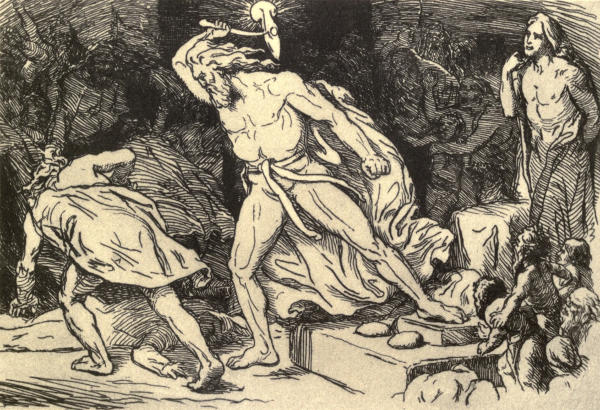
THOR DESTROYS THE GIANT THRYM. From an etching by Lorenz Frölich To protect themselves against the giants of Jotunheim, the gods decided to build a wall around Asgard, and through the persuasion of treacherous Loke, they engaged Thrym, who appeared before them as a tall, stately man, to do the work. An agreement was made whereby Thrym was to receive as his reward—provided the wall and gates were completed in a single winter—the beautiful Freya for wife, and the moon and stars were to be given him for light to work by. With the aid of his horse Swadilfari Thrym performed all that was required of him except the placing of one gate when discovery was made by the gods that Thrym was a giant in disguise. Thereupon they cried aloud for Thor to defend Asgard against this invasion, who immediately appeared amid thunder and lightning, and recognizing Thrym, despite the form he had taken, flung his hammer with such force that the giant's head was broken in many pieces and his soul cast into Nifelhel.
In the ancient Norse documents we also find the name Urd used to designate death, just as in Heliand and Beowulf, and this, too, in such a manner that Urd's personal character is not emphasised. Ynglingatal (Heimskr., ch. 44) calls Ingjald's manner of death his Urdr, and to determine death for anyone was to draga Urdr at him.
Far down in the Christian centuries the memory survived that Urd was the goddess of the realm of death and of death. When a bright spot, which was called Urd's moon, appeared on the wall, it meant the breaking out of an epidemic (Eyrbyggia Saga, 270). Even as late as the year 1237 Urd is supposed to have revealed herself, the night before Christmas, to Snobjorn to predict a bloody conflict, and she then sang a song in which she said that she went mournfully to the contest to choose a man for death. Saxo translates Urdr or Hel with "Proserpina" (Hist., i. 43).
64.
URD'S MAID-SERVANTS: (1) MAID-SERVANTS OF LIFE—NORNS, DISES OF BIRTH, HAMINGJES, GIPTES, FYLGIES; (2) MAID-SERVANTS OF DEATH—VALKYRIES, THE PSYCHO-MESSENGERS OF DISEASES AND ACCIDENTS.
As those beings for whom Urd determines birth, position in life, and death, are countless, so her servants, who perform the tasks commanded by her as queen, must also be innumerable. They belong to two large classes: the one class is active in her service in regard to life, the other in regard to death.
Most intimately associated with her are her two sisters. With her they have the authority of judges. Compare Völuspa, 19, 20, and the expressions norna dómr, norna kvidr. And they dwell with her under the world-tree, which stands for ever green over her gold-clad fountain.
As maid-servants under Urd there are countless hamingjes (fylgjes) and giptes (also called gafes, audnes, heilles). The hamingjes are fostered among beings of giant-race (who hardly can be others than the norns and Mimer). Three mighty rivers fall down into the world, in which they have their origin, and they come wise in their hearts, soaring over the waters to our upper world (Vafthr., 48, 49). There every child of man is to have a hamingje as a companion and guardian spirit. The testimony of the Icelandic sagas of the middle ages in this regard are confirmed by phrases and forms of speech which have their root in heathendom. The hamingjes belong to that large circle of feminine beings which are called dises, and they seem to have been especially so styled. What Urd is on a grand scale as the guardian of the mighty Ygdrasil, this the hamingje is on a smaller scale when she protects the separate fruit produced on the world-tree and placed in her care. She does not appear to her favourite excepting perhaps in dreams or shortly before his death (the latter according to Helgakv. Hjörv. the prose; Njal, 62; Hallf, ch. 11; proofs from purely heathen records are wanting). In strophes which occur in Gisle Surson's saga, and which are attributed (though on doubtful grounds) to this heathen skald, the hero of the saga, but the origin of which (from a time when the details of the myth were still remembered) is fully confirmed by a careful criticism, it is mentioned how he stood between good and evil inspirations, and how the draumkona (dream-woman) of the good inspirations said to him in sleep: "Be not the first cause of a murder! excite not peaceful men against yourself!—promise me this, thou charitable man! Aid the blind, scorn not the lame, and insult not a Tyr robbed of his hand!" These are noble counsels, and that the hamingjes were noble beings was a belief preserved through the Christian centuries in Iceland, where, according to Vigfusson, the word hamingja is still used in the sense of Providence. They did not usually leave their favourite before death. But there are certain phrases preserved in the spoken language which show that they could leave him before death. He who was abandoned by his hamingje and gipte was a lost man. If the favourite became a hideous and bad man, then his hamingja and gipta might even turn her benevolence into wrath, and cause his well-deserved ruin. Uvar 'ro disir, angry at you are the dises! cries Odin to the royal nithing Geirrod, and immediately thereupon the latter stumbles and falls pierced by his own sword. That the invisible hamingje could cause one to stumble and fall is shown in Fornm., iii.
The giptes seem to have carried out such of Urd's resolves, on account of which the favourite received an unexpected, as it were accidental, good fortune.
Not only for separate individuals, but also for families and clans, there were guardian spirits (kynfylgjur, ættar-fylgjur).
Another division of this class of maid-servants under Urd are those who attend the entrance of the child into the world, and who have to weave the threads of the newborn babe into the web of the families and events. Like Urd and her sisters, they too are called norns. If it is a child who is to be a great and famous man, Urd herself and her sisters may be present for the above purpose (see No. 30 in regard to Halfdan's birth).
A few strophes incorporated in Fafnersmal from a heathen didactic poem, now lost (Fafn., 12-15), speak of norns whose task it is to determine and assist the arrival of the child into this world. Nornir, er naudgaunglar 'ro oc kjósa mædr frá maugum. The expression kjósa mædr frá maugum, "to choose mothers from descendants," seems obscure, and can under all circumstances not mean simply "to deliver mothers of children." The word kjósa is never used in any other sense than to choose, elect, select. Here it must then mean to choose, elect as mothers; and the expression "from descendants" is incomprehensible, if we do not on the one hand conceive a crowd of eventual descendants, who at the threshold of life are waiting for mothers in order to become born into this world, and on the other hand women who are to be mothers, but in reference to whom it has not yet been determined which descendant each one is to call hers among the great waiting crowd, until those norns which we are here discussing resolve on that point, and from the indefinite crowd of waiting megir choose mothers for those children which are especially destined for them.
These norns are, according to Fafn., 13, of different birth. Some are Asa-kinswomen, others of elf-race, and again others are daughters of Dvalin. In regard to the last-named it should be remembered that Dvalin, their father, through artists of his circle, decorated the citadel, within which a future generation of men await the regeneration of the world, and that the mythology has associated him intimately with the elf of the morning dawn, Delling, who guards the citadel of the race of regeneration against all that is evil and all that ought not to enter (see No. 53). There are reasons (see No. 95) for assuming that these dises of birth were Honer's maid-servants at the same time as they were Urd's, just as the valkyries are Urd's and Odin's maid-servants at the same time (see below).
To the other class of Urd's maid-servants belong those lower-world beings which execute her resolves of death, and conduct the souls of the dead to the lower world.
Foremost among the psycho-messengers (psycho-pomps), the attendants of the dead, we note that group of shield-maids called valkyries. As Odin and Freyja got the right of choosing on the battlefield, the valkyries have received Asgard as their abode. There they bring the mead-horns to the Asas and einherjes, when they do not ride on Valfather's errands (Völuspa, 31; Grimnersmal, 36; Eiriksm., 1; Ulf Ugges. Skaldsk., 238). But the third of the norns, Skuld, is the chief one in this group (Völuspa, 31), and, as shall be shown below, they for ever remain in the most intimate association with Urd and the lower world.
65.
ON THE COSMOGRAPHY. THE WAY OF THOSE FALLEN BY THE SWORD TO VALHAL IS THROUGH THE LOWER WORLD.
The modern conception of the removal of those fallen by the sword to Asgard is that the valkyries carried them immediately through blue space to the halls above. The heathens did not conceive the matter in this manner.
It is true that the mythological horses might carry their riders through the air without pressing a firm foundation with their hoofs. But such a mode of travel was not the rule, even among the gods, and, when it did happen, it attracted attention even among them. Compare Gylfaginning, i. 118, which quotes strophes from a heathen source. The bridge Bifrost would not have been built or established for the daily connection between Asgard and Urd's subterranean realm if it had been unnecessary in the mythological world of fancy. Mane's way in space would not have been regarded as a road in the concrete sense, that quakes and rattles when Thor's thunder-chariot passes over it (Haustl., Skaldsk., ch. 16), had it not been thought that Mane was safer on a firm road than without one of that sort. To every child that grew up in the homes of our heathen fathers the question must have lain near at hand, what such roads and bridges were for, if the gods had no advantage from them. The mythology had to be prepared for such questions, and in this, as in other cases, it had answers wherewith to satisfy that claim on causality and consistency which even the most naïve view of the world presents. The answer was: If the Bifrost bridge breaks under its riders, as is to happen in course of time, then their horses would have to swim in the sea of air (Bilraust brotnar, er their á bru fara, oc svima i modo marir—Fafn., 15., compare a strophe of Kormak, Kormak's Saga, p. 259, where the atmosphere is called the fjord of the gods, Dia fjördr). A horse does not swim as fast and easily as it runs. The different possibilities of travel are associated with different kinds of exertion and swiftness. The one method is more adequate to the purpose than the other. The solid connections which were used by the gods and which the mythology built in space are, accordingly, objects of advantage and convenience. The valkyries, riding at the head of their chosen heroes, as well as the gods, have found solid roads advantageous, and the course they took with their favourites was not the one presented in our mythological text-books. Grimnersmal (str. 21; see No. 93) informs us that the breadth of the atmospheric sea is too great and its currents too strong for those riding on their horses from the battlefield to wade across.
In the 45th chapter of Egil Skallagrimson's saga we read how Egil saved himself from men, whom King Erik Blood-axe sent in pursuit of him to Saud Isle. While they were searching for him there, he had stolen to the vicinity of the place where the boat lay in which those in pursuit had rowed across. Three warriors guarded the boat. Egil succeeded in surprising them, and in giving one of them his death-wound ere the latter was able to defend himself. The second fell in a duel on the strand. The third, who sprang into the boat to make it loose, fell there after an exchange of blows. The saga has preserved a strophe in which Egil mentions this exploit to his brother Thorolf and his friend Arinbjorn, whom he met after his flight from Saud Isle. There he says:
at thrymreynis thjónar thrir nökkurrir Hlakkar, til hásalar Heljar helgengnir, för dvelja.
"Three of those who serve the tester of the valkyriedin (the warlike Erik Blood-axe) will late return; they have gone to the lower world, to Hel's high hall."
The fallen ones were king's men and warriors. They were slain by weapons and fell at their posts of duty, one from a sudden, unexpected wound, the others in open conflict. According to the conception of the mythological text-books, these sword-slain men should have been conducted by valkyries through the air to Valhal. But the skald Egil, who as a heathen born about the year 904, and who as a contemporary of the sons of Harald Fairhair must have known the mythological views of his fellow-heathen believers better than the people of our time, assures us positively that these men from King Erik's body-guard, instead of going immediately to Valhal, went to the lower world and to Hel's high hall there. He certainly would not have said anything of the sort, if those for whom he composed the strophe had not regarded this idea as both possible and correct.
The question now is: Does this Egil's statement stand alone and is it in conflict with those other statements touching the same point which the ancient heathen records have preserved for us? The answer is, that in these ancient records there is not found a single passage in conflict with Egil's idea, but that they all, on the contrary, fully agree with his words, and that this harmony continues in the reports of the first Christian centuries in regard to this subject.
All the dead and also those fallen by the sword come first to Hel. Thence the sword-slain come to Asgard, if they have deserved this destiny.
In Gisle Surson's saga (ch. 24) is mentioned the custom of binding Hel-shoes on the feet of the dead. Warriors in regard to whom there was no doubt that Valhal was their final destiny received Hel-shoes like all others, that er tidska at binda mönnum helskó, sem menn, skulo á ganga till Valhallar. It would be impossible to explain this custom if it had not been believed that those who were chosen for the joys of Valhal were obliged, like all others, to travel á Helvegum. Wherever this custom prevailed, Egil's view in regard to the fate which immediately awaited sword-fallen men was general.
When Hermod betook himself to the lower world to find Balder he came, as we know, to the golden bridge across the river Gjöll. Urd's maid-servant, who watches the bridge, mentioned to him that the day before five fylki of dead men had rode across the same bridge. Consequently all these dead are on horseback and they do not come separately or a few at a time, but in large troops called fylki, an expression which, in the Icelandic literature, denotes larger or smaller divisions of an army—legions, cohorts, maniples or companies in battle array; and with fylki the verb fylkja, to form an army or a division of an army in line of battle, is most intimately connected. This indicates with sufficient clearness that the dead here in question are men who have fallen on the field of battle and are on their way to Hel, each one riding, in company with his fallen brothers in arms, with those who belonged to his own fylki. The account presupposes that men fallen by the sword, whose final destination is Asgard, first have to ride down to the lower world. Else we would not find these fylkes on a Helway galloping across a subterranean bridge, into the same realm as had received Balder and Nanna after death.
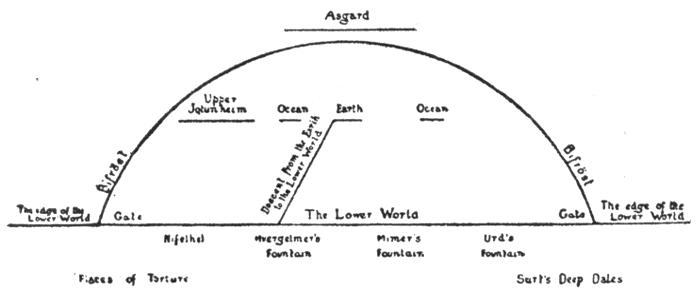
It has already been pointed out that Bifrost is the only connecting link between Asgard and the lower regions of the universe. The air was regarded as an ether sea which the bridge spanned, and although the horses of mythology were able to swim in this sea, the solid connection was of the greatest importance. The gods used the bridge every day (Grimnismal, Gylfaginning). Frost giants and mountain-giants are anxious to get possession of it, for it is the key to Asgard. It therefore has its special watchman in the keen-eyed and vigilant Heimdal. When in Ragnarok the gods ride to the last conflict they pass over Bifrost (Fafnersmal). The bridge does not lead to Midgard. Its lower ends were not conceived as situated among mortal men. It stood outside and below the edge of the earth's crust both in the north and in the south. In the south it descended to Urd's fountain and to the thingstead of the gods in the lower world (see the accompanying drawing, intended to make these facts intelligible). From this mythological topographical arrangement it follows of necessity that the valkyries at the head of the chosen slain must take their course through the lower world, by the way of Urd's fountain and the thingstead of the gods, if they are to ride on Bifrost bridge to Asgard, and not be obliged to betake themselves thither on swimming horses.
There are still two poems extant from the heathen time, which describe the reception of sword-fallen kings in Valhal. The one describes the reception of Erik Blood-axe, the other that of Hakon the Good.
When King Erik, with five other kings and their attendants of fallen warriors, come riding up thither, the gods hear on their approach a mighty din, as if the foundations of Asgard trembled. All the benches of Valhal quake and tremble. What single probability can we now conceive as to what the skald presupposed? Did he suppose that the chosen heroes came on horses that swim in the air, and that the movements of the horses in this element produced a noise that made Valhal tremble? Or that it is Bifrost which thunders under the hoofs of hundreds of horses, and quakes beneath their weight? There is scarcely need of an answer to this alternative. Meanwhile the skald himself gives the answer. For the skald makes Brage say that from the din and quaking it might be presumed that it was Balder who was returning to the halls of the gods. Balder dwells in the lower world; the connection between Asgard and the lower world is Bifrost: this connection is of such a nature that it quakes and trembles beneath the weight of horses and riders, and it is predicted in regard to Bifrost that in Ragnarok it shall break under the weight of the host of riders. Thus Brage's words show that it is Bifrost from which the noise is heard when Erik and his men ride up to Valhal. But to get to the southern end of Bifrost, Erik and his riders must have journeyed in Hel, across Gjoll, and past the thingstead of the gods near Urd's well. Thus it is by this road that the psychopomps of the heroes conduct their favourites to their final destination.
In his grand poem "Hákonármal," Eyvind Skaldaspiller makes Odin send the valkyries Gandul and Skagul "to choose among the kings of Yngve's race some who are to come to Odin and abide in Valhal." It is not said by which road the two valkyries betake themselves to Midgard, but when they have arrived there they find that a battle is imminent between the Yngve descendants, Hakon the Good, and the sons of Erik. Hakon is just putting on his coat-of-mail, and immediately thereupon begins the brilliantly-described battle. The sons of Erik are put to flight, but the victor Hakon is wounded by an arrow, and after the end of the battle he sits on the battlefield, surrounded by his heroes, "with shields cut by swords and with byrnies pierced by arrows." Gandul and Skagul, "maids on horseback, with wisdom in their countenances, with helmets on their heads, and with shields before them," are near the king. The latter hears that Gandul, "leaning on her spear," says to Skagul that the wound is to cause the king's death, and now a conversation begins between Hakon and Skagul, who confirms what Gandul has said, and does so with the following words:
Rida vit nú skulum, kvad hin rika Skagul, græna heima goda Odni at segja, at un mun allvaldr koma á hann sjálfan at sjá.
"We two (Gandul and Skagul) shall now, quoth the mighty Skagul, ride o'er green realms (or worlds) of the gods in order to say to Odin that now a great king is coming to see him."
Here we get definite information in regard to which way the valkyries journey between Asgard and Midgard. The fields through which the road goes, and which are beaten by the hoofs of their horses, are green realms of the gods (worlds, heimar).
With these green realms Eyvind has not meant the blue ether. He distinguishes between blue and green. The sea he calls blue (blámær—see Heimskringla). What he expressly states, and to which we must confine ourselves, is that, according to his cosmological conception and that of his heathen fellow-believers, there were realms clothed in green and inhabited by divinities on the route the valkyries had to take when they from a battlefield in Midgard betook themselves back to Valhal and Asgard. But as valkyries and the elect ride on Bifrost up to Valhal, Bifrost, which goes down to Urd's well, must be the connecting link between the realms decked with green and Asgard. The grænar heimar through which the valkyries have to pass are therefore the realms of the lower world.
Among the realms or "worlds" which constituted the mythological universe, the realms of bliss in the lower world were those which might particularly be characterised as the green. Their groves and blooming meadows and fields of waving grain were never touched by decay or frost, and as such they were cherished by the popular fancy for centuries after the introduction of Christianity. The Low German language has also rescued the memory thereof in the expression gróni godes wang (Hel., 94, 24). That the green realms of the lower world are called realms of the gods is also proper, for they have contained and do contain many beings of a higher or lower divine rank. There dwells the divine mother Nat, worshipped by the Teutons; there Thor's mother and her brother and sister Njord and Fulla are fostered; there Balder, Nanna, and Hödr are to dwell until Ragnarok; there Delling, Billing, Rind, Dag, Mane, and Sol, and all the clan of artists gathered around Mimer, they who "smithy" living beings, vegetation, and ornaments, have their halls; there was born Odin's son Vale. Of the mythological divinities, only a small number were fostered in Asgard. When Gandul and Skagul at the head of sword-fallen men ride "o'er the green worlds of the gods," this agrees with the statement in the myth about Hermod's journey to Hel, that "fylkes" of dead riders gallop over the subterranean gold-bridge, on the other side of which glorious regions are situated, and with the statement in Vegtamskvida that Odin, when he had left Nifelhel behind him, came to a foldvegr, a way over green plains, by which he reaches the hall that awaits Balder.
In the heroic songs of the Elder Edda, and in other poems from the centuries immediately succeeding the introduction of Christianity, the memory survives that the heroes journey to the lower world. Sigurd Fafnersbane comes to Hel. Of one of Atle's brothers who fell by Gudrun's sword it is said, i Helju hon thana hafdi (Atlam., 51). In the same poem, strophe 54, one of the Niflungs says of a sword-fallen foe that they had him lamdan til Heljar.
The mythic tradition is supported by linguistic usage, which, in such phrases as berja i Hel, drepa i Hel, drepa til Heljar, færa til Heljar, indicated that those fallen by the sword also had to descend to the realm of death.
The memory of valkyries, subordinate to the goddess of fate and death, and belonging with her to the class of norns, continued to flourish in Christian times both among Anglo-Saxons and Scandinavians. Among the former välcyrge, välcyrre (valkyrie) could be used to express the Latin parca, and in Beowulf occur phrases in which Hild and Gud (the valkyries Hildr and Gunnr) perform the tasks of Vyrd. In Atlamal (28), the valkyries are changed into "dead women," inhabitants of the lower world, who came to choose the hero and invite him to their halls. The basis of the transformation is the recollection that the valkyries were not only in Odin's service, but also in that of the lower world goddess Urd (compare Atlamal, 16, where they are called norns), and that they as psychopomps conducted the chosen Heroes to Hel on their way to Asgard.
66.
THE CHOOSING. THE MIDDLE-AGE FABLE ABOUT "RISTING WITH THE SPEAR-POINT."
If death on the battle-field, or as the result of wounds received on the field of battle, had been regarded as an inevitable condition for the admittance of the dead into Asgard, and for the honour of sitting at Odin's table, then the choosing would under all circumstances have been regarded as a favour from Odin. But this was by no means the case, nor could it be so when regarded from a psychological point of view (see above, No. 61). The poems mentioned above, "Eiriksmál" and "Hakonarmal," give us examples of choosing from a standpoint quite different from that of favour. When one of the einherjes, Sigmund, learns from Odin that Erik Blood-axe has fallen and is expected in Valhal, he asks why Odin robbed Erik of victory and life, although he, Erik, possessed Odin's friendship. From Odin's answer to the question we learn that the skald did not wish to make Sigmund express any surprise that a king, whom Odin loves above other kings and heroes, has died in a lost instead of a won battle. What Sigmund emphasises is, that Odin did not rather take unto himself a less loved king than the so highly appreciated Erik, and permit the latter to conquer and live. Odin's answer is that he is hourly expecting Ragnarok, and that he therefore made haste to secure as soon as possible so valiant a hero as Erik among his einherjes. But Odin does not say that he feared that he might have to relinquish the hero for ever, in case the latter, not being chosen on this battlefield, should be snatched away by some other death than that by the sword.
Hakonarmal gives us an example of a king who is chosen in a battle in which he is the victor. As conqueror the wounded Hakon remained on the battlefield; still he looks upon the choosing as a disfavour. When he had learned from Gandul's words to Skagul that the number of the einherjes is to be increased with him, he blames the valkyries for dispensing to him this fate, and says he had deserved a better lot from the gods (várun thó verdir gagns frá godum). When he enters Valhal he has a keener reproach on his lips to the welcoming Odin: illúdigr mjók thykkir oss Odinn vera, sjám ver hans of hugi.
Doubtless it was for our ancestors a glorious prospect to be permitted to come to Odin after death, and a person who saw inevitable death before his eyes might comfort himself with the thought of soon seeing "the benches of Balder's father decked for the feast" (Ragnar's death-song). But it is no less certain from all the evidences we have from the heathen time, that honourable life was preferred to honourable death, although between the wars there was a chance of death from sickness. Under these circumstances, the mythical eschatology could not have made death from disease an insurmountable obstacle for warriors and heroes on their way to Valhal. In the ancient records there is not the faintest allusion to such an idea. It is too absurd to have existed. It would have robbed Valhal of many of Midgard's most brilliant heroes, and it would have demanded from faithful believers that they should prefer death even with defeat to victory and life, since the latter lot was coupled with the possibility of death from disease. With such a view no army goes to battle, and no warlike race endowed with normal instincts has ever entertained it and given it expression in their doctrine in regard to future life.
The absurdity of the theory is so manifest that the mythologists who have entertained it have found it necessary to find some way of making it less inadmissible than it really is. They have suggested that Odin did not necessarily fail to get those heroes whom sickness and age threatened with a straw-death, nor did they need to relinquish the joys of Valhal, for there remained to them an expedient to which they under such circumstances resorted: they risted (marked, scratched) themselves with the spear-point (marka sik geirs-oddi).
If there was such a custom, we may conceive it as springing from a sacredness attending a voluntary death as a sacrifice—a sacredness which in all ages has been more or less alluring to religious minds. But all the descriptions we have from Latin records in regard to Teutonic customs, all our own ancient records from heathen times, all Northern and German heroic songs, are unanimously and stubbornly silent about the existence of the supposed custom of "risting with the spear-point," although, if it ever existed, it would have been just such a thing as would on the one hand be noticed by strangers, and on the other hand be remembered, at least for a time, by the generations converted to Christianity. But the well-informed persons interviewed by Tacitus, they who presented so many characteristic traits of the Teutons, knew nothing of such a practice; otherwise they certainly would have mentioned it as something very remarkable and peculiar to the Teutons. None of the later classical Latin or middle age Latin records which have made contributions to our knowledge of the Teutons have a single word to say about it; nor the heroic poems. The Scandinavian records, and the more or less historical sagas, tell of many heathen kings, chiefs, and warriors who have died on a bed of straw, but not of a single one who "risted himself with the spear-point." The fable about this "risting with the spear-point" has its origin in Ynglingasaga, ch. 10, where Odin, changed to a king in Svithiod, is said, when death was approaching, to have let marka sik geirs-oddi. Out of this statement has been constructed a custom among kings and heroes of anticipating a straw-death by "risting with the spear-point," and this for the purpose of getting admittance to Valhal. Vigfusson (Dictionary) has already pointed out the fact that the author of Ynglingasaga had no other authority for his statement than the passage in Havamál, where Odin relates that he wounded with a spear, hungering and thirsting, voluntarily inflicted on himself pain, which moved Bestla's brother to give him runes and a drink from the fountain of wisdom. The fable about the spear-point risting, and its purpose, is therefore quite unlike the source from which, through ignorance and random writing, it sprang.
67.
THE PSYCHO-MESSENGERS OF THOSE NOT FALLEN BY THE SWORD. LOKE'S DAUGHTER (PSEUDO-HEL IN GYLFAGINNING) IDENTICAL WITH LEIKIN.