TENNYSON ON HIS FRIENDS OF LATER LIFE
Reading edition
TO W. C. MACREADY
1851
Farewell, Macready, since to-night we part; Full-handed thunders often have confessed Thy power, well-used to move the public breast. We thank thee with our voice, and from the heart. Farewell, Macready, since this night we part, Go, take thine honours home; rank with the best, Garrick and statelier Kemble, and the rest Who made a nation purer through their art. Thine is it that our drama did not die, Nor flicker down to brainless pantomime, And those gilt gauds men-children swarm to see. Farewell, Macready; moral, grave, sublime; Our Shakespeare’s bland and universal eye Dwells pleased, through twice a hundred years, on thee.
TO THE REV. F. D. MAURICE
Come, when no graver cares employ, Godfather, come and see your boy: Your presence will be sun in winter, Making the little one leap for joy. For, being of that honest few, Who give the Fiend himself his due, Should eighty-thousand college-councils Thunder “Anathema,” friend, at you; Should all our churchmen foam in spite At you, so careful of the right, Yet one lay-hearth would give you welcome (Take it and come) to the Isle of Wight; Where, far from noise and smoke of town, I watch the twilight falling brown All round a careless-order’d garden Close to the ridge of a noble down. You’ll have no scandal while you dine, But honest talk and wholesome wine, And only hear the magpie gossip Garrulous under a roof of pine: For groves of pine on either hand, To break the blast of winter, stand; And further on, the hoary Channel Tumbles a billow on chalk and sand; Where, if below the milky steep Some ship of battle slowly creep, And on thro’ zones of light and shadow Glimmer away to the lonely deep, We might discuss the Northern sin Which made a selfish war begin; Dispute the claims, arrange the chances; Emperor, Ottoman, which shall win: Or whether war’s avenging rod Shall lash all Europe into blood; Till you should turn to dearer matters, Dear to the man that is dear to God; How best to help the slender store, How mend the dwellings, of the poor; How gain in life, as life advances, Valour and charity more and more. Come, Maurice, come: the lawn as yet Is hoar with rime, or spongy-wet; But when the wreath of March has blossom’d, Crocus, anemone, violet, Or later, pay one visit here, For those are few we hold as dear; Nor pay but one, but come for many, Many and many a happy year. January, 1854.
TO SIR JOHN SIMEON
IN THE GARDEN AT SWAINSTON
Nightingales warbled without, Within was weeping for thee: Shadows of three dead men Walk’d in the walks with me, Shadows of three dead men[28] and thou wast one of the three. Nightingales sang in his woods: The Master was far away: Nightingales warbled and sang Of a passion that lasts but a day; Still in the house in his coffin the Prince of courtesy lay. Two dead men have I known In courtesy like to thee: Two dead men have I loved With a love that ever will be: Three dead men have I loved and thou art last of the three.
TO EDWARD LEAR, ON HIS TRAVELS IN GREECE
Illyrian woodlands, echoing falls Of water, sheets of summer glass, The long divine Peneïan pass, The vast Akrokeraunian walls, Tomohrit, Athos, all things fair, With such a pencil, such a pen, You shadow forth to distant men, I read and felt that I was there: And trust me while I turn’d the page, And track’d you still on classic ground, I grew in gladness till I found My spirits in the golden age. For me the torrent ever pour’d And glisten’d—here and there alone The broad-limb’d Gods at random thrown By fountain-urns;—and Naiads oar’d A glimmering shoulder under gloom Of cavern pillars; on the swell The silver lily heaved and fell; And many a slope was rich in bloom From him that on the mountain lea By dancing rivulets fed his flocks To him who sat upon the rocks, And fluted to the morning sea.
TO THE MASTER OF BALLIOL
(PROFESSOR JOWETT)
I
Dear Master in our classic town, You, loved by all the younger gown There at Balliol, Lay your Plato for one minute down,
II
And read a Grecian tale re-told,[29] Which, cast in later Grecian mould, Quintus Calaber Somewhat lazily handled of old;
III
And on this white midwinter day— For have the far-off hymns of May, All her melodies, All her harmonies echo’d away?—
IV
To-day, before you turn again To thoughts that lift the soul of men, Hear my cataract’s Downward thunder in hollow and glen,
V
Till, led by dream and vague desire, The woman, gliding toward the pyre, Find her warrior Stark and dark in his funeral fire.
TO THE DUKE OF ARGYLL
O Patriot Statesman, be thou wise to know The limits of resistance, and the bounds Determining concession; still be bold Not only to slight praise but suffer scorn; And be thy heart a fortress to maintain The day against the moment, and the year Against the day; thy voice, a music heard Thro’ all the yells and counter-yells of feud And faction, and thy will, a power to make This ever-changing world of circumstance, In changing, chime with never-changing Law.
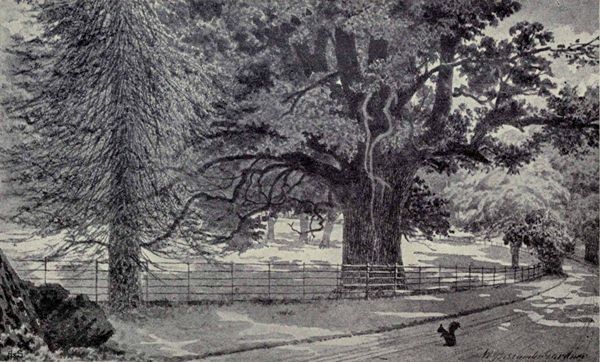
The Drive at Farringford, showing on the left the “Wellingtonia” planted by Garibaldi. From a drawing by W. Biscombe Gardner.
TO GIFFORD PALGRAVE[30]
I
Ulysses, much-experienced man, Whose eyes have known this globe of ours, Her tribes of men, and trees, and flowers, From Corrientes to Japan,
II
To you that bask below the Line, I soaking here in winter wet— The century’s three strong eights[31] have met To drag me down to seventy-nine
III
In summer if I reach my day— To you, yet young, who breathe the balm Of summer-winters by the palm And orange grove of Paraguay,
IV
I tolerant of the colder time, Who love the winter woods, to trace On paler heavens the branching grace Of leafless elm, or naked lime,
V
And see my cedar green, and there My giant ilex keeping leaf When frost is keen and days are brief— Or marvel how in English air
VI
My yucca, which no winter quells, Altho’ the months have scarce begun, Has push’d toward our faintest sun A spike of half-accomplish’d bells—
VII
Or watch the waving pine which here The warrior of Caprera set,[32] A name that earth will not forget Till earth has roll’d her latest year—
VIII
I, once half-crazed for larger light On broader zones beyond the foam, But chaining fancy now at home Among the quarried downs of Wight,
IX
Not less would yield full thanks to you For your rich gift, your tale of lands I know not,[33] your Arabian sands; Your cane, your palm, tree-fern, bamboo,
X
The wealth of tropic bower and brake; Your Oriental Eden-isles,[34] Where man, nor only Nature smiles; Your wonder of the boiling lake;[35]
XI
Phra-Chai, the Shadow of the Best,[36] Phra-bat[37] the step; your Pontic coast; Crag-cloister;[38] Anatolian Ghost;[39] Hong-Kong,[40] Karnac,[41] and all the rest.
XII
Thro’ which I follow’d line by line Your leading hand, and came, my friend, To prize your various book, and send A gift of slenderer value, mine.
TO THE MARQUIS OF DUFFERIN AND AVA
I
At times our Britain cannot rest, At times her steps are swift and rash; She moving, at her girdle clash The golden keys of East and West.
II
Not swift or rash, when late she lent The sceptres of her West, her East, To one, that ruling has increased Her greatness and her self-content.
III
Your rule has made the people love Their ruler. Your viceregal days Have added fulness to the phrase Of “Gauntlet in the velvet glove.”
IV
But since your name will grow with Time, Not all, as honouring your fair fame Of Statesman, have I made the name A golden portal to my rhyme:
V
But more, that you and yours may know From me and mine, how dear a debt We owed you, and are owing yet To you and yours, and still would owe.
VI
For he[42]—your India was his Fate, And drew him over sea to you— He fain had ranged her thro’ and thro’, To serve her myriads and the State,—
VII
A soul that, watch’d from earliest youth, And on thro’ many a brightening year, Had never swerved for craft or fear, By one side-path, from simple truth;
VIII
Who might have chased and claspt Renown And caught her chaplet here—and there In haunts of jungle-poison’d air The flame of life went wavering down;
IX
But ere he left your fatal shore, And lay on that funereal boat, Dying, “Unspeakable” he wrote “Their kindness,” and he wrote no more;
X
And sacred is the latest word; And now the Was, the Might-have-been, And those lone rites I have not seen, And one drear sound I have not heard,
XI
Are dreams that scarce will let me be, Not there to bid my boy farewell, When That within the coffin fell, Fell—and flash’d into the Red Sea,
XII
Beneath a hard Arabian moon And alien stars. To question, why The sons before the fathers die, Not mine! and I may meet him soon;
XIII
But while my life’s late eve endures, Nor settles into hueless gray, My memories of his briefer day Will mix with love for you and yours.
TO W. E. GLADSTONE
We move, the wheel must always move, Nor always on the plain, And if we move to such a goal As Wisdom hopes to gain, Then you that drive, and know your Craft, Will firmly hold the rein, Nor lend an ear to random cries, Or you may drive in vain, For some cry “Quick” and some cry “Slow,” But, while the hills remain, Up hill “Too-slow” will need the whip, Down hill “Too-quick,” the chain.
TO MARY BOYLE
(Dedicating “The Progress of Spring.”)
I
“Spring-flowers”! While you still delay to take Your leave of Town, Our elmtree’s ruddy-hearted blossom-flake Is fluttering down.
II
Be truer to your promise. There! I heard Our cuckoo call. Be needle to the magnet of your word, Nor wait, till all
III
Our vernal bloom from every vale and plain And garden pass, And all the gold from each laburnum chain Drop to the grass.
IV
Is memory with your Marian gone to rest, Dead with the dead? For ere she left us, when we met, you prest My hand, and said
V
“I come with your spring-flowers.” You came not, friend; My birds would sing, You heard not. Take then this spring-flower I send, This song of spring,
VI
Found yesterday—forgotten mine own rhyme By mine old self, As I shall be forgotten by old Time, Laid on the shelf—
VII
A rhyme that flower’d betwixt the whitening sloe And kingcup blaze, And more than half a hundred years ago, In rick-fire days,
VIII
When Dives loathed the times, and paced his land In fear of worse, And sanguine Lazarus felt a vacant hand Fill with his purse.
IX
For lowly minds were madden’d to the height By tonguester tricks, And once—I well remember that red night When thirty ricks,
X
All flaming, made an English homestead Hell— These hands of mine Have helpt to pass a bucket from the well Along the line,
XI
When this bare dome had not begun to gleam Thro’ youthful curls, And you were then a lover’s fairy dream, His girl of girls;
XII
And you, that now are lonely, and with Grief Sit face to face, Might find a flickering glimmer of relief In change of place.
XIII
What use to brood? this life of mingled pains And joys to me, Despite of every Faith and Creed, remains The Mystery.
XIV
Let golden youth bewail the friend, the wife, For ever gone. He dreams of that long walk thro’ desert life Without the one.
XV
The silver year should cease to mourn and sigh— Not long to wait— So close are we, dear Mary, you and I To that dim gate.
XVI
Take, read! and be the faults your Poet makes Or many or few, He rests content, if his young music wakes A wish in you
XVII
To change our dark Queen-city, all her realm Of sound and smoke, For his clear heaven, and these few lanes of elm And whispering oak.
TO W. G. WARD
IN MEMORIAM
Farewell, whose living like I shall not find, Whose Faith and Work were bells of full accord, My friend, the most unworldly of mankind, Most generous of all Ultramontanes, Ward, How subtle at tierce and quart of mind with mind, How loyal in the following of thy Lord!
TO SIR RICHARD JEBB
Fair things are slow to fade away, Bear witness you, that yesterday[43] From out the Ghost of Pindar in you Roll’d an Olympian; and they say[44] That here the torpid mummy wheat Of Egypt bore a grain as sweet As that which gilds the glebe of England, Sunn’d with a summer of milder heat. So may this legend[45] for awhile, If greeted by your classic smile, Tho’ dead in its Trinacrian Enna, Blossom again on a colder isle.
TO GENERAL HAMLEY
(Prologue of “The Charge of the Heavy Brigade.”)
Our birches yellowing and from each The light leaf falling fast, While squirrels from our fiery beech Were bearing off the mast, You came, and look’d and loved the view Long-known and loved by me, Green Sussex fading into blue With one gray glimpse of sea; And, gazing from this height alone, We spoke of what had been Most marvellous in the wars your own Crimean eyes had seen; And now—like old-world inns that take Some warrior for a sign That therewithin a guest may make True cheer with honest wine— Because you heard the lines I read Nor utter’d word of blame, I dare without your leave to head These rhymings with your name, Who know you but as one of those I fain would meet again, Yet know you, as your England knows That you and all your men Were soldiers to her heart’s desire, When, in the vanish’d year, You saw the league-long rampart-fire Flare from Tel-el-Kebir Thro’ darkness, and the foe was driven, And Wolseley overthrew Arâbi, and the stars in heaven Paled, and the glory grew.
EPITAPH ON LORD STRATFORD DE REDCLIFFE
IN WESTMINSTER ABBEY
Thou third great Canning, stand among our best And noblest, now thy long day’s work hath ceased, Here silent in our Minster of the West Who wert the voice of England in the East.
EPITAPH ON GENERAL GORDON
IN THE GORDON BOYS’ NATIONAL MEMORIAL HOME NEAR WOKING[46]
Warrior of God, man’s friend, and tyrant’s foe, Now somewhere dead far in the waste Soudan, Thou livest in all hearts, for all men know This earth has never borne a nobler man.
G. F. WATTS, R.A.
Divinely, thro’ all hindrance, finds the man Behind it, and so paints him that his face, The shape and colour of a mind and life, Lives for his children, ever at its best.