JAMES SPEDDING (continued 2)
Reading edition
The paper referred to was “The Story of the Merchant of Venice” in the Cornhill Magazine for March 1880. In sending a copy to Frederick Tennyson he says:
I now post you a paper by old Spedding—a very beautiful one, I think; settling one point, however unimportant, and in a graceful, as well as logical, way such as he is Master of.
A case has been got up—whether by Irving, the Stage Representative of Shylock, or by his Admirers—to prove the Jew to be a very amiable and ill-used man: insomuch that one is to come away from the theatre loving him and hating all the rest. He dresses himself up to look like the Saviour, Mrs. Kemble says. So old Jem disposes of that, besides unravelling Shakespeare’s mechanism of the Novel he draws from, in a manner (as Jem says) more distinct to us than in his treatment of any other of his Plays “not professedly historical.” And this latter point is, of course, far more interesting than the question of Irving and Co.,—which is a simple attempt, both of Actor and Writer, to strike out an original idea in the teeth of common-sense and Tradition.
And now came the end, unexpected and the result of an accident, which he maintained was entirely his own fault. In writing to tell me of the fatal result, one of his dearest friends said:
I grieve to tell you that all is over with our dear old friend.... He intended to cross before two carriages—crossed before one—found there was not time to pass before the other, and instead of pausing stepped back under the hansom which he had not seen, and which had not time to alter its course. He spent more strength in exculpating the poor driver than on any personal matter during his illness as soon as he regained memory of the circumstances.
“Mowbray Donne,” says FitzGerald, when all was over, “wrote me that Laurence had been there four or five days ago, when Spedding said, that had the Cab done but a little more, it would have been a good Quietus. Socrates to the last.”
And in another letter:
Tennyson called at the Hospital, but was not allowed to see him, though Hallam did, I think. Some one calling afterwards, Spedding took the doctor’s arm, and asked, “Was it Mr. Tennyson?” Doctors and nurses all devoted to the patient man.
To Fanny Kemble he writes:
It was very, very good and kind of you to write to me about Spedding. Yes: Aldis Wright had apprised me of the matter just after it happened—he happening to be in London at the time; and but two days after the accident heard that Spedding was quite calm, and even cheerful; only anxious that Wright himself should not be kept waiting for some communication which S. had promised him! Whether to live, or to die, he will be Socrates still.
Directly that I heard from Wright I wrote to Mowbray Donne to send me just a Post Card—daily, if he or his wife could, with but one or two words on it—“Better,” “Less well,” or whatever it might be. This morning I hear that all is going on even better than could be expected, according to Miss Spedding. But I suppose the Crisis, which you tell me of, is not yet come; and I have always a terror of that French Adage—“Monsieur se porte mal—Monsieur se porte mieux—Monsieur est—” Ah, you know, or you guess, the rest.
My dear old Spedding, though I have not seen him these twenty years and more—and probably should never see him again—but he lives—his old Self—in my heart of hearts; and all I hear of him does but embellish the recollection of him—if it could be embellished—for he is but the same that he was from a Boy—all that is best in Heart and Head—a man that would be incredible had one not known him.
Again he writes of him to Professor Norton:
He was the wisest man I have known; a great sense of Humour, a Socrates in Life and in Death, which he faced with all Serenity so long as Consciousness lasted. I suppose something of him will reach America, I mean, of his Death; run over by a Cab and dying in St. George’s Hospital to which he was taken, and from which he could not be removed home alive.
“I did not know,” he says in another letter, “that I should feel Spedding’s Loss as I do, after an interval of more than twenty years [since] meeting him. But I knew that I could always get the Word I wanted of him by Letter, and also that from time to time I should meet with some of his wise and delightful Papers in some Quarter or other. He talked of Shakespeare, I am told, when his Mind wandered. I wake almost every morning feeling as if I had lost something, as one does in a Dream; and truly enough, I have lost him. ‘Matthew is in his Grave, etc.’”
In apologizing to Fanny Kemble for not writing to her as usual, he says:
I have let the Full Moon pass because you had written to me so lately, and so kindly, about our lost Spedding, that I could not call on you too soon again. Of him I will say nothing except that his Death has made me recall very many passages in his Life in which I was partly concerned. In particular, staying at his Cumberland Home along with Tennyson in the May of 1835.... His Father and Mother were both alive—he a wise man, who mounted his Cob after Breakfast, and was at his Farm till Dinner at two—then away again till Tea: after which he sat reading by a shaded lamp: saying very little, but always courteous and quite content with any company his Son might bring to the house, so long as they let him go his way: which indeed he would have gone whether they let him or no. But he had seen enough of Poets not to like them or their Trade: Shelley for a time living among the Lakes: Coleridge at Southey’s (whom perhaps he had a respect for—Southey, I mean); and Wordsworth, whom I do not think he valued. He was rather jealous of “Jem,” who might have done available service in the world, he thought, giving himself up to such Dreamers; and sitting up with Tennyson conning over the “Morte d’Arthur,” “Lord of Burleigh,” and other things which helped to make up the two Volumes of 1842. So I always associate that Arthur Idyll with Basanthwaite Lake, under Skiddaw. Mrs. Spedding was a sensible, motherly Lady, with whom I used to play Chess of a Night. And there was an old Friend of hers, Miss Bristowe, who always reminded me of Miss La Creevy, if you know of such a Person in Nickleby.
We will conclude with what his old friend, Sir Henry Taylor, wrote of him after his death:
As he will not read what I write I may allow myself to say something more. He was always master of himself and of his emotions; but underlying a somewhat melancholy composure and aspect there were depths of tenderness known only to those who knew his whole nature and his inward life, and it is well for those by whom he is mourned if they can find what he has described in a letter to be his great consolation in all his experiences of the death of those he loved (experiences which had begun early and had not been few), “that the past is sacred and sanctified; nothing can happen hereafter to disturb or obliterate it; nor need the recollection have any bitterness if a man does not, out of a false and morbid sentiment, make it so for himself.”
And he adds:
To me there are no companions more welcome, cordial, consolatory or cheerful than my dead friends.
ARTHUR HENRY HALLAM
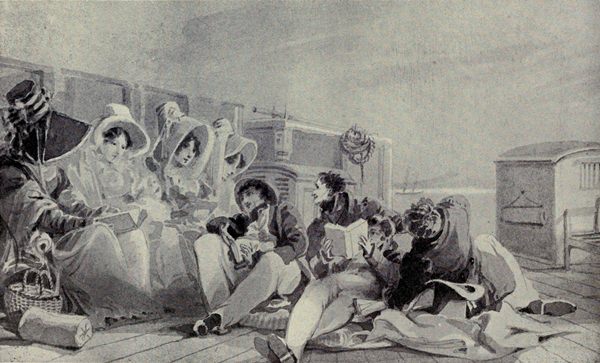
Arthur Hallam reading “Walter Scott” aloud on board the “Leeds,” bound from Bordeaux to Dublin, Sept. 9, 1830.
After Tennyson’s and Hallam’s memorable journey to the Pyrenees in aid of the revolutionary movement against King Ferdinand of Spain, vividly described by Carlyle in his Life of John Sterling.
Alfred Tennyson (in profile), John Harden and Mrs. Harden (on the left), and the Miss Hardens.