XXVIII. JOHN FOSTER PALMER.
Reading edition
HE was born near Port Townsend, about 1847, and belonged to the now extinct tribe of the Chemakums. His father died when he was very young, through the effects of intemperance, and also many others of his relations, and this made him a bitter opponent of drinking.
When ten years old he went to live with the family of Mr. James Seavey, of Port Townsend, and went with them in 1859 to San Francisco, where he remained for a year or two. He then embarked on a sailing-vessel, and spent most of the time until 1863 or 1864 near the mouth of the Amoor River, in Asiatic Russia. Returning then to Puget Sound, he served under the government at the Neah Bay Reservation for a time, but about 1868 he came to the Skokomish Reservation, where he ever afterward made his home, serving as interpreter a large share of the time, eight years under Agent Eells.
He understood four Indian languages: the
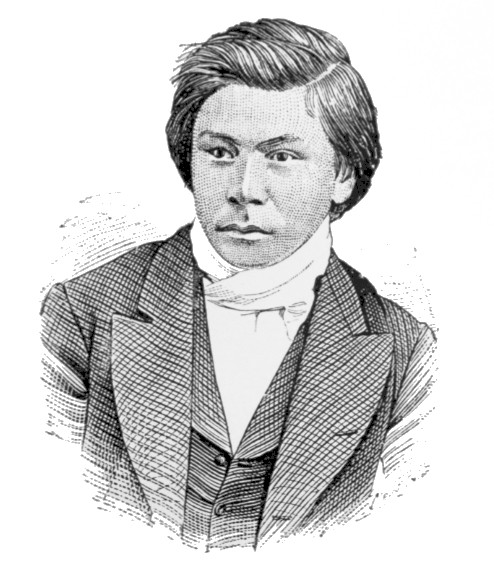
JOHN F PALMER.
Twana, Nisqually, Clallam, and Chinook jargon, also the Russian and English, and could read and write English quite well. He had a library worth fifty dollars, and took several newspapers and magazines, both Eastern and Western, although he only went to school two or three weeks in his life. To Mr. Seavey’s family, and the captain’s wife on the vessel when in Russian waters, he always felt grateful for his education.
When the church was organized at Skokomish, 1874, he united with it, being the first Indian to do so. He lived to see twenty others unite with it. On two points he was very firm: against intemperance and the heathen superstitions: being far in advance of any member of the tribe on the latter point, with the exception of M. F., soon to be mentioned—in fact, it was truly said of him, that he was more of a white man than an Indian.
He loved the prayer-meeting, and while temporarily living at Seabeck, a short time before his death, where he was at work, thirty miles from home, he returned to Skokomish to spend the holidays, and remained an additional week so that he might be present at the daily meetings of the Week of Prayer. He constantly took part in the prayer-meetings, and with the other older male members of the church took his turn in leading them.
He had no children of his own, but brought up his wife’s two sisters. When he united with the church, he said: “Now I want my wife to become a Christian,” and he lived to see her and her two sisters unite with the church. The elder of them married, and her child, Leila Spar, was the first Indian child who received the rite of infant baptism, July 4, 1880. He was killed instantly at Seabeck, February 2, 1881, while at work at the saw-mill, having been accidentally knocked off from a platform, and striking on his head among short sharp-cornered refuse lumber and slabs about ten feet below. The side of his head was crushed in, and after he was picked up he never spoke, and only breathed a few times. He was far in advance of his tribe, and has left an influence which will be felt for many years to come. It was a pleasure once for me to hear a rough, swearing white man, in speaking of him, say: “John Palmer is a gentleman!”
MILTON FISHER.