VI. DIFFICULTIES IN THE WAY OF RELIGIOUS WORK.
Reading edition
(a) LANGUAGES.
ONE great difficulty in the missionary work is the number of languages used by the people. The Clallams have one, the Twanas another; about one sixth of the people on the reservation had originally come from Squaxin, and spoke the Nisqually; the Chinook jargon is an inter-tribal language, which is spoken by nearly all the Indians, except the very old and very young, as far south as Northern California, north into Alaska, west to the Pacific Ocean, and east to Western Idaho. It was made by the early traders, especially the Hudson’s Bay Company, out of Chinook, French, and English words, with a few from several other Indian languages, for use in trade. It serves very well for this purpose, and is almost universally used in intercourse between the whites and Indians. Very few whites, even when married to Indian women, have learned to talk any Indian language except this. But it is not very good for conveying religious instruction. It is too meager. Yet so many different languages were spoken by the seven or eight hundred Indians connected with the agency that it seemed to be the only practicable one, and I learned it. I have learned to preach in it quite easily, and so that the Indians say they understand me quite well. The Twana language would have been quite useful, but it is said to be so difficult to learn that no intelligent Indian advised me to learn it. The Nisqually is said to be much easier, and one educated Indian advised me to learn it, but it did not seem to me to be wise, for while nearly all the Twana Indians understood it, as, in fact, nearly all the Indians on the upper sound do, yet it was spoken by very few on the reservation.
Hence I have often used an interpreter while preaching on the Sabbath at Skokomish, for then usually some whites, old Indians, and children were present who could not understand Chinook. At other times and places I constantly used the Chinook language. But a good interpreter is hard to obtain. “It takes a minister to interpret for a minister,” was said when Mr. Hallenback, the evangelist, went to the Sandwich Islands, and there is much truth in it. The first interpreter I had was good at heart, but he used the Nisqually language. While most of them understood it, yet this person had learned it after he was grown, and spoke it, the Indians said, much like a Dutchman does our language. Another one, a Twana, cut the sentences short, so that one of the school-boys said he could have hardly understood all that I said had he not understood English. A third could do well when he tried, but too many times he felt out of sorts and lazy, and would speak very low and without much life. Hence sometimes I would feel like dismissing all interpreters, and talking in Chinook, but then I was afraid that it would drive away the whites, who could not understand it, but whose presence, for their examples’ sake, I much desired. I feared also that it would drive away the very old ones, who sometimes made much effort to come to church, and also that the children, whose minds were the most susceptible to impressions, would lose all that was said. So there were difficulties every way.
The medley of services and babel of languages of one Sabbath are described as follows: The opening exercises were in English, after which was the sermon, which was delivered in English, but translated into the Nisqually language, and a prayer was offered in the same manner. At the close of the service two infants were baptized in English, when followed the communion service in the same language. At this there were present twelve white members of the Congregational church here, and one Indian; two white members of the Protestant Methodist church; one Cumberland Presbyterian, and one other Congregationalist. There were also present about seventy-five Indians as spectators. The Sabbath-school was held soon after, seventy-five persons being present. First, there were four songs in the Chinook jargon; then three in English, accompanied by an organ and violin. The prayer was in Nisqually, and the lesson was read by all in English, after which the lessons were recited by the scholars. Five classes of Indian children and two of white children were taught in English, and one class partly in English and partly in Chinook jargon. There was one Bible-class of Indian men who understood English, and were taught in that language, a part of whom could read and a part of whom could not, and another of about forty Indians of both sexes whose teacher talked English, but an interpreter translated it into Nisqually; and then they did not reach some Clallam Indians. Next followed a meeting of the Temperance Society, as six persons wished to join it. A white man who could do so, wrote his name, and five Indians who could not, touched the pen while the secretary made their mark. Three of these were sworn in English and two in Chinook. The whole services were interspersed with singing in English and Chinook jargon.
This was soon after I came here. During the past year we have often sung in English, Chinook jargon, Twana, and Nisqually, on the same Sabbath. Another medley Sabbath is given under the head of the Jamestown Church, in connection with its organization.
(b) THEIR RELIGION.
Another great difficulty in the way of their accepting Christianity is their religion. The practical part of it goes by the name of ta-mah-no-us, a Chinook word, and yet so much more expressive than any single English word, or even phrase, that it has almost become Anglicized. Like the Wakan of the Dakotas, it signifies the supernatural in a very broad sense. There are three kinds of it.
First. The Black Tamahnous. This is a secret society. During the performance of the ceremonies connected with it, all the members black their faces more or less, and go through a number of rites more savage than any thing else they do. They do not tell the meaning of these, but they consist of starving, washing, cutting themselves, violent dancing, and the like. It was introduced among the Twanas from the Clallams, who practised it with much more savage rites than the former tribe. It is still more thoroughly practised by the Makahs of Cape Flattery, who join the Clallams on the west. It was never as popular among the Twanas as among some other Indians, and is now practically dead among them. It still retains its hold among a portion of the Clallams, being practised at their greatest gatherings. It is believed that it was intended to be purifical, sacrificial, propitiatory.
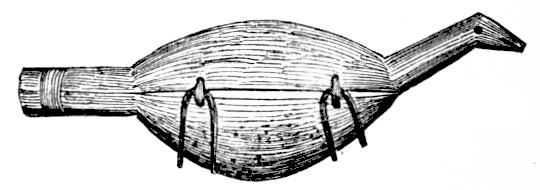
Black Tamahnous Rattle.
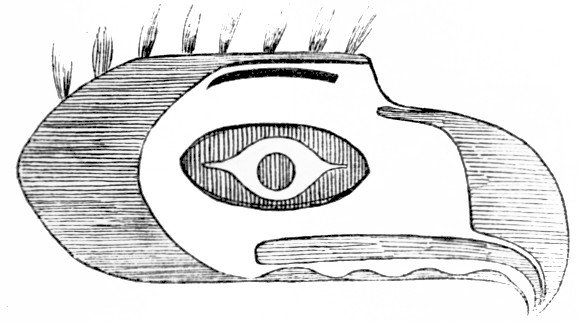
Bird Mask Used in the Black Tamahnous Ceremonies by the Clallams.
Second. The Red, or Sing, Tamahnous. During the performance of its ceremonies, they generally painted their faces red. It was their main ceremonial religion. During the fall and winter they assembled, had feasts, and performed these rites, danced and sang their sacred songs; it might be for one night, or it might be for a week or so.
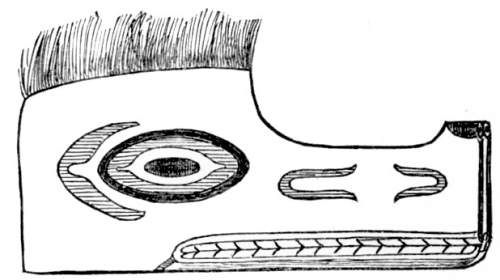
Swine Masks Used in the Black Tamahnous Ceremonies by the Clallams.
Sometimes this was done for the sake of purifying the soul from sin. Sometimes in a vision a person professed to have seen the spirits of living friends in the world of departed spirits, which was a sure sign that they would die in a year or two, unless those spirits could be brought back to this world. So they gathered together and with singing, feasting, and many ceremonies, went in spirit to the other world and brought these spirits back. This spirit-world is somewhere below, within the earth. When they are ready to descend, with much ceremony a little of the earth is broken, to open the way, as it were, for the descent. Having traveled some distance below, they come to a stream which must be crossed on a plank. Two planks are put up with one end on the ground and the other on a beam in the house, about ten feet above the ground, in a slanting direction, one on one side of the beam, and the other on the other side, so that they can go up on one side and down on the other. To do this is the outward form of crossing the spirit-river. If it is done successfully, all is well, and they proceed on their
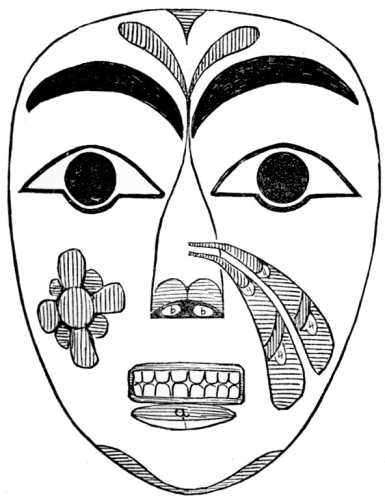
Mask Used in the Black Tamahnous Ceremonies by the Clallams.
[The markings are of different colors. The wearer sees through the nostrils.]
journey. If, however, a person should actually fall from one of these planks, it is a sure sign that he will die in a year or so. They formerly believed this to be so, but about twelve years ago a man
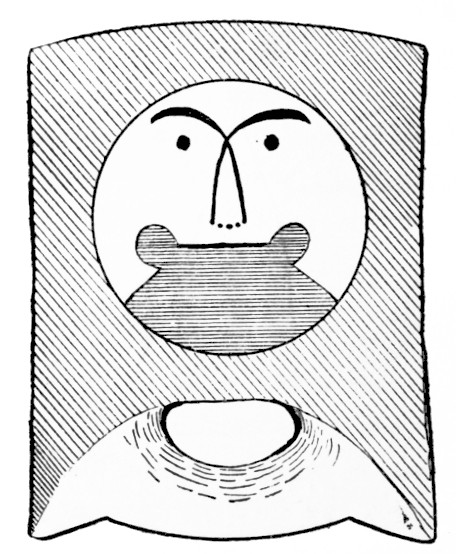
Black Tamahnous Mask.
did fall off, and did die within a year, so then they were certain of it. Having come to the place of the departed spirits, they quietly hunt for the spirits of their living friends, and when they find what other spirits possess them, they begin battle and attempt to take them and are generally successful. Only a few men descend to the spirit-world, but during the fight the rest of the people present keep up a very great noise by singing, pounding on sticks and drums, and in similar ways encourage those engaged in battle. Having obtained the spirits which they wish, they wrap them up or pretend to do so, so that they look like a great doll, and bring them back to the world and deliver them to their proper owners, who receive them with great joy and sometimes with tears of gratitude.
At other times they go through other ceremonies somewhat different. This form has now mostly ceased among the Twanas, but retains its hold among a large share of the Clallams. The Christian Indians profess wholly to have given it up.
Third. The Tamahnous for the sick. When a person is very sick, they think that the spirit of some bad animal, as the crow, bluejay, wolf, bear, or similar treacherous creature, has entered the individual and is eating away the life. This has been sent by a bad medicine-man, and it is the business of the good medicine-man to draw this out, and he professes to do it with his incantations. With a few friends who sing and pound on sticks, he works over the patient in various ways.
This is the most difficult belief for the Indian to abandon, for, while there is a religious idea in it, there is also much of superstition connected with it. As the Indian Agent at Klamath, Oregon, once wrote: “It requires some thing more than a mere resolution of the will to overcome it.” “I do not believe in it now,” said a Spokane Indian, “but if I should become very sick, I expect I should want an Indian doctor.” It will take time and education to eradicate this idea. It is the only part of tamahnous, which I think an Indian can hold and be a Christian, because it is held partly as a superstition and not wholly as a religion. Some white, ignorant persons are superstitious and, at the same time, are Christians. The bad spirit which causes the sickness is called a bad tamahnous. Soon after I first came here, we spent several evenings in discussing the qualifications of church membership, the main difference of opinion centering on this subject of tamahnous over the sick. I took the same position then that I do now, and facts seem to agree thereto; for, among the Yakamas, Spokanes, and Dakotas, who have stood as Christians many years through strong trials, have been some who have not wholly abandoned it, it remaining apparently as a superstition and not a religion.
CHEHALIS JACK.
As an illustration of the reason why they still believe in it, the following examples are given:—
Chehalis Jack is one of the most intelligent and civilized of the older uneducated Twana Indians. He has been one of those most ready to adopt the customs and beliefs of the whites; has stood by the agent and missionary in their efforts to civilize and Christianize his people when very few other Indians have done so, and was one of the first of the older Indians to unite with the church. He was a sub-chief, and tried to induce his people to adopt civilized customs, setting them an example in building by far the best house erected by the Indians on the reservation, and in various other ways. He was told by some who opposed civilization that because of this some enemy would send a bad tamahnous into him and make him sick. In July, 1881, he was taken sick, evidently with the rheumatism, or some thing of the kind, and the threats which he had heard began to prey upon his mind, as he afterward said. Yet for six weeks he lived at his home a mile from the agency, and would have nothing to do with an Indian doctor. The agency physician attended him, and his rheumatism seemed to leave him, but he did not get well and strong. At last the physician said that he did not believe that any physician could find what was the matter with him. After six weeks thus spent, by the advice of friends he tried some Indian doctors on the reservation, but some in whom he had little confidence. He grew worse. He left the reservation for other Indian doctors, twenty miles away, who said they could cure him, but he did not recover. He came back home, and imported another Indian doctor from a hundred miles distant, but was not cured. We were afraid that he would die, and it was plain to several whites that he was simply being frightened to death. I had long talks with him on the subject, and told him so, but could not convince him of the truth of it. He said: “Tamahnous is true! Tamahnous is true! You have told us it is not, but now I have experienced it, and it keeps me sick.” During the winter the agency physician resigned, and another one took his place in March, 1882. Jack immediately sent for him, but failed to recover. By the advice of white friends, who thought they knew what was the matter with him, he gave up his Indian doctor and tried patent medicines for a time, but to no purpose. He left his home, and moved directly to the agency, being very near us, having no Indian doctor. Thus the summer passed away and fall came. Intelligent persons had sometimes said that if he could be made to do some thing his strength would soon return to him, and he would find that he was not very sick. He had had fourteen cords of wood cut on the banks of the Skokomish River. There was no help that he could obtain to bring the wood to his house except a boy and an old man. He was much afraid that the rains would come, the river would rise, and carry off his wood. He left the agency and returned to his home, and had to help in getting his wood. About the same time he employed another Indian doctor in whom he seemed to have considerable confidence, and between the fact of his being obliged to work and his confidence in the Indian doctor, he recovered. It was the effect of the influence of the mind over the body. The principles of mental philosophy could account for it all, but he was not versed in those principles, and so thoroughly believes that a bad tamahnous was in him and that Old Cush, the Indian doctor, drew it out. Since that time he has worked nobly for civilization and Christianity—but his belief in tamahnous still remains in him. When the question of his joining the church came up, as nothing else stood in the way, I could not make up my mind that this superstition ought to do so, and after two and a half years of church membership the results have been such that I am satisfied that the decision was wise.
ELLEN GRAY.
She was a school-girl, about sixteen years of age, and had been in the boarding-school for several years, nearly ever since she had been old enough to attend, but her parents were quite superstitious. One Friday evening she went home to remain until the Sabbath, but on Saturday, the first of January, 1881, she was taken sick, and the nature of her sickness was such that in a few days she became delirious. Her parents and friends made her believe that a bad tamahnous had been put into her, and no one but an Indian doctor could cure her. They tamahnoused over her some. The agency physician, Dr. Givens, was not called until the sixth, when he left some medicine for her, but it is said that it was not given to her. Hence she got no better, and her friends declared that the white doctor was killing her. The agent and teacher did not like the way the affair was being manœuvered, took charge of her, moved her to a decent house near by, and placed white watchers with her, so that the proper medicine should be given, and no Indian doctor brought in. The Indians were, however, determined, if possible, to tamahnous, and declared that if it were not allowed, she would die at three o’clock A.M. They kept talking to her about it and she apparently believed it, and said she would have tamahnous. But it was prevented, and before the time set for her death, she was cured of her real sickness. But she was not well. Still the next day she was in such a condition that it was thought safe to move her in a boat to the boarding-house, where she could be more easily cared for. The Indians were enraged and said that she would die before landing, but she did not. Watchers were kept by her constantly, but the Indians were allowed to see her. They talked, however, to her so much about her having a bad tamahnous, that all except her parents were forbidden to see her. They also were forbidden to talk on the subject, and evidently obeyed. But the effect on her imagination had been so great that, for a time, she often acted strangely. She seldom said any thing; she would often spurt out the medicine, when given her, as far as she could; said she saw the tamahnous; pulled her mother’s hair, bit her mother’s finger so that it bled, seemed peculiarly vexed at her; moaned most of the time, but sometimes screamed very loudly, and even bit a spoon off. Sometimes she talked rationally and sometimes she did not. But by the fifteenth she was considerably better, walked around with help, and sat up, when told to do so, but did not seem to take any interest in any thing. Every thing possible was done to interest her and occupy her attention, and she continued to grow better for three or four days more, so that the watchers were dispensed with, except that her parents slept in the room with her. But one night she threw off the clothes, took cold, and would not make any effort to cough and clear her throat; and on the twenty-second, she died, actually choking to death. It was a tolerably clear case of death from imagination, easily accounted for on the principles of mental philosophy, but the Indians had never studied it, and still believe that a bad tamahnous killed her. I was afraid that this death would cause trouble, or, at least, that a strong influence against Christianity would result from it, but the certificates of allotment to their land came just at that time, which pleased them so much that the affair was smoothed over.
These and some other instances somewhat similar, though not quite so marked, have led me to make some allowances for the older Indians, which I would not make for whites. With small children, who were too young to have any such belief in tamahnous, I know of not a single instance like these mentioned. Indeed, the Indian doctors have been among the most unfortunate in losing their children, several of them having lost from five to ten infants each.
Some of the older uneducated Indians with the most advanced ideas have said lately that they were ready to give up all Indian doctors, and all tamahnous for the sick; still they would not acknowledge but that there was some spirit in the affair, but they said it was a bad spirit, of which the devil was the ruler, and they wished to have nothing to do with it.
One woman, as she joined the church, wished to let me have her tamahnous rattles, made of deer hoofs, for she said she was a Christian, had stopped her tamahnous, and would not want them any more. Still she thought that a spirit dwelt in them, only she thought it was a bad spirit. Hence she was afraid to have them remain in her house, for fear the spirit would injure her; for the same reason she was afraid to throw them away; she was for the same reason afraid to give them to any of her friends, even to those far away, and so she thought that the best thing that could be done with them was to let me take them, for she thought I could manage them. I was willing, and prize them highly because of the reason through which I obtained them.
Other points in their religious belief did not stand so much in the way of Christianity. They believe in the existence of a Supreme Being, though very different from that of the whites—so much so, that the latter has not received the name of the former; in a Deity called Do-ki-batl by the Twanas, and Nu-ki-matl by the Clallams, who became incarnate and did many wonderful things; in man’s sinfulness and immortality; in the creation, renovation, and government of the world by their great Beings; in a flood, or deluge, the tradition of which has enough similarity to that of the Bible to make me believe that it refers to the same: while it has so much nonsense in it as to show that they did not receive it from the whites; in thanksgiving, prayer, sacrifices, and purification; in a place of happiness for the soul after death, situated somewhere within the earth, and in a place of future punishment, also situated within the earth. The Clallams believed that the Sun was the Supreme Deity, or that he resided in the sun, but I have never been able to discover any such belief among the Twanas. They believe that the spirits dwell in sticks and stones at times, and I have seen one rough idol among the Twanas.
(c) BESETTING SINS.
The more prominent of these are gambling, betting, horse-racing, potlatches, and intemperance.
Gambling is conducted in three different native ways, and many of the Indians have also learned to play cards. The betting connected with horse-racing belongs to the same sin. Horse-racing has not been much of a temptation to the Clallams because they own very few horses, their country being such that they have had but little use for them. Nearly all of their travel is by water. The Twanas have had much more temptation in this respect.
One of the native ways of gambling belongs to the women, the other to the men: but there is far less temptation for the women to gamble than there is for the men, because summer and winter, day-time and evening, there is always something for them to do. But with the men it is different. The rainy season and the long winter evenings hang heavily on their hands, for they have very little indoor work. They can not read, and hence the temptation to gamble is great.
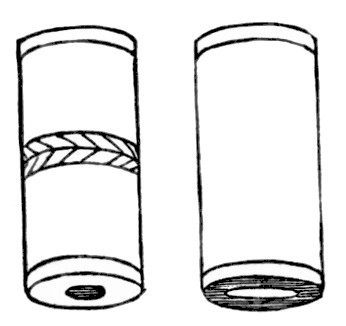
Gambling Bones.
One mode of gambling by the men is with small round wooden disks about two inches in diameter. There are ten in a set, one of which is marked. Under cover they are divided, part of them under one hand and the rest under the other, are shuffled around, concealed under cedar-bark, which is beaten up fine, and the object of the other party is to guess under which hand the marked disk is.
The other game of the men is with small bones, two inches long and a half an inch in diameter, or sometimes they are two and a half inches long and an inch in diameter. Sometimes only one of the small ones is used, and sometimes two, one of which is marked. They are passed very quickly back and forth from one hand to the other, and the object is for the opposite party to guess in which hand the marked one is. An accompaniment is kept up by the side which is playing by singing and pounding on a large stick with smaller ones. With both of these games occasionally the large drum is brought in, and tamahnous songs are sung, so as to invoke the aid of their guardian spirits.
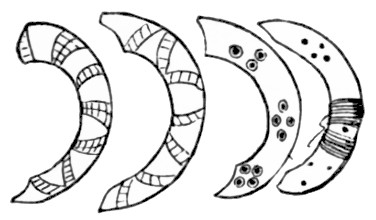
Beaver’s Teeth for Gambling of Women.
In the women’s game usually four beaver’s teeth are used, which have peculiar markings. They are rapidly thrown up, and the way in which they fall determines the number of counts belonging to the party playing. The principle is somewhat the same as with a game of dice. Formerly they bet large sums, sometimes every thing they owned, even to all the clothes they had, but it has not been the custom of late years. When Agent Eells first came to Skokomish, under orders from the Superintendent of Indian Affairs he tried to break up the gambling entirely, but there were hardly any Indians to sustain him in the effort. They would conceal themselves and gamble, do so by night, or go off from the reservation where he had no control, and carry on the game—so for a time he had to allow it, with some restrictions; that is, that the bets must be small, the games not often, but generally only on the Fourth of July, at great festivals, and the like. Occasionally they have had a grand time by gathering about all the Indians on the reservation together, both men and women, and perhaps for four days and nights, with very little sleep, have kept up the game.
On account of their want of employment in the winter and their inability to read, probably the sinfulness of this sin is not so great with them as with whites. Some good, prominent Indian workers have thought that it was hardly right to proscribe a Christian Indian from gambling. I learned of one Protestant church which admitted Indians without saying any thing on this subject, but which tried to stop it after they were in the church; but I could never bring myself to think that a church full of gambling Indians was right, and this became one of the test questions with the men in regard to admittance into the church.
When I first saw the infatuation the game possessed for them I felt that nothing but the gospel of Christ would ever stop it. Among the Clallams off of the reservation none except the Christians have given it up. On the reservation within the
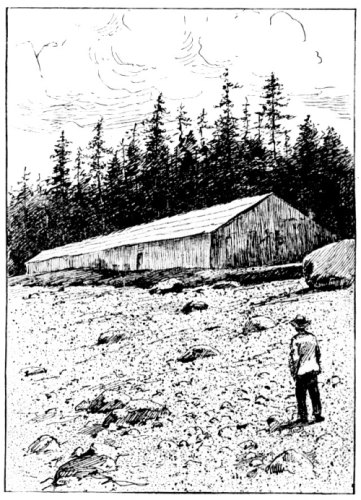
POTLATCH HOUSE, SKOKOMISH.
40 ft. x 200.
last few years so many of the Indians have become Christians that public opinion has frowned on it, and there is very little, if any, of it, though some of the Indians who do not profess to be Christians, when they visit other Indians, will gamble, although they do not when at home.
The Potlatch is the greatest festival that the Indian has. It is a Chinook word, and means “to give,” and is bestowed as a name to the festival because the central idea of it is a distribution of gifts by a few persons to the many present whom they have invited. It is generally intertribal, from four hundred to two thousand persons being present, and from one to three, or even ten, thousand dollars in money, blankets, guns, canoes, cloth, and the like are given away. There is no regularity to the time when they are held. Three have been held at Skokomish within fifteen years, each one being given by different persons, and during the same time, as far as I know, a part or all of the tribe have been invited to nine others, eight of which some of them have attended.
The mere giving of a present by one person to another, or to several, is not in itself sinful, but this is carried to such an extreme at these times that the morality of that part of them becomes exceedingly questionable. In order to obtain the money to give they deny themselves so much for years, live in old houses and in so poor a way, that the self-denial becomes an enemy to health, comfort, civilization, and Christianity. If they would take the same money, buy and improve land, build good houses, furnish them, and live decently, it would be far better.
But while two or three days of the time spent at them is occupied in making presents, the rest of the time, from three days to two and a half weeks, is spent in gambling, red and black tamahnous, and other wicked practices, and the temptation to do wrong becomes so great that very few Indians can resist it.
When some of the Alaska Indians, coveting the prosperity which the Christian Indians of that region had acquired, asked one of these Christians what they must do in order to become Christians, the reply was: “First give up your potlatches.” It was felt that there was so much evil connected with them that they and Christianity could not flourish together. Among the Twanas, while they are not dead, they are largely on the wane. Among a large part of the Clallams they still flourish.
Intemperance is a besetting sin of Indians, and it is about as much a besetting sin of some whites to furnish intoxicating liquors to the Indians. The laws of the United States and of Washington Territory are stringent against any body’s furnishing liquor to the Indians, but for a time previous to 1871 they had by no means been strictly enforced. As the intercourse of the Indians with the whites was often with a low class, who were willing to furnish liquor to them, they grew to love it, so that in 1871 the largest part of the Indians had learned to love liquor. Its natural consequences, fighting, cutting, shooting, and accidental deaths, were frequent.