Introductory material (continued 3)
Reading edition
Of Jackman's Clematises the English Gardener has the following: "They are magnificent; and more than this, they do give us some of the grandest things in the way of creepers the horticultural world has ever seen, making glorious ornaments either for walls, verandas, or rustic poles or pillars, varying in color from deep rich violet hue to dark velvety maroon, and in the newer seedlings, forms beautiful shades of pale bright blue."
Mr. Vick says of the Clematis: "Having a rather unsightly pile of stones in the back part of our grounds, we had them thrown together more in the form of a stone-heap, perhaps, than of anything worthy of the name of rockery, and planted Jackmanii and other fine sorts in the crevices, and for three summers this stone-heap has been covered most gorgeously. Thousands of flowers, in fact a mound of flowers, every day for months, has been the delight of visitors, causing one to exclaim, 'Nothing since Paradise has been more beautiful.'"
These fine hybrids will endure our Northern winters if somewhat protected. A gentleman in Rochester, N. Y., had a Jackmanii which bore full exposure without protection and came out in the spring uninjured to the height of nine feet. The extremities of the shoots for about two feet were winter-killed.
Clematis Sieboldii is a native of Japan, whence it was introduced by Mr. Low in 1837. It is of a slender free-growing habit. "The flowers which are produced from July to September are composed of six ovate sepals of a creamy white color, which form a fine background for the large rosette of purple stamens which occupy the center and render the flowers particularly attractive."
Clematis graveolins is a native of the mountains of Thibet. It is of comparative recent introduction. The flowers are produced on long stalks at the axils of the leaves, and are of a light yellow—an unusual color in this genus. It grows to the height of from ten to fifteen feet, and blooms freely during the entire season.
A lady writes to Vick's Magazine that she has a Clematis graveolins which is a wonderful sight. It grew from a feeble plant planted out in spring, two inches in height, into a column twelve feet high and three feet broad by August, and was a mass of yellow blossoms, and then, of the most exquisite, long-haired, silvery seed pods until hard frost. It lived through the winter, to its extreme tips, and then grew so rapidly, shading such an important part of her garden, that she had to remove it in the autumn, cutting it back severely. The seedlings from it grow, she adds, to eight or ten feet in a season.
Clematis crispa is of Southern origin; the flowers are one and a half inches long, produced singly on long stalks, and delightfully fragrant, a rapid grower, and perfectly hardy. Clematis coccinea is of recent introduction from Texas, the flowers are bell-shaped, of a most brilliant scarlet, and are produced in great abundance. This rare variety is offered only by Woolson & Co., Passaic Falls, N. J., who make a specialty of hardy herbaceous plants. Vesta, a Jackman, is large and of fine form; dead white, with a creamy tinge over the center bar, delicate primrose fragrance, an early bloomer. Mrs. James Bateman, pale lavender, and Thomas Moore, violet, superb, are Jackman seedlings, which flower in the summer and autumn, successionally, in masses, on summer shoots. These are all high priced. Many fine sorts can be purchased at prices ranging from thirty cents to one dollar.
The Clematis requires only ordinary garden soil. Where there are severe winters it is best to give the young plants at least some protection. They can be propagated by layering, which is rather a slow method, or rapidly by seed.
WISTARIA.
Very beautiful among the hard-wooded Climbers, is the Chinese Wistaria when in bloom. Its long, pendulous racemes of blue flowers are exceedingly graceful. They are frequently twelve inches in length and highly fragrant. The flowers appear about the last of May and first of June. It is not a continuous bloomer like the Clematis, but often gives a few flowers in August. It is rather slow at first, but after getting a good start the second or third year grows very rapidly. It is hardy after it gets strong, but young plants need some protection.
The Chinese White Wistaria was introduced by Mr. Fortune, and is regarded as a great acquisition. The Double Purple is illustrated in Ellwanger & Barry's Catalogue, by a full page engraving, which gives one an idea of its beauty better than the description which is as follows: "A rare and charming variety, with perfectly double flowers, deeper in color than the single, and with racemes of remarkable length. The plant is perfectly hardy, resembling Wistaria Sinensis, so well known as one of our best climbing plants. The stock which we offer was purchased of Mr. Parkman, who received this variety from Japan in 1863, and was the first to bloom and exhibit it in this country."
White American Wistaria is a seedling originating with Messrs. Ellwanger & Barry, of Rochester, N. Y. Flowers clear white; bushes short. Free bloomer.
CHINESE WISTARIA AS A STANDARD.
A novelty has been offered to the horticultural public of London this spring (1880), in the shape of standard trees of Wistaria Sinensis, raised in tubs, having heads five or six feet in diameter and covered with clusters of bloom. The plants were raised in Rouen, France, and sent to London for sale. It requires several years to attain plants of good size in this style, and as a matter of profit, a strict account would no doubt show a balance on the wrong side. In this country where the Wistaria is "at home," it may be raised in tree-shape in the open ground without expense, save the necessary care in pinching in and shaping. "So completely did the plants offered in London strike the popular taste, that there was quite a competition to become purchasers of them, and large sums were offered by those anxious to possess them. The general public, unaccustomed to this fine Chinese climber, looked on with wonder at "Lilacs" of such unwanted size and beauty of color."—Vick's Magazine.
Mr. Vick evidently does not deem this method an improvement on the natural graceful climber, for it reminds him of an anecdote which he thus relates in reply to an inquirer respecting the Wistaria as a standard.
"Once upon a time some kind of a steam cannon was invented, and a day of trial was arranged at Portsmouth, England, to which the Lords of the Admiralty and the Duke of Wellington were invited. After the exhibition, which we believe was somewhat successful, opinions of its merits were freely expressed, but the Iron Duke said nothing. When urged to give his opinion, he replied that he was thinking—'thinking if the steam gun had been first invented, what a grand improvement gunpowder would have been.' If the Chinese Wistaria had been a tree, and some one could have induced it to climb and cover our porches and arbors and old trees and buildings, what a grand improvement it would have been."


My faultless friends, the plants and flowers, Have only smiles for me. When drought withholds refreshing showers, Through hot and dreary summer hours, They then droop silently. When tired and worn with worldly care, Their fragrance seems like praise, A benediction in the air; Pure as an unfallen angel's prayer, Sweet'ning the saddest days. No frowns, no pouting, no complaints, In my bright garden fair, A colony of sinless saints, Whose beauty Nature's pencil paints, Are my fair darlings there. No inattention can awake Envy or jealousy; Their alabaster boxes break, As Mary's did, and I partake Of their rich fragrancy. Sometimes with weary soul and sad, I taste their sweet perfume; And then my soul is very glad, I feel ashamed I ever had A hateful sense of gloom. Flowers are the sylvan syllables, In colors like the bow, And wise is he who wisely spells The blossomed words where beauty dwells, In purple, gold and snow. O! sacred is the use of these Sweet gifts to mortals given. Their colors charm, their beauties please, And every better sense they seize, And bear our thoughts to Heaven. George W. Bungay.


"Spake full well in language quaint and olden, One who dwelleth by the castled Rhine, When he called the flowers, so blue and golden, Stars, that in earth's firmament do shine. Wondrous truths, and manifold as wondrous, God hath written in those stars above; But not less in these bright flowerets under us, Stands the revelation of His love."
WHAT changes have been manifested—how unceasingly and with what deftness Nature has silently wrought in tapestry and embroidery, sculpture and painting, till beauty is all around us, in the green carpet of earth, brightened with flowers and leafage of every hue! No wonder the birds sing praises to Him who gave them life with its fullness of blessings. Sad to think that man, high over all, and under the greatest obligation, too often is silent in thanksgiving for the gifts of a Father's love.

No month to me has such charms as June, when nature's robes are so fresh and clean, and the balmy air is redolent with fragrance. How delightful to be abroad with the early worm and early bird, working in the garden, while the songsters give free concerts, and the hum of the honey bird, and buzz of the bee, set forth a good example of cheerful industry!
The house plants have become established in the open border, and are so glad to get away from artificial heat and confined atmosphere into the broad sunlight of heaven, and breathe in full draughts of pure air and sweet dew, that they put on their best attire, and most attractive ornaments. Before the roses bloom, the bed of geraniums looks bright with flowers, each ambitious to excel his or her neighbor, either in beauty of color, or form, or duration of bloom, thus leaving me in perplexity as to choice. When Pliny bloomed everybody admired who saw his beauty; then Romeo with quite another style looked charming, but when Naomi unfolded her large trusses of double pips, of a rare, peculiar shade, nobody ever saw a geranium quite so lovely, and then its duration of bloom—full six weeks! Jennie Dolfus, however, became a dangerous rival—a deeper, richer shade, and not a pip would she allow to fade so long as Naomi looked so pert. Some said, "I like Naomi the best;" others said, "I think Jennie is the prettiest." But Beauty, close by, hearing the praises lavished on her sisters, and perchance trusting in her good name, came forth one day in dress of white with deep pink ornamentation. Never had such unique beauty as this ever been seen in Geranium before, and, "Isn't it lovely!" "Just splendid!" "What a beauty!" were uttered with exclamation points, till she blushed with becoming modesty—the flush spread and deepened until her face was completely suffused with the delicate tint, making her yet more attractive. Wellington donned his crimson suit, and De Gasx an orange yellow; Pauline Lucca, prima donna though she be, appeared in dress of pure white, and Richard Dean in scarlet with a white star that was very becoming. New Life thought to draw special attention by odd freaks, and came out in a parti-colored dress of the most singular combinations; part of it was scarlet dotted with white—part of it half scarlet, half salmon, part of it widely striped, and part white with just a flush of pink! I must call him the clown of the family!
I have only named a few of the rare Geraniums that adorn one of the beds of my garden. For beauty, free flowering, and duration of bloom they cannot be surpassed.
Interspersed with them are ornamental leaved Geraniums, Crystal Palace Gem, an improvement on Cloth of Gold; Marshal McMahon, the best of all the bronzes; Cherub, deep green, white and orange, flowers carmine; Glen Eyre Beauty, Dr. Livingstone, a new, sweet-scented, fine cut-leaved Geranium; Happy Thought, one of the most attractive, with its dark green leaves and creamy white center. Here and there are commingled Anchryanthus of divers hues, and Coleosus, giving a fine effect to the whole. This is now the most attractive bed of all, but when the Lilies are in bloom, and the dear little Tea Roses, the bed parallel with it will be the sweetest, if not so brilliant.
This year I have a tropical bed of oblong form. A Castor Bean rises majestically in the center, two beautiful Cannas each side, while a Dracæna, a splendid Croton, two fancy Caladiums, and a few other choice plants fill the space, the whole bordered with Coxcombs. In a few weeks this bed will look gorgeous, and those filled with annuals will have changed from their present inattractiveness to delightful bloom. August is really the month of fullness of blossom, and of restful enjoyment of beauty and fragrance. The weary days of preparation, of bedding out and of weeding, are over, and one may now give themselves up to the enjoyment of the fruit of their labor, till the chill nights of autumn bring a renewal of the toil.
"Does the brief period of restful enjoyment repay for the many weary days antecedent and subsequent?"
Yes, richly, fully, for there is pleasure with the toil, and to me health-giving influences that energize the physical system for indoor work, and stimulate the brain for literary pursuits. To me my garden is a God-send, fraught with blessings.
"Gardening is a pleasant pastime." I am prepared to adopt that sentiment to-day, if I did demur somewhat last month. It is a delightful pastime, in the early morning, to spend an hour among the flowers, trowel in hand, rooting out the weeds, loosening the soil around your plants, and tying up here and there the tall and fragile, while the birds are singing in the trees around you their morning song of gladness. How the dew-laden grass and shrubs impart sweetness to the air, and your lungs inhaling its purity, are expanded and invigorated, your whole system feels the better for the tonic, and prepares for breakfast, and the work that shall follow.
It is a pleasant pastime, when wearied with toil you go forth for a time among your flowers and search for the buds, or examine the newly-opened flower. How it rests you!
It is a pleasant pastime, when the labors of the day are over, and the sun is throwing long shadows from the west, you take watering-pot in hand, and shower the refreshing spray upon your plants, cleansing them from the dust, and cooling them after the heat. How they thrive, and bud and bloom!

"We should love flowers, for when we are gone From this forgetful world a few short years— Nay, months, perhaps—those whom we hold most dear, Cease to bedew our memories with tears, And no more footsteps mark the paths that lead To where we dreamless lie; but God's dear flowers Give to our very graves the loveliness That won our tender praise when life was ours."
LAST WORDS OF THE POET HEINE.
OF the many touching tributes paid to flowers, there is a beautiful one associated with the closing hours of Henry Heine, the poet. He was dying in Paris. The doctor was paying his usual visit, when Heine pressed his hand and said: "Doctor, you are my friend, I ask a last favor. Tell me the truth—the end is approaching, is it not?"

The doctor was silent.
"Thank you," said Heine calmly.
"Have you any request to make?" asked the doctor, moved to tears.
"Yes," replied the poet; "my wife sleeps—do not disturb her. Take from the table the fragrant flowers she brought me this morning. I love flowers so dearly. Thanks—place them upon my breast." He paused, as he inhaled their perfume. His eyes closed, and he murmured: "Flowers, flowers, how beautiful is Nature!" These were his last words.
THE OLD MAN AND THE FLOWERS.
A few years since the Belfast (Me.) Journal gave this touching incident: "One day last week an elderly man, known to our people as an honest and hard-working citizen, was walking slowly up Main street. There was sorrow in his countenance, and the shadow of grief upon his face. Opposite the Savings Bank his eye caught sight of the flowering Oleander, that with other plants fill the bay-window of the banking-room. He looked at it long and wistfully. At length he pushed open the door, and approaching Mr. Q., said:
"'Will you give me a few of those flowers?'
"The cashier, leaving the counting of money and the computing of interest, came around the counter, bent down the plant, cut off a cluster of blossoms, and placed it in the man's toil-hardened hand. His curiosity led him to ask:
"'What do you want them for?'
"'My little granddaughter died of scarlet fever last night,' the man replied with faltering voice, 'and I want to put them in her coffin.'
"Blessed be flowers, that can thus solace the bereavement of death and lend their brightness as a bloom, to the last resting-place of the loved one."
CONVERTED BY A FLOWER.
There is a beautiful incident told of a Texas gentleman who was an unbeliever in the Christian religion. One day he was walking in the woods, reading the writings of Plato. He came to where the great writer uses the phrase, "God geometrizes." He thought to himself, "If I could only see plan and order in God's works, I could be a believer." Just then he saw a little Texas Star at his feet. He picked it up and then thoughtlessly began to count its petals. He found there were five. He counted the stamens, and there were five of them. He counted the divisions at the base of the flower, there were five of them. He then set about multiplying these three fives to see how many chances there were of a flower being brought into existence without the aid of mind, and having in it these three fives. The chances against it were one hundred and twenty-five to one. He thought that was very strange. He examined another flower, and found it the same. He multiplied one hundred and twenty-five by itself, to see how many chances there were against there being two flowers, each having these exact relations of numbers. He found the chances against it were thirteen thousand six hundred and twenty-five to one. But all around him were multitudes of these little flowers, and they had been growing and blooming there for years. He thought this showed the order of intelligence, and that the mind that ordained it was God. And so he shut up his book, picked up the little flower, kissed it, and exclaimed: "Bloom on little flowers; sing on little birds; you have a God, and I have a God; the God that made these little flowers made me."


THIS species is one of the most desirable of hardy-wooded plants we possess. They are admirable for the house, for the balcony, the piazza, or the border, being handsome in foliage, and very graceful and beautiful in flowers. Some are stately, others dwarf, some are flexible and drooping. We have had for several years three that we have greatly admired for their variegated leaves, especially for the winter window-garden, where they compensate for the scarcity of flowers, by the brilliancy of their foliage, yellow and green, finely mottled and marbled.

Duc de Malakoff is stately, and by cutting off the top of the main stalk, it is made to branch out very largely, forming a miniature tree. It grows very rapidly, and its leaves are like the Maple in form, which has led many to call the plant Flowering Maple, but this is not correct, as it is not a Maple at all, but an Abutilon. Some of the leaves on one only a year old, measure seven inches across, and eight and a half in length. In the older plant they are not so large. Thomsonii much resembles Malakoff, but its markings are not so handsome; the green is darker, and predominates over the yellow, so far as my observation extends, but it is a more abundant bloomer. Flowers are orange color. I have vainly searched through many catalogues to find the color of the Duc de Malakoff blossom, but all are silent; it is not even said that they flower at all, but my four-year-old had one bud last year, which unfortunately blighted. The yearling has one bud, and I hope it will live and afford me the knowledge I have failed to find in books. Malakoff not variegated, has large orange bells, striped with brown.
My other variegated Abutilons are of trailing habit; Mesopotamicum is very graceful, one droops over the side, and climbs and twines around the cords of a large hanging-pot, for which it is admirably adapted. Its small pendant blossoms, crimson and yellow, growing profusely along the slender branches, drooping among the elegantly marbled foliage, give this variety a very attractive charm. Another is trained to a pot trellis, and is very beautiful in this form. We advise every one to add this variety to their collection. Pictum is very similar in every respect; the leaves are darker, and not so variegated. They require a strong light to bring out their markings, and hence are more perfect in beauty when bedded out in the garden, where they can have plenty of sunshine.
Boule de Neige (Fairy Bell) has long been a favorite for its pure white bells and constancy of bloom. A splendid winter bloomer. John Hopkins, with its rich, dark, glossy leaves and golden flowers has superseded the old Pearl d'Or, which was for a time the only real yellow. Darwinii is one of my favorites. The flowers are more spreading than any other variety, opening like a parasol; color orange-scarlet veined with pink. It blossoms very profusely, and when only a few inches in height. The flowers are large and well formed, and borne in clusters rather than singly, like many older sorts. This variety was cross-fertilized with Santana, crimson flower, and as a result we have Darwinii tessellatum, combining the variegated foliage of Thomsonii with the free-blooming qualities of Darwinii.
The improvements by hybridizing have been very great within a few years, and many new varieties have been sent out. One of these is Roseum Superbum, the flowers of which are of a rich rose color, veined with a delicate pink. Very free bloomer. Venosum, we find only named in an English catalogue. "The magnificent blooms of this variety place it at the top of all the Abutilons. Although it is of tall growth its beautiful palm-shaped leaves and gorgeous flowers make it invaluable for crossing and for conservatories."—H. Cannell.
Among the new and valuable novelties of American origin are Arthur Belsham, Robert George, J. H. Skinner, and Joseph Hill. These have been three years before the public, and Mr. John Thorp, a well-known popular florist of Queens, N. Y., says of them, "We have not, amongst all the flowering Abutilons, such fine varieties as these. I have had plants between five and six feet high, pyramidal shape and literally covered with flowers."
They originated with Messrs. Leeds & Co., of Richmond, Indiana, who make quite a specialty of new seedling Abutilons, and this year offer four "of new shades and colors."
A. G. Porter. "Flowers of a beautiful lavender color, delicately suffused with a light shade of rosy pink, and handsomely veined with magenta, forming a flower of magnificent color and shape, a very free bloomer. A cross between Boule de Neige and Rosaflora, with the habit and growth of Boule de Neige."
Little Beauty, "A very dwarf grower, having a short, compact, symmetrical bush, which is completely covered with its medium-sized but well-shaped flowers, of a very light salmon color, beautifully veined with rosy carmine. It blooms in clusters and when in full bloom makes a remarkably fine appearance. A cross between Rosaflora and Darwinii."
N. B. Stover, "A low, compact grower. Flowers large and well-formed, almost covering the bush; color, rich ponceau, finely veined with carmine. A decided novelty, being a new color among Abutilons."
Dr. Rapples. "Light orange salmon, veined with crimson. One of the most attractive in the set."
A new Abutilon, a decided novelty in color, comes to us from "The Home for Flowers," Swanley, England, sent with other choice plants by Henry Cannell & Son. It is thus described in his Floral Guide:
Firefly (Swanley Red). By far the highest and brightest color of all the family; habit dwarf, and one of the freest bloomers, throwing flowers out on strong foot stalks of the finest shape; certainly one of the noblest, and when grown in a pot it flowers all the winter, and all the summer when planted out, and forms one of the best flowering shrubs that we possess.
Parentage of this Flower.—Mr. George states that he sometime since flowered a small red variety, which had a very lively shade of color, and determining to make this a seed parent, it occurred to him to use on it the pollen of the single deep color Hibiscas, which, like the Abutilon, is included in the natural order Malvaceæ. Mr. George thinks the fine color seen in his new variety, Firefly, is due to this happy inspiration of color.
The Gardener's Chronicle has this paragraph respecting Firefly: A red Abutilon, one of a batch of recent seedlings raised by Mr. J. George of Putney Heath, well deserves the foregoing appellation. The flowers are of large size and of a much greater depth and vividness of color than that possessed by any variety in the Chiswick collection. It has been provisionally named Firefly, and we believe the stock has passed into the hands of H. Cannell & Son, of Swanley, for distribution.
A writer in Vick's Magazine describes a method of training the Abutilon that must, we think, be a very attractive one.
"A pretty plant may be obtained by inarching Abutilon Mesopotamicum upon Abutilon Darwinii, or some other strong-growing variety, and training it so as form an umbrella head, which can easily be done. The stock for this purpose should be about five or six feet high. Grown in this way it produces an abundance of bloom, and the flowers being elevated are seen in all their beauty. If Abutilon Mesopotamicum is inarched upon Abutilon Thompsonii, the result will be Abutilon Mesopotamicum Variegatum. A well-formed plant of this on a stock about five feet high is one of the finest of plants; whether in blossom or not it is always adapted for decorative or exhibition purposes. Care must be taken at all times to keep them tied to stakes, as they are liable to be broken off by the wind."
Abutilons are apt to be infested by the red spider, if kept in too dry an atmosphere, and not frequently sprayed. Moisture is death to this pest, but as it makes its home on the under side of the leaf, it is too often overlooked until it has destroyed the vitality of the foliage. Recently I found that my large Duc de Malakoff looked sickly, and I concluded it had become root-bound. A few days later, I noticed brown spots thickly covering the bark. I removed one, and on examining the under side through a microscope, I saw several tiny insects moving about. I decided that my plant was troubled with the scale of which I had often read, but never seen. I made a pretty strong solution of soap-suds, and with a sponge quite easily removed all of the pests.
In bedding out Abutilons, it is better to have them in pots, plugging the hole, or setting the pot on a stone or piece of brick, so that the roots may not go astray, for if plunged directly in the ground they throw out many roots and the plant becomes too large for re-potting to advantage. If, however, they are planted in the earth, in August they should be cut around the stock so as to bring the roots within due bounds, and the plant can be pruned in the autumn. This method is applicable to all strong plants that run largely to roots. They should be cut off sufficiently to leave only a ball of earth of convenient size to set in the pot when the plant is transplanted.


THE genus Dahlia comprises but few species, all natives of the mountains of Mexico, whose range is from 5000 to 10,000 feet above the level of the sea. About one hundred years ago a Spanish botanist introduced seeds of the Dahlia into his native country, and named the genus in honor of a Swedish botanist, Dahl. The first seed imported seemed to be variable and not very promising. About seventy years since, Humboldt sent fresh seed to Germany. Soon after this, both seeds and bulbs were introduced into England and France, and began to attract considerable attention, some enthusiast being rash enough to hazard the assertion that "there are considerable reasons for thinking that the Dahlia will hereafter be raised with double flowers."

About 1812 probably the first double Dahlia was grown, but for several years after this both double and single varieties were figured in colored plates, and exhibited at horticultural shows. That the single varieties were prized is not strange, for the double were not very good, and even as late as 1818, published figures showed very imperfect flowers.
The improvement of the Dahlia after this was rapid, and its popularity quite kept pace with its improvement. Dahlia exhibitions were held in England and on the continent, which were crowded by enthusiastic admirers of this wonderful Mexican flower. For many years the Dahlia maintained its popularity, but there is a fashion in flowers, as in almost everything, and for a time the Dahlia became, to a certain extent, unfashionable, and this was well; for it placed the flower upon merit alone, and growers were compelled to introduce new and superior varieties to command either attention or sale for their favorite flower.
A taste for old styles is now the "correct thing," and so we have imitations of ancient earthenware, furniture, etc., and import original Chinese Aster seed, and also obtain roots of the single Dahlia from Mexico.
There are three pretty distinct classes, the Show Dahlias, the Dwarf or Bedding, and the Pompon or Bouquet, and to this we may add the Fancy Dahlia. The Show Dahlia grows from three to four feet in height, and embraces all our finest sorts, fit for exhibition at horticultural shows, from which the name is derived; the flowers range in size from two and a half to five inches in diameter. The striped and mottled and spotted varieties belonging to the Show section are called Fancy, and though not as rich, nor usually as highly prized as the selfs, or those of one color, are very attractive. The Dwarf or Bedding Dahlia grows about eighteen inches in height, and makes a thick, compact bush, and covers a good deal of surface; flowers of the size of Show Dahlias. They are therefore very desirable for bedding and massing. The Pompon or Bouquet Dahlia makes a pretty, compact plant, about three feet in height. The leaves are small, and the flowers from one to two inches in diameter. Many expect to find small flowers on their Dwarf Dahlias, and feel disappointed because they are of the ordinary size, not knowing that it is the plant, and not the flower, that is dwarfed, and that only the Pompon gives the small flowers. The word Pompon is French for topknot or trinket, meaning about the same as the English word cockade. The English term Bouquet is very appropriate, as the flowers are so small they are very suitable for bouquets. Being of a spreading habit, they cover a good deal of ground. Unlike most of our bedding out plants, they do best in a poor soil; if rich, they grow to branches and leaves so much, they bloom sparingly and late.
Generally those who plant Dahlias purchase the tuberous roots, because they give good strong plants, that flower freely without trouble or risk. They are smaller and better than the large, coarse roots usually grown, because they are raised from cuttings, and generally form their roots in pots. When a tuber is planted, a number of buds that cluster around its top will push and form shoots, and if too numerous, a portion should be removed; indeed, one good, strong plant will suffice, and then the plant will become a tree instead of a bush. Even then, if the top become too thick, a little thinning of the branches will be of advantage. If the young shoots that start from the neck of the bulb, are cut off near a joint and placed in a hot-bed in sandy soil, they will root, form good plants, and flower quite as well as plants grown from the tuber; this, however, requires some care and experience, and amateurs generally will succeed best with bulbs.
New varieties of Dahlias, of course, are from seed. Some of them prove good, others fair, and a portion utterly worthless. As a general rule, we would not advise amateurs to trouble with seeds, although there is pleasure in watching the birth and development of a new and beautiful variety.
The seed of Dahlias may be sown in pots in early spring or end of winter, in a light, loamy soil; they will germinate quickly, and as soon as they begin to show their second leaves they should be pricked out into other pots or boxes, so that they may have plenty of room and air—they are very liable to damp off if at all crowded. After pricking out they should be kept in a thrifty, growing condition, by proper attention to watering and temperature; the temperature should be maintained as near 70° as possible, and the watering be sufficient to preserve a moderate moisture.
If the green fly attack them, it will be best to treat them to a very weak dilution of tobacco water; the young succulent plants are very sensitive to smoke, and it is best not to fumigate them. In about two months the young plants should be large enough to pot off singly, or to be transplanted into a frame or bed, where protection can be given them from the cold of night-time, or from late frosts. As soon as all danger is past they can be transplanted into their summer quarters, and should stand at least three feet apart. The soil where they are to grow, should be rich and mellow. In August they will come into flower, and those having blooms worthy of cultivation can be retained, and the others destroyed. Only a small proportion of the plants grown from common seed produce flowers equal to those now in cultivation, but when seed is saved from a choice collection of named varieties, the chances are that a large proportion of the plants will produce very good flowers.—Vick's Magazine.
"The Dahlia is called a gross feeder, but it is not. It loves moisture rather than rich elemental food. In clay it finds the best constituents of its development—moisture, silex, lime and alumnia. So we say to those who love this queenly flower, if you would see the queen in all her glory, plant in a comparatively heavy soil, no manure, and reduce the stalks to one for each tuber, set the stakes firmly, to keep the stalks from swaying, and if the season is dry, give the bulbs a soaking with water every evening during the drought. My word for it you will then be proud of your success."
The Pompon, or Bouquet Dahlia is a favorite variety of this genus. The little round balls of bloom are so pretty and trim. Beatrice, blush tinted with violet; Dr. Stein, deep maroon, striped and mottled; Goldfinder, golden yellow; Little Philip, creamy-buff edged with lilac; Little Valentine, crimson; Mein Streifling, salmon, striped with crimson; Pearl, white; Prima Donna, white, fimbriated; Perfection, deep maroon.
SINGLE DAHLIAS.
Anything for a change from the common order of things, seems to be the fashion now-a-days, in flowers as well as in house building and house furnishing. The antique, the antique, is the rage! So after years of labor and hybridization to bring the Dahlia up from its native state of single blessedness, to its enormous cauliflower blooms, there comes a reaction, and now single Dahlias are praised as "the most beautiful of all flowers," the "par excellence the Londoner's flower!" Well, let the English florists thus praise its beauty if they want to, but we opine that on this side of the great ocean it will never be considered "the most beautiful of all flowers," however attractive some of them may be, and well adapted for bouquets. There is no danger of their superseding the doubles, but it is well to have both when one can afford it; their present high price puts them beyond the reach of those whose purses are not well filled, but in a year or two, when the novelty is worn off, they can be purchased at half or even less, perhaps, than their present price.
We find in the London Garden the following: "Dahlia perfecta, originally introduced by Messrs. Henderson, is perhaps the finest flower which we possess, unless Paragon, brought into notice by H. Cannell, may be considered to bear away the palm. Lutea, a quilled yellow, is also a grand bouquet flower."
The single Dahlias, Paragon and Lutea, are now offered for the first time in this country, by Messrs. Hallock & Thorp of Queens, N. Y., and the former is finely illustrated in their catalogue. Color very dark velvety maroon with shadings of bright scarlet around each petal; small yellow disk. Lutea is pure yellow, with dark orange center. The same firm offer Dahlia Juarezii, of which Mr. Cannell says: "The grandest novelty of the year, and not only a novelty, but a most valuable and useful decorative plant for all purposes through the late summer and autumn months. Its blossoms are of a rich crimson, and very much resemble in shape and color the well-known Cactus, Cereus speciosissimus. Height about three feet, very bushy flowers of very striking appearance and quite unlike those of an ordinary double Dahlia, the flowerets being flat and not cupped. Figured in Gardener's Chronicle October 4th, 1879, and awarded a Botanical Certificate Royal Horticultural Society."
The following statement was made in the Gardener's Chronicle respecting this new type:
"A remarkable box of Dahlias was shown by Messrs. Cannell with three or four of the single forms, which, if it were not heresy to say so, we should so much prefer to the formal lumps so dear to the florist proper; and then there was a new type of Dahlia altogether, a Sea Anemone among Dahlias, with long crimson scarlet pointed petals, like the tentacles of an Antinia—a striking novelty, christened temporarily the Cactus Dahlia, and which will be the parent of a new strain. It received a Botanical Certificate; some said this ought to have a higher award, but what higher or more appropriate form of a certificate could be given to such a flower. If we were a Dahlia, we should greatly prefer the honor of a 'Botanical,' to that of a 'First Class Certificate.'"
This new type is illustrated in Hallock & Thorp's Catalogue.
Two new Dahlias not yet introduced in this country are included among the novelties of 1881. Cannell's Scarlet, a Show Dahlia, several shades higher and brighter in color than any scarlet before introduced. "Its shape is most model-like, and not excelled by any other, and is without doubt the best Dahlia of the year." Miss Cannell, (Eckford)—"Mr. Eckford's Dahlia, Memorial, was the king of best shapes for many years, but the one now offered is of greater excellence, and by far the best of its class; color white, tipped with rose-pink, and the depth and build of flower is most model-like."
AMARYLLIS.
These are the finest of all summer flowering bulbs, throwing up strong flower stems in June and July, bearing from two to six magnificent lily-like blossoms. The varieties are numerous, but only a few sorts are found catalogued. Amaryllis Johnsonii is the finest of the commonly grown varieties. Its leaves are a dark rich green, two inches broad, and two feet long. The flowers which are five or six inches long, are crimson with a white stripe through the center of each petal, and are borne upon a stalk two feet high. They usually bloom twice a year, the flowers appearing just as the leaves begin to grow.
Amaryllis formosissima is of a very peculiar form. The flowers are scarlet-crimson, very velvety in appearance; there are six petals, three of them nearly erect, and three drooping very long. After being bedded out, it quickly throws up a flower stalk and blooms before the leaves appear. It is a superb flower, known sometimes by the name of Jacobean Lily. Amaryllis vittata is a splendid hybrid, red ground striped with white. Amaryllis Valotta purpurea is an evergreen variety, and should be kept growing the year round. In August it throws up a flower-stem from one foot to eighteen inches high, bearing a cluster of light scarlet flowers two or three inches in diameter. A light soil and small pot suits it best. Mr. John Lewis Child of Queens, N. Y., has a finer collection and more numerous varieties than are usually found named in the catalogues. Some of them we will specify. Johnsonii Grandiflora, an improvement on the well-known Johnsonii Harrisoni, large, pure white, with double crimson streaks running through each petal. It has a delicious, orange-blossom fragrance. Reticulata, a bright rose color, the foliage is very attractive—dark green with a white stripe running through the center of each leaf. Aulica Stenopelalon, a magnificent species, having large orange crimson flowers, beautifully veined with scarlet. "Equestre fl. pl. This grand novelty was discovered in 1877, in one of the West India Islands. The flowers are perfectly double, resembling those of a large Camellia. Its color is rich, fiery orange red. We believe we have the only stock of this beautiful flower in America." John L. Child.
This and Harrisoni, are priced at $4.50, so they must be very rare and beautiful. Aspasie, white, tinted with yellow and red; large and perfect. Crinum Amænum, new and very beautiful, white-striped crimson. Lutea, a hardy variety, which blooms in the autumn; pure yellow. Calafornica, pure white.
The bulbs are of easy culture. After blooming, and the foliage fully grown, they should be allowed to rest for several months, then start into growth by watering sparingly until the flower stalks appear, when a more liberal supply should be given. Usually two successions of bloom can thus be obtained. The bulb should be planted so as to leave the upper portion uncovered.
HOYA CARNOSA, OR WAX PLANT.
This plant is a native of tropical Asia, where it is partially parasitical, its roots penetrating the bark of the trees which support it. It was introduced into England in 1802. There are several species, but only one is generally cultivated. Hoya Carnosa has thick waxy leaves, and bears umbels of beautiful flesh-colored flowers which are very wax-like in appearance. It is an excellent plant for house culture as it stands the extremes of heat and cold better than most plants, and is not easily injured by neglect. It can be trained to climb on trellis-work to almost any height, and when in bloom, which continues for half the year, it is a very interesting plant.
There are several varieties of Hoya, but one only is generally cultivated. Silver Variegated Foliage is said to be very handsome but is of slow growth and difficult to propagate. Imperialis is a new variety with beautiful foliage and scarlet flowers. Cunningham has light green leaves, deeper colored flowers than the Carnosa and is a rapid grower.
They succeed best in peat, with some fibrous soil and sand. They must have perfect drainage, and require a period of rest. Hoya Carnosa is easily propagated from cuttings. A very good method is to wrap a cutting in moss, keeping it moist until the roots are well started.

AUGUST is the month when we rest from our labor in gardening, and abandon ourselves to the full enjoyment of the varied blossoms which so abundantly meet our eye. Now we can best determine what changes may be required in the arrangement of our plants next year, in order to give the most pleasing effect. A tall plant may have been inadvertently set out in the midst of those of low growth, and we see now how awkward it looks. Short-lived annuals may have occupied a conspicuous place, and on their departure left an unseemly vacancy. A bed may have been filled with a class of plants that are not free bloomers, and so there has been little beside leaves, while another bed has been brilliant during all the summer months with flowers. Annuals of a new kind, high-priced novelties, have been tested; are they any better than our old favorites? If we cannot indulge in many sorts, what do we find the most satisfactory? Twenty-five cents per packet seemed very expensive for Heddewigii Pinks, but Crimson Belle and Eastern Queen are of such superior size and rare beauty that the investment is not regretted, and then we know that they will bloom in greater perfection next year, and that the seed saved this autumn and sown in early spring, will increase the stock. Twenty-five cents for a paper of Candytuft seed looks extravagant, but no one who invests in Tom Thumb would regret it. It is so dwarf, so compact and bushy, such a long continued bloomer, so admirable for edging a bed, that it is really almost an essential. Then it will sow itself, and the seedlings will be up as soon as the frost is out of the ground, and plants from self-sown seed are so much more thrifty and early than those one sows in the spring, that this is a great gain.

Candytuft—white, pink, light purple, dark purple and crimson, I find it well worth while to culture for early and profuse flowers, and admirably adapted for bouquets. I always have large quantities of the white, to set off the brighter flowers, and by sowing seed in June and July, have a succession of blooming plants. Foxglove, both white and purple, with their thimble-shaped spotted blossoms profusely borne on tall spikes, with side branches loaded with bloom, has been one of the greatly admired flowers of my garden. Plumbago, with its clusters of tube flowers, of the palest of blue, is very beautiful. Godetia, "Lady Albemarle," I have found to be all that it is represented. For two months it has been in constant bloom, and it will continue to flower till frost. It is of a bushy, compact habit, about twelve inches high, the flowers are from three to four inches in diameter, and of a rosy-carmine color. Everybody who has seen it, has a word of praise for this most beautiful of all the Godetias. Alba is a new variety, having pure white flowers; Insignis is pure white with a crimson blotch on each petal; Whitney's is of dwarf habit, and has large flowers, blush-colored, marked about the center with a handsome crimson stain. The new French Marigolds "Cloth of Gold," and "Meteor" are just splendid with their large and beautifully striped imbricated leaves. One has gold bars evenly marked on the rich dark velvety petals, and the other has deep orange stripes on a pale straw-colored, almost white ground. "Meteor" is a perfect gem among the Calendulas.
Convolvulus minor—new crimson-violet with yellow eye encircled with a band of pure white; dark blue and light blue with yellow eye margined with white; pure white with yellow eye, and blue and white striped, are very pretty free-blooming dwarfs of this species.
My Stocks are very fine, from mixed seed of the German, new large flowering. They are mostly very double. The creamy white are especially beautiful. The bright crimson and canary yellow are handsome. There are many varieties of this species, but what are generally termed Ten-weeks Stock are best known. They are classed under five heads: Dwarf, Miniature, Large-flowered, Pyramidal and Wall-flower-leaved. Then there are the Intermediate Stocks, prized for their late autumn blooming, of which there are twelve or more varieties. The German Brompton Stocks are divided into two sections; Brompton and Hybrid, or Cocordean. The latter bloom with a single stem which forms a splendid pyramid of flowers, and is cultivated largely in pots. Seeds sown in early spring will bloom in autumn, and if carefully potted will flower during winter; if sown in July and August, and cultivated in pots will flower the following spring and summer. The Imperial or Emperor stocks, sometimes called Perpetual, are large flowering, and white, rose, crimson and blood-red in color.
"Hardy's All-the-Year-Round," is a perpetual bloomer. The plants grow about twelve inches high, and produce hundreds of bunches of double white flowers.
Let us linger a little while at this rose bed. Are not those Teas lovely? Look at Madame Lambard, one of the finest French roses imported recently from Paris. Is not the color exquisite—a beautiful shade of silver bronze, changing to salmon and fawn, delicately shaded with carmine rose. And so deliciously fragrant! That rose so large and full, with a rare shade of violet red, brightened with crimson maroon, is Aline Sisley. It is surprising how such a tiny plant could have produced such an immense flower! And this is Letty Coles, a new French rose, very handsome and sweet; color rosy-pink, deeply shaded with intense crimson. Perle des Jardins is magnificent with its rich golden yellow, and Bon Silene has long been a special favorite. Its buds are large and beautiful. That charming white so deliciously scented is Mademoiselle Rachel, and this one with pure deep green flowers is Verdiflora, or Green Rose, scentless, and of no value except as a curiosity.
This grand rose is Abel Carriere, a hybrid perpetual more beautiful I think than the popular Jacqueminot in the perfectness of its form, and richness of its color. The outer petals are bright glowing crimson-scarlet, while the center is a deep fiery red. But it will never do to linger longer among the sweet roses, for there are many other flowers to show you.
I think that Hydrangea, with its immense trusses of bloom, is just one of the most desirable shrubs we can have in the garden. I have had mine six or seven years, and it bore three clusters of flowers the first year, though a wee plant. It blooms from August till hard frost, and needs no protection in the winter, though I do sometimes put a mulching of straw or a bit of brush around the roots. A lady writing to Vick's Magazine says of this Hydrangea: "The first year I planted Hydrangea Grandiflora it produced three heads of flowers, the second, fifty-six, and the third year ninety-two. Thorough cultivation and a pail of liquid manure once a week, helped the plant to bear this enormous load of flowers."
Hydrangea Alaska is a more recent acquisition. Its flowers frequently measure twelve inches across, and are of a bright pink color, not hardy at the North. Hydrangea Thomas Hogg would be a very unpoetical name did it not remind one of "The Ettrick Shepherd." This variety was sent to the United States from Japan, by that eminent botanist for whom it is named, and has become deservedly popular. It belongs to the Hortensia section of the family, but is a far more abundant bloomer than any other. The flowers are of the purest white, of very firm texture, and retain their beauty for a long time.
A more recent novelty sent from Japan by Mr. Hogg, is the "New Climbing Hydrangea," which he describes as clinging to trees to the height of fifty feet, producing corymbs of white flowers of the size of ordinary Hydrangeas. It clings exactly like the Ivy, and must produce a striking effect when in full bloom. It is entirely hardy. Mr. Peter Henderson was the first to offer this novelty here and in Europe. Elegantissima is a novelty truly with its leaves flaked, bordered and striped with golden yellow. I do not know whether it blossoms or not, it is handsome enough without flowers.
HELIOTROPE.
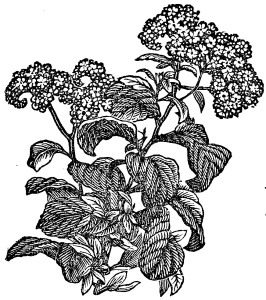
The new Heliotrope Le Negre is the darkest of this genus, and Snow Wreath the nearest approach to white we have yet had; truss very large, growth compact, and fragrance exquisite. Garibaldi is almost white; Mrs. Burgess is dark violet, and Duc de Lavendury is a rich blue, dark eye.
Sweet Alyssum is another of the essential flowers for the border, admirable for edgings, for its dwarf habit and continuity of bloom. The great novelty of last year was the new double variegated Sweet Alyssum—"The Gem." The flowers are very full, and the foliage broad with a mid-rib of light green, bordered on each side with pure white. It is a fine, compact grower, and far superior to anything of this species yet offered.
Lantanas, I think, add greatly to the attractions of the garden, so rich in color and profuse in blooming. Clotilda, pink with yellow center, and Comtesse de Diencourt, flower bright rose and yellow center sulphur, are very desirable. Alba perfecta, pure white, is fine, so also is Alba lutea grandiflora, white with yellow center. Mine d'Or is a new variety, with bright orange and crimson flowers, and golden variegated foliage. M. Schmidt is a beautiful novelty. Flowers of a brilliant yellow, passing into purple vermilion; grows in the style of a Petunia.


NEXT to Primroses, and by no means below them in value, we place the Cyclamen. The leaves, a deep green with white embroidery, are very ornamental, but when surmounted with a wealth of bloom, what can be more charming? Two of mine have begun to blossom—a white and a pink—and the buds are numerous. Others will bloom later. They continue in bloom for a long period, and are easy of culture, though where there is over-dryness of atmosphere, they are apt to be infested with the red spider. They need to be frequently sprayed and it is well to immerse occasionally the entire plant in water so as to wet the under surface of the leaves. The water ought to be tepid, and indeed for all plants in cold weather. To keep the dirt from falling out when the plant is plunged top downward, something can be wrapped around the pot. A mixture of turfy loam and sandy peat is best, but when not available, leaf mold or a rich mellow soil mixed with silver sand will do.

There are several varieties of Cyclamen, but the most common is persicum, and many catalogues name no other. One of mine is gigantium, an improvement on persicum, the flowers being much larger and finer in every respect. Among many catalogues I find this named in only one. Persicum, white and pink, is a sweet scented variety from Cyprus; Africanum, white and rose, from Africa; hederæfolium, from Britain. Other rare and expensive sorts are Atkinsii, white, crimson and rose colored; Europeum, red, and Coum, which in the early spring months bears above its very ornamental leaves "a profusion of small bright, rosy, crimson and snow-white turbinate blossoms of a roundish recurved outline, blotched with violet-crimson at the base, very beautiful."
The bulbs of all Cyclamens, except Coum, should be placed on the surface of the soil, covered half an inch, and water given moderately till the leaves are fully developed, and the flowers appear, when it may be applied more liberally. Do not make a mistake and plant your bulb upside down as did a lady I know of. "I have an idea that it is put in wrong, as the leaves seem to come from the under side," she writes. It is difficult to tell sometimes which is the right side to put down.
Persicum, with its dappled green and silvery gray, rounded, heart-shaped leaves, embroidered margins, is a fine ornament, but when these are surmounted with a profusion of pure silvery white oblong lanceolate petals, blotched with violet-crimson at their base, borne on slender flower-scopes, the plant is very beautiful. It varies in color from snow-white delicate peach and rosy crimson. Some are delightfully fragrant. During the growing and flowering season the plant should have a full exposure to the light, but not to the intense sunshine. After blooming, the bulbs may be allowed a time of rest, removing them to a cool and shady place in the border, if desired, watering rarely. In early autumn repot, and after a few weeks of growth, water more freely. It does not, however, injure the plant to keep it constantly growing, and the best florists have very generally abandoned their former method of letting them rest during the summer. Cyclamen autumnale flore alba, white, and rubra, red, blossom in the autumn.
OXALIS.
The winter blooming varieties are admirably adapted for hanging-pots, and being cheap and very easy of cultivation, they ought to be in every dwelling. There are one hundred and fifty known varieties, though our catalogues rarely name half-a-dozen. Some are strictly winter bloomers, others flower only in summer, and some blossom the year round. The floribunda varieties belong to this class of perpetuals. Ortgiesi also, which is a wonderful bloomer, and on account of its erect growth, is admirably adapted for pot culture. It is a new and somewhat rare species from Brazil. It often grows eighteen inches high, and in good form. The upper side of the leaf is rich olive green, and the under side bright violet purple. The flowers are quite small, yellow, and borne in clusters. The special beauty is in the foliage.
Floribunda alba and rosea have tuberous roots. The foliage is very strong, and the clusters of bloom are borne on long foot-stalks starting directly from the tuber. A single small tuber will often have a hundred open flowers at a time. They are from one-half to three-quarters of an inch in diameter. This variety can be obtained and planted at any time of the year. It is admirably adapted for baskets or a hanging-pot.
Oxalis acetocella is the true shamrock of Ireland. Flowers are white, borne on stalks two to four inches high. Versicolor is a winter bloomer; color white, with bright pink margins to the petals; requires sunshine; the flowers will not expand in cloudy weather. Floribunda has no such freaks, but smiles in the storm, as well as the sunshine. A lady writing to Mr. Vick becomes enthusiastic over her Oxalis. She says: "The sixth of last October I planted a bulb of Oxalis versicolor, and it is just beginning to bloom. And oh! what lovely flowers; delicate and perfect in form, pure white, with just the faintest tinge of yellow in the center, and beautiful crimson stripes on the outside. The plant also is of a very graceful habit, bearing its tuft of small leaves, and clusters of flowers on the top of a short, slender stem. It seems strange that so small a bulb can produce such beautiful flowers."
Of Bowii she thus writes: "A year ago last October I planted a bulb of Oxalis Bowii in a small bed. The bulb was so very small that I did not believe the flowers could amount to much, but was soon most agreeably disappointed. Such a mass of flowers on one small plant I had never seen before, and such large, bright-colored flowers! Many stopped to admire it, and ask its name. It continued to produce a mass of flowers the entire winter and part of the spring, until the sun became very hot. From this one bulb I obtained eight, which I wrapped in paper and kept in a dry place. About the first of August they commenced growing, and so I planted them, and the first of September they were in full bloom, though the flower grew large as the days became less hot, until they were nearly as large as Petunias. The soil in which they grew was mostly sand and rich surface earth from the woods, and I sometimes watered them with weak soap-suds."
Mr. Vick, to whom we are indebted for the most of our information on this subject, says that this variety has large, thick, fleshy leaves, and large, bright, rose-colored flowers, the largest, indeed, of any of the cultivated kinds.
In his illustrated article he gives an engraving of one named Cernuus plena, the flowers of which resemble double Portulacas; erect, borne in clusters. We regret that he gives no reference to this variety whatever. It must be a rare sort, probably not in the market here.

"CONSIDER THE LILIES."
THUS spake one wiser than Solomon, even He whose hand created and beautified the Lilies with a glory surpassing that of the greatest of Israel's kings.

This department of the Floral kingdom is too vast for us to explore; we can only make a selection of a few of the numerous varieties for consideration, gathering our information from the various sources at hand, and adapting it to our present use.
The Lily is the rival of the Rose, and by many is considered far superior. They certainly are far more easily cultivated. They are hardy, elegant, gorgeous sometimes, and sometimes of snowy purity. Many of them are of exquisite fragrance. There are early and late bloomers, and one can have these desirable flowers in succession for several months, by a right selection. The earliest bloomers are the Pomponiums, natives of Siberia, and are perfectly hardy. The Lancifolium or Speciosum is the autumn blooming Lily, native of Japan. Lancifolium Album, a fine sort, with pure white petals and a pea-green stripe, very fragrant. Lancifolium Rubrum, and Roseum, though catalogued separately, are the same with different shadings. Some purplish crimson, others a faint blush of rose. Some have a red stripe, others a dark dull green, but all are specially recommended. Lancifolium Punctatum verum is a late bloomer; color, clear white with soft rose spots and green stripes. Finest of the species, Lancifolium Praecox; flowers white with a purplish-blush at the tips. Lancifolium Monstrosum or Corymbiflorum rubrum, bears its crimson flowers in large clusters. Grows to a great size.
The Lancifolium Lilies are of special value for their hardiness and varied beauty, and their cheapness places them within general reach. They are classed under the head of Martagons, or Turks Cap.
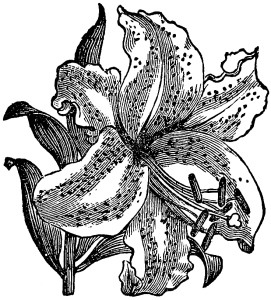
Auratum Imperial is the Golden-banded-Lily of Japan which has become so extensively known and popular since its introduction from Japan by Mr. Gordon Dexter. It was first exhibited in July 1862, at the Massachusetts Horticultural Exhibition. It first bloomed in England same year. It was for sometime considered too tender for the Canadas and New England states, but it proved to be hardy. We have had ours twelve years, and give it only a slight protection. The petals of the Auratum are snowy white with a golden band running down the center of each, and freely spotted on the sides with deep carmine red. They are very fragrant. Being of somewhat slender growth, they need support. It does best in a warm sandy soil that has been well manured and dug deeply. It is easily propagated from the scales of the bulbs, each scale producing a small bulbet. They should be planted in a box about a foot deep, in good friable soil about three inches deep, and one inch apart. Sink the box in some out of the way place in the garden, and water frequently. In a short time small bulbs will be found forming on the base, which rapidly grow, and must be transplanted out the second year in the bed; the third or fourth year it will bloom. The little bulbets which form on the mother bulb blossom a year earlier. They should be renewed in the fall, after the foliage is dead. Plant in a bed about four inches deep, and let them remain undisturbed for two years; then they are large enough to bloom and should be transplanted into a permanent bed, if required.
LONGIFLORUM LILIES.
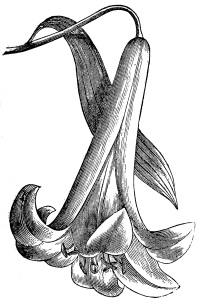
These trumpet-shaped Lilies are charming in appearance, quite hardy and fragrant. They bloom in July or August, and continue in beauty for a long time.
Longiflorum Japonicum blooms in July, and is a fine dwarf bedder; color pure white, with occasionally a greenish tinge outside. Increases rapidly. Eximium bears a longer flower, from six to nine inches in length, and is more open at the mouth than the common Longiflorum. Pure white and very fragrant. Brownii is a native of Japan, and is a grand Lily of rare beauty. It resembles Longiflorum in shape, but is larger and more expanding; color white inside, exterior brownish-purple; stamens rich chocolate, which forms a distinctive feature in this species. It has been frequently confounded with Japonicum, but the difference is very marked in the illustrations of the two, and are thus noted in Messrs. Hallock & Thorp's "Catalogue of Lilies."
"Japonicum (Odorum, Japonicum Colchesterii). One of the most beautiful and rarest Lilies in cultivation. It differs from Brownii and all the forms of Longiflorum in many respects. Note the following marked differences: Its broader, fewer and more spreading leaves, the shape of the entire flower and broader claw of its divisions, its shorter anthers with pollen tinged with red. The flower is solitary and large, interior pure white, exterior of a pinkish-brown color, tubular, bell-shaped, with spreading revolute tips; the bud shows a rich golden tint. Bulb white, or whitish-yellow, never red or brown, broad at the base, the scales which are somewhat narrow and acute at the tip, the outer ones terminate at about two-thirds of the height of the inner scales, whereas in Brownii the scales are broad, and all pass up, overlapping, and terminate together at the apex of the bulb, thus making the base much narrower than the apex."
It is a native of Japan, and is so exceedingly rare that it is priced at $7.00, more than double the cost of any other in the list. Brownii was priced, when a novelty at $4.00, but is now offered for $1.75.
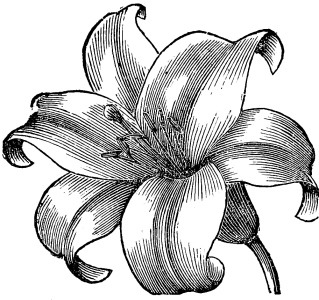
Candidum, sometimes called Easter Lily, is one of the best known and commonly grown of all the Lilies. It has been in cultivation for about three hundred years. Bears a profusion of pure white fragrant flowers in a compact head.
The double Tiger Lily is a very great improvement on the old single variety. It is very double, and very showy. Wallacei is a new Japanese variety, said to be magnificent; color, buff, spotted with black.
Chalcedonicum or Scarlet Martagon is supposed to be the "Lily of the field" mentioned in the Gospel. "It is magnificent, and its intense scarlet is one of the finest shades in the whole vegetable kingdom. A full bed is a most magnificent sight, and if suddenly looked at on a bright day, has nearly the same effect for a moment as if looking at the sun. It is much scarcer than it should be, and requires careful culture, to be planted about six or eight inches deep, and watered in the summer time. It pleases every one who is capable of being pleased."
Lilies, as well as many other bloomers, are greatly improved by thinning out the overplus, thus concentrating the sap to fewer blossoms, which being thus liberally nourished, greatly increase in size, and amply repay, by their superiority, for the loss in numbers. Although this is a demonstrated fact, yet few have the courage to prune where flowers are not very abundant, and many will not when they are.
Those who have limited space are loth to devote much room to Lilies, preferring plants that bloom continually throughout the season, or that make more show. But it is not essential that the bed should be devoted exclusively to lilies. For early spring blooming there can be the Crocuses, Snowdrops, Hyacinths, Tulips, all of which will bloom before the lilies, and after flowering can be taken up, i.e., the Tulips and Hyacinths, and low bedding plants take their places. Portulaca, Pansy, Ageratum, Mignonnette, Nemophila, Sweet Alyssum, are all suitable for this purpose, and will not only make the bed beautiful all the season with their blossoms, but will also be of real benefit to the Lilies by shading their roots somewhat, and keeping the soil more cool and moist.
Lilies must never be crowded; a foot or twenty inches is about right. The soil should be dug deep and mixed with old rotted manure and sand liberally, unless the soil is naturally sandy; if heavy, clayey soil, it ought to have in addition to sharp sand, leaf mold and bog muck. Plant the bulbs from six to eight inches deep, according to the size. Last autumn, in planting my Lily, Tulip, Hyacinth, and other bulbs, I made a little bed for each of pure sand, and then covered well with soil, over which was put a blanket of old dressing, then, before snow, a covering of boughs. The bulbs never came up so grandly, nor grew so rapidly before. October is the best month for bedding out, later will do, and many do not plant their Lilies till the frost is out in the spring.
The two leading Lily growers of this country are John L. Child and V. H. Hallock & Thorp, of Queens, N. Y.
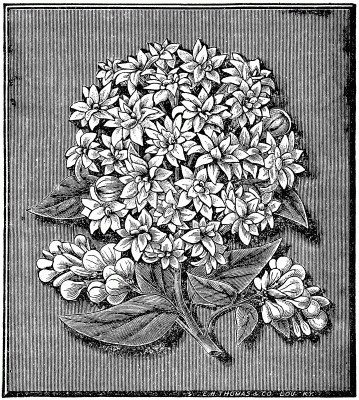
DOUBLE WHITE BOUVARDIA, "ALFRED NEUNER."
THIS is indeed a novelty among this class of valuable plants, being the first double ever known. It is said to be equal if not superior, in profuse blooming quality, and vigorous, healthy growth, to the single white variety, Davidsonii, of which it is a sport. The flowers are rather larger than those of the single flowering, and composed of three perfect rows of petals, of the purest waxy white color, each floweret resembling a miniature Tuberose. The trusses are large and perfect, and are freely and without interruption produced, even on the small side shoots, which generally make no flowers on the single one. It is highly praised by Mr. Thomas Meehan, florist and editor of the Gardeners' Monthly, and by Mr. Henry A. Dreer, florist, of Philadelphia. "A grand thing," says Mr. Meehan. "Gives great satisfaction. It has excelled our expectation," says Mr. Dreer.

My own specimen, about four inches in height, has twelve buds; two small clusters are on side-shoots. The very fine illustration of this Bouvardia we give our readers, has been kindly loaned by the Ellis Brothers, Keene, N. H., who have a fine stock which they are offering to the public.
Mr. Henry Cannell says, "Of all plants the Bouvardia, in our opinion, excels for cut flowers, no matter either for button-hole bouquets or table decoration; a spray of it is sure to be most prominent and pleasing, and the odor of several kinds is deliciously refreshing, and if well-grown they will more or less continue flowering nine months out of the year. Strange to say, they need only the ordinary course of cultivation of the winter-flowering Zonal Pelargonium; hitherto they have been treated as a stove plant, whereas they only need a temperature not higher than 50° to 60°, and in the summer to have every attention, like a specimen Chrysanthemum, and on the first appearance of frost to be taken into the house, and when growing and flowering, to be supplied with liquid manure occasionally."
Our only experience with this genus has been with Bouvardia Humboldtii Corymbiflora, and it has proved to be a very valuable plant. Its pure white flowers are produced in large trusses; their tubes are three inches in length, and very fragrant. It blooms very freely and for a long period. This variety and Vreelandii are the best single white.
Liantha is a dazzling scarlet, and a very profuse bloomer. Elegans, salmon-scarlet; large and fine. Lady Hyslop, a light rose. Canspicua is of a blood-red color, with whitish tube. Bicolor, a summer-flowering variety. Flower tube purple, with tint of blue and delicately mottled flesh, tipped with white. These last we find, only in Cannell's Floral Guide.
I have no difficulty in keeping my Bouvardia in the cellar, the leaves drop off, but they come out anew in the spring.
CAMELLIA JAPONICA.
This is a very popular genus on account of their rich dark-green leaves, and beautiful rose-like flowers. They are hardy greenhouse plants, and thrive best in light loam mixed with sand and peat, but will do well in light soil without the peat. It will not flourish in a limestone soil. Mr. Vick gives the following in his Magazine:
"The Camellia Japonica was sent to England in 1739 by Father Kamel, a missionary, for whom it was named. As a house-plant the Camellia requires considerable care, on account of the tendency of the flower buds to drop off. A northern exposure is best, and a temperature of from forty to fifty degrees. When the buds are swelling, water plentifully with warm water, but allow none to stand in the saucer. Sponge the leaves once a week. In the spring put the plant out in a shady place on the north side of a house or fence, not under the drip of trees, and water it every day. Set the pots on a hard bottom, so that no worms can get into them. They form their flower beds during the summer, and at this time a good growth of wood must be encouraged.
"In the Southern States the Camellia can be raised with not more than ordinary care; at the North it must be considered entirely a green-house plant, and as such will always be highly prized. We are often asked how it should be cared for as a house-plant, and to all such, in the northern part of the country, where it is necessary to maintain good fires in warm houses for several months of the year, we have no hesitation in saying, let it alone, do not expend care and labor where there is so little prospect of reward."
Camellias are of many hues, and some are beautifully striped. Gen. Lafayette, bright rose, striped with white, imbricated. Bell Romann, imbricated, large flower and petals, rose striated with bright crimson. Matteo Molfino, petals cerise, with pure white band down center. Mrs. Lurmann, crimson, spotted, very beautiful. Pure colors of white, red, crimson, rose and carmine, can be obtained.
Azalea.—Shrubby green-house plants of easy cultivation. Very showy and hardy. Like the Camellia, they are found in all the leading colors, and also striped, blotched and spotted. They are both single and double.
Alexander II, is white, striped with vermilion; edges of petals fringed. Aurelia, white, striped with rosy orange, amaranth spots. Flag of Truce, is a pure double white, very fine. Her Majesty, is rosy-lilac, edged with white. Alice, rose, blotched with vermilion; double.
Mr. Vick gives the following directions: "Azaleas need a light soil of sandy loam, to which should be added one-half leaf mold. Repotting should be done in May, trimming the tops to bring them into shape. Then plunge in some sheltered spot in the garden. In September the plants should be brought in under cover, or into a cool room. They do best when the temperature ranges from forty degrees at night to sixty-five or seventy by day. The foliage should be showered once a week, but care must be taken that the roots are not over-watered, as they rot easily. Small plants bloom well, but their beauty increases as they get age and size. The flowers appear on the terminal shoots, and are from one inch to two and a half inches in diameter.
"Azaleas if left to themselves will develop long shoots, that after a time become naked below and are furnished with leaves only at their extremities. Flower stems are formed on the new wood of each summer's growth, consequently the amount of bloom, other things being equal, depends upon the amount of new wood annually produced. In order to have plants of good shape when they become large, it is necessary to give attention to pinching and training them from the first. The pyramid form, or more properly that of a cone, and rounded at the top, is considered the best for the plant, as it allows the greatest exposure of leaf-surface. Two principal methods are adopted to regulate the growth and bring plants into shape: one is by successive pinchings as the growth proceeds, the other by allowing long shoots to grow and then bending and training them down, thus causing many of the dormant buds along their whole length to break and develop into shoots. A skillful combination of the two methods is probably better than either exclusively."
Mr. John Dick, Philadelphia, has the largest stock of Camellias and Azaleas, it is stated, in the United States. Their catalogue list of these plants embraces more than a hundred varieties, to which we refer our readers.


WE have come to see your garden, said a gentleman with a lady in company. They were from a neighboring town. This two weeks after the heavy frost!

I told them my garden was in the stable, and thither I piloted them. It was not a very small garden if it was in a stable. A hundred or more plants had been hurriedly removed from the beds the day before that freezing night! There they were, in the soiled pots just as taken from the ground, or packed closely in boxes. Not very attractive looking, in one sense, yet in another they were, for they were bright, healthy appearing plants—leaves as fresh as when in the open air, pretty Geraniums in bloom, a mass of Lobelia, attractive with their tiny blue flowers, Coleus of varied hues, and even a few Roses struggling into bloom.
Then we strolled among the despoiled beds, and the Pansies, so large and pert, elicited admiration, and the Sweet Peas, just as fragrant as though blight were not all around them, while dear little Mignonnette seemed to have taken a new lease of life.
Yesterday I arranged in a shallow glass dish as handsome a bouquet as I have had for the season. Sweet Clover sprays, Mignonnette and fragrant Geranium leaves for the foundation all around the dish, a few bunches of the little white wax balls, with their glossy leaves, Geranium blossoms, and lots of Sweet Peas, from the most delicate shades to the deepest, and bunches of splendid Pansies, Sweet Alyssum, a bit of purple Verbena here and there, and white-eyed Phlox. It was just lovely.
When the evidence was sure that frost was surely coming, and a great many plants must be taken up in a few hours' time, I was so glad that full half of them were in pots. I could never have potted a third of them in the time. The great object was to get them sheltered, and the repotting could be done at my leisure.
But I almost changed my mind the other day after toiling several hours at the business. So many pots to wash! then fill with fresh earth, and set the plant. O dear, wasn't I tired! But then the wide door was open, the day was lovely, and I rather think potting plants in a stable is better than potting out of doors on a cold day, and when one is in a great hurry. Plants that are in pots plunged in the ground do not grow so many roots, and that is another advantage.
MY WINDOW BOX.
Perhaps I may as well tell you about my most important window box. I had it made last autumn, and I was greatly pleased with it. It is made of zinc, size one yard long, fourteen inches broad, seven inches in depth. To give it strength it is framed at the top with wood. You can have this of black walnut, or stained in imitation. You can have the box painted any color you wish, or leave it unpainted. In the center is Croton "Weismanni," on one side of it a fine Eranthemum pictum; its green leaves look as though they were painted with white streaks; on the other side, Acalypha "Macafeeana." These are the largest plants in my box, and they do not exceed ten inches in height. There are sixty plants in all, mostly averaging six inches in height, but a few are quite small. They consist of very choice Geraniums—some of them handsome-leaved—variegated Abutilons, Lemon Verbena, two bright Achyranthes, six very beautiful Coleuses, and four fine Begonias. There are others I cannot stop to specify. You will see that I have filled my box with what are, in themselves, beautiful without the aid of flowers, though I expect to have a few of these by-and-by. I am perfectly satisfied with it, however, just as it is. I had a large German Ivy growing out of doors, which consisted of several long vines. This I planted in one corner of the box, and then drooped and twined it on the outside. The change to indoor life caused the large green leaves to fall off, but already new ones have put forth, and the vines are rapidly growing. Everything else had been previously prepared so that there was no change in their leafage after being put in the box. It is a great addition to the beauty of the box to have vines of pretty foliage drape the sides. This autumn I have had it placed on a small, low table with castors, so I can change the plants every week, and thus avoid that turning toward the window which they always assume if kept in one position.
I first put in drainage, and then filled the box with rich, mellow earth in which was a mixture of one-third sand. I have been thus particular in my description, for many, no doubt, who, like myself, have to make the most of limited space, will be glad to know just how to keep the greatest number of plants to the best advantage. Not only is there a saving of room, but of labor, and it is more cleanly.
HYACINTHS.
Among the essentials for winter flowers are the bulbs. Of these the hyacinth takes the lead. They are so easily grown; so lovely and so fragrant that they are worthy of a place in every collection. They should be planted so that the upper surface of the bulb is visible. Water liberally and then put away in a cool dark place for several weeks, six weeks is none too long, and some I allow to remain a longer time, bringing them to the light at intervals so as to have a succession of flowers. They are very effective planted in a group. They are very pretty in hyacinth glasses, but this method ruins the bulbs for future use. Planted out they will sometimes flower. The best time to plant them in the border is in October, but the first of November will do. It is a good plan to make a little bed of sand for the bulb, and then cover with light porous soil. Hyacinths are classed as tall and dwarf, single and double. The Roman Hyacinth is the earliest bloomer, coming into flower about the holidays if started in season. The spikes are small and flowers rather scattering. As soon as the blooms fade, the stalk should be removed, and when the leaves turn yellow, they can be cut off, and the bulb dried and packed in paper bags and kept till time for autumn planting.
Hyacinth bulbs come from Holland. About Haarlem the rubbish heaps are hyacinths, and the air is oppressive with their perfume.
In California there grows what is called the Twining Hyacinth. It grows in the mountains, and twines about the bushes, sometimes going up eight and ten feet. After it gets to the top of the bush and rests awhile, it lets go of the earth and goes on blooming for months, regardless of the burning sun. The flower stem breaks off near the ground, and the flowers are kept swinging in the air supported only by the bush about which it twines. The color is deep rose, and it is said to be very pretty. The picture of it certainly looks attractive. It is a large cluster composed of dozens of blossoms.
For flowering in the house the Polyanthus Narcissus are very desirable. They can be put into glasses as well as the Hyacinth, but the most natural method is in a pot of earth, and the bulb is in a better condition for after use. The Jonquils are also pretty. Snowdrops, Scillas and the Crocus are cheap bulbs, and planted in the autumn will show their bright, sweet faces soon after the snow is gone. They are also very fine for house culture. Should be planted in groups.
Tulips ought to have a place in every garden. They make a brilliant show in the Spring, when the beds are bare of other flowers, and afford bloom for a long time, if a good assortment is selected. The pretty little dwarf Duc Van Thols are early bloomers and very gay. They are admirable also for the house, and by planting in September, will come into flower in December. There are early single and double Tulips, and also late bloomers, so that by having a variety, the border may look gay for a long time. The Parrot Tulips are large and very brilliant in color, and picturesque in appearance. All of these varieties succeed in ordinary garden soil. They ought to be planted in October or November, about four to six inches apart, and about four inches under the surface. Before severe frost they need to be protected by branches of evergreen, straw or leaves. After blooming, and the leaves have died down, they can be taken up, dried and stored till autumn, if the bed is needed for other flowers.
The Bulb catalogues issued by leading florists in the autumn, and sent free to all applicants, will enable you to select just what you want.
INSECTS.
In a work of this character it seems needful to treat more fully of those pests which prove so destructive to plant life, than we have in our brief references.
The Aphis or green louse is the one that most frequently infests our plants, and the rapidity with which it multiplies, is astonishing. Reaumer has proved that in five generations one aphis may be the progenitor of six thousand millions, and there may be ten generations in a year!
The method most generally adopted for their destruction is fumigation with tobacco. As this is attended with considerable difficulty, a weak solution may be used quite as effectively. We have had no experience with either method, having used another with good success for several years. This is white hellebore which we usually apply in the powder when the Rose-bushes are wet with dew or rain, bending the branches over, so that the application can be made chiefly on the under side of the leaves, where the pests are found. Two or three times proves sufficient. For our house plants we usually make a solution, by putting half an ounce of the hellebore into pretty warm water, and letting it stand for several hours, stirring it up however, before spraying the leaves. Afterward, the plants need to be washed.
For the Scale a strong solution of soap-suds applied with a sponge or a small stiff brush. A tooth brush is very suitable for this purpose.
For Mealy Bug, a mixture of one part alcohol and three parts water, applying with a feather, or what is better, a camel hair brush. Another method is to use kerosene in the same way. A florist who has practiced this for eight years, says it is sure death to the insect. The feather should be brushed all over the mealy-looking substances found usually in the axils of the leaves.
Worms in Pots. Lime water is a safe and effectual remedy for the little white worms often found in the soil. Slake the lime in water and after it has settled, pour off the clear water and drench the earth.
Ants. Various remedies have proved effective. One is to take a vial or a cup nearly filled with sweet oil, and sink it in the ground where the ants resort, so that the rim is on a level with the surface. The ants are very fond of it, but it is sure death to them.
A German writer says that carbolic acid and water will drive ants away from any grounds—one hundred parts of water to one of the acid. Mix in a tub and stir repeatedly for twenty-four hours, taking off the scum that rises to the top.
Kerosene or coal-oil mixed with water has proved very successful in the destruction of noxious insects and grubs. A tablespoonful of the oil to two gallons of water is the rule for tender plants; for hardy ones it will be necessary probably to have it of greater strength. As the compound does not mix readily, it needs to be thoroughly stirred, and then quickly applied. The best way is to draw it back and forth a few times in a syringe, and then apply.
Water tainted with coal-oil, poured into little holes made in mole tracks, will, it is said, drive them effectually away.