Introductory material (continued 2)
Reading edition
"Now let us fly to the other side of the globe and alight in the vicinity of the Cape of Good Hope, say on the vast desert of Karroo, where there is much sand, much sunshine, and little rain. Here, in the midst of desolation, the world is rich with flowers, for the healthy shrub that occurs in patches, glowing with many bright hues, consists in part of wild Pelargoniums, which often take the form of miniature deciduous trees, although in the valleys, nearer the coast, where more rain falls, they are evergreen bushes.
"Very different in their character are these two tribes of plants, and they are not less different in their constitution and aspects. We may regard the Geraniums as herbs of Europe, and the Pelargoniums as miniature trees of Africa. When we examine the flowers, we find the fine petals of a true Geranium of precisely the same shape and size; but the fine petals of a Pelargonium are not so, for sometimes the topmost are the largest, and stand apart from the rest with great dignity, like mother and father looking down on their dutiful daughters, and in other cases they are the smallest, suggesting that the daughters have grown too fast and become unmanageable. The florists are doing their utmost to obliterate the irregularity of the petals of the Pelargonium, and in this respect to convert Pelargoniums into Geraniums, but the conversion will not be complete until much more wonderful things are accomplished. A Geranium has ten stamens, and a Pelargonium has only seven (perfect ones). These numbers are not constant, but the exceptions are of no consequence in a general statement of the case.
"When all is said that can be said about the differences and resemblances of the several genera of Geraniaceæ, there remains only one constant and unfailing test of a true Pelargonium, and that is the nectariferous tube immediately below the flower, and running down one side of the flower-stalk. If you hold the pedicel up to the light, it may be discerned as giving an indication of a double flower-stalk, but when dissected with a pin or the point of a knife, it is found to proceed from the base of the largest of the green sepals, and it often appears to form a sort of digit or point in the line of the pedicel. When you have mastered this part of the story, you may cherish the idea that you know something about Pelargoniums.
"The large flowered show varieties and the large-flowered single Zonals take the lead, and they are pleasantly followed by a crowd of ivy-leaved, double-flowered and variegated sorts that are useful and beautiful. The Pelargonium Society has set up a severe standard of judging, and a variety must be distinct and good to pass through the sieve. Moreover the raising of varieties has been to a great extent reduced to scientific principles, and we obtain as a result new characters suggestive of the great extent of the field that still lies open to the adventurous spirit in cross-breeding. No one in recent years has contributed more directly toward the scientific treatment of the subject than our own painstaking Treasurer, Dr. Denny, of whose labors I propose to present a hasty sketch.
"Dr. Denny commenced the raising of Pelargoniums in the year 1866, having in view to ascertain the influence of parentage, and thus to establish a rule for the selection of varieties for seed-bearing purposes. In raising varieties with variegated leaves, as also with distinct and handsome flowers, he found the pollen parent exercised the greatest influence on the offspring. The foundation of his strain of circular-flowered Zonals was obtained by fertilizing the large starry flowers of Leonidas with pollen taken from the finely formed flowers of Lord Derby. From 1871 to the present time Dr. Denny has sent out sixty varieties, and he has in the same period raised and flowered, and destroyed about 30,000. These figures show that when the selection is severe, and nothing is allowed to pass that is not of the highest quality, there must be 500 seedlings grown for the chance of obtaining one worth naming."
We have devoted a good deal of space to this citation because of its interest and value on the question at issue. Mr. Hibberd has, we think, made the matter very clear, and conclusive it must be to the most of minds. Pelargoniums are divided into classes, though we rarely see any classifications of them in the catalogues.
REGAL PELARGONIUMS
Are comparatively a new type, and from the fact of their having more scalloped petals, somewhat approaching a double; they retain their petals instead of shedding them as do the single show flowers. The Beauty of Oxton and Queen Victoria, novelties of very recent introduction, belong to this class. We had them in bloom last year and thought them very fine. The Beauty of Oxton has the upper petals of a very rich maroon color, darkly blotched; under petals very dark crimson, shaded with maroon; light center tinted with rose. All the petals are attractively and regularly margined with white and beautifully fringed. The flowers are large and the extra number of petals gives them the appearance of being semi-double.
Queen Victoria is of a very novel type and marvelously beautiful. The flowers have crispy petals, all of which are a rich vermilion in color, broadly margined with white, and the upper ones blotched with maroon. The "Show and Fancy Pelargoniums" have what the florists term "blotches," i.e. large spots on the two upper petals, and "spots" which mean the darker marks upon the center of the lower ones. The Lady of the Lake belongs to this class. Lower petals orange-rose painted with crimson, very dark maroon top petals with a narrow, even crimson edge, white center. Prince Charlie is very unique in its markings. Color white elegantly tipped, with rose-violet blotches.
FRINGED AND STRIPED PELARGONIUMS.
This is a very handsome class of which there are many new varieties. Princess of Wales we had last summer. It has elegant frilled petal margins; flower trusses large size and borne in profusion well above the foliage; ground color pure blush, each petal alike marked with a rich dark velvet crimson-scarlet margined blotch.
Star of the East resembles the Princess of Wales in growth and profusion of bloom, but with larger flowers, of pure white ground. The petals are elegantly fringed, the upper ones marked with a rich crimson spot, and the under ones elegantly penciled with violet-colored lines. These are among the novelties of recent introduction.
HYBRID PERPETUAL PELARGONIUMS.
A class of distinct habit, free bloomers, mostly fragrant foliage, good for bedding out. Of these we have only had Madame Glevitsky of Bavarian origin. Color, upper petals a fine vermilion, veined and spotted with purple, under petals vermilion.
We were much pleased with Pelargonium Filicifolia Odorata for its finely cut leaves of a Fern-like appearance and pleasing fragrance.
Our specimens of the various classes were from the extensive and superb collection of Mr. John Saul, of Washington, D. C. Among them was one which originated in his establishment and was named for his wife. It belongs to the "Regal" class. The habit is compact and very free flowering, producing large trusses of flowers the color of which is a rich glowing vermilion, with light center and light margin to the petals.
We are indebted to Mr. John G. Heinl for specimen plants of two "New Monthly Pelargoniums," now offered for the first time to the general public. Of the origin of one, Fred Dorner, we have this account given in a letter to Mr. Heinl, from Fred Dorner, Esq., of Lafayette. Mr. Dorner says:
"Six years ago I undertook to grow some Pelargoniums from seed. I procured some very choice seed of Ernest Benary of Erfust. The seedlings grew finely. About midwinter one commenced to bloom, and to my astonishment kept on blooming for ten months, during which period it was never without flowers. The plants grew to a good size and at one time I counted forty-seven good-sized trusses on it. The winter and everblooming quality, with the large and beautifully colored flowers, makes this Pelargonium a great acquisition to the amateur as well as the florist. I have seen here in Lafayette plants in windows blooming all winter, and it is acknowledged here to be the best and easiest kept house and window plant, blooming from nine to ten months in the year."
Freddie Heinl originated with Mr. John G. Heinl, who says it is a sport from Fred Dorner; it is lighter-colored and the flowers are somewhat larger. That these are both a rare acquisition is evident from the testimony of such florists as Mr. John Thorp of Queens, and Mr. Henry A. Dreer of Philadelphia. Mr. Thorp says, "There are no Pelargoniums equal to them and they have a decided right to be called perpetual." Three months later he writes: "I am more than ever impressed with their superiority over any perpetual blooming varieties, and they must take foremost rank." Mr. Dreer says: "The Pelargoniums have proven very satisfactory. They flowered during the greater part of the summer, and are now full of buds."
The colored lithograph, which Mr. Heinl says is a good representation, shows them to be very beautiful. We should think that to call a plant so dissimilar in foliage and flower a Geranium, would be a misnomer, why not equally such to call a Geranium a Pelargonium?
MODE OF CULTURE.
As we have seen by Mr. Hibberd's address, the Pelargonium's native home is on arid plains where there is much sand, much sunshine and little rain, so that they are chiefly dependent on heavy dews for moisture. To plant them in heavy soil, give them a sheltered situation and liberal and frequent watering, would be a mode of treatment directly the reverse of what they require. In the cultivation of all plants we should as far as possible adapt them to their native conditions. One skilled amateur says his rule is to let the earth in the pots become thoroughly dry before watering, and always to give a period of rest after blooming. Another, a lady, said she never had any success with Pelargoniums until she gave them a heavy period of rest after blooming. In the spring, when putting her plants out of doors, she laid the pots containing Pelargoniums on their sides, and let them remain perfectly dry until fall. She then took the plants out of the pots, shook the soil from the roots, and scrubbed them well with a hard brush and water. The old-looking roots were cut off and the top trimmed down to six or eight inches in height. They were then repotted in rich earth and watered very moderately till they started into full growth, and after that more freely. With this treatment they never fail to bloom.
A young physician who raised many extraordinarily fine varieties of Pelargoniums from seed, in stating his mode of culture, said that his practice was to re-pot large plants whenever they seemed in danger of being pot-bound. The mold he used was made up of black earth from under a manure heap, and a little stiff clay to retain the water. After the plants were done flowering, they were trimmed rather close, and with regard to probable places of sprouting. They were then placed in partial shade, and all shoots found straying out of symmetry were pinched off. His large plants were kept moist till after bloom, and then rather dry.—Floral Cabinet.
We have given these methods so that if not successful with one, another can be adopted.

LINES ON BEING ASKED, WHENCE IS THE FLOWER?
In May, when sea-winds pierced our solitudes, I found the fresh Rhodora in the woods, Spreading its leafless blooms in a damp nook, To please the desert and the sluggish brook; The purple petals fallen in the pool, Made the black waters with their beauty gay,— Here might the red-bird come his plumes to cool, And court the flower that cheapens his array. Rhodora! if the sages ask thee why This charm is wasted on the marsh and sky, Dear, tell them, that if eyes were made for seeing, Then beauty is its own cause for being. Why thou wert there, O rival of the Rose! I never thought to ask; I never knew, But in my simple ignorance suppose The selfsame Power that brought me there, brought you. Ralph Waldo Emerson.


A LEGEND OF THE FUCHSIA, FROM VICK'S MAGAZINE.
A legend of this little flower, I heard not long ago; 'Tis this, that when upon the cross The sinless Saviour died, And soldier with his cruel spear Had pierced his precious side, The holy drops flowed to his feet, Then fell upon the sod, When Mary knelt and wept for Him, Her son, and yet her God; An angel who was hovering near, Thus breathed a prayer to heaven: "Oh, Father, let them not be lost, These drops so freely given, But in some form of beauty still, Let them remain on earth, And here upon this rugged hill, Give some sweet floweret birth." Then, forth from the ensanguined sod, A Fuchsia sprang that morn, Rich crimson, dyed with Christian blood, Wrapped in his "robe of scorn," Drooping in sorrow, still it bows Ever its graceful head; Shivering in the slightest breeze— Trembling in fear and dread; For the dark shadow of the cross Can ne'er forgotten be, Where all the perfume of its breath Was spent on Calvary. Yes, offering its rich fragrance there, As incense at His feet, The Fuchsia, though so beautiful, Can never be more sweet.
ITS HISTORY AND CULTURE.
THE Fuchsia was introduced into England in the latter half of the last century by a sailor, at whose home it was discovered by Mr. James Lee, a florist of Hammersmith, who secured the original plant by paying quite a sum of money for it, and in addition promising to give to the sailor's wife one of the first young plants he would succeed in raising. In a short time he succeeded in producing several hundred nice plants, nearly all of which were sold at a guinea each. Shortly after this a captain Firth presented one that he had brought from Chili to the Royal Garden at Kew. The plant was named in honor of Leonard Fuch, an eminent German Botanist, who lived in the 16th century. The varieties in cultivation to-day are vast improvements. One of the early varieties was called Fulgens. We recollect seeing this variety some four or five years ago, and could not refrain from comparing it with a number of varieties lately introduced. The flower may be described as follows: A slender crimson tube two inches in length; sepals narrow, one-half inch; in color a shade lighter than the tube; the corolla purple; in size very small compared with the varieties of the present time. This variety is a strong grower, large foliage which has a silvery appearance. Thus we can have a slight idea of that from which have been produced the beauties of our time; thus can we see what a skillful florist can do when he has something to begin with. Some of the varieties of the Fuchsia are hardy in England as well as in some parts of our own country. A traveler informs us that he has seen them in California trained over arbors and to the houses just as we train grape vines here, and growing most luxuriantly. They grow in favor very rapidly wherever introduced, and it was but a short time after they became known we find the Poet eulogizing them in these lines—

"Graceful flowers on graceful stem, Of Flora's gift a favorite gem; From tropic fields it came to cheer, The natives of a climate drear; And grateful for our fostering care, Has learnt the wintry blast to bear."
While some flowers have been extremely popular for a season, and then have sunk into comparative obscurity, the popularity of the Fuchsia has never waned, but on the contrary has continually been on the increase until now it occupies a prominent place in every collection of plants, be that collection large or small. There is a cause for this popularity, and that cause is, it is of easy culture and produces its flowers freely, often under adverse circumstances. The Fuchsia is readily propagated by cuttings of the young wood. These will root in from two to three weeks, when they should be potted in rich soil, say one-half garden soil or loam enriched with well-rotted manure, and one-half leaf soil, with a little sand added to make the compost very porous. From the time the plant is first potted it should never be allowed to become so dry as that the growth will be checked. The great secret of growing Fuchsias successfully is to keep them growing. In order to do this we must provide for them a rich soil, an abundance of pot-room and a moist atmosphere. If you wish to grow large specimen plants the cuttings should be struck (that is rooted), early in the season. This will allow a longer period for them in which to make their growth before the season for blooming arrives; by keeping the plants supplied with plenty of pot-room the time of blooming will be somewhat retarded, and if on the other hand we desire to have the plants in bloom as early as possible we allow plenty of pot-room during the early part of the growing season, after which we allow the pots to become pretty well filled with roots, and abundance of beautiful pendulous flowers will be the result.
As house or window plants the Fuchsias are very popular. The variety Speciosa will bloom very freely during the winter. During the summer months they should be protected from the direct rays of the sun, and kept well syringed. As bedding plants their utility is limited, as they must be planted in a shaded position. A bed of them in such a position makes a pleasant appearance, and in this way they are easily kept through the hottest part of the year. They may be bedded out, or may be allowed to remain in the pots and the pots plunged in the garden. In this latter way they will need additional care, as they must not be allowed to suffer for want of water. If it is desirable to keep the old plants another year they may be removed to the house or cellar, and kept cool and dry until toward spring, when they can be repotted in fresh soil, watered scantily, and started into growth and pruned or trained to any desired shape or form.—The Floral World.
The foregoing article so fully and clearly stated all that was essential respecting the culture of the Fuchsia, that we have transferred it entire instead of writing something original. We need now only add a few things respecting some choice varieties and recent novelties. "Champion of the World has the largest blooms of any Fuchsia; the tubes are short; sepals very broad and of great substance, well reflexed, and of a most beautiful coral red; the foot-stalk of each bloom is of unusual length and strength, so that each flower stands out bold and graceful. Corolla of immense size, and as it expands forms two-thirds of a perfect ball. Color is of the most intense bright dark purple. Free tall grower, and for conservatory decoration is one of the most remarkable Fuchsias for size ever yet sent out."—H. Cannell.
The illustration of this Fuchsia in Mr. Cannell's Floral Guide measures two and one-third inches in diameter, and yet we are told that when well grown, the Champion produces much larger bloom than the engraving. It has four rows of petals, and looks round and full like a pink. Bland's New Striped is of the single class, but the corolla is very large, of a rich plum-colored purple, regular and distinctly striped red and rose, pyramidal shape, habit strong.
Of the Hybrid variegated Fuchsias, Sunray is by far the best with red variegated leaves ever sent out; it is very ornamental. Pillar of Gold is a very showy variety with yellow leaves. Among the novelties in color, we find mention of Aurora Superba; tube and sepals rich salmon, corolla large and spreading of a distinct orange scarlet highly suffused with yellow, fine habit and free bloomer. Polyhymnia is a dwarf yellow.
Of Lord Beaconsfield, Mr. Cannell says: "One of the strongest and most conspicuous blooming varieties ever sent out, and one of the very best for sale and decoration; flowers neither good shape nor color, but produced in very large clusters and blooms nearly all the year if allowed plenty of root room."
This Fuchsia originated with Mr. John Laing, Stanstead Park Nursery, Forest Hill, near London, and is a cross between Fuchsia Fulgens and one of the modern varieties known as "Perfection." It was exhibited at some of the meetings of the Royal Horticultural Society first, as Laing's Hybrid, in 1875 or 1876. It much resembles the old Speciosa, but is more free blooming even than that, and its flowers are twice as large.
Kingsburyana, figured in Mr. Cannell's Floral Guide—which comes to us from Swanley, England—is very large and double. "It is another addition to the double white corolla class, and is remarkable for its fine vigorous growth and large showy flowers; its corolla is particularly novel and beautiful."
Mrs. H. Cannell, named for the florist's wife by Swaffield, its originator, "was one of the greatest lifts in bringing the double white corolla to perfection," and has given great satisfaction in this country. We have never seen one so beautiful, but Mr. C. E. Allen who has a large collection, including those rare gems from across the water, we have named, says: "Snow White is the very best double white Fuchsia ever sent out. A fine, erect grower, and a remarkably free and early bloomer. Sepals coral red. Superior to Miss Lucy Finnis in that it is of a stronger habit. Have none now in bloom." Among the fine specimen blooms of the dark purple type sent us by Mr. Allen, we think Elm City the gem for size, richness of color—a double dark purple striped with scarlet, sepals scarlet-crimson—and compact form. The Swanley Gem is of a peculiar shape, single, very open bell-shape corolla, "frilled" Mr. Cannell calls it, rose color with tube and sepals coral scarlet, the latter are very prettily reflexed.
We began our list with the Champion—the largest known—we will end it with the tiniest, Microphylla, the whole plant, flowers and leaves are Liliputian among the Fuchsias.
FUCHSIAS IN THE ISLE OF MAN.
Here these are truly wonderful; they grow up the house fronts, and grow into large trees, so large that you can have a tea-party around the bole of the trees. They are also grown for hedges and kept nicely clipped, and with their bright green leaves and scarlet flowers look cheerful and refreshing. The winds and the spray from the sea do not in the least affect them.—The Garden.
Mr. Vick, in his Magazine says: "Once when in Europe, we saw at Ventnor, in the Isle of Wight, a Fuchsia tree, perhaps twenty feet or more in height, with a trunk full fifteen inches in diameter. The editor of the Flore des Serres of Belgium, in writing of this tree, says it is doubtless the largest specimen in Europe, but is only a baby compared with specimens the editor has seen in South America. Seeing our notice of this tree, Mr. Nicholls of Sharon Springs, N. Y., wrote us that he had "seen Fuchsias in the Isle of Jersey, in the English Channel, thirty feet in height, and there are hundreds there from twenty to twenty-five feet."
PROPAGATING FUCHSIAS.
We have found the most effective method to be by placing the cuttings in a bottle of water, and keeping them in a sunny window, but the following method is said to be practiced by cottagers in the west of England: "In the autumn, after the frost has destroyed the foliage, the wood of the present season is cut off close to the ground and laid like a sheaf of corn in a trench a foot deep. The bundle is covered with a few inches of soil, and here it remains until spring, when a multitude of young shoots may be seen pushing their way through. The soil is then carefully moved, and with a sharp knife a cut is made each side of a joint, and the result is rooted plants enough for the parish. The old stool throws up more vigorously than before, to be served in the same way the following autumn."


BY ONE OF THEMSELVES.
ONLY a few years ago, not one of the Coleus family had a place in the gardens of Europe and America, and I have been told that in our absence gardeners depended chiefly upon plants with showy flowers for ornamenting their gardens and grounds. When some of my remote relatives were introduced, numerous were the surmisings as to what place they should occupy amongst cultivated plants. This was especially so in the case of Perilla Nankinensis, a plant of most sombre hue, but so striking withal as to attract general attention. Some looked upon it as the forerunner of a class of plants destined to play an important part in the future, whilst others regarded it as a vile weed. Nevertheless, considerable attention was bestowed upon its cultivation for a time; but ultimately became so neglected as to be met with chiefly as a garden weed. This may have been owing in some measure to the introduction of Coleus Blumei, which species was regarded with greater favor, and at once took a place which it held fairly well for a time, or until he whose name I bear obtained from it varieties so novel and brilliant in color, as to entitle them to rank high amongst the time-honored favorites of the garden. From the most reliable information, I infer that this species at least is one of my immediate ancestors, and whether I owe as much of kinship to any other, has not been made known. But this I do know, from the day I was first introduced to the public, in my chocolate and violet colored suit until the present time, I have been praised as few plants have been. But being neither envious nor vain, I have desired the company of those whose colors are brighter than my own, as variety in harmony gives greater satisfaction than any one can singly bestow. Some of the older varieties are well fitted to produce this effect, and none more so, perhaps, than my old friends Aurea Marginata, and Golden Circle; but the majority of their class either lack expression, or are so delicately constituted as to become perfect "frights" when planted out of doors.

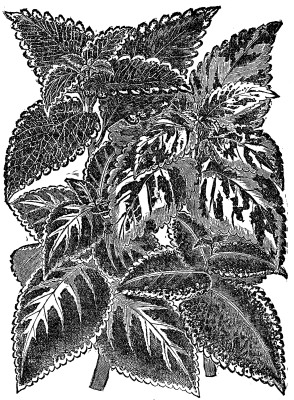
DREER'S NEW HYBRID COLEUSES.
During my time, many varieties with excellent characters when in my company, have performed their parts but poorly, whilst others have had enough to do to keep up a doubtful reputation. It was with pleasure, therefore, I hailed the arrival of a fresh set from England a short time ago, headed by George Bunyard, who, with his companions were so highly spoken of, that I hoped one or more of them would prove of service to me. But this hope has not been realized, and to-day, for all of them, I am as destitute of support as I was before their arrival. Poor George, after being much in his company for a season, it is only fair to say, he performed his part so poorly that I hope, for the credit of both, we shall never meet again under similar circumstances.
What the incoming season may bring forth, yet remains to be seen, but at present the prospects are good for a grand display, as a new order of aspirants are being marshaled for duty, whose merits, some say, are such as to eclipse the old members of our family, and even take from me the honors I have enjoyed so long. Should their claim be well founded, I shall surrender my right to the first place without regret, and be even glad to take any subordinate place I may be deemed competent to fill. But should they fail to meet the expectations thus produced, it will be my duty to remain at my post until such time as new varieties are found, regarding whose merits there can be no doubt.
Be it understood that what has been said about my associates has reference only to them as bedders; for it is well known, many varieties when grown under glass, and partially shaded from the glare of sunshine, possess greater brilliancy and beauty than I lay claim to. For this reason, I think those so constituted as to require the protection of a green-house, should be sparingly, if at all, planted out of doors, and the outside department exclusively occupied by such as attain their greatest perfection in free air and the full tide of sunlight.
Before closing this monologue, I am forced to say a word in behalf of a plant seemingly possessed of extraordinary capacity for the work in which I excel. I refer to Acalypha Macaffeana, the leaves of which are large and finely formed; color, reddish-brown, and irregularly blotched with bright shades of crimson. When fully exposed to sunlight, it looks as if "on fire through all its length," and being much more stately than myself, might form the central figure in a group of Coleus or other plants with the greatest acceptance.—Verschaffeltii, in Gardeners Monthly.
We do not know who is the author of this very interesting autobiography of an old and popular Coleus. The florist for whom it was named, M. Nuytans Verschaffelt, was the adopted son of the late Jean Verschaffelt, of whose nursery near Ghent, he was the manager, and to which he succeeded on the death of the proprietor. M. Nuytans was a very distinguished and highly esteemed horticulturist; he was an active member of the Royal Agricultural and Botanical Society of Ghent and Chevalier of the Order of Philip the Magnanimous. He died June, 1880, in the forty-fourth year of his age.
There has been a remarkable progress in the development of the Coleus since the introduction of Blumei, but the two past years have been more distinguished than any previous ones by the originating of many new and beautiful hybrids. Pre-eminent among these are "Dreer's Set of Tri-colored Coleus," fifteen varieties; "Queensland Set," fifteen varieties, and "Queensland Set of Dwarfs," ten varieties. Mr. Henry A. Dreer says of them: "These varieties which it is a pleasure to offer, have originated in our nursery grounds during the past summer, were selected from perhaps six thousand seedlings excelling in point of color, variety, habit and novelty, and we feel safe in predicting for them a future that leaves nothing wanting in this class of plants."
Mr. Dreer is sustained in his statement by the verdict of many of the leading florists who visited them, and the committees of the Cincinnati, Philadelphia and New York Horticultural Societies, the summer and autumn before they were offered to the public.
In the February number of the Gardeners Monthly, a lady asks some of the correspondents who have tried the new Coleuses, to report thereon, whether as brilliant as their illustrated types, and if they retain their colors in bedding out. We will give the replies from the March number.
J. R. H., Richmond, Va., says: "In response to the query of Mrs. R. B. Edson about Dreer's New Hybrid Coleus, I take pleasure in giving my experience with regard to their hardiness in the summer sun. As the summers in our city are extremely dry and hot, I think it a very fair trial of them.
"When I received my box of Coleus from Mr. Dreer and opened it, the first thought was that I was swindled nicely, while I at once perceived that they were of an entirely new type of Coleus, but considered their colors very ugly indeed, and quite different from the colored sheet in his catalogue. However, I determined to give them a trial before expressing my opinion. I put them in the hottest place I could find, determined to get out of them all the 'come out,' should there be any, and to my utter surprise, their colors changed so rapidly and beautifully, that after a lapse of two weeks, I could scarcely believe they were the same plants. I so much liked them I determined they should have a prominent place in my garden, and accordingly planted them in my border where they did not miss the sun at all while it shone. They grew off at once with the old colors (as when received), which discouraged me again, when to my surprise, about the middle of June, they began to show their bright colors again, and in three weeks they were the brightest and prettiest Coleuses I have ever seen, and remained so with a continual growth until they were killed by the frost.
"I must confess I never saw plants resemble as much the colored plates of their likeness, as did my Coleus; just like the plate with the exception of the fine gloss, which of course I did not expect. It seemed that the hotter the atmosphere was the brighter they looked, and have stood the sun about twenty per cent better than the older varieties. They have given me more pleasure than any set of new plants I have ever received. I consider them the greatest acquisition I have known in the soft-wooded class of plants. While there is quite a similarity in the tri-colored set, it is not at all an objection. The only objections to any of them are that Amabilis and Mrs. E. B. Cooper, while very rank growers, are exceedingly ugly, and Superbissima entirely worthless. It will not grow, I don't care what I do with it. Some seedlings that I have raised from them are very richly colored, and I think them much prettier than their parents, though I have not had a chance to test their qualities in the summer."
We regret that the writer did not give the names of those Coleus he so much admired as well as those which are "exceedingly ugly" and "entirely worthless." We can report the same lack of success with Superbissima. It would not grow one bit, but remained stationary several months, and then died.
Mr. E. L. Koethens reports from a large collection: "For bedding these are the chosen ones, Gracilliana, Miss R. Kirkpatrick, Superbissima, and above all, Speciosa. But for inside culture, many of the new ones are unsurpassed for beauty in any class of decorative plants. Here again Speciosa and Miss R. Kirkpatrick of Dreer's set, lay claims to attention, and his Amabilis is attractive for its free blooming properties. Fairy is also conspicuous, and Beacon takes the place of Superbissima indoors, but Zephyr, in my opinion crowns them all as a foliage plant for indoor culture; a single head often measuring ten inches across, with a rich bronzy-brown color. The above are all valuable acquisitions and should be in every collection."
Mrs. M. D. Wellcome thus writes: "Mrs. R. B. Edson in her charming 'Garden Notes and Gossip,' asks that some of the correspondents who have tried the new Coleus, Dreer's and Henderson's new sets, report thereon. I have not tried Henderson's, and only six of Dreer's, so I am not prepared to report very fully. But I wish to make special mention of Miss Ritta Kirkpatrick, which looks like the picture only it is handsomer. It is the one represented by a large leaf, creamy white center, broad, green lobed margin. It was a wee plant when it came to me in early spring, but it very rapidly outgrew the other five, branching out finely, so that I began in June to take slips from it, and have continued to do this each month to the present time. I should think I had rooted full thirty cuttings, and the original plant, which has been beheaded on three of its branches, has now twenty-eight that would I think all make very nice plants, if treated as were the others. I rooted them all in sand, kept constantly wet, and exposed nearly all day to the rays of the sun. I never saw anything so quickly take root and so rapidly grow as did those cuttings. At one time I kept half a dozen about two months in the pure sand, till they were fine large plants, with a great mass of roots. They can be removed from the sand to pots of earth without retarding their growth. I always allow the particles which adhere to remain in transplanting. This Coleus is a special favorite with me. Fairy, foliage yellow and green, blotched with crimson-scarlet, and Charm, yellow, tinged with bronzy scarlet, stained with dark brown; green deeply serrated margin, were very beautiful in the open ground, and from these I rooted also in sand several very fine cuttings. But the original plants did not grow rapidly. I think the Coleus adds much to the attraction of the border, but it is for the winter window-garden they are specially valuable."
These new Hybrids have stood the test of a year's trial, and three varieties exhibited at the June meeting of the Royal Horticultural Society, London, carried off the highest prize for this class of plants, and received very flattering newspaper notices. In Mr. Dreer's catalogue for 1881, he has selected twenty-four which he calls the cream of those New Hybrids. Superbissima is included, while Zephyr is omitted. Kirkpatrick is among them, we are happy to say. So superb are some of the recent Coleuses, Verschaffeltii, we fear, will have to retire still further into private life. Being quite advanced in years, we presume he will not regret this. We are sure that he will always be treated with that respect which is due to honorable old age.


HOW much one who gives attention may learn in the vast field of Nature! How varied are its attractions, how wonderful its work, how indescribable its beauties! There is a fascination in these studies, whatever may be the department to which they are directed, and the more one learns the more sensible they become of the limitations of their knowledge. I have already told you I had within a year or two been awaking to a realization of the value of ornamental foliage plants in giving an abiding brightness and beauty to the window-garden and open border. As humanity is ever prone to extremes I may become too enthusiastic in this direction. I thought there was some danger of it as I surveyed my array of pots filled with fine specimens of various sorts. I will take them for my subject to-day, giving whatever facts of interest I have been enabled to gather from various sources.

CROTONS.
Everybody has heard of croton oil, but only a few of that same everybody know anything about Crotons. The number of species known is enormous, and they are found in many parts of the world, but chiefly at the South Sea Islands. Some kinds are native to our own country, mainly in the South and Southwest, but these are not characterized by the brilliant markings of the foreign varieties. Their leaves are often thick and large, but usually they are very long and narrow and ribbed, veined, spotted and blotched with crimson, scarlet and gold. They are a very interesting class of ornamental plants, and their low price, twenty-five to fifty cents, except for novelties, places them within reach of the common people. They do best in a rich soil, with a little peat and sand; also an abundance of water.
The specimens I have are these: Aucubæ Folium—leaves large, dark green, blotched with golden yellow. Interruptum, very long leaves, mid-rib bright scarlet, shading to gold—very graceful. Irregulare, so named because of the irregularity of its leaves in shape and color—two precisely alike being rare.
The handsomest however of my collection, is Croton Weismanni. The ground color is a shining bright green, striped and mottled with golden yellow. The leaves grow to a foot in length and three-fourths of an inch wide. Among the more recent and high priced novelties are Croton Evansianus and Princess of Wales. The former is "distinguished by the peculiar form of its trilobate leaves and the depth of coloring pervading the whole plant. The newest formed leaves are light olive green with mid-ribs and veins of golden yellow, and the interspaces spotted with the same color. As the leaves become older, the green deepens and changes to a bright bronzy crimson, and the golden yellow of the mid-ribs, veins and spots becomes a rich orange scarlet." Princess of Wales is one of the long-leaved drooping forms of Croton, and is very distinct in character. The leaves are from one and one-half to two feet in length. The ground color is green, and the variegations creamy-yellow, very variable in color. The markings are of the maculate style, with here and there large blotches of clear cream-yellow, and and in other parts clouded markings of smaller confluent blotches and spots. Occasionally these conditions are reversed.
The Croton Fenzii, recently offered in commerce by M. Solviati, of Florence, is described as a jewel among the Crotons. It is the result of a cross effected in the green-houses of Sesto, between C. Veitchii and C. Weismanni, and has moderate sized oval acuminate leaves, richly veined with golden yellow, the principal nerves being purplish-red, which color extends to the stem and the petiole. The habit is so dwarf and compact that plants only a foot high are often seen with all their splendor, the yellow streaking then extending to almost the whole surface of the leaf, and the red nerves shining on the yellow ground. It is a variety especially fitted for the decoration of small green-houses, as it requires very little room to be able to develop all its charms. This variety has been dedicated to the Chevalier E. O. Fenzi, President of the Royal Horticultural Society of Tuscany.—London Florist.
FANCY CALADIUMS.
Of these the varieties are numerous, and the foliage very ornamental. Those I have are Dr. Hondley; green ground, blotched with rose, crimson center; Madame Houllette,—blush clusters and white spots on green ground; Sagittæfolium pictum,—arrow-shaped leaves prettily spotted with white; Madame Alfred Bleu,—the ground color of the leaves is silvery white, which is blotched with green, in some leaves very sparingly, in others, nearly half the surface; the veins are prominent and of rich rosy crimson, bordered by narrow bands of a lighter shade. Alfred Mame,—beautiful deep carmine, richly marked with rosy spots and white leaf margin. La Perle de Brazil,—ground color, green, reticulated all over with pure white, like fine lace. These last three are from the collection of Mr. John Saul of Washington, and are new.
Fancy Caladiums do best in somewhat shaded positions, in well enriched soil, composed of finely decomposed manure, leaf mold and sand, and a moist, warm temperature. Great care must be had in their earliest stage of growth, to prevent decay of the tubers by over-watering. They can be preserved in sand during the winter, in a room sufficiently warm to prevent danger from frost.
CALADIUM ESCULENTUM,
Is the most striking and grand of the Ornamental Foliage Plants for the lawn or flower garden. It will grow in any good soil, and is very easy of cultivation. When of full size it stands about five feet high, and its immense leaves often measure four feet in length by two and a half in breadth; very smooth, of a light green color, beautifully veined and variegated with dark green. When killed down by frost in the autumn, the bulbs must be taken up and stored in the cellar. The Caladium belongs to the family of "Jack in the Pulpit," or Indian Turnip, and the Ethiopian or Egyptian Calla. They rarely bloom in our Northern States. The flowers resemble in shape the Calla Lily, only are much larger and narrower, are of a rich cream color, very fragrant at first, but soon lose their odor, which resembles the Magnolia.
ERANTHEMUMS.
These comprise a large genus valuable for their foliage and also winter flowers, yet not very generally cultivated. Mine are labeled Andersonii, "a handsome orchid-like flower, white, spotted with red." Pictum, foliage prettily streaked with white, a strong, vigorous grower; Tricolor, leaves prettily marked with pink and green; Cooperi, has flowers white, prettily streaked with purple; El Dorado, light green foliage, with golden veinings.
MARANTAS.
These are considered by florists as among the most elegant of tropical plants, but like the Eranthemums, are not generally known. They are all natives of tropical America, and require strong heat with plenty of moisture. They are low-priced, and ought to be more extensively cultivated. I think mine are very beautiful. Eximia, upper surface of leaves striped with grayish-white; under, purplish-violet. Leopordina, pale green with oblong blotches of deep green. Mikans, shining green with a white feathery stripe. Van den Heckii, dark glossy leaves, mid-rib silvery white. Makayana, a very ornamental dwarf species; leaf-stalks slender reddish-purple, blade of the leaf ovate, ground color, olive green, beautifully and regularly blotched with creamy yellow of a transparent character; on each side the mid-rib are oblong dark green blotches, while the under side is rosy red. Tubispatha is an elegant and very attractive species of erect habit of growth; leaves some nine or ten inches long, light green, ornamented on each side the mid-rib with oblong blotches of cinnamon brown. Veitchii, "The leaves of this grand plant are upward of twelve inches in length; the under surface of a rich purplish-wine color, the upper of a deep shining green, blotched with conspicuous patches along each side, of a yellowish-green, almost verging on gray. The contrast is very marked, and the whole plant very beautiful."
Achyranthes, a genus of richly colored tropical plants, are better known, and to a limited extent are found in many gardens, Verschaffelti, with its dark crimson leaf, being the most common. Brilliantissima, ruby red, is a new English variety; Wallisii is a new dwarf, with small purple leaves; Lindeni Aurea Reticulata, foliage netted with golden yellow, on a light green ground. These plants are of the easiest cultivation, and endure strong sunshine without injury.
Alternantheras are also very effective for bedding plants; habit dwarf. Foliage is in some of a magenta-rose color, others, yellow and red; Purpurea has a purplish tint, and Versicolor, crimson and pink shadings. They are unsurpassed for ribbon or carpet bedding.
Dieffenbachia, a genus of stove plants with very showy foliage. Brasiliensis, a handsome variety, the leaves averaging eighteen inches in length by eight or nine inches in width; the ground color of the leaf is deep green, and the whole surface is mottled with small blotches of greenish-yellow and white; Bausei is a stocky-growing, broad-leaved variety, with yellowish-green leaves, which are irregularly edged and blotched with dark green, and also spotted with white, the markings being peculiarly effective; Weirie is of dwarf habit, the foliage of a bright green color, thickly blotched and spotted with pale yellow. One of the finest of the species. They grow best in loam and peat equal quantities, with a little sand. Require strong heat and frequent watering.
A few ornamental foliage plants of rare beauty received from Mr. John Saul merit special notice:
Cyanaphyllum Spectandum is a grand plant with large, oblong, lustrous leaves which have a rich, velvety appearance; they are beautifully ribbed with whitish color.
Alocacia Macrorhiza Variegata, its large caladium-shaped leaves are marbled and broadly splashed with white. Some leaves are nearly all white; Zebrina, fine yellow leaf-stalk with distinct black marks; Illustris, the leaf-stalks are erect, and have a brownish-purple tint, color a rich green, marked between the principal veins by broad patches of a blackish olive, and forming a striking contrast with the brighter green portions of the leaf surface; Sedini, "A very beautiful hybrid between A. Metallica and A. Lowii. The form of the leaf is perfectly intermediate between the two parents, whilst the coloring is a very striking and pleasing combination of the metallic hue of one parent, with the dark green and prominent white veins of the other." Alocasias require a moist heat during their growing season. Soil, peat, with a small portion of loam, sand and manure.
Acalypha Macafeeana is another of the rare and beautiful foliage plants alluded to. It is considered the best Acalypha ever offered. It is certainly very handsome with its "sub-cordate and serrate leaves, eight inches long and six broad, frequently cut into many forms, and very highly colored bright red, blotched with deep bronzy crimson." It proves to be an admirable plant for bedding out. Quite as attractive every way is Panax Laciniatum, "An elegant and very distinct habited stove plant from the South Sea islands. The leaves are tinted and indistinctly marked with pale olive brown, and form a rather complicated mass of narrow segments; they are bipinnate, nearly as broad as long, and have a drooping contour; and the pinnules or segments are very variable in size and form, presenting the appearance of a complex head of foliage in which the lanceolate lobes or pinnules have the preponderancy."
Panax Fruiticosm has a very graceful fern-like foliage. These plants belong to the Aralia family, a genus very ornamental, natives of the South Sea Islands.
Another of my Washington collection, very graceful and beautiful, is Paulinia Thalictrifolia. Its delicate cut leaves resemble the fronds of a finely divided Maiden-hair Fern. The leaves are of a rich shade of green. The young shoots and foliage are of a pinkish-brown color. It is of slender growth and climbing habit, very similar to Capsidium Filicifolium, which has long been a special favorite of mine. Both of these are elegant, trained on a pot trellis.
Paulinia Thalictrifolia is a native of the southern Brazils, from whence it was introduced to the nurseries of Messrs. Veitch & Sons of Chelsea. If only required for decorative purposes there should be no inclination to make the plants produce flowers which are inconspicuous; therefore the main object should be to have plenty of healthy foliage. To secure this, the plant should be grown in a temperature of from 65° to 70°, and if one part of the greenhouse is more adapted to its growth than another, it is the dampest part. After this plant came into the possession of Messrs. Veitch, and before its true value became known, some plants of it were placed in a corner of an old, very damp, warm pit, in which position they grew wonderfully strong, and quite surpassed in vigor and beauty those that were, as was then supposed, placed under more advantageous circumstances, i.e., in dryer and lighter parts of other houses. Care is therefore now taken to keep them where abundant atmospheric moisture can be supplied. A compost consisting of two parts good substantial peat and one of loam, together with some silver sand, suits it admirably.—Gardening Illustrated.
CANNAS.
These form a very important part of the class of which we are treating. They give a very beautiful and tropical appearance to the lawn and the garden by their stately growth and broad massive foliage, relieved by rich crimson, scarlet and orange-red flowers. Their foliage comprises various shades of green, glaucous, chocolate and purple tints, ribbed and striped, fitting them admirably for grouping with other plants.
They are also very effective for large pot plants in the pleasure-ground, or conservatory. Under rich cultivation they will attain the height of five feet. They need water often. Among the newer roots Creole, very dark foliage, grows to the height of about six feet. Ornement du Grand Rond, very tall, with large bronzy-green foliage, large scarlet flowers. Oriflamme has large lanceolate-green leaves, with violet veins, a vigorous showy plant with salmon-orange flowers.
The roots of Cannas must be taken up in the autumn. If wanted singly, divide them, if a thick clump is desirable let them be planted out as they are. They must be kept perfectly dry through the winter; if the cellar is very damp they will do better packed in sand.
DRACÆNA.
This is a valuable genus of ornamental plants, specially fine for the center of vases, and for pot culture. Although their culture is on the increase, they are not so frequently grown as they deserve. The species are very numerous, and are found in tropical countries, especially in the islands of the tropics. Many of them assume the proportions of trees. The largest specimen ever known was one of Dracæna Draco, or the Dragon tree of Oratava in Teneriffe, one of the Canary Islands. This tree was remarkable for its monstrous dimensions and prodigious longevity. About ten years since, or in the autumn of 1867, this magnificent specimen was destroyed by a gale of wind. It was a special object of interest in the Canary Islands, and received the attention and veneration of visitors, as do the great Seguvia trees of California. Its trunk below the lowest branches was eighty feet in height, and ten men holding hands could scarcely encircle it; by one measurement this span around it was seventy-nine feet. The trunk was hollow, and in the interior was a winding stair-case, by which one might ascend as far as the part from which the branches sprang. It is affirmed by tradition that, when the island of Teneriffe was discovered in 1402, this tree was as large, and the cavity in the trunk as great, as at the time of its destruction. We are even assured that in the fifteenth century, at the time of the conquest of the Canaries by the Normans and Spaniards, they celebrated mass on a little altar erected in this cavity. From the slow growth of the young Dragon trees in the Canaries, it has been estimated that this monster tree before it was destroyed, was the oldest plant upon the globe. A writer in describing it says: "Long leaves pointed like swords, crowned the extremities of the branches, and white panicles, which developed in autumn, threw a mantle of flowers upon this dome of verdure." The popular name of this species is Dragon's-blood Tree, because of a resinous juice of a red color which exudes from the cracks in its trunk. At one time this resin formed a considerable branch of commerce, as it was used medicinally as an astringent, but it has fallen into disuse.
The Dracænas belong to the Lily family, and they afford a remarkable contrast to the palms and other arborescent endogens, by their branching heads. The young trees of Dracæna Draco do not, however, send out any branches, even in their native localities, until they are thirty years old or more. The small plants of this species, cultivated for ornament, have always a single, straight stem; but are much more robust, and quickly assume more stately proportions than those of the other kinds that will be mentioned.
The Dracæna is admired for its peculiar grace of form—it would be in vain in common house culture to expect flowers. To admire a plant for its well developed and graceful form, marks an advancement in refined taste beyond that which would induce one to exclaim, "Oh!" at the sight of a brilliantly colored flower. Even in rearing a plant for flowers, the first object should be to develop it to the fullest extent in size and shape and strength—to make a beautiful object of the plant itself; just as the first and main attention given to a child, for years, should be to develop and build up its physical system.
The Dracæna is a good house plant, a good balcony and veranda plant, good for the vase in the open air, and in a handsome pot is a fine ornament for table decoration. Its culture is of the simplest kind, adapting itself to any ordinarily good soil, it only requires to be supplied moderately with moisture and to have a temperature ranging upward from sixty-five degrees. It delights in a moist air, and whenever possible, water should be kept where it will rapidly evaporate, and thus ameliorate the atmosphere in this respect for the plant. This condition, moreover, is conducive to the well-being of most plants, and no good plant-grower can disregard it with impunity. Washing the leaves and stem of the plant frequently with a wet sponge, is favorable to its health and vigor, and one of the best preventives of the attack of insects. With dust on the leaves the plants look dingy, while frequent washing keeps them bright and lustrous.
Dracæna indivisa has long, slender, dark green leaves, about three-quarters of an inch or an inch in width, and from two and a half feet to three feet in length, and the lower ones especially are very much recurved or gracefully drooping. This species is among the hardiest of the Dracænas, and is frequently wintered in the open ground, with some protection in climates where the temperature frequently descends several degrees below the freezing point.
Dracæna terminalis is the most popular of the whole family in this country, and is worthy of all the admiration bestowed upon it. The leaves are broader and more erect than those of the preceding species, and of a dark green suffused with red, or having streaks of a reddish color; the young leaves nearly pink, but assuming a dark bronzy copper color afterward. It is a very distinct and showy plant, and adapted to a great variety of ornamental purposes. The propagation and sale of it is rapidly increasing every year, and it is already widely disseminated. At the Sandwich Islands it is cultivated to a considerable extent for its roots, which are baked and eaten. A fermented beverage is also made from the juice, and its leaves are employed as fodder for cattle, and for clothing and other domestic purposes.
Dracæna Shepherdii is of a most noble form, and is one of the finest yet in cultivation. It has long, spreading leaves, of a metallic green, with stripes and border of bronzy-orange, and is a very free grower. Unlike most of the forms already known, which color most on the free young growth of vigorous plants, this plant takes on its distinctive coloring gradually on the older leaves.
Dracæna cannæfolia is an interesting species. Its peculiarity consists in the length of petiole, which is as long as the rest of the leaf. The blade of the leaf is elliptical in form, from fifteen to twenty inches in length, firm, and of a glaucous green.
Within a few years past much attention has been given by cultivators in Great Britain and Europe to hybridizing the Dracæna, and producing new varieties. The most remarkable success has attended the efforts in this direction, of Mr. Bause, in the establishment of Mr. Wills, of Anerly, England. The variety is wonderful—"broad-leaved, medium-leaved and narrow-leaved; bronzy and green, crimson, rose, pink, violet and white variegations; drooping, spreading, and erect habits, are blended in all sorts of combinations."
One of the sorts produced is described as "a most important acquisition, having quite the habit and character of the well-known favorite terminalis, but with white variegation. The ground color is a bright green, with bold, white variegation, the upper leaves being white, with here and there a bar of green."—Vick's Magazine.
DRACÆNA GOLDIANA.
Sent out in this country for the first time in 1880, is said to be "one of the most magnificent ornamental foliage plants ever introduced, and altogether unique in character and aspect. It is a native of Western Tropical Africa. The plant is of erect habit, and the stems are closely set with stalked spreading leaves, the petioles of which are of a grayish color, terete with a narrow furrow along the upper side, the base being dilated and sheathing the stem. The blade of leaf is marbled and irregularly banded with dark green and silver gray in alternate straight bands, the colors being about equally distributed. The back of the unfolded leaves is a pale reddish-purple or wine color, and the stem, where visible. It is, without doubt, one of the most superb of ornamental stove plants."
When first sent out in London in 1878, its price was from five to ten guineas per plant. We do not know the price in this country. Mr. H. A. Dreer who has an illustration of it in his catalogue, furnishes the price only on application, which is evidence that it is costly. From the type given, it must be exceedingly handsome, and wholly unlike any Dracæna before offered in America.
Dracænas, as we have noticed before, are particularly desirable house plants, keeping in good condition for a long time, even in rooms where gas is burned—places so unsuited to most plants. They are liable to attacks of the Mealy Bug and the Red Spider if neglected, but the syringing and sponging advised for them will effectually prevent their gaining a foothold if frequently and thoroughly performed. After a year or two the plants begin to lose their lower leaves, and to get leggy, a state of things quite undesirable, as the beauty and effectiveness of the plants depend upon their being furnished with leaves down to the base of the stem. When the plants have become unsightly from the loss of their leaves, they can be renewed very quickly by a simple process. Cut a notch in the stem, on one side, just below the lowest good leaves, and take out a piece of the wood, then do the same on the other side of the stem, but not exactly opposite the first notch. The object is to check the flow of sap at this point and yet allow enough of it to pass to maintain the head. Having cut the notches, take some moss or sphagnum and bind about the stem, covering the incisions and fastening it on securely with twine or fine wire; the moss is to be kept gently moist, and in the course of two weeks will have thrown out young roots above the notches. The head can now be severed from the stem and potted in a medium-sized pot. After keeping it a few days in the shade, it can be gradually brought out into the full light, and will be found to be established.
Dracænas may also be multiplied by removing the thick, fleshy root that may usually be found in the base of the plant. Those tuberous roots can be potted, and if kept in a warm place will soon start and make new plants. When plants are re-potted a favorable opportunity is offered for taking off these roots, for the roots of the old plants are actively at work and, with the fresh soil they receive, will soon recover from any slight check they may have received.
The most rapid method of propagating this plant is by cuttings of the stem; the stem may be cut into pieces an inch in length, and those pieces split in two, and all of those bits will root and become plants. They should be placed in a light, sandy soil, and given a brisk bottom heat of 70° or 80° degrees. They will break and start into growth in a few days.—Vick's Magazine.
So fully does the foregoing express all that is needful regarding the Dracæna, we have thought best to give it entire. We might greatly enlarge on the subject of Ornamental Foliage Plants, and speak of the beautiful Palms, so fine for decorative purposes, the pretty Ferns and elegant Aralias, of which latter "Sieboldi is a capital house plant, so enduring that it will live and keep its beautiful dark green color for weeks almost in the dark." Then there is the Euonymus, so bright with its glossy green leaves, long a favorite whether for the border or window garden. Argentea has striped foliage, and Japonicas aurea has its dark green foliage diversified with golden variegations. Bicolor, foliage almost white, and Tricolor, a rarer form, is marked with pink and white.
With the numerous varieties we have named, it will be apparent how ornamental our gardens, whether within doors or without, may be made by plants, the beauty of which is wholly independent of flowers, and they do wonderfully enhance the effect of the bloomers. The Centaureas and Cinerarias with their deeply lobed leaves of white, are too well known to need any special mention. We do not intend however to pass so lightly over another stately and highly ornamental genus that comes within the reach of everyone. Ricinus, the seed of which can be purchased for a dime, are magnificent in foliage, and when combined with the brilliant colored fruit of the giant varieties, the effect is very oriental. Ricinus Africanus albidus is of recent introduction. It is white fruited, and the stems and leaves are silvery; height eight feet. Borbaniensis arboreus has very large and showy foliage; height fifteen feet. Communis is the Castor Oil Plant. Sanguineus (Obermanii) bears splendid red fruit in clusters, and is very ornamental. A species from Phillippines has gigantic foliage; height ten feet. These can be purchased in separate or mixed packets, and we advise everyone who has a bit of ground to try them. We will close with
A BIG BEAN STORY.
I have just harvested my Ricinus or Castor Bean, which I raised from the seed you sent me last spring. It was of mammoth growth, attaining a height of fourteen and a half feet, and sixteen feet across the branches of which there were seventeen after cutting off five during the summer. Each of the branches contained a cluster of burs, the center one having one hundred and thirty-four burs, the other branches not so many. Many of the leaves measured from thirty to thirty-two inches across from tip to tip or point of leaves. When sawed off at the ground, the body measured five inches and a half of wood in diameter, inside of the bark, which was one-fourth of an inch thick. This is a big bean story but nevertheless a true one.—T. G. T. in Vick's Magazine.


IT is an old adage that one must take Time by the forelock. In the culture of flowers, we must certainly do so, planning and preparing in spring for the coming winter, if we would secure for ourselves plants that can be relied on for blooming. We know of none equal to

THE CHINESE PRIMROSE,
for common house culture, commencing to flower usually in November, and continuing through the spring months. The seed for this ought to be sown in April—if later the plants will not come into bloom so early. The soil for Primroses in all stages should be fine, light and rich, with a good mixture of sand.
For seed sowing it can be put in pans, boxes or six inch pots. First, put in drainage—I use for this coarse sand—then the coarse siftings of the soil. On this to the depth of one and a half or two inches, put the fine mixed soil, press down smoothly and spray lightly with tepid water. Sow the seed on the surface, and sift on enough of the fine earth to partially but not fully cover them. Cover with a glass, or with a bit of soft nice flannel, and place in the shade where a mild moist temperature can be attained. Where flannel is used, it can be kept damp and thus impart moisture to the seeds without their being saturated, washed bare, or displaced by spraying. When the seed has germinated, then glass can be substituted. The tender seedlings must be gradually brought to the sunlight; too long exposure at first would kill them, and if kept in the shade too much they will become drawn and dwarfed. This is the critical period, and many fail at this point. Great care is essential till the plants put forth the third leaf, which is rough and the true primula leaf. Then the plants must be carefully transplanted into other pots prepared as before. In about a month the glass can be removed and the plants potted separately, setting them low, as it is a peculiarity of the Primula to stretch itself up out of the soil, and become shaky. It is necessary sometimes to give them support. In watering, care must be had to prevent the water lodging in the axils of the leaves, which cause them to decay. They will not bear showering like smooth surfaced plants, and only occasionally should they be sprayed through a fine hose. They must be kept during the summer months in a shady place, and have a cool bottom to stand on; a cold frame is the best. They must be housed by the end of September, and the best situation for them is a light, airy shelf near the glass, yet not exposed to intense sunshine. They do not like frequent changes of position and temperature, nor to be grown with other plants. Give them a cool place where they will have the morning or afternoon sun for a time. During the blossoming season stimulate the soil once a week with liquid manure, or water with a few drops of ammonia added. Pick off all flowers as fast as they fade. Plants are stronger and better the second year, and unless they get too shaky, are good for three years. They must, after blossoming, be taken out of the pot, the ball of earth reduced from the roots, and then re-potted in fresh soil. It is not needful to keep them dormant and shaded through the summer, but in a cool and partially secluded position, they will after a brief rest begin to grow, putting forth frequently little crowns all around about the old one, and be full of blossoms during the autumn and winter months. The double varieties are not so easily grown, and cannot be recommended for general culture to be raised from seed. Fine plants can be procured from the florists, but the large single sorts, we think give the most satisfaction. Ellis Brothers, Keene, N. H., have sent us for trial, packets of very fine strains; some are rare, and, judging from the description, must be very beautiful. It is not often that we find more than four varieties named in the catalogues. They send out a dozen sorts, some of which we will name: Primula Fimbriata Kermesina Splendens; Large flowers, brilliant velvet like crimson, yellow eye. Primula Frimbriata Punctata Elegantissima; a new variety; flower velvety crimson, edge spotted with white; very distinct. Primula Fimbriata Striata; beautifully striped. Primula Fringed, Fern Leaf; pure white, with large citron eye; very fine. Primula Globosa, new; a large flowering, fringed sort; petals large and many of them crimped, each overlapping the other, so that they appear almost semi-double; colors white, light pink, crimson and lilac pink. All of these can be bought in mixed or separate packets. We cannot find room for all of these, but hope from the rarest to obtain some fine plants to brighten our room the coming winter. Great advances have been made since the Primrose was introduced into this country little more than half a century ago.
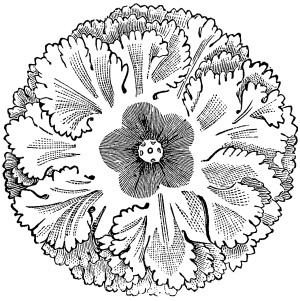
Of the novelties we find in the London Garden special mention made of Primula Sinensis Fimbriata Alba Magnifica. The writer says: "The Primulas from Mr. B. S. Williams' Victoria Nurseries, Holloway, were remarkably fine. The newest sort shown, Alba Magnifica, promises to be an excellent kind; the flowers are large, produced in dense and many flowered trusses, borne well above the foliage, which is also remarkable being elegantly crisped at the margins. The color is white, the purity of which, however, is more strongly marked when the plants are more mature than those shown; the habit of growth is very robust."
Of this novelty Mr. H. Cannell says: "The new white Primula is of exquisite form and substance; the plants are exceedingly compact, with deeply indented leaves of a light green color; the flowers measure two and one-quarter inches in diameter, pure white, with large, bright yellow eye, each petal being deeply and beautifully fringed, and are borne in large trusses well above the foliage."
We give an illustration of this Primula, kindly furnished by Ellis Bros., who are of the first to offer it in this country.
CARNATIONS AND PICOTEES.
"What is the difference between them? I am told differently by nearly every florist I ask. An old Englishman told me the other day that he used to grow great quantities of them in England, and that the difference between the two is, that the Picotee has fringed edged leaves, while in the Carnation proper the edge of the leaf is smooth like a rose."
The question is asked of Mr. Vick, and he thus replies: "The Carnation and Picotee differ only in the arrangement of the color, or markings. The distinction is made by florists, and is of course arbitrary. Seeds saved from one plant, may produce both Carnations and Picotee, or even from the same seed-pod. In an old work in our possession, the distinction is as stated, but for long years any flower with an irregular edge has been considered unworthy of propagation. The Carnation should have broad stripes of color running through from the center to the edge of the petals. The Picotee has only a band of color on the edge of each petal."—Vick's Magazine.
Although Mr. Vick here states that the Carnation should have broad stripes of color, neither he, nor any other florist makes this distinction, but call pure white, and pure red Carnations, just as freely as those that are striped.
There are two classes of Carnations, and thousands of varieties. The class of Perpetual Bloomers are called Monthly and Tree Carnations. The Garden Carnations are hardy, and can be left in the garden during winter by giving them a covering of leaves, straw, or evergreen boughs. They are easily raised from seed. Sown in June or July, will make good robust plants before frost, which will bloom the following summer. Some of them will be single, perhaps, and these can be removed. Those of superior merit may be multiplied by layering. This method is to select good healthy shoots that have not bloomed, and make a cut midway between two joints. First cut half way through the shoot, then make a slit lengthwise to a joint. Remove the earth a few inches in depth, and press the branch down so that this slit will open, and then cover with the soil. Roots will form where the cut was made, and thus a new plant will be formed, which can be removed in the autumn or spring. Midsummer is the best time to do this, and by adopting this method good, healthy plants are secured. The plants should be well watered a day or two before layering is commenced, and immediately afterward—then only occasionally. They are frequently propagated by cuttings, which can be rooted in wet sand, or in light sandy soil.
PERPETUAL BLOOMERS,
Or Monthly Carnations, can be easily obtained of the florists for summer or winter blooming; the former purchased in the spring, and the latter in the autumn. If one raises their own stock, it is not best to allow those to bloom much during the summer that are wanted for winter flowering. It is well to sink the pots in a good sunny place in the garden, and when they run up and show signs of bedding, cut back the stalk so that it may become more compact and branchy, then the buds in the late autumn or winter, will be much more numerous. The best for winter blooming are La Purite (carmine), President de Graw (white), Peerless (white, striped with pink) and Peter Henderson, of the well-known varieties. Of those of recent introduction, Lady Emma is said to be excellent. One florist says that "it is destined to be one of the leading winter-blooming Carnations. From my bed of one thousand plants in the green-house throughout December and January last, I plucked more blooms than from any other variety occupying the same space." It has proved excellent also for a bedding pink. Its color is a rare shade of crimson scarlet; the flower is of medium size, full and double, and never bursting down the side. Lord Clyde has for three years proved to be an excellent winter bloomer. It is of a very robust growth, like its parent the Edwardsii, but of a more dwarf, low-flowering habit. The ground-work is white, thickly striped with carmine, and a frequent blotch of maroon; very floriferous, each stem bearing from six to eight flowerets. Lydia is another of the recent novelties, and is very handsome. Flowers very large and intensely double, of a rich rosy, orange color blotched and flecked with carmine. Crimson King is one of the largest Carnations, very full, bushy habit, and robust, color crimson-scarlet. A pure bright scarlet is rare; when therefore, Firebrand, a novelty of 1880, was announced as a bright scarlet, it produced quite a sensation. It is very highly commended by those who have seen it. Grace Wilder, Princess Louise and Fred Johnson, are new hybrid seedlings now offered for the first time to the public.
There was quite a discussion in the Gardener's Monthly of last year as to the best pure White Carnation. In the August number, Mr. E. Fryer of Delaware writes: "The varieties called Peter Henderson, sent out by Nanz and Neuner I have found to be the best white I have yet grown for winter bloom. It is a stronger and better bloomer than de Graw, its only drawback being that it runs up high like La Purite. Snowdon is a true dwarf, pure white, and if it proves a good winter bloomer, will probably supersede all other whites, the flower being of fair size and very fragrant. Bock's Seedling, Charles Sumner, I have grown the past winter. The flower is of an enormous size, but it invariably bursts before opening, and is a dull unattractive color. Waverly I have also grown last winter—a splendid variety, rich crimson scarlet; the color was no way exaggerated as represented in the Monthly a year ago; produces a fair average of flowers to the plant, flowers selling readily at ten cents each. I think this the most useful color to the commercial florist.
"I still cling to the old carmine La Purite, which for quantity of bloom, size of flower and general good qualities, I think has not been beat by any of the newer varieties for winter bloom." Mr. Peter Henderson, one of the leading florists, places Snowdon above all other white Carnations, its dwarf habit making it specially desirable.
Florist's Pinks are more dwarf than the Carnations, flowers very double, clove scented, and are of various shades of maroon, carmine, crimson and rose interlaced with white.
THE ORIGIN OF THE FLORIST'S PINK.
The Gardener's Chronicle gives the following interesting account of the origin of this class: "It may be interesting to record the fact, published in an old number of the Floricultural Cabinet, that the first Pink worthy of notice was raised in the year 1772, by Mr. James Major who was then gardener to the duchess of Lancaster; previous to that there were but four sorts, and those of very little note, being cultivated as only common border flowers. Mr. Major having saved some seed in 1771, he reared several plants, which, blooming the next season, one of the number proved to be a double flower with laced petals, at which he was agreeably surprised, although he considered it as being only in embryo, and the prelude to still further advance to be developed at some future period, which is now verified by the rapid strides this beautiful flower made in size and quality during the years which followed. Mr. Major informed the writer of the foregoing remarks that he made his discovery known to a nurseryman or florist and was offered the sum of ten guineas for the stock of his new Pink; but, acting on the advice of his friends, he declined to sell, and set to work instead and increased the stock with a view of offering it in sale to the public. It was sent out to the public at half a guinea a pair (for it has long been a custom of offering Pinks in pairs, a custom which is continued to this day), under the name of Major's Duchess of Lancaster, the orders for which amounted to £80. It is recorded that one individual ordered as many as twenty pairs, which was considered in those days an unusually large number. It would be interesting to have a bloom of Duchess of Lancaster to compare with the fine double varieties of the present day. We appear to have come to something like a pause in the matter of Pink production as the flowers are now very large and full, and the lacing is as perfect as can well be conceived."
DIANTHUS.
The word is derived from the Greek words Dios, divine, and Anthos, a flower; God's flower, or the flower of Jove. There are several species, and many varieties of Dianthus; Dianthus Caryophyllus is what is commonly known as the Clove Pink, and from it have been produced the double varieties called Carnations and Picotees. The plant in its wild state is found growing on the south side of the Swiss Alps, at a low altitude, where the winters are not severe. The common perennial garden Pink is Dianthus Plumarias. The old and well-known Chinese Pink, Dianthus Chinensis, is a biennial, flowering the first season from seed sown in spring, lives during the winter, blooms the second year, and then dies. New and superb varieties have been introduced of late years from Japan, and Dianthus Laciniatus, and Dianthus Heddewigii, both single and double, make a splendid display, and are among the most desirable of our garden flowers. Dianthus Diadematus is of dwarf habit, very profuse in blooming, and the flowers are of various hues, from white to dark maroon, and also beautifully marbled and spotted. Of the recent novelties Eastern Queen and Crimson Belle are superb; we speak from personal knowledge. "Eastern Queen" is beautifully marbled; the broad bands of rich mauve upon the paler surface of the petals are very striking. "Crimson Belle," as its name implies, is of a rich crimson hue, with dark markings; very large and finely fringed.
For early blooming it is well to sow seed as early as April. June sowing will secure good hardy plants for the following season. When there is a profusion of bloom, it is well to remove a portion of the flowers, so that the plants may not become exhausted, and the seed pods beyond what are desired for ripening, ought also to be cut off.


Oh, a dainty plant is the Ivy green, That creepeth o'er ruins old! Of right choice food are his meals I ween, In his cell so lone and cold, The wall must be crumbled, the stone decayed, To pleasure his dainty whim; And the moldering dust that years have made, Is a merry meal for him. Creeping where no life is seen, A rare old plant is the Ivy green. Charles Dickens.
HAVE been off on a vacation, peering into other folks' gardens and admiring other people's flowers. Visited the Public Garden of Boston and saw that there had been a marked improvement within ten years. The massed beds of several sorts, with their contrasting borders, were very attractive, specially the maroon Coleuses with border of Centaurea. There were few varieties of Geraniums, and these were mostly massed in beds, some all scarlet, others wholly pink.

At Forest Hills Cemetery there was the finest display of flowers and tropical plants I ever saw, and they are very artistically and tastefully displayed. I saw several beds with artistic designs on a ground work of Sempervivum, evidencing great skill in the arrangement and culture. The entrance gateway to Forest Hills Cemetery is very beautiful in design, and here we saw that graceful climber Ampeclopsis Veitchii, in the perfection of its beauty, covering the front almost entirely. I had noted it in various stages of growth, clinging to the dwellings in all parts of the city, requiring no aid but its own little rootlets. It is a native of Japan and was introduced in this country twelve years ago. It was slow at first in being duly appreciated, but now is widely known and extensively propagated. Probably the finest plant is owned by Mr. George L. Conover of Geneva, N. Y. It covers the entire front of his two-story square house, and has become so famous that horticulturists from all parts of the country have been attracted by it, and a great many people have visited Geneva for the special purpose of seeing this fine plant. It has proved to be perfectly hardy, only the first year the young and tender plant needs some protection during the winter. Florists are growing them in great quantities to meet the increasing demand. It can be obtained for twenty cents. I received a small plant last year and kept it in my window box during the winter. It died down, however, and I quite forgot about it, till it sprang forth anew in April. Since putting it in the ground it has grown rapidly, and I shall value it now more than ever.
HONEYSUCKLE.
The Golden-Leaved Honeysuckle is a special favorite of mine. Its leaves are so netted and veined with yellow as to give this hue the predominance. The foliage is small; the flowers are yellow and fragrant. The family of Lonicerus, or Honeysuckle, embraces a large variety. The botanical name was given in honor of Lonicer, a German botanist, who died about three hundred years ago.
Lonicerus Holliana was introduced into this country from Japan by Dr. Hall. The flowers are pure white when they first open, but assume a creamy tinge in a few days. This variety blooms almost continuously from June till frost. It attains sometimes to the height of twenty, and even thirty feet. The flowers are very fragrant.
Belgian, or Monthly Fragrant, bears its blossoms in clusters. They are pure white in the interior at first, but afterward change to creamy yellow, deepening into orange.
Sempervirens (Scarlet Trumpet) is a native of this country, and perfectly hardy. This is the most common, though not fragrant. It is a strong grower, and blooms from June to November. Its scarlet flowers tinged with orange afford a pleasing contrast with its dark, glossy foliage.
CANARY BIRD FLOWER.
For an out-door annual climber, what can be prettier than the dainty, graceful Canary Flower? Mine have scorned the limitations of the twine I had fastened to the lower limbs of a small pear tree and ascending far above them, have run out a full yard on a large branch. The light green, finely lacinated foliage is very handsome of itself, but when the Canary bird flower is added, how lovely it is! It is so easily grown from seed that I wonder so few have it. A paper costing only ten cents would give you a score of plants, and they are much prettier for the bay window than Madeira vines.
A writer from England says: "While in the north of England, last fall, we paid a visit to Alnwick Castle, the seat of the Duke of Northumberland, and the ancient home of the Percy family.... The first thing that struck me on entering the town was a bay window most charmingly draped with light green climbers, and literally covered with bright lemon yellow flowers. Now this appeared so strange to me (for the chilly night air had already affected the geraniums and other tender out-door plants), that I had to cross the street, take the Yankee liberty to open the gate, go inside and examine this thrifty beauty. I confess I was not only surprised but greatly interested to find it was only the Canary flower, Tropaeolum peregrinum, a member of the Nasturtium family, and I concluded at once that there should be one cottage in America next summer worth coming miles to see on account of its climbing plants of light green foliage and rich yellow masses of Canary bird flower."—WALTON, in Vick's Magazine.
Do not forget to include this pretty vine in your seed order next year.
COBŒA SCANDENS.
This is one of the best of our climbing annuals, on account of its rapid and luxuriant growth, attractive foliage and large bell-shaped flowers. Under favorable circumstances they will grow to the height of twenty and even thirty feet in a summer. They commence to bloom when quite young, and continue in bloom until destroyed by frost. Some people remove them from the border to the house for winter blooming, but the change from out-door to indoor life, often retards their growth and mars their beauty. They are too cumbersome for window plants after having grown during the season, and it is better to sow seed in August, and get in this way plants for the house. They are hard to germinate, and need to be started in pots or in a hot bed. Place them in moist earth edge down, and do not water until the young plants appear above the surface, unless the earth becomes very dry.
For out-door blooming sow in March or April. As soon as the plants are strong enough, transplant to three-inch pots; keep them shaded from the sun for a few days, gradually expose to the open air, and plant out when all danger from frost is over. The soil should be well stirred to the depth of nearly two feet, and well rotted manure worked in. In dry weather they need liberal watering as often as once a week, and liquid manure water occasionally is of great benefit to them.
The Cobœa can be propagated by layers at almost any season of the year. It is done in this way: Cut a notch near a joint, place in a pot and fill with soil, and keep the soil moist. It takes from two weeks to a month for them to root.
A writer says of this plant: "The Cobœa is an old favorite and it is worthy of remark that but few of the novelties introduced of late years can equal some of the old favorites that we have been accustomed to grow. The Cobœa is a native of Mexico, from which country it was introduced in 1792. It was named in honor of Bernandez Cobo, a Spanish priest and botanist. The growth of the vine is very luxuriant, and it is equally easy of cultivation, the only essentials to success being warmth, a rich, light soil, and sufficient water. If allowed to become very dry, it will soon wither away. It requires sun and a warm room to grow it to perfection; yet it is not a tender plant, that is, it will live anywhere, provided the frost does not touch it, and is one of the few plants which will flourish luxuriantly in parlors lighted with gas and kept almost at fever heat. If grown in a hanging basket or pot, it must be large and the roots allowed plenty of room to spread out in. In the summer the pots can be removed from the interior room to a balcony or piazza, or plunged until they are again wanted. Then clip off the growth of branches and leaves, place the pot back again in a sunny window, where it will soon start afresh, with new arms and leaves to cover the window. It is one of the best vines for parlor decoration, as it will drape and festoon the window, and stretch forth its tendrils, running up even to the ceiling. The tendrils are so clinging in their nature that they will attach themselves to anything which comes within their reach—curtain cords, branches of other plants, brackets, etc.,—throwing out new branches everywhere.
"I advise all who adopt the plan of plunging the plant in the pot in the open air during the summer, either to shift into a pot two sizes larger, or else to take it out of the pot and reduce the ball of earth nearly one-half, and repot it in fresh compost before removing it to the house. This should be done not later than September 10th. The plants will amply repay this little attention by an increased luxuriance of both foliage and flowers during the winter months, while plants not so treated will become sickly and unhealthy before spring, and beside, when pot-bound, they soon become the prey of numerous insects."
There are several varieties of the Cobœa, though scandens is the most generally known. The large bell-shaped flowers are greenish at first, but rapidly change to a dull purple. Cobœa Scandens Alba has greenish white flowers. Cobœa variegata is one of the most magnificent ornamental climbers, the leaves being broadly margined with yellowish white, the variegated foliage forming a beautiful contrast with its large purple flowers. It is of strong habit, a rapid grower, attaining frequently the height of fifty feet in a short time. It is, however, difficult of propagation, rooting with difficulty. The seeds vegetate as readily as the common sort, but the plants are apt to die off soon after attaining their seed leaves. Layering in the manner already specified, is the best method of increase.
Cobœa scandens argentea is another variegated leaved variety, differing from variegata in that its leaves are of a purer white. It is described by some as being identical with Cobœa scandens, Schuerens Seedling, but by Messrs. Leeds & Co., of Richmond, Indiana, as being "a great improvement on the old variegated variety. Leaves large, green, bordered with creamy white; calyx of the flowers variegated like the leaves."
CLEMATIS.
Clematis (Virgin's Bower), derives its name from klema, a vine-branch. The popular name, Virgin's Bower, was given to Clematis Viticella upon its introduction into England during the reign of Elizabeth, 1569, and was intended as a compliment to that sovereign, who liked to be called the Virgin Queen.
There are, it is said, two hundred and thirty described species, the majority of them free-growing, hardy climbers. They are among the most gorgeous perpetual-blooming of the class under consideration. Great improvements have been made during the past twenty-five years by hybridization, but the finest varieties have originated within ten years. Of the new English hybrids Jackmanii stands in the front rank. The flowers are from five to six inches in diameter, and consist of from four to six sepals which have a ribbed bar down the center; the color is of an intense violet-purple, remarkable for its velvety richness, and a shading of reddish-purple toward the base, and they are furnished with a broad central tuft of pale green stamens. It originated with Jackman & Son, England, and was first exhibited at Kensington, 1872. It is a cross between Clematis Viticella and Clematis Lanuginasa. From this cross many excellent seedlings have been raised, closely resembling the parent stock in color and general character.