Ernest Glanville (continued 2)
Reading edition
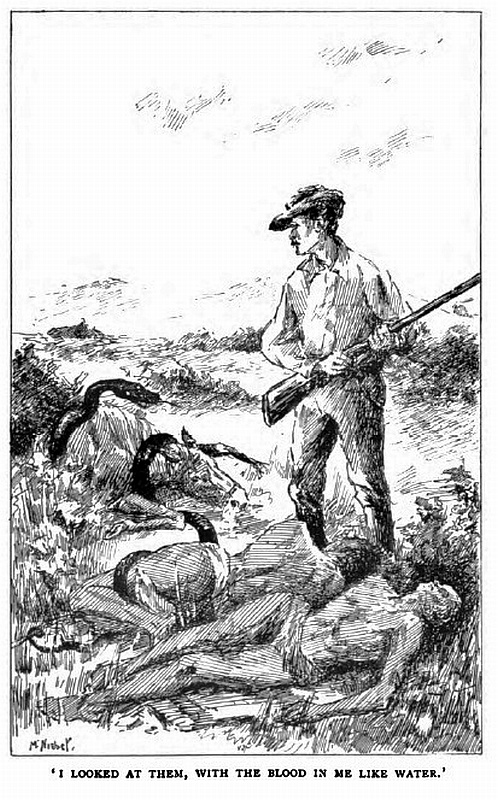
“Of course, I wasn’t swallering that, but when I told my traveller the sweat gathered in big drops on his forehead, and the old hunted look came into his face. ‘You don’t believe this silly yarn?’ says I, placing my hand on his shoulder. ‘Believe it, man!’ he said. ‘Good heavens! that snake is after me.’ ‘After you,’ says I. ‘Yes,’ says he, making an effort to swallow something. ‘It has chased me up and down over a thousand miles for two months.’ ‘Nonsense!’ I said; ‘you’re nervous and fanciful.’ ‘Listen,’ he said. ‘Two months ago I was hunting in the Zulu country, and one day, ten miles away from my camp, I shot a mamba. I took the body back with me to skin it; but when the two blacks I had with me saw it, they cried out to me to take it away, or the mamba’s mate would come in the night. I left them sleeping by the fire, and the next morning they were still sleeping—ay, they were sleeping the last sleep, for the mamba had been in the night.’
“As I looked at them, with the blood in me like water, I heard a heavy breathing, and saw my horse on the ground, his eyes glazed and his nostrils fighting for breath, while, resting on his body, was the awful head of a mamba, his eyes fixed on mine, and his forked tongue darting in and out. I fired at him with the rifle barrel, but clean missed in my flurry; then I ran until my courage came back. I found that I had left the powder behind, and slowly turned back. I had not gone a hundred paces when I met him on my track, slipping like a black streak through the grass, and I thought of nothing then but escape. After a time I met a party of Zulus, but when I asked for their assistance, they fled with loud cries of alarm, and at a Zulu kraal, where I stopped to ask for thick milk, they drove me out when they learnt why it was I fled. That night as I slept that snake coiled by my side.
“‘What!’
“‘Yes; he could have struck me then, but he preferred to have full vengeance. I woke at the flicker of his tongue on my cheek, thinking it was a fly—a fly! good Lord! and my hand fell upon his cold, sinewy folds, and his head was resting on my shoulder. Ever since he has been after me, with a deadly hate that is slowly driving me mad. Sometimes he disappears, but I never escape from the glint of his unwinking eyes, and one day he will strike, unless—unless—’
“‘Well?’ said I, looking at his drawn face.
“‘Unless,’ he said, ‘I forestall him.’
“‘No my lad,’ said I, ‘for that would be a sin, and when you are stronger this dream of yours will go.’
“He looked so fallen in, so weak, all of a sudden, that I took him for a walk to the river, and the rush of the waters seemed to comfort him. He sat on a big boulder looking across, and the whiteness presently went from his cheeks.
“‘I’ve got an idea,’ he said, ‘if I could reach the other side I’d be all right again.’
“We sat there in a sort of a dream for an hour or two, when I happened to look round, and right there on the flat of the ground was stretched out the biggest and the ugliest snake I ever saw, black as night, with a great vicious diamond-shaped head, and a pair of eyes that glowed all colours. He looked as if he’d travelled; his scales, instead of being glossy, were dull with scratches here and there, and his skin had a sort of bagginess as if he hadn’t eaten for weeks. As soon as he saw me turn he raised his head about five feet from the ground, and from his eyes there shot a look that jest kept me fixed like a stone. Then that poor young feller on the stone began to speak again, in a soft way, of the river and its journey to the sea.
“‘I wish,’ he said, ‘I could look on the sea again.’ Then I heard him move, and I knew he was looking into the eyes of his enemy, for that snake began to sway his head to and fro, to and fro, while his tail went twisting in and out, sending his body nearer and nearer. Suddenly there was a shriek, and a splash, and the snake went by me—streamed over the rock into the water, and when I leapt to my feet with a yell that startled the whole camp, I saw an arm thrust above the yeller flood, and above the arm the bend of that black snake, his head turned down looking into the water, and a coil of his body round the elbow. Ole Abe Pike has swound away once, and that was the time. Yes; there was his black body gleaming with the water on it, and his head turned towards the face of the enemy—that poor young chap he had follered over three countries for one thousand miles—one thousand English miles.”
“That a true story, Uncle Abe?”
“Ain’t I told it? That’s why I gave up transport riding. I darsn’t go near that Orange River again.”
Chapter Eleven.
How the Melons Disappeared.
I think I have said that Uncle Abe knew everything there was to be known about farming, but he was content with his knowledge and never put it to practical use, unless it was in the growing of water-melons. His melons were the biggest and the sweetest, with the reddest hearts and the smoothest rinds in the district. His patch was on the sunny side of the slope, and when the big glistening globes were coming to fruition, the old chap would sit on the worn sod bank above them and watch them “drinking in the sunshine,” as he said. I went over one morning to collect six melons, previously selected, in exchange for a sack of meal, and found him seated on a bank, the picture of misery.
“What’s the matter, Uncle?”
“A go-hoppin’ ghost’s been around here eating my melons.”
“A what?”
“A spook, and he’s walked off with the very six melons you set your mark against.”
I dismounted, and walked into the melon patch, the old man silently pointing out to me, with the stem of his pipe, the severed stems of my melons.
“They’re gone—you see.”
“Yes,” I answered dryly, “and the man who gathered them used a very clean-cutting knife.”
“What man?”
“Come, Uncle, you have parted with my melons to someone else, and I consider you have behaved shabbily.”
“That’s it—go on. It isn’t enough that my hair should turn white in the loneliness of the dark at the dog-hopping terror that came out of the deep pool down below there, ’midst a fearful groaning in the air and a splashing in the water, but you must turn on me.”
“What became of those melons, you old shuffler?”
“I ain’t had a smoke for six days, and, on top of that, each morning I woke up with an empty pipe to find a melon missing.”
I handed him my pouch, and waited for explanations.
“Yes,” he said, ramming the tobacco down with his little finger; “six days ago when I came over here to watch them melons mopping in the sunshine I saw at once one was gone—and gone, too, without so much as leaving any sign but a straight cut through the stem to show how it went, not a footprint, nor a bruised leaf, nor anything. Yes, that was the smallest of the six; and next morning another was gone, the next biggest, and there was no mark on the ground. I tell you that want of sign made me queer, and when that night I yeard a splashing down there in the pool—and there’s no sound, mind you, that comes so mysterious as the sudden splash of water out of the night—I wondered if the Kaffir’s devil was climbing out of the pool, or if the little brown man, the Tikoloshe, was up to his mischief. There was that splash, loud and sudden, as if the big tail of a monstrous snake had come down smack on the water; then there was a humming all around me in the air. Have you got a match?”
He struck the match on his corduroys, lifting his knee to stretch the breeches taut, and his hollow cheeks nearly met inside as he puffed, then he held the glow of the expiring match before me.
“There was a humming in the air all around me, and my skin tingled all over jes’sif the wind were whipping the sand against my wet body when coming from a sea bathe, and in the centre of that melon patch I seed a spark of fire like that dying match, jes’ one dull spark of fire without any ray from it. That was all. Next morning the third melon was gone—clean gone.”
“Yes; and you ate it.”
“I grow melons—I don’t eat ’em. The next day I set a spring-gun with the string from the fourth melon to the trigger, and in the middle of the night I woke up with a start to the report of the gun and to a long terrible wail, that seemed to come out of the depth of the sky and from the heart of the earth. It just went soughing and sighing and wailing through the house, and round it and over it, so that your eyes would follow it up and down and round, as though there was some living person there screeching. I tell you an ole rooster that was perched on the foot of my bedstead fell down in a dead faint, so that I had to pour a teaspoonful of brandy down his throat.”
“The melon must have given you indigestion.”
“Look here, sonny; if you play any longer on that string you’ll wear it out. In the morning there was one melon left, the spring-gun having blown the fourth one to smithereens—pieces of it being scattered all over the ground—though there was not a fragment of skin or hair or feather to show what sort of thing it was had carried off the fifth melon. There was one left. The biggest of the lot—a great dark-green ball of liquid fire and honey, that would ha’ fetched first prize at any show. I made up my mind to save that one, so I built a kraal round it with stakes driven in a foot deep, and roofed in with saplins, and over all a fence of thorns. And when the dark came on I sat out there with the gun and the bull’s-eye lantern. I tell you I’ve suffered a lot in trying to keep those six melons of yours—and that night there was a stillness in the air that brought out all my sufferings on the stretch like fiddle-strings. It was dead quiet far into the night, with the stars blinking, and the voice of the sea appearing to pass overhead, when of a sudden there came that splash from the pool, loud and startlin’. I stood up to look down into the valley, then I slipped inside.”
“What did you see?”
“See! nothing; but I felt there was something crawling up that hill—and through the air all around there came that humming. Yes, I slipped inside; but on the bank I left that lantern glaring like a great eye over the melon patch. I could not sleep for a melancholy sound in the air, half whistle, half moan; and when I went into the middle room to look out of the window, I’m gummed ef that bull’s-eye lantern wasn’t standing on the table with the slide shut. That very same lantern I’d left all ablaze on the bank—and in the room there was a smell of crabs, a damp, muddy smell, and beyond the window was a smoulderin’ fire—the same dull spark-like point I had seen on the first night.”
“Your pipe is out; do you want another match?”
“A match is not much good without baccy. Thankye, sonny. So I climbed into bed again, or rather—for I’m not ashamed of being afraid—under the bed, and there I was when I yeard the old rooster say good-morning to the sun. The first thing I did was to look at the melon patch, and—what’jer think—”
“Go on, you wretched old fabricator.”
“I seed that last water-melon sliding down the hill.”
“Sliding? Wasn’t it walking?”
“Yes, sliding—not rolling, as you’d expect a round thing to do down a steep like that, but jes’ gently sliding, as though it were resting on a coat. There was nothing by it, nothing at all, and it was the most surprisin’ sight I ever seed to watch that fine melon softly skimming over the grass and dodging all the stones. I was so lost, flabbergasted, unbalanced by this sight that I never saw what was awaiting the melon, down by the pool, until the last thing, when it slid, all of a sudden, into a dark hole. Into a dark hole—a sort of tunnel level with the take-off into the pool—and that hole, that tunnel, sonny, was the throat of the big devil-snake. All in a moment I saw that. The melon disappeared, the jaws of the snake came together, and a column of water shot into the air as he slid back into the pool.”
“So; and that’s where the six melons went?”
“Five, sonny; five—one of ’em was blown to smithereens by the gun. The five of ’em were swallowed by that devil-snake.”
“And how did he cut the stems so clean?”
“That’s where the mystery comes in, sonny. I expect you’ll have to take six of the best that are left, sonny; and I’m going into town next week to get some dynamite to blow the bottom outer that pool. That devil-snake might take it into his head to swallow me one of these fishing nights.”
Chapter Twelve.
Abe Pike and the Big Fish.
The Fish River was “down.” It generally was down, in the sense of being low, but colonial rivers run by contraries—when they are down they are up. There had been a heavy fall of rain “up country,” and the water rushing off the sun-baked surface poured like a flood between the high banks, sweeping, as we afterwards heard, a stone bridge away, and catching in its career a wagon and span of eighteen oxen at a drift which, at the time of crossing, had scarcely water enough to wet the feet. For many a mile the banks of the river are of red soil, and as the flood eats into the banks its waters are stained a dull brick colour, which hue is imparted to the Atlantic itself for miles along the coast as the red waters pour out into the sea, bearing with them a wonderful collection of flotsam in the shape of timber, dead stock, and live reptiles. Of late, railway sleepers formed no small part of the flotsam, and if work was slack we sometimes, when the river was down, spent a sloppy day on the banks fishing for these floating items. On hearing the news I rode off to pick up Uncle Abe, but finding him out, went to a spot on the bank which he particularly favoured, where a wide flat rock stood at the base of a krantz. He was not there, however, and the rock itself was covered by the flood, which reached half-way up the krantz, but it was evident he had been there, for from a cave in the rock, just above the lap of the waters, there issued a thin line of smoke, and on climbing along a ledge I saw signs of his occupation in a skin kaross, a dark lantern, a gun, and a few well-known traps which he always carried with him when after kablejauw, the great hundred pounders which come up as far as this point in the spring tides. Now thoroughly alarmed for his safety, I rode down towards the sea, from which, six miles away, there came the continuous roar and thunder of the surf, and, to my great relief, met him in a bush path, with a full-grown otter on his back, and the water oozing from his top boots and from his clothes, which clung to his lank body.
“Halloa! Uncle; I thought you were drowned.”
“That’s me,” he said, sweeping the water from his eyes; “I’ve been drowned twice over. Got a pipe and baccy? I’m jest perishing for a smoke.”
I saw now that his knuckles were skinned, and that his face was pinched and blue.
“Get up,” I said dismounting.
“Not me. I’d spoil the saddle. Lemme catch hold of the stirrup—so. Now get along quick, for I want to boil this yer soaking of water outer my bones and body.”
We went along, and presently I had a bright fire going in the cave, and the kettle singing, while Abe, stripped of his clothes, sat shivering still in his skin kaross, his eyes fixed on the red torrent, which stretched across for a mile.
A tin beaker of boiling coffee soon brought back the warmth to his body, and when he had my pipe between his teeth he began to talk.
“I believe I’m getting old, sonny; and I’ve lost my fishin’ tackle.”
“Not the kablejauw tackle?”
“Jest that. It’s stood by me, man and boy, for twenty-five years. I’ve waxed it and waxed it, and wired it about the shank, till it were strong enough to haul in a shark, and now it’s gone—all along of this yer flood. I don’t like loosing old things, and the loss of it pains me as tho’ you’d pulled the sinews outer me.”
“How did it happen?”
“Yesterday I came here to fish, and in the afternoon—when the tide crept whispering along the rushes—I cast in from the big rock. ’Twas as quiet as Sunday, with a fringe of bubbles right across the river marking when the tide moved up. On the mud bank, jest below where the big fish would soon be routing up the mud like pigs, there was a blue crane dozing on one leg, with his head bunched between his shoulders; on a dead tree above sat a big black and white kingfisher, with his red beak pointing up, and on the top of the krantz a white-headed eagle was all huddled up. After a smoke, I built up the fire in the cave, then made another cast with the line, for the fish were coming up, and the tide had reached up so high that the crane had to quit. I heaved the lead out about thirty yards, and was drawing her in when there comes a tug, and I was into a steinbrasse. That same moment the eagle started into the air, sailing roun’ and roun’, and letting go screech after screech; and when I looked up at him, surprised at the racket, I yeard a hollow murmur, like an echo that comes from a cave. I knew what it meant.
“’Twas the river comin’ down, and in a hurry I began hauling in that line, when, with a rush that parted the water, a big kablejauw took the steinbrasse, and, with a swirl of his tail, made for mid-stream to bolt his food. I dunno how it happened, but a coil of the line whipped roun’ my leg, and I was yanked on to the broad of my back into the river, with that eagle ’twixt me and the blue sky. That fish pulled me right into the middle, then he paused to take bearings, and when the strain slackened I took a breath, and reached along to get hold of the line. But it was beyond me to slacken the knot without a knife, and I turned over to swim to the rock. ’Twas easy enough till I tautened the line, when the fish made another struggle. ’Twas pull devil, pull saint, and the line wouldn’t break. First he’d gain, then I’d gain; but most of the time we just stuck there—he facing to the sea, me to the rock, and that eagle ripping out up above. And then!”
“Well, Uncle?”
“Lord love you, lad. There were a roar in the air; I seed the tree tops above the bend swaying; then there shot into the air a great tongue of water, and round the corner, from side to side, there came a wall—the face of it curved in, the top hissing in foam, and the sides of it running right up the banks, so high it shut out the valley beyond. I gave a yell, then turned over on my back, with my hands clasped behind my head to protect it from the shock, and the next minute I were scooting down the river for the sea, with that wall howling behind me like a thousand thunders.”
“I don’t understand.”
“That kablejauw did. ’Twas a race between him and the flood, and the way he flashed along showed he’d only been fooling with me before. And the line didn’t break, and overhead there sailed the eagle, with his black wings outspread and his white head looking down at me. We flew so fast that in a few minutes I saw the white lines one above the other, which showed where the waves were breaking, and then with a snap like a pistol-shot, the line snapped. ’Twasn’t my weight that broke it, but a snagged tree, into which, with the way on me, I went feet foremost. No sooner’d I clung to a mud greasy branch than, with a roar like a fallen mountain in my head, the red flood tossed the big tree into the air, and, when we come down, we were in the thick of it—rushing on, at a height of twelve feet above the blue waters of the tide. Phew! how we did go; and in a minute there was the mouth of the river, the big waves solemnly rolling in, and beyond them the heaving blue of the ocean. With a fierce rush, like a live crittur, the flood threw itself at the sea. We just footed it over the small waves, then we cut the top off the first roller, throwing up columns of spray high as the church steeple, and then the fight began. Behind us there was a hundred miles of flood; before us was the tide with the Atlantic at the back, and the sea after the first shock jes’ gave a sort of surly roar, and away back of the outermost breaker I seed a dark line coming along steady and unbroken. ’Twas the last of the seven brothers, of the seven big waves that roll in with the tide at intervals, and it was bigger than all. Nearer it came, dark at the base, with a glistening curve, and a light line along the top. We in the front had made a track for the flood behind. For a little we stopped—then my tree was flung forward, and a red, angry column shot forth to meet the big wave. My! Sonny! The music of that meeting! The two waters coming together would neither give in, and they piled up, and up, and up, until there was built up a wall of water high as a hill, red on my side, blue on the other, and up this wall my tree was forced by the flood behind. Up we went, until we were balanced on the very ridge, with a black gulf on the other side of smooth water. A breath we poised there while the fresh and the salt were straining against each other, then a heaving mass out of the sea swiftly smote the great wall, and we went headlong—the tree and me—into the biggest toss-up you ever see. I dunno why it was I kept a-hold, but I think the weight of the waters jammed me into a cleft branch. Anyhow, the life kept in my body, and when I took a breath, the next minute it was dark, the stars were blazing, and the tree was a-rocking up and down away out on the ocean beyond the fighting whirl-about of river flood and tide. In that one second between the time I went headlong from the curling top of that hill-high wall of water into the roarin’ jumble some hours had gone—the tide had flowed and turned, and the old tree, with me on it, hanging like a withered apple, had floated miles. I must have been drowned over and over, and reg’lar pickled with salt. I tell you it was lonesome out there on the sea—and wet.”
“It was a wonderful escape, Uncle.”
“But it warn’t over. Bymby the tide turned again, and the tree made again for the shore, where the fighting was going on jes’ the same from the roar, and when the sun broke I saw we would strike the mouth of the river again. I dunno, sonny, how it is, but it seemed to me the ole sea was entering into the fight, for there was a sort of rush in the great heaving masses that began to pile in out of the blue, and when I came near the beat of the surf where the sea was all red, the breaker that carried the tree on his round back rose higher and higher, as he swept on until he reached the flood water, when he let the head of him curl and plunge with a force that swept everything away, and in the wall of his foam we were shot right into the river. That’s when I was drowned again; and when I came to I found we were settled in the still centre of a great circle of waters under the left bank, outer the main current. Everything that came into that circle went roun’ and roun’ till it came gently into the centre, to drift up against the big tree. Already there were three goats against the tree, legs up, an’ a sheep were drifting up, while in the circle sailin’ roun’ was a straw hat and a pair of trousers. On the tree there was fifteen snakes—all alive, but sluggish, mostly puff-adders, with some long yeller boomslangs, and three or four ugly looking black snakes that must er come way down 200 miles from the karoo veld. While I was looking at these ugly lodgers coiled round the branch, there was a swirl in the water, and the sheep that were drifting along suddenly went under. ’Twas a shark took him. That made things lively, but when three more sharks come up, and after eating the goats, the straw hat, and the trousers began butting at the tree with their shovel noses, I felt there was a lot of excitement in this world if you only look for it patiently. The rolling of the tree stirred the snakes, and the whole fifteen of them began crawling up. If there’d been two I’d kicked ’em off, but being so many I sot and took ’em. When they had settled down again there was one round my neck, a yeller boomslang, making a very fine collar, there were a pair of black snakes on each of my arms, a brown boomslang round my waist, and no less’n six big puff-adders coiled about my legs. I tell you I kept my mouth shut less one should crawl in by mistake, an’ if my hair hadn’t been so scant and wet it would ha’ stood up straight.”
“That was a tight fix, Uncle.”
“Tight! By gum! The pressure of that six foot o’ collar on my neck tilted my chin up in the air, while the chap above my waist nearly broke my ribs. The worst of it wer’ I was freezing.”
“Freezing! and the sun at 108.”
“That’s so; but fright turns a chap cold, and them snakes were drawing all the remainin’ warmth outer me. And ther’ were those sharks promenadin’ roun’ and roun’ the tree, every now and again givin’ it a lazy shove. Jes’ then the tide turned, and the tree began to move on another cruise. This time I knew it would be all up with me. I couldn’t live through another fight with the surf, and if I moved there was the snakes and the sharks. Soon as the tree moved those snakes woke up and began hissing an’ puffing an’ swaying their heads about, while their eyes got bright and brighter. Suddenly the collar chap crept up over my face and took a twist round my head with the end of his tail in my ear; then one by one the other snakes crawled up over my face, each one of ’em giving me such a look as threatened my life in case I moved. I wondered what they were about, for I couldn’t see, but the pressure on my neck was terrible, when, after the last one had gone, I heard a hiss, a whizz, and a thud. What jer think?”
“I suppose they flew away.”
“They jest piled on top of each other, tail round the other’s neck, till they made a column that would reach the bank; then the topmost one bent forward, and there was a line of snakes from the tree to the bank. A big puff-adder was at the far end, and he hitched his fangs over a tree stump. Right there I spotted my chance. I softly hauled on the line, and drew the tree ashore, when I jumped to the ground and cut.”
“And where did you find the otter?”
“Picked him up, sonny. And to think that I lost my line.”
“That’s a wonderful story, Uncle.”
“Eh! but it’s so. You can see yourself I’m soaked through and through, and if you look out, there’s the river in flood plain enough, and here’s the otter which will make a good weskitt.”
Chapter Thirteen.
The Black Tiger Again.
Abe suffered for several days from an attack of rheumatism in his shoulder, brought on by his immersion in the flood waters, and he applied himself steadily to the manufacture of a wonderful lotion, in which camphorated oil was the main stock, with a dash of turpentine, a strong trace of eucalyptus, and a few drops of the powerful euphorbia juice, together with extracts from sundry potent herbs. When I visited him this concoction was brewing in a pot, the steam from which filled the house with an extremely pungent smell.
“There,” said he, holding up a wooden ladle full of the mixture, “jes’ take a sniff of that. That’s the sort to sift right through you, and yank out rheumatics from the knuckle joints.”
“It certainly is strong.”
“Yes, sonny; but it lacks one thing.”
“What’s that?”
“Jes’ a lump, as big as your fist, of fat from a tiger’s inside.”
“Is that so?”
“’Tw’d give substance to it; bind all these yer scents together, and make ’em settle down to their work instead of fighting against each other. This euphorby juice is mighty cantankerous, and is given to blisterin’ unless it’s toned down by tiger fat.”
“Well, Uncle, that black tiger is still alive.”
“Hum! I don’t know that the black tiger is good for this purpose. What do you say?”
“I know nothing about it; but, if any tiger is good, I should say a black tiger, by reason of his greater strength, should suit best, and, if you remember, you said you had a plan for trapping him. I believe he’s still in the big kloof.”
“Yes, he’s there. That ole man baboon’s been aroun’ here, and maybe he’s got some notion of showing me where the black fellow takes his snooze. I’ll jes’ think over it.”
“If you want any help I can bring along some dogs and a couple of guns?”
“Dogs, eh! Seems to me that tiger’s too smart for dogs. He chawed up one of yours. I don’t want no dogs, sonny, and if this tiger is to be downed, he’s got to be downed by cunning. You leave him to me.”
After the lapse of a week I rode over to see how the old man had succeeded, and found him peacefully employed boiling down wax berries for the manufacture of candles for his own lighting—the rheumatism, apparently, having been vanquished.
“Hallo! Abe,” I said, taking a look round the room, “where’s the tiger skin?”
“I speck it’s on the tiger.”
“So your plan didn’t succeed?” Abe solemnly skimmed a ladle full of melted wax from the water, and poured it into a bamboo mould.
“Berries is terrible skerce this season. Time was when a body could gather a bagful in a day from the bushes above the beach; but now—lor’, everything’s different now. This very earth’s agoing downhill—it’s getting played out.”
“Are you mixing any tiger fat with that wax, Uncle, to bind it?”
“Maybe goose fat would be better, sonny; have you got any to spare?”
“That tiger must be a cunning beast if he’s got the better of you, Uncle!”
He shook his head gravely. “He’s no tiger. He’s jes’ a ole witch prowling aroun’, that’s what he is.”
“Eh?”
“Yes. You believe me, that’s what ole Black Sam is. I worked out a plan to catch him, supposin’ I could find where he put up in the daytime, and what path he took on setting out in the night, for you know these critturs in the woods don’t go along anyhow, but follow paths jes’ as you or me would, and some of these paths they’re more fond of than others. Well, I kep’ watch on that ole man baboon, and when I see him strolling along outside the kloof I up and follered him. He knew, bless you, what I was after, and the way he led me into the dark of that kloof was a caution; so silent he went, and so careful to take the proper track. Bymby he stopped and pointed—yes, pointed with his finger at the ground—then he jumped for a bough, and there he sat grinning an’ working his eyebrows. Well, blow me, ef there wer’n’t a spoor of the tiger where he pointed, and squinting along through the underbush I see a clean walk which the tiger had made—the sides of the trees worn smooth and the ground jes’ trodden down. That was enough. So I went home and made a pill of meat, with enough poison in it to kill a museum full of stuffed critturs. Nex’ morning I went down, and if that baboon hadn’t a almost stopped me by force I’d a run bang into that tiger.”
“Was he dead?”
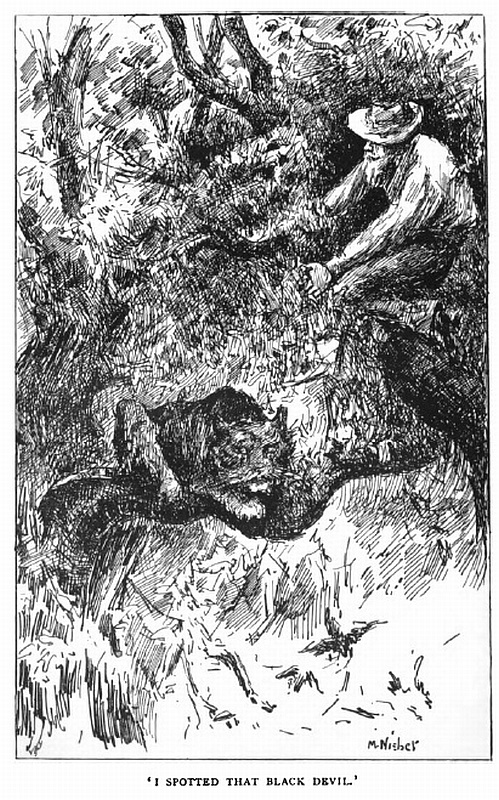
“Dead! Thunderation! he was jes’ lying full-stretched for a spring from a tree branch jes’ above where I laid that pill, awaiting for me to come along. The baboon jes’ invited me to climb a tree, and looking through the leaves, I spotted that black devil, with his tail a-switching and a-jerking. I jes’ climbed down, and slipped off like a shadder, with my heart in my boots. Well, I did some thinking. You know cats is fond of certain smells, so is dogs—only dogs is not so dainty as cats. It’s jes’ the same with a tiger, and he’s got a nose for a partickler herb which he rubs his head into. I dug up one of these year herbs, and I fixed it up fine, jes’ over the spring of a big man trap. Then, it being near dusk, I climbed into a yeller wood, and waited for Black Sam to walk up and put his foot into the jaws of that trap; but the dark came before he did, and then I wasn’t going to trust myself in the wood—so there I stuck, with the stiffness in all my bones, till the morning. By gum! it were skeery work, sittin’ up there with the wind moaning over the tree, and sounds of creeping things all aroun’. Then, blame me! the first thing I clapped eyes on in the morning was that black crittur standing there in the path, staring at that scent bush ’sif it were somethin’ to be suspicious about instead of a nice smellin’ bottle. There he stood like a dark shadder, working his nose for maybe half an hour, when he walked all around, finally sitting down on his tail with a pucker between his eyes jes’sif he were thinking. Yes, he sat there working his brain; then up he stood, looked about for a spell—then, I’m hanged, if he didn’t pick up a dry stick in his mouth and poke it at that bush.”
“What’s that?”
“Yes, sir. He jes’ sprung the trap. Of course, soon’s he poked the bush the spring give, and the jaws flew together with a snap that bit clean through the stick. Then that there witch reached for the bush with his claw, and fetched a grin that spread all over his face like a gash in a water-melon. Then he smelt that trap all over and began to switch his tail, and with a growl in his stummick off he went slinking on my trail, taking long strides with his ears flattened. Luckily he went on the long trail leading from the house, and soon’s he’d gone I lit out for the top of the krantz, where I could see the veld right up to my door.”
“Well?”
“Well, after a time, I saw him crossing the veld, making himself small when he was on the level, and running when he got in a holler. Right up near the house he went and hid himself in a clump of wild cotton, waiting and watching for me to come out o’ the door. I tell you he stopped there till the sun was right over head, then suddenly he ran right up to the house and looked in at the winder. I never was so glad at being not at home to a visitor. He walked all round the house and got on the roof; then he came back, full lick, having made up his mind I was in the kloof. Yes, then I made a bee line for home, and shut myself in.”
“And that ends it?”
“No, sonny, it’s the beginning of the chapter. He’s jes’ scheming to get me; but the ole baboon’s on the watch and maybe I’ll have the black skin yet.”
Chapter Fourteen.
Buffalo Bull and the Shorthorn.
In one of the kloofs near the Fish River, an old buffalo bull had taken up his quarters, and, like all solitary males, he was suspicious and savage.
“And I don’t wonder at it,” said Abe Pike, when discussing the bull’s points. “Trouble sours the best of us, and he’s had his share of trouble—what with his struggles as a youngster to get a footing in the herd, and his struggles, when he became leader, to guard his position against enemies without in the shape of tigers and hunters, an’ against enemies within in the shape of younger bulls, not to speak of the jealousy of his wives; and then on top of all this, the trouble of being driven from the family when his powers were failing, maybe by a own son of his. Yes, sir, that lonely animile, for all he’s so savage, an’ a’most knocked the life outer me, has my sympathy in his proud old age. Proud he is, you believe me. He might a stayed with the herd ef so be he choose to behave himself and foller with the calves, but once a king always a king. Ef he can’t rule in the herd, he’ll rule all alone in that kloof—nursing his pride and his memories—and going scatter—dash—on sight for any critters mad enough to enter his domain.”
“Did you run against him, Uncle?”
“Well—I’d put it the other way—that he run against me. I tole you often how he fit and killed my rooi bonte bull, Red Prince, that old red and white chap with a cross of shorthorn that was so masterful you couldn’t keep him in any kraal if he wanted to move out I’ve seen him fix his horns under a heavy pole that took two men to place across the gate, and jest hoist it as tho’ it were a straw, and if he set out to go into the mealie patch why he’d go in, an’ there was an end of it, bellowing all the time fit to drown the roar of the sea.”
“Did the old solitary kill your bull?”
“You know that, sonny, for you saw his body with the rip that went to his heart. I yeared ole Prince bellow one morning, and, lookin’ over the veld, I saw him away off yonder on the ridge slowly moving, with his big head swaying from side to side, and as I watched him he would, every now and again, stop to paw the ground and toss his horns. I thought, maybe, there was some stray cattle beyond, and I set off after him with the sjambok. After he topped the ridge I could still hear the rumble of his challenge, and when I reached the divide there he was down below raking up the earth with his hoof, but there was no sign of a horn or hide beside him. I ran down to him, and at the sound of my running he turned his head, showing the red of his eyes. He blew through his nostrils at me, and he looked that wicked that I dodged away behind a big rock, and soon’s I peeped out I saw he was looking at the kloof with his ears pricked forward. So I scanned the edge of the wood, which was about fifty paces off, and there, poking out of the shadows, was the head of that buffel, his black muzzle held high, and the sharp curved tips of his horns showing above the great mass of bone on his forehead. The foam was dripping from his muzzle. I saw, then, that red crittur of mine had got the scent of the buffel, and here he had come to do battle out of the love of a fight. I called to the old fool to come back, but, with another dig of his hoof and a shake of his head, he went forward with that slow, steady stride of a crittur that knows no fear. From the wood there came a menacing growl, and at the hoarse rumble of it the red bull sunk his crest and let out a beller that went rolling over the kloof. Then the old solitary stepped out, big and black, with white scars showing on his shoulders and his head held high and threatenin’. There the two of them stood face to face with twenty yards between, their ears twitching and the tails jerking against their sides, Red Prince looking heavier with a mightier neck, the crest arching like the neck of a horse, and the dewlap hanging down between his wide knees. Bigger and stronger he looked than the buffel, but my heart went weak within me for him when I saw the wild gleam of the buffel eyes, and dwelt on the pile of rugged bone that spanned his forehead. Slowly they walked up to each other, muttering deep threats, then their horns clashed, and their foreheads were pressed closer and closer to the strain of heaving quarters. A minute they stood so, the breathing coming heavily, so that the dust below was blown about—then my old red chap turned the buffalo right round, and with a snort and a sidelong blow, he ripped a long red streak in the black thigh. The buffel sprang a step aside, then his tail went up over his back, and he rushed forward. Right round on his pins as nimble as a yearling the old red went, and catching the buffel between the forelegs, he heaved him up and sent him with a thud on to his side. If he had only known, poor old chap, he would never have let his enemy reach his feet again, but he curled his nose up and jest stood there watching the black devil gather himself together. The buffel was up—phew—and then, with a savage roar, his eyes gleaming like a tiger’s, he jest leapt at the big red body standing there so proud, and the next moment—’twas done so quick—I saw the blood running from his side. I wept, lad, at the sight. There stood the buffel, with his muzzle up—and the foam dripping from it—watching the red bull, whose legs were planted wide apart to steady himself. While the life was flowing from that terrible wound in his side the old chap shook his head again. So they stood silent, eyeing one another, then Prince lurched forward—dead—and the buffel went up and smelt him, with his back toward me. I had moved round the rock to watch the fight, and as I stood there tremblin’ from the excitement, that old black devil suddenly whipped round, and with a most hair-rising roar, came straight at me. The outer curve of his horn caught me on the shoulder, and sent me spinning till I tripped over a rock, and when he turned I squeezed tight against the shelter of the stone. Then that ole brute came and stood by with his nose a few inches off, and his bloodshot eyes glaring at me, and every minute or so he’d try to chop me with a hoof, or hook me out with his horns. And three times he trotted off to smell the red bull—the which times I’d try to squeeze closer to the rock, and then at the third time he cleared off to the left at a gallop.”
Chapter Fifteen.
The End of the Tiger.
I had been busy all day ‘branding’ the young cattle, and returning hot, dusty, and tired to the house, found Abe Pike comfortably seated in the cane chair, with the veldschoens of his outspread feet resting on the top bar of the verandah rail, and his lined face looking up at the thatched roof, whence came the loud zing of a bluebottle fly caught in the meshes of a spider web. A jar of my Transvaal tobacco was on the ground by his side, and a large jug of buttermilk near it.
“Don’t disturb yourself, Uncle!”
“I’m not agoing to. Mind how you step, else you’ll obset that buttermilk—not that it would matter much, for it ain’t been rightly made. Should ha’ been kep’ in a calabash with a drop of old milk in the bottom, to flavour it with a taste of biled leather and smoke that belongs to the proper article. But all the old arts is dying out, and insects and beasts is the only critturs that keep up the old customs. Conservatism is a law of nature—among men who have broken away from nature it’s a blind, unreasonin’ protest against change. Conservatism is the preserving wisdom of the aged, the salt of experience, and change is born of the rashness of youth. I’m a Conservative—I’m old. I should be presarved for the edification and guidance of the young. Give me the buttermilk.”
As he would not move, I tilted his chair over by kicking the legs away, and passed over his recumbent body to the bedroom. After a wash down I found him still outspread on the ground, his long legs hooked over the chair, and his head resting on his arm, while the glow of his pipe showed that he was still calmly smoking.
“What’s brought you over here, Uncle?”
“Well, I ’spect I walked. Have you ever observed, sonny, that the human body is so built that it will fit itself to any position? This is comfortable and the tobacco is fair to middlin’, fair to middlin’, with a touch of sulphur in it.”
I sat down on the stone steps to listen to the most delightful of all sounds—those made by the domestic animals and birds settling to rest; while from the deep black of the sky the stars shot out with a sudden blaze, and the cool night wind came softly whispering through the acacias.
Uncle Abe gathered himself up, and bunched upon the rail, his back bent like a sickle to keep his balance. “What’s acrost over yonder?” he said.
“My boundary ridge.”
“Your boundary ridge! An’ a euphorby tree, and a sprinkling of white thorn acacias, with the gum drops glistenin’ on the rough bark, and a few grey stones all covered with moss and a stretch of grey veld. Go ’long; there’s more than that under the curtain of the dark, for if there weren’t why would you an’ me sit here and look away off, an’ look an’ look, as ef behind the curtain was all the mysteries of the unknown world. The dark makes a wonderful difference.”
“So it does—when you’re five miles from home and hear the ‘gurr’ of a tiger.”
“Sonny, I’ve downed that black tiger.”
“You have!”
“That’s so. Ole Abe Pike has come out on top—and soon’s I skinned him I lit out to tell you the news. You see it was my wits against his. Traps was no good, so I determined to set my skin against his and trust to the ole gun. I calculated to tackle him right close up to his lair.”
“In the kloof?”
“Eweh! in the dark of the big kloof, where it’s that still you can hear the sap moving in the trees. You see that crittur was more’n ordinary cunning, and he’d seen how he was feared, so he’d settle it down to a certainty that no man would ever dare tempt death near his sleepin’ place. Therefore, though deadly risky, the best plan would be to go to that very spot. Next thing was to give him a good feed far away—and yet not too far. Ef the kill was too far he wouldn’t come back to his roost, and ef it was too near he wouldn’t eat before returning. So I built a little bush kraal near the kloof an got a brandzickt goat from Ned Amos to turn in.”
“Why not have tied the goat up in the kloof?”
“No good, sonny, with an ’xper’enced tiger. He’d a suspected a plant, ’cos his understanding ’ud tell him that goats don’t grow in kloofs. The kraal he would take as a piece of man’s foolishness. Before this I filed down a whole sixpence, and the filings I melted into a good round bullet, with some clean lead. Two charges I put in behind that bullet, and seed that the powder was well up in the nipple with the shiniest cap well pressed down. Then I killed a stink-cat—I’ll tell you why afterwards. I got the goat down to the kraal an hour before sun-down, and then I slipped into the kloof, treading like a shadder, with the bleat of the old billy buck calling loud. I pulled up, an’ waited till that ole man baboon, who had watched all proceedings, gave me the sign that the Black Sam was on the move. I felt my way on up to his lair under a shelving rock at the foot of the precipice that hems in the kloof on the top side. It was that dark I couldn’t see my hand, and I knew at once my plan would land me with a split throttle if I waited for his coming back. I was that skeered, too, with the whisperin’ in the trees, that I was just making ready to run when I see a firefly dodging around.”
“And you thought it was the tiger’s eye?”
“You wait. I seed a firefly making circles of flame against the blackness—and I cotched him gently—so’s not to spoil his lantern. I fixed him in the bark of a tree that stood near the den—and two others I fixed in line—one above, one below. The top was three feet above the ground, the middle was two and a half, and the bottom one a foot high. Next thing I threw that stink-cat in the den, and the smell of him came out thick, covering up all taint of a man. Then I settled down opposite the tree with the gun fixed on the little spark where I’d fixed the middle fly. I reckoned when the ole chap came home and smelt that cat he’d stand in disgust—and as the smell would strike him just by the tree his body would blot out the flies and give me a mark.”
“And he didn’t come back that way?”
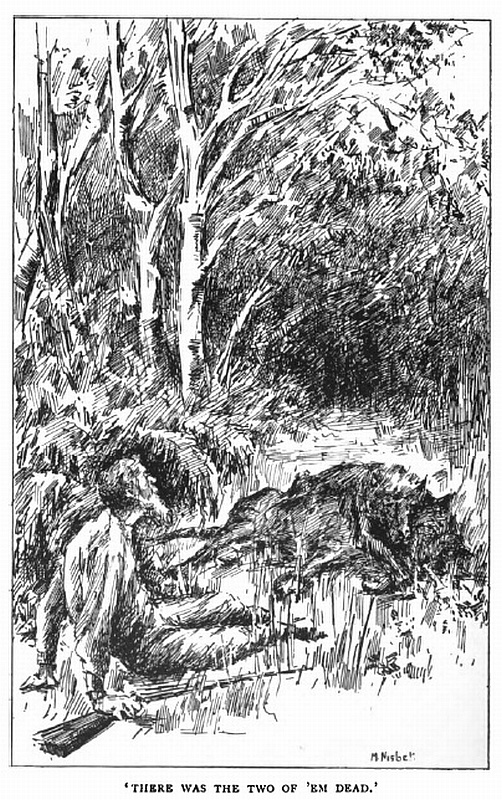
“He did that, as it was the easiest way; but before he came the feeling grew in me that he was just behind watching me where I lay. I tell you, sonny, that long watch in the stillness of the dark, with a drop of water minute by minute falling into a little pool, and a sort of queer stirring noise among the trees, gave me the ague. But he came at last. It may have been three, or two o’clock; but without a sound he was there before me. My eyes had grown tired of watching those three dots of fire, and I’d been shutting them tight for a spell every now and again, and when I opened them the last time I saw the light was there, but altered. I looked away a second, then back, and there was three lights; but two of ’em were close together, and bigger. Jimminy! it was the ole man himself looking at me. I pulled the trigger, and the gun flew outer my hands. Then I rolled over and over, with a roaring, scuffling, and screaming in my ears as ef the gun had woke a whole crowd of devils and brought them howling outer the rocks. I rolled against a tree, and I was up it before I knew where I was, an’ all the time there was that scuffling an’ growlin’ and awful screamin’ going on down below. Bymby it got weaker and weaker, until it died off in gurglings and deep breathing, and by the grey light of the morning there was the two of ’em dead, the black tiger and the ole man baboon. The baboon had got his two long teeth in the big throat, and there he had held while the tiger with his hind claws raked the stomach clean out of him.”
“And where did your bullet strike?”
“It struck the tree, and smashed the top firefly to smithereens. The other two had dropped off.”
“Then you didn’t kill the tiger?”
“I reckon I did; at any rate, I’ve got his skin and the skull of the ole baboon. He was the biggest tiger you ever see, and old as the hills, with his teeth worn down. I’m sorry for the baboon, but I’m glad he was there.”
I have reason to believe that Uncle Abe maligned himself for the sake of the yarn. On examining the tiger’s skin subsequently, I found no traces of the baboon’s teeth, but exactly between the eyes was a bullet-hole. The old man had held his gun straight in the dark kloof.
Chapter Sixteen.
Where the Quails came from.
In the spring the quails come in from the west, and one September morning I went out into the standing oat-crops with two other guns, each one of us attended by a little Kaffir lad to retrieve the birds. By noon we had traversed and re-traversed in line the upper lands and low lands, bagging 98 brace, and then in the glare of the mid-day we took shelter in the shade of a yellow-wood tree. There we argued the ever-recurring theme of the coming of the quail.
In August there is not a quail to all seeming in the land, but suddenly, as the spring advances, there comes from every thicket of grass and square of growing corn on the coast the whistling call of the male bird—‘phee—phe—yew’ calling in bird language, ‘where are you?—where are you?’ and the answering cry of the modest mate—‘phee—phee’—“here—here.” Whence do they come—these thousands of birds that throng along the coast? On that point regularly as September came round, as the 12-bore gun was taken down, and the cartridges filled with Number 6, we talked greatly, setting forth many theories. Silas Topper was of opinion that the quails spent their time in travelling round the continent of Africa in four huge armies, covering 500 miles from front to rear, and that while one was passing along the southern coast, the second army would be going north somewhere above the Zambesi, while the third would be traversing the shores of the Mediterranean, and the fourth skirting of Gold Coast. We all agreed that was a very good theory, and one deserving more credence than the crude, but positive, assertion of Amos Topper that the quail was originally a frog.
“It stands to reason,” Amos would say, “that a quail is developed from a frog. If ’tain’t so, what becomes of all the frogs?—tell me that. Take a caterpillar. A caterpillar comes from an egg, and a cocoon comes from a caterpillar, and a butterfly from a cocoon.”
“But a quail isn’t a butterfly.”
“Chuts! A tadpole comes from an egg, doesn’t it? Well, a frog comes from a tadpole, and a quail comes from a frog. That’s clear enough, ain’t it?”
Then, of course, the argument would start, and this particular September morning we had got well into the frog theory when old Abe Pike came along.
“I don’t mind if I do,” he said, as he sat down and selected a plump bird that Amos had carefully prepared for his own eating. He had opened it out by a cut down the breast bone, laid the broad bare back on the wood coals, and in the cup-like cavities of the breast had placed a pat of butter, with pepper and salt. The juices of the bird had gathered in these cavities, and Amos had just cut off a slice of bread to serve as a plate when old Pike forestalled him.
“That’s my bird,” said Topper, fiercely.
“Just yeard you say ’twas a frog,” grunted Abe, as he dug his knife into the earth to clean it.
“I said it was a frog, but it’s a sure enough bird now—blow you!”
“Go slow, sonny, go slow,” said Abe, between the mouthfuls. “Stick to one thing at a time. Once a frog always a frog.”
“Humph,” said Amos, as he picked out another bird from the heap. “I s’pose you never heard frogs whistling of a night?”
“Well, of course.”
“What do they whistle for, eh, if they’re not fitting themselves for the bird life—tell me that?” And Amos looked at us triumphantly.
“They whistle for the rain, you donderkop.”
“P’raps, then, you can tell us where these birds come from, as you’re so mighty clever.”
“To be sure, sonny, to be sure; they come from the clouds.”
“Oh, thunder!”
“Yes; from the clouds, or maybe higher. I s’pose you yeard of the people of Israel and how they were fed in the wilderness with manna and quail. Where d’you expect those birds came from? Frogs! No; they just dropped from the sky, and they’ve kep’ on droppin’ ever since in the spring.”
“Go along! There’s no people wandering in the wilderness in these days.”
“I seed ’em.”
“The Israelites?”
“No; the quail a-falling out the roof of the world. I’ll tell you how it came about that I diskivered this secret that’s been kep’ locked up all these hundreds of years. I’d been a-fishin’ off the great rock that stands out of the breakers over there yonder by the Kasouga, an’ the spring tide, rolling in with a great heave, made a boilin’ foam ’twixt me an’ the beach. I were fixed there for the night, sure enough; an’ I tell you what, sonny, when a man is brought face to face in the black of the night with the leaping sea, he don’t forget the time. Noise! by gum! You know what it is to be waked all of a sudden out of a sleep a full mile from the sea by the smacking crash of a great wave, and there I was in the very thick of the thunderation, with the big black breakers swishing out of the dark like a movin’ wall, and jus’ leapin’ agin the rock as though they were bent on sweeping it away. The white foam went flying above, drenching me through and through—and it grew so slippery up above on that table size top, that I was obliged to lay full stretched on my back with my heels agin a crack, and my arms outstretched—and my eyes fixed on the stars above whenever I could see them through the flying scud. Even a spring tide turns—and in the darkness before the early morning I could feel the rock under me growing firmer. I was just thinking o’ getting to the shore to dry myself in the white sand when I yeard a queer sound from the sky. There’s just one thing wanting to this yer quail.”
“What’s that?”
“Just a dash of Dop brandy.”
I passed him over the stone demijohn, and we listened to the cluck of the liquor as it poured into the tin komeky.
“Yes; out of the black of the sky there came a sort of sound that goes before a storm; and, boys, it licks me how such a shadder of a noise can come on in advance.”
“It’s the way with shadows,” said Amos, drily.
“Soh! but it’s a queer thing to hear the hum of a wind-storm before the wind comes along; jes’ ’sif th’re messages going ahead to warn critturs and trees to stand firm. Well, I squinted around, and bymby, as the light grew, far above I seed a something movin’, and the noise of its coming grew. ’Twas no bigger’n a umbrella when I fixed it; but it soon spread out, wider and wider, and what was the curiosest, it lengthened out behind like my old concertina. I tell you, I begun to get skeered, for I thought maybe ’twas one o’ them water-spouts. Then the light grew stronger and there was a twinkling from the growing column jes’ if thousands and thousands o’ poplar leaves was stirred by the wind. ‘’Tis alive,’ I said, jumping to my feet, and I scaled down that rock and scooted through the pools, and up over the sand hills to the shelter of the woods. I thought it was one o’ them here sea-serpents.”
“But it was not?”
“No sonny; it was a heaven-high column of quail. That’s what it were.”
“Falling from the moon, eh?”
“When the head of the column reached the ground, which it did, on the beach the whole length just collapsd like a falling tree, and the whole lot were just scattered along the coast in a twinkling.”
Chapter Seventeen.
Abe Pike and the Ghon-ya.
Old Abe had strolled over to my place to see a new Harvester tried on a good crop of wheat. In the previous reaping season I had been left suddenly in the lurch by my Kaffirs, who had silently vanished in the night for other scenes without a word of explanation, or a single regret for the loss they would put me to, and I determined to be prepared in future for such another vagary. Hence the Harvester, which reaped the corn and bound up the sheaves, aided only by one man and a boy. We were just sweeping clear the last square in the small field when Abe came up and hung himself on the fence, with his back bent like a bow, and his toes hitched under the lower wire. There, all bunched up, he eyed the machine in silence.
“Well, Uncle, what do you think of it?” I said, with some pride, as the last sheaf was tossed on one side by the human-like grippers.
He looked at me vacantly, then climbed slowly down, examined the sheaf and the tie, and then took a look all round the country.
“Things is changing,” he said.
“Yes; this is the age of progress and electricity.”
“And snorting steam engines and that there man machine—that thing without a heart, or a stomach, or eyes to see. Where’s the good?”
“It is a labour-saving machine, and enables me to produce more.”
“’Tis all vanity, an’ foolishness, an laziness—that’s what. Laziness and pride,” and the old sinner, who never did a fair day’s work in a month, wore an air of virtuous indignation as he resumed his seat on the fence.
“Things is changing—that’s so; and mankind’s on the down track. Time was when a reaper would take his sickle and harken to the rustlin’ of the yaller corn as he cut his way along, with the smell o’ the yearth in his nostrils, and the sight of all manner o’ living insects below him. And bymby he would straighten his back and look away over the land, or at the shining layers behind, and then he would stoop to it again with the thoughts busy in his mind as bees about a comb concerning the going out of the wheat in waggons an’ trains, an’ ships across the sea to the feeding of the nations. An’ look at this yer cast-iron reaper; what’s it good for but to work for a cast-iron man? That’s what’s the world’s comin’ to, with all the people cast in a mould. I’m gwine home!”
“Nonsense; come back with me and try the new lot of rolled tabak from the Transvaal.”
For all his disgust with the Harvester, Uncle Abe did not mind “riding,” to the house on the driver’s seat; neither was he cast down after supper when he sat out on the stoep. The day’s work was done for man and beast and the great quiet of the evening brooded over the place. There we sat and smoked in silence, until the glow died out of the sky, when the night creatures began to stir, sending forth inquiring notes as if to assure themselves that the time was really at hand for the starting of the wonderful orchestra of the insect band. And, as we listened, there rang out above the shrill drummings and chirpings and whistling, the weird, mournful cry of the “ghon-ya,” calling “ghon-ya!” “ghon-ya!” at regular intervals, until the melancholy of its far-reaching cry stilled the other noisy voices.
Abe stirred uneasily. “There’s the lost sperrit,” he muttered.
“Why, that’s the night locust!”
“Soh; jes’ a locust.”
“Yes, with a transparent drum in place of a body which he blows out when he wishes to make that noise, and rubs his legs upon the drum.”
“How big is this yer drum?”
“About as large as a hen’s egg.”
“So; and with such a small thunder-bag he can send out a noise that booms further than the greatest drum in the British army. Don’t tell me. That’s no insect; it’s a cry that comes from beyond.”
“Beyond where?”
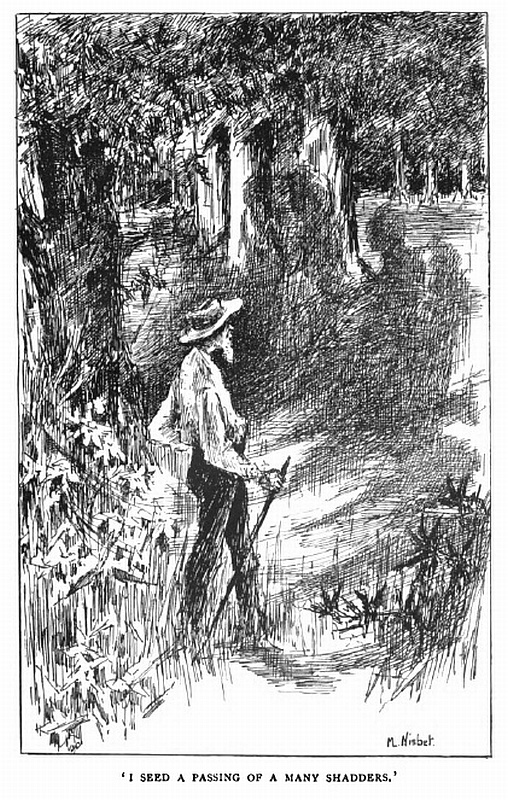
“Beyond the dark. I tell you, sonny, when the ghon-ya cries he ain’t bothering himself about any glass-eyed beetle-hunter who’s just hankering to label all the critturs in this yearth; he’s not thinkin’ about you nor me, but he’s jes’ wailing in that shudderous voice to the shadders that pass by in the night; whether it’s to comfort ’em, or to put ’em on the right track, or to warn ’em of danger, I can’t say. One night I had taken the short cut past the big krantz, being late from the shop where I’d been for a tin of o’ black sugar, and thinkin’ of nothin’ at all when I yeard the ghon-ya’s cry passin’ overhead. There was nothin’ more’n ordinary solemn in the wail of it, but when I came to the thick of the wood it seemed to me there was a queer whisperin’ going on among the trees. Have you ever marked a bee against the shadder? Of course you have, and you’ll know how he moves like a drop o’ light as the sun strikes on his wings against the dark of the hill behind. Well, I happened to look back over my shoulder to the other side of the valley where ’twas as black as black, and in the glance of my eyes, with the blue and red light snapping from ’em as it does sometimes when you blink, in that very moment of turning, I seed a passing of a many shadders.”
“Tree shadows?”
“Shadders of dreams, sonny, I tell you. Jes’ in a flash I seed ’em moving up, and then all was black groups of trees; but I knowed where that whisperin’ come from. Yes, a many shadders hurryin’ on up that valley with the cry of the ‘ghon-ya’ pealin’ out ahead. Well, I got outer that valley pretty quick, and were hurryin’ by the top of the krantz overlooking the big kloof when the ‘ghon-ya’ cried jes’ ahead o’ me. A locust! Lor’, sonny, right afore me there was a something shaddery—a darker patch on the blackness, standing on the brink of the krantz overlooking the deep kloof that lay below stretching towards the sea, and the ‘ghon-ya,’ loud, long, mournful as the solitary toll of the death-bell, went out on the air, an’ I jes’ went to the ground as if the bones had all been drawed out. Looking along the top, with my eyes to the light that was in the sky over the sea, I seed them shadders from the valley file down into the kloof. A many shadders, sonny, come out of the valley—passed by that dark patch, and jes’ floated down into the kloof—whispering as they went. What sort o’ shadders they were I couldn’t tell you, my lad; but they belong, sure enough, to the other world beyond the dark. Many a time I yeard them same things in the kloof, when the dead quiet has been broken by a movement in the air, and a sort o’ creepin’ sound ’sif somethin’ were peepin’ at you from behind a tree. You’ve felt it, too, of course. The dogs they know, ’cos they’re not so cock-sure as we are about knowin’ everything jes’ bekose we can make a cast-iron reaper.”
The ghon-ya from the darkness called again, as if the sorrows of the world were in the cry.
“A locust!” cried Abe scornfully; “that’s no locust. It’s calling the sperits of the woods together, and the ghostses of animiles—that’s what; and that’s why all the other noises is hushed.”
Chapter Eighteen.
Abe Pike and the Kaffir War.
“Were you ever in the wars, Abe?” I asked the old chap on one of my off-days, when I had called on him to go out after rhea-buck.
“Were I ever in the wars? Did I ever grow pumpkins? There’s some fellows go through life asking questions about things that’s as plain as plain—why, blow me, I’ve known ’em ask ef ’twdn’t be a fine day when there’s bin no rain for a month and not a stir o’ wind.”
“So you have been in the wars?”
Grunt.
“I suppose,” said I, unmoved by Abe’s indignation, “you never got into a fix—always kept with the rear column?”
“What, me! Jes’ you look here,” and cocking up his chin, he showed a long scar under his beard. “Assegai!” he said.
“Must have been a close shave!”
“’Twarnt no barber held that wepin I tell you, sonny. No, sir! I jes’ seed the whites of his eyes and the gleam of his teeth, and whizz!—whough!—the assegai darted like a serpent’s tongue. He was painted red, he were!”
“Who?”
“The Kaffir, you blind eyed calabash. It was in Blaauw krantz in ’45. You don’t remember those days, ’cos you weren’t born, but Blaauw krantz were jes’ where it is now, and the red Kaffirs had suddenly got back their old idea they could drive us into the sea. Wonderful how sot they are on getting us into the salt water; and that time they was partikler keen on making us take to the sea without so much as a plank. Of course we knew there was something in the wind. When Kaffirs mean to fight they don’t fire off blank cartridges in the papers; they jes’ keep dark, uncommon dark an’ sulky, but for all that they can’t keep down the human nature that’s in ’em, and they have a way of giving you the shoulder when you order them about that means mischief. When a Kaffir clicks at you with his tongue you don’t want him to tell you in plain words that he’s quaai and would like to belt you over the head. Well, I tell you, you dursen’t order a boy to step a yard but he’d click, an’ some of the chaps with families took the hint and shifted into Grahamstown; but, lor’ bless yer, the Government didn’t take any notice. Oh no; the Government knew the Kaffirs and it knew the whites, and it believed in the Kaffirs. Look here, sonny, Government’s a ass—alus was a ass, and alus will be a ass. Alus so darned cock-sure, and so blamed ignorant that any Kaffir chief could best it every time. You know, sonny, the chief he would jes’ come along—simple an’ humble—and pitch in a yarn about how he loved the ‘great white ox,’ how he wished to herd his cattle in peace, and how thankful he’d be if the great white chief would send him a little white chief to keep the wicked white men from his kraals. All he wanted was peace—since he had listened to the words of wisdom from the Government. Then the chief would say: ‘That is my speech,’ and the Government would up and pat him on the back; an’ when the farmers said the Kaffirs meant to fight, Government would tell ’em they was a passel of fools. Oh, I tell you, Government is vain as a boy in a new weskit, an’ as easily humbugged. Well, about 1845 Government was laced up and smoothed down by the chiefs, with their tongues in their cheeks, and on a sudden the war smoke rose on the frontier.”
“The war smoke!”
“Ay, bossie; the heaven-high columns of smoke going up blue and round in the still air, as a sign to the Kaffirs waiting silently in the bush and the kloofs. At the sign out they came, slipping from the bush paths stealthy as leopards on the trail, and one morning the hill-sides yonder were red, as though the aloes had blossomed.”
“What—with fire?”
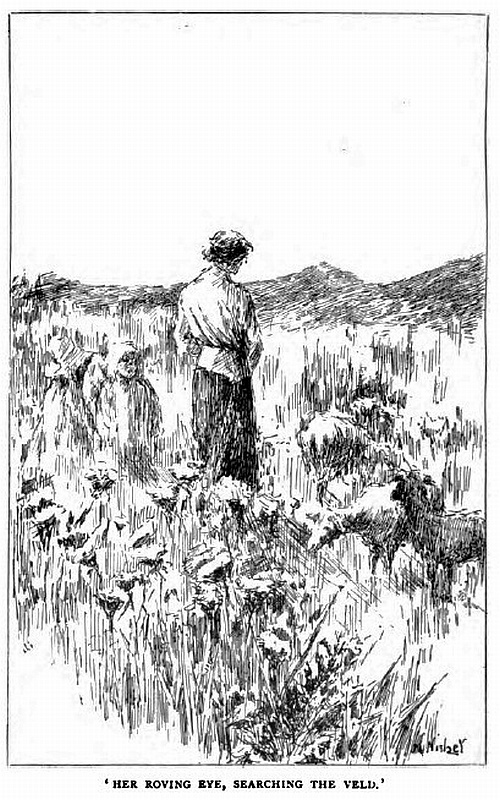
“Neh! karel with red clay smeared thick over the black faces, and with the red blankets carried by the bearers. Then there was in-spanning of horses, hurrying of women after their children, and the trail of dust about each flying cart. The red Kaffirs! Ay, lad! many a mother an’ wife has gone white at times of peace at the sight of a Kaffir in his paint—squatting, maybe, like a tame dog at the back door, waiting for his women-folk in the kitchen to hand him out a bone—for in the smouldering eyes of him she can see the leaping flames of a burning homestead and assegais runnin’ red, and if it’s so in peace what must she feel when her roving eye, searching the veld for the little ones to bid them to breakfast, lights on the far-off streak on the border hills, and when her ear catches a murmur that is not from the sea—the murmur of fighting-men singing of death? The sun was level when it shone upon the red Kaffirs, and when the shadder was close up to my heels in the mid-day the country was empty of whites, except maybe a solitary cuss like me, hating to leave his home, and lurking in the bush close to his belongings.”
“And the cattle?”
“It’s the horned beasts that you think of—well, why not? they’re meat and drink and a roof over your head. A few there were who saved their herds, but the bulk were swept in the net of the robbers. There was not a many human fish caught in that net that time, ’cept old Dave Harkins, an’ his five sons who fell all in one spot by Palmiet Fontein fighting to the last grain o’ powder, and ole Sam Parkes. Poor ole Sam. He found religion, did ole Sam, and many the day I’ve a-harkened to him holdin’ forth on his stoep, where he would sit for the rheumatism kep’ him from moving. Well, ole Sam, when they told him that he must fly, he said, ‘Lift my chair to the stoep. The Kaffirs will not harm me.’ They placed him there with his face to the east, and there the Kaffirs found him. I passed the house the next day, and he was leanin’ back lookin’ so peaceful that I hailed him. But he were dead, sonny, with a gash in his heart. Ay, they struck him as he sat, but they left the house standing and when I peeped in at the window there was the table set with all the chiney in the house. The Kaffirs did that One on ’em had been about a white man’s house, and he showed his friends how the white man prepared his table. A little one’s vanity and the blood dropping from the assegai.”
“What were you doing all this time, Uncle Abe?”
“Shiverin’ and hidin’, sonny; for a party on ’em swooped down on my place led by a thunderin’ ole thief I had once lammed with a sjambok for stealin’ my sugar. There was a fine bedstead in the house and a whole shelf o’ crockery, for I had some idees then of marryin’, and, blow me, if they didn’t smash the lot, besides breaking all the winders and burning the thatched roof. Then they killed an ox, a fine rooi bonte, roasted him whole, and ate him—by gosh. After that they slept with their bellies full! Yes, they did that; slep’ with me a watching ’em from an ant bear hole. I nearly spiflicated ’em, but somehow I didn’t. Then they moved off all but three, including that ole thief, which gathered my cows an heifers an’ calves an’ oxen together, and druv ’em off. ’Twas like partin’ with my heart strings, and I followed ’em up. That evenin’ I druv the lot inter the big kloof.”
“You recaptured them?”
“I s’pose so, sonny!”
“And the three Kaffirs?”
“I speck they ate too much beef, sonny, I speck they did. Any way they died. They did so—and after I had druv the cattle into the kloof I sot off for Grahamstown, passing ole Sam Parkes on the way. I came pretty nigh close to parties o’ Kaffirs, but ’twas when I came to Blaauw krantz that I got the shivers. I were goin’ along mighty keerful, I tell you jes’ ’sif I were ‘still huntin’’ but ne’r a sound o’ a Kaffir I could hear. Well you know one side the road there’s a yellow bank with a bush on the top. I had turned a corner on the listen, with my eyes every way, when I caught the move of a insect, or something like that, on the left. Blow me, sonny, there was a big Kaffir standing agin’ the bank, all naked, but red with clay. What caught my eye was the roll of his eyes, for he were jes’ like a part of the wall. He’d been walking down the road when he must a’ yeard me comin’ for all I went so soft. My! I jes’ give a jerk o’ my head as he launched out with his assegai. Then I gave him a charge o’ buck-shot in the stummick and jumped back inter the bush on the lower side. I yeard a shout from other Kaffirs, and, you b’lieve me, I dodged through the bush like a blue-bok until I got right under the big krantz, where I crep’ inter a cave. I seed then the blood running down, and like a streak I were out o’ that cave inter a pool o’ water until I got under a thick ‘dry-my-throat’ bush where I hid. The Kaffirs they followed on the blood-spoor right up to the cave, but they missed me where I lay in the dark o’ the pool, an’ next evenin’ I were in Grahamstown, where the doctor stitched up the wound.”
“A very close call, Uncle.”
“Oh, I’ve been in many tight places, sonny—a many, an’ maybe I’ll tell you about ’em.”
Chapter Nineteen.
A Black Christmas.
“How is it you never married?” I asked of Abe on an evening after the mealie cobs had been shelled, and we were too dead tired to brush the husks from our hair.
“Me! Well, you see this yer cob. It’s worth nothin’, ’cos all the mealies been shelled off. That’s me—I’m a shelled cob, and wimmen folk isn’t got any use for that sort of bargain.”
“But you told me the other day that you were thinking of marriage once. That time, you know, when the Kaffirs smashed your furniture.”
“Jes’ so—the critturs. They broke a fine four-posted bed and a hull lot o’ chiney.”
“And the lady.”
“You see, bossie, she was gone on that four-poster and the chiney. ’Twasn’t me she was thinkin’ of nohow.”
“Nonsense, Abe; you’re too modest.”
“Well, she forgot me, an’ took up with a armchair an’ a copper kettle which belonged to young Buck Wittal, son to ole Bob. A armchair an’ a shiney kettle, that’s what cut me out, sonny; but Buck went up the gum ’cos she would have a swing lookin’-glass. That’s so! Wimmen is mighty keen on the look o’ things, an’ that kettle fetched her. Them was times!”
“Courting times?”
“Fighting times, sonny; all up an’ down the country, in an’ out the kloofs, an’ over the mountains, by gum. I tole you about that chief—how I spoored him a full forty mile from the Chumie after Black ’Xmas?”
“Black ’Xmas!”
“You mean by that raising o’ the voice you never yeard o’ Black Xmas! Well, well, the ignorance an’ the vanity o’ learnin’ which takes no account of the great happenings in your own country, and you come swaggerin’ about with your Greek turnips.”
“I assure you I never heard of Black ’Xmas.”
“Never yeard of the soldier settlers away up by the Chumie—them as were planted there by Sir Harry Smith—of their wives and children, making merry on Christmas Day, 1850—making merry with the old custom, and the sounds of the laughing going out into the dark kloof, where the Kaffirs crouched, eyeing them as they fingered their assegais. Lor’ love you, lad: when the poor little children were running at their games, and the women were talking over their washing up, and the men at their pipes in the quiet of the afternoon, the war shout broke suddenly from the wood. There was stabbing, and a blaze, a great gasp, and the life went out of them all that Christmas Day. That was Black Xmas—men, and women, and children, and dogs, and every crawlin’ crittur given to the assegai. I were on my way there after stray cattle, and I yeard the cry of a little child, sonny, and the sand went out o’ young Abe Pike that day. I seed it all—yes—lad, and I see it now in the nights, the stabbing of the women and little ones.”
“And what did you do, old man?”
“What did I do? I dunno, sonny—I dunno! I must a walked an’ walked all through the night, for the nex’ morning I were away beyond the Chumie in a deep kloof, without knowing how I came there. Then the cry of the little one went out o’ my ears and out of my eyes with the sight of them leapin’ devils about the burnin’ houses, an’ I saw the rifle in my hand—for ther’ came boomin’ through the trees the sound of a Kaffir singing from his chest. I found him in a clearin’, stampin’ with his feet and swingin’ his kerrie before the chief and his headmen seated all aroun’ against the trees, with their long pipes all agoin’. The blood was still caked on his arms, an’ I plunked him in the breast.”
“You shot him? Good old Abe!”
“It were a ole muzzle-loader—one smooth, one rifle—and I shifted, but it weren’t long afor’ they picked up my spoor, and in the fust rush I could hear the rattle of assegais as they follered. Then it was quiet in the kloof, an’ I knew what a animile must feel when the hunter’s after him, or the tiger’s tracking him down. Bymby I yeard the call of the bush-dove every side, and I gave the call too at a venture, keepin’ my eye on a dark spot where the last cry came from. Sure enough I seed the leaves tremble, and there was a show of red paint where the Kaffir stood. That were the bush-dove, and he called again; then he came steppin’ along to the fern chump where I were hid, movin’ like a shadder with the whites of his eyes showin’ as he glanced around. By gum, lad, I thought it was all over, but another dove called an’ he moved off. I yeard the calls growin’ softer an’ softer, and I made a move to slip away; but there’s no gettin’ to the bottom of a red Kaffir’s cuteness.”
“How is that?”
“Why, sonny; that chap never went off when he made as if he would. He jes’ slipped behind a tree, and when I ris my head out of them ferns he druv his assegai at me, and it clean pinned my left arm to my side. See, here’s the scar;” and the old man rolled back the sleeve of his worn shirt until a white scar was revealed on the fleshy part of the upper arm.
“I fetched a groan, and he sprang out to belt me over the head, but I kep’ my senses, an’ knocked the wind clear outer him with a straight thrust of the muzzle. As he stood gasping, I give him back his own assegai.”
“You killed him?”
“Maybe he died; but Kaffirs is tough, and at the thrust he gave his cry, standin’ there with his legs wide apart, afore he sank among the ferns. I turned an’ ran, keeping down the little stream till I come to a krantz, with the water slidin’ down, an’ I swung over, holdin’ fast to a monkey tow. I slid down fifty feet, and then let go, holdin’ the rifle high over head, and fell feet first inter a little round pool at the bottom. It was a chance, sonny, but I kep’ my bones sound and the powder dry. I did that. I tell you young Abe Pike was some pumpkins. Then I pushed on an’ on till I went over a ridge into another kloof, an’ through that to another kop, standing up above the wood in a mass of stone. I sat down in a cleft, and the weakness came on me from the loss of blood and the want of food. Well, I tell you, sonny, I fit ag’inst the weakness, an’ with a spread of shirt, holdin’ one end in my teeth, I bound up the wound after plugging it with dirt. Right away I looked over the country, an’ I see’d to the right the smoke rising and across a stretch of veld I seed a black patch movin’. ’Twere Kaffirs on the march, an’ following the directshun they were taking, I seed a white speck to the left; a farmhouse, sonny, with a thin trail of smoke going up from the one chimney.”
“The Kaffirs were on their way to sack the place.”
“They were that, and I set off to beat ’em. But look here, I said when I started talking, I was going to tell you how I trekked the Kosa chief, and here I been a’ spinnin’ on about another thing.”
“Did you get to the house first?”
“What—me! I did that, sonny. I got there fust, an’ there was nobody in—not a one though the pot was on the fire. I went off with the pot into a patch of mealies, and when the Kaffirs came up an’ smashed things I were eatin’ pap outer the pot, yes, that’s so.”
“And did they find you?” I ventured after a long pause.
“That pap were good, but it wanted salt—it did that. So long, sonny, so long,” and the old man moved off to bed.
Chapter Twenty.
Tracking the Kosa Chief.
“I tole you all about it, and, what’s more, I ain’t got no time to jaw along when that shed o’ mine wants mendin’,” and Abe resolutely re-filled his pipe, unheeding my request for the completion of his last yarn.
“Leave the shed alone. It will keep—besides, this is resting weather.”
“Sonny, listen to me. Restin’ weather’s been the ruin of this yer country. That so. When a man should span in and plough, when he should take the hoe and skoffel the lands, what does he do? Why up and say at the first touch of the warm wind, that it’s restin’ weather. I can’t stand such laziness, and I ast you, sonny, where’d I been to-day, if I’d taken notice of the weather?”
I glanced round at the neglected lands, at the solitary gum tree, at the old water barrel on its tree sledge, at the tumble-down shed, and shook my head, for there really was nothing to say.
Old Abe followed my look, and then shoved himself back with his heels into a breadth of shade.
“That’s it, my lad,” he said with a queer smile, “cast your eyes round and see what can be done by one man if his heart’s in his work. Forty years agone this yer land were wilderness, and now look at it, with that there shed, them pumpkin lands, and this yer tree standin’ up like the steeple of a church as a token of honest labour.”
“Wonderful!” I said.
“That it are. I watched that old gum grow since it were no higher than my knee. I watered it an’ tended it, an’ measured it by the buttons on my shirt till it topped my head, and now, blow me, you could send a hull regiment with the band in the shadder of it.”
“I suppose you have seen regiments on the march?”
“What, me? Well, now, I was tellin’ you of that time I give the slip to the Kaffirs beyond Chumie and took hiding in the mealie field. Well, that time I came on a regiment in Pluto’s Vale, when a Kaffir poked his assegai in the big drum, and the Colonel he give me a big knife for what I did.”
I said nothing about the shed or the resting weather, and Uncle Abe, sprawling in the shade, went on with his story.
“Yes, sonny, there I were in the mealies, and there were the Kaffirs about the house banging at the windows because there was nobody at home for ’em to kill. They were mostly young bucks, and they all jawed together, ’cept two or three who started singin’ about what big potatoes they was. Well, after knocking around an’ smashin’ things, they set off in a cluster anyhow, on the back trail. And as I watched ’em go, blow me ef one of them in the rear didn’t drop his assegai on puppose. On they went out o’ sight behind the bush, but Abe Pike he jest kep’ where he were. I tell you, Kaffirs is mighty stuck on their assegais, and bymby, sure enough, back came that chap lopin’ along. When he reached the house he shouted out to his friends that it was all right and he’d foller. Well, they gave him the answer back, saying they would go on. He were a young chief this, with an ivory ring round his wrist, and a feather sticking out behind his ear, and as springy on his feet as a young ram. I spotted him well, for I were wondering what his game were, and marked the look in his eyes, and the smooth sweep of his jaws. He picked up his wepin and then he giv’ a sharp look all roun’, and nex’ he went steppin’ roun’ the house with his head bent. I saw it then, sonny. He were lookin’ for spoor, and, by gum, he found it sooner you could snap your fingers. I yeard him give a grunt, and nex’ thing I see him sailin’ along over the veld with his head down on a trail quite away from that taken by his friends.”
“He was spooring the people who had escaped from the house?”
“Don’t jump over a gate when you can open it, bossie. I crep’ out of the mealies and cast round the house; but for all I’d seen where that young Kaffir went it were many minutes afore I saw the spoor—then it were as slight as a brush of a hare’s tail. But there it were—the spoor of a man in veldschoens. You know, there’s no heel to a veldschoen, and it leaves little sign; but this yer chap had a habit of stickin’ his toes into the ground, and here and there he had kicked up a tuft o’ grass. Well, I laid down to that spoor, marking the direction the Kaffir had taken, and went at a trot, thinking all the time it were mighty queer for one Kaffir to leave his friends. When I reached the wood it was easier going, for in the bush path the naked spoor of the chief was plain enough in the dust. The spoor led deeper into the wood, crossed a stream where the white man had drunk, for there was the print of his corduroys where he had knelt, and then climbed a hill, when I went slow. The darkness was coming on, and I reckoned that the chief couldn’t be but a mile ahead. Neither he nor me could spoor in the dark, so I guessed he would pull up, an’ I didn’t want to run in on his assegai. Turnin’ away from the trail I pegged out under a rock until the spreuws whistled before sun-up, when I crept once more on the trail. ’Twere very faint now, but bymby I come on fresh spoor—so fresh I jest squatted behind a tree. Then, after a time, I marked where this new sign entered the path, and follering it back came on the spot where the chief had slept. The beggar had turned back on his trail a matter o’ fifty paces, and if so be I’d follered him in the evening he’d a’ had me sure.”