Front matter
Reading edition
TAKE IT FROM DAD
THE MACMILLAN COMPANY
NEW YORK · BOSTON · CHICAGO · DALLAS ATLANTA · SAN FRANCISCO
MACMILLAN & CO., Limited
LONDON · BOMBAY · CALCUTTA MELBOURNE
THE MACMILLAN CO. OF CANADA, Ltd. TORONTO
Copyright, 1920, By THE MACMILLAN COMPANY
Set up and electrotyped. Published October, 1920.
TAKE IT FROM DAD
Lynn, Mass.
September 25, 19—
Dear Ted:
Your letter asking me if I think you are a failure at school, and wanting to know whether I can give you a job in the factory, came this morning.
"Yes," to the first, and, "I can but I won't" to the second. I didn't send you to Exeter to have you leave in a week; and as for the factory, I guess it can stagger along a couple of years more without you, although I sure do appreciate your wanting to work. It's so different from anything else you have ever wanted, and as Lew Dockstader once said, "Variety is the spice of vaudeville."
Sure, Exeter is a rotten place in the fall, when it rains eight days a week, and there's nothing except soggy leaves and mud everywhere, and a continuously weeping sky that's about as cheerful as the Germans at the peace table. You don't know any one well enough yet to say three words to, and your teachers seem to be playing a continual run of luck, by always calling on you for the part of the lesson you haven't learned.
Sure it's rotten; not Exeter, but what's the matter with you. It begins with an "h" and ends with a "k," but like other diseases, lockjaw excepted, and you'll never have that anyway, it's just as well to catch it young and get it over with.
Then, too, I guess you're beginning to realize that the leader of the Lynn High School Glee Club and left end of the football team isn't so big a frog, after all, when he gets into a puddle with five hundred other boys, most of whom never heard of Lynn.
Your learning this young is a blessing which you don't appreciate now. I had to wait until I took that trip to Binghamton with the Masons. I'd thought till then I was some pumpkins of a shoemaker grinding out eight thousand pairs a day, eleven with two shifts, but when I moseyed through Welt & Toplift's and saw them make fifty thousand pairs without batting an eye, I realized I had been looking at myself through the wrong end of the telescope.
Say, Ted, did I ever tell you about the time your grandfather and grandmother went to the Philadelphia Exposition and left me at Uncle Nate's?
You never saw Uncle Nate; but I don't know as you need feel peeved about it. Anyway, Uncle Nate had whiskers like a Bolshevik, and catarrh. He was a powerful conscientious man, except in a horse dicker, when he shed his religion like a snake does his skin.
Uncle Nate lived over at Epping Four Corners, six miles from our farm, and owing to his judgment of horse flesh he was about as popular there as General Pershing would be at a Red meeting.
I landed at Uncle Nate's at noon, and by six o'clock he had asked me four times if I was a good boy, and I could tell by the look in his eye that he'd ask me that a dozen times more before I went to bed.
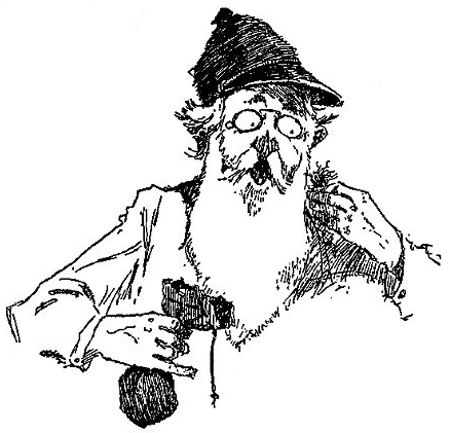
Along about seven it began to grow dark and I began to miss my mother. Uncle Nate sat in a rocking chair in the dining room with his feet on the stove, chewing fine cut and reading a farm journal, and I sat in a small chair with my feet on the floor, reading the "Pruno Almanac" and chewing my fingers.
He said nothing, and I said the same. After a while I got so blame lonesome I stole out on the back steps and stood there wishing I was dead or in jail, or something equally pleasant.
Gosh all hemlock! I was homesick. Then I remembered Sandy, our hired man, was still at the farm. I pointed my nose toward home and skedaddled and, believe me, I went some until I hit the woods just below the intervale, where the wind was soughing through those tall pines like invisible fingers plucking on Old Nick's harp. It sure was the lonesomest place I had ever been in; but the thought of Uncle Nate drove me on until I came to where the old Shaker graveyard runs down close to the road.
I'd forgotten the graveyard until just as I got up to it a white, shapeless figure jumped into the road and ran toward me, waving its arms.
Old Von Kluck did a turning movement before Paris; but he had nothing on me. I turned and, believe me, son, I went back to Uncle Nate's so fast I almost met myself coming away. I slid into the house like a dog that's just come from killing sheep and found the old gentleman asleep in his chair.
When he awoke he said I'd been a good boy not to disturb his nap, and he gave me a nickel, which surprised me so I almost refused it.
After that we were great pals, and I actually hated to leave him when the folks got home.
Cheer up, Ted, you'll like the school better before long, and try learning all your lessons instead of only part; you can fool a lot of teachers that way.
One thing more, don't write any doleful letters to your Ma just now. I'm planning a surprise trip with her to the White Mountains for our twenty-first wedding anniversary, and if you go butting in on her good time I'll tan you good. No, I won't, I'll stop your allowance for a month. That'll hurt worse.
Your affectionate father,
William Soule.
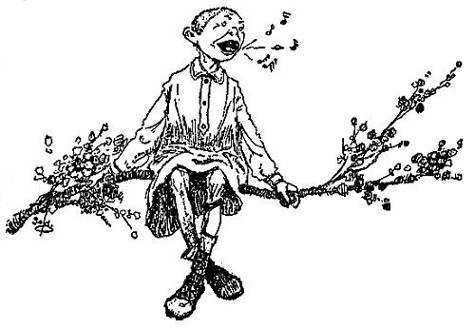
P. S.—I forgot to tell you the ghost I met by the graveyard was a half-wit who had escaped from Danvers in his nightshirt. They caught him the next morning, in a tree on the common, where he sat singing songs, thinking he was a canary.
Lynn, Mass.
September 30, 19—
Dear Ted:
So your roommate is a ham, is he? Well, if he is, you're in luck. Ham is selling for fifty cents a pound in Lynn and is going up.
Time was when ham was looked down upon as the poor man's meat, but now, when there are no poor except professional men and shoe manufacturers, his pigship has come into his own.
Seriously, Ted, I didn't care much for your last letter, it left a taste in my mouth like castor oil. I've got a pretty good idea of the appearance and general make-up of that "ham" of yours, and I'm laying myself a little bit of a lunch at the Touraine next time I'm in Boston, against reading one of your Ma's new books on the Ethical Beliefs of the Brahmins I'm right.
Comes from a small town in Kansas. Never been fifty miles away from home before, and would have taken the next train back after the frigid reception you gave him if he had had the price, and the old folks out there weren't betting on him to make good. Wears half-mast pants, draped with fringe at the bottom, and the sleeves of his coat seem to be racing each other to his elbows, and for general awkwardness he'd make a St. Bernard puppy look as graceful as Irene Castle.
You're at an age now, Ted, when you know so much more than you ever will again, it would be presumptuous for me to offer any advice.
Advice is the most beautiful exponent known of the law of supply and demand. No one wants it, that's why so much of it is always being passed around free. A man will give you a dollar's worth of advice when he'd let you starve for a nickel. But while I think of it, I want to tell you of something that happened at the Academy the year your Uncle Ted was there. That fall there blew into school a rawboned youth from the depths of Aroostook, Maine. He tucked his jean trousers in high cowhide boots, wore red flannel underwear, and spent most of his time stumbling over some one else's feet when he couldn't trip over his own. The school was full, and the only vacant place was the other half of Ted's room, so the faculty planted him there. Ted made him about as welcome as a wood pussy at a lawn party, for at the time he was badly bitten by the society bug and thought a backwoodsman roommate would queer him with the club he wanted to make. For a week Ted was as nasty to his new roomie as possible, hoping he'd get sick of his company and seek other quarters. Apparently Aroostook never noticed a thing. Just went on in his awkward way, and the nastier Ted got, the more quiet he became.
On the night of the president's reception Ted hurried back to his room to dress, filled with pride and prunes. Pride because of a brand-new dress suit he had bought with an unexpected check dad had absent-mindedly sent him, and prunes because supper at the place he boarded consisted mostly of that rare fruit. When Ted opened the door his roommate was greasing his cowhide boots, and wearing an air of general expectancy.
Ted brushed by him into the bedroom, and changed into his dress suit, his mind delightfully full of his lovely raiment and the queen of the town belles he had persuaded to accompany him.
At last, hair slicked and clothes immaculate, he rushed out into the study where his roomie stood, evidently waiting for him.
"Guess I'll walk along with you, Ted, if you don't mind?" Aroostook said. "I cal'late this reception thing is a right smart way to get to know folks."
"In those clothes?" Ted asked with biting sarcasm, delightfully oblivious of the fact that he was wearing evening clothes for the first time. Ted says he hates to remember the look that came into his roommate's eyes at his remark. The sort of a look a friendly pup has when he wags himself to your feet only to receive a kick instead of the expected pat.
His roommate did not reply, and furious at himself for having spoken as he did, and also afraid of the guying he might have to stand for his roommate's appearance, Ted walked silently down the stairs beside him. At the door he shot another venomous arrow by hurrying off in an opposite direction, exclaiming, "Well, you can't go with me anyhow! I'd stay home if I were you. I don't think you'll enjoy yourself."
Basking under the smiles of his fair lady, Ted walked by her side to the reception, pouring into her ears the story of his ridiculous roommate, and she, as heartless a young miss as ever lived, made Ted promise to introduce her so she and her friends might enjoy him at close quarters.
After a few dances Ted spied his victim leaning awkwardly against a pillar in the gym, and looking about as much at ease as a boy who's been eating green apples.
Ted introduced his partner, and in five minutes his roommate was surrounded by a bevy of town beauties. Boys are cruel as young savages, but for sheer, downright, wanton cruelty give me the thoughtless girl of seventeen. That precious crew let him try to dance with them, mocked and guyed him when he stumbled over their feet or stepped on their dresses, and poked so much fun at him that at last he left the hall, his face flaming, and his eyes wet with tears of mortification.
Little beast that Ted was, he took upon himself great credit for his humiliation and acted like a perfect cad for the rest of the evening, starting delighted giggles whenever possible by brilliant remarks about his backwoodsman.
Later, as Ted and his fair companion were walking down Main Street on the way to her home, they met a little rat-eyed "townie" by the name of Dick Cooke whom Ted had thrashed a week before, for trying to steal his coat from a locker in the gym. He made an insulting remark to the girl and started to run. Seeing, as Ted believed, a cheap chance to play the hero, he piled after him. He only went a few feet, then turned and from out of the shadows of one of those old houses, four of his cronies lit into Ted.
Ted went down with a crash, his head hitting the sidewalk so hard he saw stars. Then he heard a shout, "Stick it out, Ted, I'm coming!" There was a rush of heavy feet and spat, spat, spat, came the sound of bare fists landing where they were aimed.
When Ted struggled to his feet his gawky roommate was standing beside him, and the "townies" were tearing down the street as though Old Nick himself were after them.
Ted didn't make a long speech of apology for his meanness to his roommate. It's only in stories a boy does that, but, believe me, he treated him differently.
And, would you believe it, in less than two months Aroostook was wading through the Andover line as if it were so much knitting yarn, and at mid-year Ted was taken into the Plata Dates on the sole recommendation of being his roommate.
A fellow by the name of Burns once said, "Rank is but the guinea's stamp"; now, I don't know much about guineas, but what I do know is that the grain on a side of sole leather don't tell the whole story. It's the sound, clean, close-knit fibers underneath that make it figure right.
Son, there's going to be a place at our Sunday dinner table for that "ham" of yours. Bring him home. I've a notion it's sweet pickle he needs to be cured in, not sour.
Your affectionate father,
William Soule.
Lynn, Mass.
October, 2, 19—
Dear Ted:
You could; but I wouldn't. If you go to the principal and tell him a senior sold you the wall paper in your room, he'd get your money back for you; and you'd get interest with it, not the six per cent kind either; but a guying from the whole school, and probably the nickname of "Wally", that would stick to you closer for the rest of your life than that paper stuck to your wall.
You seemed surprised that any one who talked so nicely and seemed such a likeable, jovial sort of good fellow, would flim-flam you like that. Let me tell you right here, that the easy talkers and jolly good fellows, are the ones you want to watch in business sharper than an old maid watches her neighbors.
The short worded man I'll listen to, for he condenses all he has to say, and is usually worth hearing. But when one of your slick word wrestlers gets by the outer guard, and begins filling my office with clouds of rosy talk of how I'll soon have John D. shining my shoes if I'll only buy goods of him, I slip my wallet into my hip pocket and lean back on it, while I make signs to Mike to clear a path to the door.
Honestly, Ted, I'm glad you bought that wall paper. The male human is so constituted that he has got to make at least one fool investment during his life and it's just as well to get it out of your system early. If I were you, I'd write that six dollars down in my expense book as spent in a worthy cause, for it may save you from some day buying stock in the Panama Canal, or a controlling interest in the Brooklyn Bridge.
Speaking of fool buys, naturally reminds me of the time your Ma and I were boarding with your Aunt Maria over in Saugus. We'd just been married, and I was spending my days bossing the sole leather room in Clough & Spinney's, and my nights in trying to figure how the fellow who said two can live as cheaply as one got his answer.
Your Aunt Maria was a good woman, but so tight she squeaked, and when she let go of a dollar the eagle usually left his tail feathers behind.
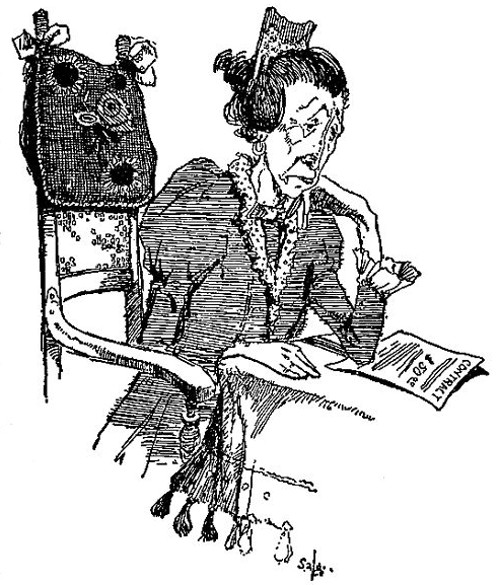
Aunt Maria, in my estimation, was the most unlikely prospect in the whole of Massachusetts, for a book agent, but one day a slick specimen representing, "The Heroines of English Literature," blew into her parlor, and when he left he had fifty dollars, in cash mind you, of her money, and an order for a set of twenty volumes.
The next day, when she had somewhat recovered from the effects of her severe gassing; and had begun to think of that fifty, lost forever, her mouth looked as though she had been eating green persimmons, and she was about as amicable as a former heavy weight champion just after he has lost his title.
For a month we had so many baked bean suppers, your Ma and I began to wonder if she had bought the world's supply, and took to accepting invitations from people we didn't like.
Now Aunt Maria in spite of her closeness, was some punkins in Saugus society. She was president of the Sewing Circle, and a strenuous leader in the Eastern Star, and one Saturday afternoon about six weeks after she had invested in, "The Heroines of English Literature," the Sewing Circle was holding a meeting in her parlor, while I was in the dining room trying to figure out a trip to the Isle of Shoals for your Ma and me.
After they had got through shooting to pieces the reputation of the absent members, and had guzzled their tea, one of the bunch spied "The Heroines" on a little side table where Aunt Maria had installed them upon their arrival. Out of sheer curiosity, the crowd fell upon them with cackles of delight, and to make themselves solid with their president, praised the books to the sky.
Aunt Maria saw a great light; and before her guests left she had sold them enough sets so that the commissions from the publishers more than made up her fifty dollars, and as a special favor to her dearest friend she delivered her own set to her then and there. For a time, after that, "The Heroines" were the most popular reading matter that ever hit Saugus. Popular with the women, I mean, for the men figured Aunt Maria's epidemic of literature cost them a good many new suits of clothes, and the village watch dogs almost went on a strike, because there were so many collectors coming around after partial payments it was hard for a dog to tell whether they were tramps or new members of his family.
Which all goes to prove that even a poor buy may sometimes be turned into a good account. Now you can draw some, Ted, or at least your teacher said you could, when he pried a hundred dollars out of me for pictures to decorate the high school.
I told him you could overdraw your allowance all right, but he insisted you had true technique, whatever that is, so I loosened up.
Why not try a little freehand stuff on your newly acquired wall paper! You might start a fad like Aunt Maria did, that would stamp you as one of the school weisenheimers, and by the way if the boy who sold you the wall paper isn't going to college tell him I'd like to see him some day. I'll need a cub salesman in the Middle West, next summer, and I don't like to see so much natural ability going to waste.
Your affectionate father,
William Soule.
Lynn, Mass.
October 15, 19—
Dear Ted:
There have been farmers and doctors and lawyers and preachers in the Soule family, and, in the old days, I believe we boasted of a pirate and a highwayman or two, but no artists, and I'd rather you didn't break the record.
Am glad though the faculty didn't fire you, for carrying out that fool suggestion of mine of decorating the other boy's wall paper. Fifteen rooms is going some Ted, and the $30.00 you received will come in real handy to pay for new school books, won't it?
After you've been tried here in the factory, to prove whether you can ever be made into a shoe manufacturer, and we decide you can't; I have no objection to your joining the grave diggers union, or driving a garbage cart, but as for your being an artist, you haven't a chance. Your Ma says I am prejudiced against artists because they are temperamental, but so far as I can see the accent must all be on the first part of the word for I never knew one who had brains enough to make a living.
You remember Percy Benson, son of old man Benson who lived on Ocean Street, don't you? Well, Percy was a promising youngster until he began to draw the cover designs of the high school Clarion, although I told his father when he was born that the name Percy was too much of a handicap for any kid to carry successfully. The old man allowed he'd never heard of a shoe manufacturer with that name but said, "The boy's Ma got it out of a book she'd been reading and that settled it." and knowing Mrs. Benson I guess he was right.
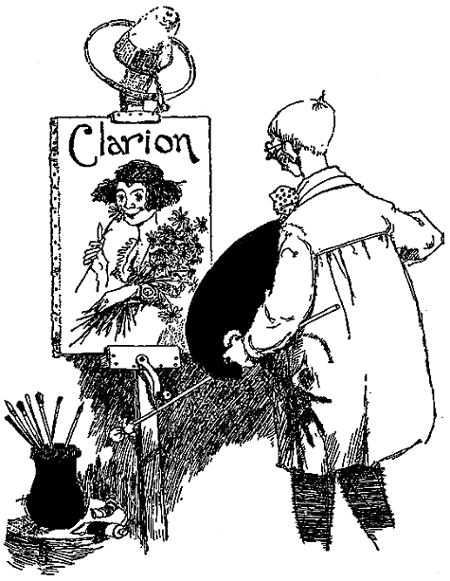
As I was saying, Percy did real well until he started drawing covers for the high school paper. After these had been accepted he swelled up like a pouter pigeon and nothing would do but he must go abroad to study. His father kicked like a steer; but in the end Percy and his mother prevailed, and Lynn lost sight of him for a few years.
For a time, I used to ask the old man how Percy was getting along with his painting, but as he always changed the subject to the leather market, I soon quit. One day after Percy had been gone about three years, I came home early and found your Ma holding a tea fight in the parlor.
After balancing a cup on my knees without spilling more than half of its contents, and getting myself so smeared with the frosting of the cake I was supposed to eat that I'd have given ten dollars for a shower bath, the conversation lulled, and remembering your Ma had told me I never talked enough in society, I asked Mrs. Benson how Percy was doing.
Ted it tickled her most to pieces, and she opened up a barrage of technique, color, fore-shortening, and high lights, winding up with the astonishing fact that one of Percy's pictures had been hung in a saloon.
I was gasping for breath like a marathon runner at the end of the twenty-third mile, but your Ma was all smiles so I thought I must be making a hit.
That's where I went wrong, and while you're about it Ted just paste this in your hat for future reference. When you begin to be pleased with yourself you're in as much danger as a fat boy running tiddelies on early November ice.
As saloon was the only word in the Benson cannonade that I understood, I replied when the bombardment was over.
"Glad to hear it, I'm sure. If the French brewers are paying him for pictures to hang in their saloons, he should be able to paint some snappy clothing ads for American manufacturers before long."
Mrs. Benson choked, gasped, strangled, and grew so red in the face I thought she was going to have apoplexy. Then she bounded out of her chair with one word, "insulting," and made for the door with your Ma one jump behind, imploring her to stay.
When your Ma returned, I learned saloon was the French word for picture gallery, and that my society stock had gone down like an aviator in a nose dive.
About a year later Old Man Benson busted trying to flood the retailers with bronze kid boots, and it was a real honest-to-goodness failure. The old man was wiped out and Percy came home from Paris.
One morning I was over at the Benson's factory along with a bunch of other creditors. The meeting had hardly got under way, when Percy entered in a cloud of cigarette smoke, and with a breath that made me think the French knew what they were about when they called the place at which he had been studying Booze Arts.
No one there had much love for Percy, but we all realized his father was too old to start again and that it was up to Percy to go to work, for from his general appearance it did not look as though the artist business was paying any dividends. So as gently as I could, I suggested he paint the inside of my factory at $25 per. I was pretty sure it was more than he was worth, but I felt sorry for the old man. Did he take it? He did not. He gave me one scornful glance and strode out of the room with the air of an insulted king. Did he go to work? Not much! He married a waitress at the Dairy Lunch who ought to have known better, and to-day she is working in the stitching room at Fair Bros. while Percy spends his days coloring photographs for about ten a week, and his nights preaching revolution at radical meetings.
Forget the artist stuff Ted, and take a second helping of the education they pass around so liberally at Exeter. It can't hurt you any, and who knows but it may do you some good. And by the way if you can spare the time from your studies (and I guess you can if you try real hard) why not play a little football?
Your Ma says she's afraid you'll have your brains knocked out, but I tell her not to worry over the impossible.
Your affectionate father,
William Soule.
Lynn, Mass.
October 21, 19—
Dear Ted:
As I was walking down Market Street to the factory the other afternoon, I overheard two of your old schoolmates refer to me as the father of the Exeter end.
I'm glad you're on the team, and for the next year or two I don't mind being the father of a star end, provided you keep it firmly fixed in your head that it's just as important to keep old Julius Cæsar from slipping around you for twenty-five yards, as it is to keep the Andover quarter from running back kicks.
After you go to work, if anyone refers to me as the father of an end, I'll feel like turning the factory over to the labor unions, because if there is anything that disgusts a live business man it's to see a young fellow in business trying to live on a former athletic reputation. Just you remember, son, that the letter on your sweater fades quickly; but the letters on a degree last through life.
I didn't care much for that part of your last letter where you said you were afraid you were not good enough to hold down a regular job on the team, and I want to go on record right now that if that's the way you feel about it you're dead right. No man ever succeeded without confidence in himself, and it don't hurt any to let others know you have it.
I don't mean boasting. I despise above all else a person who is in love. That is, with himself, but as yet I have never heard of a scientific organization of bushel raisers, so it won't do you a bit of harm to let a little of your light shine forth now and then.
And, Ted, go out on the field every day with the idea that you're better than the average as a football player, and when you get a kick in the ribs or have your wind knocked out, come up with a grin and go back at 'em harder than before.
Play to win, Ted, but play clean. Your coach doesn't tolerate dirty football, and I don't tolerate dirty business. Play nothing except football on the football field, do nothing except study in your class rooms, and when you go to work, work in business hours. If you stick to that prescription you'll come out with a pretty fair batting average at the end of your life.
You say that if you play in the Andover game you'll be up against an opponent who will out-weigh you fifteen pounds. Don't let that worry you. No less a person than the great Lanky Bob said, "The bigger they are the 'arder they fall." All through your life you will be running up against men who are bigger than you physically, mentally, and in a business way, so it's just as well to get used to the fact while you're young.
Your dreading your bigger opponent reminds me of something that happened to me when I was about your age.
In those days the Annual Cattle and Poultry Show held at Epping was quite the event of our social season, and the one thing all the people looked forward to, for months.
This particular year I had been saving my money a nickle here and a dime there, for your grandfather was determined none of his children should grow up to be spendthrifts, and would turn over in his grave if he knew the allowance I give you.
You needn't tell your Ma this, but in those days I was sweet on Alice Hopkins who was the belle of the town, and after much careful planning and skillful maneuvering had wrung an ironclad promise from her to let me escort her to the show, and I was pretty sure she would keep it, for somehow she got wind of the fact that I had all of $10 to spend which was considerably more than any of her other swains had managed to accumulate. My father loaned me his best buggy for the occasion, and I spent the entire afternoon before the great day washing and polishing it, and grooming our bay mare until she shone; and believe me, I was some punkins in my own estimation when I drove up to Alice's house the next morning and she rustled in beside me in a new pink dress.
As we rolled along the river road, the mist rising white from the marshes, the brilliant splashes of color on the sumac and maples, the autumn tang of the crisp September air, and Alice looking prettier each minute at my side, all made my thoughts turn toward a rosy future in which she and I would ride on and on. I was oblivious of the fact that my entire capital consisted of a spavined colt and the ten dollars in my pocket, and that I had about as much chance of gaining my parents' consent to marry, as a German has of being unanimously elected the first president of the League of Nations.
Alice, I found after I had hitched the horse to the rail in the maple grove inside the fair grounds, had no such vague ideas. She had the curiosity of a savage, the digestion of an ostrich, and the greed of a miser. At her prompting we drank pink lemonade, ate frankfurters at every booth, and saw all the side shows, from the bearded lady and the blue monkey to the wild man from Borneo and the marvel who could write with his toes. At times I protested feebly, as my supply of dollars dwindled, but Alice would pout prettily and guide me gently by the elbow to the ticket seller, and then almost before I knew it another quarter had been squandered.
At noon, I remembered the nice box of luncheon my mother had put up for us and which I left under the buggy seat, but Alice tossed her head and marched smack into the dining tent where a sloppy greasy meal was served at a dollar a plate.
I followed meekly, groaning inwardly, for all I had left was three dollars, but trying to console myself with the reflection that after all the candy and popcorn, and frankfurters, and pink lemonade, and with a regular country dinner besides, Alice couldn't eat much in the afternoon and my wallet would get a rest while we watched the races.
On our way over to the track, after dinner, I noticed a group of men and boys clustered about a placard which read, "Wrestling Tournament For Boys Under Eighteen." Now I was the champion wrestler of the village for I was big and strong for my age and quick as a cat, and when we drew near and I saw a prize of $10 was offered to the winner, I felt that there was a chance to retrieve my fallen fortunes and get the necessary wherewithal to feed Alice throughout the afternoon if her inclinations still ran in that direction.
The judges entered me in the second group, the winner of which was to wrestle the winner of the first group for the championship. The second group was composed of boys all of whom I had defeated, and all of whom promptly withdrew when I entered. Two contestants remained in the first group, a great hulking farm boy, Caleb Henry, whom I had beaten the only time we had ever met, but only after a severe struggle on my part, and a little undersized shrimp of a fellow who looked half scared to death and whom I was sure I could lick with one arm.
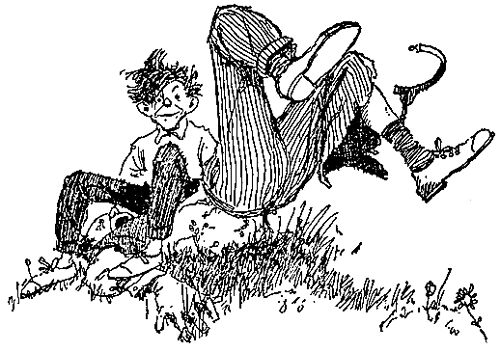
Hoping that by some miracle the little chap might win, for I had no hankering for a severe struggle with Caleb, I escorted Alice over to a seat beside the track and was overjoyed on my return to find my hopes had been fulfilled.
As I threw off my coat and advanced with overflowing confidence toward the little unknown, he looked smaller and more insignificant than ever, and my head was so filled with the thoughts of the heaps of ice cream I could buy for Alice with the $10 prize money that I grappled my antagonist carelessly, and the next minute was giving a very creditable imitation of a pinwheel as I flew through the air lighting on the back of my neck, the little fellow sitting on my chest and pinning my shoulders to the grass.
I spat out a mouthful of dirt and struggled to my feet. One of the legs of my Sunday pants was ripped clear to the knee, and one shirt sleeve was torn off. Again we grappled, and again I was thrown as quickly as before.
Sore with defeat, I pulled on my coat and limped away with the jeers of the crowd echoing in my ears. Alice was not where I had left her, and after a half an hour's search I found her in a booth eating ice cream with Jim Davis, a hated rival who promptly informed me she had promised to ride home with him.
Rats, you know, Ted, leave a ship under certain conditions. Yes, I got a licking from my father when I reached home for spoiling my Sunday suit. A corker it was, too, with a hickory branch.
Oh! I forgot to say the little fellow who threw me so hard was the Champion Lightweight of New England.
Your affectionate father,
William Soule.
Lynn, Mass.
October 26, 19—
Dear Ted:
If you imagine I've been wringing tears out of my handkerchief, and wearing crepe on my hat since I got your last letter, you're as mistaken as the Kaiser was when he started out to lick the world.
To tell the truth, Ted, I had to wipe a number eleven smile off my face when I reached the part about the seniors making you moan like new mown hay.
From the way you have been strutting around Lynn the past few months, I rather expected there was something coming to you, so I wasn't surprised to learn you'd collected it, for things are so arranged in this world that people usually get what is due them, whether it's a million dollars or Charlestown.
Some persons claim hazing is brutal. Maybe some kinds are; but your handwriting seems pretty firm in your last letter, especially in the part where you ask for an extra $10, so I guess you have not suffered any great damage. Personally, I have always maintained that hazing, if not carried too far, is the greatest little head reducer on the market, and it doesn't cost a dollar a bottle, war tax extra, either.
Perhaps it is not in keeping with the lordly dignity of your advanced years, to furnish entertainment for your schoolmates by fighting five rounds with your shadow, or asking your girl to go to a dance over an imaginary telephone. You should remember, however, that your turn will come with the new boys next fall, and you've got a long time ahead in which to think up original stunts.
Every time hazing is mentioned it reminds me of Sammy Smead and the Brothers of Mystery. I can't remember ever having told you about the Brothers, or Sammy either, for that matter, and as I have a few minutes before starting for the 10:30 to Boston, here goes!
Sammy was the son of old Isaac Smead, sole owner of the Eureka Wooden Ware factory in Epping. As old Isaac could smell a dollar farther than a buzzard can a dead cow, and as he had in early life developed a habit of collecting farm mortgages, which in those days were about as easy to pay off as the national debt of Germany, he waxed sleek and prospered mightily, until at the time about which I write, he was not only Epping's wealthiest resident, but also a selectman, pillar in the Second Church, president of the bank, and general grand high mogul of everything.
Sammy was the old man's only child, and knew it. He wore velvet pants: and patent leather shoes in the summer when all the other boys were barefooted; but his most heinous crime as I remembered it, was the round white starched collar he used to wear over the collar of his jacket.
Sammy's mother did what she could to spoil him. At that she didn't have to put in any overtime, for he was about as willing a subject, as could possibly have been found.
Those were the days, when any quantity of fraternal societies were coming into existence, and as Epping was a town where not more than five persons ever agreed on any one subject, it was a mighty good territory for new lodges.
Naturally, with all the men joining the Amalgamated Brotherhood of Clodhoppers, and the order of Husbandmen, and the women scrambling over each other in a bargain counter rush to be charter members of the Sisters of Ceres, we boys thought we had something coming to us in the way of a secret society, so we gathered in Fatty Ferguson's barn one afternoon, and banded ourselves into the Brothers of Mystery. Fatty Ferguson being the proud possessor of a discarded uniform once worn by a member of the Epping Cornet Band, was elected Grand Exalted Ruler, and I was made Keeper of the Sacred Seal, although my chance of doing business, depended on our improbable capture of such an animal, which we planned to keep in Fred Allen's duck pond.
The editor of the Epping Bugle printed some red silk badges for us to pin on our coats, and the Brothers were ready. At first, we attracted considerable attention at school by our badges, elaborate handclasps, and whispered passwords whenever two of the Brothers chanced to meet. As all the boys in our neighbourhood were members, with the exception of Sammy Smead, the novelty soon passed.
Now Sammy had everything we boys had, and a good many things we hadn't, but like everyone else in the world, he wanted what he hadn't which at that particular time, was a full-fledged membership in the Brothers.
Sammy, needless to say, had not been excluded from our select circle by chance, and it is doubtful if he would ever have become a member, if his mother, who was High Priestess of the Sisters of Ceres, had not found out that her darling had been left out in the cold.
She straightway called upon my mother, who having designs on an office on the Executive Board of the Sisters, passed the word along to me that if I wanted a new sled for Christmas, it would be well to see that Sammy was made a Brother.
Sammy being about as popular with the Brothers as sulphur and molasses, I was howled down when I proposed his name at a meeting, until I had a happy thought, that as all the Brothers were charter members, we had had no initiations.
The idea of initiating Sammy, instantly became tremendously popular, and he was duly informed that he had been elected a member, and was told to report at our barn at three o'clock the next afternoon.
Did Sammy show up? He did, velvet pants, patent leather shoes, white collar and all. Only a circus could have kept him away.
We blindfolded him, and put him through a course of sprouts in the barn, including making him ride a pig bareback around the floor, and walk the plank which was a beam above the hay mow, and to which he hung like a cat, squalling and whimpering, until Skinny Mason stepped on his fingers and made him let go.
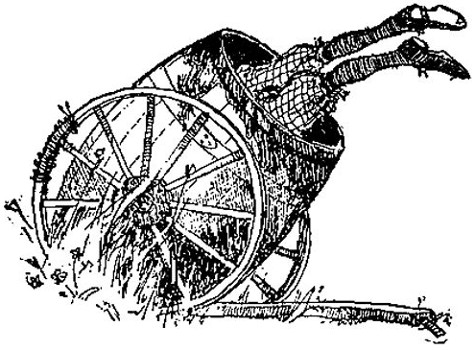
Having exhausted the resources of the barn, we marched him out into the yard planning to hang him by the heels from a tree, when to our delight we discovered a two-wheeled iron barrel of tar, which the workman who had been mending our driveway, had left uncovered when he knocked off for the day.
Instinctively, we marched Sammy up to the tar barrel, and I liberally daubed his hateful and, wonderful to relate, still clean collar with its contents, taking more pains to get it on his collar, than to keep it off his clothes. It was hard work, for the tar was lukewarm and naturally heavy; but I was making a pretty good job of it, when I heard Fred Allen yell, "Look Out!"
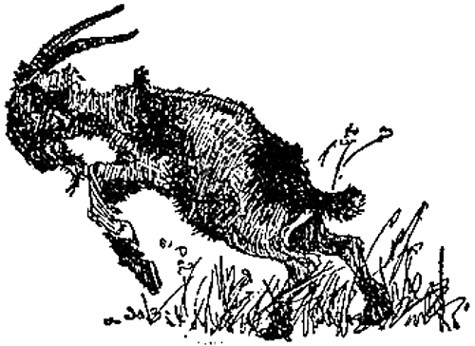
I turned just in time, and saw charging full tilt across the yard my old billy goat. The Brothers scattered in all directions, but Sammy who was blindfolded and did not sense his danger, stood patiently waiting his fate. Billy struck him squarely amidships, and Sammy leaving his feet, described a beautiful curve in the air, and landed head first in the tar barrel, just as his mother, who had been visiting my mother, stepped out on the porch to see how her darling was enjoying himself with his little playmates.
I only mentioned Sammy, to show you that you got off easy. The next time you are called upon to perform, do whatever is asked willingly. There's no fun in making a person do what he wants to do, and if you show no great indignation at doing a few tricks, you'll soon be let alone. Don't try to be funny, if you succeed you will have to give encores, and I take it that is not what you are after.
Your affectionate father,
William Soule.
P. S. I did not get a sled; but I did saw three cords of wood, stove length.
Lynn, Mass.
October 30, 19—
Dear Ted:
Somehow the price of cut soles is worrying me more, just now, than the fact that you have not been elected to one of the school clubs.
I realize that your not making one of the school clubs yet, is a terrible tragedy in your young life; but I feel as though you are going to survive, and perhaps you will be elected to one after all. I've found it a pretty good rule, not to figure a shipment of shoes a total loss even when the jobber writes that he's returning them, and if I were you I wouldn't borrow trouble until it's necessary. Trouble is the easiest thing in the world to borrow, and about the hardest to discount at the bank.
Maybe it's just as well you are having your touch of society chills and fever young, for it may save you from making a bigger fool of yourself later on. No one minds a young fool much, but an old one is about as sad an object as a Louisville distiller attending a Supreme Court decision on the prohibition law.
Society is all right, some of it; but just because you eat dessert at the end of your dinner, is no reason why you should make a meal of it. A little society, like the colic, goes a long way, and you want to remember that a man, like a piece of sole leather, usually figures out to what he is.
Burns, not Frankie the lightweight, but Bobbie who used to edit the Edinborough Daily Blade, back in the days when freshmen wore whiskers and plug hats, hit the nail on the head when he said, "A man's a man, for a' that."
I'll never forget when Aunt Carrie caught the society fever, nor will she. It was a couple of years before I was married, and it didn't make me want to postpone having a home of my own, although it did influence me to choose a girl who was society proof.
After your Grandmother Soule died, Carrie ran our old house and was doing a pretty good job of it, until Algernon Smiley came to Epping as principal of the grammar school. Algernon wore spectacles, a lisp, and long hair, and he could spout more poetry than a gusher well can oil. At that, he was a harmless sort of insect, if the girls of the town hadn't taken him seriously.
Algernon was a graduate of Harvard, and the only thing I ever had against that university. It didn't take him long to discover there was no real society in Epping, and not being at all backward about coming forward when he had anything to say, Carrie and her girl friends soon had the same idea. Now Epping had staggered along over two hundred years without the help of society, and was doing quite well thank you, with its church sociables, bean suppers, and candy pulls, until Algy butted in.
Everything we did was all wrong. "There was no culture," and having the hearty backing of all the girls he set out to culturate us. His first offense was a series of lectures, but after the young men had listened to him rave about the art of Early Egyptian Dancing, and the history of Nothing before Something, they unanimously had previous engagements when Algy sprang a lecture.
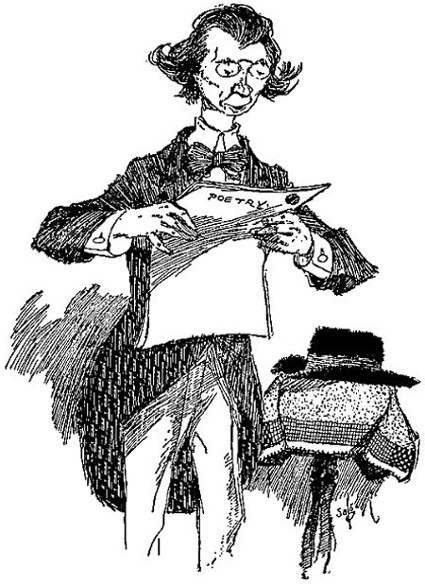
Next Algernon started a Browning Club, which consisted, so near as I could judge, in his reading a poem, and then everyone in the club expressing a different opinion as to what the poem meant. It may be good business for a poet to write a poem no one can understand, but believe me when I buy a rhyme for a street car ad it's got to be one every woman will recognize as advertising "The Princess Shoe."
To get back to Algy, after a while the attendance at the Browning clubs began to get mighty poor, and he had to think up a new scheme to keep the town from getting decultured. Somehow, the little cuss had scraped an acquaintance with some pretty solid men on the Harvard faculty, and he managed to drag several of them up to Epping to deliver lectures, with the result that the culture business began to show a healthy growth. Epping was not stupid, it had been bored.
Now while Algy had been trying to culturate Epping, he'd worn considerable horsehair off the sofa in Farmer Boggs' parlor, sitting up nights with his daughter Ruby. Ruby was a nice cow-like girl, who hadn't much to say and proved it when she talked, and as Algy was never so happy as when he was doing all the talking, he got along with her fine. Then, too, Pa Boggs owned free and clear the best farm in the township, and had $15,000 salted away in Boston and Maine stock, and Algy, for all his culture, wasn't overlooking any bets like those.
Where Algy went wrong, was in patronizing people he thought didn't know as much as he. Whenever old man Boggs juggled beans with his knife, Algy would smile upon him so condescendingly the old man would almost bust with rage; and when Mrs. Boggs said "hain't" he would raise his eyes as though calling upon heaven to forgive her; but what blew the lid off came at a Browning Club meeting that Carrie had insisted upon having at our house.
Algy imported a noted Professor to give a talk on Prehistoric Fish, and when the great man had finished, we all stood around, the girls telling him how much they enjoyed it, and the men wishing he would go, so they could retire to the kitchen and shirt sleeves. Poor Ruby, during a lull in the general conversation, started the old chestnut about Ben Perkins the light keeper at Kittery falling down the light house stairs, ending with, "and you know he had a basket of eggs in one hand, a pitcher of milk in the other, and when he reached the bottom they had turned into an omelette. Ain't spinal stairs awful?"
At the word "spinal" the Professor snickered, and Algy who was always nasty when Ruby made a break, said, "I'm surprised at your ignorance Ruby: you mean spiral."
Ruby began to cry, and everyone looked uncomfortable. I was hopping mad. I guess maybe it was the tight patent leather shoes I had on. Anyway I'd seen about enough of Algy.
"Shut up, you Goat," I snapped at him. "Haven't you brains enough to know she meant the back stairs!"
Algy claimed he was insulted.
I allowed it wasn't possible.
Then he said he was a fool to have tried to culturize Epping.
I said I reckoned his allowing he was a fool, made it unanimous, and invited him out in the yard to settle things, although I never could have hit him, if he had accepted my invitation.
In two weeks Algy left town, and the next fall Ruby married Will Hayes over at George's Mills, and has been happy ever since.
Ted, I wouldn't think too much about those clubs. There's no use worrying about what people think of you; probably they don't. You've only been at Exeter a few weeks, so if I were you I wouldn't jump into the river yet. Now I'll admit it will please me if you are elected to a club, but if you aren't, I'm not going to go around with my head bowed in shame, and neither are you, for ten years from now, no one will be greatly interested whether you belonged to the Belta Pelts or the Plata Dates, and above all things don't toady. Eating dirt never got anyone anything. Look at Russia.
Your affectionate father,
William Soule.
Lynn, Mass.
November 6, 19—
Dear Ted:
I'm glad you've been elected to the Plata Dates, if for no other reason than because now that you have stopped worrying whether you would be, you will have time to worry about your studies. Don't you fool yourself that because E stood for excellent at the high school, I don't know that it stands for Execrable at Exeter. Now you are on the football team, it's better to have an E on your sweater, than on your report.
I thought when you were elected to the Plata Dates, you would be bubbling over with joy, but your letters are about as cheerful as a hearse. The teachers are picking on you, the football coach doesn't recognize your ability, and even the seniors so far ignore your presence, by failing to remove their hats and step into the gutter when you come along.
Whatever you do, don't get sorry for yourself. There's nothing in the world more silly than a person who is sorry for himself, and the ones who are, are always the ones who have no cause to be. Now I don't believe for a minute that the teachers at Exeter have picked you alone, out of five hundred boys, to jump on; they're too busy, and I guess your coach's main idea is to get a team together that can lick Andover, so it might be well, if you are finding people hard to please, to ask yourself if it's their fault.
If you go into your classrooms with only part of your lessons learned, you aren't going to fool your teachers very long, and if you go on to the football field with an air that the coach can't show you anything he's not likely to try. Half knowledge, is the most dangerous thing in the world. I never saw a successful shoe manufacturer who only had half knowledge of making shoes, and I guess Walter Camp isn't putting anyone on his All American, who only knows how to play his position half way.
You might as well make up your mind, Ted, to learn Virgil, from the "Arma virumque cano" thing to Finis. And it's just as well to let the coach think he can show you something about football: he only played three years on the Harvard 'Varsity, and even if you do know more than he, it will make him feel good.
Being sorry for yourself is a bad habit. I had it once for a whole year, and believe me it was the worst year I ever put in, and I'm counting the panic of 1907 too.
I'd been super. over at Clough & Spinney's in Georgetown for three years, and had the little shop running like a high-grade watch, when Henry Larney of Larney Bros. in Salem died and left the whole show to his son Claude. "But in trust" nevertheless, as the wills say, and it's a mighty good thing he did for Claude spent most of his time and all his money at Sheepshead Bay and Saratoga Springs, and couldn't tell a last from a foxing.
Old Josiah Lane was trustee, and having about as much respect for Claude's ability as a shoemaker as I have for the Bolsheviki as business men, he looked around for someone to run the factory and lighted on me.
When I got over being dizzy at the thought of running a five thousand pair factory, I grabbed the job, because I was afraid I'd refuse it if I stopped to consider the responsibility. That's a pretty good plan for you to follow, Ted. Don't let a big job scare you, just lay right into it, and if you keep both feet on the floor and don't rely too much on the bridge to make fancy shots, pretty soon the job begins to shrink, and you begin to grow, and before long you fit.
I had every possible kind of trouble with the factory: a strike that tied us up flat for eight weeks in the middle of the summer, to a fire in the storehouse that destroyed five thousand cases of shoes and every blamed time I was in the midst of a mess, old Josiah Lane would blow in, and blow up. It seemed like the old cuss was always hovering around like a buzzard over a herd of sick cattle, and when he lighted on me I felt as though he went away with chunks of my hide in his skinny fingers.
I was the worst shoemaker in the world, couldn't handle help, was a rotten financial man, had no head for details, and was so poor a buyer, it was a wonder some of the leather companies didn't run me for governor. As for production, he could make more shoes with a kit of cobbler's tools, than I could turn out with the help of the S. M. Co.
That old bird used to sit in the office chewing fine cut, and drawling out sarcastic remarks, until I could have knocked him cold; but even then I realized that a man who made shoes from pegs to welts, knew something, and I needed all the knowledge I could get.
After every bawling out, old Josiah used to creak to his feet, remarking, "I'll give ye another trial though I'm foolish to do it," while I stood by trembling with rage, wishing I wasn't married so I could bust his ugly old head open with a die.
Gosh! I used to get mad for the things that happened weren't my fault. First, I thought how foolish I'd been to leave my soft job at Clough & Spinney's, then, I began to get mad at the factory, myself, and all the daily troubles that were forever piling in on me, and I determined I'd lick that job if it killed me.
I gave more time to listening to old Josiah at my periodical dressing downs, and less time to hating him, and I lived in that old ark of a factory, until I knew every nail in every beam in its dirty ceiling, and could run any machine in it in the dark.
Along in the late fall, the monthly balance sheets began to look less like the treasury statements of the Dominican Republic, but they weren't so promising that there was any danger of J. P. Morgan coming to me for advice on how to make money, and on the 15th of December I wrote out my resignation, and handed it to old Josiah. The old man never even read it. Just tore it up, threw it under the desk, and sat chewing his fine cut, until I thought I'd jump out the window if he didn't say something.
"Want to git through do ye?" he drawled at last.
"I don't want to, I am," I snapped back.
Old Josiah reached in his pocket and handed me a paper. I opened it and nearly fainted. It was a three year contract calling for an annual $1000 increase in salary.
When I hit the earth again, I looked at the old man sitting there wagging his jaws and grinning, but somehow his smile had lost its sarcasm, and he seemed less like one of these gargoyle things that the foreigners hang on the outside of their churches, and more like a shrewd kindly old Yankee shoemaker.
Ted, I learned something that year besides how to run a big shoe factory. I learned that a rip snorting bawling out doesn't necessarily mean your superior thinks you a lightweight: if he couldn't see ability, he wouldn't take the trouble to cuss you. So when your teachers, or the coach, land on you don't think of "Harry Carey", (that isn't right but it's the nearest I can come to Jap for suicide) but if they land on you twice for the same mistake, pick out a nice deep spot in the jungle. If you don't the ivory hunters will get you.
Cheer up Ted crepe is expensive, and when you get blue be glad of the things you haven't got. I will be in Exeter Saturday afternoon. Look for me on the 1:30.
Your affectionate father,
William Soule.
Lynn, Mass.
November 20, 19—
Dear Ted:
I didn't say anything about it when you were home last Sunday, for you were so happy basking in the glory of that thirty-five yard drop-kick that won the Andover game I hadn't the heart to cast any gloom, but honestly Ted, as a deacon in the First Church I don't enjoy walking to service with a son who looks like a combination of an Italian sunset and a rummage sale of Batik draperies.
It's perfectly true that clothes don't make the man, but they help to, and because Joseph wore a coat of many colors and was chosen to rule a nation, is no reason for a young fellow to get himself up like an Irish Comedian at Keith's and expect to do likewise.
Customs have changed a little in the last few thousand years, and although it may still be true that a South Sea Islander may rule the tribe by virtue of being the proud possessor of a plug hat and a red flannel petticoat, it doesn't follow that a passionate pink tie with purple dots, and pea green silk socks with bright yellow clocks, will help you to sell a bill of goods to a hard-headed buyer in Kenosha, Wisconsin.
I don't want to rub it in too hard, for I realize that in boys there's an age for loud clothes, the same as there is in puppies for distemper, and that if given the right treatment they usually survive and are none the worse for their experience.
I won't hire a salesman who wears sporty clothes and carts around a lot of jewelry, for when one of my men is calling on the trade he is not exhibiting the latest styles in haberdashery, but the latest samples of the "Heart of the Hide" line, for I've learned that a buyer whose attention is distracted from the goods in question is a buyer lost.
All this reminds me of an experience I had when I was in my first and only year at Epping Academy. The Academy was really a high school although I believe my father did pay $10 a year for my tuition, and the teachers were called professors.
Well anyhow, at that time my one ambition in life was to own a real tailor-made suit, vivid color and design preferred.
Now buying my clothes had always been a simple matter, for when I needed a new suit which in my father's estimation was about once in two years, my mother and I drove over to the "Golden Bee Emporium: Boots & Shoes, Fancy Goods & Notions" at Bristol Centre, where, after much testing for wool between thumb and finger, and with the aid of lighted matches, and in direct opposition to my earnest request for brighter colors, I was always fitted out in a dark gray, or blue, or brown, ready made, and three sizes too large so I could grow into it.
One afternoon on my way home from school, I stopped in at the Mansion House, to see if I could persuade Cy Clark, the clerk, to go fishing on the following Saturday. As I entered the door an array of tailors' samples, on a table by a front window, caught my eye. All thoughts of Cy promptly left my mind as I let my eyes feast longingly upon their checks and plaids and stripes.
The salesman, seeing that his wares had me running in a circle, assured me that the Prince of Wales had a morning suit exactly like one of his particularly violent black and white checks and that Governor Harrison had just ordered three green and red plaids.
The salesman informed me that $25 was the regular price but as a special favor I could buy at $20. Now I had $18 at home which I had earned that summer picking berries and doing chores, and finally protesting so violently I was sure he was going to weep, the drummer gave in and I raced home, broke open my china orange bank, and was back at the hotel having my measurements taken inside of ten minutes, for I was mortally afraid some one else would snap up the prize in my absence.
For the next three weeks I hung around the express office so much that old Hi Monroe threatened to lick me if I didn't keep away and not pester him.
Finally my suit came.
To tell the truth, I was somewhat startled, when I opened the box, for although the sample was pretty noticeable, the effect of the cloth made up in a suit was wonderful. From a background of stripes and checks of different colors, little knobs of brilliant purple, yellow, red, blue, and green broke out like measles on a boy's face, and I felt that maybe after all I had been a little hasty in my choice.
But when I tried the suit on, and gazed at myself in the mirror, my confidence returned, and I felt I had the one suit in town that would make people sit up and take notice. I was right.
I entered the dining room that evening just as my father was raising his saucer of tea to his lips.
"Good heavens!" he cried, spilling the tea in seven different directions.
"Why William, what have you got on?" my mother asked.
My brother Ted answered for her, "A rug."
Do you know Ted, blamed if that suit didn't look like a rug, an oriental one made in Connecticut, and your Uncle called the turn, although I never forgave him for it. That's why I named you after him.
At first, my father vowed no son of his was going to wear play actor's clothes around the village, but when he heard I had paid $18 for the suit, he changed his mind and said he wouldn't buy me another until it was worn out.
Your Uncle Ted made a lot of cheap remarks about rugs, which I put down to jealousy, and general soreheadedness, because I had made him pay me the day before, a dollar he owed me for six months. Even Grandma Haskins vowed it looked more like a crazy quilt than a suit of clothes, and I was feeling pretty blue until my mother made them lay off.
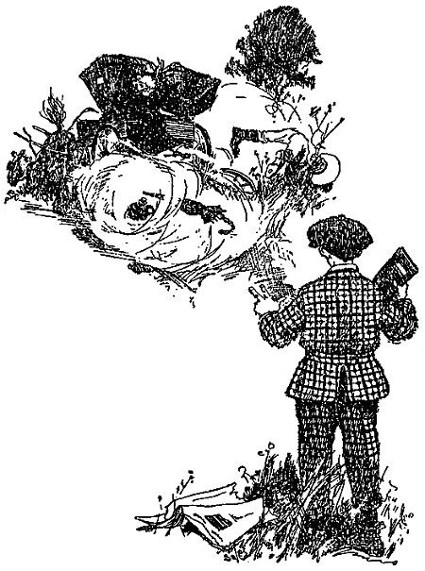
Next morning, I started for school, full of pride in my new clothes for I was sure my folks didn't know a nobby suit when they saw it, although there were knobs enough on that one for a blind man to see.
Ted had sneaked out ahead of me though, and when I reached the school yard I was greeted with cries of "Rug," and "Good morning, your Royal Highness," and "How's Governor Harrison this morning?" Ted had told them all.
On the way home, I met old Jed Bigelow in the square driving a green horse. Just as the horse got along side of me he shied, and then ran away throwing Jed into the ditch and ripping a wheel off his buggy. I always thought it was a piece of paper that did the trick, but Jed swore it was the suit and threatened to send the constable after me.
How I hated that suit. At the end of two days I would never have worn it again but my father hid my other clothes and would only let me wear them to church on Sundays. Then I did my best to spoil it by wrestling and playing football in it, but the cloth was about an inch thick, it wouldn't tear and mud came off it like cheap blacking comes off a pair of shoes.
Finally, at the end of the month, my mother came to my rescue and sent it to the poor in Boston and I want to state right here that it's probably still being worn somewhere in the slums of that city, for it never would wear out. It was the only indestructible suit ever made.
Of course I know that as end on the football team you have a certain position to uphold, and I want you always to look well dressed; but I do wish you would try to choose clothes that I can't hear before you turn the corner, and by the way Ted, everything's going up except your marks. Now the football season's over perhaps you'll have more time to study. I'd try if I were you, it can't hurt you any.
Your affectionate father,
William Soule.
Lynn, Mass.
December 1, 19—
Dear Ted:
I can't say I was totally unprepared for the news, when your report came yesterday, for I met Professor Todd at the club a week ago and much against his will he had to admit, that when he asked you in your oral English exam., who wrote "The Merchant of Venice," you weren't sure whether it was Irvin Cobb or Robert W. Chambers.
Naturally, I expected a disaster when the fall marks came, but I was not prepared for a massacre. I had hoped for a sprinkling of C's with maybe a couple of B's thrown in careless like for extra poundage; but that flock of D's and E's got under my hide. It's all very well, for you to say that you can't see how it's going to help you make shoes to know how many steps A must take to walk around three sides of a square field two hundred feet to a side, if he wears number eight shoes and stops two minutes when half way round to watch a dog fight; but let me tell you one thing, son, any training that will teach you to think quickly, and get the right answer before the other fellow stops scratching his head, is valuable. And to-day, in the shoe business, the man who can trim all the corners and figure his product to fractions, is the man who buys the limousines, while the fellow who runs on the good old hit or miss plan is settling with the leather companies for about fifteen cents on the dollar, and his wife is wondering whether she can make money by giving music lessons.
Probation is a good deal like the "flu": easy to get, and liable to be pretty serious if you don't treat it with the respect it deserves.
It isn't as if you were a fool. No son of your Ma's let alone mine could be, and your Grandfather Soule could have made a living selling snowballs to the Eskimos. It's pure kid laziness, and shiftlessness, mixed in with a little too much football, and not enough curiosity to see what's printed on the pages of your school books.
Now you're on probation, there's only one thing to do, and that's what the fellow did who sat down by mistake on the red hot stove, and the quicker you do it the more comfortable it's going to be for all concerned including yourself.
So far as I've been able to see, there's no real conspiracy among the teachers at Exeter to prevent your filling your pockets with all the education you can carry away, and if I were you I'd be real liberal in helping myself. Education is a pretty handy thing to have around, and it stays by you all your life. Just because I've succeeded without much, is no sign you can, and anyway you'll feel a lot more comfortable later on when the conversation turns to history, and you know the Dauphin was the French Prince of Wales, and not a fish, as I always thought, until I looked the word up in the Encyclopedia.
Now I want you to sail into that Math., just as you hit the Andover quarter when he tried your end, and drop old J. Cæsar with a thud before he can get started. I know J. C. was a pretty tough bird, and how he ever found time to write all those books between scraps, I never could quite understand, unless he only fought an eight hour day, but it's your job to get him and get him hard.
One thing, Ted, that's going to save you heaps of trouble if you can only get it firmly fixed in that head of yours, is that you can't get anywhere or anything without WORK.
Just because you're the old man's son, isn't going to land you in a private office when you start in with William Soule. There's only one place in this factory a young fellow can start, whether he's a member of the Soule family or the son of a laborer, and that's bucking a truck in the shipping room at twelve per, where he'll get his hands full of splinters from the cases, and a dressing down from Mike that'll curl his hair whenever he makes a fool mistake.
There's no short cut to achievement, and work is what'll land you on the top of the heap quicker than anything else, although I've seen a lot of lightweights who spent enough time working hard to avoid work, to succeed with half their energy if spent in the right direction.
That reminds me of a fellow named Clarence I hired some years ago to make himself generally useful around the office. He said he was looking for work and he told the truth all right. He wanted to find out where it was, so he could keep away from it.
I let him stay a couple of months because I rather enjoyed watching his methods. In the morning, he would spend the first two hours scheming how to get the other clerks to do his work for him, and in the afternoon he was so blame busy seeing they had done it, he had little time to do anything else. I had seen people who hated work, but I had never seen anyone before who avoided it as though it were the plague.
The last straw came one afternoon when old Cyrus White of Black & White, the big St. Louis jobbers, walked out of my private office just after giving me an order for three thousand cases and tripped in a cord that fool work avoider Clarence had rigged up, so he could raise or lower the window shade without leaving his desk.
Now old Cy weighs about two twenty and Clarence who had looped one end of the string around his wrist weighed about ninety-eight pounds with a straw hat on, so when Cy went down with a crash that shook the whole factory, he just naturally yanked Clarence right out of his chair, and the two of them became so tangled up in the cord, they lay like a couple of trussed fowls while the water cooler which had also capsized gurgled spring water down old Cy's neck.
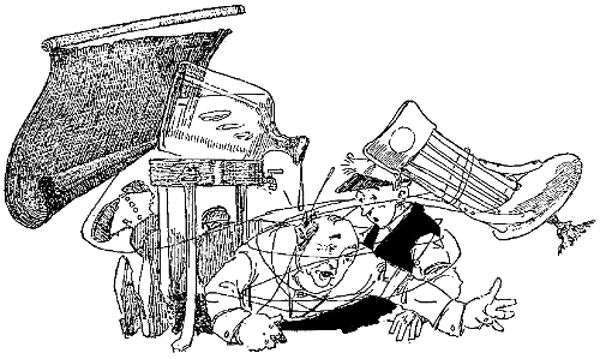
You're right, I lost that three thousand case order, and it was ten years before I could sell old Cy another bill of goods, and to make matters worse, I had to pay Clarence $200 damages, for in his rage Cy nearly bit off one of his ears. Ever since, when I find anyone on my pay roll who is working to avoid work, he gets a swift trip to the sidewalk.
Now I'm not going to stop your allowance because you're on probation, I've more heart for the suffering Exeter shopkeepers than to do that. Neither am I going to forbid your going to the Christmas house party: those would be kid punishments and you're no longer a kid, although you've been acting like one for some time.
I'm simply putting it up to you as a man to get off probation by New Year's, and I want you to remember that as a 'varsity' end you've got to set a good example to the "preps." Think it over.
Your affectionate father,
William Soule.
Lynn, Mass.
December 10, 19—
Dear Ted:
I always thought J. Cæsar, Esq., and one Virgil wrote Latin, but when I was in your room last Saturday afternoon I saw you had copies of their books in English.
Now I'll admit that an English translation is the only way I could ever read those old timers. Latin is as much a mystery to me as the income tax; but one reason I am sending you to Exeter, is so you can play those fellows on their home grounds with a fair chance of winning.
I always thought you were a pretty good sport Ted, and I have always tried to teach you the game, and to play it square. I still think you're a good sport, and the only reason you are using those "trots" is because you haven't stopped to consider how unfair it is to J. Cæsar & Co.
I have a sneaking sort of liking for those old birds. J. Cæsar was the world's first heavyweight champion, and in his palmy days could have made Jack Dempsey step around some, and as for Virgil he could make words do tricks even better than I. W. W. meaning I. Woodrow Wilson. So it was a sort of shock to me to see you giving them a raw deal.
When you get right down to cases, son, your lessons are one of the few things that can't beat you if you study 'em, so it's pretty small punkins to try to rig the game against 'em. A shoemaker can buy his leather right, and figure his costs correctly on an order, but the buyer may get cold feet and refuse them, or the unions may call a strike, or one of about a hundred other things may happen to knock the profits higher than one of Babe Ruth's home runs.
With lessons it's different. Study them and they can't beat you. You wouldn't expect much glory if the Andover team you beat had been made up of one legged men. What about the handicap you're making the All-Romans play under when you tackle them with a couple of "trots" in your fists.
There's another reason I don't want you using "trots", and it's because it's liable to get you into the habit of doing things the easiest way. Now anyone is a boob if he doesn't do a thing the easiest way provided it's the right way; but he's more of a boob if he does a thing the easiest way only because it's the easiest way. And using English translations on your Latin is like paying number one prices for a block of poor damaged leather: it may be easier to get the leather, but when it's made into shoes and you begin to hunt for the profit you find it's gone A. W. O. L.
I don't remember ever having told you about Freddy Bean, but speaking of doing things the easiest way reminds me of him, so while I have the time I'll tell you.
Freddy's Pa ran a little store in Epping just across from the railroad station, where according to its sign he sold Books, Magazines, Newspapers & Stationery, and as he owned his own house and had a thrifty wife he managed to make a living although Epping was not a literary community. Pa Bean was an inoffensive little fellow who always wore a white tie with his everyday clothes, and loved to work out the piano rebuses in the newspapers in the evenings. He had advanced ideas on politics, was a single taxer, and to-day would be classed as a radical. Then we used to call him Half-Baked.
Freddy was a good average boy and likeable enough except for his one bad habit of wanting to do everything the easiest way, and believe me he carried it to extremes.
He used to sleep in his clothes because it was easier than dressing in the morning, but his Ma walloped that out of him. Then he had the bright idea of putting a sign with the price marked on it on most of the articles in his Pa's shop and going to the ball game, when the old gentleman went over to Bristol Centre Saturday afternoons on business. This worked all right at first for the Epping folks were honest, but one Saturday some strangers carried off about $100 worth of goods and Freddy got his from his father and got it good.
I could tell you a lot about the messes Freddy got into trying to do things the easiest way, but the super. is hanging around with a lot of inventory sheets so I'll have to cut this short with Freddy's prize performance. One summer morning Freddy's Pa and Ma went away for the day, but before they started Half Baked led Freddy out into the yard, shoved an axe into his unwilling hands and ordered him to cut down an oak that stood close to one side of the house, and was growing so big it was shutting out a lot of sunlight.
Now there wasn't a boy in Epping at that time who hadn't had considerable experience in chopping wood, unless it was Sammy Smead and he never counted anyway except on the afternoon we initiated him into the Brothers of Mystery, and there wasn't one of us who didn't hate it; but Freddy loathed it more than anything else, principally I guess, because there wasn't any easy way out. If you had to cut wood you had to cut it, and that's all there was to it.
Along about two that afternoon, a crowd of us boys bound for the swimming hole happened by Freddy's house, and found him pretty limp and blistery. He'd only hacked about half through the tree, but I think his mental anguish was worse than his physical exhaustion, because scheme as he might he had hit on no easy way to fell that oak, and the job looked as though it would last till sundown.
Freddy was a good diplomat, and he tried all the Tom Sawyer stuff on us he carried, but not a chance. There was not one of us who would chop wood when he didn't positively have to, and it looked as though Freddy was going to chop until the job was finished, when Dick Harris said something about blowing it up with some gunpowder his father had stored in a keg in his corn crib.
There was not one of us who would have helped Freddy cut down the tree, neither was there one of us who would refuse to help him blow it up, and Freddy, because he saw an easy way out, was the most enthusiastic of all.
We did it. First we dug a hole about four feet deep at the foot of the tree and buried the keg of powder after boring a hole in the top for a fuse. We packed the dirt down tight all around the keg leaving just enough loose to run the fuse through. Then Freddy as master of ceremonies lighted the fuse and we stepped back to wait results.
We didn't wait long. There was a roar and we found ourselves on the grass in the midst of what resembled a volcano on the war path. Dirt, stones, grass, sticks, and heaven knows what else were milling around us in clouds, and out of the corner of one eye I saw Ma Bean's geranium bed sail gaily across the street and drape itself over Mrs. Harry Brown's front gate. Glass was falling around us like shrapnel, for every window in the Bean's house shivered itself out onto the lawn. The tree—well, Sir, it fell on the house, knocked off a chimney and broke down the piazza roof, and the next day Half Baked had to hire Jed Snow's team of oxen to pull it clear before they could even start cutting it up.
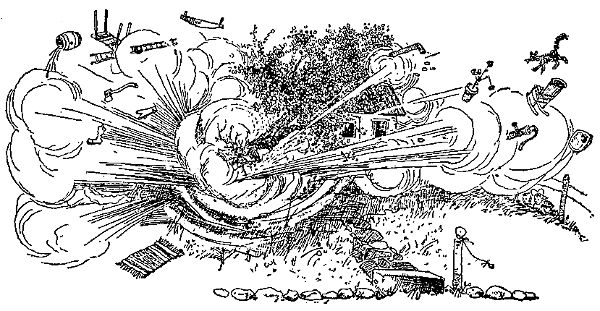
I've a very vivid recollection of what my father gave me, and I rather think Freddy's was the same only more so, in fact none of the crowd slid bases for some time, and Half Baked made Freddy cut six cords of wood during the next month.
I don't know what has become of Freddy, but I have never seen his name in the headlines, so I guess he's still hunting for easy ways to do things, but you can bet he's left gunpowder out of his schemes for the last forty years.
Now Ted you just mail me those "trots." I'll enjoy them, and you give those old timers a fair show from now on. It's not sporting Ted to pull a "pony" on them, for they can't win any way if you don't want them to. Play the game.
Your affectionate father,
William Soule.
Lynn, Mass.
January 27, 19—
Dear Ted:
That notice from Professor Todd stating that you had been taken off probation was the most welcome bit of news I've had in a long time, and the enclosed check is my way of saying thank you.
I knew if you once stopped fooling and got right down to cases, that none of those old best sellers like J. C. or Virgil could hold you for downs, and as for Quadratic Equations, your instructor writes me that if you'll take 'em seriously you can make 'em eat out of your hand.
Now you're again on speaking terms with your lessons, you can keep their friendship by visiting with them a couple of hours a day, and when they once learn you mean business they'll follow you around like a hungry cat follows the milk man.
There's nothing succeeds like success, whether it's getting respectable marks in your studies, or selling shoes, and if you don't believe it ask Charlie Dean.
Probably you've always thought of Charlie as my star salesman and you're right, but it wasn't many years ago Charlie couldn't have sold five dollar gold pieces for a quarter, even if he gave a patent corn cutter away with each as a premium.
Charlie came to work for me right out of the high school, and as he was always willing to do a little more than his share around the office, I decided to give him a try on the road, where he'd have a chance to make real money. So when a younger salesman left me one New Year's, I put Charlie through a course of sprouts in the factory to be sure he knew how the "Heart of the Hide" line was made, gave him a couple of trunks full of new samples, and shipped him out to the middle west.
Charlie was gone three months and he didn't sell enough goods to pay the express on his samples, but realizing a cub salesman's first trip is always his hardest, I swallowed my tongue and sent him out again.
I couldn't understand it. Charlie was no loafer, and I felt sure he was working hard each day, but he had no more success in persuading buyers to stock "The Heart of the Hide" line than old King Canute had in bossing the sea around. If he had done fairly well, I'd thought he was just green and would develop, but when he had been out six months and his sales record sheet was as white as a field of new fallen snow, I decided too much was enough, and wired him to return to the factory, for Fair Bros. were getting more solid in that territory every day, and I simply had to have distribution there.
When Charlie arrived in Lynn, I was going to fire him, for I never believed in putting a man back in the office who has been on the road. He's too liable to be down on the house, and afflict all the other clerks with the same poison; but Charlie pleaded so hard to stay, I finally gave him back his old job, and, as he showed no signs of being a trouble maker, I paid him no further attention.
The next winter, I had a hunch that women's fall styles would run heavy on calfskin, so I loaded up with a hundred thousand pairs of heavyweight cut soles and patted myself on the back that I had put one over on the trade. A few weeks later, the buyers made so loud a noise about Vici Kid a deaf mute could have heard 'em.
There I was, caught flatfooted with a hundred thousand pairs of soles stored in the basement, and the market on them dropping every day so fast I got dizzy when I tried to figure out how much I stood to lose.
I tried to take a loss and turn them back to the manufacturer. Nothing doing, nor would any other cut sole house take them except at a price that would have come near to busting me. Next I tried the manufacturers of women's shoes, not a chance. Then as the soles ran pretty heavy I tried boys' makers, again nothing doing.
I was getting desperate, for I had a lot of money tied up in those soles, and so far as I could see I was liable to own 'em for some time unless the sheriff took 'em.
One morning, I happened to think of Al Lippincott. You know his factory in Dover, the red one you can see from the station? Al makes a line of boys' and youths', but he is the hardest buyer in the whole trade, a regular rip tearing snorter who begins to yell the minute a salesman steps into his office, and keeps it up until the salesman either wants to lick him or to beat it.
I got Al on the long distance, and finally, after his usual outburst that nearly melted the wire, he allowed he was going to be in Lynn that afternoon and would drop in.
I went home feeling somewhat better, but while I was eating lunch the telephone rang, and I learned your Ma had been badly smashed up in an automobile accident, and had been taken to the Salem Hospital.
I never thought of Al again until I was going to bed that night, and then I was so worried about your Ma I didn't care much whether he'd called or not.
The next morning, when I rolled back the top of my desk, I found an order for the whole hundred thousand pairs of cut soles made out in Charlie Dean's handwriting and billed to Al Lippincott at two cents a pair more than I had paid for 'em.
I never asked Charlie how he made the sale, and he never told me, but when he asked for another chance on the road he got it, and knowing he'd sold the toughest man in the United States he made good from the kick-off.
I only mention Charlie because when you were on probation you were in the same kind of fix he was before he sold Al Lippincott. Now you know you can lick those studies of yours. I want you to crowd 'em so hard the teachers will mark down at least a B for you when you get up to recite.
Your affectionate father,
William Soule.
Lynn, Mass.
February 10, 19—
Dear Ted:
This trouble you seem to be having with your eyes, is causing your Ma a great deal of worry. She has visions of a blind son tapping his way through life with a cane and I expect in a few days, she'll have reached the dog on a leash stage. I'd be more worried, if I hadn't happened to remember that the mid-years are only two weeks off, and that eye trouble is one of the best known alibis.
Your suggestion of coming home early Sunday, so you can give your eyes a rest, I agree to most heartily. We'll go into Boston and have an oculist examine you. Then if you need glasses, I'll see that you get them, and if you don't, you're out of luck if you're trying to establish an alibi for flunking your exams.
Eyesight is a mighty curious thing. Some folks get so nearsighted they'll step over a ten dollar bill to pick up a nickel, and others can see a dollar a pair profit in a shipment of shoes the ordinary manufacturer would be glad to sell at cost. It takes pretty good eyesight to be a successful shoe manufacturer nowadays, for it's the ability to see profits where they don't exist, and then handle your output so that you make two little profits grow where only one grew before, that buys new tires for the car, and sends sons to "prep" schools.
Somehow, your reports don't make me feel you've strained your eyes studying. If you had, you wouldn't have made the break you did in your oral English exam. when according to Professor Todd you stated that Ben Johnson was president of the American League. Then, too, I haven't had an excess electric light bill from the school, so it's hard for me to believe your eyesight has been ruined by your burning the midnight electricity.
I remember a clerk I once had in the office, who had a terrible time with his eyes, especially, when he was about due for a bawling out for some fool mistake. He once made out a lot of shoe tags with the specifications calling for eight iron soles on comfort slippers, and when I was about to claw his hide for such a blunder, he claimed his desk was so far from a window he couldn't half see. I remembered that a lot of folks can read real well by electric light, and there was a hundred candle power bulb right over him; but I gave him the benefit of the doubt and moved him over beside a window.
Two weeks later, he made a mistake in a bill that cost me several hundred dollars, and then it was the bright light that dazzled him. I was suspicious, but he pleaded so hard for a day off, to rest his poor eyes in a darkened room, I told him to go ahead, and the next noon as I was driving home along the boulevard I spotted him fishing from some rocks, in a glare that would have made an Arab see green.
I meant to fire him, but I was so busy I forgot it, and for a month he went along without making a noticeable mistake. Then he came to me one day for a raise. I told him that his eyesight was so poor, that if the cashier put any extra money in his envelope he'd never even see it, and that he'd better strain his eyes a little looking for another job, as I couldn't have the responsibility on my shoulders of his going blind while working for me.
The old man wasn't born yesterday, Ted, and having had considerable experience with eyesight alibis he's a bit gun shy.
Perhaps one reason I'm a little suspicious of this eye trouble of yours, is that I have a very vivid recollection of your Uncle Ted the first year he was at boarding school. Ted started out like a whirlwind that fall, all A's and B's in his studies, until along in November he began to get more interested in wrestling with a flute he was trying to learn to play, than with his lessons, so that in December his marks had a striking resemblance to those of the present-day Germany.