Front matter (continued 2)
Reading edition
In January, he developed serious eye trouble. He wrote home that his eyes were so bad he couldn't study, and was sure to fail at mid-year. Whether my father believed the first part of his wail I never knew, but I'm sure he did the second. Anyway he collared Ted one Saturday afternoon, and drove him over to the oculist at Bristol Centre taking me along as ballast.
Ted put up some pretty good arguments against going, claiming a terrible headache and a violent pain in his stomach. My father made him though, and when we finally reached the oculist, Ted really did look sick enough to have had not only eye trouble, but about all the other known diseases, as well.
Doctor Boggs, who was a queer little scrap of a man, as quick tempered as gunpowder, plumped Ted down in a chair, and began to peer at his eyes through a magnifying glass. The more he looked, the more nervous Ted became. Finally, the doctor asked him if his eyes felt any better, and Ted allowed they did.
Then the doctor put a lot of charts up about twenty feet away, and asked Ted to read the letters on them, which he did so quickly the doctor couldn't change the charts fast enough. I grinned, for by then I was sure Ted was faking. Ted also realized that for a boy whose eyes had been causing him so much trouble, he'd been giving a remarkable exhibition so when Doctor Boggs began trying different glasses on him, Ted protested that he couldn't see a thing with any of them.
The doctor was very patient, trying on pair after pair, Ted groaning louder with each new one. At last, the old fellow stopped for a few minutes and rummaged around in a desk drawer where he kept a lot of his eyeglasses. Suddenly, he turned to Ted clapped a new pair on his nose, and stood back smiling sweetly at him.
"There my boy," he said, as sweet as honey. "Those are much better, aren't they!"
I took a look at Ted and almost choked. Then I realized what was coming to him, so I tried to pass him the high sign. It was too late.
"Those are the only ones I've been able to see through, doctor," Ted chirped innocently.
The next instant, the doctor with one word "Fraud!" grabbed Ted by an ear and marched him to the door, while father followed looking about as pleasant as a thunder storm.
You've probably guessed the reason why already. There was no glass in the last frames. After we got home, father and Ted retired to the woodshed and I heard the most heartrending sounds. When Ted returned to school his marks began to improve at once, and they kept on getting better and better until the end of the year, and since that day Ted has never had on a pair of glasses. It was one of the quickest and most complete cures of eye trouble ever recorded, and it also proved that old Doctor Boggs knew his job.
Faking is mighty poor business Ted, whether it's trying to establish an alibi for flunking your school exams, or making army shoes with paper soles for the government. The first is apt to get you into the habit of shirking your work, and the second is mighty likely to land you in jail. Some business men, not many, by faking the quality of their goods shoot up like a sky rocket, but when the time for repeat orders comes along, they come down like the stick, and if there's anything any more useless than the spent stick of a sky rocket, it's a man who tries to ease his way through life on alibis.
Do your best and stand by it. If it is your best, you have no cause to be ashamed no matter how it turns out, and remember that a man who never made a mistake never made anything.
My boy, if there really is something the matter with your eyes, we can't have them attended to any too quickly, and if there isn't I somehow feel a little frankness now, on my part, may effect almost as rapid a cure as your Uncle Ted's and without any painful ending.
Your affectionate father,
William Soule.
Lynn, Mass.
February 20, 19—
Dear Ted:
My boy, I owe you an apology for doubting you had eye trouble. It was hard for me to believe you were faking; but the circumstantial evidence against you was pretty strong. I should have known better, though, for you have always played fair with me so I ask your pardon.
That letter from the oculist, in Portsmouth, saying you needed glasses was a relief and a disappointment. A relief, to know you weren't trying to slip one over, and a disappointment to learn you must wear glasses. Don't let wearing glasses disturb you. You won't need them when you are playing football, and if you only wear them when you read your nose won't be disfigured by the strain.
It's funny how a young fellow like you, who has the time and the education to appreciate them, don't seem to care about reading good books, while an old rough and ready like your dad, can't have enough of them. When I was your age, I was too busy trying to help support the family, to find time to read much besides the Epping Bugle, whereas, you seem to be too busy figuring out how to have a good time, to care what the biggest men of the world thought about things.
You've wanted to know why I am always buying so many books, and although I never realized it before, I guess it's because I couldn't have them when I was young.
Yes, on that house party at Manchester, Ted, go ahead and have a good time and while I remember it here's a check that may come in handy for a few extras. If I were you, I'd take all the extras in the way of clothes you can cram into a suit case.
Forewarned is forearmed you know, and it's just as well when going to a house party, or to a fight, to carry all the heavy artillery you muster, for you never can be sure you won't need it.
I've been to only one house party, and I don't expect I shall ever go to another; but if I do even if it's only for a week end, I'm going to take every rag of clothing I own from oilskins to dress suit, not forgetting rubber boots and pumps, especially the pumps.
I believe a person is supposed to have a good time at a house party, but my only offense was about as enjoyable as the time I had typhoid.
Perhaps you remember the summer your Ma and I went to Pittsfield for two weeks, and left you with your Aunt Sarah over at Marblehead.
Well anyway we did, and I haven't thought much of Pittsfield since. We got there on a Friday, and the next morning I went down town for something and ran slap into Jack Hamilton.
Jack and I were boys together in Epping, and used to do considerable business trading rabbits and whatever live stock we happened to own.
Jack left Epping when he was seventeen, went to work for a stock broker in Boston, and made barrels of money, incidently marrying a Philadelphia girl who had callouses on her thumbs from cutting coupons.
Jack has always been my broker and handled all my finances, but for a good many years we hadn't seen much of each other socially, so when he suggested your Ma and I go out that afternoon to his cottage in Lenox, and stay over Sunday, I was glad to accept, thinking we'd have a chance to talk over old times. I went back to the hotel and told your Ma, and then promptly forgot all about it, for there was an old fellow living in Pittsfield who'd just invented an extension last that looked good to me.
I spent most of the afternoon in the old inventor's shop and when I returned to the hotel along about five, I found a high-wheeled cart outside which Jack had sent over to get us, and your Ma having duck fits for fear I wouldn't show up.
She said she'd put everything in my suit case I'd need, so I only slicked up a bit and we were off.
It was a mighty pretty ride over to Lenox, but when we turned in at the gate to Jack's cottage, I thought our driver had made a mistake, for the place looked bigger than the Boston Public Library, and about as homelike as a New York apartment house.
A frozen-faced individual in brass-buttoned red vest and a waiter's uniform met us at the front door, and when I told him I was William Soule of Lynn he led the way into the hall and disappeared.
We hung around for some time. Then a maid came along and showed us to our rooms. It was a mighty nice room I had, with pink silk wall coverings and gray wicker furniture, and with a tiled bath off it, that gleamed like a Pullman porter's smile. I looked the bed over carefully, decided it was comfortable, and then thought I'd go out in the yard and walk around. As I stepped on to the piazza, a haughty-faced woman disentangled herself from a group of ladies who were playing cards, and came towards me murmuring, Mr. Soule?
I pleaded guilty, and she extended two cold fingers, that had about as much cordiality in them as a dead smelt, and said she was pleased to meet me. From her tone, I judged she wasn't going to lead any cheers over the fact, so I bowed politely and marched on out to the stables in front of which I saw a boy exercising a mighty likely-looking colt. Jack had some fine horses, and a wonderful herd of Jerseys. His head groom was a real human sort of chap, who knew more about cattle than any man I ever met, and we were having a real good visit together when a gong like a fire alarm started somewhere in the house.
I made the piazza in three jumps, tore through the hall and up the stairs determined to get your Ma out before the house burned down, for what I'd seen of the Lenox Fire Department, sitting in his shirt sleeves before the door of the hose house as we drove over from Pittsfield, hadn't inspired me with any great amount of confidence in his ability to put out anything bigger than a bonfire.
As I rushed into the upper hall, I thought it funny I didn't smell smoke, so when I ran smack into a maid I grabbed her and asked her where the fire was.
"Fire!" she squealed.
"Yes," I answered, "wasn't that a fire gong?"
Ted, you should have seen her face. I thought she'd choke. She did her best to keep it straight, and not laugh, but it was some struggle.
At last she managed to stammer, that the gong wasn't for fire at all, but to let the guests know it was time to dress for dinner.
I felt as big as a man on Broadway looks from the tower of the Woolworth building, so I slipped her a dollar and ducked for my room.
There I sat down to get my breath, hoping that girl wouldn't tell on me, and wishing I was back in Lynn, for I saw rough weather ahead unless I kept my eyes open and my mouth shut.
I shaved, and started to climb into my regimentals. Your Ma had put in shirts, studs, collars, tie, vest, coat, silk socks, pants, and every last article of necessary trappings except pumps, and pumps were about as necessary to me then as a little leather is to a pair of shoes.
I had a horrible sort of feeling as though my stomach was slowly revolving around inside of me, and my legs felt as if they were trying to go two ways at once, for I had worn a pair of tan shoes over from Pittsfield, and I knew from the glimpse I'd caught of Mrs. Hamilton's friends, that if I didn't wear my dress suit I'd rank lower than the deuce in that game.
Just how to wear that dress suit I couldn't quite figure out. It had to be done, that was certain, but as raw as I was on society stuff, I knew tan shoes and full dress would not get by. Then I remembered the bell in the wall beside the bed. In two jumps I had a thumb on it squeezing for dear life, for I thought if one of the servants answered, I could get word out to my friend the head groom to lend me a pair of black shoes. What size didn't matter, I'd have made any size fit.
Then I heard someone running along the hall outside, and yanked open the door in the face of the same maid I'd asked about the gong.
I slammed the door shut and looked at my watch. It was seven o'clock, and I figured half an hour at the most, was all the time I had to get a pair of black shoes, and from the way I was located, a pair of black shoes seemed as easy to get as money from the government on a war contract.
Jack wasn't home, and anyway he wore shoes about three sizes smaller than mine, and as for his wife she was out of the question.
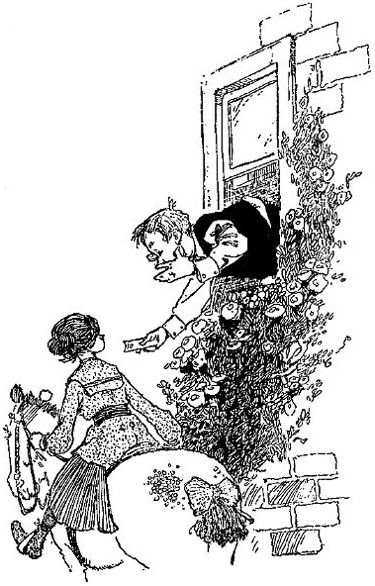
I'd about decided to go to bed and play sick, when I happened to glance out of the window and saw a girl about fifteen riding a horse around the circular drive in front of the house.
She was a real friendly-looking kid, and grinned up at me as she passed, so the next time she came around I leaned out and beckoned to her. She rode up under my window, and I told her the fix I was in.
"What size?" she asked without any hesitation.
"Anything from nine up," I replied.
"Gimme some money," she said.
I dropped her a ten spot. She caught it and was off, tearing down the drive like a jockey, and twenty minutes later she shoved a pair of pumps through my door she'd bought in Pittsfield, and I sailed down to dinner a trifle late, but as dignified as a London alderman.
Now Ted you've had considerable more experience with society than I've had, and probably you won't make any break at that house party, but if I were you after you get your suit case packed, I'd go through it a second time to see if anything's missing. Carefulness is a mighty handy habit to have around the house, whether it's a man's ability to look far enough ahead not to borrow on his insurance policy, or his wife's skill in keeping down the bills.
I've had clerks in the office who'd do a job in jig time and leave behind enough mistakes to make the Bolsheviki envious, and when it comes time to sweeten salaries they are always surprised and hurt, because they are passed by for the fellows who haven't such fancy windups, but do have better control.
Speed is a tremendous asset to-day, and when it's combined with control it's almost unbeatable. For example, Walter Johnson. Still, I've seen old Cicotte mow down the Red Sox with only two hits when he hadn't enough speed to break a window, and you'll find that a young fellow who can do a job in half a day, and get it right, is a better man to have on your pay roll than a chap who can do the same work in half an hour, and then spend a day correcting his mistakes.
Have a good time, and perhaps when you get back to school your eyes will feel better so you can make a creditable showing at your mid-years.
Your affectionate father,
William Soule.
P. S. The girl who bought me the pumps is Jack Hamilton's daughter. She's married and has three children so don't get excited.
Lynn, Mass.
February 28, 19—
Dear Ted:
I did considerable wondering while you were home last week, why it was your clothes carried a reek that seemed a cross between a tannery vat and a grease extractor.
Your Ma says "stink" is vulgar. Maybe it is, but it's good plain English, and it describes that poison gas you seemed to be carrying around with you, better than any such ladylike word as smell.
I wasn't wise until you stopped at the corner on the way to the station and lighted one. I was looking out the window at the time, and it made me plumb disgusted to see you swagger off polluting the air with a cigarette.
Now I never believed in raising a boy on "Don't." When you say "Don't" do a thing, the average person at once wants to do the very thing you tell him not to do, although before you had forbidden it, you probably could not have hired him to do it. "Don'ts" were what got the Germans in bad.
When I was in Berlin in '99 attending the International Shoe Manufacturers' Congress, there were "Verboten" signs on pretty nearly everything. "Verboten" is German for "Keep off the Grass," or something like that, anyway it means "Don't," and every time I saw one of those blamed signs, I immediately wanted to do what was forbidden.
One evening Al Lippincott and I strayed away from the bunch, and wandered into a sort of open air garden. There was a theatre, with a vaudeville show that the Watch and Ward Society at home would have closed up the first night. But the music was fine, so we picked out a table and ordered a light lunch of pickled pigs feet and sauerkraut, and were attending strictly to business when the manager, followed by two German army officers, walked up, and informed us we'd have to give up our seats. Seems they had some fool rule about civilians having to clear out if army officers wanted their table.
Now Al has always had dyspepsia, and the pickled pigs feet and sauerkraut had not done his stomach any good, and I had been "verbotened" almost to death ever since I had been in Berlin so we told them to run away and play, and turned our backs.
The next instant someone grabbed Al by the coat collar and gave him a shake.
"Do you not understand pig dog it is verboten?" a voice said.
Al wrenched free, and saw it was the younger of the two officers who had given him the shaking. He was a pasty faced, pimperly, fair-haired young man, with a monocle in one eye, and a waist that looked like it was made that way by corsets, and he had a 45 calibre sword dangling by his side that was bigger than any the Crusaders ever carried.
If he hadn't said "verboten," Al might have given him a good bawling out and let it go at that, but "verboten" to us by that time was like waving a red flag in front of a he cow, so Al gave him a good shove. The officer tripped over his sword and sat down ker-splash in a plate of hot soup an old lady was eating at the next table.
Waiters came running from all directions, but Al and I grabbed up a couple of chairs and they danced around in a circle not daring to close, while the soup spiller and his friend sputtered with rage.
"I am disgraced," yelled the one Al capsized.
"I want to fight. I would kill you, but you are not titled. I'm disgraced."
"You're a disgrace, all right," Al interrupted, "but if you want a fight, I guess we can help you out. I'm the Earl of Dover," he continued kicking a waiter in the shin who had come too near for safety, "and my friend here is the Duke of Lynn, so if you know some nice quiet place where we can settle this without gloves, lead on, we're with you."
At the mention of our titles the officers quieted down, and whispered together, then the older one bowed stiffly to me and said, "My friend accepts your friend's challenge. Follow us if you please."
They stalked out. Al and I followed. We turned into a side street, and finally came into a quiet square with a watering trough in the centre.
"We will not be interrupted here," said the older officer.
"Fine," Al replied, peeling off his coat, while the soup spiller did the same.
"Here is a sword," said the older officer handing Al his.
"What's that for?" Al asked.
"To fight with," the officer replied.
"I fight with my fists," Al shouted.
"Fighting with the fists is verboten," the officer replied.
"Get out of my way" Al yelled, and, shoving him aside, he grabbed the younger, sat down on the edge of the watering trough, spread him across his lap, and gave him with his own sword a good spanking, while the older one danced around yelling like a wild man.
Ted, you never heard such a yowling and hollering as those two set up. It would have raised the dead, and it did raise about twenty police, who grabbed us just as Al was ducking the younger one in the watering trough for the second time.
Well sir, they carted Al and me off to jail, and dumped us into a cell, where there was a straw mattress on the floor. Al had hay fever, and, believe me, we spent a pretty miserable night.
In the morning, we learned the young officer Al spanked was Prince Pigestecher, a fourteenth cousin of an aunt of the Kaiser's. We were in bad. It took the American Embassy three weeks working night shifts to get us out of jail, and then we greased our way with a five hundred dollar fine each, and that's why I made nurses' shoes at cost for the British Government when the war started.
I only mentioned this experience of Al's, to show the danger of too many "Don'ts," and it's one reason why I am not going to say, "Don't smoke cigarettes." I want you to think it over carefully, and see if in your own mind you think a boy not yet eighteen is doing a fine, manly thing to go around with a scent on his breath like Moon Island at low tide. Is he setting a good example to the younger boys, who look up to him because he's a 'varsity end, and one of the big men of the school?
Ask your trainer if cigarettes will improve your wind. I have read a lot of truck written by men with a string of letters after their names, who try to prove that cigarettes do not hurt a man, but I never yet have read anything that proved to my satisfaction that they did anyone any real good.
Remember Ted that no matter how seriously you take yourself, you are not a man. I want you to grow up a clean, manly, two-fisted shoemaker, not a chicken-breasted, weasel-eyed manufacturer of cigarette ashes. Washington, Lincoln, Roosevelt, and a few others who were not bush leaguers managed to do pretty well without smoking cigarettes, and they are good examples for a young American to imitate. Think it over, my boy.
Your affectionate father,
William Soule.
Lynn, Mass.
March 12, 19—
Dear Ted:
The most welcome letter I found waiting for me on my return from St. Louis was the report of your mid-years. Ted, you did real well considering all the handicaps you were working under, and I'm more than pleased to see that the old Soule fighting spirit has been passed along to you.
We Soules have always prided ourselves on being able to do our best work when things looked blackest. That back to the wall, "Don't give up the ship," determination has pulled us through some mighty rough places, whether hauling trawls on the Grand Banks, or fighting our way up from the ranks in business.
You are just beginning to realize you have the same amount of grit engrained in your hide, and it's a mighty comforting thought to wear under your shirt, for the man who won't be licked seldom is, and the quality of never knowing when you are beaten has made more impossible things possible, than any other one thing in the world.
I remember how when my father died and left me my mother, two young sisters, and a big mortgage to support. I was mad clear through. Not at the idea of having to support my folks, I was glad enough to do that, for no boy ever had better; but because I couldn't finish my schooling. I determined I'd work like blazes to cheat Fate for the nasty wallop it had handed me, and work like blazes I did. After all I think it was good for me. A boy who has to make his own way usually does, if he has the right stuff in him, and that's why I don't intend you shall step from school into a private office here in the factory.
It's so much more gratifying when the time comes to look back, to know that what you have, you alone have made possible, and not to have to give the credit to some one else. And that's why, when you go to work, I'm going to see to it that you learn shoemaking from tanning to selling, so that when your time comes to look back you can say to yourself, "My father left me a ten thousand pair factory, but I've boosted it to twenty-five."
There was one thing though in your recent letter I don't quite get, and that's the necessity for your spending so much of your time in Portsmouth. Now I know Portsmouth is a nice New England town, filled with quaint old colonial houses, and enough historical incidents to make a three volume series, but I never knew you to be wildly interested in such things, and since I got that bill of $24.25 from the Rockingham for dinners, I'm suspecting you don't go there to study history.
One evening last fall, on the way home from Ogunquit, the car broke down in Portsmouth, and while it was being repaired, I took in one of the movies. The show was quite good and I enjoyed it, until I came out when it was over, and found a crowd of Exeter boys hanging around the entrance speaking to any good looking young girl who was alone.
Then there was a general pairing off, and strolling up and down the main streets, looking in the shop windows, and much loud talking, giggling, and laughter, while the young townies stood on the corners making cheap remarks. Some of your schoolmates took their lady friends into the little lunch rooms with which Portsmouth is so plentifully supplied, and bought them suppers of ham and eggs, and ice cream, while a few with more money went to the Rockingham.
I moseyed around the town quite a bit watching these schoolmates of yours, and was thoroughly disgusted. Not that I saw anything really wrong. I didn't. Every one of the boys had taken the cars for Exeter by eleven, but there was such a general kissing and dumbfoolishness I'd like to have spanked the lot.
Perhaps it's heaps of satisfaction to a young fellow, one of the big men of the school, to hike for Portsmouth with a few dollars of his dad's burning holes in his pocket, cut the prettiest shop or factory girl out of a crowd, and carry her off for supper, spending his week's allowance in one evening, but I can't see it.
Now don't think I'm down on factory girls. I'm not. I've employed heaps of them, and with mighty few exceptions they've been respectable hard-working girls, who could hold their head up anywhere, and although as a rule they would scratch a fellow's eyes out who tried to get fresh with them, they don't mind paying for what they consider a good time with a few kisses.
Now I'm not a snob, and if I ever see any signs of your becoming one, I'll whale it out of you in jig time, for I hate a too-proud-to-speak individual, as much as I hate a crooked leather salesman. But I'd rather you spent your evenings in Exeter, on the piazza of those Eaton girls to whom you introduced me, than parading the streets of Portsmouth with a factory girl hanging on your arm.
I remember my first lesson in chivalry, and before the super. comes in to tell me there's an embargo on freight out of Lynn, I'll pass it along.
I was in the grammar school, and about ten years old. One day at recess, a little girl named Sally Perkins had a bag of peppermint candy and was treating the other girls, when Butcher Burch, a great hulking boy of twelve, snatched the bag out of Sal's hand and began to gobble it as fast as he could.
I was furious, for little Sally was a nice pleasant girl who never stuck her tongue out at me, and I should like to have whaled the Butcher, but he had soundly thrashed me on several occasions, and I knew he would repeat if I made any protest.
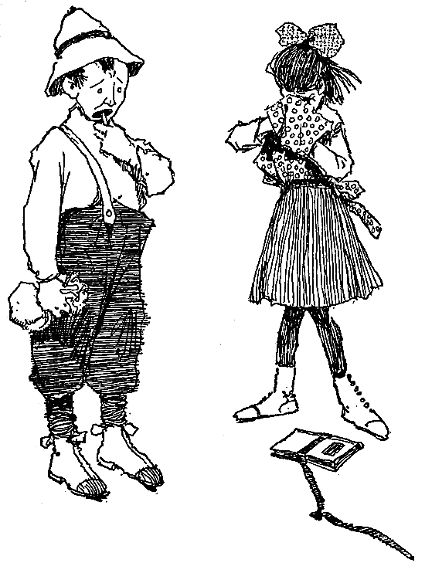
I stood hesitating. Sally was crying her head off, and the Butcher was cramming the candy into his ugly mouth as fast as he could, when along came my father.
"What's the trouble?" he asked.
I told him, suggesting he make the Butcher return the candy.
"That's your job," he replied.
"But he can lick me," I stammered, remembering former disastrous battles I had fought with the bully.
"That makes no difference," replied my father. "It's just as well for you to learn now, that whenever you see a girl or a woman insulted, it's the business of every decent man or boy to come to her rescue. I give you your choice of fighting that boy now, or taking a licking from me when you come home."
I took a good look at my father and saw he meant every word he said, and then because I hated the Butcher for what he had done to Sally, I lowered my head and sailed in, fists flying like a windmill.
Luckily, one of my first blows hit the Butcher full on the mouth and he let out a howl—and candy. He must have had half a pound in his mouth when I hit him. Knowing that my only chance was to bewilder him with my attack, I let fly everything I knew, and for a couple of minutes I had the best of it. Then his weight and strength began to tell, and he hammered me about as he pleased, finally landing a swing on my jaw that knocked me off my feet.
When I came to, I found my head resting on my father's knee, while Sally was mopping away at my bloody nose with her little, and not too clean, handkerchief, clutching in her other hand the remnants of her bag of candy. Young as I was I'll never forget the look of pride on my father's face, when later he handed me over to my mother for repairs, saying, "Patch him up, Mother, he's been fighting to protect a girl."
Ted, my boy, I want you to grow up with a reverent respect for all women, for the worst woman who ever lived, you may be sure, had some good qualities, and the best of them are far too good for any man. Besides you owe it to your Ma, for no sweeter, better woman than she ever breathed, and although there may be no real harm in the girls you meet in Portsmouth, the sort who let a fellow pick them up on the street and kiss them good night, are not the kind who are going to increase your respect for women, so my advice to you is, cut it out.
Your affectionate father,
William Soule.
Lynn, Mass.
March 20, 19—
Dear Ted:
You didn't have to write me that those boys you brought home with you on last Sunday were wonders. They told me so themselves.
Seriously Ted, they didn't make much of a hit with me. I don't mind a young fellow holding up his head. It's a sign of spirit the same as it is in a horse. No man who wears his chin on his vest gets far in life, and no one but a tin horn who's trying to throw a bluff he can ride, wants a horse that hangs its head between its knees; but neither have I much use for the young chap who's nose is forever pointing skyward as though he were marching along the edge of a tanning vat on a hot summer day.
Spirit's all right now that we have prohibition, but superiority of manner isn't. If you really are a man's superior he knows it, and if you aren't and try to act as if you are, he's liable to laugh at you; and by superior I mean superior in brains or ability to accomplish worth while things.
Now one of your friends thought he'd impress me by saying that he was descended from the Earl of Hampton, and he didn't like it a bit when I told him I wouldn't hold that up against him, and that for all I knew the Earl might have been perfectly respectable. He also said his ancestors came over on the Mayflower, and wanted to know if any of my family had crossed on the same ship, and I'll bet he thought I was impossible when I told him it was more likely to have been the Cauliflower, for the Soules were always fond of New England boiled dinners.
The other was money superior. From what he said, I learned that his dad had made a mint out of raincoat contracts during the war, and has ever since been setting up autos for the family like the lumber jacks used to set up drinks for the crowd in Pat Healey's saloon on pay night.
Money's a mighty useful article to have around these days, and it's nothing against a man if he has plenty of it, nor is it to his discredit if he hasn't—and ancestors don't do a fellow any harm if he keeps remembering they're dead and can't help him earn a living.
Money will buy many things worth having, but not the things most worth while. For a poor man with a reputation for keeping his word is a better citizen any day than a millionaire who's a liar, and I'd much rather have a young man on my pay roll, whose family came over in the steerage and hasn't a grudge against work, than a fellow who can trace his ancestry back to the peerage and is trying to get by on dead men's reputations.
Now don't think I'm down on millionaires. I'm not; some of the biggest men in this country are also the richest. But when you and I took that trip to Washington, the men whose statues we saw in the Hall of Fame, were not honored by their states for the money they had made, but for what they had done, and I didn't notice any inscription reading, "John Jenkins Stuart, Great-grandson of the Second Assistant Royal Bartender."
It's usually a poor plan to criticise a person's friends, but I'm going to do that very thing in regard to yours, for I've had considerable more experience than you, and I know how dangerous the wrong kind of friends are. The right kind of friends never did anyone any harm, and the wrong kind never did anyone any good, and take it from me, son, the two boys you brought home over the week end are not the right kind.
Unless I'm much mistaken, one will try to get by on his ancestors' reputation, and the other on his father's money, and neither will be classed among the three hundred hitters when the great Umpire calls them out.
You don't have to be ashamed of your ancestors, or my money, and it did me a world of good to overhear you say to young Raincoats that I might not have made a million out of the war, but there wasn't a leather company in the country which wouldn't sell me any amount of stock I cared to order. That's the sort of a reputation I've always tried to deserve. It's the aim of every decent American business man, but just the same it's fine to feel my only kid's as proud of it as I am.
Now I've met several of your schoolmates I'd sooner tie up to than the boys you exhibited. That roommate of yours for instance. He's pretty green yet, and his taste in neckties is awful, although it's improving, but I'll bet that ten years from now you'll be more proud of what he's accomplished, than he will of what you've done, unless you scratch considerable dirt in the meantime. That other boy, the dark-haired one from Virginia, he'll get on too; he's worth while, cultivate him.
When I was a little older than you, I once made a mistake in a friend that had mighty serious results, and I don't want you running the same risks.
It was when I was working in the Epping National Bank, that a pretty slick fellow by the name of J. Peters Wellford blew into town, hired two rooms at the Mansion House, and the best rig Sol Higgins had in his livery stable, and settled down to live the life of a gentleman of leisure.
Now every man in Epping worked, except George Banes the town half wit, and Jim Spencer the town drunk, and a person who labored neither with his hands nor brains was considered not quite respectable.
J. Peters, however, didn't get drunk, and he had a wit that was sharper than a new-honed razor, and, as he wasn't curious, paid his bills, and seemed to mind his business and no one else's, besides having faultless manners and a pocket full of ready money, the younger folks after a short period of probation welcomed him with open arms.
He never made much of a hit with the old people, and as I look back I can see it was their intuition gained by hard experience that warned them that J. Peters was not all he seemed, although at the time I put it down to pure envy.
From the first, J. Peters who was at least fifteen years older, took a great fancy to me.
He was forever hanging round the bank, inviting me to dinner at the Mansion House, driving me about the country and going fishing with me on Saturday afternoons.
J. Peters was extremely well read, seemed to have traveled everywhere, and knew men intimately whose names in the financial world were all majestic. I thought J. Peters a whale of a chap and tried in every possible way to imitate him, even to copying so far as I was able his slow drawling way of speaking.
My father couldn't see J. Peters with a spy glass, but neither could he prove anything to his discredit, and as I was then at the beautiful age of eighteen when one knows so much more than he ever does again, my father's warnings flowed out of my ears like water from a sieve.
One day, six months after J. Peters had arrived in Epping, he proposed that I accompany him on a week end trip to Boston which I was crazy to do, but had to refuse on account of my finances being at low tide.
J. Peters wouldn't take no for an answer, however, and finally persuaded me to go as his guest.
We were to take the noon train on a Friday; but when Thursday night came he called to me from the piazza of the Mansion House as I was on my way home from work, and told me that something had come up which would prevent his going until Saturday.
He pushed a roll of bills into my hands telling me to go as we had planned, engage rooms at the American House, buy theatre tickets for Saturday evening, and wait for him as he would follow on the Saturday noon train.
His story sounded plausible enough so I followed his directions, and had a gorgeous time until six o'clock Saturday evening came and with it no J. Peters. I waited for him in the lobby of the hotel until midnight, and then went to bed feeling he must have missed his train but would show up the next day.
He didn't though, and I spent Sunday roaming around the city seeing the sights, returning to the hotel for supper. Just as I was pushing my way through the front door someone grabbed me, then I felt something cold and steely clasped around my wrists, and looking up saw Hen Winters, the sheriff of Epping County, scowling down at me.
When I recovered enough from my fright to understand what it all meant, I learned that I was wanted for stealing $20,000 in Cash from the Epping National Bank, and that explanations were out of order.
The bank had been robbed. J. Peters and I were missing, and the mere fact that all the money Hen found in my pockets after a painstaking search amounted to $9.75 didn't get me anywhere, for my intimacy with J. Peters was known to everyone in town.
Back I went to Epping handcuffed to Hen, and the fact that we reached home late when no one was at the station to see us, was all that kept my folks from dying of shame.
My father stood my bail, and in a few days the detectives put matters straight by discovering that on the night I left for Boston, J. Peters alone had robbed the bank and made good his escape to Canada, but, believe me, Ted, until that mess was cleaned up I felt about as joyful as a leather merchant who's carrying a big stock in a falling market.
Now I don't believe for a minute, that either of those boys you brought home with you over Sunday, will turn out to be a J. Peters. It takes brains to be a successful bank robber, and in my estimation neither has enough of that commodity to head the lowest class in a school for feeble minded. But I do think they have enough nonsense in their heads to get you into a peck of trouble if you continue to run with them, so if I were you I'd cut them out.
At the best those boys may be harmless. There are a lot of things that don't do a man any particular harm, but life is only a short stretch, so why clutter it up with a lot of harmless things, when every young American has the opportunity to enrich it with what is really worth while.
The friends you make during the next few years will be your friends through life, and if I were you I'd select them as carefully as you do your neckties for they will wear much longer.
Your affectionate father,
William Soule.
Lynn, Mass.
March 28, 19—
Dear Ted:
Don't think that the old man has set up as a sort of a composite wiseacre, who believes he knows more than Solomon, Socrates & Company. A man can't knock around the shoe trade for thirty odd years without picking up a pretty general line of useful knowledge, and if he has a son, it's kind of up to him to see that the boy gets the benefit of what his dad learned in the School of Hard Knocks. That's why I have tried to give you some hints in my letters in regard to certain things I would not do. Betting is one of them.
When I read your last letter in which you said you cleaned up twenty bucks on the Indoor Games, I realized that although you were not yet slithering down the greased toboggan slide to perdition, it wouldn't do any harm to hand out a little advice you can use as a sort of sand paper seat to your pants, to keep you from exceeding the speed limit.
Speaking of sand paper, reminds me of something that happened one year on the train coming home from the Shoe and Leather Fair at St. Louis, and as I have a few minutes before Miss Sweeney brings in the figures on that last shipment of the Company's leather, I'll pass it on to you for what it's worth.
I was in the observation car, trying to write a few letters amid the chatter of a group of red hot sports, who I judged from their remarks, were on the way home from playing the races at New Orleans. One young fellow, in a sunset suit, was particularly noisy. Every few minutes, he would draw a huge wad of bills out of his pocket and waving them under his friends' noses would boast of what he was going to do to Wall Street when he hit little old New York.
Now I have considerable respect for Wall Street's ability to take care of itself, and somehow I couldn't picture all the old bulls and bears putting up the shutters and hiking for the tall grass, when that particular youth who had a chin like a fish's, landed in their midst.
The train stopped at a small town, and an old man who looked like the greenest rube in captivity came into the car. He sat down opposite the bunch of sports and pulling a country newspaper out of his pocket buried himself in its pages.
From where I sat, I could see the sporting fraternity sizing him up and presently the young loudmouth crossed over and sat down beside him.
"Nice country around here Uncle," young freshy began.
"Shore is," the old farmer answered. "So durned fine I hate tew leave it. I bean here nigh on forty years, and I hain't left Bington more'n twict. I sold the old farm a short spell back, and I'm going to Chicago now to live with a granddarter."
"Have a cigar?" asked the young sport.
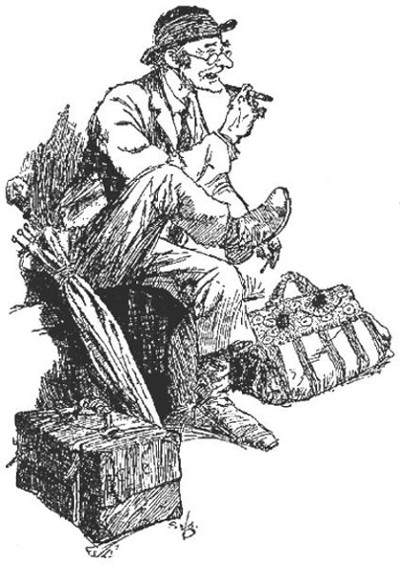
"Don't keer if I do," replied the farmer biting off the end, and taking one of the safety matches from a holder on the wall of the car he tried to strike it on the sole of his boot.
Now at that time safety matches had not been used to any great extent, still I didn't suppose it was possible there was anyone who did not know what they were, although I knew that in some of those small mountain towns away from the railroad, the people were said to be a hundred years behind the times. When the old man tried to scratch another, and then a third, I was convinced he'd never heard of or seen a safety match, and I wondered what he'd do next.
"Powerful pore matches, these be," he said with a grunt, as he reached for a fourth and attempted to light it on the leg of his trousers.
A crafty, cunning look, spread over the young sport's weak face. "You can't light those matches that way," he said.
"I'll bet I kin," the old man replied doggedly, making his fifth unsuccessful attempt.
"What will you bet?" the young fellow asked, quickly, an evil light gleaming in his fishy eyes.
"Wal I never yet seen a match I couldn't light on my pants. I'll bet you a quarter."
The young man fished out his wad of bills. "I'm no tin horn," he replied, with a sneer. "But if you want to lose your money, I'll bet you $100 you can't light one of those matches on your trousers."
"Land sakes!" cried the old farmer. "A hundred dollars?"
"That's what I said," replied the young fellow, grinning at his pals. "This gentleman will hold the money," he continued, peeling off a hundred dollar bill from his roll and thrusting it into my hands.
I had just about decided to spoil the game with a little history on safety matches, when the old farmer who had been fishing around in his wallet, darted a shrewd glance at me, then deliberately winked.
Finally, he counted out $100 in small bills, which he handed over to me, grabbed a safety match from the container, rubbed it on the leg of his trousers, and when to my astonishment, it burst into flame, calmly lighted his cigar and held out his hand for the $200 which I passed over to him.
Later, in the pullman, as the old fellow was mooching by my chair, he raised his coat enough to show me the side of a safety match box sewed to the leg of his trousers.
Now the only trouble with betting, Ted, is that it's wrong. It's wrong for several reasons. First, because it's trying to get something for nothing; second, because a man always loses when he can't afford it; third, because gambling of any kind will sooner or later get a young fellow into the kind of company he don't want to introduce to his folks; fourth, because if a fellow sticks to gambling all his life he's pretty sure to die in the neighborhood of the poorhouse; and fifth, no matter how slick a gambler you become, you will always meet a slicker one, who will trim you to a fare-thee-well.
It's fine to back your teams to the limit, and I'd think you a pretty poor sort of a stick if you didn't yell your head off at a game, but do you think it helps to steady a players nerve in a pinch, to know that if he doesn't deliver, his schoolmates will have to live on snow balls or some other light refreshment for a couple of months.
No Ted, old scout, betting is not only wrong, it's foolish.
Your affectionate father,
William Soule.
Lynn, Mass.
April 6, 19—
Dear Ted:
I agree with you, you do need a new hat. One about two sizes larger than you have been wearing, I should judge from the line of talk you turned loose when you were home last Sunday.
Now it's all right for a fellow to think well of himself. He'll never get far if he doesn't, but it's just as well to be careful how you sing your own praises, for some day your audience may consist of persons who know the folks who live next door to you.
You've done pretty well so far in making a decent showing in your mid-years under a big handicap, playing on the football team, and making the glee club, besides being elected to the Plata Dates and the student council, but you want to remember that even a vegetarian can't live long on his laurels and keep up the good work, for you haven't completed your school course by a good bit.
Sunday, you gave a pretty fair exhibition of enlargement of the cranium commonly known as swelled head. That's one of the most dangerous of all known diseases, and one you can't cure any too quickly. It's all right to be pleased with yourself for accomplishing something worth while, but it's all wrong to keep on being pleased with yourself unless you keep on accomplishing things worth while.
Whenever you can look at yourself in the mirror and be satisfied, you should consult a conscience oculist, for as sure as shooting there's something wrong with your inner sight.
But worst of all, is to let people know you're satisfied with yourself, and it's just as well to remember that the word I is the most superfluous in the English language.
Hot air may be a necessity in the Balloon corps, but the private offices in the factory are steam heated, and the men who sit in them are not there because they talk about themselves, but because they think for the firm.
The reason I'm handing you a pretty stiff dose in this letter, is principally because you need it. I've seen a lot of promising young fellows start out with a rush, and then after they have made a moderate success, become so satisfied with themselves that they stick in a small job, when they have the ability to go much higher if they could stand prosperity.
There is always an over production of beginners but the supply of completers is never equal to the demand, and I want you to remember that the 31st of December is just as good a day on which to do business as January first.
It's all very nice to be considered the biggest man in your class, but you aren't going to be long if you go around telling people how big you are. Keep from making liars of the friends who praise you, and remember that persons who try to show off their greatness usually end by showing it up.
A horse who rushes the field for the first quarter doesn't always finish in the lead. No one deserves much credit for starting out with a big splash. It's the fellow who's doing business at the finish who really counts.
You've been a little too successful so far this year in everything except your studies, and your success has settled in your head.
Now don't think I'm not glad you are popular with your schoolmates: I am, but I'd much rather you weren't quite so popular with yourself. I don't want to rub it in Ted, but I do want you to realize that it's a blamed sight easier to reduce a swelled head when it's young than after it begins to get bald.
I had my little experience when I was super. at Clough & Spinney's in Georgetown so I'll pass it along to you for what it's worth.
I'd started in as a boy in the shipping room, been promoted to shipping clerk, then I'd worked as a laster, going from that to the sole leather room. I'd married and been promoted to foreman, and having saved some money I'd bought a little house which was nearly paid for when I was made super.
I was about as happy a young fellow as you could find in all the New England shoe trade, for I'd been progressing steadily ever since I'd started work and it looked like a rosy future ahead.
As I look back now, I see that it was my help that made my success possible quite as much as my own efforts. Americans to the backbone, everyone of them! Steady going respectable men and women some of whom had been working in the shop when I was born, and who would have told any agitator to mind his own business, who might have undertaken to tell them they were working too hard.
Well, anyway, at the end of two years I had that little factory running as slick as a greased pig, and I was wearing a self-satisfied smile in consequence that I didn't even try to conceal, for old Hiram Spinney had taken to calling me William, and Ezra Clough used to invite your Ma and me to supper most every Sunday evening.
Then one day old Hiram landed a whopping big government contract, and it was up to me to make the shoes according to specifications and on time.
Well sir, there was a great bustle and hurrying around the little shop, extra hands were hired, new machinery installed, and then I started for Boston to buy the leather.
For the first time I was doing business in a really big way, and I was so full of the size of the order I was to place, I felt sure there was only one leather company that could handle my business, so I pooh-poohed several salesmen whom I met on South Street, and who having heard of our government contract assured me they had blocks of leather I could use to good advantage.
I bought my leather at what I considered a very good figure, had a good lunch at the old United States, and sat around the lobby for a while talking with the shoe and leather men I knew, letting it be pretty generally understood that as a superintendent I was some punkins.
Then on the strength of my wonderful ability as a buyer, I went up town and blew in about $100 on a new outfit for myself and some presents for your Ma.
When I took the train for Georgetown that evening, I ran bang into old Hiram Spinney and as we settled down in the same seat, he began to quiz me about the orders I had placed.
Full of pride because I considered I had bought to the best advantage, I started in to tell the old man what a great superintendent he had, poking a good deal of scorn at the foolish salesmen who had tried to interest me in their small blocks of leather, when I was out to buy a large quantity.
Old Hiram didn't say anything until I got through praising myself, which took some time as I was thoroughly sold on the idea.
When I'd finished, he looked at me out of the corner of his eye.
"Didn't even bother to look at those small lots of leather?" he asked.
"Nope, couldn't waste my time on 'em," I replied.
"I did," he answered, "looked pretty good to me too."
He went on telling me the prices quoted on each lot, describing the leather so accurately I knew I had passed by some mighty good things.
Gee! Ted, I could feel myself all shrivel up like a red toy balloon after a kid sticks a pin in it. I'd eaten a mighty good supper, but I felt hollow inside, and I guess my face looked as though I was seasick, for as near as I could figure I'd paid $12,000 more for my leather than I needed to have done.
Old Hiram let me squirm until the train reached Georgetown and we had stumbled off on to the platform.
"Thought maybe you'd like to know I bought those odd blocks," he said as I started for home.
"You did!" I replied, for I couldn't see how we possibly could use them along with what I'd purchased.
"Yep."
"What about the lot I bought?" I asked.
"I just stepped in and cancelled your order ten minutes after you'd left."
I was so happy I could have yelled for joy and at the same time I felt like two bits and a nickel.
"William," said old Hiram walking up and laying a hand on my shoulder, "you're a good boy, and you've done real well, but lately you've given signs of being too self-satisfied. Forget your own importance for the next ten years and then you will have reason to be proud."
He gave me a friendly little pat, and trudged off into the dark.
Old Hiram cured me. To this day I've remembered his advice, and tried to follow it. It's still bully good dope. I'd play it for all it's worth if I were you.
Your affectionate father,
William Soule.
Lynn, Mass.
April 30, 19—
Dear Ted:
Frankly Ted, I don't see how you ever did it. I have had some experience with expense accounts having twenty salesmen on the road; but no travelling man I have employed, ever had the nerve to present such a collection of outrageous bills as was contained in your last letter.
I'll admit, I was prepared for a few modest accounts, mostly for extra food, for a boy your age is nearly always hungry, and of course they starve you at the Commons, although I managed to get quite a substantial meal there the night I had dinner with you. But as near as I can judge the Exeter townspeople must be on the verge of starvation, for surely you have consumed all the food supplies in all the stores in the township.
I put you on an allowance this year, so you could learn how to handle money, and so far the net result has been that you have given a most perfect example of how not to do it.
A boy who can't keep pretty close to his allowance, is going to grow into a man who can't live within his income, and neither are going to score many touchdowns in the game of life, although they may do a whole lot of flashy playing between the twenty yard lines. Besides, it's just as well to remember that no one yet ever succeeded in eating his way into Who's Who.
Perhaps some of it is hereditary, though, for I remember when your Uncle Ted first went away to school, your grandmother gave him an allowance and made him promise to keep account of every cent he spent.
When he came home on his first vacation, she sat down with him and went over his accounts, on the whole much pleased, because he had kept within what she had given him.
Every third or fourth entry was S. P. G. and being a devoutedly religious woman she was delighted to find her boy had given so much of his money to the Society for Propagation of the Gospel, until Ted, being honest, had to own up that S. P. G. stood for Something, Probably Grub.
Your bills for extra feed, would make those of a stable full of trotting horses look like the meal tickets of a flock of dyspeptic canaries. But I don't mind those so much for I don't want to see you starve.
What I do mind is six silk shirts at twelve per, and a dozen silk sox at three dollars a pair. Now when you are making $15,000 a year which you won't be for some time, if you want to pay twelve dollars for a shirt that's your funeral, although I rather suspect that by then you will have found out that real good shirts can be bought much cheaper.
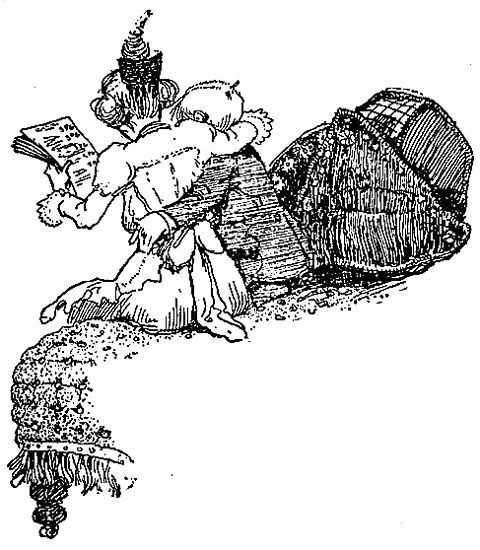
Of course when you had bought a few shirts at twelve dollars a throw, a dressing gown at forty, and silk pajamas at $15 came real natural.
Did I ever tell you how a necktie cost me $150? Well I will, before the super. comes in and tells me there's a new strike in the stitching room.
I was nineteen, and had been clerking for three years in Jed Barrow's store. Jed was so busy putting sand in the sugar, and mixing his Java with a high grade of chicory, he didn't have much time to think of advancing my wages, but I was careful, I had to be, and at the end of three years I had saved $178. I never have forgotten the exact figures, because it came so blamed hard.
There, one day, Jed suggested I take a week's vacation. I think he was afraid I was going to ask for a raise, and did it to get me out of the way, but as my Uncle Ezra had invited me to visit him in Boston I took my week, without pay, and hiked to the big town.
Uncle Ezra was the aristocrat of the family. He lived in one of those old yellow brick houses on Beacon Hill just across from the common, the kind with the lavender glass in the downstairs windows, and if the old man hadn't been so busy being an aristocrat, he'd have made a first-rate radical, for he was continually writing letters to the Transcript complaining about everything as it was.
Uncle Ezra greeted me cordially enough, until he caught sight of my necktie which I'll admit was somewhat bewhiskered and more green than black.
"My boy, what an awful tie!" he exclaimed.
"Really, you must let me buy you another," and he pulled some money out of his pocket.
Being proud, I refused, making some excuses about not having time to buy a new one. The first chance I got, I scooted across to a fancy haberdasher on Tremont Street, and picking out a handsome dark-blue tie told the clerk to wrap it up. I had never paid more than a quarter for a tie, and when he calmly told me it was two dollars I almost fainted, but I felt I couldn't very well refuse to take it so I went to the back of the store and put it on. Do you know Ted, when that rich silk tie was contrasted with my blue serge that had seen considerable service as Sunday best, I felt about as comfortable as a man in overalls wearing a plug hat.
He who hesitates is sold. I hesitated, and the next thing I knew a smart young salesman was selling me a new suit, then I noticed the shoes I was wearing were patched. Well, sir, before I finished I had a complete new outfit, and that store had $150 of my money. It didn't worry me any until I was passing the Savings Bank at home. Then it struck me all of a sudden that in a week I had spent what it had taken three years of back-twisting work to save, and that the net result of my labor I could show in money was exactly nothing.
Ever since I have spent a little less than I earned, and that is a bully principle for you to imitate. I hate a tightwad, Ted, as much as you do; but I hate what is commonly known as a good spender a blame sight more. I don't want you to grow into a man who groans every time he spends a cent, and neither do I want you to feel that money is like the smallpox to be gotten rid of as quickly as possible.
A good spender is usually a man who believes in giving himself a good time, and who leaves his wife to take in boarders and his children to shift for themselves.
Now I'm going to pay your food bills, this time for I don't believe the Exeter townspeople will get much to eat until the storekeepers collect the money owing them, and can lay in a new stock; but you are going to pay for those silk shirts, pajamas, and other dodads, at the rate of three dollars a week until you've paid me back what I advance. Then after you have paid in full, if you want to buy more on the same terms all right.
Your affectionate father,
William Soule.
Lynn, Mass.
May 10, 19—
Dear Ted:
If I'd had time before I left Exeter last week, you and I would have had a heart to heart talk about some of those freak books and magazines I found strewn all over your room.
"Equalization of the Masses," "The Worker's Share," and "The Exploitation of the People," are heavy-sounding titles, and the contents, I should judge from my hurried examination, would be about as easy to digest as a bake-shop plum pudding.
Your study table also seemed to be carrying more than its share of long-haired magazines, and although I read some of their foolishness just to see how foolish they really were, I was afraid all the time I was looking at them, some one would come in and catch me.
Now I've read a considerable number of fool articles in my life, but that one on "Soviet Government for the United States," wins in a walk. How anybody outside of Danvers could believe in such nonsense is beyond me, especially after what has happened in Russia, but as old Jed Bigelow used to say, "There ain't nothin' so foolish but some critter will believe it," and Jed was right.
When you told me a few weeks ago you had joined the Radical Club, I thought it was just a kid fad you'd taken up to have a little something extra to do, but I didn't imagine you'd started in to support all the crack-brained, long-haired, wild-eyed writers who are making a living out of the good nature of this country.
Radicalism is mighty dangerous business Ted, about as safe as smoking cigarettes in a patent leather factory, and if I really thought you believed you were in sympathy with all that nonsense I'd whale you good.
The trouble with you is you're just beginning to think a little for yourself. Now thinking for yourself is fine, but until you begin to direct your thoughts in the right direction you're a good deal like the cannon Uncle Abijah invented during the Spanish War. It was a first-rate gun when he could control it, but it was as likely to kill the people behind it as those at whom it was aimed, so Uncle Abijah gave it up as a bad job after it had blown off most of his whiskers and a couple of fingers.
These radical galoots who want to tip everything in the country upside down from the constitution to the movies get under my hide, and if I had my way I'd make everyone of them work at least eight hours a day and bathe oftener than every thirty-first of February.
It makes me mad clear through, to see these snakes who leave their own countries because the sheriff wants 'em, busy before the immigration authorities can disinfect 'em, plotting to overthrow the government who gives 'em the only chance they ever had.
In a republic all men are born equal, but that's all. It's nonsense to suppose that a good for nothing loafer who makes his living by stirring up hatred against law and order, is the equal of a decent, God-fearing, hard-working citizen, who minds his own business, pays taxes, and tries to raise a family of straight Americans, and if anyone tries to tell me two such men are equal, I'll let him know mighty quick I think he's either a liar or a blame fool.
A lot of children cut open their dolls to see what's inside, and a lot of folks who ought to know better are monkeying around with this radicalism business to see what's in it. I can tell you what's in it: "Nothing!" and working to promote nothing is a fool's job.
Now you may think I'm too conservative, but I believe that when Thomas Jefferson & Co. wrote the constitution of the United States they did a pretty fair job, and until some one can improve on it, which hasn't been done yet, I'm backing up the old constitution with every bit of my strength.
Whenever I hear of anyone becoming interested in radicalism, it always reminds me of an old fellow by the name of Charlie Gabb who lived in Epping. Now Gabb was rightly named, for he used to hang around Sol. Whittaker's store filling the place with hot air, until Sol. nailed chicken wire over the top of his cracker barrels.
Gabb was against everything as it was. Nothing was right, work included, I guess, for he was never known to do any, and was supported by a long-suffering wife who used to earn their living by going out working by the day. He was agin the government, and agin all law, and claimed all wealth should be divided equally among the people. There wasn't anything he couldn't improve on, but as he was harmless in spite of all his talk, no one paid any serious attention to him.
Gabb went on talking for a number of years, without exciting any of the Epping folks over much, and then the woolen mill was built, and a lot of Poles came to town to work in it.
They were hard working, saving sort of people, but as they had only just come over from Poland where I imagine they had a pretty rough time with the Germans on one side and the Russians on the other, both trying to rob them of everything they had, they were down on all governments on general principles, and it wasn't long before old Gabb had made a big impression on them. I don't know as they could be blamed for Gabb could talk louder, and longer, and faster, than anyone else I ever heard, and I'll admit that some of the stuff he had to offer sounded pretty well, until one sat down and started to figure out what it really meant.
Those Poles couldn't have understood much Gabb said, but it sort of flattered them to have an American take any notice of them, so in a short time Gabb became their leader, and used to gather them all together twice a week, on the common, and give them a harangue that would make your hair curl.
Then Epping got the surprise of its life, for one day the Poles quit the woolen mill in a body, and under old Gabb's leadership hiked over to a deserted village five miles back in the hills, where they lived a community life sharing everything alike.
This was a splendid arrangement for Gabb, for never having had anything, when it came time to divide up what there was, Gabb got a little something from each family, and owning nothing himself he didn't have anything to give away. Then, too, as chief of the tribe, he was allotted the best house, and was altogether much better off than he had ever been in his life.
For a time, the village prospered, for the Poles were workers, and weren't afraid to put in a little overtime when their farms needed it, and old Gabb whenever he drove over to Epping used to crow over the success of his socialistic experiment.
Now Gabb had a brother who lived at Bristol Centre, who was a regular fellow, and couldn't see the Epping member of his family with a telescope. The Bristol Centre Gabb had worked hard all his life, and owned one of the largest hog ranches in New England. One day, this brother who was a bachelor died, and Charlie suddenly found himself the owner of a farm and about two thousand hogs.
Now if Charlie Gabb really believed what he'd been preaching for years, he'd have divided up his farm and two thousand hogs among the Poles, who'd been more or less supporting him, but he did nothing of the kind. He left his socialistic friends and moved over to Bristol Centre, taking possession of his brother's farm, hogs, and all.
The Poles heard of their leader's good fortune and waited patiently for him to divide. Nothing doing. Finally, a committee went over and asked old Gabb when the grand division of pigs was to take place, and he chased them off his farm with a pitchfork.
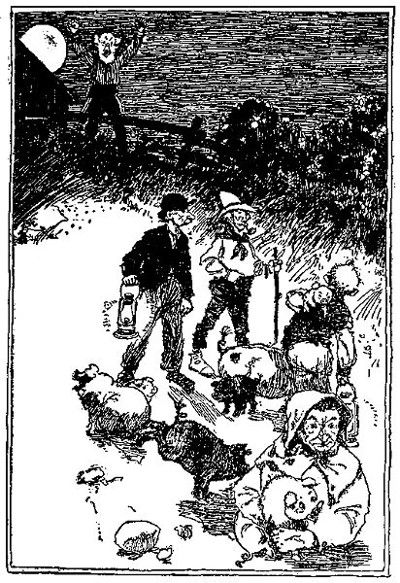
A week later, in the middle of the night, Epping was awakened by the greatest yelling, and squeaking, and grunting, that was ever heard in one place in the history of the world.
The Poles had raided old Gabb's hog farm, and were driving through Epping what they considered their share of his property.
Old Gabb was trailing along behind, cursing and howling for the sheriff, who when he heard what had happened couldn't be found, although I remember seeing him hanging out his window in his night shirt, laughing so hard I thought he'd bust.
Old Gabb started about a hundred lawsuits, but everyone sympathized with the Poles, and as one pig looks about as much like another as two peas do, Gabb couldn't swear to his property, so he lost every case. From the time of the great pig raid until he died, Gabb was the staunchest conservative in the country, and if anyone mentioned socialism to him he nearly had a fit.
Now, Ted, you are going to cut out this radical business pronto, toot sweet, and at once, and if I don't hear from you within a week that you have resigned from that Radical Club and severed diplomatic relations with that sort of nonsense, you'll leave Exeter so quick you won't know what hit you, for as long as I'm head of the Soule tribe, no member of my family is going to do anything that can in any manner be regarded as harmful to the country that our grandfathers fought for from Bunker Hill to Gettysburg.
I know that it is curiosity that has interested you in radicalism. Well, try to realize that in these trying days when the whole future of the world is at stake, every American no matter how young, has as stern a duty to perform in upholding law and order as ever our continentals had at Valley Forge.
Organize an American Club. Get together the biggest boys you can and start a club to teach the young foreigners who work in the mills and factories that America gives a square deal to all.
Show these young fellows through teaching them our American sports, that clean playing and good sportsmanship are two of the biggest things in life. Help teach them to build up, not tear down. You Exeter boys are only boys, and yet as Americans there is nothing you cannot accomplish; and God knows that to help in every possible way, the newcomers among us, to understand our American ideals is as great a privilege as was given to the boys who went "over there," that liberty might not perish from the earth.
Make me proud of you my boy, not ashamed. Make me feel that when I take down the old family Bible and turn to its fly leaf, where the history of our family has been written for generations, that in time your name will be worthy of a place beside those of our men who did their part in making the United States the greatest nation the world has ever known.
Play up Ted! You're one of the country's pinch hitters, and I know you can be depended upon to deliver.
Your affectionate father,
William Soule.
Lynn, Mass.
May 26, 19—
Dear Ted:
You can't imagine how proud I am of this new American Club of yours, and the school is too, if the letters I received from the principal, and most of the professors are good indications of what they feel. The Boston papers have taken it up, and as you have probably seen, Andover is forming an American Club for the young foreigners in the Lawrence mills, and yesterday when I met the Governor, he asked to be introduced to you when he speaks in Lynn next week.
This sort of work is so much more worth while than the radical business, I know you can't help feeling you're a better American for having undertaken it, and you may be sure that when you are older, you'll get a heap of satisfaction out of the thought, that there are a lot of good Americans who might have grown up to be trouble makers, if you and your friends hadn't helped to steer them into good citizenship.
If I were you, I'd accept the principal's offer for the use of the vacant room in the Administration Building. Fit it up as a reading room with a lot of the best magazines, histories of the United States, and lives of famous Americans for the young foreigners who can read English, and get some of the instructors to help teach the ones who can't. Thursday I'll send you a check for $200 which I've raised among a few friends. This will help buy the books, so in the fall when school reopens, you'll be ready to start things with a rush.
As to where you are going to college when you finish school, I wouldn't worry about that now if I were you. Finish school first, by then you'll probably know where you want to go.
I've always found it a pretty good rule to follow, never to worry about another job, until I've finished the one I'm working on. There are lots of people who make themselves sick worrying about things that never happen, when they might as well save their doctor's bills and enjoy life.
Personally, I think it doesn't make much difference where you go, as long as you go to college to do a fair amount of work, and not just to play football and have a good time.
There are a lot of advantages in going to one of the big universities, where you can study anything from Egyptian Hair Dressing in the fourth century B. C., to the vibrations caused by an airplane flying at one hundred miles an hour, and where you have the advantage of wonderful libraries, museums, and laboratories, to help you in your work.
Then again, the small college with its solid academic course, based principally on honest to goodness horse sense, is a pretty good place, for not having fifty-seven varieties of courses, it's apt to rub thoroughly into a boy's hide what it does have to offer.
When the time comes for you to go to college I'm not going to interfere, I am going to let you make your own choice; but as that time is nearly two years away, I'd do a little more thinking about how you are going to pass your final exams, this year, than worrying about what college you are going to enter a year from next fall.
You remind me of a clerk, by the name of Charlie Harris, I once had in the factory. Charlie was a good, hard working boy, came to me right from high school, and as he didn't seem to have a grudge against the hands of the clock because they moved slowly, and was always willing to do a little more than his share of the work, I became interested in him.
Charlie had one queer trick, though, he was never satisfied with finishing the job he had on hand, but was forever worrying about the next bit of work he might have to do, not worrying mind you, because he had the next job coming to him. As I said before Charlie wasn't afraid of work, but he was always afraid something was going to queer the future job, before he could get to it, and get it finished.
One winter, when you were a little chap, my shipper got the grippe and was out for three months. I wished his job on Charlie, and Charlie made good although you never would have thought so from the length of his face. Our shipments were sent out on time, well packed, and properly routed, but Charlie was as doleful as a rejected suitor at a pretty girl's wedding.
There wasn't a day, he didn't come in and spill gloom all over my office, prophesying that soon every thing would go wrong. Nothing happened though, so I used to laugh at him, and tell him to forget it.
Early in February, I was due to make a big shipment of shoes to a jobbers' warehouse on or before March first.
Everything had gone smoothly. I'd had no labor troubles, had bought my stock right, and stood to make a nice juicy profit, for on the first day of February all the shoes were in cases in the shipping room, ready to start on their journey to Chicago.
On the night of the second, it started to snow, for three days it came down in perfect clouds burying Lynn four feet deep.
For three days traffic was completely stalled, for although the snow was wet and sticky when the storm started, along in the afternoon of the second day, it turned cold, with the result that the whole mass turned into ice, and made it impossible to clear the streets.
Still I wasn't worrying any, for Jim Devlin my old truckman, I knew, would be among the first to do business as soon as it was possible to get through the streets, and I still had several days leeway before my shoes must start for Chicago.
On the morning of the fifth day when pungs were beginning to get around, Charlie gloomed into my office, and informed me that Devlin hadn't a single team on runners, having the previous fall traded off all his pungs for drays. Devlin had been so sure he could hire enough pungs to take care of our big shipment, he hadn't even told us the fix he was in, until having tried every teamster and livery stable within miles of Lynn, he found he couldn't get a single one. Everybody wanted pungs, and the truckmen who owned any were rushing theirs night and day to take care of their regular customers.
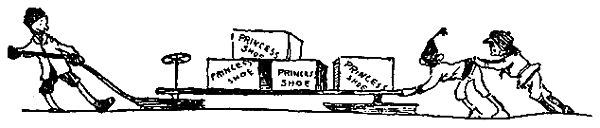
I tried to borrow from everyone I knew, with no luck, for all the shoe manufacturers had use for every pung they could get their hands on to get their own shoes to the freight yards. Finally, I gave up in disgust, and sat down to figure out my loss, when I happened to glance out the window of my office, that looks out on the alley that leads to our shipping room door.
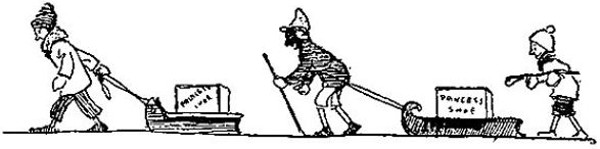
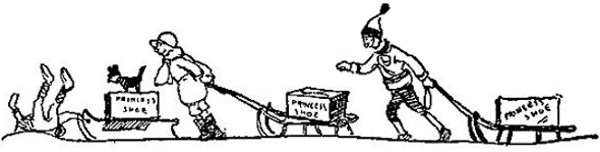
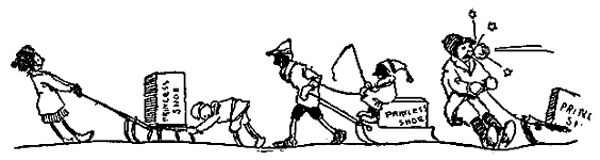
There were about three hundred kids lined up there, each one with a sled, and I wondered what in the world they were up to, when one staggered around the corner of our building, dragging a sled after him, on which was perched a shoe case with "The Princess Shoe," stencilled in red letters across the top.
I let out a whoop, and dove for the shipping room, where I found Charlie and his crew as busy as ants, tying cases of shoes onto the kids sleds as fast as the boys backed them up to the shipping-room door.
Before night, every case of shoes had been delivered to the freight yards, and Charlie's pay had been increased $10 a week, but the next morning when I reached the factory, I found him almost weeping because he was afraid that when the snow melted it would flood our shipping room which in those days was level with the street.
For five years after that, I used Charlie as a sort of pinch hitter around the factory giving him all sorts of work, but never letting him know what his next job was to be, and as he couldn't worry about what was coming, he more than made good.
Ted, any real college is a good college. It's all up to you, for so far as I know, there's nothing to prevent you learning a lot in any one of them. The thing for you to do for the next two years, is to study hard at Exeter, then when it comes time to take your exams, you needn't be afraid about being able to get into any college you choose.
I'll be in Exeter Saturday to have a look at your American Club, and at his special request I'm bringing the Governor's private secretary with me. So long old boy.
Your affectionate father,
William Soule.
Lynn, Mass.
June 8, 19—
Dear Ted:
If the super. had come in, and told me the hands were going to strike, unless I lowered the piecework rates, I wouldn't have been more surprised, than I was at your last letter. It was some shock; and at first I couldn't believe you were serious; after re-reading it I see you are, and I guess a few hints from the old man may help relieve the pain a bit, for it's as plain as your Aunt Sarah you're going to suffer, no matter how your love affair turns out.
To me, the idea of your really being in love, seems as impossible as Trotsky being elected Alderman by the Beacon Hill Ward of Boston, but it doesn't take a specialist to diagnose the symptoms, and from the stuff you have spilled all over the pages of your last letter, I should say you had an acute case with a fever going on 105 degrees.
Now, I say no matter how things turn out it is going to be painful, and at your age and vast experience of life, it can only turn out one way, and that's a broken heart for you for about a week, and then a gradual interest in life, until two weeks from now the outcome of the baseball game with Andover, will be even more important to you than how to get enough to eat between meals.
There's one thing you have done though Ted, you've played fair with the old man, and that's entered on the credit side of your ledger, although you may not think so when you've finished this letter. I am glad you introduced me to the girl at the game last Saturday, and I assure you I enjoyed every minute of her society, and would again, for she and I had a lot in common, both of us being practical business men. But when it comes to having her for a daughter-in-law, I can think up more reasons for not wanting her, than a jobber can for refusing to stock a line of shoes he feels may be out of style, before he can unload them on the retailer.
In the first place, Ted, I should judge she is slightly older than you, about eight years is my guess, and although eight years is all right when it's on the man's side, it's apt to be pretty awkward when your wife is constantly referred to by strangers as your mother; likely to make you feel foolish, and the lady peevish; and about the time you'll be thinking of changing from tennis to golf, she'll be changing from one piece dresses to wrappers, and wrappers never yet kept a man's eyes from straying in other directions.
Miss Shepard is good looking, I'll admit; real attractiveness though in spite of the soap advertisements and beauty doctors, is more than skin deep, and you must remember that no matter how perfect a surface a thing has, it's the quality underneath that counts.
After all there's not much difference between girls and sole leather. A run of leather on the warehouse floor, may look like nice profits, and when it's cut you find it didn't figure out at all as you expected; and a girl may look like a June morning before marriage, and turn out an equinoctial storm afterwards.
A smart shoe man, doesn't buy a block of leather without sizing up what's under the grain, and a young man when looking around for steady company can well do likewise. I don't want you to think I have anything against good looks, I haven't and if you can get them with other qualities, all right. It must be tough, to have to sit opposite a face at breakfast, that curdles the milk in your coffee, but better that and sizzling ham and eggs, than a rose bud for looks, and cold oatmeal.
Your lady-love didn't strike me as a young woman of means, and as for your capital, it consists principally of some loud clothes and a fair knowledge of football, neither being what you might call liquid assets, when it comes to setting up housekeeping. And speaking of housekeeping, do you think she is the kind of girl, who would enjoy getting three squares a day, running the vacuum cleaner in between, with dish washing and mending as side lines?
Now Hortense may be only six or eight years older than you. In wisdom she's nearly twenty, and you had better believe she's got no fool ideas about trying to live on three dollars a day, with sugar twenty cents a pound. No girl who's lived all her life in an academy town is so foolish as that, and if you think I'm going to finance you a couple of years from now, in a home of your own, you're taking off with the wrong foot.
I know I married when I was only twenty and was getting $18.00 a week, but your Ma is one woman in a million, a country town girl who was taught housekeeping from childhood, and who could make a dollar go further than even the immortal George, when he made his famous throw from deep center in the Potomac League. She could take my week's pay on a Saturday night, after having set aside the rent and insurance money, buy enough food for the next week, the clothes we needed, and still have some left to tuck away in the savings bank. And right here, let me tell you if you ever make another crack like you did two weeks ago, about your Ma wearing too many rings, I'll give you the worst licking you ever had. Perhaps she does, but she likes 'em, and when I think of the work those fingers have done for us, she's welcome to cover 'em with rings, if she likes, and her thumbs also for that matter.
Your Ma made me, and the right girl is the best inspirer of success a young fellow can have, while the wrong kind, is about as much help to a man trying to shin up the greased pole of success, as a nice thick coating of lard on his fingers.
Probably you don't remember John White. John and I were great pals when we were boys. Used to swim, play ball, and hunt together, fought at least one pitched battle a week, but when any one touched either of us, the other was on the intruder like a wildcat. We both got married about the same time, and John who was sensible as he could be in most things, picked out a girl who hadn't the brains of an intelligent guinea pig.
We were both working in Clough & Spinney's at the time, and three months after John was married, he had indigestion, and was wearing safety pins on his clothes instead of buttons.
Noon hours, he used to tell me what a lucky fellow he was to have married Priscilla, but as the weeks went by his praises seemed to lack the right ring, although I must say he did his best.
I often wondered how he was getting along, for in my estimation Priscilla Brown was pretty much of a lightweight, and although a nice enough girl, about as useful around a house, as one of those iron dogs some folks have on their front lawns. One day, John invited us over to Topsfield, where he lived, to supper. When we got there, I thought your Ma would have a fit. She's as orderly as a West Point Cadet, and there were clothes strewn all over John's parlor, and more dust on the furniture, than there is in some of the seashore lots the fly-by-night real estate companies sell.