Introductory material (continued 3)
Reading edition
"Rah! Rah! Rah! Thor! Thor! Thor! He's—all—right!"
"Come, fellows," spoke T. Haviland Hicks, Jr.
"Let's sing to the captain, good old Butch! Let 'er go!"
"Here's to good Butch Brewster! Drink it down! Here's to good Butch Brewster! Drink It down! Here's to good Butch Brewster— He plays football like he uster— Drink it down! Drink it down—down—down—down!"
A strange sound startled the joyous youths; it was a rumbling noise, like distant thunder, and at first they could not place it. Then, as It continued, they located the disturbance as coming from the prodigious body of Thor, and at last the wonderful phenomenon dawned on them.
"Thor is singing college songs!" quavered little Theophilus Opperdyke, so happy that his big-rimmed spectacles rode the end of his nose. "Oh, Hicks—Butch—Thor is awake at last! He is trying to get college spirit, to understand campus life—"
T. Haviland Hicks, Jr., suddenly realized that what he had so ardently longed for had come to pass; aided by Theophilus' missionary work and by the sudden shock of Thorwald, Sr.'s, letter. Thor was awakened, had come to know that he loved old Bannister. His awakening, as shown in the football game, had been splendid. How he had towered over the scrimmage, in every play, urging his team to fight, himself doing prodigies for old Bannister. Thor, who had been so silent and aloof! Then the sunny-souled youth remembered.
"Oh, I told you I'd awaken Thor, Butch!" he began, but that behemoth quelled him with an ominous look.
"You!" he growled, with pretended wrath, "you! It was Theophilus Opperdyke who did the most of it, and Thorwald's father did the rest! Don't you rob Theophilus of his glory, you feeble-imitation-of-some-thing-human!"
T. Haviland Hicks, Jr., grinned à la Cheshire cat. The happy-go-lucky Senior was vastly glad that Thor had awakened, that now he would try to grasp the real meaning of college existence. He felt that the young Hercules, from now on, would slowly and surely develop to a splendid college man, that he would do big things for his Alma Mater. And the generous Hicks gave Theophilus all the credit, and impressed on that happy Human Encyclopedia the fact that he had done a great deed for old Bannister. Just so, Thor was awakened.
"Oh, I say, Deke Radford, Coach, and Butch," Hicks chortled, getting the attention of that triumvirate as well as that of the others in the room, "remember up in Camp Bannister, in the sleep-shack, when Coach Corridan outlined a smashing full-back he wanted?"
"Sure!" smiled Deke. "What of it, Hicks?"
Then T, Haviland Hicks, Jr., that care-free, lovable, irrepressible youth, whose chance to swagger before this same trio had been postponed so long and seemingly lost forever, satiated his fun-loving soul and reaped his reward. Calling their attention to Thor, the Prodigious Prodigy, and asking them to remember his playing against Latham that day, the sunny Senior strutted before them vaingloriously.
"Oh, I told you just to leave it to Hicks!" he declared, grinning happily. "I promised to round up an unstoppable fullback, a Gargantuan Hercules, and I did! Just think of what he will do to Hamilton and Ballard in the big games! As I have often told you, always—leave It to Hicks!"
CHAPTER XI
"ALL'S WELL THAT ENDS WELL"
"Oh, what we'll do to Ballard Will surely be a shame! We'll push their team clear off the field And win the football game!"
T. Haviland Hicks, Jr., one night three days after the first big game, that with Hamilton, a week following Thor's great awakening in the Latham game, sat in his cozy room, having assumed his favorite position—chair tilted back at a perilous angle and feet thrust atop of the radiator. The versatile youth, having just composed a song with which to encourage Bannister elevens in the future, was reading it aloud, when his mind was torpedoed by a most startling thought.
"Land o' Goshen!" reflected the sunny-souled Senior, aghast. "I haven't twanged my ole banjo and held forth with a saengerfest for a coon's age! I surely can do so now without arousing Butch to wrath. Thor has awakened, Hamilton is walloped, and Bannister will surely win the Championship! Everything is happy, an' de goose hangs high, so here goes!"
Holding his banjo à la troubadour, the blithesome Hicks, who as a Senior was harassed by no study-hours or inspections, strode from his room and out into the corridor, up and down which he majestically paced, like a sentinel on his beat, twanging his beloved banjo with abandon, and roaring in his foghorn, subterranean voice:
"Oh, the way we walloped Hamilton Surely was a shame! And we're going to win the Championship— For we'll do Ballard the same!
"And Bannister shall flaunt the flag For at least three seasons more; Because—no team can win a game While the Gold and Green has Thor!"
On Bannister Field, three days before, the Gold and Green had crushed the strong team from "old Ham" to the tune of 20 to 0; Thor's magnificent ground-gaining, in which he smashed through the supposedly impregnable defense of the enemy, was a surprise to his comrades and a shock to Hamilton. Time and again, on the fourth down, the ball was given to Thorwald, and the blond Colossus, with several of old Ham's players clinging to him, plunged ahead for big gains. So now with a monster mass-meeting in half an hour, the exultant Bannister youths pretended to study, but prepared to parade on the campus, cheer the eleven and Thor, and arouse excitement for the winning of the biggest game, a victory over Ballard, a week later.
From the rooms of would-be studious Seniors on both sides of the corridor, as Hicks patrolled it, came vociferous protests and classic criticisms, gathering in force and volume as the breezy youth's foghorn voice roared his song; that heedless collegian grinned as he heard:
"R-r-rotten! Give that Jersey calf more rope!"
"Hicks has had a relapse! Sing-Sing for yours, old man!"
"Arrest Hicks, under the Public Nuisance Act!"
"Woof! Woof! Shoot it quick! Don't let it suffer!"
Just as T. Haviland Hicks, Jr., strumming the banjo blithely and Carusoing with glee, reached the end of the corridor and executed a brisk 'bout-face, he heard a terrific commotion on the stairway, and, a moment later, Butch Brewster, Beef McNaughton, Deacon Radford and Monty Merriweather gained the top of the stairs. As they were now between the offending Hicks and his quarters, there seemed no chance for the sunny Senior to play his safety-first policy; so he waited, panic-stricken, as Butch and Beef lumbered heavily down the corridor.
"Help! Aid! Succor! Relief! Assistance!" shrieked Hicks, leaning his beloved banjo against the wall and throwing himself into what he fatuously believed was an intensely pugilistic pose. "I am a believer in preparedness. You have me cornered, so beware! I am a follower of Henry Ford, but even I will fight—at bay!"
"Well, you are at sea now!" growled Beef, tucking the splinter youth under one arm and striding down the corridor, followed by Butch with the banjo, and Monty with Deacon. "You desperado, you destroyer of peace and quietude, you one-cylinder gadabout! You're off again! We'll instruct you to annoy real students, you faint shadow of something human!"
"Them's harsh sentences, Beef!" chuckled T. Haviland Hicks, Jr., as that behemoth kicked open Hicks' door, bore the futilely squirming, kicking youth into the room, and hurled him on the davenport. "Watch my banjo, there, Butch; have a couple of cares! Say, what'smatter wid youse guys, anyhow? This is my first saengerfest for eons. Old Bannister has a clear track ahead at last, the Championship is won for sure, and Thor, that mighty engine of destruction to Ham's and Ballard's hopes, after much tinkering, is hitting on all twelve cylinders. Why, I prithee, deny me the pleasure of a little joyous song?"
T. Haviland Hicks, Jr., since the memorable Latham game, when Thor had awakened between halves, and the Prodigious Prodigy had shown himself worthy of his title by winning the game after defeat leered at old Bannister, had suffered a relapse, and was again his old sunny, heedless, happy-go-lucky self. Now that John Thorwald had been startled into realizing that he loved his college and had been saved from having to leave, now that he played football for his Alma Mater, and Bannister's hopes of the Championship were roseate, the blithesome Hicks had abandoned himself to a golden existence of Beefsteak Busts downtown at Jerry's, entertaining jolly comrades in his cozy room, and pestering the campus with his banjo and ridiculous imitations of Sheerluck Holmes, the Dachshund Detective. Big Butch Brewster, lecturing him for his care-free ways, as futilely as he had done for three years past, gave up in despair.
"I might as well be showing moving-pictures to the inmates of a blind asylum," he growled on one occasion, "as to persuade you to quit acting like a lunatic! You, a Senior—acting like an escaped inhabitant of Matteawan! Bah!"
Big Butch Brewster, drawing a chair up to the davenport, assumed the manner of a physician toward a recalcitrant patient, while Beef carefully stowed the banjo in the closet and Deacon Radford, an interested spectator, sat on the bed. The happy-go-lucky Hicks, at a loss to account for the strange expressions of his comrades, tried to arise, but the football captain pinned him down with one hand.
"Seriously, Hicks," spoke Butch, "your saengerfest came at a lamentably inopportune time! I regret to Inform you that old Bannister faces another problem, with regard to Thor, and unless it is solved, I fear—"
"Thor has balked again?" gasped the dazed Hicks, whom Butch now allowed to sit up, as he showed interest. "Has the engine of destruction stalled? Why, as fast as we get him lined up, off he slides at an angle! Well, you fellows did perfectly right to bring this baffling problem, whatever it is, to me. What is the trouble—won't Thor play football?"
The irrepressible Hicks was bewildered at hearing that a new problem regarding Thor had arisen, and, naturally, he at once connected it with football, since the big Freshman had twice balked in that respect. Since his awakening, effected by Theophilus' missionary work, his last appeal, and Thor's letter from his father, Thor had earnestly striven to grasp the true meaning of college life, to understand campus tradition. No longer did he hold aloof, boning always, in his lonely room. Instead, he mingled with his fellows, lingering with the team for the skylarking in the shower-room after scrimmage, turning out for the nightly mass-meeting. Often, as the youths practiced songs and yells on the campus, Thor's terrific rumble was heard—some had even dared to slap his massive back and say, "Hello, Thor, old man!" and the big Freshman had responded. It was evident to all that Thorwald was striving to become a collegian, and knowing his slow, bulldog nature, there was no doubt as to his ultimate success; hence T. Haviland Hicks, Jr., was vastly puzzled now.
"Oh, Thor hasn't backslid!" smiled Beef. "You see, Hicks, it's this way: Owing to Mr. Thorwald's losing the five thousand dollars, Thor, as you know, is working his way at Bannister. Well, with his hustling, his studies and football scrimmage, he simply does not have a minute for the other phases of college life, for the comradeship with his fellows—"
"Here is his day's schedule," chimed in Deacon, referring to a paper: "Rise at four-thirty A. M. Hustle downtown to tend several furnaces until seven. Breakfast at seven. Till nine, make beds and sweep dormitory rooms. Nine till three-fifteen P. M., recitation periods and dormitory work, sandwiched. Then until supper, football practice, and nights study. Add to that waiting on tables for the three meals, and what time has Thor to broaden and develop, to take in all the big things of campus existence, to grow into an all-round college man?"
T. Haviland Hicks, Jr., wonderful to chronicle, was silent. He was reflecting on the irony of fate; as Deacon said, now that Thor had awakened, and earnestly wanted to be a collegian, he had no time to enter into campus life. Glad at being able to stay at old Bannister, to keep on with his studies, climbing steadily toward his goal, and finding a joy in his new relationship with the students, the ponderous Thorwald had flung himself into his hustling, as the youths called working one's way at college, with zeal. To the huge Freshman, toil was nothing, and since it meant that he could keep on with his study, he was content. The collegians vastly admired his grim determination; they aided all they could with his studies, and helped with his work, so he could have more time for scrimmage, and yet another phase of the problem came to Hicks.
It seemed unjust that John Thorwald, after his long years of hard physical toil, and his mental struggles, often after hours of grinding work, at the very time when the five thousand dollars from Henry B. Kingsley's heirs promised him a chance to study without a body tortured and exhausted, should be forced again to take up his stern fight for knowledge. And it was cruel that Thor, just awakening to the true meaning of college life, striving to grasp campus tradition, and eager to serve his Alma Mater in every way, should have so little time to mingle with his fellows. He should be with them on the campus, on the athletic field, in the dorms., the literary society halls, the Y. M. C. A. He should be realizing the golden years of college life, the glad comradeship of the campus. Instead, he must arise in the bitter cold, gray dawn, and from then until late night toil and study unceasingly.
"It's a howling shame!" declared the serious Hicks, a heart full of sympathy for Thor. "Just as he wakes up and is trying to understand things at old Bannister, bang! the Norwhal is blown up by a stray mine, and down goes his dad's money. Why didn't Mr. Thorwald get the five thousand transferred to the Valkyrie? Oh, if that money hadn't gone down to Davy Jones' locker, Thor would be awakened and have time for college life, too!"
Butch Brewster started to speak when the thunderous tread of John Thorwald sounded in the corridor. The Prodigious Prodigy seemed approaching at double-quick time, and the youths stared at each other. However, when Thor appeared in the doorway, a letter in hand, they gazed at him in bewilderment, for his face fairly glowed.
"Read it, fellows, read it!" he breathed, with what, for him, was almost excitement. "It just came! Oh, isn't that good news? Read it out, Captain Butch. Won't we wallop Ballard now!"
Big Butch Brewster, mystified by Thor's happiness, and urged on by his equally puzzled comrades, drew out the letter, and a glad smile coming to his honest countenance, he read aloud:
"THE NEW YORK-CHRISTIANIA. STEAMSHIP LINE (New York Office)
"Nov. 18, 19—.
"MR. JOHN THORWALD, JR., Bannister College.
"DEAR SIR:
"We beg to state that your father, first mate on our liner, the Valkyrie, three days outbound from New York to Christiania, sent a message, via wireless, to our New York offices by the inbound Dutch Line's Rotterdam. The Rotterdam relayed the message to us, and we forward it herewith, verbatim:
"'DEAR SON: Purser of my ship, the Valkyrie, informed me today that the purser of the ill-fated Norwhal, learning of my transfer to this liner, transferred my $5,000 to the Valkyrie before he sailed to his fate. I am sending this via the Rotterdam, inbound, and our office will forward it to you. Will write on arriving at Christiania. Father.'
"We are sorry for the delay in forwarding this message, but through an accident, it was mislaid in our office for a few days.
"Yours truly,
"THE NEW YORK-CHRISTIANIA STEAMSHIP LINE,
"per J. L. G."
A moment of silence; outside on the campus the Bannister youths, preparing for the mass-meeting in the Auditorium, started cheering. Someone caught sight of Thor, standing now by the window of Hicks' room, on the third floor of Bannister Hall, and a few seconds later there sounded:
"Thor! Thor! Thor! Thor will bring the Championship to old Bannister! Rah! Rah! Rah!—Thor!"
"Oh," shouted T. Haviland Hicks, Jr., grinning happily, his arm across Thor's massive shoulders, "'All's well that ends well,' as Bill Shakespeare says. It's all right now, Thor. Fate dealt you a hard punch, but it served its purpose; for it made you realize how you would regret to leave college. Now you won't have to hustle and have all your time filled with toil and study; you can go after every phase of campus life, and serve old Bannister in so many ways."
John Thorwald stood, a contented look on his placid, impassive face, gazing down at the campus below and hearing the plaudits of the excited collegians. The stately old elms, gaunt and bare, tossed their limbs against a leaden sky; a cold, dreary wind sent clouds of dry leaves scurrying down the concrete walks. In the faint moonlight that struggled through the clouds, the towers and spires of old Bannister were limned against the sky-line. Across the campus, on Bannister Field, the goal-posts, skeleton-like, kept their lonely vigil. On that field, in less than a week, the Gold and Green must face the crucial test—against Ballard's championship eleven, in the Biggest Game; and now, almost on the eve of battle, the shackles had been knocked from him; he was free of the great burden, free to serve his Alma Mater, to fight for the Gold and Green, to grow and develop into an all-round, representative college man.
All of a sudden it dawned on the slow-thinking young Norwegian just how much this freedom to grow and expand meant to him, and he turned from the window. From below, the shouts of "Thor! Thor! Thor!" drifted, stirring his blood, as he looked at Hicks, Butch, Beef, Monty and Deacon.
"'All's well that ends well,' you say. Hicks," he spoke slowly, his face joyous. "That's true; but I'm just starting, fellows. I'm just beginning to live my college years, not for myself, but for old Bannister, for my Alma Mater, for I am awake, and free!"
CHAPTER XII
THEOPHILUS BETRAYS HICKS
Big Butch Brewster, a life-sized picture of despair, roosted dejectedly on the Senior Fence, between the Gym and the Administration Building. It was quite cold, and also the beginning of the last study-period before Butch's final and most difficult recitation of the day, Chemistry. Yet instead of boning in his warm room, the behemoth Senior perched on the fence and stared gloomily into space.
As he sat, enveloped in a penumbra of gloom, the campus entrance door of Bannister Hall, the Senior dorm., opened suddenly, and T. Haviland Hicks, Jr., that happy-go-lucky youth, came out cautiously, after the fashion of a second-story artist, emerging from his crib with a bundle of swag, the last item being represented by a football tucked under Hicks' left arm. Beholding Butch Brewster on the Senior Fence, the sunny-souled Senior exhibited a perturbation of spirit seeming undecided whether to beat a retreat or to advance.
"Now what's ailin' you?" demanded Butch wrathily, believing the pestersome Hicks to be acting in that burglarious manner for effect. "Why should you sneak out of a dorm., bearing a football like it was an auk's egg? Why, you resemble a nigger, making his get-away after robbing a hen-roost! Don't torment me, you accident-somewhere-on-its-way-to-happen. I feel about as joyous as a traveling salesman who has made a town and gotten nary a order!"
"It's awful!" soliloquized T. Haviland Hicks, Jr., perching beside the despondent Butch on the Senior Fence. "I am not a fatalist, old man, but it does seem that fate hasn't destined Thor to play football for old Bannister this season! Here, after he won the Ham game, and we expected him to waltz off with Ballard's scalp and the Championship, he has to tumble downstairs! Oh, it's tough luck!"
It was two days before the biggest game, with Ballard—the contest that would decide the State Intercollegiate Football Championship. Ballard, the present champions, discounting even Hamilton's stories of Thor's prowess, were coming to Bannister with an eleven more mighty than the one that had crushed the Gold and Green the year before, with a heavy, stonewall line, fast ends, and a powerful, shifty backfield. The Ballard team was confident of victory and the pennant. Bannister, building on the awakened Thorwald, superbly sure of his phenomenal strength and power, of his unstoppable rushes, serenely practiced the doctrine of preparedness, and awaited the day.
And then John Thorwald, the Prodigious Prodigy, whose gigantic frame seemed unbattered by the terrific daily scrimmage, whom it was impossible to hurt on the gridiron, the day before, going downstairs in Creighton Hall, hurrying to a class, had caught his heel on the top step, and crashed to the bottom! And now, with a broken ankle, the blond Colossus, heartbroken at not being able to win the Championship for old Bannister, hobbled about on crutches. Without Thor, the Gold and Green must meet the invincible Ballard team! It was a solar-plexus blow, both to the Bannister youths, confident in Thor's prowess, building on his Herculean bulk, and to the big Freshman. Thorwald, awakened, striving to grasp campus tradition, to understand college life, was eager to fling himself into the scrimmage, to give every ounce of his mighty power, to offer that splendid body, for his Alma Mater, and now he must hobble impotently on the side-line, watching his team fight a desperate battle.
"If Bannister only had a sure, accurate drop-kicker!" reflected Captain Butch hopelessly. "One who could be depended on to average eight out of ten trials, we'd have a fighting chance with Ballard. Deke Radford is a wonder. He can kick a forty-five-yard goal, but he's erratic! He might boot the pigskin over when a score is needed from the forty-yard line, and again he might miss from the twenty-yard mark. Oh, for a kicker who isn't brilliant and spectacular, but who can methodically drop 'em over from, say, the thirty-five-yard line! Hello, what's the row, Hicks?"
T. Haviland Hicks, Jr., started to speak, changed his mind, coughed, grew red and embarrassed, and acted in a most puzzling manner. At any other time, big Butch would have been bewildered; but with Thor's loss weighing on his mind, the Gold and Green captain gave his comrade only a cursory glance.
"I—I—Oh, nothing, Butch!" stammered Hicks, to whom, being "fussed," as Bannister termed embarrassment, was almost unknown. "I—I guess I'll take this football over to my locker in the Gym. I ought to glance at my Chemistry, too. So-long, Butch; see you later, old top!"
When the splinter-youth had drifted into the Gym., Butch Brewster, remembering his strange actions, actually managed to transfer his thoughts for a time from the eleven to the care-free T. Haviland Hicks, Jr. The behemoth Senior reflected that, to date, the pestiferous Hicks had not explained his baffling mystery he recalled the day when he had told the Gold and Green eleven of the loyal Hicks' ambition to please his dad by winning his B, when he had described the youth's intense college spirit and had suggested that if Hicks failed to corral his letter the Athletic Association award him one for his loyalty to old Bannister. And Butch saw again the bewildering sentences in the letter from Thomas Haviland Hicks, Sr., to his son.
"Evidently," meditated Butch, literally and figuratively "on the fence," "Hicks has failed to summon up enough self-confidence to explain his mystery; queer, too, for he usually is bubbling with faith in himself. He has acted like a bashful schoolgirl at frequent times—he starts to tell me something, then he gets embarrassed, back-fires, and stalls. He and Theophilus have been sneaking out in the early dawn, too. Wow! What did he sneak out of the dorm. that way, with a football, for? He looked like a yeggman working night shift. Why should he skulk out with a football? He has never explained his dad's letter, or told just what Mr. Hicks meant by calling him the "Class Kid" of Yale, '96, and saying those members of old Eli wanted him to star! Oh, he's a tantalizing wretch, and I'd like to solve his mystery, without his knowledge, so I could—"
At that instant, to the intense indignation and bewilderment of good Butch Brewster, little Theophilus Opperdyke, the timorous Human Encyclopedia of old Bannister, exited from Bannister Hall. The Senior boner gave a correct imitation of the offending Hicks, in that he skulked out, gazing around him nervously; but he portaged no pigskin, and, unlike the sunny youth, on periscoping Butch, he seemed relieved.
"Theophilus, come here!" thundered the wrathful football captain, shifting his tonnage on the Senior Fence. "What's the plot, anyhow? It's bad enough when T. Haviland Hicks, Jr., sneaks out, bearing a football, like an amateur cracksman making a getaway; but when you appear, imitating a Nihilist about to hurl a bomb—say, what's the answer to the puzzle, old man?"
Little Theophilus, his pathetically frail body trembling with suppressed excitement, his big-rimmed spectacles tumbling off with ridiculous regularity, and his solemn eyes peering owlishly at his behemoth classmate, stood before the startled Butch. It was evident that the 1919 grind labored under great stress. He was waging a terrific battle with himself, struggling to make some vast and all-important decision. He strove to speak, hesitated, choked, coughed apologetically, and acted as fussed as Hicks had done, until Butch was wild; then, as if resolved to cast the die and cross the Rubicon, he decided, and plunged desperately ahead.
"It's—it's Hicks, Butch!" he quavered, torn cruelly by conflicting emotions. "Oh, I don't want to be a traitor—he trusted me with his secret, and I—I can't betray him, I just can't! But he didn't make me promise not to tell. He just told me not to. Oh, it's his very last chance, Butch, and with Thor hurt, old Bannister might need him in the Ballard game."
"What is it, Theophilus, old man?" Butch spoke kindly, for he saw the solemn little Senior was intensely excited. "Tell me—if our Alma Mater needs any fellow's services, you know, he should give them freely—since you did not promise not to tell about Hicks, if Bannister may be able to use Hicks against Ballard—though I can't, by any stretch of the imagination, figure how—then it is your duty to tell! I think I glimpse the dark secret—Hicks possesses some sort of football prowess, goodness knows what, and he lacks the confidence to tell Coach Corridan! Now, were it only drop-kicking—"
"It is drop-kicking!" Theophilus burst forth desperately. "Hicks is a drop-kicker, Butch, and a sure one—inside the thirty-yard line. He almost never misses a goal, and he kicks them from every angle, too. He isn't strong enough to kick past the thirty-yard line, but inside that he is wonderfully accurate. With Thor out of the Ballard game, a drop-kick may win for Bannister, and Deke Radford is so erratic! Oh, Hicks will be angry with me for telling; but he just won't tell about himself, after all his practice, because he fears the fellows will jeer. He is afraid he will fail in the supreme test. Oh, I've betrayed him, but—"
"T. Haviland Hicks, Jr., a drop-kicker!" exploded the dazed Butch, who could not have been more astounded had Theophilus announced that the sunny youth possessed powers of black magic. "Theophilus Opperdyke, Tantalus himself was never so tantalized as I have been of late. Tell me the whole story, old man—hurry. Spill it, old top!"
Butch Brewster, by questioning the excited Human Encyclopedia, like a police official giving the third degree, slowly extracted from Theophilus the startling story. A year before, just as the Gold and Green practiced for the Ham game, T. Haviland Hicks, Jr., one afternoon, had arrayed his splinter-structure in a grotesque, nondescript athletic outfit, and had jogged out on Bannister Field. The gladsome youth's motive had been free from any torturesome purpose. He intended to round up the Phillyloo Bird, Shad Weatherby, and other non-athletic collegians, and with them boot the pigskin, for exercise. However, little Skeet Wigglesworth, beholding him as he donned the weird regalia of loud sweater, odd basket-ball stockings, tennis trousers, baseball shoes, and so on, misconstrued his plan, and believed Hicks intended to torment the squad. Hence, he hurried out, so that when Hicks appeared in the offing, the football squad and the spectators in the stands had jeered the happy-go-lucky Junior, and had good-natured sport at his expense.
T. Haviland Hicks, Jr., after Jack Merritt had drop-kicked a forty-yard goal, made the excessively rash statement that it was easy. Captain Butch Brewster had indignantly challenged the heedless youth to show him, and the results of Hicks' effort to propel the pigskin over the crossbar were hilarious, for he missed the oval by a foot, nearly dislocated his knee, and, slipping in the mud, he sat down violently with a thud. However, so the excited Theophilus now narrated, even as the convulsed students jeered Hicks, hurling whistles, shouts, cat-calls, songs and humorous remarks at the downfallen kicker, one of Hicks' celebrated inspirations had smitten the pestersome Junior, evidently jarred loose by his crashing to terra firma.
"Hicks figured this way, Butch," explained little Theophilus Opperdyke, eloquent in his comrade's behalf, "nature had built him like a mosquito, and endowed him with enough power to lift a pillow; hence he could never hope to play football on the 'Varsity; but he knew that many games are won by drop-kicks and by fellows especially trained and coached for that purpose, and they don't need weight and strength, but they must have the art, that peculiar knack which few possess. His inspiration was this: Perhaps he had that knack, perhaps he could practice faithfully, and develop into a sure drop-kicker. If he trained for a year, in his Senior season, he might be able to serve old Bannister, maybe to win a big game. So he set to work."
Theophilus hurriedly yet graphically narrated how T. Haviland Hicks, Jr., had made the loyal, hero-worshiping little Human Encyclopedia his sole confidant. He told the thrilled Butch how the sunny youth, from that day on, had watched and listened as Head Coach Corridan trained the drop-kickers, learning all the points he could gain. Vividly he described the mosquito-like Hicks, as he with a football bought from the Athletic Association began in secret to practice the fine art of drop-kicking! For a year, at old Bannister and at his dad's country home near Pittsburgh, Hicks had faithfully, doggedly kept at it. With no one bat Theophilus knowing of his great ambition, he had gone out on Bannister Field, when he felt safe from observation; here, with his faithful comrade to keep watch, and to retrieve the pigskin, he had practiced the instructions and points gained from watching Coach Corridan train the booters of the squad. To his vast delight, and the joy of his little friend, Hicks had found that he did possess the knack, and from before the Ham game until Commencement he had kept his secret, practicing clandestinely at old Bannister; he had improved wonderfully, and when vacation started the cheery collegian had told his beloved dad, Mr. Thomas Haviland Hicks, Sr., of his hopes.
The ex-Yale football star, delighted at his son's ambition to serve old Bannister and joyous at discovering that Hicks actually possessed the peculiar knack of drop-kicking, coached the splinter-youth all summer at their country place near Pittsburgh. Under the instruction of Hicks, Sr., the youth developed rapidly, and when he returned to the campus for his final year, he was a sure, dependable drop-kicker, inside the thirty-yard line. As Theophilus stated, beyond that he lacked the power, but in that zone he could boot 'em over the cross-bar from any angle.
"He's been practicing all this season, in secret!" quavered the little Senior, "and he's a—a fiend, Butch, at drop-kicking. And yet, here it is time for the last game of his college years, and—he lacks confidence to tell you, or Coach Corridan. Oh, I'm afraid he will be angry with me for betraying him, and yet—I just can't let him miss his splendid chance, now that Thor is out and old Bannister needs a drop-kicker!"
Big Butch was silent for a time. The football leader was deeply impressed and thrilled by Theophilus Opperdyke's story of T. Haviland Hicks, Jr.'s ambition. As he roosted on the Senior Fence, the behemoth gridiron star visioned the mosquito-like youth, whom nature had endowed with a splinter-structure, sneaking out on Bannister Field, at every chance, to practice clandestinely his drop-kicking. He could see the faithful Human Encyclopedia, vastly excited at his blithesome colleague's improvement, retrieving the pigskin for Hicks. He thrilled again as he thought of the bean-pole Hicks, who could never gain weight and strength enough to make the eleven, loyally training and perfecting himself in the drop-kick, trying to develop into a sure kicker, within a certain zone, hoping sometime, before he left college forever, to serve old Bannister. With Thor in the line-up at fullback, he would not have been needed, but now, with the Prodigious Prodigy out, it was T. Haviland Hicks, Jr.'s big chance!
And Butch Brewster understood why the usually confident Hicks, even with the knowledge of his drop-kicking power, hesitated to announce it to old Bannister. Until Butch had told the Gold and Green football team of Hicks' being in earnest in his ridiculous athletic attempts of the past three years, no one but himself and Hicks had dreamed that the sunny youth meant them, that he really strove to win his B and please his dad. The appearance of T. Haviland Hicks, Jr., on Bannister Field was always the cause of a small-sized riot among the squad and spectators. Hicks was jeered good-naturedly, and "butchered to make a Bannister holiday," as he blithely phrased it. Hence, the splinter-Senior was reluctant to announce that he could drop-kick. He knew that when tested he would be so in earnest, that so much would hang in the balance and the youths, unknowing how important it was, would jeer. Then, too, knowing his long list of athletic fiascos, ridiculous and otherwise, Hicks trembled at the thought of being sent into the biggest game to kick a goal. He feared he might fail!
"You are a hero, Theophilus!" said Butch, with deep feeling. "I can realize how hard it was for Hicks to tell us. He would have kept silent forever, even after his training in secret! And how you must have suffered, knowing he could drop-kick, and yet not desiring to betray him! But your love for old Bannister and for Hicks himself conquered. I'll take him out on the gridiron, before the fellows come from class, and see what he can do. Aha! There is the villain now. Hicks, ahoy! Come hither, you Kellar-Herman-Thurston. Your dark secret is out at last!"
T. Haviland Hicks, Jr., peering cautiously from the Gym. basement doorway, in quest of the tardy Theophilus, who was to have accompanied him on a clandestine journey to Bannister Field, obeyed the summons. Bewildered, and gradually guessing the explanation from the shivering little boner's alarmed expression, the gladsome youth approached the stern Butch Brewster, who was about to condemn him for his silence. "Don't be angry with me, Hicks, please!" pled Theophilus, pathetically fearful that he had offended his comrade, "I—I just had to tell, for it was positively your last chance, and—and old Bannister needs your sure drop-kicking! I never promised not to tell. You never made me give my word, so—"
"It was Theophilus' duty to tell!" spoke Butch, hiding a grin, for the grind was so frightened, "and yours, Hicks, knowing as you do how we need you, with Thor hurt! You graceless wretch, you aren't usually so like ye modest violet! Why didn't you inform us, then swagger and say, 'Oh, just leave it to Hicks, he'll win the game with a drop-kick?' Now, you come with me, and I'll look over your samples. If you've got the goods, it's highly probable you'll get your chance, in the Ballard game; and I'm glad, old man, for your sake. I know what it would mean, if you win it! But—now that the 'mystery' is solved, what's that about your being a 'Class Kid,' of Yale, '96?"
"That's easy!" grinned T. Haviland Hicks, Jr., his arm across Theophilus' shoulders, "I was the first boy born to any member of Yale, '96; it is the custom of classes graduating at Yale to call such a baby the class kid! Naturally, the members of old Eli, Class of 1896, are vastly interested in me. Hence, my Dad wrote they'd be tickled if I won a big game for Bannister with a field-goal!"
A moment of silence, Theophilus Opperdyke, gathering from Hicks' arm, across his shoulders, that the cheery youth was not so awfully wrathful at his base betrayal, adjusted his big-rimmed spectacles, and stared owlishly at Hicks.
"Hicks, you—you are not angry?" he quavered. "You are not sorry. I—I told—"
"Sorry?" quoth T. Haviland Hicks, Jr., "Class Kid," of Yale, '96, with a Cheshire cat grin, "sorry? I should say not—I wanted it to be known to Butch, and Coach Corridan, but I got all shivery when I tried to confess, and I—couldn't! Nay, Theophilus, you faithful friend, I'm so glad, old man, that beside yours truly, the celebrated Pollyanna resembles Niobe, weeping for her lost children."
CHAPTER XIII
HICKS—CLASS KID—YALE '96
"Brekka-kek-kek—Co-Ax—Co-Ax! Brekka-kek-kek—Co-Ax—Co-Ax! Whoop-up! Parabaloo! Yale! Yale! Yale! Hicks! Hicks! Hicks!"
T. Haviland Hicks, Jr., swathed in a cumbersome Gold and Green football blanket, and crouching on the side-line, like some historic Indian, felt a thrill shake his splinter-structure, as the yell of "old Eli" rolled from the stand, across Bannister Field. In the midst of the Gold and Green flags and pennants, fluttering in the section assigned the Bannister cohorts, he gazed at a big banner of Blue, with white lettering:
YALE UNIVERSITY—CLASS OF 1896
"Oh, Butch," gasped Hicks, torn between fear and hope, "just listen to that. Think of all those Yale men in the stand with my Dad! Oh, suppose I do get sent in to try for a drop-kick!"
It was almost time far the biggest game to start, the contest with Ballard, the supreme test of the Gold and Green, the final struggle for The State Intercollegiate Football Championship! In a few minutes the referee's shrill whistle blast would sound, the vast crowd in the stands, on the side-lines, and in the parked automobiles, would suddenly still their clamor and breathlessly await the kick-off—then, seventy minutes of grim battling on the turf, and victory, or defeat, would perch on the banners of old Bannister.
It was a thrilling scene, a sight to stir the blood. Bannister Field, the arena where these gridiron gladiators would fly at each other's throats—or knees, spread out—barred with white chalk-marks, with the skeleton-like goal posts guarding at each end. On the turf the moleskin clad warriors, under the crisp commands of their Coaches, swiftly lined down, shifted to the formation called, and ran off plays. Nervous subs. stood in circles, passing the pigskin. Drop-kickers and punters, tuning up, sent spirals, or end-over-end drop-kicks, through the air. The referee, field-judge, and linesmen conferred. Team-attendants, equipped with buckets of water, sponges, and ominous black medicine-chests, with Red Cross bandages, ran hither and thither. On the substitutes' bench, or on the ground, crouched nervous second-string players; Ballard's on one side of the gridiron, and Bannister's directly across.
A glorious, sunshiny day in late November, with scarcely a breath of wind, the air crisp and bracing; the radiant sunlight fell athwart the white-barred field, and glinted from the gay pennants and banners in the stands! Here was a riot of color, the gold and green of old Bannister; in the next section, the orange and black of Ballard. The bright hues and tints of varicolored dresses, and the luster of the official flowers all contributed to a bewilderingly beautiful spectacle! Flower-venders, peddlers of pennants, sellers of miniature footballs with the college colors of one team and the other, hawked their wares, loudly calling above the tumult, "Get yer Ballard colors yere!" "This way fer the Bannister flags!" Ten thousand spectators, packed into the cheering sections of the two colleges, or in the general stands, or standing on the side-lines, impatiently awaited the kick-off. At the appearance of each football star, a tremendous cheer went up from the mass. Across the field from each other, the two bands played stirring strains. The confident Ballard cohorts cheered, sang, and yelled and those of Bannister, not quite so sure of victory, with Thor out, nevertheless, cheered, sang, and yelled as loudly, for the Gold and Green.
The sight of that vast Yale banner, so conspicuous, with its big white letters on a field of blue, amidst the fluttering pennants of gold and green, excited comment among the Ballard followers. The Bannister students, however, knew what it meant; Mr. Thomas Haviland Hicks, Sr., and thirty members of Yale, '96, were in the stand, ready to cheer Captain Butch's eleven, and hoping for a chance to whoop it up for T. Haviland Hicks, Jr., if he got his big chance.
Two days before, when little Theophilus Opperdyke, after a terrible struggle with himself, divided between loyalty to Hicks and a love for his Alma Mater, had betrayed his toothpick class-mate to Captain. Butch Brewster, that behemoth Senior had rounded up Coach Corridan, and together they had dragged the shivering Hicks out to the football field. Here, while the rest of the student body, unsuspecting the important event in progress, made good use of the study-hour, or attended classes in Recitation Hall, the Gold and Green Coach, with the team-Captain, and the excited Human Encyclopedia, watched T. Haviland Hicks, Jr. show his samples of drop-kicks. And the success of that happy-go-lucky youth, after his nervous tension wore off, may be attested by the Slave-Driver's somewhat slangy remark, when the exhibition closed.
"Butch," said Head Coach Patrick Henry Corridan, impressively, "what it takes to drop-kick field-goals, from anywhere inside the thirty-yard line, T. Haviland Hicks, Jr., is broke out with!"
The proficiency attained by the heedless Hicks in the difficult art of drop-kicking, gained by faithful practice for a year, aided by his Dad's valuable coaching, was wonderful. Of course, Hicks possessed naturally the needed knack, but he deserved praise for his sticking at it so loyally. He had no surety that he would ever be of use to his college, and, indeed, with the advent of Thor, his hopes grew dim, yet he plugged on, in case old Bannister might sometime need him—and yet, but for Theophilus, he would not have summoned the courage to tell! To the surprise and delight of the Coach and Captain, Hicks, after missing a few at first, methodically booted goals over the crossbar from the ten, twenty, and thirty-yard lines, and from the most difficult angles. There was nothing showy or spectacular in his work, it was the result of dogged training, but he was almost sure, when he kicked!
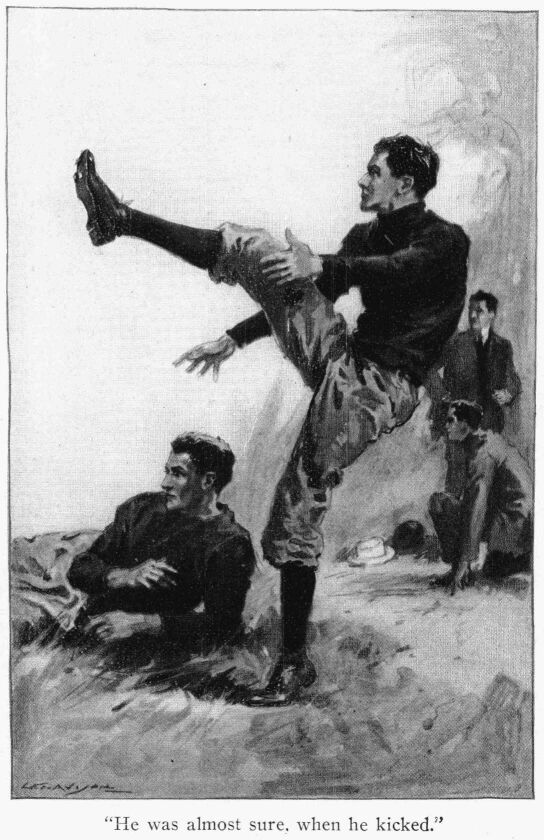
"Good!" ejaculated Coach Corridan, his arm across Hicks' shoulders, as they walked to the Gym. "Hicks, the chances are big that I'll send you in to try for a goal tomorrow, if Bannister gets blocked inside the thirty-yard line! Just keep your nerve, boy, and boot it over! Now—I'll post a notice for a brief mass-meeting at the end of the last class period, and Butch and I will tell the fellows about you, and how you may serve Bannister."
"That's the idea!" exulted Butch, joyous at his comrade's chance to get in the biggest game. "The fellows will understand, Hicks, old man, and they won't jeer when you come out this afternoon. They'll root for you! Oh, just wait until you hear them cheer you, and mean it—you'll astonish the natives, Hicks!"
Butch's prophecy was well fulfilled. In the scrimmage that same day, T. Haviland Hicks, Jr., shivering with apprehensive dread, his heart in his shoes, sat on the side-line. In the stands, the entire student-body, informed in the mass-meeting of his ability, shrieked for "Hicks! Hicks! Hicks!" Near the end of the practice game, the hard-fighting scrubs fought their way to the 'Varsity's thirty-yard line, and another rush took it five yards more. Coach Corridan, halting the scrimmage, sent the right-half-back to the side-line, and a moment later, T. Haviland Hicks, Jr. hurried out on the field with the Bannister Band playing, the collegians yelling frenziedly, and excitement at fever height, the sunny youth took his position in the kick formation. Then a silence, a few seconds of suspense, as the pigskin whirled back to him, and then—a quick stepping forward, a rip of toe against the leather, and—above the heads of the 'Varsity players smashing through, the football shot over the cross-bar!
"Hicks! Hicks! Hicks!" was the shout, "Hicks will beat Ballard!"
That night, T. Haviland Hicks, Jr., having crossed the Rubicon, and committed himself to Coach Corridan and Captain Brewster, had dispatched a telegraphic night-letter to his beloved Dad. He informed his distinguished parent that his drop-kicking powers were now known to old Bannister, and that the chances were fifty-fifty that he would be sent in to try for a field-goal in the biggest game. On the day before the game, Mr. Thomas Haviland Hicks, Sr., in a night-letter, had wired back:
Son Thomas:
Am on my way to New Haven for Yale-Harvard game. Will stop off at old Bannister—bringing thirty members of Yale '96. We hope our Class Kid will get his chance against Ballard.
Dad.
On the morning of the Bannister-Ballard game, Mr. Hicks' private car the Vulcan, with the Pittsburgh "Steel King," and thirty other members of Yale, '96, had reached town. They had ridden in state to College Hill in good old Dan Flannagan's jitney, where T. Haviland Hicks, Jr., proudly introduced his beloved Dad to the admiring collegians. All morning, Mr. Hicks had made friends of the hero-worshiping youths, who listened to his tales of athletic triumphs at Bannister and at old Yale breathlessly. The ex-Yale star had made a stirring speech to the eleven, sending them out on Bannister Field resolved to do or die!
"My Dad!" breathed T. Haviland Hicks, Jr., crouched on the side line; as he gazed at the Yale banner, he could see his father, with his athletic figure, his strong face that could be appallingly stern or wonderfully tender and kind. Like the sunny Senior, Mr. Hicks, despite his wealth, was thoroughly democratic and already the Bannister collegians were his comrades.
"Here we go, Hicks!" spoke Butch Brewster, as the referee raised his whistle to his lips. "Hold yourself ready, old man; a field-goal may win for us, and I'll send you in just as soon as I find all hope of a touchdown is gone. If they hold us back of the thirty-yard line, I'll try Deke Radford, but inside it, you are far more sure."
The vast crowd, a moment before creating an almost inconceivable din, stilled with startling suddenness; a shrill blast from the referee's whistle cut the air. The gridiron cleared of substitutes, coaches, trainers, and rubbers-out, and in their places, the teams of Bannister and Ballard jogged out. Captain Brewster won the toss, and elected to receive the kick-off. The Gold and Green players, Butch, Beef, Roddy, Monty, Biff, Pudge, Bunch, Tug, Hefty, Buster, and Ichabod, spread out, fan-like, while across the center of the field the Ballard eleven, a straight line, prepared to advance as the full-back kicked off. There was a breathless stillness, as the big athlete poised the pigskin, tilted on end, then strode back to his position.
"All ready, Ballard?" The Referee's call brought an affirmative from the Orange and Black leader.
"Ready, Bannister?"
"Ready!" boomed big Butch Brewster, with a final shout of encouragement to his players.
The biggest game was starting! Before ten thousand wildly excited and partisan spectators, the Gold and Green and the Orange and Black would battle for Championship honors; with Thor out of the struggle, Ballard, three-time Champion, was the favorite. The visitors had brought the strongest team in their history, and were supremely confident of victory. Bannister, however, could not help remembering, twice fate had snatched the greatest glory from their grasp, in Butch's Sophomore year, when Jack Merritt's drop-kick struck the cross-bar, and a year later, when Butch himself, charging for the winning touchdown, crashed blindly into the upright. Old Bannister had not won the Championship for five years, and now—when the chances had seemed roseate, with Thor, the Prodigious Prodigy—smashing Hamilton out of the way, Fate had dealt the annual blow in advance, by crippling him.
"Oh, we've got to win!" shivered T. Haviland Hicks, Jr. "Oh, I hope I don't get sent in—I mean—I hope Bannister wins without me! But if I do have to kick—Oh, I hope I send it over that cross-bar—"
A second later the Ballard line advanced, the fullback's toe ripped into the pigskin, sending it whirling, high in air, far into Bannister's territory; the yellow oval fell into the outstretched arms of Captain Butch Brewster, on the Gold and Green's five-yard line, and—"We're off!" shrieked Hicks, excitedly. "Come on, Butch—run it back! Oh, we're off."
The biggest game had started!
CHAPTER XIV
THE GREATER GOAL
"Time out!"
T. Haviland Hicks, Jr., enshrouded in a gold and green blanket, and standing on the side-line, like a majestic Sioux Chief, gazed out on Bannister Field. There, on the twenty-yard line, the two lines of scrimmage had crashed together and Bannister's backfield had smashed into Ballard's stonewall defense with terrific impact, to be hurled back for a five-yard loss. The mass of humanity slowly untangled, the moleskin clad players rose from the turf, all but one. He, wearing the gold and green, lay still, white-faced, and silent.
"It's Biff Pemberton!" chattered Hicks, shivering as with a chill. "Oh, the game is lost, the Championship is gone. Biff is out, and the last quarter is nearly ended. Coach Corridan has got to send me in to kick. It's our very last chance to tie the score, and save old Bannister from defeat!"
The time keeper, to whom the referee had megaphoned for time out, stopped the game, while Captain Butch Brewster, the campus Doctor, and several players worked over the senseless Biff. In the stands, the exultant Ballard cohorts, confident that victory was booked to perch on their banners, arose en masse, and their thunderous chorus drifted across Bannister Field:
"There's a hole in the bottom of the sea, And we'll put Bannister in that hole! In that hole—in—that—hole— Oh, we'll put Bannister in that hole!"
From the Bannister section, the Gold and Green undergraduates, alumni, and supporters, feeling a dread of approaching defeat grip their hearts, yet determined to the last, came the famous old slogan of encouragement to elevens battling on the gridiron:
"Smash 'em, boys, run the ends—hold, boys, hold— Don't let 'em beat the Green and the Gold! Touchdown! Touchdown! Hold, boys, hold, Don't let 'em win from the Green and the Gold!"
T. Haviland Hicks, Jr., with a groan of despair, sat down on the deserted subs. bench. With a feeling that all was lost, the splinter-like Senior gazed at the big score-board, announcing, in huge, white letters and figures:
4TH QUARTER; TIME TO PLAY—2 MIN.; BANNISTER'S BALL ON BALLARD'S 22-YD. LINE; 4TH DOWN—8 YDS. TO GAIN; SCORE: BALLARD—6; BANNISTER—3.
It had been a terrific contest, a biggest game never to be forgotten by the ten thousand thrilled spectators! Each eleven had been trained to the second for this decisive Championship fight, and with the coveted gonfalon of glory before them, the Bannister players battled desperately, while Ballard's fighters struggled as grimly for their Alma Mater. For six years, the Gold and Green had failed to annex the Championship, and for the past three, the invincible Ballard machine had rushed like a car of Juggernaut over all other State elevens; one team was determined to wrest the banner from its rival's grasp, and the other fully as resolved to retain possession, hence a memorable gridiron contest, to which even the alumni could find none in past history to compare, was the result.
Weakened by the loss of Thor, whose colossal bulk and Gargantuan strength would have made victory a moral certainty, presenting practically the same eleven that had faced Ballard the past season and had been defeated by a scant margin, old Bannister had started the first quarter with a furious rush that swept the enemy to midfield without the loss of a first down. Then Ballard had rallied, stopping that triumphal march, on its own thirty-five yard line, but unable to check Quarterback Deacon Radford, who booted a forty-three-yard goal from a drop-kick, with the score 3-0 in Bannister's favor, and Deacon, a brilliant but erratic kicker, apparently in fine trim, the Gold Green rooters went wild.
In the second half, however, came the break of the game, as sporting writers term it. The strong Ballard eleven found itself, and with a series of body-smashing, bone-crushing rushes, battering at the Bannister lines like the Germans before Verdun, they steadily fought their way, trench by trench, line by line, down the field. Without a fumble, or the loss of a single yard, the terrific, catapulting charges forced back old Bannister, until the enemy's fullback, who ran like the famous Johnny Maulbetsch, of Michigan, shot headlong over the goal line! The attempt for goal from touchdown failed, leaving the score, at the end of the third quarter, Ballard—6; Bannister—3.
And Deacon Radford, whose first effort at drop-kicking had been so brilliant, failed utterly. Three times, taking a desperate chance, the Bannister quarter booted the pigskin, but the oval flew wide of the goal posts, even from the thirty-yard line. With his mighty toe not to be depended on, with the Gold and Green line worn to a frazzle by Ballard's battering rushes, unable to beat back the victorious enemy, the Bannister cohorts, dismayed, saw the start of the fourth and final quarter, their last hope. The forward pass had been futile, for the visitors were trained especially for this aerial attack, and with ease they broke up every attempt. And then, with the ball in Ballard's possession on Bannister's twenty-yard line, came a fumble—like a leaping tiger, Monty Merriweather had flung himself on the elusively bounding ball, rolled over to his feet, and was off down the field.
"Touchdown! Touchdown! Touchdown!" shrieked old Bannister's madly excited students, as Monty sprinted. "Go it, Monty—touchdown! Sprint, old man, sprint!"
But Cupid Colfax, Ballard's famous sprinter, playing quarterback, was off on Monty's trail almost instantly, and his phenomenal speed cut down the Ballard end's advantage; still, by dint of exerting every ounce of energy, it was on Ballard's forty-yard line that Monty Merriweather, hugging the pigskin grimly, finally crashed to earth.
"Come on, Bannister!" shouted Captain Butch Brewster, as the two teams lined down. "Right across the goal-line, then kick the goal, and we win! Play the game—fight—Oh, we can win the Championship right now."
Then ensued a session of football spectacular in the extreme, replete with thrilling plays, with sensational tackles, and blood-stirring scrimmage. The Bannister players, nerved by Captain Brewster's exhortation, by sheer will-power drove their battered bodies into the scrimmage. End runs, line-smashing tandem plays, forward passes, followed in bewildering succession, until the ball rested on Ballard's twenty-yard line, and a touchdown meant victory and the Championship for old Bannister, Another rush, and five yards gained, then, Ballard, fighting at the last ditch, made a stand every bit as heroic and thrilling as that sensational march in the first half. The Gold and Green's tigerish rushes were hurled back—three times Captain Butch threw his backfield against the line, and three times not an inch was gained. On the third down, Monty Merriweather was forced back for a loss, so now, with two minutes to play and the ball in Bannister's possession, with eight yards to gain, the play was on Ballard's twenty-two-yard line!
And the biggest game had produced a new hero of the gridiron. Biff Pemberton, left half-back, imbued with savage energy, had borne the brunt of that spectacular advance; and now, he stretched on the turf, white and still.
"Hicks, old man," T, Haviland Hicks, Jr. turned as a hand rested grippingly on his shoulder. Head Coach Patrick Henry Corridan, his face grim, had come to him, and in quick, terse sentences, he outlined his plan.
"It's Bannister's last chance—" he said, tensely. "We can't make the first down, the way Ballard is fighting, unless we take desperate odds. Now, Hicks, it's up to you. On you depend old Bannister's hopes."
A great, chilling fear swept over T. Haviland Hicks, Jr., leaving him weak and shaken. It had come at last-the moment for which he had trained and practiced drop-kicking, for a year, in secret, that moment he had hoped would come, sometime, and yet had dreaded, as in a nightmare. Before that vast, howling crowd of ten thousand madly partisan spectators, he must go out on Bannister Field, to try and boot a drop-kick from the twenty-eight-yard-line, to save the Gold and Green from defeat. And he thought of the great glory that would be his, if he succeeded-he would be a campus hero, the idol of old Bannister, the youth who saved his Alma Mater from defeat, in the biggest game! Then he remembered his Dad, inspiring the eleven, between the halves, by a ringing speech; he heard again his sentences:
"—And to serve old Bannister, to bring glory and honor to our dear Alma Mater, is our greater goal! Go back into the game, throw yourselves into the scrimmage, with no thought of personal glory, of the plaudits of the crowd—it is a fine thing, a splendid goal, to play the game and be a hero; it is a far more noble act to strive for the greater goal, one's Alma Mater!"
"Now listen carefully," Coach Corridan rushed on, "Biff is knocked out. They'll start again soon, we are going to take a desperate chance; your Dad advises it! A tie score means the Championship stays with Ballard. To win it, we must win this game—and on you everything depends."
"But—how—" stammered Hicks, dazed—the only way to tie the score was by a drop-kick; the only way to win, by a touchdown—did the Coach mean he was not to realize his great ambition to save old Bannister by a goal, the reward of his long training?
"You jog out," whispered Coach Corridan, hurriedly, for a stretcher was being rushed to Biff Pemberton, "report to the Referee, and whisper to Butch to try Formation Z; 23-45-6-A! Now, here is the dope: our only chance is to fool Ballard completely. When you go out, the Bannister rooters, and your Yale friends, will believe it is to try a drop-kick and tie the score. I am sure that the Ballard team will think this, too, because of your slender build. You act as though you intend to try for a goal, and have Captain Butch make our fellows act that way. Then—it is a fake-kick; the backfield lines up in the kick formation, but the ball is passed to Butch, at your right. He either tries for a forward pass to the right end, or if the end Is blocked, rushes it himself! Hurry-the referee's whistle is blowing; remember, Hicks, my boy, it's the greater goal, it's for your Alma Mater."
In a trance, T. Haviland Hicks, Jr., flung off the gold and green blanket, and dashed out on Bannister Field. How often, in the past year, had he visioned this scene, only—he pictured himself saving the game by a drop-kick, and now Coach Corridan ordered him to sacrifice this glory! From the stands came the thunderous cheer of the excited Bannister cohorts, firmly believing that the slender youth, so ludicrously fragile, among those young Colossi, was to try for a goal.
"Rah! Rah! Rah! Rah! Rah! Hicks! Kick the goal—Hicks!"
And from the Yale grads., among them his Dad, came a shout, as he jogged across the turf:
"Breka-kek-kek—co-ax—Yale! Hicks-Hicks-Hicks!"
But the Bannister Senior did not thrill. Now, instead, a feeling of growing resentment filled his soul; even this intensely loyal youth, with all his love for old Bannister, was vastly human, and he felt cheated of his just rights. How the students were cheering him, how those Yale men called his name, and he was not to have his big chance! That for which he had trained and practiced; the opportunity to serve his Alma Mater, by kicking a goal at the crucial moment, and saving Bannister from defeat, was never to be his. Now, in his last game at college, he was to act as a decoy, as a foil. Like a dummy he must stand, while the other Gold and Green athletes ran off the play! Instead of everything, a tie game, or a defeat, depending on his kicking, defeat or victory hung on that fake play, on Butch Brewster and Monty Merriweather! So—the ear-splitting plaudits of the crowd for "Hicks!" meant nothing to him; they were dead sea fruit, tasteless as ashes—as the ashes of ambition. And then—
"—And to serve old Bannister, to bring glory and honor to our dear Alma Mater, is our greater goal—no thought of personal glory—a splendid goal, to play the game and be a hero; It is a far more noble act to strive for the greater goal—one's Alma Mater—"
"I was nearly a traitor" gasped T. Haviland Hicks, Jr., his Dad's words echoing In his memory, and a vision of that staunch, manly Bannister ex-athlete before him. "Oh, I was betraying my Alma Mater. Instead of rejoicing to make any sacrifice, however big, for Bannister, I thought only of myself, of my glory! I'll do it, Dad, I'll strive for the greater goal, and—we just can't fail."
Reaching the scrimmage, Hicks, whose nervous dread had left him, when he fought down selfish ambition, and thirst for glory, reported to the Referee, and hurriedly transferred Coach Corridan's orders to Captain Butch Brewster; half a minute of precious time was spent in outlining the desperate play to the eleven, for "time!" had been called, and then—
"Z-23-45-6-A!" shouted Quarterback Deacon Radford. "Come on, line—hold! Right over the cross-bar with it, Hicks—tie the score, and save Bannister from defeat—"
The Gold and Green backfield shifted to the kick formation. Ten yards back of the center, on the thirty-two-yard line of Ballard, stood T. Haviland Hicks, Jr.; the vast crowd was hushed, all eyes stared at that slender figure, standing there, with Captain Butch Brewster at his right, and Beef McNaughton on his left hand-the spectators believed the frail-looking youth had been sent in to try a drop-kick. The Ballard rooters thought it, and—the Ballard eleven were sure of their enemy's plan—Hicks' mosquito-like build, his nervous swinging of that right leg, deluded them, and helped Coach Corridan's plot.
It was the only play, if Bannister wanted the Championship enough to try a desperate chance; better a fighting hope for that glory, with a try for a touchdown, than a field-goal, and a tie-score! The lines of scrimmage tensed. The linesmen dug their cleats in the sod, those of Ballard tigerish to break through and block; old Bannister's determined to hold. Back of Ballard's line, the backfield swayed on tip-toe, every muscle nerved, ready to crash through; the ends prepared to knock Roddy and Monty aside, the backs would charge madly ahead, in a berserk rush, to crash into that slim figure.
"Boot it, Hicks!" shrieked Deke Radford, and as he shouted, the pigskin shot from the Bannister center's hands; the Gold and Green line held nobly, but not so the ends. Monty Merriweather, making a bluff at blocking the left end, let him crash past, while he sprinted ahead—Captain Butch Brewster, to whom the pass had been made, ran forward, until he saw he was blocked, and then, seeing Monty dear, he hurled a beautiful forward pass.
Into the arms of the waiting Monty it fell, and that Gold and Green star, absolutely free of tacklers, sprinted twelve yards to the goal-line, falling on the pigskin behind it! Coach Corridan's "100 to 1" chance, suggested by Mr. Thomas Haviland Hicks, Sr., had succeeded, and—the Biggest Game and the Championship had come to old Bannister at last!
Followed a scene pauperizing description! For many long years old Bannister had waited for this glory; years of bitter disappointment, seasons when the Championship had been missed by a scant margin, a drop-kick striking the cross-bar, Butch Brewster blindly crashing into an upright. But now, all their pent-up joy flowed forth in a mighty torrent! Singing, yelling, dancing, howling, the Bannister Band leading them, the Gold and Green students, alumni, Faculty, and supporters, snake-danced around Bannister Field. A vast, writhing, sinuous line, it wound around the gridiron, everyone who possessed a hat flinging it over the cross-bars. The victorious eleven, were borne by the maddened youths—Captain Butch, Pudge, Beef, Monty, Roddy, Ichabod, Tug, Hefty, Buster, Bunch, and—T. Haviland Hicks, Jr. Ballard, firmly believing Hicks would try a field-goal, had been taken completely off guard. Surprised by the daring attempt, it had succeeded with ease, and the final score was Bannister—10; Ballard—6!
"At last! At last!" boomed Butch Brewster, to whom this was the happiest day of his life. "The Championship at last. My great ambition is realized. Old Bannister has won the Championship, and I was the Team Captain!"
After a time, when "the shouting and the tumult died," or at least quieted somewhat, T. Haviland Hicks, Jr., felt a hand on his arm, and looking down from the shoulders on which he perched, he saw his Dad. Mr. Hicks' strong face was aglow with pride and a vast joy, and he shook his son's hand again and again.
"I understand, Thomas!" he said, and his words were reward enough for the youth. "It was a big sacrifice, but you made it gladly—I know! You gave up personal glory for the greater goal, and—old Bannister won the Championship! You helped win, for the winning play turned on you. It was splendid, my son, and I am proud of you! No matter if your sacrifice is never known to the fellows, I understand."
A moment of silence on Hicks' part; then the sunny youth grinned at his beloved Dad, as he responded blithesomely: "I'm Pollyanna, that old Bannister and I won out, Dad!"
CHAPTER XV
HICKS HAS A "HUNCH"
"Ladies and gentlemen, Seniors, Juniors, Sophomores, human beings, and—Freshmen! Mr. Thomas Haviland Hicks, Jr., the Olympic High-Jump Champion, holder of the World's record, and winner at the Panama-Pacific International Exposition National Championships, in his event, is about to high jump! The bar is at five feet, ten inches. Mr. Hicks is the Herculean athlete in the crazy-looking bathrobe."
T. Haviland Hicks, Jr., his splinter-structure enshrouded in that flamboyant bathrobe of vast proportions and insane colors, that inevitably attended his athletic efforts, shaming Joseph's coat-of-many-colors, gazed despairingly at his good friend, Butch Brewster, and Track-Coach Brannigan, with a Cheshire cat grin on his cherubic countenance.
"It's no use, Butch, it's no use!" quoth he, with ludicrous indignation, as big Tug Cardiff, the behemoth shot-putter, through a huge megaphone imitated a Ballyhoo Bill, and roared his absurd announcement to the hilarious crowd of collegians in the stand. "Old Bannister will never take my athletic endeavors seriously. Here I have won two second places, and a third, in the high-jump this season, and have a splendid show to annex first place and my track B in the Intercollegiates, but—hear them!"
It was a balmy, sunshiny afternoon in late May. The sunny-souled, happy-go-lucky T. Haviland Hicks, Jr., had trained indefatigably for the high jump, with the result that he had won several points for his team—however, he had not realized his great ambition of first place, and his track letter.
As Hicks now exclaimed to his team-mate and Coach Brannigan, no matter, to the howling Bannister youths, if he had won three places in the high jump, in regularly scheduled meets; his comrades had been jeering at his athletic fiascos for nearly four years, and even had Hicks suddenly blossomed out as a star athlete, they would not have abandoned their joyous habit. Still, those football 'Varsity players to whom good Butch had read Hicks, Sr.'s, letters, and explained the sunny youth's persistence, despite his ridiculous failures, though they kept on hailing his appearance on Bannister Field with exaggerated joy, understood the care-free collegian, and loved him for his ambition to please his Dad. Since Hicks had absolutely refused to accept his B, for any sport, unless he won it according to Athletic Association eligibility rules, the eleven had kept secret the contents of the letters Butch Brewster had read to them, for Hicks requested it.
The Bannister College track squad, under Track Coach Brannigan and Captain Spike Robertson, had been training most strenuously for that annual cinder-path classic, the State Intercollegiate Track and Field Championships. The sprinters had been tearing down the two-twenty straightaway like suburban commuters catching the 7.20 A.M. for the city. Hammer-throwers and shot-putters—the weight men—heaved the sixteen-pound shot, or hurled the hammer, with reckless abandon, like the Strong Man of the circus. Pole-vaulters seemed ambitious to break the altitude records, and In so doing, threatened to break their necks; hurdlers skimmed over the standard as lightly as swallows, though no one ever beheld swallows hurdling. The distance runners plodded determinedly around the quarter-mile track, broad-jumpers tried to jump the length of the landing-pit. And T. Haviland Hicks, Jr., vainly essayed to clear five-ten In the high-jump!
It was the last-named event that "broke up the show," as the Phillyloo Bird quaintly stated, somewhat wrongly, since the appearance of that blithesome youth in the offing, his flamboyant bathrobe concealing his shadow-like frame, had started the show, causing the track squad, as well as a hundred spectator-students, to rush for seats in the stand. The arrival of T. Haviland Hicks, Jr., to train for form and height in the high-jump, though a daily occurrence, was always the signal for a Saturnalia of sport at his expense, because—
"You can't live down your athletic past, Hicks!" smiled good-hearted Butch Brewster. "Your making a touchdown for the other eleven, by running the wrong way with the pigskin, your hilarious fiascos in every sport, your home-run with the bases full, on a strike-out-are specters to haunt you. Even now that you have a chance to win your B, just listen to the fellows."
The track squad's "heavy weight—white hope" section, composed of hammer-heavers and shot-putters—Tug Cardiff, Beef McNaughton, Pudge Langdon, Buster Brown, Biff Pemberton, Hefty Hollingsworth, and Bunch Bingham, equipped with megaphones, and with the basso profundo voices nature gave them, lined up on both sides of the jumping-standards, and chanted loudly:
"All hail to T. Haviland Hicks! He runs like a carload of bricks; When to high jump he tries From the ground he can't rise— For he's built on a pair of toothpicks!"
This saengerfest was greeted with vociferous cheers from the vastly amused youths in the stands, who hailed the grinning Hicks with jeers, cat-calls, whistles, and humorous (so they believed) remarks:
"Say, Hicks, you won't never be able to jump anything but your board-bill!"
"You're built like a grass-hopper, Hicks, but you've done lost the hop!"
"If you keep on improving as you've done lately, you'll make a high-jumper in a hundred more years, old top!"
"You may rise in the world, Hicks, but never in the high jump!"
"Don't mind them, Hicks!" spoke Coach Brannigan, his hands on the happy-go-lucky youth's shoulders. "Listen to me; the Intercollegiates will be the last track meet of your college years, and unless you take first place in your event, you won't win your track B. Second, McQuade, of Hamilton, will do five-eight, and likely an inch higher, so to take first place, you, must do five-ten. You have trained and practiced faithfully this season, but no matter what I do, I can't give you that needed two inches, and—"
"I know it, Coach!" responded the chastened Hicks, throwing aside his lurid bathrobe determinedly, and exposing to the jeering students his splinter-frame. "Leave it to Hicks, I'll clear it this time, or—"
"Not!" fleered Butch, whom Hicks' easy self-confidence never failed to arouse. "Hicks, listen to me, I can tell you why you can't get two inches higher. The whole trouble with you is this; for almost four years you have led an indolent, butterfly, care-free existence, and now, when you must call on yourself for a special effort, you are too lazy! You can dear five-ten; you ought to do it, but you can't summon up the energy. I've lectured you all this time, for your heedless, easy-going ways, and now—you pay for your idle years!"
"You said an encyclopedia, Butch!" agreed the Coach, with vigor. "If only something would just make Hicks jump that high, if only he could do it once, and know it is in his power, he could do it in the Intercollegiates, aided by excitement and competition! Let something scare him so that he will sail over five-ten, and—he will win his B. He has the energy, the build, the spring, and the form, but as you say, he is so easy-going and lazy, that his natural grass-hopper frame avails him naught."
"Here I go!" announced Hicks, who, to an accompaniment of loud cheers from the stand, had been jogging up and down in that warming-up process known to athletes as the in place run, consisting of trying to dislocate one's jaw by bringing the knees, alternately, up against the chin. "Up and over—that's my slogan. Just watch Hicks."
Starting at a distance of twenty yards from the high-jump standards, on which the cross-bar rested at five feet, ten inches, T. Haviland Hicks, Jr., who vastly resembled a grass-hopper, crept toward the jumping-pit, on his toe-spikes, as though hoping to catch the cross-bar off its guard. Advancing ten yards, he learned apparently that his design was discovered, so he started a loping gallop, turning to a quick, mad sprint, as though he attempted to jump over the bar before it had time to rise higher. With a beautiful take-off, a splendid spring—a quick, writhing twist in air, and two spasmodic kicks, the whole being known as the scissors form of high jump, the mosquito-like youth made a strenuous effort to clear the needed height, but—one foot kicked the cross-bar, and as Hicks fell flat on his back, in the soft landing-pit, the wooden rod, In derision, clattered down upon his anatomy.
"Foiled again!" hissed Hicks, after the fashion of a "Ten-Twent'-Thirt'" melodrama-villain, while from the exuberant youths in the grandstand, who really wanted Hicks to clear the bar, but who jeered at his failure, nevertheless, sounded:
"Hire a derrick, Hicks, and hoist yourself over the bar!"
"Your head is light enough—your feet weigh you down!"
"'Crossing the Bar'—rendered by T. Haviland Hicks, Jr.!"
"Going up! Go play checkers, Hicks, you ain't no athlete!"
While the grinning, albeit chagrined T, Haviland Hicks, Jr., reposed gracefully on his back, staring up at the cross-bar, which someone kindly replaced on the pegs, big Butch Brewster, who seemed suddenly to have gone crazy, tried to attract Coach Brannigan's attention. Succeeding, Butch—usually a grave, serious Senior, winked, contorted his visage hideously, pointed at Hicks, and sibilated, "Now, Coach—now is your chance! Tell Hicks—"
Tug Cardiff, Biff Pemberton, Hefty Hollingsworth, Bunch Bingham, Buster Brown, Beef McNaughton, and Pudge Langdon, who had been attacked in a fashion similar to Butch's spasm, concealed grins of delight, and made strenuous efforts to appear guileless, as Track-Coach Brannigan approached T. Haviland Hicks, Jr. To that cheery youth, who was brushing the dirt from his immaculate track togs, and bowing to the cheering youths in the stand, the Coach spoke:
"Hicks," he said sternly, "you need a cross-country jog, to get more strength and power in your limbs! Now, I am going to send the Heavy-Weight-White-Hope Brigade for a four-mile run, and you go with them. Oh, don't protest; they are all shot-putters and hammer-throwers, but Butch, and they can't run fast enough to give a tortoise a fast heat. Take 'em out two miles and back, Butch, and jog all the way; don't let 'em loaf! Off with you."
The unsuspecting Hicks might have detected the nigger in the woodpile, had he not been so anxious to make five-ten in the high-jump. However, willing to jog with these behemoths, with whom even he could keep pace, so as to develop more jumping power, the blithesome youth cast aside his garish bathrobe, pranced about in what he fatuously believed was Ted Meredith's style, and howled:
"Follow Hicks! All out for the Marathon—we're off! One—two—three—go!"
With the excited, track squad, non-athletes, and the baseball crowd, which had ceased the game to watch the start, yelling, cheering, howling, and whistling, T. Haviland Hicks, Jr., drawing his knees up in exaggerated style at every stride, started to lead the Heavy-Weight-White-Hope-Brigade on its cross-country run. Without wondering why Coach Brannigan had suddenly elected to send him along with the hammer-throwers and shot-putters, on the jog, and not having seen the insane facial contortions of the Brigade, before the Coach gave orders, the gladsome Senior started forth in good spirits, resembling a tugboat convoying a fleet of battleships.
"'Yo! Ho! Yo! Ho! And over the country we go!'" warbled Hicks, as the squad left Bannister Field, and jogged across a green meadow. "'—O'er hill and dale, through valley and vale, Yo! Ho! Yo! Ho! Yo! Ho!'"
"Save your wind, you insect!" growled Butch Brewster, with sinister significance that escaped the heedless Hicks, as the behemoth Butch, a two-miler, swung into the lead. "You'll need it, you fish, before we get back to the campus! Not too fast, you flock of human tortoises. You'll be crawling on hands and knees, if you keep that pace up long!"
A mile and a half passed. Butch, at an easy jog, had led his squad over green pastures, up gentle slopes, and across a plowed field, by way of variety. At length, he left the road on which the pachydermic aggregation had lumbered for some distance, and turned up a long lane, leading to a farm-house. Back of it they periscoped an orchard, with cherry-trees, laden with red and white fruit, predominating. Also, floating toward the collegians on the balmy May air came an ominous sound:
"Woof! Woof! Woof! Bow-wow-wow! Woof!"
"Come on, fellows!" urged Butch Brewster. "We'll jog across old Bildad's orchard and seize some cherries—the old pirate can't catch us, for we are attired for sprinting. Don't they look good?"
"Nothing stirring!" declared Hicks, slangily, but vehemently, as he stopped short in his stride. "Old Bildad has got a bulldog what am as big as the New York City Hall. He had it on the campus last month, you know! Not for mine! I don't go near that house, or swipe no cherries from his trees. If you wish to shuffle off this mortal coil, drive right ahead, but I will await your return here."
T, Haviland Hicks, Jr.'s, dread of dogs, of all sizes, shapes, pedigrees, and breeds, was well known to old Bannister; hence, the Heavy-weights now jeered him unmercifully. Old "Bildad," as the taciturn recluse was called, who lived like a hermit and owned a rich farm, did own a massive bulldog, and a sight of his cruel jaws was a "No Trespass" sign. With great forethought, when cherries began to ripen, the farmer had brought Caesar Napoleon to the campus, exhibited him to the awed youths, and said, "My cherries be for sale, not to be stole!" which object lesson, brief as it was, to date, had seemed to have the desired effect. Yet—here was Butch proposing that they literally thrust their heads, or other portions of their anatomies, into the jaws of death!
"Well," said Bunch Bingham at last, "I tell you what; we'll jog up to the house and ask old Bildad to sell us some cherries; we can pay him when he comes to the campus with eggs to sell, Come along. Hicks, I'll beard the bulldog in his kennel."
So, dragged along by the bulky hammer-throwers and shot-putters, the protesting T. Haviland Hicks, Jr., in mortal terror of Caesar Napoleon, and the other canine guardians of old Bildad's property, progressed up the lane toward the house.
"I got a hunch," said the reluctant Hicks, sadly, "that things ain't a-comin' out right! In the words of the immortal Somebody-Or-Other, 'This 'ere ain't none o' my doin'; it's a-bein' thrust on me!' All right, my comrades, I'll be the innocent bystander, but heed me—look out for the bulldog!"
CHAPTER XVI
THANKS TO CAESAR NAPOLEON
The Heavy-Weight-White-Hope-Brigade, towing the mosquito-like T. Haviland Hicks, Jr., advanced on the stronghold of old Bildad, so named because he was a pessimistic Job's comforter, like Bildad, the Shuhite, of old—like a flock of German spies reconnoitering Allied trenches. Hearing the house, with Butch and Beef holding the helpless, but loudly protesting Hicks, who would fain have executed what may mildly be termed a strategic retreat, big Tug Cardiff boldly marched, in close formation, toward the door, when the portal suddenly flew open.
"Woof! Woof! Bow! Wow! Woof! Let go, Butch—there's the dog!"
Amid ferocious howls from Caesar Napoleon, and alarmed protests from the paralyzed Hicks, who could not have run, with his wobbly knees, had he been set free by his captors, old Bildad, towed from the house by Caesar Napoleon, who strained savagely at the leash until his face bulged, burst upon the scene with impressive dramatic effect! It was difficult to decide, without due consideration, which was the more interesting. Bildad, a huge, gnarled old Viking, with matted gray hair, bushy eyebrows, a flowing beard, and leathery face, a fierce-looking giant, was appalling to behold, but so was Caesar Napoleon, an immense bulldog, cruel, bloodthirsty, his massive jaws working convulsively, his ugly fangs gleaming, as he set his great body against the leash, and gave evidence of a sincere desire to make free lunch of the Bannister youths. As Buster Brown afterward stated, "Neither one would take the booby prize at a beauty show, but at that, the bulldog had a better chance than Bildad!" T. Haviland Hicks, Jr., let it be recorded, could not have qualified as a judge, since his undivided attention was awarded to Caesar Napoleon!
"What d'ye want round here, ye rapscallions?" demanded Bildad, courteously, holding the savage bulldog with one hand, and constructing a ponderous fist with the other, "Hike—git off'n my land, y'hear? Git, er Caesar Napoleon'll git holt o' them scanty duds ye got on!"
"We want to—to buy some cherries, Mr.—Mr. Bildad!" explained Bunch Bingham, edging away nervously. "We won't steal any, honest, sir. Well pay you for them the very next time you come to the campus with milk and eggs."
"Ho! Ho!" roared old Bildad, piratically, his colossal body shaking, "A likely tale, lads—an' when I come for my money, ye'll jeer me off the campus, an' tell me to whistle for it! Off my land—git, an' don't let me cotch ye on it inside o' two minutes, or I'll let Caesar Napoleon make a meal off'n yer bones—git!"
To express it briefly, they got. T, Haviland Hicks, Jr., not standing on the order of his going, set off at a sprint that, while it might have caused Ted Meredith to lose sleep, also aroused in Caesar Napoleon an overwhelming desire to take out after the fugitive youth, so that Mr. Bildad was forced to exert his vast strength to hold the massive bulldog. Butch, Beef, Hefty, Tug, Buster, Bunch, Pudge, and Biff, a pachydermic crew, awed by Caesar Napoleon's bloodthirsty actions, jogged off in the wake of Hicks, who confidently expected to hear the bulldog giving tongue, on his trail, at every second.
Another lane, making in from a road making a cross-roads with the one from which they came to Bildad's house, ran alongside the orchard for two hundred yards, inside the fence; at its end was a high roadgate. At what they decided was a safe distance from the "war zone," the Heavy-Weight-White-Hope-Brigade, and T. Haviland Hicks, Jr., the latter forcibly restrained from widening the margin between him and peril, held a council on preparedness.
"The old pirate!" stormed Butch Brewster, gazing back to where the vast figure of old Bildad, striding toward the house, towered. "We can't let him get away with that, fellows. I'll have some of his cherries now, or—"
"No, no—don't, Butch!" chattered Hicks, whose dread of dogs amounted to an obsession. "He can still see us, and if you leave the lane, he will send Caesar Napoleon after us! Oh, don't—"
But Butch Brewster, evidently wrathful at being balked, strode from the path, or lane, of virtue, toward a cherry-tree, whose red fruit hung temptingly low, and his example was followed by every one of the Brigade, leaving the terrified Hicks to wait in the lane, where, because of his alarm, he had no time to wonder at the bravado of his behemoth comrades. However, finding that Bildad had disappeared, and believing he had taken Caesar Napoleon into the house, the sunny Hicks, who was far from a coward otherwise, but who had an unreasonable dread of dogs, little or big, was about to wax courageous, and join his team-mates, when a wild shout burst from Pudge Langdon:
"Run, fellows—run! Bildad's put the bulldog on us! Here comes—Caesar Napoleon—!"
With a blood-chilling "Woof! Woof!" steadily sounding louder, nearer, a streak of color shot across the orchard, from the house, toward the affrighted Brigade, while old Bildad's hoarse growl shattered the echoes with "Take 'em out o' here, Nap—chaw 'em up, boy!" For a startled second, the youths stared at the on-rushing body, shooting toward them through the orchard-grass at terrific speed, and then:
"Run!" howled T. Haviland Hicks, Jr., terror providing him with wings, as per proverb. Down the lane, at a pace that would have done credit to Barney Oldfield in his Blitzen Benz, the mosquito-like youth sprinted madly, and ever, closer, closer on his trail, sounded that awful "Woof! Woof!" from Caesar Napoleon, who, as Hicks well knew, was acting with full authority from Bildad! He heard, as he fled frantically, the excited shouts of his comrades.
"Beat it, Hicks—he's right after you—run! Run!"
"Jump the fence—he can't get you then—jump!"
"He's right on your trail, Hicks—sprint, old man!"
"Make the fence, old man—jump it—and you're safe!"
The terrible truth dawned on the frightened youth, as he desperately sprinted: the innocent bystander always gets hurt. He had protested against the theft of Bildad's cherries, and naturally, the bulldog had kept after him! But it was too late to stop, for the old adage was extremely appropriate, "He who hesitates is lost." He must make that road-gate, and tumble over it, in some fashion, or be torn to shreds by Caesar Napoleon, the savage dog that the cruel Bildad had sent after the youths.
Nearer loomed the road-gate, appallingly high. Closer sounded the panting breath of the ferocious Caesar Napoleon, and his incessant "Woof-woof!" became louder. It seemed to the desperate Hicks that the bulldog was at his heels, and every instant he expected to feel those sharp teeth take hold of his anatomy! Once, the despairing youth imitated Lot's wife and turned his head. He saw a body streaking after him, gaining at every jump, also he lost speed; so thereafter, he conscientiously devoted his every energy to the task in hand, that of making the gate, and getting over it, before Caesar Napoleon caught his quarry!
At last, the road-gate, at least ten feet high, to Hicks' fevered imagination, came so close that a quick decision was necessary, for Caesar Napoleon, also, was in the same zone, and in a few seconds he would overhaul the fugitive. T. Haviland Hicks, Jr., realizing that a second lost, perhaps, might prove fatal to his peace of mind, desperately resolved to dash at the gate, and jump; if he succeeded even in striking somewhere near the top, and falling over, he would not care, for the bulldog would not follow him off Bildad's land. From his comrades, far in the rear, came the chorus:
"Jump, Hicks! He's right on your heels!"
Like the immortal Light Brigade, Hicks had no time to reason about anything. His but to jump or be bitten summed up the situation. So, with a last desperate sprint, a quick dash, he left the ground—luckily, the earth was hard, giving him a solid take-off, and he got a splendid spring. As he arose In air, al! the training and practicing for form stayed with him, and instinctively he turned, writhed, and kicked—
For a fleeting second, he saw the top of the gate beneath his body, and he felt a thrill as he beheld twisted strands of barbed wire, cruel and jagged, across it; then, with a great sensation of joy, he knew that he had cleared the top, and a second later, he landed on the ground, in the country road, in a heap.
T. Haviland Hicks, Jr., that sunny-souled, happy-go-lucky, indolent youth, for once in his care-free campus career aroused to strenuous action, scrambled wildly to his feet, and forcibly realized the truth of Longfellow's, "And things are not-what they seem!" Instead of the ferocious, bloodthirsty bulldog, Caesar Napoleon, a huge, half-grown St. Bernard pup gamboled inside the gate, frisking about gleefully, and exhibiting, even so that Hicks, with all his innate dread of dogs, could understand it, a vast friendliness. In fact, he seemed trying to say, "That's fun. Come on and play with me some more!"
"Hey, fellows," shrieked the relieved Hicks, "that ain't Caesar Napoleon! Why, he just wanted to play."
Bewildered, the members of the Heavy-Weight-White-Hope-Brigade of the Bannister College track squad rushed on the scene. To their surprise, they found not a savage bulldog, but a clumsy, good-natured St. Bernard puppy, who frisked wildly about them, groveled at their feet, and put his huge paws on them, with the playfulness of a juvenile elephant.
"Why, it isn't Nappie, for a fact!" gasped Butch. "Oh, I am so glad that old Bildad wasn't mean enough to put the bulldog after us, for he is dangerous. He scared us, though, and put this pup on our trail. He wanted to play, and he thought it all a game, when Hicks fled. Oho! What a joke on Hicks."
"I don't care!" grinned Hicks, thus siding with the famous Eva Tanguay. "You fellows were fooled, too! You were too scared to run, and if it had been Caesar Napoleon, I'd have saved your worthless lives by getting him after me! I'll bet Bildad is snickering now, the old reprobate! Why, Tug, are you crazy?"
Tug Cardiff, indeed, gave indications of lunacy. He marched up to the road-gate, and stood close to it, so that the barbed wire top was even with his hair; then he backed off, and gazed first at the gate, then at the bewildered Hicks, while he grinned at the dazed squad in a Cheshire cat style.
"Measure it, someone!" he shouted. "I am nearly six feet tall, and it comes even with the top of my dome! Can't you see, you brainless imbeciles, Hicks cleared it."
"Wait for me here!" howled big Butch Brewster, climbing the fence and starting down the road at a pace that did credit even to that fast two-miler. The Brigade, In the absence of their leader, tried to estimate the height of the gate, and Hicks, gazing at its barbed-wire top, shuddered. The St. Bernard pup, having caused T. Haviland Hicks, Jr., for once in his indolent life to exert every possible ounce of energy in his splinter-frame, groveled at his feet, and strove to express his boundless joy at their presence.
Butch Brewster, in fifteen minutes, returned, panting and perspiring, bearing a tape-measure, borrowed at the next farm-house. With all the solemnity of a sacred rite being performed, the youths waited, as Butch and Tug, holding the tape taut, carefully measured from the ground to the top of the barbed wire on the gate. Three times they did this, and then, with an expression of gladness on his honest countenance, Butch hugged the dazed T. Haviland Hicks, Jr., while Tug Cardiff howled, "Now for the Intercollegiates and your track B, Hicks! You can do five-ten in the meet, for Coach Brannigan said you could dear it, if only you did it once."
"Why—what do you mean, Tug?" quavered Hicks, not daring to allow himself to believe the truth. "You—you surely don't mean—"
"I mean, that now you know you can jump that high," boomed Tug, executing a weird dance of exultation, In which, the Brigade joined, until it resembled a herd of elephants gone insane, "for you have done it—allowing for the sag, and everything, that gate is just five feet, ten inches high, and—you cleared it!"
"Ladies and gentlemen—Hicks, of Bannister, is about to high jump! Hicks and McQuade, of Hamilton, are tied for first place at five feet eight inches! McQuade has failed three times at five-ten! Hicks' third and last trial! Height of bar—five feet ten inches!"
This time, however, it was not big Tug Cardiff, imitating a Ballyhoo Bill, and inciting the Bannister youths to hilarity at the expense of the sunny-souled T. Haviland Hicks, Jr.; it was the Official Announcer at the Annual State Intercollegiate Field and Track Championships, on Bannister Field, and his announcement aroused a tumult of excitement in the Bannister section of the stands, as well as among the Gold and Green cinder-path stars.
"Come on, Hicks, old man!" urged Butch Brewster, who, with a dozen fully as excited comrades of the cheery Hicks, surrounded that splinter-athlete. "It's positively your last chance to win your track B, or your letter in any sport, and please your Dad! If they lower the bar, and you two jump off the tie, McQuade's endurance will bring him out the winner."
"You can clear five-ten!" encouraged Bunch Bingham. "You did it once, when you believed Caesar Napoleon was after you. Just summon up that much energy now, and clear that bar! Once over, the event and your letter are won! Oh, if we only had that bulldog here, to sick on you."
Sad to chronicle, the score-board of the Intercollegiates recorded the results of the events, so far, thus:
HAMILTON ............35 BALLARD .............20 BANNISTER ...........28
It was the last event, and even did Hicks win the high-jump, McQuade's second place would easily give old Ham. the Championship. Hence, knowing that victory was not booked for an appearance on the Gold and Green banners, the Bannister youths, wild for the lovable, popular Hicks to win his Bs vociferously pulled for him:
"Come on, Hicks—up and over, old man—it's easy!"
"Jump, you Human Grass-Hopper—you can do it!"
"Now or never, Hicks! One big jump does the work!"
"Sick Caesar Napoleon on him, Coach; he'll clear it then!"
T. Haviland Hicks, Jr., casting aside that flamboyant bathrobe, for what he believed was the last athletic event of his campus career, stood gazing at the cross-bar. One superhuman effort, a great explosion of all his energy, such as he had executed when he cleared the gate, thinking Caesar Napoleon was after him, and the event was won! He had cleared that height, it was within his power. If he failed, as Butch said, the bar would be lowered, and then raised until one or the other missed once. McQuade, with his superior strength and endurance, must inevitably win, but as he had just missed on his third trial at five-ten, if Hicks cleared that height on his final chance, the first place was his.