Introductory material (continued 2)
Reading edition
"Despite the harrowing experiences of his exile, Thorwald, a vast hulk of a stolid, unimaginative Norwegian, who reminds one of the Norse god, 'Thor,' intends to ship as first mate on the New York-Christiania Steamship Line. It is said that Thorwald has a son, at this time about twenty-five years of age, somewhere In this country, whom he will seek, and—"
T. Haviland Hicks, Jr., at this juncture, terminated the newspaper story, and finding that his explanation held his comrades spellbound, he produced a letter, and drew out the message, after stating the youths could read the entire news-story of John Thorwald, Sr., later.
"This is the letter I received from my Dad," he explained to the intensely interested Bannister youths, who were giving a concentrated attention that members of the Faculty would have rejoiced to receive from them. "Up at Camp Bannister—I was just about to read it to Coach Corridan, Butch, and Deke Radford, when Deke chaffed me, and then the Coach outlined the mammoth full-back he desired, so I kept quiet. I'll now read it to you:
"Pittsburgh, Pa., Sept, 17.
"DEAR SON THOMAS:
"Read the inclosed clipping from the San Francisco Examiner of August 25, and then pay close attention to the following facts: At the time of this news-story I was in 'Frisco on business, as you will recall, and for reasons to be outlined, when I read of the Southern Cross finding the marooned John Thorwald, and bringing him to that city, I was particularly interested, so much so that I at once looked up the one-time first mate of the ill-starred Zephyr and brought him to Pittsburgh in my private car. My reason was this; in my employ, in the International Steel Combine's mill, was John Thorwald's son, John Thorwald, Jr.
"To state facts as briefly as possible, almost a year ago, as I took some friends through the steel rolling mill, I chanced to step directly beneath a traveling crane, lowering a steel beam; seeing my peril, I was about to step aside when I caught my foot and fell. Just then a veritable giant, black and grimy, leaped forward, and with a prodigious display of strength, placed his powerful back under the descending weight, staving it off until I rolled over to safety!
"Well, of course, I had the fellow report to my office, and instinctively feeling that I wanted to show my gratitude, without being patronizing, he responded to my question as to what I could do to reward him, by asking simply that I get him some job that would allow him to attend night school. He stated that, owing to the fact that he worked alternate weeks at night shift he was unable to do so. Questioning him further, I learned the following facts:
"He was John Thorwald, Jr., only son of John Thorwald, Sr., a Norwegian; his mother was also a Norwegian, but he is a natural born American. Realizing the opportunities for an educated young man in our land, Thorwald's parents determined that he should gain knowledge, and until he was fifteen years old, he attended school in San Francisco. When he was fifteen, his father signed as first mate on the yacht Zephyr, going with the oil-king, Henry B. Kingsley, on a pleasure cruise in the Southern Pacific; Thorwald, Sr.'s, story you read in the paper. Soon after the news of the Zephyr's wreck, with all on board lost, as was then supposed, Thorwald's mother died. Her dying words (so young Thorwald told me, and I was moved by his simple, straightforward tale) were an appeal to her boy. She made him promise, for her sake, to study, study, study to gain knowledge, and to rise in the world! Thorwald promised. Then, believing both his parents dead, the young Norwegian, a youth of fifteen without money, had to shift for himself.
"Thomas, Jack London could weave his adventures into a gripping masterpiece. Starting in as cabin-boy on a freighter to Alaska, young Thorwald, in the past ten years, has simply crowded his life with adventure, thrill, and experience, though thrills mean nothing to him. He was in the Klondike gold-fields, in the salmon canneries, a prospector, a lumber-jack in the Canadian Northwest, a cowboy, a sailor, a worker in the Panama Canal Zone, on the Big Ditch, and too many other things to remember. Finally, he drifted to Pittsburgh, where his prodigious strength served him in the steel-mills, and, let me add, served me, as I stated.
"And ever, no matter where he wandered, or what was his toil, whenever possible, Thorwald studied. His promise to his mother was always his goal, and in the cities he studied, or in the wilds he read all the books he could find. The past year, finding he had a good-pay job in Pittsburgh, he settled to determined effort, and by sheer resolution, by his wonderful power to grasp facts and ideas for good once he gets them, he made great progress in night school, until he was shifted, a week before he saved my life, to work that required him to toil nightly, alternate weeks. So, for a year, Thor has had every possible advantage, some, unknown to him, I paid for myself; I got him clerical work, with shorter hours, he went to night school, and I employed the very best tutor obtainable, letting Thorwald pay him, as he thought, though his payments wouldn't keep the tutor in neckties. The gratitude of the blond giant is pathetic, and suspecting that I paid the tutor something, he insisted on paying all he could, which I allowed, of course.
"Well, in August, a year after Thorwald rescued me from serious injury, perhaps death, I was in 'Frisco, and read of Thorwald, Sr.'s rescue and return. Overjoyed, I took the father to Pittsburgh, to the son. I witnessed their meeting, with the father practically risen from the dead, and all those stolid, unimaginative Norwegians did was to shake hands gravely! Young Thorwald told of his mother's last words, and of his promise, of his having studied all the years, and of his late progress, so that he was ready to enter college. His father, happy, insisted that he enter this September, and he would pay for his son's college course, to make up for the years the youth struggled for himself—Kingsley's heirs, I believe, gave Thorwald, Sr., five thousand dollars on his return. So, though grateful to me for the aid I offered, they would receive no financial assistance, for they want to work it out themselves, and help the youth make good his promise to his dying mother.
"Much as I love old Bannister, my Alma Mater, I would not have tried to send Thorwald there, had I not deemed it a good place for him. However, since it is a liberal, not a technical, education he wants, it is all right; and that prodigious strength will serve the Gold and Green on the football field. Now, Thomas, I want you to meet him in Philadelphia, and take him to Bannister, look out for him, get him started O. K., and do all you can for him. Get him to play football, if you can, but don't condemn if he refuses. Remember, his life has been grim and unimaginative; he has toiled and studied, it is probable he will not understand college life at first."
"That's all I need to read of Dad's letter, fellows," concluded T. Haviland Hicks, Jr. "After I got it, and Coach Corridan, Butch, and Beef heard my seemingly rash vow to round up a giant full-back, I made a mystery of it; I loafed in Philadelphia and Atlantic City until I met Thor, and brought him here. You have all the data regarding Thor, 'The Billion-Dollar Mystery.'"
The students, almost as one, drew a deep breath. They had been enthralled by the story, and their feeling toward Thor had undergone a vast change. Stirred by hearing of his promise to his dying mother, thrilled at the way the stolid, determined Norwegian had ceaselessly studied to make something of himself for the sake of his mother's sacred memory, the Bannister youths now thought of football, of the Championship, as insignificant, beside the goal of Thorwald, Jr. The blond Colossus, whom an hour ago all Bannister reviled and condemned for not playing the game, who was a campus outcast, was now a hero; thanks to the erstwhile heedless Hicks, whose intense earnestness in itself was a revelation to the amazed collegians, Thor stood before them in a different light, and the impulsive, whole-souled, generous youths were now anxious to make amends.
"Thor! Thor! Thor!" was the thunderous cry, and the Bannister yell for the Prodigious Prodigy shattered the echoes. Then T. Haviland Hicks, Jr., ecstatically joyous, again stilled the tumult, and spoke in behalf of John Thorwald.
"We all understand Thor now, fellows," he said, beaming on his comrades. "We want him to play football, and we'll keep after him to play, but we won't condemn him if he refuses. At present, Thor is simply a stolid, unimaginative, dull mass of muscle. As you can realize, his nature, his life so far have not tended to make him appreciate the gayer, lighter side of college life, or to grasp the traditions of the campus. To him, college is a market; he pays his money and he takes the knowledge handed out. We can not blame him for not understanding college existence in its entirety, or that the gaining of knowledge is a small part of the representative collegian's purpose.
"Now, boys, here's our job, and let's tackle it together: To awaken in Thor a great love for old Bannister, to cause college spirit to stir his practical soul. Let every fellow be his friend, let no one speak against him, because of football. We must work slowly, carefully, gradually making him grasp college traditions, and once he awakens to the real meaning of campus life, what a power he will be in the college and on the athletic field! Maybe he will not play football this season, but let us help him to awaken!"
With wild shouts, the aroused collegians poured from the Auditorium, an excited, turbulent mass of youthful humanity, a tide that swept T. Haviland Hicks, Jr., on the shoulders of several, out on the campus. Massed beneath the window of John Thorwald's room, in Creighton Hall, the Bannister students, now fully understanding that stolid Hercules, and stirred to admiration of him by T. Haviland Hicks, Jr.'s, great speech, cheered the somewhat mystified Thor again and again; in vast sound waves, the shouts rolled up to his open window:
"Rah! Rah! Rah-rah-rah! Thor! Thor! Thor!" Captain Brewster, through a big megaphone, roared; "Fellows—What's the matter with Thor?"
And in a terrific outburst which, as the Phillyloo Bird afterward said, "Like to of busted Bannister's works!" the enthusiastic collegians responded:
"He's—all—right!"
Then Butch, apparently in quest of information, persisted:
"Who's all right?"
To which the three hundred or more youths, all seemingly equipped with lungs of leather, kindly answered:
"Thor! Thor! Thor!"
Still, though the Phillyloo Bird declared that this vocal explosion caused the seismographs as Johns Hopkins University, Baltimore, and in Salt Lake City, Utah, to register an earthquake somewhere, it had on the blond Freshman a strange effect. The vast mountain of muscle lumbered heavily across the room, gazed down at the howling crowd of collegians without emotion, then slammed down the window, and returned to study.
"Good night" called Hicks. "The show is over! Let him have another yell, boys, to show we aren't insulted; then we'll disband!"
Considering Thorwald's cool reception of their overtures, which some youth remarked, "Were as noisy as that of a Grand Opera Orchestra," it was quite surprising to the students, in the morning, when what occurred an hour after their serenade was revealed to them. As the story was told by those who witnessed the scene, T. Haviland Hicks, Jr., Butch, Beef, Monty, Pudge, Roddy, Biff, Hefty, Tug, Buster, and Coach Corridan after the commotion subsided, retired to the sunny Hicks' quarters, where the football situation was discussed, along with ways and means to awaken Thor, when that colossal Freshman himself loomed up in the doorway.
As they afterward learned, several excited Freshmen had dared to invade Thor's den, even while he studied, and give him a more or less correct account of T. Haviland Hicks, Jr.'s masterly oration in his defense. Out of their garbled descriptions, big John Thorwald grasped one salient point, and straightway he started for Hicks' room, leaving the indignant Freshmen to tell their story to the atmosphere.
"Hicks," said Thor, not bothering with the "Mr." required of all Freshmen, as his vast bulk crowded the doorway, "is it true that Mr. Thomas Haviland Hicks, Sr., wants me to play football? He has been very kind to me, and has helped me, and so have you, here at college. After a year of study, I should have had to stop night-school, but for him—instead, I got another year, and prepared for Bannister. I did not know that he desired me to play, but if he does, I feel under obligation to show my great gratitude, both for myself and for my father."
A moment of silence, for the glorious news could not be grasped in a second; those in the room, knowing Thomas Haviland Hicks, Sr.'s, brilliant athletic record at old Bannister, and understanding his great love for his Alma Mater, knew that Hicks, Sr., had sent Thor to Bannister to play football for the Gold and Green, though, as he had written his son, he would not have done so had he honestly believed that another college would suit the ambitious Goliath better.
"Does he?" stammered the dazed T. Haviland Hicks, Jr., while the others echoed the words feebly, "Yes, I should say he does!"
For a second, the ponderous young Colossus hesitated, and then, as calmly as though announcing he would add Greek to his list of studies, and wholly unaware that his words were to bring joy to old Bannister, he spoke stolidly.
"Then I shall play football."
CHAPTER VII
HICKS STARTS ANOTHER MYSTERY.
"Fifteen men sat on the dead man's chest— Yo-ho-ho and a bottle of rum! Drink and the Devil had done for the rest— Yo-ho-ho and a bottle of rum!"
T HAVILAND HICKS, JR., his chair tilted at a perilous angle, and his feet thrust gracefully atop of the study-table, in his cozy room, one Friday afternoon two weeks after John Thorwald's return to the football squad, was fathoms deep in Stevenson's "Treasure Island." As he perused the thrilling pages, the irrepressible youth twanged a banjo accompaniment, and roared with gusto the piratical chantey of Long John Silver's buccaneer crew; Hicks, however, despite his saengerfest, was completely lost in the enthralling narrative, so that he seemed to hear the parrot shrieking, "Pieces of eight! Pieces of eight!" and the wild refrain:
"Fifteen men sat on the dead man's chest— Yo-ho-ho and a bottle of rum!"
He was reading that breathlessly exciting part where the cabin-boy of the Hispaniola, and Israel Hands have their terrible fight to the death, with the dodging over the dead man rolling in the scuppers, the climbing up the mast, and the dirk pinning the boy's shoulder, before Hands is shot and goes to join his mate on the bottom; just at the most absorbing page, as he twanged his beloved banjo louder, and roared the chantey, there sounded, "Tramp—tramp—tramp!" in the corridor, the heavy tread of many feet sounded, coming nearer. Instinctively realizing that the pachydermic parade was headed for his room, T. Haviland Hicks, Jr., rushed to the closet, murmuring, "Safety first!" as usual, and stowed away his banjo. He was just in the nick of time, for a second later there crowded into his room Captain Butch, Pudge, Beef, Hefty, Biff, Monty, Roddy, Bunch, Tug, Buster, Coach Corridas, and Thor, the latter duo bringing up the rear.
"Hicks, you unjailed public nuisance!" said Butch Brewster, affectionately. "We, whom you behold, are going for to enter into that room across the corridor from your boudoir, and hold a football signal quiz and confab. We should request that you permit a thunderous silence to originate in your cozy retreat, for the period of at least a hour! A word to the wise is sufficient, so I have spoken several, that even you may comprehend my meaning."
"I gather you, fluently!" grinned T. Haviland Hicks, Jr., taking up "Treasure Island" and his graceful pose once more. "Leave me to peruse the thrilling pages of this classic blood-and-thunder book, and I'll cause a beautiful serenity to obtain hither."
"See that you do, you pestiferous insect!" threatened Beef McNaughton, ominously. "Come on, fellows, Hicks can't escape our vengeance, if he bursts into what he fatuously believes is song. Just let him act hippicanarious, and—"
When the Gold and Green eleven, half of which, to judge by size, was Thor, had gone with Coach Corridan into the room across from that of the blithesome Hicks, the sunny-souled Senior tried to resume his perusal of "Treasure Island," but somehow the spell had been broken by the invasion of his cozy quarters. So, after vainly essaying to take up the thread of the story again, Hicks arose and stood by the window, gazing across the campus to Bannister Field, deserted, since the football team rested for the game of the morrow. As he stood there, the gladsome Hicks reflected seriously. He thought of "Thor," and decided sorrowfully that the problem of awakening that stolid Colossus to a full understanding of campus life was as unsolved as ever.
"But I won't give it up!" declared Hicks, determinedly. "I have always been good at math, and I won't let this problem baffle me."
Since the night, two weeks back, when T. Haviland Hicks, Jr., had made his memorable speech, explaining to his fellow-students the "Billon-Dollar Mystery," and arousing in them a vast admiration for the slow-minded, plodding John Thorwald, every collegian had done his best to befriend the big Freshman. Upperclassmen helped him with his studies. Despite his almost rude refusal to meet any advances, the collegians always had a cheery greeting for him, and his class-mates, in fear and trembling, invaded his den at times, to show him they were his friends. Yet, despite these whole-hearted efforts, only two of old Bannister did the silent Thor seem to desire as comrades: the festive Hicks, for reasons known, and—remarkable to chronicle—little Theophilus Opperdyke, the timorous, studious "Human Encyclopedia."
"Colossus and Lilliputian!" the Phillyloo Bird quaintly observed once when this strangely assorted duo appeared on the campus. "Say, fellows—some time Thor will accidentally sit on Theophilus, and we'll have another mystery, the disappearance of our boner!"
The generous Hicks, longing for Thor's awakening to come, was not in the least jealous of his loyal little friend, Theophilus. In fact, he was sincerely delighted that the unemotional Hercules desired the comradeship of the grind, and he urged the Human Encyclopedia to strive constantly to arouse in Thor a realization of college existence, and a true knowledge of its meaning. At least one thing, Theophilus reported, had been achieved by Hicks' defense of Thorwald, and the subsequent attitude of the collegians— the colossal Freshman was puzzled, quite naturally. When over three hundred youths criticized, condemned, and berated him one night, and the next, even before he reconsidered his decision about football, came under his window and cheered him, no wonder the young Norwegian was bewildered.
On the football field, with his dogged determination, his bulldog way of hanging on to things until he mastered them, big Thor progressed slowly, and surely; the past Saturday, against the heavy Alton eleven, the blond Freshman had been sent in for the second half, and, to quote an overjoyed student, he had "busted things all up!" It seemed simply impossible to stop that terrible rush of his huge body. Time after time he plowed through the line for yards, and old Bannister, visioning Thor distributing Hamilton and Ballard over the field, in the big games, literally hugged itself.
And yet, despite Thorwald's invincible prowess, despite the vast joy of old Bannister at the chances of the Championship, some intangible shadow hovered over the campus. It brooded over the training-table, the shower-rooms after scrimmage, on Bannister Field during practice; as yet, no one had dared to give it form, by voicing his thought, but though no youth dared admit it, something was wrong, there was a defective cog in the machinery of that marvelous machine, the Gold and Green eleven.
"'Oh, just leave it to Hicks," quoth that sunny youth, at length, turning from the window; "I'll solve the problem, or what is more probable, Theophilus may stir that sodden hulk of humanity, after awhile. I won't worry about it, for that gets me nothing, and it will all come out O.K., I'm positive!"
At this moment, just as T. Haviland Hicks, Jr., picked up "Treasure Island" again, he heard drifting across the corridor from the room opposite, in Butch Brewster's familiar voice:
"—Yes, I'll win three more Bs'—one each in football, baseball and track; next spring, I'll annex my last B at old Bannister, fellows—"
His last B—The words struck the blithesome Hicks with sledge-hammer force. Big Butch Brewster was talking of his last B, when he, T. Haviland Hicks, Jr., had never won his first; with a feeling almost of alarm, the sunny youth realized that this was his final year at old Bannister, his last chance to win his athletic letter, and to make happy his beloved Dad, by helping him to realize part of his life's ambition—to behold his son shattering Hicks, Sr.'s, wonderful record. His final chance, and outside of his hopes of winning the track award in the high-jump, Hicks saw no way to win his B.
Thomas Haviland Hicks, Sr., as has been chronicled, the beloved Dad of the cheery Senior, a Pittsburgh millionaire Steel King, was a graduate of old Bannister, Class of '92. While wearing the Gold and Green, he had made an all-round athletic record never before, or afterward, rivaled on the campus. At football, basketball, track, and baseball, he was a scintillating star, annexing enough letters to start an alphabet, had they been different ones. Quite naturally, when the Doctor, speaking anent the then infantile Thomas Haviland Hicks, Jr., said, "Mr. Hicks, it's a boy!"—the one-time Bannister athlete straightway began to dream of the day when his only son and heir should follow in his Dad's footsteps, shattering the records made at Bannister, and at Yale, by Hicks, père.
However, to quote a sporting phrase, the son of the Steel King "upset the dope!" At the start of his Senior year, T. Haviland Hicks, Jr. had not annexed a single athletic honor, nor did the signs point to any records being in peril of getting shattered by his prowess; as Hicks himself phrased it, "Dame Nature was some stingy when she handed out the Hercules stuff to me!" The happy-go-lucky youth, when he matriculated as a Freshman at Bannister College, was builded on the general lines of a toothpick, and had he elected to follow a pugilistic career, a division somewhat lighter than the tissue paperweight class would have had to be devised to accommodate the splinter-student. A generous, sunny-souled, intensely democratic collegian, despite his father's wealth, the festive Hicks, with his room always open-house to all; his firm friendship for star athlete or humble boner, his never-failing sunny nature, together with his famous Hicks Personally Conducted Expeditions downtown to the Beef-Steak Busts he had originated, in his three years at old Bannister, had made himself the most popular and beloved youth on the campus, but, he had not won his B!
And he had tried. With a full realization, of his Dad's ambition, his life-dream to behold his son a great athlete, the blithesome Hicks had tried, but with hilariously futile results. Nature had endowed him, as he told his loyal comrade, Butch Brewster, with "the Herculean build of a Jersey mosquito," and his athletic powers neared zero infinity. In his Freshman year, he inaugurated his athletic career by running the wrong way in the Sophomore-Freshman football game, scoring a touchdown that won for the enemy, and naturally, after that performance, every athletic effort was greeted with jeers by the students.
"I have tried!" said Hicks, producing two letters from the study-table, "But not like I should have tried. I could never have played on the eleven, or on the nine, but I have a chance in the high-jump. I know I've been indolent and care-free, and I ought to have trained harder. Well, I just must win my track B this spring, but as to keeping the rash promise I made to Butch as a Freshman—not a chance!"
It had been at the close of his Freshman year, after Hicks, in the Interclass Track Meet, had smashed hurdles, broken high-jumping cross-bars, finished last in several events, and jeopardized his life with the shot and hammer, that he made the rash vow to which he now had reference. Butch, believing his sunny friend had entered all the events just to entertain the crowd, in his fun-loving way, was teasing him about his ridiculous fiascos, when Hicks had told him the story—how his Dad wanted him to try and be a famous athlete; he showed Butch a letter, received before the meet, asking his son to try every event, and to keep on training, so as to win his B before he graduated. Butch, great-hearted, was surprised and moved by the revelation that the gladsome youth, even as he was jeered by his friendly comrades, who thought he performed for sport, was striving to have his Dad's dream come true; he had sympathized with his classmate, and then his scatter-brained colleague had aroused his indignation by vowing, with a swaggering confidence:
"'Oh, just leave it to Hicks!' Remember this, Butch, before I graduate from old Bannister, I shall have won my B in three branches of sport!"
Butch had snorted incredulously. To win the football or the baseball B, the gold letter for the former, and the green one for the latter sport, an athlete had to play in three-fourths of the season's games, on the "'Varsity"; to gain the white track letter, one had to win a first place in some event, in a regularly scheduled track meet with another team. And now, Butch's skepticism seemed confirmed, for at the start of his last year at college, Hicks had not annexed a single B, though he bade fair to corral one in the spring in the high-jump.
"Heigh-ho!" chuckled Hicks, at length. "Here I am threatening to get gloomy again! Well I'll sure train hard to win my track letter, and that seems all I can do! I'd like to win my three B's, and jeer at Butch, next June, but—it can't be did! I shall now twang my trusty banjo, and drive dull care away."
Quite forgetful of the football conclave across the corridor, and of Butch Brewster's request for quiet, T. Haviland Hicks, Jr. dragged out his beloved banjo, caressed its strings lovingly, and roared:
"Fifteen men sat on the dead man's chest— Yo-ho-ho and a bottle of rum! Drink and the—"
"Hicks!" Big Butch Brewster crashed across the corridor, both doors being open. "Is this how you maintain a quiet? I'm going to call Thor over and make him sit down on you! Why, you—"
"Have mercy!" plead the grinning Hicks. "Honest, Butch, I didn't go to bust up the league—I—I heard you talk about your B's, and I got to thinking that I have but little time to make my Dad happy; see, here's proof—read these letters I was perusing—"
Puzzled, Butch scanned the first one, dated back in the May of their Freshman year; Hicks had received it before the class track meet, and, as chronicled, he had heard from his sunny comrade later, how it impelled the splinter youth to try every event, while Bannister believed him to enter them for fun. The letter was post-marked "Pittsburgh, Pa.," and it read:
DEAR SON THOMAS:
Your last term's report gratified me immensely, and I am proud of your class record, and scholastic achievements. Pitch in, and lead your class, and make your Dad happy.
But there is something else of which I want to write, Thomas. As you must know, it has always been a cause of keen regret to me that you have never seemed to care for athletics of any sort; you appear to be too indolent and ease-loving to sacrifice, or to endure the hardships of training. I suppose it is because of my athletic record both at Bannister and at old Yale that I am so eager to see you become a star; in fact, it is my life's most cherished ambition to have you become as famous as your Dad.
However, I realize that my fond dream can never come true. Nature has not made you naturally strong and athletic, and what athletic success you may gain, must come from long and hard training and practice. If you can only win your college letter, your B, Thomas, while at Bannister, I shall be fully content.
I said nothing when you failed even to try for the teams at your Preparatory School, but I did hope that at Bannister, under good coaches and trainers, you would at least endeavor to win your letter. I must admit that I am disappointed, for you have not even made an earnest effort to find your event. Often, by trying everything, especially in a track meet, a fellow finds his event, and later stars in it.
I really believe that if you would start in now to develop yourself by regular, systematic gymnasium work, and if you would only try, in a year or so you could make a Bannister team. Theodore Roosevelt, you know, was a puny, weakly boy, but he built himself up, and became an athlete. If you want to please me, start now and find your event. Attempt all the sports, all the various track and field events, and always build yourself up by exercise in the Gym.
And you owe it to your Alma Mater, my son! Even if, after conscientious effort, you fail to win your B, to know that you have given your college and teams what help you could, will please your Dad. Remember, the fellow who toils on the scrubs is the true hero. If you become good enough to give the first eleven, the first nine, the first five, or the first track squad a hard rub and a fast practice, you are serving Bannister.
I don't ask you to do this, Thomas, I only say that it will make me happy just to know you are striving. If you never get beyond the scrubs, just to hear you are serving the Gold and Green, giving your best, in that humble unhonored way, will please me. And if, before you graduate, you can win your B, I shall be so glad! Don't get discouraged, it may take until your Senior year, but once you start, stick.
Your loving
DAD.
"Read this one, too, Butch," requested Hicks, hurriedly, as a hail of, "Oh, you Hicks, come here!" sounded down the corridor, from Skeet Wigglesworth's abode. "I'll be back as soon as Skeet finishes his foolishness. Don't wait for me, though, if I am delayed, for you want to be talking football."
Left alone, big Butch Brewster, who of all the collegians that had known and loved the sunny Hicks, some now graduated, understood that his athletic efforts, jeered good-naturedly by the students, were made because of a great desire to win his B and make happy his Dad, read the second letter, dated a few days before:
DEAR SON THOMAS:
You are starting the last lap, son, your Senior year, and your final chance to win your B! Don't forget how happy it will make your Dad if you win your letter just once! Of course, you cannot gain it in football, for nature gave you no chance, nor in baseball; but in track work it is up to you. Train hard, Thomas, and try to win a first place; just win your track B, and I'll rest content!
Your college record gives me great pleasure. You stand at the top in your studies, and you are vastly popular, while the Faculty speak highly of you. Let your B come as a climax to your career, and I'll be so proud of you. Don't forget, you are the "Class Kid" of Yale, '96, and those sons of old Eli want you to win the letter. As to football, you cannot win your gold B by playing three-fourths of a season's games, but you might get in a big game, even win it, if you'll get confidence enough to tell Coach Corridan about yourself. Don't mind the jeers of your comrades—they just don't know how you've tried to please your Dad; you owe it to your Alma Mater to tell, and, take my word as a football star, you have the goods! Your peculiar prowess has won many a contest, and old Bannister needs it this season, I hear—
There was more, but big Butch scarcely saw it, bewildered as the behemoth Senior was; what new mystery had Hicks set afoot? What did Hicks, Sr., mean by writing, "You might get in a big game, even win it, if you'll get confidence enough to tell Coach Corridan about yourself? You owe it to your Alma Mater to tell, and take my word, as a football star, you have the goods—" Why, everyone knew that T. Haviland Hicks, Jr., possessed no more football ability than a Jersey mosquito, and yet—
"Another Hicks mystery," groaned Butch, holding the two letters thoughtfully. "And father and son are in it, But if Hicks don't get his B, it will be a shame. Say, I know—"
A few moments later, good-hearted Butch Brewster, in the behalf of his sunny comrade, T. Haviland Hicks, Jr., was making to the Gold and Green eleven and Coach Corridan, as eloquent a speech as that blithesome youth, two weeks before, had made in defense of the condemned and ostracized Thor! He read them the two letters of Hicks' beloved Dad, and told how the cheery collegian wanted to win his B for his father's sake; graphically, he related Hicks, Sr.'s, great ambition, and how Hicks, Jr., for three years had vainly tried to make good at some athletic sport, and to win his letter. Big Butch, warming to his theme, spoke of how T. Haviland Hicks, Jr., letting the students believe that he entered every event in the track meet of his Freshman year just for fun, had been trying to find his event, and train for it; he explained that the festive youth, ever sunny-natured, under the good-humored jeers of his comrades, who did not know his real purpose, really yearned to win his B.
"You fellows, and you, Coach," he thundered, "all know how Hicks, unable to make the 'Varsity, has always done humble service for old Bannister, cheerfully, gladly; how he keeps the athletes in good spirits at the training-table, and is always on hand after scrimmage to rub them out. He is chock-full of college spirit, and is intensely loyal to his Alma Mater. Why, look how he rounded up Thor—he ought to have his B for that!"
Thanks to Butch's speech, the Gold and Green football stars, most of whom were Hicks' closest friends, saw the scatter-brained, happy-go-lucky youth in a new light; his eloquent defense of John Thorwald had shown old Bannister that he could be serious, but the knowledge that T. Haviland Hicks, Jr., even as he made a ridiculous farce in athletics, was ambitious to win his B, just to make his Dad happy, stunned them. For three years, the sunny Hicks' appearance on old Bannister Field, to try for a team, had meant a small-sized riot of jeers and good-natured ridicule at his expense; but Hicks had always grinned à la Cheshire cat,—and no one but good Butch Brewster, all the time, had known how in earnest the lovable collegian was.
"Now," concluded Butch, "Hicks may win a B in track work, if he gets a first place in the high-jump, and if so, O.K., but if he does not—"
"You mean—" Monty Merriweather—understood, "if he fails, then the Athletic Association ought to—"
"Present him with a B!" said Butch, earnestly, "as a deserved reward for his faithful loyalty and service to old Bannister's athletic teams. Don't let him graduate without gaining his letter, and making his Dad realize a part of his ambition—a two-thirds vote of the Athletic Association can award him his letter, and when all the students know the truth about his ridiculous fiasco on Bannister Field, and realize the serious purpose beneath them all, they—"
"We'll give him his B!" shouted Beef, loudly, "If he fails in track work next spring, we'll vote him his letter, anyway!"
Out in the corridor, T. Haviland Hicks, Jr., returning from Skeet Wigglesworth's room and entering his own cozy quarters, could not help hearing the conversation, as the doors of both his den and the room across the corridor were open. A great love for his comrades came to his impulsive heart, and a mist before his eyes, as he heard how they wanted to vote him his B in case he failed to win it in track work; he thrilled at Butch's speech, but—
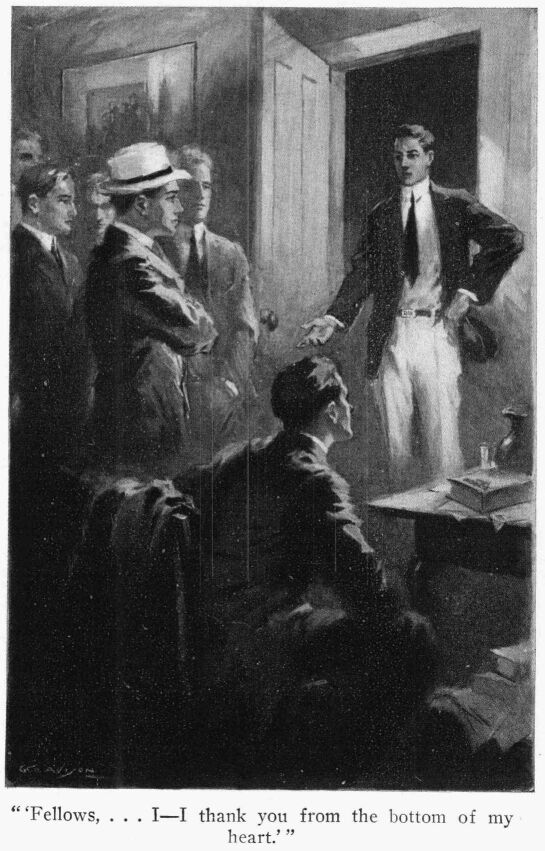
"Fellows," he startled them by appearing in the doorway, "I—I thank you from the bottom of my heart. I couldn't help hearing, you know—I do appreciate your generous thoughts, but—I can't and won't accept my B unless I win it according to the rule of the Athletic Association."
A silence, and then Butch Brewster, gripping his comrade's hand understandingly, held out to him the two letters.
"Forgive me, old man," he breathed, "for reading them aloud, but I wanted the fellows to know, to appreciate you! And say, Hicks, what does your Dad mean by saying that you are the 'Class Kid' of Yale, '96, and that those sons of old Eli want you to win your letter? And what does he mean by saying that you may get in a big game—may win it—that you have the goods in football, but lack the confidence to announce it to Coach Corridan? Also that old Bannister needs just the peculiar brand you possess?"
T. Haviland Hicks, Jr., his sunny, Cheshire cat grin illuminating his cherubic countenance, beamed on the eleven and Coach Corridan a moment.
"Oh, that's a mystery," he said, cheerfully. "If I do gain the courage and confidence, I'll explain, but unless I do—it remains a—mystery!"
CHAPTER VIII
COACH CORRIDAN SURPRISES THE ELEVEN
"ALL MEMBERS OF THE FIRST ELEVEN ARE URGENTLY REQUESTED TO BE PRESENT IN THE ROOM OF T. HAVILAND HICKS, JR.— AT EIGHT P. M. TONIGHT; YOU WILL BE DETAINED ONLY A FEW MINUTES, BUT LET EVERY PLAYER COME, AS A MATTER OF EXTREME IMPORTANCE WILL BE PRESENTED. PATRICK HENRY COERIDAN, HEAD-COACH."
"Now, what do you suppose is up Coach Corridan's sleeve?" demanded T. Haviland Hicks, Jr., cheerfully. "Has Ballard learned our signals, or some Bannister student sold them to a rival team, as per the usual football story? Though the notice doth not herald it, I am to be present, for my room is to be used, and the Coach gave me a special invitation to cut the Gordian knot with my keen intellect."
The sunny Hicks, with Butch, Beef, Tug, and Monty, had just come from "Delmonico's Annex," the college dining-hall, after supper; they had paused before the Bulletin Board at the Gymnasium entrance, where all college notices were posted, and the Coach's urgent request had caught their gaze. The announcement had caused quite a stir on the campus. The Bannister youths stood in excited groups talking of it, and in the dormitories it superseded all thought of study; however, there seemed little chance that any but the "'Varsity" and T. Haviland Hicks, Jr., who was always consulted in football problems, would know what took place in this meeting.
"There is only one way to find out, Hicks," responded big Butch Brewster, his arm across his blithesome comrade's shoulders, "and that is, attend the meeting! You can wager that every member of the eleven will be there, except Thor—he regards it as 'foolishness,' I suppose, and he won't spare that precious time from his studies."
At five minutes past eight, Butch's prophecy was fulfilled, for every member of the eleven was in Hicks' cozy room, except Thor, the Prodigious Prodigy, whose presence would have caused a mild sensation. It was an extremely quiet and orderly gathering, for Coach Corridan, who had the floor, was so grave that he impressed the would-be sky-larking youths. Having their undivided attention, he proceeded to make a speech that, to all intents and purposes, had much the same effect on the team and Hicks as a Zeppelin's bombs on London:
"Boys," he spoke, in forceful sentences, driving straight to the point, "I am going to take the eleven, and Hicks, whose suggestions are always timely, into my confidence, in the hope that we, working together, may carry out an idea of mine for the awakening of Thor to a realization of things! I ask you not to let what I shall tell you be known to the student-body, but you fellows play with Thor every day, and you will understand the crisis, and appreciate why it is done, if I decide it necessary to drop John Thorwald from the football squad."
"Drop Thor from the squad!" gasped T. Haviland Hicks, Jr., staggered, and then pandemonium broke loose among the players. Drop the Prodigious Prodigy from the squad, why, what could the Slave-Driver be thinking of? Why, look how Thorwald, on the scrubs, tore through the heavy 'Varsity line for big gains. He was simply unstoppable; and yet, almost on the eve of the big game that old Bannister depended on Thor to win by his splendid prowess, he might be dropped from the squad! Excited exclamations sounded from Captain Butch Brewster, Beef, and the others of the Gold and Green eleven:
"Why not give the big games to Ballard and Ham, Coach?"
"Say, shoot Theophilus Opperdyke in at full-back!"
"Good-by, championship! No hopes now, fellows!"
"If Thor doesn't play in the Big Games—good night!"
A greater sensation could not have been caused even had kindly white-haired Prexy announced his intention of challenging Jess Willard for the World's Heavy-Weight Championship. Dropping that human battering-ram, Thor, from the football, squad was something utterly undreamed-of. Coach Corridan raised his hand for silence, and the youths subsided.
"Hear me carefully, boys," he urged, "I know that old Bannister has come to regard John Thorwald as invincible, to use his vast bulk as a foundation on which to build hopes of the Championship, which is a bad policy, for no team can be a one-man team and win. I realize that as a football player, Thor hasn't an equal in the State today, and if he had the right spirit, he would have few in the country. It would be ridiculous to decry his prowess, for he is a physical phenomenon. But you remember T. Haviland Hicks, Jr.'s, splendid defense of Thor, a week or so ago? Hicks gave you a full and clear explanation of the big fellow, and showed you why he does not know what college spirit is, what loyalty and love for one's Alma Mater mean! His masterly speech changed your attitude toward Thor, and even before he decided to play football, for Mr. Hicks' sake, you admired him, because of his indomitable purpose, his promise to his dying mother. Now I am telling you why he may be dropped from the squad, because I want you fellows to give Thor a square deal, to remember what Hicks told you of him, and to keep on striving to awaken him to the true meaning of campus years, to make him realize that college life is more than a mere buying of knowledge. I want to keep him on the squad, if humanly possible, and I shall outline my plot later.
"Tomorrow we play Latham College. It is the last game before the big games for The State Intercollegiate Football Championship. Saturday after this, we play Hamilton, and the following week Ballard, the Champions! The eleven I send in against those teams must be a solid unit, one in spirit and purpose—every member of the Gold and Green team must be welded with his team-mates, and they must forget everything but that their Alma Mater must win the Championship! With no thought of self-glory, no other purpose in playing than a love for old Bannister, every fellow must go into those games to fight for his Alma Mater! Now, as for Thor, I need not tell you that he is not in sympathy with our ambition; he simply does not understand campus tradition and spirit. He is as yet not possessed of an Alma Mater; he plays football only because of gratitude to Mr. Thomas Haviland Hicks, Sr., and he hates to lose the time from his studies for the practice. The football squad knows that his presence is a veritable wet blanket on enthusiasm and the team's fighting spirit."
It was true. That intangible shadow of something wrong, brooding over training-table, shower-room, and Bannister Field, that self-evident truth which almost every collegian had for days confessed to himself yet hesitated to voice, had been given definite form by Coach Corridan talking to the eleven. The good that Thorwald might do for the team by his superb prowess and massive bulk was more than offset and nullified by his attitude.
To the blond Colossus, daily practice was unutterable mental torture. His mind was on his studies, to which his bulldog purpose shackled him; he begrudged the time spent on Bannister Field; he was stolid, silent, aloof. He scarcely ever spoke, except when addressed. He reported for practice at the last second, went through the scrimmage like a great, dumb, driven ox, doing as he was ordered; and when the squad was dismissed he hurried to his room. He was among the squad, but not of them; he neither understood nor cared about their love for old Bannister, their vast desire to win for their Alma Mater; he played football because he was grateful to Hicks, Sr., for helping him to get started toward his goal, but as Coach Corridan now told the 'Varsity, he killed the squad's enthusiasm,
"All of this cannot fail to damage the esprit de corps, the morale, of the eleven," declared Coach Corridan, having outlined Thor's attitude. "I know that every member of the squad, if Thor played the game because of college spirit, for love of old Bannister, would rejoice at his prowess. But as it is they are justly resentful that he is not in the spirit of the game. What we may gain by his playing, we lose because the others cannot do their best with his example to hurt their fighting spirit. I do not want, nor will I have on my eleven, any player who plays for other reasons than a love for his Alma Mater, be he a Hogan, Brickley, Thorpe, or Mahan. I have waited, hoping Thorwald would be awakened, as Hicks explained, but now I must act. Tomorrow's game with Latham must see Thor awakened, or I must, for the sake of the eleven, drop him from the squad for the rest of the season.
"Yet I beg of you, in case the plan I shall propose fails, remember Hicks' appeal! Do not condemn or ostracize John Thorwald in any degree. He has three more seasons of football, so let us keep on trying to make him understand campus life, college tradition. Be his friends, help him all you can, and sooner or later he will awaken. Something may suddenly shock him to a true understanding of what old Bannister means to a fellow. Or perhaps the awakening will be slow, but it must come. And Bannister can win without Thor, don't forget that! We'll make one final effort to awaken Thor, and if it fails, just forget him, boys, so far as football goes, and watch the Gold and Green win that championship."
"What is your scheme, Coach?" questioned Captain Butch Brewster, his honest countenance showing how heavily the responsibility of team-leader weighed upon him. "You are right; as Thor is now, he is a handicap to the eleven, but—"
"My idea is this," explained the Slave-Driver earnestly. "Select some student to go to Thorwald and try to show him that unless he gets into the game and plays for old Bannister, he will be dropped from the squad. If possible, let the fellow make him understand that, in his case, it will be a shame and a dishonor. Now, Butch, you and Hicks can probably approach Thor, or perhaps you know of someone who—"
T. Haviland Hicks, Jr.'s, cherubic countenance showed the light of dawning inspiration, and Coach Corridan paused, as the sunny youth exhibited a desire to say something, with him not by any means a phenomenal happening; given the floor, the blithesome youth burst forth excitedly: "Theophilus—Theophilus Opperdyke is the one! He has more influence over Thor than any other student, and the big fellow likes the little boner. Thor will at least listen to Theophilus, which Is more than any of us can gain from him."
After the meeting had adjourned, and the last inspection had been made in the other dorms, the Seniors being exempt, several members of the Gold and Green team—Captain Butch, Beef, Pudge, Monty, Roddy, and Bunch, together with little Theophilus Opperdyke, dragged from his studies—foregathered in the cozy room of T. Haviland Hicks, Jr.; those who had heard the coach's talk were still stunned at the ban likely to be placed on the Brobdingnagian Thor. On the campus outside Creighton Hall, a horde of Bannister youths, incited by Tug Cardiff, who gave them no reason for his act, were making a strenuous effort to awaken the Prodigious Prodigy, evidently depending on noise to achieve that end, for a vast sound-wave rolled up to Hicks' windows—"Rah! Rah! Rah! Thor! Thor! Thor! He's—all—right!"
"Listen!" exploded T. Haviland Hicks, Jr., indignantly. "You and I, Theophilus, would give a Rajah's ransom just to hear the fellows whoop it up for us like that, and it has no more effect on that sodden hulk of a Thor than bombarding an English super-dreadnaught with Roman candles! Howsomever, Coach Corridan exploded a shrapnel bomb on old Bannister's eleven tonight."
Then Hicks carefully outlined to the dazed little boner the substance of the coach's talk to the team, and Theophilus was alarmed when he thought of Thor's being dropped from the squad. When Captain Butch had outlined the Slave-Driver's plot for striving to awaken the Colossus to a realization of what a disgrace it would be to be sent from the gridiron, though he did not announce that the Human Encyclopedia had been elected to carry out Coach Corridan's last-hope idea, Theophilus sat on the edge of the chair, blinking owlishly at them over his big-rimmed spectacles.
"After all, fellows," quavered Theophilus nervously, "Coach Corridan, if he drops Thor from the squad, won't create such a riot on the campus as you might expect. You see, the students, even as they built and planned on Thor, gradually came to know that there is vastly more to be considered than physical power. That great bulk actually acts as a drag on the eleven, because Thor isn't in sympathy with things! Still, if he could only be aroused, awakened, wouldn't the team play football, with him striving for old Bannister, and not because he thinks he ought to play, for Hicks' dad? Oh, I do hope the Coach's plan succeeds, and he awakens tomorrow; I know the boys won't condemn him, if he doesn't, but—I—I want him to understand!"
"It's his last chance this season," reflected T. Haviland Hicks, Jr., enshrouded in a penumbra of gloom. "I made a big boast that I would round up a smashing full-back. I returned to Bannister with the Prodigious Prodigy. I made a big mystery of him, and then—biff!—Thor quit football. Then I explained the mystery, and got the fellows to admire him, and when Thor decided to play the game I thought 'All O.K.; I'll just wait until he scatters Hamilton and Ballard over Bannister Field, then I'll swagger before Butch and say, "Oh, I told you just to leave it to Hicks!"' But now Thor has spilled the beans again."
"I—I hope that the one you have chosen to appeal to Thor—" spoke Theophilus timorously, "will succeed, for—Oh, I don't want him to be dropped from the squad, and—"
Big Butch Brewster, who had been gazing at little Theophilus Opperdyke with a basilisk glare that perturbed the bewildered Human Encyclopedia, suddenly strode across the room and placed his hand on the grind's thin shoulders.
"Theophilus, old man, it's up to you!" he said earnestly. "Thor has a strong regard for you; in fact, outside of his good-natured tolerance for Hicks, you alone have his friendship. Now I want you to go to him, Theophilus, and make a last appeal to Thor. Try to awaken him, to make him understand his peril of being dropped from the squad, unless he plays the game for his college! It's for old Bannister, old man, for your Alma Mater—"
"Go to it, Theophilus!" urged Beef McNaughton. "Coach Corridan said Thor might be suddenly awakened by a shock, but no electric battery can shock that Colossus, and, besides, miracles don't happen nowadays. Yes, it's up to you, old man."
For a moment little Theophilus, his big-rimmed spectacles falling off as fast as he replaced them, and his puny frame tense with excitement, hesitated. Sitting on the extreme edge of the chair, he surveyed his comrades solemnly and was convinced that they were in earnest. Then, "I—I will try, sir!" exclaimed Theophilus, who would never forget his Freshman training. "I'm sure Hicks, or somebody, could do It better than I; but—I'll try!"
CHAPTER IX
THEOPHILUS' MISSIONARY WORK
"College ties can ne'er be broken— Loyal will remain each heart; Though the last farewell be spoken— And from Bannister we part!
"Bannister, Bannister, hail, all hail! Echoes softly from each heart; We'll be ever loyal to thee— Till we from life shall part!"
Theophilus Opperdyke, the timorous, intensely studious Human Encyclopedia, stood at the window of John Thorwald's study room. That behemoth, desiring quiet, had moved his study-table and chair to a vacant room across the second-floor corridor of Creighton, the Freshman dormitory, when the Bannister youths cheered him, and he was still there, so that Theophilus, on his mission, had finally located him by his low rumblings, as he laboriously read out his Latin. The little Senior was gazing across the brightly lighted Quadrangle. He could see into the rooms of the other class dormitories, where the students studied, skylarked, rough-housed, or conversed on innumerable topics; from a room in Nordyke, the abode of care-free Juniors, a splendidly blended sextette sang songs of their Alma Mater, and their rich voices drifted across the Quad. to Thor and Theophilus:
"Though thy halls we leave forever Sadly from the campus turn; Yet our love shall fail thee never For old Bannister we'll yearn! Bannister, Bannister, hail, all hail!"
Theophilus turned from the window, and looked despairingly at that young Colossus, Thor. The behemoth Norwegian, oblivious to everything except the geometry problem now causing him to sweat, rested his massive head on his palms, elbows on the study-table, and was lost in the intricate labyrinth of "Let the line ABC equal the line BVD." The frail chair creaked under his ponderous bulk. On the table lay an unopened letter that had come in the night's mail, for, tackling one problem, the bulldog Hercules never let go his grip until he solved it, and nothing else, not even Theophilus, could secure his attention. Hence the Human Encyclopedia, trembling at the terrific importance of the mission entrusted to him, waited, thrilled by the Juniors' songs, which failed to penetrate Thor's mind.
"Oh, what can I do?" breathed Theophilus, sitting down nervously on the edge of a chair and peering owlishly over his big-rimmed spectacles at the stolid John Thorwald. "I am sure that, in time, I can help Thor to—to know campus life better; but—tomorrow is his last chance! He will be dropped from the squad, unless—"
As Thor at last leaned back and gazed at his little comrade, just then, to the tune of "My Old Kentucky Home," an augmented chorus drifted across the Quadrangle:
"And we'll sing one song For the college that we love— For our dear old Bannister—good-by"
To the Bannister students there was something tremendously queer in the friendship of Theophilus and Thor. That the huge Freshman, of all the collegians, should have chosen the timorous little boner was most puzzling. Yet, to T. Haviland Hicks, Jr., a keen reader of human nature, it was clear; Thorwald thought of nothing but study, Theophilus was a grind, though he possessed intense college spirit, hence Thor was naturally drawn to the little Senior by the mutual bond of their interest in books, and Theophilus, with his hero-worshiping soul, intensely admired the splendid purpose of John Thorwald, toiling to gain knowledge, because of the promise of his dying mother. The grind, who thought that next to T. Haviland Hicks, Jr., Thor was the "greatest ever," as Hicks phrased it, had been, doing what that care-free collegian termed "missionary work," with the stolid, unimaginative Prodigious Prodigy for some weeks. Thrilled with the thought that he worked for his Alma Mater, he quietly strove to make Thorwald glimpse the true meaning and purpose of college life and its broadness of development. The loyal Theophilus lost no opportunity of impressing his behemoth friend with the sacred traditions of the campus, or of explaining why Thor was wrong in characterizing all else than study as foolishness and waste of time.
"Thor," began Theophilus timidly yet determinedly, for he was serving old Bannister now, "old man, do you feel that you are giving the fellows at Bannister a square deal?"
John Thorwald, slowly tearing open the letter that had come that night, and had lain, unnoticed, on the study-table while he wrestled with his geometry, turned suddenly. The Human Encyclopedia's vast earnestness and the strange query he had fired at Thor, surprised even that stolid mammoth.
"Why, what do you mean, Theophilus?" spoke Thor slowly. "A square deal? Why, I owe them nothing! I sacrifice my time for them, leaving my studies to go out and waste precious time foolishly on football. Why—"
"I mean this," Theophilus kept doggedly on, his earnest desire to stir Thor conquering his natural timidity. "You were brought to old Bannister by Hicks, who made a great mystery of you, so we knew nothing of you; but the fellows all thought you were willing to play football. Then, after they got enthused, and builded hopes of the championship on you, came your quitting. Hicks defended you, Thor, and changed the boys' bitter condemnation to vast admiration, by telling of your life, your father's being a castaway, your mother's dying wish, your toil to get learning, and your inability to grasp college life. Then from gratitude to Mr. Hicks you started to play again—naturally, the students waxed enthusiastic, when you ripped the 'Varsity to pieces, but now you may be dropped by the coach, after tomorrow, because you don't play for old Bannister, and your indifference kills the team's fighting spirit. You do not care if you are dropped; it will give you more time to study, and relieve you of your obligation, as you so quixotically view it, to play because Mr. Hicks will be glad; but—think of the fellows.
"They, Thor, disappointed in you, their hopes of your bringing by your massive body and huge strength the Championship to old Bannister shattered, are still your friends—they of the eleven, I mean especially, for, as yet, the rest do not know you may be dropped. And the fellows came beneath your window tonight to cheer you; they will do so, Thor, even if you are dropped and they know that you will not use that prodigious power for their Alma Mater in the big games; they will stand by you, for they understand! Just think, old man; haven't the fellows, despite your rude rebuffs, tried to be your comrades? Haven't they helped you to get settled to work and assisted you with your studies? Why, you have been a big boor, cold and aloof, you have upset their hopes of you in football, and yet they have no condemnation for you, naught but warm friendliness.
"You are not giving them or yourself a square deal, Thor! You won't even try to understand campus life, to grasp its real purpose, to realize what tradition is! The time will come, Thor, when you will see your mistake; you will yearn for their good fellowship, you will learn that getting knowledge is not all of college life. You will know that this 'silly foolishness' of singing songs and giving the yell, of rooting for the eleven, of loyalty and love for one's Alma Mater, is something worth while. And you may find it out too late. Oh, if you could only understand that it isn't what you take from old Bannister that makes a man of you, it is what you give to your college—in athletics, in your studies, in every phase of campus life; that in toiling and sacrificing for your Alma Mater you grow and develop, and reap a rich reward!"
Could T. Haviland Hicks, Jr., Butch Brewster, and the Gold and Green eleven have heard little Theophilus' fervent and eloquent appeal to John Thorwald, they would have felt like giving three cheers for him. They loved this pathetic little boner, who, because of his pitifully frail body, could never fight for old Bannister on gridiron, diamond, or track, and they tremendously admired him for working for his college and for the redemption of Thor. Timorous and shrinking by nature, whenever his Alma Mater, or a friend, needed him the Human Encyclopedia fought down his painful timidity and came up to scratch nobly.
It was Theophilus whose clear logic had vastly aided T. Haviland Hicks, Jr., to originate The Big Brotherhood of Bannister, in 1919's Sophomore year, and quell Roddy Perkins' Freshman Equal Rights campaign. In fact, it had been the boner's suggestion that gave Hicks his needed inspiration. And, a Junior, Theophilus had been elected business manager of the Bannister Weekly, with Hicks as editor-in-chief as a colossal joke. The entire burden of that almost defunct periodical had been thrust on those two, and, thanks to the grind's intensely humorous "copy," the Weekly had been revived and rebuilt. And Theophilus, in writing the humorous articles, had been moved by a great ambition to do something for old Bannister.
"Look at me, Thor!" continued Theophilus Opperdyke, his puny body dwarfed as he faced the colossal Prodigious Prodigy. "A poor, weak, helpless nothing! I'd cheerfully sacrifice all the scholastic honor or glory I ever won, or shall win, just to make a touchdown for the Gold and Green, just to win a baseball game, or to break the tape in a race for old Bannister! And you—you, with that tremendous body, that massive bulk, that vast strength—you won't play the game for your Alma Mater, you won't throw that big frame into the scrimmage, thrilled with a desire to win for your college! Oh, what wonderful things you could do with your powerful build; but it means nothing to you, while I— Oh, you don't care, you just won't awaken; and, unless you do, in tomorrow's game you'll be dropped from the squad, a disgrace."
John Thorwald-Thor, the Prodigious Prodigy, that Gargantuan Freshman of whom Bannister said he possessed no soul—stirred uneasily, shifted his vast tonnage from one foot to the other, and stared at little Theophilus Opperdyke. That solemn Senior, who had not seen the slightest effect his "Missionary Work" was having on the stolid Thor, was in despair; but he did not know the truth. As Hicks had once said, "You don't know nothing what goes on in Thor's dome. There's a wall of solid concrete around the machinery of his mind, and you can't see the wheels, belts, and cogs at work!"
T. Haviland Hicks, Jr., with all his keen insight into human nature, had failed utterly to diagnose Thor's case, had not even stumbled on the true cause of that young giant's aloofness. The truth was unknown to anyone, but there was one natural reason for John Thorwald's not mingling with his fellows of the campus-the blond Colossus was inordinately bashful! From his fifteenth year, Thor had seen the seamy side of life, had lived, grown and developed among men. In his wanderings in the Klondike, the wild Northwest, in Panama, his experiences as cabin-boy, miner, cowboy, lumber-jack, and Canal Zone worker, he had existed where everything was roughness and violence, where brawn, not brain, usually held sway, where supremacy was won, kept, and lost by fists, spiked boots, or guns! In his adventurous career, young Thorwald had but seldom encountered the finer things of life, and his nature, while wholesome, was sturdy and virile, not likely to be stirred by sentiment; so that now, among the good-natured, friendly boys of old Bannister, he, accustomed to rude surroundings and rough acquaintances, was bashful.
And Theophilus, as well as T. Haviland Hicks, Jr., shot far wide of the mark in believing that the big Hercules had no power to feel; he possessed that power, but, with it the ability to conceal his feelings. They thought nothing appealed to him, had stirred his soul, at college, but they were wrong; true, Thor was unable to understand this new, strange life; he was puzzled when the collegians condemned and ostracized him at first, when he quit football because it was not a Faculty rule to play, but he was grateful when Hicks defended him, and the admiration of the student-body was welcome to him. He had thought he was doing all they desired of him, when he went back to the game, and now—when Theophilus told him that he might be dropped from the squad, he was bewildered. He could not understand just why this could be, when he was reporting for scrimmage every day!
But the friendliness of the youths, their kind help with his studies, the assistance of the genial Hicks, and, more than all, above even the admiration of the Freshmen for his promise and purpose, the daily missionary work of little Theophilus, for whom the massive Thor felt a real love, had been slowly, insidiously undermining John Thorwald's reserve. No longer did he condemn what he did not understand. At times he had a vague feeling that all was not right, that, after all, he was missing something, that study was not all; and yet, bashful as he was, fearing to appear rough, crude, and uncouth among these skylarking youths, Thor kept on his silent, lonely way, and they thought him untouched by their overtures. Of late, when unobserved, the big Freshman had stood by the window, watching the collegians on the campus, listening to their songs of old Bannister, and yet because he felt embarrassed when with them, he gave no sign that he cared.
Now, however, the splendid appeal of loyal, timorous Theophilus stirred Thor, and yet he could not break down the wall of reserve he had builded around himself. He had deluded himself that this comradeship was not for him, that he could never mingle with these happy-go-lucky youths, that he must plod straight ahead, and live to himself, because his past had roughened him.
"You are a Freshman!" spoke Theophilus, unaware that forces were at work on Thor, and making a last effort. "You stand on the very threshold of your campus years; everything is before you. I am at the journey's end—very nearly, for in June I graduate from old Bannister. I never had the chance to fight for my Alma Mater on the athletic field, and you—Oh, think of what you can do! About to leave the campus, I, and my class-mates, realize how dear our college has become to us. If you could just know that Bannister means something to you, even now, if you only felt it, you could make your years mean great things to you. Thor, could you leave old Bannister tomorrow without regret, without one sigh for the dear old place? We, who soon shall leave it forever, fully understand Shakespeare, when in a sonnet he wrote:
"This thou perceivest, which makes thy love more strong— To love that well which thou must leave ere long!"
There was a silence, and then Thor slowly drew out a letter from its envelope, scanning the scrawl across its pages. A few moments, while its meaning seemed to seep into his slow-acting mind, and then a look of helpless bewilderment, as though the stolid Freshman just could not understand at all, came to his face; a minute John Thorwald stood, as in a trance, staring dully at the letter.
"Thor! Thor! What's the matter? What's wrong?" quavered the alarmed Theophilus, "Have you gotten bad news?"
"Read it, read it," said the big Freshman lifelessly, extending the letter to the startled Senior. "It's all over, I suppose, and I've got to go to work again. I've got to leave college, and toil once more, and save. My promise to my mother can't be fulfilled—yet. And just as I was getting fairly started."
Theophilus Opperdyke hurriedly perused the message, which had come to Thor in that night's mail but which the blond giant had let lie unnoticed while he tackled his geometry. With difficulty Theophilus deciphered the scrawl on an official letterhead:
THE NEW YORK-CHRISTIANA STEAMSHIP LINE
(New York Offices)
Nov. 4, 19—.
DEAR SON:
I am writing to tell you that I've run into a sort of hurricane, and you and I have got a hard blow to weather. I started you at college on the $5,000 received from the heirs of Henry B. Kingsley, on whose yacht, as you know, I was wrecked in the South Seas, and marooned for ten years. I figured on giving you an education with that sum, eked out by my wages, and what you earn in vacations.
I had the $5,000, untouched, in a New York bank, and I wanted to take it over to Christiania; when I was about to sail on my last voyage, I drew out the sum, and put it in care of the Purser of the Norwhal, on which I was mate, intending, of course, to get it on docking, and deposit it in Christiania. At the last hour I was transferred to the Valkyrie, to sail a few days later, and I knew the Norwhal's purser would leave the $5,000 for me in the Company's Christiania offices, so I did not bother to transfer it to the Valkyrie.
Perhaps you read in the newspapers that the Norwhal struck a floating mine, and went down with a heavy loss of life. The Purser was among those lost, and none of the ship's papers were saved; my $5,000, of course, went down also.
I am sorry, John, but there seems nothing to do but for you to leave college and work. For your mother's sake, I wish we could avoid it; but we must wait and work and tackle it again. Your first term expenses are paid, so stay until the term is out. Perhaps Mr. Hicks can give you a job in one of his steel mills again, but we must work our own way, son. Don't lose courage, we'll fight this out together with the memory of your promise to your dying mother to spur you on. The road may be long and rocky but we'll make it. Just work and save, and in a year or two you can start at college again. You can study at night, too, and keep on learning.
I'll write later. Stay at college till the term is up, and in the meantime try to land a job. However, you won't have any trouble to do that. Keep your nerve, boy, for your mother's sake. It's a hard blow, but we'll weather it, never fear, and reach port.
Your father,
JOHN THORWALD, SR.
P.S. I am sailing on the Valkyrie today, will write you on my return to New York, in a few weeks.
Theophilus looked at the massive young Norwegian, who had taken this solar-plexus blow with that same stolid apathy that characterized his every action. He wanted to offer sympathy, but he knew not how to reach Thor. He fully understood how terrific the blow was, how it must stagger the big, earnest Freshman, just as he, after ten years of grinding toil, of sacrifice, of grim, unrelenting determination, had conquered obstacles and fought to where he had a clear track ahead. Just as it seemed that fate had given him a fair chance, with his father rescued and five thousand dollars to give him a college course, this terrible misfortune had befallen him. Theophilus realized what it must mean to this huge, silent Hercules, just making good his promise to his dying mother, to give up his studies, and go back to work, toil, labor, to begin all over again, to put off his college years.
"Leave me, please," said Thor dully, apparently as unmoved by the blow as he had been by Theophilus' appeal. "I—I would like to be alone, for awhile."
Left alone, John Thorwald stood by the window, apparently not thinking of anything in particular, as he gazed across the brightly lighted Quad. The huge Freshman seemed in a daze—utterly unable to comprehend the disaster that had befallen him; he was as stolid and impassive as ever, and Theophilus might have thought that he did not care, even at having to give up his college course, had not the Senior known better.
Across the Quadrangle, from the room of the Caruso-like Juniors, accompanied by a melodious banjo-twanging, drifted:
"Though thy halls we leave forever Sadly from the campus turn; Yet our love shall fail thee never For old Bannister we'll yearn!
"'Bannister, Bannister, hail, all hail!' Echoes softly from each heart; We'll be ever loyal to thee Till we from life shall part."
Strangely enough, the behemoth Thorwald was not thinking so much of having to give up his studies, of having to lay aside his books and take up again the implements of toil. He was not pondering on the cruelty of fate in making him abandon, at least temporarily, his goal; instead, his thoughts turned, somehow, to his experiences at old Bannister, to the football scrimmages, the noisy sessions in "Delmonico's Annex," the college dining-hall, to the skylarking he had often watched in the dormitories. He thought, too, of the happy, care-free youths, remembering Hicks, good Butch Brewster, loyal little Theophilus; and as he reflected, he heard those Juniors, over the way, singing. Just now they were chanting that exquisitely beautiful Hawaiian melody, "Aloha Oe," or "Farewell to Thee," making the words tell of parting from their Alma Mater. There was something in the refrain that seemed to break down Thor's wall of reserve, to melt away his aloofness, and he caught himself listening eagerly as they sang.
Somehow he felt no desire to condemn those care-free youths, to call their singing silly foolishness, to say they were wasting their time and their fathers' money. Queer, but he actually liked to hear them sing, he realized he had come to listen for their saengerfests. Now that he had to leave college, for the first time he began to ponder on what he must leave. Not alone books and study, but—
As he stood there, an ache in his throat, and an awful sorrow overwhelming him, with the richly blended voices of the happy Juniors drifting across to him, chanting a song of old Ballard, big Thor murmured softly:
"What did little Theophilus say? What was it Shakespeare wrote? Oh, I have it:
"'This thou perceivest, which makes thy love more strong— To love that well, which thou must leave ere long.'"
CHAPTER X
THOR'S AWAKENING
"There's a hole in the bottom of the sea, And we'll put Bannister in that hole! In that hole—in—that—hole— Oh, we'll put Bannister in that hole!"
"In the famous words of the late Mike Murphy," said T. Haviland Hicks, Jr., "the celebrated Yale and Penn track trainer, 'you can beat a team that can't be beat, but—you can't beat a team that won't be beat!' Latham must be in the latter class."
It was the Bannister-Latham game, and the first half had just ended. Captain Butch Brewster's followers had trailed dejectedly from Bannister Field to the Gym, where Head Coach Corridan was flaying them with a tongue as keen as the two-edged sword that drove Adam and Eve from the Garden of Eden. A cold, bleak November afternoon, a leaden sky lowered overhead, and a chill wind swept athwart the field; in the concrete stands, the loyal "rooters" of the Gold and Green, or of the Gold and Blue, shivered, stamped, and swung their arms, waiting for the excitement of the scrimmage again to warm them. Yet, the Bannister cohorts seemed silent and discouraged, while the Latham supporters went wild, singing, cheering, howling. A look at the score-board explained this:
END OF FIRST HALF: SCORE: Bannister ........ 0 Latham ........... 3
The statement of T. Haviland Hicks, Jr., swathed in a gold and green blanket and humped on the Bannister bench, to shivering little Theophilus Opperdyke, the Phillyloo Bird, Shad Weatherby, and several more collegians who had joined him when the half ended, was singularly appropriate. In Latham's light, fast eleven, trained to the minute, coached to a shifty, tricky style of play with numberless deceptive fakes from which they worked the forward pass successfully, Bannister seemed to have encountered, as Mike Murphy phrased it, "A team that won't be beat!" According to the advance dope of the sporting writers, who, in football, are usually as good prophets as the Weather Bureau, Bannister was booked to come out the winner by at least five touchdowns to none. But here a half was gone, and Latham led by three points, scored on a rather lucky field-goal!
The psychology of football is inexplicable. Yale, beaten by Virginia, Brown, and Wash-Jeff, with the Blue's best gridiron star ineligible to play, a team that seemed at odds with itself and the 'Varsity, mismanaged, poorly coached, journeys to Princeton to battle with old Nassau; the Tiger, Its tail as yet untwisted, presents its best eleven for several seasons, a great favorite in the odds, and yet the final score is Yale, 14; Princeton, 7! A strange fear of the Bulldog, bred of many bitter defeats, of similar occasions when a feeble Yale team aroused itself and trampled an invincible Orange and Black eleven, when the Blue fought old Nassau with a team that "wouldn't" be beat, gave victory to the poorer aggregation. So many things unforeseen often enter into a football contest, shifting the balance of power from the stronger to the weaker team. One eleven gets the jump on the other, the favorite weirdly goes to pieces—team dissension may exist, a dozen other causes—but, boiled down, Mike Murphy's statement was most appropriate now.
Latham simply would not be beat! The sporting pages had said: "Latham simply can't beat Bannister!" Here the team, that could not be beaten was being defeated, and the team that would not be defeated was, so far, the victor. Perhaps the threatened dropping of Thor from the Gold and Green squad shook somewhat Captain Butch's players; more likely, the Latham aggregation got the jump on Bannister, opening up a bewildering attack of criss-crosses, line plunges, cross-bucks, and tandems, from all of which the forward pass frequently developed; they literally overwhelmed a supposedly unbeatable team. And once they got the edge, it was hard for Bannister to regain poise and to smother the fast plays that swept through or around the bewildered eleven.
"We have got to beat 'em!" growled Shad, "Mike Murphy or not. Why, if little old Latham cleans us up, smash go our chances of the State Championship! Oh, look at Thor—the big mountain of muscle. Why doesn't he wake up, and go push that team off the field?"
Thor, the Prodigious Prodigy, his vast hulk unprotected from the cold wind by a football blanket, squatted on the ground, on the side-line, apparently in a trance. Ever since the night before, when his father's letter had dealt such a knock-out blow to his hopes of fulfilling the promise to his dying mother, had rudely side-tracked him from the climb to his goal, the blond giant had maintained that dumb apathy. If anything, it seemed that the cruel blow of fate had only served to make Thor more stolid and impassive than ever, and Theophilus wondered if the Colossus had really grasped the import of the tragic letter as yet. The news had spread over the college and campus, and the students were sincerely sorry for Thor. But to offer him sympathy was about as difficult as consoling a Polar bear with the toothache.
Coach Corridan, carrying out his plot, had decided not to start Thor in the first half of the game. So the Norwegian Hercules, having received no orders to the contrary, however, donned togs and appeared on the side-line, where he had sat, paying not the slightest heed to the scrimmage and seemingly unaware that the Gold and Green was facing defeat and the loss of the Championship, for a game lost would put the team out of the running. All big John Thorwald knew was, in a few weeks he must leave old Bannister, must give up, for a time, his college course. Just when the grim battle was won, he must leave, to work. Not that the Viking cared about toil. It was the delay that chafed even his stolid self. He was stunned at having to wait, maybe two years, before starting again.
And yet, as he squatted on the side-line, oblivious to everything but his bitter reflections, the Theophilus-quoted words of Shakespeare persisted in intruding on his thoughts:
"This thou perceivest, which makes thy love more strong— To love that well, which thou must leave ere long."
Try as he would, he could not fight away the keen realization that books and study were not all he would regret to leave. He was forced to acknowledge that his mind kept wandering to other things. He found himself pondering on the parting with Theophilus Opperdyke, with that crazy Hicks; he wondered if he, out in the world again, toiling his lonely way, would miss the glad fellowship of these care-free youths that he had watched, but never shared, if he would ever think of the weeks at old Bannister. Somehow, he felt that he would often vision the Quad at night, brightly lighted, dormitories' lights agleam, students crossing and recrossing, shouting at studious comrades. He would hear again the melodious banjo-twanging, the gleeful saengerfests, the happy skylarking of the boys. He had never entered into all this, and yet he knew he would miss it all; why, he would even miss the daily scrimmage on Bannister Field; the noisy shower-room, with its clouds of steam, and white forms flitting ghostlike. He would miss the classrooms; in brief, everything!
John Thorwald was awakening! Even had this blow not befallen him, the huge, slow-minded Norwegian, in time, with Theophilus Opperdyke's missionary work, would have gradually come to understand things better—at least, to know he was wrong in his ideas, which is the beginning of wisdom. Already, he had ceased to condemn all this as foolishness, to rail at the youths for wasting time and money. Already something stirred within him, and yet, stolid as he was, bashful among the collegians, he was apparently the same. But the sudden shock Head Coach Corridan spoke of had come. His father's letter telling of his loss and that Thor must leave Bannister had awakened him to the startling knowledge that he did care for something more than study, that all the things that had puzzled him, that he had sneered at, meant something to his existence, that he dreaded leaving other things than his books.
"I—I don't understand things," thought Thorwald. "But—if I could only stay, I'd want to learn. I'd try to get this 'college' spirit! Oh, I've been all wrong, but if I could only stay—"
As if in answer to his unspoken thought, the big Freshman beheld marching toward him Theophilus Opperdyke, his spectacles off, and his face aglow, T. Haviland Hicks, Jr., evidently in the throes of emotional insanity; a Senior whom he knew as Parson Palmetter; Registrar Worthington, and Doctor Alford, the kindly, beloved Prexy of old Bannister. The last named placed his hand on the puzzled behemoth's ponderous shoulder.
"Thorwald," he said kindly, "Hicks, Opperdyke and Brewster, last night, came to my study and acquainted me with your misfortune. They told me of your life-history, of your splendid purpose to gain knowledge, to make something of yourself, for your dying mother's sake. Old Bannister needs men like you, Thorwald. Perhaps you do not understand campus ways and tradition yet, perhaps you are not in sympathy with everything here; but once a love for your Alma Mater is awakened, you will be a power for good for your college.
"Now I at once took up the matter with Mr. Palmetter, President of The Students' Aid Bureau. This year, for the first time in our history, we have dispensed with janitors and sweeps in the dormitories, and with dining-hall waiters, so that needy and deserving students may work their way through Bannister. Owing to the fact that Mr. Deane, a Senior, has given up his dormitory, Creighton Hall, as he has funds for the year and needs the time to study, we can offer you board and tuition, in exchange for your work in the dormitory, and waiting on tables in the dining-hall. Since your first term bills, until January first, are paid, if you will start to work at once, we will credit any work done this term on books and incidentals for next term. By this means—"
"Why, you don't—you can't mean—" rumbled Thor, who had just dimly grasped the greatest point in Prexy's speech. "Why, then I won't have to leave Bannister—I won't have to quit my studies! Oh, thank you, sir; thank you! I will work so hard. I am not afraid of work; I love it—a chance to toil and earn my education, that's what I want! Thank you!"
"And in addition," said the Registrar, "Mr. Palmetter reports that he can secure you, downtown, a number of furnaces to tend this winter, which you can do early in the morning and at night; this will bring you an income for living expenses, and in the spring something else will offer itself. It means every moment of your time will be crowded, but Bannister needs workers—"
Something stirred in John Thorwald. His heart had been touched at last. He thought of T. Haviland Hicks, Jr., Butch, and little Theophilus worried at his having to leave college, going to Doctor Alford; of Prexy, the Registrar, and Parson Palmetter, working to keep Thor at old Bannister. He recalled how sympathetic all the youths had been, how they admired his purpose and determination; and he had rewarded their friendliness with cold aloofness. He felt a thrill as he visioned himself working for his education, rising in the cold dawn, tending furnaces, working in the dorm., waiting on tables—studying. With what fierce joy he would assail his tasks, glad that he could stay! He knew the students would rejoice, that they would not look down on him; instead, they would respect and admire him, toiling to grow and develop, to attain his goal!
"Go to it, Thor!" urged T. Haviland Hicks, Jr. "We all want you to stay, old man; we'll give you a lift with your studies. Old Bannister wants you, needs you, so stick!"
"Stay, please!" quavered little Theophilus. "You don't want to leave your Alma Mater; stay, Thorwald, and—you'll understand things soon,"
"Report at the Registrar's office at seven tonight, Thorwald," said Prexy, and then, because he understood boys and campus problems, "and to show your gratitude, you might go out there and spank that team which is trying to lick old Bannister."
John Thorwald, when Doctor Alford and the Registrar had gone, arose and stood gazing across Bannister Field. He saw not the white-lined gridiron, the gaunt goal-posts, the concrete stands filled with spectators, or the gay banners and pennants. He saw the buildings and campus of old Bannister, the stately old elms bordering the walks; he beheld the Gym., the four dormitories—Bannister, Nordyke, Smithson, and Creighton—the white Chapel, the ivy-covered Library, the Administration and Recitation Halls; he glimpsed the Memorial Arch over the entrance driveway, and big Alumni Hall. All at once, like an inundating wave, the great realization flashed on Thor that he did not have to leave it all! Often again would he hear the skylarking youths, the gay songs, the banjo-strumming; often would he see the brightly lighted Quad., would gaze out on the campus! It was still his—the work, the study, and, if he tried, even the glad comradeship of the fellows, the bigger things of college life, which as yet he did not understand.
The big slow-minded youth could not awaken, at once, to a full knowledge and understanding of campus life and tradition, to a knowledge of college spirit; but, thanks to the belief that he had to leave it all, he had awakened to the startling fact that already he loved old Bannister. And now, joyous that he could stay, John Thorwald suddenly felt a strong desire to do something, not for himself, but for these splendid fellows who had worried for his sake, had worked to keep him at college. And just then he remembered the somewhat unclassical, yet well meant, words of dear old Doctor Alford, "And to show your gratitude, you might go out there and spank that team, which is trying to lick old Bannister."
John Thorwald for the first time looked at the score-board; he saw, in big white letters:
BANNISTER .......... 0 LATHAM ............. 3
From the Gym. the Gold and Green players—grim, determined, and yet worried by the team that "won't be beat!"—were jogging, followed by Head Coach Patrick Henry Corridan. The Latham eleven was on the field, the Gold and Blue rooters rioted in the stands. From the Bannister cohorts came a thunderous appeal:
"Hold 'em, boys—hold 'em, boys—hold—hold—hold! Don't let 'em beat the Green and the Gold!"
A sudden fury swayed the Prodigious Prodigy; it was his college, his eleven, and those Blue and Gold youths were actually beating old Bannister! The Bannister boys had admired him, some of them had helped him in his studies, three had told Doctor Alford of him, had made it possible for him to stay, to keep on toward his goal. They would be sorrow-stricken if Latham won! A feeling of indignation came to Thor. How dare those fellows think they could beat old Bannister! Why, he would go out there and show them a few things!
Head Coach Corridan, let it be chronicled, was paralyzed when he ducked under the side-line rope—stretched to hold the spectators back—to collide with an immovable body, John Thorwald, and to behold an eager light on that behemoth's stolid face. Grasping the Slave-Driver in a grip that hurt, Thor boomed:
"Mr. Corridan, let me play, please! Send me out this half. We can win. We've got to win! I want to do something for old Bannister. Why, if we lose today, we lose the Championship! I don't understand things yet, but I do love the college. I want to fight for Bannister. Please let me play!"
The astonished coach and the equally dazed Gold and Green eleven, with the bewildered collegians who heard Thor's earnest appeal, were silent a few moments, unable to grasp the truth. Then Captain Brewster, his face aglow, seized the big Freshman's arm excitedly.
"Sure you'll play, Thor!" he shouted. "Fullback, old man! Come on, team. Thor's awake! He wants to fight for his Alma Mater; he wants Bannister to win! Oh, watch us shove Latham off the field—everybody together now—the yell, for Thor!"
"Right here," grinned an excitedly happy T. Haviland Hicks, Jr., when the yell was given, "is where a team that won't be beat gets licked by a chap what can lick 'em!"
What took place when the blond Prodigious Prodigy lumbered on Bannister Field at the start of the last half of the Bannister-Latham game can be imagined by the final score-board figures:
BANNISTER ......... 27 LATHAM ............. 3
It can best be described with the aid of Scoop Sawyer's account in the next Bannister Weekly:
—At the start of the second half, however, the Latham cohorts were given a shock when they beheld a colossal being almost as big as the entire Gold and Blue eleven, go in at fullback for Bannister. And the Latham eleven received a series of shocks when Thor began intruding that massive body of his into their territory. Tennyson's saying, "The old order changeth, yielding place to new" was aptly illustrated in the second half; for Bannister's bugler quit sounding "Retreat!" and blew "Charge!" Four touchdowns and three goals from touchdowns, in one half, is usually considered a fair day's work for an entire team. Even Yale or Harvard; but when one player corrals four touchdowns in a half—he is going some! Well, Thor went some! Most of the half he furnished free transportation for two-thirds of the Latham team, carrying them on his back, legs, and neck, as he strode down the field; a writ of habeas corpus could not have stopped the blond Colossus. Anyone would have stood more show to stop an Alpine avalanche than to slow up Thor, and the stretcher was constantly in evidence, for Latham knockouts.
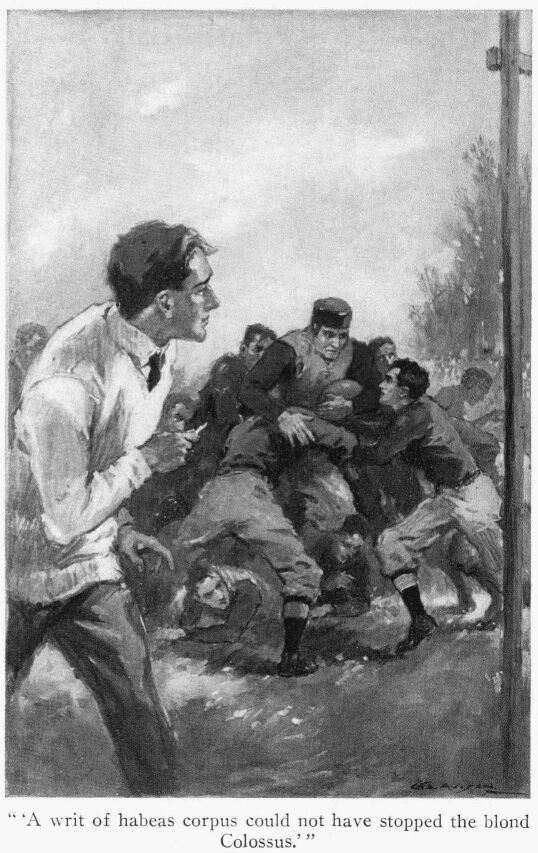
The game turned into a Thor's Personally Conducted Tour. Thorwald, escorted by the Gold and Green team, made four quick tours to the Latham goal-line. It was simply a matter of giving the ball to the Prodigious Prodigy, then waving the linesmen to move down twenty yards or more toward Latham's line. Thor was simply unstoppable, and more beneficial even than his phenomenal playing was his encouragement to the team. He kept urging them to action, his foghorn growl of, "Come on, boys!" was a slogan of victory! Judging by Thor's awakening, and his work of the Latham game, Bannister's hopes of The State Intercollegiate Football Championship are as roseate as the blush on a maiden's cheek at her first kiss, and—
That night, in the cozy room of T. Haviland Hicks, Jr., John Thorwald, supremely happy yet withal as uncomfortable as a whale on the Sahara Desert, overflowed an easy-chair. The room was filled, or what space Thor left, with the Bannister eleven, second-team players, Coach Corridan, and several students; on the campus a riotous crowd of Bannister youths "raised merry Heck," as Hicks phrased it, and their cheer floated up to the windows: