Suborder V. DELPHINOIDEA.
Reading edition
Delphinoidea, Gray, Synops. Whales & Dolph. p. 4.
Nostrils two, united into a single central transverse or crescentic blower on the back of the crown. Teeth in both jaws, permanent, or rarely deciduous by age. Pectoral fin lanceolate, ovate, or truncated. Head generally beaked. Dorsal fin falcate or wanting. Skull beaked; maxillary bone spread out over the orbit.
I. Pectoral fin elongate, obliquely truncated on the inner side. Fingers elongate, longer than the arm-bones, unequal; the second and third much the longest; the rest short. Forearm-bones close together, only separated by a straight line. Carpal bones moderate, 5 or 7 (cf. p. 85).
A. Pectoral fin on the side of the body. Second and third fingers of six or eight phalanges (cf. p. 82).
Family 9. INIIDÆ.
Iniidæ, Gray, l. c. pp. 62, 226; Synops. Whales & Dolph. p. 4.
Platanistidæ (Iniinæ), Flower, Trans. Zool. Soc. vol. vi. p. 114.
Fluviatile. Head beaked; beak bristly. Teeth in the jaws, rugulose, crowns with an internal lobe; permanent. Pectoral fin large, elongate, subfalcate. Back keeled behind, without any dorsal fin. Skull—jaw compressed; symphysis of lower jaw elongate, extending for more than half its length. Overlooking the form of the blower, Mr. Flower places this genus with Platanistidæ.
Vertebræ 41. C. 7. D. 13. L. 3. C. 18. The smallest number of any Cetacean known.
“Costal cartilages not ossified. The tubercular and capitular articulations of the ribs blending together posteriorly. Cervical vertebræ all free. Pterygoid bones thin, not conforming in their mode of arrangement with either of the other sections. Jaws very long and narrow, both with numerous teeth having compressed fangs. Symphysis of mandible very long, exceeding half the length of the entire ramus. Orbit very small. Lachrymal bones not distinct from the jugal. Pectoral limbs large. Dorsal fin rudimentary.”—Flower.
“Maxillary crests absent, or very slightly developed. Many of the teeth with a complete cingulum or a distinct tubercle at the base of the crown. Pectoral fin ovate, obtusely pointed.”—Flower.
1. INIA.
Inia, Gray, l. c. p. 226; Synops. Whales & Dolph. p. 4; Flower, Trans. Zool. Soc. vi. p. 87.
Cervical vertebræ free: the first with an inferior posterior process, bifid at the end; lateral processes very short: the second with a strong dorsal process. Dorsal vertebræ with very high dorsal processes. Scapula very high, with very long acromion and coracoid processes. The arm-bone short. Forearms thick and short, scarcely so long as the upper arm-bone. Metacarpal bones seven, imbedded in cartilage. The second and third fingers very long, with six phalanges; the first finger very short, of two phalanges; the fourth strong, short, about as long as the first two phalanges of the third finger, of four phalanges; the fifth finger very short, slender, of three phalanges. The breast-bone ovate, scutate, notched in front.
1. Inia Geoffroyii.
Inia Geoffroyii, Gray, l. c. pp. 226, 393; Synops. Whales & Dolph. p. 4; Flower, Trans. Zool. Soc. vi. p. 87, t. 25, 26, 27 (skeleton).
Delphinus amazonicus, Spix, Reise in Brasil. t. iii. pp. 1119 and 1113, fig. 34 (bad).
Inia Geoffrensis, D’Orbigny, in Ann. Mus. Paris, vol. iii. p. 23; Gervais, Ostéog. Cét. t. xxxii.
Inhab. Brazil, river Amazon.
“The number of the teeth in the different specimens of Inia examined shows a considerable range of variation, presuming that they all belong to one species. In the one now described there are R. 26, L. 26 / R. 25, L. 27 = 104. The larger specimen in the British Museum, from Ega, has 28-28/26-27 = 109, and also two minute rudimentary teeth in the gum behind the last in the left maxilla. In the smaller skull from the same place there are 29-26/28-27 = 110. In the skull in the Paris Museum, brought by D’Orbigny, there are, according to Gervais, 33-33/33-33 = 132; but in the type specimen in the same museum, taken from Lisbon, the number is given by De Bainville as 26-26/26-26 = 104. In the Berlin skull the teeth are 34-32/33-32 = 131. Von Martius, in his diagnosis of the species, gives 28-28/29-29 = 114.”—Flower.
Family 10. DELPHINIDÆ.
Delphinidæ, Gray, l. c. pp. 228, 393; Synops. Whales & Dolph. p. 4; Flower, Trans. Zool. Soc. vi. p. 113.
Head beaked. Teeth in both jaws, conical or compressed, permanent, without any internal lobe, occupying nearly the whole length of the jaws. Back rounded, with a falcate dorsal fin; rarely absent. Skull with the maxilla expanded over the orbit, and more or less turned up on the edges.
“Costal cartilages firmly ossified. Posterior ribs losing their capitular articulation, and only uniting with the transverse processes of the vertebræ by the tubercle. Anterior (2-6) cervical, in most, ankylosed together. Pterygoid bones short, thin, involuted to form, with a process of the palatine bone, the outer wall of the postpalatine air-sinus. Numerous teeth in both jaws (Monodon excepted), sometimes deciduous. Symphysis of mandible short or moderate, never exceeding one-third the length of the ramus. Bones of the skull not raised into a distinct crest behind the anterior nares. Orbit of moderate size. Lachrymal bones not distinct from the jugal. Pectoral limbs varying much in form and size. Dorsal fin usually present.”—Flower.
Tribe I. STENONINA.
Stenonina, Gray, Synops. Whales & Dolph. p. 5.
Head beaked, teeth conical. Beak of the skull elongate, slender, compressed. Nasal triangle short. Symphysis of the lower jaw elongate.
1. STENO.
Steno, Gray, Cat. Seals & Whales, pp. 230, 232, 393, 394; Synops. Whales & Dolph. p. 5.
Beak of the skull compressed, higher than broad. Symphysis of the lower jaw long. Marine and fluviatile. “Pectoral fin moderately long, triangular, obtusely pointed at the end. First digit short, without any bony phalange; the second with six, the third five, the fourth two, and the fifth one phalange. The carpal bones all separated by broad cartilages. Scapula oblique, truncated at the posterior angle. Acromion broad, and coracoid rather small.”—Flower.
a. Skull large, solid; the beak compressed, high.
* Teeth large, conical, about two in an inch of the length of the margin of the jaw.
1. Steno frontatus.
B.M.
Steno frontatus, Gray, l. c. p. 233. n. 3; Synops. Whales & Dolph. p. 5, t. 21. f. 7, 8.
Beak of the skull short; the front part thick, high, and blunt. Teeth 24·24, large, two in an inch.
Inhab. Indian Ocean.
2. Steno compressus.
B.M.
Steno compressus, Gray, l. c. p. 233. n. 4; Synops. Whales & Dolph. p. 5, t. 27.
Beak of the skull elongate, compressed, attenuated in front. Teeth 26·26, large, two in an inch (Zool. E. & T. t. 27).
Inhab. South Sea.
Steno rostratus appears to belong to this section.
** Teeth three in an inch.
3. Steno chinensis.
Delphinus chinensis, Osbeck’s China; Gray, Cat. S. & W. p. 266.
Delphinus sinenis, Desmarest, Mam. p. 514; Flower, Trans. Zool. Soc. vol. vii. p. 151, t. 17, 18 (skeleton).
Vertebræ 51:—C. 7. D. 12. L. 10. C. 22.
Inhab. China, Canton (Osbeck), Formosa (Swinhoe).
b. Skull small, rather spongy. Teeth small, slender, attenuated, about four or five in an inch of the length of the margin of the jaw.
* Beak of the skull elongate, compressed, much attenuated and acute in front. Teeth four in an inch.
4. Steno capensis.
B.M.
Steno capensis, Gray, l. c. p. 394. n. 4**; Synops. Whales & Dolph. p. 5.
Inhab. Cape of Good Hope.
5. Steno lentiginosus.
B.M.
Steno lentiginosus, Gray, l. c. p. 394. n. 4**; Synops. Whales & Dolph. p. 5; Owen, Trans. Zool. Soc. vi. t. 5. f. 2, 3.
Inhab. India (W. Elliot). Skull, B.M.
1. Steno roseiventris, Gray, Cat. S. & W. p. 233. no. 2.
Inhab. Moluccas. Skull not seen by me.
** Beak of the skull short, compressed, much attenuated and acute in front. Teeth five in an inch. Flesh-coloured. Fluviatile. Tucuxa.
6. Steno tucuxi.
B.M.
Steno tucuxi, Gray, l. c. pp. 236, 394; Synops. Whales & Dolph. p. 5.
Inhab. Brazil, river Amazons, 1500 miles from the sea (Bates).
See also S. (?) fluviatilis and S. (?) pallidus, Gray, l. c. p. 237; same locality, if distinct.
*** Beak of the skull elongate, rather depressed, broad, slightly compressed on the sides. Teeth small, five in an inch. Stenella.
7. Steno attenuatus.
B.M.
Steno attenuatus, Gray, l. c. pp. 235, 395; Syn. Whales & Dolph. p. 5.
Inhab. India.
The beak of the skull flattened (Zool. E. & T. t. 28).
This section is nearly intermediate between Steno and Clymenia.
8. Steno fuscus.
B.M.
Steno fuscus, Gray, Synops. Whales & Dolph. p. 5, t. 26. f. 1.
Only known from a fœtus in spirits.
2. Steno? brevimanus, Gray, Cat. S. & W. p. 236.
Inhab. Banda, Singapore. Teeth 36/36.
3. Steno? coronatus, Gray, Cat. S. & W. p. 238.
Inhab. Spitzbergen (Fréminville). Not seen since 1806, and no remains of it in any museum.
4. Steno? rostratus, Gray, Cat. S. & W. p. 238.
Dauphin de Breda, Cuvier, Oss. Foss. vol v. p. 400.
Inhab. North Sea.
2. SOTALIA.
Sotalia, Gray, l. c. pp. 393, 401; Synops. Whales & Dolph. p. 6.
Dorsal fin distinct. Beak depressed, rather longer than the brain-cavity. Teeth slender, conical. Palate flat behind. Pectoral fin ovate, obliquely truncated at the end; hand shorter than the arm-bones. Carpal bones small. Scapula broad. Acromion broad.
Vertebræ 55:—C. 7. D. 12. L. 14. C. 22.
Scarcely distinct from Steno.
1. Sotalia guianensis.
Sotalia guianensis, Gray, l. c. p. 401; Synops. Whales & Dolph. p. 6.
Tursio guianensis, Gray, l. c. p. 257.
Delphinus guianensis, Van Beneden, Mém. Acad. Brux. p. 27, t. 2 (skeleton), tom. xvi. tab. 2. figs. 1 and 2.
Inhab. British Guiana.
Teeth 28 or 29. Pectoral fin very broad: fingers five; the index the longest, the thumb and little finger the least developed. The caudal vertebræ very strong. The first two of the cervical vertebræ united, the five others separate. Sternum in three pieces.
Tribe II. DELPHININA.
Delphinina, Gray, Synops. Whales & Dolph. p. 5.
Head beaked. Teeth conical. Beak of the skull elongate, longer than the brain-cavity, depressed, broad, shelving on the sides. Nasal triangle short. Symphysis of the lower jaw very short, sloping. Dorsal fin subcentral, rarely wanting.
a. Beak elongate. Palate with a deep groove on each side behind.
3. DELPHINUS.
Delphinus, Gray, l. c. pp. 230, 239, 393; Synops. Whales & Dolph. p. 5.
Beak elongate. Dorsal fin distinct. Teeth small, slender, five or six in an inch. Fingers elongate, unequal; the second much the longest, 8- or 9-jointed; third elongate, about three-fourths the length; the rest short.
Fœtus and tongue figured, t. 26. f. 2 of Synops. Whales and Dolph.
* Beak of skull twice as long as the brain-case. Teeth 55/55 or 56/56.
1. Delphinus longirostris.
B.M.
Delphinus longirostris, Gray, l. c. p. 241. no. 2; Synops. Whales & Dolph. p. 5.
Inhab. Southern Ocean; Cape of Good Hope; Japan; Malabar.
** Beak of skull once and a half the length of the brain-case. Teeth 45/45 to 50/50.
2. Delphinus delphis.
B.M.
Delphinus delphis, Gray, l. c. pp. 242 (n. 3), 396; Synops. Whales & Dolph. p. 5; Reinhardt, Vidensk. Meddel. 1866, t. 1.
Black, sides grey, beneath white.
Inhab. North Sea; North Atlantic; Mediterranean.
Vertebræ 75:—C. 7. D. 13. L. 24. C. 31.
3. Delphinus Moorei.
Delphinus Moorei, Gray, l. c. p. 396, fig. 99; Synops. Whales & Dolph. p. 5.
Inhab. South Atlantic.
4. Delphinus major.
B.M.
Delphinus major, Gray, l. c. p. 396; Synops. Whales & Dolph. p. 5.
Inhab. ⸺?
5. Delphinus Walkeri.
Delphinus Walkeri, Gray, l. c. p. 397, fig. 100; Synops. Whales & Dolph. p. 5.
Inhab. South Atlantic.
Burmeister (‘Anales Mus. Buenos Ayres,’ i. p. 306) erroneously considers it a synonym of D. microps, which is a Clymenia.
6. Delphinus Janira.
B.M.
Delphinus Janira, Gray, l. c. pp. 245, 398; Zool. Ereb. & Terror, t. 23; Synops. Whales & Dolph. p. 5, t. 23.
Inhab. Newfoundland.
7. Delphinus fulvifasciatus.
B.M.
Delphinus fulvifasciatus, Pucheran, Voy. Dumont d’Urville, Mamm. t. 21. f. 1, t. 23. f. 1, 2 (skull); Gray, Cat. Seals & Whales, p. 252.
Inhab. Van Diemen’s Land.
8. Delphinus obliquidens.
Delphinus obliquidens, Cope, Proc. Ac. Nat. Sc. Philad. 1869, p. 12.
Lagenorhynchus obliquidens, Cope, Proc. Ac. Nat. Sc. Philad. 1865, p. 177.
Inhab. North Pacific. Bottle-nose.
9. Delphinus pomeegra.
B.M.
Delphinus pomeegra, Owen, Trans. Zool. Soc. vi. t. 6. f. 3, t. 8; Gray, Synops. Whales & Dolph. p. 5.
Inhab. India (W. Elliot) Skull, Brit. Mus.
10. Delphinus Forsteri.
Delphinus Forsteri, Gray, Synops. Whales & Dolph. p. 6, t. 24 (copied from Forster’s drawing).
Skull not known.
b. Beak elongate. Palate flat behind, without any lateral groove.
4. CLYMENIA.
Clymene, Gray, Cat. Seals & Whales, p. 249; P. Z. S. 1864, p. 237, 1866, p. 214.
Clymenia, Gray, Synops. Whales & Dolph. p. 6.
Beak of skull elongate, depressed. Teeth small, slender. Nasal triangle moderate. Dorsal fin distinct. Pectoral fin falcate; hand larger than the forearm-bones. Skull elongate, slender; brain-case spherical; beak slender, elongate, longer than the brain-case; intermaxillaries convex. Teeth small, slender, five or six in an inch. The symphysis of the lower jaw short. The blowers are moderate.
* Beak of the skull twice as long as the brain-case. Teeth five in an inch. Micropia.
1. Clymenia stenorhyncha.
B.M.
Clymene stenorhyncha, Gray, P. Z. S. 1866, p. 214.
Clymenia stenorhyncha, Gray, Synops. Whales & Dolph. p. 6.
Delphinus stenorhynchus, Gray, Cat. S. & W. p. 396. n. 1*.
Delphinus microps, Gray, l. c. p. 240.
** Beak of the skull once and three-quarters the length of the brain-cavity. Teeth six in an inch. Euphrosyne.
2. Clymenia microps.
B.M.
Clymene microps, Gray, P. Z. S. 1866, p. 214.
Clymenia microps, Gray, Synops. Whales & Dolph. p. 6.
Delphinus microps, Gray, Cat. S. & W. pp. 240, 395; Zool. Ereb. & Ter. t. 25.
Inhab. Coast of Brazil.
3. Clymenia Alope.
B.M.
Clymene Alope, Gray, P. Z. S. 1866, p. 214.
Clymenia Alope, Gray, Synops. Whales & Dolph. p. 6, t. 32.
Delphinus Alope, Gray, Cat. S. & W. pp. 252, 399.
Inhab. Cape Horn.
4. Clymenia Styx.
B.M.
Delphinus Styx, Gray, l. c. p. 250.
Clymenia Styx, Synops. Whales & Dolph. p. 6, t. 21.
Inhab. West Africa, North Pacific.
5. Clymenia Euphrosyne.
B.M.
Clymene Euphrosyne, Gray, P. Z. S. 1866, p. 214.
Clymenia Euphrosyne, Gray, Synops. Whales & Dolph. p. 6, t. 22 & t. 31.
Delphinus Euphrosyne, Gray, l. c. p. 251; Zool. Ereb. & Ter. t. 22.
Inhab. North Sea.
*** Beak of the skull once and a half the length of the brain-case. Teeth large, four in an inch. Gadamu.
6. Clymenia gadamu.
B.M.
Clymenia gadamu, Synops. Whales & Dolph. p. 6.
Delphinus gadamu, Owen, Trans. Zool. Soc. vi. t. 3 (animal), & t. 4 (skull).
Inhab. India (W. Elliot). Two skulls, Brit. Mus.
**** Beak of the skull once and a half or once and one-third the length of the brain-case. Teeth five or six in an inch. Clymenia.
7. Clymenia normalis.
B.M.
Clymene normalis, Gray, P. Z. S. 1866, p. 214.
Clymenia normalis, Gray, Synops. Whales & Dolph. p. 6.
Delphinus Clymene, Gray, Cat. S. & W. p. 249.
Beak of the skull once and a half the length of the brain-case, and as long as twice and one-half the width at the notch. Teeth 40, nearly six in an inch.
***** Beak of the skull once and one-half the length of the brain-case, and as long as twice and a half the width at the notch. Teeth five in an inch.
8. Clymenia Doris.
B.M.
Tursio Doris, Gray, l. c. p. 255; Zool. Ereb. & Ter. t. 20.
Clymenia Doris, Synops. Whales & Dolph. p. 6, t. 20.
Clymene Doris, Gray, P. Z. S. 1866, p. 214.
9. Clymenia euphrosynoides.
B.M.
Clymenia euphrosynoides, Gray, Synops. Whales & Dolph. p. 6.
Delphinus Euphrosyne, Gray, l. c. t. 31 (skull); Owen, Trans. Zool. Soc. vi. t. 8. f. 5.
****** Beak of the skull once and one-third the length of the brain-case, and as long as twice and one-third the width at the notch. Teeth five in an inch.
10. Clymenia dorides.
B.M.
Tursio dorides, Gray, Cat. S. &. W. p. 400.
Clymene dorides, Gray, P. Z. S. 1866, p. 215.
Clymenia dorides, Gray, Synops. Whales & Dolph. p. 6.
Inhab. ⸺?
******* Beak of the skull once and one-sixth the length of the brain-case, and as long as twice and one-half the width at the notch. Teeth five or six in an inch. The aperture of the blower large.
11. Clymenia obscura. (Fig. 3.)
B.M.
Tursio obscurus, Gray, Cat. S. & W. pp. 264, 400; Zool. E. & T. t. 16.
Clymene obscura, Gray, P. Z. S. 1866, p. 215, 1868, p. 147, fig. 1.
Clymenia obscura, Gray, Synops. Whales & Dolph. p. 6, t. 16 (skull).
Inhab. South Pacific.
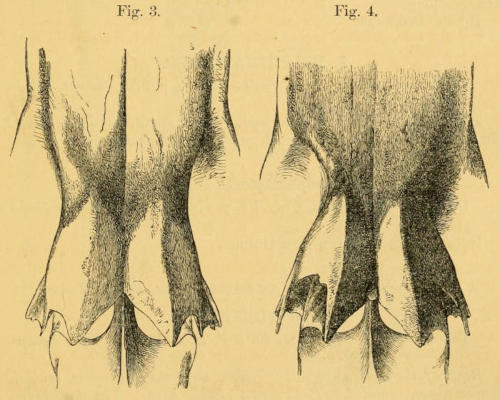
Pterygoid bones and hinder nasal opening of skull.
Fig. 3. Clymenia obscura. Fig. 4. Clymenia similis.
12. Clymenia similis. (Fig. 4.)
B.M.
Clymene similis, Gray, P. Z. S. 1868, p. 147, fig. 2.
Clymenia similis, Gray, Synops. Whales & Dolph. p. 6.
Skull like C. obscura, but palate contracted behind; side of pterygoid bone keeled.
Inhab. Cape of Good Hope.
******** ⸺?
13. Clymenia crotaphiscus.
Clymenia crotaphiscus, Cope, Proc. Ac. Nat. Sc. Philad. 1865, p. 13.
Supraoccipital rounded in profile; diameter of temporal fossa shorter than the preorbital process; beak very flat, two and a half times the breadth at notch; a keel in front of the nasal meatus.
Inhab. Unknown.
14. Clymenia esthenops.
Clymenia esthenops, Cope, Proc. Ac. Nat. Sc. Philad. 1865, p. 12.
Outline from foramen to crest curved; cranium rounded; temporal fossa much longer than the postorbital process; width of the muzzle at notch two and a half times or less in the length.
Inhab. Unknown.
Var. Width of muzzle at notch nearly three times in the length; triangle long.
Inhab. Unknown.
5. DELPHINAPTERUS.
Delphinapterus, Gray, Cat, Seals & Whales, p, 276; Synops. Whales & Dolph. p. 6.
Beak of skull elongate, depressed. Teeth small, slender. Dorsal fin none. Bladebone very broad, nearly semicircular.
1. Delphinapterus Peronii.
Delphinapterus Peronii, Gray, l. c. p. 276; Synops. Whales & Dolph. p. 6, t. 15 (animal).
Inhab. South Atlantic, New Guinea.
c. Beak short, thick. Palate flat behind, without any lateral groove.
6. TURSIO.
Tursio, Gray, l. c. pp. 254, 400; P. Z. S. 1866, p. 215; Synops. Whales & Dolph. p. 6.
Beak of the skull only rather longer than the brain-case, conical, convex above, rounded. Teeth large. Skull high. The skull large, thick, heavy, with a high swollen brain-cavity. The beak rather longer than the brain-case, broad, conical, stout, shelving on the sides. Teeth large, 22/22 or 22/25. The blower large. Nasal triangle produced considerably before the notch.
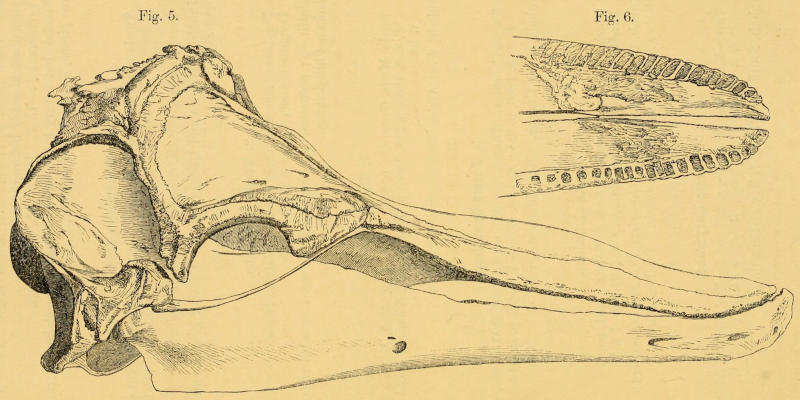
Fig. 5. Skull of Tursio truncatus (♂), adult.
Fig. 6. Under surface of the upper jaw, showing the worn surface.
Vertebræ 62:—C. 7. D. 13. L. 17. C. 25.
Second finger very long; third shorter. Breast-bone formed of three pieces, linear, dilated in front.
1. Tursio truncatus. (Figs. 5 & 6.)
B.M.
Tursio truncatus, Gray, l. c. pp. 258, 400. no. 6; P. Z. S. 1866, p. 215, 1868, p. 561, figs. 1, 2; Synops. Whales & Dolph. p. 6, (D. tursio) t. 10. f. 1.
Tursiops tursio, Gervais, Ostéogr. Cét. tab. 34. figs. 3-9.
Inhab. North Sea and Mediterranean. Coast of France and Cette (Gervais).
2. Tursio erebennus.
Delphinus erebennus, Cope, Proc. Ac. Nat. Sc. Philad.
Delphinus tursio, Cope, l. c. 1865, p. 199.
Teeth. 23/22; premaxillaries forming an elevated rounded ridge.
Inhab. Philadelphia.
3. Tursio Metis.
B.M.
Tursio Metis, Gray, l. c. p. 256. no. 3; Zool. Ereb. & Ter. t. 18; P. Z. S. 1866, p. 215, 1868, p. 362; Synops. Whales & Dolph. p. 7, t. 18.
Inhab. West Africa.
4. Tursio Cymodoce.
B.M.
Tursio Cymodoce, Gray, l. c. p. 257. no. 4; Zool. Ereb. & Ter. t. 19; P. Z. S. 1866, p. 215; Synops. Whales & Dolph. p. 7, t. 19.
Inhab. River Uragua. Mus. Buenos Ayres.
5. Tursio abusalam.
Tursio abusalam, Gray, Cat. Seals & Whales, p. 261. no. 7.
Tursiops aduncus, Gervais, Ostéogr. Cét. t. 34. figs. 1 & 2.
Inhab. Cape of Good Hope (Gervais); Red Sea (Ehrenberg).
Rather larger than Tursiops tursio. Teeth acute.
6. Tursio Eurynome.
B.M.
Tursio Eurynome, Gray, l. c. p. 261. no. 8; Zool. Ereb. & Ter. t. 17; P. Z. S. 1866, p. 215; Synops. Whales & Dolph. p. 7, t. 17.
Inhab. South Sea; India?, Bay of Bengal.
7. Tursio catalania.
B.M.
Tursio catalania, Gray, l. c. p. 262. no. 10; P. Z. S. 1866, p. 215; Synops. Whales & Dolph. p. 7.
Inhab. North-west coast of Australia.
These skulls are all very much alike.
7. EUTROPIA.
Eutropia, Gray, l. c. p. 262; P. Z. S. 1866, p. 215; Synops. Whales & Dolph. p. 7.
Beak of the skull only rather longer than the brain-case. Skull depressed, thick, with the sides rather bent down behind the notch. The beak depressed, broad, rounded on the sides, rather longer than the length of the brain-case; the intermaxillaries flat, rather broad. Teeth small, slender, five or six in an inch.
The skull bears a considerable affinity to the skulls of Phocæna, Neomeris, Beluga, and Monodon in the bending down of the sides.
1. Eutropia Dickiei.
B.M.
Eutropia Dickiei, Gray, P. Z. S. 1866, p. 215; Synops. Whales & Dolph. p. 7, t. 34.
Tursio Eutropia, Gray, P. Z. S. 1862, p. 145; Cat. S. & W. p. 262, no. 9.
Inhab. South Pacific Ocean, Chili.
2. Eutropia Heavisidii.
B.M.
Eutropia Heavisidii, Gray, P. Z. S. 1866, p. 215; Synops. Whales & Dolph. p. 7.
Tursio Heavisidii, Gray, Cat. S. & W. p. 263.
Cephalorhynchus Heavisidii, Gervais, Ost. Cét. tab. 36. fig. 1 (skull).
Inhab. Cape seas.
Vertebræ 65:—C. 7. D. 13. L. 15. C. 30.
The D. cephalorhynchus of F. Cuvier, judging from the figure of the skull given by Schlegel, appears also to belong to this genus.
See Stigmatias (Amblyodon), Cope, Proc. Acad. Nat. Sci. Philad. 1866, p. 294.
Tribe III. LAGENORHYNCHINA.
Lagenorhynchus, Gray, Cat. S. & W. p. 267; Gervais, Ostéogr. Cét. tab. 36.
Lagenorhynchina, Gray, Synops. Whales & Dolph. p. 7.
Head attenuated, beaked. Teeth conical. Beak of the skull as long as the length of the brain-case, broad, flat above, edges slightly reflexed and bent up in front of the notch. Nasal triangle elongate. Symphysis of the lower jaw short.
8. ELECTRA.
Electra, Gray, Cat. S. & W. p. 268; Synops. Whales & Dolph. p. 7.
The beak of the skull very flat above, with the edges in front of the notches bent up. Teeth-line stopping considerably short of the notch.
* Beak of the skull rather longer (about one-third) than the length of the brain-case. Teeth moderate, four in an inch, those of the lower jaw rather larger.
1. Electra obtusa.
B.M.
Lagenorhynchus Electra, Gray, l. c. p. 268; P. Z. S. 1866, p. 216; Zool. E. & T. t. 13.
Electra obtusa, Gray, Synopsis of Whales & Dolph. p. 7, t. 13 (skull).
Beak tapering, rounded in front.
Inhab. ⸺?
2. Electra Asia.
B.M.
Lagenorhynchus Asia, Gray, l. c. p. 269. no. 3; Zool. E. & T. t. 14; Gervais, Ostéog. Cét. tab. 36. fig. 6.
Electra Asia, Gray, Synops. Whales & Dolph. p. 7, t. 14 (skull).
Beak attenuated, acute in front.
Inhab. ⸺?
3. Electra fusiformis.
B.M.
Electra fusiformis, Gray, Synops. Whales & Dolph. p. 7.
Delphinus fusiformis, Owen, Trans. Zool. Soc. vi. t. 5. f. 1, t. 7 (skull).
Beak broad, and rounded in front.
Inhab. India (W. Elliot). B.M.
4. Electra acuta.
Electra acuta, Gray, Synops. Whales & Dolph. p. 7.
Lagenorhynchus acutus, Gray, Cat. S. & W. p. 270. no. 4.
Delphinus Eschrichti, Poelman, Ac. Roy. Belgique, 1864, vol. xvii. t. 1.
Inhab. North Sea.
According to Schlegel’s figure of the skull, it should be arranged in this section.
5. Electra breviceps.
Lagenorhynchus breviceps, Gervais, Ostéog. Cét. tab. 36. fig. 3.
Inhab. ⸺?
** Beak of the skull rather shorter than the length of the brain-cavity. Teeth small, five or six in an inch.
6. Electra clancula.
B.M.
Electra clancula, Gray, Synops. Whales & Dolph. p. 7, t. 35.
Lagenorhynchus clanculus, Gray, Cat. S. & W. p. 271. no. 5; Hector, Trans. New-Zealand Instit. 1870, p. 27.
Beak of the skull broad behind, once and three-fourths the width of the notch in length. Teeth five in an inch.
Inhab. South Pacific Ocean.
In the Museum of Wellington, New Zealand, a complete skeleton.
ft. in.
Total length 5 1·0
Cervical vertebræ seven, anchylosed 0 1·3
Dorsals fourteen 0 11·5
Lumbar and caudal forty-eight, thirty-four of which have processes, and may be considered lumbars.
in.
Skull:—
Length, total 14·0
Length of beak 7·5
Width at notch 3·5
Width at orbits 6·0
Width of intermaxillary at blow-hole 2·7
Width at middle of beak 2·5
Height of occiput 5·7
Length of flappers 12·0
Scapula, transverse diameter 4·5
Scapula, longitudinal diameter 6·5
This specimen was harpooned outside Wellington Harbour, and appears to be the common Dolphin of the coast.
Lower jaws of two others.
7. Electra crucigera.
Lagenorhynchus cruciger, Gervais, Ostéogr. Cét. tab. 36. fig. 3.
8. Electra thicolea.
B.M.
Electra thicolea, Gray, Synops. Whales & Dolph. p. 7, t. 36.
Lagenorhynchus thicolea, Gray, Cat. S. & W. p. 271. no. 7.
Beak of the skull narrow behind, twice as long as the width at the notch. Teeth small, six in an inch.
Inhab. West coast of North America.
9. FERESA.
Orca (Feresa), Gray, P. Z. S. 1870, p. 77.
The beak of the skull from the notch rather shorter than from the notch to the condyle, depressed, flat above, gradually tapering in front; the width at the notch two-thirds of the entire length of the beak. Lower jaw slender, narrow and thin in front, teeth not reaching the notch.
This reexamination has convinced me, and also, I believe, Mr. Flower, that the skull described under the name of Orca intermedia belongs to a very small species, and is not “the skull of a very young individual, probably of one of the large species,” as Mr. Flower supposed, apparently from the examination of the figure (see Flower, P. Z. S. 1864, p. 425). Indeed, when the animal is known, I should not be at all astonished if it should prove to be a species of Electra rather than of Orca, or perhaps a new genus.
This skull has many resemblances to those of some of the species of Electra; the teeth are much smaller than those of Orca.
1. Feresa intermedia.
B.M.
Orca intermedia, Gray, Cat. Seals & Whales, p. 283; Zool. Erebus and Terror, p. 34, tab. 8 (skull); P. Z. S. 1870, p. 77.
Inhab. ⸺?
This is the skull of a full-grown animal, and yet it is not so large as the skull of a newly born specimen of Orca. Mr. Flower, judging from the figure, believed it to be the skull of a very young animal; but on examining the skull along with me he became satisfied, from the solidity and definite form of the bones, that it is the skull of a full-grown though not aged specimen.
10. LEUCOPLEURUS.
Leucopleurus, Gray, P. Z. S. 1866, p. 216; Synops. Whales & Dolph. p. 7.
Beak of the skull rather flat above and elongate, bent up on the edge in front of the notch, narrow behind, as long as, or slightly longer than, the length of the brain-case. Teeth-line reaching nearly to the notch. Teeth small, five in an inch. First and second cervical vertebræ united by their bodies, third and fourth by the spinous processes.
Vertebræ 81:—C. 7. D. 15. L. and C. 59.
1. Leucopleurus arcticus.
B.M.
Leucopleurus arcticus, Gray, Synops. Whales & Dolph. p. 7, t. 6. f. 3-5 (fœtus), t. 12 (skull), t. 26. f. 3 (tongue).
Lagenorhynchus leucopleurus, Gray, Cat. S. & W. p. 273. no. 9; Gervais, Ostéogr. Cét. t. 36. fig. 4.
Beak of the skull twice as long as the width at the notch. Teeth small, five in an inch.
Inhab. North Sea.
11. LAGENORHYNCHUS.
Lagenorhynchus, Gray, P. Z. S. 1866, p. 216; Cat. S. & W. p. 272; Synops. Whales &. Dolph. p. 7.
Beak of the skull rather flat above, bent up on the edges in front of the notch, deep, broad behind, rather shorter than the length of brain-case. Teeth-line reaching nearly to the notch, large, three in an inch. First and second cervical vertebræ united by their bodies; the third, fourth, fifth, sixth, and seventh free.
Vertebræ 88:—C. 7. D. 14. L. and C. 67.
1. Lagenorhynchus albirostris.
B.M.
Lagenorhynchus albirostris, Gray, Cat. S. & W. p. 272. no. 8; Synops. Whales & Dolph. p. 8, t. 10. f. 2, t. 11 (skull); Gervais, Ostéogr. Cét. tab. 36. fig. 5.
The beak of the skull once and one-half as long as the width at the notch.
Inhab. North Sea, Yarmouth.
Tribe IV. PSEUDORCAINA.
Head rounded in front, very convex, not beaked. Teeth conical. Beak of the skull depressed, broad, scarcely so long as the brain-cavity.
12. PSEUDORCA.
Pseudorca, Gray, Synops. Whales & Dolph. p. 8.
Head rounded, convex; body moderate; dorsal fin moderate, in the centre of the back; arm-bones very short and thick, the humerus rather the shortest.
Triangle in front of the blowers flat. Teeth large, conical, acute, permanent. Pectoral fin falcate. Arm-bone short, broad. Metacarpal bones five, close together. Fingers very unequal, second and third much longer than the rest, six- or seven-jointed; first finger very short, two-jointed; third finger short, four-jointed, rather longer than the first two joints of the third finger. Tooth-line of the upper jaw nearly to the notch; of the lower jaw rather shorter. Lower jaw strong. Symphysis short, about as long as the space occupied by the first four teeth. Teeth large, conical, simple.
Vertebræ 50:—C. 7. D. 10. L. 9. C. 24.
The first to the sixth cervical vertebræ united by their bodies and dorsal processes. Bladebone broad, with large coracoid and acromion processes, which are much nearer together than usual.
* Beak blunt, truncated in front. Pseudorca.
1. Pseudorca crassidens.
Pseudorca crassidens, Gray, Cat. S. & W. p. 290. no. 1; Synops. Whales & Dolph. p. 8; Gervais, Ostéogr. Cét. t. 50. f. 7-17.
Beak about two-thirds the length of the brain-cavity, broad, rather tapering on the sides, truncated in front; teeth 8.
Inhab. North Sea.
** Beak narrow, tapering, and rounded in front. Neoorca.
2. Pseudorca meridionalis.
B.M.
Pseudorca meridionalis, Gray, l. c. p. 291. no. 2, figs. 58, 59; Synops. Whales & Dolph. p. 8; Gervais, Ostéogr. Cét. t. 50.
Beak as long as the brain-cavity, tapering on the side, and rounded in front. Teeth 8.
Inhab. Van Diemen’s Land.
13. ORCAELLA.
Orcaella, Gray, l. c. p. 285; Synops. Whales & Dolph. p. 7.
Head blunt, rounded, very convex. Body moderate. Dorsal fin moderate, more or less behind the middle of the back; the pectoral fin broad. Skull:—brain-case subglobular; beak very short, two-thirds the length of the brain-case, tapering, flat above. Intermaxillary half as wide as beak. Teeth small, conical, 12·12 / 12·12 or 14·14 / 14·14.
1. Orcaella brevirostris.
B.M.
Orcaella brevirostris, Gray, l. c. p. 285; Synops. Whales & Dolph. p. 7; Anderson’s Icon. ined. (animal and skull).
Phocæna brevirostris, Owen, Trans. Zool. Soc. vi. t. 9.
Globiocephalus indicus (part.), Blyth.
Black; body stout; dorsal fin subcentral.
Inhab. Estuaries of the Ganges (Dr. Anderson); Madras (Elliot).
2. Orcaella fluminalis.
Orcaella fluminalis, Anderson’s MS. & Icon. ined.
Dolphin of the Irawady, Anderson, P. Z. S. 1870, pp. 220, 544.
“Body slender, dirty white; dorsal fin more posterior.”
Inhab. River Irawady, deep channels, from 300 to 1000 miles from the sea (Dr. Anderson).
Tribe V. PHOCÆNINA.
Lateral wings of the maxilla shelving down over the orbit. Triangle in front of the blower convex. Teeth compressed.
14. PHOCÆNA.
Phocæna, Gray, Cat. S. & W. p. 301; Synops. Whales & Dolph. p. 8.
Dorsal fin distinct, in the middle of the back, with a series of small spines on the upper part of its front edge. Teeth all compressed, truncate.
Vertebræ 64 to 66:—C. 7. D. 13. L. and C. 44 to 46.
1. Phocæna communis.
Phocæna communis, Gray, l. c. p. 302; Synops. Whales & Dolph. p. 8.
Var.? Phocæna tuberculifera, Gray, l. c. p. 304.
Inhab. North Sea.
1. Phocæna brachycium, Cope, Proc. Acad. N. Sc. Phil. 1865, p. 6; 1869, p. 28.
Inhab. Harbour of Salem.
2. Phocæna vomerina, Gill, Proc. Acad. N. S. Philad. 1865; Cope, Proc. Acad. N. S. Philad. 1869, p. 13.
Inhab. North Pacific. The Bay Porpoise.
15. ACANTHODELPHIS.
Acanthodelphis, Gray, l. c. 304; Synops. Whales & Dolph. p. 8.
Dorsal fin distinct, rather behind the middle of the back. Back, in front of the dorsal fin, with a single, and the upper part of the front edge of the dorsal fin with three series of oblong keeled tubercles. Teeth compressed, front one rather conical.
1. Acanthodelphis spinipinnis.
Acanthodelphis spinipinnis, Gray, l. c. p. 304; Synops. Whales & Dolph. p. 8.
Phocæna spinipinnis, Burmeister, Anales Mus. Buenos Ayres, vol. i. t. 23 (animal), 24 (skull).
Inhab. Coast of Brazil.
16. NEOMERIS.
Neomeris, Gray, l. c. p. 306; Synops. Whales & Dolph. p. 8.
Dorsal fin none. Head rounded. Teeth compressed, slightly notched in the middle of the crown. Pectoral fin ovate-falcate. The blade bone triangular, with a large coracoid and acromion process. The forearm-bones close together, linear. Metacarpal bones five, large. The hand rather large; the second and third fingers elongate, nearly equal, as long as the arm-bones, the fourth finger shorter, the first shorter, and the fifth very short.
Vertebræ 63:—C. 7. D. 13. L. and C. 43.
1. Neomeris phocænoides.
Neomeris phocænoides, Gray, l. c. p. 306; Synops, Whales & Dolph. p. 8.
“Delphinapterus molagan,” Owen, Trans. Zool. Soc. vi. p. 24, a name given to a manuscript note of Mr. Elliot’s!
Inhab. Indian Ocean; Bengal; Cape of Good Hope; Japan.
Schlegel (Fauna Japonica, Mammalia, tab. v.) gives a detailed figure of the skull, the dorsal vertebræ, the chest-bone, and the fore limb of this animal.
B. Pectoral fin low down on the side of the body. The second and third fingers very long, of nine or twelve phalanges (cf. p. 63).
Family 11. GRAMPIDÆ.
Head rounded; forehead rather convex. Teeth conical; of upper jaw early deciduous, of lower jaw only in the front over the short symphysis. Dorsal fin low, rather behind the middle of the back. Pectoral fins ovate, elongate. Skull depressed, with the lateral expansions horizontal, rather thickened and bent up over the orbit and slightly dilated and bent down over the notch. Intermaxillaries dilated, swollen in front of the blower. Atlas free; rest of cervical vertebræ and dorsal processes united. The arm-bones short. Two middle fingers elongated, subequal, of eight or nine phalanges; the other fingers very short, of two or three phalanges. The breast-bone single, broad in front.
1. GRAMPUS.
Grampus, Gray, l. c. pp. 230, 295, 393; Synops. Whales & Dolph. p. 9.
† Triangle in front of the blowers elongate, produced in front over the vomer. Bladebone triangular, the height about two-thirds the width. Beak of skull narrow, more contracted for two-thirds of its length.
1. Grampus Rissoanus.
Grampus Rissoanus, Gray, Cat. Seals & Whales, p. 298; Gervais, Ostéog. Cét. t. 54. figs. 1-6; Murie, Journ. Anat. & Physiol. 1870, v. p. 129, t. 5 (good).
Beak of skull rather broad or gradually tapering towards the front; intermaxillaries rather broad; bladebone triangular, the height three-fourths the width.
Inhab. Nice.
2. Grampus Cuvieri.
B.M.
Grampus Cuvieri, Gray, l. c. p. 295, fig. 60; Synops. Whales & Dolph. p. 9.
Grampus griseus, Gervais, Ostéog. Cét. t. 54. figs. 1-6.
Inhab. North Sea, Hampshire.
†† Triangle in front of the blowers short, broad.
3. Grampus Richardsonii.
Grampus Richardsonii, Gray, l. c. p. 299; Synops. Whales & Dolph. p. 9.
Inhab. Cape of Good Hope.
Family 12. GLOBIOCEPHALIDÆ.
Globiocephalidæ, Gray, l. c. pp. 62, 313; Synops. Whales & Dolph. p. 8.
Head blunt, very much swollen. Teeth in the front part of both jaws, cylindrical, simple; symphysis very short, shorter than the tooth-line. Dorsal fin falcate. Pectoral fin low down on the sides of the body; fingers elongate, many-jointed. Atlas and the rest of cervical vertebræ united, or the hinder one free. Scapula triangular, with large coracoid and acromion processes. Arm-bones very short. Metacarpal bones in cartilage. The two middle fingers very long, of twelve to ten joints; the rest of the fingers short, of three or four phalanges; index finger short, slender, four-jointed; ring-finger shorter, three-jointed; little finger very short, of one phalange. Breast-bone of three separate pierced pieces; the hinder one narrow.
1. GLOBIOCEPHALUS.
Globiocephalus, Gray, l. c. p. 313; Synops. Whales & Dolph. p. 8.
Skull:—palate flat; beak rather tapering in front. First to sixth cervical vertebræ anchylosed into one mass, seventh free.
Vertebræ 58 or 59:—C. 7. D. 11. L. and C. 40 or 41.
* Black, with a white streak beneath.
1. Globiocephalus svineval.
B.M.
Globiocephalus svineval, Gray, l. c. 314; Synops. Whales & Dolph. p. 8.
Inhab. North Sea, coast of England. The Pilot Whale.
1. Globiocephalus melas, Gervais, Ostéog. Cét. t. 51.
Delphinus globiceps, Risso, Europe Mérid. vol. iii. f. 1.
Inhab. Mediterranean.
2. Globiocephalus affinis, Gray, Cat. S. & W. p. 317.
Inhab. North Sea.
3. Globiocephalus intermedius, Gray, Cat. S. & W. p. 318.
Globiocephalus, n. sp., Cope, Proc. Acad. N. Sc. Phil. 1865, p. 7.
Inhab. Delaware Bay. Teeth six above.
4. Globiocephalus Edwardsii, Gray, Cat. S. & W. p. 320.
Inhab. South Sea. Cape of Good Hope.
5. Globiocephalus guadaloupensis.
Globiocephalus intermedius, Gervais, Ostéog. Cét. t. (skull).
Globiocephalus intermedius (part.), Gray, Cat. S. & W. p. 319.
Inhab. Guadaloupe. Mus. Paris.
2. Globiocephalus Grayi.
Globiocephalus Grayi, Burmeister, Ann. & Mag. N. H. 1868, i. p. 52, t. 2. f. 2, 3; Anales Mus. Buenos Ayres; Gray, Synops. Whales & Dolph. p. 9.
Inhab. Buenos Ayres.
** Black, or only slightly paler beneath.
3. Globiocephalus macrorhynchus.
B.M.
Globiocephalus macrorhynchus, Gray, l. c. p. 320; Synops. Whales & Dolph. p. 9; Gervais, Ostéog. Cét. t. 52. f. 4; Hector, Trans. New-Zealand Instit. 1870, p. 38.
Inhab. South Sea. New Zealand (Gervais).
“Two skulls in the Colonial Museum, Wellington, New Zealand, one in longitudinal section; one lower jaw; six cervical, four lumbar, thirteen caudal vertebræ; two scapulæ; two hyoids. Both skulls are of the same dimensions:—
inches.
“Length 26
Length of nose 15
Length of tooth-series 8
Length of lower jaw 15
(This is of a different individual.)
Width at notch 11
Width at orbit 17
Width of intermaxillary at blow-hole 7·5
Width at middle of nose 9·5
Height of occiput 14
Scapula, transverse diameter 15
Scapula, longitudinal diameter 12
“Hyoid arch 11 inches wide by 7 inches high.
“Sternum 10 × 7 inches—with three sternal ribs, each 7 inches long.
“The first rib is 10 inches from head to tip, but is bent with an arch of 5 inches.
“The atlas, axis, and three other cervicals are anchylosed. The compound cervicals have a conjoined length of 4 inches. Vertical diameter of foramen magnum 2½ inches. Conjoined length of the four lumbers 8 inches; height, including spinous processes, 8·5 inches. Caudal apparatus, of thirteen segments, 16 inches; two of these are anchylosed. Teeth 9-9/8-8”.—Hector.
6. Globiocephalus Scammonii, Cope, Proc. Ac. N. S. Philad. 1869, p. 11.
Black above and below.
Inhab. North Pacific.
7. Globiocephalus australis.
Inhab. Coast of Australia. In Museum of Sydney.
8. Globiocephalus indicus, Gray, Cat. S. & W. p. 322.
Inhab. Bay of Bengal. Black fish.
9. Globiocephalus Sieboldii, Gray, l. c. p. 323.
Inhab. Japan.
10. Globiocephalus chinensis, Gray, l. c. p. 323.
Inhab. China.
11. Globiocephalus sibo, Gray, l. c. p. 323 (sub G. Sieboldii).
Inhab. Japan. Called “Sibo golo.” Purple, with a white spot behind the dorsal fin.
2. SPHÆROCEPHALUS.
Sphærocephalus, Gray, l. c. p. 323; Synops. Whales & Dolph. p. 9.
Palate of the skull convex, shelving on the sides. Beak oblong, of nearly the same width the greater part of its length.
1. Sphærocephalus incrassatus.
B.M.
Sphærocephalus incrassatus, Gray, l. c. p. 324, figs. 63 & 64; Synops. Whales & Dolph. p. 9.
Inhab. British Channel, Bridport.
II. Pectoral fin broad, rounded or truncated at the end; hand shorter than the arm-bones; second finger the longest, the rest gradually shorter; phalanges of the second finger six or eight (cf. p. 63).
Family 13. ORCADÆ.
Orca, Gray, Cat. Seals & Whales, p. 278; Synops. Whales & Dolph. p. 8.
Head rounded, scarcely beaked. Dorsal fin falcate. Skull heavy; wings of sides expanded; beak short, broad; triangle in front of the blowers flat. Lower jaw thick in front; symphysis short. Teeth large.
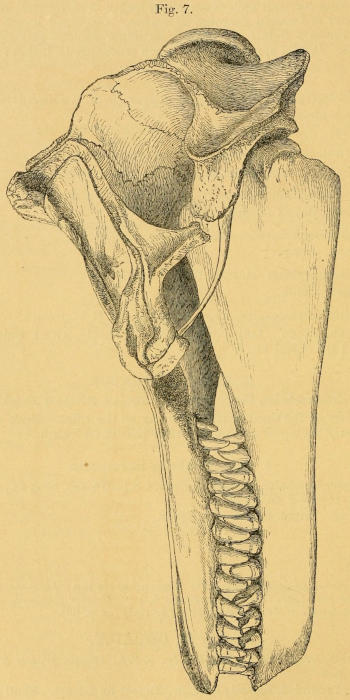
Fig. 7.
Orca stenorhyncha.
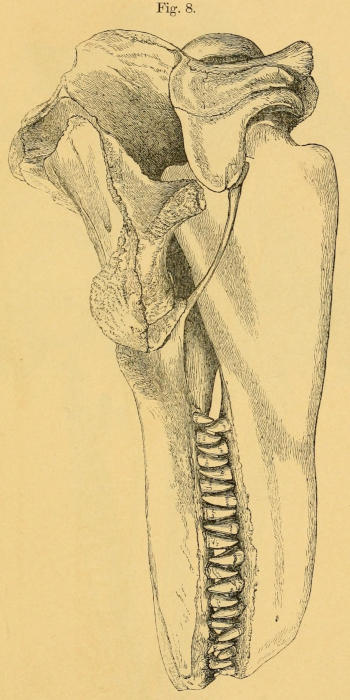
Fig. 8.
Orca capensis.
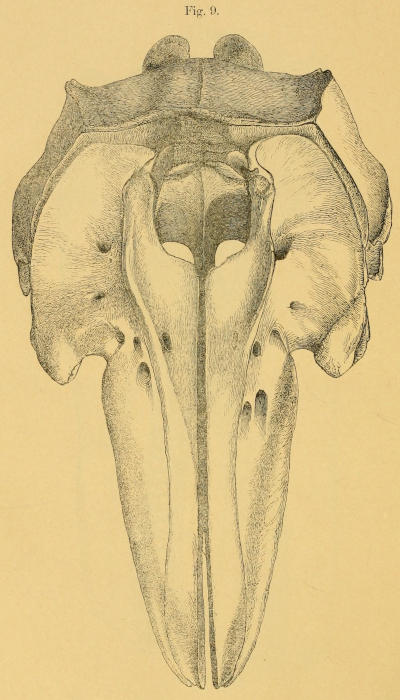
Fig. 9.
Orca stenorhyncha.
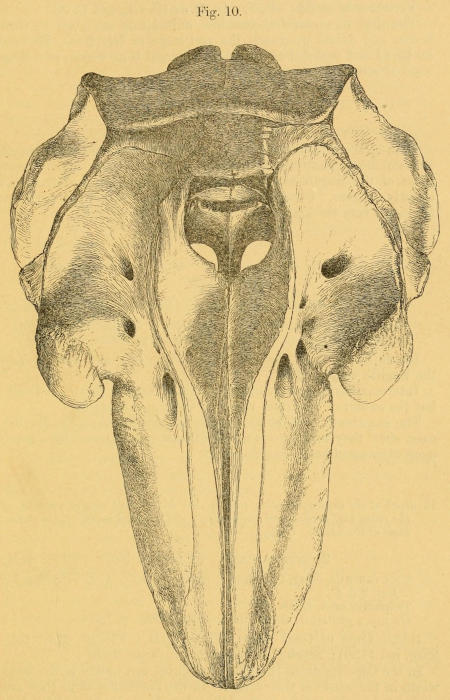
Fig. 10.
Orca capensis.
Vertebræ 51 or 52:—C. 7. D. 11 or 12. L. and C. 33.
The first three cervical vertebræ united into one mass by their bodies and dorsal processes, the rest more or less free. Pectoral fin broad and rounded at the end. “Carpal bone single, in a large mass of cartilage.”
1. ORCA.
Orca, Gray, P. Z. S. 1870, p. 70.
Beak of the skull from the notch before the orbit the same length as from the notch to the condyles; the width at the notch three-fifths of the length of the beak. The occipital end of the skull slightly concave. Condyles of moderate size. Lower jaw broad on the sides, very thick and solid in front.
A. The beak of the skull tapering and narrow in front, end narrow. Gladiator.
1. Orca stenorhyncha. (Figs. 7 & 9.)
B.M.
Orca stenorhyncha, Gray, P. Z. S. 1870, p. 71, figs. 1 & 3 (skull).
Orca gladiator, Gray, Cat. Seals & Whales, p. 279.
Inhab. North Sea. Skeleton from Weymouth, and a skull from the English coast. B.M.
Intermaxillaries narrow in the middle and rather dilated in front; but the extent of dilatation varies in the two specimens.
The examination of the four skulls of Orca found on the English coast show they belong to two very distinct species, one with a much more attenuated beak than the other.
B. Beak of the skull spatulate; sides of the hinder half nearly parallel, of the front half arched and converging; end rounded, middle rather wider than at the notch. Orca.
2. Orca capensis. (Figs. 8 & 10.)
B.M.
Orca capensis, Gray, Cat. Seals & Whales, p. 283; P. Z. S. 1870, p. 71, figs. 2 & 4.
Delphinus orca, Owen.
Grampus gladiator, Smith, South-African Zool. p. 126.
Inhab. Cape of Good Hope (Viney, B.M.; Villette, Mus. Coll. Surg. no. 1139); Seychelles Islands (Swinburne Ward).
In the Cape specimen the intermaxillaries are nearly of the same width in the whole of their length; in the Seychelles skull they are contracted in the greater part of their length, and rather dilated in front.
Mr. Swinburne Ward has kindly sent a very beautiful skull of a “Killer” taken in the sea near the Seychelle Islands.
To determine this skull I have been induced to compare the skulls of the genus in the British Museum, which it is very necessary to do from time to time, as specimens gradually accumulate, and often arrive when I am occupied on other subjects, and consequently are put aside for future examination.
In this examination I have observed that in the ‘Catalogue of Seals and Whales’ I have confounded with the skull described under the name of Orca capensis one from the North Pacific, the former being the true Orca capensis, and the skull now received from the Seychelles Islands being of the same species.
The skull figured in the ‘Zoology of the Erebus and Terror’ under the name of O. capensis is from a specimen received from the Zoological Society, to which it was presented by Capt. Delville, who said he obtained it in the North Pacific (?). It is quite a different species, for which I propose the name of Orca pacifica. I doubt its being from the North Pacific, as I believe there is a skull of the same species in the Paris Museum, collected by M. Eydoux, and said to have come from Chili.
3. Orca africana.
Orca gladiator, var. australis, Gervais, Ostéogr. Cét. t. 47. f. 2.
Inhab. Algoa Bay.
Skull much smaller, 24 inches long.
4. Orca latirostris.
B.M.
Orca latirostris, Gray, P. Z. S. 1870, p. 76.
Orca gladiator, Gervais, Ostéogr. Cét. t. 48. f. 2, 3.
Delphinus orca, Cuv. Oss. Foss. v. tab. 22. fig. 4 (skull).
The skull very similar to that of the Cape species, but much smaller; but the beak is rather narrower, the intermaxillaries moderately broad, slightly dilated in front.
Inhab. North Sea.
An adult skull from the coast of Essex (361 a), and another without the lower jaw, are in the British Museum.
These skulls of the smaller British, or, rather, European Orca are distinguishable from those of O. gladiator by the smaller size and the broader, rounder nose—and from the skulls of the Cape-of-Good-Hope species by being of a much smaller species, and having a depressed crown of the head.
I believe the skull figured under the name of Delphinus orca by Cuvier, Oss. Foss. vol. v. tab. 22. figs. 3, 4, represents this species, from the form of the beak and the narrowness of the occiput: this figure has been copied by various British and other authors.
1. Orca gladiator, var. arcticus (O. Eschrichtii), Gervais, Ostéogr. Cét. t. 47. fig. 3.
Inhab. Faroe Islands.
2. Orca gladiator, var. europæus, Gervais, Ostéogr. Cét. t. 47. f. 4.
Orca gladiator, Gervais, l. c. t. 48. f. 1.
Inhab. the Atlantic.
Skull about 40 inches long.
3. Orca gladiator, var. europæus, Van Beneden & Gervais, Ostéogr. Cét. t. 47. f. 5.
Delphinus orca, Gervais, Zool. et Paléont. Française, t. 37. f. 3, 4.
Inhab. Mediterranean, Cette.
Skull about 22 inches long. It is about the same size as the Orca from Algoa Bay; but the brain-cavity is rather broader and the beak is not so acute in front.
Gervais, in the ‘Zoology and Paleontology of France,’ figures the skull of a young Delphinus orca, taken on the coast of Cette, which is now in the Museum of Paris. It appears to belong to this species; or it may be that the Orca of the Mediterranean does not grow to the usual size; or, again, it may be of a different species; for the skull is only fifty-eight centimetres long and thirty broad.
5. Orca magellanica.
Orca magellanica, Burmeister, Ann. & Mag. Nat. Hist. ser. 3. xviii. p. 101, t. 9. f. 5; An. Mus. Publ. de Buenos Ayres, i. p. 373, tab. 22; Gray, Synops. Whales & Dolph. p. 8; P. Z. S. 1870, p. 76.
Inhab. Patagonia. Mus. Buenos Ayres.
This species, according to the figure, is very like Orca latirostris.
6. Orca tasmanica.
Orca gladiator, var. australis, Gervais, Ostéogr. Cét. t. 47. fig. 1.
Inhab. Tasmania. Skull about 32 inches long.
7. Orca rectipinna.
Orca rectipinna, Cope, Proc. Acad. Nat. Sci. Philad. 1869, p. 12.
No white spot behind eye.
Inhab. California.
8. Orca atra.
Orca ater, Cope, l. c. 1869, p. 12.
Black above and below, with white spot behind eye.
Inhab. Oregon, Aleutian Islands.
The following are the measurements of the different skulls of the genus in the collection of the British Museum; they were carefully taken with calipers by Mr. Edward Gerrard.
O. stenorhyncha. O. capensis. O. latirostris. O. pacifica. O. intermedia.
361 b. 361 c. 1065 b, c. 361 a. 1065 a. 362 a.
in. lin. in. lin. in. lin. in. lin. in. lin. in. lin.
Length from end of nasal to centre of occipital condyle 35 0 37 0 39 0 33 0 36 6 14 0
Length of nose 17 6 18 6 22 6 17 0 18 0 7 0
of tooth-line 13 6 14 0 16 0 13 0 14 6 4 9
of lower jaw 27 6 30 0 31 0 26 0 29 6 11 3
Breadth at the notch 10 6 11 0 12 0 10 0 12 6 4 9
at the orbit 18 0 19 6 20 0 18 0 21 0 8 6
at temple above 18 0 19 6 20 0 18 0 20 0 9 0
at middle of beak 9 0 10 0 11 0 9 6 10 0 3 6
at intermaxillaries 3 3 3 3 4 6 3 3 3 6 0 9
2. OPHYSIA.
Ophysia, Gray, P. Z. S. 1870, p. 76; Synops. Whales & Dolph. p. 8.
Skull:—beak from the notch before the orbit the same length as from the notch to the condyle; width at the notch two-thirds the entire length of the beak. Intermaxillaries very narrow, slightly dilated in front; brain-cavity broad; occiput deeply concave. Lower jaw very broad on the sides, very thick and solid in front.
1. Ophysia pacifica.
B.M.
Ophysia pacifica, Gray, P. Z. S. 1870, p. 76.
Delphinus globiceps, Grant, P. Z. S. 1833, p. 65.
Delphinus orca, Eydoux, Mus. Paris.
Orca capensis, Gray, Zool. Ereb. & Terr. p. 34, tab. 9, not Cat. Seals & Whales, p. 283; Gervais, Ostéogr. Cét. t. 48. fig. 1.
Orca (Ophysia) capensis, Gray, Synops. Whales & Dolph. p. 8, tab. 9 (skull).
Inhab. North Pacific (Capt. Delville, R.N.).
Skull, from the Zoological Society’s collection.
Family 14. BELUGIDÆ.
Beluginæ, Flower, Trans. Zool. Soc. vi. p. 115.
Head rounded in front. Teeth in both jaws more or less early deciduous, rarely wanting or, rather, not developed. Back without any dorsal fin. Pectoral fin small, ovate. Skull with the lateral expansion of the maxilla over the orbit, and the side of the beak, shelving downwards. Fingers short; index and middle fingers nearly the same length, the rest rather shorter; phalanges 2, 5, 6, 4, 3. Cervical vertebræ generally free; the second with a large dorsal process.
“The Narwhal and the Beluga appear to separate themselves from all the rest, by certain well-marked structural conditions, especially the characters of the cervical vertebræ. As these two animals are in almost every part of their skeleton nearly identical, even to the number of the vertebræ and phalanges, I am disposed to look upon the exceptional dentition of the former as an aberration of secondary importance, and to unite the two genera into a distinct subfamily, placing it next to the Platanistidæ.”—Flower, l. c. p. 114.
1. BELUGA.
Beluga, Gray, Cat. S. & W. pp. 231, 306, 393; Synops. Whales & Dolph. p. 9.
Lateral wing of the maxilla over the orbit shelving downward. Teeth conical in both jaws, early deciduous. Male without any spiral horn-like tooth. Fingers short. Metacarpal bones surrounded with cartilage. Bladebone with large coracoid and acromion processes. Second cervical vertebra with a large dorsal process.
Vertebræ 50:—C. 7. D. 10. L. and C. 33.
1. Beluga catodon.
B.M.
Beluga catodon, Gray, l. c. p. 307, fig. 61; Synops. Whales & Dolph. p. 9, tab. 29. f. 3 (tongue).
Delphinus canadensis, Gray, Synops. Whales & Dolph. t. 5 (head false, with beak).
Beluga albicans, Gervais, Ostéogr. Cét. t. 44. f. 1-5.
Delphinapterus, Lucas, Vidensk. Selsk. Skr. Række 5, Band ix. tab. 8 (skull and teeth, showing how they are worn).
Inhab. North Sea, mouths of rivers.
1. Beluga rhinodon, Cope, Proc. Acad. Nat. Sci. Philad. 1865, p. 5, 1869, p. 13, fig. 1.
Inhab. Arctic seas.
2. Beluga declivis, Cope, Proc. Acad. Nat. Sci. Philad. 1865, p. 5, 1869, p. 14.
Inhab. Arctic seas.
3. Beluga angustata, Cope, Proc. Acad. Nat. Sci. Philad. 1869, p. 20, figs. 2 & 3.
Beluga concreta, Cope, Proc. Acad. Nat. Sci. Philad. 1865, p. 5.
Inhab. Arctic seas.
These are probably varieties of B. catodon, showing that the attachment of the cervical vertebræ, the number of ribs, and the form of the acromion are liable to vary.
4. Beluga canadensis, Wyman, Proc. Bost. Soc. Nat. Hist. 1865.
Inhab. Canada.
I believe it to be the same as the former.
2. Beluga Kingii.
Beluga Kingii, Gray, Cat. S. & W. p. 309; Synops. Whales &. Dolph. p. 9, t. 7.
Inhab. Australia.
2. MONODON.
Monodon, Gray, l. c. pp. 231, 310; Synops. Whales & Dolph. p. 9.
Monoceros, Gray, Cat. S. & W. p. 393.
Lateral expansion over the orbit shelving down. Teeth in both jaws very early deciduous. Male with one, rarely two, very long, projecting, spiral tusks in the left side of the upper jaw. Cervical vertebræ:—first free, thin; second and third united by the spinal processes. Bladebone with large coracoid and acromion processes. Fingers short.
Vertebræ 50:—C. 7. D. 11. L. 6. C. 26.
“In the skeleton of two males in the Museum of the College of Surgeons, the bodies of the second and third cervical vertebræ are firmly united.”—Flower.
1. Monodon monoceros.
B.M.
Monodon monoceros, Gray, l. c. p. 311; Synops. Whales & Dolph. p. 9; Gervais, Ostéogr. Cét. t. 44. f. 6-9.
Inhab. North Sea.
Family 15. PONTOPORIADÆ.
Head long-beaked. Beak slender, smooth. Nostrils on the nape, crescent-shaped. Teeth in both jaws permanent, conical, with a swollen ring round the base. Dorsal fin short, trigonal. Pectoral fin short, truncated. Fingers 5, nearly equal; the thumb very short, of one joint; the index finger the longest, the rest gradually shorter to the little finger. Bladebone broad, with two ridges. Skull long-beaked, the beak compressed. Lower jaws united together nearly to the base. Cartilages of ribs ossified.
Vertebræ 42:—C. 7. D. 10. L. 7. C. 18.
1. PONTOPORIA.
Pontoporia, Gray, Cat. S. & W. pp. 230, 231 & 393; Synops. Whales & Dolph. p. 5; Flower, Trans. Zool. Soc. vi. p. 87; Burmeister, An. Mus. P. Buenos Ayres, p. 389.
Stenodelphis, Gervais, 1847.
Beak of the skull high, compressed. Symphysis of the lower jaw very long.
1. Pontoporia Blainvillii.
B.M.
Pontoporia Blainvillii, Gray, l. c. p. 231; Synops. Whales & Dolph. p. 5, t. 29 (skull); Flower, Trans. Zool. Soc. vi. p. 106, t. 28 (skull); Burmeister, An. Mus. P. Buenos Ayres, i. p. 387, tab. 23 (animal), tab. 25 & 26 (skeleton).
Inhab. South Atlantic, Monte Video.
The animal figured by Gervais as Delphinus (Stenodelphis) Blainvillii (Voy. Amér. Mérid. t. 23) differs from Burmeister’s figure in having an elongated subfalcate pectoral fin, and a higher dorsal, and a broad white streak, commencing from the blower and extending down the back to near the tail. If this is not a figure of the animal seen at sea, which I suspect it must be, it must be a different species.