Suborder I. BALÆNOIDEA (cf. p. 46).
Reading edition
Head large. Body stout. Dorsal fin none. Chest and belly smooth, without plaits. Pectoral fin broad, truncated; fingers 5, graduated. Arm-bones very short, thick; radius and humerus of equal length. Baleen elongate, slender. Tympanic bones rhombic. Cervical vertebræ united.
Balænoidea, Gray, Synops. Whales & Dolph. p. 1.
Family 1. BALÆNIDÆ. Right Whales.
Balænidæ, Gray, Cat. Seals & Whales B. M. pp. 61, 75; Synops. Whales & Dolph. p. 1; Lilljeborg, N. Acta Upsal. 1867, vi.
Head very large, and body short. Dorsal fin none. Belly smooth. Baleen elongate, slender. Vertebræ of the neck anchylosed. Pectoral fin broad, truncated at the end; fingers 5. Tympanic bones rhombic; maxillary bones narrow.
Capt. Maury’s Whale-Charts show that Right Whales are found in almost all seas, from the poles to within 35 or 30 degrees of latitude on each side of the equator. An experienced whaler observes that “Right Whales are as seldom seen in that belt as Sperm-Whales are found out of it.” Capt. Maury justly observes, the torrid zone is to these animals “forbidden ground, and it is as physically impossible for them to cross the equator as it would be to cross a sea of flame. In short, these researches show that there is a belt of from two to three thousand miles in breadth, and reaching from one side of the ocean to the other, in which the Right Whale is never found.”—Maury, Whale-Charts, p. 233.
Prof. Van Beneden, in a paper to the Royal Belgian Academy, and reproduced enlarged in the ‘Ostéographie—Cétacés,’ gives a geographical distribution of Whales. He acknowledges only six species, having the following distribution:—
1. B. mysticetus. The Arctic Ocean on both sides of Greenland, and on the coast of Siberia to the Sea of Okhotsk.
2. B. biscayensis. The North Atlantic, from latitude 65° to 45°, and a belt across the Atlantic to the coast of the United States, from lat. 45° to 50°.
3. B. japonica. A band across the North Pacific from lat. 60° to 45° on the west coast of America and 45° to 30° on the coast of Japan.
4. B. australis. A belt across the South Atlantic, from lat. 25° to 30° on the south-west coast of Africa and lat. 35° to 50° on the coast of South America.
5. B. antipodarum. In a similar belt across the South Pacific from the west coast of South America, in lat. 45°, to New Zealand.
6. A species which he does not name, said to inhabit a belt from Natal to the south-east part of Australia, about lat. 30°.
See Dr. Gray’s observations on this theory, Ann. & Mag. Nat. Hist. 1868, vol. i. p. 242, and 1870, vol. vi. p. 193, in which he observes “I think I have proved that M. van Beneden’s theory is entirely unsupported by facts.”
I. Baleen thin, polished, with a thick enamel on each side and a fine elongate slender fringe (cf. p. 42).
1. BALÆNA.
Balæna, Gray, l. c. p. 79; Synops. Whales & Dolph. p. 1; Lilljeborg, N. Acta Upsal. vi. 1867.
First rib slender, narrow, and undivided at the vertebral end. Tympanic bones square; aperture nearly as long as the bone. There is at the end of the radius and at the end of the cubitus a large cartilaginous compartment which corresponds with the radial and cubital bone, and has not even a bony nucleus; between these two cartilages is an intermediate cartilage; below these are two or three carpals. Cervical vertebræ united by their bodies. Upper lateral process of atlas broad at the base, compressed, rather narrow, and rounded at the end; the lower lateral process elongate, subcylindrical, angulated at the lower side of the base (see Cat. Whales, p. 84, f. 4; Ostéogr. Cét. t. 4. f. 5-9). The lower process of the second and third elongate and produced; the upper process of the second, fifth, sixth, and seventh elongate, produced, and bent forward. Bladebone with a large, compressed, elongate acromion (Ostéogr. Cét. t. 4. f. 26). Carpus cartilaginous, with three small carpal bones (Ostéogr. Cét. t. 4. f. 27).
1. Balæna mysticetus.
B.M.
Balæna mysticetus, Gray, l. c. pp. 81, 370, figs. 1, 2, 4, 5; Synops. Whales & Dolph. p. 1, t. 1. f. 4 (baleen); R. Brown, P. Z. S. 1868, p. 534.
Inhab. North Sea.
Dr. Robert Brown gives an account and notes of the habits and migrations of this animal. He observes:—“Where the Whale goes to in winter is still unknown. It is said that it leaves Davis Strait about the month of November, and produces young in the St. Lawrence River, between Quebec and Camaroa, returning to Davis Strait in the spring. At all events, early in the year they are found on the coast of Labrador, where the English whalers occasionally attack them; but the ships arrive generally too late, and the weather at that season is too tempestuous to render the ‘south-west fishing’ very attractive.... It is said that early in September they enter Cumberland (Hogarth’s) Sound in great numbers, and remain until it is completely frozen up, which, according to the Eskimo account, is not until January.... They enter the Sound again in the spring, and remain until the heat of summer has melted off the land-floes in these comparatively southern latitudes. It thus appears that they winter and produce their young all along the broken water off the southern coasts of Hudson’s Strait, Davis Strait, and Labrador.”
He continues, “I am strongly of belief that the Whales of the Spitzbergen sea never, as a body, visit Davis Strait, but winter somewhere in the open water at the southern edge of the northern ice-fields. The Whales are being gradually driven further north.”
2. Balæna mediterranea.
Balæna mediterranea, Gray, Ann. & Mag. Nat. Hist. 1870, vi. pp. 198, 200.
Baleine, Lacépède, Cétacés, tab. 7. fig. 1.
Balæna biscayensis (part.), Van Beneden, Ostéogr. Cét. tab. 7. fig. 1 (animal), figs. 8-11 (nuchal vertebræ), figs. 2, 3 (? vertebræ).
Inhab. Mediterranean, I. St. Marguerite (Lacépède).
3. Balæna angulata.
B.M.
Balæna, mysticetus, var. angulata, Gray, Cat. Seals & Whales, p. 86, f. 5 (ear-bones).
Inhab. North Sea? Ear-bones, British Museum.
4. Balæna nordcaper.
Balæna nordcaper, Bonnat.
Balæna islandica, Brisson.
Balæna biscayensis, Eschricht.
Balæna mysticetus, var., Brown, P. Z. S. 1868. p. 546.
Inhab. Iceland. Called “Slet-bag.”
It has been ascertained, “1st, that it is much more active than the Greenland Whale, much quicker and more violent in its movements, and accordingly both more difficult and dangerous to capture; 2nd, that it is smaller (it being, however, impossible to give an exact statement of its length) and has much less blubber; 3rd, that its head is shorter, and that its whalebone is comparatively small and scarcely more than half the length of that of the B. mysticetus; 4th, that it is regularly infested with a cirriped belonging to the genus Coronula, and that it belongs to the temperate North Atlantic as exclusively as the B. mysticetus belongs to the icy sea.”—Dr. Brown, P. Z. S. 1868, p. 546.
Dr. Brown says that barnacles are looked upon as a sign of age in a Whale; and he considers that a considerable portion of the description of the nordcaper corresponds with what he has said of the Spitsbergen whale (P. Z. S. 1868, p. 547).
See also:—
1. Balæna mysticetus, Cope, Proc. Acad. N. S. Philad. 1869, pp. 17 & 35.
The Bow-headed Whale, Scammond, American whalers.
Inhab. Behring’s Straits.
2. Balæna kuliomoch, Chamisso, Nov. Acta Natur. tab. 7. fig. 1; Gray, Ann. & Mag. N. H. 1870, vi. p. 202.
Balæna cullamacha, Chamisso, Nov. Act. xii. p. 251, t. ; Cope, Proc. Acad. Phil. 1868, p. 225, 1869, pp. 14, 17 & 40, fig. 4.
Inhab. North Pacific.
From wooden model made by the Aleutians.
2. NEOBALÆNA.
Skull rather depressed; brain-cavity nearly as long as the beak, depressed, much expanded on the sides, with a very deep notch on the middle of each side over the condyles of the lower jaw, and with a subtriangular crown-plate. The nose as broad as the expanded brain-cavity at the base, regularly attenuated to a fine point in front, and slightly arched downwards. Lower jaw laminar, compressed, high; the upper edge thin, and inflexed the greater part of its length, erect in front; the lower edge inflexed in front, the rest of the edge being simple. The baleen elongate, slender, several times as long as broad, with a fringe of a single series of fine fibres; enamelled surface smooth and polished, thick.
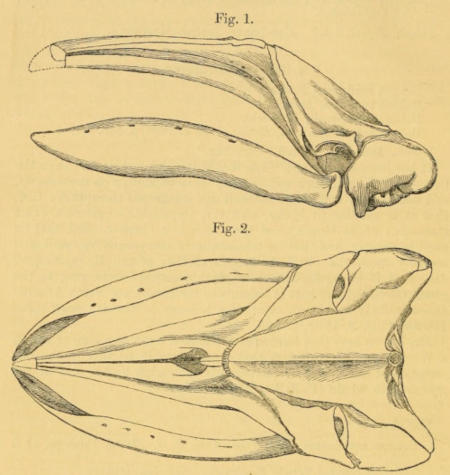
Figs. 1 & 2. Side view and top view of the skull of Neobalæna marginata, from Dr. Hector’s figures.
1. Neobalæna marginata.
B.M.
Balæna marginata, Gray, Cat. Seals & Whales Brit. Mus. p. 90; Hector, Proc. & Trans. of the New-Zealand Institute, 1869, t. 2 B. f. 1-4; Ann. & Mag. Nat. Hist. 1870, v. p. 221, and vi. p. 155, figs. 1 & 2.
Inhab. New Zealand; Island of Kawau (Sir G. Grey). Mus. Wellington.
In width and general form the beak of the skull is somewhat like the beak of some of the Finner Whales; but it does not at all justify Mr. Knox’s idea that Balæna marginata is a Finner. But this difference of skull makes us more anxious to have the description of the entire animal and its skeleton, as the animal may prove to be the type of a new family of Whales, between the true Whales and Finners.
This pigmy whale, which is not more than 15 or 16 feet long, is a representative in the Southern Ocean of the gigantic Right Whale of the Greenland seas. It has the most beautiful, the most flexible, most elastic, and the toughest whalebone or baleen yet discovered; and if this were of larger size, it would fetch a much higher price than the whalebone of the Greenland Whale, the latter being three or four times the value of the brittle coarse whalebone of the Eubalænæ or Right Whales of the Southern and Pacific Oceans. The trade of the Continental nations being chiefly confined to their colonies, or their merchants obtaining the whalebone that is used in their manufactures second-hand, there are not in the market the varieties of whalebone and finner-bone which we have in this country, where the whalebone and finner-bone from different localities bear each a different value. This perhaps explains why the Continental zoologists (as Eschricht) who have paid attention to the structure of whales have not paid sufficient attention to the characters afforded by the shape, structure, and colour of this substance, to which I called their attention more than twenty years ago, and showed its value as a character for distinguishing the genera and species. It has been a fertile subject of reproach to me that I established some species on the characters afforded by this substance; but I need only mention, as a proof of the little attention Van Beneden has paid to this part of my work, that in his book on the anatomy of Whales, now in progress, after saying that I have established the species Balæna marginata on three blades of whalebone, he says I have called it Eubalæna marginata, thus confounding it with the Whales with brittle and coarse whalebone—whereas the chief reason that induced me to consider the blades to belong to a distinct species was their very fine and tough structure. The accuracy of the determination is now proved by the very different form of its skull from that of any other known Whale. In the same manner, the Physalus antarcticus, also established on finner-bone or baleen imported from New Zealand, has been proved to be a very distinct species of that genus, named Sulphur-bottoms by the whalers.
From the description given at page 90 of the British-Museum ‘Catalogue of Seals and Whales,’ there is no doubt that the baleen corresponds with the above species. The specimen was obtained at Kawau Island by Sir George Grey, and appears to be unique, as the species has hitherto only been known from the baleen.
The dimensions are as follows:—
lbs.
Weight of cranium 58
Weight of lower jaw 13
ft. in.
Length 4 9
Fronto-nasal section 2 10
To centre of orbit 3 10
Width at orbit 2 5
Width at mastoid process 2 7
in. lin.
Lower jaw, high 3 11
Depth (greatest) 8 0
Baleen 29 inches long, 3½ inches in extreme width.
Black margin from ¼ to ⅜ inch.
“Knox now admits that this is not the Sulphur-bottom, which he says is the Trigger of the New-Zealand whalers. He fancies that B. marginata may be the true Finner of the south. I will try to find some more of the bones.”—Trans. New Zeal. Inst. 1870, p. 26.
This Whale, from the form and structure of the whalebone, cannot be a Finner, but is certainly, as I arranged it, a true Right Whale, very nearly allied to the Right Whale of Greenland, and of a very small size. The bones of this Whale would be a most valuable addition to the British Museum or any zoological museum. They appear not to be uncommon in the Kawau Islands; and the measurements of the skull are a valuable addition to our knowledge of the species.
This small Right Whale of the Antarctic Sea is the representative of the Right Whale in the Arctic Sea, and, judging from the length of the head, cannot be more than 14 or 15 feet long, while the Greenland Whale is from 50 to 65 feet long.
II. Baleen thick, not polished, with a thin enamel coat on each side, and a coarse thick fringe (cf. p. 37).
3. EUBALÆNA.
Eubalæna, Gray, l. c. p. 91; Synops. Whales & Dolph. p. 1; Lilljeborg, N. Acta Upsal. vi. 1867; Flower, Trans. Zool. Soc. vi. p. 115.
First rib broad at the vertebral end. Tympanic bone square; aperture nearly as long as the bone. The first six cervical vertebræ all united by their bodies. The upper lateral process of the atlas subcylindrical, narrow at the base, recurved and rounded at the end; the lower lateral process narrow at the base, swollen and rounded at the end (Ostéog. Cét. t. 1. f. 19). Carpus cartilaginous, with six carpal bones, a radius and cubitus, one radial and one cubital and two carpals in the second range (Ostéog. Cét. t. 1. f. 1). Scapula as long as broad, with a small cylindrical coracoid process, rounded at the end. Five phalanges to the middle finger, four to the index and ring fingers, four to the little finger, and two to the thumb. The first rib is simple at the upper and thin at the free edge. The nasal bone rhomboidal, moderate. Vertebræ 50-59.
1. Eubalæna australis.
B.M.
Eubalæna australis, Gray, l. c. p. 91, fig. 6; Synops. Whales & Dolph. p. 1.
Balæna australis, Cuv., Oss. Foss. v. t. 25-27.
Balæna capensis, Gray, Synops. Whales & Dolph. t. 1. f. 3 (baleen).
Inhab. Cape of Good Hope.
2. Eubalæna Sieboldii.
Eubalæna Sieboldii, Gray, l. c. p. 96; Synops. Whales & Dolph. p. 1, t. 1. f. 2 (baleen).
Balæna japonica, Gray, Zool. Ereb. & Ter. p. 15, tab. 1*. fig. 2 (baleen).
Balæna alutiensis, Meyer; Van Beneden, Bull. Acad. Belgique, xx. 1866, no. 14. [Both from the North-west-Coast whalebone of commerce, which is quite distinct from the South-sea whalebone, brought from the Cape.]
Balæna japonica, Eschricht, Vid. Selsk. Skrivt. ser. 5. ix. p. 1, Kjöbenh. 1869, pl. 1 (skull of fœtus), pl. 2 (head); Gray, Ann. & Mag. Nat. Hist. 1870, vi. p. 202.
Inhab. Kamtschatka. Skeleton of fœtus 5¼ feet long, in Mus. Copenhagen.
See also the following doubtful species:—
1. Balæna japonica, Lacépède, Mém. Mus. iv. p. 473.
Balæna lunulata, Lacép. Mém. Mus. iv. p. 475.
These two are from Chinese, or, rather, Japanese drawings.
2. Balæna australis, Temminck, Fauna Japonica, Taf. 28 & 29 (not Desmoulins).
Balæna Sieboldii, Gray, Ann. & Mag. N. H. 1864, xiv. p. 349.
From a model made by the Japanese in porcelain clay.
3. Eubalæna? cisarctica.
Eubalæna? cisarctica, Cope.
Balæna cisarctica, Cope, Proc. Acad. Nat. Sc. Philad. 1865, p. 1; Gray, Ann. & Mag. N. H. 1868, i. pp. 244 & 247, 1870, vi. p. 200.
Balæna biscayensis, Van Beneden, Ostéogr. Cét. t. 7. figs. 4, 5, 6 (ear-bones only).
Inhab. Atlantic.
“There is a skeleton of the Balæna cisarctica in the Museum of the Academy of an individual of 37 feet, and a ramus mandibuli 16 feet in length, indicating a total of 68 feet, adult size. A scapula in the Museum, Rutger’s College, New Brunswick, N. J., measures 36 inches in height, and 48·5 inches in width, indicating an adult of 57 feet in length. A young individual of 45 feet, line-measurement, awaits mounting in the Museum Compar. Zoology, Cambridge, Mass. Of this individual I will shortly give a detailed description in an essay on the species. Like the other specimens, it presents a strong acromion. The phalanges of the manus exhibited an important difference from those of B. australis. In it they number respectively 2, 5, 6, 3, 3, while Cuvier gives (Oss. Foss. 227. 23) 2, 5, 6, 5, 4.”
4. HUNTERIUS.
Hunterius, Gray, l. c. pp. 78, 98; Synops. Whales & Dolph. p. 1; Lilljeborg, N. Acta Upsal. vi. 1867.
First rib broad, with a double head at the vertebral end. Tympanic bones square; aperture nearly as long as the bone. Vertebræ 57 or 58; the five first cervical united. Five phalanges in the fourth or ring finger, and four to the second, third, and fifth fingers. The first rib bifid and articulated to the first two dorsals, or the last cervical and the first dorsal; the second rib very thick at the free end. The nasal bones very large.
1. Hunterius Temminckii.
Hunterius Temminckii, Gray, l. c. p. 98, fig. 8; Synops. Whales & Dolph. p. 1; Ann. & Mag. N. H. 1870, p. 191.
Balæna australis, Temm. F. Japon. t. 28, 29.
Balæna australis, var., Van Ben. Ostéogr. Cét. p. 35.
Inhab. Cape of Good Hope.
M. van Beneden regards the character on which this genus is established as merely a variation of Balæna australis (Ostéog. Cét. p. 35).
The skeleton was sent from the Cape of Good Hope by Dr. Horstock. It is described by Schlegel, Abhand. Gebiete der Zool. 1841, p. 37 (Flower, P. Z. S. 1864).
2. Hunterius biscayensis.
Hunterius biscayensis, Gray, Ann. & Mag. Nat. Hist. 1868, i. p. 244; Synops. Whales & Dolph. p. 2.
Balæna biscayensis, Eschricht, Compt. Rendus, 1860, Act. Soc. Linn. Bordeaux, xiii.; Gray, Ann. & Mag. N. H. 1870, p. 200 (not Van Beneden).
Balæna eubalæna, Flower, P. Z. S. 1864, p. 391.
Inhab. St. Sebastian. Skeleton of very young animal in Mus. Copenhagen, from the Museum of Pampeluna.
Mr. Flower informs me that this skeleton belongs to the genus Hunterius, which has brittle whalebone, with a large coarse fringe (which easily splits into strips), and a bifid first rib.
3. Hunterius Swedenborgii.
Hunterius Swedenborgii, Lilljeborg, N. Act. A. Sci. Upsal. vi. 1867, p. 35, t. 9, 10, 11 (skeleton); Gray, Synops. Whales & Dolph. p. 1.
Inhab. North Sea; Sweden (subfossil).
5. CAPEREA.
Caperea, Gray, l. c. pp. 78, 101; Synops. Whales & Dolph. p. 2; Lilljeborg, N. Acta Upsal. vi. 1867.
First rib ⸺? Baleen ⸺? Tympanic bones irregular, rhombic; aperture irregular, much contracted at the upper end; the wide part not half the length of the bone. “Cervical vertebræ all united. First rib single at the upper, and very broad at the lower end. Bladebone (acromion) rudimentary. Coracoid process none.”—Lilljeborg.
Vertebræ 55; the seven cervical all soldered by their bodies, and the spinous processes of the first five united into a single crest, and of the two last into a separate crest; each has a distinct upper lateral process and, except the seventh, a distinct lateral process. Upper lateral process of the atlas narrow, square, reflexed, and bent upwards; lower one thick, enlarged, and rounded at the end (Ostéogr. Cét. t. 3. f. 4, 5). Scapula with only a slight ridge in the place of the acromion (Ostéogr. Cét. t. 3. f. 7). Carpus cartilaginous, with five small bones. Skull with a slender arched beak. Lower jaw subcylindrical, thick near the condyle, rather attenuated in front.
The first rib is very narrow above, and gradually becomes very broad below and deeply notched on the lower edge, which embraces nearly the whole length of the sternum; upper end with a single head. Second rib equally large at the free end, and not notched. Phalanges 1, 4, 5, 4, 3.
I believe that the “bonnet” of the Sandwich-Islands whalers is only the “topknot” of the old male whale of this genus, or of a nearly allied species.
1. Caperea antipodarum.
B.M.
Caperea antipodarum, Gray, l. c. p. 101, f. 9; Synops. Whales & Dolph. P. 2.
Balæna australis, Desm. Diction.
Balæna antipodarum, Van Ben. Ostéogr. Cét. p. 46, t. 3; Gray, Dieffenbach, t. 1.
Inhab. New Zealand. Skeleton, Mus. Paris.
The seven cervical vertebræ are completely soldered by their bodies; and the first five spinal apophyses form a continuous crest, and the two last form a separate crest (Ostéogr. Cét. t. 3. f. 4, 5). The petrous portion of the skull short, small. The bladebone longer than broad, with only a slight indication of a process on the front edge. Upper lateral process of the axis square, bent back; lower process rounded at the end and prominent.
6. MACLEAYIUS.
Macleayius, Gray, l. c. pp. 103, 371; Synops. Whales & Dolph. p. 2.
Cervical vertebræ united into a single mass; upper lateral process of the atlas very broad, compressed, occupying the greater part of the side, truncated at the end. Lower margin close on the lower lateral process. Lower lateral process elongate, compressed, rather swollen in the middle, truncated at the end and bent forward, the upper processes of the second and third cervical vertebræ forming a crest (Cat. Seals & Whales, p. 105, f. 10, 11, and p. 372, f. 74, 75). Baleen ⸺?
1. Macleayius australiensis.
Macleayius australiensis, Gray, l. c. pp. 105 (figs. 10, 11), 371 (figs. 74, 75); Synops. Whales & Dolph. p. 2.
Inhab. Australian seas.
Atlas vertebra—the width, measuring from the extremity of the lower processes, 28½ inches; width of the atlas 25 inches; height from the base of atlas to top of crest 18 inches. Thickness of last cervical vertebra 10 inches.
2. Macleayius britannicus.
B.M.
Macleayius britannicus, Gray, Ann. & Mag. N. H. 1870, vi. pp. 198 & 204.
Balæna biscayensis, Van Beneden (part.), Ostéogr. Cét. tab. 7. fig. 7 (copied from Gray, Cat. Seals & Whales, p. 83, fig. 3).
Balæna britannica, Gray, Ann. & Mag. N. H. 1870, vi. p. 200.
Inhab. Lyme Regis, Dorsetshire.
Cervical vertebræ of Balæna from Lyme Regis (Gray, Cat. Seals & Whales, p. 83, f. 3) copied on plate of Balæna biscayensis, Ostéog. Cét. t. 7. f. 7. Dredged up at Lyme Regis. The lateral processes of this bone are much more like those of Macleayius australiensis than those of any other species; yet it differs in the outer edge of the broad lateral process being oblique, narrowed towards the base, and in the lower lateral process being shorter, turned up at the end, and the outer end obliquely truncated and subangular below. This massive vertebra has no affinity with B. biscayensis, and indicates the existence of a completely different new species of Right Whales, which appears to be an inhabitant of our seas.