SUPPLEMENT TO TRAP-DOOR SPIDERS.
Reading edition
There would doubtless be a just feeling of pride and satisfaction in the heart of a naturalist who could say that he had made himself thoroughly acquainted with all the species of a particular group of animals, had learned their most secret habits, and mastered their several relations to the objects, animate and inanimate, which surrounded them. But perhaps a still keener pleasure is enjoyed by one who carries about with him some problem of the kind but partially solved, and who, holding in his hand the clue which shall guide him onwards, sees in each new place that he visits fresh opportunities of discovery. The latter is certainly the condition of those who take an interest in searching out the habits and characters of trap-door spiders; for this subject, far from being exhausted, expands under the light of recently acquired facts, and invites research in many parts of Europe, north as well as south.
We have only to compare the number of types of trap-door nest which were known before the publication of Ants and Spiders, with those at present recorded, to see how fruitful this field of inquiry has already proved.
Before this little work was published, only one type of trap-door nest was known in Europe: two new types were described in its pages, and I have now the pleasure of being able to bring three more hitherto unknown European types before the notice of my readers, thus raising the number to six in all. I do not include in these six types the very curious, and still imperfectly-known nest of Atypus;122 a spider which is a true representative of the trap-door group as far as its structural characters are concerned, but which, although it excavates a silk-lined burrow in the earth, does not appear to construct any kind of door at the mouth of its tube.
Much uncertainty still hangs over the habits of this spider, as the facts hitherto recorded, though perfectly authentic, are difficult to piece together into a satisfactory whole. One thing, however, is clear, and that is, that the nests and habits of the spiders of the genus Atypus (of which, as Mr. Pickard-Cambridge, informs me, two if not three distinct species inhabit England) merit attentive study, and would most certainly repay it. Hastings, Portland, the coast of Dorsetshire, and the neighbourhood of London and Exeter, are the habitats hitherto cited for this spider, but I cannot doubt its existence in many sheltered localities on the south coast of England.
The most recent contribution to our knowledge of this genus is contained in a paper by M. Eugène Simon,123 who describes three species (two of which are new), as inhabiting France, and it remains to be ascertained whether our British Atypi agree in their characters with any of these.
He describes (p. 113-4) the nest and mode of life of Atypus piceus, Sulzer (=A. Sulzeri, Latr.),124 the commonest of the three species, as follows:—"They (the spiders) seek dry and somewhat sandy slopes, sometimes also woods, chiefly plantations of evergreens; their retreat is always concealed either by stones, or in moss which one must remove carefully and in large masses (plâques) in order to detect them."
"This Atypus excavates an oblique hole of 15 to 20 centimetres deep, and of the size of its body; it lines it with a rather narrow silken tube of a very close texture, the upper part of which, exceeding the subterranean portion in length, lies horizontally on the surface of the ground, and ends in an open tapering point. Near its lower extremity the tube is suddenly contracted, and then dilates into the form of a fairly spacious apartment, in which the spider lives; the cocoon enclosing the eggs is suspended by a few threads at the contraction. I have frequently surprised Atypus in the act of holding earth-worms in their falces, and I think that these Annelids constitute the larger part of their food; indeed, if one examines the lower portion of the silk chamber, one may remark a part where the tissue is thinner and more transparent. I have not been able to detect an opening, but it is probable that the Atypus can easily part the not very compact threads, and thus obtain for itself an easy prey, and dispense with the necessity of ascending to the surface of the ground. When taken out of its tube, Atypus does not even attempt to escape; it is therefore plain that it is not organized for the pursuit of an active prey; and, on the other hand, the upper extremity of the tube is ill-adapted for an ambuscade, being almost closed, and without support. This small opening would seem to be solely intended for the entrance and exit of the male (a very much smaller creature than the female) during the breeding season, which occurs in the month of October."
Plate XIII
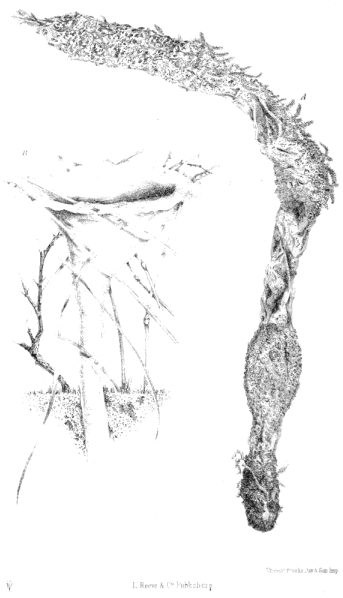
M. Simon says that this species of Atypus is common in all the centre, east and west of France, and that he has detected it in great abundance in the neighbourhood of Troyes, in Champagne, in the month of October, when the male was inhabiting the same tube with the female.125 I am greatly indebted to M. Simon for having given me the specimen of a silk tube taken entire from a nest found in this locality, which I have figured in Plate XIII, fig. A. It will be seen that the tube has collapsed, but one may still trace the enlargement near the base which forms the chamber, the elbow where it is bent at the surface of the ground, the moss, scales, and fibres of plants which are woven into, and serve to conceal the aërial portion, and its termination in a twisted and apparently-closed mouth.
Indeed, I believe that, in this specimen, the upper extremity of the tube is really closed, for, when I succeeded in inflating this aërial portion, the lips did not part, but remained drawn together.
It seems very extraordinary that the mouth of the tube should be thus closed, so that the female spider becomes a prisoner, self-immured, and I can only suppose that this is a temporary condition, limited perhaps to the period during which she receives the visits of the male.
At the very base of the tube I found a mass of earth, roots and vegetable fibres, and in this I hoped to have detected the débris of insects or other food, such as I sometimes find at the bottom of and below the tubes of the trap-door nests in the South, but of this there was no trace.
It is difficult to me to imagine how the spider could contrive to live by the capture of worms, after the fashion suggested by M. Simon; for who does not know the speed with which, on the slightest alarm, worms draw back into their holes and escape pursuit, and the muscular power which they exert in resisting any attempts to drag them out of the earth?
M. Simon's account of the closed tube and capture of worms by this spider corresponds, however, with that given by Mr. Joshua Brown, the first discoverer of Atypus in England.
This gentleman communicated his discovery to Mr. Edward Newman126 in 1856, since which time (with the exception of M. Simon's paper quoted above) little or nothing seems to have been done to clear up the points which remain doubtful in the history of these singular creatures.
Several nests of Atypus were discovered by Mr. Joshua Brown in the neighbourhood of Hastings, when traversing a lane bounded on either side by high and steep sand-banks, partially covered with grass and bushes.
His attention was at first arrested by the sight of "something hanging down which looked like the cocoon of some moth;" but, on closer examination, the silk case proved to be empty, and was continued as a tube into the ground to a depth of 9 inches, where he came upon the spider lying at the bottom. Further research revealed the existence of a number of these nests in the same locality, but the length of the different tubes varied much; they were usually about 9 inches long, but some were much longer, often baffling his attempts to follow them; the longest which he was able to secure entire measured 11 inches. All the nests were, however, alike in having a tubular silk lining, about 3/4 of an inch in diameter, a part of which protruded from the ground for about 2 inches, and was pendent, inflated, and covered with particles of sand, assimilating it to the surrounding surface; it was closed at the upper extremity, leaving no exit to the open air.
Mr. Brown took home some of these tubes in a collapsed state with the spider at the bottom. In one case, on opening the box in which the nest was placed, he perceived a movement throughout the tube, as if it were being inflated; this however soon subsided, but the following morning he was surprised to see that the whole tube was inflated, especially at the end which had lain exposed on the bank. He failed to find any aperture by which the spider could enter or leave her nest, and his captives, though passing backwards and forwards in their tubes, never came out at either end. He never saw flies or any fragments of insects in the nests; but, on drawing out one of the tubes, he observed a worm at the lower end, partially within it, partially outside, and he perceived that the spider had evidently been eating a considerable portion of its anterior extremity.
It will readily be seen that there are some discrepancies between the different accounts which have been given of the nests of Atypus found in England and France,127 and I think it quite probable that some at least of the nests described may really differ, and be the work of distinct species belonging to this genus. Mr. Brown describes his nests as having by far the greater part of their length under ground, while in those observed by M. Simon, as shown in my figure, Plate XIII fig. A, the exposed portion of the tube equalled or exceeded the subterranean.
An imperfect specimen at the British Museum, from some English station (exact habitat not given), appears to have the proportions described by Mr. Brown; the length of the aërial portion of the tube being less than one-fourth of that of the subterranean; the upper end of the tube is however open, but I am doubtful whether this was originally so or not, for the silk is torn at this point, and the opening may be a rent caused by rough handling.
After a comparison of the above description, it appears to me that the following are the principal points which remain to be cleared up:
1. What is the precise structure of the nests of Atypus, and are they always uniform in character at all seasons of the year?
2. What is the use of the exposed aërial portion of the tube?
3. Do the two British species make similar nests?
4. What food, besides worms, does the female live upon, and how does she obtain it?
5. Does she ever leave the nest?
6. What becomes of these spiders and their nests in the winter, and how long do they live?
7. When do the young leave the nest; and do they, like their relatives in the South, construct nests like those of their parents in miniature?
I would commend all these points to any lover of Nature who may seek the southern coasts of England during the autumn and winter months, and I think it more than likely that a careful search in the sandy banks near St. Leonards, the slopes under the fir-woods of Bournemouth, and the deep lanes in the neighbourhood of Torquay, would be rewarded with success.
If the breeding season in England only commences in October, as appears to be the case in France, it would seem most probable that the spiders survive the winter. Very possibly these spiders and their nests might be transplanted and placed for observation in a garden; and if room were granted them in a greenhouse or Wardian case, or even in a large flower-pot in a living-room, it is not unlikely that the warmer temperature might waken them up to renewed activity.
It seems clear that Atypus has to fear the insidious attacks of enemies; for not only is the external portion of the tube closed or almost closed at certain seasons, but it is covered outside with such materials as may serve to make it resemble the surrounding surface of the ground. Thus Mr. Brown's nests, lying on a sandy bank, were covered with particles of sand, while my specimen from Troyes has moss and fibres of plants woven into its upper extremity.
Indeed, all the European representatives of the suborder Territelariæ which I have myself met with, conceal their nests with great care and skill. There appear to be others, however, which either make no nests at all but hide under stones, or only construct a simple silk tube, open at the mouth, and without any special contrivance for its dissimulation. Further observation of the habits and dwellings of these apparently unworthy members of the trap-door group is much to be desired.
Mr. Bates,128 in his work on the Amazons, describes Mygale (Theraphosa) Blondii, a large and powerful spider of that region, as burrowing into the earth and "forming a broad slanting gallery about three feet long, the sides of which he lines beautifully with silk." This spider "is nocturnal in his habits," and maybe seen "just before sunset keeping watch within the mouth of his tunnel, disappearing suddenly when he hears a heavy foot-tread near his hiding place."
This nest would therefore appear to have an open tube undefended by any door; but in this case the great size of the spider and the depth of the burrow, which is more than twice as long as that of the average European nests, may help to explain this apparent want of precaution.
But, if we wish to learn with what different materials and by what varied means the same end of self-preservation can be attained, we have only to cast a glance at the sketch of a portion of a nest at fig. B, Plate XIII, p. 183, where it will be seen that the entrance to the nest, far from being concealed or obscured in any way, is rendered a most striking object, and one which appears devised for the very purpose of attracting attention. The nest to which I refer is the work of Cyrtauchenius elongatus, from Morocco, and consists, according to the account given me by its discoverer, M. Simon, of a deep cylindrical burrow in the soil, the silk lining of which is prolonged upwards for about three inches above the surface of the ground, and enlarged into a funnel shape, so that it becomes from two to three inches across at the orifice. This aërial portion being snow-white, at once attracts the eye even from a considerable distance, and the nests rising up amid the sparse grasses and other small plants which serve to support but not to conceal them, present the appearance of scattered white fungi.
This is therefore quite a new type among the nests constructed by trap-door spiders, new in form and probably in function also, and I would propose to distinguish it provisionally as the funnel type.
Now the female Cyrtauchenius is, like its near relatives the Nemesias, a sluggish and rather helpless creature, and shows no apparent physical superiority which might countenance its dispensing with the methods of concealment which form the characteristic habit of the group.
How then does this spider manage to escape its many enemies, especially the insidious attacks of the insects of the Sphex and Ichneumon families, which certainly abound in Morocco?
Mr. Wallace, to whom I put the question, suggested that this species may perhaps be chiefly nocturnal in its habits, and that, if this is the case, the bright white and flower-like tube of the nest may possibly serve to attract night flying insects, which would thus become its prey.
In any case, whether we can discover them or not, some curious points of difference must exist between this spider and its allies, which secure to it a comparative immunity.
It appears to me that there are few questions which can be of greater interest to the naturalist than those which have to do with the conditions determining the existence of a given species in a given place.
Of the questions, Who are your relatives? Where do they live? and How are you able to live here? surely the last is not the least important.
And, if we wish to try to answer this question, we must do all in our power to find out how the habits and conditions of life of the creature in question, differ from those of its competitors; for we may be quite certain that it does not exist where we see it by grace and favour, but by merit; if it is neither stronger, cleverer nor more numerous than its neighbours, we may be sure that it has found some means of living which does not interfere fatally with their requirements. Hence the endless diversity of function and habits in all living creatures, which forms such a prolific and marvellous subject for our study and contemplation.
I am indebted to M. Simon for permission to publish the details given above on Cyrtauchenius elongatus, and also for having given me such directions as enabled me to make the sketch from which the drawing at Plate XIII, fig. B, was copied.
I must however state that this illustration is not taken from an actual specimen, but is prepared solely from his description; so that it cannot pretend to complete accuracy of detail. M. Simon assured me nevertheless that it conveyed the general appearance of this remarkable nest with sufficient fidelity, and I have been induced to reproduce it here in the hope that it may serve to make my meaning plainer, and to suggest the kind of object which one should look for, if an opportunity offered.
Another species of the same genus, Cyrtauchenius Doleschallii, is known to inhabit Sicily, but the nest is undescribed. M. Lucas has described two species,129 belonging to the closely-allied genus Cyrtocephalus, both of which appear to construct nests somewhat similar in form to that discovered by M. Simon. Whether these nests are equally showy we cannot tell, as the account is brief and few details are given; but one, that of Cyrtocephalus terricola, appears to differ in having threads stretched from the opening of its funnel, which serve to ensnare insects and to give notice of these captures.
The great trap-door group therefore comprises spiders which differ widely in respect of their dwelling places. Some construct no nest at all or only an irregular web, and live under stones; others, like Theraphosa Blondii, make a simple cylindrical tunnel, or, like those just described, a tube having a prolonged, uncovered, funnel-shaped mouth: others again, belonging to the genus Atypus, form the curious and as yet imperfectly-understood nests with a silken tubular lining, part of which hangs down outside; while on the highest rung of the architectural ladder, stand the builders of the veritable trap-door nests.
It seems quite possible that, when we know more of the structures made by Territelariæ generally in various parts of the world, we shall find that nests of various degrees of complexity and perfection of structure exist, bridging over the gulf between the barbarous dwellers under stones and the highly civilized inhabitants of the branched wafer and cork nests.
Indeed, thanks to recent discoveries, I am already able to do something of this kind for one small group of spiders, namely, for that of the European Nemesias having nests with wafer doors.
Plate XIV.
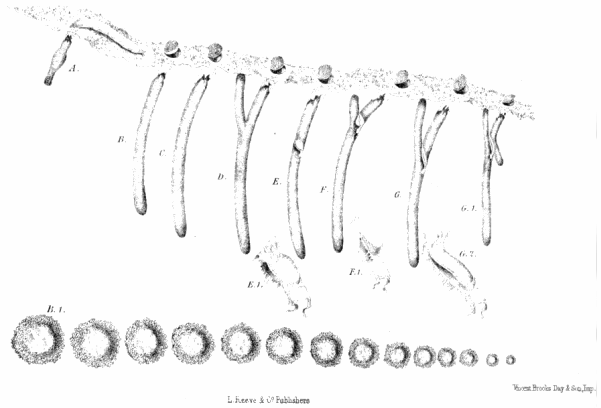
I hope to make this plain by reference to the diagrams on Plate XIV, where the figures C, D, E, F, and G represent on a reduced scale five types of wafer nest constructed by as many distinct spiders, and where a gradation may readily be traced between the simplest type at C and the most complicated at G; but we shall speak more fully of this matter by-and-by.
In these diagrams I have placed that representing the nest of Atypus on the extreme left (A);130 next to this stands that of a nest of the cork type (B), a type which must be carefully distinguished from all the rest. It must not be supposed that the solid cork door (so called from its resemblance to a short cork closing the neck of a bottle), is nothing more than a thicker edition of the wafer door; it is not so, but, on the contrary, possesses a very characteristic structure of its own, being composed of many layers of silk, each furnished with a sloping rim of earth, while the wafer door consists of but a single layer of silk.
I have represented at B 1 the 14 layers of silk and earth which went to make a single cork door examined by me. It will be seen that the outermost of these layers is the largest, and the innermost the smallest, and I have already (Ants and Spiders, p. 150) shown reason for believing that the latter constituted the first door the spider ever made, and that the consecutive layers mark successive stages in the enlargement of the nest.
There is therefore a broad distinction as to construction between cork nests and wafer nests; moreover, while the former are, as far as we know at present, all of one type, and only differ in size or proportion, the latter appear under five distinct types.
Thus, every known cork nest, whether found in Europe, America, or the Antipodes, has the same solid door and simple tube; while of the wafer nests, some have branched and others simple tubes, and some again possess a lower door in addition to the upper or surface door.
In the following pages I intend to treat of the trap-door spiders and their nests in the same order in which the latter are placed in the diagram, commencing with those of the cork type B, and then dealing successively with the several wafer nests from C to G. We have already spoken of A, the nest of Atypus piceus, and seen that our present knowledge of this nest, of the habits of its occupant and of those of its relations, is still far from complete.
The cork type is, as my readers will perhaps remember, the great cosmopolitan type which ranges round the world, and which, curious to say, is built by many different spiders belonging to distinct genera.
The idea of planning this very perfect bit of mechanism appears to be the common inheritance of these several spiders, separated though they are by wide intervals of geographical space as well as to structural divergence.
At Mentone two distinct spiders construct nests of the cork type, one of these being a Nemesia and the other a Cteniza. They are as unlike each other as they well can be, and it seems remarkably strange that their nest-building instinct should be so similar. The nest of the Cteniza is indeed shallower than that of the Nemesia, and a practised eye can usually trace a difference between the slightly less angular lower surface and more semi-circular outline of the door of the former, and the more abruptly bevelled and more circular door of the latter.
These spiders and their nests have been already described and figured in Ants and Spiders under the names of Ct. fodiens and Nemesia cæmentaria. Recent discoveries have however shown that these spiders possess distinctive characters of their own, and, though closely allied to the species indicated, should be separated from them.
Last spring when pulling down an old terrace-wall (by permission) I had the good fortune to discover the very remarkable male Cteniza drawn at fig. A, Pl. XX, p. 254. I found no trace of a nest or web of any kind, and the spider was merely hiding between the stones.
There appears to be scarcely any doubt that this is the male of the female Mentonese Cteniza which has, up to this time, been called Ct. fodiens. A comparison with typical specimens of the true Ct. fodiens from Corsica, has however shown that the two are certainly distinct, and Mr. Pickard-Cambridge131 now describes the Mentonese form under the name of Ct. Moggridgii.132
The females of the true Cteniza fodiens are far larger than those of our new Mentonese species, and construct their nests in dry and exposed places, instead of in the moist and shady ivy-covered banks selected by the latter. I have found Cteniza Moggridgii at San Remo and Mentone, and it will probably be also discovered at Nice, but I failed to detect it either at Cannes or Hyères.
The Corsican male at the first glance curiously resembles that found at Mentone, but differs essentially in details and especially in having the surface of the caput unbroken, whereas the caput of the latter presents a very peculiar character in an impressed line which runs across it from side to side (figs. A 1 and A 2). Both agree, however, in being strangely unlike their females.
The other builder of a nest of the cork type at Mentone was, as has been already stated, described and figured in Ants and Spiders under the name of Nemesia cæmentaria. Now the true N. cæmentaria of Latreille is found at Montpellier, the classical habitat where the first discovery of trap-door spiders in Europe was made towards the end of the last century, but its true characters have been hitherto but imperfectly known.
I have lately been able to secure several specimens at this place, and they certainly differed in their markings from the so-called cæmentaria of Mentone. M. Simon had previously informed me that he considered our Mentonese spider distinct from the typical cæmentaria, and had kindly proposed to give my name to the Mentonese species; and now Mr. Pickard-Cambridge, on the receipt of the specimens collected by me at Montpellier, coincides with M. Simon, and adopts his nomenclature, calling the Mentonese Nemesia N. Moggridgii.133
I found but one nest of the cork type at Montpellier, where it was most abundant, and invariably inhabited by the same spider, so that there can be little doubt that this is the celebrated Nemesia cæmentaria of Latreille, the nests of which were described by the Abbé Sauvages in 1763.
When living, the pattern on the abdomen is far more distinct and is traced on a paler ground than in N. Moggridgii, and the patterns on the back of the caput, as seen in specimens preserved in spirits, and the relative sizes of the lateral eyes, as well as other details enumerated by Mr. Pickard-Cambridge, afford characters by which they may be known apart; and it is probable that when the males, which are at present unknown, shall be discovered, they will be found to present other distinctive peculiarities. In the present instance we have the reverse of the case described above, in which two very distinct spiders constructed a similar nest, for here both spiders and nests are much alike.
We have yet to learn what are the special advantages which each type of nest affords; but it is plain from the fact of the same type being adopted indifferently by both nearly- and most distantly-related spiders, that the form of the nest is governed far more by the conditions which it is contrived to meet, than by the affinity or resemblance of the spiders which construct it.
I have found N. Moggridgii at San Remo, Mentone, Cannes, Hyères, and Marseilles, but thus far, I only know of the true N. cæmentaria at Montpellier.
The latter spider is rather bolder than the former, and I frequently saw it at Montpellier watching at the slightly raised door, with the tips of the claws projecting from the nest, and it rarely failed to resist most vigorously any attempt of mine to force the door open.
During the summer of 1873, I received two specimens of trap-door nests from California. Both of these nests were of the cork type and nearly entire, wanting only a small portion of the base of the tube; they most closely resembled one another and were probably the work of the same spider. For one of these, coming from the San Joaquin valley, between the Calaveras and the Tejon, I have to thank M. J. C. Puls, a Belgian entomologist residing at Ghent; and for the other, containing the spider which had constructed it alive within its tube (!), I am indebted to Mr. G. H. Treadwell of San Francisco. The former nest is drawn at fig. A, Plate XV, and the spider134 from the latter at fig. B of the same plate.
Plate XV.
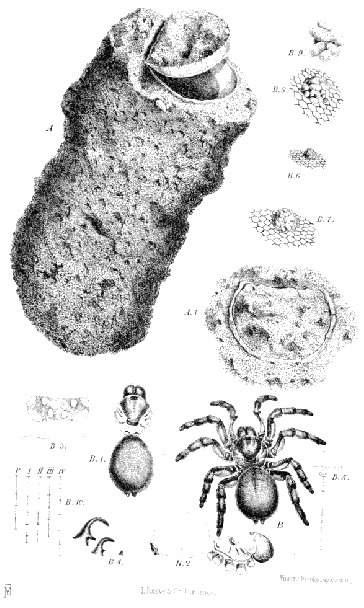
Mr. Treadwell had carried this spider and its nest, with the block of earth in which it lay, all the way from Visalia, a town about 350 miles south of San Francisco, where he had taken it; the nest and spider travelled safe to London enclosed in an empty cocoatina tin, 41/2 inches deep, and 23/4 across.
The nest was then entire, for these spiders appear to make singularly shallow tubes; and it might have remained so up to the present day had it not been for the rash curiosity of a chambermaid in the London hotel where Mr. Treadwell was staying, who, smitten with a great desire to learn what the heavy little box which came from the land of gold might contain, proceeded to examine the earth, when the sudden appearance of the spider frightened her so much that box and nest and all were thrown with a crash upon the floor.
Were it not for this unlucky incident I might have seen a complete specimen of this curious nest; but as it was, though the spider miraculously escaped uninjured, the bottom of the nest was pounded into dust, and only the upper portion remained intact.
Both this nest and that sent to me by M. Puls, were of the true cork type, and presented a solid door with a bevelled edge, fitting into the correspondingly bevelled lip of the tube, and shutting flush with the surface of the ground. The lining of the tube was strong and thick, but soft and silky to the touch.
The tube itself in Mr. Treadwell's specimen, when intact, cannot have measured more than 31/2 inches in length; and we learn from Dr. Lanzwert, who collected the other specimen, that the average length of these nests does not exceed three inches. Dr. Lanzwert, writing in one of the local papers135 of "The Mygales or Ground Spiders," says, "the poisonous black tarantulas, so well known to naturalists, are extremely common in California, but only in places upland, or lowland which are very hot and dry. Their principal haunts are the San Joaquin valley, between the Calaveras and the Tejon. A similar species from the coast is not only smaller than the interior variety, but the colours are much deeper. They both make a curious habitation under the ground, composed of a glutinized, web-worked purse, about three inches long, and which is furnished with a tightly-fitting lid which they can open or shut at pleasure, and which is as cunning a piece of insect architecture as is to be found in nature. These ugly loathsome Californian spiders are often mentioned by thoughtless scribes as carrying no more danger than a common wasp, like the species of Italy, but it is well known that several persons, young and old, have lost their lives in this State from the bite of such tarantulas as are met with in our coast and interior country. Their enemy in the Tulare valley is an immense shining black wasp,136 fully an inch long, which will pounce upon them, and after a short battle drag the tarantula along in the most valiant style of heroic conquest. These interior tarantulas are often seen measuring two inches in the spread."
Mr. Treadwell was quite as much impressed as Dr. Lanzwert with the belief that the bite of these spiders is fatal, but it does not appear that either of these gentlemen have obtained conclusive evidence in support of this allegation.
I have occasionally been bitten by the trap-door spiders in South France, but have never experienced the slightest subsequent inconvenience, nor was there any trace of inflammation or poisoning about the punctures which they made. Mr. Blackwall137 has made a very careful set of observations on this head, and has caused some of the largest species of British spiders to bite his finger and wrist until the blood flowed, without the slightest ill effects. He also inoculated himself at the same time with the poisonous secretion of the spider and with that of the wasp; when the latter wound became extremely painful, while the former was not perceptibly aggravated. Mr. Blackwall obtained the spiders' poison by causing a spider to seize a slip of clean glass with its mandibles, when a small quantity of a liquid showing a slightly acid reaction was deposited.
Mr. Treadwell informed me that these Californian trap-door spiders leave their nests in the daytime, and may be seen walking by the roadside, though they are always prepared to hurry back to their nests on the approach of danger.
I received the spider which I have represented at fig. B, Pl. XV, p. 198 (Cteniza Californica), from this gentleman alive, and still within the remaining portion of her nest, on the 6th of July, 1873. She then had the legs and cephalothorax of a brownish-black, and the abdomen of a dull, uniform, dusky chocolate brown, but with an indistinct median line near the anterior end on the upper side, intersected at right angles by a shorter line. Mr. Treadwell said, however, that when captured, this spider was much darker, and of a pitchy black colour. The hairs all over the body were short, but especially so on the abdomen, which had the appearance of cloth or felt.
This creature in many ways recalls Cteniza fodiens of Corsica, and in a less degree the Cteniza of Mentone and San Remo.
We find not only the same general form of body, but also the same claws furnished with only one tooth, instead of many as in Nemesia, and other distinctive features; and it is interesting to observe in the nest that the more semi-circular form of the door and the wider hinge also connect it rather with Cteniza than with Nemesia.
Here, as in all spiders yet observed in cork nests, we find the habit of resisting any attempt to open the door, and many a time when I have wished to raise the lid in order to drop in flies or other food, I have been obliged to desist because the bending blade of my penknife showed that I should injure the nest if I used greater force.
No doubt the shallowness of the nest is an advantage to its occupant in one way—namely, that it enables the spider to start up at the shortest notice, and cling on to the door.
It is curious to find that, far as California is removed from the Riviera, the same habits of construction and self-defence are common to the spiders of both countries, and that the bond of kinship sets time and space at defiance.
I kept this spider all through the summer and early autumn at Richmond (Surrey), sprinkling the nest from time to time with water, and constantly supplying its inhabitant with flies, wood-lice, grasshoppers, earwigs, and other similar dainties. She did not, however, seem eager for food, and the insects provided for her, and actually placed within the nest, were often turned out again almost untouched.
When I placed living insects, such as grasshoppers, for example, within the nest over-night, she would often allow them to remain there unharmed, so that I found them ready to escape on opening the door the following morning.
I never saw her leave the nest of her own free will, and when I made her come out and set her to run in the garden, she began at once to seek for a place to hide in, hobbling along in an ungainly way and at a slow pace.
She must, however, have left the nest on more than one occasion, unseen by me, for she deposited several clusters of eggs at various times upon the under-surface of the gauze net which was fastened over the mouth of the box in which she was imprisoned.
The first of these groups of eggs was laid during the night between the 12th and 13th of July, and formed a raspberry-shaped cluster attached to the gauze.
I have represented this cluster of the natural size at fig. B, 6, and magnified at fig. B, 7, on Plate XV, only in an inverted position, for they really hung downwards from the under side of the net.
These eggs were greyish white or pale brown, and varied in shape from globose to oblong.
All were very small, the largest only measuring 1/2 line in its greatest length, but it is doubtful whether any of these eggs were fertile, and, though they appeared full and plump, many presented an irregular and fissured surface.
A fortnight later (July 27) another cluster of eggs was laid, and this time between the hours of five and eight P.M. When the lamp was brought in at the latter hour, I perceived what I took to be a drop of water hanging from the gauze cover above and rather in front of the spider's door, the very position occupied by the cluster of eggs previously described. On closer inspection this proved to be a drop of a pellucid colourless liquid, in which some thirty eggs floated. One egg was laid on the gauze at some distance from the main group, and several were also attached to the inside of the tin box.
At midnight I found that the drop had coagulated and contracted, and by the following morning the mass was quite dry and resembled the former group, only that it was not quite so convex.
Some of the eggs forming this cluster were much larger than any in the preceding one, and one measured as much as a line in length by half a line in breadth. This group is shown magnified at fig. B, 8, Plate XV, and some of the separate eggs more highly magnified at fig. B, 9.
Between this date and the end of November when the spider died, eggs were laid on seven distinct occasions—viz., on July 31, August 11, 15, 31 (when I again found the eggs floating in a drop of liquid, having been deposited on the gauze between two and half-past four o'clock in the afternoon); September 9 (23 eggs laid on the earth near the entrance to the nest); September 19 (about 30 eggs on the gauze), and November 4 (about 30 eggs on the gauze).
Thus, between July 13 and November 4, this spider laid nine clusters of eggs, all but one of which were placed on the same part of the gauze cover, above and a little in front of the door, and the total number of eggs deposited cannot have been less than 250. It is difficult to understand why she should have laid these eggs outside the nest, unless indeed she knew them to be sterile, and so treated them as refuse. I can scarcely believe that such a procedure is in accordance with the ordinary habits of these spiders; for, if the eggs and young are habitually exposed, then the perfect concealment of the nest would lose one of its most important uses. When we remember that there are minute hymenopterous insects which lay their eggs within the eggs of the spiders, we can see how important it may be that the entrance to a nest, which is at once nursery and stronghold, should be closed by a well-fitting door, and one which may exclude, not only the larger and more powerful enemies of the full-grown spiders, but also the tiny and almost imperceptible assailants of the eggs and young.
This Californian spider was always careful to eject from the nest the remains of insects with which I had supplied her, and, as she did so deliberately and by day as well as by night, I had frequent opportunities of watching her. Sometimes, if not alarmed by any sudden movement, she would remain for one or two minutes at the mouth of the nest with the door partly raised, and I was glad to seize these opportunities for making some experiments, with a view to learning whether she would prove as sensitive to sound as she did to other vibrations and to the sight of moving objects.
Placing myself so that the partly-opened door screened me from her view, I was able to approach close to the nest without causing her alarm, and to make different sounds and noises at distances varying from three to fourteen inches.
In no case, however, did she pay the slightest attention; and neither shrill and sudden whistling, deep chest and buzzing sounds, an octave of piercing notes struck upon brass bells, my best imitation of the whirring of the fern owl, or finally, the angry hum of a large humble-bee imprisoned in a paper box, and held within three inches of the door of the nest, appeared to produce any kind of effect. This surprised me, I confess, for, though I am aware that no auditory apparatus has as yet been discovered in spiders, I can scarcely believe that they stand at so great a disadvantage as creatures would seem to do which lack the power of hearing.
These experiments must not, however, be taken for more than they are worth; and the results obtained may have been due rather to apathy in the individual spider than to a want of perception in the race generally. In any case they suggest the need of further experiment and observation in this direction.
In October I carried this Californian spider out with me to Mentone, and she lived there and appeared plump and well until the end of the following month, when she suddenly died, having laid one more group of eggs in the interval. On examination, I found a dark brown spot on one side of the abdomen, and this, I think, probably indicates that her death was caused by some insect of the ichneumon family, which had laid its eggs within the spider's body, after having stabbed it at the place indicated by the discolouration.
Not very long before this melancholy event occurred, I had put the spider to some inconvenience in order to secure her portrait from life, to effect which I took her from her nest and placed her in a deep china saucer.
She exhibited the strongest dislike to exposure, and sought to hide herself even under a fold of blotting-paper which lay in the saucer with her. I also noted that she appeared quite incapable of walking up the sides of the saucer, and it would therefore seem that she was destitute of the viscid hairs which enable some spiders to traverse glazed and polished surfaces.
Seeing this anxiety on the part of the spider for concealment, it came into my mind that, perhaps, if she were placed on the surface of a pot full of garden mould she might excavate a tunnel in order to hide herself from view. This I accordingly did in the evening of November 15, and on the following morning I was delighted to find that she had commenced to dig and was still at work.
In little more than an hour's time the hollow had become about the size of half a walnut, and resembled in its nearly semi-circular outline and size the surface of the door of her own nest. I was greatly pleased to be able to watch the creature at the work of excavation, a sight which I believe no naturalist has ever had before.
The legs took no part in the digging, and the palpi were but little used, the mandibles and their fangs being the implements chiefly employed. As soon as a little earth had been loosened and gathered up, the spider walked up to the edge of her excavation and deposited there her mouthful of particles of earth, separating and working the mandibles up and down in the effort to part with the pellet, which had been carried between the fangs and the mouth-organs. Each pellet was very small, and the operation appeared to be excessively tedious and laborious. I had expected to see the spider scrape out large quantities of earth at a time, and either drag it backwards or kick it out behind her as a terrier does when working at a rabbit-burrow; but no, every little pellet removed was carried forwards, and deposited separately on the "tip."
On the two following days, the 17th and 18th November, the spider remained almost inactive, and brooded over the cavity she had made, and which still remained too shallow to conceal or even contain her. At 4 P.M. on the latter day I made a hole for her in the earth, and, after some indecision, she took possession of it. Next day, however, finding that she remained motionless in the hole which I had made, and displayed no apparent intention of either lining it with silk or furnishing it with a door, I replaced her in her own nest.
Within a few days after this date I found her dead at the bottom of her tube, and at first I was inclined to fear that the treatment to which she had lately been subjected might have caused her end. When, however, I detected the brown spot on the side of the abdomen, described above, and which so strongly recalled the marks frequently observable in caterpillars attacked by ichneumons, I came to the conclusion that she had really died from the internal injuries caused by the gnawing of these cruel parasites; and that the eggs, laid long before by one of these insects, had been hatched within her body and developed into larvæ, which, living upon her tissues, had at length destroyed some vital part. It is surprising that a creature, carrying within itself such a fatal brood, should not only live, but be capable of undergoing such adventures and misadventures as this travelled spider endured with seeming indifference; but similar facts are familiar to all those who have attended to the rearing of caterpillars, and the frequent disappointment caused by the death of apparently sound specimens which have been attacked in this way is but too well known.
It would appear that Cteniza Californica is peculiarly amenable to captivity, and indeed to captivity of the strictest kind.
My specimen lived during all the time she was in my possession in a cocoatina tin, a cylindrical box 41/2 in. deep and 23/4 in. in diameter, which always stood among the books and papers on my writing-table. It is probable that those trap-door spiders which inhabit nests with short tubes, and which therefore can be transported nest and all, would be less disconcerted by imprisonment than is the case with other kinds living at the bottom of a long burrow which it is almost impossible to carry away entire. This is borne out by what has been related (Ants and Spiders, p. 122) of the habits of Cteniza ionica in captivity, which not only endured to have its nest set upside down in a flower-pot, but actually furnished the inverted base of the tube with a door appropriate to its new position.
Canon Tristram (the well-known author and naturalist) was so kind as to send me two trap-door nests from Palestine for inspection; these were small cork nests, the doors of which resembled those of the Mentonese Cteniza (Ct. Moggridgii), but the tubes were exceedingly short, and that of the more perfect specimen, as I gather from Canon Tristram, measured only two inches and an eighth in length when entire.
The nests of Cteniza ionica are but little longer, and that of the Mentonese Cteniza, though never so shallow as these, are far less deep than those of Nemesia cæmentaria, the builder of the typical cork nest.
And now we will leave the nests of the cork type and their inhabitants, and turn to the more intricate group of nests belonging to the wafer type. Following the order indicated in the diagrams, we will begin with the simplest type of all, fig. C, and afterwards take the remaining types one after the other, advancing until we reach the most complex type, G. The nest represented diagrammatically at fig. C, in Plate XIV, is shown of the natural size in Plate XVI., with the spider (Nemesia Simoni, Camb.) which constructs it (fig. A 1).
Plate XVI.
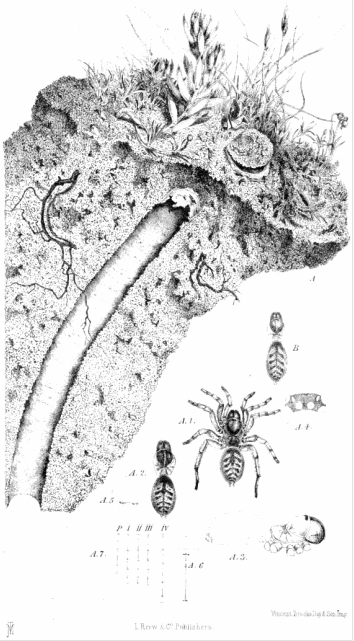
It belongs to the single-door unbranched wafer type, of which one example has already been described in the West Indian nest (see Ants and Spiders, p. 79, fig. B in woodcut); for, though this latter has a shorter tube and a much stouter silk lining than is the case with its European representative, there does not appear to be sufficient difference to justify their separation as distinct types.
This, which is the simplest known form of trap-door nest, is quite new to Europe, and the spider inhabiting it proves also to be one hitherto undescribed; it has received from Mr. Pickard-Cambridge, the name of Nemesia Simoni,138 being so called in honour of M. E. Simon, the well-known arachnologist.
During last May (1874) we spent a few days at Bordeaux on our homeward route. While there my sister was fortunate enough to discover a single nest of this type when we were out together on a spider-hunt near the little village of Lormont, which is situated on the opposite bank of the river to that on which the city stands. We subsequently found these nests in tolerable abundance in a deep shady lane near a restaurant called Mon Répos, on the same side of the river, but rather farther up.
Here the hedge banks were high, and the soil was composed of a fine even-grained loam of great depth, which permitted the spiders to carry their tubes very far down, some of them attaining a length of 15 inches.
This made it very difficult to follow them throughout their whole course and so to assure oneself of the real structure of the nests, but I succeeded in doing this in twelve instances.
In every one of these I found the tube cylindrical and unbranched throughout, and destitute of any trace of a lower door.
This deficiency alone distinguishes the present type from that to which the nest of Nemesia Eleanora belongs; the latter being of the double-door and the former of the single-door, unbranched wafer type.
But perhaps it may be asked whether it is safe to assume that because twelve examples of this nest were found to correspond in structure, and were tenanted by the same occupant, that therefore all the Bordeaux nests in which this particular spider might be found would present similar peculiarities.
I greatly hope that other naturalists will put this question to the test of actual investigation on the spot, but I do not hesitate to assert my conviction that this will prove to be the case.
The result of my experience among the nests of the other Nemesias, scores of which I have carefully examined in many widely separated localities, shows that a given spider is invariably associated with a fixed type of nest.
Thus, Cannes is from fifty to sixty miles distant from San Remo, but the nests of N. cæmentaria, N. Manderstjernæ, and N. Eleanora show precisely the same characteristics in either place.
Moreover, the twelve nests referred to were not all taken from one restricted locality at Bordeaux, but were found presenting the same characteristics and occupied by the same spider in three distinct habitats, distant some miles from one another. In two nests several young spiders were found with the mother, and, in one case where the family consisted of twenty-three young ones, I observed that they were not all equally small, and some had nearly attained one-third of their full size.
This agreed with the fact that no very small nests were observed, and it seems probable that the young are not turned out of their nursery quite so early as some of their relations are at Mentone. This, however, varies perhaps in accordance with changes of climate and local conditions.
We failed to detect any other type of nest at Bordeaux than the one described above: and even the cork nests, which we had shortly before seen in such abundance at Montpellier, were apparently absent.
Bordeaux is by far the north-westernmost point in Europe139 at which any spider constructing a true trap-door nest has as yet been discovered; and the fact that they exist in a climate so different from that of the Riviera and of the whole Mediterranean region, leads me to hope that their range may in reality be much more widely extended than has hitherto been supposed to be the case.
A glance at the vegetation of this district will suffice to show how little there is that betokens either a warm or dry winter climate; for here the myrtles, oranges and olives are left far behind, and in their place we see tall hedgerow elms, and poplars bearing mistletoe on their branches.
Here therefore we are met by the question, How do these Bordeaux spiders contrive to live under conditions so different from those to which their relations on the Riviera have adapted themselves? How do they bear the cold and damp of the long winter, and how is it that one frail upper door suffices to protect their nest from molestation?
The thick coating of dead leaves, which covered the banks even when we found them, no doubt aids largely in their concealment, and the colder climate probably diminishes the number of their enemies, but their means of subsistence are most likely also less abundant and their period of active life shorter.
The next type we have to consider is a totally new one, and may be distinguished as the single-door branched wafer nest. I detected this nest at Montpellier but a few days before the visit to Bordeaux alluded to above.
Circumstances unfortunately prevented me from following up my discovery as closely as I could have wished, and it appears moreover that this nest is far less common at Montpellier than the typical cork nest (Nemesia cæmentaria).
Plate XVII.
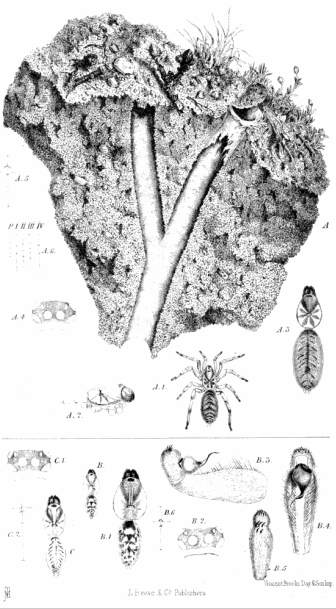
I hope therefore that other naturalists will make further investigations, and especially that they will endeavour to secure the male.
I obtained twelve spiders and thoroughly followed the course of ten nests; I opened thirteen more nests, but failed to trace their structure satisfactorily.
The upper part of this nest is shown of the natural size in Plate XVII with the spider (Nemesia suffusa, Camb.140) which constructs it. This is again a wafer nest without any lower door, and this absence of a lower door alone distinguishes it as a type from the branched nest represented at F in the diagram, just as the same deficiency separated the Bordeaux type from that at fig. E.
In this new single-door branched type, the branch makes a more or less acute angle with the main tube, and reaches the surface of the ground, but is there closed by a layer of particles of earth slightly bound together with silk, forming an immovable cover or thatch. This cover constitutes, however, but a slight obstruction and could easily be torn away by the spider if she needed to use this passage as a way of escape.
These nests were tolerably plentiful at a place called Les Mourines, a short distance from Montpellier, where they were mixed with cork nests in the steep hedge banks. The nests were from 8 to 10 inches deep, and, as in all the trap-door nests which I have examined, were tenanted by the female alone. It seems strange that this spider, building as she does a nest apparently but poorly furnished either for concealment or defence, should be able to enter into competition with N. cæmentaria, whose solid, closely-fitting door appears so perfectly contrived for both. It will probably be found, however, when we are better acquainted with their respective ways of life, that they are really more nearly on a footing than they seem to be at first sight. I detected the remains of ants and the elytra of a beetle in one of these branched single-door nests. Now these may also be found in cork nests, so that Nemesia suffusa evidently competes with cæmentaria for its food, and this is of course the main cause of contention between all living creatures.
It is possible, that, if we knew all the uses to which the branch is put by the spider which constructs it, we should find that the advantages derived in the way of security from the existence of this second passage, counterbalance those possessed by the cork nest, which, though so perfectly closed, has only the one tube, and no other possible way of escape.
It may perhaps be no more than a coincidence, but we can scarcely avoid commenting upon the fact, that, just as this Montpellier wafer nest is simpler in construction than any found along the Riviera, so in like manner is the Bordeaux nest simpler than that of Montpellier. It thus becomes tempting to ask whether, in the case of these wafer nests, we shall not discover that the colder and damper climates are the homes of the builders of the simpler types, while the warmer and drier ones, where more food, more enemies and more competitors are found, are reserved for the architects of the more complicated nests.
Doubtless naturalists will soon discover wafer nests on the slopes of the Pyrenees, as for example at Pau and other winter stations in South-western France; and perhaps the coast of the Bay of Biscay may also yield specimens, even to the north of Bordeaux. If so, this curious speculation as to whether there is any relation between simplicity of structure and warmth of climate, will be put on its trial.
About the very time when I was engaged in digging out these new wafer nests at Montpellier, the celebrated arachnologist, Dr. L. Koch of Nuremberg, had just published141 an account and figure of a very remarkable nest which he had received from Australia, and which, though differing both in form and proportions from the Montpellier nest, may nevertheless perhaps be referred to the present single-door branched wafer type.
This Australian nest, the exact habitat of which is not mentioned, is constructed by a spider now described for the first time under the name of Idioctis helva. The nest has a wafer-door about the size of a sixpence, closing a vertical tube less than half an inch long, which meets and opens into a horizontal tube about three inches in length, and forms with it what may be roughly likened to the figure of a capital T inverted, thus, ┹.
The upstroke of the T is however, very short, and one of the arms is longer than the other, and curved downwards at its extremity. This is, as far as I know, the first recorded example of a wafer-nest from the Antipodes, and it may be regarded as one of the first fruits of a harvest which lies ready for the reaping of any naturalist resident in those parts. Hitherto the only nests which I have seen or heard of from Australia were of the cork type (Ants and Spiders, p. 132).
Next in order to the single-door branched wafer comes the double-door unbranched wafer type, which is the simplest of all the nests possessing two doors. This habitation, the work of N. Eleanora, has been already described (Ants and Spiders, p. 106), and I have not much to add to the account there given.
Perhaps some of my readers may remember that, while I was actually engaged on the proofs of Ants and Spiders I had one of these Eleanora spiders in captivity, and that I gave an account (p. 148) of her behaviour up to the latest moment possible. She had been captured on October 23, 1872, and placed, together with five young ones found with her in the nest, on the surface of some earth in a medium-sized flower-pot covered over with gauze. The young ones soon made nests for themselves in the earth, each furnished with its little door, but the mother roamed about on the surface of the soil, and it was not until she had been twenty-one days in captivity that she commenced spinning a silk cell.
This cell in twelve days' time presented the form of a rude figure of 8, and had an aperture at either end; it was just large enough to contain the spider when the legs were extended; its upper surface was attached to the gauze covering of the pot, and its lower to the earth. It was at this stage that the record was broken off, and I will now relate the remainder of the history.
Four days before the cell was commenced, the spider had covered the under surface of the gauze with a semi-transparent film of a substance resembling varnish, which formed a band about three inches long by half an inch wide, close to where the rim of the flower-pot threw the most shade. It was at one extremity of this band that the silk-cell was formed, but it is important to note that this band of varnish was longer than the cell, which only measured an inch and a quarter from end to end, for we shall see that the layer of varnish was apparently laid with a view to further operations.
In four days after the completion of the cell its form was modified, and, during the next ten days (up to December 21st), the spider gradually thickened the walls, and made the form of the cell more and more cylindrical, sometimes closing and at other times opening the extremities.
Between December 14th and 25th, she lengthened out the cell by spinning a cylindrical silk tube in prolongation of one end, and this tube followed the course of the band of varnish, the whole measuring three-and-a-half inches in length by about half an inch in diameter.
It would appear therefore from the correspondence in length between the band of varnish and this silk tube, that she had contemplated the construction of the latter when she first commenced her work on November 3rd.
On January 19th the silk tube parted from the gauze, leaving only the enlarged end which formed the cell still adhering to it. On the following day I observed the very curious fact that when I sprinkled the nest with water, as it was my custom to do every morning, the tube, which had become somewhat flaccid since it had lost its attachment to the gauze, gradually recovered its perfect shape. This was repeated for eleven days, until on the morning of the twelfth day (January 31st), finding the tube completely collapsed, instead of merely sprinkling water over it, I drew a large camel-hair brush loaded with water along its whole length, when the tube started up, and almost instantaneously regained its cylindrical form.
This morning the spider had left her cell, and was roaming about the pot when I wetted the tube, thus proving that she was in no way concerned with its movements, which were no doubt due to hygrometric action.
Between this time and February 25th, I constantly restored the tube to its shape by wetting it in the way above described, but on this day it remained very flaccid, and only expanded partially. For some days previous to this date, the spider had left the tube when it collapsed, and only returned to it again when it had resumed its shape. On the following day I found the entire silk tube and the cell again collapsed and lying flat upon the ground, and this time water failed to produce its previous effect.
The spider then became very restless and excited, and I observed that the door of one of the little nests constructed by one of her five offspring which had been imprisoned in the same pot with her, had been torn off, and thrown on one side, and there could be little doubt but that the mother had been guilty of this very un-maternal action. By the evening she had pulled up her collapsed tube from its attachment to the earth, and had coiled it in a confused heap. Seeing this, and fearing that, in her distress and excitement, she might do further damage to the young spiders, which had up to that time thriven well, I made a cylindrical hole for her in the earth, supposing that she would at once take possession of it. On the following morning, however, the mother spider had advanced some way in building another figure-of-8 cell, rising the shrivelled silk of her previous dwelling as a foundation.
In twenty-four hours this second cell was complete, and closely resembled the former one, save that the smaller end of the 8 was turned in the opposite direction, but, on examining it, I found to my surprise that it was empty! The spider had taken possession of the hole I had made for her, which she had at first refused to notice, and was busily employed in lining it with silk and furnishing it with a covering composed of silk with earth and fragments of moss woven into the surface. By mid-day the aperture was completely closed, but there was no moveable door. From this time (February 28) up to April 12, the spider lived in this hole, which she eventually furnished with a distinct wafer-door, and, as I found on opening the nest, with a typical lower door also. This latter was not neatly made, but still it possessed all features the essential which characterize these lower doors in the nests of N. Eleanora.
So this captive Nemesia Eleanora lived in a flower-pot in my bedroom for more than five months and a half, during which time she absolutely refused to burrow or to attempt any kind of excavation, but passed the greater part of that period on the surface of the earth in a silk tube ending in an oblong enlargement, utterly unlike her normal habitation. Finally, when I had done the digging for her, she furnished the cylindrical hole I had bored in the earth with a silk lining, and made it secure with her own two typical doors.
The figure-of-8 cell which she constructed at first, and subsequently modified until it became the oblong enlargement of the tube alluded to above, was totally unlike any form of trap-door spider's nest known to me; but in its ultimate shape (which resembled that of the glass part of a thermometer with an oblong bulb, save that it was curved and not straight), I think we may trace some resemblance to the silk tube which is made by Atypus, and of which a figure is given at A, Plate XIII, p. 183; the mouth of the tube made by my captive was, however, open. It is curious, also, when we recall this resemblance, to note that Mr. Brown has recorded, in his observations alluded to above (p. 185), that the tube of one of the nests of Atypus, which he brought home in a collapsed state, showed a somewhat similar tendency to become distended. For, on opening the box in which they had been carried, he perceived a movement throughout the tube as if it were becoming inflated, and though this inflation appeared to subside shortly after, yet the following morning the tube had recovered its cylindrical shape. I am tempted to believe, though this is mere conjecture, that the box in which these tubes were put contained moisture, and that their apparent inflation was due to the same hygrometric action which, was displayed in the tube of N. Eleanora. I regretted that I was unable to continue my observations on this captive spider, as it would have been interesting to know how long she would have lived contentedly and in good health under the conditions described above, but I left Mentone at the end of April, and was unable to take her alive with me to England. When removed from her nest in the pot on April 12, she appeared in perfect condition, and I placed her in a hole which I made for her among some stones in a garden at the back of the house, hoping to find her again on my return to Mentone in the autumn; this hope was, however, not destined to be realized.
I shall, however, have occasion to speak again of the young captives of this species (N. Eleanora), in the concluding remarks which will follow these detailed accounts of the nests and their occupants, when the behaviour of captive trap-door spiders generally will be treated of.
The next type of trap-door nest is one to which I have found it difficult to assign a descriptive name, and I am compelled for the present to speak of it as the Hyères double-door branched wafer nest.
One of its most distinctive features is found in the shape of the lower door, fig. F 1, Plate XIV, and figs. A 1, A 2, Plate XVIII., which may be said to be double, presenting two crowns, one of which fits into the main tube and the other into the branch, but I could not see my way to employing this character in naming the type. The nest is, however, quite distinct from all the others, and is inhabited by a new species of trap-door spider (N. congener, Camb.142). The characteristic portions of this nest are shown in Plate XVIII, and fig. A 3, in the same Plate, represents its occupant.
The hedge-banks near Hyères, and also about the railway station of the same name, which is some 4 miles from the town itself, are frequently tenanted by this spider. During a short stay there in May, 1873, I secured a large number of specimens, and verified the structure of the nest by a careful examination of thirty-eight examples. The nest is invariably branched and furnished with a lower door, but the branch is of variable length, usually short, and never, as far as I could detect, quite reaches the surface. In some cases this branch was so short that it could scarcely contain the spider, and, under these circumstances, it is not easy to conceive any other use for it than that of retaining the lower door when not in use. It may, however, enable the spider to take up a rather better position when engaged, as she frequently is if disturbed, in keeping the main tube closed by pressing the lower door upwards with her feet, for then her head points downwards, and her abdomen rests in the branch.
Plate XVIII.
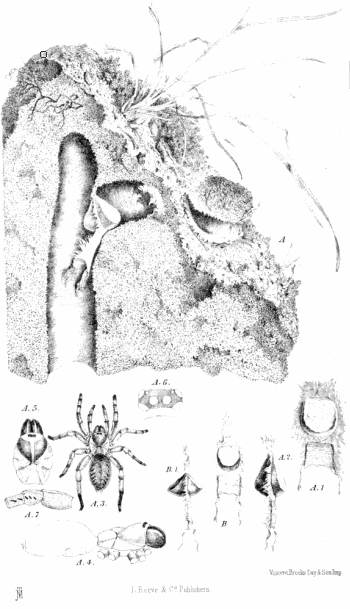
I have seen her in this attitude on several occasions when I had cut out a block of earth similar to that figured in the plate. The lower door is quite unlike that of either of the other two double-door wafer nests, being wedge-shaped, tapering from below upwards to the hinge, which is always placed at the point of bifurcation of the tubes, and having two crowns separated from each other by the gusset-like web of silk which connects the door on either side with the lining of the main tube, one of these crowns fitting into and closing the main tube, while the other fits into the aperture of the branch.
The wedge-shaped structure of the door is seen in its most exaggerated form in the nests of the younger spiders (figs. B, B 1, Plate XVIII), and becomes less so in the older and larger ones (figs. A 1, A 2). I have even seen some of these lower doors, evidently made by old spiders, which were so much flattened as to bear a considerable resemblance to that of N. Eleanora.
The main tube of the nest is from 10 to 12 inches long, and usually enters the earth almost horizontally, bending downwards from the point at which the branch joins it, and where the lower door is hung. This causes the lower door to lie nearly horizontally when not in use, and its lower crown probably serves, by fitting into the aperture of the branch, to sustain it in this position and prevent it from falling forward. The point of bifurcation is placed, as a rule, much nearer to the entrance of the nest, than it is in the two other branched nests, and occurs usually within two inches of the surface of the earth; so close is it indeed that, on lifting the upper door and looking in, one may frequently see the lower door move across and close the passage down the main tube, pushed by the spider from below. This frequently enabled me to secure the spider without having to follow her to the bottom of the nest; and, when fortune favoured me, I secured a block of earth by one rapid sweep of the knife (a common table-knife), which furnished me at once with a good specimen of the nest and of its occupant.
When the spider has once fairly determined upon resistance, it is scarcely possible to make her retreat without destroying the nest, and, in one case, when I tried to push the lower door down from above, while she was pressing it upwards from below, I found that, without crushing my opponent, I could not succeed.
There were probably young in the nest on this occasion, for I have frequently found them in the nests with the mother at this season. In no case did I even catch a glimpse of the male, and this sex is at present unknown.
The young spiders make their nests at an early age, and there can be no doubt that N. congener enlarges its dwelling from time to time as growth demands, just as the trap-door spiders at Mentone do. Indeed in one of these new Hyères nests I found, outside the main tube and some way above the existing lower door, a former and disused lower door much smaller than the one then in use, and which had evidently belonged to the nest at a previous stage of its development. I have observed this before in the nests both of N. Manderstjernæ and N. Eleanora.
This new type is strictly intermediate between the double-door unbranched wafer nest constructed by N. Eleanora, and the double-door branched wafer with the descending cavity which I am now about to describe.
This latter nest, the work of N. Manderstjernæ, Auss.143 (formerly called N. meridionalis), has already been partially made known by the figures and description given of it in Ants and Spiders (Plates IX., X., and XI., pp. 98, 100, and 104); but I have to confess, with great regret, that when these illustrations and descriptions were published, I was not fully acquainted with the true structure of this nest, having overlooked the existence of a short descending cavity which leaves the main tube a little above and on the opposite side to the ascending branch. This cavity is always present, but the very largest and oldest spiders usually allow it to become filled up with remains of food and particles of earth, and sometimes even spin silk across its entrance, in which case it can only be traced on very close examination.
It was from an old nest such as this, in which the descending cavity had been closed up, that the large drawing at fig. A on Plate IX of Ants and Spiders was made, and this figure, therefore, still remains substantially correct.
But in the case of the other illustrations—namely, fig. B, Plate IX, fig. A, Plate X, and figs. B and B 1, Plate XI, where nests of young spiders, or of spiders which, though adult, have not attained the maximum size, are represented, this descending cavity, though overlooked by me, should have been shown, for it must certainly have existed.
Its presence was first observed by the Honourable L. G. Dillon, who detected it when tracing the course of the main tube upwards from below. I had always followed the tube from above downwards, and in so doing must have unwittingly filled up the descending cavity (the existence of which I was far from suspecting) with detached particles of earth.
I will own that, when Mr. Dillon first showed me this new feature, I hoped that it might prove to be something accidental and exceptional; and it was only after careful examination of a large series of nests of all sizes, that I gradually and almost unwillingly admitted that this descending cavity formed an important feature in the typical structure of the nests.
I now see, however, that the presence of this cavity adds considerably to the interest of the structure as a whole, and places its architect quite at the head of all the builders of trap-door nests. This type should now be called, for the sake of distinction, the double-door, branched, cavity, wafer nest, to avoid confusion with the Hyères branched nest.
I am now about to endeavour to atone for my past oversight by giving new illustrations (Plate XIX, figs. A and B) and descriptions of this very remarkable nest; while I would at the same time beg the indulgence of my readers for past and present shortcomings, reminding them that the interest which attaches to structures of this kind is proportioned to the complexity and subtlety of their contrivance, and, therefore, to the difficulty we experience in properly understanding and describing them.
Plate XIX.
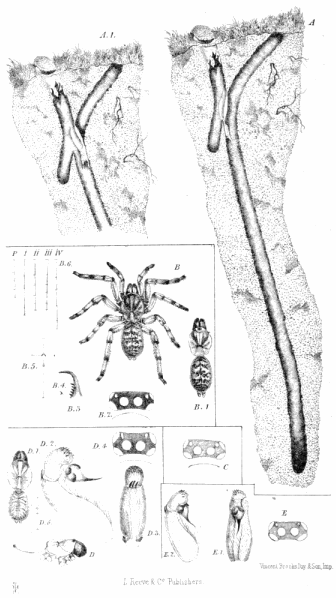
It will be seen by a reference to Plate XIX,144 figs. A and A 1, that in addition to the cylindrical branch, which mounts upwards, there is a shorter branch which leaves the main tube on the opposite side (on the left as seen in the Plate), and takes a downward course. Now this descending branch, which is barely more than an inch in length, is a cavity of variable form, being sometimes cylindrical, and sometimes egg- or even watch-shaped,145 but there is one particular in which it never varies, and that is the position of its elliptic orifice. This orifice is always situated on the opposite side of the main tube to that on which the ascending branch leaves this latter, so that the whole nest, when seen in section, presents the figure of a St. Andrew's cross, only with arms of unequal length.
But the most remarkable point is that, when the lower door is pushed across so as to close the main tube (as shown in fig. A, Plate XIX), it will invariably be found to lie in such a position that its lower extremity exactly meets the lower lip of the orifice of the descending cavity, when it will be seen that the semi-cylindrical surface of the lower door then coincides with, and appears to continue and form part of, the lower wall of the descending cavity on the one side, and of the corresponding wall of the main tube on the other. When the upper portion of the main tube is thus united to the cavity the two combine to form what appears like a short, independent unbranched nest.
Now, if we fancy ourselves an insect entering the nest in search either of the spider, her eggs, or young, I think it is plain that, when the lower door is in this position (fig. A), we should probably walk straight down to the bottom of the cavity, expecting to find our prey there, and should then return by the way we came, impressed with the belief that we had explored the whole nest, the secret of the lower door remaining undiscovered.
Whether this imaginary case may, or may not, represent what really takes place, is of course mere conjecture; but the constant occurrence of this beautiful adaptation of the various parts to one another, surely points to the conclusion that this is no mere coincidence, but rather a subtle contrivance having some very definite use and meaning.
We must admit, however, that it is difficult to conceive why, if this structure is of such great utility, it should be abandoned by the oldest and largest spiders.
Among the possible answers to this question I think that one of the more probable is that this arrangement may have been specially devised for protection against some enemy which the aged spiders have ceased to fear.
Indeed it is not unlikely that these aged spiders may have come to a time of life when they no longer lay eggs, and so do not need to keep up all the defences which they employed when they had families to protect.
Since my attention was drawn to the existence of this cavity in the dwellings of N. Manderstjernæ I have never noted the presence of young in those nests in which the cavity was filled up and disused; but then I have only exact records with reference to this point in the case of seven nests.
In these seven nests, however, there was no free cavity, and there were no young spiders, though it was at the season when it was common to find young in the nests.
The question, therefore, remains open, and further observations on this head would be very acceptable. I detected the débris of insects, and especially the horny coats of ants, in the descending cavity, in many nests; and in some of the oldest, where it had become completely blocked up, these remains still indicated its former outlines and position.
The nests of N. Manderstjernæ at Cannes correspond both in respect of the cavity and of their other characteristics with those at Mentone. N. Manderstjernæ occurs pretty abundantly at San Remo in the olive-grounds east of the Sanctuary, but I can say nothing as to whether the nests there possessed the cavity or not, for, when I was there, I was not aware of its existence. I obtained a single example of N. Manderstjernæ and its nest at Hyères, and this is the westernmost point at which this species has as yet been detected.
We have now passed in review all the seven known types of true trap-door nest, and have taken note also of the lower and more rudimentary forms of nest, such as that of Atypus, and the funnel nest of Cyrtauchenius elongatus, neither of which is furnished with a door.
Among the true trap-door nests, those of the cork type stand in a measure alone, being distinguished from all the others by their solid surface doors, composed of many layers of silk and earth; and we do not at present know of any intermediate forms linking the cork and wafer types together. But among the various nests which represent the wafer type the case is different, for here the types naturally fall into a progressive series, such as that represented in the diagrams (Pl. XIV, p. 193).
If we try to picture to ourselves the stages through which the most complicated wafer nest—namely, that of the double-door, branched, cavity type (Diagram G 1) may have passed in the course of its development from a simpler ancestral form, we should à priori expect to find precisely such structures as the Hyères double-door branched nest (Diagram F), and the single-door branched nest (Diagram D) forming successive halting-places in the advance from the primitive single-door, unbranched nest (Diagram C).
The double-door unbranched type may in like manner find its prototype in the same original single-door unbranched nest (C), which we may look upon as the parent idea, from which all these structures have been derived.
Bearing this in mind, and remembering that kinship between living creatures is not only revealed to us by likeness in structure and colour, but also by similarity in habits and instincts, it becomes of interest to trace any resemblance that may exist between these wafer-nests and the dwellings constructed by Lycosa narbonensis, a species belonging to the allied family of Lycosidæ, and which closely resembles the true tarantula146 of Southern Italy.
I first made the acquaintance of Lycosa narbonensis near the glass-works west of Cannes, where this spider may not rarely be found living in tubular burrows in sandy clearings among the pine woods along the shore (Pinus pinea, the stone pine).
I have already (Ants and Spiders, p. 146), alluded to an account given by M. Léon Dufour of his observations on the nest and habits of the true tarantula (Lycosa tarentula), which he discovered in Spain.
The nests of L. narbonensis at Cannes resembled those described by M. Dufour, but the cylindrical, subterranean burrows were apparently shorter. It was extremely difficult to trace their course, on account of the loose sand which poured into the tubes and choked them up, and I only succeeded in doing so completely in one case, when I stuffed the tube with cotton-wool before proceeding to dig. Here the open tube, which was quite simple, and about 1 inch in diameter, descended vertically for 31/4 inches, and was then suddenly bent so as to become horizontal, terminating shortly afterwards in a triangular chamber, the floor of which measured 2 inches across at the widest part, and was strewed with the remains of beetles and other insects.
The nest was lined throughout with coarse silk, which had a blackish hue, owing to the presence of the filaments of what I believe to have been some undeveloped fungoid growth. The mouth of the tube was open, and frequently surmounted by a short tubular prolongation, commencing at the surface of the ground, which formed a sort of chimney about an inch high and from an inch to an inch and a quarter across; this was composed of fibres of plants, pine-needles, and especially of a large branching lichen, very common in the neighbourhood of the nests, and all these materials were woven together and kept in place by a few threads of silk spun here and there.
It was not every nest that was furnished with a chimney, nor were all the chimneys equally complete, for in some cases they consisted merely of a small rim or one-sided lip, while in others they resembled little birds' nests, and were sufficiently firm and compact to permit of my carrying them away. It appeared to me that these chimneys served as screens to prevent the loose sand from being swept into the burrows by the winds which rage over that open seashore plain, and that they were more or less complete in proportion as the exposure was greater or less, and the sand looser or more bound together.
I captured eight of these spiders, and here, as in the trap-door group, the female alone inhabited the nest.
Besides this habit, they have other points in common with trap-door spiders; such, for example, as the resemblance which exists between this nest and that of Theraphosa Blondii from Brazil (see p. 188, above), and between the chimney of this Tarantula and the aërial prolongation of the tube sometimes found in nests of the wafer type.
But perhaps the most suggestive point of resemblance consists in the habit which this Tarantula possesses of covering and closing the aperture of the nest during the winter with a thin layer of materials, similar to those of which the chimney is composed, and, like them, bound together with silk. This is, in fact, an immovable wafer-door, and precisely resembles those which I have seen constructed by Nemesia Manderstjernæ, and N. Eleanora, when captive and placed in an artificial hole in the earth.
The tubes are, as has been already stated, open during the spring, and we may suppose that the spider, on the approach of warm weather, wakes up from her winter lethargy, and tears away this concealing thatch. But if one of these spiders should by chance happen to free this silk-woven thatch by cutting round some three-fourths of its circumference, so as to leave it still attached to the rim of the aperture of the nest by the remaining quarter, she would then have made for herself a veritable, though rather rude trap-door of the wafer kind.
It is most likely, however, that the spider knows what she is about and that a door to her dwelling would be the reverse of an advantage to her, for she is more powerful and swifter than the generality of European trap-door spiders, and, as she probably lives by leaping out upon and hunting her prey, she no doubt needs to have the entrance to her nest free of all encumbrance.
I am indebted to the Rev. W. G. Brackenridge for evidence of the very interesting fact that Lycosa narbonensis closes her nest at Cannes in the winter.
I was aware that Latreille stated that the Tarantula possessed this habit,147 and I was anxious to know whether the species which I had detected at Cannes, inhabiting as it did open nests in the month of May, would also exhibit this curious custom. Being unable to visit Cannes myself during the winter, I applied to Mr. Brackenridge, who, on the 28th of January last (1874), secured a very perfect specimen of the aërial portion or chimney of one of the nests having the orifice closed in the way above described, and most kindly transmitted it to me.
I have, on a very few occasions, found the doors of a wafer or cork nest spun up during the winter at Mentone, and on digging have discovered the spider alive, though partially torpid, inside; but this is quite an exceptional event. I should much like to know, however, whether this becomes the rule in the case of the nests of those trap-door spiders which inhabit climates less favoured than that of Mentone.
In my concluding remarks in Ants and Spiders I called attention to the importance which attaches to a knowledge of the food and manner of feeding of any creature whose life-history we may wish to study, and I would now once more press the subject on the attention of my readers. For the range and distribution of a species largely depends upon the nature of its food, and this will also be an indication of the rivals with which it has to compete in the struggle for existence; the times and seasons of its activity, and in many cases even the structure and position of its dwelling-place will be governed by this same all-important question of food-supply.
I have now detected the remains of insects, and of ants especially, in the nest of every species of trap-door spider which I have examined in situ; very frequently, however, one may open several nests in succession without finding any of these débris, and at other times they will only be detected beneath the existing bottom of the tube, layers of silk having been spun over successive layers of refuse.
The horny coats of ants form by very far the largest proportion of these remains, and I have lately been much struck by the number of instances in which, while digging out ants' nests at Mentone, I have found trap-door nests (especially those of N. Manderstjernæ and N. Moggridgii) in their midst, the tubes often traversing the very heart of the ants' colony and coming into close contact with the galleries and chambers of the ants. The doors in these instances had almost always escaped my notice, and, indeed, they so closely resembled the surface of the ground that even when I knew, from having accidentally cut across the tube below ground, that one of these doors must lie near a given spot, yet I could only discover it by following the passage from below upwards. This perfect concealment is doubtless of essential importance to the spiders' success in life, for, if they once alarmed the whole colony of ants and let them know the exact whereabouts of their lurking-place, they would soon learn to avoid it.
But, as it is, the work of opening the door, snatching in an ant, and closing it again, is but the affair of a second or two, and before the companions of the victim have time to realize the nature of the phenomenon, the gaping earth has closed again and become once more, to all appearance, part of the solid and trustworthy ground.
I have seen N. Manderstjernæ snatch at insects in this way during the daytime, and I well remember how I started on one occasion when, as I was looking fixedly at a small blue gnat which I had taken for a moth, I saw the earth suddenly open and one of these spiders partly emerge, make a swift stroke at the insect, and withdraw again as swiftly.
I have found the remains of ants, of beetles of many species and different sizes, of wood-lice (Oniscus), and of earwigs (Forficula) in the nests of N. Eleanora and N. Manderstjernæ, and the wings of a large green field-bug in the nest of the former. I have only once detected traces of food in the dwellings of Cteniza Moggridgii, and these consisted of minute fragments of the integuments of insects, none of which were certainly recognisable, though I believe that they partly consisted of the coats of a small species of ant. The rarity or complete absence of the wings of insects which habitually fly rather than crawl on the ground, and my inability to discover either snares or any evidence that these spiders ever leave the nest, lead me to believe that they live (at any rate from October to May) by dragging into their nests any insects which approach within reach.
Ants, earwigs, beetles, and wood-lice are precisely the very creatures which would fall a prey to the spider without obliging her to leave her nest, and it is accordingly their remains that we find.
On one occasion, however, at Montpellier, my sister detected N. cæmentaria in the act of devouring a fair-sized caterpillar, to obtain which there is some reason to think she must have left her nest. We were out together on the 8th of May last (1874), hunting for the new wafer nests of that district, under the kind guidance of M. Lichtenstein, when my sister called our attention to a caterpillar, the body of which partly projected from the tube of a cork nest (N. cæmentaria), and prevented the lid from closing.
On closer examination we found that the spider was in the act of devouring the caterpillar, and had already sucked out the juices from the anterior portion, while the middle and posterior parts of the body still resisted, and the legs clung tenaciously to the lip of the nest.
M. Lichtenstein told us that this larva, which when entire must have been rather more than an inch long, was that of the mullein moth (Cucullia verbasci).
It was not full grown, and as there were no mullein plants within some two feet of the nest and this caterpillar will not leave the plant on which it feeds unless compelled, it would seem as if the spider must have gone afield in order to capture it. It is possible, nevertheless, that the caterpillar may have fallen within reach of the spider when blown off the mullein leaves by the wind.