SPECIFIC DESCRIPTIONS OF TRAP-DOOR SPIDERS,
Reading edition
BY
THE REV O. PICKARD-CAMBRIDGE.
Genus Cteniza, Latr.
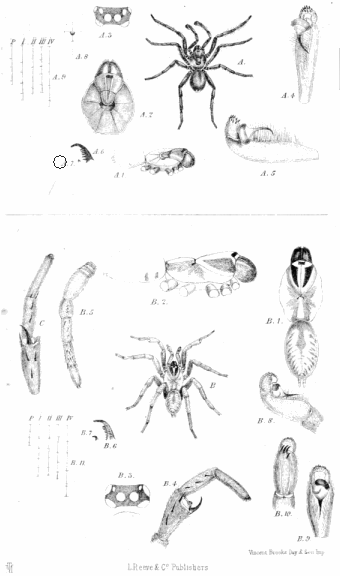
Cteniza Moggridgii, sp. n., Plate XX, fig. A, p. 254.
Cteniza fodiens (Camb.)? ♀ in Harvesting Ants and Trap-door Spiders, J. T. Moggridge, 1873, p. 89, Plate VII., excluding synonyms there quoted.
Adult male length 51/2 lines, length of cephalothorax 3 lines, breadth 21/2.
The cephalothorax is of a short, broad-oval form, its length being only half a line greater than its breadth; it is flattened-convex above, and depressed near the margins, the caput (when looked at in profile) scarcely rising above the level of the thorax. At the junction of the caput and thoracic segments is a deep, circularly-curved indentation, or fovea, the curve of which is directed backwards; the extremities of this indentation are continued obliquely forwards on either side, forming the normal ones which indicate the junction of the caput and thorax. Rather more than one-third of the distance between the above curved indentation and the fore margin of the caput is a very perceptible and deep but narrow, slightly curved, transverse indentation which divides the caput into two distinct parts; the curve of this indentation is directed forwards. The normal thoracic indentations are well marked, but not very strong; the surface of the thorax, though shining, appeared under a lens to be covered with fine rugulosities. Its colour is yellow-brown; a large triangular patch on either side of the caput being tinged with orange, and the rest suffused with dark brown. The caput is of a dark reddish yellow-brown, showing (in spirit of wine) two longitudinal bars, or strong lines, of a clearer orange yellow-brown colour; its surface is glossy, though, under a lens, the sides of the fore part are very finely striated or rugulose. These lines begin behind the extremities of the hinder row of eyes, and gradually converge to a point at the thoracic junction; the ocular region and central longitudinal line of the fore-segment of the caput have some long and very prominent black bristles. When alive, the cephalothorax appears to have been suffused with a purplish hue, corresponding to that of the abdomen and other parts.
Plate XX.
The eyes form a rectangular figure, whose fore side is a little shorter than the hinder one, and whose transverse, or longest, diameter is as nearly as possible double the length of its shortest one; the eyes of the central or fore-central pair are small, and separated by a diameter's distance from each other. The hind laterals are the smallest of the eight, and each is almost contiguous to the hind-central nearest to it, this latter being of a sub-triangular form, and separated from the fore-central on its side by an interval equal to that which divides the two fore-centrals, but less than that which separates each fore-central from the fore-lateral on its side. Looked at as in two transverse rows of four each, those of the foremost row are darkish coloured, while those of the hinder row are pearly white. Omitting the eyes of the hind-central pair, the remaining three on either side form as nearly as possible an equilateral triangle.
The legs are long, moderately strong, their relative length being 4, 1, 2, 3. They are of a dark brown colour, generally paler on the under sides, furnished with hairs, fine bristles, and spines; the latter are numerous and strong beneath the metatarsi and tibiæ of the first and second pairs; on those of the third pair they are less strong and more uniformly disposed; on those of the fourth pair they are fewest and least conspicuous. The genual joints of the third pair have some strongish spines on the outer side; the right leg has eight, the left nine. The toothing of the superior tarsal claws does not appear to be uniform on the different legs of the same example; on those of the fourth pair there were five teeth; on those of the first pair eight or nine, with two others, quite rudimentary, towards the point of the claw; and even on one of the fourth pair of legs one of the claws had six, the other five teeth. The tarsal claws of the second pair are toothed throughout nearly their whole length with from eight to ten teeth; on one of the third pair the teeth were but five or six, while on the other there were on one claw but three ordinary teeth and a much stronger one a little way off in front of them, on the second claw only a single strong tooth about the middle, and a smaller one close to its base.
The palpi are long and rather slender, measuring rather over six lines in length; they are similar in colour to the legs, and excepting a few—from twelve to fourteen—short strong spines on the upper side of the extremity of the digital joint, furnished with hairs only. The cubital joint is more than half the length of the radial; this latter is equal in length to the humeral joint, and nearly as long as the femora of the first pair of legs. The digital joint is short, of an oblong oval form, broadest at its extremity. The palpal organs consist of a nearly spherical corneous lobe, prolonged at its fore extremity into a long, slender, tapering, beak-like spine, curving upwards (i.e., with its point near to the radial joint), and inwards.
A broad, conspicuous, shining, corneous band, of a deeper red-brown than the rest, runs round the middle (or equatorial line) of the spherical portion of these organs, covering the greater part of their surface.
The falces are of moderate length and strength, and of ordinary form. They are similar in colour to the legs, and furnished in front, chiefly on their inner edges, with hairs, and at their extremities on the inner sides, with a few, but not very strong nor conspicuous, short spines; their under side (along which the fang lies) is toothed on the inner edge only; the fang is strong and curved, but presents nothing remarkable in form, nor could I detect either denticulation or serration.
The maxillæ are strong, straight, divergent, with a small prominent point at the inner extremity of each; they are as strong, but not so long, as the basal (coxal) joints of the legs of the first pair, of a yellow-brown colour, furnished with hairs, but with no spines of any sort or size.
The labium is similar in colour to the maxillæ, and somewhat quadrate in shape, rounded at the apex; it is furnished with hairs only.
The sternum is of a sub-pentagonal form, much broader behind than in front; its colour is dull yellowish-brown, and it is furnished with hairs, leaving two largish, bare, round, slightly impressed patches, not far from each other, in a transverse line near the middle.
The abdomen is short-oval in form, and very convex above; it projects a little over the base of the cephalothorax, and its upper side is of a purplish grey-brown hue, mottled with a pale dull whitish-yellow, and furnished sparingly with hairs. The sides and under side are of a uniform dull whitish-yellow. The spinners (four in number) are, as usual, of very unequal size, those of the superior pair longish, strong, three-jointed, and up-turned, the inferior pair short but stout, consisting of one joint only and pretty close together.
The female (as it is conjectured to be) of this species was described, in the work to which the present publication is supplementary, from examples found at Mentone. There is little doubt now but that it is not Ct. fodiens, Walck., but whether or not identical with the male above described is not absolutely certain. I think myself (with Mr. Moggridge, see p. 195) that it is so, in spite of some differences in the relative size of the eyes, the toothing of the under side of the falces, and the denticulation of the tarsal claws. With regard to the eyes and falces, I am not inclined to lay special stress upon these differences. It is found that in other groups of spiders whose cephalothorax varies very markedly in development in the two sexes, differences of this nature occur. In the present genus, the male has an almost flat caput, while the female has a strongly elevated one; and with respect to the variation in the tarsal claws, no special weight can be attached to it in the present instance, since these claws are not uniformly denticulated in the different feet of the same individual. Another difference is the absence in the male of sundry small but distinct tooth-like spines at the apex of the labium and the inner corner of the base of the maxillæ; the female is also wanting in regard to the very characteristic transverse indentation which divides the caput of the male into two parts. I can, however, trace in the female the slightest possible corresponding depression, scarcely amounting to an indentation, and placed rather nearer to the junctional thoracic pit.
With regard to the differences between this species and Ct. Sauvagii, Latr. (Ct. fodiens, Walck.), size alone would suffice to distinguish them; two females of the latter now before me measuring 13 lines in length; while the male (Aran. nouv. ou peu connus du Midi de l'Europe, par Eugène Simon, Mém., Liège, 1873) measures 8 lines (17 mm.) and the female rather over 14 lines (30 mm.), the fore-central eyes in the female of Ct. Sauvagii appeared to be smaller than those in Ct. Moggridgii and placed rather farther forwards, but the eyes in both are otherwise remarkably similar both in size and position. The males, however, cannot be confounded inasmuch as, according to M. Simon, no trace of any transverse indentation on the caput exists in Ct. Sauvagii.
The denticulation of the tarsal claws in the females of both species is similar, but M. Simon does not mention this portion of the structure of the male he describes of Ct. Sauvagii.
The adult male of Ct. Moggridgii above described, was found behind the stones of an old wall at Mentone, but not in any kind of nest.
Nest-making, and excavating for that purpose, is, probably, no part of the work of the adult males in this and other allied genera, and hence we can see a reason for differences in the development of the caput, and the denticulation of the falces. The usual habitat of the females and their nests is in damp and shady spots, whereas Ct. Sauvagii constructs its nests in dry exposed banks.
Habitat. Mentone and San Remo.
Cteniza Californica, sp. n., Plate XV, fig. B, p. 198.
Adult female; length very nearly 14 lines; length of the cephalothorax, 51/2; greatest breadth of ditto, 5; breadth of fore part of caput, 4 lines; length of caput rather over 3 lines.
The cephalothorax of this spider is rather broader in proportion to its length than that of Ct. Sauvagii, Walck., Sim. = Ct. fodiens, Walck. The convexity, or elevation, of the caput is also less, but that of the thorax is greater, so that (when looked at in profile) the profile line of the two forms a tolerably even and continuous slope, interrupted only by the thoracic fovea; the profile, however, of the occiput is curved.
The thoracic fovea, or junctional indentation, is strong, deep, and semilunar in form, the horns of the crescent pointing forwards; the other normal indentations are well marked, but those which divide the caput from the first thoracic segment do not unite with the extremities of the junctional fovea, being in this respect unlike Ct. Moggridgii, but more like Ct. Sauvagii. The clypeus, although transversely impressed, yet slopes forward more gradually than in either of those species, its breadth is about equal to that of the ocular area, or amounts to half that of the facial space. The colour of the cephalothorax, taken from the specimen preserved in spirit of wine, is a deep reddish-yellow brown, gradually getting paler towards the margins. When alive, I understand that the general colour of the whole spider was a dark blackish chocolate brown, the legs and cephalothorax being darker than the abdomen; there are a few prominent bristly hairs in the medial line both before and behind the ocular area.
The eyes form a narrow transverse oblong figure, its length being about two and a half times its width, and its fore side is a little the shortest; the fore-lateral eyes are large and oval, and by far the largest of the eight; the rest do not differ much in size, though perhaps the hind laterals, which are also oval, are a little the largest; the longest diameter of these, however, is less than half the longest diameter of the fore laterals. The interval between the fore and hind laterals is small, only equal to the shortest diameter of the hind lateral; and this interval is nearly double that which separates each hind lateral and the hind central nearest to it. The hind laterals and hind centrals form an almost perfectly straight line, the former being very slightly indeed within the straight line of the former; the intervals which separate the fore centrals from each other, and each of them from the fore lateral on its side, are as nearly as possible equal, though very slightly, if at all, less than that which separates each of them from the hind central on its side: the interval which separates the fore laterals is double the length of the longest diameter of one of them.
The legs are short and very strong; they are like the cephalothorax in colour, but paler underneath the femora; this joint in the third pair is proportionally much stronger than in the other legs; all are furnished with hairs, bristles, and spines, a group of erect bristles among the rest occupies the fore part of the upper side of the metatarsi of the first and second pairs; strong spines of different lengths are thickly placed beneath and on the lower part of the sides of the tibiæ tarsi and metatarsi of the first and second pairs. On the tarsi and metatarsi of the third and fourth pairs similar spines are distributed more uniformly over the whole surface of the joints, and on the genual joint of the 3rd pair there is one short strong spine near its extremity on the outer side, those on the tibiæ both of the third and fourth pairs being confined to a few on the outer side, and towards the lower side only. Each tarsus terminates with three claws, of which the two superior ones have a single strong tooth towards the base on the lower side.
The palpi are rather long, strong, and similar in colour to the legs. They are furnished with hairs, bristles, and spines; of the latter the radial and digital joints have some short and strong ones, pretty thickly grouped along both their outer and inner sides; the digital joint ends with a single untoothed claw.
The falces are strong and massive, more so than in Ct. Sauvagii, but of normal form. They are furnished with hairs and bristles, and with strong spines near their inner extremities on the upper side; the fangs are strong, folded along the under side of the falces in a furrow which is toothed along either edge. The colour of the falces is a rich deep red-brown.
The maxillæ are strong, straight, divergent, with a prominent point at the inner extremity, and some very short, strong, tooth-like spines at their base; their colour is dull yellow-brown, and, with the labium and sternum, they are thickly clothed with short strong hairs.
The labium is dark yellow-brown, tipped slightly with black; it is of a somewhat semilunar form, and has a few very short tooth-like spines near its apex.
The sternum is of a rough oval form, broadest behind and shorter and broader in proportion than that of Ct. Sauvagii and Ct. Moggridgii; its colour is dull yellow-brown, and it is destitute of the two shining bare patches conspicuous in both those species.
The abdomen is large, short-oval, broadest behind and very convex above; it is of a dull yellowish-brown colour, thickly mottled with minute dark points seen through a lens to be little rings, from the centre of each of which springs a bristly hair; the underside is paler; the spinners and spiracular openings are normal. As observed above, the colour of the abdomen was rather different in life; it was then of a deep blackish chocolate brown, with an indistinct longitudinal line along the middle of its fore part on the upper side, intersected by a similar line at right angles; but these lines soon disappeared after death; the specimen had been in spirit of wine some months before the present description was made.
A single example, with its tubular nest of the cork-lid type, was received alive from California in 1873, and appears to have been hitherto undescribed; though no larger than Ct. Sauvagii, it is yet a stouter and more massive spider, and may readily be distinguished by the large size of its fore-lateral eyes, the narrower ocular area arising from the far greater proximity to each other of the eyes of each lateral pair, the less convexity of the caput, and the greater convexity of the thorax, as well as by its being altogether a darker coloured spider, and having shorter stouter legs.
Habitat. Visalia, 350 miles south of San Francisco, California.
Gen. Nemesia, Savigny.
Nemesia Cæmentaria, Plate XIX, fig. B, p. 229.
Mygale cæmentaria (Latr.) Hist. Nat. des Crust. t. vii. p. 164.
—♀—Walck., Hist. Nat. des Ins. Apt. 1, p. 235.
---- —— Cuvier's Règne Animal, ed. Paris. 20 vols. 18—? Pl I., A. Dugès del. ♂ et ♀.
Adult female, length 7 to 9 lines.
Cephalothorax oval, truncated and almost equally broad at each end; the upper surface is moderately convex, the caput elevated a little above the rest, and equally rounded on the sides and upper part; the profile of the whole cephalothorax forms a general sloping slightly curved line, broken by the thoracic junctional pit or fovea, which is narrow but strong, and gently but equally curved, the convexity of the curve directed forwards; the thorax next to this fovea is rather gibbous, but not over any great extent of surface; the other normal indentations are tolerably strong; the colour of the cephalothorax is yellow-brown, darkest on the sides of the caput, and along the thoracic indentations, palest on the margins, forming a pale marginal border indistinctly vandyked on the inner edge. The surface is clothed, but not densely, with yellowish-grey adpressed hairs; there are a few black bristles in a straight transverse line, directed forwards from the lower margin of the clypeus; also a few more bristles curved and of various lengths before and behind the ocular area, their points meeting over this area, and a row of strong, nearly erect ones in a longitudinal central line from the ocular area to the junctional fovea; besides these are a few more, finer and less conspicuous, along the middle both of the caput and thorax; the colour on either side and in front of the ocular area is orange yellow-brown, and joining with this a broad band of the same runs backwards from the ocular area to the thoracic fovea. The band begins as wide as this area, it then directly enlarges a little, and thence tapers slightly and gradually to its termination, forming a truncate wedge, with the margins rather irregular, but on the whole a little curved. This band is not immaculate, there being two dark yellow-brown tapering lines or bars along the greater part of its length; these bars begin from each outer pair of eyes of the hinder row, and tapering to a fine line, converge to the thoracic fovea, but do not quite meet. It is important to note the exact form and distribution of the central band and these tapering bars, as their differences from the character of the similar part in another closely allied species are strongly specific; the above description holds good in above twenty examples before me.
The eyes are in two transverse lines, forming an area whose length is rather less than 21/2 times its width; the foremost line is curved, and the curve directed backwards, the hinder one is also curved and in a similar direction, but less strongly, looking laterally the extreme margin of the four eyes of the hinder row forms a straight line. Considered as in pairs, those of the fore-central pair are separated by an interval equal to that which separates each from the fore-lateral and hind-central nearest to it; the fore-laterals are divided by about two and a half diameters; they are the largest of the eight, only slightly however, in some examples, larger than the hind-laterals. Each of them is separated from the hind-lateral on its side by not quite half the diameter of the latter, and each hind-lateral is very nearly but not quite contiguous to the hind-central on its side; the hind-centrals are roughly rounded, smallest of the eight, though in some examples equal in size to the fore-centrals, and are separated from the fore-central nearest to it by about one diameter, which gives a clue to the absolute distance between the eyes of the foremost pair. The four lateral eyes are oval, the fore-centrals round; those of the foremost row are darkish coloured, while those of the hinder row are pearly white.
Although it is of great importance to observe as accurately as possible the relative position and size of the eyes, yet we must be prepared to find exceptions to the rule derived from the most exact measurements in any individual instance.
In the present species the above conclusions, as to position and size, are drawn from a consideration and comparison of 20 examples, and are, it is believed, pretty true, but yet in one example, one of the hind central eyes was but half the size of the other, and in another example one of the same eyes was but one-fourth of that of the other, a mere dot in fact, and the relative size of the respective lateral eyes of the two rows do not appear to maintain exactly the same proportions in all individuals. The height of the clypeus appeared to be as nearly as possible half that of the facial space.
The legs are strong, moderately long, their relative length 4, 1, 2, 3, though in some examples those of the second and third pairs are equal in length; in others, those of the third pair are slightly longer than those of the second; here again, as with the eyes, although the relative proportion of the legs of spiders is an important specific point, and in general tolerably reliable, yet accurate observation and measurements prove that there are small differences in individual instances. The legs are yellow-brown in colour, furnished with hairs, bristles, and a few spines. The outer sides of the genual joints of the third pair are destitute of spines; in two instances only out of 20, this joint had a single, not very conspicuous, spine. The superior tarsal claws have 4-5 minute pectinations underneath near their base.
The palpi are moderately long and strong, and similar in colour and general armature to the legs; they terminate with a single, strong, sharply curved untoothed claw.
The falces are of a deep black red-brown colour, strong and prominent, and flat, but not cut away, on their inner sides; they are furnished on their upper sides with black bristles and yellowish-grey hairs, disposed in longitudinal lines; these bristles are strongest and most numerous on the inner margin of the upper side, increasing in strength forwards where, near the extremity, are some strong spines.
On the inner edge of the under side of each falx is a row of teeth, and each fang is also denticulate or finely serrate, beneath towards its hinder part.
The maxillæ are strong, cylindrical, and divergent; and each has a small bluntish angular prominence at the extremity on the inner side; their inner margin has a thick fringe of pale reddish hairs, the fore surface being clothed (as ordinarily) with dark bristly hairs, and there are a few black minute tooth-like spines in a line (sometimes in a small group) near the inner corner of their base.
The labium is short, broad, its breadth nearly double its length, and the upper corners rather rounded off; there are some strongish bristles, mostly towards the apex, but no tooth-like spines nor denticulations.
The sternum is oval, rather convex, broadest towards the hinder part, which is pointed at this extremity but hollow-truncate before.
The abdomen is sparingly clothed with hairs; it is of a stoutish regular oval form, and of a dull brownish yellow colour; its fore extremity on the upper side is thickly blotched with deep blackish-brown, and the whole length spanned by a series of about five curved, or slightly angular, stoutish bars or chevrons, formed of more or less confluent, dark, blackish-brown blotches and markings; a more or less indistinct line of a similar nature also divides the fore part of the upper side of the abdomen longitudinally. There is some variety in the extent, depth, and distinctness of these markings, but the figures given (Pl. XIX, p. 229, figs. B, B 1) show the appearance of an average example.
It must be remembered that this description is made from examples in spirit of wine, and that in life the markings (especially on the cephalothorax) are often considerably obscured by the hairs on the surface; when seen through spirit the actual tints of colour are sometimes misrepresented, but the characteristic markings are seen more distinctly.
The lower part of the sides and the underside of the abdomen are of a uniform pale dull brownish-yellow; the spinners of the superior pair are short, strong, and 2-jointed; those of the inferior pair are very minute, and near together at the base of, and almost between, the others.
Adult and immature females were found in 1873-4 abundantly at Montpellier in France, in unbranched tubular nests closed at the surface with a close-fitting "cork" lid.
In Harvesting Ants and Trap-door Spiders, p. 92, a spider inhabiting similar nests, and found commonly at Cannes and Mentone was described as N. cæmentaria, Latr. The subsequent discovery however of a very closely allied, but certainly distinct, species in abundance at Montpellier (the locality in which the original N. cæmentaria, Latr., was found) makes it more than probable that the Montpellier, and not the Mentone, species is the true N. cæmentaria. Certainly as yet no other species more likely than this to be the one described by Latreille has been found at Montpellier; in fact, the one here described is the common one found there, and alone answers to Latreille's character of having a nest with a lid of the cork type.
It has become therefore necessary now to record the Mentone species under another name, and under that name, "N. Moggridgii" (p. 273) will be noted the specific differences by which the two species may be at once distinguished from each other.
The male of the spider here described has not been yet found. A description is given (p. 276) of a male spider, Nemesia incerta (no doubt closely allied), found by M. Eugène Simon at Digne; but reasons will be given why it is not probable that this Digne spider should be, as conjectured by M. Simon, the male of the Montpellier species. Whether the N. carminans (Latr.) is the male of N. cæmentaria (Latr.) or not, is another question, and one surrounded with some obscurity and difficulty. Latreille described N. cæmentaria (female) from Montpellier, and N. carminans (male) from Aix in Provence; the latter being specially characterized by a bifid point to the prolongation of the palpal bulb; L. Dufour appears subsequently to have considered N. carminans, Latr. (male) to be the male of N. cæmentaria, and Latreille appears to have agreed with L. Dufour upon this, vide Walck. Ins. Apt., i. p. 236; but Dufour afterwards (Ann. Gen. Sc. Phys., tom. v. Bruxelles, 1820, p. 103) introduced an element of confusion into the question by describing N. carminans as having the point of the palpal organs simple, "nullement bifid," and throwing out a suggestion that it might be the male of N. Sauvagii, Latr., (= N. pionnière or fodiens, Walck.) Latreille upon this (Vues générales sur les Aranéides, Acad. Roy. des Sc., 1830, pp. 64, 65) explains Dufour's suggestion as an inadvertence, but takes no notice of the difference of the form of the palpal organs as described by him; at the same time however Latreille explains why, probably, Walckenaer "still considers (in his Faune française) N. carminans to be a distinct species." We may conclude from this that Latreille never altered his opinion that his own N. cæmentaria and N. carminans were the two sexes of the same species; and we shall probably rightly agree with Walckenaer that Dufour had another species before him, which he wrongly (l.c.) described as N. carminans.
Subsequently again a male and female spider, evidently of one species, were figured by Dugès to illustrate N. cæmentaria male and female in Cuvier's Règne Animal—Edition in 20 vols. not numbered and without date, published in Paris, "accompagnée de Planches par une réunion de disciples de Cuvier, MM. Audouin, Blanchard, Deshayes, Aleide d'Orbigny, Doyère, Dugès, Duvernoy, Laurillard, Milne Edwards, Roulin, et Valenciennes." Of these figures, that of the male has the point of the palpal organs distinctly bifid, and the nest figured is of the cork-lid type.
On the whole it may be concluded that the male of the true N. cæmentaria, Latr., will be found to have the bifid point to the palpal organs, but the question cannot be considered settled until further researches at Montpellier and Aix (in Provence) shall have furnished males of the N. cæmentaria now described, and females of the bifid pointed male—N. carminans, Latr.—for of course it is possible that Latreille's first views of the distinctness of cæmentaria and carminans may be the correct ones.
The characters of the species now described accord so well with the figures of the female in Dugès' plate (above mentioned) that little doubt can be entertained of their identity, and if so there would seem to be little doubt also, but that further research at Montpellier will reveal a male similar to the male figured by Dugès.
Habitat. Montpellier, France.
Nemesia Eleanora.
Syn. Nemesia Eleanora, Cambr., male and female, in Harvesting Ants and Trap-door Spiders, by J. T. Moggridge, p. 180, Pl. XII and woodcuts, p. 109.
Nemesia Alpigrada (Simon) male, Aranéides nouv. ou peu connus du Midi de l'Europe, 2e Mémoire. Liège, 1873, 2e sér. t. v. p. 27 (separate copy.).
There is but little to add to the descriptions given (l.c. supra). It must however be noted that the spines on the outer side of the genual joints of the third pair of legs, then supposed to be a characteristic of the present species only, are now found to exist in several others, with some small exceptions in regard to number, and also in respect to strict uniformity, on both legs of the same individual. In N. cæmentaria (p. 264), however, there is rarely found even a single spine on either of these joints; and not one out of ten examples of another species, N. Simoni (p. 297), had even one of these spines.
Shortly after the publication of Harvesting Ants and Trap-door Spiders the male of this species was described by M. Simon (l.c.) from two examples taken at Vaucluse near Avignon.
Habitats. San Remo, Mentone, Cannes, Vaucluse near Avignon, and, according to M. Simon, Digne, Basses Alpes.
Nemesia Moggridgii, sp. n., Plate XIX, fig. C, p. 229.
Syn. Nemesia Cæmentaria, Cambr., in Harvesting Ants and Trap-door Spiders, (by J. T. Moggridge), p. 93, Pl. VIII
This spider is exceedingly closely allied to the foregoing and was thought to be the true N. cæmentaria, Latr., until subsequent researches at Montpellier (the locality where Latreille's types were found) have resulted in the belief that the Montpellier, rather than the Mentone species, is that described by him. At present the females only of the two species are known, and these may readily be distinguished by the pattern on the caput.
In the foregoing (the Montpellier Spider) a broad orange yellow-brown band runs from the ocular area to the thoracic fovea, tapering gradually to that part, where it is truncated, forming a wedge with the point cut off. This wedge-shaped band is charged with two longitudinal, more or less distinct, dark brown irregularly-tapering lines, running throughout its whole length and converging towards each other but not touching.
In the Mentone Spider there are three orange-yellow-brown well-defined bars or longitudinal lines between the ocular area and the thoracic fovea; the central bar tapers and reaches from the eyes to the fovea, the lateral ones never more than two-thirds of the distance from it to the eyes, diverging a little from the central bar as they run forwards. These two lateral bars are not straight, i.e., their margins are more or less notched or roughly angular, forming in some examples a line of a somewhat zigzag or bent character. It may perhaps be observed that when the two dark brown lines which run along the broad orange-yellow-brown band on the caput of the Montpellier spider, are well marked, this also leaves three longitudinal yellow lines, somewhat similar to those just described in the Mentone species, but there is this difference even then (and it is constant throughout a long series of examples), the lateral lines in the Montpellier spider always run through to the eyes, equalling in length the central line, while in the Mentone spider the lateral bars never reach the eyes, always stopping short of the ocular area, by one-half, or nearly so, of their length.
Another distinction which appears constant is the form of the thoracic fovea; in the Montpellier species this forms a slight but uniform curve; in the Mentone spider it is more sharply bent at the apex (or centre of the curve), forming in most examples a bluntish-angular line.
In the eyes there appears to be but little reliable difference; if there be any at all constant, it seems to be that in the present (Mentone) species the fore-laterals are constantly smaller than the hind-laterals, and sometimes smaller than the fore-centrals. A close examination, however, of the relative size and position of the eyes in a series of examples, lowers one's estimation of the absolute value of this character in the determination of the species of Nemesia; still it is a specific character not by any means to be overlooked, though to be used guardedly, and often with great reservation.
In regard to other characters and general description there seems but little to add to the description given (l.c. supra), except that the labium has no denticulations at its apex and the outer sides of the genual joints of the third pair of legs are generally without spines. Occasionally (in one example out of sixteen) there is a single spine on this joint, of either the right or left leg. In this character, however (differing from several others described below), the Montpellier spider agrees with that from Mentone.
In both spiders, the fangs of the falces are (in some instances at least) denticulated. Also in regard to the relative lengths of the legs, like those of the Montpellier spider, the second and third pairs of the Mentone species are not constant in their relative proportions, though the differences either way are very slight, and there is often no difference whatever.
The nest and habits of the two species appear to be nearly, if not quite, similar.
In naming the present species (at the suggestion of M. Eugène Simon) the writer of these descriptions gladly testifies to his appreciation of the great value attaching to Mr. Traherne Moggridge's investigations of the habits of the closely-allied species of this very difficult, though most interesting group of spiders.
M. Eugène Simon (Ann. Soc. Ent. Fr. 1873, Bull, c.), perceiving the difference between the present species and the one known to himself as N. cæmentaria, Latr., concludes it to be identical with N. meridionalis, Sim. Examples, however, of this latter, from M. Simon's cabinet, show that they are very distinct.
On N. meridionalis, Sim., see p. 289; and on N. cæmentaria, Sim., p. 280, M. Simon has, I understand, subsequently admitted the error of his conclusion, published l.c. supra.
Habitat. San Remo, Mentone, Cannes, Hyères, and Marseilles.
Nemesia incerta, sp. n., Plate XIX, fig. D, p. 229.
Adult male, length slightly above 41/2 lines.
Cephalothorax oval, truncate at each end; moderately convex above, the profile line forming a pretty even, sloping, curved line, but flattish in the middle near the thoracic fovea, which is of a strongly curved form; the other normal indentations are not strong, though fairly defined; the colour of the cephalothorax is yellow-brown, palish and clothed with yellowish-grey adpressed hairs on the margins, and inclining to orange on the caput. The clypeus is somewhat steep, about equal to half the height of the facial space, and the sides of the caput are dark blackish-brown, leaving a longitudinal, central reddish orange-brown band tapering to the thoracic fovea.
The upper and hinder part of the thorax is strongly suffused with brown, leaving broad but irregular pale lateral margins; there is a group of strong bristles directed forwards from the margin of the clypeus, and two or three more in the median line behind the ocular area.
The eyes are on a strongish oblong dark brown transverse tubercular eminence; the fore-laterals are rather smaller than the hind-laterals, and the fore-centrals are larger than the hind-centrals, the latter being much the smallest of the eight; the interval between those of each lateral pair is about equal to, or slightly larger than, the diameter of one of the fore-central eyes; the intervals between the four eyes of the front row are equal, each interval being equal to the diameter of one of the fore-centrals; and each hind-central eye is separated from the fore-central nearest to it by as nearly as possible a similar distance, and from the hind-lateral on its side by a very small but distinct interval.
The legs are rather long, strong, of a brownish-yellow colour, suffused with blackish-brown on the upper sides of the femora, and furnished with hairs, bristles, and spines. Those of the hinder (fourth) pair were wanting, the relative lengths of the others being 1, 2, 3; 2 and 3 being very nearly equal. The spines are not numerous, being disposed mostly on the tibiæ and metatarsi of the third pair; some, however, had been evidently broken off; all the tarsi were without spines; each tarsus ends with three claws, the superior pair with several—6-8?—teeth on their under sides.
The tibial joint of each of the first pair is short, no longer than the genual joint, but it is strong and enlarged gradually beneath to its fore extremity, where it ends in a strong, sharp-pointed, tapering red-brown curved spine, directed downwards, forwards, and inwards. Each tarsus of the first and second pairs is pretty thickly fringed just below on each side along its whole length, with short strongish hairs of an even length.
On the outer side of the genual joint of the third pair (left leg) are three spines in a longitudinal row; the other leg of this pair was wanting.
The palpi are moderately long, and similar in colour and general armature to the legs; the radial joint is strong, a little tapering forwards, and somewhat curved underneath towards its hinder part; its length is about double that of the digital joint, and from its fore extremity on the upper side, three strong, somewhat sessile, spines of equal length, and directed forwards issue, in a straight transverse line.
The palpal organs consist of a roundish corneous bulb drawn out into a longish, tapering, curved, sharp-pointed spine, the point being very fine, gradual, and directed outwards.
The falces are strong, prominent, of a deep red-brown colour, furnished above with dull greyish-yellow hairs mixed with dark bristles, and disposed in longitudinal stripes; and near the upper extremity on the inner side are four strongish spines.
The maxillæ are strong, divergent, cylindrical, with a small angular prominence at their inner extremity; they are furnished with hairs, but no denticulations, and there is a strong fringe of reddish hairs on their inner margins. The maxillæ are of the same colour as the palpi.
The labium is short and broad; its breadth double its height and its apex rounded. Its junction with the sternum appeared to be about at right angles. It is darker in colour than the maxillæ, but with a paler apex; its surface is furnished with bristly hairs, but there are no denticulations at its apex. Sternum oval, truncate before, pointed behind, furnished with bristly hairs, and of the same colour as the legs.
The abdomen is of an oblong-oval form, truncate before, and tolerably convex above; it is of a pale dull yellowish colour clothed with yellow-grey hairs, among which are a good many prominent dark bristly ones; the fore part of the upper side is irregularly marked with black-brown; following this towards the hinder part, and reaching half way or more to the spinners, is an indistinct longitudinal central line of the same colour, throwing off numerous short lateral lines at right angles; towards either side of the hinder two-thirds of the abdomen are several oblique black-brown lines extending more or less over the sides; one, about the middle, extends farther over the sides than the rest, and almost unites with a curved deep black-brown transverse line crossing the under side of the abdomen a little way in front of the spinners.
The under side of the abdomen is similar in colour to the upper side, and, besides the transverse dark line above mentioned, there is another touching the anterior margins of the posterior spiracular plates; the superior pair of spinners are short and strong; the inferior pair small, and in the ordinary position, but apparently not (proportionally) so small as in the females of some other species.
A single adult male was received for examination from M. Eugène Simon, by whom it was found at Digne (Basses Alpes, France). M. Simon conjectures that it may be the male of Nemesia Moggridgii (p. 273), but some slight differences in the size and positions of the eyes, and in the pattern on the cephalothorax, and on the under, as well as the upper, side of the abdomen, lead me to believe that it is of a different, and hitherto undescribed species, though probably very closely allied to some others, especially to Nemesia Manderstjernæ (N. meridionalis, Cambr., described, p. 283); in the present species however the hind-lateral eyes are much larger in proportion than in N. Manderstjernæ.
Habitat. Digne, Basses Alpes, France.
Nemesia dubia, sp. n., Plate XIX, fig. E, p. 229.
Syn. Nemesia cæmentaria, Simon, Aranéides nouv. ou peu connus du Midi de l'Europe, Mém. Liège, 1873 (separate copy), p. 24.
Adult male, length 51/2 lines to 6 lines.
M. Eugène Simon (l.c.) describes, as N. cæmentaria, Latr., both sexes of a spider found by himself in the Pyrenees and Spanish mountain regions.
Languedoc and Provence are also given as localities, but it is not clear that he has himself found it in these latter parts, certainly not the male.
Two examples of this sex, found in the Pyrenees, and received from M. Simon, are now before me; these correspond, so far, very exactly to the description he gives (l.c.); the female I have not seen.
If the position assumed (p. 271) on Latreille's own authority, that the true male of N. cæmentaria, Latr., (N. carminans, Latr.), has a bifid point to the prolongation of the palpal bulb, it is clear that the present species is distinct from that of Latreille.
M. Simon describes this palpal bulb as having its extreme point "simple et plus effilée" (i.e. more slender than in the preceding species he has described N. meridionalis). That the examples now before me, agreeing exactly with this description, are not the males of the species above described by myself as N. cæmentaria, Latr., from numerous females found at Montpellier, appears to me clear, not only because I assume that of the true N. cæmentaria, Latr., males will be found to have the point of the palpal bulb bifid, but because the position of the eyes is markedly different in M. Simon's Pyrenean males and the Montpellier females. In the latter the eyes of the front row are separated from each other by equal intervals, in the former the interval between those of the central pair is very perceptibly greater than that between each and the lateral of the same row nearest to it. The interval also between each of the fore-central eyes and the hind-central on its side is proportionally much less.
It appears therefore necessary to characterize N. cæmentaria (Sim. l.c.) by some other name, for if eventually it should be found that Latreille has erred in N. carminans (with the bifid point to the palpal bulb) being the male of his N. cæmentaria, and that the Montpellier species has a male with a simple point to this part, even then the present spider cannot retain its name (cæmentaria), being distinct from the females found at Montpellier.
It is possible, of course, that the present species may hereafter be found, perhaps abundantly, at Montpellier; in that case it will have to be decided which of the two is most likely to be the species described by Latreille. In that eventuality it seems to me that the spider, above described from Montpellier, would be more probably Latreille's species, for one of its specific characters is a tolerably distinct and bold series of, not more than, five dark angular bars along the middle of the upper side of the abdomen, agreeing exactly with Dugès' figures in the Règne Animal of Cuvier, quoted above (p. 271); while in M. Simon's Pyrenean spider, the abdominal pattern of the female described by him, does not agree with this: "il est orné d'une fine ligne noire longitudinale, un peu ondulée, présentant de nombreuses ramifications, s'étendant sur les parties latérales" (l.c. p. 26). The males before me accord with this description, though (as M. Simon also remarks) the "série de fins accents bruns transverses" is "peu visibles et souvent effacés" (l.c., p. 25); in one example this pattern is fairly distinct, in the other it is scarcely recognisable.
The present is a larger spider than N. incerta (the male found by M. Simon at Digne); it is also less distinctly marked both on the cephalothorax and abdomen. The position of the eyes is different, and so also is the palpal bulb; in that species the spine describes a simple curve with a strong outward direction; in the present it is slightly but perceptibly sinuous, and its general direction is parallel to the radial joint of the palpus; the spines also at the upper fore extremity of the radial joint are 5-6 in number instead of three. The outer side of the genual joint of each of the legs of the third pair has three spines; that on the left side, however, of one example, has four. The palpal bulb also appears to be proportionally smaller than that of N. dubia, or of N. Manderstjernæ, Auss. (N. meridionalis, Cambr.)
Another difference may here be noted between the present species and the Montpellier cæmentaria. M. Simon (in lit.) separates his N. cæmentaria from all others by the length of the patella and tibia (genual and tibial joints) of the fourth pair of legs, exceeding in length that of the cephalothorax and falces.
This character has not been found to exist in several females of the Montpellier species, minutely measured by Mr. Moggridge; in them the length of the cephalothorax and falces were found to exceed that of the genual and tibial joints of the fourth pair of legs, by from 11/2 to 2 mm.
In regard to the relative length of the legs of the present species this was 4, 1, 2, 3 in the one example examined, and 4, 1, 2-3 in the other, both being males.
It is a matter of regret that nothing, as yet, has been accurately observed in regard to the particular type or form of the nest of N. dubia.
Habitat. Pyrenees and Spanish mountain regions.
Nemesia Manderstjernæ, Plate XX, fig. B, C, p. 254.
Syn. Nemesia Manderstjernæ, Auss. ♂, Beitr. zur Kenntn. der Arachn. Fam. der Territelariæ, p. 54.
Nemesia meridionalis, Cambr. (female), Harvesting Ants and Trap-door Spiders, by J. T. Moggridge, p. 101. Plates IX. X. XI.
Adult male, length 61/4 to 71/2 lines.
Since the publication of the description of N. meridionalis, Cambr. (♀ l.c. supra), I have had an opportunity of examining an adult example of each sex of a Nemesia, described about the same time by M. Eugène Simon as N. meridionalis, Costa, in Aranéides nouv. ou peu connus du Midi de l'Europe, p. 21 (separate copy). The species described by M. Simon was found by himself abundantly in Corsica. He also gives Italy and Provence as localities, but the former of these two is, I conclude, given as being Costa's locality for the spider described by this latter author in Fauna d. Regn. Napl. Arachn., p. 14; the other locality (Provence) would seem to have been doubtfully given. On careful examination of the Corsican examples (male and female), and on comparing them with the male and female of N. meridionalis, Cambr., as well as the description and figure given by Costa, I feel no doubt but that M. Simon is right in according to the Corsican species M. Costa's name—meridionalis. It agrees, I think, decidedly better, on the whole, with Costa's figure and description than the species to which (l.c.) I had allotted the specific name meridionalis conferred by that author. Nor had I any hesitation in accepting the determination made by M. Simon, in Bull. Ent. Soc. Fr., 1873, sér. v. tom. 3, c.; that my N. meridionalis ♀ is the female of N. Manderstjernæ, Auss., the more especially as since the publication of my description I have received from the same locality (Mentone) not only the male of the spider described by myself (l.c.), but also the type of M. Ausserer's description of N. Manderstjernæ (found at Nice), and believe these to be identical in species. There is, indeed, a difference in the, apparent, relative positions and colour of the eyes of the two spiders, but no more than may be well accounted for by the condition of M. Ausserer's type (most kindly lent to me for examination by its owner, Dr. Ludwig Koch); this example is much shrunken, having the appearance of having been allowed to get dry and then to have been again immersed in spirit. This would (I have frequently found it so in other spiders) cause even the hard integument of the cephalothorax to contract, and so cause the eyes to shrink up together into a closer group, as well as to sink down into the cuticle, making some of them appear smaller than they really are. Alternate drying and wetting again in spirit would also account for the yellowish brown colour of the eyes, whereas in the male of the Mentone spider the eyes of the hinder row are pearly grey, and of the front row dark grey. Beyond these differences I can find no distinction between them.
The male of the present species is very nearly allied to both N. incerta (p. 276) from the Pyrenees, and N. dubia (p. 280) from Digne, of both of which, as remarked (l.c.), the male sex alone is known to me; it is, however, larger than either, more richly coloured, and more distinctly marked. In all three species the elongated portion of the palpal bulb has a simple point, but in the present spider it is not drawn out so finely and gradually: some portion of its extremity being, though very fine yet really, cylindrical, and not tapering off into a hair-like termination; the general direction of the palpal bulb is parallel with the radial joint, but the point which is equally curved is directed outwards and a little downwards; the radial joint has four spines at the fore extremity on the upper side (in one of the examples there were however seven on the radial joint of the right palpus), and the genual joint of each leg of the third pair, in both examples from Mentone as well as in M. Ausserer's example from Nice, has three spines on its outer side. This character was not remarked upon in the description of N. meridionalis ♀ (Cambr. l.c.). It is not invariable in a long series of female examples; occasionally one is found with four spines on one of these genual joints, in others there is occasionally but one spine and sometimes (but rarely) none; perhaps in this case broken off? I am inclined to attach some importance as a specific character to the number, presence, or absence of these spines on the outer side of the genual joint of the third pair of legs; not that it is an invariable character, few, if any, specific characters are absolute and invariable, nor that it is of more importance than the armature of other portions of the different legs, but as being more easily observed and less liable to injury than the larger and more numerous spines on other parts. Equally useful in specific determination are the spines at the fore-extremity on the upper side of the radial joint of the palpus. This, however, applies only to the male, whereas the character derived from the spines on the genual joints of the third pair of legs applies to both sexes.
Another character by which the present species (♀) may be distinguished from N. dubia (N. cæmentaria, Sim.) is that the former is rather narrower at the fore-extremity of the caput, which is also less elevated, being almost equally level with the thorax.
The description of the female given (l.c. supra) needs but little addition. It may be noticed, however, that the central longitudinal tapering orange band on the caput is faintly continued to the extreme hinder margin of the thorax, and the thoracic fovea is rather sharply curved. The intervals between the eyes is the same as in those of N. Moggridgii, though their absolute size in some examples appeared to be smaller. In both sexes there are several small, black, tooth-like, tubercular spines on the inner side of the base of each maxilla, but none at the apex of the labium.
The colour of the cephalothorax in the male is bright-reddish orange-yellow; a large portion of the sides of the caput, and the ocular area also, is black-brown; the middle of the thorax is distinctly marked with black-brown lines radiating to the thoracic fovea.
Other, less deep, brown markings are mixed with these radiating lines; there are a few prominent bristles in front of the ocular area, a single longitudinal line of erect bristles along the middle of the orange band from the eyes to the thoracic fovea, and the whole cephalothorax is more or less clothed with greyish-yellow adpressed hairs.
The falces are of a deep blackish red-brown colour, longitudinally striped with yellow-greyish hairs mixed with dark bristles; and there are some strong spines at the fore extremity on the inner side.
The abdomen is oval, tolerably convex above, of a dull, pale, straw colour, suffused with brown at its fore extremity, whence an indistinct central longitudinal band tapers to a point rather more than half way to the spinners; on either side of this band are some oblique, lateral, brown lines, which become broken chevrons, between the termination of the central band and the spinners. The sides are obscurely and irregularly marked with brown, and the under side is of a uniform dull straw-yellow; the abdomen is clothed thickly with mixed yellow-grey and dark hairs; the upper side is furnished also with strong, nearly erect bristly black ones.
Each tarsus terminates with three claws; those of the superior pair are pectinated beneath, but the number of teeth appears to vary in the different legs, from six to eight. The tibial joint of the first pair is of the same character as that in the males of other species: it has a strong black curved spine directed inwards from the fore extremity of the under side, and a short bluntish-conical, but very distinct prominence at the same extremity on the inner side, not far from the base of the curved spine, Plate XX, fig. B 4 and C; the colour of the legs is yellow, tinged with orange, the upper sides of the femora being nearly black; the palpi are similar in colour, the upper side of the humeral joints being suffused with a blackish hue.
The relative length of the legs is not constant; in one example it was 4, 3, 1, 2, in the other 4, 1, 2, 3, 2 and 3 being very nearly equal. Similar variations are also found in the legs of the female.
In regard to the nest of this species, researches made subsequently to the publication of Harvesting Ants and Trap-door Spiders have proved it to be of rather a different form from that there represented; thus in the main tube, just before the inner door is reached, there is a descending branch running off from the main tube at the same angle as the ascending branch, but in an opposite direction; in the older and larger nests the descending branch becomes choked with débris; it is more distinct in the nests of the younger spiders, and is always more or less distinctly traceable.
N.B.—In the above details there have been only one or two special distinctions observed between the two male examples examined. It should however be noted that in one (the one captured behind a stone wall) the ocular area was slightly narrower in proportion to its length, and the interval between the eyes of each lateral pair rather less.
Habitat. San Remo, Bordighera, Mentone, Cannes, and Hyères.
Nemesia Meridionalis, Plate XVII, fig. B, p. 215.
Syn. Nemesia meridionalis, Costa, Fauna d. Regn. Napl. Arachn., p. 14, Pl. I, figs. 2, 3.
---- —— Simon, Aranéides nouv. ou peu connus du Midi de l' Europe, Mém. Liège, 1873 (separate copy), p. 21.
Adult male, length 63/4 lines (14 mm.), female adult, length 101/2 lines (22 mm.).
The examination of an adult example of each sex of this spider received from M. Simon, by whom they were found in Corsica, leads me to conclude that we have here the true N. meridionalis, Costa, as certainly at least as it is possible at present to identify the species by the insufficient description and figures given by this author.
The eyes appear to be less closely massed together than in N. Manderstjernæ, but in other respects no particularly tangible difference is to be noted; the interval however between the eyes of each lateral pair is perhaps rather greater. Between the male and the female of the present species there is a decided difference in the relative position of the eyes. In the female the fore-centrals are nearer together than each is to the fore-lateral on its side, while in the male, the fore-centrals are wider apart than each is from its fore-lateral. I have also noted a similar difference in regard to N. Manderstjernæ. The fore-centrals are also smaller in the female than in the male.
The two species, although bearing such great general similarity to each other, may be at once distinguished by several very tangible differences. First in regard to the male. The cephalothorax of N. meridionalis has the whole caput of an almost uniform dark brown colour, two slender yellow lines beginning, one a little way behind each lateral pair of eyes, and converging rather quickly towards each other, run on nearly parallel, but in close proximity together to the thoracic fovea. The centre of the thorax is also dark brown, the brown portion formed by radiating confluent patches, rather than by distinct lines as in Manderstjernæ. The curve of the thoracic fovea is sharp, in fact more in the form of a straight line with the ends bent down.
The cephalothorax is of nearly one uniform level and convexity above; the caput being a little more rounded than the thorax; the eye eminence seemed to be rather higher than in N. Manderstjernæ, and the clypeus, which is steepish, is impressed in the middle and exceeds in height half that of the facial space; on the lower margin of the clypeus is a transverse row of several strong prominent bristles. There were no bristles behind the eyes, and no appearance of any having been broken off there (the female, however, has a single longitudinal row on the caput). The lateral and hinder margins of the cephalothorax, however, are, in the male (but not in the female) clothed with black bristles and bristly hairs.
The palpi are longer than in Manderstjernæ. The radial joints have, at the upper fore extremity of each, five spines, three in front in a transverse line, and two immediately behind them. The palpal bulb is more globular, and the spiny production, which is not very long, springs from it more suddenly, and is strongly sinuous, its sharp tapering point directed outwards. The strong sinuosity of this part distinguishes it at once both from N. Manderstjernæ and all other known European males with a simple point to the palpal organs.
The legs are longish and strong; their relative length 4-1, 3, 2 (male); 4-1, 2, 3 (female); they are furnished with hairs, bristles, and spines. These do not appear to call for special notice, except that each genual joint of those of the third pair has two spines on its outer side in both sexes.
The superior tarsal claws are denticulated, but the denticulations differ in number and strength, not only in the two sexes and in the different legs, but in some instances in the two superior claws of the same leg. The denticulations seemed to be more numerous in the female than in the male.
The abdomen is elongate oval, and of a straw yellow colour. In the male the fore part of the upper side is irregularly black brown, followed by an irregular somewhat broken longitudinal central bar, and some broken oblique lines and portions of chevrons. In the female the fore part is less densely blackish, the central longitudinal line is obscure, but the oblique lateral lines are more distinct and less broken, but none are quite united so as to form chevrons, though the two or three nearest to the spinners almost do so.
The upper side is furnished with numerous strong nearly erect black bristles.
The labium has a row, of bristles only, at its apex.
The markings of the cephalothorax in the female are very nearly like those of that sex in N. Manderstjernæ; the tapering orange yellow band, however, behind the eyes appears to be rather bolder, as in that species this band also is faintly traceable quite to the hinder thoracic margin. The inner corner of the base of the maxillæ, in both sexes, has several minute tooth-like black spines.
The form of the cephalothorax in the female differs from that of the male; in the latter sex (male) it is narrower before and rather rounded behind; in the former sex (female) it is broadest before and more distinctly hollow-truncate behind; the caput is also rounder and more elevated. In the female the tarsi and metatarsi of the two first pairs of legs have close set brush-like hairs beneath; these are wanting in the two hinder pairs, and also almost entirely wanting on the two first pairs in the male.
Various other characters, both peculiar and differential, are noted in regard to this species by M. Simon (l.c.). It is to be regretted that this painstaking observer did not note more exactly the form and type of its nest; from his description of it, however, it appears to be branched, but whether the door is of the wafer or cork type, or whether it has an inner door or not, is not mentioned.
Habitat. Corsica.
Nemesia Congener, sp. n., Plate XVIII, fig. A, p. 225.
Adult female, length 9 lines (19 mm.).
In general appearance, colours, and markings this spider bears great resemblance to N. cæmentaria. The eyes, however, appeared to be smaller, and the hind-centrals also smaller in proportion to the rest. The pale margins of the cephalothorax are in the present species generally confined to some rather indistinct pale patches.
The central orange band from the eyes to the thoracic fovea is, especially in immature examples, often only a simple tapering line; in others it is larger, and often composed of three converging narrow orange bands, which form, in some examples, a broad central tapering band, marked with two longitudinal dark lines. The thoracic fovea is curved, but not sharply.
The abdomen is broadish oval, of a dull clay colour, marked with dark brown lines, and markings on the sides and upper side. In some examples these form a longitudinal central series of curved or slightly angular lines; in others but little trace of regular chevrons can be seen.
In the present spider there is also a longitudinal pale yellowish patch on the inner upper margin of the falces near their base; they are furnished with hairs in longitudinal bands, and spines, like others of the genus.
The legs are moderately long, strong, and furnished with hairs and bristles, and, sparingly, with spines. The genual joints of the third pair have some spines on the outer side, varying from one to three in different examples. The tarsi and metatarsi of the first and second pairs, as well as the radial and digital joints of the palpi, have strong lateral brush-like fringes of close-set sooty black hairs. The superior pair of tarsal claws are denticulated, but not uniformly either in strength, number, or position.
No doubt this will prove a very troublesome spider to distinguish with certainty from N. cæmentaria, but the almost constant presence of a spine or spines on the outer face of the genual joint of the third pair of legs seems to be a good distinguishing character; in no one example out of nine carefully examined could I detect their absence altogether, while a single spine even on N. cæmentaria is rare.
In the present species five examples had three spines on each of these joints; two had two spines on each; one had a single spine on each; another had one on one side, two on the other.
The nest, however, is very characteristic and peculiar. It is of the wafer-lid type, and so cannot, from even the outside, be mistaken for that of N. cæmentaria, which is of the cork-lid type; it is, moreover, branched below, while that of N. cæmentaria is a single unbranched tube. It has also an inside door, or valve, of very remarkable construction, having two perfect cork-like faces, securely shutting off either the branch, or the main tube just above the branch, at pleasure. By this latter character it is distinguished also from the tube of N. Manderstjernæ, as well as by the absence of a second short branch or cavity, lately discovered in the nest of this last spider. Examples of this spider were found, not unfrequently, but invariably in such nests as that above described, at Hyères.
The female sex only has yet been met with.
Habitat. Hyères.
Nemesia Suffusa, sp. n., Plate XVII, fig. A, p. 215.
Immature female, length 71/2 lines (151/2 mm.).
Although no example was quite adult, this species may readily be distinguished from all others yet known to me, by its more elongated form, particularly the cylindrico-ovate form of the abdomen.
The cephalothorax is oval, broadest towards its posterior extremity, where it is rounded, the fore-margin being truncated; the caput is well rounded and convex, and the thorax perhaps more so than in other species, so that when looked at in profile there is a considerable dip or hollow at the thoracic fovea; this fovea forms a slight curve. Except that the lateral margins are rather broadly pale towards the hinder part (though the pale portion is ill-defined), the whole of the cephalothorax is of a uniform dull yellowish-brown colour; the extreme lateral margin is marked by a black line, and in one or two examples there was an indistinct yellowish central longitudinal line from the eyes to the thoracic junction, having a single row of prominent bristles upon it. The whole surface of the cephalothorax is fairly clothed with dusky yellowish-grey adpressed hairs: the ordinary grooves and indentations are well marked.
The eyes are on the usual eye eminence, which is perhaps rather more elevated than ordinary, and its summit black; their position is ordinary. It may, however, be noticed that the fore-centrals are placed more forward than in most of the other known species; the fore-centrals are about equally separated from each other, and from the fore-laterals nearest to each respectively; they are also separated from the hind-central nearest to each, by an interval not differing much from that between each other; the hind-centrals are distinctly oval, or rather somewhat semilunar in form, smallest of the eight (except in one example, when they were almost, if not quite, as large as the fore-centrals), and at their hindermost point very near, but not quite contiguous, to the hind-laterals. The eyes of each lateral pair (of which the hinder is very nearly equal in size to the fore one), are very near, but not quite contiguous, to each other; the interval between them is narrower than that between the corresponding eyes in almost any other yet described species.
The legs are neither long nor very strong; their relative length is 4, 1, 2, 3, though between 2 and 3 there is in different examples the same variation observed in other species; sometimes they are equal, and sometimes one, and then the other, very slightly the longest: their colour is pale yellowish, and they are furnished with hairs, bristles, and spines, but the latter are not numerous, and appeared to be both longer and slenderer than usual; the genual joints of the third pair have spines, from one to three on the outer side, for the most part, three; the superior tarsal claws are pectinated (but not uniformly on all the legs) beneath their hinder portion.
The falces are strong, and similar in colour to the cephalothorax, but they do not appear to call for any special remark.
The maxillæ have a few minute tuberculiform black teeth at their base on the inner side, and, with the labium (which has no hairs at its apex) and sternum, are similar in colour to the legs.
The abdomen is of an elongated, or cylindrico-ovate form, of a dull drab-yellowish colour, with a central, longitudinal, irregular, rather chocolate-brown bar on its upper side, and 6 to 7 well-defined lateral oblique slightly curved lines of the same colour and touching the central line; between these lines are some other irregular, but similarly coloured, markings.
The sides are almost immaculate, and the underside quite so; the spinners are ordinary.
About 10 examples (all immature) were found at Montpellier in branched tubes closed at the entrance with a wafer-lid. The branch arises some way below the entrance and runs up to the surface at an acute angle with the main tube; there is no lower door, and thus this tube forms the type of a new form of nest, being branched, with a wafer-lid, but without a lower door.
This species cannot be confused with N. cæmentaria, which is found abundantly in the same locality; both the general form, colours, markings, and nest readily distinguish it from that species.
Habitat. Montpellier.
Nemesia Simoni, sp. n., Plate XVI, fig. A, p. 211.
Adult female, length rather more than 91/4 lines (20 mm.).
This spider is of a proportionally broader and stouter form than others of the genus Nemesia, and the cephalothorax (which is entirely glabrous and destitute of adpressed hairs) has the caput more rounded and elevated than in any other species of Nemesia known to me, approaching Cteniza in these respects.
The cephalothorax is oval, truncate, and about equally broad at each end; the ordinary grooves and indentations are strong; besides the groove which indicates its union with the thorax, the caput has an indented or pinched-in appearance towards its hinder part on each side. Except that this was present in all the examples examined (ten) it might have been taken to be accidental.
The colour of the cephalothorax is dark brown tinged with yellow, darkest on the sides of the caput, which is divided longitudinally by a narrow, dull, orange-yellow line, and lightest on the margins towards the hinder part; the thoracic fovea is curved, but more deeply indented and the indentation is wider at each end than in other species, the ends being a little turned back: there is a single longitudinal row of long erect bristles along the central line of the caput, and a few more on the lower margin of the clypeus.
The eyes form a narrower oblong area than usual, owing chiefly to their small size and to those of each lateral pair being almost contiguous to each other, separated only by an interval equal to that which divides each hind-lateral from the hind-central nearest to it. The hind-centrals are smallest of the eight, and vary in form, being round, semilunar, or roughly wedge-shaped, differing at times in the same example. The eye eminence is less elevated than in most species, and this brings the fore-centrals nearer to the straight line of the fore-laterals; these last are the largest of the eight. The height of the clypeus exceeds half that of the facial space.
The legs are short and strong; their relative length 4, 1, 3, 2, or 4, 1, 2, 3, or 4, 1, 2-3; they are of a brownish yellow colour, deeper on their fore-sides, furnished with hairs, bristles, and spines, the latter not very numerous nor unusually strong; there are no spines on the outer sides of the genual joints of the third pair; the tarsal claws are longish and strong. Those of the superior pair have but one, two, or three pectinations on their underside; on some of the legs I could not detect any. There seemed to be no more uniformity in the tarsal-claw pectinations in this species than in others. The tarsal and metatarsal joints of the legs of the first pair have a fringe of close-set short blackish hairs on either side, as also have the digital joints of the palpi, these being similar to the legs in colour and armature; the humeral joints are very deep but narrow, being apparently bent and hollowed on their inner sides to allow of meeting well over the falces.
The terminal palpal claw has two teeth towards its base on the underside. I could not ascertain satisfactorily whether this is or not a uniform character in all examples; in one example these denticulations were very plain, but they seemed to be wanting in others.
The falces are very strong and massive, round in their profile, and very roundly prominent near their base on the upper side. They are of a rich deep black-brown colour, glossy, and furnished along their inner margins with black bristles and hairs, and with strong spines at their extremity on the upper side. The fang is strong, and the outer margin of the groove in which it lies when at rest has some strong teeth.
The maxillæ are strong, of normal form, but very convex on their outer surface.
The small tuberculous teeth noticed at the base on the inner side of the maxillæ of all the other species I have examined, were visible (though with difficulty) in this species also.
The labium is broader than it is high, convex on its face, and rounded at the apex; it is (as also are the maxillæ and sternum) of the same colour as the legs, and clothed with numerous strong bristly hairs.
The abdomen is short-oval, and strongly convex above; it is of a dull clay-coloured brown tinged with chocolate, and along the centre of its upper side is a series of six strong angular bars or chevrons of a dark chocolate-brown colour, and pretty distinctly defined, though, when examined closely, broken in parts.
The intervening spaces between the angular bars and the sides have a few irregular markings of a similar colour; and they are connected by a longitudinal central line of the same hue running through their apices.
The abdomen is very sparingly clothed with hairs and fine bristles; the superior pair of spinners are strong; those of the inferior pair very small and short.
Examples of this fine and very distinct spider were found at Bordeaux in simple unbranched tubes, covered with a wafer-lid, running down very deep into the earth, in some cases as much as fifteen inches into an exceedingly hard soil, making it a work of great labour and care to get them out without injury.
This species can scarcely be confused with any other yet known; its short robust form, short legs, more elevated caput, general dark colour, distinct angular bars on the abdomen, and almost contiguous lateral eyes, as well as the form of the nest, will readily distinguish it.
It is with great pleasure that I connect with this spider the name of my most kind friend and brother arachnologist, Monsieur Eugène Simon, to whom I am so greatly indebted for much information and numerous examples of rare spiders.
I must not conclude these descriptions without expressing my sense of obligation to Mr. Moggridge for so kindly allowing me to add them to the far more popular, and more interesting, portion of this volume, in which the habits of these spiders are recorded.
Descriptions of colour, form, and structure are but dry details, though very necessary for the determination of species; and in the present case it is very important as well as interesting to be able to conclude with some certainty that differences of type in the tubular nests of the spiders Mr. Moggridge has observed so closely and accurately, are joined to well-marked specific differences obtained from those other characters above mentioned, and which it has been my endeavour to detail as fully and faithfully as possible.