SUNDAY STORIES
Reading edition
STORIES FROM THE OLD AND NEW TESTAMENTS
By
CATHARINE SHAW
Author of
"Cherry's Choice," "Mother's Bible Stories," "Suffer Little Children," etc., etc.
JOHN F. SHAW & CO., LTD.
3, Pilgrim Street, London, E.C.4
British Manufacture.
CONTENTS.
I. The Message to the Shepherds
II. "His Star"
III. The Flight into Egypt
IV. Found in the Temple
V. At Jordan
VI. "Nazareth where He was brought up"
VII. The Well at Nazareth
VIII. At Bethany
IX. The Temptation
X. The Deep Well
XI. "Suffer Little Children to come unto Me"
XII. "Follow Me"
XIII. Lazarus
XIV. The Widow's Mite
XV. "Do this in Remembrance of Me"
XVI. The Lame Man Leaping
XVII. Gethsemane
XVIII. The Trial
XIX. The King of the Jews
XX. The Soldiers Mocked Him
XXI. Jesus Carrying His Cross
XXII. The Cross of Jesus
XXIII. The Sealed Tomb
XXIV. The Resurrection
XXV. On the Shore at Dawn
XXVI. Going to the Father
XXVII. When the Earth was made Beautiful
XXVIII. Adam and Eve
XXIX. Cain and Abel
XXX. The Escape from Sodom
XXXI. The Tower of Babel
XXXII. The Friend of God
XXXIII. In a Thirsty Land
XXXIV. The Offering of Isaac
XXXV. A Bargain Between Two Brothers
XXXVI. The Ladder up to Heaven
XXXVII. Jacob meets Rachel
XXXVIII. The Story of Joseph
XXXIX. Jacob Comes into Egypt
XL. Moses and the Children of Israel
XLI. The Rod of God
XLII. Pharaoh's Refusal
XLIII. The Passover
XLIV. Bread from Heaven
XLV. The Tabernacle in the Wilderness
XLVI. Breaking God's Law
XLVII. A Great Victory
XLVIII. Caleb's Daughter
XLIX. The First King
SUNDAY STORIES
I. The Message to the Shepherds
In the dark night, all was still and quiet in those fields at Bethlehem, where the shepherds watched their flock and gazed up into the starry sky, waiting for the dawn.
But as they looked, suddenly they saw an angel of the Lord close to them, and a wonderful light shone all round them—such a glory as they had never seen before, even in the brightest day.
The shepherds were very frightened, but the angel spoke to them at once; and he said to them, what God says to us so many times in the Bible: "Fear not!"
You may think how anxiously the shepherds listened to the angel's words; and those words have been repeated thousands and thousands of times all over the world, and have made heavy hearts rejoice.
Listen to the angel's message: "Fear not! for, behold, I bring you good tidings of great joy, which shall be to all people."
Still the shepherds held their breath to listen, and still the glory of the Lord shone round them.
Was that all the message? What were the glad tidings which would make everybody joyful?
Ah! Here it is: "For unto you is born this day in the city of David a Saviour, which is Christ the Lord!"
Did the shepherds turn and look eagerly towards the little village over the fields? "A Saviour? Christ the Lord?"
But hush! The angel has not finished his message: "And this shall be a sign unto you: Ye shall find the Babe wrapped in swaddling clothes, lying in a manger."
And then, as if the news was too great and too glad for them to keep silence any longer, suddenly there was with the angel thousands more angels, a multitude of the heavenly host, praising God, and saying, "Glory to God in the highest, and on earth peace, good will towards men!"
Then all the angels went back to heaven, and the shepherds said to each other, "Let us go, and see this thing that has come to pass, which the Lord hath made known to us."
So they ran very quickly to Bethlehem, and there, in the stable of the inn, they found Mary and Joseph, with the Holy Babe wrapped in swaddling clothes, and lying in the manger!
Then the shepherds understood what the angel had meant about the "sign"; that this little Babe was the One they were looking for, and was to be the Saviour of the world.
How glad they were! They were only poor men, those shepherds, among the poorest in the land, but they had the honour of being told of God's great gift, and they had seen Him with their own eyes.
No wonder that they went out and told everybody they met that the Babe lying in the manger was Christ the Lord.
II. "His Star"
How happy those men look! They are pointing to a bright star, and it is one which they are very glad to see.
They have come a very long journey; and they have had to go through hot deserts where there is no water to be had.
What made them take that journey, do you think?
When people go a long way, they generally want to see some one at the end of it. And these wise men from the East wanted to see some one too.
They had come all that way to see a King! When they reached the end of their journey and got to Jerusalem, their first question was, "Where is He that is born King of the Jews? for we have seen His star in the East, and are come to worship Him."
Now Herod was the king of the Jews at that time, a king set up by the Romans; and when he heard what the wise men said, he did not like it at all.
So he inquired of the chief priests whether they knew where Christ should be born; and when he understood that God had said in the Scriptures that He should be born in Bethlehem, he sent secretly for the wise men, and told them to search for the Baby King, and when they had found Him, to let him know, and he would come and worship Him too.
So the wise men left King Herod, and when they began their journey again, lo! The star which they had seen in the East, went before them, till it came and stood over where the young child was.
When they saw the star, they rejoiced with exceeding great joy.
And when they were come into the house, they saw the dear little Baby with Mary His mother, and they fell down and worshipped Him; and when they had opened their treasures—which you know the camels had brought all that way—they presented to the dear Lord Jesus gifts from their store, gold, and frankincense, and myrrh.
Then God warned them in a dream to go back to their country another way, and not to return to Herod, who was a wicked man, and did not really want to worship the Lord Jesus at all.
Do you not think you would have liked to be with the wise men, and have found the dear little Baby, and have had the joy of giving Him gifts from your treasures?
If you say "Yes," dear children, then remember that you have a treasure which the dear Lord Jesus wants above all else—that is, the love of your heart! Do not forget that we can make Jesus glad now, by giving Him that!
III. The Flight into Egypt
I have told you about the wise men who saw the star of Jesus in the East, and how King Herod heard of it and was very troubled.
Herod was afraid that if the real King whom the godly Jews were expecting to come very soon should be born, he would lose his throne; so he sent for the chief priests and scribes, who knew more about the Scriptures than any one else, and asked them where Christ should be born.
They told him at once that in the book of the prophet Micah it was foretold, 700 years before, that the Ruler of Israel should be born at Bethlehem in the land of Judah.
So Herod sent the wise men to find the young Child, promising to come and worship Him too.
But the wise men were warned by God not to go back to Herod after they had seen the Lord Jesus.
Then Herod was so angry that he sent to Bethlehem and killed all the little baby boys he could find.
But God had taken care of the Lord Jesus, and before Herod's soldiers could get to Bethlehem, He was far away!
For God had spoken to Joseph in a dream, and had told him to take the little Babe, and Mary His mother, right away down into Egypt, and to stay there till He sent him word.
Joseph was a very good man, and obeyed God in all things.
When the Angel told him to go down into Egypt, he arose at once, and set out in the night with Mary and the Babe on their journey.
By and by, when the wicked King Herod was dead, God sent an angel again to Joseph, and told him to take the little Child and His mother back to Palestine, directing him to go to Nazareth, so that the words of the prophet might be fulfilled: "He shall be called a Nazarene."
So Joseph and Mary left Egypt and came back to Nazareth, "that it might be fulfilled which was spoken of the Lord by the prophet, saying, Out of Egypt have I called my Son."
We must never forget, children, that Jesus is the Son of God! He became a little child, and lived on earth as a man, in order that He might die for us; but after His death on the cross, He rose from the grave, and went back to heaven, and there He is now, ready to help us at any moment when we speak to Him. He is alive for evermore!
Nazareth was not a very good place, but the Holy Child Jesus was brought up there for thirty years. He, who did no sin and was pure and good, lived in the midst of sinful people, so that He might be a holy pattern to all of us—showing that we may be good with God's help wherever we are!
IV. Found in the Temple
It is nice to think that the dear Lord Jesus was a boy, just the age that you little boys and girls are to-day.
And in His holy and blameless life, while He lived on this earth, we have the great Example of how we ought to live too.
The Jews went up to Jerusalem to worship at the Passover Feast every year, and when Jesus was twelve years old, Joseph went up to worship as other Jewish men did, and the mother of Jesus went too.
A number of other people from the country villages travelled together, so that there was a very large company.
When they all set out to go home again, Jesus stayed behind in Jerusalem, and His mother and Joseph went a day's journey before they found out that He was not with the rest of the travellers.
But when they could not find Him, they turned back again to Jerusalem, and looked for Him for three whole days.
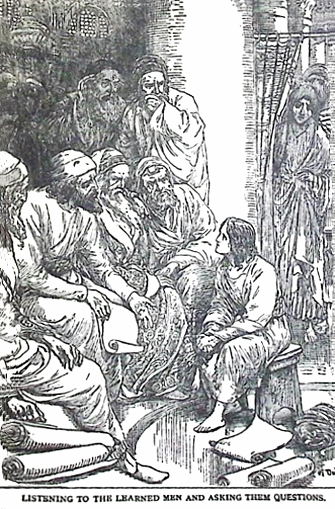
LISTENING TO THE LEARNED MEN AND ASKING THEM QUESTIONS.
At length, they found Him in the Temple of God, listening to the learned men and asking them questions. And all that heard Him were astonished at His understanding and His answers.
Then His mother told Him how she and Joseph had looked for Him so long. And He gave them that gentle answer which, from the Son of God and the Son of man as He was, meant so much, "How is it that you looked for Me? Did you not know that I must be about My Father's business?"
He was speaking of His Heavenly Father, and of the glorious and loving work which He had come on earth to do.
His mother Mary thought a great deal about His sayings, and though she could not fully understand all that was going to happen, she watched her gentle Son with ever-increasing wonder and love, as she saw His obedience and wisdom, and how He grew towards manhood, loved and praised by all who knew Him.
To all children, just growing out of children into boys and girls, our blessed Lord's obedience comes as a great encouragement.
The Bible says He was "subject" to His parents; that means that He was always ready to obey in His earthly home, and to live a quiet life in a carpenter's shop in the lowly town of Nazareth!
V. At Jordan
John the Baptist had been sent by God to baptize the people for the remission of sins, and to tell them that the Lamb of God who was to "take away the sin of the world" was soon coming to live among them, and to be their Saviour.
"And it came to pass in those days, that Jesus came from Nazareth . . . and was baptized of John in Jordan."
"And straightway coming up out of the water, He saw the heavens opened, and the Spirit like a dove descending upon Him; and there came a voice from heaven, saying, 'Thou art My beloved Son, in whom I am well pleased.'"
"And John saw, and bare record, that this is the Son of God."
So now we know, children, what was happening all those eighteen years at Nazareth, while Jesus grew from a boy into a man.
The people at Nazareth were offended at Him, when, after His baptism, He began to go about the country healing the sick, and teaching the people about God; and they said, scornfully, "Is not this the Carpenter?"
But God gives us the whole history of those eighteen quiet years in one sentence—
"This is My beloved Son in whom I am well pleased!"
When John saw Jesus coming to him to be baptized, he had exclaimed,—
"Behold the Lamb of God, which taketh away the sin of the world!"
And two of his disciples, hearing him speak, turned and followed Jesus.
May we hear those blessed words, and follow Him too!
VI. "Nazareth where He was brought up"
When the Lord Jesus was on earth, He lived among men for thirty-three and a half years.
We have in the New Testament only little glimpses of His life during the first thirty years.
First as a little baby; then, as a boy of twelve, we see Him journeying to Jerusalem to be present at the Passover Feast, and we are told that when He returned home to Nazareth He "was subject" to His mother and Joseph, and obedient to them in all things.
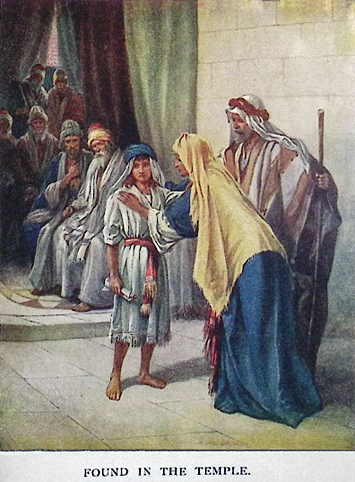
FOUND IN THE TEMPLE.
Here for eighteen quiet years Jesus lived learning the trade of a carpenter, and working with His own blessed hands, making the simple things that were used by the country people around Him—seats, and tables, ploughs, and yokes for oxen.
Is it not nice to think that Jesus knows all about making yokes!
Do you not remember afterwards, how He said, "Take My yoke upon you, and learn of ME . . . for My yoke is easy, and My burden is light"?
So children, Jesus knows exactly all about the weight of "the yoke" you may have to bear. Everybody has some trial or burden; but Jesus says, if you will come to Him, the yoke He has made for you will be light.
I like to think that when He made yokes for the oxen, He made them as comfortable and easy and light as they could possibly be made, so that no rough edge should gall the patient animal as he pulled the heavy plough!
When Jesus was thirty years old, all the wonderful things began which we read of in the Gospels.
His first public appearance was when He came to John the Baptist to be baptized by him in the river Jordan, which we shall read about on the next page.
Soon after this He began His public ministry.
One Sabbath day, He went to the synagogue as was His custom, and stood up to read from the Holy Book.
The servant or attendant gave Him a roll of the Prophet Isaiah, and, when He had found the place, He began to read.
And what do you think the Son of God, the Saviour of the World, read to explain His great mission?
He read: "The Lord . . . hath anointed Me to preach good tidings to the poor; He hath sent Me to heal the brokenhearted; to preach deliverance to the captives, and recovering of sight to the blind; to set at liberty them that are bruised."
He comes to each one of us first of all with the promise of forgiveness. His name means that!
"Jesus: for He shall save His people from their sins."
VII. The Well at Nazareth
In the story belonging to the last picture, we heard how God sent an angel to Joseph in a dream, and told him to take the Lord Jesus and His mother away from Egypt, and to go back to their own city, Nazareth.
Our next picture is of the public well at Nazareth, where people even to this very day go to draw all the water which they want.
For you know, children, that water is not "laid on" in eastern countries, but has to be fetched from long distances in jars or skins.
The women and children generally do this; and the Lord Jesus when He was a little boy must have gone daily to this well with His mother, keeping her company in the long hot walks to and fro, and helping her to carry the jars of water back to their home.
If you were to go to Palestine, the land where Jesus lived, you would see (besides, the women who come to the wells) the water-carriers, who have large pig-skins supported by straps to their shoulders.
These they fill with water, and tie up the neck securely with a string; and then they carry the heavy skin to the next town or village; and as they go along they call out—
"Ho! Thirsty ones, come and buy water! Here is water! Do you want to buy it?"
Then the people who have any money to spare, and who do not want to walk the long distance to the well, come out to the water-carriers and have their jars filled and pay for it.
Do you remember what God says about that in the 55th chapter of Isaiah?
"Ho! Every one that thirsteth, come ye to the waters, and he that hath no money come and buy. Yea, come and buy wine and milk without money and without price."
Ah, children, God gives us His gifts without money and without price! The "Living Water" which Jesus promises, we have only to ask of Him and we shall be given it.
For Jesus is the Living Water Himself, and those who drink of that water and have Jesus in their hearts, will find that He makes them happy, and that having Him for their Saviour they have all they need!
We read of many wells in the Bible, and some of them are to be found now.
There is "Jacob's Well," where Jesus promised the Living Water to the woman of Samaria; and there is this well at Nazareth, which is called "Mary's Well" now, because people feel sure that Mary, the dear mother of Jesus, must have drawn water at it when she lived at Nazareth.
It is nice to think that the feet of Jesus as a little child walked along those roads; that His eyes rested on those very hills that surround Nazareth; that He picked some of the countless flowers that grow all over the fields and make a carpet of beautiful colours such as we never see here.
This was the home of Jesus all the time He was a child; and here He lived every day, and watched Joseph at his work in his carpenter's shop. It was here that He lived an obedient, dutiful life, and grew in favour with God and with men. It was here He pleased His Heavenly Father in all things.
It is a nice thought, children, that whatever age you are, He was just that age too; so that He knows what children's feelings are, and all their little trials or joys or temptations.
He lives in heaven now, it is true, but He is ready to help you if you look up to Him.
I do not mean looking up with your eyes, but with your heart and your thoughts.
Just a little word or two spoken in Your heart will bring help from Jesus!
A little prayer of three words has made many a person happy when he was miserable before.
"Lord help me!" or "Lord save me!" will bring Jesus near in a moment; and He does help and save!
VIII. At Bethany
There seems to have been one home especially where the Lord Jesus loved to visit.
We hear a great deal about the people who lived in this home, perhaps more about them than any other of the friends of Jesus.
Their names were Lazarus, Martha and Mary.
One day the Lord Jesus was going about healing the sick, and teaching people about His Heavenly Father, and in His journey He came to the village of Bethany, where Martha and Mary and Lazarus lived.
Martha was a very industrious, energetic woman, and when she saw Jesus and His disciples coming, I dare say she ran out to meet them, and invited them into her house to have something to eat.
She bustled about and spread the table; she told her servants what to bring to set before the large company who had suddenly come to her; and with joyful willingness she hurried to put before them whatever she could think of to make them welcome.
Suddenly her eyes fell upon her only sister, Mary. She was not bustling about and getting the dinner ready; she was sitting near Jesus, eagerly listening to His words, and satisfied to be in His presence.
Poor Martha! She loved to hurry about and make Jesus welcome, but to have her sister sit idle and enjoy to hear Him talk, was more than she could bear.
So she got quite cross and vexed. She felt that it was too hard; and she ran to Jesus and asked Him how it was He did not care that Mary had left her all the work to do alone, and begged Him to bid Mary come and help her.
And then Jesus turned to her and said those gentle words which have been a lesson to busy, bustling people all these hundreds of years: "Martha, Martha, you are too much troubled over these many things; only one thing is needful, and Mary has chosen the good part which shall never be taken away from her."
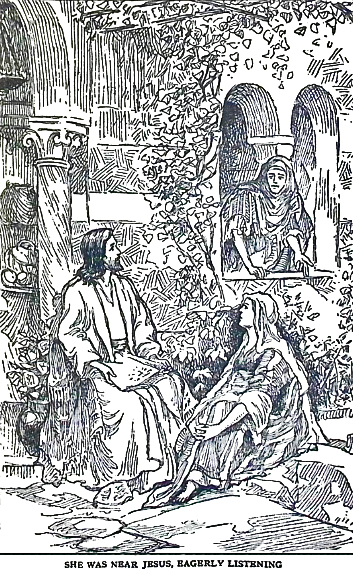
SHE WAS NEAR JESUS, EAGERLY LISTENING.
Do you ask, children, what that one thing is?
It is learning of Jesus, and hearing His voice.
Even if everything else is lost to us, if we have Jesus we can be happy. Even the poorest and most wretched person in the world, who has heard the voice of Jesus, has the "one thing" which will make him happy here, and will give him endless joy by and by.
IX. The Temptation
Directly after the Lord Jesus had been baptized, and God had spoken out of heaven saying He was His beloved Son, the Holy Spirit led Jesus into the wilderness to be tempted by Satan.
Perhaps you ask, dear children, "Why must Jesus, the Holy One, be tempted by Satan?"
I think it was for two reasons: that He might be our perfect example in everything; and that He might show us the way to conquer Satan.
It says in the Bible Jesus was tempted in all points like we are!
One of Satan's temptations to Jesus in the wilderness was "if He was the Son of God," to make the stones into bread.
Jesus was very hungry, He had not had food for a long time; but Jesus would not do what Satan asked Him. He said to Satan, that it was written in God's word "that men were not to live by bread alone," but to please God first of all.
You will understand His wonderful answers to Satan's temptations as you get older. But you can remember this now—If Satan tells you to do wrong, tell him boldly in return, that "Jesus is your Saviour, and He died to save you."
It says in the Bible, "His name shall be called Jesus, for He shall save His people from their sins," and if you say to Satan the one word "Jesus!" you will find that he runs away.
X. The Deep Well
Jesus was taking a long journey. He had to walk many, many miles, and at last, when He came near a large town called Samaria, He sent His disciples on in front to buy food.
He was very tired, and while He waited for them, He sat down to rest by the well which, hundreds of years before, Jacob had dug, which has been called ever since Jacob's Well.
Presently a woman from the town came with her pitcher to draw some water. As it was twelve o'clock in the day, the sun Was very hot, and the dear Lord Jesus was very thirsty.
When the woman came close to the well, He asked her to give Him some water to drink. But she was so busy with her own thoughts, that she told Him she was surprised that He should ask her for anything, as the Jews were not friendly with the people of Samaria.
Jesus did not answer that; for His loving heart knew all about her, and how she needed a Saviour to save her from her sins.
So He said to her something like this—
"If you knew what a wonderful gift God has to give you, and Who it is that has asked you to give Him drink, you would have asked Him instead, and He would have given you living water."
The woman could not understand this at all. She saw that Jesus had nothing to draw with, and she knew that Jacob's Well was very deep. What could He mean by living water?
Then Jesus told her that if any one came to Him for this living water, he would never be thirsty again, but would have everlasting life!
The woman began to think that it would be very nice not to be thirsty any more, so she asked Jesus to give her this water; but she did not know that she was talking to the Son of God, Who gives the Holy Spirit; she only thought of her many hot journeys to and from the well.
And now the Lord has to show her that it is something much better than real water that He wants her to have. He explains to her that she is a sinner, and He tells her so much about her past life, which she thought nobody knew, that she begins to guess that Jesus must be the Christ whom the Jews were expecting to come into the world.
Then Jesus said, "I, that speak unto thee, am He."
The woman was so surprised, and so glad, that she left her waterpot and ran back to the town to tell her neighbours all about her wonderful Saviour.
So numbers of them came out to find Jesus, and many believed on Him, not only because the woman had said that Jesus had told her all that ever she did, but because they heard from His own loving lips the words which brought them everlasting life.
XI. "Suffer Little Children to come unto Me"
A number of people are pressing round the dear Lord Jesus!
The mothers have heard how kind He is, and how He is doing good to everybody who comes to Him, and they are anxious that their little ones shall be blessed too.
So they take their babes in their arms, and their toddling children by the hand, and lead them to where they know the Lord Jesus is.
When the little ones see His loving face, they are not a bit afraid. They run to Him, sure that He will not refuse them, and when they come to Him, Jesus takes them up in His arms, puts His hands upon them, and blesses them.
The men who are following the dear Lord Jesus, think that the little children will be a trouble to Him, so they tell the mothers to take the little ones away; but we read that Jesus was much displeased, and said, "Suffer little children to come unto Me, and forbid them not; for of such is the kingdom of heaven."
Yes, Jesus said, when He was here walking about in our world, "Let the children come unto Me, and do not forbid them"; and now He is gone to be with His Father in heaven, He says just the same to all of you little ones. "Come to Me!" He says every day.
He is here in spirit, just as much as He was then, and He wants you to love Him with all your loving little hearts.
He loves you so much that He cares about everything that happens to you. He cares whether you are happy, He is sorry if you are naughty, and He is glad when you are good. He loves to have you do anything to please Him, and His dear eyes see you all day long, and He will help you to please Him if you ask Him.
Besides all this, the Lord Jesus has died on the cross, to bear the punishment of your sins, instead of you.
Should you not think it very kind if a little brother were to offer to be punished instead of the one who had done wrong?
That is what Jesus did. He took upon Himself the sin of the whole world, that whoever trusts Him and comes to Him, may be forgiven, and may go at last to live with Him, and with God our Heavenly Father, in that bright and beautiful home which He is getting ready for all who love Him.
Perhaps you ask, "Why does Jesus want you to come to Him?"
When you have been naughty and are sorry, why does mother hold out her loving arms to you?
Is it not that you may run into there and be forgiven and comforted? Is it not because she loves you?
Does she not wipe away your tears, and tell you that she will not think of your fault any more?
Does she not take you with her about the house, or in the garden, and show you by her manner how glad she is that you have come to her for forgiveness, and that you are going to try to do better?
Well, that is just a little bit like the love of Jesus.
He wishes you to come to Him, that you may have happiness and joy.
He wants you to live with Him all day long, and walk about by His side; to go to Him in every trouble; to ask His help in anything difficult.
You cannot see Him yet, but He is close to you all the time, and He can see you and hear you in an instant when you speak to Him.
By and by He will give you endless pleasures at His right hand for evermore.
"Gentle Jesus, meek and mild, Look upon a little child; Pity my simplicity, Suffer me to come to Thee. "Fain I would to Thee be brought, Blessed Lord, forbid it not: In the kingdom of Thy grace Give a little child a place."
XII. "Follow Me"
Soon after Jesus had chosen Peter and James and John as His disciples, He was walking near the lake of Gennesaret when He saw Matthew sitting at the place where the people had to pay taxes.
For Matthew was not a fisherman, like the others, but was a taxgatherer employed by the Romans to collect money from the Jews.
These taxgatherers were very much disliked, as they often took more money than they ought, and kept it for themselves, so that the Jews hated them and dreaded to see them coming.
But the Lord Jesus chooses disciples from all sorts of people. He does not wait till we are good, to call us to follow Him; but He says to us, just where we are, at school, at work, at play, in the street, in the home, in the shop, "Follow Me."
And these words mean, "Keep close to Me, where you can see Me and speak to Me. And if you keep close to Me, by and by when I lead the way into My glory in Heaven, you, if you are following Me, shall come with Me and share all I have."
So Jesus called Matthew the publican; and Matthew heard His call, and rose up, and left all and came after Jesus.
Dear children, if we hear Jesus calling us, let us leave behind anything that would displease Him, and tell Him we are ready to follow Him wherever He may lead.
XIII. Lazarus
Not so very long after the supper where Martha had served, her brother Lazarus fell sick and died.
We are told that "Jesus loved Martha and her sister and Lazarus," and yet He let him die!
Ah, how often have those whom Jesus loves, to trust Him through the very hardest thing that could happen to them!
Jesus was not there when Lazarus fell ill, and though they sent to Him to tell Him, He did not go to them at once, but stayed where He was for two more days. In the meantime Lazarus died, and was buried.
At length Jesus told His disciples that He would go to Bethany.
When they got near to where Lazarus lived, Martha heard that Jesus was coming, and hurried out to meet Him with the words, "Lord, if you had been here, my brother would not have died. But I know that whatever you ask of God, God will give it to you."
Then Jesus told her that Lazarus would rise again; and Martha showed her faith in answering that she knew he would rise at the last day. And again Jesus questioned her with these wonderful resurrection words, "Whosoever liveth and believeth in Me shall never die. Believest thou this?"
And Martha gave one of the most wonderful answers that we read in the Bible: "Yea, Lord: I believe that Thou art the Christ, the Son of God, which should come into the world."
Blessed Martha! She had found the one thing needful!
So by and by they come to Bethany, and Jesus sent for Mary to come from the house of mourning to Him.
And Mary's first words were the same as Martha's, "Lord, if you had been here, my brother had not died."
Oh, the compassion of Jesus! He knew that soon their sorrow would be turned into joy, but when He saw them all weeping. He was very troubled, and wept too.
And so they come to the grave; and Jesus told them to take away the stone. The Martha reminded Him that Lazarus had been dead four days.
But Jesus answered her, "Did I not say to you, that, if you would believe, you should see the glory of God?"
And Jesus lifted up His eyes, and said, "Father, I thank Thee that Thou hast heard Me . . . that they may believe that Thou hast sent Me."
And then He called with a loud voice, "Lazarus, come forth!" And the dead man came forth, bound with graveclothes and Jesus said to them, "Loose him, and let him go."
Oh, how happy those sisters were! Did not Martha, indeed, see the glory of God, as Jesus had said?
XIV. The Widow's Mite
One day, very shortly before our dear Lord was crucified, He was teaching in God's Temple at Jerusalem and preaching the gospel.
He had been warning the people against the scribes, who loved to seem very good and to be thought well of, who chose the highest seats in the synagogues and the chief rooms at feasts, who made long prayers for a show, and who oppressed poor widows and took away their houses.
The Lord looked straight into people's hearts, and He could not bear for the scribes to seem very good outside and to be very wicked inside!
Jesus was sitting near the treasury, which was the chest or receptacle in which the people put their offerings of money for God's service.
After He had been speaking about those scribes that oppressed the widows, He raised His eyes and saw the people casting their gifts into the treasury; and many that were rich cast in much.
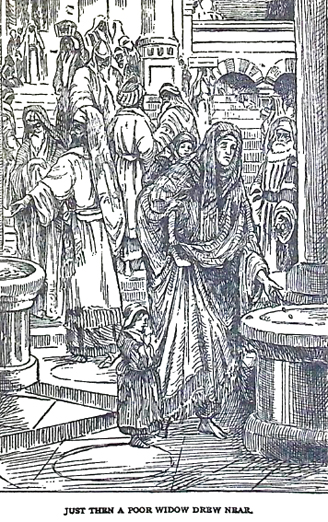
JUST THEN A POOR WIDOW DREW NEAR.
And just then a poor widow drew near, and she put in two mites, which make a farthing.
Jesus saw it all! He could see into her empty pocket; He knew all about it!
Then He called His disciples to Him and said to them, "This poor widow has cast more in than all the others who have cast into the treasury: for they did cast in of their abundance; but she of her want did cast in all that she had, even all her living!"
There is another widow we read of, who gave all her living to God! The account is in 1 Kings xvii. God sent the prophet Elijah to her in a time of famine. When he got to where the widow lived, he found her gathering a few sticks to make a fire to bake the last bit of bread that she had!
So Elijah called to her to fetch him a little water. He was nearly dying of thirst, and as she ran to fetch it, he begged her also to bring him a morsel of bread too.
But she told him that she only had a tiny bit of meal left in the barrel, and a little oil in a cruse, and this she was going to make into a little cake for her and her son, and when they had eaten that, she said, they must die!
But Elijah said some words like these to her: "Fear not . . . make me a little cake first, and bring it to me . . . for thus saith the Lord God of Israel, You shall always find a little meal in the barrel, and a little oil in the cruse as long as the famine lasts!"
And she believed God's promise, and went and did as Elijah had said; and she and Elijah and her son had enough to eat for many days.
XV. "Do this in Remembrance of Me"
Very soon after this, just before the Feast of the Passover, when Jesus knew that the hour had come that He was to die, and to go back to His Father, He wished to do one last act of love to His disciples, because "He loved them to the uttermost."
And supper being ended, Jesus rose up and taking a towel He poured water into a basin, and began to wash the feet of His disciples.
This astonished them very much, and when it came to Peter's turn, he said, "Lord, dost Thou wash my feet?"
Then Jesus said to him something like this, "You cannot understand what I am doing now, Peter, but you shall understand by and by."
But Peter said to Jesus, "Thou shalt never wash my feet!"
And Jesus answered him, "If I do not wash you, Peter, you have no part with Me."
So Peter at last let Jesus wash his feet; but he asked Him to wash his hands too, and his head. I think he meant that he wanted to be made wholly clean!
Jesus is our perfect example, and though He was their Lord and Master, He did for them what was the office of the servants in the East, that they might hereafter remember that there is no act, however lowly, that they should be unwilling to perform for one of His disciples.
This loving example has helped thousands of the followers of Jesus to go into prisons and hospitals; or to minister to the sick in crowded, wretched rooms, where dirt and misery abound; that they may brighten and cleanse them, and bring a little, to the poor suffering inmates, of that love of Jesus which loves to the uttermost, and "is able to save to the uttermost, those that come unto God by Him."
* * * * * *
And now the hour for the Passover Feast had come, and Jesus sat down, the twelve apostles with Him, and He told them that with a great desire He had longed to eat that Passover with them before He suffered.
Dear children, you have often heard of the Communion of the Lord's Supper, and some of you may have been with your parents, and may have seen it.
But now I am going to tell you about the first time the Lord's Supper was held.
Ever since that time for nearly nineteen hundred years, the people who love the Lord Jesus have met together "to remember Him" as He told them; and those who love Him are told to do this, till He comes back again to take us to His heavenly home.
So that night "in which He was betrayed" this was how our dear Lord gave us this last command.
"And He took bread, and gave thanks, and brake it, and gave unto them, saying, 'This is My body which is given for you: this do in remembrance of Me.'
"Likewise also the cup after supper, saying, 'This cup is the New Testament in My blood which is shed for you.'
"And when they had sung a hymn, they went out into the Mount of Olives."
And Jesus said to them, "All ye shall be offended because of Me this night: for it is written, 'I will smite the Shepherd, and the sheep shall be scattered!'"
But in His great forgiving love, though Jesus knew they would all forsake Him, He gave them the promise, that when He was risen from the dead He would go before them to Galilee, and there they should see Him again.
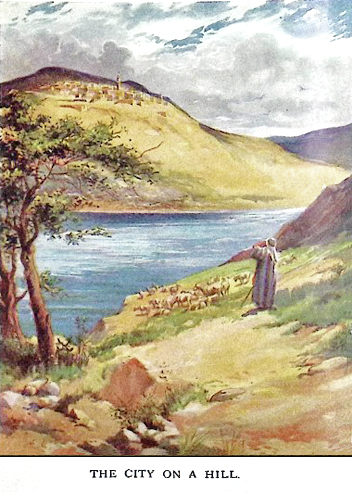
THE CITY ON A HILL.
XVI. The Lame Man Leaping
Acts iii. 8
One day, very soon after the Holy Spirit had been sent down to give power to the disciples, Peter and John, as their custom was, went up into the Temple to pray.
It was what was called the ninth hour, our three o'clock in the afternoon, and was "the hour of prayer" in Jerusalem.
Peter and John climbed up the many steps that led to the Temple, and reached the gate called the Beautiful Gate.
Some one else had come up those many steps, too; but he had not walked. He had been lame all his life, and daily his friends carried him up that long way, to lay him in the Beautiful Gate.
What do you think they took all that trouble for? It was that the poor lame man might ask for money of the passersby who went up to pray.
He had no means of providing for himself, and, like many other sick and helpless people, he lay there hour after hour, holding out his hand to receive the coins which the pity of the passersby made them give him.
As he saw Peter and John about to go into the Temple, he begged them to have pity on him in his poverty.
Then Peter, knowing that within him rested the great power of God, said to the lame man, "Look on us!"
The poor man eagerly obeyed, thinking they were not going to pass on without showing him some kindness.
He was quite right. Peter at once said: "I have not any silver or gold! But what I have, I will give you! In the Name of Jesus Christ of Nazareth, rise up and walk!" And he took him by the right hand, and lifted him up, and immediately his feet and ankle bones were given strength, and the man, who had been a cripple for more than forty years, walked and leapt, and went with Peter and John into the Temple, walking and leaping and praising God!
Then all the people, who knew all about this lame man for so many years, were filled with amazement at what had happened to him. For the lame man held Peter and John, and all the people ran together into Solomon's Porch to see the wonderful sight. But Peter told them, at once, that it was not by their own power that they had made this man well, but because God had glorified His Son Jesus, and that it was through faith in His Name that he had been given this perfect soundness.
And then he told these wondering, amazed Jews, that it was their God, "the God of Abraham and Isaac and Jacob," who had sent Jesus to earth to bless them, and to turn away every one of them from their sins.
And that blessed Name of Jesus has the same power now to help and save all who look to Him. Forgiveness, strength, comfort, and help can belong to those who will trust Him!
XVII. Gethsemane
Many, many hundreds of years ago, the Easter full moon was shining down in all its beauty on a garden near Jerusalem.
This garden was called Gethsemane and I should think that every one who loves the Lord Jesus, and who knows about His great agony in that garden, must love the very name of the place, and remember with very tender feelings all He bore for our sakes.
Every Easter now, when the moon shines so sweetly, we can recall that night on which our dear Lord was betrayed, and we can ask Him to help us to watch and pray that we may not enter into temptation.
He had just eaten the Passover Supper with His disciples; He had told them and us, to "do this, as oft as ye take it, in remembrance of ME," and then, after they had sung a hymn, or psalm, they went down the steep path from one of the gates leading out of Jerusalem, to go to the Mount of Olives.
Just at the bottom of the valley there lay the Garden of Gethsemane; and the Lord Jesus, who knew all that was going to happen to Him the next day,—how He would be mocked and beaten and crucified—wanted to pray to His Heavenly Father before He was betrayed into the hands of the Jews.
So He turned into the garden beneath the olive trees, telling some of His disciples to wait outside, but taking Peter and James and John into the garden with Him.
He was very, very sorrowful, so He bade them wait near Him and watch. Then He went a little further on, and fell on the ground and prayed to His Father that, if it were possible, the hour might pass away from Him.
He knew that all things were possible with God, but He did not want to have His own will, if His dear Father in Heaven wished anything different. He had come to earth to do His will perfectly.
Then after His prayer, He rose and went to His disciples. But he found them asleep! They had not watched as He bade them.
So He said to Peter, "Simon, sleepest thou? couldest thou not watch one hour?"
And then He told them to watch and pray lest they should enter into temptation.
He said He knew they were willing to do it, but they had tired bodies, and this made it the more necessary to be watchful.
So He went away again and prayed to His Father in an agony that the bitter cup might pass from Him.
We cannot fully understand all that is meant by that bitter cup. It is enough for us to know that our blessed Lord dreaded it above everything.
But even in the midst of that misery, He could say, "Oh, My Father, if this cup may not pass away from Me except I drink it, Thy will be done!"
And there appeared an angel from heaven, strengthening Him.
Still again a third time He went away and prayed the same prayer, but all the while His disciples were fast asleep!
At last Jesus rose up from prayer, and when He came to His disciples He told them that now He was going to be betrayed into the hands of sinners.
As He was speaking, a great band of men, led by wicked Judas, came hurrying into the garden.
Now Judas had said to the chief priests (when he sold Jesus to them for thirty pieces of silver), "Whomsoever I shall kiss, that same is He; hold Him fast."
The Lord Jesus, who is God as well as man, could easily have escaped from their cruel hands. He told them He could have prayed to His Father, and He would have sent Him thousands and thousands of angels.
The band of men and officers from the chief priests were so amazed at the majesty of Jesus, that they went backward and fell to the ground.
But Jesus was ready to die for us; for how else could we be saved?
Then they took Jesus prisoner, and bound Him and led Him away to the palace of the High Priest.
And as He was led away from Gethsemane, He said to Peter those memorable words of love and submission—"The cup which My Father hath given Me, shall I not drink it?"
He knew that the Cross to which He was going was His Father's Will! For had He not said Himself, to the people?—
"For God so loved the world, that He gave His only begotten Son, that whosoever believeth in Him should not perish, but have everlasting life."
XVIII. The Trial
When Judas had betrayed the Lord Jesus with a kiss, and the band of soldiers and officers were going to take Him away, Peter tried to defend Jesus by drawing his sword, and he smote one of the servants of the High Priest and cut off his ear.
But Jesus did not wish His disciples to fight for Him with swords, and He told Peter to put it up in the sheath again; and then, in His love and compassion, He healed the man's ear.
And Jesus said to the soldiers, "Are you come out as if I were a thief, with swords and staves to take me? I was with you every day in the Temple, teaching you, and you did not take Me; but the Scriptures must be fulfilled."
Then all His disciples forsook Him and fled.
Jesus is the Good Shepherd; and now it had come to the time when He was going to lay down His life for the sheep.
But oh! How sad it must have made Him, to have all His disciples run away from Him!
Then the soldiers bound Him and led Him away.
But after the first moment of fear and dismay, John, the beloved disciple, ran to follow his Master, and the crowd tried to prevent his going after Jesus. But he managed to escape from them, and presently he reached the High Priest's house, and, as he was known to the High Priest, he went in with Jesus into the palace.
But Peter was left in the garden, and he followed afar off, even into the palace of the High Priest, and sat with the servants and warmed himself at the fire.
When the whole band had brought Jesus into the palace, they found there all the chief priests, and the elders, and the scribes.
Then the chief priests and all the council sought for witness against Jesus to put Him to death; but found none.
There were many false witnesses who gave evidence against Him, but they all contradicted each other.
All this time Jesus stood silent, listening to their false charges, but not answering a word.
At last the High Priest exclaimed, "Answerest thou nothing? What is it that these witness against thee?"
But Jesus held His peace, and answered nothing.
Then the High Priest asked Him a question which Jesus answered.
He said, "Art Thou the Christ, the Son of the Blessed?"
And Jesus said, "I am; and ye shall see the Son of Man sitting on the right hand of power, and coming in the clouds of heaven."
Then the High Priest tore his clothes, and said there was no need to examine any more witnesses, for they had heard Him say Himself that He was the Son of God.
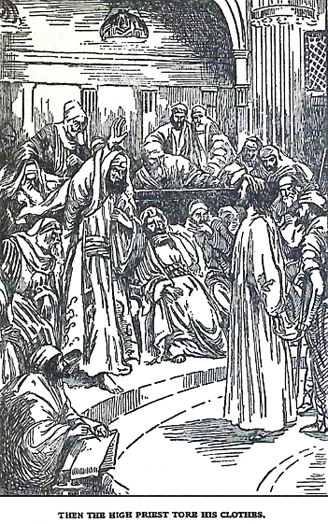
THEN THE HIGH PRIEST TORE HIS CLOTHES.
And for this they all condemned Him to be guilty of death.
XIX. The King of the Jews
When the chief priests of the Jews had determined to kill the Lord Jesus, after examining Him for many hours on the dreadful night when all His disciples had forsaken Him and Peter had denied Him, they consulted together as to how they could carry out their wicked plan.
The morning dawned before they had decided what to do; and at length, as they did not like to put Him to death themselves, they thought the best way would be to take Him to Pilate the Roman governor, for they thought that he would do what they wished.
The Jews and the High Priest had asked Jesus whether He was really the Christ, the Son of God; and the Lord Jesus, to leave them without excuse, told them plainly that He was, and that hereafter they would see Him sitting in heaven, and coming back to earth in the clouds.
At this they had been fearfully angry, and had torn their clothes, and had bound Him and led Him away to Pilate, in the hopes that Pilate would at once order Him to be put to death.
* * * * * *
Now we are told in Matthew's Gospel that Judas, who had betrayed his Master with a kiss, saw Jesus led away to Pilate. He knew by this that the chief priests had condemned Him to death, and, too late, Judas repented of the wicked thing he had done.
Jesus had told the disciples when they sat down to the Passover supper, that one of them should betray Him, and Judas had asked, among the rest, "Lord, is it I?" And Jesus had told him, that though He must die to save the world, yet it was woe to the man who should betray Him.
But Judas thought of the thirty pieces of silver which he was going to earn for doing this sad deed, and he left the supper table and went out into the dark night.
Judas had made his decision against Jesus!
Oh, children! Let our decision be for Jesus! All through our lives, let our one purpose be that He shall be our Lord and our King. We shall not be sorry by and by that we have decided so.
But Judas had made his evil choice; he had set going a thing which he could not now stop. And when he realized that the chief priests had really condemned Jesus, Judas would have given everything he possessed to undo what he had done. But it was too late.
He hurried back to the chief priests with the money in his hand, and he exclaimed, "I have sinned; I have betrayed the innocent One!"
But they said, "What is that to us? You must see to that!"
So he threw down the thirty pieces of silver in the Temple, and went and hanged himself.
Oh, poor Judas! What good was his money to him then? "What shall it profit a man if he gain the whole world, and lose his own soul?"
Then the chief priests took up the silver and consulted as to what they should do with it, because it was "the price of blood," and they might not put it into God's Treasury; and they decided to buy a field, called the Potter's field, to bury strangers in. And that field was called "the Field of Blood" ever afterwards. We read in the Bible that, five hundred years before that, it was foretold by the prophet Zechariah that all these things should be done, when Jesus was sold for thirty pieces of silver.
* * * * * *
So Jesus was brought before Pilate, and stood there in all His majesty and humility, and Pilate asked Him, "Art Thou the King of the Jews?" And Jesus again left no excuse to those who condemned Him. Though He had answered nothing when the false witnesses spoke against Him, though He answered nothing now when the chief priests and elders accused Him, yet, to give Pilate an opportunity of believing and accepting Him, He answered him at once—
"You have said what I am—a King. To this end was I born, and for this cause came I into the world, that I should bear witness of the truth."
Then Pilate told the chief priests that he found no fault in Him.
When Pilate found it impossible to quiet the chief priests, though he told them he could find no fault in Jesus, he decided to send Him to Herod, who was at Jerusalem at that time.
And when Herod saw Jesus, he was very glad, because he had heard of Him, and hoped to have seen a miracle done by Him.
So he asked Jesus a great many questions, but He answered him nothing.
And the chief priests stood and vehemently accused Him.
And Herod and his soldiers mocked Him and arrayed Him in a gorgeous robe, and sent Him again to Pilate.
Now at the feast of the Passover, the Roman governor pleased the Jews by setting free a prisoner whomsoever they asked for. So, because Pilate did not like the Jews, and knew that they had delivered Jesus up for envy, he offered to release to them Barabbas, who was a great robber, or "Jesus who was called Christ"?
So Pilate went back to the judgment-seat and sat down. And it was quite early morning yet.
Then his wife sent down in haste to him to have nothing to do with condemning Jesus, because she had had a dreadful dream, and she knew that Jesus was a just man.
But the chief priests and elders persuaded the multitude that they should ask for Barabbas.
Pilate was sure that Jesus was not worthy of any punishment; but when he found that the Jews were raising a great tumult, and that they charged Pilate with not being Cæsar's friend, if he allowed Jesus to be the King of the Jews, Pilate was afraid.
He was more afraid of the Jews than of God! And so poor Pilate made his great decision. And he, like Judas, made it on the wrong side!
So he called for water, and when it was brought to him, he washed his hands before all the people, saying, "I am innocent of the blood of this just person: see ye to it."
Then Pilate said to them, mockingly, "Shall I crucify your King?"
But they cried the more exceedingly, "Crucify Him, crucify Him!"
And the voices of them and of the chief priests prevailed.
Then Pilate released Barabbas to them, and when he had scourged Jesus, he delivered Him to be crucified.
XX. The Soldiers Mocked Him
So when Pilate had sentenced Him to be crucified the governor's soldiers took Jesus into the common hall, and gathered together the rest of the soldiers, and began to mock at the dear Lord whom we love so much.
They clothed Him with a purple robe, and they plaited a crown of long sharp thorns and put it on His loving head, and then they put a reed in His hand and bowed down to Him, and mocked Him saying, "Hail, King of the Jews!"
Jesus did not mind being called the King of the Jews, because He came on earth to be their King; He was only sorry that they would not love Him, or have Him for their King and Saviour.
Ah, how it must have cut Him to the heart in all His pain, to have them mock Him, and beat Him on the head, and spit upon Him, and pretend to worship Him.
If our hearts are filled with grief that He could have suffered so much, should we not love Him more than ever; and turn away from the sins which He died on purpose to save us from?
So Pilate went outside again, and said to the Jews, "Behold, I bring Him forth to you, that you may know that I find no fault in Him."
Then Jesus came out wearing the crown of thorns, and Pilate said, "Behold the man!"
But the Jews burst out again with the cry, "Crucify Him!"
And Pilate said, "Why, what evil hath He done?"
But the Jews told Pilate that Jesus had made Himself equal with God, and so He must die.
Then Pilate was more afraid than ever, and went again into the hall, and asked Jesus where He had come from?
But Jesus gave him no answer.
At length the Jews clamoured so loudly, and told Pilate that he was not Cæsar's friend, that though Pilate longed to release Jesus, when he heard them say that, he gave in to them, and brought Jesus forth for the last time, saying to them, "Behold your King!"
And they all cried out, "Away with Him, crucify Him!"
"The head that once was crowned with thorns Is crowned with glory now: A royal diadem adorns The mighty Victor's brow. "The highest place that heaven affords Is His, is His by right: The King of kings, and Lord of lords, And heaven's eternal light."
XXI. Jesus Carrying His Cross
And after they had mocked Jesus, they took off the gorgeous robe in which Herod and his soldiers had dressed Him, and they put His own clothes on Him again, and led Him away to crucify Him.
And Jesus—the King of glory—went forth, carrying the cross on which He was to be crucified for us!
Thus our dear Lord left the city where He had been rejected and condemned, bearing His heavy, cruel cross.
I think He must have fainted beneath its weight, for we are told that when they came to the gate of the city, they met a man, Simon the Cyrenian, coming in from the country, and the soldiers forced him to carry the cross after Jesus.
A great multitude came out after them, and the women who had followed and loved Jesus were mourning and grieving at their dear Lord's sorrowful fate.
But Jesus turned to them and told them not to cry for Him, but for all the sorrow which was coming upon Jerusalem because the Jews would not have Him for their Saviour.
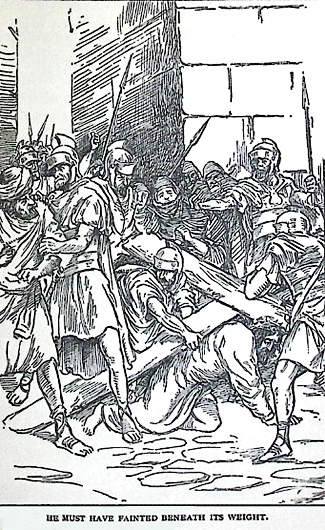
HE MUST HAVE FAINTED BENEATH ITS WEIGHT.
And there were two other men led out with Jesus to be crucified at the same time. They were called malefactors, because they had been very wicked.
So the whole great company went outside the city walls, and they bring Jesus to a place called "The Skull." They offered our dear Lord some wine and myrrh to drink, but, when He had tasted it, He would not take it.
Then they crucified Jesus, our King, and the two malefactors, one on the right hand and the other on the left, and Jesus in the midst.
Children, in all His dreadful sufferings and sorrow, what is it we hear from those dear lips?
Then Jesus said,—
"Father, forgive them; for they know not what they do."
XXII. The Cross of Jesus
We pause at this picture, dear children, with awe and reverence, and as we gaze upon it our hearts are filled with love and grief.
"Did Jesus bear that cruel death for me?" we whisper to ourselves. "Was my name on His heart when He hung all those hours on the cross? Were my sins pardoned by His most precious blood, which flowed from His bleeding side?"
If we can answer a solemn "yes" to these questions, then the cross of Jesus our Saviour is the place where henceforth we can find joy, and thankfulness, and strength.
On the cross where Jesus was crucified, a piece of parchment was nailed. This was generally done, so that people should know what the crime was for which any one was to suffer this cruel death.
But Pilate had nothing to charge Jesus with. He had said over and over again, "I find no fault in Him." And when he sat down to write His accusation on the parchment, he wrote—
"Jesus of Nazareth—the King of the Jews."
This writing was read by many of the Jews, because the place where Jesus was crucified was near to the city, and many were passing backwards and forwards at this Passover feast time.
And Pilate wrote it in Hebrew and Greek and Latin.
The Jews did not at all like what Pilate had written, and wanted him to take the writing down. They said, "Do not say that He is the King of the Jews! But say, He said He was."
But Pilate would not alter it. "What I have written, I have written," he said.
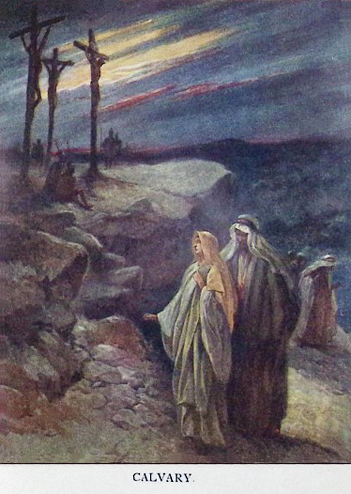
CALVARY.
So when Jesus died, He had only this accusation—that He is King!
And the people stood beholding.
They saw the four soldiers carry away His raiment, to divide it between them. But when the soldiers found that His coat, or under-robe, was seamless and woven in one piece, they cast lots for that; so that the Scripture, written hundreds of years before, might be fulfilled, "They parted My raiment among them, and for my vesture they did cast lots." These things, therefore, the soldiers did.
Then the rulers who were standing by mocked Him, saying, "He saved others, why did He not save Himself and come down from the cross?"
Dear children, do you know why Jesus did not come down from the cross?
"He knew how wicked man had been, He knew that God must punish sin; So, out of pity, Jesus said He'd bear the punishment instead. "And so He died! And this is why He came to earth to bleed and die: The Bible says He came from heaven, That we might have our sins forgiven."
Perhaps some of you may think that the cruel nails held His dear hands and feet so fast that He could not come down?
But that was not the reason—oh no!
It was love that made Him stay there—love to you and to me. He stayed there that He might die for us, that His precious blood should be shed to pay the price for our sins.
The two thieves who were crucified on either side of Jesus, joined with the Jews in reproaching Him; but after a while one of them began to think of Him as He hung there in all His patience and love, and he was sorry that he had spoken against Him. He rebuked the other thief, and told him that they both were condemned justly, "but this Man hath done nothing amiss," he said.
And then we can picture him, turning his poor suffering face towards the loving Saviour who hung beside him, and we can almost hear him saying, "Lord, remember me when Thou comest into Thy Kingdom!"
And Jesus answered and said, "To-day shalt thou be with Me in Paradise!"
Ah! He was the King of Love! Not a reproach to that sinful man; not a word that now it was too late; nothing but love and cheer and tenderness. "Verily I say unto thee, To-day, thou shalt be with Me in Paradise!"
Oh, does not this tender Jesus make your heart grow warm with love?
Though He was racked with pain, He could cheer one who was suffering by Him; though He was dying for the sins of the whole world, He could save one single soul who turned to Him in faith.
God sent a great darkness over all the land from twelve o'clock till three o'clock, while His holy Son was dying on the cross.
No one can tell all the depth of woe and loneliness which Jesus suffered while the load of our sins rested upon Him; but the more we understand it, the more we shall love Him for His great love.
"When I survey the wondrous cross On which the Prince of Glory died, My richest gain I count but loss, And pour contempt on all my pride. "Forbid it, Lord, that I should boast Save in the death of Christ my God: All the vain things that charm me most, I sacrifice them to His blood. "See from His head, His hands, His feet, Sorrow and love flow mingled down: Did e'er such love and sorrow meet? Or thorns compose so rich a crown? "Were the whole realm of nature mine, That were an offering far too small: Love so amazing, so divine, Demands my soul, my life, my all. "To Christ, who won for sinners grace By bitter grief and anguish sore, Be praise from all the ransomed race For ever and for evermore."
Now there were standing by the cross of Jesus, His mother, and His mother's sister Mary, the wife of Cleophas, and Mary Magdalene.
When Jesus saw His mother, and John, the disciples whom He loved, standing there, He charged him to take care of His dear mother; and John took her to his own home from that hour.
And now everything was done which the Scriptures had said should happen; and Jesus, knowing this, said, "I thirst!"
And one ran and filled a sponge with vinegar and put it on hyssop, and put it to His mouth.
And when Jesus had received the vinegar, He said, "It is finished!" And He gave up His spirit into His Father's keeping; and then He died.
XXIII. The Sealed Tomb
Now when the centurion who was in charge of the soldiers who crucified Jesus, saw all the things that had happened—His wonderful love and patience, His dying words, the darkness and the great earthquake,—he feared greatly, and said, "Truly this was the Son of God!"
And there were many women there, standing as near as they dared. Among these was Mary Magdalene, out of whom Jesus had cast seven devils; and Mary the mother of James and Joses; and Salome the mother of Zebedee's children, James and John, the disciples who had been with Jesus in the Garden of Gethsemane, and at other special times during His ministry.
So these women stood and waited near the cross all those long hours till the evening, to see what they would do with their Lord.
And when the evening had come, there came a rich man of Arimathea, named Joseph.
He was a counsellor and much respected among the Jews; and when the Lord had been condemned by them, he had not consented to what they had done. He was looking for the Kingdom of God, like many other godly Jews at that time.
So he brought fine linen to wrap the precious body of Jesus in; and sweet spices for His burial.
And he went boldly in to Pilate and begged him to give him the body of Jesus.
So Pilate gave him leave, and Joseph hastened back to take Jesus down from the cross, and to wrap Him in beautiful pure linen, and to carry Him away to his own new tomb which was in a garden close to Calvary.
We are told by those who have been there, that just beneath that hill outside Jerusalem called The Skull, there is a garden with a tomb in it, cut out of the rock. It is thought by some, that this is the tomb in which Jesus was laid; but no one can be quite certain that this is so.
At any rate, we are told in the Gospel of John that the garden was near at hand. And here they buried the body of our dear Lord, and rolled a great stone across the door of the sepulchre.
And Mary Magdalene and the other Mary saw where He was laid, and sat down over against the sepulchre to watch.
But the next day, the chief priests and Pharisees came to Pilate, to remind him that Jesus had said while He was alive, that He was going to rise again from the dead on the third day.
So they begged Pilate to command that the sepulchre should be made sure till the third day, lest Jesus' disciples should come in the night and steal His body away, and pretend that He had risen as He had said, which they thought would be a worse mistake than all!
And Pilate answered, "You have soldiers who can watch, go and make it as sure as you can."
So they went back, and made the sepulchre sure, sealing the stone, and setting men to keep watch all night.
XXIV. The Resurrection
They had sealed the grave to make all sure, and they had set a watch that no one should come to steal the body of Jesus; and the women and those who loved Him and had followed Him, left the tomb at last, and went to their own homes.
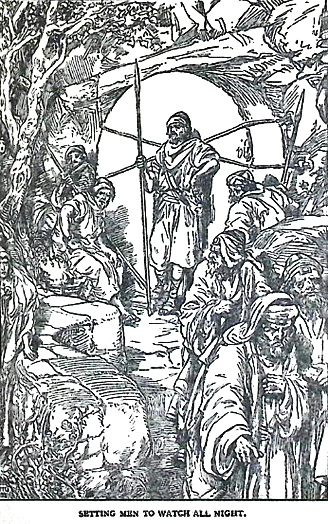
SETTING MEN TO WATCH ALL NIGHT.
They had forgotten that the Lord Jesus had told them, over and over again, that He would rise from the dead on the third day.
But it was impossible that the grave could hold the Son of God, when the time came for Him to rise.
He tasted death for all of us; but He also rose from the dead to show that God was satisfied that He had atoned for our sins.
Very early on the first day of the week, which is our Sunday, Mary Magdalene, and Salome, and "the other Mary," came to the grave with spices and sweet-smelling ointments to anoint the body of Jesus.
And as they went along, they said to each other, "Who shall roll away the stone for us?" For they knew that it was very large and heavy!
But when they got there, the stone was already rolled away.
So they entered into the tomb, and they saw a young man sitting there on the right side, clothed in a long, white garment, and they were very frightened.
But he said to them, "Do not be frightened; you are looking for Jesus of Nazareth, who was crucified: He is risen; He is not here: look at the place where they laid Him. And go and tell His disciples, and Peter, that if they go into Galilee they shall see Him, as He said to them."
At first they were so frightened at the shining angel that they ran away, and did not tell any one. But very soon, while it was yet very early, Jesus met Mary Magdalene (out of whom, we read in the 8th of Luke, He had cast seven devils), and when she had seen Him and He had talked with her, she knew certainly that He was the Lord; and she ran and told His other disciples who were mourning and crying because they thought He was dead, and that they should never see Him again.
And do you not think, too, that Peter must have been very glad indeed of that special message which the Lord Jesus sent to him?
We read afterwards that the Lord also appeared to Peter; but we do not know what He said to His sorrowful disciple. All we do know is that Jesus forgave him.
And this is what He will do for us, children, if we ask Him to forgive us. He will comfort us with the assurance of His love and pardon, and He will help us to go on again like He did Peter.
Meanwhile the soldiers who were watching at the tomb were very frightened at all that had happened, and went and told the chief priests all about it.
So when they had consulted together, they gave the soldiers money, and told them to say that the disciples of Jesus had come in the night and had stolen His body.
So that saying was believed among the Jews from that time.
But Jesus was alive! He showed Himself over and over again to His own disciples; and so that there should be no mistake, He came one evening into the midst of the room where the disciples and those who were with them were assembled, and said, "Peace be unto you!"
They were all so frightened, thinking that they had seen a spirit, that Jesus told them to touch Him and to look at the marks of the nails in His hands and feet; and when they could hardly believe for joy, He asked them to give Him some food, and He sat down and ate it before them, explaining to them in loving words that it was necessary for Him to die, but also necessary for Him to rise again, that He might obtain eternal salvation for all who will obey Him.
XXV. On the Shore at Dawn
On the day of the resurrection, two of the disciples of the Lord Jesus were walking from Jerusalem to the village of Emmaus, and as they went along they spoke of all that had happened, reasoning together about it.
And as they walked, Jesus Himself drew near, and went with them. But their eyes were holden that they did not know Him.
So He asked them what they were talking of, and why they were sad?
And Cleopas answered, that He must be a stranger in Jerusalem if He did not know what had so lately happened there.
And Jesus asked them, "What things?"
So they told Him it was about Jesus of Nazareth who had been a mighty prophet, but now had been crucified; and how they had hoped that He was to be their Saviour.
Then Jesus told them that if they had only believed, they would have understood that the Scriptures had foretold that Christ must suffer to atone for sin, and then to enter into His glory.
So He explained in all the Scriptures the things about Himself—but still they did not know Him.
Then they came to the village, and they pressed Him to abide with them; and while they sat at supper Jesus blessed the bread, and brake it, and gave to them.
Then their eyes were opened, and they knew Him, and He vanished out of their sight.
So they rose up the same hour and hurried back to Jerusalem, where they found the eleven disciples together, who were full of the joyful news that the Lord had risen indeed, and that He had appeared to Peter.
Then Cleopas and his companion told their great news, and as they did so, Jesus Himself stood in their midst, and said to them, "Peace be unto you!"
* * * * * *
Now I must tell you how Jesus showed Himself to six of His disciples and Nathanael at the sea of Galilee, sometimes called Tiberias.
Peter had proposed one evening to go to fish on the lake, and the others had said they would go with him. But all that night they took nothing. When the morning dawned they were cold and hungry, and as the light came back they saw some one on the shore who seemed to be waiting for them.
They did not know that it was Jesus and even when His voice came to them across the water, asking if they had anything to eat, they did not recognize it.
But when the stranger called to them to cast their nets on the right side of the ship, and they found a lot of fish, John began to guess Who it must be, and he said to Peter, "It is the Lord!"
Then Peter threw on his fisher's coat and cast himself into the sea to get quickly to his beloved Lord, and the rest hastened to follow in a small boat, dragging the net full of great fishes.
When they landed on the beach, they found that Jesus had prepared for them. He knew that they were cold and hungry, and they saw a fire already lighted, with some fish being cooked on it, as well as bread to eat with it.
Then Jesus told them to bring some of the fish which they had caught; and He said to them, "Come and break your fast." But none of the disciples durst ask Him, "Who art Thou?" knowing that it was the Lord.
Jesus then came to them, and gave them fish and bread, and satisfied their hunger. But oh, what must it have been to have His presence, and to see Him once more, face to face!
You can picture them as they sat in that clear morning air with Jesus close to them and how they must have listened to every word that fell from His dear lips. And what do you think was the message that He wanted them to remember, above all, from that resurrection breakfast table?
When they had finished their meal, Jesus turned to Simon Peter—Peter who loved Him so truly, and yet who had denied Him,—and He said tenderly to him three times, "Simon, son of Jonas, do you love Me?"
And Peter answered each time, "Yes, Lord, Thou knowest that I love Thee!"
And Jesus said to him words like this: "Then, Peter, if you love Me, feed My lambs, and feed My sheep!"
Jesus did not mean, children, that Peter should turn into a shepherd. No; He wanted Peter to understand that among the people of God, whom God often calls His flock, there would be little lambs—children—who would want cherishing, and sheep who would want feeding, with the Bread of Life.
I think this was the message of that resurrection breakfast table: "If you love Me, tell others of My great love!"
XXVI. Going to the Father
At length the time came for the Lord Jesus to return to heaven, to be at His Father's right hand.
So one day He led His disciples out of Jerusalem to the Mount of Olives.
He did not tell them to wait for Him at Gethsemane that day! All sorrow and suffering were now past for Him. He had finished the work which His Father had given Him to do, and now He had only to bless His disciples, and ascend up above the clouds to live with His Father.
During the forty days since His resurrection, He had appeared to them many times, and had told them many things about the kingdom of God, and about the Holy Spirit who was soon to be sent to them to be their Comforter.
And now having led them out as far as Bethany, He blessed them, and while He blessed them, He was parted from them, and carried up into heaven, and a cloud received Him out of their sight.
While they looked earnestly up to heaven, two angels stood by them in white clothes, and said to them, "Why stand ye gazing up into heaven? This same Jesus, which is taken up from you into heaven, shall so come in like manner, as ye have seen Him go into heaven."
Then they returned back to Jerusalem with great joy.
It was the thought of Jesus being in glory which gave them great joy; and His promise that He would come again some day, made them happy and hopeful.
They had lost His dear bodily presence here; but He said that though He was in heaven, He would be with them here too, even to the end of the world.
This is what He says to us, dear children, to-day! He says, "I am with you all the days, and I am coming again to receive you to Myself, that where I am, there you may be also."
Jesus wants us all to set to work for Him. He has left us a charge to tell others about His love in dying for us, that they may come to Him to be blessed.
We may not be able to do very much, but we can try to please Him every day by being obedient, faithful and loving; and while we listen to His voice saying to us from the glory, "Surely I come quickly!" We can answer Him with adoring love,—
"Come, Lord Jesus!"
XXVII. When the Earth was made Beautiful
Long ago, before this earth was made ready for us to live on, if you had been able to look at it, you would have seen nothing but mist, and darkness, and water!
And as you think about it, you wonder very much how it all was.
If you were asked, you would say that the earth is a great round ball, and that it hangs up in the sky without anybody holding it up!
You cannot explain how that is, and you find it very difficult to understand how it can be.
Perhaps you wonder who made the earth? And how did it get hung up in the sky, and who keeps it there?
So I am going to tell you about it.
A very, very long time ago, a great deal longer ago than you or I can count, for the Bible tells us that it was "In the beginning," God made the heaven and the earth.
The earth on which we live now, where there are trees and beautiful flowers, and horses and cows, as well as men and women and children, was quite empty then. It was always dark there in those days, and all the ground was covered with water!
You can think how desolate it must have been: nothing to be seen but mist and darkness!
But God had not forgotten this earth of ours.
And we read another thing in the Bible about "In the beginning," and that is, that Jesus the Son of God was "in the beginning with God."
That is such a comforting thought! Before our world was prepared for us to live on, Jesus was with God in Heaven!
You children love your fathers and mothers very much; you like to go on their messages, and to do what you can to help them, do you not? The Lord Jesus loved to do God's will, and to carry out all His Father gave Him to do.
And what do you think God did give Him to do? Perhaps you have begun to guess!
God His Father gave Him the wonderful work of making our earth, and preparing it all for us to live on!
It says in the Bible "All things were made by Him, and without Him was not anything made that was made."
So the first thing that happened when God began to prepare this earth for men to live on, was that God's Spirit came and "brooded" over the dark waters that covered the earth.
You wonder what that means? Perhaps you have seen a hen sitting day after day on the nest of eggs, and "brooding" over them till they get warmth and life?
Well, that is what the word means! God's Holy Spirit came near our earth, and surrounded it with His warmth and love.
And then God said, "Let there be light!" or "Let the light come!"
And lo! Instead of the dark waters and deep shadow, there came a shining over the earth; and God called the light Day, and the darkness He called Night.
Next to the day and night, God made the air and the sky and the clouds. And He told the sea to stay where it was, and the sky to stay above the earth, and He called the sky Heaven.
But still there was no land to be seen; so in His wonderful power, God told the sea to go back to a certain distance, and then the mountains and the hills and the plains stood out, and the earth was ready to be furnished for us men, who were to live on it.
So God our Father, and Jesus Christ our Saviour, and the Holy Spirit our Comforter, all prepared this beautiful earth for us.
It is God's power (by His wonderful laws) which holds the earth up in the sky, so that it does not tumble out of its place.
And it is His power which brought the trees and the grass, the flowers and the corn, the fruit and the vegetables to make us happy.
And now came something else.
God planned for us to have the beautiful sun to cheer us, and to tell us what time of day it is; and He gave us the moon to shine at night, and also to remind us what time of the month we have reached. He set them in the sky to make us happy, and to remind us every day of His love and power. Then God made the fishes and the birds, the cattle and the sheep, as well as the lions and tigers, the horses and the elephants.
And not only the large animals, but the little ants and bees and caterpillars—everything that lives on this earth.
But there were no men or women or children there, yet.
Then God talked to the Lord Jesus about it; for we are told in the first Chapter of Genesis that He said "Let us make man . . . after our likeness."
So God made Adam and Eve, and blessed them, and promised to give them some little children, and told them He had made everything on the earth to make them happy and to do them good.
And then God saw that His work was very good; nothing had been left out, it was perfect! Every leaf was perfect, every flower, every insect, every animal, every star; all were very good!
Thus the heavens and the earth were made, and God rested on the seventh day, and blessed the seventh day, because in it, He rested from all His work which He had done.
This is why we have Sunday; and we shall find that in keeping His day of Holy Rest, we too are promised a great blessing for "in keeping His Commandments there is great reward."
XXVIII. Adam and Eve
When God made the earth ready for men and women and children to live in, He made a beautiful garden called Eden, and there God put Adam and Eve who were the first man and the first woman.
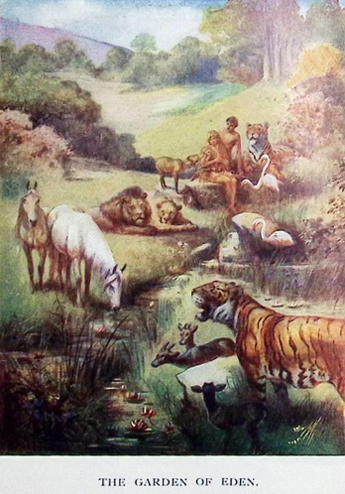
THE GARDEN OF EDEN
In this garden they were very good and happy. God himself used to come down and talk to them in the cool of the evening.
He told Adam and Eve that He had made everything for them, and that the trees with their sweet fruit were for their food.
But God gave them one command. He said they were not to eat the fruit of one particular tree in the garden. God knew the fruit of this tree would make Adam and Eve very unhappy, if they ate it.
Now I must explain to you that there were some of God's angels who had been very disobedient, and they had been shut out of heaven because they would not obey God.
Adam and Eve were very happy, as I said, and they did not think of disobeying God till Satan (that wicked angel who tries to make us do naughty things) hid himself in a serpent, and came to Eve and began to talk to her.
Eve was not surprised that a serpent could talk to her, for so many wonderful things were around her, that she listened to him, and answered him, without thinking it was any harm.
This is how temptation often comes to us, children!
Satan began by asking Eve a very clever question. He said, "Are you sure God has said that you may not eat of every tree in the garden?"
Then Eve said eagerly, "We may eat of every tree except one; but if we eat of that one we shall have to die!"
Then the serpent said to Eve, "You will not have to die! You will only be a great deal more wise than you are now!"
And so Eve looked longingly at the tree, and when she saw that the fruit looked so nice, and heard that it would make her clever, she forgot all about obeying God, and picked the fruit and ate it, and gave some to Adam her husband, and he ate it too.
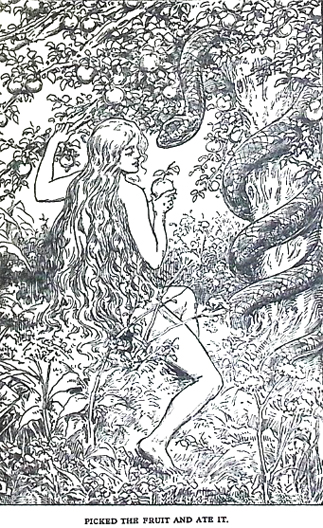
PICKED THE FRUIT AND ATE IT.
Oh, how sad was their disobedience, and what sorrow it brought on them and their children!
So the Lord God sent them out of the beautiful garden, because there was in the midst of the garden the Tree of Life, and God did not wish them to eat of that tree now.
So He put angels at the gate of Eden with a flaming sword, to keep the way of the Tree of Life.
Then Adam and Eve went out sorrowfully from their lovely garden, and Adam had to work very hard in digging the ground to plant things to grow for that food.
Eve was very sad too, and in the end they both had to die, as God had said.
But God is very pitiful, and when He was telling Eve how wrong she had been, and what a cruel enemy the Serpent was, He promised her that some day a Deliverer should come, who should destroy the serpent, Satan.
This Deliverer is Jesus Christ our Saviour, Who came to earth to live and to die for us, that He might undo all that Satan had done to hurt us, and make all who will trust Jesus, happy in heaven for ever.
And in the Revelation, we read a beautiful promise, which tells us something about Heaven that we never could have guessed when we saw poor Adam and Eve driven out of Eden—
"To him that overcometh will I give to eat of the Tree of Life, which is in the midst of the Paradise of God!"
XXIX. Cain and Abel
By and by God gave Adam and Eve two sons. The eldest was named Cain, who helped Adam till the ground; and the younger was named Abel, who was a keeper of sheep.
After a time, both these young men brought an offering to the Lord; and the Lord accepted the offering of Abel, which was a lamb from the flock, but He could not accept the offering of fruit which Cain brought.