SUNDAY STORIES (continued 2)
Reading edition
Perhaps you wonder at that, dear children? But I will try to explain it to you. God looks on the heart, and Abel's heart was obedient. He brought that which God had appointed as the way to come to Him. But Cain was not obedient; he thought that the fruit of the ground which he had taken such trouble to grow, would do just as well!
So when he found that God did not accept his offering, he was very angry, and his countenance fell.
And the Lord said to him, "Why are you angry, Cain? If you do well, shall it not be accepted? And if you do not do well, a Sin-offering lies at the door."
I think that GOD meant Cain to understand that it was only by a Sacrifice that we can come near to Him. And when, all through the Old Testament, we read of the sacrifice of a lamb as an offering for sin, God accepted the lamb, because He looked on to the time when the Lord Jesus would be "The Lamb of God, which taketh away the sin of the world."
But Cain did not heed God's gentle persuasion, that he too could bring a sin-offering; and presently, when he was alone with his brother, he got more and more angry, and at last rushed at him and struck him and killed him!
Oh, the misery of poor Cain! No one can tell how he longed to undo that cruel deed. No one knows the sorrow and punishment of his whole life.
Children, let it be a warning to us not to let anger and jealousy live in our hearts, but let us pray every day, "Deliver me from Satan, the Evil one, who would tempt me to sin against Thee, and accept me, for Jesus' sake!"
XXX. The Escape from Sodom
Then the two angels rose up and went towards Sodom, and the Lord remained talking with Abraham.
He told Abraham that He intended to destroy Sodom, because the city was so very wicked!
Now Abraham knew that his nephew Lot was living there, and he begged God to spare Sodom if there were fifty good people there. And the Lord promised to spare it if there were!
But Abraham began to fear there were not so many; and he kept on asking the Lord, till at last he got down to ten! and the Lord said He would spare it for ten's sake.
And then the Lord went on His way, and Abraham went back to his home.
But when the angels got to Sodom, they could not even find ten who loved God!
They found Lot and his family, and urged them to escape for their lives across the plain, and not once to look behind them, for Sodom was going to be burned all up!
So Lot escaped with his wife and two daughters and fled for his life. But his wife was disobedient to God's message, and turned to look back, and she was turned into a pillar of salt.
And so the great and wicked city was destroyed by a terrible judgment from the Lord, but Lot was saved!
Dear children! God has sent Jesus to be our Saviour, let us fly to Him from our sins, and so be safe for ever in His happy, happy land.
XXXI. The Tower of Babel
"What a great tower!" says someone. "And how high it is! Look; the houses are so small down there on that great sort of field, and the tower is going to be built higher still, because, you see, it is not finished!"
You are quite right! That beautiful tower never was finished, though it was begun four thousand years ago!
I told you about the Flood; and this is the next story after the Flood.
You remember that when the rain stopped, and God allowed the waters to go down, the tops of the mountains began to be seen, and then the green fields were uncovered, and Noah and his children and all the animals were able to come out of the Ark, and to begin to live on the earth again.
But, alas, as men began to increase on the earth, they began to forget God, and the way He had saved them in the Ark. But they remembered the flood, and they thought in their pride, that they would build a very high tower whose top should reach to Heaven, so that no flood could overwhelm them any more.
But there was another thing they forgot; and that was God's promise to them, that He never would send a flood to destroy the world again.
Then God came down from Heaven to see all that the men on the earth were doing. And when He saw their pride and their forgetfulness of Him, the Lord said, Let us go down and prevent the men from understanding each other's speech.
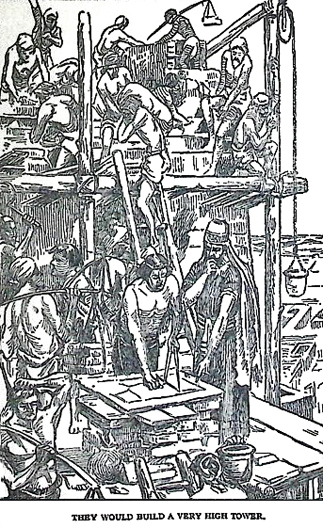
THEY WOULD BUILD A VERY HIGH TOWER.
And when God had done this, the men could not speak to each other about their work as they used. It was just as if someone were to speak German or Italian or Spanish to you and expect you to understand.
So the men could not build any more, for no one could understand what the others said. So they left off building and were scattered to all parts of the earth; and the city they had tried to build was called Babel—which means Confusion.
But God did not forget His servant Noah, nor Noah's good son Shem. He took care of Shem and of his children after him, and by and by of Shem's grandchildren and great-grandchildren, till at length Abraham was born.
And Abraham had the great honour of being called The Friend of God!
Perhaps you think how much you would like to be called such a name as that?
Then let all of us who would like to be called God's friends set out to be obedient.
God has put in the Bible rules which are to guide us every day. If we follow them, that is being obedient.
Do you remember what the Lord Jesus said about that, when He was on earth?
Here are the words,—
"Ye are My friends, if ye do whatsoever I command you." "For whosoever shall do the Will of My Father which is in Heaven, the same is My brother and sister and mother."
XXXII. The Friend of God
"Now the Lord had said to Abram, Get thee out of thy country, and from thy father's house, unto a land which I will shew thee; and I will make of thee a great nation, and I will bless thee . . . and in thee shall all families of the earth be blessed."
So Abram obeyed, and went out from Ur of the Chaldees, and came into the land of Canaan.
God had given Abram most wonderful promises, as well as frequent assurances of His love. He was also very rich, for God had given him a great deal of money, and many sheep and oxen and camels.
But there was one thing which God had not given Abram, which he longed for very much; and this was a little child of his very own.
God loved Abram, and He would not have denied him his desire without some wise and loving reason.
God promised Abram that he should have a son, but He wished to prove to all the world, and to the angels who are looking on at what happens on this earth, that Abram could trust Him, and trust His promise even though he should have to wait twenty years for it.
Abram had brought his wife Sarah, and his nephew Lot with him, when he left his own country; but after a time he and Lot had so many sheep and oxen that there was not grass enough for them all; so Lot chose the land towards Sodom, and Abram dwelt in the land of Canaan.
One day the word of God came to Abram in a vision or dream, saying, "Fear not, Abram, I am thy shield, and thy exceeding great reward!"
Then Abram told the Lord how he wanted a son of his own, for he had no one to take all his riches by and by, except the servant who managed his property.
And God promised Abram that he should have a son of his very own.
And God led him out in the night when all the beautiful stars were shining in the deep blue sky, and God said, "Look now towards heaven, and tell the stars if thou be able to count them"; and God said, "So shall the number of your children be!"
And Abram believed in the Lord, and He counted it to him for righteousness.
Do you not think, children, that as Abram walked on those lonely mountains in Palestine, that he must often have thought "God has promised all this land to me and my children!" And then, when he looked up at the stars at night in the clear atmosphere, that he must have been lost in wonder at the thousands and thousands of stars which he saw, and have said to himself, "God promised so shall my seed be!"
The Lord Jesus, in the New Testament, tells us something about Abraham which we do not read in Genesis.
He said "Abraham rejoiced to see my day, he saw it and was glad!"
How wonderful it is that God notices and remembers when we try to please Him, and sees our hearts when nobody else can!
At length Abram was ninety years old, and the Lord appeared to him again, and told him that his name should not be called Abram any more, but Abraham, because he was to be a father of many nations. And then God told Abraham that very soon he and Sarah were to have a little son, and that his name was to be called Isaac.
So one day Abraham was sitting at the door of his tent in the heat of the day, when he looked up and saw three men standing by him; and when he saw them, he ran to meet them and bowed himself to the ground.
Perhaps Abraham guessed that one of the three men was the Lord; for afterwards he did not seem at all surprised when the Lord spoke to him, and promised to give Sarah a little son very soon.
At any rate he begged the three men to rest beneath the tree while he hastened away to prepare food to refresh them.
Then he took butter and milk and a young calf which he had cooked, and set it before them and he stood by under the tree, and they did eat.
Then they asked him where Sarah was, and Abraham answered that she was in the tent.
And the Lord said, "I will certainly return and Sarah, thy wife, shall have a son."
Now Sarah was just inside the tent, and when she heard the words, she laughed within herself.
And the Lord said to Abraham, "Why did Sarah laugh, saying, 'Shall I of a surety have a child?' Is anything too hard for the Lord? At the time appointed I will return unto thee, and Sarah shall have a son."
And Sarah was ashamed that she had doubted God's promise, and she denied, saying, "I did not laugh," for she was afraid.
But the Lord said, "Nay, but thou didst laugh."
XXXIII. In a Thirsty Land
This is a nice story for children, because it tells us that God listens when children pray, and sympathizes with all that happens to children.
The boy you see in the picture is almost dying for want of water. Perhaps none of you children know how dreadful it is to be really very thirsty, and have nothing to drink, however thirsty you may be.
Hagar, the mother of the boy, is very sad. She knows that the bottle is empty, and she cannot see any sign of a well, or of a spring of water, in the great sandy desert which stretches in every direction as far as the eye can see.
Ishmael is her one child, and God has allowed them to be sent out into the wilderness, with only a bottle of water and as much bread as they can carry; for Hagar had been turned out of her home, and had been obliged to take that long and dangerous journey, because of the unkindness of her mistress Sarah.
But God was watching over her and Ishmael. He would not allow anything to really hurt them, and in His great pity, He sent to save them when all other help had failed.
By and by there was not one drop of water left in the bottle, and Ishmael had no strength to walk any further.
Hagar knew that all hope was over, now that Ishmael could not walk another step! So she laid him down under a little shrub that grew there, and went some little distance off, for she said in her grief, "I cannot bear to see him die."
So she sat down in her misery and cried bitterly.
But God heard the voice of the lad, and He sent His angel to call to Hagar from heaven. "What is the matter, Hagar? Do not be afraid, for God has heard the voice of the lad, where he is. Arise, lift up the lad and hold him in thine hand; for I will make of him a great nation."
Then God opened her eyes and she saw a well of water; and she went and filled the bottle with water, and gave the lad drink, and he revived, and presently got quite well.
And this is the lesson which we may learn from Ishmael's cry, children.
God knows our difficulties; God hears us when we speak to Him; God is nearer than we think; God is more loving than the most loving of earthly friends. He tells us to call upon Him in trouble.
Let us think of Ishmael dying for want of water, and crying to God in his distress, and let us do the same in our troubles!
No matter how small they may seem, God says He cares.
Let us take courage, then; and if God whispers to us when we are sorrowful (like He did to Hagar), "What aileth thee—what is the matter?" Let us listen for another whisper, for He will surely finish the sentence to us, as He did to Hagar, with the cheering words, "Fear not!"
XXXIV. The Offering of Isaac
So Abraham was given his dear little son Isaac, and he was the delight of Abraham's life, and of Sarah's too.
But by and by, God wished to try Abraham's faith more than even in that long waiting time for Isaac. God was going to ask him to do about the hardest thing that a man could be asked to do.
God told Abraham that he was to take his dear son whom he so fondly loved, and to go to a mountain a long way off, in the land of Moriah, and to offer him up to God as a sacrifice.
This was to try Abraham's obedience and faith.
Was he to take Isaac! On whom all his hopes rested, who was the joy of his life, and through whom all the world was to be blessed; was he to lay him upon the altar, and offer him up to God, as he did the lambs from his flock?
But Abraham did not hesitate. If God told him to do a thing, he obeyed. He knew that God could even raise Isaac from the dead, if He thought good. At any rate he had nothing to do, but to obey!
So he got up very early in the morning and saddled his ass, and took two young men with him, and his son, and the wood for the burnt offering, and set out on his journey to the place God had told him of.
The most precious thing Abraham had was that son who was walking beside him. And besides his love for his boy, God had promised that Isaac should live to have a son, and that by and by the Saviour should come into the world as one of Isaac's great-great-great-great-grandchildren!
Isaac was now grown into a strong young man, but he went with his father; and though he asked him on the way, Where was the lamb for the burnt offering? He was satisfied with his father's answer, "My son, God will provide Himself a lamb for a burnt offering."
When they reached the place which God had told him of, Abraham bound Isaac his son, and laid him upon the altar; and then he stretched out his hand with the knife in it, to offer up his son as God had told him.
But as quickly as the knife was raised, so quickly an angel of God called out of heaven, "Abraham, Abraham!"
Oh, how glad Abraham was to draw back that dreadful knife and answer, "Here am I!"
And God said, "Lay not thy hand upon the lad, neither do thou anything to him; for now I know that thou fearest God, seeing thou hast not withheld thy son, thine only son, from ME."
And when Abraham looked up, he saw a ram caught by his horns in a bush; and he took him and offered him up instead of his son.
So Isaac was given back to his loving father, and God was very pleased with Abraham's obedience, and He told him that in Isaac's children, by and by, all the nations of the world should be blessed.
For in about eighteen hundred years after this, the Lord Jesus Christ was coming to this earth to be "The Lamb of God which taketh away the sin of the world"; and I think that when Abraham said, "God Himself will provide a lamb," he was thinking, not only of the saving of Isaac's life, but of that far-off day when Jesus should bear our sins, instead of us, on the Cross of Calvary, that we may go free!
XXXV. A Bargain Between Two Brothers
By and by Isaac grew up to be a man.
Abraham and Sarah heard that in Abraham's old home in Mesopotamia, his brother Nahor had a family of sons and daughters, and they thought it would be very nice if Isaac could have one of these daughters for his wife. So Abraham called Eliezer, his chief servant, and told him to prepare for a long journey, as he wished him to bring back a wife for his son Isaac.
Eliezer was afraid that the maiden would not come so far, but Abraham told him that God would send His angel with him to prosper him on his way.
So Eliezer took some valuable presents, and set out with camels and servants to seek for a wife for his master's son.
He at length reached the city of Nahor, where Abraham used to live. It seems that Eliezer used to pray about everything! If he could not kneel down to pray, he prayed in his heart; and to those who tell God everything, God sends very quick answers.
In those hot countries, the caravans stop outside the city at the well, so that the thirsty men as well as the camels may drink.
Then Eliezer prayed, and asked God to send out the maiden to draw water, who was to be the wife of Isaac, and to point her out to him by her offering to draw water for the camels; and it all happened just as he had prayed.
Rebecca came out of the city with a pitcher upon her shoulder, which she carried to the well and filled with water.
When Eliezer ran to meet her, and asked her for a drink, she hastened to give him some, and offered at once to fill the trough and water all the thirsty camels. Then Eliezer asked her whose daughter she was, and when she told him, he knew at once that God had guided him to the very maiden whom Abraham wanted his son to marry!
Was not this a quick answer? And Eliezer not only asked, but he thanked God for the answer. "And the man bowed down his head and worshipped the Lord."
Then he gave Rebecca some beautiful presents; as well as many precious things for her mother and her brother.
And so Rebecca consented to go back with Eliezer and became Isaac's wife; and Isaac was very glad his father had sent for her all that long way, for he loved her very much.
By and by God sent Isaac and Rebecca two little twin sons, who grew up to be men.
Esau was the elder, and Jacob was the younger.
Esau was a very clever hunter, and lived an adventurous life among the mountains, and was often away for days in his hunting excursions.
Jacob, however, preferred staying quietly at home, living in the tents, and looking after the flocks and herds.
Isaac was now getting old, and he loved Esau the best of his two sons, because Esau often brought him a wild animal from his hunting, and would cook it for his father and make it into a savoury dish.
But Rebecca loved Jacob the best; and in after years, through her making him such a favourite, she had the greatest sorrow of her life.
One day Esau came in from a long journey, and though he had succeeded in catching and bringing home an animal, he had had nothing to eat for a long time and as he got near to the tents where they all lived, he saw his brother Jacob sitting eating a bowlful of red pottage, which he had just made for himself.
Esau was very faint and hungry, with such hunger as you and I, dear children, have probably never felt. Very likely he had tasted no food that day, and perhaps not the day before. The sight of the steaming bowl of pottage made him feel as if he would give anything he possessed for some of it to stop the pangs of hunger.
Now I am sorry to tell you that Jacob had a very mean character. Though he truly loved God and wished to please Him, his natural character was very shifty.
So when his brother Esau asked him eagerly to give him his bowl of pottage, Jacob did not jump up and press it upon his hungry brother, but he thought it was a good opportunity to make a bargain!
"If I do give it to you, sell me your birthright!" he exclaimed.
Now among the Jews, the birthright of being the eldest son, God had made a great honour. It was most jealously guarded and taken care of; and God gave great blessings with it.
But Esau did not love God truly in his heart, as Jacob did; he was busy with other things, and had never given it a thought that to love and serve God was more important than anything else.
So he said to Jacob, "I am so faint for food that I am ready to die! What good will this birthright do me?"
So Jacob answered, "You must give me your most sacred promise that you sell it to me for this pottage of lentils!"
And Esau promised most solemnly; and so he sold his birthright!
Then Jacob gave Esau some bread, and his pottage of lentils, and Esau ate and drank, and rose up and went away.
And thus, he despised the birthright which God had given him. He was very very sorry afterwards, but he could not undo what he had done.
I think this is a very sorrowful story, because there are so many people like Esau, who turn away from God's best gifts, and seek only the earthly things which will quickly pass away.
Let the lesson to us, dear children, be to love God first and best of all—before food or clothes, or toys, or happiness—to put God first; and when we have Him for our own, He will take care that we shall have all we need to make us happy; and at the end "a Right to the Tree of Life; and we shall enter in through the gates, into the Heavenly City."
XXXVI. The Ladder up to Heaven
Though Jacob loved God truly, he was not very truthful, and had many faults.
This is very sad, but I think knowing about it is a help to you and me, dear children, because we see that in spite of all, God loved him and forgave him, and taught him as He led him through his long life, to try more and more to please Him in everything.
Jacob had bargained with his hungry brother Esau for his Birthright, and had got it from him.
After a time when Isaac, his father, was very old and was soon going to die, Rebecca heard Isaac asking Esau to go out hunting and bring him home some savoury meat, for he wished to bless him before he died.
Directly Esau was gone, Rebecca called Jacob to her, and together they planned to deceive Isaac, who was nearly blind with age, by Jacob's dressing up in Esau's clothes and pretending to be his first-born son.
So Jacob got his father's blessing as well as the Birthright; and Esau was so terribly angry that he said he would kill his brother when his father was dead. When Rebecca heard of this, she begged Jacob to fly to Haran, where her brother Laban lived, and stay there until Esau was pacified.
Then she went to Isaac and told him that they would send Jacob to get a wife from her old home, and Isaac agreed, and Rebecca sent her son away and never saw his face again.
Oh, sad deception! What sorrow it brought on both Rebecca and Jacob!
So Jacob set out on his long journey and one night he came to a lonely places far from any village where people lived.
Jacob was tired and the sun had set, and he had no light to guide him, so he thought he would lie down where he was, and go to sleep till daylight.
Then he had a wonderful dream, and this is what he saw: Right in front of him was a ladder set up on the earth, and it went up till the top reached right to heaven. And he could see the angels of God going up and coming down upon it.
But beyond all, in the radiant glory, the Lord stood above the ladder and spoke to Jacob. He told him that He was the Lord God of Abraham, and of Isaac, and that by and by through his children's children should come the One who was to be the Blessing of the whole world.
We know the name of that Holy One Who is the world's blessing; it is Jesus Christ, Who came into the world to save sinners!
Then Jacob awoke from his dream and said, "Surely the Lord is in this place! . . . This is none other than the gate of heaven!"
So he took the stones on which he had been resting, and set them up for an altar to the Lord, and made a vow that he would serve God all his life, and would give to God the tenth part of everything that God gave to him.
Now it seems to me, children, that this Ladder up to heaven comes into our lives every day.
Jesus, our Saviour, is like the ladder which rested on the earth close to Jacob; and He is gone back to heaven now to be there to help us in every way: that is the top of the ladder which reached to heaven, where the Lord stood and spoke to Jacob.
So when you see this picture, say to yourselves, "Jesus is my ladder! He is close to me here, He is close to God there! He will never leave me nor forsake me; I can send messages and prayers every time I am lonely or in trouble, and He will send back answers if I wait for them."
So Jacob went on his journey over the desert and at length reached the country to the East, where he hoped he would find his mother's relations.
XXXVII. Jacob meets Rachel
One day Jacob sat down by a well, and looking about him he saw a number of flocks coming near and waiting by the mouth of the well, which had a large stone upon it. So he asked the shepherds whether they knew a man called Laban; and they told him that they did, and that his daughter Rachel was even now coming with her father's flock!
So Jacob was very glad to see Rachel, and went to the well and rolled the stone away, and watered the flock for her. And then he told Rachel that his mother was Rebecca, Laban's sister; and she ran and told her father.
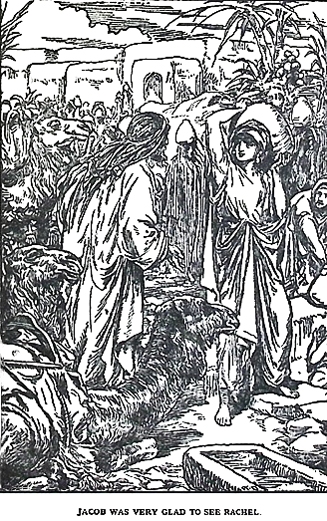
JACOB WAS VERY GLAD TO SEE RACHEL.
Then there was great rejoicing, and Laban welcomed Jacob to his home, and he began to take care of the flocks.
When Jacob had been there a month, Laban asked him what wages he would have, and whether he would stay with him? And Jacob gladly consented, for he loved Rachel very much, and promised to serve Laban for seven years, if he would give him Rachel for his wife.
So at the end of the time, Rachel became his wife; and by and by, God sent her a little son called Joseph, who was going to be, many years afterwards, a great ruler in the land of Egypt!
XXXVIII. The Story of Joseph
You have often heard of Joseph's coat of many colours, and of his being sold by his brothers into Egypt.
So I am going to tell you a little about him, and then you will understand how he came to have that beautiful coat. I have read that generally the eldest son was given a bright coloured, beautifully-worked coat; but Joseph was the eleventh son, and Jacob, his father, gave him that pretty coat because he loved him so very much.
When his brothers saw it, they felt very jealous, and hated Joseph because his father made him such a favourite.
Now jealousy is a very wretched feeling. It is wrong as well as wretched. If boys and girls—or grown up people-give way to jealousy, they may by and by do very unkind and wicked things. The Bible says "Jealousy is cruel as the grave," and you will see as we go on with the story of Joseph, how very true it was in his case.
One day Joseph had a very wonderful dream, and he told his brothers about it.
He had dreamed that he and his brothers were binding sheaves of corn in a field, and that his sheaf stood upright, and that all the sheaves of his brothers bowed down to his sheaf.
This displeased his brothers very much, and they hated him more than they did before.
After a time, Jacob sent Joseph to some far-off fields to see how his brothers and the flocks were getting on, for Jacob and his sons were shepherds.
When the brothers saw him coming, they remembered about his dream, and they determined to kill him, and cast his body into a pit.
But Reuben, his eldest brother, wished to save him out of their hands, so he advised them to put him into the pit alive, intending to come presently and take him back to their father.
But while Reuben was away, some merchants came by on camels, on their way down to Egypt, and the brothers decided to sell Joseph to them.
Though the lad wept and besought them not to be so cruel, they would not hear. So the merchants gave them twenty pieces of silver for their brother, and put him on a camel, and took him a long way off to sell him for a slave.
Then the brothers took Joseph's coat of many colours, and dipped it in the blood of a little goat, and carried the coat back to Jacob, telling him they supposed Joseph must have been killed by a wild beast, as that was how they had found his coat!
But "God meant it for good" all the time, and afterwards we see how this was.
So the unkind brothers let their poor father grieve for Joseph for many many years.
Meanwhile Joseph was brought by the merchants down to Egypt, which is the country that joins on to the land of Canaan at the bottom—or south.
The master who bought him from the merchants treated him very kindly, and when he saw how God prospered all that Joseph did, he made him overseer of all his property.
But all at once another trouble came to Joseph! He was falsely accused to his master, and was cast into prison. Still God meant it for good, and Joseph behaved so well in the prison (for God was with him), that the keeper of the prison took the fetters off his feet, and gave him the charge of all the other prisoners.
See, children, what a nice thing it is to serve God in difficult circumstances!
By and by, after a very long time, Joseph was taken to Pharaoh, the great King of Egypt, to tell him the meaning of a wonderful dream, which had frightened him very much.
Thus step by step the slave-boy was being brought to the king's palace.
God gave Joseph wisdom and favour. He was not only able to tell Pharaoh the meaning of his dream, that there would be seven years of plentiful harvests and seven years of famine; but he gave the king such good advice that the Egyptians were delighted, and Pharaoh put Joseph at the head of everything to carry it out.
The advice was, to carefully store up the corn in the good years, so that there would be enough for the bad years.
And it was in those bad years of famine that old Jacob—Joseph's dear father—sent ten of his sons down to Egypt to buy corn.
They had no idea that the great ruler, who, they heard, was selling corn to the hungry people, was their own brother, whom they had sold for a slave thirteen years before!
So they came down to Egypt, and were taken into the presence of Joseph, though they did not recognize who that great prince was. Then they bowed themselves to the ground before him, and asked him if he would sell them some corn for their families!
Joseph knew his brothers at once. They were less changed than he was; but he did not make himself known to them at first.
He asked all about their father, and their youngest brother; and spoke roughly to them, telling them that if they wanted corn, they must go back to fetch their brother Benjamin, that he might see him, if they were true men!
Afterwards he told them that he served God himself, and as he knew their families were hungry, he would give them some corn, but they must go, all the same, and fetch their other brother back.
Oh! How sorry all those ten brothers were for their sin. They remembered now how cruel they had been. They said to each other, "We were verily guilty concerning our brother, in that we saw the anguish of his soul when he besought us, and we would not hear."
But they talked in their own language, and did not know that the great prince understood them; and Joseph hastened away from them and cried. For he was quite ready to forgive them, but he longed to see his brother Benjamin. So he sent nine of them back with the corn to fetch him, and kept one brother in ward till they should come again.
So they returned to Canaan, and poor old Jacob was obliged to spare his youngest boy to go down to Egypt, little thinking that Joseph was alive, and that by and by, in God's best time, he was to see his dear Joseph again, and clasp his son In his arms.
God watches over His people, and promises to make all things work together for good, because they love Him!
XXXIX. Jacob Comes into Egypt
When at last Benjamin reached Egypt, Joseph could hardly help telling his brothers the great secret, that he was alive! But still, he allowed them to set out with their sacks of corn on their homeward journey again; and told his servants to hide his drinking cup in Benjamin's sack. When the party had gone a little way, Joseph's servants were told to overtake them, and to charge them with having stolen his cup!
You can guess how terrified the brothers were at such a charge from the great prince!
They unloaded their asses, and told the Egyptian servants to look for themselves!
But when the cup was really found in Benjamin's sack, they had not a word to say; and as they returned sorrowfully to the house of the great prince, they confessed to each other that God was punishing them for their cruelty to their young brother long ago.
But God saw their sorrow for their sin, and He forgave them, and was going to bring good out of it all.
When they got back to Joseph, after hearing their sorrowful explanation, he could no longer keep in his loving wish to forgive them; and he told them not to grieve, for he was still alive. And then, he sent them all home again, giving his brothers a handsome set of clothes each, and with quantities of presents for his aged father, as well as sending some wagons to the land of Canaan, to fetch his father and all their families down to Egypt, that he might take care of them while the famine lasted.
Joseph sent his father a great many beautiful presents; and when the brothers got back, and told Jacob that Joseph was alive and was ruler over all the land of Egypt, and that he wished his father and all their families to come down to Egypt, the heart of Jacob fainted within him, for he did not believe them.
But when he saw the wagons which Joseph had sent to carry him down to Egypt, "the heart of Jacob their father revived, and Israel said, It is enough; Joseph my son is yet alive: I will go down and see him before I die!"
And children! These wagons of Joseph's have often been a lesson to me!
Like old Jacob, we see God's mercies surrounding us, and yet because we do not believe and trust Him enough, our hearts faint within us at some fresh difficulty that stands in our way, perhaps.
You ask, "What are the wagons, then?"
I think the wagons are a picture to us of the reality of God's promises, and of the reality of the living Jesus.
Jacob said, "Joseph my son is yet alive!"
We may say with tenderest reverence, "Jesus my Saviour is a living Saviour, I will trust myself to Him and follow Him, and one day I shall see Him face to face!"
XL. Moses and the Children of Israel
You often hear in the Bible about "The Children of Israel," and now I am going to tell you how it was they were called by that name.
Long before Jacob and his sons went down to Egypt to live near Joseph, God had met Jacob one night and had given him a new name. God loved Jacob very much, and He did not wish him to be called Jacob any more, because that name meant a Supplanter—one who had taken something away from another—and God forgave Jacob for his deceit, and called him henceforward, Israel.
So, when in after years, he went down to Egypt, he is often called Israel; and thus his twelve sons came to be called "The Children of Israel."
Well, the children of Israel settled down in Egypt, and Joseph was very kind to them, and they lived in the land of Goshen and were very happy.
But after a time another Pharaoh came to the throne, who did not remember Joseph, and all he had done for the Egyptians in that great famine; and this Pharaoh thought that these Jews or children of Israel should be made into slaves, and should build his great cities and pyramids; and he made their lives a terrible burden to them.
But God had not forgotten His great promise to Abraham that his children should live in the land of Canaan; and when the time that God had mentioned to Abraham drew near, He was preparing a great deliverance for them; to take them right out of Egypt back to their own land!
You will now hear how God brought this to pass. His ways are most wonderful!
The King of Egypt, called Pharaoh, was very surprised to find that in spite of all his unkindness, the children of Israel grew to be so many, that he feared they would fill up all the land of Egypt. So he sent out a cruel order that all the little baby boys should be killed as soon as they were born.
Some of the Jews who loved and feared God would not obey the wicked order, and among these was a mother called Jochebed who had a very beautiful baby called Moses.
The very best way when we want to do anything very difficult is to tell God about it, and ask Him to help us. So this Jewish mother did; and then she made a strong basket of bulrushes, over which she put pitch to keep out the water, and then laid her sweet baby in it, and laid the cradle in the bulrushes on the river bank, sending his little sister Miriam to watch him as well as she could.
Think of the greedy crocodiles who might have come up from the river and have eaten little Moses up!
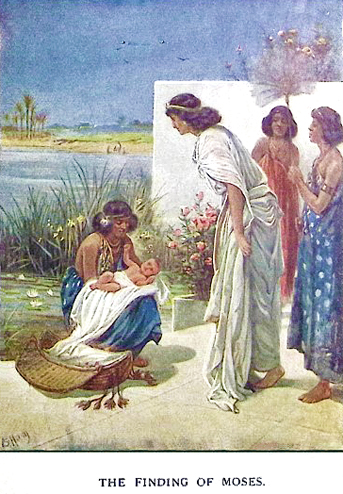
THE FINDING OF MOSES.
But God's loving care was over him and he did not get any harm.
By and by the daughter of Pharaoh came down to the river to bathe; and God sent her to the very spot where little Moses lay crying in his basket.
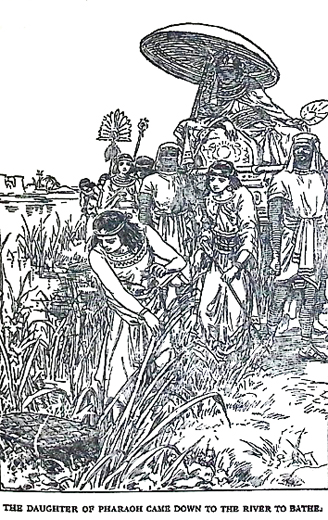
THE DAUGHTER OF PHARAOH CAME DOWN TO THE RIVER TO BATHE.
The Princess felt very sorry for the little baby, and guessed it must belong to one of the poor Jews who were ordered to throw their boys into the river. So she told her maids to take up the babe; and just as they did so, little Miriam, who was not more than twelve years old, came up to see what would happen to her little brother.
When she saw the Princess was so kind, she offered, like a wise little girl, to fetch a nurse for him; and when the princess gave her permission, Miriam ran to Moses, own dear mother; and she was allowed to take care of him, to bring him up for the princess, who loved him so much that she called him her son.
We are told in the Epistle to the Hebrews, that it was "by faith" that Moses' parents saved his life! Because they trusted God to do for them what they could not do for themselves!
XLI. The Rod of God
Perhaps when you have thought of little Moses in the bulrushes, you have wondered what became of him when he grew up to be a man?
Well, at first when he was in Pharaoh's Palace, he was given hard lessons to learn, like any of us. But he seems to have been very clever and very industrious, for soon he became learned in all the arts of the Egyptians, and was mighty in word and in deed.
Though he was brought up so grandly in a palace, he did not forget that he was a Jew, one of the Children of Israel. He was very sorry to see his relations so cruelly treated, and sometimes he would walk down to the part of the town where the Jews lived, and would look at them as they toiled at the hard work which Pharaoh gave them to do.
One day Moses saw one of the Egyptians being very unkind to a Jew, and he ran to them and defended the Jew, and killed the Egyptian and hid him in the sand; he thought the Jews would understand that God was going to send him to deliver them.
But the next day when he wished to settle a quarrel between two of the Children of Israel, they did not like it, and asked him if he was going to kill them as he did the Egyptian yesterday?
Then Moses was frightened, and left Pharaoh's beautiful palace, and all the splendour that he had enjoyed all his life, and went away quite far from Egypt for forty years! Here he was married and had two sons, and he kept his father-in-law's flocks, and lived very happily.
At length, when he was watching the sheep one day near to a mountain, the angel of God appeared to him in a flame of fire, out of the midst of a bush. Moses thought the sight so wonderful that he came closer to look at it, and then God called to him out of the burning bush and told him not to come near, as God Himself was there, and the place was very holy.
And the Lord said, what will comfort every one of us to remember, if we are in any trouble or sorrow, "I have surely seen the affliction of My people which are in Egypt, and have heard their cry by reason of their taskmasters; for I know their sorrows; and am come down to deliver them out of the hands of the Egyptians. Come now therefore, and I will send you to Pharaoh, that you may bring forth My people out of Egypt."
But at first Moses was very much afraid that the Children of Israel would not trust him, and he almost wanted God to send some other messenger who would do the work better.
But God was very patient with Moses; He kept on assuring him that He would help him in every difficulty, "Certainly I will be with thee," He said.
At last Moses told the Lord that the people would say that he had not seen God at all; and then the Lord asked him what it was which he held in his hand?
So Moses said it was a rod. Then God told him to throw it on the ground, and in a moment the rod had turned into a serpent!
Then God told him not to be afraid of it, but to catch it by its tail; and the serpent turned back into a rod in his hand.
So God told him to take that rod in his hand when he went to Egypt, for He would work signs with it for him.
Moses was still afraid, and then God allowed him to have his brother Aaron with him, that they might do God's wonderful signs together, and help each other.
At length Moses accomplished his journey to the land of the Pyramids, which it is probable the poor Jews were helping to build at that very time; and Moses stood before Pharaoh and gave him God's message "Let My people go that they may serve Me!"
But Pharaoh was not willing to understand that message. He saw those thousands of slaves, who were busy building his cities and his tombs, and he would not believe that there was anyone strong enough to deliver them from his powerful hand. So he said scornfully, "Who is the Lord, that I should obey His voice?"
XLII. Pharaoh's Refusal
So Moses and Aaron stood before Pharaoh and gave him God's message—
"Thus saith the Lord: Israel is My son, even My first-born . . . and I say unto thee, Let My son go that he may serve Me; and if thou refuse to let him go, behold I will slay thy son, even thy first-born."
Pharaoh was very angry. He did not love the great and holy God who made heaven and earth; but served his own gods made of wood and stone, who could not speak or move.
And he said scornfully, "Who is the Lord that I should obey His voice?"
So Moses did as the Lord had commanded him to do. He told Aaron, his brother, to take the Rod of God, which God had given him to do wonders with, and to cast it down on the ground in front of Pharaoh and his servants.
And when Aaron cast it down, the rod turned into a serpent!
So Pharaoh called his wise men and sorcerers to see what they could do. They were used to playing with snakes, and teaching them tricks; and when they threw down their rods, they also turned into serpents. But such a wonderful thing happened then—Aaron's rod swallowed up all their rods! That was a thing they could not do!
But Pharaoh's heart was hardened, and he would not let the Children of Israel go.
So God sent some dreadful plagues on the land of Egypt. He turned all their water into blood; He sent frogs over the land, which came into their houses and got up on to their beds; He sent a great darkness over all the land in the day-time, so that the Egyptians could not find their way about, and many more things which I have not space to tell you.
For many days Moses had been trying to persuade Pharaoh to let the Children of Israel go out of his land; and though God had sent great and dreadful plagues to warn the Egyptians that they must obey Him, yet Pharaoh would not listen.
At last, God sent Moses to him again and told him that if he would not let His people go, God would send His destroying angel through the land, and the first-born of every man and beast must die! And there would be most dreadful sorrow through all the land of Egypt.
XLIII. The Passover
The Easter full moon was shining down in all its white glory on the land of Egypt, more than three thousand years ago.
It was the last night that the Children of Israel were to stay in Egypt! To-morrow they would be free.
For that night, at midnight, the destroying angel would pass through the land of Egypt, to kill all the first-born of the Egyptians; and there would not be one house where there was not one dead.
Perhaps you think to yourselves, children, "But would the first-born of the Israelites die too? How would the destroying angel know which were Egyptians, and which were the Children of Israel?"
Ah! God had foreseen how to prevent that! He had not let plagues touch the houses of His own people!
He told Moses that all who wished to be safe on that dreadful night, must take a lamb, and when they had killed it, they must put its blood in a basin, and sprinkle the blood on their houses.
God told them to take a bunch of hyssop, and to sprinkle the top of the doorway and the side posts with blood; and He promised that when He saw the blood He would pass over that house, and not allow the destroying angel to enter.
That was why it was called The Lord's Passover.
And when God saw the blood of the Lamb, He looked forward to the time when His own dear Son would be the Lamb of God which taketh away the sin of the world.
Do you not think, children, that those Israelites made sure that the blood was sprinkled on their house? Can you not Picture them running outside to look before they shut themselves inside the door? And can you not almost hear them saying, "Yes, there is the blood of the Lamb! Now we are safe!" And so hurry inside again, and stay there until the morning, as they were commanded.
And does not this question come home to your heart and mine to-day? Is the blood of the Lamb of God sprinkled on my heart? Am I safe from the punishment of my sins because Jesus died for me?
If so, children, we may rest secure, and go out rejoicing on our journey towards the Promised Land in heaven.
* * * * * *
God told them also to take the flesh of the lamb and to roast it at the fire, and all who were in the house were to eat the Passover Supper. It was a night to be remembered for ever, when the Lord delivered His people out of Egypt! And we, too, may say—
"Christ our Passover is sacrificed for us, therefore let us keep the feast!"
XLIV. Bread from Heaven
So the Israelites left the Red Sea behind, and they went three days' journey into the wilderness, and found no water for them to drink.
At length they came to a place called Marah, where to their joy they found some water. But when they came to taste it, the water was so bitter that they could not drink it.
Then the people were very very angry with Moses, and blamed him very much.
So Moses cried to the Lord; and the Lord shewed him a tree, which when he had cast into the waters they were made sweet and nice, and the people could drink.
Soon after this the great company had eaten up all the bread they had brought out of Egypt, and there were no shops to buy anything at, nor any corn growing in the wilderness.
Here was a new trouble, so the people began to scold Moses and Aaron again, saying they wished they had stayed in Egypt after all.
They forgot all about the cruel taskmasters, and the bricks, and their slavery; and they told Moses he had brought them into the wilderness to kill them with hunger! How soon they had forgotten all that God had done for them, and how they had walked through the midst of the sea on dry land!
God was very grieved when He heard their murmurings; but He promised Moses that He would rain down bread from heaven for them to eat.
So that evening the Lord sent a number of little birds, called quails, for the people to eat, and they satisfied their hunger; and in the morning He sent them the bread from heaven which He had promised.
Perhaps you will say, children, "Loaves from heaven?" I daresay the Israelites thought the same, and wondered as you do.
So in the morning when they went out of their tents, the dew laid on the ground, and when the dew was gone, the whole ground was covered with little white seeds. And the Children of Israel called it Manna.
The Lord told them this was bread from heaven, and that they were to gather a measure—called an omer—full for each person, which would make them enough bread for the whole day.
On the day before the Sabbath, they were told to gather two omers full for every person, and to make it into cakes ready for the Sabbath day.
The taste of the cakes was like wafers made with honey.
And now, children, here comes a very sweet little lesson for you and for me.
Jesus is the true Bread from heaven, and every day, if we want to grow strong, and brave, and good, we should—before we begin the work, or play, or school of our day—kneel down and ask God to give us a sight of Jesus, and to let us taste the sweetness of His love. This will be our Bread from Heaven!
But soon came another difficulty. As the great company moved on their journey, they left the water which God had made sweet far behind them; and very soon they were thirsty again, and there was no water to drink!
They forgot all about the Manna and the sweetened water at Marah; and they went and scolded Moses again.
So God told Moses to go to the Rock in Horeb, and to strike it with his Rod, and water would flow out of it for the people to drink.
Moses did exactly as God told him, and the water flowed from the Rock, and so the People drank and were no longer thirsty.
XLV. The Tabernacle in the Wilderness
The children of Israel had been delivered from the bondage of the Egyptians, God had led them in the Wilderness by His pillar of cloud by day, and His pillar of fire by night; He had given them His Holy Law, which we call the Ten Commandments; and now God longed that the people should be brought near to Himself, and that He should be able to dwell among them.
So while Moses was up on the mountain alone with God, God told him to make tent or tabernacle where the people could bring their sacrifices, and where they might worship Him.
So the first thing Moses had to do was to tell the people that if they had willing hearts, they were to bring gold and silver and brass; and blue and purple and scarlet and fine linen; and shittim wood; and oil for light; and precious stones and spices; all these for an offering to the Lord, to be used for setting up the Tabernacle.
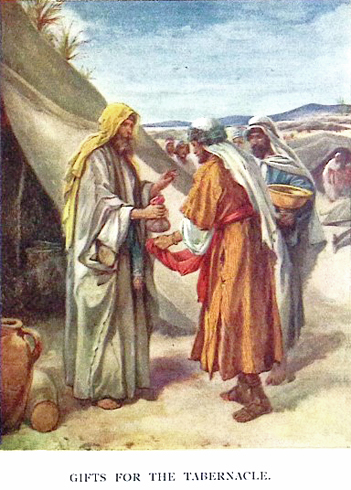
GIFTS FOR THE TABERNACLE.
And then within the Tabernacle there were to be some very holy things.
It was divided into two parts. One part was called the Holy Place, and the other the Holiest of all.
In this Holiest place of all there was only one thing to be put, and that was an Ark with the Angels (called Cherubims), shadowing the Mercy Seat above it.
In this Ark, or chest, God told Moses to put the slabs of stone with the Commandments written upon it; and this reminds us of those words, "Yea, Thy law is within my heart."
And then, resting on the top of the Ark, or chest, was the Mercy Seat, where the blood of the Lamb was sprinkled, and where God's glory would shine from day to day, as He talked with Moses from above the Mercy Seat.
Then in the other part of the Tabernacle, called the Holy place, there were to be three things. An Altar of Incense, overlaid with gold; the Table of Shewbread, where fresh loaves were to be put daily; and opposite to that, was the Golden Candlestick, all of gold, for the light.
God chose Bezaleel, the grandson of Hur, and filled him with wisdom to make all the wonderful things of the Tabernacle, according to the pattern God had given Moses, and to teach other wise-hearted men to help him in this holy work.
Surrounding the Tabernacle was a fence made with boards and curtains.
Every part of the Tabernacle was to be made so that it might be taken down, and carried from place to place, and put up again when the camp rested.
Only the priests might enter that enclosure hung with curtains. As the people looked into it from the doorway, or looked down upon it from the hillside above it, the first thing that they would see shining out in the light of the sun was the Brazen Altar, or Altar of Burnt Offering.
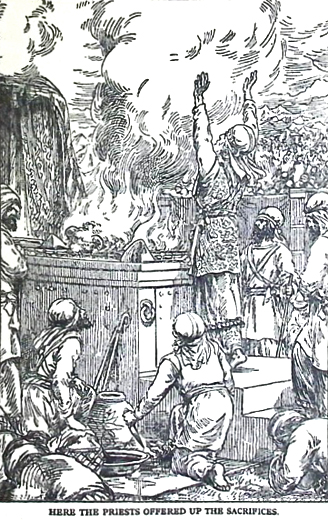
HERE THE PRIESTS OFFERED UP THE SACRIFICES.
Here the Priests offered up the sacrifices which were brought by the people, and God accepted them for the sake of Jesus, His Holy Son. For, children, we cannot draw near to God to worship Him, without the perfect sacrifice of Jesus Christ our Lord, who is "the Lamb of God that taketh away the sin of the world."
Then there was the Laver of Brass, at which the Priests washed before they went into the Tabernacle.
I cannot tell you, children, all that this wonderful Tabernacle means, but some day you will be able to understand how it all foreshadowed the loving life, and glorious work, of our blessed Lord and Saviour Jesus Christ.
* * * * * *
So when the Tabernacle was finished, "then a cloud covered the tent of the congregation, and the glory of the Lord filled the Tabernacle."
XLVI. Breaking God's Law
So God told Moses to lead the Children of Israel to a mountain called Sinai, and there He commanded all the congregation to wait while He gave them His Holy Law.
Moses went up to the top of the mountain to meet God, and to hear Him speak, and the people waited in the plains below.
But before God began to give His law to the people, He sent Moses down again to them to warn them once more not to come near the mountain; and even Moses, who was God's faithful servant, felt that the sight was very terrible, when he drew near to the thick darkness where God was.
God had many things to say to Moses, and many instructions to give him about making the beautiful Tabernacle, where they were to worship Him; so that he was up in the mountains a very long time—forty days and forty nights—and by and by the people began to get tired of waiting.
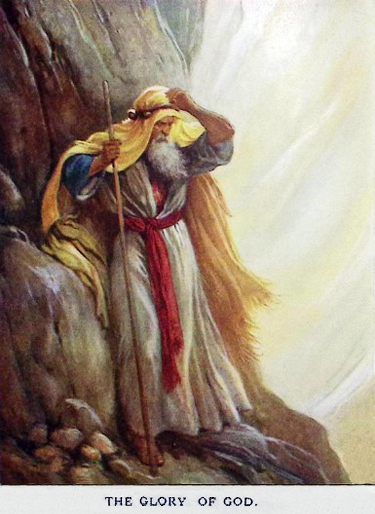
THE GLORY OF GOD.
They began to distrust God, and people soon get disobedient who distrust God! Then they said to Aaron, "Make us gods to carry before us, for as for this Moses, we do not know what has become of him."
I think Aaron was very sorry that the people were so foolish and so wicked. But he did as the people asked him. He made them a golden calf for them to worship, and allowed them to play round it.
Just as they were shouting and dancing and feasting, Moses began to come down from talking with God.
He held in his hand two pieces or slabs of stone on which God Himself had written His Holy Law—those ten Commandments which we often hear read, and which begin with "I am the Lord thy God which brought thee out of the Land of Egypt, out of the house of bondage, thou shalt have no other gods before ME."
Moses was carrying these two slabs of stone, and he and his servant Joshua (who I think had waited somewhere on the mountain while Moses talked with God) came down once more towards the camp. But when they had got within sight of it, they heard the sound of shouting and singing.
Then Moses looked down over the edge of the mountain, and he saw the golden calf set up, and the people worshipping it; and he was so grieved and angry that he cast down the two slabs of stone, which had been made by God, and written on by God, right out of his hand down the steep mountain side, and they were broken all to pieces!
Then Moses and Joshua hastened down, and Moses stopped the people in their worship of the golden calf. He cast it into the fire and burnt it, and was very angry with Aaron and the people.
Then he went to the Lord, and told Him all about it, confessing the great sin of the people, and asking Him to forgive it.
God is very pitiful and of tender mercy; and though He had to punish the people for their sin by sending a plague among them, yet He did forgive them, and He told Moses to lead the people forward again, and to make two fresh slabs of stone, and told him to write His law upon them over again.
How often we find in our daily lives, children, that when we mean to be very good, after all, we do not keep to what we had intended to do.
The only way is for us to ask God to write His Holy Law in our hearts every day, and to beg Him to keep us from doing what would displease Him. If we trust in our own strength we shall be sure to fail; but if we look to Him and truly seek to please Him, He will help us to become more and more like the Lord Jesus.
And when we know that we have failed in anything, let us not wait a single moment, but lift our hearts to our Father in heaven, and ask Him, for Jesus' sake, to wash away our sin and make us pure and white again in the precious Blood of Jesus, the Lamb of God.
XLVII. A Great Victory
Soon after the smiting of the Rock, out of which God made water to flow for the people's thirst, another difficulty came.
As the great company of the Children of Israel travelled on, some enemies, called, Amalekites, came out against them, and tried to conquer them.
So Moses called Joshua and told him to choose men who could fight, to go against the Amalekites; and that he would go to-morrow to the top of the hill with the Rod of God in his hand.
So Joshua did as Moses had said to him, and fought with Amalek; and Moses and Aaron and Hur went up to the top of the hill.
So Moses stretched out his hand with the Rod of God in it, and then the Children of Israel prevailed and conquered, but when he let down his hand, Amalek prevailed.
But poor Moses got very weary, and his hands seemed very heavy, so that he could not hold them up any longer!
But Aaron and Hur thought of a very good plan. They took a large stone for Moses to sit on, and they stood by him and held up his hands, one on each side, and his hands were steady till the sun went down.
And Joshua had a great victory over Amalek, because God fought for them.
And God told Moses to write it down in a book, and tell Joshua about it, that He would utterly destroy the Amalekites.
We read afterwards in Deuteronomy xxv. 17, that God had been specially angry with the Amalekites because they had attacked the Israelites when they were faint and weary, and had smitten the hindmost and weak ones in the camp instead of fighting bravely with the strong.
It seems to me that we may take this first battle of the Israelites as a sort of picture of Satan's temptations and buffetings.
He attacks us where we are weakest. He perhaps tells us that God has forgotten us for a little while, that we are like those weaker Israelites in the camp, who were particularly exposed to the enemy!
Then what must we do, when we feel Satan is too strong for us?
We must, like Joshua, resist with all the fighting power at our disposal; and like Moses we must take the Rod of God—the rod of faith and prayer—and go up on the hill top and get nearer God!
Do you wonder what the hill top is for us?
It is kneeling in our room and asking Him to help us.
It is looking up with our hearts, and saying one word of faith to Jesus!
And when they had gained that great victory over Amalek, Moses built an altar to God, and offered a sacrifice, and he called the name of it—
"Jehovah-Nissi," which means "The Lord our Banner!"
Here is a hymn which has comforted and cheered numbers of people who have found Satan—like Amalek—very strong!
Why should I fear the darkest hour, Or tremble at the Tempter's power? Jesus vouchsafes to be my Tower! Though hot the fight, why quit the field? Why must I either fly or yield, Since Jesus is my mighty shield? I know not what may soon betide, Or how my wants shall be supplied; But Jesus knows, and will provide. Though sin would fill me with distress, The Throne of Grace I dare address, Since Jesus is my righteousness. Though faint my prayers and cold my love, My steadfast hope shall not remove, While Jesus intercedes above. Against me earth and hell combine: But on my side is power divine: Jesus is all, and He is mine!
XLVIII. Caleb's Daughter
The old man whom you see in this picture is Caleb, one of the two faithful spies who brought a good report of the land of Canaan.
So when after forty years, the land was divided among the people, Joshua blessed Caleb and gave him Hebron or Kirjath Arba: and Caleb drove out from it three giants, and he made his home there.
There were still many enemies round him, so Caleb sent his soldiers to fight against Kirjath Sepher, and promised that the man who took the city should have his daughter Achsah for his wife.
So Othniel the son of Kenaz was the successful one. At length the wedding day came. When Achsah was starting for her husband's home, she begged Othniel to ask her father to give her a field as a wedding present.
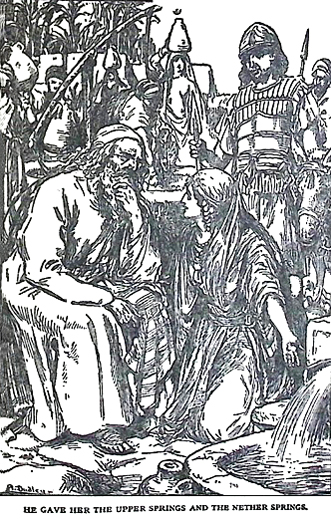
HE GAVE HER THE UPPER SPRINGS AND THE NETHER SPRINGS.
Caleb seems to have agreed to this; but Achsah knew he was rich as well as loving; so she alighted off her ass, and ran to his side, "Give me a blessing!" she said. "You have given me a south land—give me also springs of water!"
And he gave her the upper springs and the nether springs.
* * * * * *
Jesus says to us to-day, "How much more shall your Father which is in heaven, give the Holy Spirit to them that ask Him."
XLIX. The First King
So the child Samuel grew up and became a prophet of the Lord, and he judged the people and helped them in all their difficulties, by encouraging them to seek God and trust in Him.
But the Children of Israel often turned back from the Lord and followed their own ways, even making idols for themselves like the Canaanites had.
This grieved Samuel very much, because he knew that it would make God very angry with them.
At length Samuel was getting to be an old man, and the people got tired of being judged by his sons, who were not very good and faithful young men, and they asked Samuel to make a king to rule them, and go to war with them as they saw other nations do.
This was the greatest grief of all to Samuel, because the Lord was their King! But nothing that he could say would turn them from their wish to have a king whom they could see, and who would lead them to battle against their enemies.
The Lord told Samuel that he could do as the people asked; but that in choosing an earthly king they had rejected the Lord, who had brought them up out of the land of Egypt, and delivered them from all their foes.
There was at this time a man of the tribe of Benjamin whose name was Saul. He was a very handsome young man, and was so tall that he was head and shoulders above everyone else. His father's name was Kish.
One day, the asses belonging to Kish strayed away and got lost, and Saul and his servant went a very long way to seek for them.
They searched for a long time, but could not find them. At last, the servant suggested that they should go to the prophet who lived near the place to which they had travelled, for he thought perhaps he might tell them where to find the asses.
So they came to the city where Samuel the prophet lived, and when they made enquiries, they found that Samuel was going to offer a sacrifice there that very day.
Now the Lord had told Samuel that He would bring the young man who was to be king to him, that he might anoint him.
So Samuel met Saul and invited him to dinner, and told him that he wanted to speak to him presently, and that he should go back to-morrow. "And as for the asses," he said, "that were lost three days ago, they are found!"
So when they had eaten their meal, Samuel and Saul went on the housetop and Samuel talked with him for a long time; and early the next morning Samuel took a vial of oil and poured it on Saul's head, and told him he was anointed to be King over God's inheritance.
He told him also that he was to go to Gilgal and wait there seven days, until he came down to him to offer a sacrifice to the Lord.
But now, children, we come to Saul's first disobedience. Saul waited seven days, but he forgot that God's prophet had said "wait seven days, even till I come to offer the sacrifice," and when Samuel delayed to come for a few hours, Saul took upon himself to offer the sacrifice.
Then Samuel came! And Saul hurried out to meet him. But Samuel drew back from his greeting, and told him he had been very disobedient, and that the Lord would choose someone else to be the king; one who would keep God's commandments and love Him with all his heart!
So Samuel went back to Gilgal, and Saul went to fight against the Philistines.
* * * * * *
By and by God sent another message to Saul by Samuel the prophet, and this was the message: "Thus saith the Lord of Hosts, I remember what Amalek did to Israel . . . when he came up from Egypt, now go and smite Amalek, and utterly destroy all that they have, and spare them not."
So Saul went to fight against Amalek and conquered them; but again he was disobedient. He saved the king and did not kill him as he had been commanded, and he also saved all the best of the sheep and oxen.
Then the Lord said to Samuel, "It repenteth Me that I have made Saul king, for he hath not kept My commandments."
And it grieved Samuel, and he cried unto the Lord all that night.
And when Samuel rose early in the morning to meet Saul, the king hurried to him and told him he had done all that the Lord had told him to do!
But Samuel stopped him. "What is the meaning of this bleating of sheep that I hear, then?" he asked.
And Saul said, "The people saved the best to sacrifice to God!"
And Samuel said, "Do you think that the Lord has as much pleasure in sacrifice as in obeying the voice of the Lord? Behold, to obey is better than sacrifice, and to hearken than the fat of rams. Because thou hast rejected the word of the Lord, He hath also rejected thee from being king."
And as Samuel sorrowfully turned away, he knew that he should never see Saul's face again.
This is a very sad and solemn story, children.
Let us all be aware of little disobediences, lest they should grow into greater ones.
God will dwell in the humble and contrite heart, which trembles at his word. He will give grace to the lowly.
Let us pray, as David did in Psalm cxix., "With my whole heart have I sought Thee: O let me not wander from Thy commandments!"
And then this promise shall be ours: "He that doeth the will of God abideth for ever!"