PART III
Reading edition
APPENDIX I BRITISH SUBMARINES
“The tendency of the Admiralty is to follow and not to lead other great nations. I hope that one of these days we shall not follow just a little too late.”—W. E. Arnold Forster.
Probably the first occasion of recent years that mention was made of submarine boats in Parliament was subsequent to the trial of the Nautilus, a diving boat invented by Messrs. Campbell and Ash, during a trial of which several exalted personages nearly lost their lives. Lord George Hamilton described the incident to the House of Commons, and created some amusement by his relation, and there is no reason to believe that the submarine was looked upon by members other than as an erratic toy to whose mercy no wise man would entrust his person.
Mr. Nordenfelt built several submarine boats, one of which was bought by the Turkish and another by the Greek Government, but though in several quarters the advisability of the Admiralty purchasing one or more Nordenfelt boats was suggested, nothing came of it.
Mr. Edmund Robertson, K.C., dealing in the Nineteenth Century, of May, 1900, with the question of submarine boats 250remarked that five or six years ago he knew the opinion of the technical advisers of the Admiralty, and that they did not see their way to recommend the Admiralty or the Government to make any provision for submarine vessels of war.
Since that time, however, very few weeks passed but some writer took up the cudgels on behalf of the submarine and urged the Admiralty to consider the advisability of constructing boats.
The keen interest taken in France in under-water warfare was reflected to a certain extent in this country, and on the 9th of February, 1899, Mr. Charles McLaren addressed a question to the First Lord of the Admiralty in which he referred to the “extraordinary value” assigned by the French minister to the new vessels, and asked “whether the British Admiralty attached any importance to these experiments, or had any intention of adding any such vessels to the British Navy?” Viscount Goschen’s answer was: “It would be inexpedient at this stage for me to express the opinion of the Admiralty as to the reported performances of the new submarine boats. With reference to any action which the Board of Admiralty may take, I am not at present prepared to make any statement.”
The position of the Admiralty in the early part of 1900 may be ascertained from an answer given by Viscount Goschen to a question put by Captain Norton on the 6th of April. “Close attention has been given by the Admiralty to the subject of submarine boats. The submarine boat, even if the practical difficulties attending its use can be overcome, would seem so far as the immediate future is concerned to be eventually a weapon for maritime Powers on the defensive, and it is natural that those nations which anticipate holding that position should endeavour to develop it. The question of the best way of meeting its attack is receiving much consideration, and it is in this direction that practical suggestions should be valuable. It seems certain that the reply to this weapon must be 251looked for in other directions than in building submarine boats ourselves, for it is clear that one submarine boat cannot fight another.” In the debate on the Ship-building vote the First Lord made a further statement. “The importance of submarine boats had been pointed out, and it had been said that it was their duty to make experiments. The nations which were likely to have the greatest use for these boats might gain from their experiment more than others. He did not propose to make publicly any declaration as to these boats. Of course he did not wish to encourage or discourage other nations, but he must ask the Committee to excuse him going into the question.”
In the same debate Mr. Arnold Forster, who a few months later was appointed Parliamentary and Financial Secretary to the Admiralty, made some remarks on this “somewhat cryptic utterance,” as Mr. Robertson called it. “If in the matter of submarine boats the First Lord of the Admiralty had said that in the opinion of the engineering advisers of the Admiralty to design and work a submarine boat, was so remote of accomplishment that there was no reasonable probability of being able to work it, he would have been slow to contradict him; but that was not the line taken by him. The First Lord said that the Admiralty had not designed a submarine boat, and did not propose to design one, because such a boat would be the weapon of an inferior power. But if it could be produced as a working article, the Power which possessed such an article would no longer be an inferior but a superior Power. We, above all nations, were exposed to the attacks of this engine. He submitted that it was not a satisfactory thing to stand by and allow others to carry out this problem without making some attempt to solve it for ourselves. He admitted the tendency of the Admiralty to follow and not to lead other great nations. He hoped that one of these days we should not follow just a little too late. If we had been compelled to learn our lesson with regard to ironclads, breechloaders, and armoured 252cruisers in the face of an active enemy we should have experienced the same lessons which the Austrian army underwent in 1866 when they were compelled to learn the merits of the breechloader by studying it on the field of battle. There was room for improvement in the attitude we had taken up in regard to submarine navigation.”
During the short session of December, 1900, after the General Election, the Admiralty was again questioned, and the reply was that the “attention of the Admiralty had been called to the additional provision for submarine boats in the French naval programme, and a statement will be made when the estimates are laid before the House.” Between this date and the introduction of the Navy Estimates endless rumours regarding the position the Admiralty would take as to the submarine boat question found their way into the daily press. While, on the one hand, it was “confidently asserted” that, the Government were making secret trials with all kinds of wonderful craft, on the other hand it was stated “on the highest authority” that the Lords of the Admiralty had no intention of altering their minds as to the advisability of taking any action whatever in the matter.
The statement of the First Lord of the Admiralty explanatory of the Navy Estimates for 1901–2, published on the 1st of March, 1901, contained the following item:—
“Five submarine vessels of the type invented by Mr. Holland have been ordered, the first of which should be delivered next autumn. What the future value of these boats may be in naval warfare can only be a matter of conjecture. The experiments with these boats will assist the Admiralty in assessing their true value. The question of their employment must be studied, and all developments in their mechanism carefully watched by this country.”
In the discussion on the Navy (Supplementary) Estimates on March 4, 1901, Mr. Flynn asked whether the policy of the Admiralty in constructing battleships “as to the strength of 253which they knew nothing,” when other nations were turning their attention to submarine vessels, was quite wise. This same notion as to the advisability of going in for small submarines instead of big battleships is to be found in a speech by Mr. O’Shee on March 23rd, who said that if these boats were able to do half what was claimed for them, then the present gigantic expenditure for naval construction was entirely uncalled for. A submarine boat could be built for £25,000, and manned by ten men, and if it were true they were able to combat the big ships which the Government were building, those ships would be absolutely useless except for carrying the submarine boats to places where they were to work. If submarines were all that was claimed for them it would render unnecessary the £9,000,000 which was then being expended on new battleships.
Mr. Arnold Forster in the House on March 18, 1901, said:—
“I will not say much about submarine vessels, but I will say that I am glad that the Admiralty, under the advice of Lord Goschen, took the view that it was wise not to be found unprepared in regard to this matter. We have a great amount of information about these boats, but we do not attach an exaggerated value to it. But we believe that an ounce of practice is worth a ton of theory, and that when we get officers and men to see these boats, they will learn more from them than from many reports which come from foreign countries. One thing stands between the submarine boat and efficiency, and that is the motor by which it is propelled. But there is no disguising the fact that if you can add speed to the other qualities of the submarine boat, it might in certain circumstances become a very formidable vessel. We are comforted by the judgment of the United States and Germany, which is hostile to these inventions, which I confess I desire shall never prosper.—(Commander Young, M.P., said that if the Admiralty built any submarine boats, all he would ask would be that he might not be ordered to serve on one.)—But 254we cannot regard our position as the same as that of other nations. The United States to-morrow, if a perfect submarine were invented, would not only have more secure protection for their harbours. In Germany the harbours are no doubt carefully protected now. But we live in the narrow waters of the Channel, and our problem is not precisely that of any other nation, and I am glad that Lord Goschen did give this instruction to the Board which has now borne fruit in the determination to put this experiment into execution, and we shall see the result of it during the next financial year.”
Mr. Edmund Robertson, K.C., in the debate on the Navy Estimates on March 21, 1901, remarked that as the building of the submarine boats was only a matter of experiment, he thought it might have been introduced upon a somewhat smaller scale. If its value was purely conjectural, he should have said that one boat would have been enough to experiment with. Two should have been quite enough, but we generally did things on a large scale, and after having refused to say one word for many years about submarine boats, we now found the Admiralty launching out into quite a little fleet of them. “What,” asked Mr. Robertson, “had become of the control of the House of Commons? What had become of that control when the Admiralty of the day, having refused to tell them their policy, come forward shortly afterwards and say they will build five of these boats?” He could not help protesting against this, for a new departure of this nature ought not to have been made except with the sanction of the House, and at the very least it ought not to have been done without being divulged to the House.
It may be noted that Mr. Arnold Forster, speaking in the House of Commons in January, 1902, explained that when the decision to construct submarine boats was arrived at, only one type was available for purchase, that the right to build boats of this type was in the hands of one firm, and that it was therefore necessary to entrust the work to that firm.
255The first British Submarines.—The first five British submarines are almost identically the same as the six Holland boats ordered by the U.S. Congress on June 7, 1900.
They are cigar-shaped vessels 63 feet 4 inches long; beam, 11 feet 9 inches; and displacement submerged, 120 tons. The plating and frames are of steel and of sufficient size and thickness to withstand the pressure of depths not exceeding 100 feet. The bulkheads are located to provide safety in event of collision, and to stiffen the hull as a whole; decks are provided throughout the whole length of the interior of the vessel, combined with beams and floors to carry the weight of machinery; the tanks are of steel, and they are braced, stiffened, rivetted, and caulked absolutely tight, and man-holes are located to allow access to the interior of all tanks.
When the vessel is in light condition for surface running, an above-water deck, 31 feet long, is available, and there are means of stowing anchor and lines and of affording mooring facilities to the vessel. Rudders of steel plates are provided, and they are supported by skegs at the stern of the vessel. The conning tower is of armoured steel; its outside diameter is 32 inches, and its minimum thickness 4 inches; it is provided with ports for observation by the steersman. In the construction of the vessel care has been taken that all portions of the exterior of the hull shall be free from projections of a kind that might be entangled by ropes or other obstacles when submerged, and the lines of the vessels have been designed so that there shall be a minimum of resistance when it is running at the surface.
Propulsion.—On the surface the vessel is propelled by a 160 h.p., single screw, four-cylinder, Otto gasoline engine, capable of giving a speed of 8 knots, while when submerged it is driven through the water by a 70 h.p. electric waterproof motor giving a speed of 7 knots. The radius of action at the surface is about 400 knots, while the storage batteries have sufficient capacity for a speed of 7 knots on a four hours’ 256submerged run. Gearing is provided for the charging of the batteries by using the motor as a dynamo, and running it from the gasoline engine when at the surface, and from connecting the propeller either to the engine or the motor; these operations are effected through clutches. Switchboards and switches are provided for the safe and efficient distribution of the electric current throughout the vessel. The lighting system consists of portable incandescent electric lamps, together with several ports and openings in the hull to admit the outside light. The hull is circular, in cross sections, and is divided by the watertight bulkheads into three separate compartments. There is also a thorough subdivision of the bottom and every precaution is taken to localise any injury to the hull which might threaten the buoyancy.
In the forward compartment is one torpedo expulsion tube, located at the extreme forward end of the vessel, opening outward two feet below the light water-line. The tube is placed with its muzzle in the nose of the craft and its axis inclined somewhat to the longitudinal axis of the vessel. The muzzle of the tube is closed by a watertight door, and this can be lifted from within for the discharge of the five Whitehead torpedoes, each 11 feet 8 inches long, which are carried in the interior. One torpedo is placed in the tube, and the other four are placed side by side above the storage batteries. When the first torpedo is fired a sufficient amount of water to compensate for the loss of weight is automatically and almost instantaneously admitted into the tube, causing only a slight change of time for a few seconds. Such compensation is necessary, as the submarine boat is lighter than the amount of water it displaces and any alteration in its weight tends to send it up to the surface or down towards the bottom. When the second torpedo is placed in the tube the water is run into a special torpedo compensating tank; of these tanks there are four, and they are filled as each torpedo is fired. When the last torpedo has been ejected the expulsion tube is filled with water and is kept thus until the end of the run.
257Besides the torpedo tube there is in the forward compartment a series of air flasks, a gasoline tank of 850 gallons capacity, and a trimming tank.
The central compartment contains in its double bottom the main ballast tanks and a circular compensating tank placed between the two sets of batteries. Above the double bottom and below the axis of the vessel are located the storage batteries, and above these are carried the four torpedoes, which are 45 centimetres in diameter and 11 feet 8 inches in length. In the same compartment are a series of air flasks in which air at 2,000 lbs. to the square inch pressure is stored for the purpose of keeping pure the living spaces of the crew.[9]
In the rear compartment is the four-cylinder gasoline engine, which is rated at from 160 to 190 actual horse-power, and at from 320 to 390 revolutions per minute. Its net weight is 1,300 lbs., its length over all is 9 feet 7 inches, and its total height above the crank-shaft centre is 5 feet 6 inches. In these engines, which gave satisfaction in the first Holland boat, the distribution of the cranks and the timing of the valves and igniters are so arranged that the operations in the four-cylinders alternate, so that while one is at the expansion stroke the other three are at the suction, compression, and exhaust strokes respectively. By this arrangement the engine is perfectly balanced and vibration is reduced to a minimum.
Submersion.—The first operation to be performed when it is desired to submerge the vessel is the admission of water into her ballast tanks. When these are full she runs “awash” with her conning tower alone above the waves.
In order to completely submerge the boat she is steered below the surface by means of her pair of horizontal rudders at the stern. When at the required depth (normally from 20 to 30 feet) she is brought up on an even keel by the 258inclination of the horizontal rudders, which may be controlled automatically (by some such arrangement as is found in the Whitehead torpedo) or by hand. All modern submarine craft go under at an angle, and are steered below the waves by rudders: the principle of submersion on an even keel by down-haul propellers, advocated by Mr. Nordenfelt, has been abandoned by all latter-day designers, as has also the submersion of the drawing in of cylinders adopted in the Campbell-Ash boat.
When running submerged the submarine is lighter than her displacement, and is only kept under by her horizontal rudders, which, of course, only act when she is moving.
The great drawback to all under-water craft has been their lack of longitudinal stability, for they have a tendency to rise or sink at the slightest provocation. In our account of the Nordenfelt boats this disagreeable quality is illustrated. In order to keep the vessel at a regular depth recourse must be had to the horizontal rudders and to the two trimming tanks and the one circular compensating tank carried.
In a general way it will probably be found possible to keep the boat on an even keel by means of her rudders, but if she shows any decided tendency either to dive to the bottom or to rise to the surface or to heel over to one side water may be admitted into the above-mentioned tanks, and the admission may be effected either automatically or by hand. A hydrostatic valve will prevent the vessel passing the safe limit of depth.
Air Supply and Ventilation.—Compressed air is stored aboard the vessel with means of allowing a supply of air into the interior of the vessel. Ventilators are provided for the circulation of outside air throughout the vessel; the gasoline vapours from the engines and all noxious gases are carefully excluded by suitable devices, while safety valves are provided to prevent the pressure to the vessel from exceeding that of the atmosphere.
259Pumps and Pumping.—All tanks and compartments are connected with the pumps, the valves are located to allow of quick manipulation, and pumps with independent means of operation are furnished in duplicate. The tanks can also be emptied by flowing out.
Navigating Apparatus.—In communication with the interior of the vessel there are bells and speaking tubes, while there are provided gauges, indices, and clinometers for indicating pressure, depth, positions, quantities, and weights.
Two compasses are carried, each compensated and adjusted. It is said that the first of the British submarines exhibited certain defects in its compasses, which it was thought were due to the steel conning tower. This was replaced by a brass construction, and on being tested the compasses acted more satisfactorily. After a few trials a new steering-wheel was fixed in the boat close to the conning tower, which could be worked from above and below alike.
The first British submarine was launched on November 2, 1901, at Barrow without any ceremony, although representatives of the Admiralty were present. The trials were placed under the direction of Captain R. H. S. Bacon, D.S.O.
Before launching “No. 1” was by means of a floating dock placed on the gridiron. A crew of six men were put on board, and she was then hermetically sealed for three hours, air being supplied by compressed air cylinders. The trial was quite successful, and the men suffered no inconvenience. On her first “sea trial” “No. 1” started from the floating dock and proceeded along the Devonshire and Buccleuch docks and back to her moorings. On subsequent trials she attained a surface speed of 10 knots.
The first submersion trials of “No. 1” were carried out on February 5, 1902. She went under water with some officers of the Hazard t.g.b., the mother ship to the submarines (Captain R. H. S. Bacon, D.S.O.) on board, and most satisfactory results were obtained. Her appliances for the 260purification of the air were used to maintain atmospheric conditions without any need of her cylinders of compressed air being requisitioned. The first deep sea trials of “No. 1” took place at the beginning of April last in the Irish Sea. The submerging was accomplished in less than six seconds. From the “awash” conditions she suddenly disappeared and then came again into sight some yards’ distant with great rapidity and ease, and the diving was continued at intervals for several hours at a time without any perceptible hitch.[10]
Submarine “No. 2” was launched on February 21, 1902. Certain alterations were made in her construction, rendered advisable by defects which had been discovered during the testing of “No. 1.” “No. 3” took the water on May 9th, and “No. 4” on May 23 last.
During April last No. 42 t.b. was commissioned at Portsmouth as tender to the Hazard t.g.b., and was sent to Barrow for a series of experiments with the submarines.
The Navy Estimates for 1902–1903 provided for four further submarines, which Mr. Arnold Forster said would be an improvement on those already constructed at Barrow. The Admiralty, he added, proposed to continue the process of adding submarines to our fleet. Details of the new boats are not obtainable.
261
APPENDIX II THE AMERICAN SUBMARINES
“The Submarine Boat is a small ship on the model of the Whitehead, subject to none of its limitations, improving on all its special qualities, excepting speed, for which it substitutes incomparably greater endurance. It is not, like other small vessels, compelled to select for its antagonist a vessel of about its own or inferior power; the larger and more powerful its mark the better its opportunity.”—Mr. J. P. Holland.
“In my judgment, as a constructor of these boats (the new Hollands for the United States Government), and from my long experience in designing and constructing war vessels for the Government, and as the constructor of the original Holland, I have no doubt whatever of the endurance, habitability, durability, and reliability of these boats.
“No type of boat in the navy has received such crucial tests as the Holland. The submarine boat to-day is further advanced in its development than any type of naval vessels that I am aware of. I desire to say that in my opinion the Holland, without any improvements, is to-day the greatest vessel for harbour and coast defence ever known.”—Mr. Lewis Nixon, builder of the Holland.
When the British Admiralty decided to experiment with submarine boats, the type chosen was that invented by Mr. John P. Holland. It is therefore fitting that some account should be given of the various stages through which the Holland boat has gone in the course of its evolution.
Although Mr. John P. Holland, of Paterson, New Jersey, 262U.S.A., made a number of experiments in the sixties, his first real submarine boat was not built until 1875.
Holland No. 1 may be described as an under-water canoe, for there was only room for one occupant, who propelled the vessel along by means of pedal-acting mechanism, a small screw being fitted at the stern.
The dimensions were:—
Length 16 feet
Beam 20 inches
Depth 2 feet

MR. HOLLAND’S EARLIEST SUBMARINE. (1875.)
It was divided into three parts; the two end ones were used as air reservoirs and submersion tanks, and that in the centre contained the operator, whose head was encased in a diver’s helmet. The vessel was driven by a small propeller projecting from the stern joist, and beneath this was the rudder.
Holland No. 2 was constructed in 1877 at the Albany City Iron Works of New York.
Its dimensions were:—
Length 10 feet
Beam 3·5 feet
Depth 3 feet
It had a double shell, and in the space between water ballast could be admitted for submersion. The motor was a petroleum engine of 4 h.p., working a screw at the stern. Two rudders, one vertical, the other horizontal, were carried, and experiments showed that the latter acted better when placed at the stern than when on the side. After a series of trials on the Passaic River, Mr. Holland removed the 263machinery and sank his boat under Falls Bridge at Patterson, where it probably remains at this day.
Holland No. 3 was commenced in 1879 in the yards of the Delamater Iron Company of New York City, and finished in 1881.
Its dimensions were:—
Length 31 feet
Beam 6 feet
Depth 6 feet
Displacement 19 tons
It was propelled by a 15 h.p. petroleum engine of the Brayton type; as armament a submarine cannon, 11 feet long and 9 inches in diameter, was carried, and the projectile was expelled by means of a charge of compressed air. “She was the first submarine since Bushnell’s time,” writes Admiral Hichborn, “employing water ballast and always retaining buoyancy, in which provision was made to ensure a fixed centre of gravity and a fixed absolute weight. Moreover, she was the first buoyant submarine to be steered down and up inclines in the vertical plane by horizontal rudder action, as she was pushed forward by her motor, instead of being pushed up and down by vertically acting mechanism. Her petroleum engine, provided for motive power and for charging her compressed air flasks, was inefficient, and the boat therefore failed as a practical craft; but in her were demonstrated all the chief principles of successful brain-directed submarine navigation. After the completion of the boat, Holland led the world far and away in the solution of submarine problems, and for a couple of years demonstrated that he could perfectly control his craft in the vertical plane. Eventually, through financial complications, she was taken to New Haven, where she now is.” In 1896 her air-compressor was removed to work a forge, and she is now nothing but an empty hull.
264Holland No. 4 was constructed in the yard of Gammon and Cooper, of Jersey City. It was simply meant as a model, being only 16 ft. 4 in. long, 28 in. in diameter, and displacing a ton. The motor was an explosive engine, which was to serve for propulsion above and below the surface. The life of this model was unfortunately short, for on one occasion she was submerged with her cupola open, with the result that the water entered and she sank.
Holland No. 5, commonly known under the name of the “Zalinsky Boat,” owing to its dynamite guns, was built at Fort Lafayette.
It was—
30 feet long,
7 feet beam,
7 feet in diameter,
and was armed with two Zalinsky pneumatic dynamite guns. Owing to an error in construction, she was shipwrecked on the rocks, but was afterwards rescued and used for some experiments in the docks.
Holland No. 6 never got further than the design stage; it was not a true submarine, not being capable of total submergence.
Holland No. 7 was known as the Plunger.
265
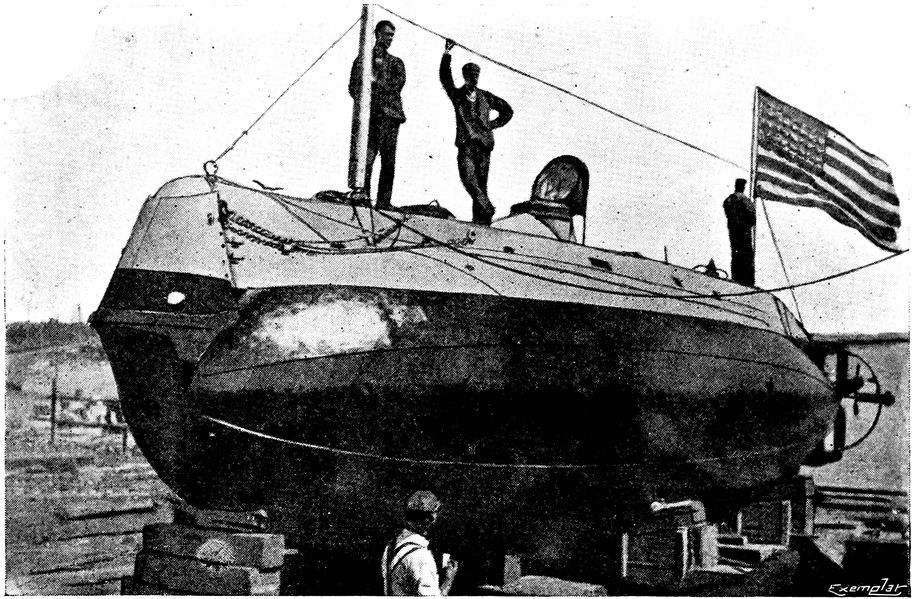
BOW VIEW OF THE “HOLLAND.”
Whilst Mr. Whitney was Secretary of the Navy he was anxious to provide some kind of protection against gun-fire for torpedo-boats, and under suggestion he invited proposals for submarine boats. A great many designs were sent in, and two propositions to build were made by the famous Cramp firm, the designs being those of Holland and Nordenfelt. It will not be necessary to enter into any detailed comparison between the two types. Suffice it to say that while Mr. Nordenfelt screwed his boat down by using vertical screws, and held the opinion that the keel of a submarine must always be kept parallel to the surface of the water, Mr. Holland steered his boat down and up an incline by the action of horizontal rudders placed in the stern. The Holland design was accepted, because “it embodied the ideas of a fixed centre of gravity, of an exact compensation for expended weights, of a low longitudinal metacentric height, and of quick diving and rising by the effort of the propeller pushing the vessel against the resistance of her midship section only down and up inclines, the angles of which were to be determined by horizontal rudder action.” Difficulties in regard to guarantees of performance prevented the closing of a contract that year—1888—and the next year, after all preliminaries were arranged, a change in administration caused the matter to be put aside. After the lapse of some years interest in submarine boats was again aroused, and on March 3rd, 1893, Congress authorised the building of a single experimental vessel, and after a third competition of designs and other delays a contract for a Holland boat was signed two years later with the Holland Torpedo-boat Company (formed in 1895). The new vessel was to be called the Plunger. The long delay was owing, 266Mr. Holland has said, to the opposition of a few officers of Conservative spirit, who preferred to see the value of submarine boats fully established by their employment in other navies, and their place in schemes of attack and defence properly located before they could recommend their adoption in their own navy.
The dimensions of the Plunger are as follows:—
Length 85 feet
Beam 11½ feet
Diameter 11½ feet
Displacement 140 tons on the surface
Displacement 165 tons submerged
Guaranteed speed 15 knots on the surface for two hours
Guaranteed speed 14 knots submerged to one foot with the conning tower above water
I.H.P. (surface) 1,625
I.H.P. (submerged) 200
Motor Steam engine on surface, fed with liquid fuel
Electric motor, completely submerged, giving speed of 8 knots for six hours
Although the Plunger was actually launched on the 7th of August, 1897, she was never completed, although for three years various alterations were carried out. The steam engines were removed and were replaced by oil motors, but by the time these modifications had been effected the Holland Torpedo-boat Company came to the conclusion that the Plunger, when completed according to the terms of the contract, would be so inferior to the more modern Hollands that they offered to refund the Government all it had paid them upon the Plunger, and all expenses connected with the contract, provided the Navy Department would enter into a contract for a new 267Holland. The proposition was accepted, and the money, some $94,000 odd, was accordingly refunded. A short time ago it was announced that the Plunger was being broken up.
Holland No. 8 resembled very much the later types, but as she was not entirely satisfactory, Holland No. 9 was built. This latter vessel is generally referred to as the Holland. She was the prototype of the British submarines, and her performances have excited a vast deal of interest all over the civilised world.
The dimensions of the Holland, which was constructed at Elizabeth Port, New Jersey, by Mr. Lewis Nixon, at the expense of the Holland Company, and whilst the alterations to the Plunger were still in progress, are as follows:—
Length 53 ft. 10 ins.
Diameter 10 ft. 3 ins.
Height (bottom to superstructure deck) 10 ft. 7 ins.
Displacement 75 tons
Water ballast 10 tons
Reserve buoyancy 250 lbs.
On the surface the motor is a gasoline engine of the Otto type of 50 h.p., giving a speed of about 7 knots an hour, and under water an electric motor, capable of giving 50 h.p. for 6 hours or 150 h.p. for 2 hours, is used. The battery of accumulators consists of 66 cells, giving 350 amperes for 4 hours, and allowing a speed of 8 knots an hour. The radius of action on the surface is 1,500 miles at 7 knots without a renewal of gasoline, and it can go 50 knots under water without coming to the surface. In order to dive water ballast is admitted until the boat is flush with the water, and it is then steered down an incline by her two horizontal rudders at the stern, carried in addition to the ordinary vertical rudder. It has a reserve buoyancy which tends to bring it to the surface in case of accident. It can dive to a depth of 28 feet in 8 seconds. The armament was intended originally to consist of three tubes—two at the bows and one at the stern; 268two were to throw aerial torpedoes and shells, while the third was to discharge Whitehead torpedoes. The submarine gun aft, which was worked by pneumatic power, and was capable of throwing 80 lbs. of dynamite a distance of about half a mile, was, however, abandoned. The aerial gun at the bows is 11·25 ft. long and 8 in. in diameter, and each of the projectiles weighs 222 lbs., and carries 100 lbs. of gun-cotton. This gun can shoot these projectiles a distance of one mile. The torpedo tube is 18 in., and three torpedoes are carried; they have a running capacity of more than half a mile at a speed of 30 knots. On the top of the boat a flat superstructure is built to afford a walking platform, and underneath this are spaces for exhaust pipes, and for the external outfit of the boat, such as ropes and a small anchor. From the centre of the boat a turret extends upward through the superstructure about 18 inches. It is about 2 feet in diameter, and is the only means of entrance to the boat; it is also the place from which the boat is operated.
As Mr. Holland had been experimenting with submarine craft for 25 years, and as he now considered that he had secured a practical result, and that his newest boat would do all that he claimed, he requested the United States Admiralty to make a series of exhaustive trials with the Holland. These trials accordingly took place, and having been found to be satisfactory, the Holland was purchased by the U.S. Government on April 11, 1900. The price paid was $150,000, and the Company stated that the vessel had cost them, exclusive of any office expenses, or salaries of officers, $236,615,427. The Holland was formally placed in commission under the command of Lieut. Harry H. Caldwell, U.S.N., on October 13, 1900, but the boat had been under the charge of this officer since June 25, 1900.
An Act making appropriations for the Naval Service for the fiscal year ending June 30, 1901, which was approved on June 7, 1900, contained the following item:—
269“The Secretary of the Navy is hereby authorised and directed to contract for five submarine torpedo boats of the Holland type, of the most improved design, at a price not to exceed one hundred and seventy thousand dollars each: Provided, That such boats shall be similar in dimensions to the proposed new Holland, plans and specifications of which were submitted to the Navy Department by the Holland Torpedo-boat Company, November twenty-third, eighteen hundred and ninety-nine. The said new contract and the submarine torpedo-boats covered by the same are to be in accordance with the stipulations of the contract of purchase made April eleventh, nineteen hundred, by and between the Holland Torpedo-boat Company, represented by the secretary of the said company, the party of the first part, and the United States, represented by the Secretary of the Navy, the party of the second part. Towards the completion of the equipment, outfit of the new vessels heretofore authorised 400,000 dollars.”
A contract for the construction of six (not five) submarine torpedo-boats, Nos. 3–8, was finally concluded on the 25th of August, 1900, between the Holland Torpedo-boat Company and the Secretary of the United States Navy.
Their names are as follows:—
1.
Adder.
2.
Moccassin.
3.
Porpoise.
4.
Shark.
These four were to be constructed in the yards of Lewis Nixon, at Elizabethport, New Jersey.
5.
Grampus.
6.
Pike.
These were to be built at the Union Iron Works, San Francisco.
As the specification for these six boats resembles in almost every particular that for the five British submarines of the Holland type, details need not be given here.
270The contract price of the hull and machinery of each boat was $34,000.
The first of the six submarine boats ordered from the Holland Company by the United States Government, to be launched was the Adder, the launching ceremony being performed by Mrs. E. B. Frost, wife of the Secretary of the Holland Company.
The Porpoise, Moccassin, and Shark were all launched in 1901; at the time of writing the Grampus and the Pike were still on the stocks.[11]
The “Fulton.”
The Fulton is an exact duplicate of the six boats the Holland Torpedo-boat Company have built for the United States. She has been built at the expense of the company with the object of experimenting, to see if it is possible to get smaller engines with less weight and greater power.
Mr. Holland said that he could not build his boats any longer and could not get any more speed, simply for the reason that he could not get engines with enough power. It was his intention to subject every part of the equipment and motive power of the Fulton to thorough test, and to incorporate the experience thus gained in the six Government boats.
The Fulton was launched on June 2, 1901, from the yards of Lewis Nixon.
In the autumn of last year the vessel, with seven officers and men on board, remained for fifteen hours at the bottom of Peconie Bay, whilst a bad storm was raging above, without having the air in the interior renewed. The turret-hatch was closed at seven o’clock on November 23rd, and at the expiration of fifteen hours it had not been found necessary to draw off any of the compressed air contained in the four flasks 271taken down with the boat. The atmosphere was said to be as pure as in the cabin of an ordinary yacht. A glass of water filled to the brim stood on the cabin table during all the time of submersion, and not a drop was spilled in spite of the gale blowing above water. The new submarines of the Fulton type carry 59 cubic feet of air compressed by a pressure of 2,000 pounds to the square inch. With the supply to fall back on, Captain Cable said that six men could probably live in the Fulton for something like eight months. It was, according to him, more a matter of food than air.
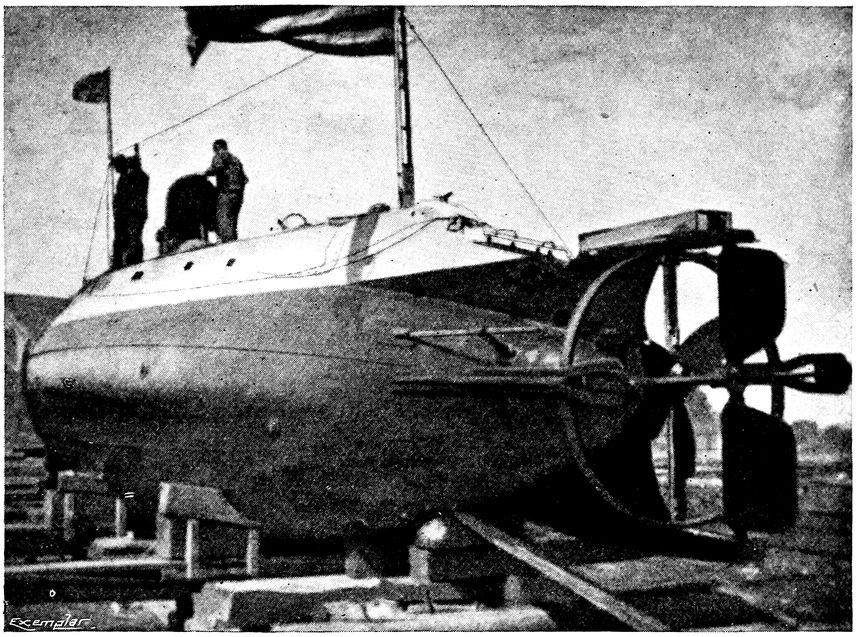
STERN VIEW OF THE “HOLLAND.”
In December, 1901, the Fulton gave an exhibition for the benefit of the Norwegian naval officers who were deputed to inquire into the capabilities of the Holland boats. Whilst travelling under water it discharged dummy torpedoes at targets with perfect accuracy, and dived repeatedly once in three seconds, or quickly enough to dodge a shell aimed at it. 272Commander Geelmuyden, who was aboard, said that when he inspected the Holland it was quite incapable of the Fulton’s performances. There is indeed little doubt that the newest Holland boats represent all that is newest and best in submarine boat construction.
She does not, however, appear to be perfect in every particular. On Monday, April 28, 1902, the Fulton left New York for Washington, convoyed by the steamer Norfolk. Her course was to have been to Hampton Roads, up Chesapeake Bay and the Potomac River to the Federal capital, where she was expected to arrive on the Saturday following her departure. She had on board, besides stored electricity for her submarine trials, 750 gallons of gasoline for surface propulsion. She put in at Delaware Breakwater on Monday morning, and shortly afterwards an explosion occurred. Lieutenant Oscar Kohen, of the Austrian Navy, who was on board at the time, was severely bruised, while a lieutenant of the American Navy and several others were injured. The boat itself was not seriously damaged. It transpired that the accident was due to a slight explosion of hydrogen gas caused by the spilling of the acid from the batteries. It was stated that during the trial the engine ran twenty hours in a very heavy sea without stopping, and the speed of the boat averaged 87 10 knots, and behaved extremely well.
The Holland Torpedo-boat Company intended, so it is stated, to build a couple of boats to go to the lakes and to be carried on battleships. Mr. Lewis Nixon, the builder of the Holland, said recently that Congress should provide one submarine boat at least for every battleship and cruiser small enough to be swung by a derrick, and lowered into the water before going into action. He remarked that it was perfectly feasible to design a successful submarine boat for such service. Admiral Dewey had said that big vessels could be fitted to carry diving torpedo-boats, and that special transport steamers would be the best for this purpose.
273
APPENDIX III FRANCE AND HER SUBMARINES
“By reason of her submarine division the navy of France is the most dread and the most powerful in the world” (A French journalist, after the torpedoing of the battleship Charles Martel by the Gustave Zédé in Ajaccio Harbour in July, 1901).
“Jamais nous n’aurions trop de sous-marins.”—(M. V. Guillouse in Le Yacht).
Had it not been for the keen and abiding interest displayed by Admiral Aube in the question of under-water warfare, it is extremely unlikely that the French Navy would be in possession of its present fleet of submarines.
It was in 1886 that Admiral Aube, being then Minister of Marine, requested designs for submarine boats. In most quarters his ideas were received with ridicule, and the experts of the day did not hesitate to declare that such vessels would never become warships, that at best they would serve only as diving bells, and that submarine navigation was a subject more fitted for romancers like Jules Verne than for serious marine architects.
The Admiral held his own, however, and contrary to the advice of the Director of Material, ordered from M. Goubet on the 12th of September, 1886, a small boat, and in the same year, in face of the protests of all his colleagues, he signed an 274order directing the Société des Forges et Chantiers de la Méditerranée to build a larger vessel from the plans of M. Gustave Zédé.
M. A. Saissy, a French journalist who has warmly advocated the constructing of submarines by France, has written a preface to Messrs. Forest and Noalhat’s treatise, “Les bateaux sous-marins” (1900), in which he pays a tribute to the endeavours of the late Admiral to provide his country with a submarine fleet. “Had we but followed his ideas,” he writes, “had we but carried out his plans, not only would the defence of our coasts and of our colonies be assured against attack, but France would be at this hour the greatest naval power in the world.”
Admiral Aube argued that in the naval war of the future France would most certainly act on the defensive, and that it was therefore the business of the nation to prepare, to organise, and to bring to the highest state of efficiency its weapons of defence. He blamed the Admiralty for spending the millions which had been voted for the navy in the creation of “mastodons” which “had neither speed, nor teeth to bite.”
M. Saissy says that the Admiral’s plans were put on one side and that his warnings appealed to deaf ears, but the time came when they were brought to light again.
“On the morrow of Fashoda, after the insolent behaviour of the English, the Minister of Marine saw his duty plain before him, and set to work with zeal. M. Lockroy was surrounded by officers to whom the programme of Admiral Aube was not a chimera. The study of submarine navigation was actively pushed forward, and if M. Lockroy had remained at the Ministry we should have at this moment an important number of these weapons of naval warfare, so precious and so indispensable; but he was superseded and, according to custom, his successor began to undo the good work of his predecessor, so that we find ourselves to-day in a most difficult situation. Our habit is always to act as if we had plenty of time before us, and the enormous budget of the Navy and its supplementary 275estimates will, unless we are on our guard, be wasted in a useless expenditure.
“If war had broken out last year, all our maritime ports and our arsenals would have been bombarded and burned, before our squadrons could have attempted to defend them.
“Is the situation better now than it was then? Have the means of defence been strengthened as they should be?
“The Ministry of Marine is aware of the gravity of the situation. Our legislators cannot be ignorant of the facts, and yet nothing is done. Our only hope is in the individual initiative of those honest men of science who give some thought to what the morrow may bring forth.”
M. Fleury Ravarin in a report written in November, 1900, supporting the Ministerial programme for the building of large battleships, remarked:—
“If we are now asked what a fighting navy should really be we must say that it should be capable of fighting upon the high seas with the navies of rival nations, and that it is the business of the technical boards of the Navy to indicate the nature and composition of the fleet required for the purpose. It is for the Parliament to decide if we shall be content with a modest defensive navy which would be unable, we cannot repeat too often, to do more than delay defeat in case of war, or whether on the other hand France is resolved to enforce her position as a great Power and to make the heavy but remunerative sacrifices necessary to give weight to her voice in the councils of Europe, thus attracting to herself commerce and riches, and spreading throughout the world her influence and her traditional ideal of justice and generosity.”
Recent French naval activity in ship construction, deepening the anchorages in home waters and protecting them against torpedo attacks, organising torpedo stations, enlarging dry docks, creating vast depôts of coal, war stores, &c., facilitating 276the rapid coaling of vessels, providing bases of operation in different parts of the world, &c., is avowedly aimed at Great Britain, and the idea that was uppermost in the minds of those who counselled these preparations was that France should be able, when a favourable moment arose, to strike a swift and sudden blow at British supremacy.
Writers in France openly acknowledge that all French manœuvres embrace the idea that the “enemy” is Great Britain, and the manœuvres of 1901 took the form of an attempt to prevent a junction of the British Channel and Mediterranean squadrons.
Baron de Coubertin has lately warned England in the plainest and most emphatic way that France will support Russia in any war with England, and it is now well known that Russia was prepared to support France in the Fashoda crisis.
Opinion in France is divided on the question of the shipbuilding programme; whilst, on the one hand, there are those who regard the construction of large battleships and cruisers as absolutely necessary, on the other hand, there are others who look upon this type of warship as inferior to the smaller class of fighting ship.
Just now the former party is in the ascendant. M. de Lanessan has contrasted the short range of the torpedo with the long range of the gun, and has deduced from the conditions the necessity for two classes of vessels (a) torpedo craft, and (b) battleships and armoured cruisers. He has explained that in order that the gun should be given its full value it is essential that the platform should be stable and that a vessel of considerable dimensions was thus called for. It was impossible upon such a platform to place many powerful guns, but a necessary consequence was that these should be protected, and hence came the need of heavy armouring. In short, the two qualities of offence and defence were indissoluble, but they were not the only qualities called for; speed 277and range in action were also necessary, and these again led inevitably to the heavy battleship.
M. Fleury-Ravarin, commenting on the fact that many advocates of the guerre de course had asked if there did not exist a more economical means of making war than that which consisted in opposing to certain ships others of a like character, told the French Parliament that it (the guerre de course) had never brought an enemy to submission, and that in the existing conditions of naval warfare it was very costly, whilst speed, its essential element, was of all elements at sea the most elusive. Moreover, the organisation of the guerre de course required many naval bases so that not only was it more costly in the beginning, but it demanded greater charges for maintenance. For these reasons this system of warfare could not be raised to a method; it must remain an accessory.
There can be no doubt that the popularity of the submarine craft with ministers, writers, journalists, and populace is due very largely to the idea that these vessels will in warfare prove capable of meeting and defeating the battleships and cruisers which Great Britain will send against France when the “Real Thing” arrives.
A writer who adopts the nom de plume of “Armour” points out the probable course of action in a naval war between France and Great Britain. British squadrons would be deprived of value by giving them no object to attack and preventing the possibility of establishing an effective blockade. The French ships would be withdrawn to the forts, which would be strongly fortified so as to secure them against attack. The close watching of a port would be too dangerous to be undertaken, and at night the squadrons would be obliged to withdraw to great distances in order to escape the menaces of the submersible boats: and at the same time the ingress and egress of cruisers—the only large vessels that would put to sea—would be easy.
In theory the British fleet should be equal in strength to 278the combined fleets of any two Powers, and although there are times when our strength is below the requisite, this ideal standard should be ever before those responsible for the condition of the navy. In the opinion of a certain class of Frenchmen the submarine will at a comparatively small expense, and in a very short space of time, satisfactorily neutralise all that England can do.
They hold that the use of the torpedo greatly strengthens an inferior but enterprising enemy, and that the tendency of torpedo warfare is to reduce the maritime forces of states differing considerably in power to the level of equals.
The opinions of a few of the most ardent believers in submarines among Frenchmen may be given here.
A French naval writer commenting on the sums expended by the French Government on the construction of submarines writes—
“The cruiser which can guard itself from the ordinary torpedo-boat will be without defence against the invisible enemy slowly creeping up to it to discharge its torpedo. It will be no longer possible for it to enter narrow waters and to approach the enemy’s coast. Its only safety will be in flight, and it will become a relic of the past. The naval battles of the future will take place not on the surface but in the depths of the ocean.”
M. Lockroy, in 1899, speaking in explanation of the French navy estimates, said that whilst formerly France had but one naval rival, she now had four, and the Triple Alliance could muster but sixty-seven battleships, while England had ninety-four, and France sixty. Could France ensure superiority over her rivals? Yes; submarine navigation ensured her a considerable advantage. The achievements of the Zédé might lead to a revolution in naval equipment and warfare. Meanwhile France had a terrible weapon—just what she wanted. “Everything,” said Vice-Admiral Jurien de la Gravière, “which threatens les colosses and tends to emancipate les 279moucherons should be warmly welcomed by the French Navy, for by such means we can double in a few years our forces and our power.” One might be forgiven for supposing that all French writers were on the side of the smaller fighting vessel. There are, however, quite as many who are opposed to this policy and who believe that France would be better with more battleships and cruisers and less torpedo craft, but they do not state their views in the emphatic and picturesque language of the other party, and as a consequence their influence is less felt. In 1888 Admiral Bourgois in his book on Torpedoes emphatically stated that the torpedo and the torpedo-boat could not take the place of the ironclad.
Says another writer: “Qu’on se rappelle les mitrailleuses de 1871. Nous souhaitons sincerement que le sous-marin après avoir inspiré la meme confiance exagerée ne cause pas les mêmes déceptions que les mitrailleuses de 1870!”
Again the same writer reminds his countrymen that a naval battle cannot be compared to a manœuvre when everything is arranged beforehand. The submarine cannot venture to sea in foul weather without exposing itself to dire accidents, but will the enemy wait until the sea is calm before commencing battle? What would happen if he chose the moment to attack when a troubled sea forces the submarine to remain in port and no other defence can be utilised?
The submarine, he says, is still in the rudimentary condition, and the problem of submarine navigation has not yet been solved.
“Other navies possess submarines and have made experiments, and we cannot be certain that we are ahead of them, although we make the most fuss.
“A means of defence from the attack of submarines, if ever they become really dangerous weapons, will assuredly be found, and the country which is so imprudent as to rely chiefly on such vessels will be quickly disarmed by a stronger foe.
“To sum up, submarine navigation, like aerial navigation, is 280as yet only in the experimental stage—let us follow its progress carefully and encourage experiments; but to make a radical transformation in our navy on the strength of certain manœuvres would be an act of imprudence both perilous and criminal.”
The attitude of the saner class of Frenchmen may be gathered from the following extract from a speech delivered in the Senate on the 4th of December, 1900.
“At the present time we are certainly all of us believers in the submarines; I am as keen a believer as you, but it must be recognised that it is still the vessel of the future rather than of to-day.
“The day may come when it will cause all the cruisers to disappear, but to-day the submarine is a weapon about whose efficiency one cannot be very certain, or at least whose use in warfare is limited to special circumstances. For the present, then, we needs must accept the proposals of the Admiralty and wait to substitute these new engines of warfare for our present bigger vessels until the future has given to submarines the power and the value which some already claim for them.”
“It has been the crowning misfortune of France,” said Sir G. Clarke, “that every fresh invention has resulted to the advantage of the principal naval Power, from whom it has ever been her ambition to wrest the command of the sea. A closer study of the problem of the submarine boat will probably reveal the fact that the boat will be of little use against moving targets, but, having been convoyed to its destination, may be of service against fixed targets. The Power able to blockade its enemy can so convoy the submarine boat without risk, and then it can be sent on its adventurous enterprise in the crowded harbours of the enemy.”
It will be only an instance of the irony of fate if submarines come to be employed by Great Britain against France in the next great war, but the French writers who declare that England reaps where France has sown must remember that no 281nation can hope in these days to possess the monopoly of any one particular weapon of warfare.
“We have seriously believed,” says a writer in the Journal de la Marine, “that in all the great modifications that have been brought about in the construction of submarines is the result of the important changes which the last fifty years of the century have produced in the art of naval warfare. All these changes have been sought out, experimented upon, studied, and finally realised by France, who has also been the first to apply them. These results have established in a brilliant and incontestable manner the skill of our engineers; but our rivals have not only appropriated the results of our labours, but they have not been slow to place themselves on equal terms with us, and finally to excel us in the application of these discoveries.... We have been only the humble artisans working for them to establish their superiority.”
All this, it is added, is due to the industrial supremacy of England. France built a commerce-destroyer, D’Entrecasteaux, of 8,000 tons, and with a speed of 19 knots. She was to prey on English ships of commerce like a second Alabama. And Great Britain replied to the threat by building the Powerful and the Terrible, each of 14,000 tons and 22 knots, and the efforts of France were thus brought to naught, and the Journal wearily complains that, “It is easy for England to place three armed cruisers for service where we can only place one.”
In the question of submarines Great Britain has pursued the same perfidious conduct. Very quietly the British sat still until France had done all the preliminary work of experiment and trial, and now, after something of the nature of a real engine for naval war has been produced by their engineers, Britain quietly steps in and begins at the point France had reached.
“The English Government have not chosen to contribute by their own researches and work to upset a state of things to which the supremacy of the British Navy is due; the appearance 282of a boat which will plunge under the water and act on the offensive within a considerable radius of action has enlarged the question. At present all they wish is the protection of coasts and harbours.”
But it was the intention of France to place herself in a position of offence towards England.
“In the near future the types Narval and Holland, being invisible enemies, would be in a position to operate against the English coasts and carry destruction into the midst of the naval forces which protect them. They would be able to seek and hunt out these same forces even in the harbours and roads where they are lying at anchor.”
But the ability of England to reply with some other equally good engine and protect herself as she has always done oppresses the writer’s mind.
“On the other hand, if England with any chance of success is able to oppose with the torpedo destroyer or some other force of an equalising nature, she will render all this impossible to the submarine. There will be some other means of defence against these redoubtable engines, though the solution does not appear to be near. England will find her best means of protection to attack the coasts of the enemy.... Anyway, she has five submarines on the stocks, and it is believed that these will be followed shortly by others.... The English have kept it a great secret. They have allowed a time of serious observation and attention to pass not with indifference before entering on the path opened by other nations.”
The writer takes consolation from the reflection that, although when England does begin it is easy for her to put three armed cruisers where France can only put one, yet the start in submarines which France has will revolutionise the conditions of naval war, and, he hopes, is such that she need not fear what England can do for a long time to come. “Doubtless,” he says, “more than a year will pass before the Holland or vessels of that class, however perfect they may 283be, can really be placed on service.” Then follows an enumeration of France’s fleet of submarines:—
“We possess already four submarines in service actually employed on the same work as torpedo boats—the Gymnote, the Gustave Zédé, the Morse, and the Narval. The Française and the Korrigan will follow the Gnome and the Lutin at Rochefort. At Cherbourg four are now on the stocks—the Silure, Triton, Sirène, and Escapadon. During this year twenty-three more will be placed on the stocks, which will make altogether thirty-seven submarines.”
These will make a most formidable fleet, sporting like porpoises round the English warships in the Channel and along her shores, and holding them at the mercy of France. “The fact that England should launch into their construction shows that they are more menacing to her than to us,” adds the writer complacently. But France is not to sit down quietly:—
“But since we have made a very real advance in that which concerns the submarine, let us work without ceasing to preserve this superiority. Our engineers, who have succeeded so brilliantly, will be able to work for themselves new improvements while profiting by the experience already acquired.”