Part 1 — PART I. French Submarines Proper, i.e. those Dependent entirely on Electricity for Motive Power.
Reading edition
Gymnote.
The first submarine built for the French navy was the Gymnote. The original plans of this vessel were worked out by the celebrated engineer, Dupuy de Lôme, but unfortunately he never lived to execute his project, for he died just when he had finished the details.
Some years later M. Gustave Zédé, a Marine Engineer, 284revived the ideas of his friend, and after making some modifications in Dupuy de Lôme’s original design, he brought it before Admiral Aube, the Minister of Marine, who accepted it at once, and signed a contract for its construction by the Société des Forges et Chantiers de la Méditerranée. M. Zédé was one of the directors of this society, and thus he was able to superintend the work, which was carried out under the direction of M. Romazzotti, then first-class Assistant Engineer of Marine.
The Gymnote is built of steel in the shape of a cigar. It is 59 feet long, 5·9 feet beam, and 6 feet in diameter, just deep enough to allow a man to stand upright in the interior; its displacement is 30 tons, a total weight a little less than the weight of the water displaced by the boat when completely immersed, and its speed about 6 knots; leaden plates placed on each side of the boat in two hollows regulate its draught of water. The top of the vessel affords a narrow platform, and on this are a manhole and a little cupola, with windows.
The motive power was originally an electro-motor of 55 h.p., driven from 564 accumulators. It was designed by Captain Krebs and built in the workshops of the Société des Forges et Chantiers at Havre.
It was of extraordinary lightness, weighing only 4,410 lbs., and drove the screw at the rate of 2,000 revolutions a minute, giving a speed of 6 knots an hour, its radius of action at this speed being 35 knots; reduced to 4 knots its radius of action was 100 miles.
This motor was afterwards replaced by a much simpler machine.
Immersion is obtained by the introduction of water into three reservoirs, placed one forward, one aft, and one centre.
The water is expelled either by means of compressed air or by a rotary Behrens pump worked by an electro-motor.
Two horizontal rudders steer the boat in the vertical plane and an ordinary rudder steers it on the horizontal. Originally 285one horizontal rudder only was carried at the stern, but this did not answer well and was given up.
The behaviour in the sea of the boat when subjected to the influence of this rudder was somewhat unsatisfactory. For rather prolonged “dives,” such as would be necessary, for example, in forcing a blockade, the instability of the boat became very great, and the man at the helm was unduly fatigued without succeeding in retaining the mastery of his craft. On account of this instability no greater speed in submersions than 6 knots was attained. For this speed the inclination of the axis of the boat was from three to five degrees forward. The difference in the draught of water between the bow and the stern was 0·88 metre (about 34 inches) for an inclination of 3 degrees; for 5 degrees it reached 1·50 metres (nearly 5 feet).
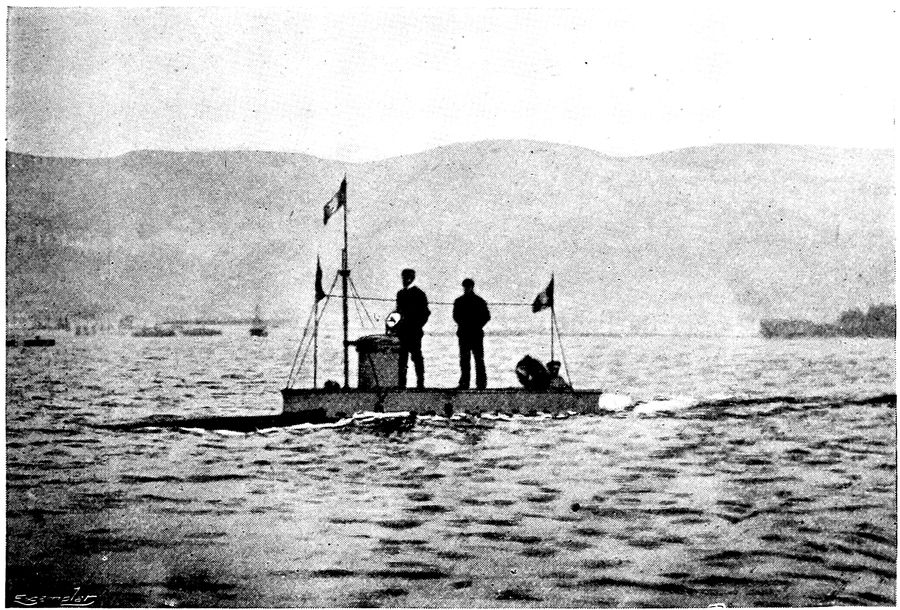
Photo by] [M. Bar THE “GYMNOTE.”
Another system of “dip” rudder, proposed in 1891, executed in 1893, and tested towards the end of 1894, 286consists in the employment of two horizontal floatboards, placed on each side of the boat at the height of the midship frame. Their use, combined with that of the stern rudder, has given better results. The boat is inclined less for the “dive,” dips more regularly, and lurches or “yaws” less.
When navigating on the surface or when her hull is immersed to the water-line the Gymnote carries a cupola, or movable shell with sidelights.
This apparatus is composed essentially of a metal shell provided with sidelights all round its circumference. A cylinder of strong tarred canvas fixed on steel springs, which ensure rigidity, bind the shell itself to the upper part of the hull. Horizontal folds in front permit this canvas to double up regularly upon itself after the style of a Venetian lantern, and in such a way that when the doubling up is complete the height of the shell (or “casque”) comes exactly on a level with the upper platform of the boat. During navigation at the surface or on the water-line the whole structure can be raised or lowered by means of a vertical screw moved by a horizontal hand-wheel of which the movable nut constitutes the lower part of a vertical frame formed of metallic uprights, which go to rejoin the hull. When the system is at the end of an upward course the canvas is completely stretched and the observatory is at its maximum height; when, on the contrary, it is at the end of a downward run, the canvas is completely contracted and the “kiosk” has externally disappeared.
Such a system (as a French writer has pointed out) is very faulty and dangerous, as may be easily conceived. In the first place, considering the feeble resistance which a canvas can oppose even when mounted on steel springs, it was indispensable to protect it against the pressure of the water during the “dive.” This was believed to have been accomplished by providing the shell with an indiarubber crown, forming a sort of beak, which, when the system was completely 287folded up and closed, came to rest on another washer of indiarubber placed at the bottom of a groove, where it formed a watertight joint. This would have been very good if there had been certitude that the beak or cap fixed on the shell rested exactly at the bottom of the groove. To make sure of that there had been arranged a small opening, which ought to give water when the closure was not sufficient, but this only gave an almost illusory means of control, the opening being found almost always obstructed by some detritus, débris of sea-wrack, and other foreign bodies encountered by the vessel. It will be seen what permanent danger was created by this apparatus—danger which on two occasions just missed causing the loss of the craft, an unlooked-for chance alone preventing it from foundering.
It would further be easy to show that in spite of its danger the movable shell, with canvas folded in accordion pleats, was almost unusable—that it could not serve when there was a slight sea on; that it caused, even during progress on the water-line, infiltrations capable of sinking the boat; and finally that, even in a calm sea and under the best conditions, the length of the manœuvre of raising and lowering made the operations of the “dive” slow and wanting in precision—operations which demand so much rapidity and delicacy, and to which alone it is allowable to sacrifice something on a submarine boat. This movable shell was 0·35 metre (about 13½ to 14 inches) in diameter; it was abandoned after all the Commandants had successively condemned it, and to-day it is never used.
For use below the surface the Gymnote carries an optical tube with two inclined mirrors and a periscope, but these have so far given but poor results.
The Gymnote was first tried on September 24, 1888, in Toulon harbour. The French Press was enthusiastic about the qualities of the new boat. According to Le Temps she was a complete success: “She steers like a fish both 288as regards direction and depth; she masters the desired depth with ease and exactness; at full power she attains to anticipated speed of from nine to ten knots; the lighting is excellent, there is no difficulty about heating. It was a strange sight to see the vessel skimming along the top of the water, suddenly give a downward plunge with its snout and disappear with a shark-like wriggle of its stern, only to come up again at a distance out and in an unlooked-for direction. A few small matters connected with the accumulators have to be seen to; but they will not take a month.”
At the trials which took place before the Maritime Prefect of Toulon in 1888, the Gymnote behaved very well, as far as speed and stability were concerned, but it was found difficult to keep her at a constant level when submerged.
The Gymnote was commanded by several officers, and for some time served as a training school for officers and men in the management of the new type of craft, and many suggestions and improvements were suggested by them, and in some cases carried out. She is now used as an instructional boat.
At first the vessel carried no armament, but afterwards two torpedo tubes were fitted.
Gustave Zédé.
The Gymnote being intended merely as an unarmed, experimental craft, the next step was to construct a larger vessel carrying a submerged torpedo tube.
M. Barbey, the Minister of Marine, took the initiative in this project and M. Romazzotti, Naval Constructor, was ordered to draw up the plans for the boat and to place it on the stocks in the yard of Mourillon.
The construction of the boat (which was to be named the Sirène) was decided upon in 1890.
During the building M. Zédé, the inventor of the Gymnote, died, and the Minister of Marine conceived the happy idea of 289paying a last tribute of respect to the famous engineer by giving the name of Gustave Zédé to the first armed submarine of the French fleet.
The Gustave Zédé was launched at Toulon on June 1, 1893; she is 159 feet in length, beam 12 feet 4 inches, and has a total displacement of 266 tons. Her shell is of “Roma” bronze, a non-magnetic metal, and one that cannot be attacked by sea water.
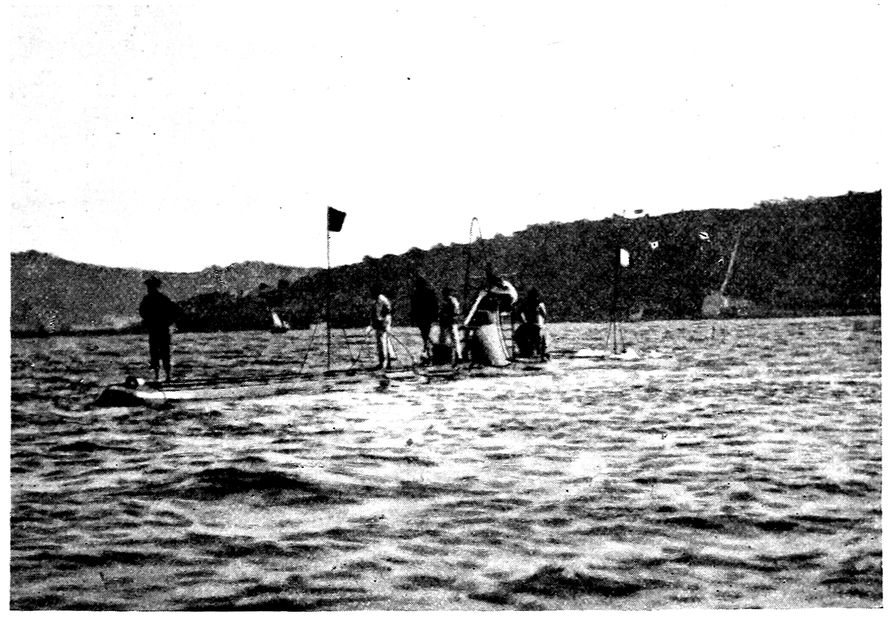
Photo by] [M. Bar THE “GUSTAVE ZÉDÉ.”
The motive power, of 720 h.p. is furnished by two independent electro-motors of 360 h.p. each of the Thury type, constructed by M. Sautter-Harlé and fed by accumulators of the Laurent-Cély type. The screw revolves at the rate of 250 revolutions a minute.
In order to endow the boat with a wide radius of action a battery was provided composed of 720 cells, each containing 29 plates and having an output of 400 amperes and a capacity 290of 1,800 amperes an hour. The Gustave Zédé had scarcely been placed in the water before the motive power gave out owing to the short-circuiting of most of the cells.
To remedy this, two plates were removed from each cell in order that each plate might be wrapped in a “chemise en toile d’amiante.” The result was no better for the covers, and the ebonite joints burst into flames and the boat was in danger of being consumed by fire. It was then decided to reduce it to 360 cells; this gave a speed of eight knots, though originally it was hoped that sixteen would be obtained.
The successive crews of the Gustave Zédé have suffered much from the poisonous fumes of the accumulators, and during the earlier trials all the men on board were ill.
In the bows is a torpedo tube and an arrangement is used whereby the water that enters the tube after the discharge of the torpedo is forced out by compressed air. Three 17½ Whitehead torpedoes are carried. In spite of the fact that a horizontal rudder placed at the stern had not proved serviceable on the Gymnote, such a rudder was fitted in the Gustave Zédé. With this rudder she usually plunged at an angle of about 5°, but on several occasions she behaved in a very erratic fashion, seesawing up and down, and once when the Committee and Experts were on board, she proved so capricious, going down at an angle of 30°–35°, often throwing the poor gentlemen on to the floor, that it was decided to fix a system of six rudders, three on each side.
Four water tanks are carried, one at each end and two in the middle, and the water is expelled by four Thirion pumps worked by a little electro-motor; these pumps also furnish the air necessary for the crew and for the discharge of the torpedoes.
For steering on the surface there was placed on the Gustave Zédé at first a movable shell with folded canvas similar to that of the Gymnote. It was found even more dangerous there than on the smaller boat; it was, therefore, taken away and 291replaced by a fixed kiosk, immovably attached to the hull, and of a shape tapering away fore and aft. The Gustave Zédé possesses, for under-water vision, an optical tube and a periscope.
The crew consists of an officer and eight men.
The first journey of any length undertaken by the Gustave Zédé was from Salins d’Hyères to Toulon. The sea was choppy, and a fresh breeze was blowing, and yet no mishap of any kind occurred. She navigated for the greater distance at the surface, with her cupola above the water, but when the water became too rough she plunged under the waves, occasionally emerging to take bearings. The distance between Toulon and Salins is short, and so the next journey was from Toulon to Marseilles, a distance of forty-one miles, and this the Gustave Zédé covered also in a rough sea without accident of any kind at the rate of six knots. Although accompanied by a tug, the Utile, it had no occasion for its services. She navigated on the surface all the way, but by reason of the swell everything was hermetically closed, and for more than seven hours the crew were kept in conditions exactly the same as if the vessel had been really under water.
On reaching Marseilles the accumulators had sufficient power left to perform the return journey.
The trials of the Gustave Zédé resulted in stimulating the interest of the French in submarine warfare. Writers vied with one another in extolling the qualities of under-water craft and the popular imagination saw already the powerful fleets of Great Britain and Germany destroyed by the attacks of the French submarine flotilla.
“Jamais nous n’aurions trop de sous-marins,” wrote M. V. Guilloux in Le Yacht. “The twelve years of consecutive efforts and studies continued in order to obtain a solution of the question of submarine navigation have at length been crowned with success,” said a writer in the Moniteur de la Flotte.
292Lieutenant Maurice Loir writing in the Moniteur of a later date remarked that Frenchmen went too fast in proclaiming that these isolated trials sounded the knell of the battleships.
He nevertheless believed the submarine boat to be a real element in naval war because the very fear of its invisible attack would keep at a distance adversaries who might have an object in approaching the coasts.
So great was the interest taken in France in submarine boats that the Matin opened a “Patriotic Subscription Fund” in 1898, to raise money for building submarine boats of the Gustave Zédé type. The journal itself headed the list with a subscription of 5,000 francs. In a long article the Matin dwelt on the utility of these engines of warfare, and asked the French public to furnish the funds necessary for the construction of at least one more Gustave Zédé. It urged the Government to build a fleet of these boats as an effectual protection for the French ports and the harbours of the French Colonies, against the most powerful navies of the world.
The result of the opening of the fund was that two submarines were presented to the nation—the Français and the Algerien—and the sum of 300,000 francs, mostly in small sums, was contributed by the French nation for these vessels.
The history of the Gustave Zédé shows how much in earnest the French were in the matter of submarines. When it was first launched it was a distinct failure in almost every respect, and it was only after some years during which many alterations and improvements were carried out, that she became a serviceable craft. At first nothing would induce the Gustave Zédé to quit the surface, and when at last she did plunge she did it so effectually that she went down to the bottom in 10 fathoms of water at an angle of 30°. The Committee of Engineers were on board at the time, and it speaks well for their patriotism that they did not as a result of their unpleasant experiences condemn the Gustave Zédé, and advise the Government to spend no more money over these monsters of the deep.
293 Morse.
Before the Gustave Zédé was completed M. Romazzotti prepared designs for a smaller submarine, which should be intermediary between the Gymnote, displacing 30 tons, and the Gustave Zédé of 266 tons.
This vessel, the Morse, is 118 feet long, 9 feet beam, 8 feet 3 inches diameter, is made of “Roma” bronze, and displaces 146 tons. Amidships is a circular conning tower rising about 18 in. from the top of the boat.
The sole motive power, as in the Gustave Zédé and the Gymnote, is electricity. The motor is of the Thury type, and develops 350 h.p., rotating the screw at 250 revolutions a minute. The current is derived from a battery of accumulators by the Société anonyme pour le Travail Electrique des Métaux. It is claimed that a means of recharging the batteries while at sea has been discovered; it is described as being a “combination of motors,” doubtless an intentionally vague description of a method which seems to be like an attempt to solve the impossible problem of creating energy.
The Morse is submerged and steered in the same way as the Gustave Zédé in her most improved form. Water is admitted into three separate compartments until a certain amount of buoyancy has been overcome, and the boat is then steered below the surface by her horizontal rudders. A false keel of lead can be detached if necessary from the inside.
The armament consists of a bow torpedo tube and two special carriers on the side, each holding one torpedo. Her crew consists of a commander and 8 men, and her range of action is 150 miles.
Although the Morse was taken in hand many years previously she was not launched until the 5th of July, 1899. One of the reasons for this delay was the question whether an oil engine should be fitted in the vessel for surface navigation. She has cost in all 648,000 francs.
294The Morse is steered on the surface and awash from the conning tower, and underneath by means of a periscope that rises above the surface and allows (theoretically) of her seeing everything at a depth of 20 feet. In fine weather the periscope reflects everything within its field of vision, and can be turned round so as to cover the whole horizon.
The French naval authorities believe that they have in the Morse a vessel which fulfils all the conditions of coast defence torpedo-boats, with the further advantage of invisibility, which makes it a specially dangerous weapon of attack upon hostile vessels in day-time.
Early in January, 1901, the French Minister of War visited Cherbourg and went for a trip in the Morse.
Although a considerable sea was running outside the harbour the submarine rolled very slightly. The operation of submerging took but two minutes. During the voyage four torpedoes were fired, and each was said to run straight and true.
“The feeling experienced,” says a writer in the Temps, “at the moment the vessel is making her descent is most peculiar; it is one of expectancy, but nothing happens, one is astonished at the quiet, the absolute calm, there is no movement, not even a tremble, the waves wash overhead without causing the least vibration, the motor works silently, and the vessel glides through the water without causing any bow wave or leaving any track. Above, the voice of the captain is heard, who, standing by the periscope, gives his orders for so many degrees of helm and so many revolutions of the engine. The little vessel is now almost in equilibrium, and would sink deeper or rise to the surface were it not for the ‘ailettes’ on each side which serve to prevent this. Before an instrument which indicates the depth stands a petty officer with his eye fixed and his attention concentrated on the pointer, and by turning a wheel he causes the ‘ailettes’ to act so as to maintain the vessel at the required depth. Should she for any 295reason continue to descend or refuse to ascend, a pig of lead ballast can be detached which would cause her immediately to rise to the surface, but after this the buoyancy would be so much increased that she could no longer be submerged even with all her ballast tanks full. Orders had been given to remain a quarter of an hour under water, and at the expiration of the time pumps are set in motion and the water is forced out of the ballast tanks (situated forward, aft, and amidships) and the Morse commences to rise, the conning tower and the small platform emerge, and the man-holes are opened. No commotion takes place at the entering of the external air and no inconvenience has been felt by those on board during the dive, the act of breathing being as free and regular as in the open air.
“Trials to ascertain the habitability of the Morse had already been made, and she has remained for eight hours under water, the crew experiencing no difficulty in breathing and no buzzing sensation in the ears, no excitation or inconvenience of any sort, and it was considered they could have remained double the time if necessary, the chemical analysis of the air showing also that it would have been possible to considerably prolong the trial if required.”
M. Calmette, of the Figaro, who accompanied General André on the trial trip of the Morse, sent to his journal a long account of his experiences during the two hours which the trial lasted. He said the defect of the Morse lay in the fact that the motive power was supplied by electric accumulators, the premature exhaustion of which might deprive the vessel of all means of action. A combination had, however, been effected, which enabled accumulators to be recharged on the spot. This system would be utilised on the submarines Français and Algerien. As was already known, the commander directed the navigation of the vessel by means of a periscope, the extremity of which, resting on the surface, gave him—no matter at what depth—an absolutely faithful and 296distinct image of all that was taking place on the surface. The immersion was effected easily and without shock, in exactly seventy seconds. Breathing in a submarine was as easy as in an ordinary room. The vessel could remain in the water for sixteen hours without inconvenience to the occupants, and could rise to the surface very rapidly. The correspondent went on to say that after the trial the Morse, in conjunction with the Narval, went through a series of manœuvres lasting eight hours. The Morse discharged a torpedo with remarkable precision by a process which was a profound secret.
M. Calmette’s account furnishes interesting reading. He says:—
“General André, Dr. Vincent, a naval doctor, and I enter the submarine boat Morse through the narrow opening in the upper surface of the boat. Our excursion is to begin immediately; in two hours we are to come to the surface of the water again three miles to the north to rejoin the Narval. Turning to the crew, every man of which is at his post, the commandant gives his orders, dwelling with emphasis on each word. A sailor repeats his orders one by one, and all is silent. The Morse had already started on its mysterious voyage, but is skimming along the surface until outside the port in order to avoid the numerous craft in the Arsenal. To say that at this moment, which I had so keenly anticipated, I did not have the tremor which comes from contact with the unknown would be beside the truth. On the other hand, calm and imperturbable, but keenly curious as to this novel form of navigation, General André had already taken his place near the commandant on a folding seat. There are no chairs in this long tube in which we are imprisoned. Everything is arranged for the crew alone, with an eye to serious action. Moreover, the Minister of War is too tall to stand upright beneath the iron ceiling, and in any case it would be impossible to walk about.
“The only free space is a narrow passage, 60 centimetres 297broad, less than two metres high, and 30 metres long, divided into three equal sections. In the first, in the forefront of the tube, repose the torpedoes, with the machine for launching them, which at a distance of from 500 to 600 metres are bound to sink, with the present secret processes, the largest of ironclads. In the second section are the electric accumulators which give the light and power. In the third, near the screw, is the electric motor which transforms into movement the current of the accumulators. Under all this, beneath the floor, from end to end, are immense water ballasts, which can be emptied or filled in a few seconds by electric machines, in order to carry the vessel up or down. Finally, in the centre of the tube, dominating these three sections, which the electric light inundates, and which no partition divides, the navigating lieutenant stands on the look-out giving his orders.
“There is but one thing which could destroy in a second all the sources of authority, initiative, and responsibility in this officer. That is the failure of the accumulators. Were the electricity to fail everything would come to a stop. Darkness would overtake the boat and imprison it for ever in the water. To avoid any such disaster there have been arranged, it is true, outside the tube and low down a series of lead blades which can be removed from within to lighten the vessel. But admitting that the plunger would return to the surface, the boat would float hither and thither, and at all events lose all its properties as a submarine vessel. To avoid any such disaster a combination of motors has been in course of construction for some months, so that the accumulators may be loaded afresh on the spot, in case of their being used up. I betray no secret in stating that this new scheme is already completed, and the next submarine vessels, the Français, the Algerien, and the Matin, will be fitted with the result.
“The Morse, after skimming along the surface of the water until outside the port, is now about to sink. The commandant’s 298place is no longer in the helmet or kiosque whence he can direct the route along the surface of the sea. His place is henceforth in the very centre of the tube, in the midst of all sorts of electric manipulators, his eyes continually fixed on a mysterious optical apparatus, the periscope. The other extremity of this instrument floats on the surface of the water, and whatever the depth of the plunge it gives him a perfectly faithful and clear representation, as in a camera, of everything occurring on the water.
“The most interesting moment of all now comes. I hasten to the little opening to get the impression of total immersion. The lieutenant by the marine chart verifies the depths. The casks of water are filled and our supply of air is thereby renewed from their stores of surplus air. In our tiny observatory, where General André stations himself above me, a most unexpected spectacle presents itself as the boat is immersed.
“The plunge is so gentle that in the perfect silence of the waters one does not perceive the process of descent, and there is only an instrument capable of indicating, by a needle, the depth to which the Morse is penetrating. The vessel is advancing while at the same time it descends, but there is no sensation of either advance or roll. As to respiration, it is as perfect as in any room. M. de Lanessan, who since entering office has ordered eight more submarine vessels, has concerned himself with the question as a medical man also, and, thanks to the labours of a commission formed by him, the difficulties of respiration are entirely solved. The crew can remain under water sixteen hours without the slightest strain. Our excursion on this occasion lasted scarcely two hours. Towards noon, by means of the mysterious periscope, which, always invisible, floats on the surface and brings to the vessel below a reflection of all that passes up above, the captain shows us the Narval, which has just emerged with its two flags near the old battery Impregnable. From the depths in which we are sailing we 299watch its slightest manœuvres, until the admiral’s flag, waving on the top of a fort, reminds us that it is time to return.”
Français and Algerien.
Two sister vessels, submarines proper, the Français and the Algerien, designed by M. Romazzotti, were laid down at Cherbourg in 1900. They were built with the proceeds of a subscription opened by the Matin at the time of the Fashoda dispute. They are almost identical with the Morse, though in some respects they are improvements on their prototype. They are built of steel, and the sole motive power is electricity. The cost of each is £32,972. The Français was launched on January 29, 1901, and the Algerien on February 15, 1901.
Farfadet Class.
The Farfadet class, designed by M. Maugas, consists of four submarines all laid down simultaneously at Cherbourg on September 27, 1899, viz., Farfadet, Gnome, Korrigan, and Lutin.
In size they are between the Gustave Zédé and the Morse, the measurements being—length 135 feet 8 inches, beam and also draught 9½ feet, displacement 185 tons. Each has a single screw, and the sole motive power is electricity, supplied by accumulators. On the surface the speed is 12·25, and submerged 9 knots. The complement is a lieutenant and eight men. The hull is of steel and not of Roma metal, like the Gustave Zédé and the Morse. The armament consists of four torpedoes carried on the exterior of the vessel.
The cost of each of the Farfadet class is about £32,000. The Farfadet was launched on May 17, 1901, and the Korrigan on February 2, 1902.
The Perle Class.
The Budget of 1901 made provision for 23 submarines, 20 of the “defensive,” 3 of the “offensive” class.
300The names of the 20 defensive boats are: (1) Perle; (2) Bonite; (3) Esturgeon; (4) Thon; (5) Souffleur; (6) Anguille; (7) Alose; (8) Dorade; (9) Truite; (10) Grondin; (11) Naiäde; (12) Protée; (13) Lynx; (14) Ludion; (15) Loutre; (16) Castor; (17) Phoque; (18) Otarie; (19) Méduse; (20) Oursin.
All these twenty boats (which were laid down in 1901) will be constructed of steel, will have a displacement of 68 tons, a length of 77 feet, a beam of 7½ feet, and draught 8 feet.
The sole motive power will be electricity supplied by accumulators, and the motor will actuate a single screw.
The maximum speed will be 8 knots, and their crew will consist of an officer and four men. The price of each is £14,616, which is less than any previous submarine boat.
Of these twenty vessels five are building at Cherbourg, six at Rochefort, and the rest at Toulon. They are to unite all the best points of the existing vessels, and are intended primarily for harbour and coast defence.