III. THALASSA. THE OUTER GEOGRAPHY OF THE ODYSSEY.
Reading edition
The legendary Geography of the Odyssey may in one sense be compared with that of Ariosto, and that of Bojardo. I should be the first, indeed, to admit that a disquisition, having for its object to establish the delimitation of the Geography of either of those poets, and to fix its relation to the actual surface of the earth, was but labour thrown away. For two thousand years, however, perhaps for more, the Geography of the Odyssey has been a subject of interest and of controversy. In entering upon that field I ask myself, why the case of Homer is in this respect so different from that of the great Italian romancers? It is not only that, great as they were, we are dealing with one before whom their greatness dwindles into comparative littleness. Nor is it only, though it seems to be in part, because the adventures of Ulysses are, or appear to be, much more strictly bound up with place, than those of Orlando, Rinaldo, or Ruggiero. The difference, I think, mainly lies in this, that an intense earnestness accompanies Homer every where, even through his wild and noble romance. Cooped up as he was within a narrow and local circle—for such it was, though it was for so many centuries the centre of the whole greatness of the world—here is his effort to pass the horizon ‘by strength of thought;’ to pierce the mist; to shape the dim, confused, and conflicting reports he could pick up, according to the best of his knowledge and belief, into land and sea; to people its habitable spots with the scanty material he could command, every where enlarged, made good, and adorned out of the wealth of his vigorous imagination; and to form, by effort of the brain, for the first time as far as we know in the history of our race, an idea of a certain configuration for the surface of the Earth.
Hence, perhaps, may have flowed the potency of the charm, which has attended the subject of Homer’s Outer Geography. The subject has, however, in my belief, its utility too. It is rarely otherwise than well worth while to trace even the erroneous thoughts of powerful minds. But, moreover, in the present instance, I apprehend we can learn, through the Outer Geography of Homer, important and interesting matter of history, which is not to be learned from any other source. For the Poet has embedded into his imaginative scheme a multitude of real geographical and physical traditions; and by means of these, upon comparing them with their proper originals, we can judge with tolerable accuracy what were the limits of human enterprise on the face of earth in the heroic age.
The question before us is, what map of the earth did Homer shape in his own mind, that he might adjust to it the voyages and tours of his heroes Menelaus and Ulysses, particularly the latter? And in order to a legitimate inquiry the first step to be taken is negative. Do not let us engage in the vain attempt to construct the Geography of the Odyssey upon the basis of the actual distribution of the earth’s surface. Such a process can lead to no satisfactory result. Whatever materials Homer may have obtained to assist him, we must consider as so many atoms; I speak of course, as to all that lay beyond the narrow sphere of his Greek knowledge and experience. He had no adequate means of placing the different parts of the accounts which reached him in their true geographical relations to one another. The outer world was for him broken up into fragments, and these fragments were rearranged at his pleasure, with the aid of such lights only, as his limited physical knowledge could afford him.
Principal heads of the inquiry.
Assuming for the present that the Phœnicianism of the Outer Geography has been on the whole sufficiently proved, I proceed to a more exact examination of the subject itself; and I propose to inquire into the following questions.
1. Has Homer two modes of dealing with the subject of locality, considered at large? if so, can it be shown that he applies them to two distinct geographical regions; one the circumscribed central tract of land and sea within which he lived, the other a wider and larger zone, which lay beyond it in all directions; and can a line be drawn with reasonable confidence and precision between these geographical regions accordingly?
2. If it be established that Homer has a system of Outer Geography, severed by a sufficiently-defined barrier from his Inner Geography, then are there any, and if so what, keys, or leading ideas of local arrangement for the former scheme, which, themselves derived from the evidence of his text, should be used for the adjustment of its details?
3. Under the system thus ascertained, what was the route of Menelaus, and more especially of Ulysses, as these presented themselves to the mind of Homer?
I set out from the proposition, which, as I conceive, rests upon universal consent, that within a certain sphere the poems may be considered as a record of experimental geography; and one sometimes carried down into detail with so much of accuracy, that it embraces even the miniature of that branch of knowledge, to which we usually give the name of topography.
By way of example for the former, I should say that when Homer describes the Bœotian towns, when he measures the distance over the Ægean, nay, when he makes Ulysses represent that he floated in ten days from some point near Crete to the Thesprotian coast, he is a geographer. Again, in his variously estimated account of the interior of Ithaca, he is a topographer. He is the same on the whole, though probably with greater license, when he is dealing with the Plain of Troy.
The two spheres of Geography.
In speaking of the experimental geography of Homer, of course I do not intend to imply that he had, even within his narrow sphere, the means that later science has afforded of establishing situations and distances with absolute precision. He could only proceed by the far ruder testimony of the senses, trained in the school of experience. Neither do I mean that the experience was in every case his own, though to a great extent his geographical information was probably original, and acquired by him principally in the exercise of his profession as an itinerating Bard. But by the experimental and real geography of Homer, I mean these two things; first, that the Poet believed himself to be describing pro tanto points upon the earth’s surface as they actually were; secondly, that his means of information were for practical purposes adequate. The evidence of the passage containing the simile of the Thought (Il. xv. 580) would suffice, were there none other, to show that he was himself a traveller; he also lived among a people already accustomed to travel, and familiar with the navigation of a certain portion of the earth’s surface. In a former part of this work I have given several instances to illustrate the disposition of the early Greeks with respect to travel[525]. A people of habits like theirs was well qualified to supply a practical system of geography for the whole sphere with which it was habitually conversant.
But the boldness and maturity of navigation may be measured pretty nearly by the length of its voyages. The geographical particulars of the Wanderings, however dislocated and distorted, show us that the people who had supplied them had acquired a considerable acquaintance with all the waters within, and probably also, nay, I should be disposed to say certainly, some that were without, the Straits of Gibraltar. But in all the poems of Homer we find the traces of Greek knowledge and resort become fainter and fainter, as we pass beyond certain points. On the Greek Peninsula, to the south of the Ambracian gulf on the west and of Mount Olympus on the east, we have the signs of a constant intercourse to and fro. The same tokens extend to the islands immediately surrounding it, and reaching at least as far as Crete. Indeed, apart from particular signs, we may say that, without familiar and frequent intercourse among the members that composed it, the empire of Agamemnon could not have subsisted.
But, at certain distances, the mode of geographical handling becomes faint, mistrustful, and indistinct. Distances are misstated, or cease to be stated at all. The names of countries are massed together in such a way as to show that the Poet had no idea of a particular mode of juxtaposition for them. Topographical or local features, of a character such as to identify a description with some particular place or region as its prototype in nature, are erroneously transposed to some situation which, from general indications, we can see must be upon a different and perhaps distant part of the surface of the globe. Again, by ceasing to define distances and directions, he shows from time to time that he has lost confidence in his own collocation, that he is not willing to challenge a comparison with actual nature, and that, from want of accurate knowledge, he feels he must seek some degree of shelter in generalities.
It is obvious that, under the circumstances as they have thus far been delineated, the geography of the poems, with a centre fixed for it somewhere in Greece, say at Olympus or Mycenæ, might be first of all divided into three zones, ranging around that centre. The first and innermost would be that of the familiar knowledge and experience of his countrymen. The second would be that of their rare and occasional resort. The third would be a region wholly unknown to them, and with respect to which they were wholly dependent on foreign, that is on Phœnician, report; much as a Roman, five hundred years ago, would practically depend upon the reports of Venetians and Genoese mariners for all or nearly all his ultra-marine knowledge.
Now, though we may not be able to mark positively at every point of the compass the particular spot at which we step from the first zone to the second, and from the second to the third, yet there is enough of the second zone discernible to make it serve for an effectual delimitation between the first and the third; between the region of experience and that of marvel; of foreign, arbitrary, unchecked, and semifabulous report. Just as we are unable to fix the moment at which night passes into dawn, and dawn into day; but yet the dawn of morning, and the twilight of evening are themselves the lines which broadly separate between the day and the night, lying respectively at the extremities of each. So with the poems of Homer, it may be a question whether a given place, say Phœnicia, is in the first or the second zone; or whether some other, such as Scheria, or as the Bosphorus, is in the second or the third; but it will never be difficult to affirm of any important place named in the poems either that it is not in the zone of common experience, or else that it is not in the zone of foreign fable.
Limits of the Inner Geography.
Let me now endeavour to draw the lines, which thus far have been laid down only in principle.
1. And first it seems plain, that the experimental knowledge of Homer extended over the whole of the continental territory embraced within the Greek Catalogue, including, along with the continent, those islands which he has classed with his mainland, and not in his separate insular group[526].
2. It may be slightly doubtful whether he had a similar knowledge of the islands forming the base of the Ægean. There is a peculiarity in the Cretan description (Il. ii. 645-52), namely, that after enumerating certain cities he closes with general words (649),
ἄλλοι θ’, οἳ Κρήτην ἑκατόμπολιν ἀμφενέμοντο.
Still he uses characteristic epithets: and in another place (Od. xiv. 257), he defines (of course by time) the distance from Crete to Egypt. So again in Rhodes (656), Camirus has the characteristic epithet of ἀργινόεις. On the whole we may place this division within the first zone of Homeric geography.
3. Homer would appear to have had an accurate knowledge of the positions of the islands of Lemnos, Samothrace, Imbros, Lesbos, Samos, and Chios[527]. These we may consider, without further detail, as answering practically for the whole Ægean sea.
4. Homer knew the positions of Emathia and Pieria, relatively to one another and to Greece; and the general course of the southern ranges of the Thracian mountains[528]. The Trojan Catalogue appears to show that he also knew the coast-line westward from the Dardanelles, as far as to the river Axius. There we may consider that his Pieria begins, with Greece upon its southern and western border.
5. It would appear that Homer had a pretty full knowledge of the southern coast-line of the Propontis. He seems to place the Thracians of the Trojan Catalogue on the northern side of that sea, but his language is quite general with respect to this part of it. On the south side, however, and in the whole north-western corner of Asia Minor, we appear to find him at home[529]. Thus much we may safely conclude from the detail of the Trojan Catalogue; from the particular account of the Idæan rivers in the Twelfth Iliad[530]; from the latter part of the journey of Juno in the Fourteenth[531]; and from the speech of Achilles in the Twenty-fourth[532], which fixes the position of Phrygia relatively to Troy.
6. From the point of Lectum to the southward, Homer shows a knowledge of the coast-line as far as Lycia in the south-western quarter of Asia Minor. But here we must close his inner sphere. The Solyman mountains supply the only local notice in the poems which can be said to belong to the interior country, and of these his conceptions are evidently as far as possible from geographical. In the Sixth Iliad[533] he appears to conceive of the Solyman people as bordering upon Lycia. Although the name has suggested to some a connection with Jerusalem, we ought to consider it as representing that for which it stands in geography, a part of the grand inland mass of Asiatic mountains. But from the proximity of the Solymi to Lycia, Homer would appear to have moved them greatly westward. Again, when Neptune in the Fifth Odyssey sees Ulysses from the Solyman mountains on his way from Ogygia, we must suppose that Homer conceived them to command some point of a neighbouring and continuous line of sea, which would allow of such a prospect. He would hardly have made Neptune see Ulysses from Lycia, or from a point across the mountains of Thrace, or from one on the other side of the actual Mount Taurus.
We have now, I think, made the circuit of the whole zone, and it is a small one, of the real or experimental geography of Homer.
The intermediate or doubtful Zone.
Let us take next the intermediate zone, which marks the extreme and infrequent points of Greek resort.
Beginning in the west and north-west, we have found Sicania (now Upper Calabria), Epirus, and the country of the Thesprotians[534], marking the points of this intermediate region. To the northward, we may fix it at Emathia. In the north-east, it seems to be bounded by the northern shore of the Sea of Marmora. The Thracians of Homer inhabit a country which he calls ἐριβώλαξ, Il. xx. 485, and which the Hellespont enclosed (ἐέργει), that is to say, washes on two sides at least. The Hellespont, as in this place it is termed ἀγάῤῥοος, signifies to the Eastern part of its waters in particular; and the name probably includes the Propontis (which he might well suppose to have a strong current throughout, like the Straits of Gallipoli), together with the northern Ægean between Chalcidice and the Thracian Chersonese. He has described these Thracians in very vague terms[535], and without any local circumstance, in the Catalogue: but the form of the coast-line apparently implied in the word ἐέργει, and the epithet of fertility, appear to indicate the plain of Adrianople and the Maritz. But this inclosure on two sides terminates when the northern shore begins to trend directly to the eastward: and the Πλαγκταὶ, or Bosphorus, which no man but Jason ever succeeded in passing, are to be considered as in the zone of a semifabulous or exterior chorography.
When we pass into the south-east, we find that Cyprus, Phœnicia, and Egypt may perhaps most properly be placed in the doubtful zone. We have seen that Cyprus was known as a stage on the passage to the East, and as within the possible military reach of Agamemnon. But its lord did not join in the war: and Homer has no details about the island, beyond the specification of Paphos as the seat of the residence, and of the principal worship, of Venus.
We have no instance of any visit paid by Greeks to Phœnicia under ordinary circumstances. The tour of Menelaus is, like that of Ulysses, outside the sphere of ordinary life. He describes himself in it to Telemachus as πολλὰ παθὼν καὶ πόλλ’ ἐπαληθεὶς[536], which may be compared with Od. i. 4. respecting Ulysses. We hear of the Taphians there; for it was at Sidon that they kidnapped the nurse of Eumæus. Piracy in those times probably reached somewhat further than trade. These same Taphians appear to be of doubtful Hellenism. On the one hand, Mentes their leader was a ξεῖνος to Ulysses[537]. But (1) we thus find them in Phœnicia[538], which is not a place of usual Greek resort. (2) They sail to Temese in foreign parts, ἐπ’ ἀλλοθρόους ἀνθρώπους (Od. i. 183), which we do not find elsewhere said of Greeks. The case of the pseudo-Ulysses cannot stand as a precedent for the rest of Greece, nor even for the rest of Crete[539]. (3) The father of Mentes had given Ulysses poison for his arrows, which Ilus, the Hellene, had from motives of religion refused him. This at once supplies a particular reason for the xenial bond between them, and suggests that this Taphian prince may have been, though a ξεῖνος, yet of a different religion and race. (4) The absence of the Taphians from the war, especially as a tribe so much given to navigation, further strengthens the presumption that they were not properly Greeks.
Phœnicia, then, hangs doubtfully on the outer verge of the Greek world, and belongs to the intermediate zone. Yet more decidedly is this the case with Egypt. For Ulysses means something unusual, when he describes the voyage as one lasting for five days across the open sea, even with the very best wind all the way, from Crete; and it is elsewhere described as at a distance formidably great. Such is the idea apparently intended by the statement, that the very birds do but make the journey once a year over so vast a sea[540]. No ordinary Greek ever goes to Egypt: and when the pseudo-Ulysses planned his voyage thither, it was under a sinister impulse from Jupiter, who meant him ill[541]:
αὐτὰρ ἐμοὶ δειλῷ κακὰ μήδετο μητίετα Ζεύς.
Again, the Poet appears to have entirely misconceived the distance of Pharos from the coast. He places it at a day’s sail from Αἴγυπτος, meaning probably by that name the Nile. Vain attempts have been made to get rid by explanation of this geographical error. Nitzsch[542] says truly, that for the geography of this passage Homer was dependent on the gossip of sailors, and compares it with that of Ogygia, Scheria, and the rest. When Menelaus went to Egypt, it was involuntarily, as we are assured by Nestor[543];
ἀτὰρ τὰς πέντε νέας κυανοπρῳρείους Αἰγύπτῳ ἐπέλασσε φέρων ἄνεμός τε καὶ ὕδωρ.
Beyond the circumscriptions which have thus been drawn, lie the countries of the Outer Geography. Outwards their limit in the mind of Homer was either the great River Ocean, or else the land immediately bordering upon it. Their inner line, that is, the line nearest to the known Greek or Homeric world, may be defined by a number of points specified in the poems. We have, for example, the Lotophagi and Libya in the south; the land of the Cyclops on the west; (I pass by Sicily, because it can, I think, be shown, that Homer transplanted it into another quarter;) Scheria to the north-west, the Abii, Glactophagi, and Hippemolgi, to the north. Then come the Strait of the Πλαγκταὶ, or Bosphorus, pretty accurately conceived as to its site; next towards the east, the Amazons and the Solymi with their mountains; in the south-east the Ἐρεμβοὶ, and then the widely spread Αἰθίοπες. All the places and people visited by Ulysses after the Lotophagi, that have not been named, must be conceived to lie yet further outwards.
I have now explained the grounds on which I assume the existence of two great zones, the one of a real, the other of an imaginative, fluctuating, and semi-fabulous Geography in Homer; and of a third zone, drawn as a somewhat indeterminate border-ground between them.
Sphere of the Outer Geography.
I come now to consider what are the keys or leading ideas of local arrangement which we can first obtain from the particulars of the Outer Geography of Homer, and which we may then apply to the solution of such questions of detail as it presents.
It is plain that we have real need of some such keys. To ascertain the general direction of the movements of the Wanderings of Ulysses, and the general idea entertained by the Poet of the distribution of land and sea, is an essential preliminary to the solution of such questions as, Where were the Sirens? or, Where were the Læstrygones? According to the statement I have recently given, many of the points, that Ulysses in the Wanderings visited by sea, would appear to have been so fixed by Homer, as to imply his belief that the chieftain sailed over what we know to be the European continent.
The two propositions, which I have already ventured to state as being the keys to the Outer Geography of the Odyssey, are in the following terms[544]:
1. That Homer placed to the northward of Thrace, Epirus, and the Italian peninsula, an expanse, not of land, but of sea, communicating with the Euxine; or, to express myself in other words, that he greatly extended the Euxine westwards, perhaps also shortening it towards the East; and that he made it communicate, by the gulfs of Genoa and Venice, with the southern Mediterranean.
2. That he compounded into one two sets of Phœnician traditions respecting the Ocean-mouth, and fixed the site of it in the North-East.
In the first place, I assume that it would be a waste of time to enter upon an elaborate confutation of the traditional identifications, which the pardonable ambition of after-times has devised for the various points of the wanderings. According to those expository figments, we must believe that the land of the Cyclops is an island, that it is the same island which reappears at a later date as Thrinacie, that Æolia is Stromboli in sight of that island of the Cyclops, (though it took Ulysses nine days of fair wind to sail from it to within sight of Ithaca,) and that Ulysses could sail straight across the sea from Æolia to Ithaca. We must look for the Læstrygones and their perpetual day in the latitudes of the Mediterranean. We must either place the ocean northward, (but wholly without any prototype in nature,) and the under-world on the west coast of Italy, where there is no stream whatever, and seek, too, for fogs and darkness in the choicest atmospheres of the world; or else we must remove the Ocean-mouth to a distance about four times as far from the island of Circe, as that island is from Greece, whereas the poem evidently presumes their comparative proximity. But in truth, it is useless to go on accumulating single objections, for it is not upon these that the confutation principally depends. The confutation of these pardonable but idle traditions rests on broader grounds. The grounds are such as really these, that in no one particular do these Italian fables—for such I must call them, notwithstanding the partial countenance they receive from the chaotic and seemingly adulterated parts of the Theogony of Hesiod[545]—satisfy the letter of the text of Homer; that in the attempt to give it a geographical character, they misconceive its spirit; and that they oblige us to override and nullify not only the facts of actual geography, for that we might do without violating any law of reason and likelihood under the conditions of the case, but also the positive indications which Homer has given us from phenomena that lay within his knowledge and experience. In fact, they would oblige us to condemn Homer as geographically unworthy of trust, within the sphere of the every day life and resort of the Greeks, as well as in regions, which he and his countrymen never visited.
And the result of all the violence thus done to Homer would be, that we should have sacrificed at once his language and his imagination, in the attempt to struggle with contradictions to the actual geography which defy every attempt at reconciliation.
At the outset, according to my view, both admissions must be made, and principles must be laid down, as cardinal and essential to the conduct of the inquiry we have now in hand.
Dislocation of actual nature.
It must, I think, be admitted,
1. That Homer has dislocated or transplanted the traditions he had received. For example, he has either carried the Bosphorus westwards[546], or else the Straits of Messina eastwards.
2. That therefore as we are on this occasion inquiring not into the geographical information Homer can give us, but into the errors he had embraced, we must not be surprised if we fail to arrive at any conclusions, either wholly self-consistent or demonstratively clear. We must exact from his text, with something less than geographical rigour, even the conditions of inward harmony.
It may then reasonably be asked, if this be so, how are we to find any clue to his meaning.
My answer is, by laying down rules which will enable us to discriminate between his primary and his secondary statements; between the results of his knowledge, and the fruits of his fancy.
By his knowledge I mean, what he had seen, what he had travelled over, what was familiarly and habitually known to his countrymen, so as to give him ample opportunities of refreshing recollection, of enlarging knowledge, and of correcting error.
By the fruits of his fancy I mean, the forms he has thought fit to give to statements of geography lying outside the world of his own experience, and that of the Greeks in general. These statements, gathered here and there as time and opportunity might serve, he could hardly have moulded into a correct and consistent scheme. Emancipating himself wholly from obligations which it was impossible for him to fulfil, he has treated them simply as the creatures of his poetic purpose, and has analysed, shifted, and recombined them into a world of his own, in the creation and adjustment of which, the principal factor has of necessity been his own will.
Postulates for the inquiry.
I therefore lay down the following postulates:
1. That, Homer having an Inner or known and an Outer or imagined world, between which a line may be drawn with tolerable certainty, the voyage of Ulysses, from the Lotophagi to Scheria inclusive, lies in the Outer world.
2. That we may not only implicitly accept the geographical statements of Homer, when they lie within his own horizon or the Inner world, but may fearlessly argue from them.
3. That arguments so drawn are available and paramount, as far as they go, for governing the construction of passages relating to the geography of the Outer world.
4. That we have no title to argue, when we find a point in the Outer world described in such a manner as to correspond with some spot now known, that Homer gave to that tract or region in his own mind, the site which we may now know it to occupy, but that he is quite as likely to have placed it elsewhere.
5. That arguments grounded on the physical knowledge of the Poet are to be trusted. I would name by way of example, (subject only to a certain latitude for inexactness,) such arguments as are drawn from the directions of winds, and from other patent and cardinal facts of common experience, for example, the distances which may be traversed within given times.
6. So likewise are the indications, which harmonize with known or reasonably presumed historical and ethnological views, to be trusted as good evidence on questions relating to his geographical meaning.
In order, however, to be in a condition to make use of indications supplied by the Winds, we must consider what the Winds of Homer are.
The Winds of Homer.
The Winds of Homer are only four in number, and the manner of their physical arrangement is rude. It by no means corresponds with our own, but varies from it greatly, just as his points of the compass varied from ours. And though he names only four winds, yet I apprehend we must consider that upon the whole he uses them with such latitude, as to express under the name of some one of them every gale that blew.
As to some of these winds, Homer has provided us with an abundance of trustworthy data for their point of origin: and through them the evidence as to the rest may be enlarged.
Homer’s governing points, from which to measure arcs of the horizon were, as is evident, the sunrise and the sunset. This is clearly shown by his expressions, such as πρὸς ἠῶ τ’ ἠέλιόν τε, for the east, and then in opposition to this, ποτὶ ζόφον ἠερόεντα[547] for the west. Again, when Ulysses urges upon his companions that he has lost all means of forming a judgment of their position, his mode of expression is this, that he does not know where is dusk or where is dawn; where the joy-giving sun rises, or where he sinks[548]. We must therefore dismiss from our minds the four cardinal points to which we are accustomed. They were not cardinal points for Homer. We must also remember not only (1) that Homer had only two[549], but also (2) that his two did not correspond with any of our four, and (3) that from the variation of sunrise and sunset with the seasons of the year a certain amount of vagueness was of necessity introduced into his conceptions of the point of origin for each of the different winds.
We should not, however, exaggerate this vagueness. It had its cause in the variations of the ecliptic, and, like its cause, it was limited. I suppose, however, that the eye guesses rudely at the deviations of the ecliptic, and that we must take N.W. and S.E. for the two cardinal points of Homer.
Homer’s west then ranged to the north of west, and Homer’s east to the south of east. But although this must be borne in mind when we translate his winds into our language, yet of course the winds themselves were arranged, not technically so as each to cover a certain arc on the horizon, but with reference to the directions in which they were found by experience commonly to blow. And in associating each wind with a particular point of the horizon, we must bear in mind that such a point is to be regarded as its centre, and that the same name would be given to a wind within a number of points on either side of it.
As to the respective prevalence of the different winds, the criterion is certainly a rude one, still it is a criterion, which is provided for us by the comparative frequency of the occasions on which they are mentioned. Eurus is mentioned in the poems seven times, Notus fifteen; Boreas twenty-seven, subject to a small deduction for cases where he is simply a person; and Zephyr twenty-six. The latter pair are the leading Winds of the poem: not necessarily that they indicated the prevailing currents of air, but that they represented such currents of air as usually prevailed with force sufficient to make them good poetical agents.
We may also learn, from the epithets given to the winds, the impressions which they respectively made upon the mind of Homer.
Eurus never has a character attached to it. Notus seldom has any epithet; but still it is mentioned, by the comrade of Ulysses in Od. xii. 289, as one of the most formidable winds. This may probably have been on account of its direction relatively to the place of the speaker; because from that point it blew right upon Scylla[550]. Again, as Zephyr and Notus are nowhere else associated by the Poet, the presumption arises on that ground also that here Notus is put in for a special and local reason. It is called ἀργέστης, and is so essentially allied with the idea of moisture, that νότιος stands simply for wet (νότιος ἱδρὼς, Il. xi. 810).
The characteristic epithets of Boreas are μέγας, ὀπώρινος, and αἰθρηγένης. The first of these indicates that he blew hard: and we know the same thing from the facts, that Achilles desired him to contribute towards rapidly consuming the pyre of Patroclus, and that he is often used for a storm[551].
But, of all the winds, the Zephyr evidently was the most prominent in the view of Homer. It is μέγας (Od. xiv. 458), λαβρὸς ἐπαιγίζων (Il. ii. 148), κελαδεινὸς (Il. xxiii. 208), δυσαὴς (Il. xxiii. 200, and Od. xii. 289), κεκληγὼς (Od. xii. 408); and it alone of the winds roars, ζεφύροιο ἰώη (Il. iv. 276). In Od. xii. 289, it is mentioned with Notus: they are the winds most apt to destroy ships even despite or without the gods. For Notus, as I have said, this character seems to be local: but the Zephyr is here called δυσαὴς, and the sense of the passage is in accordance with his general reputation. He, with Boreas, is invoked for the pyre of Patroclus: and these two are the only winds which are ever employed singly to make foul weather. Homer’s other modes of creating a tempest by the agency of the winds are (1) to make a combination of all or several of them, (2) to cover the matter in a generality by speaking of the ὀλοοὶ ἄνεμοι without distinction.
There is, however, in Homer a faint trace of the milder character, which was afterwards more fully recognised in Zephyr, when he had moved down from the north, and become a simple west wind. In the description of the Elysian plain, we find that it is never vexed with tempest or with rain, but that the happy spirits dwelling there are incessantly refreshed with the Zephyrs which spring from Ocean[552]. But even here the breezes are λιγυπνείοντες: and this word means what is called blowing fresh. And the conception of the wind here is rather as a sea-wind, and therefore not a cold one, than as being soft and gentle.
Of these four Winds, Homer has made, on various occasions, two couples. He repeatedly associates Boreas and Zephyr in the same work[553]:
ὡς δ’ ἄνεμοι δύο πόντον ὀρίνετον ἰχθυόεντα, Βορέης καὶ Ζέφυρος, τώτε Θρῄκηθεν ἄητον.
And again, for the purposes of Achilles, the two come together over the sea, and quickly fall to, that the pyre may be consumed; even as the prayer of the hero had been addressed to them in common[554].
In the same way, Eurus and Notus are associated together as exciting the Icarian Sea. This passage is curiously illustrative of Homer’s distinctions between the winds. He has two successive similes, both describing the agitation of the same Assembly[555]. In the first it is compared to the Icarian Sea lashed by Eurus, and by Notus charging from the clouds. In the second, to a corn-field, on which Zephyr powerfully sweeps down[556].
From a just consideration of these passages, it becomes clear that the four winds of Homer were not at equidistant points of the compass, but that each two of them were capable of association, while neither member of one pair is ever described, except in a single passage, which I will presently notice, as cooperating with one of the other. Of course I do not refer to those cases, where the Poet raises all the four winds at once, simply to create a hurricane; no bad conjecture, I will add, for those times, in anticipation of the modern discovery that hurricanes are eddies, and that it is their circular motion which makes them seem to blow almost simultaneously in all directions[557].
Let us now inquire what can be done towards ascertaining more particularly the leading points of these winds, of which we have surveyed the general descriptions.
Points of origin for Zephyr and Boreas.
I begin with the more prevailing pair, Zephyr and Boreas.
There can, I think, be no hesitation in deriving Ζέφυρος from ζόφος. It may be well to remind the reader that ζόφος is the same word in substance with κνέφας and νέφος[558].
Thus the north-west is his cradle. But he is so closely associated with Thrace and with Boreas, the former being his residence, and the latter[559] his companion, that though he may mean any wind from west up to north, we must consider him as usually leaning from the north-west towards the north, while he properly belongs to the north-west rather than any other given point of the compass.
The position of Boreas is the best defined of all the winds of Homer. He cannot come from any point to the west of due north: for all that space is appropriated to Zephyr. He is equally well defined on the other side. For he blows from Thrace, both generally, as in Il. ix. 5, and particularly on the Plain of Troy[560]. I hold to be of no authority, as fixing the direction of this wind, the Boreas which carries the pseudo-Ulysses from Crete to Egypt[561]: for there Homer is already beyond the Inner World, and he only knows the position of Egypt from Phœnician report. But we have other trustworthy indications from within the sphere of Greek nautical knowledge, in his carrying Hercules from Ilium to Cos[562], in his preventing a voyage from Crete to Ilium[563], and in the fate of Ulysses, who, in rounding Malea, is carried off by Boreas to the westward of Cythera[564]. All these operations can be performed only by a wind blowing from the quarter between east and north-east.
Putting together these indications, I think we must conclude that the Boreas of Homer is a wind to the east of north. But it seems plain that he does not embrace nearly the whole quadrant from north to east. For, like and even more than Zephyr on the other side of the pole, he has a leaning towards the polar side, and, in the absence of more particular marks, Homer should be taken to mean by him a N.N.E. wind, that is, a wind ranging principally or wholly from N. to N.E.
I take the line Il. ix. 5, which many have treated as a difficulty, for a sound and valuable geographical indication. Boreas and Zephyr blow from Thrace. To a Greek, say at Mycenæ, Thrace, which reaches from the Adriatic to the Euxine, covers more than ninety degrees of the horizon. It is from within those ninety degrees that every Boreas, and probably every Zephyr, of Homer can be shown to blow. These are facts which we may hold in deposit, ready for service in the explanation of the movements of the Outer Geography.
And along with them we must keep in mind the Homeric affinity and sympathy established between Boreas and Zephyr. It is so considerable, and they are especially in such local proximity, that practically we should not go far wrong were we to say Homer divides the whole circumference of his horizon into three nearly equal arcs of 120 degrees, more or less. The first of these, beginning from due west, is given to Zephyr and to Boreas. The next, reaching to within 30° of the South Pole, to Eurus: and the third, embracing the residue of the circle, to Notus.
Points of the Compass for Notus and Eurus.
Notus is the great southern wind, Eurus being comparatively of little account. Now, one of the chief data applicable to determining the direction of these winds is the passage Il. ii. 144-6. Here they are described as disturbing the Icarian Sea, which was within the sphere of Greek navigation. Now the position of that sea, on the coast of Asia Minor to the south of Samos, shows,
1. That both these winds in Homer have a decidedly southern character.
2. That one, of course Eurus, must come from the east, and the other, Notus, in that place, from the west of south. Because the conflict of the two winds presumes a considerable space between the points from which they blow, while the position of the Icarian Sea requires both to be southern. But in the Fifth Odyssey, too, Notus is treated as the proper antagonist of Boreas. His centre therefore lies a little to the westward of due south; but Eurus does not approach the South Pole, and every wind from about S.S.E. to W. will probably fall within the Homeric description of Notus.
The associations of Notus and Eurus are frequent[565]. On one occasion, however, Notus is combined with Zephyr, though there is no corresponding case of junction between Eurus and Boreas. Notus and Zephyr are sent from the sea by Juno to blast the Trojan army with heat. Boreas would of course be a cold wind: and Eurus would be cold on the plain of Troy, from passing over the chain of Ida: though in Greece he melts the snow that Zephyr has brought. Differences of season, as well as of situation, may have to do with these varieties of operation.
Though less strong than Zephyr and Boreas, Notus is a stronger wind than Eurus. And though generally the counterpart of Boreas, his power of cooperating with Zephyr shows that he must reach over the quadrant from the South pole to West, whereas we have no Boreas coming down from the North pole as far as East.
As the opposite of Zephyr, Eurus blows principally from the south-eastern quarter; and hence is in frequent cooperation with Notus, but never with any other wind. He must, however, be understood to cover the whole space from the rigidly northern Boreas down to Notus, or from about N.E. to within 30° of the South pole. Boreas is inflexibly confined by all the evidence of the poems to a very narrow space: and Eurus, his neighbour eastward, does not much frequent those points of the compass that lie nearest to him.
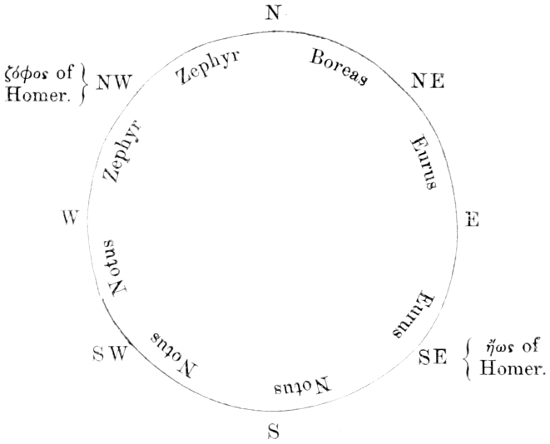
The accompanying sketch expresses what I believe to be in the main Homer’s arrangement of the Winds. At the same time, I do not know that we have any practical example of any wind in Homer which blows from within forty-five degrees on either side of due East, or from within about the same number of degrees on either side of due West. Perhaps it was from their local infrequency, that he does not appear to have put such winds in requisition[566].
The name Eurus is further attached to the point of sunrise by the root ἔως, to which it is traced[567]. The tracts of Aides are with Homer σμερδάλεα εὐρώεντα (Il. xx. 65). May not this εὐρωεὶς come from the same source? The Cimmerian darkness of Homer is close to the mouth of Ocean, and near that chamber of the Sun, which is at Ææa[568]. Viewing dawn as the middle point between night and day, Homer possibly connected it with each. It seems further possible, that he connected the Eastern with the Western darkness: both because this would bring his two regions of the future world into relations with each other, and because he makes the Sun disport himself with his oxen on the same spot in Thrinacie after his setting in the evening, and before his rising in the morning: a passage, which for its full explanation might require the supposition, that Homer believed the earth to be cylindrical in form, and thus the extremes of East and West to meet[569]. There will shortly be occasion to revert to this subject, in further considering what were the constituent parts of Homer’s East.
Homeric distances and rates of speed.
I shall trust mainly then to winds, thus ascertained from Homer’s Inner world, as the means of indicating the directions of the movements described in his Outer one. But besides directions, we have distances to consider. And here too we have some evidence, supplied by his experimental knowledge, to guide us.
By combining the inner-world data of distance with those of direction, we shall obtain the essential conditions of decision for the outer-world problems. Conditions both essential and sufficient, when we can lay hold upon them; but we shall still have to contend with this difficulty, that in one or two remarkable cases the Poet takes refuge in language wholly vague, and leaves us no guide for our conjectures, except the rule of making the unascertained conform in spirit to what has been made reasonably certain.
The distances of which I now speak are sea-distances. It is a somewhat remarkable fact, that Homer scarcely gives us land-distances at all. Telemachus and Pisistratus drive in two days from Pylus to Sparta: but it is not the wont of the Poet to describe places, which communicate over land, by the number of days occupied in travelling between them. This circumstance is illustrative of a trait, which assumes great importance in Homer’s Outer Geography, namely, the miniature scale of his conceptions as to all land-spaces; a trait, I may add, to which we shall have occasion to revert.
The sea-distances of Homer are performed in no less than six different modes.
1. By ordinary sailing. 2. By ordinary rowing. 3. By rafts, Od. v. 251. 4. By drifting on a timber, Od. xiv. 310-15. 5. By floating and swimming, Od. v. 374, 5, 388, 399.
Sixthly, and lastly, the ships of the Phæacians perform their voyages by an inward instinct, and with a rapidity described as marvellous.
Evidence as to rates of motion.
The language of the poems nowhere takes cognizance of any difference in speed as between sailing and rowing. For example, when Achilles speaks of the time of his voyage to Phthia as dependent upon εὐπλοίη, which the favour of Neptune could give, he evidently means a good sea and the absence of tempest, and does not at all bargain for a wind from a particular quarter, which was not a matter lying within Neptune’s especial province. Nor does there seem to be, on general grounds, any cause for assuming a difference between the average speeds of rowing and of sailing, when we consider, in favour of the first, that the crew rowed almost to a man, with little cargo to carry; and, to the prejudice of the second, that the science and art of building quick sailers could not then have been understood. I therefore take rowing and sailing as equal in celerity. So that we have in reality no more than five different cases to consider.
But, again, I think there is no reason why we should assume a difference in speed between drifting on a piece of timber, and making way by floating and swimming only. In practicability there may be a considerable difference: but that is not the point before us.
The four methods now remaining seem to require the assumption of different speeds respectively.
Now Homer has supplied us with the times necessary for performing known distances in two cases; and has also given us a third case, which may be used for checking one of the other instances.
A case of known distance is that from the mouth of the Straits of Gallipoli to Phthia. This, according to Achilles in the Ninth Iliad[570], would, with favourable weather, be performed so as to arrive on the third day. It may amount to a little more than three degrees, and may be taken at two hundred and twenty miles. The time is three days and two nights. So that, for ordinary sailing or rowing, a day and a night may be taken at about ninety miles, of course without any pretension to minute accuracy.
Secondly. With a good passage, a ship sailing from Crete to Egypt arrives on the fifth day (Od. xiv. 257). But we cannot consider Homer’s opinion of the distance between Crete and Egypt as entitled to the full weight of his experimental knowledge. Again, it is to be borne in mind, that here the north wind, which carries the ship, was a prime one (ἀκραὴς καλὸς, 253). Lastly, much might depend on the part of Crete, from which we suppose the vessel to have sailed.
As respects the last-named question, we must, from the habits of ancient navigation, suppose the eastern extremity of the island to have been the point of departure; because no sailor would have committed himself to Boreas on the open sea, as long as he could make way under cover of a shore lying to windward.
The distance between the eastern point of Crete and the western mouth of the Nile is about three hundred and fifty miles; the time five days and four nights. This would give a somewhat less rate of progress per diem than the last case; but then it is likely that Homer took the distance to be greater in that almost unknown sea (see Od. iii. 320.) than it really is; so that we have cause to view the two computations as in substance accordant. And even if they had clashed, the former would still be entitled to our acceptance.
What, however, does appear to be the case is, that Homer mistook the course from Crete to Egypt. It is really S. W.: he has defined it by the wind Boreas, which never blows from a point westward, or at the very uttermost never from one materially westward, of N. So that the course must have been about S. Now, as Homer knew the position of Crete, this would show that he brought Egypt too much to the westward, by shortening the eastern recess or arm of the Mediterranean; an error in exact conformity, I conceive, with all his operations in imagining the geography of the east. But this by the way.
The third test of sea-distances is supplied by the pretended passage of Ulysses, on a mast, from a point just out of sight of Crete[571] to Thesprotia[572]. He arrives on the tenth night. The distance exceeds, by about one half, the voyage from Troas to Phthia. The time is nearly four times as long. But then some allowance may be made for delay on the score of the irregular winds (ὀλοοὶ ἄνεμοι) which prevailed. We may therefore justly calculate the rate of a floating or drift-passage at about one half that of a sailing passage, or two miles an hour instead of four. And here our direct evidence closes.
At an intermediate point between these, we may place the mode of passage by raft, which brought Ulysses from Ogygia. For merchant ships were built broad in the beam; and the raft was as broad as a merchant ship[573]. Thus constructed, and with its flat bottom, it must have been very greatly slower than an ordinary sailing vessel, and I venture to put it by conjecture as low as two and a half miles an hour.
Lastly, we have to consider the rates of the Scherian ships. About these the only thing that is clear is, that Homer meant to represent them as far exceeding all known speed of the kind. They went, says Alcinous, to Eubœa, or as the verse may be rendered, to Eubœa and back, in a day[574]: they are like a chariot with four horses scouring the plain; the hawk, swiftest of birds, could not keep up with them[575]. We cannot, I think, pretend to appreciate with great precision Homer’s meaning in this point; but it is plain that, as he had a map of some kind in his head, he must have had some meaning with respect to the distance performed by the ship from Scheria, though probably a vague one. I think we may venture to take it at three times the speed of the ordinary sailing vessel, or at about twelve miles an hour.
Thus, taking drift-speed for our unit, we have the following scale approximately established:
1. Drift = 2 miles per hour = 48 miles per day of 24 hours.
2. Raft = 1¼ drift = 2½ miles per hour = 60 miles per day of 24 hours.
3. Sailing or rowing ship = 2 drift = 4 miles per hour = 96 miles per day of 24 hours.
4. Hawk-ship of Scheria = 3 sailing ship = 6 drift = 12 miles per hour = 288 miles per day of 24 hours.—
Let us next proceed to consider, whether there are any cardinal ideas of particular places or arrangements in the Outer Geography of Homer, which govern its general structure. For such ideas may, together with the data that we have now drawn from the circle of his Inner or Experimental Geography, assist us in the examination of what undoubtedly at first sight appear to be almost chaotic details.
Northward sea-route to the Euxine.
Setting out from this point, my first business is to show, that Homer believed in a sea-route from the Mediterranean to the Euxine, other than that of the Straits of Gallipoli and the Bosphorus. This route was formed in his mind, as I shall endeavour to prove, by cutting off the land from east to west, a little to the north of the Peninsula of Greece, all the way from the Adriatic to the Euxine. Thus we practically substitute an expanse of sea for the mass of the European continent; and we must not conceive of any definite boundary to this θάλασσα, other than the mysterious one which may finally separate it from Ocean. Or, in other words, we must give to the Black Sea an indefinite extension to the west and north-west, perhaps also shortening it in the direction of the East. This is the one master variation from nature in Homer’s ideal geography[576]; and, when his belief on this subject has been sufficiently proved, almost every thing else will fall into its place with comparative ease.
I will endeavour to illustrate and sustain this hypothesis from the positive evidence, either direct or inferential, of the poems: and I hope to show that it stands upon grounds independent of the negative argument, that it is absolutely necessary in order to supply a key to the Wanderings. At the same time, I hold that that negative argument, if made good, would suffice: for, though we do no violence to probability in imputing to the geography of the Odyssey any amount of variance, however great, from actual nature, yet we should sorely offend against reason, if we supposed that Homer had constructed a route so elaborate and detailed, without laying it out before his own mental vision, and presenting it to that of his hearers, after the fashion of something like a map. This was alike demanded by the realism (so to speak) of the time, and needful for the complete comprehension and easy enjoyment of the romance.
The indications on this subject, apart from the evidence of the Wanderings themselves, are as follows:
1. When, in the Thirteenth Iliad[577], Jupiter turns away his eyes from the battle by the Ships, he turns them towards the north-east: in the direction, that is, in which, according to the hypothesis above stated, there was for Homer not, as we now know to be the case, a wide expanse of land capable of containing a countless multitude of tribes, but, after a certain interval, a vast and unexplored sea. Now the Poet tells us, not that Jupiter looked over an indefinite mass of continent, or the ἀπείρονα γαῖαν; but that he looked over the country of the Thracians, the Mysians, the Hippemolgi, the Glactophagi, and the Abii. Moreover, he indicates, by giving characteristic epithets to each of these nations, that they lay more or less within the sphere of contact with Greek intercourse and experience, and therefore at no great distance to the northward: for not only are the Thracians riders of horses, but the Mysians are fighters hand to hand, the Hippemolgi are formidable or venerable, and the Abii are the most righteous of men. The Glactophagi are defined by their name as feeders upon milk. This limited and characteristic enumeration is in conformity, at the very least, with the hypothesis, that Homer imagined in that direction no continuous succession of land and of inhabitants, but a sea circumscribing the country of Thrace to the north.
2. A more marked indication is, I think, yielded by the passage of the Odyssey, in which Alcinous says to Ulysses, ‘We will convey you to your home, even though it should be more distant than Eubœa, the furthest point that has been visited by our people; of whom some saw it, when they carried Rhadamanthus thither, in the matter of Tityus, son of the Earth[578].’
It appears to me evident, that Homer means in this place to suppose a maritime route between Scheria and Eubœa, to the North of Thrace. He is not, we must remember, experimentally informed as to the position of Scheria itself, and probably he conceived it to lie quite outside the sphere of Greece, at a considerable distance to the northward. Though he brings Ulysses from thence to Ithaca in a day, this is effected by the privileged and miraculous rapidity of passage, which was the distinguishing gift of the Phæacians, as the kin of the Immortals. They are indeed in contact, according to the poem, with the habitable world, but they are strictly upon the outer line of it. They are of the race of Neptune: related to the Cyclops and the Giants: their ordinary life and their maritime routes could not, without doing utter violence to the conceptions of the Poet, be brought within the sphere of ordinary Greek experience. We cannot, therefore, be intended to suppose them to have carried the ancient Rhadamanthus past every known town, port, and point in Greece; past Ithaca, Dulichium, the Cephallenes, Pylus, and the rest. Nor would Eubœa, thus approached, be to Ulysses, who had himself visited Aulis on his way to Troy, a good type of remoteness: nor does it answer that description for the Phæacians themselves, if we consider it according to geographic prose; for though the way to it is long, it is not so distant in a direct line as other parts of Greece, Crete for example; and any people who had made a voyage to Eubœa by sea, round the peninsula, would know very well that the proper way to it was by land. We must, in short, presume such a position for the Scheria of Homer, as to imply a communication by sea between it and Eubœa, other than that through the known waters of Greece.
But if we suppose a maritime passage from the Adriatic round Thrace to exist, then we keep the Phæacians entirely in their own element, as borderers between the world of Greek experience, and the world of fable. They still, when they carry Rhadamanthus, as in all other cases, hang upon the skirt, as it were, of actual humanity. And, thus viewed, Eubœa might fairly stand for a type of extreme remoteness.
3. Another passage of Homer, when understood according to its geographical bearings, appears to me, of itself, nearly conclusive upon this question.
When Mercury is ordered to carry the message of the gods from Olympus to Calypso[579], his proceedings are carefully described. He equipped himself with his foot-wings (Od. v. 44), took in hand his wand (47), and got upon the wing (49). The next step in the narrative is,
Πιερίην δ’ ἐπιβὰς, ἐξ αἰθέρος ἔμπεσε πόντῳ· (50.)
He then bounded along the wave (51), reached the remote island (55), landed on the beach (56), and finally arrived at the cave (57). I think no one can read this description, which extends over sixteen verses, without feeling that it is meant to convey to us, that Mercury moved with great rapidity in a right line, the shortest by which he could reach his destination. But now, if this be so, then, as Pieria lies to the northward of Olympus, we have only to ask how does he pursue his further route? From Pieria he sweeps down upon the sea, and rides upon the waves (54) all the way to Ogygia. It is hopeless to fit this even by a moderate deviation either way to any existing sea: we have only, therefore, to conclude, in conformity with the other indications, that Homer believed in a θάλασσα to the northward of Pieria. We cannot take refuge in the plea, that Homer did not know where Pieria lay. First, because it was on the Olympian border of Thessaly, and as Homer knew that region well, he must have known that Pieria lay to the north of it. Secondly, it was probably within the circle of Greek traditions; since it is sometimes read for Πηρείῃ in Il. ii. 766, and at any rate they seem to be in all likelihood different forms of the same word. Thirdly, a complete proof is given by the route of Juno in the Fourteenth Iliad. She passes, in accordance with the actual geography, from Olympus to Pieria, from Pieria (apparently verging eastwards) to Emathia, and so by the Thracian mountains, evidently of Chalcidice, to Lemnos[580].
4. There is another passage which may be cited in direct corroboration of these views[581]. The spirits of the Suitors passed (1) the stream of Ocean, and (2) the Leucadian rock; and also passed (3) the gates of the Sun, and (4) the people of Dream Land.
Northward route to the Euxine.
Now it may be observed, that to pass the Leucadian rock is not the way from Ithaca to the Straits of Gibraltar: the course would lie round either the north or the south point of Cephallonia. Neither is it the way to the Bosphorus and Black Sea; which must be sought by steering first in a southerly direction. But it is the way to Ocean, and the nether Shades, if I am correct in my belief that Homer believed the route to lie along the Adriatic, and round the north of Thrace. Nor am I aware of any other view of his geography, on which this passage can be explained. The evidence, which it affords, is at first sight conclusive in support of the proposition, that Homer’s route to the Ocean-mouth lay up the Adriatic. But there are two grounds, on which a scruple may be felt about its reception. First, it stands in the second Νεκυΐα, the only considerable portion of either poem which appears, to me at least, open to the suspicion that it may have been seriously tampered with. Secondly, the order of the passage is singular, as it runs thus: they passed, or they went towards, the channels of Ocean, and the Leucadian rock, and the gates of the Sun: while, according to Homer’s geography, the Leucadian rock would come first, the gates of the Sun second, and Ocean-mouth would be the last of the three points.
But in answer to the first, the suspicions affecting this passage are too vague and indeterminate to warrant our rejecting its evidence, where it is in harmony with the general testimony of Homer. Even if these lines were interpolated, they would be remarkable as embodying an ancient, probably a very ancient opinion, as to Homer’s geographical view on the point at issue.
As regards the second, we may cite the parallel case of Menelaus in his narrative of his own tour. After Cyprus and Phœnicia, he describes his visits in the following order: (1) Egypt, (2) Ethiopians, (3) Sidonians, (4) Erembi, (5) Libya. It is evident that this cannot be intended to be understood as the order in which the several places were actually visited[582].
We have thus, I hope, secured for Ulysses, without drawing upon the Wanderings for testimony, what seamen call a good or wide berth; room enough for the disposition of his marvels, and the mystery of the distances between them. In this northern division of the θάλασσα we may imagine Homer to have placed, without any impropriety, or any violence done to his experience of his own latitude, both the double day of the Læstrygones, and the fogs of the Cimmerians. Into it he might well drive Ulysses by the force of the south wind[583], and from it bring him back by the strength of Zephyr or of Boreas[584]. Lastly, by means of this θάλασσα, we can avoid placing Circe and the Sunrise to the west of Homer’s own country; and we are not obliged to find his representation of the Πλαγκταὶ involving him in the hopeless absurdity of contradiction to his own experimental knowledge of the general direction of Jason’s course with the ship Argo.
Amalgamated reports of the Ocean-mouth.
I now pass on to the second of the two propositions, on which it appears to me that a reasonable interpretation of the Outer Geography is to be founded.
It is this: that the Poet has compounded into one two sets of Phœnician traditions respecting the Ocean-mouth, one of them originally proceeding from, or belonging to, the West, and the other to the North-east: and that he has chosen the north-eastern site as the ground on which to fix the scene of his amalgamated representation.
The argument, which has recently been adduced for another purpose from the Twenty-fourth Odyssey, is available to show that the Ocean-mouth of Homer is towards the north: but it does not suffice to decide the question between North-east and North-west, nor does it decide whether Homer simply transplanted the Straits of Gibraltar, or whether he mixed together the accounts of it and of some other strait, and welded them into one.
This question we must examine from the evidence concerning the Ocean-mouth supplied by the Wanderings themselves.
Ulysses and his companions, when they enter the great River Ocean, enter it at a point far north, by the city and country of the Cimmerians, who are enveloped in cloud and vapour[585]: and they are carried up or against the stream (παρὰ ῥόον), by the breath of Boreas[586], to the mouth of the Inferno. Returning from thence, they come down the stream (κατὰ ῥόον Od. xi. 639) back to the sea (θάλασσα); and they there find themselves at the isle of Circe, where is the dwelling of Ἠὼς, and where is also the couch, from which the sun rises in the morning.
In this account it is not difficult to trace certain outlines of truth. The ideas of Homer respecting the gates of Ocean would be drawn from reports which may have related primâ facie to any one of several geographical points; to the Straits of Gibraltar, to the Bosphorus, to the Straits of Yenikalè leading into the Sea of Azof, or to all the three. At one and all of these there appears to be a continual stream flowing inwards in the direction of the Mediterranean or θάλασσα. One and all, as sea-straits, present the character of a vast marine river. In exact accordance with these physical facts, Homer makes the ship of Ulysses, entering the great River Ocean, sail up the stream. We may observe in passing, that he describes his θάλασσα as εὐρύπορος, in evident contrast with the Ocean, which is marked, therefore, by a contraction of shores.
Further, Homer had conceived the existence of what we may call ultra-terrene parts, both westwards and eastwards. On the one hand, Menelaus, after death, is to be carried to the Elysian plain, where Zephyrs continually blow, springing fresh from the bed of western Ocean. On the other hand, the groves of Persephone are on the beach of Ocean, but in the furthest East.
Still it does not at all follow from this, that he had in his mind the idea of a double egress from the Mediterranean, or, the θάλασσα at large, to the Ocean. On the contrary, we never hear of any mode of access to it except one; and his placing the point where Ulysses enters it amidst mist and cloud, and his calling in the aid of Boreas to carry the ship to the groves of Persephone and mouth of the Shades (which he probably intended to be the exact counterpart in position of the Elysian plain), lead to the belief that his egress from sea to Ocean was in the north, and that the further route to the Shades lay, for the most part, in a southerly direction.
Open-sea Passage to Ocean-mouth.
The reader of the Odyssey will observe, that Ulysses encounters on his passage tempests indeed, but yet nothing in the nature of a dangerous maritime passage, before he has entered the Ocean-river, and then, completing his excursion to the nether world, has returned to the island of Circe[587]. Therefore we may say with certainty, that the mouth of Oceanus is, according to the ideas of Homer, accessible by the broad and open sea. Thus we have attained a first condition for the determination of its site.
But, before he sets out a second time from Ææa, Circe, now his friend, directs him as to his onward and homeward course. First, he was to reach the island of the Sirens[588]. After passing beyond this, the deity no longer lays before him a single and continuous route[589]: but indicates to him two alternatives, each involving a most dangerous passage. The first is described in the lines Od. xii. 59-72, beginning ἔνθεν μὲν γάρ. The second, which she recommends in vv. 73-110, begins with οἱ δὲ δύω σκόπελοι: where the δὲ is the apodosis to the μὲν of v. 59. Now, it must be remembered, that physically there was nothing to prevent his returning by the way he came, and thus avoiding both of these passages. Why then does Homer expose him to such extraordinary danger, leaving him no option but either total destruction, or the certain loss, at the least, of six men of his crew[590]?
The voyage of Ulysses might have been given us by the Poet as the execution of a divine plan, comprehensively premeditated as a whole: but it is not so: it is shown us as simply prolonged from time to time by some error of his own or of his companions, or by the spite of Neptune, or by the vengeance which the Sun demanded and obtained[591]. At Ææa he has nothing to do, but to take the best way home. Tiresias had indeed prophesied that he would come to Thrinacie[592], but nowhere intimates that he was to be divinely compelled to do this, or that he would take that route for any other reason than according to his own best judgment. Why then does he not return, as he had come, by the open sea, instead of tempting either of the two passages of peril?
The answer I believe to be this. He was subject to the resentment of Neptune, who operates by storm in the open sea. Otium divos rogat in patenti prensus Ægæo. As in the heroic age, every wound, generally speaking, is death, so storm either invariably or commonly means foundering or shipwreck. Thus then Ulysses might prudently keep to landlocked waters and narrow seas, even with a crisis of great danger before him, rather than face the angry Sea-god on the long passages over the open main, by which he had come to the land of the Cyclops, and so onwards to Ææa.
Rationalized, and reduced to its simplest form, this seems to imply that the routes pointed out to him by Circe, and perhaps especially that which he was to prefer, were short cuts either to his home, or at least back into the Inner or Greek world. And in conformity with this supposition, the whole prediction of Circe appears to presume that a passage of moderate length would bring him back within the known world; for it never speaks of the breadth of any unknown sea to be crossed, which to the navigators of that day was always its most formidable feature.
In the mental view of Homer, then, the passage of Scylla could not lie much beyond the horizon of his own Greek world and of geography proper. This was the more eligible of the two routes. The other was that of the Πλαγκταὶ, or Bosphorus. It was rejected as involving certain destruction: for only Jason had safely passed it by the aid of Juno, and Pallas was not now at hand to succour Ulysses; since he was outside that Greek world, to which her action has been restricted, generally speaking, and in all likelihood for poetical reasons, in the Odyssey. Now, since both these passages are spoken of as apparently lying near the island of the Sirens, which is itself separated, as far as we can judge, by no long interval from Ææa and Circe, the next inferences we have to draw are two of very great importance. The first is, that although the one strait of Homer physically corresponds with the Straits of Messina, while by the other he plainly means the Bosphorus, yet he conceived of these as within no great distance of one another. The second inference is that, according to the belief of Homer, the waters beyond the Bosphorus were accessible by some channel other than that of the Dardanelles and Sea of Marmora: for otherwise Ulysses could not have placed himself on the farther side of those terrible narrows, except by navigating one of them.
Three maritime routes to Ocean-mouth.
There were therefore three maritime routes by which Homer conceived that mouth of Ocean, which Ulysses entered, to be approachable:
1. The route by which the hero actually arrived there:
2. The route of Scylla and Charybdis, by which he returned from it:
3. The route of the Bosphorus, by which Jason had passed, and which Ulysses might, according to the description of Circe, have attempted.
But now, what in the view of Homer was this mouth of Ocean? that is, on what geographical basis rested the reports or descriptions which he adopted for the groundwork of his picture? We cannot but admire, as we pass along, the manner in which the Phœnicians guarded the treasures of their distant markets: no way lay to them except through a choice of terrors; terror in the boundless expanse of devouring waters; terror in shipwreck by the Πλαγκταὶ, which none but Jason (so says Circe, the Phœnician witness) had escaped; terror in certain loss of men by the voracious maw of Scylla. What, however, was this Ocean-mouth that lay beyond them?
My answer is, that there are two mouths of Ocean, either of which might tolerably correspond with the Homeric picture, if tried only by its relation to the intermediate points that are represented by these dangerous passages.
Firstly, the Straits of Gibraltar, leading to the Atlantic.
Secondly, the Straits of Kertch or Yenikalè, leading to the Sea of Azof.
Straits of Gibraltar as Ocean-mouth.
1. As regards the Straits of Gibraltar, they correspond with the Homeric description in respect of their great distance from Ithaca: of their current ever setting inwards to the Mediterranean: of their being accessible, without previously leaving the wide or open sea for any narrow passage: of their being, we may confidently believe, within the maritime experience of the Phœnicians. Further, on the route to them there lies an island triangular in form, which was already described by the name Thrinacie[593]. Again, it would appear that there were other islands between Thrinacie and this Ocean-mouth. For both Circe and the Sirens inhabit islands. Even the nearest of the Balearic isles, namely, Ibiza, is from the Straits of Gibraltar about as far as Crete from Egypt, which we know to have been estimated by the Poet at five days’ sail. It seems, however, not unlikely that Homer, having received a notice of the Balearic isles in the Phœnician reports concerning the Pillars of Atlas, carried them over, together with Atlas himself, into the eastern situation, where he blends two sets of traditions into one. He may therefore have been supplied from this source with materials for his island of Circe and island of the Sirens.
Lastly, although the misty Cimmerians are close by the Ocean-mouth, while the atmosphere of Gibraltar is warm and sunny, yet even the fogs may find their prototype in St. George’s Channel[594], or in the Straits of Dover, and it may also be said that, in the hazy distance of a Phœnician captain’s tale, they might from Homer’s point of view seem to stand nearly together. But still this is a difficulty. There are other more serious impediments, which make it absolutely impossible for us to say that the Homeric mouth of Ocean corresponds with the Straits of Gibraltar. This one especially: that he has, by a multitude of ties, fastened down his mouth of Ocean to an eastern rather than a western site; for there, at least hard by, is the dwelling of Aurora; there is the morning couch of the Sun; there is Circe, sister of Æetes, to whose country Jason sailed through the Bosphorus; and these both have had the Sun for their father, and Perse, daughter of Ocean, without doubt an eastern and not a western personage, for their mother[595]. The site of Ææa will, however, together with that of Ogygia, receive presently a fuller consideration.
Straits of Yenikalè as Ocean-mouth.
Let us turn then to the other alternative in the inquiry.
2. As the Straits of Gibraltar offer a resemblance to the Homeric picture, by their lying beyond the Straits of Messina, so do the Straits of Yenikalè, by their lying beyond the Bosphorus. The perpetual current inwards[596] is another feature of correspondence, such as may apply to both the cases, and such as probably assisted the process at which I shall presently glance. The whole group of Oriental conditions, attaching to Homer’s Ocean-mouth, appear to be exactly realized in the straits of Yenikalè.
The Cimmerian country of Homer is represented down to the present day by the Crimea, one of the most ancient passages from Asia into Europe, and probably known to the Phœnicians, who could well enough pass the Bosphorus themselves, while making it a bugbear to others. The cloud, in which these Cimmerians are wrapped, finds its counterpart in the notoriously frequent winter fogs of the Euxine. The peninsula, lying on the very Straits themselves, is in exact correspondence with the passage (Od. xi. 13),
ἡ δ’ εἰς πείραθ’ ἵκανε βαθυρρόου Ὠκεανοῖο· ἔνθα δὲ Κιμμερίων ἀνδρῶν δῆμός τε πόλις τε.
The only point of the description which is less faithfully represented at this point than at the other, is the epithet βαθύρροος. This agrees better with the deep water of Gibraltar, than with the (now at least) shallow current of Yenikalè[597].
Nor is it unnatural, that near the Cimmerian darkness he should place the home of Aurora and the Eastern Sun: for it is out of darkness that dawn and day must ever rise; and we have occasion to notice, in various forms, the association in Homer’s mind of ideas belonging to darkness with the East. Again, there is a combination of a northerly with an easterly direction in the conditions of the Homeric description, which is exactly met by the position of these Straits relatively to Greece.
But if we say, that these Straits form the single prototype of the Homeric description, we are again met by hopeless contradictions. For there does not lie any triangular island close by the Bosphorus, which might answer to Thrinacie: and there is no free maritime passage whatever, other than the Bosphorus, by which the Ocean-mouth, that is, the mouth of the Palus Mæotis, can be attained by a person who has Troy for his point of departure.
These facts appear to direct us plainly towards one satisfactory, and as it seems inevitable, conclusion. It is exhibited in the sentences that immediately follow.
First, it seems at once clear that Homer either knew, or else dimly figured to himself by Phœnician report, certain geographical facts, including those which follow:—
1. That there was an island, whose figure was defined by a word signifying three promontories, and which was accessible by a passage on the western side of Greece.
2. That near this island, there lay on one side the jaw of a dangerous narrow.
3. That either on the other side of it or in some other neighbouring quarter lay the open sea, and a route along it, by which the further side of the island might be reached, without traversing the narrow.
4. That at a point beyond both these openings (I say nothing for the present of the points of the compass) there lay a great stream such as he called Ὠκεανὸς, flowing always inwards to the θάλασσα, which he supposed to be fed by it (Il. xxi. 196).
5. That there was likewise a passage, which Homer called the Πλαγκταὶ, accessible from the eastern side of Greece; and through which Jason, and as he believed Jason alone, had sailed.
6. That at a point beyond this passage too, there lay an expanse of sea, θάλασσα, and again a great stream, such as he called Ὠκεανὸς, flowing always inwards to the θάλασσα.
Now we have seen that he gives us in the poem one mouth, and one mouth only, of Ὠκεανὸς, which corresponds with every one of these propositions taken singly: it is, according to him, beyond Thrinacie, beyond the Straits of Scylla and Charybdis, attainable by an open sea passage, and beyond the Πλαγκταὶ or Bosphorus.
It seems to follow almost mathematically, that he believed in an open sea route, which must have lain to the north, and which established a communication, independent of the Bosphorus, between the Mediterranean and the Euxine.
He blends two sets of reports into one.
It also hereby appears that he had received from the Phœnicians two sets of reports, one relating to western, and the other to north-eastern navigation, but both involving a description of a great inward flowing stream as an ultimate point, agreeably to his idea of the River Ocean. These two ulterior points, obtained respectively from each set of reports, Homer, led by the similarity of features, has blended into one. We can even now take his untrue representation to pieces, and can see where and how it separates into two, each of them geographically true. In his one mouth of Ocean he has combined the conditions, that in nature belong to two separate geographical points. Both the north-eastern report and the western report he has amalgamated, by carrying the remote point of the former round, so to speak, in order to meet the latter: and having thus made his Ocean-mouth northern, as well as eastern, he consistently calls in Boreas to take the ship of Ulysses to the mouth of the Shades below, so as to fix that point in the east, because it was the counterpart to his Elysian fields which lay in the west. The two sets of Phœnician reports are in this way oddly brought to integrate one another. The Ocean mouth in the Euxine gets the benefit of the open sea route; and the Ocean mouth at Gibraltar has credit for being placed in a northern latitude and eastern longitude; each report thus throwing its own separate attributes into the common stock.
The effect of thus forcing Yenikalè and Gibraltar to meet, naturally enough brings the Faro of Messina and the Bosphorus near to one another: and hence Circe, in the Twelfth Book, names them to Ulysses as alternative routes, both apparently lying in the same region.
But again I say, that in order to comprehend the Outer or imaginary geography of the Odyssey, we must entirely dismiss from our minds the map of Europe as it is. We must treat as having been a real map to Homer only the little sphere which was embraced within the resort of ordinary Greek navigation. Beyond that narrow range, we must consider him as distributing land and sea in the manner he best could, by the aid of reports, necessarily in that age most indistinct, and in all likelihood exaggerated, and even wilfully darkened to boot, by trading craft. Sometimes therefore he puts a people upon poetical terra firma at points, where it fortunately but accidentally turns out that nature has provided an antitype for the imagery of the Poem. Sometimes he lodges them where there is none; ubi nîl nisi pontus et aer. But though details are to be thus disposed of, still the one master variation from actual nature is this; the sea extended from the Mediterranean to the Euxine, behind, i. e. to the north of, the Bosphorus and of Thrace. This gives us that open passage into the Euxine, by which Homer supposed Ulysses to have reached the maritime region, that Jason had sought and found through the Bosphorus.
In sum; it is too plain to require much of the detailed proof which I have tried to give, that Homer believed in a great expanse of waters lying somewhere to the north. The probability is, that from some Phœnician source he had heard rumours of the great German Ocean. It need not to us appear strange that his mind did not readily conceive an extent of land like that of the continent of Europe, when we notice that his experience made him conversant partly with islands, partly with countries in minute subdivisions, and of small breadth from sea to sea. This great imaginary mass of waters he included within the θάλασσα, to which everything belonged as far as the point where the great River Oceanus was reached.
I think then that we have now found the two keys to the Outer Geography,
1. In the sea-route north of Thrace;
2. In the amalgamation of the western with the north-eastern report of the Ocean-mouth.
From the site of the Ocean-mouth of Homer, we may most naturally proceed to examine the site of Ææa; which, as being within one day’s sail, is a kind of porter’s lodge to it[598], and is a point of the utmost importance in the system. Hitherto I have proceeded only by assertion, so far as the site of the Homeric Ææa is conceived. But to defend the second main proposition or key to the system, in the face of counter-theories, it will be necessary to examine, with as much care as may be, all the Homeric evidence that bears either upon this question, or upon the kindred one of the site of Ogygia.
We have then to inquire, subject to the rules which have been laid down, first, whether Ææa, the island of Circe, is to be placed, its northward direction being generally admitted, in the north-west or in the north-east?
Secondly, as dependent very much upon the prior question, and as entering at the same time largely into the proof of it, what is the site of Ogygia, the island of Calypso?
North-western hypothesis for the site of Ææa.
Now I think that the arguments, which have been used for the north-western theory, have been principally founded,
1. Upon precipitate inferences, drawn from some one or more of Homer’s outer-world statements, and then illegitimately used in order to govern the rest of them;
2. Upon the course of the later tradition, which was led, probably by the course of colonization, to identify and appropriate the particulars of the Outer Geography rather in the West than in the East. For Sicily and Italy became at an early period familiar to the Greeks; but it was long before they grew to be well acquainted with the more dangerous, remote, and isolated navigation of the Black Sea[599]. Perhaps, indeed, the main reason for placing the tour of Ulysses all along in the West has been no better than this; that Homer has given us an account of an island apparently corresponding in form with Sicily; which it may very well do, and yet the conception of the site may be totally erroneous. Again, with respect to traditional authority, I apprehend it may be asserted, that the Fragment of Mimnermus[600], which carries Jason to the East, to the chamber of the Sun, and to the city of Æetes, as to one and the same point, expresses an universal tradition, so far as the voyage of the Argonauts is concerned. And I would also observe, that the current local appropriations about the coast of Italy seem to be given up on all hands as geographically worthless: the only question is, not so much that of removal, as into which of two quarters they shall be transplanted. On the other hand, the principal arguments for the north-eastern hypothesis are, as I conceive, founded upon legitimate inferences, drawn from the inner-world or experimental statements of Homer, and then applied, by a law essentially sound, to determine the cardinal problems of his Outer Geography.
North-eastern hypothesis.
For example, much will depend upon the answer to the question, whether we are to carry the Straits of Messina, or rather the fable of Scylla and Charybdis, taken to represent them, eastwards, or whether we are in preference to move the Bosphorus westwards.
I answer without hesitation, that it is much more reasonable to construe Homer as shifting essentially the site of Scylla and Charybdis, than the site of the Bosphorus; and for the following reasons.
We have not the slightest reason to suppose that either Sicily or the Scylla passage came within the experimental knowledge of Homer and the Greeks of his time, either as to the island and the Strait themselves, or as to the direction in which they lay.
We find indeed that a continuance of winds, which ranged between E. and S. W. detained Ulysses in Thrinacie or Trinacria. It has from this been, as I think by much too hastily, inferred that Thrinacie lay to the north-west of Ithaca[601]. Even if it did so, we should still miss the true bearing of Sicily, which is west, with all inclination to the south, and not north-west, from Ithaca. But the assumption is in fact unwarranted. The wind, which principally held Ulysses fast in Thrinacie, was, as is evident from the passage, Notus, a southerly wind. Eurus plays a secondary part there[602]. Besides this, the wind, which Ulysses needed, may have been needed to bring him not to Ithaca, but to some point on his way to Ithaca, from whence his bearings would be known; to some point at which, from the Outer, it would have been practicable for him to re-enter the Inner or Greek world. The needful conditions would be satisfied if, for instance, Thrinacie lay either north-west or north-east from the Dardanelles; and then Ulysses would want either Zephyr or else Boreas to get there. And the opposite theory proceeds upon the entirely arbitrary, nay, untrue, assumption, that the way back through the Narrows was, like the way by which Ulysses had come to Ææa, an open-sea route, and not one in which the course would have to be governed by fixed points of land lying along the course.
There is then no middle term between Thrinacie and any fixed point of the Inner Homeric world, from which we can by direct inference argue as to its site. And the winds, which detain Ulysses in Thrinacie, go far of themselves to show that this island is not on the site of Sicily.
The case is far otherwise in regard to the Bosphorus, or Πλαγκταὶ, of the Odyssey. For here we know,
1. That Homer was familiar with the Dardanelles, a stage on the way to it, and not very far from it:
2. That he makes Jason pass the Bosphorus:
3. That he also makes Jason settle at Lemnos, and become sovereign of the island, evidently in connection with his route from Thessaly to the East.
But Thessaly, and Lemnos too, are places of the inner world: with Lemnos the Poet appears to have been accurately acquainted; and the line between that island and the home of Jason determines absolutely so much as this; that the general direction of his voyage was known by Homer, at least up to this point, to have lain to the north-eastward through the Straits of Gallipoli.
I hold therefore that the passage of the Πλαγκταὶ is fixed immovably, by known-world evidence, as to its general direction: that to transplant it to the west, is to break up the foundations of Homer’s experimental knowledge, which is always to be trusted: whereas to move his Thrinacie eastward is merely to suppose that he gave the site which was poetically most convenient to a tradition which, as it came to him, had no site at all, no positive local or geographical determination.
Character and site of Thrinacie.
Again, I take the island Thrinacie by itself; and I contend that, although the report on which this delineation was founded may probably have had its origin in Sicily, yet the Thrinacie of Homer is associated rather with the East than with the West.
For, though he has given us no geographical means for directly determining the site, he has supplied us with other means that belong, not to Phœnician rumour or fireside tale, but to his own knowledge and experience. Since nothing can be more certain, than that the leading local association of the Sun, for Homer as for all mankind, is with the east. It is true that he is in the west just as often as in the east; but we certainly hold Napoleon to belong more to Corsica than to Saint Helena; and so the mind connects the Sun with the place of his daily birth, and not with that of his daily death. Now, without entering upon any other question for the present, I only observe, that in Thrinacie are the oxen with which the Sun disports himself when not engaged in his daily labours; that is, as he himself supplies the explanation, both before they begin, and after they are ended[603]. In deference, then, to those associations, founded on actual nature, which for the present purpose are strictly facts, I cannot hesitate to maintain, that the island of Thrinacie is upon the whole, relatively to Greece, an eastern island.
A like inference may be drawn from the names Lampetie (λάμπειν) and Phaethusa (φάος), which he has given to the Nymphs of the Sun. Had the island been in his intention western, he would have called them by names of a different etymology.