III. THALASSA. THE OUTER GEOGRAPHY OF THE ODYSSEY. (continued 2)
Reading edition
And as the Scylla passage, which is on its coast, is near the Πλαγκταὶ, I think we shall pretty closely conform to the views of Homer, if we make Thrinacie form the western side of the Bosphorus, and if we separate it by an imaginary or poetical Scylla from the main land of Turkey in Europe.
Again, it is admitted that Αἰήτης has his name from Αἰαίη. From the personal relations of Æetes, as well as from those of his daughter Circe, we may therefore argue respecting the site of Ææa, provided we can attach them to any known and fixed point of the system of Homeric ideas.
Now their parentage furnishes a point of this kind, on both the father’s and the mother’s side. Their father is the Sun: a divinity not, like the Apollo or Minerva[604], de-localized, but one having his daily sojourn (out of work-hours) in the east. The mother is Perse: and enough, I think, has been shown with respect to the import of this name for the Achæan mind[605], to make it pretty certain that, when Homer gives a residence to the children of Perse, he intends it to be in the east.
It is now time to bring more directly into the discussion a point much contested—the situation of the island of Calypso. The usual modes of solution, which place the original of this picture on the Bruttian coast or in Malta[606], are inadmissible in spirit as well as in the letter. For very great remoteness is the most essential point in the description, and to bring it near would wholly change its character. It requires eighteen days of favourable wind[607] to come by raft within sight of Scheria from Ogygia: while even the distance from Crete to Egypt, a greater one than from the Bruttian coast to Greece, might be performed, as Homer thinks, in five[608]. It is the midpoint, or ὄμφαλος[609], of a vast expanse of sea: and Mercury, passing thither from Olympus, mentions the route as one which traverses a mighty space of water, without habitations of men between[610]. Again, the name of Calypso (καλύπτειν) places it wholly beyond the circle of Greek maritime experience: as does her relation to Atlas, who holds the pillars, that is, stands at the extremity, of earth and sea. The first and cardinal point to be fixed therefore is its decided, if not extreme remoteness.
Next, if it is thus remote, we find by a process of exhaustion that it must be in the north. As far as we know, Homer recognised the African coast by placing the Lotophagi upon it, and the Ethiopians inland from the East all the way to the extreme West. In that direction there is no more θάλασσα, or sea. And again, as Nitzsch truly remarks, Scheria is on the proper homeward line of the voyage of Ulysses[611]. Consequently he cannot pass, nor can he even approach, Ithaca while on his way to Scheria: I add, he must come to it down the Adriatic on his way to Ithaca.
Site of Ogygia to the East of North.
Now we are provided with an important argument, drawn, like some preceding ones, from what we may fairly call Homer’s experience, and tending to fix the site of Ogygia in the north or north-east. It is derived from the route taken by Mercury, when he carries the message of the Immortals to Calypso, which in another point of view we have already had to examine[612]:
Πιερίην δ’ ἐπιβὰς, ἐξ αἰθέρος ἔμπεσε πόντῳ.
We are obliged to suppose, as has been observed, that Mercury, who does not march, but flies like a bird wont to hunt for fish[613], must move in a direct line towards his object. But Pieria is a district stretching along the shore of Macedonia; it begins in the south, to the eastward of Olympus, and then extends due north of it. Its limits are variously defined[614]; but the only question about it could be, whether it verges, not to the westward, but to the eastward of North. Again, from the route of Juno in the Fourteenth Iliad[615], no question can arise, except what would tend to give Pieria an eastward turn.
A line drawn from Olympus over the centre of Pieria would carry Mercury to the North. It might, consistently with the condition of crossing Pieria, diverge a little either to the east or the west of due North, but only a little. Consequently the island of Calypso may be affirmed to be, according to the intention of Homer, in the North, and not very far from due North.
This conclusion is confirmed by two other arguments; which are both of the class which I have described as legitimate, because they are founded on Homer’s physical knowledge of the direction of the winds.
After the storm has destroyed the ship of Ulysses to the south of Thrinacie, Notus, a wind of decidedly southerly character, carries him back again to Scylla, Od. xii. 426: and again, when he has passed it, he proceeds thus[616]:
ἔνθεν δ’ ἐννῆμαρ φερόμην, δεκάτῃ δέ με νυκτὶ νῆσον ἐς Ὠγυγίην πέλασαν θεοί.
Now there is no mention between these two passages either of any change of wind, or of any particular wind. Consequently it seems rational to assume that Homer meant us to understand a continuance of the wind just named, namely Notus. Even independently of this collocation, we should be thrown back upon the general rule of the Wanderings, which is that southerly winds blow Ulysses away from home, while northerly ones bring him back again.
Consequently, the natural construction to put upon the passage is, that it was a south wind, whether a little east or west of south matters not much, which continued to blow, and which drifted Ulysses away from Ithaca to the island of Calypso. This is in entire accordance with the passage which describes him as windbound by Eurus and Notus at Thrinacie; since the way from home is presumably the exact reverse of the way towards it. But it will be said, this implies that he made westing on his way to Ogygia from Ææa. I answer, that this is probably so: for Circe is described as immediately connected with the east, while Calypso is far, as Mercury complains, from all land and habitation: so that apparently her island is, in the intention of Homer, materially to the westward, as well as greatly to the northward, of Ææa. But the main direction taken from Scylla is northward; and, since Scylla is near the Πλαγκταὶ, and the Πλαγκταὶ are the Bosphorus of actual nature, it must be taken from a point near the Bosphorus, along the imaginary expanse of an enlarged and westward-reaching Euxine.
According to this argument, then, Ogygia might lie upon a line drawn from Mount Olympus in a direction not very wide either way of St. Petersburgh.
Nor are we wholly without means of measuring the distance. He floats (from Scylla) for nine days, and arrives on the tenth. Now this is just what happened to the pseudo-Ulysses[617], who in the same space of time drifted from a point near Crete to the country of the Thesprotians. We may therefore fix Ogygia as (in the intention of the Poet), at about the same distance from Scylla, which we measure from the south of Epirus to a point near, yet not in sight of, Crete. But this in passing.
The corresponding argument is derived from the homeward passage of Ulysses, and stands as follows:
For seventeen days Ulysses pursues his raft-voyage from Ogygia to Scheria; and the raft threatens to founder on the eighteenth. He then floats, by the aid of the girdle he had received from Ino. Up to this point there is no positive indication of the wind; the argument from the relation between his course and the stars I will consider shortly. But after he has put on the girdle, and when Neptune withdraws his persecution, since he is now approaching the horizon of the Inner world again, Minerva’s agency revives, and she sends a north wind or a north-north-east wind, Boreas, to bring him to Scheria.
Now there is no reason for our supposing that Homer meant to represent Ulysses as changing his general direction at this particular point. The orders of Circe with respect to the stars all indicate a single right line from Ogygia to Scheria, and neither the wind nor his course alter, until he has seen the island on the far horizon. The natural inference therefore is, that Boreas, the N. or N. N. E. wind, which at last drifted him in, was the wind which had brought him all the way from the island of Calypso, over an unbroken and unincumbered expanse of sea.
We appear to have seen, thus far, that Ogygia is greatly to the northward, and probably somewhat to the westward, of the Strait of Scylla. We shall obtain further light upon the site of that island, if we can more precisely define the position of Scylla with regard to what lay southward, as well as with respect to what lay northward, from it.
Our data are as follows:
1. Thrinacie appears to be close to Scylla, for it is reached αὐτίκα (xii. 261).
2. The comrades of Ulysses, when they arrive at the island, and when he attempts to dissuade them from landing, reply by asking what is to become of them if they set sail at night, and are then caught by a squall of Eurus or of Zephyr (284-93).
3. The ship is windbound in Thrinacie for a month by Eurus and Notus; which may be taken in Homer as the winds that cover the whole horizon from a point north of east to the western quarter[618].
4. When they finally set sail, we are not told with what wind it was: but, after they have got out of sight of the island, the sky darkens, and mischief follows[619];
αἶψα γὰρ ἦλθεν κεκληγὼς Ζέφυρος, μεγάλῃ σὺν λαίλαπι θύων·
and the ship goes to pieces in the tempest. At length Zephyr ceases, and Notus blows Ulysses back upon Scylla.
5. If it was the intention of Homer to place Thrinacie by the Bosphorus, then the next point which Ulysses had to make was the Dardanelles.
Scylla and the Dardanelles.
The question therefore is, what conclusion can we draw from the evidence now before us as to the position of Scylla relatively to the Dardanelles? I think a pretty clear one.
We have at least two of those statements, which may be called experimental, now before us. Homer knew the position of the mouth of the Dardanelles. He knew the nature of the wind Notus. And there is a third piece of evidence not unimportant, which we may here properly bring into view. We have seen that, in Il. ii. 845, Homer confines or contains his Thracians (ἔντος ἐέργει) by the Hellespont: and the Hellespont with him means all the waters from the Sea of Marmora to the northern Ægæan inclusive. Now by this he intends only a part of the Thracians, those, say, of the plain of Adrianople. It is presumable therefore that he believed the configuration of the coast at the two extremities of the Dardanelles to be something like at least two of the sides of a square, running N. and W. respectively: for unless it formed a portion of some marked figure, it would not answer his description of including a certain district, and the words would become applicable to the whole of Thrace alike. Therefore it appears that Homer thought the northern coast of the Sea of Marmora trended, from its western point, more rapidly to the north, than is really the case.
The most decisive evidence, however, is that which had been previously named.
When the storm came, which shattered the ship, Ulysses was on the true course from Thrinacie to the Dardanelles. But if we know the point for which he was making in a right line from point x, and if we also know the wind which carried him back to point x, then the line on which point x itself lies is also known. In other words, as Notus, or say the S.S.W. wind, carried him back upon Scylla, Scylla lies to the N.N.E. of the inner mouth of the Dardanelles: and the unnamed wind which takes him back to Scylla is Notus, which we are entitled to consider as blowing (even as Boreas, its counterpart, blows from due N. to the eastward) from any point between the limit of Eurus on the East of South, and 45 or even 90 degrees beyond South to the westward.
Ææa, then, is in the East; with somewhat of an inclination, as measured from Greece, towards the north. Ulysses has much westing to make, in order to get to Scheria. Part of this is made on his passages between Ææa and Ogygia in the farther north. The rest in the course of his long seventeen days’ voyage from the north, which is propelled, as it would appear, by Boreas, and therefore includes also a slight westerly inclination.
All these arguments converge towards the same conclusions, and all of them are mainly founded, not on Homer’s outer-world representations, but upon indications drawn from his knowledge of nature, or else from his experimental or otherwise familiar acquaintance with the Inner world: that is, they are built not on the figures of his fancy, but on the facts of his own and his countrymen’s every-day experience.
And now let us consider the adverse construction put upon the text of the Odyssey; particularly with regard to the island of Ææa.
Why Ææa cannot lie North-westward.
It is quite plain, from the accounts given of the route both ways, that the Ocean-mouth is meant by Homer to be near the island of Ææa; that is, within a day’s sail[620] of that island. How is this reconcilable with the doctrine, which places the island in the far north-west? In the north-east we have an Ocean-mouth, the situation of which the Poet, guided up to a certain point by his inner-world knowledge, has not very inaccurately conceived. In the north-west there is no Ocean-mouth. The Straits of Gibraltar, though they lie rather to the south of west from Ithaca, must be carried far into the north for the purpose; in what form, or with what accompaniments, it is hard to conceive. To attempt such a transposition would involve the complete abandonment of all actual geography, and would after all leave us involved in hopeless confusion in the effort to construct any tolerable scheme from the text of Homer.
Construction of Od. xii. 3, 4.
At the mere transportation, indeed, we need not scruple overmuch, if we could justify the proceeding by other clear indications of Homer’s intention. But there is no such justification. It is hardly possible to exaggerate the violence done to the text of Od. xii. 3, 4, by the interpretation which Nitzsch (following, as I admit, Eustathius), puts upon it. The ship, leaving the stream of Ocean, reaches the sea and the island[621]:
νῆσόν τ’ Αἰαίην, ὅθι τ’ Ἠοῦς ἠριγενείης οἰκία καὶ χοροί εἰσι, καὶ ἀντολαὶ Ἠελίοιο.
The ἀντολαὶ, the rising, or rising-point of the sun, does not, he says, mean the east, but only the first appearance of the sun on their return from darkness, which is a kind of dawning on them. And the dwelling of the early-born Dawn, and the place (such appears to be the meaning of χόροι) of the Dances of her kindred or attendant Nymphs—who in later mythology became the virgin train of Hours, that now delight us in the frescoes of Guido and Guercino—not only do not mean anything eastern, but apparently in this place are conceived to have no meaning whatever, and to be an idle, indeed a most inconvenient and bewildering, pleonasm. And thus the magic poetry of this passage and all the curious traditions it involves, are destroyed, in order to make room—for what? For the hypothesis that Homer places the dwelling of Morning and the chamber of the rising Sun far to the westward of the country that he himself inhabited[622]!
There is, I confess, something almost of naïveté in the confession of Nitzsch, that ‘it sounds rather strange to interpret ἀνατολαὶ without any reference to sunrise, since it is the customary counterpart to δύσις, the sunset.’ But fortunately there is no Homeric evidence against it: as indeed there cannot well be, since the word occurs in no other passage. With respect to Ἠὼς, Nitzsch contends that it means not dawn, but light: and he quotes the passages which say, ‘your glory shall reach as far as Ἠὼς,’ and ‘horses, the best to be found beneath the Sun and Ἠώς.’ Certainly it is most allowable, (though I by no means think the sense of dawn inadmissible in these two passages,) especially as day goes nowhere except preceded by dawn, to generalize the word Ἠὼς so as to make it equivalent to light. But the fatal flaw in the interpretation is this, that when Ἠὼς is thus used, it is invariably apart from any circumstances which can give a local colour to its meaning. But wherever there is any thing local implied, as is admitted to be in the case before us, the ἠὼς uniformly means the east, though with a certain indefiniteness perhaps as to northward and southward inclination. For instance, when Homer speaks of omen-birds flying eastwards, he describes them as flying πρὸς ἠώ τ’ ἠέλιόν τε, and the opposite movement as ποτὶ ζόφον, which here evidently means north-west, although it too may signify darkness in general. The whole aim of the passage (Od. xii. 1-5) is, to fix locality; and it is in the teeth of all Homeric usage to deprive ἠὼς in such a passage of local force, while it confessedly can have no local meaning but an eastern one.
To me, I confess, it appears that Homer has nowhere done more, and rarely so much, in a single passage, as in this, with a view of declaring his intention. The island Ææa, irrespective of all geographical argument, is, as we have seen, directly bound and fastened to an eastern site by four separate cords. First, as the rising point of the Sun. Secondly, as the residence of Dawn. Thirdly, because Circe, its mistress, has the Sun, the most eastern of all mythological conceptions except the Dawn, for her father. Fourthly, because she has also Perse, whose name indicates a trans-Phœnician origin, for her mother. And further, I am convinced we cannot alter the place of Ææa without uprooting the whole Phœnician scheme of the Outer Geography.
The scope and range thus given to the adventures of Ulysses confines them without doubt to the northern semi-circle, but allows them to reach, within that semi-circle, to its eastern and to its western extremities, as they are imagined by the Poet. Æolus and the Læstrygonians are evidently placed by him in the north-west. The hypothesis, which has here been maintained for Ææa and Calypso, supplies an effectual counterpart, and properly fills up the eastern corner. But, independently of all other objections, the north-western hypothesis for these islands jumbles them, if I may so speak, in one heap with the others, and leaves the eastern quarter towards the North wholly unoccupied. And yet that East was, for a Greek, the source and the scene of the richest legendary and mythological representations. Such an incongruous view of the question would not, I think, be at all in keeping with Homer’s ordinary modes of conceiving, handling, and presenting his materials.
Construction of Od. v. 276, 7.
But I am aware that, up to this time, we have left out of view a passage, of which I freely admit that the prevailing, and in so far the most obvious, interpretation is against me. Ulysses sails over the sea from Ogygia, governing the rudder of his raft with art, and watching the stars, especially the Great Bear; which at that period, I believe, was nearer the Pole, and was a more conspicuous and splendid astronomical object, than it now is. It was with respect to this constellation that he had received a particular order from Calypso[623]:
τὴν γὰρ δή μιν ἄνωγε Καλυψὼ, δῖα θεάων, ποντοπορευέμεναι ἐπ’ ἀριστερὰ χειρὸς ἔχοντα.
Or, according to the common construction of the words, he was to keep that constellation on the left during his voyage. But if his course lay in the direction of a right line drawn from St. Petersburgh to Corfu, it appears that Arctus, when visible to him, would be visible on the right, and not on the left.
I could not, however, accommodate myself to this passage at such a cost as that of oversetting an interpretation of the general scheme, which is so deeply rooted both in the letter and spirit of the poem, as is the eastern, and likewise somewhat north-eastern, hypothesis for Ææa, together with a northern site for Ogygia. These two, it may be observed, stand together. It is plain, from the times occupied by the several stages between Ææa and Ogygia, and from the language used where no precise time is stated, that the Poet conceived the distance between them to be limited, though very considerable. And indeed the north-western hypothesis for Ææa would do nothing for the passage I have quoted, unless we also carry Ogygia into the north-west, in order that Ulysses, on his way home from it, may have Arctus on his left. Inasmuch, however, as the admission of the received sense for the lines would involve us in a new series of the most complicated and hopeless contradictions, we must look for relief in some other direction.
On the genuineness of the passage.
I desire to eschew, as a general rule, the dangerous and seductive practice of questioning the genuineness of the text because it seems to stand in conflict with a favoured interpretation. I may however state, without unduly relying on them, one or two particulars which, drawn from the poem itself, may show that these two lines are not unjustly open to the suspicion of interpolation.
1. The two lines are wholly void of any necessary connection with what precedes and follows them, and the text is complete without them. We should not break up the passage generally by removing them. This argument, however, is one purely negative.
2. These lines tell us, that Calypso had bid Ulysses keep Arctus on his left. Now Homer has given us a speech of Calypso[624] on the subject of this voyage, in which she promises to send, from behind him, a breeze which shall carry him home. But there is in this speech no order to him whatever about observing the stars; and the promise of the wind in some degree, though not perhaps quite conclusively, tends to show that no such injunction was needed. For it is plain that, if the wind blew fair across the open sea, he did not depend at all upon the helm, and noticing the stars would be of no assistance to him. I rely, however, more upon this, that there is here a sort of patchwork, very unlike Homer’s usual method, in the mode in which the injunction is recorded. Clearly, if Calypso gave a direction respecting the stars, the proper place for it was in the speech where she delivered to Ulysses what may be called his general instruction for the voyage. And I am not sure whether another instance can be found in the whole of the poems, where an omission of something relevant and material in one of the speeches is supplied by a recital in the subsequent narrative. It is wholly contrary to the manner of Homer, who so uniformly throws into speech and the dramatic form whatever is susceptible of being thus handled.
3. The expression ἐπ’ ἀριστερὰ χειρὸς is found nowhere else in Homer, though the phrase ἐπ’ ἀριστερὰ occurs many times.
4. There is no other passage in the Wanderings, or elsewhere in the poems, which describes the conduct of navigation by means of the stars. In the Iliad we have the mention of a star in connection with sea-travelling; but it is simply as a portent, (ναύτῃσι τέρας, Il. iv. 76). On this, however, if it stood alone, I should place no commanding stress: and it should also be observed that the objection is one which, if admitted, would displace eight lines.
So much for the genuineness of the passage.
As respects the grammatical meaning of the phrase, I have endeavoured to discuss it at large in a separate paper; and to show that its real sense is in fact the reverse of that which is ordinarily assumed. It means, I believe, a star looking towards the left, and therefore a star looking from and situated on the right hand in the sky.
In no case, however, can I admit it to be the true meaning of Homer, that Ulysses is to follow a south-westward course from Ogygia to Scheria; because this is at variance with all the trustworthy, I must add with the consentient, indications of Homer’s intention in the whole arrangement of the tour, as well as in the particular description of Circe’s island. It is also in contradiction to those indications, drawn from his inner or experimental geography, which determine at certain points the bearings applicable to the Outer or Phœnician sphere.
Before proceeding to draw up in propositions the whole outline of the interpretation which I venture to give to the route of Ulysses, I would call attention to the means, which the Poet has adopted to signify to us his own doubt and incertitude respecting its actual bearings at several important points.
By means of the wind Boreas he indicates to us the direction, not however the distance, of the Lotophagi. After leaving them, he tells us nothing either of distance or direction between their country and that of the Cyclopes. From this point he provides us with certain aids until we reach Æolia. When in Æolia, Ulysses is to the north-west of Ithaca: for the Zephyr given by Æolus, he says, would have carried him home. From this isle, six days of rowing take him to Læstrygonia. Another passage of indefinite length next carries him to Ææa; and, arriving here, he is entirely out of his bearings; he cannot tell where is east or west[625], the point of dusk or the point of dawn, until he has been duly instructed by Circe: but he sees an unbounded sea (πόντος ἀπείριτος) on every side of him.
Homer’s geographical misgivings.
This expression of ignorance, put into the mouth of Ulysses, probably conveys the true sense of the Poet; who, more or less puzzled with even his own method of harmonizing the Phœnician reports, and suspecting that it might not bear the test of application to actual nature, shielded himself by anticipation, through giving us to understand that he did not mean to submit Circe’s isle to the strict rules of geographical measurement.
And indeed it was no wonder that he felt some diffidence, when we recollect that he had to concentrate in a single point facts or traditions that embraced east, north, and west. Eastern his site must be to allow of the rising of the sun, and the accompanying legends: he may have had misgivings, lest his Thrinacie, and also other traditions of which he had to work up the materials, should in reality lie westward from Greece: lastly, an appreciable northern element was involved in the general direction of the navigation through the Bosphorus, which in fact supplies a kind of meeting-point for the two former. The remedy is, thus to hang the island of Circe in a vague and shadowy distance, which gives the nearest practicable approach to an exemption from the laws imposed by any determinate configuration of the earth.
Nor are these the only cases, in which Homer has afforded us tokens of his own want of clear knowledge and confidence in regard to the scenes through which he has carried his hero. On the contrary, he has indicated the haziness of his views, and the insecurity of the ground he trod, by forbearing in several other instances to fix with precision the particular winds which favoured or opposed the voyage of Ulysses, or to particularize the distances he travelled.
Homeward route of Ulysses.
We are now at liberty to approach the last portion of our subject. We have, I trust, fixed the distinction of the Inner and Outer Geography; ascertained the keys of the outer system, and fixed its governing points. It remains to inquire what, according to the data ascertained, did the Poet intend to be the route of Ulysses over the face of his ideal map; and then, finally, to show its relation to that of Menelaus, and to Homer’s general conception of the configuration and distribution of the surface of the earth.
I. His first halting-place, after quitting Troy, is with the Cicones, in Thrace. This visit was paid with scarcely a deviation from his homeward route: and therefore it does not belong to the Outer Geography. The Cicones of the Odyssey were probably placed near the northernmost point of the Ægæan sea (Od. ix. 39).
II. From the country of the Cicones, he sails southward, under a heavy north-north-east gale (Od. ix. 67), which lasts for three days. He has then fair weather, till he gets to Cape Malea. But, as he is rounding Cape Malea, the north-north-easter returns, and drives him down the west coast of Cythera (now Cerigo), and so out to sea (79-81). After nine days’ sail, with ὀλοοὶ ἄνεμοι, he reaches the land of the Lotophagi (82-4). Now, as it took five days of the best possible wind to sail from Crete to Egypt (Od. xiv. 253), we may perhaps assume that, in the ten days of veering gales, about an equal distance was made in the general direction of south-south-east indicated for us by the Boreas of v. 82. This will place the Lotophagi on the Syrtis Major, now the Gulf of Sidra. Here the region of the marvel-world begins: and the mention of the ὀλοοὶ ἄνεμοι, in lieu of the pure Boreas, may be taken as fair notice from the Poet, that he had no precise knowledge on what portion of the coast of Africa Ulysses was to set his foot.
The Lotophagi are full of Egyptian resemblances: and it appears that, as Egypt and Phœnicia were for Homer the two greatest border-lands between the real and the imagined worlds, therefore Ulysses makes his first step into the Outer world through a quasi-Egyptian people, and his last step out of it among a quasi-Phœnician people.
III. The voyage from the land of the Lotophagi to the next stage, the country of the Cyclopes, is without the smallest indication either of distance or direction (103-5). But as, within the Outer sphere, northern winds are always homeward, and southern ones carry Ulysses outward, we may assume that Homer here intended some southern wind; though, as he breaks at this juncture the last link with the known world, he could not venture to state any thing like the precise point of the compass.
Shall we place the Cyclopes of Homer on any point of terra firma, or must we imagine a country for them?
Tradition has answered this question by commonly placing them in Sicily. But a vague tradition, as we have seen, is of little authority in regard to Homeric questions; and in this instance, I think, it may be shown to be in error, for the following reasons:
1. The country of the Cyclopes is not an island: it is mainland (γαίη Κυκλώπων, 106), with an island near to it, 105. By the expression γαίη, Homer sometimes means a great island such as Crete: but we have no authority for supposing he would apply it to Sicily.
2. It can hardly be doubted that the little which Homer probably did know of Sicily is represented to us by his Thrinacie. And all this consists in two points: the first, that it was an island (Od. xii. 127): the second, that it was triangular, and derived its name from its form. But his Thrinacie he has given to the oxen of the Sun: and therefore he certainly does not mean it to be the land of the Cyclopes, or he would have given it the same name on both occasions. Indeed, on the contrary, he has actually given another name to the land of the Cyclopes: it is the εὐρύχορος Ὑπέρεια of Od. vi. 4. I may add, that the epithet εὐρύχορος is not generally applicable to Sicily, which is channelled all through with hill and dale, and which nowhere, unless perhaps between Syracuse and Catania, seems to present any great breadth of plain.
3. Besides this, Ulysses traverses very long distances[626], in order to reach Ææa from Hypereia: but Thrinacie, on the other hand, is very near Ææa, so that he has not retraced his distance, and therefore cannot be in Sicily.
Where then were situated these Cyclopes, to whose country Ulysses came after quitting the Lotophagi? It is plain that they were not within the Greek maritime world, or Homer would, we may be sure, have indicated their position by the time of the voyage, or by the quarter from which the wind blew to take him there.
I submit that Homer meant to place the Cyclopes in Iapygia, the heel of Italy; a region nearly corresponding, on the west of the Ionian sea, with the position of Scheria on the east. This hypothesis is consistent with the whole evidence in the case, and might well stand on that ground only. But it is, I think, also sustained by a separate argument from the migration of the Phæacians[627].
The Phæacians, descended like the Cyclopes from Neptune, were recent inhabitants of Scheria; they formerly dwelt near the Cyclopes in Hypereia, and were dislodged from thence by the violence of their brutal neighbours. They removed under Nausithous, and settled in Scheria.
They were flying from a race who had no ships with which to follow them. If Hypereia in which they lived was Iapygia, any place in the situation of Scheria, or near it, would be a natural place of refuge for them. But if they had been in Sicily, Homer in all likelihood would not have carried them beyond the neighbouring coast of Italy, which would have afforded them the security they desired.
IV. From Iapygia or Hypereia, the country of the Cyclopes, Ulysses proceeds to pay his double visit to Æolia. We are not assisted in the first instance (Od. ix. 565. x. 1.) by any indication of wind or distance. It is not unfair to presume that Stromboli, with its active volcano, was the prototype of this gusty island. But, like other places, it is not on the site of its prototype. For Æolus gives Ulysses a Zephyr or north-west wind, which would have carried him home, had it not been for the folly of his comrades (Od. x. 25, 46). The Æolia of Homer then must conform to these two conditions:
1. It must lie north-west of Ithaca.
2. There must be a continuous open sea between them; and one uninterrupted by land, so that one and the same wind may carry a ship all the way.
To meet these conditions, we have only to move Æolia northward. For the northern part of Italy has no existence in the Outer Geography. It is swept away, along with the great mass of the European continent, and the θάλασσα covers all.
After the opening of the bag (x. 48, 54) the ship is driven back by a θύελλα upon Æolia. But here we have had another valuable indication. They had enjoyed the Zephyr nine full days, and they were in sight of home on the tenth (v. 28, 9), when the folly was committed. Therefore Æolia is between nine and ten days’ sail to the north-west of Ithaca: or, with an allowance of fifty miles for the distance to the horizon, there will be about one thousand miles between them.
V. The fifth stage is Læstrygonia: and it is reached after seven days’ rowing (x. 80). There is no indication of direction in the voyage: but we have a sure proof that the prototype of this place was far north; namely, that there is here perpetual day;
ποιμένα ποιμὴν ἠπύει εἰσελάων, ὁ δέ τ’ ἐξελάων ὑπακούει.
It cannot, I think, be doubted that Homer obtained information of a region displaying this natural peculiarity from Phœnician mariners, who had penetrated into the German Ocean to the northward of the British Isles. His retentive mind has, then, made an early record of this, along with so many other singular reports, out of which a large proportion have been verified.
There is another proof that we are here nearly, or rather quite, at the furthest bound of distance ever reached by Ulysses. For the united distances (1) from within sight of Ithaca to Æolia, and (2) from Æolia to Læstrygonia, make seventeen days, the same number occupied in a much slower craft on the voyage from Ogygia to Scheria.
It will be found, under the rules of calculation which have been adopted, that we may place Læstrygonia at near seventeen hundred miles from Iapygia. If we are to suppose that by the name Artacie, given to the fountain in Læstrygonia, he means an allusion to a place of that name in the Euxine, I take this as a new sign of his dim and confused extension of that sea to the westward.
The name Læstrygonia appears to belong to a city, not to a country. It is τηλέπυλος, and it is also Λάμου αἰπὺ πτολίεθρον. Homer avoids calling it either a land (γαίη) or an island (νῆσος). By the former term he sometimes designates large islands as well as portions of a continent. The epithet αἰπὺ points to a steep and rocky site: but his forbearing to fix it as continent or island seems to show, that he was himself in doubt upon the point. The trait of perpetual day, however, speaks most explicitly for the bona fides of the tradition on which the Poet proceeds, and for the latitude from whence it came: and it seems far from improbable that Iceland may have been the dimly perceived original of Læstrygonia; of which the site in the Odyssey is near the actual site of Denmark.
VI. The sixth stage is Ææa. This could only be reached by a long passage from Læstrygonia. The Poet has not ventured to define its extent or direction. But he leaves himself an ample margin by the declaration from the mouth of Ulysses, that he knew nothing on his arrival of the latitude or longitude (Od. x. 190-2): and he is content with planting it immovably near the point of sunrise, though with a great vagueness of conception (Od. x. 135-9; xii. 1-4).
There is indeed something near a verbal contradiction between the declaration of Ulysses in Od. x., that he, being then at Ææa, did not know where to look for sunrise or for sunset, and his narrative in xii. 3, 4, where he so directly associates the island with the land of sunrise. But he had remained there a full year in friendly company with Circe (x. 466-9), and he was instructed by her as to his movements, so that we may, I presume, fairly consider that during that time he learned what on his first arrival was strange to him.
The course from Læstrygonia to Ææa is primâ facie conjectural: but it is not really so, for Læstrygonia is fixed by the times and winds from Hypereia; and Ææa is practically determined by its local relations to Ocean-mouth, Thrinacie, and the Bosphorus.
The Euxine does not abound in islands, such as we might appropriate to Circe and the Sirens: for it is little likely that a rock like the Isle of Serpents, which on a recent occasion acquired a momentary notoriety, should have been noticed particularly in the navigation of the heroic age. It is much more likely, that Homer brought his islands for the Euxine from among the materials provided by his western traditions. We may however reasonably presume that Homer meant to place Ææa at the east end of the Euxine, not far perhaps from the Colchis of Æetes: and in that neighbourhood I shall venture to deposit three islands, vaguely corresponding with the Baleares, which may have been transplanted into this vicinity together with the other traditions of the western Ocean-mouth.
(1) From hence, under the directions of Circe, they sail for one day with a toward breeze, to the Ocean-mouth, hard by that abode of the Cimmerians, which is wrapt in perpetual mist and night (Od. xi. 1-19). Circe promised them the aid of Boreas, when Ulysses, alarmed at the unusual journey he was to make, asked who would guide him. I therefore infer that Boreas was to blow not before, but after, they had entered the Ocean-mouth, and was to carry them up the stream. Before reaching it, we may assume that, as usual on his way outwards, he was sailing with a wind from some southern quarter.
(2) In the Ocean-river, they haul their vessel high and dry, and proceed by land up the stream to the mouth of the Shades or under-world (Od. xi. 20-2).
(3) From the mouth of the Shades they return to their ship, and in it down (κατὰ) the Ocean stream, and to the Ææan island. They go first by rowing, and then by a favourable breeze, of which the direction is not mentioned (Od. xi. 638-40; xii. 1-3: also xxiii. 322-5.)
VII. Σειρήνων νῆσος. This island is reached with an ἴκμενος οὖρος; the quarter is not named, nor is the distance, but from the terms of the passages it would appear to have been very short. (Od. xii. 149-54, 165-7; also 39, and xxiii. 326.)
VIII. Avoiding the Πλαγκταὶ, the hero passes between Scylla and Charybdis, to Thrinacie, the island of the Sun. The strait is reached forthwith, αὐτίκα (Od. xii. 201), after leaving the island, and Thrinacie is reached forthwith in like manner (αὐτίκα v. 261) after leaving the strait (Od. xi. 106, 7; xii. 262; xxiii. 327-9. The last passage appears to place the Πλαγκταὶ and the Scylla passage close together, as it says that he came to them both, though he passed only through Scylla).
In Thrinacie he is detained by Notus, blowing for a month, and by the total absence of any wind but Notus and Eurus. The common point of these winds is, that they are chiefly in the southern hemisphere. Also it would seem from this part of the Fourth Book that Boreas was evidently the wind that Ulysses required to help him forward on his way home, rather than Zephyrus: for it was the latter wind that caught them when they were already on their passage, and brought the hurricane in which the ship went to pieces (Od. xii. 408).
Accordingly, as the Bosphorus is geographically fixed, I place Thrinacie beside it, and Scylla beside Thrinacie.
It will be observed that, after allowance is made for too much northing in the north coast of the Propontis, the mouth of Scylla will be at the point, from which a N. N. E. wind would have brought Ulysses to the Dardanelles, and would thus have placed him, by the shortest cut, at the very gate of the Ægæan, and of the known route to his home.
The Crimea has so much the character of an island, and its south-eastern face appears to be both in scenery and climate so delightful, while again its proximity to the Ocean-mouth of the Odyssey is so suitable, that we might be tempted to consider it as representing the abode of the Sirens. But it is too large for one of Homer’s νῆσοι. Probably, too, the isle of Sirens should lie on the direct route from Ææa to the Straits.
IX. When out of sight of the island (403), the ship encounters a violent Ζέφυρος, and founders. Ulysses mounts on a couple of spars (424). In one night Notus drifts him upon the passage of Scylla and Charybdis, which he traverses in safety (427-30, 442-6), and then drifting on, apparently with the same wind, he reaches, on the tenth day, the island of Calypso, Ὠγυγίη νῆσος (xii. 447, 8; xxiii. 333), which is the ὄμφαλος or central point of the θάλασσα (Od. i. 50): that is to say which, as nearly due north from Greece, not only is conceived to be alike removed from the supposed eastern and western Ocean, but also if not equidistant, yet very distant, at all points from main land.
X. The next stage to Ogygia is Scheria, Σχερίη (Od. vi. 8), or the γαίη Φαιήκων (Od. v. 345). Leaving Ogygia on his raft (v. 263 and seqq.), he keeps Arctos set on his right, and looking towards his left hand, till on the eighteenth day (v. 278), he arrives in sight of Scheria. Neptune, coming up from among the Ethiopians, discerns him afar, from the Solyman mountains (282). The storm rises, and the raft is tossed in a hurricane of all the winds (293 and 331, 2). At length it founders (370): Minerva sends a brisk Boreas, and the hero drifts to Scheria, arriving on the third day (382-98). Homer gives to Scheria the name of ἤπειρος (Od. v. 348, 50); and it does not appear clear that he considered it as an island. At the same time, the term ἤπειρος may mean the shore: and the word γαίη may be used, like Κρήτη τις γαί’ ἐστιν, for an island, if it be presumed to be of extraordinary size.
XI. Ἰθάκη. The living ship of the Phæacians leaves somewhat early in the day, after the proper rites; the goods having been stowed at daybreak (Od. xiii. 18, and seqq.) No wind is named: but, with a speed more rapid than that of a hawk, the vessel, propelled by oars, reaches Ithaca before the next dawn. Od. xiii. 78, 86, 93-5.
Directions and distances from Ææa.
We have however still to consider the directions and distances of the tour, from Ææa onwards, on the way home.
Homer plainly intends to describe very short passages, first to the island of the Sirens, next from that island to Scylla, and then from Scylla to the landing on the coast of Thrinacie. They are not defined: but they by no means correspond with the very considerable eastward stretch of the Euxine from the Bosphorus.
It has already been observed that Homer shortens the eastern recess of the Mediterranean, and brings Egypt nearly to the southward of Crete: and that this is part of a system of compression which abbreviates all the distances of his Outer geography eastward from Lycia. We have now come to another example of the working of this idea in his mind: placing Ææa and the Sirens so near the Bosphorus, he plainly curtails the eastward Euxine, like the eastward Mediterranean.
Ten days floatage northwards from Scylla would give us a distance of nearly five hundred miles in that direction, up to the point where we should fix the island of Calypso.
But from Ogygia to within sight of Scheria, Ulysses occupies eighteen days in sailing by raft: which will give us for the whole distance at sixty miles per diem, with an allowance of fifty miles, as the distance from which Ithaca had become visible, about eleven hundred and thirty miles. We have also to consider the further question, how far Scheria is to be placed from Ithaca. We must reckon the time occupied by the hawk-like ship at not less than sixteen hours; and we cannot reckon the distance below one hundred and eighty or ninety miles. Thus Ogygia ought to be reckoned at fully thirteen hundred miles from Ithaca. Læstrygonia is, as we have found, nearly seventeen hundred from Ithaca. And the site of Ogygia will be upon the point which is both at the distance of five hundred miles from the Homeric or transposed Scylla, and of eleven hundred and thirty miles from the Homeric Scheria. This point will, I think, lie a little to the west of the real site of Kieff.
The actual distance from Ithaca to the middle point of Corfu may be about eighty miles. Corfu is said to resemble in its natural features the Scheria of Homer. But if this be admitted, we must remove the site of the island in the direction of Dalmatia to more than double its real distance from Ithaca, so as to satisfy the conditions of the Phæacian voyage. It will then be near the point where we may, consistently with all the representations of Homer, cut off the Greek peninsula, and substitute for the northward land the great spaces of his sea.
The island of Calypso, thus determined, will satisfy in a great degree the conditions of the ὄμφαλος θαλάσσης. It may be nearly equidistant from Ææa and the Cimmerian country in the south-east, from Scylla in the south, and from the possible extension of the Cimmerian country to the north. Towards Æolia and Læstrygonia on the west the distances will indeed be greater; but as among very great distances Homer may naturally fail to maintain the close measurements of small ones.
Tours of Menelaus and Ulysses compared.
Thus, then, we have brought Ulysses home; and now let us proceed to examine the undeveloped, but still rather curious, relation between the tours of the two chieftains, Ulysses and Menelaus.
The readers of Dante will recollect with what complex precision, as a poetical Architect, he has actually, for the purposes of his work, built an Universe of Hell, Purgatory, and Paradise. Every line of his poem has a determinate relation to a certain point in space, fixed in his own mind; but whether every such point be fixed or not in nature is no more material, than if it were simply one to be determined by axes of coordinates. Intricate as the fabric is, this great brother of Homer in his art never for a moment lets drop the thread of his labyrinth, but holds it steadily from the beginning of the first canto to the end of the hundredth. Homer, composing for a younger world, had to deal with all ideas whatsoever in simpler forms; but, I think, it is discernible that in his way he, too, made a systematic distribution of the Outer Earth, as he had rather vaguely conceived it in his teeming imagination.
We are apt to forget, from the comparatively summary manner in which the subject is dismissed by the Poet, that the voyages and travels of Menelaus occupy a time almost as long as those of Ulysses. He has but recently returned, says Nestor to Telemachus, in the last year of his father’s wanderings[628]: and Menelaus himself states, that he came home only in the eighth year after the capture of Troy[629]. And as in point of time, so likewise they are geographically in correspondence. To Menelaus Homer has given, in outline, the southern world from east to west, and to Ulysses, in detail, the northern world from west to east. It is true that he made Ulysses begin his Wanderings, properly so called, with the Lotophagi in Africa: but this is because it was necessary to throw him at Malea, by some wide and irrecoverable deviation, off his route to Ithaca. So Menelaus loses his course at the very same critical point, the Malean Promontory[630]. Then the two strike off to the opposite ends of the diameter: Menelaus to Crete, for Cyprus, Phœnicia, and Egypt, in the south-east; Ulysses to Africa, for the Cyclopes, Æolia, and Læstrygonia, in the north-west. Again, Menelaus visits Libya to the westward, where, it will be remembered, he is to find his home after death in the Elysian fields. The counterpart of this is in the eastward movement of Ulysses along a northern zone to the isle of Circe, and in his visit to the Shades. Again, it is Phœnicia, which in the south-east forms a kind of boundary line between the known and the unknown world. Accordingly Homer has given us an idealized Phœnicia on the north-western line. Perhaps only partial, but still perfectly real, resemblances of character establish a poetical relation between the Φοίνικες and the Φαίηκες. Other parts of the Phæacian character might seem to have been borrowed from the Egyptians. No one, I think, can doubt that Homer had the Phœnicians to some extent in his mind, when he invented the Phæacians. But he has given us another etymological sign of the connection. The Φοίνικες stand in evident connection with Συρίη[631]. Who but they could give that name to the island where Eumæus was born? an island with which we see them to have been in relations by a double token; the first, a Phœnician slave carried thither by the Taphians; and the second, Eumæus as a boy carried off thence by the Phœnicians, who had paid it a visit with a cargo of fine goods. The island of Ψυρίη, lying north-west from Chios, probably owed its title to the same source: if not also Σκῦρος, corrupted from Συρός. Surely then, like Φαίηκες from Φοίνικες, so Homer made Σχερίη from Συρίη. It being always remembered that Scheria is for Homer, like Phœnicia, a maritime land. It is nowhere called an island; from which we know, that Homer either believed it to be attached to the continent, or to form, like Crete[632], a continent of itself.
The Erembi of Menelaus are generally understood to be the Arabians. The Æthiopes, whom he also visits, extend from the extreme east to the furthest west of the surface of the earth; and they possibly may have a counterpart in the Cimmerians of the north. In the same zone with the Æthiopes, on the borders of Ocean to the south, a passage of the Iliad places the ἄνδρες Πυγμαῖοι[633]. Herodotus supports Homer in this, as in most other particulars. And the researches of the most recent travellers sustain the assertion of these two old ethnologists of Greece, that there are dwarfed races in the interior of Africa, accessible from Egypt.
Thus, then, it would appear in general that the voyage and travels of Menelaus, together with those of Ulysses, including in the former his final passage to Elysium, cover the entire surface of the earth, such as Homer had conceived it. This, however, can only be taken generally, and tells us little of what Homer thought concerning the actual form of the earth’s surface, while it leaves untouched various questions regarding its distribution in detail. With some of these let us now endeavour to deal.
And first, what was Homer’s belief concerning the form of the earth?
Earth of Homer probably oval.
The passage of the poems which bears most directly upon the solution of this question is that which describes the Shield of Achilles. We here learn that, in finishing his work, Vulcan gave it the great River Ocean for a border[634]. From this it follows conclusively, that the form of the Shield was that which Homer also conceived to be nearest to the form of the surface of the Earth.
The question then arises, what was the form of the Shields treated of by Homer? And it is one not easy to answer. Homer compares the light of this very Shield of Achilles in a subsequent passage to that of the moon[635]: but he does not say the full moon, and the moon in certain stages might suggest the oval, although when full it would require the circular shape. The epithets which he uses do not solve the question: for some of them appear to agree better with the one supposition, and some with the other. The ἄσπις ἀμφιβρότη, for instance, in Il. xi. 32, suggests a shape adapted in a great degree to that of the human form. The ποδηνεκὴς of Il. xv. 646 appears absolutely to require it. No circular shield, which reached down to the feet, could have been carried on the arm. But, on the other hand, Homer calls the shield εὔκυκλος[636] and παντόσε ἴση, which certainly at first sight favour the idea of a circular form. Shall we then suppose that both forms prevailed? And if so, which of the two shall we assign to the Shield of Achilles?
It appears that in the military system of historic Greece the round shield chiefly prevailed; but for the time of Homer I cannot help leaning to the supposition that the Shield was oval. For I do not know any explicit testimony, with respect to its primitive form, that can weigh against the lines of Tyrtæus[637];
μήρους τε, κνήμας τε κάτω, καὶ στέρνα, καὶ ὤμους ἀσπίδος εὐρείης γαστρὶ καλυψάμενος.
Another strong testimony to the same effect is borne by the ancient custom of bearing the dead warrior upon his shield, whence came the old formula of the Spartan mothers, ἢ τὰν, ἢ ἐπὶ τάν; Bring it, or be brought upon it[638].
With respect to the Homeric epithets, it is impossible to reconcile those which favour the oblong form with the rival sense: but the παντόσε ἴση might apply to any regular figure, and the εὔκυκλος is hardly strained if we understand it of an oval pretty regularly formed.
To a certain extent, the natural form of the hides of animals affords an indication; they were worn as cloaks coming down to the heels, and they would properly cut into the oblong form[639]. Again, in the expression σάκος σακέϊ προθελύμνῳ[640], I understand the epithet to mean that the shields were rested on the ground in front of the bearers of them. The meaning common to it, in the three places where Homer uses it, seems to be ‘from the ground,’ or ‘from the base.’
It would not be satisfactory to assume that the two forms prevailed, but that they had, though different, been confounded by Homer; and on the whole we shall perhaps do best to consider the σάκος as an oval.
It follows that such was, in Homer’s estimation, the form of the world. And this interpretation agrees with the other Homeric indications on the subject.
We must, I think, take Homer to have supposed something like an equal extension of the earth northward and southward from Greece. But, whether we judge from the Tours of the Odyssey or from the general indications of the poems, we have, I think, no sign of an extension correspondingly great either eastward or westward. The flights of migratory birds, and the prevailing winds, are both evidently from the poles or from the quarters near them. The only great positive developments of distance in the Odyssey are those towards Læstrygonia and Ogygia, both of which lie in the north; the latter, as an ὄμφαλος, with a sea stretching far beyond it. All appearances, too, go to show that the Eastern Ocean was in Homer’s view at no great distance; and I apprehend we should consider the Western one as being on his map about equally remote from Greece. Now the oval figure will give us what we thus appear to want, namely a shorter diameter of the earth from east to west, than the diameter from north to south. Some other particulars of evidence will appear as we proceed.
Points of contact with Oceanus.
In conformity with his declaration, that the Ocean-River surrounds the earth, he as it were realizes his belief in it, by giving us instances of actual contact with it at very many points of the compass. Thus the Pigmies in the South are visited by the cranes, on their way to the Ocean in the South[641]. The gods feast with the Ethiopians by the Ocean, and this must be in the S. E., as Neptune takes the Solyman mountains (which are in immediate association with Lycia, a point of the inner world) on his way back to the Thalassa[642]. Ulysses visits Ocean, as we have seen, in the East. The Great Bear escapes dipping into its waters in the North[643]. Menelaus is destined to the Elysian plain beside the Ocean, at the point from which Zephyr blows, therefore between West and North[644].
The Caspian Sea and Persian Gulf.
This noble conception of a great circumfluent River was doubtless founded upon reports of two classes which had reached Homer. One class would be reports of streams flowing from some great outer water into the Thalassa, and seeming to feed it. The other class might be formed by reports of waters outside the Thalassa, and not known to communicate with it, which Homer would at once very naturally reckon as portions of his great world-embracing Stream. With the former class we have already dealt largely in discussing the Ocean-mouth. To the latter one, Phœnician sailors might contribute reports of the Atlantic and German Oceans. And particularly in the east, I think, we cannot doubt that, along with the rumours and traditions of Arabians, Ethiopians, Persians, and Cimmerians, Homer cannot but have received other vague rumours of waters as well as lands; of waters exterior to his Thalassa (which included the Mediterranean and the Euxine), waters of which two would clearly be the Caspian Sea, and the Persian Gulf. On these two I wish to fix attention; and indeed the only other water he was likely to have heard of would probably be the Red Sea. Now it will be observed upon any map, 1. that the Caspian lies north and south; 2. that a line prolonged from N. to S. down the Caspian will strike the Persian Gulf. In conjunction with this, let the reader observe the course of Ulysses. Quitting the Euxine at the Ocean-mouth, or Straits of Yenikalè, he turns round to the right by the Sea of Azof, enlarged so as to join the Caspian. In the interval between them there is still a low salt valley, which may in Homer’s time have been a water-way[645]. He is thus in a condition to proceed southward towards the dwelling of Persephone, which I have already shown some cause for placing in the east and to the south. Now the provision of wind, which Homer has made for his hero, is precisely that which this hypothesis requires[646]:
τὴν δέ κέ τοι πνοιὴ Βορέαο φέρῃσιν.
In other words, from Homer’s use of Boreas in this place it appears that he meant to describe the course of his Ocean-stream at this quarter as from south to north, or thereabouts; and this is the line actually formed by the junction of the Persian gulf and the Caspian, which I submit that we may accordingly with propriety consider as genuine fragments of geography, incorporated into his fabulous conception of the Ocean-stream.
It is indeed true that the vague accounts, which had probably reached Homer of these two waters, must be supposed not to have included the indispensable element of a current. The same remark, however, will apply to whatever he may have heard of the German or Atlantic Oceans. But in dealing with these shadowy distances, his inference would be amply warranted, without the means of complete identification, if he had heard of any waters in positions agreeing with that of his ideal Ocean, capable of communicating easily with its mouth, and, above all, independent of the Thalassa.
One word before we finally quit the subject of the enchanted River; in order to complete the chain of connection between the Persephone of Homer and the waters of the Persian gulf, in the character of a part of Ocean, at that point upon the beach, which so well balances the Elysian plain in the west.
I have already endeavoured to make use of the names Perseus, Perse, and Persephone, as evidences which attach the Persians to the eastern extremity of Homer’s ideal world, and which connect the Greek race with a Persian origin. But here we have a geographical trait, which deserves further consideration. The groves of Persephone are on the shore of Ocean, in the east, and to the south of the sunrise. What is the meaning of these groves? We are compelled, by unvarying analogies of signification, to understand them as both the symbols and the sites of a certain organized worship, which was paid to Persephone. But if paid, then paid by whom? Certainly not by the nations of the dead: for the place, where these groves were, was not within the kingdom of the goddess, but it was on the shore of Ocean. Ulysses, too, was to haul up his ship there, and only then to enter into the abode of king Aidoneus. It therefore seems to follow, that the Poet meant us to understand this as a place where Persephone was habitually worshipped by a portion of the human race, which could only be his Persians or his Ethiopians. I do not say that the two were sharply severed in his mind; but here the race to which he chiefly points appears to be the Persian race[647].
There are even etymological signs, independent of Homer, which deepen the association between the East and the Under-world. Some writers have compared the name Cimmeria with the Arabic word kahm, black, and ra, the mark of the oblique case in Persian: Mæotis with the Hebrew Maweth, meaning death: and have treated the ancient Tartarus as equivalent to the modern Tartary, and as formed by the reduplication of Tar, in Tarik, the Persic word for darkness[648].
Contraction of the Homeric East.
Next let me wind up what relates to the contraction and compression of the Homeric East.
Homer’s experience did not supply him with any example of a great expanse of land: but the detail and configuration of the countries, with which he was acquainted, was minute. This probably was the reason why he so readily assumed the existence of that sea to the northward of Thrace, in which he has placed the adventures of Ulysses. To that sea, as we perceive from the terms of days which he has assigned to the passages of Ulysses, he attached his ideas and his epithets for vastness; epithets, which he never bestowed on regions of land; and ideas, which were sure, indeed, to form a prominent feature in the Phœnician reports, that must have supplied him with material. Acting on the same principle, it would appear that he greatly shortens the range of Asia Minor eastwards. Through the medium of the Solymi (Il. vi. 184, 204) he appears to bring the Solyman mountains close upon Lycia. A chain now bearing that name skirts the right bank of the Indus: but it is probable that Homer identified, or rather confounded, them with the great chain of the Caucasus between the Euxine and the Caspian, and with the Taurus joining it, and bordering upon Lycia: for, on the one hand, we cannot but connect them with the Solymi, the warlike neighbours of the Lycians: and on the other, since Neptune, from these mountains, sees Ulysses making his homeward voyage from Ogygia, it follows that they must have been conceived by Homer to command a clear view of the Euxine, and of its westward extension. Thus he at once brings Egypt nearer to Crete (helping us to explain the Boreas of Od. xiv. 253), and Phœnicia nearer to Lycia: and it is in all likelihood immediately behind Phœnicia that he imagined to lie the country of the Persians and the ἄλσεα Περσεφονείης (Od. x. 507), on the shore of that eastern portion of Oceanus, for which the reports both of the Caspian and of the Red Sea, probably, as we have seen, have formed parts of his materials. Thus we find much and varied evidence converging to support the hypothesis, that Homer greatly compressed his East, and brought Persia within moderate distance of the Mediterranean.
In the obscure perspectives of Grecian legend, we seem to find various points of contact between Egypt, Phœnicia, and Persia; and each of these points of contact favours the idea that Persia and Phœnicia were closely associated in Homer’s mind.
Proteus, a Phœnician sea-god, is placed only at a short distance from the Egyptian coast. Helios, strongly associated with Egypt through his oxen, is associated with Phœnicia and with the remoter east by his relationship to Circe, and by his residence, the ἀντολαὶ Ἠελίοιο. And again, from the family of Danaus, a reputed Egyptian, descends Perseus, in whose name we find a note of relationship between the Persians and the Greeks. Lycia, too, is near the Solymi, and the Solyman hills are really Persian. Here is a new ray of light cast on Homer’s passion for the Lycians of the War[649].
A few words more will suffice to complete a probable view of the terrestrial system of Homer.
The Ocean surrounds the earth. On its south-eastern beach are the groves of Persephone, and the descent to the Shades: on its north-western, the Elysian plain. The whole southern range between is occupied by the Αἰθίοπες, who stretch from the rising to the setting sun[650]. The natural counterpart in the cold north to their sun-burnt swarthy faces is to be found in the Cimmerians, Homer’s Children of the Mist[651]. Accordingly, they are placed by the Ocean mouth, hard by the island of Circe and the Dawn; nearly in contact, therefore, with the Ethiopians of the extreme east. Two hypotheses seem to be suggested by Homer’s treatment of the north. Perhaps Homer imagined that the Cimmerians occupied the northern portion of the earth from east to west, as the Ethiopians occupied the southern: a very appropriate conjecture for the disposal of the country from the Crimea to the Cwmri. On the other hand, it seems plain that Homer must have received from his Phœnician informants two reports, both ascribed to the North, yet apparently contradictory: the one of countries without day, the other of countries without night. The true solution, could he have known it, was by time; each being true of the same place, but at different seasons of the year. Not aware of the facts, Homer has adopted another method. While preserving the northern locality for both traditions, he has planted the one in the north-west, at the craggy city of Lamus; and the other in the north-east, together with his Cimmerians.
Outline of his terrestrial system.
On the foundation of the conclusions and inferences at which we have thus arrived, I have endeavoured to construct a map of the Homeric World. The materials of this map are of necessity very different. First, there is the inner or Greek world of geography proper, of which the surface is coloured in red.
Next, there are certain forms of sea and land, genuine, but wholly or partially misplaced, which may be recognised by their general likeness to their originals in Nature.
Thirdly, there is the great mass of fabulous and imaginative skiagraphy, which, for the sake of distinction, is drawn in smooth instead of indented outline.
The Map represents, without any very important variation, the Homeric World drawn according to the foregoing argument. To facilitate verification, or the detection of error, I have made it carry, as far as possible, its own evidences, in the inscriptions and references upon it.
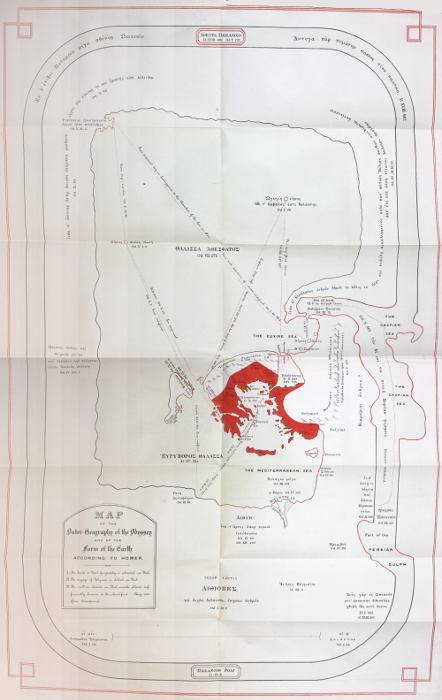
MAP of the Outer Geography of the Odyssey AND OF THE Form of the Earth ACCORDING TO HOMER.