STUDIES IN THE THEORY OF DESCENT (continued 2)
Raphael Meldola translation
We may therefore fairly assert that the structure of larvæ is on the whole remarkably uniform, in consequence of the uniformity in the conditions of life. Notwithstanding the great variety of external aspects, the general structure of caterpillars does not become changed—it is only their outward garb which varies, sometimes in one direction, and sometimes in another, and which, starting from inherited characters, becomes adapted to the various special conditions of life in the best possible manner.
All this is quite different in the case of the imagines, where we meet with very important differences in the conditions of life. The butterflies, which live under the influence of direct sunlight and a much higher temperature, and which are on the wing for a much longer period during the day, must evidently be differently equipped to the moths in their motor organs (wings), degree of hairiness, and in the development of their eyes and other organs of sense. It is true that we are not at present in a condition to furnish special proofs that the individual organs of butterflies are exactly adapted to a diurnal life, but we may safely draw this general conclusion from the circumstance that no butterfly is of nocturnal habits.195 It cannot be stated in objection that there are many moths which fly by day. It certainly appears that no great structural change is necessary to confer upon a Lepidopteron organized for nocturnal life the power of also flying by day; but this proves nothing against the view that the structure of the butterflies depends upon adaptation to a diurnal life. Analogous cases are known to occur in many other groups of animals. Thus, the decapodous Crustacea are obviously organized for an aquatic life; but there are some crabs which take long journeys by land. Fish appear no less to be exclusively adapted to live in water; nevertheless the “climbing-perch” (Anabas) can live for hours on land.
It is not the circumstance that some of the moths fly by day which is extraordinary and demands a special explanation, but the reverse fact just mentioned, that no known butterfly flies by night. We may conclude from this that the organization of the latter is not adapted to a nocturnal life.
If we assume196 that the Lepidopterous family adapted to a diurnal life gives rise in the course of time to a nocturnal family, there can be no doubt but that the transformation of structure would be far greater on the part of the imagines than on that of the larvæ. The latter would not remain quite unchanged—not because their imagines had taken to a nocturnal life which for the larva would be quite immaterial, but because this change could only occur very gradually in the course of a large number of generations, and during this long period the conditions of life would necessarily often change with respect to the larvæ. It has been shown above that within the period of time necessary for the formation of a new species impulses to change occur on both sides; how much more numerous therefore must these be in the case of a group of much higher rank, for the establishment of which a considerably longer period is required. In the case assumed, therefore, the larvæ would also change, but they would suffer much smaller transformations than the imagines. Whilst in the latter almost all the typical portions of the body would undergo deep changes in consequence of the entirely different conditions of life, the larvæ would perhaps only change in marking, hairs, bristles, or other external characters, the typical parts experiencing only unimportant modifications.
In this manner it can easily be understood why the larvæ of a family of Noctuæ do not differ to a greater extent from those of a family of butterflies than do the latter from some other Rhopalocerous family, or why the imagines of a Rhopalocerous and a Heterocerous family present much greater form-divergences than their larvæ. At the same time is therefore explained the unequal value that must be attributed to any single family of butterflies in its larvæ and in its imagines. The unequal form-divergences coincide exactly with the inequalities in the conditions of life.
When whole families of butterflies show the same structure in their typical parts (antennæ, wings, &c.), and, what is of more importance, can be separated as a systematic group of a higher order (i.e. as a section or sub-order) from the other Lepidoptera whilst their larval families do not appear to be connected by any common character, the cause of this incongruence lies simply in the circumstance that the imagines live under some peculiar conditions which are common to them all, but which do not recur in other Lepidopterous groups. Their larvæ live in precisely the same manner as those of all the other families of Lepidoptera—they do not differ in their mode of life from those of the Heterocerous families to a greater extent than they do from one another.
We therefore see here a community of form within the same compass as that in which there is community in the conditions of life. In all butterflies such community is found in their diurnal habits, and in accordance with this we find that these only, and not their larvæ, can be formed into a group having common characters.
In the larvæ also we only find agreement in the conditions of life within a much wider compass, viz. within the whole order. Between the limits of the order Lepidoptera the conditions of life in the caterpillars are, as has just been shown, on the whole very uniform, and the structure of the larvæ accordingly agrees almost exactly in all Lepidopterous families in every essential, i.e. typical, part.
In this way is explained the hitherto incomprehensible phenomenon that the sub-ordinal group Rhopalocera cannot be based on the larvæ, but that Lepidopterous caterpillars can as a whole be associated into a higher group (order); they constitute altogether families and an order, but not the intermediate group of a sub-order. By this means we at the same time reply to an objection that may be raised, viz. that larval forms cannot be formed into high systematic groups because of their “low and undeveloped” organization.
To this form of incongruence, viz. to the formation of systematic groups of unequal value and magnitude, I must attach the greatest weight with respect to theoretical considerations. I maintain that this, as I have already briefly indicated above, is wholly incompatible with the admission of a phyletic force. How is it conceivable that such a power could work in the same organism in two entirely different directions—that it should in the same species lead to the constitution of quite different systems for the larvæ and for the imagines, or that it should lead only to the formation of families in the larvæ and to sub-orders in the imagines? If an internal force existed which had a tendency to call into existence certain groups of animal forms of such a nature that these constituted one harmonious whole of which the components bore to one another fixed morphological relationships, it would certainly have been an easy matter for such a power to have given to the larvæ of butterflies some small character which would have distinguished them as such, and which would in some measure have impressed them with the stamp of “Rhopalocera.” Of such a character we find no trace however; on the contrary, everything goes to show that the transformations of the organic world result entirely from external influences.
III. Incongruences in other Orders of Insects.
Although the order Lepidoptera is for many reasons especially favourable for an investigation such as that undertaken in the previous section, it will nevertheless be advantageous to inquire into the form-relationships of the two chief stages in some other orders of metamorphic insects, and to investigate whether in these cases the formation of systematic groups also coincides with common conditions of life.
Hymenoptera.
In this order there cannot be the least doubt as to the form-relationship of the imagines. The characteristic combination of the pro- and meso-thorax, the number and venation of the wings, and the mouth-organs formed for biting and licking, are found throughout the whole order, and leave no doubt that the Hymenoptera are well based on their imaginal characters.
But it is quite different with the larvæ. It may be boldly asserted that the order would never have been founded if the larvæ only had been known. Two distinct larval types here occur, the one—caterpillar-like—possessing a distinct horny head provided with the typical masticatory organs of insects, and a body having thirteen segments, to which, in addition to a variable number of abdominal legs, there are always attached three pairs of horny thoracic legs: the other type is maggot-shaped, without the horny head, and is entirely destitute of mouth-organs, or at least of the three pairs of typical insect jaws, and is also without abdominal and thoracic legs. The number of segments is extremely variable; the larvæ of the saw-flies have thirteen besides the head, the maggot-shaped larvæ of bees possess fourteen segments altogether, and the gall-flies and ichneumons only twelve or ten. We should be much mistaken also if we expected to find connecting characters in the internal organs. The intestine is quite different in the two types of larvæ, the posterior opening being absent in the maggot-like grubs; at most only the tracheal and nervous systems show a certain agreement, but this is not complete.
The order Hymenoptera, precisely speaking and conceived only morphologically, exists therefore but in the imagines; in the larvæ there exist only the caterpillar- and maggot-formed groups. The former shows a great resemblance to Lepidopterous larvæ, and in the absence of all knowledge of the further development it might be attempted to unite them with these into one group. The two certainly differ in certain details of structure in the mouth-organs and in the number of segments, abdominal legs, &c., to a sufficient extent to warrant their being considered as two sub-orders of one larval order; but they would in any case be regarded as much more nearly related in form than the caterpillar- and maggot-like types of the Hymenopterous larvæ.
Is it not conceivable, however, that the imagines of the Hymenoptera—that ichneumons and wasps may be only accidentally alike, and that they have in fact arisen from quite distinct ancestral forms, the one having proceeded with the Lepidopterous caterpillars from one root, and the other with the grub-like Dipterous larvæ from another root?
This is certainly not the case; the common characters are too deep-seated to allow the supposition that the resemblance is here only superficial. From the structure of the imagines alone the common origin of all the Hymenoptera may be inferred with great probability. This would be raised into a certainty if we could demonstrate the phyletic development of the maggot-formed out of the caterpillar-formed Hymenopterous larvæ by means of the ontogeny of the former. From the beautiful investigations of Bütschli on the embryonic development of bees197 we know that the embryo of the grub possesses a complete head, consisting of four segments and provided with the three typical pairs of jaws. These head segments do not subsequently become formed into a true horny head, but shrivel up; whilst the jaws disappear with the exception of the first pair, which are retained in the form of soft processes with small horny points. We know also that from the three foremost segments of the embryo the three typical pairs of legs are developed in the form of round buds, just as they first appear in all insects.198 These rudimentary limbs undergo complete degeneration before the birth of the larva, as also do those of the whole199 of the remaining segments, which, even in this primitive condition, show a small difference to the three foremost rudimentary legs.
The grub-like larvæ of the Hymenoptera have therefore descended from forms which possessed a horny head with antennæ and three pairs of gnathites and a 13-segmented body, of which the three foremost segments were provided with legs differing somewhat from those of the other segments; that is to say, they have descended from larvæ which possessed a structure generally similar to that of the existing saw-fly larvæ. The common derivation of all the Hymenoptera from one source is thus established with certainty.200
But upon what does this great inequality in the form-relationship of the larvæ and imagines depend? The existing maggot-like grubs are without doubt much further removed from the active caterpillar-like larvæ than are the saw-flies from the Aculeate Hymenoptera. Whilst these two groups differ only through various modifications of the typical parts (limbs, &c.), their larvæ are separable by much deeper-seated distinctions; limbs of typical importance entirely vanish in the one group, but in the other attain to complete development.
In the Hymenoptera there exists therefore a very considerable incongruence in the systems based morphologically, i.e. on the pure form-relationships of the larvæ and of the imagines. The reason of this is not difficult to find: the conditions of life differ much less in the case of the imagines than in that of the larvæ. In the former the conditions of life are similar in their broad features. Hymenoptera live chiefly in the air and fly by day, and in their mode of obtaining food do not present any considerable differences. Their larvæ, on the other hand, live under almost diametrically opposite conditions. Those of the saw-flies live after the manner of caterpillars upon or in plants, in both cases their peculiar locomotion being adapted for the acquisition and their masticatory organs for the reduction of food. The larvæ of the other Hymenoptera, however, do not as a rule require any means of locomotion for reaching nor any organs of mastication for swallowing their food, since they are fed in cells, like the bees and wasps, or grow up in plant galls of which they suck the juice, or are parasitic on other insects by whose blood they are nourished. We can readily comprehend that in the whole of this last group the legs should disappear, that the jaws should likewise vanish or should become diminished to one pair retained in a much reduced condition, that the horny casing of the head, the surface of attachment of the muscles of the jaws, should consequently be lost, and that even the segments of the head itself should become more or less shrivelled up as the organs of sense therein located became suppressed.
The incongruence manifests itself however in yet another manner than by the relatively greater morphological divergence of the larvæ: a different grouping is possible for the larvæ and for the imagines. If we divide the Hymenoptera simply according to the form-relationships of the imagines, the old division into the two sub-orders Terebrantia or Ditrocha and Aculeata or Monotrocha will be the most correct. The distinguishing characters of a sting or ovipositor and a one- or two-jointed trochanter are still of the greatest value. But these two sub-orders do not by any means correspond with the two types of larvæ since, in the Terebrantia, there occur families with both caterpillar-formed and maggot-formed larvæ.
The cause is to be found in that a portion of these families possess larvæ which are parasitic in other insects or in galls, their bodily structure having by these means become transformed in a quite different direction. The mode of life of the imagines is, on the other hand, essentially the same.
We have here therefore another case like that which we met with among the Rhopalocerous Lepidoptera, in which the imagines appear to be capable of being formed into a higher group than the larvæ, because the former live under conditions of life which are on the whole similar whilst the latter live under very divergent conditions.
The old division of the Hymenoptera into two sub-orders has certainly been abandoned in the later zoological text-books; they are now divided into three:—saw-flies, parasitic, and aculeate Hymenoptera; but even this arrangement has been adopted with reference to the different structure of the larvæ. Whether this system is better than the older, i.e. whether it better expresses the genealogical relationship, I will not now stop to investigate.201
DIPTERA.
The imagines of the Diptera (genuina), with the exception of the Aphaniptera and Pupipara, agree in all their chief characters, such as the number and structure of the wings, the number and joints of the legs, the peculiar formation of the thorax (fusion of the three segments);202 and even the structure of the mouth organs varies only within narrow limits. This is in accordance with their mode of life, which is very uniform in its main features: all the true Diptera live in the light, moving chiefly by means of flight, but having also the power of running; all those which take food in the imago condition feed upon fluids. Their larvæ, on the other hand, are formed on two essentially different types, the one—which I shall designate as the gnat-type—possessing a horny head with eyes, three pairs of jaws, and long or short antennæ, together with a 12- or 13-segmented body, which is never provided with the three typical pairs of thoracic legs, but frequently has the so-called abdominal legs on the first and last segments. The other Dipterous larvæ are maggot-shaped and without a horny head, or in fact without any head, since the first segment, the homologue of the head, can in no case be distinguished through its being larger than the others; it is on the contrary much smaller. The typical insect mouth-parts are entirely absent, being replaced by a variously formed and quite peculiar arrangement of hooks situated on the mouth and capable of protrusion. Never more than eleven segments are present besides the first, which is destitute of eyes; neither are abdominal legs ever developed.
The mode of life differs very considerably in the two groups of larvæ. Although the Dipterous maggots are not as a rule quite incapable of locomotion like the grubs of the Hymenoptera (bees, ichneumons), the majority are nevertheless possessed of but little power of movement in the food-substance on which they were deposited as eggs. They do not go in search of food, either because they are parasitic in other insects in the same manner as the ichneumons (Tachina), or else they live on decaying animal or vegetable substances or amidst large swarms of their prey, like the larvæ of the Syrphidæ amongst Aphides. They generally undergo pupation in the same place as that which they inhabit as larvæ and indeed in their larval skin which hardens into an oval pupa-case. Some few leave their feeding place and pupate after traversing a short distance (Eristalis).
As in the case of the Hymenoptera the structure of the larvæ can here also be explained by peculiarities in their mode of life. Creatures which live in a mass of food neither require special organs of locomotion nor specially developed organs of sense (eyes). They have no use for the three pairs of jaws since they only feed on liquid substances, and the hooks within the mouth do not serve for the reduction of food but only for fastening the whole body. With the jaws and their muscular system there likewise disappears the necessity for a hard surface of attachment, i.e. a corneous head.
The mode of life of the larvæ of the gnat-type is quite different in most points. The majority, and indeed the most typically formed of these, have to go in search of their food, whether they are predaceous, such as the Culicidæ and many of the other Nemocera (Corethra, Simulium), or whether they feed on plants, which they in some cases weave into a protective dwelling tube (certain species of Chironomus). Many live in water and move with great rapidity; others bury in the earth or in vegetable substances; and even those species which live on fungi sometimes wander great distances, as in the well-known case of the “army worm” where thousands of the larvæ of Sciara Thomæ thus migrate.
Now the two types of larvæ correspond generally with the two large groups into which, as it appears to me correctly, the Diptera (genuina) are as a rule divided. In this respect there is therefore an equality of form-relationship—the grouping is the same, and the incongruence depends only upon the form-divergence between the two kinds of larvæ being greater than between the two kinds of imagines.203
That the form-divergence is greater in the larvæ than in the imagines cannot be doubted; that this distant form-relationship cannot, however, be referred to a very remote common origin, i.e. to a very remote blood-relationship, not only appears from the existence of transition-forms between the two sub-orders, but can be demonstrated here, as in the case of the Hymenoptera, by the embryonic development of the maggot-like larvæ.
Seventeen years ago I showed204 that the grub-formed larvæ of the Muscidæ in the embryonic state possessed a well-developed head with antennæ and three pairs of jaws, but that later in the course of the embryonic development a marked reduction and transformation of these parts takes place, so that finally the four head segments appear as a single small ring formed from the coalesced pairs of maxillæ, whilst the so-called “fore-head” (the first head segment), together with the mandibles, becomes transformed into a suctorial-head armed with hooks and lying within the body. At the time of writing I drew no conclusion from these facts with reference to the phyletic development of these larval forms; nor did Bütschli, six years later, in the precisely analogous case of the larvæ of the bees. The inference is, however, so obvious that it is astonishing that it should not have been drawn till the present time.205
There can be no doubt that the maggot-like larvæ of insects are not by any means ancient forms, but are, on the contrary, quite recent, as first pointed out by Fritz Müller,206 and afterwards by Packard207 and Brauer,208 and as is maintained in the latest work by Paul Mayer209 on the phylogeny of insects.
The Dipterous maggots have evidently descended from a larval form which possessed a horny head with antennæ and three pairs of jaws, but which had no appendages to the abdominal segments; they are therefore ordinary Dipterous larvæ of the gnat-type which have become modified in a quite peculiar manner and adapted to a new mode of life, just as the grubs of the Hymenoptera are larvæ of the saw-fly type, which have become similarly transformed, although by no means in the same manner. The resemblance between the two types of larva is to a great extent purely external, and depends upon the process designated “convergence” by Oscar Schmidt, i.e. upon the adaptation of heterogeneous animal forms to similar conditions of life. By adaptation to a life within a mass of fluid nutriment, the caterpillar-formed larvæ of the Hymenoptera and the Tipula-like larvæ of the Diptera have acquired a similar external appearance, and many similarities in internal structure, or, in brief, have attained to a considerable degree of form-relationship, which would certainly have tended to conceal the wide divergence in blood-relationship did not the embryological forms on the one side and the imagines on the other provide us with an explanation.
It is certainly of great interest that in another order of insects—the Coleoptera—grub-formed larvæ occur quite irregularly, and their origin can be here traced to precisely the same conditions of life as those which have produced the grubs of bees. I refer to the honey-devouring larvæ of the Meloïdæ (Meloë, Sitaris, Cantharis). The case is the more instructive, inasmuch that the six-legged larval form is not yet relegated to the development within the egg, but is retained in the first larval stage. In the second larval stage the maggot-form is first assumed, although this is certainly not so well pronounced as in the Diptera or Hymenoptera, as neither the head nor the thoracic legs are so completely suppressed as in these orders. Nevertheless, these parts have made a great advance in the process of transformation.
The grub-like larvæ of the Hymenoptera and Diptera appear to me especially instructive with reference to the main question of the causes of transformation. The reply to the questions: what gives the impetus to change? is this impetus internal or external? can scarcely be given with greater clearness than here. If these larvæ have abandoned their ancestral form and have acquired a widely divergent structure, arising not only from suppression but partly also from an essentially new differentiation (suctorial head of the Muscidæ), and if these structural changes show a close adaptation to the existing conditions of life, from these considerations alone it is difficult to conceive how such transformations can depend upon the action of a phyletic force. The latter must have foreseen that at precisely this or that fixed period of time the ancestors of these larvæ would have been placed under conditions of life which would make it desirable for them to be modified into the maggot-type. But if at the same time the imagines are removed in a less degree from those of the caterpillar-like larvæ, this divergence being in exact relation with the deviations in the conditions of life, I at least fail to see how we can escape the consequence that it is the external conditions of life which produce the transformations and induce the organism to change. It is to me incomprehensible how one and the same vital force can in the same individual induce one stage to become transformed feebly and the other stage strongly, these transformations corresponding in extent with the stronger or weaker deviations in the conditions of life to which the organism is exposed in the two stages; to say nothing of the fact that by such unequal divergences the idea of a perfect system (creative thought) is completely upset.
Nor can the objection be raised that we are here only concerned with insignificant changes—with nothing more than the arrested development of single organs and so forth, in brief, only with those changes which can be ascribed to the action of the environment.
We are here as little concerned with a mere suppression of organs through arrested development as in the case of the Cirripedia; the transformation and reconstruction of the whole body goes even much further than in these Crustacea, although not so conspicuous externally. Where do we elsewhere find insects having the head inside a cavity of the body (sectorial head of the Muscidæ), and of which the foremost segment—the physiological representative of the head—consists entirely of the coalesced antennæ and pairs of maxillæ?
The incongruences in the form-relationships are, however, exceedingly numerous in the case of the Diptera, and a special treatise would be necessary to discuss them thoroughly. I may here mention only one case, because the inequality shows itself in this instance in a quite opposite sense.
Gerstäcker, who is certainly a competent entomologist, divides the Diptera into three tribes, viz. the Diptera genuina, the Pupipara, and the Aphaniptera. The latter, the fleas, possess in their divided thoracic segments and in their jointed labial appendages characters so widely divergent from those of the true Diptera and of the Pupipara that Latreille and the English zoologists have separated them entirely from the Diptera and have raised them into a separate order.210 Those who do not agree in this arrangement, but with Gerstäcker include the fleas under the Diptera, will nevertheless admit that the morphological divergence between the Aphaniptera and the two other tribes is far greater than that which exists between the latter. Now the larvæ of the fleas are completely similar in structure to those of the gnat-type, since they possess a corneous head with the typical mouth parts and antennæ and a 13-segmented body devoid of legs. Were we only acquainted with the larvæ of the fleas we should rank them with the true Diptera under the sub-order Nemocera. On first finding such a larva we should expect to see emerge from the pupa a small gnat.
While the imagines of the Nemocera and Aphaniptera thus show but a very remote form-relationship their larvæ are very closely allied. Can any one doubt that in this case it is not the larva but the imago which has diverged to the greatest extent? Have not the fleas moreover become adapted to conditions of life widely different from those of all other Diptera, whilst their larvæ do not differ in this respect from many other Dipterous larvæ?
We have here, therefore, another case of unequal phyletic development, which manifests itself in the entirely different form-relationship of the larvæ and the imagines. Thus in this case, as in that of the Lepidoptera, it is sometimes the larval and at other times the imaginal stage which has experienced the greatest transformation, and, as in the order mentioned, the objection that a phyletic vital force produces greater and more important differentiations in the higher imaginal stage than in the lower or less developed larval stage, is equally ineffectual.
If, however, it be asked whether the unequal phyletic development depends in this case upon an unequal number of transforming impulses which the two stages may have experienced during an equal period of time, this must be decidedly answered in the negative. The unequal development obviously depends in this case, as in the higher systematic groups of the Lepidoptera, upon the unequal value of the parts affected by the changes. These parts are on the one side of small importance, and on the other side of great importance, to the whole structure of the insect. This is shown in the last-mentioned case of the fleas, where, of the typical parts of the body, only the wings have become rudimentary, whilst the antennæ, mouth-parts, and legs, and even the form and mode of segmentation (free thoracic segments), must have suffered most important modifications; their larvæ, on the other hand, can have experienced only unimportant changes, since they still agree in all typical parts with those of the gnat-type.
Although therefore in this and in similar cases a greater number of transforming impulses may well have occurred on the one side than on the other—and it is indeed highly probable that this number has not been absolutely the same—nevertheless the chief cause of the striking incongruence is not to be found therein, but rather in the strength of the transforming impulses, if I may be permitted to employ this figure, or, more precisely expressed, in the importance of the parts which become changed and at the same time in the amount of change.
In this conclusion there is implied as it appears to me an important theoretical result which tells further against the efficacy of a phyletic force.
If the so-called “typical parts” of an animal disappear completely through the action of the environment only, and still further, if these parts can become so entirely modified as to give rise to quite new and again typical structures (suctorial head of the Muscidæ) without the typical parts of the other stage of the same individual being thereby modified and transformed into a new type of structure, how can we maintain a distinction between typical and non-typical parts with respect to their origin? But if a difference exists with respect only to the physiological importance of such parts, i.e. their importance for the equilibrium of the whole organization, while, with reference to transformation and suppression, exactly the same influences appear to be effective as those which bring about a change in or a disappearance of the so-called adventitious parts, where is there left any scope for the operation of the supposed phyletic force? What right have we to assume that the typical structures arise by the action of a vital force? Nevertheless this is the final refuge of those who are bound to admit that a great number of parts or characters of an animal can become changed, suppressed, or even produced by the action of the environment.
IV. Summary and Conclusion.
The question heading the second section of this essay must at the conclusion of the investigation be answered in the negative. The form-relationship of the larvæ does not always coincide with that of the imagines, or, in other words, a system based entirely on the morphology of the larvæ does not always coincide with that founded entirely on the morphology of the imagines.
Two kinds of incongruence here present themselves. The first arises from the different amount of divergence between two systematic groups in the larvæ and in the imagines, these groups being of equal extent. The second form of incongruence consists essentially in that the two stages form systematic groups of different extents, either the one stage constituting a group of a higher order than the other and therefore forming a group of unequal value, or else the two stages form groups of equal systematic value, these groups, however, not coinciding in extent, but the one overlapping the other.
This second form of incongruence is very frequently connected with the first kind, and is mostly the direct consequence of the latter.
The cause of the incongruences is to be found in unequal phyletic development, either the one stage within the same period of time having been influenced by a greater number of transforming impulses than the other, or else these impulses have been different in strength, i.e. have affected parts of greater or less physiological value, or have influenced parts of equal value with unequal strength.
In all these cases in which there are deep-rooted form-differences, it can be shown that these correspond exactly with inequalities in the conditions of life, this correspondence being in two directions, viz. in strength and in extent: the former determines the degree of form-difference, the latter its extent throughout a larger or smaller group of species.
The different forms of incongruence are manifested in the following manner:—
(1.) Different amount of form-divergence between the larvæ on the one side and the imagines on the other. Among the Lepidoptera this is found most frequently in varieties and species, and there is evidence to show that in this case the one stage has been affected by transforming influences, either alone (varieties), or at any rate to a greater extent (species). In the last case it can be shown in many ways that one stage (the larva) has actually remained at an older phyletic grade (Deilephila species). Incongruences of this kind depending entirely upon the more frequent action of transforming impulses can only become observable in the smaller systematic groups, in the larger they elude comparative examination. In the higher groups unequal form-divergence may be produced by the transforming impulses affecting parts of unequal physiological and morphological value, or by their influencing parts of equal value in different degrees. All effects of this kind can, however, only become manifest after a long-continued accumulation of single changes, i.e. only in those systematic groups which require a long period of time for their formation. By this means we can completely explain why the incongruences of form-divergence continually diminish from varieties to genera, and then increase again from genera upwards through families, tribes, and sub-orders: the first diminishing incongruence depends upon an unequal number of transforming impulses, the latter increasing incongruence depends upon the unequal power of these impulses.
Cases of the second kind are found among the Lepidopterous families, and especially in the higher groups (Rhopalocera and Heterocera), and appear still more striking in the higher groups of the Hymenoptera and Diptera. Thus the caterpillar shaped and maggot-formed larvæ of the Hymenoptera differ from one another to a much greater extent than their imagines, since the latter have experienced a complete transformation of typical parts; whilst in the caterpillar-formed larvæ these parts vary only within moderate limits. Similarly in the case of the Diptera, of which the gnat-like larvæ diverge more widely from those of the grub type than do the gnats from the true flies. On the other hand the divergence between the imagines of the fleas and gnats is considerably greater than that between their larvæ—indeed the larvæ of the fleas would have to be ranked as a family of the sub-order of the gnat-like larvæ if we wished to carry out a larval classification. By this it is also made evident that these unequal divergences, when they occur in the higher systematic groups, always induce at the same time the second form of incongruence—that of the formation of unequal systematic groups.
In general whenever such unequal divergences occur in the higher groups they run parallel with a strong deviation in the conditions of life. If these differ more strongly on the side of the larvæ, we find that the structure of the latter likewise diverges the more widely, and that their form-relationship is in consequence made more remote (saw-flies and ichneumons, gnats and flies); if, on the other hand, the difference in the conditions of life is greater on the side of the imagines, we find among the latter the greater morphological divergence (butterflies and moths, gnats and fleas).
(2.) The second chief form of incongruence consists in the formation of different systematic groups by the larvæ and the imagines, if the latter are grouped simply according to their form-relationship without reference to their genetic affinities. This incongruence again shows itself in two forms—in the formation of groups of unequal value, and the formation of groups equal in value but unequal in extent, i.e. of overlapping instead of coinciding groups.
Of these two forms the first arises as the direct result of a different amount of divergence. Thus the larvæ of the fleas, on account of their small divergence from those of the gnats, could only lay claim to the rank of a family, whilst their imagines are separated from the gnats by such a wide form-divergence that they are correctly ranked as a distinct tribe or sub-order.
The inequalities in the lowest groups, varieties, can be regarded in a precisely similar manner. If the larva of a species has become split up into two local forms, but not the imago, each of the two larval forms possesses only the rank of a variety, whilst the imaginal form has the value of a species.
Less simple are the causes of the phenomenon that in the one stage the lower groups can be combined into one of higher rank, whilst the other stage does not attain to this high rank. Such a condition appears especially complicated when the two stages can again be formed into groups of a still higher rank.
This is the case in the tribe Rhopalocera, which is founded on the imagines alone, the larvæ forming only families of butterflies. Both stages can however be again combined into the highest systematic group of the Lepidoptera.
In this case also the difference in the value of the systematic groups formed by the two stages corresponds precisely with the difference in the conditions of life. This appears very distinctly when there are several sub-groups on each side, and not when, as in the fleas, only one family is present as a tribe on the one side and on the other as a family. Thus in the butterflies, on the one side there are numerous families combined into the higher rank of a sub-order (imagines), whilst on the other side (larvæ) a group of the same extent cannot be formed. In this instance it can be distinctly shown that the combination of the families into a group of a higher order, as is possible on the side of the imagines, corresponds exactly with the limits in which the conditions of life deviate from those of other Lepidopterous families. The group of butterflies corresponds with an equally large circle of uniform conditions of life, whilst a similar uniformity is wanting on the side of the larvæ.
The second kind of unequal group formation arises from the circumstance that groups of equal value can be formed from the two stages, but these groups do not possess the same limits—they overlap, and only coincide in part.
This is most clearly seen in the order Hymenoptera, in which both larvæ and imagines form two well-defined morphological sub-orders, but in such a manner that the one larval form not only prevails throughout the whole of the one sub-order of the imagines, but also extends beyond and spreads over a great portion of the other imaginal sub-order.
Here again the dependence of this phenomenon upon the influence of the environment is very distinct, since it can be demonstrated (by the embryology of bees) that the one form of larva—the maggot-type—although the structure now diverges so widely, has been developed from the other form, and that it must have arisen by adaptation to certain widely divergent conditions of life.
This form of incongruence is always connected with unequal divergence between the two stages of the one systematic group—in this case the Terebrantia. The larvæ of this imaginal group partly possess caterpillar-like (Phytospheces) and partly maggot-formed (Entomospheces) larvæ, and differ from one another to a considerably greater extent than the saw-flies from the ichneumons.211 The final cause of the incongruence lies therefore in this case also in the fact that one stage has suffered stronger changes than the other, so that a deeper division of the group has occurred in the former than in the latter.
The analogous incongruences in single families of the Lepidoptera may have arisen in a similar manner, as has already been more clearly shown above; only in these cases we are as yet unable to prove in detail that the larval structure has become more strongly changed through special external conditions of life than that of the imagines.
In the smallest systematic group—varieties, it has been possible to furnish some proof of this. The one-sided change here depends in part upon the direct action of external influences (seasonal dimorphism, climatic variation), and it can be shown that these influences (temperature) acted only on the one stage, and accordingly induced change in this alone whilst the other stage remained unaltered.
It has now been shown—not indeed in every individual case, but for each of the different kinds of incongruence of form-relationship—that there is an exact parallelism corresponding throughout with the incongruence in the conditions of life. Wherever the forms diverge more widely in one stage than in the other we also find more widely divergent conditions of life; wherever the morphological systemy of one stage fails to coincide with that of the other—whether in the extent or in the value of the groups—the conditions of life in that stage also diverge, either more widely or at the same time within other limits; whenever a morphological group can be constructed from one stage but not from the other, we find that this stage alone is submitted to certain common conditions of life which fail in the other stage.
The law that the divergence in form always corresponds exactly with the divergence in the conditions of life212 has accordingly received confirmation in all cases where we have been able to pronounce judgment. Unequal form-divergences correspond precisely with unequal divergence in the conditions of life, and community of form appears within exactly the same limits as community in the conditions of life.
These investigations may thus be concluded with the following law:—In types of similar origin, i.e. having the same blood-relationship, the degree of morphological relationship corresponds exactly with the degree of difference in the conditions of life in the two stages.
With respect to the question as to the final cause of transformation this result is certainly of the greatest importance.
The interdependence of structure and function has often been insisted upon, but so long as this has reference only to the agreement of each particular form with some special mode of life, this harmony could still be regarded as the result of a directive power; but when in metamorphic forms we not only see a double agreement between structure and function, but also that the transformation of the form occurs in the two chief developmental stages in successive steps at unequal rates and with unequal strength and rhythm, we must—at least so it appears to me—abandon the idea of an inherent transforming force; and this becomes the more necessary when, by means of the opposite and extremely simple assumption that transformations result entirely from the response of the organism to the actions of the environment, all the phenomena—so far as our knowledge of facts at present extends—can be satisfactorily explained. A power compelling transformation, i.e. a phyletic vital force, must be abandoned, on the double ground that it is incapable of explaining the phenomena (incongruence and unequal phyletic development), and further because it is superfluous.
Against the latter half of this argument there can at most be raised but the one objection that the phenomena of transformation are not completely represented by the cases here analysed. In so far as this signifies that the whole organic world, animal and vegetable, has not been comprised within the investigation this objection is quite valid. The question may be raised as to the limit to which we may venture to extend the results obtained from one small group of forms. I shall return to this question in the last essay.
But if by this objection it is meant that the restricted field of the investigation enables us to actually analyse only a portion of the occurring transformations,213 and indeed only those cases, the dependence of which upon the external conditions of life would be generally admitted, I will not let pass the opportunity of once more pointing out at the conclusion of the present essay that the incongruences shown to exist by no means depend only upon those more superficial characters the remodelling of which in accordance with the external conditions of life may be most easily discerned and is most difficult to deny, but that in certain cases (maggot-like Dipterous larvæ) it is precisely the “typical” parts which become partly suppressed and partly converted into an entirely new structure. From the ancient typical appendages there have here arisen new structures, which again have every right to be considered as typical. This transformation is not to be compared with that experienced by the swimming appendages of the Nauplius-like ancestor of an Apus or Branchipus which have become mandibulate, nor with the transformation which the anterior limbs must have gone through in the reptilian ancestors of birds. The changes in question (Dipterous larvæ) go still further and are more profound. I lay great emphasis upon this because we have here one of the few cases which show that typical parts are quite as dependent upon the environment as untypical structures, and that the former are not only able to become adapted to external conditions by small modifications—as shown in a most striking manner by the transformations of the appendages in the Crustacea and Vertebrata—but that these parts can become modelled on an entirely new type which, when perfected, gives no means of divining its mode of origin. I may here repeat a former statement:—With reference to the causes of their origination we have no grounds for drawing a distinction between typical and untypical structures.
It may be mentioned in concluding that quite analogous although less sharply defined results are arrived at if, instead of fixing our attention upon the different stages of a systematic group in their phyletic development, we only compare the different functional parts (organs in the wide sense) of the organisms.
A complete parallel can be drawn between the two classes of developmental phenomena. From the very different systematic values attached by taxonomists to this or that organ in a group of animals, it may be concluded that the individual parts of an organism are to a certain extent independent, and that each can vary independently, when affected either entirely alone or in a preponderating degree by transforming impulses, without all the other parts of the organism likewise suffering transformation, or at least without their becoming modified in an equal degree. Did all the parts and organs in two groups of animals diverge from each other to the same extent, the systematic value of such parts would be perfectly equal; we should, for example, be able to distinguish and characterize two genera of the family of mice by their kidneys, their liver, their salivary glands, or by the histological structure of their hair or muscles, or even by differences in their myology, &c. equally as well as by their teeth, length of toes, &c. It is true that such a diagnosis has yet to be attempted; but it may safely be predicted that it would not succeed. Judging from all the facts at present before us, the individual parts—and especially those connected in their physiological action, i.e. the system of organs—do not keep pace with reference to the modifications which the species undergoes in the course of time; at one period one system and at another period some other system of organs advances while the others remain behind.
This corresponds exactly with the result already deduced from the unparallel development of the independent ontogenetic stages. If the inequality in the phyletic development is more sharply pronounced in this than in the last class of cases, this can be explained by the greater degree of correlation which exists between the individual systems of organs in any single organism as compared with that existing between the ontogenetic stages, which, although developed from one another, are nevertheless almost completely independent. We should have expected à priori that a strong correlation would have here existed, but as a matter of fact this is not the case, or is so only in a very small degree.
Just as in the stages of metamorphosis the inequality of phyletic development becomes the more obliterated the more distant and comprehensive, or, in other words, the greater the period of existence of the groups which we compare, so does the unequal divergence of the systems of organs become obliterated as we bring into comparison larger and larger systematic groups.
It is not inconceivable—although a clear proof of this is certainly as yet wanting—that a variety of the ancestral species would differ only in one single character, such as hairiness, colour, or marking, and such instances would thus agree precisely with the foregoing cases in which only the caterpillar or the butterfly formed a variety. All the more profound modifications however—such for instance as those which determine the difference between two species—are never limited to one character, but always affect several, this being explicable by correlation, which, as Darwin has shown in the case of dogs, may cause modifications in the skull of those breeds having hanging ears in consequence of this last character alone. It must be admitted however that one organ only would be originally affected by a modifying influence. Thus, I am acquainted with two species of a genus of Daphniacea which are so closely allied that they can only be distinguished from one another by a close comparison of individual details. But whilst most of the external and internal organs are almost identical in the two species the sperm-cells of the males differ in a most striking manner, in one species resembling an Australian boomerang in form and in the other being spherical! An analogous instance is furnished by Daphnia Pulex and D. Magna, two species which were for a long time confounded. Nearly all the parts of the body are here exactly alike, but the antennæ of the males differ to a remarkable extent, as was first correctly shown by Leydig.
Similarly in the case of genera there may be observed an incongruence of such a kind that individual parts of the body may deviate to a greater or to a less extent than the corresponding parts in an allied genus. If, for instance, we compare a species of the genus of Daphniacea, Sida, with a species of the nearly allied genus Daphnella, we find that all the external and internal organs are in some measure dissimilar—nevertheless certain of these parts deviate to an especially large extent, and have without question become far more transformed than the others. This is the case, for example, with the antennæ and the male sexual organs. The latter, in Daphnella, open out at the sides of the posterior part of the body as long, boot-shaped generative organs, and in Sida as small papillæ on the ventral side of this region of the body. If again we compare Daphnella with the nearly allied genus Latona, it will be found that no part in the one is exactly similar to the corresponding part in the other genus, whilst certain organs differ more widely than others. This is the case for instance with the oar-like appendages which in Latona are triramous, but in Daphnella, as in almost all the other Daphniacea, only biramous.
In families the estimation of the form-divergence of the systems of organs and parts of the body becomes difficult and uncertain: still it may safely be asserted that the two Cladocerous families Polyphemidæ and Daphniidæ differ much less from one another in the structure of their oar-like appendages than in that of their other parts, such as the head, shell, legs, or abdominal segments. In systematic groups of a still higher order, i.e. in orders, and still more in classes, we might be inclined to consider that all the organs had become modified to an equally great extent. Nevertheless it cannot be conclusively said that the kidneys of a bird differ from those of a mammal to the same extent as do the feathers from mammalian hair, since we cannot estimate the differences between quite heterogeneous things—it can only be stated that both differ greatly. Here also the facts are not such as would have been expected if transformation was the result of an internal developmental force; no uniform modification of all parts takes place, but first one part varies (variety) and then others (species), and, on the whole, as the systematic divergence increases all parts become more and more affected by the transformation and all tend continually to appear changed to an equal extent. This is precisely what would be expected if the transforming impulses came from the environment. An equalization of the differences caused by transformation must be produced in two ways; first by correlation, since nearly every primary transformation must entail one or more secondary changes, and secondly because, as the period of time increases, more numerous parts of the body must become influenced by primary transforming factors.
A tempting theme is here also offered by attempting to trace the inequality of phyletic development to dissimilar external influences, and by demonstrating that individual organs have as a rule become modified in proportion to the divergence in the conditions of life by which they have been influenced, this action, during a given period of time, having been more frequent in the case of one organ than in that of the others, or, in brief, by showing the connection between the causes and effects of transformation.
It would be quite premature, however, to undertake such a labour at present, since it will be long before physiology is able to account for the fine distinctions shown by morphology, and further because we have as yet no insight into those internal adjustments of the organism which would enable us à priori to deduce definite secondary changes from a given primary transformation. But so long as this is impossible we have no means of distinguishing correlative changes from the primary modifications producing them, unless they happen to arise under our observation.
APPENDIX I.214 Additional Notes on the Ontogeny, Phylogeny, &c., of Caterpillars.
Ontogeny of the Noctua larvæ.—References have already been given in a previous note (67, p. 166) to observations on the number of legs and geometer-like habits of certain Noctua-larvæ when newly hatched. This interesting fact in the development of these insects furnishes a most instructive application of the principle of ontogeny to the determination of the true affinities, i.e. the blood-relationship of certain groups of Lepidoptera. While the foregoing portions of this work have been in course of preparation for the press, some additional observations on this subject have been published, and I may take the present opportunity of pointing out their systematic bearing—not, indeed, with a view to settling definitively the positions of the groups in question, as our knowledge is still somewhat scanty—but with the object of stimulating further investigation.
Mr. H. T. Stainton has lately recorded the fact that the young larva of Triphæna Pronuba is a semi-looper (Ent. Mo. Mag. vol. xvii. p. 135); and in a recently published life-history of Euclidia Glyphica (Ibid. p. 210) Mr. G. T. Porritt states that this caterpillar is a true looper when young, but becomes a semi-looper when adult. To these facts Mr. R. F. Logan adds (Ibid. p. 237) that “nearly all the larvæ of the Trifidæ are semi-loopers when first hatched.” The Cymatophoræ appear to be an exception, but Mr. Logan points out that this genus is altogether aberrant, and seems to be allied to the Tortricidæ. Summing up the results of these and the observations previously referred to, it will be seen that this developmental character has now been established in the case of species belonging to the following families of the section Genuinæ:—Leucaniidæ, Apameidæ, Caradrinidæ, Noctuidæ, Orthosiidæ, Hadenidæ, and Xylinidæ, as well as the other Trifidæ (excepting Cymatophora).215 The larvæ of the Minores and Quadrifidæ are as a rule semi-loopers when adult and may be true loopers when young, although further observations on this point are wanted. These facts point to the conclusion that the Noctuæ as a whole are phyletically younger than the Geometræ, whilst the Genuinæ and Bombyciformes have further advanced in phyletic development than the Minores and Quadrifidæ. The last two sections are therefore the most closely related to the Geometræ, as correctly shown by the arrangement given in Stainton’s “Manual;” whilst that adopted in Doubleday’s “Synonymic List,” where the Geometræ precede the Noctuæ, is most probably erroneous.
Additional descriptions of Sphinx-larvæ.—In the foregoing essay on “The Origin of the Markings of Caterpillars,” Dr. Weismann has paid special attention to the larvæ of the Sphingidæ and has utilized for this purpose, in addition to his own studies of the ontogeny of many European species, the figures in the chief works dealing with this family published down to the time of appearance of his essay (1876).216 In order to amplify this part of the subject I have added references to more recent descriptions and figures of Sphinx-larvæ published by Burmeister and A. G. Butler, and I have endeavoured in these cases to refer the caterpillars as far as possible to their correct position in the respective groups founded on the ontogeny and phylogeny of their allies. It is, however, obvious that for the purposes of this work figures or descriptions of adult larvæ are of but little value, except for the comparative morphology of the markings; and even this branch of the subject only becomes of true biological importance when viewed in the light of ontogeny. As our knowledge of the latter still remains most incomplete in the case of exotic species, it would be at present premature to attempt to draw up any genealogy of the whole family, and I will here only extend the subject by adding some few descriptions of species which are interesting as having been made from the observations of field-naturalists, and which contain remarks on the natural history of the insects.
Mr. C. V. Riley in his “Second Annual Report on the Noxious, Beneficial, and other Insects of the State of Missouri, 1870,” gives figures and describes the early stages and adult forms of certain grape-vine feeding larvæ of the sub-family Chærocampinæ. The full-grown larva of Philampelus Achemon, Drury, “measures about 3½ inches when crawling, which operation is effected by a series of sudden jerks. The third segment is the largest, the second but half its size, and the first still smaller, and when at rest the two last-mentioned segments are partly withdrawn into the third.... The young larva is green, with a long slender reddish horn rising from the eleventh segment and curving over the back.” Mr. Riley then states that full grown specimens are sometimes found as green as the younger ones, but “they more generally assume a pale straw or reddish-brown colour, and the long recurved horn is invariably replaced by a highly polished lenticular tubercle.” The specimen figured was the pale straw variety, this colour deepening at the sides, and finally merging into a rich brown. The markings appear to consist of an interrupted brown dorsal line, a continuous subdorsal line of the same colour, and six oblique scalloped white bars along the side. Whether the colour and marking is adapted to the vine, as is the case with the two varieties of the dimorphic Chærocampa Capensis (q.v.), is not stated. The larva of Philampelus Satellitia, Linn., when newly hatched, and for some time afterwards is “green with a tinge of pink along the sides, and with an immensely long straight pink horn at the tail. This horn soon begins to shorten, and finally curls round like a dog’s tail.” The colour of the insect changes to a reddish-brown as it grows older, and the caudal horn is entirely lost at the third moult. The chief markings appear to be five oblique cream-yellow patches with a black annulation on segments 6–10, and a pale subdorsal line. The caterpillar crawls by a series of sudden jerks, and often flings its “head savagely from side to side when alarmed.” “When at rest, it draws back the fore part of the body and retracts the head and first two joints into the third.” Two points in connection with these species are of interest with respect to the present investigations. The green colour and the possession of a long caudal horn when young shows that these larvæ, like those of Chærocampa Elpenor (p. 178), C. Porcellus (p. 184), and Philampelus Labruscæ (p. 195, note), are descended from ancestors which possessed these characters in the adult state.217 The next point of interest is the attitude of alarm assumed by these larvæ, and effected by withdrawing the head and two front segments into the third.218 The importance of this in connection with the similar habit of ocellated species will be seen on reading the remarks on page 367 bearing upon the initial stages of eye-spots. The other species figured by Mr. Riley are Chærocampa Pampinatrix, Smith and Abbot, and Thyreus Abboti, Swains. The latter has already been referred to (p. 256).
In a paper “On a Collection of Lepidoptera from Candahar” (Proc. Zoo. Soc., May 4th, 1880), Mr. A. G. Butler has described and figured, from materials furnished to him by Major Howland Roberts, the larvæ of three species of Sphingidæ. Chærocampa Cretica, Boisd., feeds on vine; out of 100 specimens examined, there was not one black variety, while in another closely allied species, found at Jutogh and Kashmir, the larva is stated to be as often black as green. The general colour of the caterpillar harmonizes with that of the underside of the vine leaves; it possesses a thread-like dorsal, and a pale yellow subdorsal line; also “a subdorsal row of eye-spots, each consisting of a green patch in a yellow oval, the first spot on the fifth segment being the largest and most distinct, those on each following segment becoming smaller, more flattened, and less distinct, till lost on the twelfth segment, sometimes becoming indistinct after the seventh or eighth segment; these spots are only distinct as eye-spots on the fifth and sixth segments, that on the sixth being flatter than that on the fifth, those on the remaining segments appearing like dashes while the larvæ is green, but more like eyes on its changing colour when full fed.” The change here alluded to is the dark-brown coloration so generally assumed by green Sphinx-larvæ previous to pupation, and which, as I have stated elsewhere (Proc. Zoo. Soc., 1873, p. 155), is probably an adaptation advantageous to such larvæ when crawling over the ground in search of a suitable place of concealment. Making the necessary correction for the different mode of counting the segments, it will be seen that the primary ocelli of this species are in the same position as those of the other species of this genus as described in a previous part of this essay, and that it belongs to the second phyletic group treated of at p. 193. The interesting fact that this species does not display dimorphism, whilst the closely allied form from Kashmir is dimorphic, shows that in the present species the process of double adaptation has not taken place; and this will probably be found to be connected with the habits of life, i.e. the insect being well adapted to the colour of its food-plant may not conceal itself on the ground by day. The caterpillar of Deilephila Robertsi, Butl., is found at Candahar on a species of Euphorbia growing on the rocky hills, and is so abundant that at the end of May every plant with any leaves left on it had several larvæ feeding upon it. “The larvæ are very beautiful and conspicuous, and are very different in colouring according to their different stages of growth.” The general colour is black with white dots and spots; a subdorsal row of large roundish spots, one on each segment, either white, yellow, orange or red; dorsal stripe variable in colour, and sometimes only partially present or altogether absent. “At the end of May most of the larvæ found presented a different appearance; the black disappears more or less, and with it many of the small white spots. In some cases the black only remains as a ring round the larger white spots; the ground-colour therefore becomes yellowish-green or yellow, varying very considerably.” The larva does not change colour previous to pupation. This species, according to the outline figure given (loc. cit., Pl. XXXIX., Fig. 9), appears to belong to the first of Dr. Weismann’s groups, comprising D. Euphorbiæ, D. Dahlii and D. Nicæa (see p. 199), and is therefore in the seventh phyletic stage of development (p. 224). From the recorded habits it seems most probable that the colours and markings of this caterpillar are signals of distastefulness. It is much to be regretted that Major Roberts has not increased the value of his description of this species by adding some observations or experiments bearing on this point. Eusmerinthus Kindermanni, Lederer, feeds on willow. “General colour green, covered with minute white dots and seven long pale yellow oblique lateral bands. (The ground-colour is the same as the willow-leaves on which the larva feeds, the yellow stripes the same as the leaf-stalks, and the head and true legs like the younger branches).” As no subdorsal line is mentioned or figured, this species must be regarded as belonging to the third stage of phyletic development (see p. 242).
I have recently had an opportunity of inspecting a large number of drawings of Sphinx-larvæ in the possession of Mr. F. Moore, and of those species not mentioned in the previous portions of this work the following may be noticed:—Chærocampa Theylia, Linn., like Ch. Lewisii (note 82, p. 194), appears to be another form connecting the second and third phyletic groups of this genus. Ch. Clotho, Drury, belongs to the third group (figured by Semper; see note 3 to this Appendix). The larva of Ch. Lucasii, Walk., offers another instance of the retention of the subdorsal line by an ocellated species. The larva of Ch. Lycetus, Cram., of which Mr. Moore was so good as to show me descriptions made at the various stages of growth, presents many points of interest. It belongs to the third phyletic group, and all the ocelli appear at a very early stage. The dimorphism appears also in the young larvæ, some being green, and others black, a fact which may be explained by the law of “backward transference” (see p. 274). A most suggestive feature is presented by the caudal horn, which in the young caterpillar is stated to be freely movable. It is possible that this horn, which was formerly possessed by the ancestors of the Sphingidæ, and which is now retained in many genera, is a remnant of a flagellate organ having a similar function to the head-tentacles of the Papilio-larvæ, or to the caudal appendages of Dicranura (see p. 289).
Lophostethus Dumolinii, Angas.—The larva of this species differs so remarkably from those of all other Sphingidæ, that I have thought it of sufficient interest to publish the following description, kindly furnished by Mr. Roland Trimen, who in answer to my application sent the following notes:—“My knowledge of the very remarkable larva of this large and curious Smerinthine Hawk-moth is derived from a photograph by the late Dr. J. E. Seaman, and from drawings and notes recently furnished by Mr. W. D. Gooch. The colour is greenish-white, inclining to grey, and in the male there is a yellow, but in the female a bluish, tinge in this. All the segments but the second and the head bear strong black spines, having a lustre of steel blue, and springing from a pale yellow tubercular base. The longest of these spines are in two dorsal rows from the fourth to the eleventh segment, the pairs on the fourth and fifth segments being longer than the rest, very erect, and armed with short simple prickles for three-fourths of their upper extremity. The anal horn, which is shorter than the spines, is of the same character as the latter, being covered with prickles, and much inclined backwards. Two lateral rows of similar shorter spines extend from the fourth to the 12th segment, and on each of the segments 6–11 the space between the upper and lower spines is marked with a conspicuous pale yellow spot. Two rows of smaller similar spines extend on each side (below the two rows of larger ones) from the second to the thirteenth segment, one spine of the lowermost row being on the fleshy base of each pro-leg. All the pro-legs are white close to the base, and russet-brown beyond. Head smooth, unarmed in adult, greenish-white with two longitudinal russet-brown stripes on face.
“The young larvæ have proportionally much longer and more erect spines with distinct long prickles on them. There is a short pair besides, either on the back of the head or on the second segment. Moreover, the dorsal spines of the third and fourth segments, and the anal horn (which is quite erect, and the longest of all), are longer than the rest, and distinctly forked at their extremity.
“Mr. Gooch notes that these young larvæ might readily be mistaken for those of the Acrææ, and suggests that this may protect them. He also states that the yellow lateral spots are only noticed after the last moult before pupation, and that the general resemblance of the larva as regards colour is to the faded leaves of its food-plant, a species of Dombeia.”
The forked caudal horn in the young larva of this species is of interest in connection with the similar character of this appendage in the young caterpillar of Hyloicus Pinastri, p. 265.
Retention of the Subdorsal Line by Ocellated Larvæ.—It has already been shown with reference to the eye-spots of the Chærocampa-larvæ, that these markings have been developed from the subdorsal line, and that, in accordance with their function as a means of causing terror, this line has in most species been eliminated in the course of the phylogeny from those segments bearing the eye-spots in order to give full effect to the latter (see p. 379). In accordance with the law that a character when it has become useless gradually disappears, the subdorsal is more or less absent in all those species in which the ocelli are most perfectly developed; and it can be readily imagined that in cases where adaptation to the foliage exists the suppression of this line would under certain conditions be accelerated by natural selection. On the other hand, it is conceivable that the subdorsal line may under other conditions be of use to a protectively coloured ocellated species by imitating some special part of the food-plant, under which circumstances its retention would be secured by natural selection.
Such an instance is offered by Chærocampa Capensis, Linn.; and as this case is particularly instructive as likewise throwing light upon the retention of the subdorsal by certain species having oblique stripes (see p. 377, and note 166, p. 378), I will here give some details concerning this species which have been communicated to me by Mr. Roland Trimen, the well-known curator of the South African Museum, Cape Town. The caterpillar of C. Capensis, like so many other species of the genus, is dimorphic, one form being a bright (rather pale) green, and the other, which is much the rarer of the two, being dull pinkish-red. Both these forms are adapted in colour to the vine on which they feed, the red variety according to some extent with the faded leaves of the cultivated vines, but to a greater extent with the young shoots and underside of the leaves of the South African native vine (Cissus Capensis), on which it also feeds. There are two eye-spots in this species in the usual positions; they are described as being blue-grey in a white ring, and raised so as to project a little. The subdorsal is white, and is bordered beneath by a wide shade of bluish-green irrorated with white dots, and crossed by an indistinct white oblique ray on each segment. These last markings are probably remnants of an oblique striping formerly possessed by the progenitor of this and other species of the genus (see, for instance, Fig. 25, Pl. IV., one of the young stages of C. Porcellus). It is possible that these rudimentary oblique stripes are now of service in assisting the adaptation of the larva to its food-plant, but this cannot be decided without seeing the insect in situ.
The subdorsal line extends from immediately behind the second eye-spot to the base of the very short and much curved violet anal horn. With reference to the protective colouring Mr. Trimen writes:—“The difficulty of seeing these large and beautifully-coloured larvæ on the vines is quite surprising; six or more may be well within sight, and yet quite unnoticed. The subdorsal stripe greatly aids in their concealment, as it well represents in its artificial light and shade the leaf-stalks of the vine.” When this larva withdraws its front segments the eye-spots stand out very menacingly; but in spite of this it is greedily eaten by fowls and shrikes (Fiscus Collaris), and Mr. Trimen also found that a tame suricate (Rhyzæna Suricata) and a large monitor lizard (Regenia Albogularis) did not refuse them. The failure of the eye-spots in causing terror in these particular cases cannot be regarded as disproving their utility in all instances. It must always be borne in mind that no protective character can possibly be of service against all foes; natural selection only requires that such characters should be advantageous with respect to the majority of the enemies of any species, and further experiments with this caterpillar may show that in the case of smaller foes the eye-spots are effective as a means of causing alarm. The dimorphism of the larva of C. Capensis is of special interest, although we are not yet sufficiently acquainted with the habits of this species to offer a complete explanation. According to Dr. Weismann’s conclusions (p. 297), the dimorphism of the Chærocampa-larvæ is due to a double adaptation, the insects first having acquired the habit of concealing themselves by day, and the dark form having then been produced by the action of natural selection, in order to adapt such varieties to the colour of the soil, whilst others retained the green colour which adapts them to the foliage of their food-plants. In accordance with this, C. Capensis may have a similar habit of concealment, or (should this be found not to be the case) it is possible that this insect at a former period possessed this habit and fed upon some other plant, when it would have become dimorphic in the manner explained, and the existing dimorphism may be a survival of the more ancient dimorphism, the red form (corresponding to the older dark form) having been subsequently modified so as to become also adapted to the new food-plant. Much light would be thrown upon this by studying the ontogeny of the species.
Phytophagic Variability.—A number of observations bearing on the phytophagic variability of the Sphinx-larvæ and other caterpillars have been recorded in a previous note (p. 305), and reference has also been made to the food-plants of Acherontia Atropos in South Africa (note 121, p. 263). I am now enabled to add some further observations on this species, from notes furnished to me by Mr. Roland Trimen, who states that for many years he has noticed that at the Cape this larva varies greatly in the depth and shade of the green ground-colour, the variability being in strict accordance with the colour of the leaves of the particular plant on which the individual feeds. The phenomenon was particularly noticeable in larvæ feeding on Buxia Grandiflora, a shrub in common cultivation in gardens, and of which the foliage is of a very dull pale greyish-green. Another striking instance was noticed in some very fine caterpillars feeding on a large shrubby Solanum, which, excepting the bright yellow bands bordering the dorsal violet bars, were generally dull ochreous-yellow, like the leaves and stalks of the Solanum. On plants with bright green or deep green leaves, the colour of the larvæ is almost in exact agreement. Mr. Trimen adds:—“These remarks apply principally to the underside and pro-legs and lower lateral regions, the dorsal colours of violet and yellow varying but little. The protection afforded is very considerable, as the larvæ almost always cling to the lower side of the twigs of their food-plants, so that their uniformly-coloured under-surface is upwards, and turned towards the light, and their variegated upper surface turned downwards.”
These observations are of the highest importance, not only as adding another instance to the recorded cases of phytophagic variation, but likewise as showing that with this variability a protective habit has been acquired. It is to be hoped that such a promising field for experimental investigation as is offered by this and analogous cases will not long remain unexplored. In attacking the problem two chief questions have in the first place to be settled: (1) Is the variability truly phytophagic, i.e. are the colour variations actually brought about by the chemico-physiological action of the food-plant? and (2) Are the larvæ at any period of growth susceptible to the action of phytophagic influences? The first question could be decided by feeding larvæ from the same batch of eggs on different food-plants from the period of their hatching. The second question could be settled by changing the food-plants of a series of selected specimens at various stages of growth, and observing whether any change of colour was produced. In accordance with the principles advocated in a previous note (p. 305), it is conceivable à priori that phytophagic variability may occur by direct chemico-physiological action, quite irrespective of any of the changes of colour being of protective use. In the case of brightly-coloured distasteful species phytophagic variability might thus have full play, but in the case of protectively-coloured edible species, phytophagic variability would be under the control of natural selection. These considerations raise a question of the greatest theoretical interest in connection with this phenomenon. If phytophagic variability can have full play uncontrolled by natural selection in brightly-coloured caterpillars, ought not this phenomenon to be of more common occurrence in such species than in those protectively coloured? Although our knowledge of this subject is still very imperfect, as a matter of fact brightly coloured larvæ, so far as I have been able to ascertain, do not appear to be susceptible of phytophagic influences. But this apparent contradiction, instead of opposing actually confirms the foregoing views, as will appear on further consideration. The colours of protected species are as a whole much inferior in brilliancy to those of inedible species, so that any phytophagic effect would be more perceptible in the former than in the latter, in which the highest possible standard of brilliancy appears in most cases to have been attained. Now phytophagic variations of colour appear to be of but small amount, or, in other words, such variations fluctuate within comparatively restricted limits, and as the cases at present known are mostly adaptive it is legitimate to conclude that they have been produced and brought to their present standard by natural selection, i.e. that they have arisen from phytophagic influences as a cause of variability. The initial stages of phytophagic variations must therefore have been still less perceptible than the now perfected final results; and this leads to the conclusion that minute variations of this character were of sufficient importance to protectively-coloured species to be taken advantage of by natural selection. But minute variations in a dull-coloured larva would, as previously pointed out, produce a comparatively much greater effect than such variations in a brilliantly-coloured species; and as protection is required by the former, the initial phytophagic effects would be accumulated, and the power of adaptability conferred by the continued action of natural selection, whilst in vividly-coloured species where no power of adaptability is required this cause of variation would not only produce a result which, as compared with its effects upon dull species, may be regarded as a “vanishing quantity,” but this result would be too insignificant to be taken advantage of by natural selection, which is in these cases dealing only with large “quantities,” and striving to make the caterpillars as brilliant as possible. The fact that vividly-coloured distasteful larvæ do not show phytophagic variation is to my mind explained proximately by these considerations; the ultimate cause of phytophagic variability regarded as a chemico-physiological action requires further investigation.
Sexual Variation in Larvæ.—Since most of the markings of caterpillars can be explained by the two factors of adaptation and inheritance, or, in other words, by their present and past relations to the environment, and since sexual selection can have played no direct part in producing these colours and markings, I feel bound to record here some few observations on the sexual differences in larvæ in addition to the cases of Anapæa and Orgyia already recorded (note i., p. 308) and of Lophostethus Dumolinii (p. 527).
Mr. C. V. Riley states219 with reference to the larva of Thyreus Abboti that the ground-colour appears to depend upon the sex, Dr. Morris having described the insect as “reddish-brown with numerous patches of light green,” and having expressly stated that “the female is of a uniform reddish-brown with an interrupted dark-brown dorsal line and transverse striæ.” Mr. W. D. Gooch, who has reared the South African butterflies Nymphalis Cithæron and N. Brutus from their larvæ, states220 that these “differed sexually in both instances.” Of Brutus only a few were bred, but of Cithæron many. “The sexual difference of the latter was that the females had a large dorsal sub-cordate cream mark, which was wanting, or only shown by a dot, in the males, and the colour was more vivid in the edgings to the frontal horns.”
Although such cases appear to be at present inexplicable, they are of interest as examples of those “residual phenomena” which, as is well known, have in many branches of science so often served as important starting-points for new discoveries and generalizations.221
APPENDIX II.
The following paper by Dr. Fritz Müller222 forms the third of a series of communications on Brazilian butterflies published in “Kosmos,” and as it bears upon the investigations made known in the third essay of the present work, I will here give a translation, by permission of the publisher, Herr Karl Alberts.
“Acræa and the Maracujá Butterflies as Larvæ, Pupæ, and Imagines.
“In a thoughtful essay on ‘Phyletic Parallelism in Metamorphic Species,’ Weismann has shown that in the case of Lepidoptera the developmental stages of larva, pupa, and imago vary independently, and that a change occurring in one stage is without influence upon the preceding and succeeding stages, so that the course which has been followed by the individual stages in their developmental history has not been in all cases identical. This want of agreement may manifest itself both by unequal divergence of form-relationship, and by unequal group formation. With respect to unequal form-divergence the caterpillars are sometimes more closely related in form than their imagines, and at other times the reverse is the case. With respect to unequal group formation again, two cases are possible; the larvæ and imagines may form groups of unequal value, the one stage forming higher or lower groups than the other, or they may form groups of unequal size, i.e., groups which do not coincide but which overlap. Form-relationship and blood-relationship do not therefore always agree; the resemblances among the caterpillars would lead to a quite different arrangement to that resulting from the resemblances among the imagines, and it is probable that neither of these arrangements would correspond with the actual relationships.
“Starting from this fact, which he establishes by numerous examples, Weismann proceeds to show most convincingly that an innate power of development or of transformation, such as has been assumed under various names by many adherents of the development theory, has no existence, but that every modification and advancement in species has been called forth by external influences.
“A most beautiful illustration of the want of ‘phyletic parallelism,’ as Weismann designates the different form-relationships of the larvæ, pupæ, and imagines, is furnished by the five genera Acræa, Heliconius, Eueides, Colænis, and Dione (= Agraulis). This instance seems to me to be of especial value, because it offers the rare case of pupæ showing greater differences than the larvæ and imagines.
“The species of which I observed the larvæ and pupæ are Acræa Thalia and Alalia, Heliconius Eucrate, Eueides Isabella, Colænis Dido and Julia, Dione Vanillæ and Juno; besides these I noticed the pupa of Eueides Aliphera.
“The following remarks apply only to these species, although we may suppose with great probability that the whole of the congeneric forms—excepting perhaps the widely ranging species of Acræa—would display similar characters to their Brazilian representatives.
“The imagines of the five genera mentioned form two sharply defined families, the Acræidæ and the butterflies of the Maracujá group.223 The latter comprises the three genera Heliconius, Eueides, and Colænis, which differ only in very unimportant characters; Eueides is distinguished from Heliconius by its shorter antennæ, and Colænis differs from Eueides in having the discoidal cell of the hind-wings open. The genus Dione is further removed by the different structure of the legs, and the silvery spots on the underside of the wings. Certain species resemble those of other genera in a most striking manner, and much more closely both in colour and marking, and even in the form of their wings, than they do their own congeners. This is the case with Acræa Thalia and Eueides Pavana, with Heliconius Eucrate and Eueides Isabella, and with Eueides Aliphera and Colænis Julia, which are deceptively alike, and the last two are connected with Dione Juno, at least by the upper side of the wings. The difficulty of judging of the relationships of the single species is thus much aggravated; it cannot be said how much of this resemblance is to be attributed to blood-relationship, and how much to deceptive imitation.
“As larvæ all the Brazilian species must be placed in one genus, as they agree exactly in the number and arrangement of their spines (4 spines, not in a transverse row, on segments 2 and 3; 6 spines, in a transverse row, on segments 4–11; 4 spines, not in a transverse row, on the last (12th) segment). They differ from one another much less in this respect than do the German species of Vanessa, such, for instance, as V. Io or Antiopa from V. Polychloros, Urticæ, and Atalanta.224 The larvæ of Acræa Thalia are certainly without the two spines on the head which the others possess, and, on the other hand, they have a well-developed pair of spines on the first segment, which, in most of the other species, are completely absent; but this does not justify their separation, since the head spines of Heliconius, Eueides, and Colænis Dido, which are of a considerable length, are shorter than those of the next segment in Colænis Julia, and Dione Vanillæ, and in Dione Juno they dwindle down to two minute points, this last species also bearing a short pair on the first segment. The larva of Dione Juno is thus as closely related to that of Acræa Thalia as it is to that of its congener Dione Vanillæ.
“If it were desired to form two distinct larval groups this could not be effected on the basis of their differences in form, but could only be based on their food-plants. The larvæ of Heliconius, Eueides, Colænis, and Dione live on species of Maracujá (Passiflora); those of Acræa Thalia and Alalia on Compositæ (Mikania and Veronia). These larval groups would agree with those founded on the form-relationships of the imagines, but unlike the imaginal groups, which can be formed into families, they would scarcely possess a generic value.
“If we arrange the single species of caterpillars according to their resemblances, this arrangement does not agree with that based on the resemblances of the imagines, even if we disregard the different values of the groups. The result is somewhat as follows:—
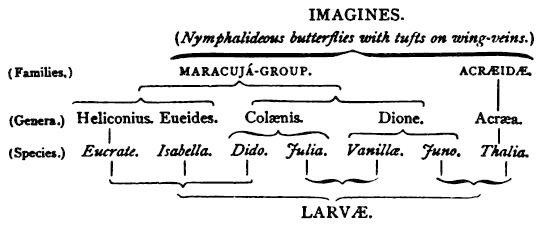
IMAGINES. (Nymphalideous butterflies with tufts on wing-veins.) /---------------------------------------------------\ (Families.) MARACUJÁ-GROUP. ACRÆIDÆ. /---------------------------\ | /-------------------\ /-------------------\ | (Genera.) Heliconius. Eueides. Colænis. Dione. Acræa. | /-------\ /-------\ | (Species.) Eucrate. Isabella. Dido. Julia. Vanillæ. Juno. Thalia. | | | | | | | \----------+---------/ \--------/ \------/ \--------------------------------------/ LARVÆ.”
* * * * *
[Here follow the remarks on the habits of the larvæ in connection with their colours, &c., which have already been quoted in illustration of the use of the spiny protection (note 133, p. 293). From these facts the author draws the conclusion that the form-relationships of the caterpillars depend rather upon their mode of life than upon their blood-relationships, assuming the latter to be correctly expressed by the arrangement of the imagines at present adopted.]
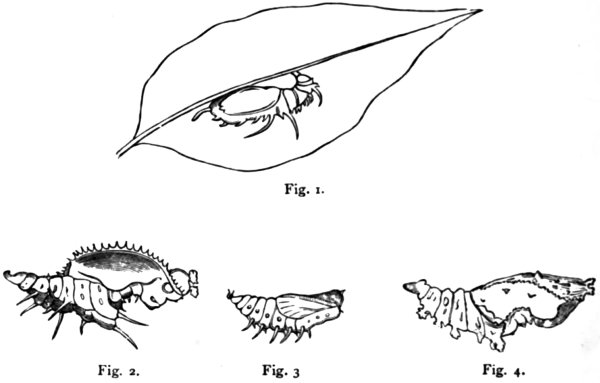
Figs. 1–4. Pupæ of Acræa Thalia; Heliconius Eucrate; Eueides Isabella, and Colænis Dido; life size.
“A glance at the above figures of the pupæ of Heliconius Eucrate (Fig. 2), Eueides Isabella (Fig. 3), and Colænis Dido (Fig. 4), will show how great are the differences between these pupæ as compared with the close form-relationship of all the Maracujá butterflies, and with the no less close resemblance of their larvæ. A family which comprised three such dissimilar pupæ would also be capable of including that of Acræa Thalia (Fig. 1).
“The pupa of this last species has nothing peculiar in its general appearance, but possesses the ordinary pupal form; it is tolerably rounded, without any great elevations or depressions; a minute pointed projection is situated on the head over each eye-cover, and a similar process projects from the roots of the wings. Its distinguishing characters are five pairs of spines on the back of the abdominal segments. These spines are found also in Acræa Alalia, but appear to be absent in other species, e.g. in the Indian A. Violæ. Last summer, among some batches of Thalia larvæ—each batch being the progeny from one lot of eggs—I found certain individuals which differed from the others in having much shorter spines, and these changed into pupæ in which the five pairs of spines were proportionally shorter than usual, thus being an exception to the rule that changes in one stage of development are without influence on the other stages. I may remark, by the way, that this law, enunciated by Weismann, can only be applied to imagines and pupæ with certain restrictions. The skin of the pupa forms a sheath or cover for the eyes, antennæ, trunk, legs, and wings of the imago, and if these parts undergo any considerable modification in the latter, corresponding changes must appear in the pupa. This is shown, for instance, by many ‘Skippers’ (Hesperidæ), in which the extraordinarily long trunk necessitates a sheath of a corresponding length. The colour of the pupa of Acræa Thalia is whitish, the wing-veins with some other markings and the spines are black; metallic spots are absent.
“In the pupa of Heliconius Eucrate the laterally compressed region of the wings is raised into a large projection, the antennal sheaths lying on the edges of the wings are serrated and beset with short pointed spines; instead of the minute projections of Acræa Thalia, the head bears two large humped processes; the body is raised on each side into a foliaceous border carrying five spines of different lengths, the foremost pair, directed towards the head, being the longest. The pupa is brown, and ornamented with four pairs of brilliant metallic spots, one pair close behind the antennæ, and three pairs, almost coalescent, on the back before the longest pair of spines. A short spine projects from the middle of each of the latter somewhat arched metallic patches.
“In the pupa of Colænis Dido (which resembles that of Colænis Julia, and to which may be added those of Dione Vanillæ and Juno) the spines are absent, the wing region is but moderately arched, and the antennæ marked only by small elevations; instead of the leaf-like border, there are on each side of the back five knotty or humped processes. The metallic spots are similar in number and position to those of Heliconius Eucrate; those on the back have a wart-like process in the middle, instead of a spine.
“The pupæ of Heliconius and Colænis when moving their posterior segments rapidly, as they do whenever they are disturbed, produce a very perceptible hissing noise by the friction of these segments, this sound, which is especially noticeable in the case of Heliconius Eucrate, perhaps serving to terrify small foes. (So loud is the sound produced in this manner by the pupæ of Epicalia Numilia, that my children have named them ‘Schreipuppen.’)
“The pupæ of Heliconius and Colænis thus differ to a much greater extent than the imagines or larvæ, and the same holds good for Eueides in a much higher degree as compared with its above-mentioned allies. The larvæ of Eueides have no distinctive characters, and even the generic rank of the imagines is doubtful; as pupæ, on the other hand, they are far removed (even by their mode of suspension) not only from the remainder of the Maracujá group and from the whole of the great Nymphalideous group (Danainæ, Satyrinæ, Elymniinæ, Brassolinæ, Morphinæ, Acræinæ and Nymphalinæ), but from almost all other butterflies. The larva pupates on the underside of a leaf; the pupa is fastened by the tail, but does not hang down like the pupæ of the other Nymphalidæ,—its last segments are so curved that the breast of the chrysalis is in contact with the underside of the leaf. I am not acquainted with any other pupa among those not suspended by a girdle which assumes such a position. Something similar occurs, however, in the pupa of Stalachtis, which is without a girdle, and according to Bates, is ‘kept in an inclined position by the fastening of the tail.’ By this peculiarity Bates distinguishes the Stalachtinæ from the Libytheæ with pupæ ‘freely suspended by the tail.’