FANTASTICS AND OTHER FANCIES
Reading edition
EDITED BY
CHARLES WOODWARD HUTSON
There are tropical lilies which are venomous, but they are more beautiful than the frail and icy-white lilies of the North. Lafcadio Hearn
INTRODUCTION
"I am conscious they are only trivial," wrote Lafcadio Hearn from New Orleans in 1880 to his friend H. E. Krehbiel, speaking of the weird little sketches he was publishing from time to time in the columns of the Daily Item, the New Orleans newspaper which first gave him employment in the city where he spent the ten years from 1877 to 1887.
"But I fancy," he goes on, "that the idea of the fantastics is artistic. They are my impressions of the strange life of New Orleans. They are dreams of a tropical city. There is one twin-idea running through them all—Love and Death. And these figures embody the story of life here, as it impresses me. I hope to be able to take a trip to Mexico in the summer just to obtain literary material, sun-paint, tropical color, etc. There are tropical lilies which are venomous, but they are more beautiful than the frail and icy-white lilies of the North. Tell me if you received a fantastic founded upon the story of Ponce de Leon. I think I sent it in my last letter. I have not written any fantastics since except one—inspired by Tennyson's fancy fancy—
"My heart would hear her and beat, Had it lain for a century dead— Would start and tremble under her feet— And blossom in purple and red."
It was this "Fantastic," published first in the Item on October 21, 1880, and later re-written in more ornate style and published in the Times-Democrat on April 6, 1884, under the title of "L'Amour après la Mort," which is the only one of the weird little sketches that has appeared in book form, outside of those which he himself republished in Stray Leaves from Strange Literature, and Some Chinese Ghosts.
For it was this one which he sent to a friend with the deprecatory criticism that it "belonged to the Period of Gush" and the request "to burn or tear it up after reading." He had merely enclosed it to show how and when he had first used the phrase "lentor inexpressible" to which his friend had objected.
"Fortunately his correspondent—as did most of those to whom he wrote—treasured everything in his handwriting," says his biographer, Mrs. Elizabeth Bisland Wetmore, "and the fragment which bore—my impression is—the title of 'A Dead Love' (the clipping lacks the caption) remains to give an example of some of the work that bears the flaws of his 'prentice hand, before he used his tools with the assured skill of a master." And she quotes the strange, fanciful little sketch in full, with the comment: "To his own, and perhaps other middle-aged taste, 'A Dead Love' may seem negligible, but to those still young enough, as he himself then was, to credit passion with a potency not only to survive 'the gradual furnace of the world,' but even to blossom in the dust of graves, this stigmatization as 'Gush' will seem as unfeeling as always does to the young the dry and sapless wisdom of granddams. To them any version of the Orphic myth is tinglingly credible. Yearningly desirous that the brief flower of life may never fade, such a cry finds an echo in the very roots of their inexperienced hearts. The smouldering ardor of its style, which a chastened judgment rejected, was perhaps less faulty than its author believed it to be in later years."
"It was to my juvenile admiration for this particular bit of work," she goes on, "that I owed the privilege of meeting Lafcadio Hearn in the winter of 1882, and of laying the foundation of a close friendship which lasted without a break until the day of his death."
His linking of love with death in this and the other "Fantastics" was in full accord with the sombre atmosphere of the trebly stricken city to which he had come—a city with a glorious and a joyous past, but just then ruined by three horrors:—recent war, misrule under the carpet-baggers, and oft-recurring pestilence. He had come expecting much from a semi-tropical environment. He found sorrow and trouble and a wasted land; and his mood was soon in unison with the disastrous elements around him. His letter to his friend Watkin when he first came to this smitten Paradise shows how strong the impression was: "When I saw it first—sunrise over Louisiana—the tears sprang to my eyes. It was like young death—a dead bride crowned with orange flowers—a dead face that asked for a kiss. I cannot say how fair and rich and beautiful this dead South is. It has fascinated me. I have resolved to live in it; I could not leave it for that chill and damp Northern life again."
From the files of the Item and the Times-Democrat over a score of these "Fantastics" have been gathered, and with them certain other fanciful little sketches that seem worth preserving, though they do not deal so directly with the mystic "twin-idea of Love and Death."
In his sympathetic Introduction to Hearn's Leaves from the Diary of an Impressionist, Mr. Ferris Greenslet deplores the loss of that collection of these "Fantastics" made by Hearn himself as one section of the book he evidently planned to publish under the title Ephemeræ, or Leaves from the Diary of an Impressionist. Says Mr. Greenslet:
Apparently it was Hearn's intention to add to the "Floridian Reveries" a little collection of "Fantastics," with such savory titles as "Aïda," "The Devil's Carbuncle," "A Hemisphere in a Woman's Hair," "The Fool and Venus," etc[1].
This group, however, is, unfortunately, lost. From the notebook labeled upon its cover "Fantastics" many leaves have been cut, and there remains only the paper on "Arabian Women."
But for the solitary copy of the files of the Item, preserved in the office of that paper, most of these earliest bits of original fantasy wrought by the shabby, eccentric young journalist, whose passion for exquisite words was so incomprehensible to the other "newspaper boys," would have been wholly lost.
"The modest Item goes no farther than St. Louis," wrote Hearn to Krehbiel; and it was for this little two-page paper, too insignificant at that time to be preserved even in the city archives or in the public libraries, that he wrote most of the "tales of Love and Death" reproduced in this volume. Twenty-nine out of the thirty-odd are to be found only, so far as we know, in the brittle yellow pages of bound volumes of the City Item, from June, 1878, to December, 1881, to which we have been given access through the courtesy of the present owners of the New Orleans Item. The other six, some of which were rearrangements and paraphrases of earlier "Fantastics," appeared in the Times-Democrat, of which several nearly complete files exist in libraries.
Among these thirty-five brief but vitally imaginative sketches several are far superior to "L'Amour après la Mort."
The "Fantastics" proper and the "Other Fancies" have been grouped indiscriminately in chronological order, though differing greatly in spirit and in excellence of style. "The Little Red Kitten" and "At the Cemetery" are less labored in point of diction; but they are charming in their simplicity and unaffected tenderness. In the earlier of these little pictures his sympathy with our "poor brothers"—in this case "sisters"—of the animal world, from first to last a striking trait in his character, is beautifully expressed. There is delicate humor, too, as well as pathos, in the sketch. In the latter we have the glow of his feeling for the sorrow of a child, and the spring of his wonderful imagination which a few handfuls of sand not native to the spot evoke. In neither is there the least trace of the weird which is in so large a degree characteristic of most of the others. Slight as they are in texture, they seem to me to rise far above the more subtle and fanciful tales in the strength and beauty of simple truth to nature—to the best that was in his own nature.
But the others, notably "The Black Cupid," "The Undying One," "Aphrodite and the King's Prisoner," "The Fountain of Gold," "The Gypsy's Story," are not to be undervalued. There is a power of vision, an imaginative magnificence, a weird melody of word-music in them that grips the mind of the reader as in a vise.
"The Fountain of Gold" was later reproduced in the form of "A Tropical Intermezzo," recently given to a wider public in the pages of Leaves from the Diary of an Impressionist. It is interesting to compare the first sketch with the finished picture. The earlier work is less dramatic, less convincing, less artistic, though full of a charm of its own. The whole design is transmuted into something immensely effective by the simple device of an equating the language of him who tells the tale.
In a less degree the same thing may be remarked in the comparison of "A Dead Love," written for the Item, and "L'Amour après la Mort," contributed to the Times-Democrat.
In "The Tale of a Fan" may be traced, it seems to me, the germ of what he later expanded or meant to expand into "A Hemisphere in a Woman's Hair," which has not been found.
But it is not alone the charm that clings about all that is weird and fanciful that gives value to this early work of Hearn's. It sheds rich light upon one phase of his development and forms an essential part of his biography; and it helps to furnish proof, along with much else of varying form and excellence, that he put forth a vast deal of literary effort in the years of his stay in New Orleans before his engagement with the Times-Democrat.
The extent and value of his work as literary editor of the Item has been wholly ignored by his biographers and critics. This is due largely to the fact that the matter he selected for publication in his earlier literary career was drawn from the Times-Democrat. But to those who have gone carefully over the files of the Item it is evident that he did far more original work for that paper than for the other. His forte was supposed by the editors of the Times-Democrat to be translation, and, with the exception of some striking editorials, his work for that paper was mostly translation. Even the Stray Leaves from Strange Literatures and Some Chinese Ghosts belong to that category.
Besides the "Fantastics," he wrote for the Item many editorials on a variety of subjects and many book reviews, dramatic criticisms, and translations both from the French and the Spanish, as well as Creole sketches and certain fanciful squibs illustrated with quaint original designs distinctly akin to those that appear in Letters from the Raven.
But unquestionably his most remarkable contributions to the Item were the "Fantastics."
From a hint given him by a traveler's tale, by a trivial street incident, by a couplet of verse, or a carven cameo in an antique shop, by an old legend, or a few grains of sand, his genius was able to create a series of vivid and mystical visions, more real to him and to his readers than the political contests or the personal gossip which fill the surrounding columns of print.
To discover these vibrant bits of poesy in their commonplace setting is like finding rare and glorious orchids in the midst of the crowfoots and black-eyed Susans that crowd the banquettes and gutters' edges of our New Orleans streets.
"He hated the routine work, and was really quite lazy about it," testifies Colonel John W. Fairfax, former owner of the Item, and Hearn's first New Orleans employer and friend. At the age of seventy-two this genial old gentleman recalls many incidents of his association with the eccentric young literary editor who for three years and a half aided him and Mark F. Bigney in the task of filling the columns of the unpretentious little paper which he had purchased from the printers and tramp journalists who were its original owners—for the Item was started on a cooperative, profit-sharing basis.
"Hearn was really quite lazy about his regular work," Colonel Fairfax insists. "We had to prod him up all the time—stick pins in him, so to speak. But when he would write one of his own little fanciful things, out of his own head—dreams—he was always dreaming—why, then he would work like mad. And people always noticed those little things of his, somehow, for they were truly lovely, wonderful. 'Fantastics' he called them."
It was Colonel Fairfax who deserves the credit of "discovering" Hearn in New Orleans, when he applied, shabby and half-starved, at the Item office for a job, just after he had written to his friend Watkin, June 14, 1878: "Have been here seven months and never made one cent in the city. No possible prospect of doing anything in this town now or within twenty-five years."
But his next letter (undated) says—and it is evident that the impression he had made had secured him more than he had asked for:
"The day after I wrote you, I got a position (without asking for it) as assistant editor on the Item, at a salary considerably smaller than that I received on the Commercial, but large enough to enable me to save half of it."
And the old gentleman appears still to regard the Hearn he recalls with the sort of half-admiring, half-contemptuous, wholly marveling affection which a fine healthy turkey-cock would feel for the "ugly duckling" just beginning to reveal himself of the breed of swans.
Apparently he and Bigney allowed Hearn considerable latitude in his choice and treatment of subject. The three years of his work in their employ show bolder and more varied editorial comment, as well as five or six times as many "Fantastics" as are to be found in the six years of his work under the Bakers, and prove that the quality of his work was already fine enough to justify Page Baker's choice of him for a place on the staff of "the new literary venture."
How these strange little blossoms of Hearn's genius attracted the admiration of lovers of beauty and won him fame and friends among professional men and scholars is told most vividly in the words of Dr. Rodolph Matas, now a surgeon of international reputation, who was Hearn's friend and early foresaw his fame.
In those days [says he] I was not so busy as I am now, and had more time to read the books I enjoyed, and to spend long hours in talk with Hearn.
It was in the early eighties, I remember, that I knew him first. Whitney, of the Times-Democrat, was a friend of mine, and I asked him one day: "Who writes those wonderful things—translations, weird sketches, and remarkable editorials—in your paper?" And he told me, "A queer little chap, very shy—but I'll manage for you to meet him."
I became editor of the New Orleans Medical and Surgical Journal in 1883, and it must have been shortly before this that I first met Hearn. He was astonished to find that I knew him so well—but then, you see, I had been reading these "Fantastics" and his wonderful book-reviews and translations, and his editorials on all sorts of unusual subjects, for a long time.
He often came to me to get information about medical points which he needed in some of his work. He was deeply interested in Arabian studies at that time, and I was able to give him some curious facts about the practice of medicine among the Arabs, which happened to be exactly what he was seeking. Not only did he read every book on Arabia which he could find, but he actually practiced the Arabic script, and he used to write me fantastic notes, addressing me as if I had been an Arab chief.
His capacity for reading swiftly—for getting the heart out of a book—was amazing. While others read sentences, he read paragraphs, chapters—in the time it would take an ordinary reader to finish a chapter, he would have read the whole book. And this in spite of his defective vision. With his one great near-sighted eye roving over the page, he seemed to absorb the meaning of the author—to reach his thought and divine his message with incredible rapidity. He knew books so well—knew the habits of thought of their writers, the mechanics of literature. His power of analysis was intuitive. Swiftly as he read, it would be found on questioning him afterward that nothing worth while had been over-looked, and he could refer back and find any passage unerringly.
Both in taste and temperament he was morbid, and in many respects abnormal—in the great development of his genius in certain directions, and also in his limitations and deficiencies in other lines. His nature towered like a cloud-topping mountain on one side, while on others it was not only undeveloped—it was a cavity! I understood this better, perhaps, than others of his friends, knowing as I did the pathology of such natures, and for that reason our intercourse was singularly free and candid, for Hearn revealed himself to me with a frankness and unconventionality which would have startled another. I never judged him by conventional standards. I listened to the brilliant, erratic, intemperate outpourings of his mind, aware of his eccentricities without allowing them to blind me to the beauty and value of his really marvelous nature. For example, he would bitterly denounce his enemies—or fancied enemies—for he had an obsession of persecution—in language that was frightful to listen to—inventing unheard-of tortures for those whom he deemed plotters against him. Yet in reality he was as gentle and as tender-hearted as a woman—and as passionately affectionate. But there was an almost feminine jealousy in his nature, too, and a sensitiveness that was exaggerated to a degree that caused him untold suffering. He was singularly and unaffectedly modest about his work—curiously anxious to know the real opinion of those whose judgment he valued, on any work which he had done, while impatient of flattery or "lionizing." Yet with all his modesty he had, even in those days of his first successes, a high and proud respect for his work. He was too good a critic not to know his value; and he consistently refused to cheapen it by allowing it to appear in any second-rate medium—I mean, any of his literary work, as distinct from the journalistic matter he did for his daily bread. Nor would he lower himself by criticizing any book or poem which he did not consider worthy of his opinion. Thus he was obliged, in spite of his kind nature, which impelled him to do anything which a friend might ask, to refuse to criticize books of inferior worth, and he was very firm and dignified about such refusals. He would not debase his pen by using it on inferior subjects.
At the time when I knew him best, he was already highly esteemed by many who appreciated his great gifts, while others regarded him with some jealousy and would gladly have seen him put down. From the first I recognized his genius so clearly that he used to laugh at me for my faith in his future fame. For I would often predict that he would be known to future generations as one of the great writers of the century, though it was easy to foresee that he would not receive full recognition in his lifetime.
And though he used to smile at my enthusiasm, he himself felt, I am convinced, the same certainty as to the quality of his gift, the ultimate fame that Fate held for him. It was this that made him regard his work with a reverent humility, and it was this that accounted in some degree for his extraordinary shyness, which made him shrink from being lionized or exploited by those who, at that time, would have been glad enough to entertain him and make much of him, for he had already begun to be quite an important literary person in the circles here which cared for such matters.
But Hearn fled from social attentions as from the plague. He was by nature suspicious and he loathed flattery and pretense.
His sense of literary and artistic values was singularly sure, and it has always seemed to me that it was intuitive—a sort of instinctive feeling for beauty and truth.
When he became acquainted with the work of Herbert Spencer—through the enthusiasm of his friend Ernest Crosby for that philosopher and for the Darwinian theory of evolution, which we were all discussing with deep interest at that time—he used that thinker's philosophy as a foundation upon which to base his marvelous speculations as to the ultimate development of the race and the infinite truths of the universe. I used to listen in wonder while he talked by the hour along these lines, weaving the most beautiful and imaginative visions of what might be. For his theory of the universe was essentially literary rather than philosophical.
It was to Dr. Matas that "Chita" was dedicated, not only as a token of the warm admiration and affection which the sensitive soul of Hearn felt for the broad-minded young physician, but as an acknowledgment of the help Dr. Matas had given him in gathering the material for the setting of the story. The physician's cosmopolitan rearing and his scattered practice among French, Spanish, and even Filipino settlers in the region about Grand' Isle enabled him to give Hearn in each instance the appropriate phraseology in the dialect of the people he was writing about.
Some of the "Other Fancies" are noteworthy for special reasons. In "A River Reverie" one gets an odd glimpse of Mark Twain reflected in the personality of the dream-haunted Irish-Greek, who handles the visit of the humorist in so unjournalistic a way. How ruthlessly his recollections of the old river-captain would be excised by the copy-reader of the modern newspaper!
In several of these sketches Hearn gives a picture of the horrors of yellow fever which shows even more clearly than his letters how vivid was the impression made on him by that summer of 1878, when he passed through the epidemic with only an attack of the dengue, a mild form of the tropical plague.
Others of these sketches show the influence of contact with Spanish friends and acquaintances, and the strong longing for the tropics, which seems to have lasted all his life.
"Aïda" is, of course, merely the story of the well-known opera by Verdi. Hearn wrote for the Item, during the opera season of 1880, brief outlines like this of the stories of several of the operas played at the French Opera House that winter: this one is included in this volume only because it is mentioned among the "Fantastics" in the list given in Dr. George Gould's book, Concerning Lafcadio Hearn. "Hiouen-Thsang" is included for the same reason, as it is not strictly a "Fantastic."
"The Devil's Carbuncle," besides being a translation, is not a "Fantastic," according to Hearn's definition of the term: it is not a story of love and death; it is a story of greed and death.
"The Post-Office" is much more breezy and out-of-doors than any of the "Fantastics," and does not properly belong with them; but it is so charming a sketch of his visit to Grand' Isle, the place which gave him the material for his first successful original story, "Chita," that it seems worth while to reproduce it.
It has been almost a commonplace, with writers treating of Hearn's development, to date from this visit the beginnings of his interest in far-away lands. But they mistake in assigning a late date for his delight in the tropics and his longing for Japan. His articles in the Item years before go to show that from the first it was almost an instinct with him to yearn for glimpses of the Orient and the Spanish Main. Throughout the volume of the Item for 1879 the column headed "Odds and Ends" reveals his interest in Spanish-American countries. It is generally shown in translated citations or quotations from La Raza Latina.
In finding these cameo-like studies buried in the pages of the newspapers of a generation ago, and in identifying them beyond question as Hearn's, I have been aided by Mr. John S. Kendall and by my daughter, Ethel Hutson, who have been for some years gathering traces of Hearn's journalistic activities in New Orleans. To Mr. C. G. Stith, of the New Orleans Item, we are indebted for the finding of the first two or three of the "Fantastics" in that paper, after we had located Hearn's work in the Times-Democrat.
To one who has studied his way of expressing himself in his imaginative writings the internal evidence would be quite enough to prove that these "Fantastics" were woven in the brain-cells of Lafcadio Hearn. But in addition to this we have the avowal of the editor-in-chief of the Item, elicited by the praise of the Claiborne Guardian.[2]
The author named them only "Fantastics." We have given to each its separate title, as indicated by the most striking feature in the story. To the "Other Fancies," which we have included in the collection, he gave the titles under which they now appear, and some of them he signed.
CHARLES WOODWARD HUTSON
FANTASTICS AND OTHER FANCIES
ALL IN WHITE[1]
"No," he said, "I did not stay long in Havana. I should think it would be a terrible place to live in. Somehow, in spite of all the tropical brightness, the city gave me the idea of a huge sepulchre at times. One feels in those narrow streets as though entombed. Pretty women?—I suppose so, yes; but I saw only one. It was in one of the quaint streets which make you think that the Spaniards learned to build their cities from the Moors—a chasm between lofty buildings, and balconies jutting out above to break the view of the narrow strip of blue sky. Nobody was in the street except myself; and the murmur of the city's life seemed to come from afar, like a ghostly whisper. The silence was so strange that I felt as if walking on the pavement of a church, and disturbing the religious quiet with my footsteps. I stopped before a great window—no glass, but iron bars only;—and behind the iron bars lay the only beautiful woman I saw in Havana by daylight. She could not have been more than eighteen—a real Spanish beauty—dark, bewitching, an oval face with noble features, and long eyelashes resting on the cheek. She was dead! All in white—like the phantom bride of the German tradition—white robes, white satin shoes, and one white tropical flower in her black hair, shining like a star. I do not know what it was; but its perfume came to me through the window, sweet and strange. The young woman, sleeping there all in white, against the darkness of the silent chamber within, fascinated me. I felt as if it was not right to look at her so long; yet I could not help it. Candles were burning at her head and feet; and in the stillness of the hot air their yellow flames did not even tremble. Suddenly I heard a heavy tramping at the end of the street. A battalion of Spanish soldiers were coming towards me. There was no means of proceeding; and I had no time to retreat. The street was so narrow that I was obliged to put my back to the wall in order to let them pass. They passed in dead silence—I only heard the tread of the men, mechanically regular and heavily echoing. They were all in white. Every man looked at me as he passed by; and every look was dark, sinister, suspicious. I was anxious to escape those thousands of Spanish eyes; but I could not have done it without turning my face to the wall. I do not think one of them looked at the dead girl at all; but each one looked at me, and forced me to look at him. I dared not smile,—not one of the swarthy faces smiled. The situation became really unpleasant. It was like one of those nightmares in which you are obliged to witness an endless procession of phantoms, each one of whom compels you to look at it. If I had even heard a single "Carajo Americano," I should have felt relieved; but all passed me in dead silence. I was transpierced by the black steel of at least two thousand Spanish eyes, and every eye looked at me as if I had been detected in some awful crime. Yet why they did not look at that window instead of looking at me, I cannot tell. After they had passed, I looked an instant at the dead girl again; and it seemed to me that I saw the ghost of a smile—a cynical, mocking smile about her lips. She was well avenged—if her consecrated rest had been disturbed by my heretic eyes. I can still smell the white flower; and I can see even the silk stitches in the white satin shoes—the motionless yellow tongues of the candles—the thin dead face that seemed to smile, and the thousand sinister faces that smiled not, and dared me to smile."
THE LITTLE RED KITTEN[2]
The kitten would have looked like a small red lion, but that its ears were positively enormous—making the head like one of those little demons sculptured in mediæval stonework which have wings instead of ears. It ate beefsteak and cockroaches, caterpillars and fish, chicken and butterflies, mosquito-hawks and roast mutton, hash and tumble-bugs, beetles and pigs' feet, crabs and spiders, moths and poached eggs, oysters and earthworms, ham and mice, rats and rice pudding—until its belly became a realization of Noah's Ark. On this diet it soon acquired strength to whip all the ancient cats in the neighborhood, and also to take under its protection a pretty little salmon-colored cat of the same sex, which was too weak to defend itself and had been unmercifully mauled every night before the tawny sister enforced reform in the shady yard of the old Creole house. The red kitten was not very big, but was very solid and more agile than a monkey. Its flaming emerald eyes were always watching, and its enormous ears always on the alert; and woe to the cat who dared approach the weak little sister with hostile intentions. The two always slept together—the little speckled one resting its head upon the body of its protector; and the red kitten licked its companion every day like a mother washing her baby. Wherever the red kitten went the speckled kitten followed; they hunted all kinds of creeping things together, and even formed a criminal partnership in kitten stealing. One day they were forcibly separated; the red kitten being locked up in the closet under the stairs to keep it out of mischief during dinner hours, as it had evinced an insolent determination to steal a stuffed crab from the plate of Madame R. Thus temporarily deprived of its guide, philosopher, and friend, the speckled kitten unfortunately wandered under a rocking-chair violently agitated by a heavy gentleman who was reading the "Bee"; and with a sharp little cry of agony it gave up its gentle ghost. Everybody stopped eating; and there was a general outburst of indignation and sorrow. The heavy gentleman got very red in the face, and said he had not intended to do it. "Tonnerre d'une pipe;—nom d'un petit bonhomme!"—he might have been a little more careful!... An hour later the red kitten was vainly seeking its speckled companion—all ears and eyes. It uttered strange little cries, and vainly waited for the customary reply. Then it commenced to look everywhere—upstairs, downstairs, on the galleries, in the corners, among the shrubbery, never supposing in its innocent mind that a little speckled body was lying far away upon a heap of garbage and ashes. Then it became very silent; purring when offered food, but eating nothing.... At last a sudden thought seemed to strike it. It had never seen the great world which rumbled beyond the archway of the old courtyard; perhaps its little sister had wandered out there. So it would go and seek her. For the first time it wandered beyond the archway and saw the big world it had never seen before—miles of houses and myriads of people and great cotton-floats thundering by, and great wicked dogs which murder kittens. But the little red one crept along beside the houses in the narrow strip of shadow, sometimes trembling when the big wagons rolled past, and sometimes hiding in doorways when it saw a dog, but still bravely seeking the lost sister.... It came to a great wide street—five times wider than the narrow street before the old Creole house; and the sun was so hot, so hot. The little creature was so tired and hungry, too. Perhaps somebody would help it to find the way. But nobody seemed to notice the red kitten, with its funny ears and great bright eyes. It opened its little pink mouth and cried; but nobody stopped. It could not understand that. Whenever it had cried that way at home, somebody had come to pet it. Suddenly a fire-engine came roaring up the street, and a great crowd of people were running after it. Then the kitten got very, very frightened; and tried to run out of the way, but its poor little brain was so confused and there was so much noise and shouting.... Next morning two little bodies lay side by side on the ashes—miles away from the old Creole house. The little tawny kitten had found its speckled sister.
THE NIGHT OF ALL SAINTS[3]
The Night of All Saints—a night clear and deep and filled with a glory of white moonlight.
And a low sweet Wind came up from the West, and wandered among the tombs, whispering to the Shadows.
And there were flowers among the tombs.
They looked into the face of the moon, and from them a thousand invisible perfumes arose into the night.
And the Wind blew upon the flowers until their soft eyelids began to close and their perfume grew fainter in the moonlight. And the Wind sought in vain to arouse them from the dreamless sleep into which they were sinking.
For the perfume of a flower is but the presence of its invisible soul; and the flowers drooped in the moonlight, and at the twelfth hour they closed their eyes forever and the incense of their lives passed away from them.
Then the Wind mourned awhile among the old white tombs; and whispered to the cypress trees and to the Shadows, "Were not these offerings?"
And the Shadows and the cypresses bowed weirdly in mysterious reply. But the Wind asked, "To Whom?" And the Shadows kept silence with the cypresses.
Then the Wind entered like a ghost into the crannies of the white sepulchres, and whispered in the darkness, and coming forth shuddered and mourned.
And the Shadows shuddered also; and the cypresses sighed in the night.
"It is a mystery," sobbed the Wind, "and passeth my understanding. Wherefore these offerings to those who dwell in the darkness where even dreams are dead?"
But the trees and the Shadows answered not and the hollow tombs uttered no voice.
Then came a Wind out of the South, murmuring to the orange groves, and lifting the long tresses of the palms with the breath of his wings, and bearing back to the ancient place of tombs the souls of a thousand flowers. And the Wind of the South whispered to the souls of the flowers, "Answer, little spirits, answer my mourning brother."
And the flower-souls answered, making fragrant all the white streets of the white city of the dead:
"We are the offerings of love bereaved to the All-loving—the sacrifices of the fatherless to the All-father. We know not of the dead—the Infinite secret hath not been revealed to us; we know only that they sleep under the eye of Him who never sleeps. Thou hast seen the flowers die; but their perfumes live in the wings of the winds and sweeten all God's world. Is it not so with that fragrance of good deeds, which liveth after the deed hath been done—or the memories of dead loves which soften the hearts of the living?"
And the cypresses together with the Shadows bowed answeringly; and the West Wind, ceasing to mourn, spread his gauzy wings in flight toward the rising of the sun.
The moon, sinking, made longer the long shadows; the South Wind caressed the cypresses, and, bearing with him ghosts of the flowers, rose in flight toward the dying fires of the stars.
THE DEVIL'S CARBUNCLE[4]
Ricardo Palma, the Lima correspondent of La Raza Latina, has been collecting some curious South American traditions which date back to the Spanish Conquest. The following legend, entitled "El Carbunclo del Diablo," is one of these:
When Juan de la Torre, one of the celebrated Conquistadores, discovered and seized an immense treasure in one of the huacas near the city of Lima, the Spanish soldiers became seized with a veritable mania for treasure-seeking among the old forts and cemeteries of the Indians. Now there were three ballesteros belonging to the company of Captain Diego Gumiel, who had formed a partnership for the purpose of seeking fortunes among the huacas of Miraflores, and who had already spent weeks upon weeks in digging for treasure without finding the smallest article of value.
On Good Friday, in the year 1547, without any respect for the sanctity of the day—for to human covetousness nothing is sacred—the three ballesteros, after vainly sweating and panting all morning and afternoon, had not found anything except a mummy—not even a trinket or bit of pottery worth three pesetas. Thereupon they gave themselves over to the Father of Evil—cursing all the Powers of Heaven, and blaspheming so horribly that the Devil himself was obliged to stop his ears with cotton.
By this time the sun had set; and the adventurers were preparing to return to Lima, cursing the niggardly Indians for the unpardonable stupidity of not having been entombed in stat/e upon beds of solid gold// or silver, when one of the Spaniards gave the mummy so ferocious a kick that it rolled a considerable distance. A glimmering jewel dropped from the skeleton, and rolled slowly after the mummy.
"Canario!" cried one of the soldiers, "what kind of a taper is that? Santa Maria! what a glorious carbuncle!"
And he was about to walk toward the jewel, when the one who had kicked the corpse, and who was a great bully, held him back with the words:
"Halt, comrade! May I never be sad if that carbuncle does not belong to me; for it was I who found the mummy!"
"May the Devil carry thee away! I first saw it shine, and may I die before any other shall possess it!"
"Cepos quedos!" thundered the third, unsheathing his sword, and making it whistle round his head. "Sol am nobody?"
"Caracolines! Not even the Devil's wife shall wring it from me," cried the bully, unsheathing his dagger.
And a tremendous fight began among the three comrades.
The following day some Mitayos found the dead body of one of the combatants, and the other two riddled with wounds, begging for a confessor. Before they died they related the story of the carbuncle, and told how it illumined the combat with a sinister and lurid light. But the carbuncle was never found after. Tradition ascribes its origin to the Devil; and it is said that each Good Friday night travelers may perceive its baleful rays twinkling from the huaca Juliana, rendered famous by this legend.
LES COULISSES[5]
SOUVENIRS OF A STRAKOSCH OPERA NIGHT
Surely it cannot have been a poet who first inspired the popular mind with that widely spread and deeply erroneous belief that "behind the scenes" all is hollow mockery and emptiness and unsightliness;—that the comeliness of the pliant limbs which move to music before the starry row of shielded lights is due to a judicious distribution of sawdust; and that our visions of fair faces are created by the magic contained in pots of ointment and boxes of pearl powder of which the hiding-places are known only to those duly initiated into the awful mysteries of the Green Room.
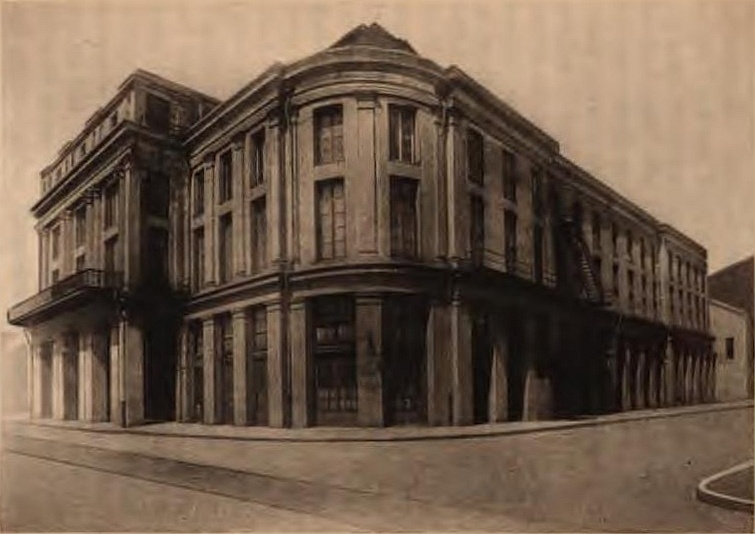
The Old Creole Opera House, New Orleans
No; the Curtain is assuredly the Veil which hides from unromantic eyes the mysteries of a veritable Fairy-World—not a fairyland so clearly and sharply outlined as the artistic fantasies of Christmas picture-books, but a fairyland of misty landscapes and dim shadows and bright shapes moving through the vagueness of mystery. There is really a world of stronger enchantment behind than before the scenes; all that movement of white limbs and fair faces—that shifting of shadowy fields and plains, those changing visions of mountain and wold, of towers that disappear as in tales of knight-errantry, and cottages transformed into palaces as in the "Arabian Nights"—is but a small part of the great wizard-work nightly wrought by invisible hands behind the Curtain. And when, through devious corridors and dimly-lighted ways—between rows of chambers through whose doors one catches sudden glimpses of the elves attiring in purple and silver, in scarlet and gold, for the gaslit holiday among canvas woods and flowing brooks of muslin, mystic, wonderful—thou shalt arrive within the jagged borders of the Unknown World itself to behold the Circles of bright seats curving afar off in atmospheres of artificial light, and the Inhabitants of those Circles become themselves involuntary Actors for the amusement of the lesser audience, then verily doth the charm begin. There is no disillusion as yet. The Isis of the drama has lifted her outer veil; but a veil yet more impenetrable remains to conceal the mystery of her face. The Heart of all that Mimic Life—mimic yet warm and real—throbs about thee, but dost thou understand its pulsations? Thou art in the midst of a secret, in the innermost chamber of the witch-workers—yet the witchcraft remains. Thou hast approached too near the Fata Morgana of theatrical enchantment—all has vanished or tumbled into spectral ruin. Fragments of castles and antiquated cities—torn and uneven remnants of pictures of various centuries huddled together in mystic anachronism—surround and overshadow thee; but to comprehend that harmonious whole, thou must retire to the outer circles of the shining temple, before the tall Veil. About thee it is a world wrought of many broken worlds;—a world of picturesque ruin like the moon in heaven—a world of broken lights and shadows and haunted glooms—a wild dream—a work of goblinry. Content thyself, seek not disillusion; for to the gods of this mysterious sphere human curiosity is the greatest of abominations. Satisfy thyself with the knowledge that thou art in Fairyland; and that it is not given to mortals to learn all the ways of elves. What though the woods be mockeries, and the castles be thinner than Castles of Spain, and the white statues fair Emptinesses like the elf women of Northern dreams?—the elves and gnomes and fairies themselves are real and palpable and palpitant with the ruddy warmth of life.
Perhaps thou thinkest of those antique theatres—marble cups set between the breasts of sweetly-curving hills, with the cloud-frescoed dome of the Infinite for a ceiling, and for scenery nature's richest charms of purple mountain and azure sea and emerald groves of olive. But that beautiful materialism of the ancient theatre charmed not as the mystery of ours—a mystery too delicate to suffer the eye of Day;—a mystery wrought by fairies who dare only toil by night. One sunbeam would destroy the charm of this dusky twilight world. Strange! how the mind wanders in this strange place! Yet it is easier to dream of two thousand years ago than to recollect that thou livest in the material present—that only a painted ceiling lies between thy vision and the amethystine heaven of stars above, and that only a wall of plastered brick separates thee from the streets of New Orleans or the gardens westward where the bananas are nodding their heads under the moon. For the genii of this inner world are weaving their spells about thee. Figures of other centuries pass before thy eyes, as in the steel mirror of a wizard: lords of Italian cities gorgeous as Emperor-moths, captains of free companies booted and spurred, phantoms, one may fancy, of fair women whose portraits hang in the Uffizi Gallery, and prelates of the sixteenth century. Did Macbeth's witches ever perform greater magic than this?—a series of tableaux after Racinet animated by some elfish art? If the human character of the witchery does not betray itself by a pretty anachronism!—some intermingling of the costumes of the sixteenth century with those of the seventeenth, a sacrifice of history to the beauty of woman—the illusion remains unbroken. Thou art living, by magic, in the age of Lorenzo di Medici; and is it strange that they should address thee in the Italian tongue?
There is an earthquake of applauding, the Circles of seats are again hidden, and this world of canvas and paint is tumbling about thy ears. The spell is broken for a moment by Beings garbed in the everyday attire of the nineteenth century, who have devoted themselves to the work of destruction and reconstruction—to whom dreamers are an abomination and idlers behind the scenes a vexation of spirit. Va t'en, inseq' de bois de lit!
Aye, thou mayst well start!—thou hast seen her before. Where?—when? In a little French store, not very, very far from the old Creole Opera House. This enchantment of the place has transformed her into a fairy. Ah, thou marvelest that she can be so pretty; nor Shakespeare's Viola nor Gautier's Graciosa were fairer to look upon than this dream of white grace and pliant comeliness in the garb of dead centuries. And yet another and another Creole girl—familiar faces to the dwellers in the Quaint Places of New Orleans. What is the secret of that strange enchantment which teaches us that the modest everyday robe of black merino may be but the chrysalis-shell within which God's own butterflies are hidden?
Suddenly through the motley rout of princes and princesses, of captains and conspirators, of soldiers and priests, of courtiers and dukes, there comes a vision of white fairies; these be the Damosels of the Pirouette. Thou mayest watch them unobserved; for the other beings heed them not; Cophetua-like, the King in his coronation robes is waltzing with a pretty Peasant Girl; and like Christina of Spain, the Queen is tête-à-tête with a soldier. The dancers give the impression of something aerial, ethereal, volatile—something which rests and flies but walks not—some species of splendid fly with wings half-open. The vulgar Idea of Sawdust vanishes before the reality of those slender and pliant limbs. They are preparing for the dance with a series of little exercises which provoke a number of charming images and call out all the supple graces of the figure; it is Atalanta preparing to pursue Hippomenes; it is a butterfly shaking its wings; it is a white bird pluming itself with noiseless skill. But when the Terpsichorean flight is over, and the theatre shakes with applause; while the dancers shrink panting and exhausted into some shadowy hiding-place, breathing more hurriedly than a wrestler after a long bout—thou wilt feel grateful to the humane spirits who break the applause with kindly hisses, and rebuke the ignorance which seeks only its own pleasure in cries of encore.
And the Asmodean Prompter who moves the dramatic strings that agitate all these Puppets of mimic passion, whose sonorous tones penetrate all the recesses of the mysterious scenery without being heard before the footlights, resumes his faithful task; the story of harmony and tragedy is continued by the orchestra and the singers, while a Babel of many tongues is heard among the wooden rocks and the canvas trees and the silent rivers of muslin. But little canst thou reck of the mimic opera. That is for those who sit in the outer circles. The music of the many-toned Opera of Life envelops and absorbs the soul of the stranger—teaching him that the acting behind the Curtain is not all a mimicry of the Real, but in truth a melodrama of visible, tangible, sentient life, which must endure through many thousand scenes until that Shadow, who is stronger than Love, shall put out the lights, and ring down the vast and sable Curtain. And thus dreaming, thou findest thyself again in the streets, whitened by the moon! Lights, fairies, kings, and captains are gone. Ah! thou hast not been dreaming, friend; but the hearts of those who have beheld Fairyland are heavy.
THE STRANGER[6]
The Italian had kept us all spellbound for hours, while a great yellow moon was climbing higher and higher above the leaves of the bananas that nodded weirdly at the windows. Within the great hall a circle of attentive listeners—composed of that motley mixture of the wanderers of all nations, such as can be found only in New Orleans, and perhaps Marseilles—sat in silence about the lamplit table, riveted by the speaker's dark eyes and rich voice. There was a natural music in those tones; the stranger chanted as he spoke like a wizard weaving a spell. And speaking to each one in the tongue of his own land, he told them of the Orient. For he had been a wanderer in many lands; and afar off, touching the farther horn of the moonlight crescent, lay awaiting him a long, graceful vessel with a Greek name, which would unfurl her white wings for flight with the first ruddiness of morning.
"I see that you are a smoker," observed the stranger to his host as he rose to go. "May I have the pleasure of presenting you with a Turkish pipe? I brought it from Constantinople."
It was moulded of blood-red clay after a fashion of Moresque art, and fretted about its edges with gilded work like the ornamentation girdling the minarets of a mosque. And a faint perfume, as of the gardens of Damascus, clung to its gaudy bowl, whereon were deeply stamped mysterious words in the Arabian tongue.
The voice had long ceased to utter its musical syllables. The guests had departed; the lamps were extinguished within. A single ray of moonlight breaking through the shrubbery without fell upon a bouquet of flowers, breathing out their perfumed souls into the night. Only the host remained—dreaming of moons larger than ours, and fiercer summers; minarets white and keen, piercing a cloudless sky, and the many-fountained pleasure-places of the East. And the pipe exhaled its strange and mystical perfume, like the scented breath of a summer's night in the rose-gardens of a Sultan. Above, in deeps of amethyst, glimmered the everlasting lamps of heaven; and from afar, the voice of a muezzin seemed to cry, in tones liquidly sweet as the voice of the stranger—"All ye who are about to sleep, commend your souls to Him who never sleeps."
Y PORQUE[7]?
"Ah, caballero," said the Spanish lady, with a pretty play of fan and eye as she spoke, "you will not return to Mexico, the beautiful city?"
"No, señorita," replied the young man addressed, a handsome boy, about twenty-two years old, olive-skinned and graceful, with black curly hair, that had those bluish lights one sees in the plumage of a raven.
"Y porque?" asked the girl, laying aside her fan for a moment, and concentrating all the deep fire of her eyes upon his face.
The boy did not answer. He made an effort to speak, and turned his head aside. There was a momentary lull in the conversation. Suddenly he burst into tears, and left the room.
The beautiful city! Ah! how well he remembered it! The mighty hills sleeping in their eternal winding-sheets of snow, the azure heaven and the bright lake rippled by mountain winds, the plaza and its familiar sights and sounds. Y porque? The question brought up all the old bright memories, and the present for the moment melted away, and the dream of a Mexican night rose in ghostliness before him.
He stood again within an ancient street, quaint with the quaintness of another century, and saw the great windows of the hospitable Spanish residence at which he had been so often received as a son. Again he heard the long chant of the sereno in the melancholy silence; again he saw the white stars glimmering like lamps above the towers of the cathedral. The windows were tall and large, and barred with bars of iron; and there were lights in one of them—flickering taper-lights that made moving shadows on the wall. And within the circle of the tapers, a young girl lay all in white with hands crossed upon her breast, and flowers in the dark hair. He remembered all with that terrible minuteness agony lends to observation—even how the flickering of the tapers played with the shadows of the silky eyelashes, making the lids seem to quiver, as though that heart, to which all his hopes and aims and love had been trusted, had not forever ceased to beat. Again the watchman solemnly chanted the hour of the night, with words of Spanish piety; and far in the distance that weird mountain which ancient Mexican fancy called "The White Lady," and modern popular imagination, "The Dead One," lay as a corpse with white arms crossed upon its bosom, in awful mockery of the eternal sleep.
A DREAM OF KITES[8]
Looking out into the clear blue of the night from one of those jutting balconies which constitute a summer luxury in the Creole city, the eye sometimes marks the thin black threads which the telegraph wires draw sharply against the sky. We observed last evening the infinitely extending lines of the vast web which the Electric Spider has spun about the world; and the innumerable wrecks of kites fluttering thereupon, like the bodies of gaudy flies—strange lines of tattered objects extending far into the horizon and tracking out the course of the electric messengers beyond the point at which the slender threads cease to remain visible.
How fantastic the forms of these poor tattered wrecks, when the uniform tint of night robs them of their color, and only defines their silhouettes against the sky!—some swinging to and fro wearily, like thin bodies of malefactors mummified by sunheat upon their gibbets—some wildly fluttering as in the agony of despair and death—some dancing grotesquely upon their perches like flying goblins—some like impaled birds, with death-stiffened wings, motionlessly attached to their wire snare, and glaring with painted eyes upon the scene below as in a stupor of astonishment at their untimely fate.
All these represented the destruction of childish ambitions—each the wreck of some boyish pleasure. Many were doubtless wept for, and dreamed of afterward regretfully on wet pillows. And stretching away into the paler blue of the horizon we looked upon the interminable hues of irregular dots they made against it and remembered that each little dot represented some little pang.
Then it was natural that we should meditate a little upon the vanity of the ways in which these childish losses had been borne. The little owners of the poor kites had hearts whose fibre differed more than that of the kites themselves. Some might weep, but some doubtless laughed with childish heroism, and soon forgot their loss; some doubtless thought the world was all askew, and that telegraph wires ought never to have been invented; some, considering critically the question of cause and effect, resolved as young philosophers to profit by their experience, and seek similar pleasures thereafter where telegraph wires ensnared not; while some, perhaps, profited not at all, but only made new kites and abandoned them to the roguish wind, which again traitorously delivered them up to the insatiable enemies of kites and birds.
Is it not said that the child is the father of the man?
And as we sat there in the silence with the stars burning in the purple deeps of the summer night above us, we dreamed of the kites which children of a larger growth fly in the face of heaven—toys of love and faith—toys of ambition and of folly—toys of grotesque resolve and flattering ideals—toys of vain dreams and vain expectation—the kites of human Hope, gaudy-colored or gray, richly tinseled or humbly simple—rising and soaring and tossing on the fickle winds of the world, only to become entangled at last in that mighty web of indissoluble and everlasting threads which the Weird Sisters spin for all of us.
HEREDITARY MEMORIES[9]
"I was observing," continued the Doctor, "that it very frequently happens that upon seeing or hearing something new for the first time—that is, something entirely new to us—we feel a surprise, not caused by the novelty of that which we see or hear, but by a very curious echo in the mind. I say echo. I would do better to use the word memory-echo. It seems to us, although we know positively we have never seen or heard of this new thing in our mortal lives, that we heard or saw it in some infinitely remote period. An old Latin writer considered this phenomenon to be a proof of the theory of Preexistence. A Buddhist would tell you that the soul, through all its wanderings of a million years, retains faint memories of all it has seen or heard in each transmigration and that each of us now living in the flesh possesses dim and ghostly recollections of things heard and seen æons before our birth. That the phenomenon exists there can be no doubt. I am not a believer in Buddhism nor in the soul; but I attribute the existence of these vague memories to hereditary brain impressions."
"How do you mean, Doctor?" asked one of the boarders.
"Why, sir, I mean that a memory may be inherited just like a mole, a birthmark, a physical or a moral characteristic. Our brains, as a clever writer has expressed it, are like the rocks of the Sinaitic valley, all covered over with inscriptions written there by the long caravans of Thought. Each impression received upon the brain through the medium of the senses leaves there a hieroglyphic inscription, which, although invisible under the microscope, is nevertheless material and real. Why should not these hieroglyphs of the parent brain reappear in the brain of the child?—fainter and less decipherable to the eyes of the memory, yet not so faint as to be wholly lost."
There was a long silence. The moon rose higher; the bananas did not wave their leaves; the air still glowed with the heat of the dead day; and the stars in the blue above sparkled with that luminosity only known to Southern nights. Everything seemed to dream except the lights of heaven, and we dreamed also of the Infinite.
"Doctor," said a bearded stranger, who had remained silent all the evening, "I want to ask you a question. I have lived in the West Indies, New Zealand, Canada, Mexico; and I am something of a traveler. I have a good memory, too. I seldom forget the sight of a city I have visited. I remember every street and nook I have ever seen. How is it, then, that I dream continually of places which I am positive I have never seen, and hear in my sleep a tongue spoken that I have never heard while awake in any part of the world?"
The Doctor smiled. "Can you describe," he asked, "the places you see in your dreams?"
"I can, because I have dreamed of them more than a hundred times. Sometimes I do not dream of them for a year at a time; and then again I will dream of them every night for a week. And I always hear that strange tongue spoken.
"I sail to these places from a vast port, surrounded by huge wharves of cut stone—white and even-worn by the friction of a mighty traffic. It is all sun there and light and air. There are tropical fruits heaped up, and wines and oils and spices; and many people in brightly colored dresses, blue and yellow. I have a queer idea that it might be some port in the Mediterranean.
"Then I arrive after a long voyage in a strange country. I do not remember the disembarking. I only remember a great city. It is not built like any American or European city. Its houses are high; its streets narrow and fantastic. I have seen in Spain a few buildings which reminded me of those I dream about; but they were old Moorish buildings.
"There is an immense edifice in one part of the city, with two graceful domes, rising like white breasts against a sky most intensely blue. There are tall and very slender white towers near the domes. There are enormous stairways of white stone leading down into an expanse of still water, reflecting the shadows of the palace, or whatever it may be. I see birds there with immense beaks and flaming plumage, walking about near the water. I have seen such birds stuffed, but never alive, except in dreams. But I do not remember where the stuffed birds came from.
"I feel that the city is as large as one of our great Western cities here. I do not see it, but I feel it. There is a mighty current of human life flowing through its streets. The people are swarthy and graceful. They look like statues of bronze. Their features are delicate and their hair black and straight. Some of the women are naked to the waist, and exceedingly beautiful. They wear immense earrings and curious ornaments of bright metal. The men wear turbans and brightly colored dresses. Some are very lightly clad. There are so many dressed in white! All speak the same strange language I have told you of, and there are camels and apes and elephants and cattle that are not like our cattle; they have a hump between the head and shoulders."
"Is that all?" asked the Doctor.
"All I can remember."
"Were you ever in India?"
"No, sir."
"Have you never visited India even through the medium of art—books, engravings, photographs?"
"I do not believe I have ever read a single illustrated book upon India. I have seen articles brought from India, and some pictures—drawings on rice paper; but this of very late years. I have never seen anything in pictures like the place I have described to you."
"How long have you been dreaming of these places?"
"Well, since I was a boy."
"Was your father ever in India, or your mother?"
"My father was, sir; not my mother. But he died there when I was a child. I was born in Europe."
"Hereditary impressions!" cried the Doctor. "That explains all your stories of metempsychosis. The memories of the father descending to the children, perhaps even to the third and fourth generation. You dream of Indian cities you have never seen and probably never will see. Why? Because the delicate and invisible impressions made upon the brain of an English traveler in India, through the mediums of sight and sound, are inherited by his children born in a colder climate who have never seen the Orient, and will nevertheless be forever haunted by visions of the Far East."
THE GHOSTLY KISS[10]
The theatre was full. I cannot remember what they were playing. I did not have time to observe the actors. I only remember how vast the building seemed. Looking back, I saw an ocean of faces stretching away almost beyond the eye's power of definition to the far circles where the seats rose tier above tier in lines of illumination. The ceiling was blue, and in the midst a great mellow lamp hung suspended like a moon, at a height so lofty that I could not see the suspending chain. All the seats were black. I fancied that the theatre was hung with hangings of black velvet, bordered with a silver fringe that glimmered like tears. The audience were all in white.
All in white!—I asked myself whether I was not in some theatre of some tropical city—why all in white? I could not guess. I fancied at moments that I could perceive a moonlit landscape through far distant oriel windows, and the crests of palms casting moving shadows like gigantic spiders. The air was sweet with a strange and a new perfume; it was a drowsy air—a poppied air, in which the waving of innumerable white fans made no rustle, no sound.
There was a strange stillness and a strange silence. All eyes were turned toward the stage, except my own. I gazed in every direction but that of the stage! I cannot imagine why it was that I rarely looked toward the stage. No one noticed me; no one appeared to perceive that I was the only person in all that vast assembly clad in black—a tiny dark speck in a sea of white light.
Gradually the voices of the actors seemed to me to become fainter and fainter—thin sounds like whispers from another world—a world of ghosts!—and the music seemed not music, but only an echo in the mind of the hearer, like a memory of songs heard and forgotten in forgotten years.
There were faces that I thought strangely familiar—faces I fancied I had seen somewhere else in some other time. But none recognized me.
A woman sat before me—a fair woman with hair as brightly golden as the locks of Aphrodite. I asked my heart why it beat so strangely when I turned my eyes upon her. I felt as if it sought to leap from my breast and fling itself all palpitating under her feet. I watched the delicate movements of her neck, where a few loose bright curls were straying, like strands of gold clinging to a column of ivory;—the soft curve of the cheek flushed by a faint ruddiness like the velvet surface of a half-ripe peach;—the grace of the curving lips—lips sweet as those of the Cnidian Venus, which even after two thousand years still seem humid, as with the kisses of the last lover. But the eyes I could not see.
And a strange desire rose within me—an intense wish to kiss those lips. My heart said, Yes;—my reason whispered, No. I thought of the ten thousand thousand eyes that might suddenly be turned upon me. I looked back; and it seemed to me as if the whole theatre had grown vaster! The circles of seats had receded;—the great centre lamp seemed to have mounted higher;—the audience seemed vast as that we dream of in visions of the Last Judgment. And my heart beat so violently that I heard its passionate pulsation, louder than the voices of the actors, and I feared lest it should betray me to all the host of white-clad men and women above me. But none seemed to hear or to see me. I trembled as I thought of the consequences of obeying the mad impulse that became every moment more overpowering and uncontrollable.
And my heart answered, "One kiss of those lips were worth the pain of ten thousand deaths."
I do not remember that I arose. I only remember finding myself beside her, close to her, breathing her perfumed breath, and gazing into eyes deep as the amethystine heaven of a tropical night. I pressed my lips passionately to hers; I felt a thrill of inexpressible delight and triumph; I felt the warm soft lips curl back to meet mine, and give me back my kiss!
And a great fear suddenly came upon me. And all the multitude of white-clad men and women arose in silence; and ten thousand thousand eyes looked upon me.
I heard a voice, faint, sweet—such a voice as we hear when dead loves visit us in dreams:
"Thou hast kissed me: the compact is sealed forever."
And raising my eyes once more I saw that all the seats were graves and all the white dresses shrouds. Above me a light still shone in the blue roof, but only the light of a white moon in the eternal azure of heaven. White tombs stretched away in weird file to the verge of the horizon; where it had seemed to me that I beheld a play, I saw only a lofty mausoleum; and I knew that the perfume of the night was but the breath of flowers dying upon the tombs!
THE BLACK CUPID[11]
There was a small picture hanging in the room; and I took the light to examine it. I do not know why I could not sleep. Perhaps it was the excitement of travel.
The gilded frame, massive and richly moulded, inclosed one of the strangest paintings I had ever seen, a woman's head lying on a velvet pillow, one arm raised and one bare shoulder with part of a beautiful bosom relieved against a dark background. As I said, the painting was small. The young woman was evidently reclining upon her right side; but only her head, elevated upon the velvet pillow, her white throat, one beautiful arm and part of the bosom was visible.
With consummate art the painter had contrived that the spectator should feel as though leaning over the edge of the couch—not visible in the picture—so as to bring his face close to the beautiful face on the pillow. It was one of the most charming heads a human being ever dreamed of; such a delicate bloom on the cheeks;—such a soft, humid light in the half-closed eyes;—such sun-bright hair;—such carnation lips;—such an oval outline! And all this relieved against a deep black background. In the lobe of the left ear I noticed a curious earring—a tiny Cupid wrought in black jet, suspending himself by his bow, which he held by each end, as if trying to pull it away from the tiny gold chain which fettered it to the beautiful ear, delicate and faintly rosy as a seashell. What a strange earring it was! I wondered if the black Cupid presided over unlawful loves, unblest amours!
But the most curious thing about the picture was the attitude and aspect of the beautiful woman. Her head, partly thrown back, with half-closed eyes and tender smile, seemed to be asking a kiss. The lips pouted expectantly. I almost fancied I could feel her perfumed breath. Under the rounded arm I noticed a silky floss of bright hair in tiny curls. The arm was raised as if to be flung about the neck of the person from whom the kiss was expected. I was astonished by the art of the painter. No photograph could have rendered such effects, however delicately colored; no photograph could have reproduced the gloss of the smooth shoulder, the veins, the smallest details! But the picture had a curious fascination. It produced an effect upon me as if I were looking at living beauty, a rosy and palpitating reality. Under the unsteady light of the lamp I once fancied that I saw the lips move, the eyes glisten! The head seemed to advance itself out of the canvas as though to be kissed. Perhaps it was very foolish; but I could not help kissing it—not once but a hundred times; and then I suddenly became frightened. Stories of bleeding statues and mysterious pictures and haunted tapestry came to my mind; and alone in a strange house and a strange city I felt oddly nervous. I placed the light on the table and went to bed.
But it was impossible to sleep. Whenever I began to doze a little, I saw the beautiful head on the pillow close beside me—the same smile, the same lips, the golden hair, the silky floss under the caressing arm. I rose, dressed myself, lit a pipe, blew out the light, and smoked in the dark, until the faint blue tints of day stole in through the windows. Afar off I saw the white teeth of the Sierra flush rosily, and heard the rumbling of awakening traffic.
"Las cinco menos quarto, señor," cried the servant as he knocked upon my door—"tiempo para levantarse."
Before leaving I asked the landlord about the picture.
He answered with a smile, "It was painted by a madman, señor."
"But who?" I asked. "Mad or not, he was a master genius."
"I do not even remember his name. He is dead. They allowed him to paint in the madhouse. It kept his mind tranquil. I obtained the painting from his family after his death. They refused to accept money for it, saying they were glad to give it away."
I had forgotten all about the painting when some five years after I happened to be passing through a little street in Mexico City. My attention was suddenly attracted by some articles I saw in the window of a dingy shop, kept by a Spanish Jew. A pair of earrings—two little Cupids wrought in black jet, holding their bows above their heads, the bows being attached by slender gold chains to the hooks of the earrings!
I remembered the picture in a moment! And that night!
"I do not really care to sell them, señor," said the swarthy jeweler, "unless I get my price. You cannot get another pair like them. I know who made them! They were made for an artist who came here expressly with the design. He wished to make a present to a certain woman."
"Una Méjicana?"
"No, Americana."
"Fair, with dark eyes—about twenty, perhaps, at that time—a little rosy?"
"Why, did you know her? They used to call her Josefita. You know he killed her? Jealousy. They found her still smiling, as if she had been struck while asleep. A 'punal.' I got the earrings back at a sale."
"And the artist?"
"Died at P—, mad! Some say he was mad when he killed her. If you really want the earrings, I will let you have them for sixty pesos. They cost a hundred and fifty."
WHEN I WAS A FLOWER[12]
I was once a flower—fair and large. My snowy chalice, filled with a perfume so rich as to intoxicate the rainbow-winged insects that perched upon it, recalled to those who beheld me the beauty of those myrrhine cups used at the banquets of the old Cæsars.
The bees sang to me all through the bright summer; the winds caressed me in the hours of sultriness; the Spirit of the Dew filled my white cup by night. Great plants, with leaves broader than the ears of elephants, overshadowed me as with a canopy of living emerald.
Far off I heard the river singing its mystic and everlasting hymn and the songs of a thousand birds. By night I peeped up through my satiny petals at the infinite procession of the stars; and by day I turned forever to the eye of the sun my heart of yellow gold.
Hummingbirds with jeweled breasts, flying from the Rising of the Sun, nestled near me and drank the perfumed dews left lingering in my chalice, and sang to me of the wonders of unknown lands—of black roses that grew only in the gardens of magicians and spectral lilies whose perfume is death which open their hearts only to tropical moons.
They severed the emerald thread of my life, and placed me in her hair. I did not feel the slow agony of death, like the fettered fireflies that glimmered as stars in the night-darkness of those splendid tresses. I felt the perfume of my life mingling in her blood and entering the secret chambers of her heart; and I mourned that I was but a flower.
That night we passed away together. I know not how she died. I had hoped to share her eternal sleep; but a weird wind entering through the casement rent my dead leaves asunder and scattered them in white ruin upon the pillow. Yet my ghost like a faint perfume still haunted the silent chamber and hovered about the flames of the waxen tapers.
Other flowers, not of my race, are blooming above her place of rest. It is her blood that lives in the rosiness of their petals; her breath that lends perfume to their leaves; her life that vitalizes their veins of diaphanous green. But in the wizard hours of the night, the merciful Spirit of the Dew, who mourns the death of summer day, bears me aloft and permits me to mingle with the crystal tears which fall upon her grave.
METEMPSYCHOSIS[13]
"Those theories which you call wild dreams," cried the Doctor, rising to his feet as he spoke, his features glowing with enthusiasm under the moon, "are but the mystic veils with which the eternal Isis veils her awful face. Your deep German philosophy is shallow—your modern pantheism vaguer than smoke—compared with the mighty knowledge of the East. The theories of the greatest modern thinkers were taught in India before the name of Rome was heard in the world; and our scientific researches of to-day simply confirm most ancient Oriental beliefs, which we, in our ignorance, have spoken of as dreams of madmen."
"Yes, but surely, you cannot otherwise characterize the idea of the transmigration of souls?"
"Ah! souls, souls," replied the stranger, drawing at his cigar until it glowed like a carbuncle in the night—"we have nothing to do with souls, but with facts. The metempsychosis is only the philosophic symbol of a vast natural fact, grotesque only to those who understand it not,—just as the most hideous Indian idol, diamond-eyed and skull-chapleted, represents to the Brahmin a hidden truth incomprehensible to the people. Conscious of the eternity of Matter and Force;—knowing that the substance of whirling universes, like clay in the hands of the potter, has been and is being and will be forever fashioned into myriad shifting forms;—knowing that shapes alone are evanescent, and that each atom of our living bodies has been from the beginning and will always be, even after the mountains have melted like wax in the heat of a world's dissolution—it is impossible to regard the theory of transmigration as a mere fantasy. Each particle of our flesh has lived before our birth through millions of transmigrations more wonderful than any poet has dared to dream of; and the life-force that throbs in the heart of each one of us has throbbed for all time in the eternal metempsychosis of the universe. Each atom of our blood has doubtless circulated, before our very civilization commenced, through the veins of millions of living creatures—soaring, crawling, or dwelling in the depths of the sea; and each molecule that floats in a sunbeam has, perhaps, vibrated to the thrill of human passion. The soil under my foot has lived and loved; and Nature, refashioning the paste in her awful laboratory into new forms of being, shall make this clay to live and hope and suffer again. Dare I even whisper to you of the past transformations of the substance of the rosiest lips you have kissed, or the brightest eyes which have mirrored your look? We have lived innumerable lives in the past; we have lived in the flowers, in the birds, in the emerald abysses of the ocean;—we have slept in the silence of solid rocks, and moved in the swells of the thunder-chanting sea;—we have been women as well as men;—we have changed our sex a thousand times like the angels of the Talmud; and we shall continue the everlasting transmigration long after the present universe has passed away and the fires of the stars have burned themselves out. Can one know these things and laugh at the theories of the East?"
"But the theory of Cycles—"
"It is not less of a solemn truth. Knowing that Force and Matter are eternal, we know also that the kaleidoscope of changing shapes must whirl forever. But as the colored particles within a kaleidoscope are limited, only a certain number of combinations may be produced. Are not the elements of eternal matter limited? If so, their combinations must also be; and as the everlasting force must forever continue to create forms, it can only repeat its work. Then, we must believe that all which has already happened must have happened before throughout all time, and will happen again at vast intervals through all eternity. It is not the first time we have sat together on the night of September 6;—we have done so in other Septembers, yet the same; and in other New Orleanses, the same yet not the same. We must have done it centrillions of times before, and will do it centrillions of times again through the æons of the future. I shall be again as I am, yet different; I shall smoke the same cigar, yet a different one. The same chair with the same scratches on its polished back will be there for you to sit in; and we shall hold the same conversation. The same good-natured lady will bring us a bottle of wine of the same quality; and the same persons will be reunited in this quaint Creole house. Trees like these will fling their shadows on the pavement; and above us shall we again behold as now the golden swarm of worlds sparkling in the abysses of the infinite night. There will be new stars and a new universe, yet we shall know it only as we know it at this moment that centrillions of years ago we must have suffered and hoped and loved as we do in these weary years. Good-bye, friends!"
He flung the stump of his cigar among the vines, where it expired in a shower of rosy sparks; and his footsteps died away forever. NAY, not forever; for though we should see him no more in this life, shall we not see him again throughout the Cycles and the Æons? YEA, alas, forever; for even though we should see him again throughout the Cycles and the Æons, will it not be so that he always departeth under the same circumstances and at the same moment, in sæcula sæculorum?
THE UNDYING ONE[14]
I have lived for three thousand years; I am weary of men and of the world: this earth has become too small for such as I; this sky seems a gray vault of lead about to sink down and crush me.
There is not a silver hair in my head; the dust of thirty centuries has not dimmed my eyes. Yet I am weary of the earth.
I speak a thousand tongues; and the faces of the continents are familiar to me as the characters of a book; the heavens have unrolled themselves before mine eyes as a scroll; and the entrails of the earth have no secrets for me.
I have sought knowledge in the deepest deeps of ocean gulfs;—in the waste places where sands shift their yellow waves, with a dry and bony sound;—in the corruption of charnel houses and the hidden horrors of the catacombs;—amid the virgin snows of Dwalagiri;—in the awful labyrinths of forests untrodden by man;—in the wombs of dead volcanoes;—in lands where the surface of lake or stream is studded with the backs of hippopotami or enameled with the mail of crocodiles;—at the extremities of the world where spectral glaciers float over inky seas;—in those strange parts where no life is, where the mountains are rent asunder by throes of primeval earthquake, and where the eyes behold only a world of parched and jagged ruin, like the Moon—of dried-up seas and river channels worn out by torrents that ceased to roll long ere the birth of man.
All the knowledge of all the centuries, all the craft and skill and cunning of man in all things—are mine, and yet more!
For Life and Death have whispered me their most ancient secrets; and all that men have vainly sought to learn has for me no mystery.
Have I not tasted all the pleasures of this petty world—pleasures that would have consumed to ashes a frame less mighty than my own?
I have built temples with the Egyptians, the princes of India, and the Cæsars; I have aided conquerors to vanquish a world; I have reveled through nights of orgiastic fury with rulers of Thebes and Babylon; I have been drunk with wine and blood!
The kingdoms of the earth and all their riches and glory have been mine.
With that lever which Archimedes desired I have uplifted empires and overthrown dynasties. Nay! like a god, I have held the world in the hollow of my hand.
All that the beauty of youth and the love of woman can give to make joyful the hearts of men, have I possessed; no Assyrian king, no Solomon, no ruler of Samarcand, no Caliph of Bagdad, no Rajah of the most eastern East, has ever loved as I; and in my myriad loves I have beheld the realization of all that human thought had conceived or human heart desired or human hand crystallized into that marble of Pentelicus called imperishable—yet less enduring than these iron limbs of mine.
And ruddy I remain like that rosy granite of Egypt on which kings carved their dreams of eternity.
But I am weary of this world!
I have attained all that I sought; I have desired nothing that I have not obtained—save that I now vainly desire and yet shall never obtain.
There is no comrade for me in all this earth; no mind that can comprehend me; no heart that can love me for what I am.
Should I utter what I know, no living creature could understand; should I write my knowledge no human brain could grasp my thought. Wearing the shape of a man, capable of doing all that man can do—yet more perfectly than man can ever do—I must live as these my frail companions, and descend to the level of their feeble minds, and imitate their puny works, though owning the wisdom of a god! How mad were those Greek dreamers who sang of gods descending to the level of humanity that they might love a woman!
In other centuries I feared to beget a son—a son to whom I might have bequeathed my own immortal youth; jealous that I was of sharing my secret with any terrestrial creature! Now the time has past. No son of mine born in this age, of this degenerate race, could ever become a worthy companion for me. Oceans would change their beds, and new continents arise from the emerald gulfs, and new races appear upon the earth ere he could comprehend the least of my thoughts!
The future holds no pleasure in reserve for me:—I have foreseen the phases of a myriad million years. All that has been will be again:—all that will be has been before. I am solitary as one in a desert; for men have become as puppets in my eyes, and the voice of living woman hath no sweetness for my ears.
Only to the voices of the winds and of the sea do I hearken;—yet do even these weary me, for they murmured me the same music and chanted me the same hymns, among aged woods or ancient rocks, three thousand years ago!
To-night I shall have seen the moon wax and wane thirty-six thousand nine hundred times! And my eyes are weary of gazing upon its white face.
Ah! I might be willing to live on through endless years, could I but transport myself to other glittering worlds, illuminated by double suns and encircled by galaxies of huge moons!—other worlds in which I might find knowledge equal to my own, and minds worthy of my companionship—and—perhaps—women that I might love—not hollow Emptinesses, not El-women like the spectres of Scandinavian fable, and like the frail mothers of this puny terrestrial race, but creatures of immortal beauty worthy to create immortal children!
Alas!—there is a power mightier than my will, deeper than my knowledge—a Force "deaf as fire, blind as the night," which binds me forever to this world of men.
Must I remain like Prometheus chained to his rock in never-ceasing pain, with vitals eternally gnawed by the sharp beak of the vulture of Despair, or dissolve this glorious body of mine forever?
I might live till the sun grows dim and cold; yet am I too weary to live longer.
I shall die utterly—even as the beast dieth, even as the poorest being dieth that bears the shape of man; and leave no written thought behind that human thought can ever grasp. I shall pass away as a flying smoke, as a shadow, as a bubble in the crest of a wave in mid-ocean, as the flame of a taper blown out; and none shall ever know that which I was. This heart that has beaten unceasingly for three thousand years; these feet that have trod the soil of all parts of the earth; these hands that have moulded the destinies of nations; this brain that contains a thousandfold more wisdom than all the children of the earth ever knew, shall soon cease to be. And yet to shatter and destroy the wondrous mechanism of this brain—a brain worthy of the gods men dream of—a temple in which all the archives of terrestrial knowledge are stored!
. . . . . . . . .
The moon is up! O death-white dead world!—couldst thou too feel, how gladly wouldst thou cease thy corpselike circlings in the Night of Immensity and follow me to that darker immensity where even dreams are dead!
THE VISION OF THE DEAD CREOLE[15]
The waters of the Gulf were tepid in the warmth of the tropical night. A huge moon looked down upon me as I swam toward the palm-fringed beach; and looking back I saw the rigging of the vessel sharply cut against its bright face. There was no sound! The sea-ripples kissed the brown sands silently, as if afraid; faint breezes laden with odors of saffron and cinnamon and drowsy flowers came over the water;—the stars seemed vaster than in other nights;—the fires of the Southern Cross burned steadily without one diamond-twinkle;—I paused a moment in terror;—for it seemed I could hear the night breathe—in long, weird sighs. The fancy passed as quickly as it came. The ship's bells struck the first hour of the morning. I stood again on the shore where I had played as a child, and saw through the palms the pale houses of the quaint city beyond, whence I had fled with blood upon my hands twenty-seven long years before.
Was it a witch-night, that the city slumbered so deep a sleep and the sereno slept at his post as I passed? I know not, but it was well for him that he slept! I passed noiselessly as the Shadow of Death through the ancient gates, and through the shadows flung down by the projecting balconies, and along the side of the plaza unilluminated by the gaze of the tropical moon, and where the towers of the cathedral made goblin shapes of darkness on the pavement; and along narrow ways where the star-sprinkled blue of heaven above seemed but a ribbon of azure, jagged and gashed along its edges by sharp projections of balconies; and beyond again into the white moonshine, where orange trees filled the warm air with a perfume as that of a nuptial chamber; and beyond, yet farther, where ancient cypresses with roots and branches gnarled and twisted as by the tortures of a thousand years of agony, bowed weirdly over the Place of Tombs.
Gigantic spiders spun their webs under the moon between the walls of the tombs;—vipers glided over my feet;—the vampire hovered above under the stars; and fireflies like corpse-lights circled about the resting-places of the dead. Great vines embraced the marbles green with fungus-growths;—the ivy buried its lizard feet in the stones;—lianas had woven a veil, thick as that of Isis, across the epitaphs carven above the graves. But I found HER tomb! I would have reached it, as I had sworn, even in the teeth of Death and Hell!
I tore asunder the venomous plants which clung to the marble like reptiles;—but the blood poured from my hands upon her name;—and I could not find one unreddened spot to kiss. And I heard the blood from my fingers dripping with a thick, dead sound, as of molten lead, upon the leaves of the uptorn plants at my feet.
And the dead years rose from their graves of mist and stood around me! I saw the moss-green terrace where I received her first kiss that filled my veins with madness;—the marble urns with their carved bas-reliefs of naked dancing boys;—the dead fountain choked with water-lilies;—the monstrous flowers that opened their hearts to the moon. And SHE!—the sinuous outlines of that body of Corinthian bronze unconcealed by the feathery lightness of the white robe she wore;—the Creole eyes;—the pouting and passionate mouth;—and that cruel, sphinx-smile, that smile of Egypt, eternally pitiless, eternally mystical—the smile she wore when I flung myself like a worm before her to kiss her feet, and vainly shrieked to her to trample upon me, to spit upon me! And after my fierce moment of vengeance, the smile of Egypt still remained upon her dark face, as though moulded in everlasting bronze.
There was no rustle among the lianas, no stir among the dead leaves; yet SHE stood again before me! My heart seemed to cease its beatings;—a chill as of those nights in which I had sailed Antarctic seas passed over me! Robed in white as in the buried years, with lights like fireflies in her hair, and the same dark, elfish smile! And suddenly the chill passed away with a fierce cataclysm of the blood, as though each of its cells were heated by volcanic fire;—for the strange words of the Hebrew canticle came to me like a far echo—
LOVE IS STRONG AS DEATH!
I burst the fetters with which horror had chained my voice;—I spake to her; I wept—I wept tears of blood!
And the old voice came to me, argentine and low and mockingly sweet as the voices of birds that call to each other through the fervid West Indian night—
"I knew thou wouldst come back to me—howsoever long thou mightst wander under other skies and over other seas.
"Didst thou dream that I was dead? Nay, I die not so quickly! I have lived through all these years. I shall live on; and thou must return hither again to visit me like a thief in the night.
"Knowest thou how I have lived? I have lived in the bitter tears thou hast wept through all these long years;—the agony of the remorse that seized thee in silent nights and lonesome wastes;—in the breath of thy youth and life exhaled in passionate agony when no human eyes beheld thee;—in the images that haunt thy dreams and make it a horror for thee to find thyself alone! Yet wouldst thou kiss me—"