FANTASTICS AND OTHER FANCIES (continued 2)
Reading edition
I looked upon her again in the white light;—I saw the same weirdly beautiful face, the same smile of the sphinx;—I saw the vacant tomb yawning to its entrails;—I saw its shadow—my shadow—lying sharply upon the graves;—and I saw that the tall white figure before me cast no shadow before the moon!
And suddenly under the stars, sonorous and vibrant as far cathedral bells, the voices of the awakening watchmen chanted—Ave Maria Purísima!—las tres de la mañana, y tiempo sereno!
THE NAME ON THE STONE[16]
"As surely as the wild bird seeks the summer, you will come back," she whispered. "Is there a drop of blood in your veins that does not grow ruddier and warmer at the thought of me? Does not your heart beat quicker at this moment because I am here? It belongs to me;—it obeys me in spite of your feeble will;—it will remain my slave when you are gone. You have bewitched yourself at my lips; I hold you as a bird is held by an invisible thread; and my thread, invisible and intangible, is stronger than your will. Fly: but you can no longer fly beyond the circle in which my wish confines you. Go: but I shall come to you in dreams of the night; and you will be awakened by the beating of your own heart to find yourself alone with darkness and memory. Sleep in whose arms you will, I shall come like a ghost between you; kiss a thousand lips, but it will be I that shall receive them. Though you circle the earth in your wanderings, you will never be able to leave my memory behind you; and your pulse will quicken at recollections of me whether you find yourself under Indian suns or Northern lights. You lie when you say you do not love me!—your heart would fling itself under my feet could it escape from its living prison! You will come back."
And having vainly sought rest through many vainly spent years, I returned to her. It was a night of wild winds and fleeting shadows and strange clouds that fled like phantoms before the storm and across the face of the moon. "You are a cursed witch," I shrieked, "but I have come back!"
And she, placing a finger—white as the waxen tapers that are burned at the feet of the dead—upon my lips, only smiled and whispered, "Come with me."
And I followed her.
The thunder muttered in the east; the horizon pulsated with lightnings; the night-birds screamed as we reached the iron gates of the burial-ground, which swung open with a groan at her touch.
Noiselessly she passed through the ranges of the graves; and I saw the mounds flame when her feet touched them—flame with a cold white dead flame like the fire of the glow-worm.
Was it an illusion of broken moonlight and flying clouds, or did the dead rise and follow us like a bridal train?
And was it only the vibration of the thunder, or did the earth quake when I stood upon that grave?
"Look not behind you even for an instant," she muttered, "or you are lost."
But there came to me a strange desire to read the name graven upon the moss-darkened stone; and even as it came the storm unveiled the face of the moon. And the dark shadow at my side whispered, "Read it not!"
And the moon veiled herself again. "I cannot go! I cannot go!" I whispered passionately, "until I have read the name upon this stone."
Then a flash of lightning in the east revealed to me the name; and an agony of memory came upon me; and I shrieked it to the flying clouds and the wan lights of heaven!
Again the earth quaked under my feet; and a white Shape rose from the bosom of the grave like an exhalation and stood before me: I felt the caress of lips shadowy as those of the fair phantom women who haunt the dreams of youth; and the echo of a dead voice, faint as the whisper of a summer wind, murmured: "Love, love is stronger than Death!—I come back from the eternal night to save thee!"
APHRODITE AND THE KING'S PRISONER[17]
Columns of Corinthian marble stretching away in mighty perspective and rearing their acanthus capitals a hundred feet above the polished marble from which they rose;—antique mosaics from the years of Hadrian;—Pompeiian frescoes limning all the sacrifices made to Aphrodite;—naked bronzes uplifting marvelous candelabra;—fantastically beautiful oddities in terra cotta;—miracles of art in Pentelic marble;—tripods supporting vessels of burning spices which filled the palace with perfumes as intoxicating as the Song of Solomon;—and in the midst of all a range of melodious fountains amid whose waters white nymphs showed their smooth thighs of stone and curved their marble figures into all the postures that harmonize with beauty. Vast gardens of myrtle and groves of laurel, mystic and shadowy as those of Daphne, surrounded the palace with a world of deep green, broken only at intervals by the whiteness of Parian dryads;—flowers formed a living carpet upon the breadth of the terraces, and a river washed the eastern walls and marble stairways of the edifice. It was a world of wonders and of marvels, of riches and rarities, though created by the vengeance of a king. There was but one human life amid all that enchantment of Greek marble, of petrified loveliness and beauty made motionless in bronze. No servants were ever seen;—no voice was ever heard;—there was no exit from that strange paradise. It was said that the king's prisoner was served by invisible hands;—that tables covered with luxurious viands rose up through the marble pavements at regular hours;—and the fumes of the richest wines of the Levant, sweetened with honey, perfumed the chamber chosen for his repasts. All that art could inspire, all that gold might obtain, all that the wealth of a world could create were for him—save only the sound of a human voice and the sight of a human face. To madden in the presence of unattainable loveliness, to consume his heart in wild longings to realize the ravishing myth of Pygmalion, to die of a dream of beauty—such was the sentence of the king!
Lovelier than all other lovelinesses created in stone or gem or eternal bronze by the hands of men whose lives were burnt out in longings for a living idol worthy of their dreams of perfect beauty—a figure of Aphrodite displayed the infinite harmony of her naked loveliness upon a pedestal of black marble, so broad and so highly polished that it reflected the divine poem of her body like a mirror of ebony—the Foam-born rising from the silent deeps of a black Ægean. The delicate mellowness of the antique marble admirably mocked the tint of human flesh;—a tropical glow, a golden warmth seemed to fill the motionless miracle—this dream of love frozen into marble by a genius greater than Praxiteles; no modern restorer had given to the attitude of this bright divinity the Christian anachronism of shame. With arms extended as if to welcome a lover, all the exquisite curves of her bosom faced the eyes of the beholder; and with one foot slightly advanced she seemed in the act of stepping forward to bestow a kiss. And a brazen tablet let into the black marble of the pedestal bore, in five learned tongues, the strange inscription:
Created by the hand of one maddened by love, I madden all who gaze upon me. Mortal, condemned to live in solitude with me, prepare thyself to die of love at my feet. The old gods, worshiped by youth and beauty, are dead; and no immortal power can place a living heart in this stony bosom or lend to these matchless limbs the warm flexibility and rosiness of life.
Around the chamber of the statue ran a marble wainscoting chiseled with Bacchanal bas-reliefs—a revel of rude dryads and fauns linking themselves in amorous interlacings;—upon an altar of porphyry flickered the low flame of the holy fire fed with leaves of the myrtle sacred to love;—doves for the sacrifice were cooing and wooing in the marble court without;—a sound of crystal water came from a fountain near the threshold, where beautiful feminine monsters, whose lithe flanks blended into serpent coils, upheld in their arms of bronze the fantastic cup from which the living waters leapt; a balmy, sensuous air, bearing on its wings the ghosts of perfumes known to the voluptuaries of Corinth, filled the softly lighted sanctuary;—and on either side of the threshold stood two statues, respectively in white and black marble—Love, the blond brother of Death; Death, the dark brother of Love, with torch forever extinguished.
And the King knew that the Prisoner kept alive the sacred fire, and poured out the blood of the doves at the feet of the goddess, who smiled with the eternal smile of immortal youth and changeless loveliness and the consciousness of the mighty witchery of her enchanting body. For secret watchers came to the palace and said:
"When he first beheld the awful holiness of her beauty, he fell prostrate as one bereft of life, and long so remained."
And the King musingly made answer:
"Aphrodite is no longer to be appeased with the blood of doves, but only with the blood of men—men of mighty hearts and volcanic passion. He is youthful and strong and an artist!—and he must soon die. Let the weapons of death be mercifully placed at the feet of Aphrodite, that her victim may be able to offer himself up in sacrifice."
Now the secret messengers were eunuchs. And they came again to the palace, and whispered in the ears of the silver-bearded King:
"He has again poured out the blood of the doves, and he sings the sacred Hymn of Homer, and kisses her marble body until his lips bleed;—and the goddess still smiles the smile of perfect loveliness that is pitiless."
And the King answered:
"It is even as I desire."
A second time the messengers came to the palace, and whispered in the ears of the iron-eyed King:
"He bathes her feet with his tears: his heart is tortured as though crushed by fingers of marble; he no longer eats or slumbers, neither drinks he the waters of the Fountain of Bronze;—and the goddess still smiles the mocking smile of eternal and perfect loveliness that is without pity and without mercy."
And the King answered:
"It is even as I had wished."
So one morning, in the first rosy flush of sunrise, they found the Prisoner dead, his arms madly flung about the limbs of the goddess in a last embrace, and his cheek resting upon her marble foot. All the blood of his heart, gushing from a wound in his breast, had been poured out upon the pedestal of black marble; and it trickled down over the brazen tablet inscribed with five ancient tongues, and over the mosaic pavement, and over the marble threshold past the statue of Love who is the brother of Death, and the statue of Death who is the brother of Love, until it mingled with the waters of the Fountain of Bronze from which the sacrificial doves did drink.
And around the bodies of the serpent-women the waters blushed rosily; and above the dead, the goddess still smiled the sweet and mocking smile of eternal and perfect loveliness that hath no pity.
"Thrice seven days he has lived at her feet," muttered the King; "yet even I, hoary with years, dare not trust myself to look upon her for an hour!" And a phantom of remorse, like a shadow from Erebus, passed across his face of granite. "Let her be broken in pieces," he said, "even as a vessel of glass is broken."
But the King's servants, beholding the white witchery of her rhythmic limbs, fell upon their faces; and there was no man found to raise his hand against the Medusa of beauty whose loveliness withered men's hearts as leaves are crisped by fire. And Aphrodite smiled down upon them with the smile of everlasting youth and immortal beauty and eternal mockery of human passion.
THE FOUNTAIN OF GOLD[18]
This is the tale told in the last hours of a summer night to the old Spanish priest in the Hôtel Dieu, by an aged wanderer from the Spanish Americas; and I write it almost as I heard it from the priest's lips:
I could not sleep. The strange odors of the flowers; the sense of romantic excitement which fills a vivid imagination in a new land; the sight of a new heaven illuminated by unfamiliar constellations, and a new world which seemed to me a very garden of Eden—perhaps all of these added to beget the spirit of unrest which consumed me as with a fever. I rose and went out under the stars. I heard the heavy breathing of the soldiers, whose steel corselets glimmered in the ghostly light; the occasional snorting of the horses; the regular tread of the sentries guarding the sleep of their comrades. An inexplicable longing came upon me to wander alone into the deep forest beyond, such a longing as in summer days in Seville had seized me when I heard the bearded soldiers tell of the enchantment of the New World. I did not dream of danger; for in those days I feared neither God nor devil, and the Commander held me the most desperate of that desperate band of men. I strode out beyond the lines;—the grizzled sentry growled out a rough protest as I received his greeting in sullen silence;—I cursed him and passed on.
. . . . . . . . .
The deep sapphire of that marvelous Southern night paled to pale amethyst; then the horizon brightened into yellow behind the crests of the palm trees; and at last the diamond-fires of the Southern Cross faded out. Far behind me I heard the Spanish bugles, ringing their call through the odorous air of that tropical morning, quaveringly sweet in the distance, faint as music from another world. Yet I did not dream of retracing my steps. As in a dream I wandered on under the same strange impulse, and the bugle-call again rang out, but fainter than before. I do not know if it was the strange perfume of the strange flowers, or the odors of the spice-bearing trees, or the caressing warmth of the tropical air, or witchcraft; but a new sense of feeling came to me. I would have given worlds to have been able to weep: I felt the old fierceness die out of my heart;—wild doves flew down from the trees and perched upon my shoulders, and I laughed to find myself caressing them—I whose hands were red with blood, and whose heart was black with crime.
. . . . . . . . .
And the day broadened and brightened into a paradise of emerald and gold; birds no larger than bees, but painted with strange metallic fires of color, hummed about me;—parrots chattered in the trees;—apes swung themselves with fantastic agility from branch to branch;—a million million blossoms of inexpressible beauty opened their silky hearts to the sun;—and the drowsy perfume of the dreamy woods became more intoxicating. It seemed to me a land of witchcraft, such as the Moors told us of in Spain, when they spoke of countries lying near the rising of the sun. And it came to pass that I found myself dreaming of the Fountain of Gold which Ponce de Leon sought.
. . . . . . . . .
Then it seemed to me that the trees became loftier. The palms looked older than the deluge, and their cacique-plumes seemed to touch the azure of heaven. And suddenly I found myself within a great clear space, ringed in by the primeval trees so lofty that all within their circle was bathed in verdant shadow. The ground was carpeted with moss and odorous herbs and flowers, so thickly growing that the foot made no sound upon their elastic leaves and petals; and from the circle of the trees on every side the land sloped down to a vast basin filled with sparkling water, and there was a lofty jet in the midst of the basin, such as I had seen in the Moorish courts of Granada. The water was deep and clear as the eyes of a woman in her first hours of love;—I saw gold-sprinkled sands far below, and rainbow lights where the rain of the fountain made ripples. It seemed strange to me that the jet leaped from nothing formed by the hand of man; it was as though a mighty underflow forced it upward in a gush above the bright level of the basin. I unbuckled my armor and doffed my clothing, and plunged into the fountain with delight. It was far deeper than I expected; the crystalline purity of the water had deceived me—I could not even dive to the bottom. I swam over to the fountain jet and found to my astonishment that while the waters of the basin were cool as the flow of a mountain spring, the leaping column of living crystal in its centre was warm as blood!
. . . . . . . . .
I felt an inexpressible exhilaration from my strange bath; I gamboled in the water like a boy; I even cried aloud to the woods and the birds; and the parrots shouted back my cries from the heights of the palms. And, leaving the fountain, I felt no fatigue or hunger; but when I lay down a deep and leaden sleep came upon me,—such a sleep as a child sleeps in the arms of its mother.
. . . . . . . . .
When I awoke a woman was bending over me. She was wholly unclad, and with her perfect beauty and the tropical tint of her skin, she looked like a statue of amber. Her flowing black hair was interwoven with white flowers; her eyes were very large, and dark and deep, and fringed with silky lashes. She wore no ornaments of gold, like the Indian girls I had seen—only the white flowers in her hair. I looked at her wonderingly as upon an angel; and with her tall and slender grace she seemed to me, indeed, of another world. For the first time in all that dark life of mine, I felt fear in the presence of a woman; but a fear not unmixed with pleasure. I spoke to her in Spanish; but she only opened her dark eyes more widely, and smiled. I made signs; she brought me fruits and clear water in a gourd; and as she bent over me again, I kissed her.
. . . . . . . . .
Why should I tell of our love, Padre?—let me only say that those were the happiest years of my life. Earth and heaven seemed to have embraced in that strange land; it was Eden; it was paradise; never-wearying love, eternal youth! No other mortal ever knew such happiness as I;—yet none ever suffered so agonizing a loss. We lived upon fruits and the water of the Fountain;—our bed was the moss and the flowers; the doves were our playmates;—the stars our lamps. Never storm or cloud;—never rain or heat;—only the tepid summer drowsy with sweet odors, the songs of birds and murmuring water; the waving palms, the jewel-breasted minstrels of the woods who chanted to us through the night. And we never left the little valley. My armor and my good rapier rusted away; my garments were soon worn out; but there we needed no raiment, it was all warmth and light and repose. "We shall never grow old here," she whispered. But when I asked her if that was, indeed, the Fountain of Youth, she only smiled and placed her finger upon her lips. Neither could I ever learn her name. I could not acquire her tongue; yet she had learned mine with marvelous quickness. We never had a quarrel;—I could never find heart to even frown upon her. She was all gentleness, playfulness, loveliness—but what do you care, Padre, to hear all these things?
. . . . . . . . .
Did I say our happiness was perfect? No: there was one strange cause of anxiety which regularly troubled me. Each night, while lying in her arms, I heard the Spanish bugle-call—far and faint and ghostly as a voice from the dead. It seemed like a melancholy voice calling to me. And whenever the sound floated to us, I felt that she trembled, and wound her arms faster about me, and she would weep until I kissed away her tears. And through all those years I heard the bugle-call. Did I say years?—nay, centuries!—for in that land one never grows old; I heard it through centuries after all my companions were dead.
The priest crossed himself under the lamplight, and murmured a prayer. "Continue, hijo mio," he said at last; "tell me all."
It was anger, Padre; I wished to see for myself where the sounds came from that tortured my life. And I know not why she slept so deeply that night. As I bent over to kiss her, she moaned in her dreams, and I saw a crystal tear glimmer on the dark fringe of her eyes—and then that cursed bugle-call—
The old man's voice failed a moment. He gave a feeble cough, spat blood, and went on:
I have little time to tell you more, Padre. I never could find my way back again to the valley. I lost her forever. When I wandered out among men, they spoke another language that I could not speak; and the world was changed. When I met Spaniards at last, they spoke a tongue unlike what I heard in my youth. I did not dare to tell my story. They would have confined me with madmen. I speak the Spanish of other centuries; and the men of my own nation mock my quaint ways. Had I lived much in this new world of yours, I should have been regarded as mad, for my thoughts and ways are not of to-day; but I have spent my life among the swamps of the tropics, with the python and the cayman, in the heart of untrodden forests and by the shores of rivers that have no names, and the ruins of dead Indian cities,—until my strength died and my hair became white in looking for her.
"My son," cried the old priest, "banish these evil thoughts. I have heard your story; and any, save a priest, would believe you mad. I believe all you have told me;—the legends of the Church contain much that is equally strange. You have been a great sinner in your youth; and God has punished you by making your sins the very instrument of your punishment. Yet has He not preserved you through the centuries that you might repent? Banish all thoughts of the demon who still tempts you in the shape of a woman; repent and commend your soul to God, that I may absolve you."
"Repent!" said the dying man, fixing upon the priest's face his great black eyes, which flamed up again as with the fierce fires of his youth; "repent, father? I cannot repent! I love her!—I love her! And if there be a life beyond death, I shall love her through all time and eternity: more than my own soul I love her!—more than my hope of heaven!—more than my fear of death and hell!"
The priest fell on his knees, and, covering his face, prayed fervently. When he lifted his eyes again, the soul had passed away unabsolved; but there was such a smile upon the dead face that the priest wondered, and, forgetting the Miserere upon his lips, involuntarily muttered: "He hath found Her at last." And the east brightened; and touched by the magic of the rising sun, the mists above his rising formed themselves into a Fountain of Gold.
A DEAD LOVE[19]
He knew no rest; for all his dreams were haunted by her; and when he sought love, she came as the dead come between the living. So that, weary of his life, he passed away at last in the fevered summer of a tropical city; dying with her name upon his lips. And his face was no more seen in the palm-shadowed streets; but the sun rose and sank as before.
And that vague phantom life, which sometimes lives and thinks in the tomb where the body moulders, lingered and thought within the narrow marble bed where they laid him with the pious hope—que en paz descanse!
Yet so weary of his life had the wanderer been that he could not even find the repose of the dead. And while the body sank into dust the phantom man found no rest in the darkness, and thought to himself, "I am even too weary to rest!"
There was a fissure in the wall of the tomb. And through it, and through the meshes of the web that a spider had spun across it, the dead looked, and saw the summer sky blazing like amethyst; the palms swaying in the breezes from the sea; the flowers in the shadows of the sepulchres; the opal fires of the horizon; the birds that sang, and the river that rolled its whispering waves between tall palms and vast-leaved plants to the heaving emerald of the Spanish Main. The voices of women and sounds of argentine laughter and of footsteps and of music, and of merriment, also came through the fissure in the wall of the tomb; sometimes also the noise of the swift feet of horses, and afar off the drowsy murmur made by the toiling heart of the city. So that the dead wished to live again; seeing that there was no rest in the tomb.
And the gold-born days died in golden fire;—and the moon whitened nightly the face of the earth; and the perfume of the summer passed away like a breath of incense;—but the dead in the sepulchre could not wholly die.
The voices of life entered his resting-place; the murmur of the world spoke to him in the darkness; the winds of the sea called to him through the crannies of the tomb. So that he could not rest. And yet for the dead there is no consolation of tears!
The stars in their silent courses looked down through the crannies of the tomb and passed on; the birds sang above him and flew to other lands; the lizards ran noiselessly above his bed of stone and as noiselessly departed; the spider at last ceased to renew her web of magical silk; the years came and went as before, but for the dead there was no rest!
And it came to pass that after many tropical moons had waxed and waned, and the summer was come, with a presence sweet as a fair woman's—making the drowsy air odorous about her—that she whose name was uttered by his lips when the Shadow of Death fell upon him, came to that city of palms, and to the ancient place of burial, and even to the tomb that was nameless.
And he knew the whisper of her robes; and from the heart of the dead man a flower sprang and passed through the fissure in the wall of the tomb and blossomed before her and breathed out its soul in passionate sweetness.
But she, knowing it not, passed by; and the sound of her footsteps died away forever!
AT THE CEMETERY[20]
"Come with me," he said, "that you may see the contrast between poverty and riches, between the great and the humble, even among the ranks of the dead;—for verily it hath been said that there are sermons in stones."
And I passed with him through the Egyptian gates, and beyond the pylons into the Alley of Cypresses; and he showed me the dwelling-place of the rich in the City of Eternal Sleep—the ponderous tombs of carven marble, the white angels that mourned in stone, the pale symbols of the urns, and the names inscribed upon tablets of granite in letters of gold. But I said to him: "These things interest me not;—these tombs are but traditions of the wealth once owned by men who dwell now where riches avail nothing and all rest together in the dust."
Then my friend laughed softly to himself, and taking my hand led me to a shadowy place where the trees bent under their drooping burdens of gray moss, and made waving silhouettes against the catacombed walls which girdle the cemetery. There the dead were numbered and piled away thickly upon the marble shelves, like those documents which none may destroy but which few care to read—the Archives of our Necropolis. And he pointed to a marble tablet closing the aperture of one of the little compartments in the lowest range of the catacombs, almost level with the grass at our feet.
There was no inscription, no name, no wreath, no vase. But some hand had fashioned a tiny flower-bed in front of the tablet—a little garden about twelve inches in width and depth—and had hemmed it about with a border of pink-tinted seashells, and had covered the black mould over with white sand, through which the green leaves and buds of the baby plants sprouted up.
"Nothing but love could have created that," said my companion, as a shadow of tenderness passed over his face;—"and that sand has been brought here from a long distance, and from the shores of the sea."
Then I looked and remembered wastes that I had seen, where sand-waves shifted with a dry and rustling sound, where no life was and no leaf grew, where all was death and barrenness. And here were flowers blooming in the midst of sand!—the desert blossoming!—love living in the midst of death! And I saw the print of a hand, a child's hand—the tiny Angers that had made this poor little garden and smoothed the sand over the roots of the flowers.
"There is no name upon the tomb," said the voice of the friend who stood beside me; "yet why should there be?"
Why, indeed? I answered. Why should the world know the sweet secret of that child's love? Why should unsympathetic eyes read the legend of that grief? Is it not enough that those who loved the dead man know his place of rest, and come hither to whisper to him in his dreamless sleep?
I said he; for somehow or other the sight of that little garden created a strange fancy in my mind, a fancy concerning the dead. The shells and the sand were not the same as those usually used in the cemeteries. They had been brought from a great distance—from the moaning shores of the Mexican Gulf.
So that visions of a phantom sea arose before me; and mystic ships rocking in their agony upon shadowy waves;—and dreams of wild coasts where the weed-grown skeletons of wrecks lie buried in the ribbed sand.
And I thought—Perhaps this was a sailor and perhaps the loving ones who come at intervals to visit his place of rest waited and watched and wept for a ship that never came back.
But when the sea gave up its dead, they bore him to his native city, and laid him in this humble grave, and brought hither the sand that the waves had kissed, and the pink-eared shells within whose secret spirals the moan of ocean lingers forever.
And from time to time his child comes to plant a frail blossom, and smooth the sand with her tiny fingers, talking softly the while—perhaps only to herself—perhaps to that dead father who comes to her in dreams.
"AÏDA"[21]
To Thebes, the giant city of a hundred gates, the city walled up to heaven, come the tidings of war from the south. Dark Ethiopia has risen against Egypt, the power "shadowing with wings" has invaded the kingdom of the Pharaohs, to rescue from captivity the beautiful Aïda, daughter of Amonasro, monarch of Ethiopia. Aïda is the slave of the enchanting Amneris, daughter of Pharaoh. Radames, chief among the great captains of Egypt, is beloved by Amneris; but he has looked upon the beauty of the slave-maiden, and told her in secret the story of his love.
And Radames, wandering through the vastness of Pharoah's palace, dreams of Aïda, and longs for power. Visions of grandeur tower before him like the colossi of Osiris in the temple courts; hopes and fears agitate his soul, as varying winds from desert or sea bend the crests of the dhoums to the four points of heaven. In fancy he finds himself seated at the king's right hand, clad with the robes of honor, and wearing the ring of might; second only to the most powerful of the Pharaohs. He lifts Aïda to share his greatness; he binds her brows with gold, and restores her to the land of her people. And even as he dreams, Ramphis, the deep-voiced priest, draws nigh, bearing the tidings of war and of battle-thunder rolling up from the land "shadowing with wings," which is beyond the river of Ethiopia. The priest has consulted with the Veiled Goddess—Isis, whose awful face no man may see and live. And the Veiled One has chosen the great captain who shall lead the hosts of Egypt. "O happy man!—would that it were I!" cries Radames. But the priest utters not the name, and passes down the avenue of mighty pillars, and out into the day beyond.
Amneris, the daughter of Pharaoh, speaks words of love to Radames. His lips answer, but his heart is cold. And the subtle mind of the Egyptian maiden divines the fatal secret. Shall she hate her slave?
The priests summon the people of Egypt together; the will of the goddess is made manifest by the lips of Pharaoh himself. Radames shall lead the hosts of Egypt against the dark armies of Ethiopia. A roar of acclamation goes up to heaven. Aïda fears and weeps; it is against her beloved father, Amonasro, that her lover must lead the armies of the Nile. Radames is summoned to the mysterious halls of the Temple of Phthah: through infinitely extending rows of columns illumined by holy flames he is led to the inner sanctuary itself. The linen-mantled priest performs the measure of their ancient and symbolic dance; the warriors clad in consecrated armor; about his loins is girt a sacred sword; and the vast temple reëchoes through all its deeps of dimness the harmonies of the awful hymn to the Eternal Spirit of Fire.
The ceremony is consummated.
The monarch proclaims tremendous war. Thebes opens her hundred mouths of brass and vomits forth her nations of armies. The land shakes to the earthquake of the chariot-roll; numberless as ears of corn are the spear-blades of bronze;—the jaws of Egypt have opened to devour her enemies!
Aïda has confessed her love in agony; Amneris has falsely told her that her lover has fallen in battle. And the daughter of Pharaoh is strong and jealous.
As the white moon moves around the earth, as the stars circle in Egypt's rainless heaven, so circle the dancing-girls in voluptuous joy before the king—gauze-robed or clad only with jeweled girdles;—their limbs, supple as the serpents charmed by the serpent charmer, curve to the music of harpers harping upon fantastic harps. The earth quakes again; there is a sound in the distance as when a mighty tide approaches the land—a sound as of the thunder-chanting sea. The hosts of Egypt return. The chariots roar through the hundred gates of Thebes. Innumerable armies defile before the granite terraces of the Palace. Radames comes in the glory of his victory. Pharaoh descends from his throne to embrace him. "Ask what thou wilt, O Radames, even though it be the half of my kingdom!"
And Radames asks for the life of his captives. Amonasro is among them; and Aïda, beholding him, fears with an exceeding great fear. Yet none but she knows Amonasro; for he wears the garb of a soldier—none but she, and Radames. The priests cry for blood. But the king must keep his vow. The prisoners are set free. And Radames must wed the tall and comely Amneris, Pharaoh's only daughter.
It is night over Egypt. To Ramphis, the deep-voiced priest, tall Amneris must go. It is the eve of her nuptials. She must pray to the Veiled One, the mystic mother of love, to bless her happy union. Within the temple burn the holy lights; incense smoulders in the tripods of brass; solemn hymns resound through the vast-pillared sanctuary. Without, under the stars, Aïda glides like a shadow to meet her lover.
It is not her lover who comes. It is her father! "Aïda," mutters the deep but tender voice of Amonasro, "thou hast the daughter of Pharaoh in thy power! Radames loves thee! Wilt thou see again the blessed land of thy birth?—Wit thou inhale the balm of our forests?—Wilt thou gaze upon our valleys and behold our temples of gold, and pray to the gods of thy fathers? Then it will only be needful for thee to learn what path the Egyptians will follow! Our people have risen in arms again! Radames loves thee!—he will tell thee all! What! dost thou hesitate? Refuse!—and they who died to free thee from captivity shall arise from the black gulf to curse thee! Refuse!—and the shade of thy mother will return from the tomb to curse thee! Refuse!—and I, thy father, shall disown thee and invoke upon thy head my everlasting curse!"
Radames comes! Amonasro, hiding in the shadow of the palms, hears all. Radames betrays his country to Aïda. "Save thyself!—fly with me!" she whispers to her lover. "Leave thy gods; we shall worship together in the temples of my country. The desert shall be our nuptial couch!—the silent stars the witness of our love. Let my black hair cover thee as a tent; my eyes sustain thee; my kisses console thee." And as she twines about him and he inhales the perfume of her lips and feels the beating of her heart, Radames forgets country and honor and faith and fame; and the fatal word is spoken. Napata!—Amonasro, from the shadows of the palm-trees, shouts the word in triumph! There is a clash of brazen blades; Radames is seized by priests and soldiers: Amonasro and his daughter fly under cover of the night.
Vainly tall Amneris intercedes with the deep-voiced priest. Ramphis has spoken the word: "He shall die!" Vainly do the priests call upon Radames to defend himself against their terrible accusations. His lips are silent. He must die the death of traitors. They sentence him to living burial under the foundations of the temple, under the feet of the granite gods.
Under the feet of the deities they have made the tomb of Radames—a chasm wrought in a mountain of hewn granite. Above it the weird-faced gods with beards of basalt have sat for a thousand years. Their eyes of stone have beheld the courses of the stars change in heaven; generations have worshiped at their feet of granite. Rivers have changed their courses; dynasties have passed away since first they took their seats upon their thrones of mountain rock, and placed their giant hands upon their knees. Changeless as the granite hill from whose womb they were delivered by hieratic art, they watch over the face of Egypt, far-gazing through the pillars of the temple into the palm-shadowed valley beyond. Their will is inexorable as the hard rock of which their forms are wrought; their faces have neither pity nor mercy, because they are the faces of gods!
The priests close up the tomb; they chant their holy and awful hymn. Radames finds his Aïda beside him. She had concealed herself in the darkness that she might die in his arms.
The footsteps of the priests, the sacred hymn, die away. Alone in the darkness above, at the feet of the silent gods, there is a sound as of a woman's weeping. It is Amneris, the daughter of the king. Below in everlasting gloom the lovers are united at once in love and death. And Osiris, forever impassible, gazes into the infinite night with tearless eyes of stone.
EL VÓMITO[22]
The mother was a small and almost grotesque personage, with a somewhat mediæval face, oaken colored and long and full of Gothic angularity; only her eyes were young, full of vivacity and keen comprehension. The daughter was tall and slight and dark; a skin with the tint of Mexican gold; hair dead black and heavy with snaky ripples in it that made one think of Medusa; eyes large and of almost sinister brilliancy, heavily shadowed and steady as a falcon's; she had that lengthened grace of dancing figures on Greek vases, but on her face reigned the motionless beauty of bronze—never a smile or frown. The mother, a professed sorceress, who told the fortunes of veiled women by the light of a lamp burning before a skull, did not seem to me half so weird a creature as the daughter. The girl always made me think of Sou they's witch, kept young by enchantment to charm Thalaba.
The house was a mysterious ruin: walls green with morbid vegetation of some fungous kind; humid rooms with rotting furniture of a luxurious and antiquated pattern; shrieking stairways; yielding and groaning floors; corridors forever dripping with a cold sweat; bats under the roof and rats under the floor; snails moving up and down by night in wakes of phosphorescent slime; broken shutters, shattered glass, lockless doors, mysterious icy draughts, and elfish noises. Outside there was a kind of savage garden—torchon trees, vines bearing spotted and suspicious flowers, Spanish bayonets growing in broken urns, agaves, palmettoes, something that looked like green elephant's ears, a monstrous and ill-smelling species of lily with a phallic pistil, and many vegetable eccentricities I have never seen before. In a little stable-yard at the farther end were dyspeptic chickens, nostalgic ducks, and a most ancient and rheumatic horse, whose feet were always in water, and who made nightmare moanings through all the hours of darkness. There were also dogs that never barked and spectral cats that never had a kittenhood. Still the very ghastliness of the place had its fantastic charm for me. I remained; the drowsy Southern spring came to vitalize vines and lend a Japanese monstrosity to the tropical jungle under my balconied window. Unfamiliar and extraordinary odors floated up from the spotted flowers; and the snails crawled upstairs less frequently than before. Then a fierce and fevered summer!
It was late in the night when I was summoned to the Cuban's bedside: a night of such stifling and motionless heat as precedes a Gulf storm: the moon, magnified by the vapors, wore a spectral nimbus; the horizon pulsed with feverish lightnings. Its white flicker made shadowy the lamp-flame in the sick-room at intervals. I bade them close the windows. "El Vómito?"—already delirious; strange ravings; the fine dark face phantom-shadowed by death; singular and unfamiliar symptoms of pulsation and temperature; extraordinary mental disturbance. Could this be Vómito? There was an odd odor in the room—ghostly, faint, but sufficiently perceptible to affect the memory:—I suddenly remembered the balcony overhanging the African wildness of the garden, the strange vines that clung with webbed feet to the ruined wall, and the peculiar, heavy, sickly, somnolent smell of the spotted blossoms! And as I leaned over the patient, I became aware of another perfume in the room, a perfume that impregnated the pillow—the odor of a woman's hair, the incense of a woman's youth mingling with the phantoms of the flowers, as ambrosia with venom, life with death, a breath from paradise with an exhalation from hell. From the bloodless lips of the sufferer, as from the mouth of one oppressed by some hideous dream, escaped the name of the witch's daughter. And suddenly the house shuddered through all its framework, as if under the weight of invisible blows: a mighty shaking of walls and windows—the storm knocking at the door.
I found myself alone with her; the moans of the dying could not be shut out; and the storm knocked louder and more loudly, demanding entrance. "It is not the fever," I said. "I have lived in lands of tropical fever; your lips are even now humid with his kisses, and you have condemned him. My knowledge avails nothing against this infernal craft; but I know also that you must know the antidote which will baffle death;—this man shall not die!—I do not fear you!—I will denounce you!—He shall not die!"
For the first time I beheld her smile—the smile of secret strength that scorns opposition. Gleaming through the diaphanous whiteness of her loose robe, the lamplight wrought in silhouette the serpentine grace of her body like the figure of an Egyptian dancer in a mist of veils, and her splendid hair coiled about her like the vipérine locks of a gorgon.
"La voluntad de mi madre!" she answered calmly. "You are too late! You shall not denounce us! Even could you do so, you could prove nothing. Your science, as you have said, is worth nothing here. Do you pity the fly that nourishes the spider? You shall do nothing so foolish, señor doctor, but you will certify that the stranger has died of the vómito. You do not know anything; you shall not know anything. You will be recompensed. We are rich." Without, the knocking increased, as if the thunder sought to enter: I, within, looked upon her face, and the face was passionless and motionless as the face of a woman of bronze.
She had not spoken, but I felt her serpent litheness wound about me, her heart beating against my breast, her arms tightening about my neck, the perfume of her hair and of her youth and of her breath intoxicating me as an exhalation of enchantment. I could not speak; I could not resist; spellbound by a mingling of fascination and pleasure, witchcraft and passion, weakness and fear—and the storm awfully knocked without, as if summoning the stranger; and his moaning ceased.
Whence she came, the mother, I know not. She seemed to have risen from beneath:
"The doctor is conscientious!—he cares for his patient well. The stranger will need his excellent attention no more. The conscientious doctor has accepted his recompense; he will certify what we desire—will he not, hija mia?"
And the girl mocked me with her eyes, and laughed fiercely.
THE IDYL OF A FRENCH SNUFF-BOX[23]
The old Creole gentleman had forgotten his snuff-box—the snuff-box he had carried constantly with him for thirty years, and which he had purchased in Paris in days when Louisiana planters traveled through Europe leaving a wake of gold behind them, the trail of a tropical sunset of wealth. It was lying upon my table. Decidedly the old gentleman's memory was failing!
There was a dream of Theocritus wrought upon the ivory lid of the snuff-box, created by a hand so cunning that its work had withstood unscathed all the accidents of thirty odd years of careless usage—a slumbering dryad; an amorous faun!
The dryad was sleeping like a bacchante weary of love and wine, half-lying upon her side; half upon her bosom, pillowing her charming head upon one arm. Her bed was a mossy knoll; its front transformed by artistic magic into one of those Renaissance scroll-reliefs which are dreams of seashells; her ivory body moulded its nudity upon the curve of the knoll with antique grace.
Above her crouched the faun—a beautiful and mischievous faun. Lightly as a summer breeze, he lifted the robe she had flung over herself, and gazed upon her beauty. But around her polished thigh clung a loving snake, the guardian of her sleep; and the snake raised its jeweled head and fixed upon the faun its glittering topaz eyes.
There the graven narrative closed its chapter of ivory: forever provokingly motionless the lithe limbs of the dryad and the serpent thigh-bracelet and the unhappily amorous faun holding the drapery rigid in his outstretched hand.
I fell asleep, still haunted by the unfinished idyl. The night filled the darkness with whispers and with dreams; and in a luminous cloud I beheld again the faun and the sleeping nymph and the serpent with topaz eyes coiled about her thigh.
Then the scene grew clear and large and warm; the figures moved and lived. It was an Arcadian vale, myrtle-shadowed, and sweet with the breath of summer winds. The brooks purled in the distance; bird voices twittered in the rustling laurels; the sun's liquid gold filtered through the leafy network above; the flowers swung their fragile censers and sweetened all the place. I saw the smooth breast of the faun rise and fall with his passionate panting; I fancied I could see his heart beat. And the serpent stirred its jeweled head with the topaz eyes.
Then the faun moved his lips in sound—a sound like the cooing of a dove in the coming of summer, and an answering coo rippled out from the myrtle trees. And softly as a flake of snow, a white-bosomed thing with bright, gentle eyes alighted beside the faun, and cooed and cooed again, and drew yet a little farther off and cooed once more.
Then the serpent looked upon the dove—which is sacred to Aphrodite—and glided from its smooth resting-place, as water glides between the fingers of a hunter who drinks from the hollow of his hand in hours of torrid heat and weariness. And the dove, still retreating, drew after her the guardian snake with topaz eyes.
Then with all her body kissed by the summer breeze, the nymph awoke, and her opening eyes looked into the eager eyes of the faun; and she started not, neither did she seem afraid. And stretching herself upon the soft moss after the refreshment of slumber, she flung her rounded arms back, and linked them about the neck of the faun; and they kissed each other, and the doves cooed in the myrtles.
And from afar off came yet a sweeter sound than the caressing voices of the doves—a long ripple of gentle melody, rising and falling like the sighing of an amorous zephyr, melancholy yet pleasing like the melancholy of love—Pan playing upon his pipe!—
There was a sudden knocking at the door:
"Pardon, mon jeune ami; j'oubliais ma tabatière! Ah! la voici! Je vous remercie!"
Alas! the vision never returned! The idyl remains a fragment! I cannot tell you what became of the dove and the serpent with topaz eyes.
SPRING PHANTOMS[24]
The moon, descending her staircase of clouds in one of the "Petits Poèmes en Prose," enters the chamber of a newborn child, and whispers into his dreams: "Thou shalt love all that loves me—the water that is formless and multiform, the vast green sea, the place where thou shalt never be, the woman thou shalt never know."
For those of us thus blessed or cursed at our birth, this is perhaps the special season of such dreams—of nostalgia, vague as the world-sickness, for the places where we shall never be; and fancies as delicate as arabesques of smoke concerning the woman we shall never know. There is a languor in the air; the winds sleep; the flowers exhale their souls in incense; near sounds seem distant, as if the sense of time and space were affected by hashish; the sunsets paint in the west pictures of phantom-gold, as of those islands at the mere aspect of whose beauty crews mutinied and burned their ships; plants that droop and cling assume a more feminine grace; and the minstrel of Southern woods mingles the sweet rippling of his mocking music with the moonlight.
There have been sailors who, flung by some kind storm-wave on the shore of a Pacific Eden, to be beloved for years by some woman dark but beautiful, subsequently returned by stealth to the turmoil of civilization and labor, and vainly regretted, in the dust and roar and sunlessness of daily toil, the abandoned paradise they could never see again. Is it not such a feeling as this that haunts the mind in springtime;—a faint nostalgic longing for the place where we shall never be;—a vision made even more fairylike by such a vague dream of glory as enchanted those Spanish souls who sought, and never found El Dorado?
Each time the vision returns, is it not more enchanting than before, as a recurring dream of the night in which we behold places we can never see except through dream-haze, gilded by a phantom sun? It is sadder each time, this fancy; for it brings with it the memory of older apparitions, as of places visited in childhood, in that sweet dim time so long ago that its dreams and realities are mingled together in strange confusion, as clouds with waters.
Each year it comes to haunt us, like the vision of the Adelantado of the Seven Cities—the place where we shall never be—and each year there will be a weirder sweetness and a more fantastic glory about the vision. And perhaps in the hours of the last beating of the heart, before sinking into that abyss of changeless deeps above whose shadowless sleep no dreams move their impalpable wings, we shall see it once more, wrapped in strange luminosity, submerged in the orange radiance of a Pacific sunset—the place where we shall never be!
And the Woman that we shall never know!
She is the daughter of mist and light—a phantom bride who becomes visible to us only during those magic hours when the moon enchants the world; she is the most feminine of all sweetly feminine things, the most complaisant, the least capricious. Hers is the fascination of the succubus without the red thirst of the vampire. She always wears the garb that most pleases us—when she wears any; always adopts the aspect of beauty most charming to us—blonde or swarthy, Greek or Egyptian, Nubian or Circassian. She fills the place of a thousand odalisques, owns all the arts of the harem of Solomon: all the loveliness we love retrospectively, all the charms we worship in the present, are combined in her. She comes as the dead come, who never speak; yet without speech she gratifies our voiceless caprice. Sometimes we foolishly fancy that we discover in some real, warm womanly personality, a trait or feature like unto hers; but time soon unmasks our error. We shall never see her in the harsh world of realities; for she is the creation of our own hearts, wrought Pygmalion-wise, but of material too unsubstantial for even the power of a god to animate. Only the dreams of Brahma himself take substantial form: these are worlds and men and all their works, which shall pass away like smoke when the preserver ceases his slumber of a myriad million years.
She becomes more beautiful as we grow older—this phantom love, born of the mist of poor human dreams—so fair and faultless that her invisible presence makes us less reconciled to the frailties and foibles of real life. Perhaps she too has faults; but she has no faults for us except that of unsubstantially. Involuntarily we acquire the unjust habit of judging real women by her spectral standard; and the real always suffer for the ideal. So that when the fancy of a home and children—smiling faces, comfort, and a woman's friendship, the idea of something real to love and be loved by—comes to the haunted man in hours of disgust with the world and weariness of its hollow mockeries—the Woman that he shall never know stands before him like a ghost with sweet sad eyes of warning—and he dare not!
A KISS FANTASTICAL[25]
Curves of cheek and throat, and shadow of loose hair—the dark flash of dark eyes under the silk of black lashes—a passing vision light as a dream of summer—the sweet temptations of seventeen years' grace—womanhood at its springtime, when the bud is bursting through the blossom—the patter of feet that hardly touch ground in their elastic movement—the light loose dress, moulding its softness upon the limbs beneath it, betraying much, suggesting the rest; an apparition seen only for a moment passing through the subdued light of a vine-shaded window, briefly as an object illuminated by lightning—yet such a moment may well be recorded by the guardian angels of men's lives.
"Croyez-vous ça?" suddenly demands a metallically sonorous voice at the other side of the table.
"Pardon!—qu'est ce que c'est?" asks the stranger, in the tone of one suddenly awakened, internally annoyed at being disturbed, yet anxious to appear deeply interested. They had been talking of Japan—and the traveler, suddenly regaining the clue of the conversation, spoke of a bath-house at Yokohama, and of strange things he had seen there, until the memory of the recent vision mingled fantastically with recollections of the Japanese bathing-house, and he sank into another reverie, leaving the untasted cup of black coffee before him to mingle its dying aroma with the odor of the cigarettes.
For there are living apparitions that affect men more deeply than fancied visits from the world of ghosts;—numbing respiration momentarily, making the blood to gather about the heart like a great weight, hushing the voice to a murmur, creating an indescribable oppression in the throat—until nature seeks relief in a strong sigh that fills the lungs with air again and cools for a brief moment the sudden fever of the veins. The vision may endure but an instant—seen under a gleam of sunshine, or through the antiquated gateway one passes from time to time on his way to the serious part of the city; yet that instant is enough to change the currents of the blood, and slacken the reins of the will, and make us deaf and blind and dumb for a time to the world of SOLID FACT. The whole being is momentarily absorbed, enslaved by a vague and voiceless desire to touch her, to kiss her, to bite her.
The lemon-gold blaze in the west faded out; the blue became purple; and in the purple the mighty arch of stars burst into illumination, with its myriad blossoms of fire white as a woman's milk. A Spanish officer improved a momentary lull in the conversation by touching a guitar, and all eyes turned toward the musician, who suddenly wrung from his instrument the nervous, passionate, semi-barbaric melody of a Spanish dance. For a moment he played to an absolutely motionless audience; the very waving of the fans ceased, the listeners held their breath. Then two figures glided through the vine-framed doorway, and took their seats. One was the Vision of a few hours before—a type of semi-tropical grace, with the bloom of Southern youth upon her dark skin. The other immediately impressed the stranger as the ugliest little Mexican woman he had ever seen in the course of a long and experienced life.
She was grotesque as a Chinese image of Buddha, no taller than a child of ten, but very broadly built. Her skin had the ochre tint of new copper; her forehead was large and disagreeably high; her nose flat; her cheek-bones very broad and prominent; her eyes small, deeply set, and gray as pearls; her mouth alone small, passionate, and pouting, with rather thick lips, relieved the coarseness of her face. Although so compactly built, she had no aspect of plumpness or fleshiness:—she had the physical air of one of those little Mexican fillies which are all nerve and sinew. Both women were in white; and the dress of the little Mexican was short enough to expose a very pretty foot and well-turned ankle.
Another beautiful woman would scarcely have diverted the stranger's attention from the belle of the party that night; but that Mexican was so infernally ugly, and so devilishly comical, that he could not remove his eyes from her grotesque little face. He could not help remarking that her smile was pleasing if not pretty, and her teeth white as porcelain; that there was a strong, good-natured originality about her face, and that her uncouthness was only apparent, as she was the most accomplished dancer in the room. Even the belle's movements seemed heavy compared with hers; she appeared to dance as lightly as the hummingbird moves from blossom to blossom. By and by he found to his astonishment that this strange creature could fascinate without beauty and grace, and play coquette without art; also that her voice had pretty bird tones in it; likewise that the Spanish captain was very much interested in her, and determined to monopolize her as much as possible for the rest of the evening. And the stranger felt oddly annoyed thereat; and sought to console himself by the reflection that she was the most fantastically ugly little creature he had seen in his whole life. But for some mysterious reason consolation refused to come. "Well, I am going back to Honduras to-morrow," he thought—"and there thoughts of women will give me very little concern."
"I protest against this kissing," cried the roguish host in a loud voice, evidently referring to something that had just taken place in the embrasure of the farther window. "On fait venir l'eau dans la bouche! Monopoly is strictly prohibited. Our rights and feelings must be taken into just consideration." Frenzied applause followed. What difference did it make?—they were the world's Bohemians—here to-day, there to-morrow!—before another moonrise they would be scattered west and south;—the ladies ought to kiss them all for good luck.
So the kiss of farewell was given under the great gate, overhung by vine-tendrils drooping like a woman's hair love-loosened.
The beauty's lips shrank from the pressure of the stranger's;—it was a fruitless phantom sort of kiss. "Y yo, señor," cried the little Mexican, standing on tiptoe as she threw her arms about his neck. Everybody laughed except the recipient of the embrace. He had received an electric shock of passion which left him voiceless and speechless, and—it seemed to him that his heart had ceased to beat.
Those carmine-edged lips seemed to have a special life of their own as of the gymnotus—as if crimsoned by something more lava-warm than young veins: they pressed upon his mouth with the motion of something that at once bites and sucks blood irresistibly but softly, like the great bats which absorb the life of sleepers in tropical forests;—there was something moist and cool and supple indescribable in their clinging touch, as of beautiful snaky things which, however firmly clasped, slip through the hand with boneless strength;—they could not themselves be kissed because they mesmerized and mastered the mouth presented to them;—their touch for the instant paralyzed the blood, but only to fill its motionless currents with unquenchable fires as strange as of a tropical volcano, so that the heart strove to rise from its bed to meet them, and all the life of the man seemed to have risen to his throat only to strangle there in its effort at self-release. A feeble description, indeed; but how can such a kiss be described?
. . . . . . . . .
Six months later the stranger came back from Honduras, and deposited some small but heavy bags in the care of his old host. Then he called the old man aside, and talked long and earnestly and passionately, like one who makes a confession.
The landlord burst into a good-natured laugh, "Ah la drôle!—la vilaine petite drôle! So she made you crazy also. Mon cher, you are not the only one, pardieu! But the idea of returning here on account of one kiss, and then to be too late, after all! She is gone, my friend, gone. God knows where. Such women are birds of passage. You might seek the whole world and never find her; again, you might meet her when least expected. But you are too late. She married the guitarrista."
THE BIRD AND THE GIRL[26]
Suddenly, from the heart of the magnolia, came a ripple of liquid notes, a delirium of melody, wilder than the passion of the nightingale, more intoxicating than the sweetness of the night—the mocking-bird calling to its mate.
"Ah, comme c'est coquet!—comme c'est doux!"—murmured the girl who stood by the gateway of the perfumed garden, holding up her mouth to be kissed with the simple confidence of a child.
"Not so sweet to me as your voice," he murmured, with lips close to her lips, and eyes looking into the liquid jet that shone through the silk of her black lashes.
The little Creole laughed a gentle little laugh of pleasure. "Have you birds like that in the West?" she asked.
"In cages," he said. "But very few. I have seen five hundred dollars paid for a fine singer. I wish you were a little mocking-bird!"
"Why?"
"Because I could take you along with me to-morrow."
"And sell me for five hundred dol—?" (A kiss smothered the mischievous question.)
"For shame!"
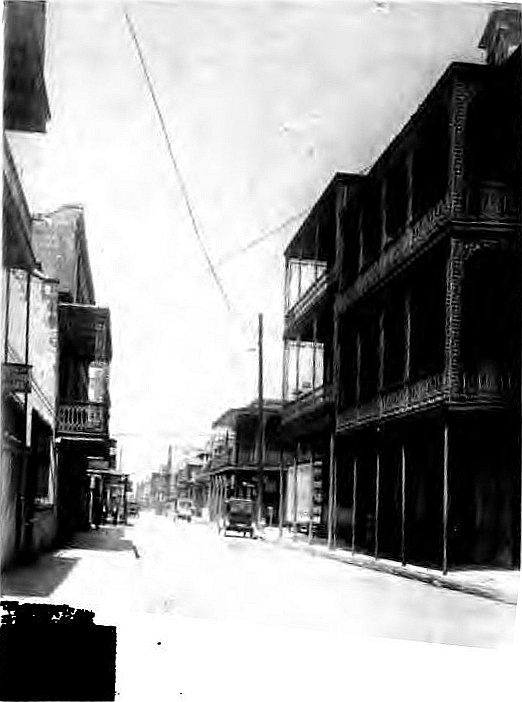
Jutting Balconies in the Creole City
"Won't you remember this night when you hear them sing in the cages?—poor little prisoners!"
"But we have none where I am now going. It is all wild out there; rough wooden houses and rough men!—no pets—not even a cat!"
"Then what would you do with a little bird in such a place? They would all laugh at you—would n't they?"
"No; I don't think so. Rough men love little pets."
"Little pets!"
"Like you, yes—too well!"
"Too well?"
"I did not mean to say that."
"But you did say it."
"I do not know what I say when I am looking into your eyes."
"Flatterer!"
The music and perfume of those hours came back to him in fragments of dreams all through the long voyage;—in slumber broken by the intervals of rapid travel on river and rail; the crash of loading under the nickering yellow of pine-fires; the steam song of boats chanting welcome or warning; voices of mate and roustabout; the roar of railroad depots; the rumble of baggage in air heavy with the oily breath of perspiring locomotives; the demands of conductors; the announcement of stations;—and at last the heavy jolting of the Western stage over rugged roads where the soil had a faint pink flush, and great coarse yellow flowers were growing.
So the days and weeks and months passed on; and the far Western village, with its single glaring street of white sand, blazed under the summer sun. At intervals came the United States mail-courier, booted and spurred and armed to the teeth, bearing with him always one small satiny note, stamped with the postmark of New Orleans, and faintly perfumed as by the ghost of a magnolia.
"Smells like a woman—that," the bronzed rider sometimes growled out as he delivered the delicate missive with an unusually pleasant flash in his great falcon eyes—eyes made fiercely keen by watching the horizon cut by the fantastic outline of Indian graves, the spiral flight of savage smoke far off which signals danger, and the spiral flight of vultures which signals death.
One day he came without a letter for the engineer—"She's forgotten you this week, Cap," he said in answer to the interrogating look, and rode away through the belt of woods, redolent of resinous gums and down the winding ways to the plain, where the eyeless buffalo skulls glimmered under the sun. Thus he came and thus departed through the rosiness of many a Western sunset, and brought no smile to the expectant face: "She's forgotten you again, Cap."
And one tepid night (the 24th of August, 18—), from the spicy shadows of the woods there rang out a bird-voice with strange exotic tones: "Sweet, sweet, sweet!"—then cascades of dashing silver melody!—then long, liquid, passionate calls!—then a deep, rich ripple of caressing mellow notes, as of love languor oppressed that seeks to laugh. Men rose and went out under the moon to listen. There was something at once terribly and tenderly familiar to at least One in those sounds.
"What in Christ's name is that?" whispered a miner, as the melody quivered far up the white street.
"It is a mocking-bird," answered another who had lived in lands of palmetto and palm.
And as the engineer listened, there seemed to float to him the flower-odors of a sunnier land;—the Western hills faded as clouds fade out of the sky; and before him lay once more the fair streets of a far city, glimmering with the Mexican silver of Southern moonlight;—again he saw the rigging of masts making cobweb lines across the faces of stars and white steamers sleeping in ranks along the river's crescent-curve, and cottages vine-garlanded or banana-shadowed, and woods in their dreamy drapery of Spanish moss.
"Got something for you this time," said the United States mail-carrier, riding in weeks later with his bronzed face made lurid by the sanguine glow of sunset. He did not say "Cap" this time; neither did he smile. The envelope was larger than usual. The handwriting was the handwriting of a man. It contained only these words:
DEAR—, Hortense is dead. It happened very suddenly on the night of the 24th. Come home at once.
S—
THE TALE OF A FAN[27]
Pah! it is too devilishly hot to write anything about anything practical and serious—let us dream dreams.
. . . . . . . . .
We picked up a little fan in a street-car the other day—a Japanese fabric, with bursts of blue sky upon it, and grotesque foliage sharply cut against a horizon of white paper, and wonderful clouds as pink as Love, and birds of form as unfamiliar as the extinct wonders of ornithology resurrected by Cuvieresque art. Where did those Japanese get their exquisite taste for color and tint-contrasts?—Is their sky so divinely blue?—Are their sunsets so virginally carnation?—Are the breasts of their maidens and the milky peaks of their mountains so white?
But the fairy colors were less strongly suggestive than something impalpable, invisible, indescribable, yet voluptuously enchanting which clung to the fan spirit-wise—a tender little scent—a mischievous perfume—a titillating, tantalizing aroma—an odor inspirational as of the sacred gums whose incense intoxicates the priests of oracles. Did you ever lay your hand upon a pillow covered with the living supple silk of a woman's hair? Well, the intoxicating odor of that hair is something not to be forgotten: if we might try to imagine what the ambrosial odors of paradise are, we dare not compare them to anything else;—the odor of youth in its pliancy, flexibility, rounded softness, delicious coolness, dove-daintiness, delightful plasticity—all that suggests slenderness graceful as a Venetian wineglass, and suppleness as downy-soft as the necks of swans.
. . . . . . . .
Naturally that little aroma itself provoked fancies;—as we looked at the fan we could almost evoke the spirit of a hand and arm, of phantom ivory, the glimmer of a ghostly ring, the shimmer of spectral lace about the wrist;—but nothing more. Yet it seemed to us that even odors might be analyzed; that perhaps in some future age men might describe persons they had never seen by such individual aromas, just as in the Arabian tale one describes minutely a maimed camel and its burthen which he has never beheld.
There are blond and brunette odors;—the white rose is sweet, but the ruddy is sweeter; the perfume of pallid flowers may be potent, as that of the tuberose whose intensity sickens with surfeit of pleasures, but the odors of deeply tinted flowers are passionate and satiate not, quenching desire only to rekindle it.
There are human blossoms more delicious than any rose's heart nestling in pink. There is a sharp, tart, invigorating, penetrating, tropical sweetness in brunette perfumes; blond odors are either faint as those of a Chinese yellow rose, or fiercely ravishing as that of the white jessamine—so bewitching for the moment, but which few can endure all night in the sleeping-room, making the heart of the sleeper faint.
Now the odor of the fan was not a blond odor:—it was sharply sweet as new-mown hay in autumn, keenly pleasant as a clear breeze blowing over sea foam:—what were frankincense and spikenard and cinnamon and all the odors of the merchant compared with it?—What could have been compared with it, indeed, save the smell of the garments of the young Shulamitess or the whispering robes of the Queen of Sheba? And these were brunettes.
The strength of living perfumes evidences the comparative intensity of the life exhaling them. Strong sweet odors bespeak the vigor of youth in blossom. Intensity of life in the brunette is usually coincident with nervous activity and slender elegance.—Young, slenderly graceful, with dark eyes and hair, skin probably a Spanish olive!—did such an one lose a little Japanese fan in car No.— of the C. C. R. R. during the slumberous heat of Wednesday morning?
A LEGEND[28]
And it came to pass in those days that a plague fell upon mankind, slaying only the males and sparing the females for some mysterious reason.
So that there was only one man left alive upon the face of the earth.
And he was remarkably fair to behold and comely and vigorous as an elephant.
And feeling the difficulties of his position, the man fled away to the mountains, armed with a Winchester rifle, and lived among the wild beasts of the forest....
And the women pursued after him and surrounded the mountain; and prevailed upon the man, with subtle arguments and pleasant words, that he should deliver himself up into their hands.
And they made a treaty with him, that he should be defended from ill-usage and protected from fury and guarded about night and day with a guard.
And the guard was officered by women who were philosophers, and who cared for nothing in this world beyond that which is strictly scientific and matter of fact, so that they were above all the temptations of this world.
And the man was lodged in a palace, and nourished with all the dainties of the world, but was not suffered to go forth, or to show himself in the streets; forasmuch as he was guarded even as a queen bee is guarded in the hive.
Neither was he suffered to occupy his mind with grave questions or to read serious books or discourse of serious things or to peruse aught that had not been previously approved by the committee of scientific women.
For that which wearieth the brain affecteth the well-being of the body.
And all the day long he heard the pleasant plash of fountain waters and inhaled delicious perfumes, and the fairest women in the world stood before him under the supervision of the philosophers.
And a great army was organized to guard him; and great wars were fought with the women of other nations on his account, so that nine millions and more of strong young women were killed.
But he was not permitted to know any of these things, lest it might trouble his mind; nor was he suffered to hear or behold aught that can be unpleasant to mortal ears.
He was permitted only to gaze upon beautiful things—beautiful flowers and fair women, and matchless statues and marvelous pictures, and graven gems and magical vases, and cunningly devised work of goldsmiths and silversmiths. He was only suffered the music created by the fingers of the greatest musicians and by the throats of the most bewitching of singers.
And once a year out of every ten thousand women in the world the fairest one and the most complete in all things was chosen; and of those chosen ones the fairest and most perfect were again chosen; and out of these again the committee of philosophers selected one thousand; and out of these thousand the man chose three hundred.
For he was the only man in the whole world; and the committee of philosophers ordained that he should be permitted to remain entirely alone for sixty-five days in the year, lest he might be, as it were, talked to death.
At first the man fell occasionally in love and felt unhappy; but as the committee of philosophers always sent unto him women more beautiful and more adorable than any he had seen before, he soon became reconciled to his lot.
And instead of committing the folly of loving one woman in particular, he learned to love all women in general.
And during fifty years he lived such a life as even the angels might envy.
And before he died he had 15,273 children, and 91,638 grandchildren.
And the children were brought up by the nation, and permitted to do nothing except to perfect their minds and bodies.
And in the third generation the descendants of the man had increased even to two millions of males, not including females, who were indeed few, so great was the universal desire for males.
And in the tenth generation there were even as many males as females.
And the world was regenerated.
THE GYPSY'S STORY[29]
The summer's day had been buried in Charlemagne splendors of purple and gold; the Spanish sable of the night glittered with its jewel-belt of stars. The young moon had not yet lifted the silver horns of her Moslem standard in the far east. We were sailing over lukewarm waves, rising and falling softly as the breast of a sleeper; winds from the south bore to us a drowsy perfume of lemon-blossoms; and the yellow lights among the citron trees seemed, as we rocked upon the long swell, like the stars of Joseph's dream doing obeisance. Far beyond them a giant pharos glared at us with its single Cyclopean eye of bloodshot fire, dyeing the face of the pilot crimson as a pomegranate. At intervals the sea amorously lipped the smooth flanks of the vessel with a sharp sound; and ghostly fires played about our prow. Seated upon a coil of rope a guitarrista sang, improvising as he sang, one of those sweetly monotonous ballads which the Andalusian gypsies term soleariyas. Even now the rich tones of that solitary voice vibrate in our memory, almost as on that perfumed sea, under the light of summer stars:
Sera, Para mi er mayo delirio Berte y no poerte habla. Gacho. Gacho que no hab ya motas Es un barco sin timon. Por ti, Las horitas e la noche Me las paso sin dormi. Sereno, No de oste la boz tan arta Que quieo dormi y no pueo. Marina, Con que te lavas la cara Que la tienes tan dibina?
Why he told me his story I know not: I know only that our hearts understood each other.
"Of my mother," he said, "I knew little when a child; I only remember her in memories vague as dreams, and perhaps in dreams also. For there are years of our childhood so mingled with dreams that we cannot discern through memory the shadow from the substance. But in those times I was forever haunted by a voice that spoke a tongue only familiar to me in after years, and by a face I do not ever remember to have kissed.
"A clear, dark face, strong and delicate, with sharp crescent brows and singularly large eyes, liquidly black, bending over me in my sleep—the face of a tall woman. There was something savage even in the tenderness of the great luminous eyes—such a look as the hunter finds in the eyes of fierce birds when he climbs to their nests above the clouds; and this dark dream-face filled me with strange love and fear. The hair, flowing back from her temples in long ripples of jet, was confined by a broad silver comb curved and gleaming like a new moon.
"And at last when these dreams came upon me, and the half-fierce, loving eyes looked upon me in the night, I would awake and go out under the stars and sob.
"A vast unrest possessed me; a new heat throbbed in my veins, and I heard forever flute-tones of a strange voice, speaking in an unknown tongue; but far, far off, like the sounds of words broken and borne away in fragments by some wandering wind.
"Ocean breezes sang in my ears the song of waves—of waves chanting the deep hymn that no musician can learn—the mystic hymn whereof no human ear may ever discern the words—the magical hymn that is older than the world, and weirder than the moon.
"The winds of the woods bore me odors of tears of spicy gums and the sounds of bird-voices sweeter than the plaint of running water, and whispers of shaking shadows, and the refrain of that mighty harp-song which the pines sing, and the vaporous souls of flowers, and the mysteries of succubus-vines that strangle the oaks with love.
"Winds also, piercing and cold as Northern eyes, came to me from the abysses of the rocks, and from peaks whose ermine of snow has never since the being of the world felt the pressure of a bird's foot; and they sang Runic chants of mountain freedom, where the lightnings cross their flickerings. And with these winds came also shadows of birds, far circling above me, with eyes fierce and beautiful as the eyes of my dream.
"So that a great envy came upon me of the winds and waves and birds that circle forever with the eternal circling of the world. Nightly the large eyes, half fierce, half tender, glimmered through my sleep: phantom winds called to me, and shadowy seas chanted through their foam-flecked lips runes weird as the Runes of Odin.
"And I hated cities with the hatred of the camel—the camel that sobs and moans on beholding afar, on the yellow rim of the desert, the corpse-white finger of a minaret pointing to the dome of Mahomet's heaven.
"Also I hated the rumble of traffic and the roar of the race for gold; the shadows of palaces on burning streets; the sound of toiling feet; the black breath of towered chimneys; and the vast machines, forever laboring with sinews of brass, and panting with heart of steam and steel.
"Only loved I the eyes of night and the women eyes that haunted me—the silence of rolling plains, the whispers of untrodden woods, the shadows of flying birds and fleeting clouds, the heaving emerald of waves, the silver lamentation of brooks, the thunder roll of that mighty hymn of hexameters which the ocean must eternally sing to the stars.
"Once, and once only, did I speak to my father of the dark and beautiful dream that floated to me on the misty waves of sleep. Once, and once only; for I beheld his face grow whiter than the face of Death.
"Encompassed about by wealth and pleasure, I still felt like a bird in a cage of gold. Books I loved only because they taught me mysteries of sky and sea—the alchemy of suns, the magic of seasons, the marvels of lands to which we long forever to sail, yet may never see. But I loved wild rides by night, and long wrestling with waves silver-kissed by the moon, and the musky breath of woods, where wild doves wandered from shadow to shadow, cooing love. And the strange beauty of the falcon face, that haunted me forever, chilled my heart to the sun-haired maidens who sought our home, fair like tall idols of ivory and gold.
"Often, in the first pinkness of dawn, I rose from a restless sleep to look upon a mirror; thirsting to find in my own eyes some dark kindred with the eyes of my dreams; and often I felt in my veins the blood of a strange race, not my father's.
"I saw birds flying to the perfumed South; I watched the sea gulls seeking warmer coasts; I cursed the hawks for their freedom—I cursed the riches that were the price of my bondage to civilization, the pleasures that were the guerdon of my isolation among a people not my own.
—"'O that I were a cloud,' I cried, 'to drift forever with the hollow wind!—O that I were a wave to pass from ocean to ocean, and chant my freedom in foam upon the rocks of a thousand coasts!—O that I might live even as the eagle, who may look into the face of the everlasting sun!'
"So the summer of my life came upon me, with a madness of longing for freedom—a freedom as of winds and waves and birds—and a vague love for that unknown people whose wild blood made fever in my veins,—until one starless night I fled my home forever.
"I slumbered in the woods at last; the birds were singing in the emerald shadows above when I awoke. A tall girl, lithe as a palm, swarthy as Egypt, was gazing upon me. My heart almost ceased to beat. I beheld in the wild beauty of her dark face as it were the shadow of the face that had haunted me; and in the midnight of her eyes the eyes of my dream. Circles of thin gold were in her ears;—her brown arms and feet were bare. She smiled not; but, keeping her great wild eyes fixed upon mine, addressed me in a strange tongue. Strange as India—yet not all strange to me; for at the sound of its savage syllables dusky chambers of memory long un visited reopened their doors and revealed forgotten things. The tongue was the tongue spoken to me in dreams through all those restless years. And she, perceiving that I understood, although I spoke not, pointed to far tents beyond the trees, and ascending spirals of lazy smoke.
"'Whithersoever we go, thou shalt also go,' she murmured. 'Thou art of our people; the blood that flows in thy veins is also mine. We have long waited and watched for thee, summer by summer, in those months when the great longing comes upon us all. For thy mother was of my people; and thou who hast sucked her breasts mayst not live with the pale children of another race. The heaven is our tent; the birds guide our footsteps south and north; the stars lead us to the east and west. My people have sought word of thee even while wandering in lands of sunrise. Our blood is stronger than wine; our kindred dearer than gold. Thou wilt leave riches, pleasures, honors, and the life of cities for thy heart's sake; and I will be thy sister.'
"And I, having kissed her, followed her to the tents of her people—my people—the world wanderers of the most ancient East."
THE ONE PILL-BOX[30]
Like Nebuchadnezzar's furnace, the sun seemed to blaze with sevenfold heat; the sky glowed like steel in the process of blistering; a haze yellow as the radiance above a crucible gilded the streets; the great plants swooned in the garden—fainting flowers laid their heads on the dry clay; the winds were dead; the Yellow Plague filled the city with invisible exhalations of death. A silence as of cemeteries weighed down upon the place; commerce slept a wasting slumber; the iron muscles and brazen bones of wealth machinery relaxed, and lungs of steel ceased their panting; the ships had spread their white wings and flown; the wharves were desolate; the cotton-presses ceased their mighty mastication, and no longer uttered their titanic sighs.
The English mill-master had remained at his post, with the obstinate courage of his race, until stricken down. There was a sound in his ears as of rushing waters; darkness before his eyes: the whispering of the nurses, the orders of the physicians, the tinkling of glasses and spoons, the bubbling of medicine poured out, the sound of doors softly opened and closed, and of visits made on tiptoe, he no longer heard or remembered. The last object his eyes had rested upon was a tiny white-and-red pill-box, lying on the little table beside the bed.
The past came to him in shadowy pictures between dark intervals of half-conscious suffering—of such violent pain in thighs and loins as he remembered to have felt long years before after some frightful fall from a broken scaffolding. The sound in his ears of rushing water gradually sharpened into a keener sound—like the hum of machinery, like the purring of revolving saws, gnawing their meal of odorous wood with invisibly rapid teeth. Odors of cypress and pine, walnut and oak, seemed to float to his nostrils—with sounds of planing and beveling, hammering and polishing, subdued laughter of workmen, loud orders, hurrying feet, and above all the sharp, trilling purr of the hungry saws, and the shaking rumble of the hundred-handed engines.
He was again in the little office, fresh with odors of resinous woods—seated at the tall desk whose thin legs trembled with the palpitation of the engine's heart. It seemed to him there was a vast press of work to be done—enormous efforts to be made—intricate contracts to be unknotted—huge estimates to be made out—agonizing errors to be remedied—frightful miscalculations to be corrected—a world of anxious faces impatiently watching him. Figures and diagrams swam before his eyes—plans of façades—mathematical calculations for stairways—difficult angles of roofs—puzzling arrangements of corridors. The drawings seemed to vary their shape with fantastic spitefulness; squares lengthened into parallelograms and distorted themselves into rhomboids—circles mockingly formed themselves into ciphers—triangles became superimposed, like the necromantic six-pointed star. Then numerals mingled with the drawings—columns of magical figures which could never be added up, because they seemed to lengthen themselves at will with serpent elasticity—a mad procession of confused notes in addition and subtraction, in division and multiplication, danced before him. And the world of anxious faces watched yet more impatiently.
All was dark again; the merciless pain in loins and thighs had returned with sharp consciousness of the fever, and the insufferable heat and skull-splitting headache—heavy blankets and miserable helplessness—and the recollection of the very, very small pill-box on the table. Then it seemed to him there were other pill-boxes—three! nine! twenty-seven! eight-one! one hundred and sixty-two! one hundred and sixty-two very small pill-boxes.
He seemed to be wandering in a cemetery, under blazing sunlight and in a blinding glare of white-washed washed tombs, whose skeletons of brick were left bare in leprous patches by the falling away of the plastering. And, wandering, he came to a deep wall, catacombed from base to summit with the resting-places of ten thousand dead; and there was one empty place—one black void—inscribed with a name strangely like his own. And a great weariness and faintness came upon him; and the pains, returning, carried back his thoughts to the warmth and dimness of the sick-room.
It seemed to him that this could not be death—he was too weary even to die! But they would put him into the hollow void in the wall!—they might: he would not resist, he felt no fear. He could rest there very well even for a hundred years. He had a gimlet somewhere!—they would let him take it with him;—he could bore a tiny little hole in the wall so that a thread of sunlight would creep into his resting-place every day, and he could hear the voices of the world about him. Yet perhaps he should never be able to leave that dark damp place again!—It was very possible; seeing that he was so tired. And there was so much to be arranged first: there were estimates and plans and contracts; and nobody else could make them out; and everything would be left in such confusion! And perhaps he might not even be able to think in a little while; all the knowledge he had stored up would be lost; nobody could think much or say much after having been buried. And he thought again of the pill-boxes—one hundred and sixty-two very small pill-boxes. No; there were exactly three hundred and sixty-six! Perhaps that was because it was leap year.
Everything must be arranged at once!—at once! The pill-boxes would do; he could breathe his thoughts into them and close them tightly—recollections of estimates, corrections of plans, directions to the stair-builders, understanding with contractors, orders to the lumber dealers, instructions to Texan and Mississippi agents, answers to anxious architects, messages to the senior partner, explanations to the firm of X and W. Then it seemed to him that each little box received its deposit of memories, and became light as flame, buoyant as a bubble;—rising in the air to float halfway between floor and ceiling. A great anxiety suddenly came upon him;—the windows were all open, and the opening of the door might cause a current. All these little thoughts would float away!—yet he could not rise to lock the door! The boxes were all there, floating above him light as motes in a sunbeam:—there were so many now that he could not count them! If the nurse would only stay away!... Then all became dark again—a darkness as of solid ebony, heavy, crushing, black, blank, universal...
All lost! Brutally the door opened and closed again with a cruel clap of thunder.... Yellow lightnings played circling before his eyes.... The pill-boxes were gone! But was not that the face of the doctor, anxious and kindly? The burning day was dead; the sick man turned his eyes to the open windows, and beheld the fathomless purple of the night, and the milky blossoms of the stars. And he strove to speak, but could not! The light of a shaded lamp falling upon the table illuminated a tiny object, blood-scarlet by day, carmine under the saffron artificial light. There was only one pill-box.
A RIVER REVERIE[31]
An old Western river port, lying in a wrinkle of the hills—a sharp slope down to the yellow water, glowing under the sun like molten bronze—a broken hollow square of buildings framing it in, whose basements had been made green by the lipping of water during inundations periodical as the rising of the Nile—a cannonade-rumble of drays over the boulders, and muffled-drum thumping of cotton bales—white signs black-lettered with names of steamboat companies, and the green lattice-work of saloon doors flanked by empty kegs—above, church spires cutting the blue—below, on the slope, hogsheads, bales, drays, cases, boxes, barrels, kegs, mules, wagons, policemen, loungers, and roustabouts, whose apparel is at once as picturesque, as ragged, and as colorless as the fronts of their favorite haunts on the water-front. Westward the purple of softly-rolling hills beyond the flood, through a diaphanous veil of golden haze—a marshaled array of white boats with arabesque lightness of painted woodwork, and a long and irregular line of smoking chimneys. The scene never varied save with the varying tints of weather and season. Sometimes the hills were gray through an atmosphere of rain—sometimes they vanished altogether in an autumn fog; but the port never changed. And in summer or spring, at the foot of the iron stairway leading up to a steamboat agency in the great middle building facing the river, there was a folding stool—which no one ever tried to steal—which even the most hardened wharf thieves respected—and on that stool, at the same hour every day, a pleasant-faced old man with a very long white beard used to sit. If you asked anybody who it was, the invariable reply was: "Oh! that's old Captain-; used to be in the New Orleans trade;—had to give up the river on account of rheumatism;—comes down every day to look at things."