Chapter IV
Reading edition
WILLY always walked home from school alone. The school was round the corner of the square, and he would have felt it below his dignity to be fetched.
He had been inattentive at lessons all day; he could not get the thought of that grieving child out of his head.
His father had not returned, as he often did, at lunchtime. Was the baby better? Was it worse? Had the angel of Death taken it away from its sister-mother?
He answered his teacher in such an anyhow manner that the kind lady shook her head and said the fog had got into his brain, and that his geography and history and Latin grammar had lost their way there, and were knocking against each other.
When afternoon class was over, instead of returning home straight he looked about him.
It was a most uncomfortable afternoon. It was misty above and muddy below, the snow had begun to melt and the sky was murky.
Willy looked up to the yellow sky once, and down on the ground, and then he set off running. He made a dash to the right, and then he ran on until he came to a turning on the left. He kept on running until he came to a shabby street which lay at the back of the handsome thoroughfares. The street had a depressed yet genteel air; it seemed an apologetic street, as if it were a humble relation of the very rich neighbouring streets.
This was the street where Janie lived. He knew the number of the house—No. 14. It was more slippery here. There was very little light, except where there was a great stream of brilliant gas, which issued from a public-house. Groups were standing about—rough groups of men and women; laughter and loud talk streamed through the door.
Willy hurried on faster, but the ground was so slippery that suddenly he fell. There was a roar of hoarse laughter. Willy picked himself up; he did not look to the right or left; he went on once more.
Where was No. 14? It was like trying to find a house in a nightmare; every number seemed to be there except No. 14. The tall houses with their dingy windows seemed to be mocking him.
It was growing colder and darker and more slippery. The street seemed never to come to an end. He thought he would turn back, and yet something in his heart seemed to urge him to go on to little Janie.
All at once it stood before him, with a gas-light shining inside and throwing the number out distinctly—No. 14.
He stood on tip-toe and knocked, and the door was opened by a very fat woman. Willy thought she was the fattest woman he had ever seen. She had three double chins.
"Dear, dear! I thought you were the doctor," she said, in a melancholy gurgle.
"I am the doctor's son," replied Willy, with an air that implied it was the next best thing.
Then a fat man, who was, if possible, fatter than the fat woman, came out and looked at Willy.
"I want to know how the baby is," said Willy feeling shy.
"Bless him!" said the fat woman, sighing.
"Bless him!" said the fat man.
Willy looked from one to the other. They did not say how the baby was, but repeated "Bless him!" and sighed.
"I'll take the little gentleman up," said the fat woman dolefully.
"No; I'll take him," said the fat man. "She is too fat to go up easily," he added, with a twinkle in his small eyes.
He led the way; he seemed to grunt at every step.
Up, up they went. The higher they went the shabbier grew the stairs, the dingier the walls; and what with the yellow sky outside, and the dismal look of the house, and the melancholy panting of his guide, Willy's heart grew heavier and heavier.
At last the fat man stopped before a door and knocked. Willy's heart felt like lead. What grief was he about to behold?
His first impression was of a brightly-burning fire, of a familiar little figure stirring something in a saucepan. It looked round as he entered, dropped the spoon, and ran to meet him, forefinger pressed on lips. It was Janie. She was pale and heavy-eyed, but the despair was gone from her face.
"Baby is better; come and see," she whispered, taking Willy's hand and leading him to the cot's side. The baby looked pale, but was sleeping peacefully.
"Don't she look fine?" whispered Janie softly, drawing the blanket closer about the baby.
A thin old man, with long, straight, white hair, was sitting in the shadow on the other side of the bed. "Yes, yes, she is going to be well again. The little mother has nursed her back to life. She will soon be as merry again as a fiddle playing at a pantomime," he said in a gay whisper.
"That's Uncle Sam, I let him sing baby to sleep," said Janie, flitting back to her saucepan.
The old man nodded to Willy, "Sit down, sir, sit down; you're kindly welcome."
"He is the little boy of the doctor who is making baby well," whispered Janie, who had flitted back to the bedside, and was giving a pat to baby's pillow.
"Father's so clever! He makes everybody well whom he attends," said Willy, proudly.
"Begging your pardon, sir, the little mother there had something to do with it, too. Why, she makes a poultice as soon as look at it, and gruel that's as pleasant as a tune to take. She nurses us all," said the old man.
"No; it's the doctor made her well," said Janie.
"Little mother helped, bless her!" said the fat man, in a voice soft, suetty, and slow.
If a plum pudding could speak, it would have just such a voice.
"Why, when I go to the theatre," he continued, "and see her a-dancing and pirouetting on tip-toe, I split my sides laughing, thinking that's the little mother. At night there's a fairy for ye, and in the day ye see her a-boiling, and cooking, and nursing, and ye say there's a grannie for ye, and she's Janie all the time—little Janie Sprigs."
"Hush!" said Janie, for the baby had begun to move.
"That's true, every word of it," said the old man, rubbing his hands, and, forgetting to whisper, speaking in a shrill voice. "It is Janie and the doctor together!" He gave a thump to the pillow. "They're like the bow and the fiddle making music together—they're making baby well." He gave another thump, and the baby, waking, began to cry.
"Go away, Uncle Sam," cried Janie, coming up with outstretched arms. "Ye've no thought but of your fiddle. You forget baby is not a senseless thing."
She took up the wailing child in her arms, and began walking up and down, soothing and hushing its cries.
With its wraps and its shawls, and its large head bobbing against Janie's shoulder, the baby looked as large as did its tender nurse.
Willy watched the motherly little figure, and noted how worn and white was Janie's face, and something like a feeling of reverence stole into his heart for that poorly-clad girl.
"That's the way she has been all night, a-walking up and down, never resting; never a wink of sleep did she take, and to think she's a-going to dance at the theatre to-night," said Uncle Sam.
"Dance!" cried Willy, aghast.
"I am a-going to-night," cried Janie, stopping straight in front of Willy, rocking softly backwards and forwards to keep the baby still. "Everything must be paid for, and I'm a-going to dance, to pay for things. If baby had died I'd never have danced no more—never." She gave a little hug closer to the child in her arms. "But now, as she's going to live, I'll dance—dance till—" her voice choked.
"Till baby is danced into health, and baby is danced into education and grows tall and hearty. God bless the little mother!" said the doctor, who suddenly came into the room.
"Yea, God bless her!" said the thin old man and the fat landlord.
"I could not help coming," said Willy, as he caught his father's astonished glance. "I wanted to know how the baby was."
"You may hold her!" said Janie; and before he knew where he was the big-headed baby was in his arms.
"Oh!" said Willy, in a great fright lest he should drop it.
Janie snatched it back in a moment. "Why you are as awkward as Uncle Sam," she cried with a laugh.
And now the fat landlady came panting into the room, saying it was time to get ready for the play.
Then all was fuss and bustle. Baby was put into Fatty's arms, and Janie gave all sorts of directions as she put on her cloak and hat in a hurry.
"You'll come and see me dance?" she said to Willy.
"I would rather come here," he replied.
"He would rather see the little mother than the fairy Pea Blossom," said the doctor.
"That is true," exclaimed Willy.
"Good-bye," said Janie, taking Willy's hand—suddenly she stooped and kissed it—"I like you because you care for the baby," she said, and was off.
How the Starling Caught Cold.
A GARDEN LEGEND. BY GEO. MANVILLE FENN,
AUTHOR OF "DICK O' THE FENS," "IN THE KING'S NAME," "NAT THE NATURALIST," &c., &c. ————————
"HALLO!"
"Spuzz!"
"Eh?"
"Spitz, spuzz."
It was a marigold with an orange frill about her neck that said "Hallo!" and it was a queer looking, zigzag, blunt headed creature, with his perambulators doubled under him making him look like an insect engine, that emitted the harsh sounds as soon as he had alighted on one of the leaves of the marigold.
Then there was a pause till the soft breeze stole through the garden, when the Canterbury bell gave forth a gentle tinkle that nobody could hear, the sunflower bowed his head and scratched one petal against a garden nail in the old brick wall, and a bird away in the meadow cried, "Cuckoo."
"Spuzz, spuzz, spitz, spuzz!" came from the little creature on the marigold's leaf, as if it had touched a spring and set its works in motion.
"Well," cried the marigold, "of all the crinketty cranketty creatures that ever came for a walk on me, you are about the queerest. What are you! A green wasp walking on stilts?"
"Spuzz, spitz, spuzz!"
"I say, what are you a doing of?" cried the marigold, who was a very vulgar flower.
"Spuzz, spuzz!"
"Well, don't spuzz again," cried the marigold. "Why I do declare you've got saws on your legs. What yer doing of? Trying to saw off your wings?"
"Spuzz, spuzz!"
"Here, what's your name?"
"Spitz, spuzz!"
"Then I hope you're proud of it. Is it a Christian name or a surname?"
There was a curiously rapid mechanical motion of the angular legs, and a repetition of the sound like a tooth-pick being rubbed along the edge a small comb.
"I don't know what you say," shouted the marigold.
"Spuzz, spuzz, spuzz!"
"He's a foreigner," said the marigold to herself. "Shouldn't wonder if he's one of the queer things that come over in boxes with the bulbs." Then aloud, "Are you from foreign abroad?"
"Tchah, tchizz! Nonsense: I am as English as you are!"
"Then why didn't you say so sooner?"
"You didn't say I was a foreigner sooner."
"Then why do you keep on saying, 'spuzz, spuzz,' every time one speaks?"
"I don't know," said the little stranger, "spuzz, spuzz!"
"That's it! why do you keep on saying that?"
"I don't. Spuzz, spuzz!"
"O my! You wicked thing," cried the marigold, "why you said it then."
"No I didn't."
"Yes you did; I heard you."
"Stuff! people don't talk with their legs, do they?"
"Well, no," said the marigold. "I don't think they do. But," she added, triumphantly, "they talk with their hands. I've seen the gardener's deaf and dumb boy."
"But this isn't talking; I always go like that."
"Why?"
"Because it is my nature to. See here."
As he spoke he set his legs in motion, and made the peculiarly sharp sound again.
"Oh, I say, don't!" cried the marigold. "It tickles."
"Eh?"
"It makes me feel all creepy. What's the good of doing it?"
"I don't know," said the little fellow, "but I always do."
"Humph!" said the marigold, waving a leaf thoughtfully, "you are a rum-looking fellow. Why you've got your legs all dibbly-double under your body. Don't it hurt?"
"Not a bit. They're spring-heeled-jack legs. I can jump like a kangaroo with them. Didn't you see me jump on to your leaf?"
"No: you flew on."
"That I didn't."
"Of course you didn't," said the marigold thoughtfully. "You haven't any wings."
"That I have; beauties!"
"Where are they, then?" said the marigold. "At home?"
"No; folded up neatly in their cases. Spuzz, spuzz!"
"I say, don't do that!" cried the marigold angrily. "It isn't nice."
"Isn't it? Spuzz, spuzz!"
"Don't—do—that; it's rude. You don't see me playing scratchy tunes with my legs."
"You couldn't. You haven't got any legs."
"Well, perhaps not legs," said the marigold, giving her head a gentle toss. "But I've got a leg, and foot-stalks. How else could I stand?"
"Oh, I don't know," said the queer little fellow. "On your head, perhaps. Wizz, wizzle, wizz, spitz, spuzz."
"Why can't you leave off when you are asked?" said the marigold, looking quite annoyed. "How can you be so rude? I wasn't planted here for you to come and stand upon and saw."
"How do you know? Why shouldn't I stand on you? I always do on the tall grass in the meadows. Spuzz!"
"Then go and stand on the tall grass now. You jar me all through. Don't come sharpening your wooden saws on me."
"Get out, you nasty proud yellow-faced thing! It's no such very great pleasure to stop on your rough leaf."
"Rough, indeed," said the marigold.
"Yes, rough; and what common scent you use. Pah! It's disgusting!"
"Well, I'm sure!" cried the marigold, colouring up, and growing so excited that she opened a fresh bud. "And of all the nasty—Well now! look at that! Why he went off like a cold firework!"
For all at once the little fellow gave a double kick, and darted through the air to alight on the big, soft leaf of a moth mullein.
"Not at home," said the tall plant, as the curious little fellow began to walk up his high spire like a Steeple Jack, right to the very top, where he gave another kick, darted through the air, and alighted on the snapdragon's finest sprig.
"Here! hi!" cried the flower. "Keep off the grass! mean, don't turn me into a door-mat. I mean, are your feet clean?"
"Of course they are, old dragon's mouth."
"Don't call names," said the flower fiercely. "What do you want?"
"Only a friendly visit. I've just come out of the fields."
"But who are you? Not one of our insect friends?"
"I'm the grasshopper."
"Then why don't you go and hop on your grass?" said the flower shortly.
"Well, the fact is," said the grasshopper, "honey is dreadfully scarce out there this season, so I've come on my travels. I've come hopping."
"Well, you're not coming hopping here. I don't grow hops."
"You? No!" said the artful little insect. "You are too beautiful. My! what lovely colours!"
The snapdragon coughed slightly, feeling flattered.
"And what a sweet expression there is about your mouth."
"Oh, really! I don't know," said the snapdragon.
"Oh, but I do."
"Well, I must own that I have been admired," said the foolish flower.
"Admired! I should think so, indeed. What a pity it is though that you have no honey."
"No honey! Why I've plenty."
"Where? Down in your roots?"
"Nonsense! In my blossoms, shut up close."
"Dear me!" said the grasshopper. "Well, with honey and such lovely colours you only want a little scent to make you perfect."
"I'm quite as perfect as I wish to be," said the snapdragon.
"And as I wish you to be," replied the grasshopper. "But, I say, isn't it nearly lunch time?"
"What do you mean?"
"Thought perhaps you might feel disposed to offer me a little honey. Just a wee taste, you know."
"Oh, I couldn't think of such a thing. I don't even give any to the bees."
"Really!"
"No; not a bit."
"What do you do with it then?"
"Keep it till it's stolen."
"Better give it away then. Who steals it?"
"Oh, some wretched little insects eat a hole through my flowers close up to the stalk, and get it all."
"Well, you might give me a taste," said the grasshopper. "There, open your mouth, and shut your eyes. I won't take much."
"But if I did, you'd creep in, and wouldn't go again when I told you."
"Oh! don't say that! On the honour of a grasshopper. Now just you try me. Oh! you beauty."
"Well," said the flower, smiling with every mouth, "I think I will try you, for I don't like to be greedy. But mind, you are not to have much; and when I cry, 'Stop!' out you must come."
"Spitz, spuzz, spuzz, spuzz, spuzz!"
"Oh, I say, don't!" cried the snapdragon in alarm. "Why if you did that when you were in one of my blossoms you'd tickle my throat, and make me cough."
"That was because I was so pleased. It was only my hop legs."
"Then you had better leave your legs outside."
"Well, I couldn't very well do that," said the grasshopper; "but don't you be alarmed. You may trust me."
As he spoke he could not contain his joy in the anticipation of a feast that was not even offered to the bees; and he went off with such a fierce fizz that it sounded as if he had let off a baby cracker all at once.
"There!" cried the snapdragon, "you see you really are not to be trusted."
"That was like a clearing up shower," said the grasshopper. "Come along; open your mouth, and give us a taste."
"I really hardly like to venture," replied the snapdragon.
"You don't trust me, and yet I'm ready to trust you. Suppose I said I was afraid you might bite me in two."
"But I've got no teeth," cried the flower.
"Well, there then," cried the grasshopper, "fair play's a jewel, I'll trust you if you'll trust me."
"But couldn't you really leave your legs outside?"
"Impossible! the birds might steal them while I was gone, and where should I be then?"
"In my blossom."
"Yes, but where would my legs be?"
"Well, I will trust you," said the flower, opening one of its blossoms slowly. "And you will come out when I call?"
The grasshopper wanted no second permission, but often declaring upon his honour that he would come out when called, he crept into the open flower, and without heeding a remonstrance to be careful—consequent upon his scratching the roof of the snapdragon's mouth with his awkward top joints—he dashed right to the end, and began feasting merrily upon the flower's honey pots, eating ten times as much as was good for him or just to the generous flower.
"Gently, please!" said the snapdragon.
"'Lishus," said the grasshopper thickly.
"I think that will do now," said the snapdragon.
"'Tis good!" replied the grasshopper, smacking his lips, "rather thick sticky sort of honey, though."
"Yes, you have had enough."
"Can't hear what you say. The door's shut."
The snapdragon opened the door immediately—a regular yawning mouth, all rose, amber, orange and gold, but the grasshopper gobbled away.
"Door's open now," said the snapdragon. "Come out!"
"Shan't!" said the voracious little monster.
"Don't answer in that rude manner, but come out," cried the snapdragon.
"Had too much trouble to get in," said the grasshopper.
"Now don't be unfair. I trusted you," said the snapdragon, "so come out."
"Not I! I am going to stop."
"If you do not come out directly," cried the flower angrily, "I'll shut the door, and you'll be obliged to stay."
"Don't care!"
"'Don't care' came to a bad end."
"But he had no honey pots to feast upon. One can't starve here."
"Now then, I warn you," said the snapdragon. "Come out!"
"Shan't!"
"I warn you again."
"Don't care!"
"I'll shut you up in prison for stealing."
"Shut away!"
"'Snap!'"
That was the noise made by the flower dragon's mouth, and then there was silence, while the grasshopper kept on eating away till he could eat no more.
"Phew!" he said; "it's rather hot in here. What nasty sticky honey it is."
There was a pause.
"Oh, dear me!" he said. "I didn't think this place was so tight. One can't turn round. Must have another taste, though."
He attacked the honey once more, but left off directly.
"Bah! not good honey—much too sweet. Here, open your mouth; I've had enough of this stuff."
"Of course," said the snapdragon. "You've broken faith, so you may stop in now till I choose to let you out."
"Here, open this door," cried the grasshopper. "Be quick, or I'll kick it down. This honey's stifling, and I've got it all over my front."
"You'll stop there till I please to let you out," said the flower, angrily.
"Oh, that's it, is it?" cried the grasshopper. "Well, we will soon see who is master. Do you know I can kick?"
"No; but I know you can hop sometimes. You can't hop now."
"Do you want me to choke you?"
"You may do just what you like," said the snapdragon, sternly. "I've got you, and I don't mean to let you go."
"How tight and hot this nasty place is!" grumbled the grasshopper, "and how fearfully sticky. Only wait till I get out. Here, open this door!"
The grasshopper waited a few minutes to see if the flower would set him at liberty, but he waited in vain, and, growing fierce now, he drew up his legs.
"Now then," he said, "we shall see!"
There was a moment's pause, and then he began to saw away, rasping the edges of his wing cases and making such a jarring, hideous noise as was never heard before in blossom or bell.
"Spuz-z-z-z-z. Fidz-z-z-z-z-z. Budz-z-z-z-z-z. Dzar-r-r-r-r-r-r-r-r-z-z-z-z-z-z," and the sound was a hundred times the more strange from being shut up in the quaint-looking flower.
"Oh, my pods and seeds!" exclaimed the snapdragon, "this is horrible. It tickles my throat so! I can't bear it. I—Oh, dear me! It is impossible to bear this. I shall—shall—"
The snapdragon did not say what it would do, but began to cough so violently that its mouth opened wide, and the grasshopper laughed, and began to back out with a shuffling motion.
He laughed too soon, for, annoyed by its enemy's mirth, the flower snapped its mouth to again, and there was the grasshopper, caught tightly round the middle, and with its long, dibble-double legs kicking about outside, with nothing to rest on, like a frog swimming in water, but without being able to move away, for the honey thief was regularly caught in a trap.
It was a tight trap, too, and one in which he was helpless, for though he kicked and threw out his legs, and tried to rasp the little combs upon the edges of his wing cases, so as to make his jarring sounds, he could not reach them, and as he kicked the flower looked on and laughed; while, to make matters worse for him, a merry blue larkspur which grew close by began to tickle him with his spurs, making the little fellow kick more than ever.
"Serve him right for being rude," said the marigold.
"Put him on a kicking-strap with one of my leaves," said the ribbon grass.
"No, no; let the greedy little creature be," cried the snapdragon. "I'll punish him, and—oh! he's gone!"
No wonder: for the snapdragon had opened the wrong mouth when he spoke, and suffered like the crow with the cheese in the fable. For the grasshopper dropped down on the ground quite out of breath with his struggles. He soon recovered though, and vented his spleen upon the snapdragon by backing up close to the stems, and kicking and rasping till the poor flower was all of a quiver, and gaped, and looked foolish with its many mouths.
After a long rest the grasshopper made a fresh start. He began though by leaping upon the helpless snapdragon, and then jumped to and fro, whizzing at the flower derisively. From there he hopped on to the marigold's leaf, serving her the same, before making one grand effort which sent him flying through the air into the mignonette, which he insulted by telling the tiny flower it smelt nasty.
A sharp spring carried the mechanical-looking little creature into the grass, where he crawled up a stout bent, gathered up his strength, and leaped to the foot of the lily.
"Get away!" cried the elegant lady of the silver chalice and golden dust, but the grasshopper had no reverence, and crawled right to the tip-top bud for a few moments, before spinning himself right away on to the sunflower's high stem.
"Oh! you're here now!" said the giant, shaking his great head.
But the grasshopper was out of temper, and contented himself with turning the tall flower into a scaffold from which he could leap on to the velvet-green moss on the top of the red brick wall.
"Here we are!" he cried joyously, as he rubbed his legs and emitted his harsh, horny sound, and from the point of vantage he looked right and left, hesitating whether to leap to the right, among the flowers, or to the left, among the vegetables.
He had no time, though, to choose, for a fat young blackbird in mottled-brown came hopping along the top of the wall, caught sight of the insect, and made an inexperienced dab at him with his soft beak. He was quick, but the grasshopper was quicker, and flew hurriedly away into the tall, green feathers of the carrot, where there was room to hide from all the sharp-eyed birds in the garden.
"No business here," said the biggest carrot in the bed. "Do you hear? No business in my bed."
"Spuzz!" went the grasshopper derisively, as he slowly climbed the tallest leaf. "I shall stop as long as I—"
"Peck!" went the robin, caught the little fellow by the waist, and flew away, flitter, flutter, till the grasshopper drew his legs well up under him, and then gave so loud and jarring a spuzz that the robin said "murder!" opening his beak in his fright, and down went the little grasshopper right into the heart of the fattest cabbage in the garden.
"Oh! spuzz, spuzz. I shall be killed if I don't go back to the fields. I'll creep down here to be safe."
"No lodgings to let," said the fat cabbage, "I'm eaten up as it is. There are the earwigs and little earwigses in number two; there's a snail in number four with a small family; fourteen caterpillars in number six; and every other leaf occupied by slugs, except number a hundred-and-two, which has been turned into a storehouse for new laid eggs. And now you've come."
"Spuzz, spuzz. Ditz. And I mean to stop," cried the grasshopper. "Who are you?"
"I'm a regular riddle," said the cabbage, "so full of holes you must give me up. Everybody takes advantage of me without so much as saying by your leaf. But, I say, who are you?"
"The grasshopper."
"Mind that bird," whispered the cabbage, as a sparrow alighted on an apple tree, and looked down with his head on one side.
"Fizz!" went the grasshopper into the mint, and made the sparrow stare. Spuzz again, and he was down among the thyme. Away into the curly-headed parsley, and off to the wise old sage, but after taking a sniff at sweet marjoram and another at balm, he declared the herbs were a dowdy lot, and not half so nice as new mown hay.
Off on his travels again he hopped and spun about from vegetable to tree and bush, and then on to the wall once more, where he stopped for a rest and looked down at the flowers.
"Now then," he cried, "here goes for the biggest spin of all, and then I'll have another feast on the snapdragon's honey."
His wings must have been used that time, for the spin seemed many yards long, but instead of his coming down in the flower bed, he made too big a leap, and dropped upon the other side right on the lawn, when—
"Peck!"
A sharp-billed starling had him by the middle.
"Fidz-fidz-fidz, wizz-wizz-wizzle," went the grasshopper's combs, but he began too late. The starling had dropped him, but it was down inside, and thus they say he lives still in the starling's throat. For though there are many who think that the speckled, sharp-billed bird has made himself hoarse by getting up too early in search of grubs, the genuine truth in Birdland is that his cold was caught by swallowing the grasshopper, and, for proof of this, you have but to listen to the starling's note as he sits high up in some elm tree, with the spiky feathers of his head and throat erect.
Sweet, melodious, and true come his notes—sweeter than those of a thrush, pure as the soft flute of the blackbird for two or three bars of his song, and then you hear the grasshopper in his throat, wizzling and wheezing, all sputter and fidz, like the rasping of the tiny combs of the insect's legs on the horny cases at his sides.
But someone says, "This can't be true?"
Well, in the chronicles of Birdland nothing is written down. Everything is handed from parent to child by word of beak, and I must confess that the only thing in support of the truth of this legend is the starling's husky, wheezing song.

Chéri's Second Escapade.
BY MRS. MOLESWORTH,
AUTHOR OF "A CHRISTMAS POSY," "HERR BABY," "CARROTS," &c. ————————
HE told it to Evie himself this time. How he managed it, and how "she" managed it: he the telling, she the understanding, I'm sure I can't say. But "I" have it from Evie, for clever as she is at foreign languages—and of all foreign languages I should think "dog" language the hardest to learn—she always declares she can't write down even the simplest story in at all an interesting way. So I said I would do it for her. It does seem a pity that naughty Chéri's second escapade should not be told, for a lesson to dogs, and also to too confiding mistresses of the same.
You remember—each of you, my dear children, who read "Jack Frost's Little Prisoners," two, no, "three" Christmases ago—dear, dear, how time flies!—the story of Chéri's first running away from his happy home. You may perhaps remember how he finished up by hinting that "some day" he thought he might possibly repeat this piece of disobedience. But time passed, and Chéri grew older, and, all his friends began to hope, wiser. Any way there were no signs for a long time of any rebellion on the part of the small person, and everyone interested in him began to breathe freely.
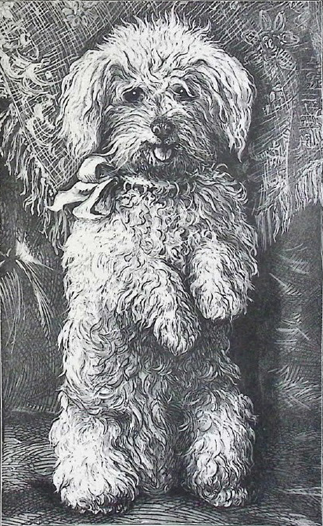
But there came a day, an unfortunate day, in which Chéri went out a walk with his two mistresses, Evie and Dolly—not that Dolly is really his mistress, he is Evie's very own dog, but Dolly is very fond of him, and "very" good to him, and when Evie is away he attaches himself to Dolly as second-best. They were not going far from home, and they had come to have perfect confidence in him, so he was without a "lead," as I believe it is called, free to ramble about a little and make small excursions on his own account, providing he kept within a reasonable distance of the girls, or as Evie always impressed upon him, kept them "well within sight." All went right; Chéri, feeling that as a gentleman he was bound to behave in an attentive and chivalrous manner, took care not to stray far, and kept his eye on the young ladies.
They were walking on briskly, when suddenly they stopped short. It was in front of a house that looked something between a shop and a private dwelling, for though there was a large square window, there were no goods in it for sale—only a few embroidered skirts and handkerchiefs, and such things spread out in a conspicuous, conceited kind of way, as if they were saying "look at us! how clean we are, and how nicely ironed and 'got up'!" And from inside the open doorway came a rather pleasant, clean, hot smell—of freshly washed, drying linen, and irons scorching hot. It was a laundress's. The two girls stopped in front of the window as if its contents interested them very much. But that was not the attraction.
"O Dolly," said Evie, "I never can pass this place without thinking of our darling Wollops" (I must explain that "Wollops" was Chéri's "last" new name), "and the night he was lost—Oh, Dolly, 'what' we went through!—for I feel convinced this is the house he was at all the time, though, of course, I can't be 'quite' sure. They have a horrid little common dog, I have seen him several times. 'Very' likely dear Chéri came here to pay him a visit just out of kind feeling: he has such a good heart. Oh, see, Doll, there is the dog."
For at that moment "Prince," an ugly, nominally white, but really grey, woolly dog with a pink nose—looking not unlike a very dirty big toy-lamb, came out to air himself on the steps.
"'What' an ugly dog!" Dolly exclaimed.
Her voice unluckily attracted Chéri's attention—he had been amusing himself by snuffing at a piece of orange-peel on the curbstone, which at first sight, he thought looked like something good, for Chéri's eyes are not as sharp as they might be, in consequence, perhaps, of the shaggy hair that always overhangs them. But Dolly's exclamation made him turn round, and there, on the door-step, he recognized his friend Prince.
Chéri bristled—this is a figurative expression; nothing could really make his long shaggy silky coat bristle—with indignation.
"Ugly dog, indeed!" he said to himself. "My good Prince. I hope he did not catch the word. Impertinent chit, that Dolly is," and full of anxiety to make amends, up he trotted.
The two dogs had not met for fully two years.
"Upon my word, my dear fellow, this is a pleasure," said Chéri, throwing all the cordiality he could into his bark. "I have so often thought of you, and wished to see you again, since the—the pleasant visit I paid you some time ago."
"H'm," returned Prince, with a slight snarl, "doesn't seem very like it, I must say. You might have looked me up before now, I should think, if—"
"Oh, 'oh,' Evie," shrieked Dolly, "they're going to fight. Look at that nasty, horrid, pink-nosed creature; he 'is' so snarling. Come away, Chéri; 'come away,' sir, I say!"
Chéri turned, and looked at her with bold contempt.
"'Lord, what fools these mortals be!'" he would probably have ejaculated had he known the quotation. What he did—bark—was this:
"'Sir,' indeed, Miss Dolly! ordering me about in this way, and insulting my friend!" Then he turned to Prince, who stood there, pretending he understood what Dolly said, though he really didn't.
"My young ladies are nervous," he said. "You see, when I am out in charge of them I make them my first thought. They are, perhaps, a little jealous of my attentions. So for the moment, my good Prince, I must leave you; but I will look in one day very soon. I will, I assure you, seize the very first opportunity. To—to tell the truth—I was not quite sure of your address."
"All right," said Prince, who was really not an ill-natured dog, "always pleased to see you. Bring a bone with you if you like, and we'll have a nice crunch together."
This was a little vulgar, but Chéri was in a contradictory humour, and determined to stand up for Prince the more Dolly spoke against him.
He followed the girls, feeling very irate.
"We must be very careful, Evie," Dolly went on, "or we shall have Billy running off again. He 'evidently' knows that horrid pink-nosed dog."
"It's only his good-nature," said Evie. "He would never really make a friend of a common dirty dog like that. And after all we don't 'know' that it was there he went that night."
All of which remarks, as Chéri—Billy, Wollops, etc.—afterwards confessed to his mistress only made him the more determined to carry out the intention in his head.
No "opportunity," as he had said to Prince, offered itself for some days. Perhaps the girls, Dolly especially, were rather on the alert; any how, though he sneaked to the front door every time he heard the bell ring, which was not very often, as he was generally shut up in a room upstairs, and once or twice had a try at the area steps when he was having his dinner in the kitchen, he never managed to get even as far as the pavement. The young ladies did not take him out walking except with a lead, and his only running about was in the garden at the back, whence, not having wings, nor being able to climb like a cat, he could not escape.
But "Tout vient à qui sait attendre."
One evening, Evie and Dolly were out on their own account, paying a quiet visit to two young friends of theirs. The carriage came round at ten o'clock to call for their maid, who was to fetch them.
"Be sure you put Billums to bed before you come for us," had been Evie's last injunction to Thecla before starting. But Thecla was a little hurried, Chéri was in a sweet sleep on the work-room rug, she thought it a pity to disturb him, he would be "ganz recht" till she and her young ladies came home again. Ah, Thecla! Little did she dream "who" came softly creeping downstairs behind her, hidden by her skirts, who watched his moment, keeping in a shady corner of the hall, while she chattered to the footman about the address he was to tell the coachman, who sneaked out while the door was open—out, silly little self-willed dog, into the dark street—trotting off in triumph, away from his safe, happy home, into the great wide desert of London, where dog stealers abound, and Evies and Dollies are not to be met with at every turn.
He was going to call on Prince. He was quite sure he knew the way, even in the dark. And he was quite sure he could find his own home again, even though—yes, as he glanced about him a little, it did strike him that the door-steps all down the street were ridiculously, absurdly like each other. The feeble light of the gas-lamps had to do with this, doubtless; by day there were one or two little distinctions—the shape of the scraper, for instance, that he had learnt to notice. But he tossed aside all misgivings; how pleased Prince would be to see him! and he hastened his steps.
Hush! There came in the solitary street the sound of heavy, measured footsteps. A tall policeman drew near.
"A strayed dog," he said to himself, as he lowered his bull's eye to have a look at him. "Well, my fine fellow, and where do you hail from?" he was beginning, but Chéri was too sharp for him. To be captured at the outset by a policeman, and ignominiously carried home! for Chéri was conceited enough to think himself well-known in the neighbourhood. No thank you. There was a side street just where the policeman was standing. In an instant Chéri had darted round the corner, and was careering away. The policeman could have caught him had he chosen, but he thought better of it.
"Seems to know his way about," he said. "No use botherin' if he's not a real stray;" and he marched on again.
Chéri, hearing his footsteps growing fainter in the distance, stopped to look about him. Was he on his way to Prince's house? He hesitated. Then the sight of a better-lighted street some little way ahead, a street with shops, and, late as it was, cabs and carts, and plenty of people about still, made him run on again. For it was in a busy street like this that the laundress lived.
But he passed shop after shop, peeping in at several, but none looked like, none "smelt" quite like Prince's home. At last a brilliant idea struck him—he would cross the road. And cross it he did, escaping with his life more by luck than good management, I can assure you, as a heavy dray came crashing up on one side, followed by a dashing hansom, and an omnibus boomed along on the other. Chéri's heart, by the time he reached the opposite pavement, was beating so that he felt choking.
"I think," he said to himself, "that when I get to Prince's I'll ask him to put me up for the night, as he did before. It's really scandalous to allow all these carts and carriages in the street so late."
He tried to feel important, and trotted along a little way in a brisk, would-be-easy-minded fashion. But he did not arrive at the laundress's on this side of the road either, and he began to feel tired, and just a little frightened.
"I almost think," he said to himself at last, "I almost think I'll give it up for to-night. Stay; I might enquire," and as that moment he caught sight of a fox-terrier following his master, he accosted him politely.
"Excuse me," he said, "do you happen to know if a—a dog of the name of Prince lives hereabouts? They take in washing at his place, I believe."
The fox-terrier looked at him superciliously.
"I never make chance acquaintances," he said. "Washerwomen indeed! Where do you get such low tastes? You look a well-bred dog, but I advise you to make the best of your way home. It's getting late; you'll find yourself at the police station en route for Battersea, I can tell you, if you don't take care."
Chéri was terribly frightened. What did the fox-terrier mean? Police and Battersea?
"Oh dear," he thought at last, "I wish I were safe at home again. Let me see—I must cross the road—bless me, how nervous I feel."
He managed to get across, however—there were rather fewer vehicles than before. Then he ran along a little way and turned into a dark street, which he felt sure must be Winchester Crescent, "his" street. And—oh, joy!—yes, there were houses with steps, just like his house. He chose one hap-hazard; he was getting stupid and confused—the scraper seemed like his own house's scraper—and, tired and weary, he mounted to the top step and there sat himself down and whined. Whined and then yelped, till the door opened, and with a bark of delight he prepared to rush in. But "Off with you, you nasty whining thing," said a rough voice; not that of James, Chéri's own footman, but a stranger's—a cross parlour-maid, who was shutting up for the night, and had no pity for a poor, naughty little runaway. "Off with you!" and off crept Chéri—his tail very dejected, his ears very limp, his heart very, "very" sore.
He tried one or two other door-steps in vain—either no attention was paid to his piteous attempts to attract it, or he was scolded and "shoo'ed" away. Then he decided that after all this was not his street (though it was, for the cross parlour-maid, whose mistress knew Evie and Dolly, confessed the next day that had she recognized the dog she would have taken him in), and off he set again on another voyage of discovery, a fruitless one, of course. He grew very tired indeed; he remembered little more of the details of that dreary night, he told Evie only one idea haunted him—at all costs he must keep out of the way of policemen and that unknown danger the fox-terrier had told him of, "Battersea." So as soon as ever he heard the measured tramp coming down the street, off he set; the police had no need to "move him on," poor, terrified little truant, though after all they would have been his best friends had he only known it. Fortunately, it was a mild night; he must have slept a good deal, Evie thinks—slept on some dark door-step probably, or in the shade of a wall, on the cold, hard stone, uncovered, unsheltered—he, the tenderly cared-for little dog whom Evie put to bed like a baby under his blanket every night! See what comes of disobedience, children!
The next morning, as soon as it was light, he set off again to search for home. He fancied it would be easier in the day-time. But, alas! it did not prove so. And the unusual amount of exercise he had had was beginning to make him very hungry, though it was still some hours to his dinnertime. He found a crust which some "pretence beggar," as the children say, had contemptuously thrown away, and though it was dirty and muddy, he eat it thankfully enough. Then he wandered about, the streets growing more and more crowded and his stupid little brain more and more confused. Once, about eleven o'clock that morning, he heard his own name called.
"Chéri! Can that be Evangeline's Chéri?" a little girl said. And he tried to run up to her, but in an instant she was lost in the crowd. "I should have been sure to hear if he was lost," she said to her mother as they walked on. "There are so many little dogs something like him."
Not long after that, Chéri found himself in a less crowded street. He was so perfectly miserable now that he thought he would like to die, and he was wondering how he could best manage it when a cheery, good-natured voice made him look up.
"Are you lost, old fellow?" it said. And Chéri, seeing that the speaker's face matched his voice—he was a stout, honest-looking man in working clothes—pulled himself together a little, saying, "Yes, yes; I am lost indeed," as plainly as wagging tail and pleading eyes and appealing whine "could" speak.
"If I could but make him understand where I live," he said to himself. But that, alas, was out of the question.
"You'd best come 'ome with me," said the man, picking him up gently, as he spoke. "I'll leave 'im with Bella when I'm out. And there'll be posters about him in a day or two—sure to be."
So Chéri journeyed to the workman's home in the good fellow's arms. "Home" meant two rooms in a small stuffy little house, and the back room was really a work-shop, all littered over with shavings. Chéri could not make it out; he had never seen shavings before, and thought they were good to eat, and then when he found out his mistake, he was just as puzzled by the queer sort of wheel in the middle of the room, that the man was always turning. Afterwards, Evie told him that his host was a wood-turner, but I don't know that he understands what that means, even now. The shavings were not so bad, however; a little heap of them made a pretty decent bed, better than the cold stones any way, though not to be compared with his own little rug and baskets at home! But oh, how tired Chéri got of that work-room, and of the little yard about five feet square at the back, which was his only pleasure ground. For though the wood-turner and his wife were very kind to him, they never took him out. They were probably afraid of his running away, and afraid too, very likely, of being pounced upon by the police as dog stealers.
It was a good thing Evie had taken such pains to teach Chéri to understand human talking, otherwise, he would have been still more wretched than he was. For by listening to the conversation of his hosts he found there was still some hope for him. The first day or two they seemed in very good spirits. Stephens, that was the man's name, turned over his work so as to get out early to have "a look round," as he called it. And each time he came in, his wife looked up eagerly.
"Seen anything?" she said; but Stephens shook his head.
"Neither seen nor 'eard. Yet 'someone's' a enquirin' for 'im, I'm sure. He's a pet, and no mistake, wherever 'e comes from."
"That's certing," said Bella. "Just to watch 'ow he creeps up to my skirts and settles hisself as cozy as may be. It'll come—make your mind easy, Stephens. There'll be posters up in a day or two."
But a day or two, and more than a day or two passed, and no clue was found by the wood-turner. Chéri grew thin, though the poor people fed him well—so well, that they began to wonder how they could afford to keep him much longer, and Stephens decided one evening that he would go the next morning to consult a friend of his at the neighbouring mews, who was known to do a little business now and then privately in the dog line.
Chéri was lying on his heap of shavings depressed and dejected when the wood-turner came back from his visit. The dog was losing heart altogether now—he just turned his head a little and blinked feebly with his sad eyes. But Stephens' first words made him prick up his ears (this, also, I beg to say, is a figurative expression in Chéri's case) and listen eagerly for more.
"I've got on the track at last, if I'm not oncommonly mistook," he said to Mrs. Bella, as she followed him in from the other room, wiping her hands on her apron, to hear the news. Stephens was holding a newspaper, which he flourished about.
"Tom Swires, at the mews, bethought him of this 'ere. It's the great card for local advertisements, and he 'unted up last week's hissue, and just you listen, Bella."
Then Mr. Stephens proceeded to read aloud: "Lost, on the evening of the 20th May, from 58, Winchester Crescent, a small silky, long-haired Scotch terrier. Whoever brings him to the above address, will receive £1 reward."
"It's 'im," said Mrs. Stephens. "Off with you. Clean yourself up a bit first."
Chéri quivered with anxiety. He had not quite understood his hosts' conversation, for you see Evie had been very particular to accustom him only to a truly refined and cultivated way of speaking. Still, he understood a good deal; the words "58, Winchester Crescent," were very familiar.
"Oh dear, oh 'dear,'" he thought, "if it could be—oh, if I 'could' get home again!" and he crept forward, wagging his tail and staring up in Stephens' face with eyes that all but spoke.
"All right, old fellow," said the workman. "You'll give us a good character, won't you? It's been more comfortabler for you 'ere than at that there Battersea, any how."
Again that queer word. What could it mean? Evie has told him about it since. Poor Evie—she had got to know the Battersea home for strayed dogs only too well in the last few days. That very morning, she and Dolly, escorted by the faithful Thecla, had set off on their third pilgrimage thither, only to return home again saddened and hopeless. There was no Chéri there, no naughty disobedient darling, his feathery little body in a quiver of delight at the sight of his dear mistresses at last, among the scores of poor doggies in the barred-in kennels.
"I can't go there again, Dolly," said Evie as they came away. "It's too heart-breaking. Did you see how the poor dogs looked up in our faces, 'begging' us to take them home with us? No, I can't bear it. It is a very good thing, I'm sure—they are kindly treated, and have plenty of water. But I almost think the kindest part of it is that they put them to death before long."
"And without it hurting them at all," said Dolly, softly. "'Chloroform is just like going gently to sleep,' mamma says. But oh, Evie, to 'think' of what that keeper told us—that lots and lots of these dogs are very old ones, turned out by their owners on purpose! after a life of faithful service. Is it not too horrible?"
Evie shuddered.
"I wish I knew that poor Chéri was dead," she said quietly.
It was a long way home, and sore hearts make more miles. Evie felt as if she really could not have walked a yard further, when at last they found themselves on their own door-step. A head was peeping out from behind the dining-room curtain—it was actually mamma's! What a funny thing for mamma to do! There was a queer feeling in the air as James most promptly opened the door—a sort of repressed excitement and expectancy.
"Mamma," said Evie, in a half-dazed way, "is—has?"
"Yes, yes, darling, it is. He—he's come home," and then not another word, but a fluffy ball, all quivering and dancing, seemed to leap into her arms, and, oh yes, it was her own naughty, repentant little doggie back again at last!
"I'll never, 'never,' NEVER do it again," he said to her—how, I don't know, but she understood, and that is all that matters.
He had been lost for ten days!
He crept up to me just as I wrote the last words. Fancy his finding out it was all about him! I'm afraid he is very conceited.
"Please be sure to say I'll 'never' do it again," he says—dear me, I'm getting nearly as clever as Evangeline about dog language—"I have really had a good lesson this time."

Neigh-bour's Fare.
(FOUNDED ON FACT.) BY C. M. YONGE.
————————
"HE—HE—HE—HEIGH! What are you doing at my hedge?"
"Heigh—high—hoity-toity! The hedge is as much mine as yours!"
"Yours, you scrubby, hairy, low-born thing, that wouldn't know how to eat a mouthful of corn if it was set before you? Ha! Ha!"
"I thank my stars that I'm not so fine and dainty as not to be able to do my work without being pampered upon corn! Heigh! heigh!"
"Work! To creep along with a cart-load of potatoes and cabbages, no faster than old Timothy can crawl. Do you call that work?"
"A pretty deal more work than trotting along with a baby-boy atop of you, or drawing a bit of a basket with a lady in it! I wouldn't be such a useless creature, not I," rushing off with a flourish of heels.
"Stay till you are asked;" and another career, with heels kicked up. For Pearl and Peggy were ponies! Each was turned out for the night into a paddock, and between them there was a low hedge, chiefly of snowberry bushes, but with a strong wire or two running the whole length, to make all secure.
Pearl belonged to the lady at the pretty house just above, with the projecting eaves, and the deep oriel windows, all covered with roses. She had a beautiful cosy stable, only it was so hot in the long days of summer that it was thought better to turn her out in the pleasant dewy field for the night, after her work was done—taking little master out for a ride in the morning, and drawing her mistress in the basket carriage in the afternoon. She was a slender, shining bay pony, with black mane and tail, and a very pretty head—indeed it was said that her great, great, great grandmother was an Arabian, so no wonder she gave herself airs, and she was washed and curry-combed every day by her own groom.
Peggy was rough, dark, and sturdy, with a short neck, a hog mane, and stout legs. Two days in the week she drew the cart to market along the dusty roads. On two others she took kindlings to the same town. On another she fetched clothes for the wash, and received another load of clean ones, and there was always something hard and heavy for her to do on the sixth day. Nobody groomed her; she had no place to sleep in, in all weathers but a shed in the corner of the field; she never got a feed of corn, far less lumps of sugar, and pieces of bread, but she was turned out when her work was over, to pick up her living in that little rough field as best she might, only now and then getting a little bran, or a few carrots.
It was Sunday, so neither had done any work, and they had the more time to look, and teaze each other with snorts and scornful laughter. Presently Peggy's master, hobbling up on his way to Church, held out his hand with a carrot in it, crying, "Coup, coup, old lass," and when she came up, petted her, and played with her forelock while she munched the carrot.
"As if I would stand still for such a dirty old man!" snorted Pearl.
"He's not dirty, you impudence," whinnied back Peggy, "he is groomed for Sunday!"
"Much you know about grooming that rough coat of yours," was the retort of satin-skinned Pearl, while the old man went on his way to Church.
The bells ceased to sound, and all was quiet. Presently a big gipsy-looking man in a fur cap, and a boy with a black shock head of hair looked over the hedge.
"Handsome pony that!" said the man, looking at Pearl.
Pearl liked praise, from whomsoever it came, so she pricked up her ears and whinnied.
"Wouldn't I like to be upon the back of her," said the boy.
"Too smart and spirited for you, my lad," said the man, "but she would fetch a pretty penny. That's the serviceable article! Here!" and he moved to Peggy's untidy old gate, and chirruped, but Peggy was more wary, and kept her distance.
The days were long just then; the sun rose very early, and even before he rose, the lark which had its nest in the corner of Peggy's field had waked, and was singing, singing away, far, far up in the sky.
Just as the first beams were touching the brown breast, a wary whistle, and "coup, coup" sounded in the corner of Peggy's field. She awoke, and turned an ear to listen. The sound came again, and there was the shaking of a sieve. Corn, the greatest delicacy a horse knows, had been very seldom tasted by Peggy, and, strange as the hour was for a breakfast, she was so much enticed as to lose all her suspicions, and trotted up in a moment. Her nose was scarcely among the oats before a halter was over her head, and she found herself being dragged off!
It was all done so quietly that Pearl had heard nothing but the first call, which made her prick up her delicate black ears, and bend up one fore-leg in preparation for rising. No doubt, then she thought, that hard-worked, beggarly old master of Peggy's wanted to set to work at this dreadful time in the morning. She would go to sleep again.
The call was sounding again in her own field. The sieve rattled, but Pearl was too well fed, and corn was too common a thing with her for her to care much about that. She thought it dangerous, and stood up, with her nostrils spread, and her eyes full of alarm. The man advanced upon her; she cantered away to the further end of her field. Then the boy ran after her, while, thoroughly alarmed, she galloped wildly about, neighing as loud as she could to call for help. Alas! nobody was up, nothing answered her but poor Peggy's frightened neighs! and though she led the man, the boy, and a girl, who now appeared, a pretty dance, at last she was penned up in a corner, and the great, hard, dirty hand had got hold of her mane, pulling it hard and spitefully, and abusing her fiercely for all the trouble she had given.
She tried to kick, but he held her fast, and a whip came down stinging on her satin sides whenever she struggled. Presently she found herself and Peggy tied side by side, by their halters, at the back of a very dirty old gipsy cart, with a tilt over it, ten times worse than the one that Peggy was used to draw, and filled with straw and ragged little children, whose shouts of glee were shocking to the ponies. They were, however, silenced at once by rough words from the father and mother. A poor lean horse was in the shafts, and the boy, running beside him, pulled his bridle, and gave him two or three blows, so that he moved on, dragging behind Pearl and Peggy—past the dear, beautiful stable where Pearl had her own comfortable stall, near the two fine tall carriage-horses, past the thatched cottage where old Timothy lived, past the neat garden where abode Pearl's groom! How they struggled and neighed, but all in vain—nobody would hear, or look-out, everyone was fast asleep, and on, on they went. The ponies pulled and dragged at their halters, and strove with all their might, but in vain—the ropes would not yield, and they only hurt themselves; while on, on they were forced to go, at that weary, slow pace, which fretted Pearl the most, and with nothing to eat.
Once, a mile or more from home, Peggy saw a man whom she knew, because he had dealings with her master, and she neighed, and strained at her halter, doing all she could to attract his attention, but he would not, or did not, take any notice, and on they went. Pearl did not like the movement, and kicked at Peggy, who returned it, but the man, seeing the commotion, turned back, and with rude words laid his whip across both of them.
Very, very weary were the two poor ponies, dragged on through stony lanes, as the sun became hotter and hotter, but at last the cart stopped under a hedge, on the border of a wide heath. The hungry and thirsty creatures tried to get their mouths to the grass, but the ropes were too short, and in her disappointment Peggy tried to bite at her companion.
"Oh!" whinnied out Pearl, "we had best be friends in this strange, terrible place—we who are old neighbours."
"Ha! ha! You aren't so proud now you are brought as low as I am," returned Peggy.
It was a rude answer; but Peggy was very tired and miserable, and though she was more used to rough it than was Pearl, she had less spirit to stand up against their distress.
However, their new master seemed to remember them. He and the boy led them down to a muddy pond under the hedge, and though Pearl in general would have scorned such water, she was glad enough to suck it up. Then an armful of hay was thrown down before each. It had perhaps been pulled out of a hay-rick, but that was not the ponies' business, and they gladly ate it up, and only wished there was more. Then the halters were drawn up tighter, and the cart set out again, but both were in better heart, and Peggy was good-humoured, and ready to believe, as Pearl did, that biting and kicking at one another was not the way to be less distressed, so they journeyed on in quite a friendly manner, and tried to flick off each other's flies with their tails. When at last the long day's journey was over, Pearl sadly missed the groom's hand washing her, and curry-combing her to make her comfortable, and Peggy not only forbore to laugh at her for being such a fine lady as to expect it, but really tried to do what she could for her by biting at a lump that a horse-fly had made in her neck.
They could both understand what human beings said, and when the rumbling of the cart was over, they listened anxiously to what the man, his wife, and eldest son were saying about them.
The woman wanted to take them to a great fair near at hand, and sell them early in the day. They squeezed closer together, and Pearl put her neck across Peggy's, as they felt how dreadful it would be to be parted from all that was left of home.
They were relieved to hear the man say that it could not be done safely; but then the woman answered that was nonsense—they had only to cut off the long hair of the rough pony, clip the mane and tail of the bay, and paint over the white star on her forehead.
Dreadful! the mane and tail that little master was so proud of! Poor Pearl gave a jerk to her halter, and determined to kick and bite her hardest before any such thing should be done to her. However, by the time the kettle was boiled, and the evening meal eaten, the man declared he must have his beer, and though his wife declared that without him to hold the horses she could not trim them, he would not listen, but started off for the public-house in the village, whose chimneys and their smoke could just be seen far down in the valley below.
The ponies were tied by ropes and allowed to graze, but the grass was very short, and there were a great many thistles, more fit for a donkey than a horse, as Pearl sighed when they pricked her delicate nose, and there was no water, except that a fine drizzling rain came on. Tinker, the old horse in the shafts, who was turned loose, did not cheer them. He told them he led a wretched life, beaten, starved, and tired, and his only hope was to have Peggy put on to help him with his loads. Pearl would at home have been safely housed in her own stable, here she could only creep as near the shelter of the cart as she could, and shiver. And good-natured Peggy, who was used to such things, and had much longer hair, came and squeezed up against her to keep her warmer; but still it was a wretched time, and the poor ponies felt damp, and limp, and tired when the cart set off again in the morning, and the halters were too short to allow of their even hanging down their poor disconsolate heads.
They went down the hill, over a rough chalk road, stumbling along, but they stopped at the public-house for beer for the people in the cart, and a little hay and water for the horses.
Just as they were enjoying clean water, a rough-looking man sauntered up, "I say, mate," said he, "there be notices up everywhere about a couple of ponies, and I heard tell as the bobbies were on the look-out for them at the Fair."
Those words did Pearl and Peggy more good than even the water.
There followed a few more words, and then the whole family were bundled back into the cart, and Tinker was forced to drag them all up the same steep hill.
There they halted, and the boy was sent on the further road to spy out what he could. Presently, he came running back as hard as he could. "Two policemen out in front of their station," he declared.
"There's nothing else for it," said the man.
"All your fault for going off and not helping me with them," said the woman.
However that might be, the halters were taken off their necks, there was a hard parting smack, and behold, Pearl and Peggy were free! They could hardly believe it, but the man and boy stamped and whooped at them, and off they went, putting down their heads and prancing with heels in the air for joy, and only wishing for a moment that poor Tinker was with them.
When they came to the end of the down, they stood still and consulted how to get home. Peggy snuffed about, but it was beyond where she had ever been before, or Pearl either, but there was a feeling in them for the right way, and they cantered along side by side as merrily as could be.
Presently Pearl said, "I've been in this corner with my mistress! I remember the white post that made me shy! This way!" How they tossed their heads and trotted on.
"Soh!" there was a call Pearl knew well.
It was her own kind groom in the trap with the superintendent of police.
What rejoicing there was; Pearl's little master kissed her when she came home, and old Timothy did almost as much by Peggy.
And whenever the two ponies were turned out in their two fields, they used to get to the fence between and rub their noses together, and they whinnied kind greetings to one another whenever they met. Their adventures had quite cured them of their two kinds of pride.
The Giant Fishers of Hertzenberg.
BY MRS. A. M. GOODHART.
————————
IN the good old days in Germany, when wild beasts and giants still ravaged the country, and the fairies danced by moonlight on the banks of the shining rivers, and the kindly little earthmen crept into the farmhouse kitchens and tidied the hearths and re-laid the rushes in return for the brimming bowls of milk, which the tired peasants, however weary, never forgot to set out for the tiny people at night, a pretty village, the village of Hertzenberg, lay nestled under the shadow of a mighty hill, a hill so mighty and venerable, that time had wrapped its rugged sides in a mantle of rustling pines, and crowned its lofty head with a garland of perpetual snow.
Nowhere could you have found a more secluded spot, for it lay between this great hill and a broad and noble river, which flowed tumultuously down to the unknown sea.
Now the Hertzenbergers were a happy people, young and old they knew no cares, and the children, the sweet, rosy, blue-eyed children, played without check or fear the whole year through, knowing that at the worst, nothing more terrible would happen to them than to be hauled before the village elders to receive a few strokes of the rod in pickle, that celebrated rod which was kept in state (chained to the village pump) for the punishment of any of the Hertzenberg youngsters, whose overflowing spirits might lead them into mischief.
The village was a pretty place; in the centre of its tiny green stood the farrier's shop and smithy, not to mention the aforesaid pump, where the old folk gathered together morning, noon, and night to discuss the news of the place, while scattered around in groups of twos and threes, the cosy red-roofed cottages beyond, looked for all the world like merry children playing at bo-peep with one another.
One house alone stood by itself, turning its back with an air of dignified grandeur upon the rest of the cosy little cottages, and facing the pine-clad hill; this was the abode of the village school-mistress, a quaint old dame in a high-crowned hat and scarlet cloak, whom the children of Hertzenberg either loved or feared according to their own behaviour, for it was not altogether a pleasant thing to find oneself in the old lady's black books, with the rod in pickle, so clearly to be seen through the little lattice window! What they learnt from this old dame I hardly know, I fancy they spent most of their time in teazing her black cat, Cæsar, or in gazing out of the open door at the great hill opposite, in the hope of catching a glimpse of the golden eagles swooping in rapid circles over the stony crags.
Now the hill itself belonged to all the villagers, but no one was allowed to build upon it, or even to lop one branch off the smallest of its countless pines; imagine, therefore, the surprise, indignation, and consternation of everybody when, one fine morning, a gang of strange workmen, clad in an outrageous fashion, and jabbering an unknown tongue, were discovered at work on the side of the hill, directly overlooking the village. How they came there no one knew, but what they were doing, alas, was only too clear! They were felling as quickly as possible the beautiful straight-limbed trees, which had been the pride of the Hertzenbergers for generation after generation; cutting, hacking, slashing, too, with reckless cruelty, clearing the ground as if by magic.
The Hertzenbergers at first could not believe their eyes; then, as another, and another, and another tree fell with a mighty crash that echoed through the wood, they suddenly rose up as one man to defend their beloved property. Hastily forming into a procession, headed by the blacksmith in his leathern apron, they marched towards the hill with the intention of driving off the impudent workmen, who had dared to trespass upon their domain. But, alas, this was easier said than done, for when they got up to them, the workmen turned out to be huge and powerful monkeys, who upon the first show of fight, rushed so fiercely upon the villagers that the latter, scared out of their wits, were glad to retreat as fast as their legs would carry them.
After this discovery, the strange workmen were left alone, and every day saw them busy at work, dressed in their uncouth garb, with their tails tucked cleverly out of sight, and their caps drawn down so carefully over their brown wizen faces that, at a little distance, it would have been impossible to detect them from ordinary workmen, except by their size and extreme quickness of movement.
Even when night fell, they never ceased their restless activity, but lit great watch-fires, by whose lurid flames they toiled unceasingly, throwing off, under cover of the darkness, the workmen's habiliments, which had been so effectual a disguise; wild, uncouth creatures they were, and as they leapt and capered about in the glare and shadow of the flames, clad only in the hairy skins, and long powerful tails with which mother Nature had adorned them, their strange ungainly figures struck fresh terror and astonishment into the hearts of the villagers. Ere long a deeper thrill of excitement ran through the village as the leader of the troupe, a fierce and powerful baboon, was seen to advance towards the stone quarry, closely followed by the whole band of monkeys.
Too soon, alas, the air was ringing with the blows of hammers and chisels, as stone after stone was cut out from the rock, and dragged with much gesticulating and quarrelling to the spot where the monkeys had already dug out the foundations of what was afterwards to be so widely known and dreaded as the stronghold of the Giant Fishers of Hertzenberg.
All too rapidly the work progressed under the indignant eyes of the poor helpless Hertzenbergers, and soon there arose against the clear blue sky, a grim forbidding tower of solid stone.
This tower, which seemed to frown down upon, and menace the whole village, was not long left empty, but was soon taken possession of by a family of giants, for whom, indeed, it had been purposely built.
The poor villagers, once so happy and free of care, now trembled in their shoes for dread of what might happen next; they knew that their new neighbours meant them no good, and they could not hide their fears from their children, who were even more alarmed than they were, for it was not long before a rumour ran like wild-fire through the place, a rumour so dreadful, that it curdled the blood of every little boy and girl who heard it, and was conscious of possessing a plump, tender body, and a sleek rosy face! Dreadful as it was, the report could be put into four tiny words:
"BOY AND GIRL PIE!!!"
Yes, that was the long and short of it, "boy and girl pie!" And a terrible thing it was to the poor little Hertzenbergers, who knew that they were only too likely to find their way into the giants' gigantic pie dishes!
For many weeks the villagers were afraid to venture out of doors except in the dark; the dame's school was shut up, and the poor children played dismally inside their own houses, being forbidden by their mothers so much as to put their curly locks or even the tip of their tiny snub noses out of the windows, for fear that the giants might catch sight of them. One poor widow, who had only two children left to comfort her—a sturdy, high-spirited boy, named Kaspar, and a delicate little daughter called Gretchen, went so far as to bolt and bar the wooden shutters of all her casements which looked towards the giants' tower, but after a while, when it was found that the giants never attempted to come out of their stronghold, the panic grew less, and, as is often the case, public confidence began to revive at the very moment when the peril was at its highest, for it was about this time that the giants hit upon that strange mode of attack which won for them the nickname of "The Giant Fishers of Hertzenberg!"
Out of the castle windows came first of all showers of gaily-coloured sweetmeats, just to attract the children's attention; then, when these had all been picked up and eaten, without any harm happening to anybody, public opinion veered round, and began to vote the giants "rather good fellows after all!" But there was more behind, as you shall hear, for the showers of sweets ceased all too soon, and then the giants began to amuse themselves by casting down fishing lines into the village, baited with all the most tempting things that you could possibly imagine.
The lines were hung so cleverly over the green that the children could not come out of school, or cross over to the pump for a pail of water without finding gingerbreads and sweetmeats, and toys of every kind dangling in the air in front of them, or lying, as if by chance, on the ground beneath their feet. Of course they were strictly forbidden by their parents to touch any of these things, and at first fear made them obedient, but one of the first to grow reckless was Kaspar, the poor widow's son.
He was a high-spirited lad, full of pluck and self-confidence, and being tempted, beyond endurance, one day, by a box of tin soldiers, which pursued him everywhere, he determined at last to throw caution to the winds, and to make one desperate effort to snatch them off the line. Alas, poor Kaspar, no sooner did he thus resolve, and seize hold of the coveted box with his eager hands, than the giant, who was fishing out of the castle above, by a clever twist of the line, jerked the cord tightly round and round his wrists, and having thus secured his prey, began pulling his struggling victim slowly, but surely, towards the tower.
Kaspar struggled, and kicked, and fought in vain, he grew red with rage, then white with fear, and screamed so loudly that the whole village rushed out to see what was the matter; but alas, by this time the poor fellow was already dangling in mid-air, about half way up the castle wall! While down below, like one distracted, stood his weeping mother, wringing her hands, and crying aloud so that all could hear her, "Oh my poor Kaspar, my brave bonny boy . . . he will be made into mincemeat, and baked in the oven!"
Having made sure of his fish, however, the giant fisher seemed in no hurry to pull him right up into the castle, and when twilight fell, and the sorrowing villagers went sadly back into their cottages and left him to his fate, Kaspar was still dangling below the giants' larder window. How long he hung there he never knew! Of course, he gave himself up for lost, but when it had grown quite dark, and he was almost dead from fright and cold, he heard a gruff, but not unkindly, voice above him, bidding him not to be afraid! He could not see who was speaking to him, but it was no other than the old giant's wife, who had determined to try and save the boy, whilst her husband and sons were taking their forty winks after supper.
Presently, Kaspar felt something touch his shoulder; it was an old clasp knife, and with one hand, which he had managed to free in his struggles, he set to work to sever the rope, and after a tough struggle cut it right through, and before he knew where he was, had dropped like a stone to the ground, and remembered nothing more for some time.
Luckily, however, the ground was soft, and as he was only half stunned, he no sooner began to recover his senses, than fear lent wings to his feet, and he set off as fast as his legs could carry him in the direction of his mother's cottage, where such a welcome-home awaited him, as no words of mine can describe.
The next morning, a great stir arose in the castle, when Grimbo, the old giant, discovered that his prisoner had escaped. His wife did not let out her share in the matter, and when the rope was hauled up and found to be severed in such an uneven way, both the giant and his sons jumped to the conclusion, as they examined the jagged and frayed ends, that they owed the loss of their prisoner to some flaw in the cord, which had caused it to break of itself. "I'll kill and stew that cheating rope-maker, I will," cried the father giant in a rage, "as sure as my name is Grimbo! A nice trick he has been serving us, to sell us rope that will not stand the weight of a little shrimp like that! I'll teach him that he can't cheat honest giants for nothing! If he is too tough to roast or boil, he needn't think to escape for all that, I'll eat him with pleasure in a stew, if it is only to serve him out for playing us such a shabby, mean trick!!!"
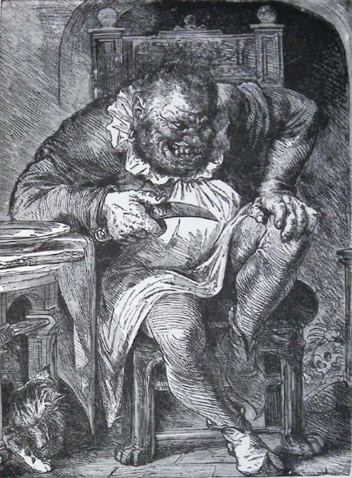
All the while Grimbo was uttering these threats, he was working himself up into a towering passion, an amusement that he was very fond of indulging in. In one respect, he was a very peculiar giant, for he was provided with two heads, either of which he screwed on in turn as the fancy took him. One of these heads had a good-natured face, the other was dark and scowling, but I am sorry to say that it was this one he was the most often seen wearing. When things had gone wrong, or the wind was in the east, he always began the day by screwing on the ill-natured face, but on this particular morning, he awoke in such good spirits at the prospect of dining off a plump tender youngster, that he had screwed on the good-tempered face, and had left the ill-tempered one grumbling away to itself in the drawer, where it was locked up for safety when not on duty.
Now, however, he felt so savage that he unscrewed the smiling unoffending head with a vicious jerk, and threw it to the other end of the room, while he sent his terrified wife upstairs to fetch the other one. As soon as that was screwed on, he was stalking across country, grumbling, growling, and muttering to himself that he would pay the rope-maker out for his insolence, and the rope-maker's wife seeing him coming, ran at once to warn her husband and to hide her children, for she had some very tempting chubby little creatures, just about the size that the giant liked for patties!!
The rope-maker came out of his house to meet the giant with a sickly smile and trembling limbs. Too well he knew that he "had" been cheating old Grimbo lately, and a guilty conscience added to a glance he had caught of the scowling ogre, made a terrible coward of him now. "Will my noble lord Grimbo deign to honour my poor yard with his royal presence?" he enquired in a terror-stricken voice, hardly daring to raise his eyes from the ground.
The giant answered by a terrific roar, which so terrified the guilty rope-maker, that he fairly turned tail and fled, whilst gasping out some trembling excuse about "preparing the yard for his highness's reception."
The rope-yard was a walled-in space, entered by a massive gateway high enough to permit even of Grimbo's passing through by slightly lowering his head. The rope-maker, who was a quick-witted man, as well as a cheat, had always foreseen that an evil day might come when the giant's anger would be turned against him, and had taken his precautions accordingly. Not content to trust to an ordinary rope, he had secretly woven a long length of hempen cords, intermingled with strands of the toughest steel wire, and in this manner had produced a rope of such extraordinary strength, that twenty giants would have found it hard work to break it. This rope, which was provided with a slip-knot and a noose, hung always in a secret place behind the stone parapet overhanging the archway, ready for any emergency.
That emergency was now come, and as the angry giant rushed headlong through the archway, ducking his head and charging like an infuriated bull, the rope-maker's eldest boy, who had received instructions from his father before being stationed in readiness on the parapet overhead, dropped the noose in front of him, and lassoed him cleverly round the neck!!
Then ensued a sharp, fierce struggle between the entrapped Grimbo, and the whole family of the rope-maker, who began tugging away with their united force at the straining rope, as if all their lives depended upon it, which, indeed, they did, and ere long Grimbo's struggles became fainter, and his strength began to fail, then the whole family gathered themselves together for one mighty effort. Tug—tug—tug, and their old enemy lay dead at their feet, outwitted and slain by the crafty rope-maker.
Terrible as was the nature of his death, I am afraid poor Grimbo was not very much lamented even in his own castle; while the Hertzenbergers were so delighted to have got rid of their hated old enemy, that they quite forgot that he had left behind two strong and lusty sons to carry on his evil ways.
They were not, however, allowed to remain very long in forgetfulness, for the fishing soon began to be carried on with greater vigour than ever. The two young giants, Ruffo and Kuffo, were also more artful than their father, and baited their lines with far more tempting baits than he had ever done.
Kaspar they tried to inveigle in every possible way, dangling perfect armouries of swords, guns, and pistols before the distracted boy's eyes; and, in fact, no one could complain of being forgotten, for they hung out toys for the little ones, rattles for the babies, brooms and dust-pans for the mothers, pipes and drinking cups for the fathers, and even a bag of gold for the old miser in the hollow!
Meanwhile, Kaspar had many a narrow escape of his life as, with ever-growing boldness and dexterity, he attempted, and often succeeded, in wrenching off and making away with several of the most coveted prizes. And before long something exceedingly like quarrelling began to take place between the two giant brothers, for Kaspar's example was successfully followed by so many of the other bold spirits in Hertzenberg that Ruffo and Kuffo angrily accused each other of bad fishing. The castle larder was often empty—very empty indeed—and the giants were almost starved (which did not improve their tempers), while the poor people in the village were in a still worse position, for they lived in a regular condition of siege, not daring to venture outside their houses until after nightfall, when the darkness gave them a certain sense of security.
Truly they were in a pitiable plight, for beside their constant dread that the giants would hit upon some new method of fishing which would catch them in spite of themselves, they foresaw only too clearly that want, cold, and starvation must soon stare them in the face.
It was doubtless a great relief, after being shut up in the house all day, to slip out in the darkness for a word with a neighbour, or to fetch a pail of water from the village pump; but it was quite impossible to gather in the crops or to prepare the ground for the next year's sowing, or even to get in a fresh supply of wood for charcoal, which was all that they had to depend upon in the way of fuel.
At length Kaspar, who was always full of bold projects, called together a secret meeting after dark, in the village schoolroom, to which all the men and boys were invited. When all were assembled, he extracted from each in turn a solemn promise of secrecy, after which he unfolded his plan, which was neither more nor less than to dig out an underground passage from the school-house to the giants' castle, beginning under the floor on which they were standing, and working steadily away underground, like moles, until they were near enough to spring a mine beneath the tower, and to blow up their relentless enemies.
So, under Kaspar's directions, they at once fell to work to drag up the tiled floor, and then commenced to dig out the tunnel. The work once begun was never allowed to stop; night and day it was taken up by different bands of workers, the women bringing them food under cover of the darkness.
Meanwhile, the little school-house presented outside a singularly deserted and unused appearance. The shutters were closely barred by day as well as night, and not a living creature was seen to go in or out.
But Kaspar's heart burned within him with pride as he saw the work (in which he was ever foremost) progressing at a rate which far exceeded his most hopeful calculations.
It was known, moreover, that the giants had but lately stored away a large quantity of gunpowder in the dungeons beneath their tower, and if the workers could but dig their way through the lower foundations, Kaspar knew that it would only require a lighted fuse, a brave heart and steady hand, to do all the rest.
At last the anxious miners came tap, tap, against something hard and firm. It was the stone floor of the castle dungeon. When this fact became known Kaspar could only restrain his men from shouting aloud by the threat of shooting the first one, old or young, who opened his mouth, a threat which they all felt, in the desperate anxiety of the moment, he was quite capable of carrying out.
So in grim silence the work proceeded, and it was not until the middle of the night, when he knew that Ruffo and Kuffo would be lying senseless in a heavy sleep, that Kaspar ventured himself, and with the greatest care, to remove two of the large paving stones, which formed the floor of the dungeon. Oh, how his brave heart beat as he clambered through, and found himself in that gloomy place where so many of his fellow villagers had languished in tears until the giants thought fit to eat them. He soon retired, however, cautiously replacing the stones, but leaving them loose, the night being already too far advanced to venture to return with the fuse. Before leaving, however, he was careful to take note of the exact situation of the barrels of gunpowder, and to have everything in readiness for his next great attempt.
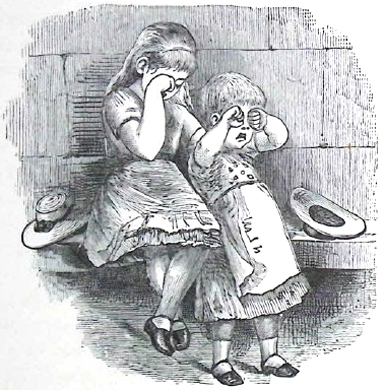
All the following day Kaspar was in such a state of feverish excitement that he did not know what to do with himself; but when midnight came, and every glimmer of light had died out of the castle windows, he prepared, with a wildly beating heart, to set out upon his perilous expedition. On the way, however, it shot through his mind for the first time that his good friend, the old giant's wife, would probably be asleep in the castle, and he racked his brains to devise some plan by which he could enable her to escape the fate prepared for her cruel sons. Before, however, he could think of anything, he ran by accident into the arms of the village barber, who was taking advantage of the pitchy darkness to draw some water from the pump; now the barber was a gossip, as barbers generally are, and Kaspar's first thought when he recognized his voice was how to get rid of him at once, but before he could even attempt to do so, the barber had him by the arm, and in a loud whisper exclaimed, "Hast thou heard, friend Kaspar, the last news from up yonder?" pointing thumb over shoulder to the castle behind. "Didst say no? Know, then, that the giant's wife was seen only this afternoon by thy humble servant escaping for her life across the mountains, with her apron to her eyes and weeping as though her heart would break. She had no one with her but a lame, black dog, and a little maiden with long, golden curls, who seemed to be clinging to her dress for protection. Ruffo and Kuffo were throwing darts and stones at her from the window, and shouting after her with such cruel threats and taunts, that, 'as I am a MAN!' I would dearly have liked to box their huge ears!!!"
As he gave utterance to this bold speech, the barber (who, by the way, was as great a coward as ever breathed), thrust out his chest and shook his fist at the tower with an air of the greatest audacity; but Kaspar paid little heed to his grand speeches, he had learnt all that he wanted to know and was only too eager to get away.
"Forgive me, most worshipful master," he said, "but I must not linger longer," and before the barber could reply Kaspar had shaken himself loose and was out of sight.