Chapter II · (continued 2)
Reading edition
"Robin, look at your stocking—it is full of candied fruit and bon-bons!" cried Barbara.
"So it is," said Robin. "Then it is true after all."
"What a dear, sweet darling, Santa Klaus is; how I do love him. I knew he wouldn't forget us," cried Barbara.
Then they laughed and clapped their hands, and, as it was still early, tumbled all four into one bed, and Robin related to them her last night's adventure with Santa Klaus, and it was the nicest story she had ever told them, because it was quite true.
But I have something more to tell you which was better far than the presents sent by Santa Klaus.
When Miss Frost came in with the hot water, she was laden with letters and Christmas cards, and there was a scramble, of course—a scramble in which, strange to say, Robin took no part.
The fact was, she was slowly and laboriously making out a letter from mother, and the contents of this letter was of a nature so pleasing that she could think of nothing else.
"Bab, Paul, Georgie, listen!" she cried. Then, as the uproar still continued, she mounted the table, and from this commanding position succeeded in obtaining a hearing.
"News! news! such news!" Robin cried. "Father is better and is coming home. He and mother are on their way now—only think of it!"
The shouting recommenced after that, and all four children fell to embracing each other.
Then they stationed themselves at the window waiting for the arrivals, and in the new and glad excitement poor Santa Klaus was for the time quite forgotten.


Wattie and the Wolves.
BY FRANCES CLARE,
AUTHOR OF "A CHILD'S PILGRIMAGE," "A STORE OF STORIES," &c. ————————
WATTIE Moate was the eldest child and only son of a small fruit farmer in Worcestershire. He was a brave, honest, manly lad, and the pride of his father and mother and good old grandmother and was devoted to his little sister, Hetty, who was seven years younger than himself, and the pet and darling of them all; and no wonder, for Hetty was one of the sweetest, dearest, prettiest little girls in the county of Worcestershire. Her eyes were as blue as a Highland lake in summer, her cheeks were like damask roses, her round arms were dimpled, her little fat hands were dimpled, and when she laughed—which she very often did—the corners of her cherry mouth were dimpled also. Of course she was a little spoilt with so many people to make much of her, and therefore she liked to do as she liked, and not as other and wiser folk liked, and she gave them all a great deal of trouble by the scrapes she got into, but she was so loving and winning, and so penitent when she had been naughty, that it was not difficult to forgive her. And after a time something happened that made her almost as thoughtful as her brother. I will tell you what it was.
When Hetty was seven years of age, and Wattie fourteen, their father, Farmer Moate, decided to try and "better himself," that is to say, to improve his fortune, and in order to do so he sold his little fruit farm and emigrated to the newly opened up State of Michigan, in the backwoods of America. But though he took the old carved bureau, the old eight-day clock, and the old spinning wheel with him as well as his wife and his children, he couldn't take the old grandmother, for she slept "under the daisies" in Bromsgrove churchyard, and when her little granddaughter forgot to be good the kind old grandmother could never plead for her forgiveness any more.
Farmer Moate's new house was called Creek Cot, and it stood in an open clearing near some great woods, even as the old Worcestershire farm house had done.
But here all resemblance ended, for the English house had been a red brick one, with a tiled roof, on which the yellow-flowered ginger root and the friendly house-leek grew and flourished, whilst the American dwelling was merely a log hut, or shanty, whose sole adornment was a coat of green paint.
And oh, how different was the vast American forest from the quiet Bromsgrove woods; for in the latter you would sometimes unwittingly startle a rabbit or hare, but in the former it might happen that a wolf or a panther would startle "you."
One day it happened that Hetty was not very well, and as there were many things needed in the humble home, and Farmer Moate wanted some implements, Mrs. Moate decided to go with her husband, in order to consult the doctor about Hetty's ailment and also to replenish the empty medicine chest—a very necessary piece of business; for far away in the backwoods the possession of a few simple drugs may sometimes mean the saving of a life. So, on the day of which I am speaking, Mr. Moate and his wife set out with their wagon to go to Cliftonville, the nearest town. But it was at least seven miles distant from Creek Cot, and the farmer did not altogether like leaving Wattie to take charge of the house, although the sturdy little fellow was almost inclined to be vexed at the very idea of anyone fearing for "him."
"Never trouble for me, daddy," he said. "I shall have a splendid time, and I'll take care of Hetty, never fear."
"I don't, my lad; I don't," cried the farmer. "God bless thee. You'll see mother and me back long before nightfall."
"All right," shouted the lad, and then he went into the cabin and tidied up: that is to say, he made up the fire (as it was a bitterly cold winter's morning), and put the kitchen in neat order. For you must know that Wattie was what country people in Worcestershire called a "handy boy," by which I think they mean that he could turn his willing brown hands to many and various uses.
After he had finished this task he took Hetty on his knee, and told her an amusing tale, which brought a smile on her pale little face, and she seemed so much better that when the story was ended Wattie went out into the clearing and brought in a good supply of logs for the fire; then he looked in the fowl pen, found two newly-laid eggs, brought them back into the shanty, boiled one for his sister, put the other by in the cupboard for his mother, and began to make Hetty a long-promised doll's house.
"It will be splendid when it's done," said the cheerful boy, as he cut up strips of white pine wood and glued them together, "and you won't make a hole in the roof for the dolls to go in by as you did in the last one, will you, darling, for Brother Wattie is taking extra pains with this?"
"I'll take great care of this one," replied Hetty, "because it's new, but you might please put me a back and a front door in if you've time, will you?"
"Yes; and I tell you what, Hetty, I mean to try and finish as much as I can of the house before daddy gets back from Cliftonville," said the eager Wattie, who little thought how much would have happened when he saw his father and mother again.
Time passed on.
Wattie and Hetty took their simple meal of bread and milk, and after that the first floor of the doll's new residence was completed and duly admired; then, as it was too dark for Wattie to get any more wood, the doll's house was set away on the top of the bureau until another day.
And still Mr. and Mrs. Moate did not return, and when night began to draw on the lad guessed that something had unexpectedly detained his parents, and began to feel a little, only a little, lonely, as well indeed he might, for Creek Cot stood quite by itself, and as far as eye could see stretched the great dark forest.
But you must remember that besides being handy and industrious, Walter Moate was also a brave little fellow, so he resolved not to give way to foolish fears, and as he had no one to cheer him up he determined to cheer up himself, and in order to do this he began to whistle.
He whistled all the tunes he had heard in "the Old Country," as his mother always called it; he whistled all the airs he had learnt in the New. He whistled "God save the Queen" as he put a big log of wood on the fire, and he had begun to whistle "The Star-spangled Banner" when he went outside the log cabin to put up the shutters.
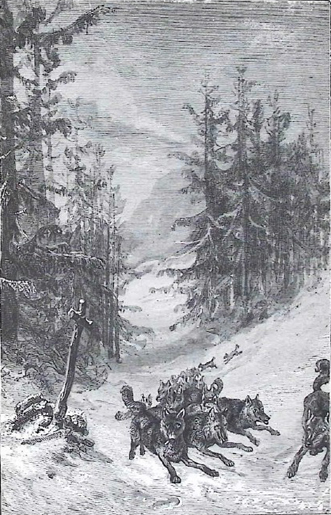
But he never finished the tune; for to his horror he beheld some slowly moving, dark, and terrible forms—forms as of large, thin dogs in the distance—forms which skulked and prowled round the clearing outside his home.
And as he glanced at the dimly seen, but only too well recognized objects, a long, shrill, whining howl came borne on the keen, clear, frosty, air; and the lad, his worst fears confirmed, put his hands to his ears and cried—
"Oh, father, if only you were here! Oh do make haste home; it's the wolves!" For he had heard old hunters' stories, and though this was his very first winter in Michigan, he guessed at once what these terrible visitors were.
Hardly could his trembling fingers close the shutters, scarcely could his limbs bear him into the house, so feeble did he feel from fear. But he made all the haste he could, and once inside he shut the door and barred it with a feeling of thankfulness that he was inside, and longing, oh how fervently, for his father's return.
He looked at Hetty, who lay on the broad settle near the fire in a sweet and peaceful sleep, and made up his mind not to frighten her if he could possibly help it. "It would make her ill again," he thought.
"I must keep them outside somehow," he murmured; then he took down a wood-cutter's axe from the wall, planted himself near the strongly-barred door, and listened.
Listened as if there was nothing to do but listen—listened until it seemed as if all other senses had failed and were all merged in that one intense power of hearing.
And all at once he thought of grandmother, sitting as she used to sit and spin in the homestead near Bromsgrove woods, of grandmother telling his sister the story of Little Red Riding Hood.
But those days were past. Grandmother neither toiled nor spun any longer, and the wolves were at their own door.
Yes, they were at the very door, for their howling sounded quite close to his ear, and he saw the door shake and knew they were trying to force it; and again he put his hands to his ears, as if to shut out the sound which refused to be shut out.
Then the door all at once ceased shaking, and there was a curious gnawing sound. And the oil in the lamp sank down, the light grew dimmer, dimmer, dimmer; soon, very soon, they would be in total darkness—save, indeed, for the firelight—if the lamp were not replenished. So, trembling, Wattie refilled the lamp, and just as he lit it Hetty awoke and looked around her.
And her still sleepy blue eyes fell on a large hairy paw which was thrust through an aperture in the bottom of the door, where it joined the step of the roughly-built log cabin.
"Look, Wattie, look!" she exclaimed, "a doggie wants to get in. See, see, there's its paw."
"All right, love," said Wattie, in a voice which he tried to make cheerful, "all right; you go to sleep and leave me to see to the dogs."
But Hetty, who from her corner could not see very clearly what was going on, was more amused than frightened, and begged her brother not to be cross with the poor dog, but to "give it a bone, and then it would go away."
"But, darling, they're not dogs, they're wolves," said poor Wattie, feeling it was best to tell her.
"Wolves! What, like Red Riding Hood's wolf, Wattie? They won't hurt us, will they?"
"No, darling, I won't let them!" said Wattie, setting his teeth and looking stern, as he felt he could die, if need were, for his little sister. At this moment the paw came through again, and this time it was pushed farther into the room. Without a word Wattie seized his axe, and bringing it down with all his might, and with the skilful stroke he had learnt since he had been in the backwoods, he smote off the evilly intruding limb. A howl followed, then a silence, and then another paw was thrust under the door to share the fate of the former one.
Hetty lay quite still on the settle, and watched her heroic defender.
"Oh, Wattie, don't you wish father and mother would come? Why don't you get father's gun and shoot them? You can shoot now, you know; and didn't Mr. Hughes say that was what you would have to do if the wolves came around this winter?"
"Yes; but, Hetty dear, father took his gun with him—he never likes to go away without it. Oh, Hetty! do you remember Mr. Hughes saying that if anyone blew out a bladder and hung it in the wind that the wolves would never come very near it? Oh, if we only had a bladder!"
"Why, we have! Mother said she must buy some lard to-day when she looked at the empty bladder."
"Oh, you good girl to remember that! Where is it, Hetty?"
"Up in the loft. I saw it when I was up there with mother this morning. But I was poorly, you know, so I didn't care to play with it then, and I hung it up in the loft. Father blew it out and tied a piece of string to it, and told me I might have it to play with, as I couldn't buy balls out here in the backwoods."
"Oh, Hetty, God must have put it into father's heart to do that. Come, dear, take my hand while there's a minute's silence, and we'll baulk them yet."
Quickly the two ascended the ladder into the loft, and there, sure enough, was the bladder, fastened to a rafter and swaying about in the wind, which came keenly in through the rough little shutters of the window which lighted the loft.
Very quickly Wattie pushed open the shutter; very quickly, but very firmly, he tied the string to the hook which held the shutter, making sure that the other end of the string was fast to the bladder. Then he left it to flutter in the now rapidly-rising wind, and, with his little sister, descended the ladder again, and piled more logs on the fire and waited.
"Why," he said, after a pause of anxious watching, "Farmer Hughes must have known what he was talking about, after all!"
No paw was thrust under the door, although Wattie awaited it with uplifted axe. The fierce howling changed to a half-fearful whine, and it was more distant, too. After a while it almost ceased.
Presently, Hetty said, "I'm not a bit afraid, Wattie; I'll say my prayers and go to sleep. I know you'll take care of me," and she nestled into her brother's arms and fell asleep, thoroughly tired out; nor did she even awaken when Wattie started up at the sound of a shot at some distance, then another and another in quick succession, and then the welcome, welcome sound of his father's shout!
Gently laying the sleeping child on the settle, Wattie rushed to the door.
"My boy, what has happened? Have you been frightened by the wolves? I've settled some of the brutes to-night, at any rate. How is Hetty? We've been delayed because the doctor was away from home, and mother here is nearly out of her mind with anxiety about you. And what's that fluttering up at the loft window?"
Wattie soon related all that had happened after his father's departure, and when his mother hugged and kissed and cried over him, and his father called him a little hero, and even had tears in his eyes as he said it, Wattie felt prouder than ever he had done in his life, and thought he was richly rewarded for all that he had gone through during that terrible, never-to-be-forgotten night with the wolves.