Chapter XVI · GROVETON AND THE SECOND MANASSAS (continued 2)
Reading edition
10.15 a.m. It was now 10.30 a.m., and Jackson had long since learned that Lee was near at hand. Longstreet’s advanced guard had passed through Gainesville, and the main body was closing up. Not only had time been gained, but two brigades alone had proved sufficient to hold the enemy at arm’s length, and the rough counterstrokes had disconcerted the order of attack. A fresh Federal force, however, was already approaching. The troops from Centreville, comprising the divisions of Hooker, Kearney, and Reno, 17,000 or 18,000 men, were hurrying over the Stone Bridge; and a second and more vigorous attack was now to be withstood. Sigel, too, was still capable of further effort. Bringing up Steinwehr’s division, and demanding reinforcements from Reno, he threw his whole force against the Confederate front. Schenck, however, still exposed to the fire of the massed artillery, was unable to advance, and Milroy in the centre was hurled back. But through the wood the attack was vigorously pressed, and the fight raged fiercely at close quarters along the railway. Between Gregg’s and Thomas’ brigades a gap of over a hundred yards, as the men closed in upon the centre, had gradually opened. Opposite the gap was a deep cutting, and the Federals, covered by the wood, massed here unobserved in heavy force. Attack from this quarter was unexpected, and for a moment Hill’s first line was in jeopardy. Gregg, however, had still a regiment in second line, and throwing it quickly forward he drove the enemy across the railroad. Then Hill, bringing up Branch from the third line, sent this fresh brigade to Gregg’s support, and cleared the front.
The Germans had now been finally disposed of. But although Longstreet had arrived upon the ground, and was deploying in the woods on Jackson’s right, thus relieving Early, who at once marched to support the centre, Jackson’s men had not yet finished with the enemy. Pope had now taken over command; and besides the troops from Centreville, who had already reached the field, McDowell and Porter, with 27,000 men, were coming up from Manassas, and Reynolds had not yet been engaged. But it is one thing to assemble large numbers on the battle-field, another to give them the right direction.
In the direction of Gainesville high woods and rolling ridges had concealed Longstreet’s approach, and the Federal patrols had been everywhere held in check by Stuart’s squadrons. In ignorance, therefore, that the whole Confederate army was concentrated before him, Pope, anticipating an easy victory, determined to sweep Jackson from the field. But it was first necessary to relieve Sigel. Kearney’s division had already deployed on the extreme right of the Federal line, resting on Bull Run. Hooker was on the left of Kearney and a brigade of Reno’s on the left of Hooker. While Sigel assembled his shattered forces, these 10,000 fresh troops, led by some of the best officers of the Army of the Potomac, were ordered to advance against A. P. Hill. Reynolds, under the impression that he was fighting Jackson, was already in collision with Longstreet’s advanced-guard; and McDowell and Porter, marching along the railway from Manassas, might be expected to strike the Confederate right rear at any moment. It was then with good hope of victory that Pope rode along his line and explained the situation to his generals.
But the fresh attack was made with no better concert than those which preceded it. Kearney, on the right, near Bull Run, was held at bay by Jackson’s guns, and Hooker and Reno advanced alone.
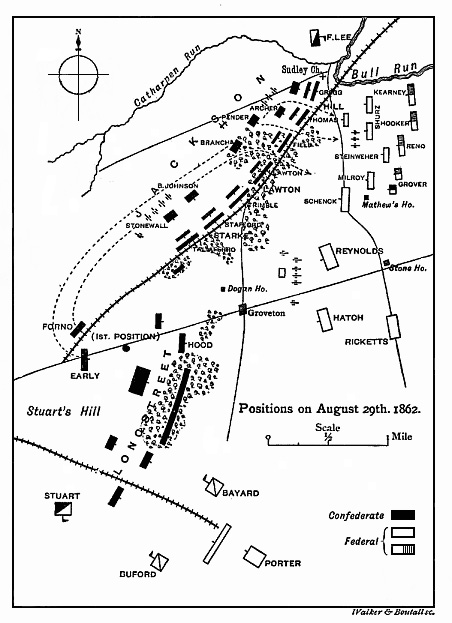
1 p.m. As the Federals moved forward the grey skirmishers fell back through the Groveton wood, and scarcely had they reached the railroad before the long blue lines came crashing through the undergrowth. Hill’s riflemen, lying down to load, and rising only to fire, poured in their deadly volleys at point-blank range. The storm of bullets, shredding leaves and twigs, stripped the trees of their verdure, and the long dry grass, ignited by the powder sparks, burst into flames between the opposing lines. But neither flames nor musketry availed to stop Hooker’s onset. Bayonets flashed through the smoke, and a gallant rush placed the stormers on the embankment. The Confederates reeled back in confusion, and men crowded round the colours to protect them. But assistance was at hand. A fierce yell and a heavy volley, and the regiments of the second line surged forward, driving back the intruders, and closing the breach. Yet the Federal ranks reformed; the wood rang with cheers, and a fresh brigade advanced to the assault. Again the parapet was carried; again the Southern bayonets cleared the front. Hooker’s leading brigade, abandoning the edge of the wood, had already given ground. Reno’s regiments, suffering fearful slaughter, with difficulty maintained their place; and Hill, calling once more upon his reserves, sent in Pender to the counterstroke. Passing by the right of Thomas, who, with Field, had borne the brunt of the last attack, Pender crossed the railroad, and charged into the wood. Many of the men in the fighting-line joined in the onward movement. The Federals were borne back; the brigades in rear were swept away by the tide of fugitives; the wood was cleared, and a battery near by was deserted by the gunners.
Then Pender, received with a heavy artillery fire from the opposite heights, moved boldly forward across the open. But the counterstroke had been pushed too far. The line faltered; hostile infantry appeared on either flank, and as the Confederates fell back to the railroad, the enemy came forward in pursuit. Grover’s brigade of Hooker’s division had hitherto been held in reserve, sheltered by a roll of the land opposite that portion of the front which was held by Thomas.
3 p.m. It was now directed to attack. “Move slowly forward,” were the orders which Grover gave to his command, “until the enemy opens fire. Then advance rapidly, give them one volley, and then the bayonet.” The five regiments moved steadily through the wood in a single line. When they reached the edge they saw immediately before them the red earth of the embankment, at this point ten feet high and lined with riflemen. There was a crash of fire, a swift rush through the rolling smoke, and the Federals, crossing the parapet, swept all before them. Hill’s second line received them with a scattered fire, turned in confusion, and fled back upon the guns. Then beckoned victory to him who had held his reserves in hand. Jackson had seen the charge, and Forno’s Louisianians, with a regiment of Lawton’s, had already been sent forward with the bayonet.
In close order the counterstroke came on. The thinned ranks of the Federals could oppose no resolute resistance. Fighting they fell back, first to the embankment, where for a few moments they held their own, and then to the wood. But without supports it was impossible to rally. Johnson’s and Starke’s brigades swept down upon their flank, the Louisianians, supported by Field and Archer, against their front, and in twenty minutes, with a loss of one-fourth his numbers, Grover in his turn was driven beyond the Warrenton turnpike.
Four divisions, Schurz’, Steinwehr’s, Hooker’s, and Reno’s, had been hurled in succession against Jackson’s front. Their losses had been enormous. Grover’s brigade had lost 461 out of 2,000, of which one regiment, 288 strong, accounted for 6 officers and 106 men; three regiments of Reno’s lost 530; and it is probable that more than 4,000 men had fallen in the wood which lay in front of Hill’s brigades.
The fighting, however, had not been without effect on the Confederates. The charges to which they had been exposed, impetuous as they were, were doubtless less trying than a sustained attack, pressed on by continuous waves of fresh troops, and allowing the defence no breathing space. Such steady pressure, always increasing in strength, saps the morale more rapidly than a series of fierce assaults, delivered at wide intervals of time. But such pressure implies on the part of the assailant an accumulation of superior force, and this accumulation the enemy’s generals had not attempted to provide. In none of the four attacks which had shivered against Hill’s front had the strength of the assailants been greater than that of his own division; and to the tremendous weight of such a stroke as had won the battles of Gaines’ Mill or Cedar Run, to the closely combined advance of overwhelming numbers, Jackson’s men had not yet been subjected.
The battle, nevertheless, had been fiercely contested, and the strain of constant vigilance and close-range fighting had told on the Light Division. The Federal skirmishers, boldly advancing as Pender’s men fell back, had once more filled the wood, and their venomous fire allowed the defenders no leisure for repose.[25] Ammunition had already given out; many of the men had but two or three cartridges remaining, and the volunteers who ran the gauntlet to procure fresh supplies were many of them shot down. Moreover, nine hours’ fighting, much of it at close range, had piled the corpses thick upon the railroad, and the ranks of Hill’s brigades were terribly attenuated. The second line had already been brought up to fill the gaps, and every brigade had been heavily engaged.
4 p.m. It was about four o’clock, and for a short space the pressure on the Confederate lines relaxed. The continuous roar of the artillery dwindled to a fitful cannonade; and along the edge of the wood, drooping under the heat, where the foliage was white with the dust of battle, the skirmishers let their rifles cool. But the Valley soldiers knew that their respite would be short. The Federal masses were still marching and counter-marching on the opposite hills; from the forest beyond long columns streamed steadily to the front, and near the Warrenton turnpike fresh batteries were coming into action.
Pope had ordered Kearney and Reno to make a fresh attack. The former, one of the most dashing officers in the Federal army, disposed his division in two lines. Reno, in the same formation, deployed upon Kearney’s right, and with their flank resting on Bull Run the five brigades went forward to the charge. The Confederate batteries, posted on the ridge in rear, swept the open ground along the stream; but, regardless of their fire, the Federals came rapidly to close quarters, and seized the railroad.
4.30 p.m. When Hill saw this formidable storm bursting on his lines he felt that the supreme moment had arrived. Would Gregg, on whose front the division of Reno was bearing down, be able to hold his own? That gallant soldier, although more than one half of his command lay dead or wounded, replied, in answer to his chief’s enquiry, that his ammunition was almost expended, but that he had still the bayonet. Nevertheless, the pressure was too heavy for his wearied troops. Foot by foot they were forced back, and, at the same moment, Thomas, Field, and Branch, still fighting desperately, were compelled to yield their ground. Hill, anxiously looking for succour, had already called on Early. The enemy, swarming across the railroad, had penetrated to a point three hundred yards within the Confederate position. But the grey line was not yet shattered. The men of the Light Division, though borne backwards by the rush, still faced towards the foe; and Early’s brigade, supported by two regiments of Lawton’s division, advanced with levelled bayonets, drove through the tumult, and opposed a solid line to the crowd of Federals.
Once more the fresh reserve, thrown in at the propitious moment, swept back numbers far superior to itself. Once more order prevailed over disorder, and the cold steel asserted its supremacy. The strength of the assailants was already spent. The wave receded more swiftly than it had risen, and through the copses and across the railroad the Confederates drove their exhausted foe. General Hill had instructed Early that he was not to pass beyond the original front; but it was impossible to restrain the troops, and not till they had advanced several hundred yards was the brigade halted and brought back.
5.15 p.m. The counterstroke was as completely successful as those that had preceded it. Early’s losses were comparatively slight, those inflicted on the enemy very heavy, and Hill’s brigades were finally relieved. Pope abandoned all further efforts to crush Jackson. Five assaults had failed. 30,000 infantry had charged in vain through the fatal wood; and of the 8,000 Federal casualties reported on this day, by far the larger proportion was due to the deadly fire and dashing counterstrokes of Jackson’s infantry.
While Pope was hurling division after division against the Confederate left, Lee, with Longstreet at his side, observed the conflict from Stuart’s Hill, the wooded eminence which stands south-west of Groveton. On this wing, though a mile distant from Jackson’s battle, both Federals and Confederates were in force. At least one half of Pope’s army had gradually assembled on this flank. Here were Reynolds and McDowell, and on the Manassas road stood two divisions under Porter.
Within the woods on Stuart’s Hill, with the cavalry on his flank, Longstreet had deployed his whole force, with the exception of Anderson, who had not yet passed Thoroughfare Gap. But although both Pope and Lee were anxious to engage, neither could bring their subordinates to the point. Pope had sent vague instructions to Porter and McDowell, and when at Length he had substituted a definite order it was not only late in arriving, but the generals found that it was based on an absolutely incorrect view of the situation. The Federal commander had no knowledge that Longstreet, with 25,000 men, was already in position beyond his left. So close lay the Confederates that under the impression that Stuart’s Hill was still untenanted, he desired Porter to move across it and envelop Jackson’s right. Porter, suspecting that the main body of the Southern army was before him, declined to risk his 10,000 men until he had reported the true state of affairs. A peremptory reply to attack at once was received at 6.30, but it was then too late to intervene.
Nor had Lee been more successful in developing a counterstroke. Longstreet, with a complacency it is difficult to understand, has related how he opposed the wishes of the Commander-in-Chief. Three times Lee urged him forward. The first time he rode to the front to reconnoitre, and found that the position, in his own words, was not inviting. Again Lee insisted that the enemy’s left might be turned. While the question was under discussion, a heavy force (Porter and McDowell) was reported advancing from Manassas Junction. No attack followed, however, and Lee repeated his instructions. Longstreet was still unwilling. A large portion of the Federal force on the Manassas road now marched northward to join Pope, and Lee, for the last time, bade Longstreet attack towards Groveton. “I suggested,” says the latter, “that the day being far spent, it might be as well to advance before night on a forced reconnaissance, get our troops into the most favourable positions, and have all things ready for battle the next morning. To this General Lee reluctantly gave consent, and orders were given for an advance to be pursued under cover of night, until the main position could be carefully examined. It so happened that an order to advance was issued on the other side at the same time, so that the encounter was something of a surprise on both sides.[26] Hood, with his two Texan brigades, led the Confederates, and King’s division, now commanded by Hatch, met him on the slopes of Stuart’s Hill. Although the Federals, since 1 a.m. the same morning, had marched to Manassas and back again, the fight was spirited. Hood, however, was strongly supported, and the Texans pushed forward a mile and a half in front of the position they had held since noon. Longstreet had now full leisure to make his reconnaissance. The ground to which the enemy had retreated was very strong. He believed it strongly manned, and an hour after midnight Hood’s brigades were ordered to withdraw.
The firing, even of the skirmishers, had long since died away on the opposite flank. The battle was over, and the Valley army had been once more victorious. But when Jackson’s staff gathered round him in the bivouac, “their triumph,” says Dabney, “bore a solemn hue.” Their great task had been accomplished, and Pope’s army, harassed, starving, and bewildered, had been brought to bay. But their energies were worn down. The incessant marching, by day and night, the suspense of the past week, the fierce strife of the day that had just closed, pressed heavily on the whole force. Many of the bravest were gone. Trimble, that stout soldier, was severely wounded, Field and Forno had fallen, and in Gregg’s brigade alone 40 officers were dead or wounded. Doctor McGuire, fresh from the ghastly spectacle of the silent battle-field, said, “General, this day has been won by nothing but stark and stern fighting.” “No,” replied Jackson, very quietly, “it has been won by nothing but the blessing and protection of Providence.” And in this attitude of acknowledgment general and soldiers were as one. When the pickets had been posted, and night had fallen on the forest, officers and men, gathered together round their chaplains, made such preparations for the morrow’s battle as did the host of King Harry on the eve of Agincourt.
NOTE
Students of war will note with interest the tactical details of the passage of the Rappahannock by the Army of Northern Virginia.
August 21.—FEDERALS.
In position behind the river from Kelly’s Ford to Freeman’s Ford.
Tête de pont covering the railway bridge, occupied by a brigade.
CONFEDERATES.
Longstreet to Kelly’s Ford.
Jackson to Beverley Ford.
Stuart to above Beverley Ford.
Constant skirmishing and artillery fire.
August 22.—FEDERALS.
In position from Kelly’s Ford to Freeman’s Ford.
Bayard’s cavalry brigade on right flank.
Buford’s cavalry brigade at Rappahannock Station.
CONFEDERATES.
Jackson to Sulphur Springs. Early crosses the river.
Longstreet to Beverley Ford and railway.
Constant skirmishing and artillery fire.
August 23.—FEDERALS.
Pope abandons tête de pont and burns railway bridge.
Sigel moves against Early, but his advance is repulsed.
Army to a position about Warrenton, with detachments along the river, and a strong force at Kelly’s Ford.
CONFEDERATES.
Early moves north to Great Run, and is reinforced by Lawton.
Stuart to Catlett’s Station.
Longstreet demonstrates against railway bridge.
August 24.—FEDERAL.
Buford’s and Bayard’s cavalry to Waterloo.
Army to Waterloo and Sulphur Springs.
CONFEDERATES.
Jackson in the evening retires to Jefferson, and is relieved after dark opposite Sulphur Springs and Waterloo by Longstreet.
Anderson relieves Longstreet on the railway.
Constant skirmishing and artillery fire all along the line.
August 25.—FEDERALS.
Pope extends his left down the river to Kelly’s Ford, determining to receive attack at Warrenton should the Confederates cross.
CONFEDERATES.
Jackson moves north and crosses the river at Hinson’s Mills.
Longstreet demonstrates at Waterloo, and Anderson at the Sulphur Springs.
August 26.—FEDERALS.
A reconnaissance in force, owing to bad staff arrangements, comes to nothing. At nightfall the whole army is ordered to concentrate at Warrenton.
CONFEDERATES.
2 a.m. Stuart follows Jackson.
Late in the afternoon, Longstreet, having been relieved by Anderson, marches to Hinson’s Mills.
Jackson captures Manassas Junction.
Skirmishing all day along the Rappahannock.
August 27.—FEDERALS.
7 a.m. Hooker’s division from Warrenton Junction to Bristoe Station.
8.30 a.m. Army ordered to concentrate at Gainesville, Buckland Mills, and Greenwich. Porter and Banks at Warrenton Junction.
3 p.m. Action at Bristoe Station.
6.30 p.m. Pope arrives at Bristoe Station.
Army ordered to march to Manassaa Junction at dawn.
CONFEDERATES.
Jackson at Manassas Junction.
Longstreet to White Plains.
Third CorpsHeintzlemanHooker’s Division Kearney’s Division10,000
Fifth CorpsPorterMorell’s Division Sykes’ Division10,000
Pennsylvania Reserves. Reynolds8,000