Part 11 — CHAPTER XXVI. (continued 3)
Reading edition
It is to be hoped that the North-American Indian when communicating with Kitchi-Manitou does not forget to pray to be cured of his intolerable vice of covetousness. He can let nothing odd or valuable pass him without yearning for it, or so says every traveller whose lot it has been to sojourn among Red men. So says Mr. Murray, and quotes a rather ludicrous case in support of the assertion:
“While I was sitting near my packs of goods, like an Israelite in Monmouth Street, an elderly chief approached and signified his wish to trade. Our squaws placed some meat before him, after which I gave him the pipe, and in the meantime had desired my servant to search my saddle bags, and to add to the heap of saleable articles everything of every kind beyond what was absolutely necessary for my covering on my return. A spare shirt, a handkerchief, and a waistcoat were thus drafted, and among other things was a kind of elastic flannel waistcoat made for wearing next to the skin and to be drawn over the head as it was without buttons or any opening in front. It was too small for me and altogether so tight and uncomfortable, although elastic, that I determined to part with it.
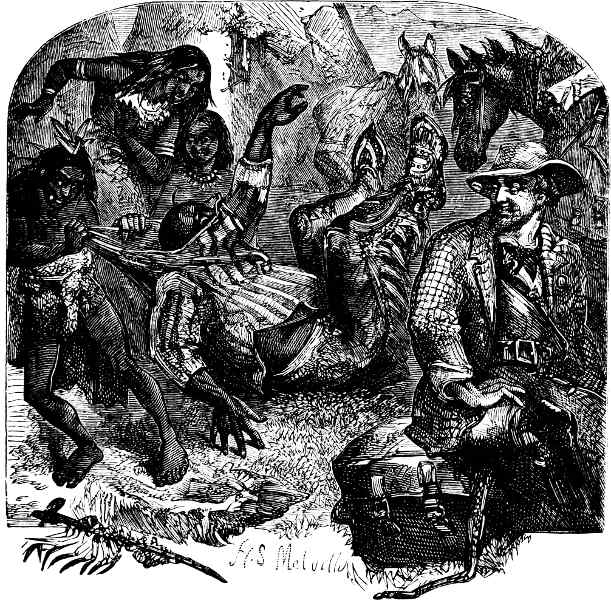
The Covetous Pawnee.
“To this last article my new customer took a great fancy and he made me describe to him the method of putting it on and the warmth and comfort of it when on. Be it remembered that he was a very large corpulent man, probably weighing sixteen stone. I knew him to be very good-natured, as I had hunted once with his son and on returning to the lodge the father had feasted me, chatted by signs, and taught me some of the most extraordinary Indian methods of communication. He said he should like to try on the jacket, and as he threw the buffalo robe off his huge shoulders I could scarcely keep my gravity when I compared their dimensions with the garment into which we were about to attempt their introduction. At last by dint of great industry and care, we contrived to get him into it. In the body it was a foot too short, and fitted him so close that every thread was stretched to the uttermost; the sleeves reached a very little way above his elbow. However, he looked upon his arms and person with great complacency and elicited many smiles from the squaws at the drollery of his attire; but as the weather was very hot he soon began to find himself too warm and confined, and he wished to take it off again. He moved his arms, he pulled his sleeves, he twisted and turned himself in every direction, but in vain. The old man exerted himself till the drops of perspiration fell from his forehead, but had I not been there he must either have made some person cut it up or have sat in it till this minute.
“For some time I enjoyed this scene with malicious and demure gravity, and then I showed him that he must try and pull it off over his head. A lad who stood by then drew it till it enveloped his nose, eyes, mouth, and ears; his arms were raised above his head, and for some minutes he remained in that melancholy plight, blinded, choked, and smothered, with his hands rendered useless for the time. He rolled about, sneezing, sputtering, and struggling, until all around him were convulsed with laughter and our squaws shrieked in their ungovernable mirth in a manner that I had never before witnessed. At length I slit a piece of the edge and released the old fellow from his straight-waistcoat confinement; he turned it round often in his hands and made a kind of comic-grave address to it, of which I could only gather a few words: I believe the import of them was that it would be ‘a good creature’ in the ice-month of the village. I was so pleased with his good humour that I gave it to him to warm his squaw in the ‘ice-month.’”
As this will probably be the last occasion of discussing in this volume the physical and moral characteristics of the North American Indian, it may not be out of place here to give a brief descriptive sketch of the chief tribes with an account of their strength and power in bygone times and their present condition. The names of Murray, Dominech, Catlin, etc., afford sufficient guarantee of the accuracy of the information here supplied.
The Ojibbeway nation occupies a large amount of territory, partly within the United States, and partly within British America. They are the largest community of savages in North America: the entire population, in 1842, amounted to thirty thousand. That part of the tribe occupying territory within the United States inhabit all the northern part of Michigan, the whole northern portion of Wisconsin Territory, all the south shore of Lake Superior, for eight hundred miles, the upper part of the Mississippi, and Sandy, Leech, and Red Lakes. Those of the nation living within the British dominions occupy all Western Canada, the north of Lake Huron, the north of Lake Superior, the north of Lake Winnibeg, and the north of Red River Lake, about one hundred miles. The whole extent of territory occupied by this single nation, extends one thousand nine hundred miles east and west, and from two to three hundred miles north and south. There are about five thousand in British America, and twenty-five thousand in the United States. Of their past history nothing is known, except what may be gathered from their traditions. All the chiefs and elder men of the tribe agree that they originally migrated from the west. A great number of their traditions are doubtless unworthy of credence, but a few that relate to the foundation of the world, the subsequent disobedience of the people,—which, the Ojibbeways say, was brought about by climbing of a vine that connected the world of spirits with the human race, which was strictly forbidden the mortals below, and how they were punished by the introduction of disease and death, which before they knew not;—all this and much more of the same nature, is a subject of more than ordinary interest to the contemplative mind.
Their first intercourse with Europeans was in 1609, when they, as well as many of the other tribes belonging to the Algonquin stock, met Champlain, the adventurous French trader. They were described by him as the most polished in manners of the northern tribes; but depended for subsistence entirely on the chase, disdaining altogether the more effeminate occupation of the cultivation of the soil. From that time they eagerly sought and very soon obtained the friendship of the French. The more so that their ancient and inveterate foes, the Iroquois, were extremely jealous of the intrusive white men. With the help of the French they gained many bloody and decisive battles over the Iroquois, and considerably extended their territories. The history of the nation from this time is not very interesting. From the ravages of war and disease the tribe, as may be perceived from a comparison with many others, has escaped with more than ordinary success; partly owing to the simplicity and general intelligence of the tribe in guarding against these evils.
Their religion is very simple, the fundamental points of which are nearly the same as all the North American Indians. They believe in one Ruler or Great Spirit—He-sha-mon-e-doo, “Benevolent Spirit,” or He-ehe-mon-edoo, ”“Great Spirit.” This spirit is over the universe at the same time, but under different names, as the “God of man,” the “God of fish,” and many others. It is supposed by many travellers that sun-worship was a part of their mythology, from the extreme respect which they were observed to pay to that luminary. But we find the reason of this supposed homage is, that the Indian regards the sun as the wigwam of the Great Spirit, and is naturally an object of great veneration. In this particular, perhaps, they are not greater idolaters than civilized people, who have every advantage that art and nature can bestow. The Indian, because the sun doesn’t shine to-day, won’t transfer his adoration to the moon to-morrow; and in this respect at least is superior to many a wise and educated “pale face.”
In addition to the good spirit they have a bad spirit, whom, however, they believe to be inferior to the good spirit. He is supposed to have the power of inflicting all manner of evils, and, moreover, to take a delight in doing so. This spirit was sent to them as a punishment for their original disobediences. They have, besides these, spirits innumerable. In their idea every little flower of the field, every beast of the land, and every fish in the water, possesses one.
Pawnees.—This tribe, which is scattered between Kansas and Nebraska, was at one time very numerous and powerful, but at the present time numbers no more than about ten thousand. They have an established reputation for daring, cunning, and dishonesty. In the year 1832 small-pox made its appearance among the Pawnees, and in the course of a few months destroyed fully half their numbers. They shave the head, all but the scalp lock. They cultivate a little Indian corn, but are passionately fond of hunting and adventure. The use of the Indian corn is confined to the women and old men. The warriors feed on the game they kill on the great prairies, or on animals they steal from those who cross their territory. The Pawnees are divided into four bands, with each a chief. Above these four chiefs is a single one, whom the whole nation obey. This tribe has four villages, situated near the Nebraska. It is allied with the neighbouring tribe of the Omahas and Ottoes. It was till recently the custom of these people to torture their prisoners, but it is now discontinued, owing to the fact of a squaw of the hostile tribe being snatched from the stake by a white man. The circumstance was regarded as a direct interposition of the Great Spirit, and as an expression of his will that torture should he discontinued. They do not appear to possess any historical traditions, but on certain other subjects preserve some curious legends. The “sign” of the Pawnees is the two forefingers held at the sides of the head in imitation of a wolf’s ears.
The Delawares.—This ancient people, once the most renowned and powerful among American Indians, has of late years so dwindled that were the entire nation to be gathered, it would scarcely count one thousand souls. They are now settled in the Valley of the Canadian river, and their pursuits are almost strictly agricultural. According to their traditions, several centuries ago they inhabited the western part of the American continent, but afterwards emigrated in a body to the banks of the Mississippi, where they met the Iroquois, who, like themselves, had abandoned the far west and settled near the same river. In a short time, however, the new comers and the previous holders of the land, the Allegavis, ceased to be on friendly terms, and the combined Delawares and Iroquois declared war against them to settle the question. The combined forces were victorious, and divided the land of the Allegavis between them. After living peaceably for two hundred years, another migration was resolved upon, and, according to some accounts, the whole of both nations, and according to others, but part of them, settled on the shores of the four great rivers, the Delaware, the Hudson, the Susquehanna, and the Potomac. Up to this time the Delawares remained, as they had ever been, superior to the Iroquois, and by-and-by the latter grew jealous of their powerful neighbours, and by way of thinning their numbers sought to breed a deadly feud between the Delawares and certain other near-living tribes, amongst which were the warlike Cherokees. This was an easy matter. The arms of every tribe are more or less peculiar and may be safely sworn to by any other. Stealing a Delaware axe, an Iroquois lay wait for a Cherokee, and having brained him with the weapon laid it by the side of the scalpless body. The bait took, and speedily the Delawares and the Cherokees were plunged into deadly strife.
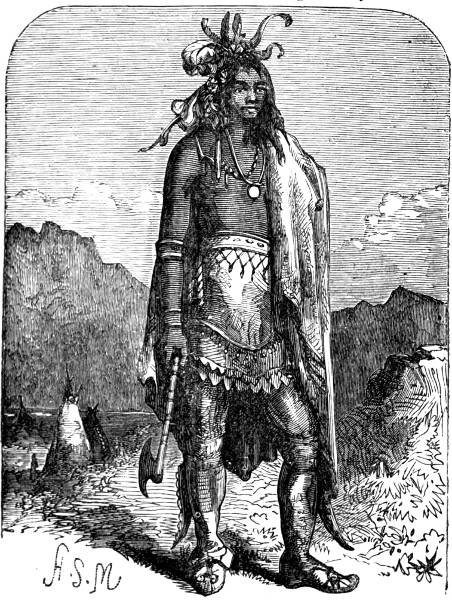
An Iroquois Warrior.
The Iroquois, however, were not destined to escape scot free for their diabolical trick. The Delawares discovered it, and swore in council to exterminate their malicious neighbours. But the latter were much too wise to attempt a single-handed struggle with their justly incensed foes, so soliciting the attention of the other tribes they set out their grievances in so artful a manner that the others resolved to help them, and there was straightway formed against the unoffending Delawares a confederation called the Six Nations. “This,” says the Abbé Dominech, “was about the end of the fifteenth and beginning of the sixteenth century, and from this period dates the commencement of the most bloody battles the New World has witnessed. The Delawares were generally victorious. It was during this war that the French landed in Canada, and the Iroquois not wishing them to settle in the country took arms against them; but finding themselves thus placed between two fires, and despairing of subduing the Delawares by force of arms, they had recourse to a stratagem in order to make peace with the latter, and induce them to join the war against the French. Their plan was to destroy the Delawares’ fame for military bravery, and to make them (to use an Indian expression) into old women. To make the plan of the Iroquois understood, we must mention that most of the wars between these tribes are brought to an end only by the intervention of the women. They adjure the warriors by all they hold dear to take pity on their poor wives and on the children who weep for their fathers, to lay aside their arms and to smoke the calumet of peace with their enemies. These discourses rarely fail in their effect and the women place themselves in an advantageous position as peace-makers. The Iroquois persuaded the Delawares that it would be no disgrace to become “women,” but that on the contrary, it would be an honour to a nation so powerful, and which could not be suspected of deficiency in courage or strength, to be the means of bringing about a general peace and of preserving the Indian race from further extermination. These representations determined the Delawares to become “women” by asking for peace. So they came to be contemptuously known by other tribes as “Iroquois Squaws,” and losing heart, from that time grew more few.
Shawnees.—The ancient “hunting grounds” of this important tribe were Pennsylvania and New Jersey; but they are now found in the Valley of the Canadian. “Some authors are of opinion,” says the author of “The Deserts of North America,” “that these Indians come from Eastern Florida, because there is in that country a river called Su-wa-nee, whence the word Shawanas, which is also used to design the Shawnees, might be derived. It is certain, however, that they were known on the coast of the Atlantic, near Delaware and Chesapeak, subsequent to the historical era: that is to say, after the arrival of the Anglo-Saxons in the land. The Shawnees, as well as the Aborigines of whom they formed part, held a tradition of their transatlantic origin. It is but a few years ago that they ceased to offer animal sacrifices to render thanks to the Great Spirit for their happy arrival in America. The Shawnees and their neighbours the Delawares were alternately friends and enemies. They frequently made war on each other, and retreated to the west in consequence of the invasion of the whites. The present Shawnees are as much civilized as the Chactas; they are perhaps less rudely attired; with the exception of rings, earrings, and brooches of their own manufacturing, they care little for the ornaments by which other Indians set so much store. Their features are peculiar; their nose has a Grecian cut not devoid of beauty; their hair is short to the neck and parted in the front; the men wear moustaches; the women are rather good looking, and notwithstanding the dark colour of their complexion their cheeks show signs of robust health. Some of the most renowned of American chiefs are found among the Shawnees. The present actual population is 1,500.”
And now, having so long endured the trying climate of North America, let us turn to a warmer country—to one of the warmest and quaintest—to Abyssinia. Not the least quaint of its features is the fact that there are more churches there than in any other country; and, though it is very mountainous, and consequently the view much obstructed, it is very seldom you see less than five or six; and, if you are on a commanding ground, five times that number. Every Abyssinian that dies thinks he has atoned for all his wickedness, if he leaves a fund to build a church, or has built one in his lifetime. The king builds many. Wherever a victory is gained, there a church is erected in the very field—and that before the bodies of the slain are buried. Formerly this was only the case when the enemy was Pagan or Infidel; now the same is observable when the victories are over Christians. The situation of a church is always chosen near running water, for the convenience of their purifications and ablutions, in which they strictly observe the Levitical law. They are always placed on the top of some beautiful round hill, which is surrounded entirely with rows of the oxycedrus, or Virgin cedar, which grows here in great beauty and perfection, and is called Arz. Nothing adds so much to the beauty of the country as these churches, and the plantations about them. In the middle of this plantation of cedars is interspersed, at proper distances, a number of those beautiful trees called Cuffo, which grow very high, and are all extremely picturesque.
The churches are all round, with thatched roofs; their summits are perfect cones; the outside is surrounded by a number of wooden pillars, which are nothing else than the trunks of the cedar-tree, and are placed to support the edifice, about eight feet of the roof projecting beyond the wall of the church, which forms an agreeable walk or colonnade around it in hot weather or in rain. The inside of the church is in several divisions, according as is prescribed by the law of Moses. The first is a circle somewhat wider than the inner one; here the congregation sit and pray. Within this is a square, and that square is divided by a veil or curtain, in which is another very small division answering to the holy of holies. This is so narrow, that none but the priests can go into it. You are barefooted, whenever you enter the church, and, if barefooted, you may go through every part of it, if you have any such curiosity, provided you are pure, that is, have not had connexion with woman for twenty-four hours before, or touched carrion or dead bodies (a curious assemblage of ideas), for in that case you are not to go within the precincts, or outer circumference, of the church, but stand and say your prayers at an awful distance among the cedars.
Every person, of both sexes, under Jewish disqualifications, is obliged to observe this distance; and this is always a place belonging to the church, where, except in Lent, you see the greatest part of the congregation; but this is left to your own conscience; and, if there was either great inconvenience in the one situation, or great satisfaction in the other, the case would be otherwise.
On your first entering the church, you put off your shoes: but you must leave a servant there with them, or else they will be stolen, if good for anything, by the priests and monks, before you come out of the church. At entering you kiss the threshold and the two door-posts, go in and say what prayer you please; that finished you come out again, and your duty is over. The churches are full of pictures, painted on parchment, and nailed upon the walls a little less slovenly than you see paltry prints in beggarly country ale-houses. There has been always a sort of painting known among the scribes, a daubing much inferior to the worst of our sign-painters. Sometimes, for a particular church, they get a number of pictures of saints, on skins of parchment, ready finished from Cairo, in a style very little superior to these performances of their own. They are placed like a frieze, and hung in the upper part of the wall. St. George is generally there with his dragon, and St. Demetrius fighting a lion. There is no choice in their saints; they are both of the Old and New Testament, and those that might be dispensed with from both. There is St. Pontius Pilate and his wife; there is St. Balaam and his ass; Samson and his jawbone; and so of the rest. But the thing that surprised Mr. Bruce most was a kind of square miniature upon the head-piece or mitre of the priest, administering the sacrament at Adowa, representing Pharaoh on a white horse plunging in the Red Sea, with many guns and pistols swimming upon the surface of it around him.
Nothing embossed, or in relief, ever appears in any of their churches; all this would be reckoned idolatry, so much so that they do not wear a cross, as has been represented, on the top of the ball of the sendick or standard, because it casts a shade; but there is no doubt that pictures have been used in their churches from the very earliest ages of Christianity.
The primate or patriarch of the Abyssinian Church is styled Abuna. The first of these prelates mentioned in history is Tecla Haimanout, who distinguished himself by the restoration of the royal family, and the regulations which he made both in church and state. A wise ordinance was then enacted that the Abyssinians should not have it in their power to raise one of their own countrymen to the dignity of Abuna. As this dignitary of the church very seldom understands the language of the country, he has no share in the government. His chief employment is in ordinations, which ceremony is thus performed:—A number of men and children present themselves at a distance, and there stand from humility, not daring to approach him. He then asks who these are, and they tell him that they wish to be deacons. On this he makes two or three signs with a small cross in his hand, and blows with his mouth twice or thrice upon them, saying, “Let them be deacons.” Mr. Bruce once saw the whole army of Begemder, when just returned from shedding the blood of 10,000 men, made deacons by the Abuna, who stood about a quarter of a mile distant from them.
The Abyssinians neither eat nor drink with strangers, though they have no reason for this; and it is now a mere prejudice, because the old occasion for this regulation is lost. They break, or purify, however, every vessel a stranger of any kind shall have eaten or drunk out of. The custom, then, is copied from the Egyptians; and they have preserved it, though the Egyptian reason does no longer hold.
The Egyptians made no account of the mother what her state was; if the father was free, the child followed the condition of the father. This is strictly so in Abyssinia. The king’s child by a negro-slave, bought with money, or taken in war, is as near in succeeding to the crown as any one of twenty children that he has older than that one, and born of the noblest women of the country.
In Abyssinia, once every year they baptize all grown people, or adults. Mr. Bruce here relates what he himself saw on the spot, and what is nothing more than the celebration of our Saviour’s baptism:—“The small river, running between the town of Adowa and the church, had been dammed up for several days; the stream was scanty, so that it scarcely overflowed. It was in places three feet deep, in some perhaps four, or little more. Three large tents were pitched the morning before the feast of the Epiphany; one on the north for the priests to repose in during the intervals of the service, and, besides this, one to communicate in: on the south there was a third tent for the monks and priests of another church to rest themselves in their turn. About twelve o’clock at night the monks and priests met together, and began their prayers and psalms at the water-side, one party relieving each other. At dawn of day, the governor, Welleta Michael, came thither, with some soldiers, to raise men for Ras Michael, then on his march against Waragna Fasil, and sat down on a small hill by the water-side, the troops all skirmishing on foot and on horseback around them.
“As soon as the sun began to appear, three large crosses of wood were carried by three priests dressed in their sacerdotal vestments, and who, coming to the side of the river, dipped the cross into the water, and all this time the firing, skirmishing, and praying, went on together. The priests with their crosses returned, one of their number before them carrying something less than an English quart of water in a silver cup or chalice; when they were about fifty yards from Welleta Michael, that general stood up, and the priest took as much water as he could hold in his hands, and sprinkled it upon his head holding the cup at the same time to Welleta Michael’s mouth to taste; after which the priest received it back again, saying at the same time, “Gzier y’barak,” which is simply, “May God bless you.” Each of the three crosses was then brought forward to Welleta Michael, and he kissed them. The ceremony of sprinkling the water was then repeated to all the great men in the tent, all cleanly dressed as in gala. Some of them, not contented with aspersion, received it in the palms of their hands joined, and drank it there; more water was brought for those that had not partaken of the first; and after the whole of the governor’s company was sprinkled, the crosses returned to the river, their bearers singing hallelujahs, and the skirmishing and firing continuing.”
Mr. Bruce observed, that, a very little time after the governor had been sprinkled, two horses and two mules, belonging to Ras Michael and Ozoro Esther, came and were washed. Afterwards the soldiers went in and bathed their horses and guns; those who had wounds bathed them also. Heaps of platters and pots, that had been used by Mahometans or Jews, were brought thither likewise to be purified; and thus the whole ended.
The men in Egypt neither bought nor sold; the same is the case in Abyssinia to this day. It is infamy for a man to go to market to buy any thing. He cannot carry water or bake bread; but he must wash the clothes belonging to both sexes; and, in this function, the women cannot help him. In Abyssinia the men carried their burdens on their heads, the women on their shoulders: and this difference, we are told, obtained in Egypt. It is plain that this buying in the public market by women must have ended whenever jealousy or sequestration of that sex began. For this reason it ended early in Egypt; but, for the opposite reason, it subsists in Abyssinia to this day. It was a sort of impiety in Egypt to eat a calf; and the reason was plain, they worshipped the cow. In Abyssinia, to this day, no man eats veal, although every one very willingly eats beef. The Egyptian reason no longer subsists, as in the former case, but the prejudice remains, though they have forgotten their reason.
The Abyssinians eat no wild or water-fowl, not even the goose, which was a great delicacy in Egypt. The reason of this is, that, upon their conversion to Judaism, they were forced to relinquish their ancient municipal customs, as far as they were contrary to the Mosaical law, and the animals in their country not corresponding in form, kind, or name with those mentioned in the Septuagint, or original Hebrew, it has followed that there are many of each class that know not whether they are clean or not, and a wonderful confusion and uncertainty has followed through ignorance or mistake, being unwilling to violate the law in any one instance, though not understanding it.
Among the Gallas of Abyssinia, the Kalijas (magicians) and the Lubas (priests) reign supreme. It is the business of the latter to determine whether any impending war will be successful, and for this purpose the entrails of a goat are consulted. With his long hair streaming wildly, a bright copper circlet decorating his brow, and with a sonorous bell, which he beats to enjoin the silence and attention of the assembled multitude, he plunges his naked arm into the bowels of the freshly-slaughtered animal, and withdrawing part of the intestines, according to their colour declares the prospects of the savage army. In such matters, however, the Kalijas never interferes. His business is to cast out from sick men the evil spirits that torment them. There are eighty-eight evil spirits, say the Kalijas, divided into two bands of forty-three each and ruled and directed by a chief. The Kalijas is untiring in his efforts to hunt out this formidable army of eighty-eight. He goes about with a bell in one hand and a whip in the other, and with a festoon of dried goat’s entrails about his neck. Sent for by a patient he rubs him well with grease, smokes him with aromatic herbs, cries out at the top of his voice, rings his bell with a deafening din, and then lays into the sick person with the whipthong. If all these powerful remedies fail to drive out the Sao or evil spirit, why, the Kalijas resignedly takes his fee and goes away, leaving the victory to the doughty soldier of the eighty six.
In debating on the ills the Abyssinian is heir to the Bouda and Zar must not be forgotten, since they occupy a most prominent place in the catalogue of evils which torture the brown-skinned children of the sun. Of the two the Bouda, or sorcerer, as the word signifies, is the most dreaded. His powers in the black art are reported to be of a most varied character. At one time he will enslave the objects of his malice, at another he will subject them to nameless tortures, and not unfrequently his vengeance will even compass their death. Like the genii and egrets of the Arabian Nights the Bouda invariably selects those possessed of youth and talent, beauty and wit, on whom to work his evil deeds.
A variety of charms have been invented to counteract the Bouda’s power, but the most potent are the amulets written by the pious deleteras and worn round the neck. The dread of the sorcerer has introduced a whole tribe of exorcists who pretend both to be able to conjure the evil spirit and also to detect his whereabout; and these are accordingly held in great awe by the people. Their traffic resembles that of the highwayman; with this difference only—that the one in bold and unblushing language calls on his victim to stand and deliver, the other stealthily creeps into the midst of a troop of soldiers, or amongst a convivial party of friends, and pronounces the mystical word Bouda. The uncouth appearance and sepulchral voice of the exorcist everywhere produce the deepest sensation, and young and old, men and women, gladly part with some article to get rid of his hated and feared presence. If, as sometimes happens, one or two less superstitious individuals object to these wicked exactions, the exorcist has a right to compel every one present to smell an abominable concoction of foul herbs and decayed bones which he carries in his pouch; those who unflinchingly inhale the offensive scent are declared innocent, but those who have not such strong olfactory nerves are declared Boudas and shunned as allies of the evil one.
“During the rainy season,” says Mr. Stern, the most recent of Abyssinian travellers, “when the weather, like the mind, is cheerless and dull, the Boudas, as if in mockery of the universal gloom, celebrate their saturnalia. In our small settlement at Gaffat the monotony of our existence was constantly diversified by a Bouda scene. Towards the close of August, when every tree and shrub began to sprout and blossom, the disease degenerated into a regular epidemic; and in the course of an evening two, three, and not unfrequently every hut occupied by the natives would ring with that familiar household cry. A heavy thunderstorm by some mysterious process seemed invariably to predispose the people to the Bouda’s torturing influence.
“I remember one day about the end of August we had a most tremendous tempest: it commenced a little after mid-day and lasted till nearly five o’clock. During its continuance the air was completely darkened, except when the lightning’s blaze flashed athwart the sky and relieved for a few seconds the almost midnight gloom. No human voice could be heard amidst the thunder’s deafening crash and the torrent’s impetuous rage.
“The noise and tumult of the striving elements had scarcely subsided when one of the servants, a stout, robust, and masculine woman, began to exhibit the Bouda symptoms. She had been complaining the whole noon of langour, faintness, and utter incapacity for all physical exertion. About sunset her lethargy increased, and she gradually sank into a state of apparent unconsciousness. Her fellow servants who were familiar with the cause of her complaint at once pronounced her to be possessed. To outwit the conjuror I thought it advisable to try the effect of strong liquid ammonia on the nerves of the evil one. The place being dark, faggots were ignited; and in their bright flickering light we beheld a mass of dark figures squatted on the wet floor around a rigid and apparently dead woman. I instantly applied my bottle to her nose; but although the potent smell made all near raise a cry of terror, it produced no more effect on the passive and insensible patient than if it had been clear water.
“The owner of Gaffat, an amateur exorcist, almost by instinct, as if anticipating something wrong in that part of his dominion occupied by the Franks, made his appearance in the very nick of time, and no sooner had the bloated and hideous fellow hobbled into the hut, than the possessed woman, as if struck by a magnetic wire, burst into loud fits of laughter and the paroxysms of a maniac.
“Half-a-dozen stalwart fellows caught hold of her, but frenzy imparted vigour to her frame which even the united strength of these athletics was barely sufficient to keep under control. She tried to bite, kick, and tear every one within reach; and when she found herself foiled in all these mischievous attempts she convulsively grasped the unpaved wet floor and, in imitation of the hyæna, gave forth the most discordant sounds. Manacled and shackled with leather thongs, she was now partly dragged, and partly carried, to an open grassy spot; and there in the presence of a considerable number of people the conjuror, in a business-like manner, began his exorcising art.
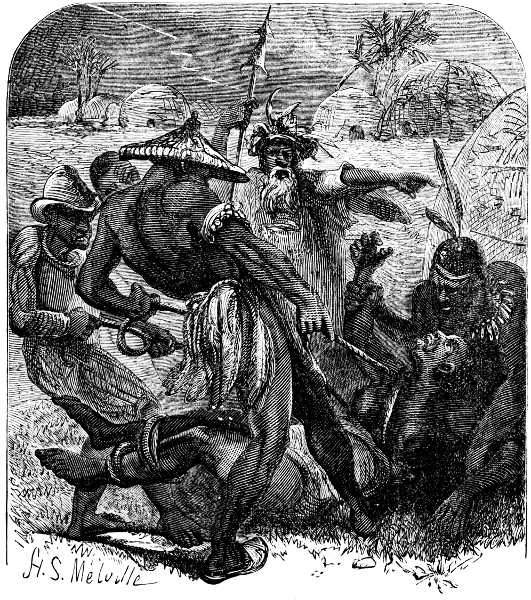
A Woman under the Influence of Bouda.
“The poor sufferer, as if conscious of the dreaded old man’s presence struggled frantically to escape his performance; but the latter disregarding her entreaties and lamentations, her fits of unnatural gaiety and bursts of thrilling anguish, with one hand laid an amulet on her heaving bosom, whilst with the other he made her smell a rag in which the root of a strong-scented plant, a bone of a hyæna, and some other abominable unguents, were bound up. The mad rage of the possessed woman being instantly hushed by this operation, the conjuror addressed himself to the Bouda, and in language unfit for polite ears, requested him to give him his name. The Bouda, speaking through the medium of the possessed, replied:
“‘Hailu Miriam.’
“‘Where do you reside?’
“‘In Damot.’
“‘What is the name of your father and confessor?’
“‘My father’s name is Negouseye, and my Abadre’s, Oubie.’
“‘Why did you come to this district?’
“‘I took possession of this person on the plain of Wadela, where I met her on the road from Magdala.’
“‘How many persons have you already killed?
“‘Six.’
“‘I command thee, in the name of the blessed Trinity, the twelve apostles, and the three hundred and eighteen bishops at the council of Nicæa, to leave this woman and never more to molest her.’
“The Bouda did not feel disposed to obey the conjuror; but on being threatened with a repast of glowing coals, he became docile, and in a sulky voice promised to obey the request.
“Still anxious, however, to delay his exit, he demanded something to eat; and to my utter disgust his taste was as coarse as the torments inflicted on the young woman were ungallant. Filth and dirt of the most revolting description, together with an admixture of water, were the choice delicacies he selected for his supper. This strange fare, which the most niggardly hospitality could not refuse, several persons hastened to prepare; and when all was ready, and the earthen dish had been hidden in the centre of a leafy shrub, the conjuror called to the Bouda, ‘As thy father did, so do thou.’ These words had scarcely escaped the lips of the exorcist when the possessed person leapt up and, crawling on all fours, sought the dainty repast, which she lapped up with a sickening avidity and greediness. She now laid hold of a stone which three strong men could scarcely lift, and raising it aloft in the air, whirled it round her head, and then fell senseless to the ground. In half an hour she recovered, but was quite unconscious of what had transpired.
“Next in importance to the Bouda is the Zar. This malady is exclusively confined to unmarried women, and has the peculiar feature, that during the violence of the paroxysm it prompts the patient to imitate the sharp discordant growl of the leopard. I recollect that the first time I saw a case of this description it gave me a shock that made my blood run cold. The sufferer was a handsome, gay and lively girl of fifteen. In the morning she was engaged, as usual, with her work, when a quarrel ensued between her and the other domestics. The fierce dispute, though of a trifling character, roused the passions of the fiery Ethiopian to such a pitch that it brought on an hysterical affection. Her companions cried out, ‘She is possessed;’ and certainly her ghastly smile, nervous tremor, wild stare, and unnatural howl, justified the notion. To expel the Zar, a conjuror, as in the Bouda complaint, was formerly considered indispensable; but, by dint of perseverance, the medical faculty of the country, to their infinite satisfaction, have at length made the discovery that a sound application of the whip is quite as potent an antidote against this evil as the necromancer’s spell.”
Turning from Abyssinia to Dahomey we find, as might be expected from all that one hears of that most sanguinary spot on earth, that religion is at a very low ebb. Leopards and snakes are the chief gods worshipped by the Dahomans, and surely the mantle of these deities must have descended to their worshippers, who possess all the cunning of the one and the bloodthirstiness of the other. Besides these, the Dahoman worships thunder and lightning, and sundry meaningless wooden images. The sacrifices are various. If of a bullock it is thus performed: the priests and priestesses (the highest of the land, for the Dahoman proverb has it that the poor are never priests) assemble within a ring in a public square, a band of discordant music attends, and, after arranging the emblems of their religion and the articles carried in religious processions, such as banners, spears, tripods, and vessels holding bones, skulls, congealed blood, and other barbarous trophies, they dance, sing, and drink until sufficiently excited. The animals are next produced and decapitated by the male priests with large chopper knives. The altars are washed with the blood caught in basins; the rest is taken round by the priests and priestesses, who strike the lintel and two side posts of all the houses of the devotees with the blood that is in the basin. The turkey buzzards swarm in the neighbourhood, and with the familiarity of their nature gorge on the mangled carcass as it is cut in pieces. The meat is next cooked and distributed among the priests, portions being set aside to feed the spirits of the departed and the fetishes. After the sacrifice the priesthood again commence dancing, singing, and drinking, men, women, and children grovelling in the dirt, every now and then receiving the touch and blessing of these enthusiasts. Among the priesthood are members of the royal family, wives and children. The mysteries are secret, and the revelation of them is punished with death. Although different fetishes are as common as the changes of language in Central Africa, there is a perfect understanding between all fetish people. The priests of the worship of the leopard, the snake, and the shark, are initiated into the same obscure forms. Private sacrifices of fowls, ducks, and even goats, are very common, and performed in a similar manner: the heads are taken off by the priests, and the altars washed with the blood, and the lintels and sides of the door posts are sprinkled; the body of the animal or bird is eaten or exposed for the sacred turkey buzzards to devour. The temples are extremely numerous, each having one altar of clay. There is no worship within these temples, but small offerings are daily given by devotees and removed by the priests.
Sickness is prevalent among the blacks, small-pox and fever being unattended, except by bad practitioners in medicine. And here let me remark that, after teachers of the Gospel and promoters of education, there is no study that would so well ensure a good reception in Africa as that of medicine. The doctor is always welcome, and, as in most barbarous countries, all white men were supposed to be doctors. If an African sickens, he makes a sacrifice first, a small one of some palm oil food. Dozens of plates of this mixture are to be seen outside the town, and the turkey buzzards horribly gorged, scarcely able to fly from them. If the gods are not propitiated, owls, ducks, goats, and bullocks are sacrificed; and if the invalid be a man of rank, he prays the king to permit him to sacrifice one or more slaves, paying a fee for each. Should he recover, he in his grateful joy liberates one or more slaves, bullocks, goats, fowls, etc., giving them for ever, to the fetish, and henceforward they are fed by the fetish-men. But should he die, he invites with his last breath his principal wives to join him in the next world, and according to his rank, his majesty permits a portion of his slaves to be sacrificed on the tomb.
Should any one by design or accident—the former is scarcely likely—hurt either a leopard or snake fetish, he is a ruined man. But a very few years ago a cruel and lingering death was the penalty; but Dahoman princes of modern times are more tender-hearted than their predecessors, and are content with visiting the culprit with a thorough scorching. Mr. Duncan instances such a case:
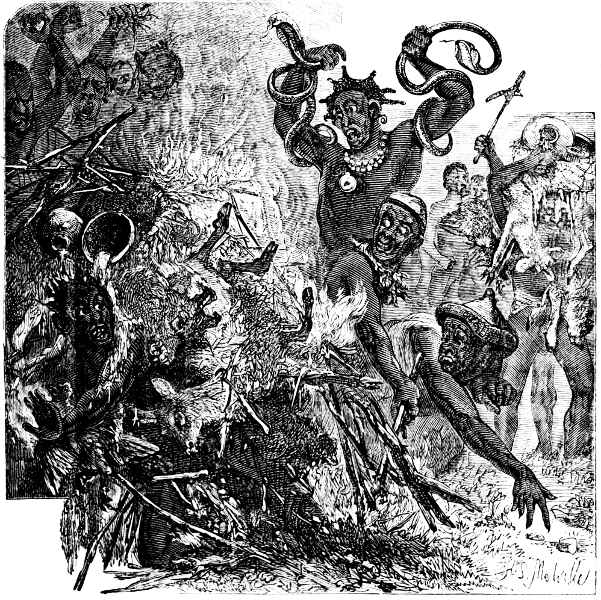
Punishment for Killing Fetish Snakes.
“May 1st.—Punishment was inflicted for accidentally killing two fetish snakes, while clearing some rubbish in the French fort. This is one of the most absurd as well as savage customs I ever witnessed or heard of. Still it is not so bad as it was in the reign of the preceding King of Dahomey, when the law declared the head of the unfortunate individual forfeited for killing one of these reptiles, even by accident. The present king has reduced the capital punishment to that about to be described. On this occasion three individuals were sentenced as guilty of the murder of the fetish snakes. A small house is thereupon made for each individual, composed of dry faggots for walls, and it is thatched with dry grass. The fetish-men then assemble, and fully describe the enormity of the crime committed. Each individual is then smeared over, or rather has a quantity of palm-oil and yeast poured over him, and then a bushel basket is placed on each of their heads. In this basket are placed small calabashes, filled to the brim, so that the slightest motion of the body spills both the oil and the yeast, which runs through the bottom of the basket on to the head. Each individual carries a dog and a kid, as well as two fowls, all fastened together, across his shoulders. The culprits were then marched slowly round their newly-prepared houses, the fetish-men haranguing them all the time. Each individual is then brought to the door of his house, which is not more than four feet high. He is then freed from his burthen, and compelled to crawl into his house on his belly, for the door is only eighteen inches high. He is then shut into this small space with the dog, kid, and two fowls. The house is then fired, and the poor wretch is allowed to make his escape through the flames to the nearest running water. During his journey there he is pelted with sticks and clods by the assembled mob; but if the culprit has any friends, they generally contrive to get nearest to him during his race to the water, and assist him, as well as hinder the mob in their endeavours to injure him. When they reach the water they plunge themselves headlong into it, and are then considered to be cleansed of all the sin or crime of the snake-murder. After the lapse of thirteen days, “custom” or holiday is held here for the deceased snakes.
“The superstitions of the Bonny People are very extraordinary. Whatever animal or other thing they consider sacred they term a “jewjew,” and most common and apparently the principal of these jewjews is the guana, a reptile which in their country obtains a very large size. Several which I saw exceeded three feet and a half in length, and in their appearance were particularly disgusting, being of an unvaried dirty tawny hue. Those which live in the towns are very tame, and several as I passed through the narrow alleys approached and amused themselves in licking the blacking from my shoes. The masses of filth scraped and deposited in corners appeared to be their favourite haunts when no pools were near. There they were observed watching the flies carousing and darting at them their long slender tongues with extraordinary quickness and dexterity. For these, as well as snakes, which are likewise jewjews, small spaces are enclosed and diminutive huts erected in various parts near the sea and in the interior of the country. To kill either is considered by the natives as a capital offence and punished with death; yet towards whites so offending they do not resort to such a severe measure, but merely content themselves by strongly censuring them for their profane conduct. When, however, a very flagrant instance occurs, and the white man is not individually known by those of the natives witnessing the act, it is likely that in the first transport of their anger he may be made to atone for his offence with his life; for though the whites themselves are termed jewjews, this, in all probability, is merely a nominal title confered as a compliment.”
The king of Bonny, though often invited, will never venture on board a man-of-war, but sometimes visits the merchant vessels, proceeding from the shore in a war canoe in great form, but as he approaches he always keeps aloof till the compliment of a heavy salute is paid him. He then goes close to the ship’s side and breaks a new-laid hen’s egg against it, after which he ascends the deck fully persuaded that by the performance of this ceremony he has fortified himself against any act of treachery. For other reasons, or perhaps none that he can explain, he likewise takes with him a number of feathers and his father’s arm bone, which, on sitting down to dinner, he places on the table beside his plate. He also has at the same time a young chicken dangling by one leg (the other being cut off) from his neck.
The bar of the river Bonny has sometimes proved fatal to vessels resorting thither, and being therefore injurious to the trade of the place, the inhabitants, considering it as an evil deity, endeavour to conciliate its good will by sacrificing at times a human victim upon it. The last ceremony of this sort took place not a very long time before our arrival. The handsomest and finest lad that could be procured was chosen for the purpose, and for several months before the period fixed for the close of his existence he was lodged with the king, who on account of his mild demeanour and pleasing qualities soon entertained a great affection for him, yet, swayed by superstitious fanaticism, he made no attempt to save him, but on the contrary regarded the fate to which the unfortunate lad was destined as the greatest honour that could be conferred upon him. From the time that he was chosen to propitiate by his death the forbearance of the bar he was considered as a sacred person; whatever he touched, even while casually passing along, was thenceforth his, and therefore when he appeared abroad the inhabitants fled before him to save the apparel which they had on or any articles which at the time they might be carrying. Unconscious, as it was affirmed, of the fate intended for him, he was conveyed in a large canoe to the bar and there persuaded to jump overboard to bathe, while those who took him out immediately turned their backs upon him and paddled away with the utmost haste, heedless of the cries of the wretched victim, at whom, pursuant to their stern superstition, not even a look was allowed to be cast back.
In Abo, says Mr. Bakie, every man and every woman of any consequence keeps as “dju-dju,” or jewjew, the lower jaw of a pig, or, until they can procure this, a piece of wood fashioned like one. This is preserved in their huts, and produced only when worshipped or when sacrifices are made to it, which are at certain times, at intervals of from ten days to three weeks. The particular days are determined by the dju-dju, with palm wine and touching it with a kola-nut; they speak to it and ask it to be good and propitious towards them. It is named Agba, meaning pig, or Agba-Ezhi, pig’s jaw; but when as dju-dju, it is also termed Ofum, or “my image.” People also select particular trees near their huts, or if there are none in the neighbourhood, they transplant one; these they worship, and call Tuhukum, or “my God.” They hang on these, bits of white baff (calico) as signs of a dju-dju tree, and as offerings to the deity. No one ever touches these, and if they rot off they are replaced. Little wooden images are also used, and are styled Ofo Tuhuku, “talk and pray.” When a man is suspected of falsehood, one of these is placed in his right hand, and he is made to swear by it, and if he does so falsely, it is believed that some evil will speedily befall him. Sacrifices, principally of fowls, are made to these latter as to the former. At Abo one large tree is held as dju-dju for the whole district; it is covered with offerings, and there is an annual festival in honour of it, when sacrifices of fowls, sheep, goats, and bullocks are made. When a man goes to Aro to consult Tshuku he is received by some of the priests outside of the town, near a small stream. Here he makes an offering; after which a fowl is killed, and if it appears unpropitious, a quantity of a red dye, probably camwood, is spilt into the water, which the priest tells the people is blood, and on this the votary is hurried off by the priests and is seen no more, it being given out that Tshuku has been displeased, and has taken him. The result of this preliminary ceremony is determined in general by the amount of the present given to the priests; and those who are reported to have been carried off by Tshuku are usually sold as slaves. Formerly they were commonly sent by canoes to Old Kalabar, and disposed of there. One of Mr. Bakie’e informants met upwards of twenty such unfortunates in Cuba, and another had also fallen in with several at Sierra Leone. If, however, the omen be pronounced to be favourable, the pilgrim is permitted to draw near to the shrine, and after various rites have been gone through, the question, whatever it may be, is propounded of course through the priests, and by them also the reply is given. A yellow powder is given to the devotee, who rubs it round his eyes. Little wooden images are also issued as tokens of a person having actually consulted the sacred oracle, and these are known as Ofo Tshuku, and are afterwards kept as dju-dju. A person who has been at Aro, after returning to his home is reckoned dju-dju, or sacred, for seven days, during which period he must stay in his house, and people dread to approach him. The shrine of Tshuku is said to be situated nearly in the centre of the town, and the inhabitants of Aro are often styled Omo Tshuku, or “God’s children.”
Mondzo is a bad or evil spirit in this country. The worst of evil spirits is named Kamallo, possibly equivalent with Satan. His name is frequently bestowed on children, and in some parts of Igbo, especially in Isuama, Kamallo is worshipped. No images are made, but a hut is set apart in which are kept bones, pieces of iron, etc., as sacred. Persons make enquiries of this spirit, if they wish to commit any wicked action, such as murder, when they bring presents of cowries and cloth to propitiate this evil being and render him favourable to their designs. If the individual intended as the victim suspects anything, or gets a hint of his adversary’s proceedings, he also comes to worship, bringing with him, if possible, more valuable offerings to try to avert the impending danger, and this is called Erise nao, or “I cut on both sides.” In Isuama, if a man is sick, the doctor often tells the friends to consult an evil spirit called Igwikalla, and he is also worshipped by persons wishing to injure others. His supposed abode is generally in a bush, which has been well cleared all round; but occasionally huts are dedicated to him, and priests execute his decrees.
Among savages who have no conception of the existence of a Supreme Being must be enumerated the “Sambos,” a race of Indians residing on the shores of the Mosquito River. The only person who is dreaded as a priestess, or “medicine-woman,” is the Sukia. This woman possesses more power than the king or chiefs. Her orders, even though of the most brutal and inhuman kind (as often they are), are never disputed nor neglected. When Mr. Bard visited the Sambos he saw a Sukia, whom he describes as a person hideous and disgusting in the extreme. “Her hair was long and matted, and her shrivelled skin appeared to adhere like that of a mummy to her bones; for she was emaciated to the last degree. The nails of her fingers were long and black, and caused her hands to look like the claws of some unclean bird. Her eyes were bloodshot, but bright and intense, and were constantly fixed upon me, like those of some wild beast of prey.” These women, before they assume the office, wander away into the forest and live for a considerable time, without arms or clothing of any kind as a defence against the wild beasts and still wilder elements of the tropics. It is during their residence in the woods that they become initiated into the mysteries of nature, and doubtless obtain their antidotes for serpent charming and other wonderful performances for which they are so famous, such as standing in the midst of flames uninjured. The author of “Waikna” gives a very interesting and amusing account of one of these ceremonies as witnessed by him. “The Sukia made her appearance alone, carrying a long thick wand of bamboo, and with no dress except the ule tourno. She was only inferior to her sister of Sandy Bay in ugliness, and stalked into the house like a spectre, without uttering a word. He cut off a piece of calico and handed it to her as her recompense. She received it in perfect silence, walked into the yard, and folded it carefully on the ground. Meanwhile a fire had been kindled of pine splints and branches, which was now blazing high. Without any hesitation the Sukia walked up to it and stepped in its very centre. The flames darted their forked tongues as high as her waist; the coals beneath and around her naked feet blackened, and seemed to expire; while the tourno which she wore about her loins cracked and shivered with the heat. There she stood, immovable and apparently as insensible as a statue of iron, until the blaze subsided, when she commenced to walk around the smouldering embers, muttering rapidly to herself in an unintelligible manner. Suddenly she stopped, and placing her foot on the bamboo staff, broke it in the middle, shaking out, from the section in her hand, a full-grown tamagesa snake, which on the instant coiled itself up, flattened its head, and darted out its tongue, in an attitude of defiance and attack. The Sukia extended her hand, and it fastened on her wrist with the quickness of light, where it hung dangling and writhing its body in knots and coils, while she resumed her mumbling march around the embers. After awhile, and with the same abruptness which had marked all her previous movements, she shook off the serpent, crushed its head in the ground with her heel, and taking up the cloth which had been given to her, stalked away, without having exchanged a word with any one present.”
Perhaps the secret of it lies in the non-existence of the sting, which may be extracted, as is frequently done by the Arab serpent-charmer. Anyhow, such powers are greatly dreaded by the simple and superstitious savage, who regard the Sukia as a supernatural person.
The Tinguians of the Phillipine Islands are in an almost equally benighted condition. They have no veneration for the stars; they neither adore the sun, nor moon, nor the constellations; they believe in the existence of a soul, and pretend that after death it quits the body, and remains in the family of the defunct.
As to the god that they adore, it varies and changes form according to chance and circumstances. And here is the reason: “When a Tinguian chief has found in the country a rock, or a trunk of a tree, of a strange shape—I mean to say, representing tolerably well either a dog, cow, or buffalo—he informs the inhabitants of the village of his discovery, and the rock, or trunk of a tree, is immediately considered as a divinity—that is to say, as something superior to man. Then all the Indians repair to the appointed spot, carrying with them provisions and live hogs. When they have reached their destination they raise a straw roof above the new idol, to cover it, and make a sacrifice by roasting hogs; then, at the sound of instruments, they eat, drink, and dance until they have no provisions left. When all is eaten and drank, they set fire to the thatched roof, and the idol is forgotten, until the chief, having discovered another one, commands a new ceremony.”
It has been already noticed in these pages, that the Malagaseys are utterly without religion. Their future state is a matter that never troubles them; indeed, they have no thought or hope beyond the grave, and are content to rely on that absurd thing “sikidy” for happiness on this side of it. Thanks, however, to Mr. Robert Drury (whom the reader will recollect as the player of a neat trick on a certain Malagasey Umossee), we are informed that a century or so back there prevailed in this gloomy region a sort of religious rite known as the “Ceremony of the Bull,” and which was performed as follows:
The infant son of a great man called Dean Mevarrow was to be presented to the “lords of the four quarters of the earth,” and like many other savage rite began and ended with an enormous consumption of intoxicating liquor. In this case the prime beverage is called toak, and, according to Mr. Drury, “these people are great admirers of toak, and some of the vulgar sort are as errant as sots and as lazy as any in England; for they will sell their Guinea corn, carravances—nay, their very spades and shovels—and live upon what the woods afford them. Their very lamber (a sort of petticoat) must go for toak, and they will go about with any makeshift to cover their nakedness.”
Now for the ceremony. “The toak was made for some weeks beforehand by boiling the honey and combs together as we in England make mead. They filled a great number of tubs, some as large as a butt and some smaller; a shed being built for that purpose, which was thatched over, to place them in. On the day appointed, messengers were despatched all round the country to invite the relations and friends. Several days before the actual celebration of the ceremony there were visible signs of its approach. People went about blowing of horns and beating of drums, both night and day, to whom some toak was given out of the lesser vessels as a small compensation for their trouble. They who came from a long distance took care to arrive a day or two before, and were fed and entertained with toak to their heart’s content. On the evening preceding the feast I went into the town and found it full of people, some wallowing on the ground, and some staggering; scarcely one individual sober, either man, woman, or child. And here one might sensibly discern the sense of peace and security, the people abandoning themselves without fear or reserve to drinking and all manner of diversions. My wife” (Mr. Drury got so far reconciled to his state as to marry a fellow slave) “I found had been among them indeed, but had the prudence to withdraw in time, for she was fast asleep when I returned home.
“On the morning of the ceremony I was ordered to fetch in two oxen and a bull that had been set aside for the feast, to tie their legs, and to throw them along upon the ground. A great crowd had by this time collected around the spot where the child was, decked with beads, and a skin of white cotton thread wound about his head. The richest of the company brought presents for the child—beads, hatchets, iron shovels, and the like, which, although of no immediate value to him, would doubtless be saved from rusting by his parents. Every one was served once with toak, and then the ceremony began.
“For some time the umossee had been, to all appearance, measuring his shadow on the ground, and presently finding its length to his mind, he gave the word. Instantly one of the child’s relatives caught him up and ran with him to the prostrate bull, and putting the child’s right hand on the bull’s right horn, repeated a form of words of which the following is as nigh a translation as I can render: ‘Let the great God above, the lords of the four quarters of the world, and the demons, prosper this child and make him a great man. May he prove as strong as this bull and overcome all his enemies.’ If the bull roars while the boy’s hand is on his horn they look upon it as an ill omen portending either sickness or some other misfortune in life. All the business of the umossee is nothing more than that above related; for as to the religious part of the ceremony he is in nowise concerned in it, if there be any religion intended by it, which is somewhat to be questioned.
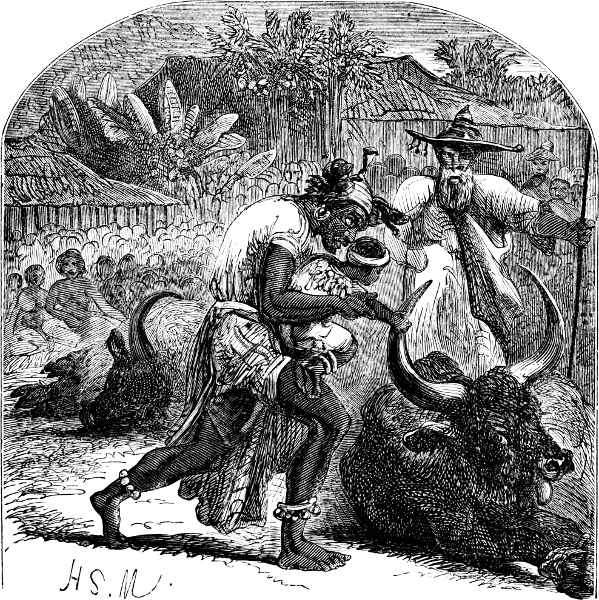
Ceremony of Touching the Bull.
“The ceremony being over the child is delivered to its mother, who all this time is sitting on a mat, with the women round her; and now the merriment began: the thatch was all pulled off the toak house, and I was ordered to kill the bull and the oxen; but these not being sufficient my master sent for three more which had been brought by his friends, for there was abundance of mouths to feed. Before they began to drink he took particular care to secure all their weapons, and no man was permitted to have so much as a gun or a lance; and then they indulged themselves in boiling, broiling and roasting of meat, drinking of toak, singing, hollowing, blowing of shells, and drumming with all their might and main; and so the revel continued through that night and the next day.”
It is very curious, and were it not so serious a matter, could scarcely fail to excite the risible faculties of the reader, to read the outrageous notions entertained by African savages concerning religion generally. Take the case of King Peppel, a potentate of “Western Africa, and the descendant of a very long line of kings of that name (originally “Pepper” or “Pepperal,” and so named on account of the country’s chief trade being, in ancient times, nearly limited to pepper). Thanks to the missionaries, King Peppel had been converted from his heathen ways and brought to profess Christianity. As to the quality of the monarch’s religious convictions, the following conversation between him and a well-known Christian traveller may throw a light:
“What have you been doing, King Peppel?”
“All the same as you do—I tank God.”
“For what?”
“Every good ting God sends me.”
“Have you seen God?”
“Chi! No; suppose man see God he must die one minute” (He would die in a moment).
“When you die won’t you see God?”
With great warmth, “I know no savvy (I don’t know). How should I know? Never mind, I no want to hear more for that palaver” (I want no more talk on that subject).
“What way?” (Why?)
“It no be your business; you come here for trade palaver.”
I knew, says the missionary in question, it would be of no use pursuing the subject at that time, so I was silent, and it dropped for the moment.
In speaking of him dying I had touched a very tender and disagreeable chord, for he looked very savage and sulky, and I saw by the rapid changes in his countenance that he was the subject of some internal emotion. At length he broke out using most violent gesticulations, and exhibiting a most inhuman expression of countenance, “Suppose God was here I must kill him, one minute.”
“You what? You kill God?” exclaimed I, quite taken aback and almost breathless with the novel and diabolical notion, “You kill God? why you talk all some fool (like a fool); you cannot kill God; and suppose it possible that He could die, everything would cease to exist. He is the Spirit of the Universe. But he can kill you.”
“I know I cannot kill him; but suppose I could kill him I would.”
“Where does God live?”
“For top.”
“How?” He pointed to the zenith.
“And suppose you could, why would you kill him?”
“Because he makes men to die.”
“Why, my friend,” in a conciliatory manner, “you would not wish to live for ever, would you?”
“Yes; I want to stand” (remain for ever).
“But you will be old by-and-by, and if you live long enough will become very infirm, like that old man,” pointing to a man very old for an African, and thin, and lame, and almost blind, who had come into the court during the foregoing conversation to ask some favour, “and like him you will become lame, and deaf, and blind, and will be able to take no pleasure; would it not be better, then, for you to die when this takes place, and you are in pain and trouble, and so make room for your son as your father did for you?”
“No, it would not. I want to stand all same I stand now.”
“But supposing you should go to a place of happiness after death, and——”
“I no savvy nothing about that. I know that I now live and have too many wives and niggers (slaves) and canoes” (he did not mean it when he said he had too many wives, etc.; it is their way of expressing a great number), “and that I am king, and plenty of ships come to my country. I know no other ting, and I want to stand.”
I offered a reply, but he would hear no more, and so the conversation on that subject ceased, and we proceeded to discuss one not much more agreeable to him, the payment of a very considerable debt which he owed me.
Getting round to the south of Africa we find but little improvement in the matter of the religious belief of royalty, at least according to what may be gleaned from another “conversation,” this time between the missionary Moffat and an African monarch:
“Sitting down beside this great man, illustrious for war and conquest, and amidst nobles and councillors, including rain-makers and others of the same order, I stated to him that my object was to tell him my news. His countenance lighted up, hoping to hear of feats of war, destruction of tribes, and such-like subjects, so congenial to his savage disposition. When he found my topics had solely a reference to the Great Being, of whom the day before he had told me he knew nothing, and of the Saviour’s mission to this world, whose name he had never heard, he resumed his knife and jackal’s skin and hummed a native air. One of his men sitting near me appeared struck with the character of the Redeemer, which I was endeavouring to describe, and particularly with his miracles. On hearing that he raised the dead he very naturally exclaimed, ‘What an excellent doctor he must have been to make dead men alive.’ This led me to describe his power and how the power would be exercised at the last day in raising the dead. In the course of my remarks the ear of the monarch caught the startling news of a resurrection. ‘What,’ he exclaimed with astonishment, ‘what are these words about; the dead, the dead arise?’ ‘Yes,’ was my reply, ‘all the dead shall arise.’ ‘Will my father arise?’ ‘Yes,’ I answered, ‘your father will arise.’ ‘Will all the slain in battle arise?’ ‘Yes.’ ‘And will all that have been killed and devoured by lions, tigers, hyænas, and crocodiles, again revive?’ ‘Yes, and come to judgment.’ ‘And will those whose bodies have been left to waste and to wither on the desert plains, and scattered to the winds, arise?’ he asked with a kind of triumph, as if he had now fixed me. ‘Yes,’ I replied, ‘not one will be left behind.’ This I repeated with increased emphasis. After looking at me for a few moments he turned to his people, to whom he spoke with a stentorian voice: ‘Hark, ye wise men, whoever is among you the wisest of past generations, did ever your ears hear such strange and unheard-of news?’ and addressing himself to one whose countenance and attire showed that he had seen many years and was a personage of no common order, ‘Have you ever heard such strange news as these?’ ‘No,’ was the sage’s answer; ‘I had supposed that I possessed all the knowledge of the country, for I have heard the tales of many generations. I am in the place of the ancients, but my knowledge is confounded with the words of his mouth. Surely he must have lived long before the period when we were born.’ Makaba then turning and addressing himself to me, and laying his hand on my breast, said: ‘Father, I love you much. Your visit and your presence have made my heart white as milk. The words of your mouth are sweet as honey, but the words of a resurrection are too great to be heard. I do not wish to hear again about the dead rising; the dead cannot arise; the dead must not arise.’ ‘Why,’ I enquired, ‘can so great a man refuse knowledge and turn away from wisdom? Tell me, my friend, why I must not speak of a resurrection.’ Raising and uncovering his arm, which had been strong in battle, and shaking his hand as if quivering a spear, he replied, ‘I have slain my thousands, and shall they arise?’ Never before had the light of divine revelation dawned upon his savage mind, and of course his conscience had never accused him; no, not for one of the thousands of deeds of rapine and murder which had marked his course through a long career.
“Addressing a Namaqua chief, I asked, ‘Did you ever hear of a God?’ ‘Yes, we have heard that there is a God, but we do not know right.’ ‘Who told you that there is a God?’ ‘We heard it from other people.’ ‘Who made the sea?’ ‘A girl made it on her coming to maturity, when she had several children at once. When she made it the sweet and bitter waters were separated. One day she sent some of her children to fetch sweet water whilst the others were in the field, but the children were obstinate and would not fetch the water, upon which she got angry and mixed the sweet and bitter waters together; from that day we are no longer able to drink the water, and people have learned to swim and run upon the water.’ ‘Did you ever see a ship?’ ‘Yes, we have seen them a long time ago.’ ‘Did you ever hear who made the first one?’ ‘No, we never heard it.’ ‘Did you never hear old people talk about it?’ ‘No, we never heard it from them.’ ‘Who made the heavens?’ ‘We do not know what man made them.’ ‘Who made the sun?’ ‘We always heard that those people at the sea made it; when she goes down they cut her in pieces and fry her in a pot and then put her together again and bring her out at the other side. Sometimes the sun is over our head and at other times she must give place to the moon to pass by.’ They said the moon had told to mankind that we must die and not become alive again; that is the reason that when the moon is dark we sometimes become ill. ‘Is there any difference between man and beast?’ ‘We think man made the beasts.’ ‘Did you ever see a man that made beasts?’ ‘No; I only heard so from others.’ ‘Do you know you have a soul?’ ‘I do not know it.’ ‘How shall it be with us after death?’ ‘When we are dead, we are dead; when we have died we go over the sea-water at that side where the devil is.’ ‘What do you mean by devil?’ ‘He is not good; all people who die run to him.’ ‘How does the devil behave to them, well or ill?’ ‘You shall see; all our people are there who have died (in the ships). Those people in the ships are masters over them.’”
With such rulers it is not surprising to find the common people woefully ignorant and superstitious. The crocodile figures prominently in their religious belief. In the Bamangwato and Bakwain tribes, if a man is either bitten, or even has had water splashed over him with a reptile’s tail, he is expelled his tribe. “When on the Zouga,” says Dr. Livingstone, “we saw one of the Bamangwato living among the Bayeye, who had the misfortune to have been bitten, and driven out of his tribe in consequence. Fearing that I would regard him with the same disgust which his countrymen profess to feel, he would not tell me the cause of his exile; but the Bayeye informed me of it; and the scars of the teeth were visible on his thigh. If the Bakwains happened to go near an alligator, they would spit on the ground and indicate his presence by saying “Boles ki bo,” There is sin. They imagine the mere sight of it would give inflammation of the eyes; and though they eat the zebra without hesitation, yet if one bites a man he is expelled the tribe, and is obliged to take his wife and family away to the Kalahari. These curious relics of the animal worship of former times scarcely exist among the Makololo. Sebituane acted on the principle, “Whatever is food for men is food for me,” so no man is here considered unclean. The Barotse appear inclined to pray to alligators, and eat them too, for when I wounded a water antelope, called onochose, it took to the water. When near the other side of the river, an alligator appeared at its tail, and then both sank together. Mashauana, who was nearer to it than I, told me that though he had called to it to let his meat alone, it refused to listen.”
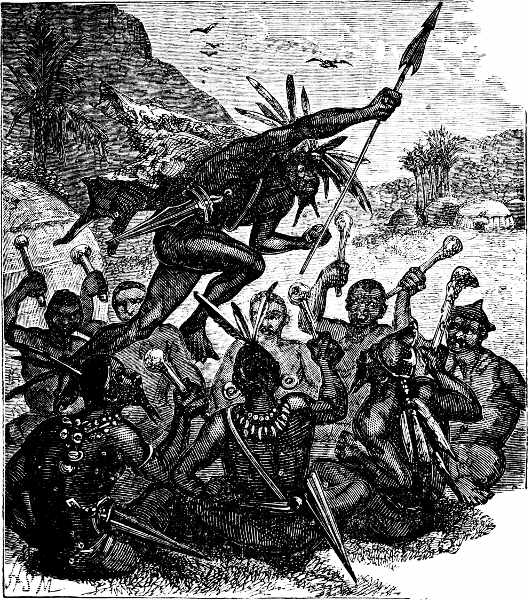
Divination Scene.
The Southern African has most implicit belief in witch power. Whatever is incomprehensible to him must be submitted to a “witch man,” and be by him construed. While Mr. Casalis was a guest among the Basutos, he had opportunity of witnessing several of these witch ceremonies. Let the reader picture to himself a long procession of black men almost in a state of nudity, driving an ox before them, advancing towards a spot of rising ground, on which are a number of huts surrounded with reeds. A fierce-looking man, his body plastered over with ochre, his head shaded by long feathers, his left shoulder covered with a panther skin, and having a javelin in his hand, springs forwards, seizes the animal, and after shutting it up in a safe place, places himself at the head of the troop, who still continue their march. He then commences the song of divination, and every voice joins in the cry. “Death, death, to the base sorcerer who has stolen into our midst like a shadow. We will find him, and he shall pay with his head. Death, death to the sorcerer.” The diviner then brandishes his javelin, and strikes it into the ground as if he were already piercing his victim. Then raising his head proudly, he executes a dance accompanied with leaps of the most extraordinary kind, passing under his feet the handle of his lance, which he holds with both hands. On reaching his abode, he again disappears, and shuts himself up in a hut into which no one dare enter. The consulters then stop and squat down side by side, forming a complete circle. Each one has in his hand a short club. Loud acclamations soon burst forth, the formidable diviner comes forth from his sanctuary where he has been occupied in preparing the sacred draught, of which he has just imbibed a dose sufficient to enable him to discover the secrets of all hearts. He springs with one bound into the midst of the assembly: all arms are raised at once, and the ground trembles with the blows of the clubs. If this dismal noise does not awake the infernal gods whom he calls to council, it serves at least to strike terror into the souls of those wretches who are still harbouring sinister designs. The diviner recites with great volubility some verses in celebration of his own praise, and then proceeds to discover of what the present consists, which he expects in addition to the ox he has already received, and in whose hands this present will be found. This first trial of his clairvoyance is designed to banish every doubt. One quick glance at a few confederates dispersed throughout the assembly apprises them of their duty.
“There are,” cries the black charlatan, “many objects which man may use in the adornment of his person. Shall I speak of those perforated balls of iron which we get from Barolong?”
The assembly strike the ground with their clubs, but the confederates do it gently.
“Shall I speak of those little beads of various colours which the whites as we are told pick up by the sea side?”
All strike with equal violence.
“I might have said rather that you had brought me one of those brilliant rings of copper.”
The blows this time are unequal.
“But no, I see your present; I distinguish it perfectly well.... It is the necklace of the white men.”
The whole assembly strike on the ground violently. The diviner is not mistaken.
But he has disappeared; he is gone to drink a second dose of the prepared beverage.
Now he comes again. During the first act the practised eye has not failed to observe an individual who seemed to be more absorbed than the rest, and who betrayed some curiosity and a considerable degree of embarrassment. He knows therefore who is in possession of the present; but in order to add a little interest to the proceedings, he amuses himself for an instant, turns on his heel, advances now to one, now to the other, and then with the certainty of a sudden inspiration, rushes to the right one and lifts up his mantle.
Now he says, “Let us seek out the offender. Your community is composed of men of various tribes. You have among you Bechuanas (unequal blows on the ground), Batlokoas (blows still unequal), Basias (all strike with equal violence), Bataungs (blows unequal). For my own part, I hate none of those tribes. The inhabitants of the same country ought all to love one another without any distinction of origin. Nevertheless, I must speak. Strike, strike, the sorcerer belongs to the Basias.”
Violent and prolonged blows.
The diviner goes again to drink from the vessel containing his wisdom. He has now only to occupy himself with a very small fraction of the criminated population. On his return he carefully goes over the names of the individuals belonging to this fraction. This is very easy in a country where almost all the proper names are borrowed from one or other of the kingdoms of nature. The different degrees of violence with which the clubs fall upon the ground give him to understand in what order he must proceed in his investigation, and the farce continues thus till the name of the culprit is hit on, and the farce of trial is brought to an end, and the tragedy of punishment begins.
The Damaras of South Africa have some curious notions about the colour of oxen: some will not eat the flesh of those marked with red spots; some with black, or white; or should a sheep have no horns, some will not eat the flesh thereof. So, should one offer meat to a Damara, very likely he will ask about the colour of the animal; whether it had horns or no. And should it prove to be forbidden meat, he will refuse it; sometimes actually dying of hunger rather than partake of it. To such an extent is this religious custom carried out, that sometimes they will not approach any of the vessels in which the meat is cooked; and the smoke of the fire by which it is cooked is considered highly injurious. For every wild animal slain by a young man, his father makes four oblong incisions in front of his body; moreover, he is presented with a sheep or cow, the young of which, should it have any, are slaughtered and eaten; males only are allowed to partake of it. Should a sportsman return from a successful hunt, he takes water in his mouth, and ejects it three times over his feet, as also in the fire of his own hearth. When cattle are required for food, they are suffocated; but when for sacrifices, they are speared.
One of the most lucrative branches of a heathen priest’s profession is the “manufacture” of rain; at the same time, and as may be easily understood, the imposture is surrounded by dangers of no ordinary nature. If the rain fall within a reasonable time, according to the bargain, so delighted are the people, made as they are in droughty regions contented and happy, whereas but yesterday they were withering like winter stalks, that the rain maker is sure to come in for abundant presents over and above the terms agreed on. But should the rain maker fail in the terms of his contract, should he promise “rain within three days,” and the fourth, and the fifth, and the sixth, and the seventh day arrive, and find the brilliant sky untarnished, and the people parched and mad with thirst, what more horrible position can be imagined than his whose fault it appears to be that the universal thirst is not slaked? “There never was yet known a rain maker,” writes a well-known missionary, “who died a natural death.” No wonder! The following narrative of the experiments and perplexities of a rain maker furnished by Mr. Moffat may be worth perusal.
Having for a number of years experienced severe drought, the Bechuanas at Kuruman held a council as to the best measures for removing the evil. After some debate a resolution was passed to send for a rain maker of great renown, then staying among the Bahurutsi, two hundred miles north-east of the station. Accordingly commissioners were dispatched, with strict injunctions not to return without the man; but it was with some misgiving as to the success of their mission that the men started. However, by large promises, they succeeded beyond their most sanguine expectations.
During the absence of the ambassadors the heavens had been as brass, and scarcely a passing cloud obscured the sky, which blazed with the dazzling rays of a vertical sun. But strange to relate the very day that the approach of the rain maker was announced, the clouds began to gather thickly, the lightning darted and the thunder rolled in awful grandeur, accompanied by a few drops of rain. The deluded multitude were wild with delight; they rent the sky with their acclamations of joy, and the earth rang with their exulting and maddening shouts. Previously to entering the town, the rain maker sent a peremptory order to all the inhabitants to wash their feet. Scarcely was the message delivered before every soul, young and old, noble and ignoble, flew to the adjoining river to obey the command of the man whom they imagined was now collecting in the heavens all his stores of rain.
The impostor proclaimed aloud that this year the women must cultivate gardens on the hills and not in the valleys, for the latter would be deluged. The natives in their enthusiasm saw already their corn-fields floating in the breeze and their flocks and herds return lowing homewards by noonday from the abundance of pasture. He told them how in his wrath he had desolated the cities of the enemies of his people by stretching forth his hand and commanding the clouds to burst upon them; how he had arrested the progress of a powerful army by causing a flood to descend, which formed a mighty river and stayed their course. These and many other pretended displays of his power were received as sober truths, and the chief and the nobles gazed on him with silent amazement. The report of his fame spread like wildfire, and the rulers of the neighbouring tribes came to pay him homage.
In order to carry on the fraud, he would, when clouds appeared, command the women neither to plant nor sow, lest the seeds should be washed away. He would also require them to go to the fields and gather certain roots of herbs, with which he might light what appeared to the natives mysterious fires. Elate with hope, they would go in crowds to the hills and valleys, collect herbs, return to the town with songs, and lay the gatherings at the magician’s feet. With these he would sometimes proceed to certain hills and raise smoke; gladly would he have called up the wind also, if he could have done so, well knowing that the latter is frequently the precursor of rain. He would select the time of new and full moon for his purpose, aware that at those seasons there was frequently a change in the atmosphere. But the rain maker found the clouds in these parts rather harder to manage than those of the Bahurutsi country, whence he came.
One day as he was sound asleep a shower fell, on which one of the principal men entered his house to congratulate him on the happy event; but to his utter amazement he found the magician totally insensible to what was transpiring. “Hela ka rare (halloo, by my father)! I thought you were making rain,” said the intruder. Arising from his slumber, and seeing his wife sitting on the floor shaking a milk sack in order to obtain a little butter to anoint her hair, the wily rain maker adroitly replied, “Do you not see my wife churning rain as fast as she can?” This ready answer gave entire satisfaction, and it presently spread through the town that the rain maker had churned the rain out of a milk sack.
The moisture, however, caused by this shower soon dried up, and for many a long week afterwards not a cloud appeared. The women had cultivated extensive fields, but the seed was lying in the soil as it had been thrown from the hand; the cattle were dying for want of pasture, and hundreds of emaciated men were seen going to the fields in quest of unwholesome roots and reptiles, while others were perishing with hunger.
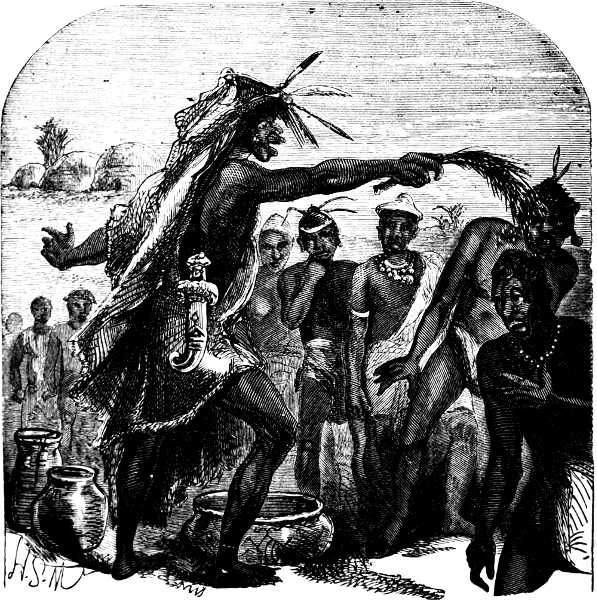
Making Rain.
All these circumstances irritated the rain maker very much, and he complained that secret rogues were disobeying his proclamations. When urged to make repeated trials, he would reply, “You only give me sheep and goats to kill, therefore I can only make goat rain; give me fat slaughter oxen, and I shall let you see ox rain.”
One night a small cloud passed over, and a single flash of lightning, from which a heavy peal of thunder burst, struck a tree in the town. Next day the rain maker and a number of people assembled to perform the usual ceremony on such an event. The stricken tree was ascended, and roots and ropes of grass were bound round different parts of the trunk. When these bandages were made, the conjuror deposited some of his nostrums, and got quantities of water handed up, which he poured with great solemnity on the wounded tree, while the assembled multitude shouted. The tree was now hewn down, dragged out of the town and burned to ashes. Soon after the rain maker got large bowls of water, with which was mixed an infusion of bulbs. All the men of the town were then made to pass before him, when he sprinkled each person with a zebra’s tail dipped in water.
Finding that this did not produce the desired effect, the impostor had recourse to another stratagem. He well knew that baboons were not very easily caught amongst rocky glens and shelving precipices, and therefore, in order to gain time, he informed the men that to make rain he must have a baboon. Moreover, that not a hair on its body was to be wanting; in short the animal should be free from blemish. After a long and severe pursuit, and with bodies much lacerated, a band of chosen runners succeeded in capturing a young baboon, which they brought back triumphantly and exultingly. On seeing the animal, the rogue put on a countenance exhibiting the most intense sorrow, exclaiming, “My heart is rent in pieces! I am dumb with grief!” pointing at the same time to the ear of the baboon that was slightly scratched, and the tail, which had lost some hair. He added, “Did I not tell you I could not bring rain if there was one hair wanting?”
He had often said that if they could procure him the heart of a lion he would show them he could make rain so abundant, that a man might think himself well off to be under shelter, as when it fell it might sweep whole towns away. He had discovered that the clouds required strong medicines, and that a lion’s heart would do the business. To obtain this the rain maker well knew was no joke. One day it was announced that a lion had attacked one of the cattle out-posts, not far from the town, and a party set off for the twofold purpose of getting a key to the clouds and disposing of a dangerous enemy. The orders were imperative, whatever the consequences might be. Fortunately the lion was shot dead by a man armed with a gun. Greatly elated by their success, they forthwith returned with their prize, singing the conqueror’s song in full chorus. The rain maker at once set about preparing his medicines, kindled his fires, and, standing on the top of a hill, he stretched forth his hands, beckoning to the clouds to draw near, occasionally shaking his spear and threatening them with his ire, should they disobey his commands. The populace believed all this and wondered the rain would not fall.
Having discovered that a corpse which had been put into the ground some weeks before had not received enough water at its burial, and knowing the aversion of the Bechuanas to the dead body, he ordered the corpse to be taken up, washed, and re-interred. Contrary to his expectation, and horrible as the ceremony must have been, it was performed. Still the heavens remained inexorable.