Part 11 — CHAPTER XXVI. (continued 2)
Reading edition
The Dayaks acknowledge four chief spirits: “Tapa,” who created men and women, and preserves them in life; “Tenahi,” who made the earth and, except the human race, all things therein, and still causes it to flourish; “Iang,” or “Iing,” who first instructed the Dayaks in the mysteries of their religion, and who superintends its performance; “Jirong,” who looks after the propagation of the human species, and causes them to die of sickness or accident. They believe that when Tapa first made the world, he created Iang, then the spirits “Triee” and “Komang,” and then man. That man and the spirits were at first equal and fought on fair terms, but that on one woeful occasion the spirits got the better of man, and rubbed charcoal in his eyes, which rendered him unable any longer to see his spirit foes, except in the case of some gifted persons, as the priests, and so placed him at their mercy.
With respect to a future state, the common Dayak belief is, that when a man dies, he becomes a spirit and lives in the jungle, or (this Mr. Chalmers heard from one of the body-burning tribes) that as the smoke of the funeral pyre of a good man rises, the soul ascends with it to the sky, and that the smoke from the pyre of a wicked man descends, and his soul with it is borne to the earth, and through it to the regions below. Another version is, that when a man dies a natural death, his soul, on leaving the body, becomes a spirit, and haunts the place of burial or burning. When a spirit dies—for spirits too, it would seem, are subject unto death—it enters the hole of Hades, and coming out thence again becomes a “Bejawi.” In course of time the Bejawi dies, and lives once more as a “Begutur;” but when a Begutur dies, the spiritual essence of which it consists enters the trunks of trees, and may be seen there damp and blood-like in appearance, and has a personal and sentient existence no longer.
The Land Dayaks point to the highest mountains in sight as the abode of their departed friends. The spirits they divide into two classes—“Umot,” spirits by nature, and “Mino,” ghosts of departed men. The former are said to live amid the forests that cap the hills. They delight in war and bloodshed, and always come down to be present at the Dayak “head-feast.” They are described as of a fierce and wild appearance, and covered with hair like an ourang-outang. The Umot spirits are divided into classes. There is the “Umot Sisi,” a harmless kind of spirit which follows the Dayak to look for the fragments of food which have fallen through the open flooring of their houses, and who is heard at night munching away below; “Umot Perubak,” who causes scarcity among the Dayaks by coming invisibly and eating the rice from the pot at meal time; and “Umot Perusong,” who comes slily and devours the rice which is stored within a receptacle made of the bark of some gigantic tree, and is in the form of a vat. It is kept in the garrets of the houses, and a large one will contain a hundred and fifty bushels, and the family live in constant fear that these voracious spirits will visit their store and entirely consume it.
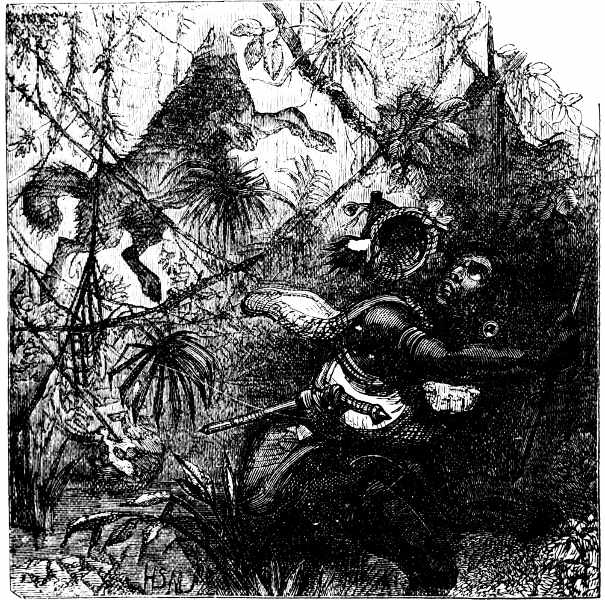
Spectre of Headless Dog and Dayak.
“Mino Buau” are the ghosts of those who have been killed in war. These are very vicious and inimical to the living; they live in the jungle, and have the power of assuming the form of headless beasts and men. A Quop Dayak once met with one. He was walking through the jungle and saw what he thought was a squirrel sitting on the large roots of a tree which overhung a small stream. He had a spear in his hand. This he threw at the squirrel, and thought he had struck it: he ran towards the spot where it had apparently fallen, when, to his horror, it faced him, rose up, and was transformed into a dog. The dog walked on a few paces, and then turning into a human shape, sat down on the trunk of a tree—head there was none. The spectre body was parti-coloured, and at the top drawn up to a point. The Dayak was smitten with great fear and away he rushed home and fell into a violent fever; the priest was called, and he pronounced that the patient’s soul had been summoned away from its corporeal abiding-place by the spirit, so he went to seek it, armed with his magic charms. Midway between the village and the place where the Buau had appeared, the fugitive soul was overtaken, and induced to pause, and, having been captured by the priest, was brought back to its body and poked into its place through an invisible hole in the head. The next day the fever was gone.
To propitiate the superior spirits the Dayaks shut themselves in their houses a certain number of days, and by that, among other means, hope to avert sickness, to cure a favorite child, or to restore their own health. They also have recourse to it when the cry of the gazelle is heard behind them, or when their omen-birds utter unfavorable warnings. They likewise place themselves under this interdict at the planting of rice, at harvest-home, and upon many other occasions. During this time they appear to remain in their houses in order to eat, drink, and sleep; but their eating must be moderate, and often consists of nothing but rice and salt. These interdicts are of different durations and importance. Sometimes, as at the harvest-home, the whole tribe is compelled to observe it, and then no one must leave the village; at other times it only extends to a family or a single individual. It is also considered important that no stranger should break the tabu by entering the village, the house, or apartment placed under interdict. If any one should do so intentionally, he is liable to a fine. People under interdict may not bathe, touch fire, or employ themselves about their ordinary avocations. The religion of the Dayak prohibits the eating of the flesh of horned animals, as cattle and goats, and many tribes extend the prohibition to wild deer. In some tribes none but the elders and the women and children may partake of eggs; in others, they, and no one else, may dine off venison: the young men and the warriors abstaining from it lest it should render them timid as the animal that supplies the last-mentioned meat. It is also strictly commanded to all those intending to engage in a pig hunt to abstain from meddling with oil; but whether for any more important reason than that the game may not slip through their fingers is not exactly known.
A singular custom of a religious character prevails among certain Dayak tribes, and which is known as making brothers. The offer to become the “brother” of one of these savages was made, and what is more accepted, to the gentleman who furnishes the foregoing account of the Dayak religion, as well as the following:
“Singauding sent on board to request me to become his brother by going through the sacred custom of imbibing each other’s blood. I say imbibing, because it is either mixed with water and drunk, or else it is placed within a native cigar and drawn in with the smoke. I agreed to do so, and the following day was fixed for the ceremony. It is called Berbiang by the Kayans; Bersabibah by the Borneans. I landed with our party of Malays, and after a preliminary talk to give time for the population to assemble, the affair commenced. We sat in the broad verandah of a long house, surrounded by hundreds of men, women, and children, all looking eagerly at the white stranger who was about to enter their tribe. Stripping my left arm, Kum Lia took a small piece of wood, shaped like a knife-blade, and slightly piercing the skin brought blood to the surface; this he carefully scraped off; then one of my Malays drew blood in the same way from Singauding; and a small cigarette being produced, the blood on the wooden blades was spread on the tobacco. A chief then arose, and walking to an open place, looked forth upon the river and invoked their god and all the spirits of good and evil to be witness of this tie of brotherhood. The cigarette was then lighted and each of us took several puffs, and the ceremony was concluded. I was glad to find that they had chosen the form of inhaling the blood in smoke, as to have swallowed even a drop would have been unpleasant, though the disgust would only arise from the imagination. They sometimes vary the custom, though the variation may be confined to the Kiniahs who live farther up the river, and are intermarried with the Kayans. There a pig is brought and placed between the two who are to be joined in brotherhood. A chief offers an invocation to the gods, and marks with a lighted brand the pig’s shoulder. The beast is then killed, and after an exchange of jackets, a sword is thrust into the wound and the two are marked with the blood of the pig.”
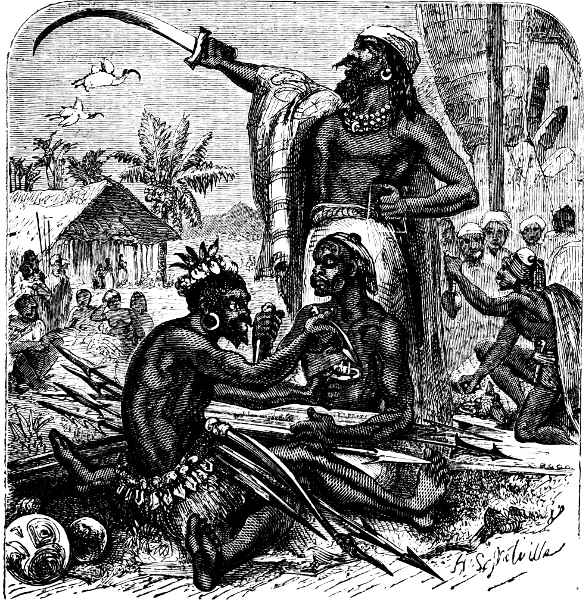
Making Brothers.
This curious ceremony of “making brothers” is not confined to Borneo; it is practised in Western and Eastern Africa. In the latter region the ceremony is invested with much importance, especially when the individuals concerned are two chiefs who have long been at variance. Squatting before each other in the presence of the chiefs and elders with their implements of war on their laps, and having each in his hands a sharp knife and a small cup, the would-be brothers make a slight gash in each other’s breast and, catching the blood in the cup, drink it to their eternal friendship, the oldest man of the tribe standing over them to witness the reconciliation and waving his sword over them.
The Sea Dayaks, whose customs differ widely in many respects from those of the Land Dayaks, have a clear idea of one omnipotent being who created and now rules over the world. They call him Batara. Beneath him are many good and innumerable bad spirits, and the fear of the latter causes them to make greater and more frequent offerings to them than to the good spirits. The awe with which many of them are named has induced a few, among others Mr. Chambers, to imagine that their religion is a species of polytheism. But this, according to Mr. St. John’s way of thinking, is a mistake; and Mr. Johnson and Mr. Gomez, who have much knowledge of the Sea Dayaks, agree with the gentleman formerly mentioned.
The Sea Dayaks pay homage to evil spirits of various kinds, who reside in the jungles, in the mountains, and in the earth; all sicknesses, misfortunes, or death, proceed from them; while to Batara is attributed every blessing. When they make offerings, however, both are propitiated and, as usual, the wicked ones have the larger share. The priests offer a long prayer and supplicate them to depart from the afflicted house or from the sick man. Of the seven platesful of food, four are given to the evil spirits and cast forth or exposed in the forest, while the others are offered to the good spirits, who are implored to protect and bless them. The food offered to the latter is not considered to be interdicted, but may be, and always is eaten.
The Lingga Dayaks, besides Batara, have various good spirits—as Stampandei, who superintends the propagation of mankind; Pulang Ganah, who inhabits the earth and gives fertility to it, and to him are addressed the offerings at the feasts given whilst preparing the rice for cultivation: Singallong Burong, the god of war, excites their utmost reverence, and to him are offered the Head feasts. On these occasions he comes down and hovers in the form of a kite over the house, and guns are fired and gongs beaten in his honour. His brave followers married to his daughters appear in the form of his omen birds. No wonder he is honoured; he gives success in war and delights in their acquisitions of the heads of their enemies. Nattiang inhabits the summits of the hills and is one of their demigods. The Linggas tell many stories of his exploits. The most famous was his expedition to the skies to recover his wife who had been caught in a noose and hoisted up there by an old enemy of his. To dream of him is to receive the gift of bravery.
When the small-pox was committing dreadful havoc among the Sakarangs the villagers would not allow themselves to be innoculated; they ran into the jungle in every direction, caring for no one but themselves, leaving their houses empty and dwelling far away in the most silent spots in parties of two and three and sheltered only by a few leaves. When these calamities come upon them they utterly lose all command over themselves and become as timid as children. When the fugitives become short of provisions a few of the old men who have already had the complaint creep back to the houses at night and take a supply of rice. In the daytime they do not dare to stir or speak above a whisper for fear the spirits should see or hear them. They do not call the small-pox by its name, but are in the habit of saying, “Has he left you?” at other times they call it jungle-leaves or fruit; at other places the Datu or chief.
Their priests frequently use the names of invisible spirits, and are supposed to be able to interpret their language as well as to hold communion with them; and in ordinary times they pretend to work the cure of the sick by means of incantations, and after blinding the patient’s eyes pretend, by the aid of the spirits, to draw the bones of fish or fowl out of their flesh. When the Dayaks are questioned as to their belief in these easily-exposed deceits, they say, No; but the custom has descended to them from their ancestors, and they still pay their priests heavy sums to perform the ancient rites.
They believe in a future state—considering that the Simaūgat or spiritual part of man lives for ever; that they awake shortly after death in the Sabayan or future abode, and that there they find those of their relatives and friends who have departed before them. Some tribes divide their Sabayan into seven distinct stories which are occupied by the souls of the departed according to their rank and position in life. The really wicked occupy the lowest, but whether happy or miserable they acknowledge ignorance.
The Kayans of Baram have some singular ideas concerning a future state. The name of their god is Totadungan and he reigns over all; they say he has a wife but no children, and beneath him are many gods of inferior power. They believe in a future state with separate places for the souls of the good and the bad, and that both heaven and hell are divided into many distinct residences—that those who die from wounds, or sickness, or drowning, go to separate places. If a woman dies before her husband they hold that she goes to heaven and marries again; but that if when her earthly husband dies he goes to heaven the celestial match is broken off and the old husband claims his partner.
Among both Land and Sea Dayaks dreams are regarded as actual occurrences. They think that in sleep the soul sometimes remains in the body and sometimes leaves it and travels far away, and that both when in and out of the body it sees and hears and talks and altogether has a presence given it which when the body is in a natural state it does not enjoy. Fainting fits or a state of coma are thought to be caused by the departure of the soul on some expedition of its own. Elders and priestesses often assert that in their dreams they have visited the mansion of the blessed and seen the Creator dwelling in a house like that of a Malay, the interior of which was adorned with guns and gongs and jars innumerable, Himself being clothed like a Dayak.
A dream of sickness to any member of a family always ensures a ceremony; and no one presumes to enter the priesthood, or to learn the art of a blacksmith, without being or pretending to be warned in a dream that he should undertake to learn it. A man has been known to give one of his two children to another who has no children because he dreamed that unless he did so the child would die.
In dreams also, “Tapa” and the spirits bestow gifts on men in the shape of magic stones, which being washed in cocoa milk the water forms one of the ingredients in the mass of blood and tumeric which is considered sacred and is used to anoint the people at the harvest-feasts. They are ordinary black pebbles, and there is nothing in their appearance to give a notion of their magic power and value.
On the banks of one of the rivers Mr. St. John discovered the effigy of a bull cut in a sort of stone said to be unknown in the country; its legs and part of its head had been knocked off. Its history is as follows:—Many years ago on being discovered in the jungle the Malays and Dayaks removed it to the banks of the river preparatory to its being conveyed to the town, but before it could be put into a prahu they say a tremendous storm of thunder and lightning, wind and rain, arose, which lasted thirty days. Fearing that the bull was angry at being disturbed in his forest home they left him in the mud, and there Sir James Brooke found it and had it removed to his own house. Several of the Dayak tribes sent deputations to him to express their fears of the evil consequences that would be sure to ensue—everything would go wrong, storms would arise, their crops would be blighted, and famine would desolate the land. Humouring their prejudices, he answered that they were mistaken, that the bull on the contrary would be pleased to be removed from the dirty place in which the Malays had left him, and that now he was kept dry and comfortable there would be no show of his anger. This reply satisfied them. Occasionally the Dayaks would come and wash the stone bull, taking away the precious water to fertilize their fields.
Amongst some of the Bornean aborigines there is a superstition that they must not laugh at a dog or a snake crossing their path. Should they do so they would become stones. These Dayaks always refer with respect and awe to some rocks scattered over the summit of a hill in Sadong, saying that they were originally men. The place was a very likely one to be haunted—a noble old forest but seldom visited. Many years ago they say a great chief gave a feast there, in the midst of which his lovely daughter came in; she was a spoilt child who did nothing but annoy the guests. They at first tried to get rid of her by mixing dirt with her food: finding she still teazed them, they gave her poison. Her father in his anger went back to his house, shaved his dog and painted him with alternate streaks of black and white. Then giving him some intoxicating drink he carried him in his arms into the midst of the assembly and set him on the ground. The dog began to caper about in the most ludicrous manner which set them all off laughing, the host as well as the guests, and they were immediately turned into stone.
With one giant stride of our any-number-of-league boots we step from Borneo into North America and among the many semi-savage tribes that there reside. As a rule the North-American savage believes in one Supreme Being whom he knows as the Great Spirit, and whose abode is Paradise, or the “happy hunting ground.” This Supreme Being, however, they regard as much too exalted to trouble himself about the petty businesses of the world, and therefore governs by deputy. There are, according to Indian belief, numerous subordinate deities, the business of each of whom it is to govern and control the earth, the forests and the game there abounding, the winds, the air, and the water, together with its finny denizens. Besides those—at least in the case of the Ojibbeway, who may fairly be taken as the type of the North-American Indian—they have a host of evil spirits or munedoos, or manitou, headed by one arch Matchi-munedoo, and who, it is to be feared on account of their predilection for mischief, occupy a greater portion of the Indian’s time and attention in the way of propitiation and friendly peace-offering, than ever is devoted to Kitchi-manitou, the Great Spirit to whom, if the Indian’s religion is worth a straw, it should be sufficient to obey to render one self-defiant of Matchi-munedoo and all his works.
As might be expected the Indian language is rich in mythological lore, and is often found to be a curious tangle of what we acknowledge as Biblical truth, and nonsense, remarkable chiefly for its quaint grotesqueness. Take the following narrative of the Deluge:
“Before the general deluge there lived two enormous creatures, each possessed of vast power. One was an animal with a great horn on his head; the other was a huge toad. The latter had the whole management of the waters, keeping them secure in its own body, and emitting only a certain quantity for the watering of the earth. Between these two creatures there arose a quarrel, which terminated in a fight. The toad in vain tried to swallow its antagonist, but the latter rushed upon it, and with his horn pierced a hole in its side, out of which the water gushed in floods, and soon overflowed the face of the earth. At this time Nanahbozhoo was living on the earth, and observing the water rising higher and higher, he fled to the loftiest mountain for refuge. Perceiving that even this retreat would be soon inundated, he selected a large cedar tree which he purposed to ascend, should the waters come up to him. Before they reached him he caught a number of animals and fowls, and put them into his bosom. At length the water covered the mountain. Nanahbozhoo then ascended the cedar tree, and as he went up he plucked its branches and stuck them in the belt which girdled his waist. When he reached the top of the tree he sang, and beat the tune with his arrow upon his bow, and as he sang the tree grew and kept pace with the water for a long time. At length he abandoned the idea of remaining any longer on the tree, and took the branches he had plucked, and with them constructed a raft, on which he placed himself with the animals and fowls. On this raft he floated about for a long time, till all the mountains were covered, and all the beasts of the earth and fowls of the air, except those he had with him, perished.
“At length Nanahbozhoo thought of forming a new world, but how to accomplish it without any materials he knew not, till the idea occurred to him that if he could only obtain a little of the earth, which was then under water, he might succeed in making a new world out of the old one. He accordingly employed the different animals he had with him that were accustomed to diving. First, he sent the loon, a water fowl of the penguin species, down into the water in order to bring up some of the old earth; but it was not able to reach the bottom, and after remaining in the water some time, came up dead. Nanahbozhoo then took it, blew upon it, and it came to life again. He next sent the otter, which also failing to reach the bottom, came up dead, and was restored to life in the same manner as the loon. He then tried the skill of the heaver, but without success. Having failed with all these diving animals, he last of all took the musk-rat; on account of the distance it had to go to reach the bottom, it was gone a long time, and came up dead. On taking it up, Nanahbozhoo found, to his great joy, that it had reached the earth, and had retained some of the soil in each of its paws and mouth. He then blew upon it, and brought it to life again, at the same time pronouncing many blessings on it, saying, that as long as the world he was about to make should endure, the musk-rat should never become extinct. This prediction of Nanahbozhoo is still spoken of by the Indians when referring to the rapid increase of the musk-rat. Nanahbozhoo then took the earth which he found in the musk-rat’s paws and mouth, and having rubbed it with his hands to fine dust, he placed it on the waters and blew upon it; then it began to grow larger and larger, until it was beyond the reach of his eye. In order to ascertain the size of the world, and the progress of its growth and expansion, he sent a wolf to run to the end of it, measuring its extent by the time consumed in his journey. The first journey he performed in one day, the second took him five days, the third ten, the fourth a month, then a year, five years, and so on, until the world was so large that Nanahbozhoo sent a young wolf that could just run, which died of old age before he could accomplish the journey. Nanahbozhoo then said the world was large enough, and commanded it to cease from growing. After this Nanahbozhoo took a journey to view the new world he had made, and as he travelled he created various tribes of Indians, and placed them in different parts of the earth; he then gave them various religions, customs, and manners.
“This Nanahbozhoo now sits at the North Pole, overlooking all the transactions and affairs of the people he has placed on the earth. The Northern tribes say that Nanahbozhoo always sleeps during the winter; but, previous to his falling asleep, fills his great pipe, and smokes for several days, and that it is the smoke arising from the mouth and pipe of Nanahbozhoo which produces what is called ‘Indian summer.’”
They have, however, legends that relate to times anterior to the flood, even to the beginning of Time itself and the days of Adam and Eve. Mr. Kohl, of “Lake Superior” celebrity, contributes the following:
“On Torch Lake it is said, that Kitchi-Manitou (the Good Spirit) first made the coast of our lake. He strewed the sand and formed a fine flat dry beach or road round the lake. He found that it was splendid walking upon it, and often wandered along the beach. One day he saw something lying on the white sand. He picked it up. It was a very little root. He wondered whether it would grow if planted in the ground, and made the trial. He planted it close to the edge of the water in the sand, and when he came again, the next day, a thick and large reed-bed had grown out of it through which the wind rustled. This pleased him, and he sought for and collected more little roots and other seeds from the sand and spread them around so that they soon covered the rocks and land with grass and fine forests, in which the birds and other animals came to live. Every day he added something new to the creation, and did not forget to place fish and other creatures in the water.
“One day when Kitchi-Manitou was again walking along the sand, he saw something moving in the reeds, and noticed a being coming out of the water entirely covered with silver-glistening scales like a fish, but otherwise formed like a man. Kitchi-Manitou was curious to see on what the being lived and whether it ate herbs, especially as he saw it constantly stooping and plucking herbs which it swallowed. The man could not speak, but at times when he stooped he sighed and groaned.
“The sight moved Kitchi-Manitou with compassion in the highest degree, and as a good thought occurred to him, he immediately stepped into his canoe and paddled across to the island, which still lies in the centre of the lake. Here he set to work providing the man the company of a squaw. He formed her nearly like what he had seen the man to be, and also covered her body with silver-glistening scales. Then he breathed life into her, and carried her across in his canoe to the other bank of the lake, telling her that if she wandered busily along the lake and looked about her, she would perhaps find something to please her. For days the squaw wandered about one shore of the lake, while the man was seeking herbs for food on the other. One day the latter went a little further, and, to his great surprise, saw footsteps in the sand much like those he himself made. At once he gave up seeking herbs and followed these footsteps, as he hoped there were other beings like himself on the lake. The squaw during her long search had left so many footsteps that the man at first feared they might belong to a number of Indians, and they might perhaps be hostile. Hence he crept along carefully in the bush, but always kept an eye on the trail in the sand.
“At last he found the being he sought sitting on a log near the shore. Through great fatigue she had fallen asleep. He looked around to the right and left but she was quite alone. At length he ventured to come out of the bushes; he approached her with uncertain and hesitating steps; he seized her and she opened her eyes.
“‘Who art thou?’ he said, for he could now suddenly speak, ‘Who art thou, what is thy name, and whither dost thou come?’
“‘My name is Mami,’ she replied, ‘and Kitchi-Manitou brought me here from that island, and told me I should find something here I liked. I think that thou art the promised one.’
“‘On what dost thou live?’ the man asked the woman.
“‘Up to this time I have eaten nothing, for I was looking for thee. But now I feel very hungry; hast thou anything to eat?’
“Straightway the man ran into the bushes, and collected some roots and herbs he had found good to eat, and brought them to the squaw, who greedily devoured them.
“The sight of this moved Kitchi-Manitou, who had watched the whole scene from his lodge. He immediately came over in his canoe, and invited the couple to his island. Here they found a handsome large house prepared for them, and a splendid garden round it. In the house were glass windows, and in the rooms tables and chairs and beds and conveniences of every description. In the garden grew every possible sort of useful and nourishing fruits, potatoes, strawberries, apple-trees, cherry and plum trees; and close by were large fine fields planted with Indian corn and beans.
“They ate and lived there for days and years in pleasure and happiness; and Kitchi-Manitou often came to them and conversed with them. ‘One thing,’ he said, ‘I must warn you against. Come hither; see, this tree in the middle of the garden is not good. I did not plant it, but Matchi-Manitou planted it. In a short time this tree will blossom and bear fruits which look very fine and taste very sweet; but do not eat of them, for if ye do so ye will die.’ They paid attention to this, and kept the command a long time, even when the tree had blossomed and the fruit had set. One day, however, when Mami went walking in the garden, she heard a very friendly and sweet voice say to her, ‘Mami, Mami, why dost thou not eat of this beautiful fruit? it tastes splendidly.’ She saw no one, but she was certain the voice did not come either from Kitchi-Manitou or her husband. She was afraid and went into the house. The next day though, she again went into the garden, and was rather curious whether the same pleasant voice would speak to her again. She had hardly approached the forbidden tree, when the voice was heard once more, ‘Mami, Mami, why dost thou not taste this splendid fruit? it will make thy heart glad.’ And with these words a young handsome Indian came out of the bushes, plucked a fruit, and placed it in her hand. ‘Thou canst make famous preserves of it for thy household,’ the friendly Indian added.
“The fruit smelled pleasantly, and Mami licked it a little. At length she swallowed it entirely, and felt as if drunk. When her husband came to her soon after she persuaded him also to eat of it; he did so, and also felt as if drunk. But this had scarce happened ere the silver scales with which their bodies had been covered, fell off; only twenty of these scales remained on, but they had lost their brilliancy,—ten on the fingers and ten on the toes. They saw themselves to be quite uncovered, and began to be ashamed, and withdrew timidly into the bushes of the garden.
“The young Indian had disappeared, but the angry Kitchi-Manitou soon came to them, and said ‘It is done; ye have eaten of Matchi-Manitou’s fruit, and must now die. Hence it is necessary that I should marry you, lest the whole human race might die out with you. Ye must perish, but shall live on in your children and children’s children.’ Kitchi-Manitou banished them also from the happy isle, which immediately grew wild, and bore them in his canoe to the shores of the lake. But he had mercy on them still. He gave the man a bow and arrow, and told him he would find animals which were called deer. These he was to shoot, and Mami would get ready the meat for him, and make mocassins and clothing of the hide.
“When they reached the other shore, Mami’s husband tried first of all this bow and the arrows. He shot into the sand, and the arrows went three inches deep into the ground.
“Mami’s husband then went for the first time to hunt, and saw in the reeds on the lake an animal moving, which he recognised for a deer, as Kitchi-Manitou had described it to him. He shot his arrow, and the animal straightway leaped from the water on shore, sank on its knees, and died. He ran up and drew his arrow from the wound, examined it, found that it was quite uninjured, and placed it again in his quiver, as he thought he could use it again. When he brought the deer to his squaw, she cut it into pieces, washed it, and laid the hide aside for shoes and clothing; but soon saw that they, as Indians, could not possibly eat the meat raw, as the barbarous Eskimos in the north do: she must cook it, and for that purpose have fire.
“This demand embarrassed the man for a moment, as he had never yet seen any meat boiling or roasting before the fire. But he soon knew how to help himself. He took two different descriptions of wood, rubbed them against each other, and soon made a bright fire for his squaw. The squaw in the meanwhile had prepared a piece of wood as a spit, placed a lump of meat on it, and held it in the fire. They both tasted it, and found it excellent. ‘As this is so good, the rest will be famous,’ she said, and cut it all up and put it in the kettle, and then they ate nearly all the deer that same evening. This gave Mami’s husband strength and courage, and he went out hunting again the next morning, and shot a deer; and so he did every day, while his squaw built a lodge for him, and sewed clothes and mocassins.
“One day when he went a-hunting again, the man found a book lying under a tree. He stopped and looked at it. The book began speaking to him, and told him what he was to do, and what to leave undone. It gave him a whole series of orders and prohibitions. He found this curious, and did not much like it; but he took it home to his squaw.
“‘I found this book under a tree,’ he said to her, ‘which tells me to do all sorts of things, and forbids me doing others; I find this hard, and I will carry it back to where I found it.’ And this he did too, although his squaw begged him to keep it. ‘No,’ he said, ‘it is too thick; how could I drag it about with me in my medicine bag?’ And he laid the book again, the next day, under the tree, where he had taken it up; and so soon as he laid it down, it disappeared. The earth swallowed it up.
“Instead of it, however, another book appeared in the grass. That was easy and light, and only written on a couple of pieces of birch bark. It also spoke to him in the clear and pure Ojibbeway language; forbade him nothing, and ordered him nothing; and only taught him the use and advantages of the plants in the forest and on the prairie. This pleased him much, and he put the book at once in his hunting bag, and went into the forest, and collected all the plants, roots, flowers, and herbs which it pointed out to him.
“Quite loaded with herbs of fifty different sorts, he returned to his squaw Mami. He sorted them out, and found they were all medicine, good in every accident of life. As he had in this way become a great medicine man, as well as a mighty hunter, he wanted but little more to satisfy his earthly wants. The children his wife bore him he brought up as good hunters; taught them the use of the bow; explained to them the medicine book; and told them, shortly before his and Mami’s death, the history of their creation and their former mode of life on the Torch Lake island with Kitchi-Manitou, who now, after so much suffering and sorrow, was graciously pleased to receive them again.”
The following story was communicated to Mr. Jones, a native minister, by an Ojibbeway Indian named Netahgawineneh, and will serve to illustrate the source whence they derive their ideas of a future state:—
“In the Indian country far west an Indian once fell into a trance, and when he came to life again, he gave the following account of his journey to the world of spirits.
“I started, said he, my soul or spirit in company with a number of Indians who were travelling to the same spirit land. We directed our footsteps towards the sun-setting. On our journey we passed through a beautiful country, and on each side of our trail saw strawberries as large as a man’s head. We ate some of them, and found them very sweet; but one of our party who kept loitering behind, came up to us and demanded, ‘Why were we eating a ball of fire?’ We tried to persuade him to the contrary, but the foolish fellow would not listen to our words, and so went on his way hungry. We travelled on until we came to a dark, swollen and rapid river, over which was laid a log vibrating in a constant wavering motion. On this log we ventured to cross, and having arrived at the further end of it, we found that it did not reach the shore; this obliged us to spring with all our might to the land. As soon as we had done this, we perceived that the supposed log on which we had crossed was a large serpent, waving and playing with his huge body over the river. The foolish man behind was tossed about until he fell off, but he at length succeeded in swimming to shore. No sooner was he on land than a fierce and famished pack of wolves fell on him and began to tear him to pieces, and we saw him no more. We journeyed on, and by and by came within sight of the town of spirits. As soon as we made our appearance there was a great shout heard, and all our relatives ran to meet us and to welcome us to their happy country. My mother made a feast for me, and prepared everything that was pleasant to eat and to look upon; here we saw all our forefathers; and game and corn in abundance; all were happy and contented.
“After staying a short time, the Great Spirit of the place told me that I must go back to the country I had left, as the time had not yet arrived for me to dwell there. I accordingly made ready to return; and as I was leaving, my mother reproached me by all manner of foolish names for wishing to leave so lovely and beautiful a place. I took my departure, and soon found myself in the body and in the world I had left.”
The allegorical traditions of the North American Indians regarding the introduction into the world of the art of medicine and of religious mysteries are still more extravagant than their theogony. We will cite from Dominech the principal among them, to give an idea of all the others of the same kind.
“A great Manitou of heaven came once on earth and married a woman, who died, after giving birth to four children. The first was called Manabozho, and was the protector and friend of men; the second Chibiabos, took care of the dead and ruled over the empire of shadows, that is to say, of souls; the third, called Onabasso, fled towards the north as soon as he saw the day, and was metamorphosed into a white rabbit without ceasing to be a Manitou; the last of the four brothers was called Chokanipok, that is to say, the man of the fire-stone.
“When Manabozho grew up, he declared war against Chokanipok, whom he accused of being the cause of their mother’s death. The struggle was long and terrible. The surface of the earth still preserves traces of the battles which were fought between them. Chokanipok was conquered by his brother, his entrails were taken out, and changed into vines, and the fragments of his body became fire-stones, which were scattered all over the globe, and supplied man with the principle of fire. Manabozho it was who taught the Red Indians the mode of manufacturing axe blades, arrow points, traps, nets, how to turn stones and bones to use to capture wild animals, fish, and birds. He was very much attached to Chibiabos, with whom he lived in the desert, where they conferred together for the good of humanity. The material power and the extraordinary intelligence of these two superior beings excited the jealousy of the Manitous, who lived in the air, on earth, and in the water. This jealousy gave rise to a conspiracy against the life of Chibiabos. Manabozho warned him to be on his guard against the machinations of the Manitous, and never to quit him. But one day Chibiabos ventured alone during the winter on one of the great frozen lakes; when he arrived in the middle of the lake the Manitous broke the ice, and Chibiabos sank to the bottom of the water, where his body remained buried.
“Manabozho wandered for a long time on the banks of the lake, calling his beloved brother; his voice trembling with fear and hope, was heard from afar. When he had no longer any doubt of the misfortune which had befallen him, his fury knew no bounds; he declared war against the wicked Manitous, killed a great number of them, and his rage no less than his despair spread consternation through the whole desert. After the first moments devoted to revenge, he painted his face black, covered his head with a veil of the same colour, then sat down on the shore of the lake and mourned the deceased for six years, making the neighbouring echoes incessantly ring with the cherished name of Chibiabos. The Manitous deeply moved by his profound grief, assembled to consult on the means they should take to console the unhappy mourner. The oldest and wisest of them all, who had not been concerned in the death of Chibiabos, took the task of reconciliation on himself. Aided by the other spirits, he built a sacred lodge near that of Manabozho, and prepared a great feast. He procured the best tobacco imaginable, and put it in a beautiful calumet; then placing himself at the head of the Manitous, who walked in procession, each carrying under his arm a bag made of the skins of various animals, and filled with precious medicine, he went to invite Manabozho to the festival. Manabozho uncovered his head, washed his face, and followed the Manitous to the sacred lodge. On his entrance he was offered a drink composed of the most exquisite medicines, a rite initiatory to propitiation. Manabozho drank it in a single draught, and immediately felt the grief and sadness lifted from his soul. The Manitous then began their dances and songs, which were succeeded by several ceremonies and by feats of address and magic, performed with the intention of restoring serenity of mind to the unconsolable protector and friend of the human race. It was thus the mysteries of the dance and of medicine were introduced on the earth.
“The Manitous then united all their powers to recall Chibiabos to life, which they did without difficulty. He was, however, forbidden to enter the sacred lodge; but receiving a flaming brand, he was sent to preside over the empire of the dead. Manabozho, quite consoled, ate, drank, danced, and smoked the sacred pipe, went away to the Great Spirit, and returned to earth to instruct men in the useful arts, in the mysteries of dancing and medicine, and in the curative properties of plants. It is he who causes the medicinal plants to grow which cure sickness and wounds; it is he who killed all the monsters with which the desert was peopled. He placed spirits at the four cardinal points to protect the human race: that of the north sends snow and ice to facilitate the chase in winter; that of the south causes the maize to grow, as well as all kinds of fruit and tobacco; that of the west gives rain; and that of the east brings light, by commanding the sun to move round the globe. Thunder is the voice of these four spirits, to whom tobacco is offered in thanksgiving for the various blessings which they confer on the inhabitants of the earth.”
Among the more ignorant tribes of North American Indians the god of thunder is believed to be the eagle. The Rev. Peter Jones asserts this to be the belief of the Ojibbeways. When a thunderbolt strikes a tree or the ground, they fancy that the thunder has shot his fiery arrow at a serpent and caught it away in the twinkling of an eye. Some Indians affirm that they have seen the serpent taken up by the thunder into the clouds. They believe that the thunder has its abode on the top of a high mountain in the west, where it lays its eggs and hatches its young, like an eagle, and whence it takes its flight into different parts of the earth in search of serpents.
The following is a story related by an Indian who is said to have ventured, at the risk of his life, to visit the abode of the thunders: “After fasting, and offering my devotions to the thunder, I with much difficulty ascended the mountain, the top of which reached to the clouds. To my great astonishment, as I looked I saw the thunder’s nest, where a brood of young thunders had been hatched and reared. I saw all sorts of curious bones of serpents, on the flesh of which the old thunders had been feeding their young; and the bark of the young cedar trees peeled and stripped, on which the young thunders had been trying their skill in shooting their arrows before going abroad to hunt serpents.”
Another thunder tradition says: “That a party of Indians were once travelling on an extensive plain, when they came upon two young thunders lying in their nest in their downy feathers, the old thunders being absent at the time. Some of the party took their arrows, and with the point touched the eyes of the young thunders. The moment they did so their arrows were shivered to pieces, as if a young thunder arrow had struck them. One of the party, more wise than his companions, entreated them not to meddle with them, warning them that if they did they would pay dearly for their folly. The foolish young men would not listen, but continued to teaze and finally killed them. As soon as they had done this a black cloud appeared, advancing towards them with great fury. Presently the thunder began to roar and send forth volumes of its fiery indignation. It was too evident that the old thunders were enraged on account of the destruction of their young—soon, with a tremendous crash, the arrows of the mighty thunder-god fell on the foolish men and destroyed them, but the wise and good Indian escaped unhurt.”
In proof of the American Indian’s suspicious nature, especially as regards matters connected with a religion differing from his own, Dr. Franklin furnishes the following little story:—
“Conrad Weiser, the Indian interpreter, who had gone to Ouondago with a message from Government, demanded hospitality of one of his old friends, the famous Canastatego, one of the chiefs of the six nations. Happy to meet after a long separation, the two friends were joyous and chatty. Conrad was soon seated on furs spread on the ground, with a meal of boiled vegetables, venison, and rum and water before him. After dinner Canastatego asked how the years since they had parted had passed with his friend, whence he came, where going, and what the aim of his journey. When all these questions were answered, the old Indian said, ‘Conrad, you have lived a great deal among white people, and know their customs. I have myself been several times to Albany, and have observed that once every seven days they shut up their shops and assemble in a large house; tell me wherefore, and what they do there?’—‘They assemble to hear and learn good things,’ replied Conrad.—‘I have no doubt,’ said the Indian, ‘that they have told you that; but I do not much believe in their words, and I will tell you why. Some time ago I went to Albany to sell furs and to buy blankets, powder, and knives. You know I am in the habit of dealing with Hans Hanson, but on that day I had a mind to try another merchant, but first went to Hans Hanson and asked what he would give for beaver skins. He answered that he could not pay a higher price than four shillings a pound. “But,” added he, “I cannot talk of such affairs to-day; it is the day of our meeting to hear good things, and I am going to the assembly.” I then reflected that as there was no possibility of my transacting business on that day, I too might as well go to the great house and hear good things.
“‘There was a man in black who seemed in a great passion while speaking to the people. I did not understand what he said, but perceiving that he looked a good deal at me, I thought that perhaps he was angry at seeing me in the house. I therefore hastened to leave it, and went and seated myself outside on the ground against the wall, and began to smoke till the end of the ceremony. I fancied that the man in black had spoken about beavers, and I suspected that that was the motive of the meeting, so that as the crowd was coming out, I stopped my merchant, and said to him, “Well, Hans Hanson, I hope you will give me more than four shillings a pound.”—“No,” answered he, “I can only give you three shillings and a half.”
“‘I then spoke to other merchants, but all were unanimous in the price. This proved clearly that I was right in my suspicions, and that the pretended intention of meeting to hear good things was only given out to mislead opinions, and that the real aim of the meeting was to come to an understanding to cheat the Indians as to the price of their goods. Reflect, Conrad, and you will see that I have guessed the truth; for if white people meet so often to hear good things, they would have finished by knowing some long since, but on that head they are still very ignorant. You know our ways when white men travel over our lands and enter our colonies: we treat them as I treat you; when wet we dry them, we warm them when they are cold, we give them food and drink, and spread our best furs for them to repose on, asking for nothing in return. But if I go to a white man and ask for eat and drink, he answers me, “Begone, Indian dog!” You thus see that they have as yet learned very few good things, which we know, because our mothers taught them to us when we were little children, and that the subject of all these assemblies is to cheat us in the price of our beavers.’”
Here is a strange story of North American Indian “second sight” and not the less remarkable as it is recorded by a highly respectable Wesleyan Missionary who had it from a Government Indian Agent in Upper Canada.
“In the year 1804, wintering with the Winebagos on the Rock river, I had occasion to send three of my men to another wintering house, for some flour which I had left there in the fall on my way up the river. The distance being about one and a half day’s journey from where I lived, they were expected to return in about three days. On the sixth day after their absence I was about sending in quest of them, when some Indians, arriving from the spot, said that they had seen nothing of them. I could now use no means to ascertain where they were: the plains were extensive, the paths numerous, and the tracks they had made were the next moment covered by the drift snow. Patience was my only resource; and at length I gave them up for lost.
“On the fourteenth night after their departure, as several Indians were smoking their pipes, and telling stories of their war parties, huntings, etc., an old fellow, who was a daily visitor, came in. My interpreter, a Canadian named Felix, pressed me, as he had frequently done before, to employ this conjuror, as he could inform me about the men in question. The dread of being laughed at had hitherto prevented my acceding to his importunities; but now, excited by curiosity, I gave the old man a quarter-pound of tobacco and two yards of ribbon, telling him that if he gave me a true account of the missing ones, I would, when I ascertained the fact, give him a bottle of rum. The night was exceedingly dark and the house situated on a point of land in a thick wood. The old fellow withdrew, and the other Indians retired to their lodges.
“A few minutes after, I heard Wahwun (an egg) begin a lamentable song, his voice increasing to such a degree that I really thought he would have injured himself. The whole forest appeared to be in agitation, as if the trees were knocking against each other; then all would be silent for a few seconds; again the old fellow would scream and yell, as if he were in great distress. A chill seized me, and my hair stood on end; the interpreter and I stared at each other without power to express our feelings. After remaining in this situation a few minutes the noise ceased, and we distinctly heard the old chap singing a lively air. We expected him in, but he did not come. After waiting some time, and all appearing tranquil in the woods, we went to bed. The next morning I sent for my friend Wahwun to inform me of his jaunt to see the men.
“‘I went,’ said he, ‘to smoke the pipe with your men last night, and found them cooking some elk meat, which they got from an Ottawa Indian. On leaving this place they took the wrong road on the top of the hill; they travelled hard on, and did not know for two days that they were lost. When they discovered their situation they were much alarmed, and, having nothing more to eat, were afraid they would starve to death. They walked on without knowing which way they were going until the seventh day, when they were met near the Illinois river by the Ottawa before named, who was out hunting. He took them to his lodge, fed them well, and wanted to detain them some days until they had recovered their strength; but they would not stay. He then gave them some elk meat for their journey home, and sent his son to put them into the right road. They will go to Lagothenes for the flour you sent them, and will be at home in three days.’ I then asked him what kind of place they were encamped in when he was there? He said, ‘they had made a shelter by the side of a large oak tree that had been torn up by the roots, and which had fallen with the head towards the rising sun.’
“All this I noted down, and from the circumstantial manner in which he related every particular, though he could not possibly have had any personal communication with or from them by any other Indians, I began to hope my men were safe, and that I should again see them. On the appointed day the interpreter and myself watched most anxiously, but without effect. We got our suppers, gave up all hopes, and heartily abused Wahwun for deceiving us. Just as we were preparing for bed, to my great joy the men rapped at the door, and in they came with the flour on their backs. My first business was to enquire of their travels. They told me the whole exactly as the old Indian had before stated, not omitting the tree or any other occurrence; and I could have no doubt but that the old fellow had got his information from some evil or familiar spirit.”
As has already been mentioned in this book, belief in dreams is very intimately associated with North-American Indian religious belief; and when an Indian dreams anything that seems to him important, he does not fail to enter in his birch bark “note book” the most salient points of it. Being, as a rule, however, incapable of giving his thoughts a tangible appearance by the ordinary caligraphic process, he draws the pictures just as he sees them in his vision. From the birch bark of a brave, by name the “Little Wasp,” Mr. Kohl copied the picture which appears on the next page: and this is the explanation of it:—
“The dreamer lying on his bed of moss and grass is dreaming the dream of a true hunter, and there are the heads of the birds and beasts which his guardian spirit promises that he shall not chase in vain. The man wearing the hat is a Frenchman, which the Little Wasp also dreams about.
“The Indians picture themselves without a hat because they usually have no other head gear than their matted hair, or, at most, a cloth wound turban-wise round the head. The hat, however, appears to them such a material part of a European—as much a part of their heads as the horse to the Centaur—that a hat in a picture-writing always indicates a European.
“It was not at all stupid of Little Wasp to dream of a Frenchman, for of what use would a sky full of animals prove to him unless he had a good honest French traiteur to whom he could sell the skins and receive in exchange fine European wares? The vault of the sky is represented by several semi-circular lines in the same way as it is usually drawn on their gravestones. On some occasions I saw the strata or lines variously coloured—blue, red, and yellow, like the hues of the rainbow. Perhaps, too, they may wish to represent that phenomenon as well. But that the whole is intended for the sky is proved by the fact that the ordinary colour is a plain blue or grey. The bird soaring in the heavens was meant for the kimou which so often appears in the dreams of these warlike hunters.
“When I asked the dreamer what he meant by the strokes and figures at the foot of the drawing, he said: ‘It is a notice that I fasted nine days on account of this dream. The nine strokes indicate the number nine, and a small figure of the sun over them means days.’
“His own self he indicated by the human figure. It has no head but an enormous heart in the centre of the breast.
“Though the head is frequently missing, the heart is never omitted in Indian figures, because they have as a general rule, more heart than brains, more courage than sense. ‘I purposely made the heart rather large,’ the author of the picture remarked, ‘in order to show that I had so much courage as to endure a nine days’ fast.’ He omitted the head, probably because he felt that sense was but little mixed up with such nonsensical fasting.
“‘But why hast thou painted the sun once more, and with so much care over it?’ asked I. ‘Because,’ replied he, ‘the very next morning after my fast was at an end, the sun rose with extraordinary splendour, which I shall never forget, for a fine sunrise after a dream is the best sign that it will come to pass.’”
The superstitions, in fact, of all Indians, are singularly wild, poetic, and primitive. Catlin, in his “Descriptive Catalogue,” gives some strange and interesting particulars. He says, for instance, the Sioux have a superstitious belief that they will conquer their enemy if they go through the following ceremony:—A dog’s liver and heart are taken raw and bleeding and placed upon a sort of platform, and, being cut into slips, each man dances upon it, bites off and swallows a piece of it, in the certain belief that he has thus swallowed a piece of the heart of his enemy whom he has slain in battle. Again, it is supposed that he most is in the favour of the Great Spirit who can throw most arrows from an Indian bow before the first cast reaches the ground, and Catlin says: “So eager are the Indians for this supremacy that I have known men who could get eight arrows in the air, all moving at the same time.” Another superstition takes the shape of a belief in dancing compelling a flock of buffaloes to turn upon the path of the dancers. This superstitious gyration is only resorted to when a tribe is absolutely starving, and it is accompanied by a song to the Great Spirit, imploring Him to help them, promising, at the same time, a burnt sacrifice, or, as they themselves generally put it, that the Great Spirit shall have the best of the meat cooked for himself.
A far more charming use of the superstitious, or rather religious, dances is that of the warriors upon their return from battle, when, if they can exhibit scalps, they are justified in dancing and wailing in front of the wigwams of the widows of their companions who have been killed. If the widow is one of a man of any importance in the tribe, especially if he has been a medicine man, they cast presents upon the ground for the use of the widowed woman.
Another strange superstition is the green corn dance—the sacrifice of the first kettle to the Great Spirit. Four medicine men, whose bodies are painted with white clay, dance around the kettle until the corn is well boiled, and they then burn it to cinders as an offering to the Great Spirit. The fire is then destroyed, and new fire created by rubbing two sticks together, with which the corn for their own feast is cooked.
Again, there is a snow-shoe dance, performed at the first fall of snow, and which is as solemn a rite as any in the Indian faith.
Another strange superstition is that by which an Indian becomes a medicine or mystery man. Splints of wood are thrust through his flesh and by these he hangs from a pole, and gazes, medicine bag in hand, at the sun, from its rising to its setting. This voluntary torture entitles him to great respect for the remainder of his life as a medicine or mystery man—in another word, an astrologer. The history of Indian superstition has yet to be written.
The North American is no less adept at picture “talking” than at picture writing. Burton, while sojourning among the Prairie Indians, devoted considerable attention to this art as practised among them. He describes it as a system of signs, some conventional, others instinctive or imitative, which enables tribes who have no acquaintance with each other’s customs and tongues to hold limited but sufficient communication, An interpreter who knows all the signs, which, however, are so numerous and complicated that to acquire them is the labour of years, is preferred by the whites even to a good speaker. The sign system doubtless arose from the necessity of a communicating medium between races speaking many different dialects and debarred by circumstances from social intercourse.
The first lesson is to distinguish the signs of the different tribes, and it will be observed that the French voyageurs and traders have often named the Indian nations from their totemic or masonic gestures.
The Pawnees imitate a wolf’s ears with the two forefingers—the right hand is always understood unless otherwise specified—extended together, upright, on the left side of the head.
The Araphos, or Dirty Noses, rub the right side of that organ with the forefingers; some call this bad tribe the Smellers, and make their sign to consist of seizing the nose with the thumb and forefinger.
The Comanches imitate by the waving of the hand or forefinger the forward crawling motion of a snake.
The Cheyennes, Piakanoves, or Cut Wrists, draw the lower edge of the hand across the left arm, as if gashing it with a knife.
The Sioux, by drawing the lower edge of the hand across the throat; it is a gesture not unknown to us, but forms a truly ominous salutation, considering those by whom it is practised; hence the Sioux are called by the Yutas Hand-cutters.
The Hapsaroke, by imitating the flapping of the bird’s wings with the two hands, palms downwards, brought close to the shoulders.
The Kiowas, or Prairie-men, make the signs of the prairie, and of drinking water.
The Yutas, they who live on mountains, have a complicated sign which denotes “living in mountains.”
The Black-feet, called by the Yutas Paike or Goers, pass the right hand, bent spoon-fashion, from the heel to the little toe of the right foot.
The following are a few preliminaries indispensable to the prairie traveller:
Halt! Raise the hand, with the palm in front, and push it backward and forward several times, a gesture well known in the East.
I don’t know you. Move the raised hand, with the palm in front, slowly to the right and left.
I am angry. Close the fist, place it against the forehead, and turn it to and fro in that position.
Are you friendly? Raise both hands, grasped as if in the act of shaking hands, or lock the two forefingers together, while the hands are raised.
See. Strike out the two forefingers forward from the eyes.
Smell. Touch the nose-tip. A bad smell is expressed by the same sign, ejaculating at the same time, “pooh,” and making the sign of bad.
Taste. Touch the tongue-tip.
Eat. Imitate the actions of conveying food with the fingers to the mouth.
Drink. Scoop up with the hand imaginary water into the mouth.
Smoke. With the crooked index describe a pipe in the air, beginning at the lips, then wave the open hand from the mouth to imitate curls of smoke.
Speak. Extend the open hand from the chin.
Fight. Make a motion with both fists to and fro like a pugilist of the eighteenth century who preferred a high guard.
Kill. Smite the sinister palm earthwards, with the dexter fist sharply, the sign of going down, or strike out with the dexter fist towards the ground, meaning to “shut down,” or pass the dexter index under the left forefinger, meaning to “go under.”
Some of the symbols of relationship are highly appropriate and not ungraceful or unpicturesque. Man is denoted by a sign which will not admit of description; woman by passing the hand down both sides of the head, as if smoothing or stroking the long hair. For a child, a bit of the index held between the antagonised thumb and medius is shown. The same sign expresses both parents, with additional explanations. To say, for instance, my mother, you would first pantomime “I,” or, which is the same thing, my, then woman, and finally, the symbol of parentage. My grandmother would be conveyed in the same way, adding to the end, clasped hands, closed eyes, and like an old woman’s bent back. The sign for brother and sister is perhaps the prettiest; the two first finger-tips are put into the mouth, denoting that they fed from the same breast. For the wife—squaw is now becoming a word of reproach amongst the Indians—the dexter forefinger is passed between the extended thumb and index of the left.
Of course there is a sign for every weapon. The knife—scalp or other—is shown by cutting the sinister palm with the dexter ferient downward and towards oneself: if the cuts be made upward with the palm downwards, meat is understood. The tomahawk, hatchet, or axe, is denoted by chopping the left hand with the right; the sword by the motion of drawing it: the bow by the movement of bending it, and a spear or lance by an imitation of darting it. For the gun the dexter thumb or fingers are flashed or scattered, i.e. thrown outwards and upwards, to denote fire. The same movement made lower down expresses a pistol. The arrow is expressed by knocking it upon an imaginary bow, and by snapping with the index and medius. The shield is shown by pointing with the index over the left shoulder where it is slung ready to be brought over the breast when required.
The pantomime, as may be seen, is capable of expressing detailed narratives. For instance, supposing an Indian would tell the following tale:—“Early this morning I mounted my horse, rode off at a gallop, traversed a ravine, then over a mountain to a plain where there was no water, sighted bisons, followed them, killed three of them, skinned them, packed the flesh upon my pony, remounted, and returned home,”—he would symbolize it thus:
Touches nose—“I.”
Opens out the palms of his hand—“this morning.”
Points to east—“early.”
Places two dexter forefingers astraddle over sinister index—“mounted my horse.”
Moves both hands upwards and rocking-horse fashion towards the left—“galloped.”
Passes the dexter hand right through thumb and forefinger of the sinister, which are widely extended—“traversed a ravine.”
Closes the finger-tips high over the head and waves both palms outwards—“over a mountain to a plain.”
Scoops up with the hand imaginary water into the mouth, and waves the hand from the face to denote no—“where there was no water.”
Touches eye—“sighted.”
Raises the forefingers crooked inwards on both sides of the head—“bison.”
Smites the sinister palm downwards with the dexter first—“killed.”
Shows three fingers—“three of them.”
Scrapes the left palm with the edge of the right hand—“skinned them.”
Places the dexter on the sinister palm and then the dexter palm on the sinister dorsum—“packed the flesh upon my pony.”
Straddles the two forefingers on the index of the left—“remounted.”
Finally, beckons towards self—“returned home.”
“While on the subject of savage modes of correspondence, it may not be out of place to quote an amusing incident furnished by the Western African traveller Hutchinson. There was, it seems, a newspaper established in the region in question for the benefit of the civilized inhabitants, and an old native lady having a grievance, “writes to the editor.” Let us give her epistle, and afterwards Mr. Hutchinson’s explanation of it:
“To Daddy Nah, Tampin Office.
“Ha Daddy,—Do yah nah beg you tell dem people for me make dem Sally own pussin know—Do yah. Berrah well. Ah lib nah Pademba Road—one buoy lib dah ober side lakah dem two docta lib overside you Tampin office. Berrah well. Dah buoy head big too much—he say nah Militie Ban—he got one long long ting—so so brass someting lib da dah go flip flap dem call am key. Berry well. Had dah buoy kin blow she—ah na marnin, oh na sun time, oh na evenin, oh nah middle night oh—all same—no make pussin sleep. Not ebry bit dat more lib dah One Boney buoy lib overside nah he like blow bugle. When dem two woh woh buoy blow dem ting de nize too much to much. When white man blow dat ting and pussin sleep he kin tap wah make dem buoy carn do so. Dem buoy kin blow ebry day, eben Sunday dem kin blow. When ah yerry dem blow Sunday ah wish dah bugle kin blow dem head bone inside. Do nah beg you yah tell all dem people bout dah ting, wah dem to buoy dah blow. Tell am Amstrang Boboh hab feber bad. Tell am Titty carn sleep nah night. Dah nize go kill me two picken oh. Plabba done—Good by, Daddy.
“Crashey Jane.”
“For the information of those not accustomed to the Anglo-African style of writing or speaking, I deem a commentary necessary in order to make this epistle intelligible. The whole gist of Crashey Jane’s complaint is against two black boys who are torturing her morning, noon, and night—Sunday as well as every day in the week—by blowing into some ‘long, long brass ting,’ as well as a bugle. Though there might appear to some unbelievers a doubt as to the possibility of the boys furnishing wind for such a lengthened performance, still the complaint is not more extravagant than those made by many scribbling grievance-mongers amongst ourselves about the organ nuisance.
“The appellative Daddy is used by the Africans as expressive of their respect as well as confidence. ‘To Daddy in the stamping (alias printing) office,’ which is the literal rendering of the foregoing address, contains a much more respectful appeal than ‘To the Editor’ would convey, and the words ‘Berrah well’ at the end of the first sentence are ludicrously expressive of the writer’s having opened the subject of complaint to her own satisfaction and of being prepared to go on with what follows without any dread of failure.
“The epithet ‘woh-woh’ applied to the censured boys means to entitle them very bad; and I understand this term, which is general over the coast, is derived from the belief that those persons to whom it is applied have a capacity to bring double woe on all who have dealings with them. ‘Amstrang Boboh,’ who has the fever bad, is Robert Armstrong, the stipendiary magistrate of Sierra Leone, and the inversion of his name in this manner is as expressive of negro classicality as was the title of Jupiter Tonans to the dwellers on Mount Olympus.”
It is probable that to his passion for “picture making” Mr. Catlin is indebted for his great success among North-American children of the wilderness. A glance through the two big volumes published by that gentleman shows at once that he could have little time either for eating, drinking, or sleeping; his pencil was all in all to him. No one would suppose it by the specimens Mr. Catlin has presented to the public, but we have his word for it, that some of the likenesses he painted of the chiefs were marvels of perfection—so much so, indeed, that he was almost tomahawked as a witch in consequence. He says:
“I had trouble brewing from another source; one of the medicines commenced howling and haranguing around my domicile amongst the throng that was outside, proclaiming that all who were inside and being painted were fools and would soon die, and very naturally affecting thereby my popularity. I, however, sent for him, and called him in the next morning when I was alone, having only the interpreter with me, telling him that I had had my eye upon him for several days and had been so well pleased with his looks that I had taken great pains to find out his history, which had been explained by all as one of a most extraordinary kind, and his character and standing in his tribe as worthy of my particular notice; and that I had several days since resolved, that as soon as I had practised my hand long enough upon the others to get the stiffness out of it (after paddling my canoe so far as I had) and make it to work easily and succesfully, I would begin on his portrait, which I was then prepared to commence on that day, and that I felt as if I could do him justice. He shook me by the hand, giving me the Doctor’s grip, and beckoned me to sit down, which I did, and we smoked a pipe together. After this was over he told me that he had no inimical feelings towards me, although he had been telling the chiefs that they were all fools and all would die who had their portraits painted; that although he had set the old women and children all crying, and even made some of the young warriors tremble, yet he had no unfriendly feelings towards me, nor any fear or dread of my art. ‘I know you are a good man (said he), I know you will do no harm to any one; your medicine is great, and you are a great medicine-man. I would like to see myself very well, and so would all of the chiefs; but they have all been many days in this medicine-house, and they all know me well, and they have not asked me to come in and be made alive with paints. My friend, I am glad that my people have told you who I am; my heart is glad; I will go to my wigwam and eat, and in a little while I will come and you may go to work.’ Another pipe was lit and smoked, and he got up and went off. I prepared my canvass and palette, and whistled away the time until twelve o’clock, before he made his appearance, having employed the whole forepart of the day at his toilette, arranging his dress and ornamenting his body for his picture.
“At that hour then, bedaubed and streaked with paints of various colours, with bear’s-grease and charcoal, with medicine-pipes in his hands, and foxes’ tails attached to his heels, entered Mah-to-he-bah (the old bear) with a train of his profession, who seated themselves around him, and also a number of boys whom it was requested should remain with him, and whom I supposed it possible might have been his pupils whom he was instructing in the mysteries of his art. He took his position in the middle of the room, waving his evil calumets in each hand and singing the medicine song which he sings over his dying patient, looking me full in the face until I completed his picture at full length. His vanity has been completely gratified in the operation; he lies for hours together day after day in my room in front of his picture gazing intently upon it, lights my pipe for me while I am painting, shakes hands with me a dozen times each day, and talks of me and enlarges upon my medicine virtues and my talents wherever he goes, so that this new difficulty is now removed, and instead of preaching against me he is one of my strongest and most enthusiastic friends and aids in the country.
“Perhaps nothing ever more completely astonished these people than the operations of my brush. The art of portrait painting was a subject entirely new to them and of course unthought of, and my appearance here has commenced a new era in the arcana of medicine or mystery. Soon after arriving here I commenced and finished the portraits of the two principal chiefs. This was done without having awakened the curiosity of the villagers, as they had heard nothing of what was going on, and even the chiefs themselves seemed to be ignorant of my designs until the pictures were completed. No one else was admitted into my lodge during the operation, and when finished it was exceedingly amusing to see them mutually recognizing each other’s likeness and assuring each other of the striking resemblance which they bore to the originals. Both of these pressed their hand over their mouths awhile in dead silence (a custom amongst most tribes when anything surprises them very much); looking attentively upon the portraits and myself and upon the palette and colours with which these unaccountable effects had been produced.
“Then they walked up to me in the most gentle manner, taking me in turn by the hand with a firm grip, and, with head and eyes inclined downwards, in a tone of a little above a whisper, pronounced the words te-ho-pe-nee Wash-ee, and walked off.
“Readers, at that moment I was christened with a new and a great name, one by which I am now familiarly hailed and talked of in this village, and no doubt will be as long as traditions last in this strange community.
“That moment conferred an honour on me which you, as yet, do not understand. I took the degree (not of Doctor of Law, nor Bachelor of Arts) of Master of Arts—of mysteries, of magic, and of hocus pocus. I was recognized in that short sentence as a great medicine white man, and since that time have been regularly installed medicine, or mystery,—which is the most honourable degree that could be conferred upon me here, and I now hold a place amongst the most eminent and envied personages, the doctors and conjurati of this titled community.
“Te-ho-pe-nee Wash-ee—pronounced ‘tup’penny’—is the name I now go by, and it will prove to me no doubt of more value than gold, for I have been called upon and feasted by the doctors, who are all mystery-men, and it has been an easy and successful passport already to many strange and mysterious places, and has put me in possession of a vast deal of curious and interesting information which I am sure I never should have otherwise learned. I am daily growing in the estimation of the medicine-men and the chiefs, and by assuming all the gravity and circumspection due from so high a dignity (and even considerably more), and endeavouring to perform now and then some art or trick that is unfathomable, I am in hopes of supporting my standing until the great annual ceremony commences, on which occasion I may possibly be allowed a seat in the medicine lodge by the doctors, who are the sole conductors of this great source and fountain of all priestcraft and conjuration in this country. After I had finished the portraits of the two chiefs and they had returned to their wigwams and deliberately seated themselves by their respective firesides and silently smoked a pipe or two (according to an universal custom), they gradually began to tell what had taken place; and at length crowds of gaping listeners, with mouths wide open, thronged their lodges, and a throng of women and girls were about my house, and through every crack and crevice I could see their glistening eyes which were piercing my hut in a hundred places, from a natural and restless propensity—a curiosity to see what was going on within. An hour or more passed in this way and the soft and silken throng continually increased until some hundreds of them were clung and piled about my wigwam like a swarm of bees hanging on the front and sides of their hive. During this time not a man made his appearance about the premises; after awhile, however, they could be seen folded in their robes gradually sidling up towards the lodge with a silly look upon their faces, which confessed at once that curiosity was leading them reluctantly where their pride checked and forbade them to go. The rush soon after became general, and the chiefs and medicine-men took possession of my room, placing soldiers (braves, with spears in their hands) at the door, admitting no one but such as were allowed by the chiefs to come in. The likenesses were instantly recognized, and many of the gaping multitude commenced yelping; some were stamping off in the jarring dance, others were singing, and others again were crying; hundreds covered their mouth with their hands and were mute; others, indignant, drove their spears frightfully into the ground, and some threw a reddened arrow at the sun and went home to their wigwams.
“The pictures seen, the next curiosity was to see the man who made them, and I was called forth. Readers, if you have any imagination, save me the trouble of painting this scene. I stepped forth and was instantly hemmed in in the throng. Women were gazing, and warriors and braves were offering me their hands, whilst little boys and girls by dozens were struggling through the crowd to touch me with the ends of their fingers, and while I was engaged from the waist upwards in fending off the throng and shaking hands my legs were assailed (not unlike the nibbling of little fish when I have been standing in deep water) by children who were creeping between the legs of the bystanders for the curiosity or honour of touching me with the end of their finger. The eager curiosity and expression of astonishment with which they gazed upon me plainly showed that they looked upon me as some strange and unaccountable being. They pronounced me the greatest medicine-man in the world, for they said I had made a living being; they said they could see their chief alive in two places—those that I had made were a little alive; they could see their eyes move, could see them smile and laugh; they could certainly speak if they should try, and they must therefore have some life in them.
“The squaws generally agreed that they had discovered life enough in them to render my medicine too great for the Mandans, saying that such an operation could not be performed without taking away from the original something of his existence, which I put in the picture, and they could see it move, see it stir.
“This curtailing of the natural existence for the purpose of instilling life into the secondary one they decided to be an useless and destructive operation, and one which was calculated to do great mischief in their happy community, and they commenced a mournful and doleful chant against me, crying and weeping bitterly through the village, proclaiming me a most dangerous man, one who could make living persons by looking at them, and at the same time could, as a matter of course, destroy life in the same way, if I chose; that my medicine was dangerous to their lives and that I must leave the village immediately; that bad luck would happen to those whom I painted, and that when they died they would never sleep quiet in their graves.
“In this way the women and some old quack medicine-men together had succeeded in raising an opposition against me, and the reasons they assigned were so plausible and so exactly suited for their superstitious feelings, that they completely succeeded in exciting fears and a general panic in the minds of a number of chiefs who had agreed to sit for their portraits, and my operations were of course for several days completely at a stand. A grave council was held on the subject from day to day, and there seemed great difficulty in deciding what was to be done with me and the dangerous art which I was practising and which had far exceeded their original expectations. I finally got admitted to their sacred conclave and assured them that I was but a man like themselves, that my art had no medicine or mystery about it, but could be learned by any of them, if they would practice it as long as I had; that my intentions towards them were of the most friendly kind, and that in the country where I lived brave men never allowed their squaws to frighten them with their foolish whims and stories. They all immediately arose, shook me by the hand, and dressed themselves for their pictures. After this there was no further difficulty about sitting, all were ready to be painted; the squaws were silent, and my painting-room was a continual resort for the chiefs and braves and medicine-men, where they waited with impatience for the completion of each one’s picture, that they could decide as to the likeness as it came from under the brush, that they could laugh and yell and sing a new song, and smoke a fresh pipe to the health and success of him who had just been safely delivered from the hands and the mystic operation of the white medicine.”
The Mandans celebrate the anniversary of the feast of the deluge with great pomp. During the first four days of this religious ceremony they perform the buffalo dances four times the first day, eight the second, twelve the third, and sixteen the fourth day, around the great canoe placed in the centre of the village. This canoe represents the ark which saved the human race from the flood, and the total-number of the dances executed is forty, in commemoration of the forty nights during which the rain did not cease to fall upon the earth. The dancers chosen for this occasion are eight in number and divided into four pairs corresponding to the four cardinal points. They are naked and painted various colours; round their ankles they wear tufts of buffalo hair; a skin of the same animal with the head and horns is thrown over their shoulders; the head serves as a mask to the dancers. In one of their hands they hold a racket, in the other a lance, or rather a long inoffensive stick. On their shoulders is bound a bundle of branches. In dancing they stoop down towards the ground and imitate the movements and the bellowing of buffaloes.
Alternating with these pairs is a single dancer, also naked and painted, and wearing no other garments than a beautiful girdle and a head-dress of eagles’ feathers mingled with the fur of the ermine. These four dancers also carry each a racket and a stick in their hands; in dancing they turn their backs to the great canoe. Two of them are painted black with white spots all over their bodies to represent the sky and stars. The two others are painted red to represent the day, with white marks to signify the spirits chased away by the first rays of the sun. None but these twelve individuals dance in this ceremony of solemnity. During the dance the master of the ceremonies stands by the great canoe and smokes in honour of each of the cardinal points. Four old men also approach the great canoe, and during the whole dance, which continues a quarter of an hour, the actors sing and make all the noise possible with their instruments, but always preserving the measure.
Besides the dancers and musicians there are other actors who represent symbolical characters and have a peculiar dress during this festival. Near the great canoe are two men dressed like bears who growl continually and try to interrupt the actors. In order to appease them women continually bring them plates of food, which two other Indians disguised as eagles often seize and carry off into the prairie. The bears are then chased by troops of children, naked and painted like fawns and representing antelopes, which eagerly devour the food that is served. This is an allegory, signifying that in the end Providence always causes the innocent to triumph over the wicked.
All at once on the fourth day the women begin to weep and lament, the children cry out, the dogs bark, the men are overwhelmed with profound despair. This is the cause: A naked man painted of a brilliant black like the plumage of a raven and marked with white lines, having a bear’s tusk painted at each side of his mouth, and holding a long wand in his hand, appears on the prairie running in a zigzag direction, but still advancing rapidly towards the village and uttering the most terrific cries. Arriving at the place where the dance is performing he strikes right and left at men, women, and children, and dogs, who fly in all directions to avoid the blows of this singular being, who is a symbol of the evil spirit.
The master of the ceremonies on perceiving the disorder quits his post near the great canoe and goes toward the enemy with his medicine-pipe, and the evil spirit, charmed by the magic calumet, becomes as gentle as a child and as ashamed as a fox caught stealing a fowl. At this sudden change the terror of the crowd changes to laughter, and the women cease to tremble at the evil spirit and take to pelting him with mud; he is overtaken and deprived of his wand and is glad to take to his heels and escape from the village as quickly as he can.