THE FIRST CRUSADE
Reading edition
I. Causes of the Crusades
Mecca inhabitants shrewd apostles
Medina increased conquered crusades
Mohammed idolatry zealous hermit
About six hundred years after the birth of Christ, a child named Mohammed was born in the city of Mecca in Arabia. The father of Mohammed died when the child was still a babe, and his mother was very poor. During his boyhood he earned a scanty living by tending the flocks of his neighbors, and much of his time was spent in the desert.
Even when young, Mohammed seemed to be religious. He often went to a cave a few miles from Mecca, and stayed there alone for days at a time. He claimed that he had visions in which the angel Gabriel came down to him, and told him many things which he should tell the people of Arabia. When he was forty years old, he went forth to preach, saying that he was the prophet of God.
At the end of three years he had forty followers. The people of Mecca, however, did not believe him to be a prophet. They were for the most part idolaters, and as Mohammed preached against idolatry, they finally drove him from the city.
He and his followers then went to the city of Medina. The inhabitants of that city received them kindly, and Mohammed was able to raise an army with which to overcome his enemies.
Mohammed was a very shrewd man, and among other things he was careful to teach his followers that the hour of each man’s death was fixed. Hence one was as safe in battle as at home. This belief, of course, helped his soldiers to fight bravely.
The number of Mohammed’s followers now increased very fast; and ten years after his flight to Medina, he returned to Mecca at the head of forty thousand pilgrims. Soon all Arabia was converted to his faith, and idolatry was no longer known in Mecca.
After Mohammed’s death, his followers formed the plan of converting the whole world by means of the sword. In course of time their armies overran Persia, Egypt, and northern Africa. They also entered Spain, and having established themselves there, they hoped to conquer the whole of Europe.
Soon the Moslems, as the followers of Mohammed were called, took possession of Palestine and of Jerusalem, where was the sacred tomb of our Saviour.
After the earliest churches had been established by the apostles of Christ, it had been the custom of Christians to make pilgrimages to Jerusalem to see the tomb of our Saviour. Each pilgrim carried a palm branch and wore a cockleshell in his hat. The branch was the token of victory; the shell a sign that the sea had been crossed. After the Moslems had gained possession of the Holy Land, as Palestine is often called, the pilgrims often suffered much from persecution. Then, too, they were required to pay a large sum for permission to visit the tomb and other sacred places.
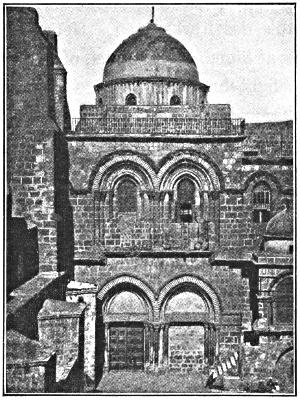
Church of the Holy Sepulcher
(Present Day)
It was to free the pilgrims, who came from Europe, from this persecution that the crusades, or holy wars, were undertaken. These crusades were begun through the efforts of one zealous man, a priest commonly known as “Peter the Hermit.”
II. Peter the Hermit
pilgrimage exposure admittance enthusiasm
resurrection sanction earnestly separated
cardinals council military Constantinople
Peter the Hermit was born in France. He was in turn a soldier, a priest, and a hermit. At length he made a pilgrimage to the Holy Land. On reaching Jerusalem, he saw with such sadness the wrongs suffered by the Christians that he said in his heart, “I will rescue the tomb of our Lord from the heathen.”
During his stay in the Holy City, he went often to the Church of the Resurrection. One day he beheld in a vision the Lord, who directed him to go forth and do his work. He at once returned to Europe. His plan was to raise a great army and with it drive the Moslems from the Holy Land. But he must first obtain the consent and aid of Pope Urban II.
So he traveled to Rome and was permitted to tell the Pope his plan. What a picture they made! The Pope sat in state clothed in rich robes. His cardinals and attendants were around him. Before him stood the pilgrim, his face tanned with exposure and his clothes all travel-stained, telling of the grievous wrongs suffered by the Christians in Jerusalem. No wonder Pope Urban wept. The Pope gave his sanction to Peter to preach throughout Europe, urging the people to go and rescue the blessed tomb.
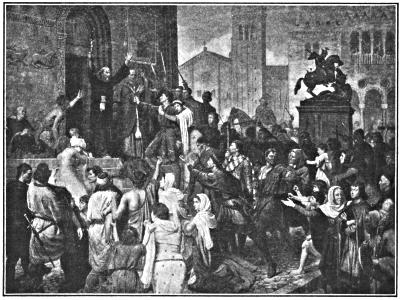
Peter the Hermit preaching the Crusade
Peter, light of heart but strong of purpose, started forth in the year 1094. He was clad in a woolen garment over which he wore a coarse brown mantle. His feet and head he left bare. He was a small man, and if you had seen him, you would not have called him fine looking. Still, he was never refused admittance into the presence of prince or king.
The poor loved him for his gentleness, and the rich loaded him with gifts. These, however, he never kept for himself, but gave to those who were in need.
At Clermont, in November, 1095, the Pope held a council of all the cardinals, bishops, and priests who stood high in the Church. He told them what Peter meant to do, asking them to render him aid. So earnestly did he speak, that when he had finished, they all shouted together, “God wills it! God wills it!”
“Then,” said Pope Urban, “let the army of the Lord when it rushes upon its enemies shout that cry, ‘God wills it.’”
He commanded all who should take up arms in the cause to wear on the shoulder a cross, reminding them that Christ had said, “He that does not take up his cross and follow me is not worthy of me.” This is why the wars were called the Crusades, for the word “crusade” means literally “the taking of the cross.”
A great army was soon assembled and ready to march. All the men were eager and wild with enthusiasm, but most of them had never had any military training. How would they succeed in that long and toilsome journey across sea and land to Palestine?
They soon began to meet with trouble. In their haste, they had not provided nearly enough food for themselves. When that gave out, they began to take whatever they needed from the people along the way. In Hungary they did much harm to towns and farms. This made the inhabitants very angry, and they came out to fight the crusaders. Many of the crusaders were killed and the rest were scattered in flight.
At length Peter was separated from his followers, and wandered for some time alone in the forest. Then, in order to make his whereabouts known to any who might be in the same forest or near, he blew his horn. In answer to his call several companies of his friends soon appeared. So with only a small number of those who at first started out, Peter at length reached Constantinople.
At that time Constantinople was the capital of the Roman Empire in the East and its ruler was the Emperor Alexis. The emperor received the crusaders kindly. Here Peter the Hermit was rejoined by a large force of his followers who had been separated from him during the march.
After leaving Constantinople, the crusaders entered the land of the Turks, through which they must march before reaching the Holy Land. A terrible battle was soon fought with the Moslems, and most of the crusaders perished. Peter now saw that with the few men who were left he could do nothing; he therefore decided to find a place of security among the mountains and wait there until aid should come. There we shall leave him for a time.
III. Knighthood in the Crusades
chivalry tournaments modesty archery
jousts avenge obedience sponsors
When Pope Urban II called the council of Clermont, and so many men of all ranks stitched upon their shoulders the cross of red silk, the Age of Chivalry in Europe had already begun. The word “chivalry” is from a French word which means rider of a horse. So, when we speak of the Age of Chivalry, we picture to ourselves knights riding their horses and engaging in real or mock battles.
The mock battles were called jousts or tournaments, and they were the chief amusement of the time. Noble lords and beautiful ladies were present and watched the contest from raised seats as we now watch ball games. The real battles had many causes. Sometimes one prince would quarrel with a neighboring prince and settle the dispute by war. Sometimes a body of knights would go forth to avenge a wrong.
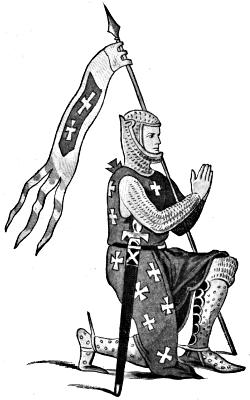
A Knight of the Crusades
Sometimes a king would call upon his knights to go with him to conquer some neighboring country. The knights were therefore always ready for war.
Every boy, if he were the son of a noble, at about the age of seven was sent to the castle or court of some prince or king, as a page.
Here he was taught modesty and obedience, hunting, riding, archery, and the hurling of the lance.
When he had become skillful in these he might bear the shield of his master. He was then a squire. He must know no fear, and must not boast of his own deeds. He must defend the weak and be ever courteous to ladies. At feasts he must carve the meats and wait upon the guests.
When he reached the age of twenty-one, the squire might be made a knight. This was often a very pretty ceremony. The squire would come before his lord and a great party of nobles, dressed in armor, except the helmet, sword, and spurs.
Several nobles would offer themselves as sponsors, declaring that they were sure he would prove himself noble and brave. Then the squire was struck lightly on the shoulders with the sword of his master. At the same time his master repeated these words, “I dub thee knight in the name of God and St. Michael; be faithful, bold, and fortunate.” The knight then went forth to do some deed by which to “win his spurs.”
Sometimes, before being knighted, the young squire was left in the chapel of the castle all night. Here he guarded his armor, and by devout and continuous prayer invoked the blessing of God upon himself and whatever cause he should undertake.
Urged by the preaching of Peter the Hermit and the encouragement of Pope Urban, the knights of Western Europe took up the cause of the crusades. Soon after the departure of Peter with his untrained host of followers, a gallant army, led by two famous knights, Godfrey of Bouillon and Tancred, an Italian knight, began its march to the Holy Land.
Peter at last succeeded in joining them with the few men who were left with him, and together they advanced to Jerusalem.
IV. Godfrey of Bouillon
material scarcity missiles recognized
exhaust devices signals Saracens
Many are the tales that are told of the knightly leaders in this first crusade, and many were their adventures. It was on the 29th of May, 1099, that the Christian army first came into full view of the Holy City. Filled with new zeal at the sight, every man shouted, “It is the will of God.”
The city, however, had been fortified in every possible way, and Godfrey, who was in command, knew it would be a hard task to mount the high walls. He was certain that battering-rams would be necessary to break down the walls, but how were they to obtain the material to make them? The barren country around afforded nothing of which they could make use. To transport the timber from a distance would exhaust both men and horses which were already suffering from scarcity of water and food.
At last news came that a fleet had arrived from Genoa with siege machines and supplies. The crusaders hastened to the nearest seaport, but found that their enemies had been before them and destroyed the fleet. Still they were able to pick up much of the material and many of the instruments used in the making of the machines. Some of the Genoese who were skilled in handicraft put together a few wooden towers and other devices which were of great use in surmounting and breaking down the walls. Bridges were also thrown out, over the walls, by which the soldiers could pass into the city.
On Thursday morning, July 14, 1099, the crusaders made the first attack with their wooden towers. The Saracens, as the Mohammedans were called by the crusaders, met them with missiles of all sorts, which they threw upon them. The crusaders soon made a breach in the wall, but still could not enter the city.
Early the next morning the attack was renewed. A procession of priests was formed and moved about through the throng, encouraging the knights. A pigeon was captured, and under its wing a note was found telling the Saracen commander that help was at hand. This stirred the Christians to still fiercer attack.
Suddenly there appeared to the host a horseman clothed in white. The crusaders at once recognized the vision of St. George. “St. George has come to our assistance,” Godfrey exclaimed. “He signals to enter the Holy City.”
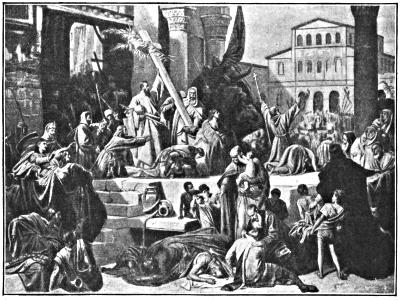
Jerusalem taken by the Crusaders
Again arose the cry, “God wills it! God wills it!” Godfrey commanded the attack to be renewed. The hay which the Saracens had heaped up against the walls to deaden the shock of the battering-rams was set on fire. The Saracens, stifled by the smoke, leaped from the walls. Then the tower bridges were let fall, and soon Godfrey and other knights forced their way into the city.
After the capture of the Holy City, Godfrey was chosen king of Jerusalem, or Defender of the Faith. But he lived only about a year to enjoy that high distinction.
V. Tancred
patrolled cautiously finally renowned
endurance Antioch endeared approached
Tancred was known among his followers for his unselfishness. He seemed never to become weary. If a comrade complained of a duty, he himself would perform it. He patrolled walls at night, fought by day, and by his own endurance of labor and hard fare sought to set an example for his men.
One night, when he was standing guard with only his squire as companion, he was attacked by three armed Saracens on horseback. They came upon him quickly, thinking, of course, that they could easily overcome him. They did not know that the blade of this renowned warrior could cleave their heavy armor as if it were cloth.
On came the first horseman and down came Tancred’s sword. The Saracen fell. The next, who had seen the first one fall, waited for the third. Very cautiously they approached side by side, but they soon fared the same as their companion.
It was Tancred who took possession of Bethlehem. He was made ruler over that part of the Holy Land, but hearing that Antioch was threatened by the Saracens, he went to its relief. For three years he held it against the unbelievers.
Tancred’s cousin, Bohemond, who was the rightful ruler of Antioch, was held as prisoner by the Saracen commander; but finally Tancred succeeded in setting his cousin free. He at once gave up to his cousin the entire rule, although he had so endeared himself to the people that they besought him to remain.
A battle wound was the cause of Tancred’s death. He met his fate bravely, and died with the purpose of saving the Holy Land still uppermost in his heart.
Between the years 1095 and 1270 there were eight crusades, all undertaken for the purpose of delivering the Holy Land from the Saracens. While they failed to accomplish that object, they were still of great benefit to the Church and civilization. They made the people better acquainted with the geography and history of other lands, and led to an increase of trade and industry throughout the known world.